
Maria Konnikova
Author of Mastermind: How to Think Like Sherlock Holmes
About the Author
Image credit: Author Maria Konnikova at SXSW 2023, by Fuzheado
Works by Maria Konnikova
The Grift 1 copy
Bir Sahtekar Gibi Düsünmek 1 copy
Associated Works
Tagged
Common Knowledge
- Birthdate
- 1984
- Gender
- female
- Education
- Harvard University
Columbia University - Occupations
- science writer
journalist - Organizations
- The New Yorker
Panoply Media - Relationships
- Pinker, Steven (mentor)
Mischel, Walter (mentor) - Nationality
- Russia
USA - Birthplace
- Moscow, Soviet Union
- Places of residence
- Massachusetts, USA
Members
Reviews
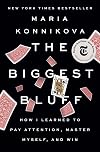
I got all the way to the end before I realized there was a glossary of poker terms there. THANX, KINDLE. Grr.
And I read basically the whole thing without really understanding even the rudimentary rules to Texas Hold 'Em. But that's OK! Because it's not about the hands and how they went. It's about... life.
Konnikova has written a fairly unique "my year of" style book. She decides she wants to master poker in a year. A lot of random things have gone wrong in her life at once, and somehow she show more feels that studying poker will help her learn to understand the role of random chance in life. What makes the book unique is not only that it actually takes her more than a year to do what she sets out to do (and she sticks with it anyway even though that "ruins" the premise); but that she injects very little extraneous detail about herself. Once in a while we get in on a conversation with her husband or mother. She seems to have no kids and live in Brooklyn, but she doesn't dwell on either of those things. She doesn't dwell on herself at ALL, except as a student of poker. It's wonderful! She's a journalist, and that may have something to do with it.
So basically, what we learn is, you gotta know when to hold 'em, and know when to fold 'em, just like the song says. It's so cliche, but I used to say it too; before I became more enamored of my Domino theory of life, I had a Card Game theory of life: there's the hands you're dealt, but then there's how you play them. When my father was ill, every day felt like another really tough card. And I thought about the big areas of my life and how I'd played my cards, and there were some plays I was really proud of, some I'd always doubt... And I thought about how my brother was refusing to play these tough rounds at all. And it was a really helpful metaphor. And when I try to explain why the Kinks song "Better Things" was for so long the only thing that could cheer me up, I could only say it was something about the particular phrasing, "I know tomorrow you'll find better things." So many things are beyond our control - we just FIND them. And I was finding crappy things right now, but the law of averages implied that sooner or later I would surely find BETTER things. Those are the cards you're dealt.
Oh wait, I was writing a book review. For Konnikova, it seems to come down to stoicism. She becomes successful when she can control her emotions and just play, play, play. She throws in some helpful quotations here and there, and the most appropriate seems to be from Kipling:
"If you can meet with Triumph and Disaster,
And treat those two impostors just the same..."
She has to learn that anyone can have either a triumph or a disaster through no fault of her playing (though she can certainly have a disaster through her own fault, too). Anyone can get lucky or unlucky. Successful pros just keep playing - and learning - and adjusting. While there's LOTS and lots of poker, poker slang, and poker play-by-play along the way - the life lesson ultimately comes through. show less
And I read basically the whole thing without really understanding even the rudimentary rules to Texas Hold 'Em. But that's OK! Because it's not about the hands and how they went. It's about... life.
Konnikova has written a fairly unique "my year of" style book. She decides she wants to master poker in a year. A lot of random things have gone wrong in her life at once, and somehow she show more feels that studying poker will help her learn to understand the role of random chance in life. What makes the book unique is not only that it actually takes her more than a year to do what she sets out to do (and she sticks with it anyway even though that "ruins" the premise); but that she injects very little extraneous detail about herself. Once in a while we get in on a conversation with her husband or mother. She seems to have no kids and live in Brooklyn, but she doesn't dwell on either of those things. She doesn't dwell on herself at ALL, except as a student of poker. It's wonderful! She's a journalist, and that may have something to do with it.
So basically, what we learn is, you gotta know when to hold 'em, and know when to fold 'em, just like the song says. It's so cliche, but I used to say it too; before I became more enamored of my Domino theory of life, I had a Card Game theory of life: there's the hands you're dealt, but then there's how you play them. When my father was ill, every day felt like another really tough card. And I thought about the big areas of my life and how I'd played my cards, and there were some plays I was really proud of, some I'd always doubt... And I thought about how my brother was refusing to play these tough rounds at all. And it was a really helpful metaphor. And when I try to explain why the Kinks song "Better Things" was for so long the only thing that could cheer me up, I could only say it was something about the particular phrasing, "I know tomorrow you'll find better things." So many things are beyond our control - we just FIND them. And I was finding crappy things right now, but the law of averages implied that sooner or later I would surely find BETTER things. Those are the cards you're dealt.
Oh wait, I was writing a book review. For Konnikova, it seems to come down to stoicism. She becomes successful when she can control her emotions and just play, play, play. She throws in some helpful quotations here and there, and the most appropriate seems to be from Kipling:
"If you can meet with Triumph and Disaster,
And treat those two impostors just the same..."
She has to learn that anyone can have either a triumph or a disaster through no fault of her playing (though she can certainly have a disaster through her own fault, too). Anyone can get lucky or unlucky. Successful pros just keep playing - and learning - and adjusting. While there's LOTS and lots of poker, poker slang, and poker play-by-play along the way - the life lesson ultimately comes through. show less
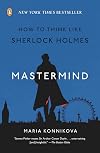
Irony of ironies - - this is a book about being more attentive and observant, like Sherlock Holmes, and I picked it up thinking it was a book written in the style of Sherlock Holmes. I completely missed the point, in other words. But I don't regret it, much, because this was a very engaging book. Did I put 100% of my attention to reading it so that I internalized all of its nuanced messages? Of course not. I mostly read it on the elliptical machine so my mind was wandering - Watson-like - show more the usual amount. But it was surprisingly captivating, and it did have some interesting insights into our unconscious information processing biases and how they influence our perceptions. I am definitely going to try to be more conscious in my thinking after having read this book. Although I doubt I will achieve true Holmesian thinking, perhaps I can be Watson+. show less
A joumalist and academic who’s speciality is decision making decides to learn to play tournament poker. She manages to persuade a major player to become her mentor as well as enlisting other poker experts of one kind and another along the way. Bracingly honest about her failures, missteps and doubts along the way, this is a fascinating account of the unforgiving lessons poker hands out about the balance between skill and luck, and the extent to which both good and bad luck play a role in show more all our lives. The author narrates this audiobook herself and she's not a great narrator, but compelling content all the same. Recommended. show less
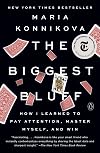
Maria Konnikova's book combines a fascinating story about her rise from less-than-an-amateur to a professional poker player and a series of short essays on psychology, especially the psychology of decision making. I don't mean to say that the essays stand alone; they are woven into her story so that they enlighten the reader while the plot entertains him or her.
Konnikova has a doctorate in research psychology with an emphasis on decision making, bias, and pressure. She takes her academic show more knowledge and tries to apply it to the best of all poker games: Texas No Limit Hold 'Em. In her quest, she finds an ideal mentor in Eric Seidel, one of the giants of the poker field. At Eric's suggestion, she also spends time with other poker gurus and even with a performance psychologist who aims to improve her mental state while playing high-stakes poker.
A meditation on the relationship between luck and skill, a primer on Texas Hold 'Em, and a hero's journey--all wrapped into one entertaining book. show less
Konnikova has a doctorate in research psychology with an emphasis on decision making, bias, and pressure. She takes her academic show more knowledge and tries to apply it to the best of all poker games: Texas No Limit Hold 'Em. In her quest, she finds an ideal mentor in Eric Seidel, one of the giants of the poker field. At Eric's suggestion, she also spends time with other poker gurus and even with a performance psychologist who aims to improve her mental state while playing high-stakes poker.
A meditation on the relationship between luck and skill, a primer on Texas Hold 'Em, and a hero's journey--all wrapped into one entertaining book. show less
Lists
Corruption (1)
True Crime (1)
Awards


You May Also Like


Associated Authors
Statistics
- Works
- 10
- Also by
- 1
- Members
- 2,188
- Popularity
- #11,721
- Rating
- 3.6
- Reviews
- 58
- ISBNs
- 59
- Languages
- 9