
Leonard Merrick (1864–1939)
Author of Mr Bazalgette's Agent
About the Author
Works by Leonard Merrick
The House of Lynch 7 copies
The worldlings 5 copies
When Love Flies Out o' the Window 2 copies
Frankenstein II 1 copy
The Tragedy of a Comic Song 1 copy
Lynch's Daughter 1 copy
Four Stories 1 copy
The Little Dog Laughed 1 copy
The Position of Peggy 1 copy
While Paris Laughed 1 copy
Associated Works
Tagged
Common Knowledge
- Birthdate
- 1864-02-21
- Date of death
- 1939-08-07
- Gender
- male
- Birthplace
- London, England
- Place of death
- London, England
- Associated Place (for map)
- London, England
Members
Reviews
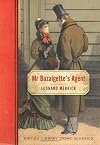
Miriam Lea, the protagonist of this novel, may not be a very good detective but she is a fascinating character.
The narration takes the form of her diary. She is an acerbic and entertaining narrator and is interesting for what she withholds as much as what she says. She vividly describes her reduced circumstances, living in London in a dreary boarding house. She implies that she is used to better and refers drily to losing her post as a governess because she was previously an actress.
It show more seems she has a colourful past, but although she drops hints throughout the narrative, it is never entirely clear what her background is and why she finds herself so alone.
She is forthright in describing the terror of poverty. She is just clinging to respectability but, however much she despises her current life, she knows she has further to fall. She is exasperated by her failure to find employment and weary of the disbelief of those who would say she just isn’t trying (contemporary resonances there).
However, she maintains her spirits in part by looking down on those who are in the same precarious situation as her, rather than finding any sense of solidarity.
In desperation she turns to a private investigator for work, after spending the last of her money on a good pair of gloves, knowing that ‘the less you look in want of the thing you solicit the more likely you are to get it’.
It seems her problems are solved when she is offered an assignment which requires her to travel Europe, staying in top hotels in the guise of a wealthy widow, while pursuing a fugitive. But this opportunity throws up other challenges.
The plot doesn’t stand up to scrutiny and for this reason I think many fans of contemporary crime fiction would find this novel lacking. But it is an interesting piece of social history and the more enduring mystery is Miriam Lea herself. show less
The narration takes the form of her diary. She is an acerbic and entertaining narrator and is interesting for what she withholds as much as what she says. She vividly describes her reduced circumstances, living in London in a dreary boarding house. She implies that she is used to better and refers drily to losing her post as a governess because she was previously an actress.
It show more seems she has a colourful past, but although she drops hints throughout the narrative, it is never entirely clear what her background is and why she finds herself so alone.
She is forthright in describing the terror of poverty. She is just clinging to respectability but, however much she despises her current life, she knows she has further to fall. She is exasperated by her failure to find employment and weary of the disbelief of those who would say she just isn’t trying (contemporary resonances there).
However, she maintains her spirits in part by looking down on those who are in the same precarious situation as her, rather than finding any sense of solidarity.
In desperation she turns to a private investigator for work, after spending the last of her money on a good pair of gloves, knowing that ‘the less you look in want of the thing you solicit the more likely you are to get it’.
It seems her problems are solved when she is offered an assignment which requires her to travel Europe, staying in top hotels in the guise of a wealthy widow, while pursuing a fugitive. But this opportunity throws up other challenges.
The plot doesn’t stand up to scrutiny and for this reason I think many fans of contemporary crime fiction would find this novel lacking. But it is an interesting piece of social history and the more enduring mystery is Miriam Lea herself. show less
'Conrad' is an amusing, sometimes highly eccentric, Edwardian comedy about the perils and gifts of nostalgia. Structured in three acts, it follows a man's nostalgic revisitation of his childhood and youthful loves, to then turn its focus to a reformed music-hall's singer equal nostalgia for her adventurous and colourful past and the encounter between them. If the overall structure is perhaps too obvious and a little clumsy, the book nonetheless offers numerous delights in its account of the show more minutiae of disappointment: the portrait of the seaside towns, for example, is delightful, as is the motif of the lovers' farewell. The book also has some highly eccentric and hilarious digressions, such an ode to a post-office girl in Bloomsbury and a direct address to his female public. show less
Interesting as one of the first novel-length stories about a female detective. The heroine (who tells the story to her diary) is a poor unemployed gentlewoman (poverty vividly described0 in London who takes a detective job out of pure desperation. She is assigned to find a fleeing embezzler. She tracks what se believes to be the main across Europe and eventually to South Africa ad the diamond fields at Kimberley, where she falls in love with him and suffers a conflict of love and duty which show more is resolved in a neat, but to me unsatisfying, manner. She does not display great detective abilities other than persistence. The story is competently written but more a travelogue than a mystery. Merrick wrote many more books, but no more mysteries. show less
Lists
You May Also Like


Associated Authors
Statistics
- Works
- 28
- Also by
- 10
- Members
- 188
- Popularity
- #115,782
- Rating
- 3.5
- Reviews
- 5
- ISBNs
- 59
- Languages
- 2