
James Yang
Author of A Boy Named Isamu: A Story of Isamu Noguchi
Series
Works by James Yang
Associated Works
Tagged
Common Knowledge
- Birthdate
- 1960-12-23
- Gender
- male
Members
Reviews

If you were a boy named Isamu…what would you learn about your world?
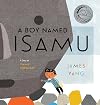
Beginning with the whimsical jacket design that’s echoed in the shapes, colors, and prose that follow, readers are encouraged to experience finding their own voices in quiet spaces. Isamu, a young boy with beige skin and black hair, feels overwhelmed in the crowded and noisy market—a patchwork of stalls, merchandise, and people. Instead he seeks out colorful paper lanterns, a still wood where leaves crunch, a field of show more grass, a rocky beach, and more. Using the second person, the narrator invites readers to imagine themselves as Isamu, asking his questions and immersing himself in the natural world using his senses. Whimsy is woven throughout, appearing even in a large gray stone with a face that is echoed on the dust jacket. Colorful lines of all forms dominate the design of the spreads—straight bamboo stalks, rounded stones that look like birds, a wavy outline in rock that frames the sea—all carefully rendered in bold colors balanced by plenty of white space. Yang depicts Isamu in proportion with his wonder at the world, by turns prominent and peripheral. The author’s note explains how Isamu Noguchi’s biracial background (his father was Japanese and his mother was a White American) led to ostracization in both Japan and the United States, prompting him to seek out safe, natural spaces that eventually inspired his artwork, based in stone and wood.
A marvel of prose, illustration, and design that invites repeated meditation. (Picture book. 4-8)
-Kirkus Review show less
Beginning with the whimsical jacket design that’s echoed in the shapes, colors, and prose that follow, readers are encouraged to experience finding their own voices in quiet spaces. Isamu, a young boy with beige skin and black hair, feels overwhelmed in the crowded and noisy market—a patchwork of stalls, merchandise, and people. Instead he seeks out colorful paper lanterns, a still wood where leaves crunch, a field of show more grass, a rocky beach, and more. Using the second person, the narrator invites readers to imagine themselves as Isamu, asking his questions and immersing himself in the natural world using his senses. Whimsy is woven throughout, appearing even in a large gray stone with a face that is echoed on the dust jacket. Colorful lines of all forms dominate the design of the spreads—straight bamboo stalks, rounded stones that look like birds, a wavy outline in rock that frames the sea—all carefully rendered in bold colors balanced by plenty of white space. Yang depicts Isamu in proportion with his wonder at the world, by turns prominent and peripheral. The author’s note explains how Isamu Noguchi’s biracial background (his father was Japanese and his mother was a White American) led to ostracization in both Japan and the United States, prompting him to seek out safe, natural spaces that eventually inspired his artwork, based in stone and wood.
A marvel of prose, illustration, and design that invites repeated meditation. (Picture book. 4-8)
-Kirkus Review show less
f you were a boy named Isamu…what would you learn about your world?
Beginning with the whimsical jacket design that’s echoed in the shapes, colors, and prose that follow, readers are encouraged to experience finding their own voices in quiet spaces. Isamu, a young boy with beige skin and black hair, feels overwhelmed in the crowded and noisy market—a patchwork of stalls, merchandise, and people. Instead he seeks out colorful paper lanterns, a still wood where leaves crunch, a field of show more grass, a rocky beach, and more. Using the second person, the narrator invites readers to imagine themselves as Isamu, asking his questions and immersing himself in the natural world using his senses. Whimsy is woven throughout, appearing even in a large gray stone with a face that is echoed on the dust jacket. Colorful lines of all forms dominate the design of the spreads—straight bamboo stalks, rounded stones that look like birds, a wavy outline in rock that frames the sea—all carefully rendered in bold colors balanced by plenty of white space. Yang depicts Isamu in proportion with his wonder at the world, by turns prominent and peripheral. The author’s note explains how Isamu Noguchi’s biracial background (his father was Japanese and his mother was a White American) led to ostracization in both Japan and the United States, prompting him to seek out safe, natural spaces that eventually inspired his artwork, based in stone and wood. (This book was reviewed digitally.)
A marvel of prose, illustration, and design that invites repeated meditation. (Picture book. 4-8)
-Kirkus Review show less
Beginning with the whimsical jacket design that’s echoed in the shapes, colors, and prose that follow, readers are encouraged to experience finding their own voices in quiet spaces. Isamu, a young boy with beige skin and black hair, feels overwhelmed in the crowded and noisy market—a patchwork of stalls, merchandise, and people. Instead he seeks out colorful paper lanterns, a still wood where leaves crunch, a field of show more grass, a rocky beach, and more. Using the second person, the narrator invites readers to imagine themselves as Isamu, asking his questions and immersing himself in the natural world using his senses. Whimsy is woven throughout, appearing even in a large gray stone with a face that is echoed on the dust jacket. Colorful lines of all forms dominate the design of the spreads—straight bamboo stalks, rounded stones that look like birds, a wavy outline in rock that frames the sea—all carefully rendered in bold colors balanced by plenty of white space. Yang depicts Isamu in proportion with his wonder at the world, by turns prominent and peripheral. The author’s note explains how Isamu Noguchi’s biracial background (his father was Japanese and his mother was a White American) led to ostracization in both Japan and the United States, prompting him to seek out safe, natural spaces that eventually inspired his artwork, based in stone and wood. (This book was reviewed digitally.)
A marvel of prose, illustration, and design that invites repeated meditation. (Picture book. 4-8)
-Kirkus Review show less
This book is an ode to Isamu, not a biography. If one reads this story, as a story, it is quite nice. It is about a child’s view of wonder. If one is reading it as a biography about the artist Isamu, one will be highly disappointed. As there is very little, almost nothing about the artist. This is all about how the artist viewed life. It’s an interesting read, but not one that readers would gravitate to over and over again.

When a young boy misses his bus, he finds himself standing at the bus stop for quite some time. A number of different kinds of buses pass by, but each of them seem to be the wrong kind of conveyance, either because of the kind of passengers they carry, or because they don't look like buses at all. Finally, in desperation, the boy boards a floating bus with lots of interesting, exotic-looking creatures aboard, and has the ride of his life...
Bus! Stop! is the first picture-book I have read show more from author/artist James Yang, who also produced the two Joey and Jet stories, and I found that it was the illustrations that I really enjoyed. I liked the story idea, of course - there's a sense of urban magical realism here - but the text itself is quite simple, leaving the visuals to really expand the tale, and carry it forward. There's a fun, block-print style to this art, that works very well in the boy's city surroundings. Recommended to young bus riders, and to any child who's ever looked around them, and longed for something really unusual to come down the road toward them. show less
Bus! Stop! is the first picture-book I have read show more from author/artist James Yang, who also produced the two Joey and Jet stories, and I found that it was the illustrations that I really enjoyed. I liked the story idea, of course - there's a sense of urban magical realism here - but the text itself is quite simple, leaving the visuals to really expand the tale, and carry it forward. There's a fun, block-print style to this art, that works very well in the boy's city surroundings. Recommended to young bus riders, and to any child who's ever looked around them, and longed for something really unusual to come down the road toward them. show less
Lists
Awards


You May Also Like


Associated Authors
Statistics
- Works
- 11
- Also by
- 2
- Members
- 394
- Popularity
- #61,533
- Rating
- 3.6
- Reviews
- 38
- ISBNs
- 32