
Doris Janzen Longacre (1940–1979)
Author of More-with-Less Cookbook
About the Author
Works by Doris Janzen Longacre
Tagged
Common Knowledge
- Other names
- Janzen, Doris Helene
- Birthdate
- 1940-02-15
- Date of death
- 1979-11-10
- Gender
- female
- Education
- Goshen College, Indiana (BA | Home Economics)
Goshen Biblical Seminary
Kansas State University - Organizations
- Mennonite Central Committee
- Cause of death
- breast cancer (metastasized)
- Nationality
- USA
- Birthplace
- Newton, Kansas, USA
- Places of residence
- Vietnam
Indonesia
Akron, Pennsylvania, USA - Place of death
- Hershey, Pennsylvania, USA
- Burial location
- Wolfs Cemetery, Ephrata, Pennsylvania, USA
- Associated Place (for map)
- Pennsylvania, USA
Members
Reviews

This wonderful, one-of-a-kind cookbook, originally commissioned by the Mennonite Central Committee in the 1970s, focuses on preparing simple but tasty food, with a minimum of waste and expense. It advocates eating more whole grains and fresh produce, consuming meat and dairy in moderation, and avoiding over-processed convenience foods. The idea is not simply to provide a healthier lifestyle for the individual, but to foster an ethic of food that promotes planetary health and human welfare. show more
But despite its very earnest intention to "do good" in the world, "More-With-Less" never comes across as heavy-handed. Instead, it is infused with a sense of warmth and humanity, with personal stories about cooking, spirituality, and world food issues interspersed among the recipes. If this book has one over-riding "message," it is that world hunger is not unrelated to our own personal food choices. But have no fear, it is not a proselytising book, despite the fact that many of the personal stories come from missionaries and their families.
This book was recommended to me many times by a very dear friend from my college days, who used to swear that no matter how few ingredients she had in the house, "More-With-Less" always gave her a recipe that could transform them into a tasty meal. Whether you want to address ethical issues through your food choices, live more frugally, or just adopt a healthier lifestyle, this is the book for you. show less
But despite its very earnest intention to "do good" in the world, "More-With-Less" never comes across as heavy-handed. Instead, it is infused with a sense of warmth and humanity, with personal stories about cooking, spirituality, and world food issues interspersed among the recipes. If this book has one over-riding "message," it is that world hunger is not unrelated to our own personal food choices. But have no fear, it is not a proselytising book, despite the fact that many of the personal stories come from missionaries and their families.
This book was recommended to me many times by a very dear friend from my college days, who used to swear that no matter how few ingredients she had in the house, "More-With-Less" always gave her a recipe that could transform them into a tasty meal. Whether you want to address ethical issues through your food choices, live more frugally, or just adopt a healthier lifestyle, this is the book for you. show less
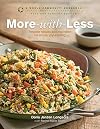
A Mennonite introduced me to More-With-Less: A World Community Cookbook 20 years ago or more. First published in 1976, this cookbook authored by a socially conscious Mennonite, is being reissued this year. It’s hard to fathom that ideas that are now a cornerstone of healthy eating — avoid processed food, eat less meat in order to create a healthier planet and more sustainable agriculture in lesser-developed countries, sample ethnic cuisines, you can eat better and more cheaply, we can show more change the world with our food purchases — were once revolutionary ideas. And it was More-With-Less’s late author, Doris Janzen Longacre, who helped make them mainstream.
The cookbook has been updated in its 40th anniversary edition, and, having lost that long-ago copy, and I’m very happy to have it back. It’s a welcome addition for any cook who realizes that, when we get more with less, others can have more. Delicious food and a chance to make a difference for the planet and its people. Who could ask for anything more?
In the interest of full disclosure, I received this book from NetGalley and Herald Press in exchange for an honest review. show less
The cookbook has been updated in its 40th anniversary edition, and, having lost that long-ago copy, and I’m very happy to have it back. It’s a welcome addition for any cook who realizes that, when we get more with less, others can have more. Delicious food and a chance to make a difference for the planet and its people. Who could ask for anything more?
In the interest of full disclosure, I received this book from NetGalley and Herald Press in exchange for an honest review. show less
It took me a long time to read this book. There is a lot to chew on in its pages, and a lot to challenge me towards action within my home and my person, within my community, and within the world at large. I plan to write a more reflective review hopefully in the next day or so, but for now, I just want to note a few things that were particularly interesting to me about this book.
1) This is not just a book for Mennonites. Although it's clear from some of the cultural references and jargon show more (for lack of a better term) that this is written from a Mennonite perspective primarily for a Mennonite audience, it has so much of value to offer people from all backgrounds. I'm Unitarian Universalist with an affinity for buddhist teachings and practice, and I found myself thinking many times, "Wow...I had no idea how similar Mennonites and UUs are!"
2) This is not a guilt-inspiring book. When I read books like this, about all of the things that we need to change in order to promote environmental wellbeing, political and social equality, and economic justice, I tend to feel hope ("Wow! Look at all of the things that people are doing! I could do that, too!") followed closely by despair ("Holy cow, this job is way, way too big for me. Even if I totally rearrange my life, my efforts will be only a drop in the bucket."). I admit, I did at first follow this familiar pattern while reading this book, but the focus and structure of the book helped cushion the fall. Looking at each challenge through the lens of Longacre's Five Life Standards made simplifying seem like a change that adds something of value, not a change centered on sacrifice. Brian McLaren's afterword was the icing on the cake for me. McLaren spells out a way of reading the book and taking on the challenges outlined therein---with an outlook of joy and grace rather than guilt. It helped me, too, that he specifically opens up the idea to those who are not Mennonite---or even Christian. While I felt the invitation in the pages, it was nice to see it spelled out so explicitly. My favorite bit:
3) This is not only practical advice for simple living. At each step, the topic and suggestions come back to the Five Life Standards. As a result, each suggestion for change has a clear connection to the values and ideals that were outlined at the beginning of the book. It's not just simplifying for the sake of simplifying. It's action with a purpose, and that feels much more satisfying to me.
At any rate, I'm going to mull this one over a bit, maybe read the beginning again, and see what comes up. I really, really enjoyed it, even though I had to take it in small doses so as not to overwhelm myself. There is just so much to take in. It's such a deceptively radical act to consider, living according to our values. show less
1) This is not just a book for Mennonites. Although it's clear from some of the cultural references and jargon show more (for lack of a better term) that this is written from a Mennonite perspective primarily for a Mennonite audience, it has so much of value to offer people from all backgrounds. I'm Unitarian Universalist with an affinity for buddhist teachings and practice, and I found myself thinking many times, "Wow...I had no idea how similar Mennonites and UUs are!"
2) This is not a guilt-inspiring book. When I read books like this, about all of the things that we need to change in order to promote environmental wellbeing, political and social equality, and economic justice, I tend to feel hope ("Wow! Look at all of the things that people are doing! I could do that, too!") followed closely by despair ("Holy cow, this job is way, way too big for me. Even if I totally rearrange my life, my efforts will be only a drop in the bucket."). I admit, I did at first follow this familiar pattern while reading this book, but the focus and structure of the book helped cushion the fall. Looking at each challenge through the lens of Longacre's Five Life Standards made simplifying seem like a change that adds something of value, not a change centered on sacrifice. Brian McLaren's afterword was the icing on the cake for me. McLaren spells out a way of reading the book and taking on the challenges outlined therein---with an outlook of joy and grace rather than guilt. It helped me, too, that he specifically opens up the idea to those who are not Mennonite---or even Christian. While I felt the invitation in the pages, it was nice to see it spelled out so explicitly. My favorite bit:
"Grace is our best motivation for a more-with-less lifestyle. Having received grace ourselves, we want our neighbors in poverty to receive it, too. Even our enemies need grace, we realize. So do the rivers and streams, the soil and wind...the same goes for the birds of the air, the fish of the sea, the flowers and creatures of the field. We want all to be given all the grace they need to thrive and prosper. It is our joy to live with less so that others may have enough."
3) This is not only practical advice for simple living. At each step, the topic and suggestions come back to the Five Life Standards. As a result, each suggestion for change has a clear connection to the values and ideals that were outlined at the beginning of the book. It's not just simplifying for the sake of simplifying. It's action with a purpose, and that feels much more satisfying to me.
At any rate, I'm going to mull this one over a bit, maybe read the beginning again, and see what comes up. I really, really enjoyed it, even though I had to take it in small doses so as not to overwhelm myself. There is just so much to take in. It's such a deceptively radical act to consider, living according to our values. show less
I know that a kick is a kick, but as far as kicks go...I really hope this one lasts. I just got my "More-with-Less" A World Community Cookbook in the mail that I ordered from amazon.com. written by Doris Janzen Longacre.
I am amazed at the information in this book, so I'll tell you about it, because that is what I do!
It begins by explaining what less with more actually is, that it is not about not enjoying what we eat, it is not about starving or being less creative with our meals. It IS show more about "simplifying [our] meals in order to reduce food expenditures...while in no way depraved of tasty, nutritious food" (p.12). The author goes through a list of reasons this should be done, including topics such as: World Shortages, North America: Five times as Much, Overspending Money, Overeating Calories, Overeating Protein, Overeating Sugar (my HUGE downfall), Overeating Processed Foods, and Over complicating our Lives.
I was amazed at how much information was in these sections which I had not fully thought about, but that I completely see the point of. I love America, I love the beauty of it all and the incredible people and diversity in our country...I do not love our need to enjoy the richness of it all and expect "someone else" to do something about the world's poverty. It is easy to continue on just buying things at the expense of others when you do not know what you are doing, and who it affects, but when you do know...well, that then is another story. I used to think that what I did with my money, my time and my donations really did not have a big affect on anyone but my family and I. Now I have just figured out that what I do does impact, it does change others, and that I can choose to have a positive impact on others, and not live in luxury at their expense.
Today as I was reading the reasons to change what we eat, and how to do "more-with-less" and in reading I realized something that bothered me. In the Overeating Sugar section, where the author writes about how, " much of the land used for sugar beets and cane could produce crops far more beneficial to a hungry world. Sugar provides calories, not a smidgen of protein, vitamins, or minerals"(p.17). This immediately made me picture the times of kings and queens where the royal family would be sitting in a huge elegant dining hall and the people they were serving were rioting outside their castle walls because they were not receiving the foods that they needed in order to survive. I have also heard of feasts that the wealthy had where they would cause themselves to puke up what they had eaten in order to continue on eating the delicacies of the festival. Ahhhhh! This picture happened many times throughout history because the people with less are the easiest to ignore, and it is happening now as well. We as Americans are the wealthy, even if we only have enough food to eat and a place to sleep...we are the wealthy! This is a blessing that I feel was given to us for a reason, and that reason is not to see how much we ourselves can indulge, but what impact we can have on the people around us who do not have. I realized that I need to look out of my castle walls, and reach out to the people that are hungry, week and just need something, anything. Yes, you can see...conviction has captured me, and I am oh, so thankful. Guilt is rotten but conviction....that is one of the huge blessings of having a functioning conscience.
I realize that helping those who lack is not a "calling" or a gift, or a different way of "spiritualizing" it away so that we can continue to do nothing about it....it is what we are told we need to do. It seems Jesus made it all SUPER clear in Matthew 25: 31-46...when he talks of those who actually knew Him...read it, I guess I see it pretty much as life and death, it is what we will do if we really do follow what he is asking of us...I guess unless we long to hear the: "depart from me! for you do not know me". This is not religious, it is not pious...it is obedience, and that is what God is continually working with me on OBEDIENCE.
Anyway, I know it is hard to read something like this...well, really know that it is hard to write something you are feeling convicted about because you fear the readers to assume that you are saying you have it together, or that you are trying to get them to do it, or the grand 'ol one "preachy". At this point though, I am beyond worried about what people will think, I figure if you really know me, you'll know what I am like. So, just know, this is my conviction...not yours, unless you feel it should be and then, well it is yours too. right?
So yeah....that is probably the most conviction anyone has gotten from a cookbook....but there you have it... I'm fully convicted. show less
I am amazed at the information in this book, so I'll tell you about it, because that is what I do!
It begins by explaining what less with more actually is, that it is not about not enjoying what we eat, it is not about starving or being less creative with our meals. It IS show more about "simplifying [our] meals in order to reduce food expenditures...while in no way depraved of tasty, nutritious food" (p.12). The author goes through a list of reasons this should be done, including topics such as: World Shortages, North America: Five times as Much, Overspending Money, Overeating Calories, Overeating Protein, Overeating Sugar (my HUGE downfall), Overeating Processed Foods, and Over complicating our Lives.
I was amazed at how much information was in these sections which I had not fully thought about, but that I completely see the point of. I love America, I love the beauty of it all and the incredible people and diversity in our country...I do not love our need to enjoy the richness of it all and expect "someone else" to do something about the world's poverty. It is easy to continue on just buying things at the expense of others when you do not know what you are doing, and who it affects, but when you do know...well, that then is another story. I used to think that what I did with my money, my time and my donations really did not have a big affect on anyone but my family and I. Now I have just figured out that what I do does impact, it does change others, and that I can choose to have a positive impact on others, and not live in luxury at their expense.
Today as I was reading the reasons to change what we eat, and how to do "more-with-less" and in reading I realized something that bothered me. In the Overeating Sugar section, where the author writes about how, " much of the land used for sugar beets and cane could produce crops far more beneficial to a hungry world. Sugar provides calories, not a smidgen of protein, vitamins, or minerals"(p.17). This immediately made me picture the times of kings and queens where the royal family would be sitting in a huge elegant dining hall and the people they were serving were rioting outside their castle walls because they were not receiving the foods that they needed in order to survive. I have also heard of feasts that the wealthy had where they would cause themselves to puke up what they had eaten in order to continue on eating the delicacies of the festival. Ahhhhh! This picture happened many times throughout history because the people with less are the easiest to ignore, and it is happening now as well. We as Americans are the wealthy, even if we only have enough food to eat and a place to sleep...we are the wealthy! This is a blessing that I feel was given to us for a reason, and that reason is not to see how much we ourselves can indulge, but what impact we can have on the people around us who do not have. I realized that I need to look out of my castle walls, and reach out to the people that are hungry, week and just need something, anything. Yes, you can see...conviction has captured me, and I am oh, so thankful. Guilt is rotten but conviction....that is one of the huge blessings of having a functioning conscience.
I realize that helping those who lack is not a "calling" or a gift, or a different way of "spiritualizing" it away so that we can continue to do nothing about it....it is what we are told we need to do. It seems Jesus made it all SUPER clear in Matthew 25: 31-46...when he talks of those who actually knew Him...read it, I guess I see it pretty much as life and death, it is what we will do if we really do follow what he is asking of us...I guess unless we long to hear the: "depart from me! for you do not know me". This is not religious, it is not pious...it is obedience, and that is what God is continually working with me on OBEDIENCE.
Anyway, I know it is hard to read something like this...well, really know that it is hard to write something you are feeling convicted about because you fear the readers to assume that you are saying you have it together, or that you are trying to get them to do it, or the grand 'ol one "preachy". At this point though, I am beyond worried about what people will think, I figure if you really know me, you'll know what I am like. So, just know, this is my conviction...not yours, unless you feel it should be and then, well it is yours too. right?
So yeah....that is probably the most conviction anyone has gotten from a cookbook....but there you have it... I'm fully convicted. show less
Lists
You May Also Like


Associated Authors
Statistics
- Works
- 4
- Members
- 1,511
- Popularity
- #17,020
- Rating
- 4.2
- Reviews
- 23
- ISBNs
- 17
- Languages
- 1
