
Pierre Teilhard de Chardin (1881–1955)
Author of The Phenomenon of Man
About the Author
Born in Sarcenat, France, Teilhard de Chardin was the son of a landowner and was educated at a Jesuit school. In 1911 he was ordained a Jesuit priest, but also became interested in geology and paleontology. In 1918 Teilhard de Chardin became professor of geology at the Institut Catholique in Paris. show more Between 1923 and 1946, he went on paleontological and anthropological expeditions to China and Central Asia, where he helped discover Peking Man in 1929. His work in Cenozoic geology and paleontology earned him widespread recognition, including the French Legion of Honour (1946). Early Man in China, one of his writings from his period as a scientist, is still available. Teilhard de Chardin's lively mind moved beyond science to speculative cosmology. He ranks as an interpreter of naturalistic evolution within a broadened framework of spirituality. During his lifetime his writings were disapproved by the authorities in his order and the church; however, their posthumous publication in the wake of Vatican II catapulted Teilhard into the very center of attention, by intellectuals and philosophers throughout the world. Although his views seem insupportable to many more cautious minds, they have been taken seriously and have stimulated considerable discussion. Teilhard's system on philosophy has been ably epitomized by J. E. Bruns in his review of Phenomenon of Man: ""The story of life is not more than a movement of consciousness veiled by morphology.' These words of the author, referring to consciousness as related to organic structure, express the essential theme of his book. . . . Evolution has not run its course. Geogenesis led to biogenesis, "which turned out in the end to be nothing else than psychogenesis. . . . Psychogenesis has led to man. Now it efficaces itself, relieved or absorbed by another and a higher function---the engendering and subsequent development of all the stages of the mind, in one word noogenesis noogenesis.' Noogenesis implies the production of a "superabundance of mind' and looks forward to the ultimate earth, a "universe of conscious substance.' Teilhard envisions mankind, through an ever increasing psychosocial unity, concentrating on the transcendent center of this psychic convergence---God---until it reaches the "Omega point,' the "fulfillment of the spirit of the earth,' a detachment of the mind from its material matrix and an abandonment of its organoplanetary foothold" (Catholic World). (Bowker Author Biography) show less
Works by Pierre Teilhard de Chardin
Letters from My Friend, Teilhard de Chardin, 1948-1955: Including Letters Written During His Final Years in America (1980) 25 copies, 1 review
Inno dell'universo-La messa sul mondo-Il Cristo nella materia-La potenza spirituale della materia-Pensieri scelti (1992) 10 copies
La activación de la energía 3 copies
Cartas de Hastings y de Paris 3 copies
Vroege Geschriften III 3 copies
La aparición del hombre 3 copies
Le Phénomène humain 3 copies
Lobgesang des Alls die Messe über die Welt. Christus in derMaterie. Die geistige Potenz der Materie (1987) 2 copies
Vroege geschriften, deel 1 2 copies
Teilhard de Chardin 2 copies
Reisbrieven 1923-1955 2 copies
Sobre a Felicidade, Sobre o Amor 2 copies
Het voorspel 1914 /1916 2 copies
Mundo, Homem e Deus 2 copies
La energía humana 2 copies
L'Activation de l'Energie 2 copies
Sobre el Sufrimiento 1 copy
TRA IL MITO E L'ERESIA 1 copy
Nuevas cartas de viaje 1 copy
L EVOLUTION REDEMPTRICE 1 copy
La Vision du Passe 1 copy
Letters to Two Friends 1 copy
Ciencia y Cristo 1 copy
Ser más directivas sacadas de los escritos del Padre, de su correspondencia y de sus notas (1974) 1 copy
Le Phénomene Humain 1 copy
Yo me explico 1 copy
L'Énergie humaine 1 copy
Christianity and Religion 1 copy
L'Energie humaine 1 copy
Cartas de Egipto (1905-1908) 1 copy
Brieven uit Egypte 1 copy
L'oeuvre Scientifique maps 1 copy
Réflexions sur le progrès 1 copy
O fenómeno humano 1 copy
La Messe sur le monde 1 copy
Title Not Given 1 copy
Pierre Teilhard de Chardin 1 copy
Mon univers 1 copy
Dialectiek van de geest 1 copy
Lettres Intimes de Teilhard de Chardin à Auguste Valensin, Bruno De Solages, Henri De Lubac 1919-1955 (1993) 1 copy
Vroege geschriften, deel 2 1 copy
Il sacerdote 1 copy
Het voorspel 1917 /1919 1 copy
Sauvons l'humanit 1 copy
Associated Works
Ants, Indians, and Little Dinosaurs: A Celebration of Man & Nature for the 75th Anniversary of Natural History Magazine (1975) — Contributor — 201 copies, 1 review
The Sheed and Ward Anthology of Catholic Philosophy (A Sheed & Ward Classic) (2005) — Contributor — 34 copies
Tagged
Common Knowledge
- Canonical name
- Teilhard de Chardin, Pierre
- Legal name
- Teilhard de Chardin, Pierre
- Birthdate
- 1881-05-01
- Date of death
- 1955-04-10
- Gender
- male
- Education
- Mongré Jesuit College (bac.|1899)
Sorbonne (Geology, Botany and Zoology)
Catholic Institute of Paris (Ph.D|1922)
University of Caen (lic.|1902) - Occupations
- priest (Jesuit ∙ or Society of Jesus)
philosopher
paleontologist
geologist
stretcher-bearer, French Army - Organizations
- Society of Jesus (1899)
8th Moroccan Rifles, French Army (WWI)
Catholic Institute of Paris
Catholic Church (ordained 1911) - Awards and honors
- Médaille militaire (France)
Légion d'Honneur
French Academy of Sciences (1950) - Relationships
- Teilard-Chambon, Marguerite (cousin)
- Cause of death
- heart attack
- Nationality
- France
- Birthplace
- Orcines, Puy-de-Dôme, France
- Places of residence
- Cairo, Egypt
Paris, Île-de-France, France
Tientsin, China
Beijing, China
Manchuria, China
Shanxi, China (show all 9)
Shensi, China
Urumqi, Sinkiang, China
USA - Place of death
- New York, New York, USA
Members
Reviews
Summary: A synthesis of evolutionary thought and teleology culminating in a collective consciousness or Omega Point.
I recently reviewed (https://bobonbooks.com/2025/07/21/review-the-divine-milieu/) de Chardin’s The Divine Milieu in which de Chardin traces our growth in godlikeness toward the end of Christ uniting all things in himself. In that book, de Chardin attempts to integrate an understanding of evolution with Christian ideas. De Chardin wrote The Phenomenon of Man a decade later. In show more it, he elaborates his ideas about the evolutionary process and its telos in a uniting of all conscious, the noosphere in what de Chardin calls “the Omega Point.” He was not permitted to publish either book during his life, both being published posthumously in 1957.
The work is divided into four books. The first describes the origins of the material universe. One of the most important ideas running throughout this work is the inner and outer energies, mind and matter, that constitute all matter. The outer included crystallising and polymerising material.
The second book traces the transition of this material to living organisms from single cells to the expansion of life. He argues that this is not a random process but reflects the working of the inner “mind” through outer matter. Furthermore, life develops increasing complexity in “the tree of life” until the rise of consciousness in hominid.
Then book three traces the development of thought within the human race. Not only are humans self aware, but they also convey their knowledge to others. For de Chardin, this network of shared though results in a thinking layer, or noosphere, that encircles the earth. Consequently, humanity is heading toward a decisive turning point or choice, either toward stillborn destruction or to emergence as a kind of “supersoul.” Our collective consciousness culminates in a new level of existence.
Finally, in book four, de Chardin describes this new level of existence as “the Omega Point.” All the consciousnesses will become singular. Science, technology and religion will come together. Our instincts to survive and to love will come together.
A few observations. One is that de Chardin is hard to read. He creates words like involution and noosphere. A second is that most evolutionary scientists would reject any idea of a telos for evolution. Finally, for me, the most telling is that while de Chardin skates on the edge of orthodoxy in The Divine Milieu, he goes over the edge in this book from theism to panentheism, what he describes as “God all in everyone.” Gone from this book is the idea of God uniting all things in Christ. Rather, all things are united in the noosphere and evolves into a super consciousness.
I have seen an increase in interest in de Chardin in recent years. I can’t help but wonder if the advent of AI and ideas like Ray Kurzweil’s singularity are bringing de Chardin to renewed attention. Personally, I consider all of this as just one more version of humanity’s penchant for “tower of Babel” projects. I wish de Chardin had stopped at The Divine Milieu. This book is neither good science nor good theology but rather an exercise in speculative and wishful thinking. show less
I recently reviewed (https://bobonbooks.com/2025/07/21/review-the-divine-milieu/) de Chardin’s The Divine Milieu in which de Chardin traces our growth in godlikeness toward the end of Christ uniting all things in himself. In that book, de Chardin attempts to integrate an understanding of evolution with Christian ideas. De Chardin wrote The Phenomenon of Man a decade later. In show more it, he elaborates his ideas about the evolutionary process and its telos in a uniting of all conscious, the noosphere in what de Chardin calls “the Omega Point.” He was not permitted to publish either book during his life, both being published posthumously in 1957.
The work is divided into four books. The first describes the origins of the material universe. One of the most important ideas running throughout this work is the inner and outer energies, mind and matter, that constitute all matter. The outer included crystallising and polymerising material.
The second book traces the transition of this material to living organisms from single cells to the expansion of life. He argues that this is not a random process but reflects the working of the inner “mind” through outer matter. Furthermore, life develops increasing complexity in “the tree of life” until the rise of consciousness in hominid.
Then book three traces the development of thought within the human race. Not only are humans self aware, but they also convey their knowledge to others. For de Chardin, this network of shared though results in a thinking layer, or noosphere, that encircles the earth. Consequently, humanity is heading toward a decisive turning point or choice, either toward stillborn destruction or to emergence as a kind of “supersoul.” Our collective consciousness culminates in a new level of existence.
Finally, in book four, de Chardin describes this new level of existence as “the Omega Point.” All the consciousnesses will become singular. Science, technology and religion will come together. Our instincts to survive and to love will come together.
A few observations. One is that de Chardin is hard to read. He creates words like involution and noosphere. A second is that most evolutionary scientists would reject any idea of a telos for evolution. Finally, for me, the most telling is that while de Chardin skates on the edge of orthodoxy in The Divine Milieu, he goes over the edge in this book from theism to panentheism, what he describes as “God all in everyone.” Gone from this book is the idea of God uniting all things in Christ. Rather, all things are united in the noosphere and evolves into a super consciousness.
I have seen an increase in interest in de Chardin in recent years. I can’t help but wonder if the advent of AI and ideas like Ray Kurzweil’s singularity are bringing de Chardin to renewed attention. Personally, I consider all of this as just one more version of humanity’s penchant for “tower of Babel” projects. I wish de Chardin had stopped at The Divine Milieu. This book is neither good science nor good theology but rather an exercise in speculative and wishful thinking. show less

Tedy, k tomu srovnání s Vesmírem a lidstvem: Vesmír a lidstvo mi přišel o trochu čtivější, víc vypravěčský a osobní než obsahově podobná úvodní esej z téhle knížky. Zbylé články se taky pohybují kolem tohohle jeho hlavního tématu, ale každý trochu zorným úhlem jiného typu lidské činnosti - od umění po vědu. Pokud bych měl něco doporučit někomu, kdo od něj asi nic nečet, doporučil bych zatím spíš Vesmír a lidstvo, pokud by chtěl získat show more komplexnější pohled na Teilharda jako osobu, pak spíš tohle. show less
The Unifying Evolutionary Drive of Consciousness
"The Phenomenon of Man" by Pierre Teilhard de Chardin is an extraordinary visionary book. Written in 1938, it predicted the advent of a so-called Noosphere, a layer of knowledge covering and connecting our planet, which has found a physical expression in the form of today's internet.
The book is mostly about paleontology, how life arose from abiotic material and how life evolved to generate man, who in its turn will lead to a convergence of show more evolution in what Teilhard de Chardin called the Omega point. This unique vision showing how the one became many and the many will become one again finds a strong resonance in the present day hype of the coming Technological Singularity.
But the book is not merely an accurate overview of the phenomenological aspects of evolution by a paleontologist; Teilhard de Chardin transcends the scientific method in giving a rightful place to the "within" of forms of being. This within is "consciousness" and if life was able to perfect itself to progress from mere physical interactions to sensations and culminating in knowledge of self and environment then this is because there was a conscious awareness associated with it, from the smallest forms of existence onwards.
Teilhard de Chardin therefore a priori seems a panpsychist or rather a pantheist, who pinpoints exactly the sole essence which really counts. But he does not stop there: Evolution has a direction, namely the direction of concentrating consciousness in form, striving towards an apotheosis of knowledge, which gradually is attained by the formation of the noosphere and which will culminate in the theogenesis of the Omega point. But this Omega point is not a simple merger of the drop with the ocean as in Hinduism, which advocates the dissolution of the (false) ego. Rather, the Omega point is the essence of "personalisation" in which the true ego of each living human reaches its pinnacle.
Written in days when totalitarian systems were usurping the power in the world, Teilhard de Chardin recognises that although there is a fundamental and crucial drive in the unifying purpose of such systems, their execution thereof is wrong by the very denial of the rights of the individual. Unification needs to be all-inclusive and lead to an expression of the best anyone can be. From a profound humanitarian point-of-view and not as a matter of exclusion of the weaker, Teilhard de Chardin even anticipates the necessity of eugenics to avoid degeneration of the physical aspects of the species in a world of abundance.
The strange thing is that Teilhard de Chardin was a Catholic Priest and his pantheistic and evolutionary ideas do not only prima facie seem to be contradictory to his religion but were de facto strongly condemned by his Church. Interestingly, Teilhard de Chardin sought to unify these opposing views by stating that the Omega point is not necessarily a future construct, but in fact in a sense is already there as the "Great Presence". He is able to justify his ideas as "Christian" as he reveals a proper unifying drive in all that is, an expression of intelligence and love seeking connection from the smallest particle to the highest creature. Thus his Pantheism is more a Panentheism in which God has both an immanent and transcendent aspect.
This is a book that even today has not lost a grain of its importance but rather is of ever increasing relevance in the light of the rapidly approaching Singularity.
A must read for every contemporary and future oriented philosopher! show less
"The Phenomenon of Man" by Pierre Teilhard de Chardin is an extraordinary visionary book. Written in 1938, it predicted the advent of a so-called Noosphere, a layer of knowledge covering and connecting our planet, which has found a physical expression in the form of today's internet.
The book is mostly about paleontology, how life arose from abiotic material and how life evolved to generate man, who in its turn will lead to a convergence of show more evolution in what Teilhard de Chardin called the Omega point. This unique vision showing how the one became many and the many will become one again finds a strong resonance in the present day hype of the coming Technological Singularity.
But the book is not merely an accurate overview of the phenomenological aspects of evolution by a paleontologist; Teilhard de Chardin transcends the scientific method in giving a rightful place to the "within" of forms of being. This within is "consciousness" and if life was able to perfect itself to progress from mere physical interactions to sensations and culminating in knowledge of self and environment then this is because there was a conscious awareness associated with it, from the smallest forms of existence onwards.
Teilhard de Chardin therefore a priori seems a panpsychist or rather a pantheist, who pinpoints exactly the sole essence which really counts. But he does not stop there: Evolution has a direction, namely the direction of concentrating consciousness in form, striving towards an apotheosis of knowledge, which gradually is attained by the formation of the noosphere and which will culminate in the theogenesis of the Omega point. But this Omega point is not a simple merger of the drop with the ocean as in Hinduism, which advocates the dissolution of the (false) ego. Rather, the Omega point is the essence of "personalisation" in which the true ego of each living human reaches its pinnacle.
Written in days when totalitarian systems were usurping the power in the world, Teilhard de Chardin recognises that although there is a fundamental and crucial drive in the unifying purpose of such systems, their execution thereof is wrong by the very denial of the rights of the individual. Unification needs to be all-inclusive and lead to an expression of the best anyone can be. From a profound humanitarian point-of-view and not as a matter of exclusion of the weaker, Teilhard de Chardin even anticipates the necessity of eugenics to avoid degeneration of the physical aspects of the species in a world of abundance.
The strange thing is that Teilhard de Chardin was a Catholic Priest and his pantheistic and evolutionary ideas do not only prima facie seem to be contradictory to his religion but were de facto strongly condemned by his Church. Interestingly, Teilhard de Chardin sought to unify these opposing views by stating that the Omega point is not necessarily a future construct, but in fact in a sense is already there as the "Great Presence". He is able to justify his ideas as "Christian" as he reveals a proper unifying drive in all that is, an expression of intelligence and love seeking connection from the smallest particle to the highest creature. Thus his Pantheism is more a Panentheism in which God has both an immanent and transcendent aspect.
This is a book that even today has not lost a grain of its importance but rather is of ever increasing relevance in the light of the rapidly approaching Singularity.
A must read for every contemporary and future oriented philosopher! show less
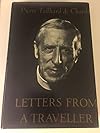
Letters from a Traveller is a collection of the letters of the Jesuit paleontologist Pere Teilhard de Chardin. His fascinating letters prove what can happen when a brilliant mind is united with a warm heart. His explorations in several parts of the world, but primarily in China, furthered understanding of the age and development of the earth’s geology and the development of man. His ideas were not well received by the church thus his apparent exile to out of the way parts of the world. The show more development of his ideas of reconciling religion with science rattled a few Vatican cages. After WWII began in Europe but prior to the opening of the Pacific theater he requested that he be allowed to an attend a scientific conference in New York. That request was denied stranding him in China for seven years. With the Japanese occupation his work ground to a near halt. His anxiety about the uncertainty of the situation was palpable in his letters. Shortly after he finally made it home to France he promptly had a heart attack. Although he recovered, he had lost some vigor as well as many opportunities and discoveries were lost or destroyed in the ensuing chaos.This is a fascinating read that gives insight into one of the most brilliant minds of the twentieth century. show less
Lists
Awards


You May Also Like


Associated Authors
Statistics
- Works
- 177
- Also by
- 2
- Members
- 7,767
- Popularity
- #3,139
- Rating
- 3.7
- Reviews
- 100
- ISBNs
- 277
- Languages
- 13
- Favorited
- 14
