
Stephen C. Meyer (1) (1958–)
Author of Signature in the Cell: DNA and the Evidence for Intelligent Design
For other authors named Stephen C. Meyer, see the disambiguation page.
About the Author
Stephen C. Meyer is director of the Discovery Institute's Center for Science and Culture (CSC) and a founder of the intelligent design movement and of the CSC. Dr. Meyer is a Cambridge University-trained philosopher of science, the author of peer-reviewed publications in technical, scientific, show more philosophical and other books and journals. His signal contribution to ID theory is given most fully in Signature in the Cell: DNA and the Evidence for Intelligent Design, published by HarperOne in June 2009. Meyer graduated from Whitworth College in Spokane, Washington, in 1981 with a degree in physics and earth science. He later became a geophysicist with Atlantic Richfield Company (ARCO) in Dallas, Texas working in digital signal processing and seismic survey interpretation. As a Rotary International Scholar, he received his training in the history and philosophy of science at Cambridge University, earning a PhD in 1991. He returned to Whitworth College in 1990 to teach philosophy. He left Whitworth in 2002, giving up a tenured position, to found and direct the CSC at Discovery Institute. Meyer's many other publications include a contribution to, and the editing of, the peer-reviewed volume Darwinism, Design and Public Education (Michigan State University Press, 2004) and the innovative textbook Explore Evolution (Hill House Publishers, 2007). He is also the author of New York Times bestseller Darwin's Doubt: The Explosive Origin of Animal Life and the Case for Intelligent Design HaperOne June 2013. Meyer has been widely featured in media appearance on CNN, MSNBC, NBC, ABC, CBS, Fox News, PBS, and the BBC. In 2008, he appeared with Ben Stein in Expelled: No Intelligence Allowed. He's also featured prominently in two other science documentaries, Icons of Evolution and Unlocking The Mystery of Life. (Bowker Author Biography) show less
Image credit: Stephen C. Meyer/from his website
Works by Stephen C. Meyer
Darwin's Doubt: The Explosive Origin of Animal Life and the Case for Intelligent Design (2013) 519 copies, 7 reviews
Return of the God Hypothesis: Three Scientific Discoveries That Reveal the Mind Behind the Universe (2021) 310 copies, 3 reviews
O Regresso da Hipótese de Deus Três descobertas científicas que revelam a mente por trás do universo (2022) 2 copies
A Duvida de Darwin - A Origem Explosiva da Vida Animal e a Ideia do Design Inteligente (Em Portugues do Brasil) (2019) 2 copies
Associated Works
Four Views on Creation, Evolution, and Intelligent Design (Counterpoints: Bible and Theology) (2017) — Contributor — 178 copies
Tagged
Common Knowledge
- Birthdate
- 1958
- Gender
- male
- Education
- Whitworth College
University of Cambridge (PhD) - Occupations
- scholar
philosopher of science - Organizations
- Atlantic Richfield Company
Discovery Institute - Nationality
- USA
- Places of residence
- Seattle, Washington, USA
- Associated Place (for map)
- Washington, USA
Members
Reviews
Darwin's Doubt: The Explosive Origin of Animal Life and the Case for Intelligent Design by Stephen C. Meyer

This isn't a creationist book per se, and it definitely isn't a Young Earth Creationist work. It is an Intelligent Design book, and one crafted on the contention that the Standard Model of Darwinian Evolution, or Neo-Darwinism, can't explain the Cambrian Explosion and the sudden burst of diverse forms of life from no apparent antecedents. Meyer attempts to undermine the excuses evolutionists give for the Cambrian Explosion, then tries to prove that Intelligent Design is not an ipso facto show more denial of the scientific process. He succeeds on logical grounds, if you are willing to believe it, and offers a workable model, if you are willing to believe it. Yes, but belief. But, Meyer tries to show, the standard model relies on belief too. Chockfull of science, jargon, diagrams, references, and logic, Meyer is definitely no dilettante or intellectual lightweight, but still readable if you slog through. It is dense and long and big. But, it is worth the effort if you study such things. I read this out of order, i should've tackled his The Signature in the Cell first, but, it makes me want to go back and read that before plowing ahead to his more recent The Return of the God Hypothesis. It certainly makes it plain that something is amiss with evolutionary dogma. show less
Darwin's doubt : the explosive origin of animal life and the case for intelligent design by Stephen C. Meyer
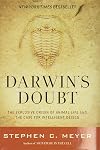
This is the second of two major works by philosopher of science, Stephen C. Meyer arguing for the thesis that the evolutionary process is a designed process. The core of Dr. Meyer's argument in this book is basically the same argument used in his first book, "Signature in the Cell." Given the mathematical improbability of the complex, specified information such as that found in the DNA of every eukaryotic cell being created through the processes of random mutation and natural selection alone show more within the agreed upon time of our world (and the universe's) existence, some kind of intelligence appears to be a necessary component of the evolutionary process. In this second volume Meyer takes up one of the crucial problems that Darwin himself was very aware of. Namely, the sudden (in terms of geological time) appearance of multiple animal forms for which no common ancestor has been found or even successfully theorized is a major stumbling block for Darwinian and now Neo-Darwinian theory.
Meyer documents that it is not only intelligent design theorists who are convinced that orthodox Neo-Darwinianism has failed in its attempt to provide a viable explanation for the so called "Cambrian Explosion," but more and more biologists whose work is based upon the paradigm of materialism now reject the adequacy of the Neo-Darwinian hypotheses and consequently are working upon alternative theories of evolution, a development heralded by Stephen Gould's theory of punctuated equilibrium.
Meyer and his colleagues at Seattle's Biologic Institute (associated with the Discovery Institute) argue for the theory of intelligent design as a more scientifically adequate explanation for the evolution of life by applying the same abductive logic Darwin himself used in his theorizing. Since we cannot observe or duplicate macro evolutionary change (sans intelligent intervention), one must choose between theories that extrapolate from currently observed micro evolutionary phenomena that may be parallels to macro-level processes. Thus Darwin used what was commonly known from breeding practices in his day as well as his own observations of micro evolutionary changes gained on such expeditions as his famous Beagle voyage to postulate inter-special changes over long periods of geological time. In like manner, Meyer argues that given the fact that we humans instinctively attribute the events in our life that involve complex, specified information (CSI) to the involvement of intelligent actors (an email for instance), we are right to assume that the involvement of such information in biological processes such as DNA and some of the cellular engines that appear to be designed are in fact designed.
Whether one is convinced by Meyer's arguments or not, having read either this or the earlier volume of his growing corpus of articles and books, one will have no trouble recognizing the oft heard charge that intelligent design is nothing more than another form of creationism as the uninformed prejudice or dishonest propaganda that it is. And anyone who wishes to have some insight into the history and current theories of evolutionary research would benefit from reading this and Dr. Meyer's earlier book. show less
Meyer documents that it is not only intelligent design theorists who are convinced that orthodox Neo-Darwinianism has failed in its attempt to provide a viable explanation for the so called "Cambrian Explosion," but more and more biologists whose work is based upon the paradigm of materialism now reject the adequacy of the Neo-Darwinian hypotheses and consequently are working upon alternative theories of evolution, a development heralded by Stephen Gould's theory of punctuated equilibrium.
Meyer and his colleagues at Seattle's Biologic Institute (associated with the Discovery Institute) argue for the theory of intelligent design as a more scientifically adequate explanation for the evolution of life by applying the same abductive logic Darwin himself used in his theorizing. Since we cannot observe or duplicate macro evolutionary change (sans intelligent intervention), one must choose between theories that extrapolate from currently observed micro evolutionary phenomena that may be parallels to macro-level processes. Thus Darwin used what was commonly known from breeding practices in his day as well as his own observations of micro evolutionary changes gained on such expeditions as his famous Beagle voyage to postulate inter-special changes over long periods of geological time. In like manner, Meyer argues that given the fact that we humans instinctively attribute the events in our life that involve complex, specified information (CSI) to the involvement of intelligent actors (an email for instance), we are right to assume that the involvement of such information in biological processes such as DNA and some of the cellular engines that appear to be designed are in fact designed.
Whether one is convinced by Meyer's arguments or not, having read either this or the earlier volume of his growing corpus of articles and books, one will have no trouble recognizing the oft heard charge that intelligent design is nothing more than another form of creationism as the uninformed prejudice or dishonest propaganda that it is. And anyone who wishes to have some insight into the history and current theories of evolutionary research would benefit from reading this and Dr. Meyer's earlier book. show less
Darwin's Doubt: The Explosive Origin of Animal Life and the Case for Intelligent Design by Stephen C. Meyer
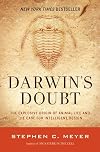
When I was sixteen I read a book by a Jehovah Witness titled "Did Man Get Here by Evolution or by Creation?" It presented the idea of a roomful of chimpanzees pounding away on typewriters and wondered how long it would take them to produce the works of William Shakespeare. It also looked askance on radiocarbon dating. That book was in print from 1930 to 1985. "Darwin's Doubt" updates those concerns. It accepts the data collected by the paleontologists but finds fault with the conclusions of show more neo-Darwinism, punctuated equilibrium, evolutionary developmental biology, etc. Basically it comes down to a paucity of fossil evidence and conclusions that can be drawn from the "body plans" of the fossils that have been found and combinatorial inflation. The author explains the latter with a clever scenario: Would a bicycle thief attempt to steal a bicycle secured by a three dial padlock or a four dial padlock? Which would take less time to crack? Since we know how long life has existed on Earth and since we know a great deal more about genetics since Crick and Watson's discovery in 1953, more than Darwin, LaMarck, and Mendel ever did, its a mathematical impossibility that natural selection and gene mutation can account for the history of life.
Anyone interested in Intelligent Design and the controversy surrounding it should read this book. show less
Anyone interested in Intelligent Design and the controversy surrounding it should read this book. show less

This book was referenced in Douglas Richards thriller "Unleashed". That, and the author's notes at the end of that novel made me decide to pick this book up and read it for myself.
At about 12% through, I abandoned it. I was expecting something more approachable. I understand science and information theory, and have a basic understanding of biology and chemistry. I found this book to be very technical, and thus slow going. For a lay person, I think it would be a struggle.
Also, in my opinion, show more Meyer makes assertions that are unfounded. For example, "information must have a creator". I disagree with this. The rings in the stump of a felled tree contain information, yet there's no evidence that an intelligence put them there. show less
At about 12% through, I abandoned it. I was expecting something more approachable. I understand science and information theory, and have a basic understanding of biology and chemistry. I found this book to be very technical, and thus slow going. For a lay person, I think it would be a struggle.
Also, in my opinion, show more Meyer makes assertions that are unfounded. For example, "information must have a creator". I disagree with this. The rings in the stump of a felled tree contain information, yet there's no evidence that an intelligence put them there. show less
You May Also Like


Associated Authors
Statistics
- Works
- 15
- Also by
- 1
- Members
- 1,461
- Popularity
- #17,583
- Rating
- 4.2
- Reviews
- 17
- ISBNs
- 44
- Languages
- 2