
Max Beckmann (1884–1950)
Author of Max Beckmann: A Retrospective
About the Author
Image credit: self-portrait
Works by Max Beckmann
Max Beckman: A small loan retrospective of paintings centred around his visit to London in 1938 (1974) 8 copies
Max Beckmann graphics. Selected from the Ernest and Lilly Jacobson Collection (1972) 6 copies, 1 review
Max Beckmann 5 copies
Max Beckmann, die Triptychen im Städel : Städtische Galerie im Städelschen Kunstinstitut Frankfurt am Main, 16. April bis 21. Juni 1981 (1981) 3 copies
Tagebücher 1940 - 1950. Zusammengestellt von Mathilde Q. Beckmann. Herausgegeben von Erhard Göpel. Erweiterte und neu durchgesehene Ausgabe. (1979) 2 copies
Max Beckmann: Grabando con puñales. Obra gráfica 1900-1950 : 8 de febrero al 17 de marzo, 1996, Centre Cultural Bancaixa (1996) 2 copies
Die Argonauten : ein Triptychon 2 copies
Max Beckmann als Zeichner 1 copy
Original drawing 1 copy
Works By Max Beckmann [Exhibition Catalog, Nassau Co. Museum of Fine Art, Oct. 21, 1984-Jan. 13, 1985] (1985) 1 copy
Quappi und Max Beckmann 1 copy
Max Beckmann in America 1 copy
Max Beckmann : the watercolors and pastels : catalogue raisonné of the works in color on paper ; Schirn Kunsthall (2006) 1 copy
Beckmann~ Max Beckmann 1 copy
Max Beckmann als Illustrator 1 copy
Sichtbares und Unsichtbares 1 copy
Beginning (oil on canvas) 1 copy
Associated Works
Theories of Modern Art: A Source Book by Artists and Critics (1968) — Contributor — 854 copies, 6 reviews
Theories and Documents of Contemporary Art: A Sourcebook of Artists' Writings (1995) — Contributor — 417 copies, 1 review
Tagged
Common Knowledge
- Canonical name
- Beckmann, Max
- Legal name
- Beckmann, Max Carl Friedrich
- Birthdate
- 1884-02-12
- Date of death
- 1950-12-27
- Gender
- male
- Occupations
- painter
draftsman
printmaker
sculptor
writer - Relationships
- Beckmann, Peter (son)
Beckmann, Mayen (grandson) - Nationality
- Germany
- Birthplace
- Leipzig, Germany
- Place of death
- New York, New York, USA
- Associated Place (for map)
- Germany
Members
Reviews

Max Beckmann was among the greatest painters of the 20th century, yet no retrospective of his work has been mounted in the art capitals of New York, London, and Paris in over 30 years. Perhaps the lapse of attention has to do with the importance of abstraction in 20th-century art, and Beckmann's work is always figurative, simultaneously muscular and enigmatic and has enormous and unsettling power. Beckmann began his career as a naturalist and Symbolist in the period before World War I. After show more the war he developed a unique pictorial style that mixed expressionist color and gesture, mythological and mystical allegory, and the harsh new objectivity of his portrayal of modern life throughout the Nazi reign of terror. A prolific artist in painting, drawing, and printmaking--as well as a powerful sculptor--Beckmann created mysterious images and dense tableaux of unparalleled intensity and complexity during an odyssey that took him from his native Germany to Paris, Amsterdam, St. Louis, and New York. A new examination of Beckmann's role and reputation during the first half of the 20th century has been eagerly awaited. Making use of new scholarship and previously unavailable research materials, this book sheds light on Beckmann's work and his influence on and interactions with the artists of his day. Essays include discussions of Beckmann's Frankfurt cityscapes, his pictures from Italy, his triptychs, his group portraits, and his relationship with cultural politics in the 1920s and 1930s; texts and interviews by artists Leon Golub and Ellsworth Kelly; curator Robert Storr on "The Beckmann Effect"; and artist William Kentridge on Beckmann's Death. This sumptuous volume is published on the occasion of the retrospective exhibition mounted jointly by the Tate Modern, Centre Georges Pompidou, and The Museum of Modern Art, New York. It is the first comprehensive exhibition of Beckmann's work to be seen in the United States since 1984, and the first in New York since 1964. show less
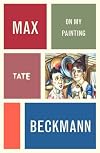
The great German Expressionist painter Max Beckmann (1884-1950) delivered a lecture in London in 1938 entitled On My Painting, a lecture later printed in essay form and published as a book. For me, this short work is one of the most inspiring statements I have ever read by an artist on the subject of his art. As a way of providing a sampling of Max Beckmann’s passion and artistic vision, below are direct quotes from the text followed by my own comments:
“Painting is a very difficult show more thing. It absorbs the whole man, body and soul – thus I have passed blindly many things which belong to real and political life.” ---------- This statement speaks to the unflinching dedication a true painter must have for his or her painting. Sacrifices will have to be made, no doubt, which could result in a lifetime of poverty, being kicked out of one's family or accepting the role of social outcast. But for the true artist, the world of the canvas comes first. Viewing the below Max Beckmann self-portrait, is there any doubt about the painter’s intense commitment to his art?
“I am seeking for the bridge which leads from the visible to the invisible, like the famous cabalist who once said: “If you wish to get hold of the invisible you must penetrate as deeply as possible into the visible.” ---------- The infamous 1937 Degenerate Art Exhibition of the Nazis included Max Beckmann paintings. It was this desire to penetrate beyond the mere outer skin of appearances in order to express the spiritual dimensions to which Hitler and the Nazis so objected. For example, take a look at Beckmann’s “Carnival” below, capturing the inner emotional and feeling states of each individual and the overall vibrancy of the group – remarkable.
“Space, and space again, is the infinite deity which surrounds us and in which we are ourselves contained. That is what I try to express through painting, a function different from poetry and music but, for me, predestined necessity.” ---------- Ah! Of course, vision and the dimensions of space rendered on canvas – the very lifeblood of what it means to be a painter. For example, the painting below is so alive with a slicing together of various spaces, it’s as if the canvas is ready to explode.
“I hardly need to abstract things, for each object is unreal enough already, so unreal that I can only make it real by means of painting.” ---------- A true painter – all those people and objects he sees around him are given a rebirth through his paintings. Where are all those people and objects he portrayed in his paintings now? Gone, gone, gone. Ars longa, vita brevis.
“Art is creative for the sake of realization, not for amusement; for transfiguration, not for the sake of play. It is the quest of our Self that drives us along the eternal and never-ending journey we must all make.” ---------- Is there any doubt about Max Beckmann’s seriousness of purpose? If you ever feel surrounded by the frivolous or superficial, you can always turn to this artist for relief.
“I must look for wisdom with my eyes. I repeat, with my eyes, for nothing could be more ridiculous or irrelevant than a “philosophical conception” painted purely intellectually without the terrible fury of the senses grasping each visible form of beauty and ugliness.” ---------- A painter has five senses but it is that mystical, vital visual sense, the magic of the eyes that counts, to see, to really see, to pierce, to penetrate, as for example in the Beckmann painting below, to use one’s eyes to see a bowl of fruit.
“Life is difficult, as perhaps everyone knows by now. It is to escape from these difficulties that I practice the pleasant profession of a painter.” ---------- There are challenges in art, but when a dedicated artist is in the creative “zone,” there is nothing like it. Anyone who has likewise experienced what it like to be in this artistic, creative “zone” knows the truth of Max Beckmann’s statement from first-hand experience.
“To transform height, width, and depth into two dimensions is for me an experience full of magic in which I glimpse for a moment that fourth dimension which my whole being is seeking.” ---------- When the three dimensions of our everyday world are transformed onto a two dimensional canvas, an artist’s creative imagination kicks in and the world opens up. In the painting below, the artist captures this woman’s energy and inner spirit – vibrant, vital – and all the pinks hum with electricity.
show less
The great German Expressionist painter Max Beckmann (1884-1950) delivered a lecture in London in 1938 entitled “On My Painting,” a lecture later printed in essay form and published as a book. For me, this short work is one of the most inspiring statements I have ever read by an artist on the subject of his art. As a way of providing a sampling of Max Beckmann’s passion and artistic vision, below are direct quotes from the text followed by my own comments:
“Painting is a very difficult show more thing. It absorbs the whole man, body and soul – thus I have passed blindly many things which belong to real and political life.” ---------- This statement speaks to the unflinching dedication a true painter must have for his or her painting. Sacrifices will have to be made, no doubt, which could result in a lifetime of poverty, being kicked out of one's family or accepting the role of social outcast. But for the true artist, the world of the canvas comes first. Viewing the below Max Beckmann self-portrait, is there any doubt about the painter’s intense commitment to his art?
“I am seeking for the bridge which leads from the visible to the invisible, like the famous cabalist who once said: “If you wish to get hold of the invisible you must penetrate as deeply as possible into the visible.” ---------- The infamous 1937 Degenerate Art Exhibition of the Nazis included Max Beckmann paintings. It was this desire to penetrate beyond the mere outer skin of appearances in order to express the spiritual dimensions to which Hitler and the Nazis so objected. For example, take a look at Beckmann’s “Carnival” below, capturing the inner emotional and feeling states of each individual and the overall vibrancy of the group – remarkable.
“Space, and space again, is the infinite deity which surrounds us and in which we are ourselves contained. That is what I try to express through painting, a function different from poetry and music but, for me, predestined necessity.” ---------- Ah! Of course, vision and the dimensions of space rendered on canvas – the very lifeblood of what it means to be a painter. For example, the painting below is so alive with a slicing together of various spaces, it’s as if the canvas is ready to explode.
“I hardly need to abstract things, for each object is unreal enough already, so unreal that I can only make it real by means of painting.” ---------- A true painter – all those people and objects he sees around him are given a rebirth through his paintings. Where are all those people and objects he portrayed in his paintings now? Gone, gone, gone. Ars longa, vita brevis.
“Art is creative for the sake of realization, not for amusement; for transfiguration, not for the sake of play. It is the quest of our Self that drives us along the eternal and never-ending journey we must all make.” ---------- Is there any doubt about Max Beckmann’s seriousness of purpose? If you ever feel surrounded by the frivolous or superficial, you can always turn to this artist for relief.
“I must look for wisdom with my eyes. I repeat, with my eyes, for nothing could be more ridiculous or irrelevant than a “philosophical conception” painted purely intellectually without the terrible fury of the senses grasping each visible form of beauty and ugliness.” ---------- A painter has five senses but it is that mystical, vital visual sense, the magic of the eyes that counts, to see, to really see, to pierce, to penetrate, as for example in the Beckmann painting below, to use one’s eyes to see a bowl of fruit.
“Life is difficult, as perhaps everyone knows by now. It is to escape from these difficulties that I practice the pleasant profession of a painter.” ---------- There are challenges in art, but when a dedicated artist is in the creative “zone,” there is nothing like it. Anyone who has likewise experienced what it like to be in this artistic, creative “zone” knows the truth of Max Beckmann’s statement from first-hand experience.
“To transform height, width, and depth into two dimensions is for me an experience full of magic in which I glimpse for a moment that fourth dimension which my whole being is seeking.” ---------- When the three dimensions of our everyday world are transformed onto a two dimensional canvas, an artist’s creative imagination kicks in and the world opens up. In the painting below, the artist captures this woman’s energy and inner spirit – vibrant, vital – and all the pinks hum with electricity. show less
Fair Condition, fading on cover
You May Also Like


Associated Authors
Statistics
- Works
- 84
- Also by
- 6
- Members
- 331
- Popularity
- #71,752
- Rating
- 3.9
- Reviews
- 4
- ISBNs
- 57
- Languages
- 5
- Favorited
- 1