

Otto Eissfeldt (1887–1973)
Author of The Old Testament: An Introduction
About the Author
Works by Otto Eissfeldt
Palestine in the Time of the Nineteenth Dynasty: The Exodus and Wanderings (1965) 4 copies, 1 review
Hexateuch-Synopse; die Erzählung der Fünf Bücher Mose und des Buches Josua mit dem Anfange des Richterbuches (German Edition) (1978) 2 copies
Geschichtsschreibung im Alten Testament : ein kritischer Bericht über die neueste Literatur dazu 1 copy
Associated Works
Fischer Weltgeschichte Bd.4 Die Altorientalischen Reiche III, Die erste Hälfte des 1. Jahrtausends (1965) — Author — 66 copies
Tagged
Common Knowledge
- Other names
- Eißfeldt, Otto
- Birthdate
- 1887-09-01
- Date of death
- 1973-04-23
- Gender
- male
- Nationality
- Germany
- Birthplace
- Northeim (Hannover)
- Burial location
- Laurentiusfriedhof in Halle, Germany
- Associated Place (for map)
- Germany
Members
Reviews
The Old Testament : an introduction, including the Apocrypha and Pseudepigrapha, and also the works of similar type from by Otto Eissfeldt

This book is rather more narrowly focussed than the title suggests. Note the subtitle: The History of the Formation of the Old Testament. Eissfeldt's Introduction is really a synthesis in handbook of the historical critical theories extant in the early to mid-twentieth century.
Understanding this volume's purpose will explain why there is little to nothing in the way of historical background, theology, history of interpretation, literary genre, etc. Rather, the book begins with an exhaustive show more systematisation of form critical types and the possible prehistory of the OT books. The rest of the book works systematically through the books of the OT, Apocrypha & Pseudepigrapha—discussing the historical critical concerns of each book in detail—before concluding with an examination of the formation of the canon and the work of textual criticism.
There is no doubt that Eissfeldt is thorough, as only a German could be! The bibliographies are extensive. However, I suspect that this book will appeal to few. It is dated (1964). It was written in the heyday of the historical critical consensus. Nowadays, biblical scholarship has moved on to other concerns. The historical critical consensus is breaking down. If you are interested in the history of historical critical interpretation of the OT, than this volume will help you. If you are after a more conventional introductory textbook, look elsewhere.
If I may conclude on a personal note, this book illustrates to me why the historical critical venture in biblical studies (19th-20th centuries) was so misguided. It led to atomisation of the text, hypothetical reconstructions of sources, sometimes fanciful Sitz im Leben, and a situation where only the skilled scholar could rightly dispense the text, sifting its layers and separating earlier passages from later interpolations. The "layman" could do little but try to keep up or give up on trying to understand Scripture. Although conservative scholarship was out of step with this trend, it amuses me that scholars are now rediscovering the way "fundamentalists" (as they were labelled - ie. the likes of academics F.F. Bruce, D.J. Wiseman and Donald Guthrie) have always read the text: as literature, as canon, as scripture, as theology. Perhaps biblical scholarship is in a state of almost chaotic flux. But many of these directions are more fruitful than the dead letter of historical critical textual archaeology. show less
Understanding this volume's purpose will explain why there is little to nothing in the way of historical background, theology, history of interpretation, literary genre, etc. Rather, the book begins with an exhaustive show more systematisation of form critical types and the possible prehistory of the OT books. The rest of the book works systematically through the books of the OT, Apocrypha & Pseudepigrapha—discussing the historical critical concerns of each book in detail—before concluding with an examination of the formation of the canon and the work of textual criticism.
There is no doubt that Eissfeldt is thorough, as only a German could be! The bibliographies are extensive. However, I suspect that this book will appeal to few. It is dated (1964). It was written in the heyday of the historical critical consensus. Nowadays, biblical scholarship has moved on to other concerns. The historical critical consensus is breaking down. If you are interested in the history of historical critical interpretation of the OT, than this volume will help you. If you are after a more conventional introductory textbook, look elsewhere.
If I may conclude on a personal note, this book illustrates to me why the historical critical venture in biblical studies (19th-20th centuries) was so misguided. It led to atomisation of the text, hypothetical reconstructions of sources, sometimes fanciful Sitz im Leben, and a situation where only the skilled scholar could rightly dispense the text, sifting its layers and separating earlier passages from later interpolations. The "layman" could do little but try to keep up or give up on trying to understand Scripture. Although conservative scholarship was out of step with this trend, it amuses me that scholars are now rediscovering the way "fundamentalists" (as they were labelled - ie. the likes of academics F.F. Bruce, D.J. Wiseman and Donald Guthrie) have always read the text: as literature, as canon, as scripture, as theology. Perhaps biblical scholarship is in a state of almost chaotic flux. But many of these directions are more fruitful than the dead letter of historical critical textual archaeology. show less


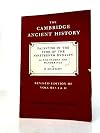
Edition: Revised Edition of Volumes I and II // Descr: 32 p. 23.5 cm. // Series: The Cambridge Ancient History Call No. { } Contains Bibliography. // //
You May Also Like


Associated Authors
Statistics
- Works
- 29
- Also by
- 2
- Members
- 287
- Popularity
- #81,378
- Rating
- 3.4
- Reviews
- 5
- ISBNs
- 17
- Languages
- 2