
Robert Kolker
Author of Hidden Valley Road: Inside the Mind of an American Family
Works by Robert Kolker
Associated Works
Tagged
Common Knowledge
- Birthdate
- 20th Century
- Gender
- male
- Occupations
- author
journalist
editor - Awards and honors
- Harry Frank Guggenheim Excellence in Criminal Justice Reporting Award (2011)
- Nationality
- USA
- Birthplace
- Baltimore, Maryland, USA
- Places of residence
- Brooklyn, New York, USA
- Map Location
- New York, USA
Members
Reviews
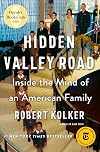
Hidden Valley Road might do for schizophrenia what The Immortal Life of Henrietta Lacks did for HeLa cells; in other words, bring the devastating disease into the public consciousness through a moving family story.
In accordance with Catholic teachings, Don and Mimi Galvin had twelve children. Six of their ten boys developed debilitating mental illness in their late teens or early twenties. Those who escaped schizophrenia, including their two daughters, grew up in a chaotic home with show more preoccupied parents and little attention. It was a recipe for disaster on many levels.
Author Robert Kolker traces the family story in detail from the 1970s to today. The biographical chapters are interspersed with sections about scientific efforts to understand and treat schizophrenia. The indifference of the big pharmaceutical companies to exploring new approaches is infuriating.
This excellent book goes on a little too long, but otherwise is highly recommended. show less
In accordance with Catholic teachings, Don and Mimi Galvin had twelve children. Six of their ten boys developed debilitating mental illness in their late teens or early twenties. Those who escaped schizophrenia, including their two daughters, grew up in a chaotic home with show more preoccupied parents and little attention. It was a recipe for disaster on many levels.
Author Robert Kolker traces the family story in detail from the 1970s to today. The biographical chapters are interspersed with sections about scientific efforts to understand and treat schizophrenia. The indifference of the big pharmaceutical companies to exploring new approaches is infuriating.
This excellent book goes on a little too long, but otherwise is highly recommended. show less
Robert Kolker’s Hidden Valley Road: Inside the Mind of an American Family is one of the most tragically fascinating family histories I have ever read. Frankly, reading this one felt akin to slowing down just long enough to take in all the gory details of a bloody roadside accident before continuing on the way. What happened behind the closed doors of the Galvin family home for decades is almost unbelievable – especially since Don and Mimi Galvin seem to have been so oblivious to the show more worst of the horrors that were going on all around them. Don Galvin’s solution was to absent himself from the house as often as possible by taking on work projects that required him to be on the road. His wife, Mimi, on the other hand, largely remained in classic denial until she died in her nineties.
Between 1945 and 1965, twelve children were born into the Galvin family, ten boys followed by two girls. Statistically, this alone would make the Galvin family an unusual one, but this is just the beginning of their story. What makes the family a true statistical rarity is that six of the ten Galvin boys, starting with the oldest, were afflicted with schizophrenia. For decades, theirs was a household literally at war with itself, one in which brothers were constantly in the kind of physical warfare with each other that placed them and everyone else in the home in grave danger. Six of the boys, as they reached adolescence, so lost touch with reality that they became a danger to themselves and anyone who had to live with them, especially their two little sisters – who suffered the worst kind of abuse imaginable from several of their brothers.
And Don and Mimi Galvin, often victims themselves, were helpless to stop what was going on around them. This was all happening when schizophrenia was still largely a misunderstood mental illness, a time when locking up patients long enough to stabilize then with drugs or electric shock therapy before releasing them back into the world was really the only answer that doctors had. And that did not work; some patients, including more than one of the Galvins were in and out of the same hospital dozens of times until their minds were effectively fried by the drugs imposed on them. Perhaps even more tragically, two of the Galvin brothers died at age 53 of heart attacks, the cumulative effect of all the drugs they had taken for four decades.
What I, as an outsider, find most difficult to understand is how Don and Mimi Galvin could have continued to have children, almost year after year, when it should have been so obvious to them that the illness afflicting the children they already had was likely to be an inherited one. Particularly since both parents were very concerned about image and reputation, this makes no sense. Being in utter denial seems to be the only answer that makes much sense.
The good news about the Galvin family – and there is some - is that the family agreed to participate in a study in which their genetic material was studied by scientists looking for answers about the illness. What causes schizophrenia? Is it inherited or is it a product of environment (it used to be blamed entirely on an over-controlling mother)? Can the illness be prevented? The Galvin family was a goldmine for researchers because no scientist had ever found so many full-blooded sibling schizophrenics in a family before. The genetic material they provided has become central in the study to unlock some of the secrets of the illness that have plagued human history.
That research continues to this day.
Bottom Line: Readers will find Hidden Valley Road fascinating for two distinct reasons. First, is that everyday life inside the Galvin family reads more like something out of a farfetched Stephen King novel than it does as something out of the real world. What those fourteen people (maybe especially the eight trying to cope with the behavior of the six schizophrenics in the family) endured for so many years was horrendous. Second, is the chronological history of our understanding of schizophrenia and its treatment that is interspersed in separate chapters throughout the book. The Galvin family is a truly remarkable one. show less
Between 1945 and 1965, twelve children were born into the Galvin family, ten boys followed by two girls. Statistically, this alone would make the Galvin family an unusual one, but this is just the beginning of their story. What makes the family a true statistical rarity is that six of the ten Galvin boys, starting with the oldest, were afflicted with schizophrenia. For decades, theirs was a household literally at war with itself, one in which brothers were constantly in the kind of physical warfare with each other that placed them and everyone else in the home in grave danger. Six of the boys, as they reached adolescence, so lost touch with reality that they became a danger to themselves and anyone who had to live with them, especially their two little sisters – who suffered the worst kind of abuse imaginable from several of their brothers.
And Don and Mimi Galvin, often victims themselves, were helpless to stop what was going on around them. This was all happening when schizophrenia was still largely a misunderstood mental illness, a time when locking up patients long enough to stabilize then with drugs or electric shock therapy before releasing them back into the world was really the only answer that doctors had. And that did not work; some patients, including more than one of the Galvins were in and out of the same hospital dozens of times until their minds were effectively fried by the drugs imposed on them. Perhaps even more tragically, two of the Galvin brothers died at age 53 of heart attacks, the cumulative effect of all the drugs they had taken for four decades.
What I, as an outsider, find most difficult to understand is how Don and Mimi Galvin could have continued to have children, almost year after year, when it should have been so obvious to them that the illness afflicting the children they already had was likely to be an inherited one. Particularly since both parents were very concerned about image and reputation, this makes no sense. Being in utter denial seems to be the only answer that makes much sense.
The good news about the Galvin family – and there is some - is that the family agreed to participate in a study in which their genetic material was studied by scientists looking for answers about the illness. What causes schizophrenia? Is it inherited or is it a product of environment (it used to be blamed entirely on an over-controlling mother)? Can the illness be prevented? The Galvin family was a goldmine for researchers because no scientist had ever found so many full-blooded sibling schizophrenics in a family before. The genetic material they provided has become central in the study to unlock some of the secrets of the illness that have plagued human history.
That research continues to this day.
Bottom Line: Readers will find Hidden Valley Road fascinating for two distinct reasons. First, is that everyday life inside the Galvin family reads more like something out of a farfetched Stephen King novel than it does as something out of the real world. What those fourteen people (maybe especially the eight trying to cope with the behavior of the six schizophrenics in the family) endured for so many years was horrendous. Second, is the chronological history of our understanding of schizophrenia and its treatment that is interspersed in separate chapters throughout the book. The Galvin family is a truly remarkable one. show less
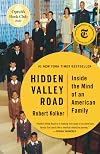
This almost unbelievable saga of a family with twelve children, six of whom are afflicted with schizophrenia, is almost as important a clinical study as The Immortal Life of Henrietta Lacks. The main question for me is: why on earth would you choose to have so many children? Even under the best of circumstances, without the brain disease, there is the fact that no child under those conditions ever gets enough attention, affection, and love; and here, since the girls who would have been made show more to be backup caretakers don't come along in the birth order until last, mother Mimi Galvin is wholly responsible for this entire family's every need, with the exception of financial, where husband Don labors in an Air Force job that is unfulfilling for him. As each of the six boys' disorders come to the surface in their late teens, daily life is a series of brutal beatings and competition between the boys and sexual molestation of the girls by one of the brothers. The book chronicles hard-won advances in medical research, which come mostly too late for the six boys, and treatment is still no guarantee of improvement, no less a cure. What's a parent to do? Avoid creating massive families where no one is safe or happy. show less
EDIT
I wrote the thoughtful and very long review that you can read down here.
I also gave the book 4 stars.
Then I realised that I had been so focused on separating the burnt curtains from the salvageable ones, that I had missed the fact that this house is on fire.
This book is not about schizophrenia. It is about a family rife with parental neglect, and with sexual, emotional and physical abuse, in which six out of twelve children ALSO had schizophrenia.
However, Kolker decided that the family show more problems were all due to the schizophrenia, so creating a very dangerous and unjust equation between schizophrenia and being a violent abuser and a killer.
This is untrue, unfair to people who suffer from schizophrenia (one of whom I had the pleasure to have in my life, and I say pleasure, yes, because she was an amazing person) and very dishonest.
So, read the following if you want, but beware: I DID slam the door on myself about this one, because it tricked me into not seeing the forest for the trees...
ORIGINAL REVIEW
It is difficult, maybe impossible, to judge this book impartially. Its topic and the events talk to our worst fears, hidden and declare values, and deep feelings: family dysfunction, unforgiving mental illness, American society and its demands on the middle class in the last century, sexual, emotional and physical abuse, and the role of parents in shaping the lives of their children. Whoa. There is enough to have a heated discussion with oneself, and leave the room slamming the door.
So, maybe, it is best to look at the degree of respect and thoroughness with which the people involved are given (or denied) a voice.
On one side, only the two sisters engaged with the writer, while the ten boys, sick or "sane", chose to keep their distance. The imbalance in representation is visible, and while the damaged, sick and frail brothers are given, in the last chapter, some voice, the non-schizophrenic siblings who made a life for themselves come out as a bit two-dimensional; one feels close to smell some judgement in which their life choices are treated, but not quite. Let's say that Kolker stops short of harsh judgement throughout the story. Also, a quality of his narration that I appreciated is that he did not refrain from analysing some manipulative elements in the way the two narrating sisters managed family relations in adult life, but he also keeps a deep, and, I think, honest empathising attitude towards all people involved.
On the other side, the role and figures of the parents, who were in danger of become either the villains or the misunderstood martyrs of the tale, are analysed with rare equanimity and humanity, and I have to say that this is what endeared the book to me. I will never get to understand how people with an education can put twelve children in the world, and then leave the younger girls and boys in the hands of clearly unstable adult or adolescent brothers, but I know something about denial, societal pressure, fragility and about how much of a Catch 22 it is to deal with mental illness in the family and get out of it squeaky clean, and Kolker managed to convey all the complexity of the situation. Understandably, he had a more delicate hand in treating the personality and actions of the mother, who was there all along while daddy studied, had a career, and even enjoyed his extra-marital affairs (think: Mad Man goes even more horribly wrong than you thought it had already gone...)
Finally, I found the scientific chapters interesting, if not always well intertwined with the biography sections. Maybe here there is too much eagerness, especially in the first part of the narration, to discount the role of the environment in the development of full-fledged schizophrenia. It looks as if Kolker was tempted to make martyrs out of the parents, and then achieved a more balanced view, in which the discovery of certain genetic and neurological markers associated with schizophrenia does not cancel the possibility that the chaotic and emotionally abusive (or at least inadequate) environment in which the children grew had a big role in the tragic outcome. Sure thing, the pharmacological "therapies" had on the sick brothers as horrifically imparing, and sometime lethal, consequences as the illness itself. Kolker had the merit of balancing different possibilitiesm and of giving a clear and honest view of the incompleteness of our current understanding of schizophrenia, but it still feels weird that he left this imbalance in judgement in the first part of the book, as if he still wants us to take the mother's defence.
In the same way, I wish there would have been some more clarification of the difference between the horrifying but justifiable aggression that can come with psychotic crises, for whom I feel sorrow, and the sexual abuse and feminicide that seemed to be a staple attitude of some family member, not to talk about the parents visibly looking the other way, and also exposing their children to the paedophile priest (because the poor children were not unhappy enough, so their parents thought it necessary to let yo'man pick his prey at will, as one of the girls puts it). Now, this is a big alarm ringing about some stone left unturned in this family's dynamics and there is not much in terms of trying to divide the victim of illness from the perpetrator of rape and homicide/suicide. It nearly looks like some of the poor women and children victim of these crimes are collateral damage of the suffering of the perpetrators, and this was hard to forgive. On the other hand, some other episodes (the ones that involve the sisters) are more fleshed out and seen from the victim's point of view, and it is made clear how the family cut their ties with one the rapist male brothers, while the other was too far gone in his medicated absence and beyond understanding what was asked of him. Maybe this lack of focus on the two wives victims of their husbands is, once more, due to a lack of first-hand documentation.
Apart for this major blunder, Kolker managed to make me empathise with people for whom, starting the book, I had nothing but contempt, and this without hiding hard facts. He made me question my values and my tendency to judge harshly when it comes to family dynamics, and he managed to present different and divergent ways to cope with a painful past as equally valid.
A book that needs to be read, whatever its shortcomings. show less
I wrote the thoughtful and very long review that you can read down here.
I also gave the book 4 stars.
Then I realised that I had been so focused on separating the burnt curtains from the salvageable ones, that I had missed the fact that this house is on fire.
This book is not about schizophrenia. It is about a family rife with parental neglect, and with sexual, emotional and physical abuse, in which six out of twelve children ALSO had schizophrenia.
However, Kolker decided that the family show more problems were all due to the schizophrenia, so creating a very dangerous and unjust equation between schizophrenia and being a violent abuser and a killer.
This is untrue, unfair to people who suffer from schizophrenia (one of whom I had the pleasure to have in my life, and I say pleasure, yes, because she was an amazing person) and very dishonest.
So, read the following if you want, but beware: I DID slam the door on myself about this one, because it tricked me into not seeing the forest for the trees...
ORIGINAL REVIEW
It is difficult, maybe impossible, to judge this book impartially. Its topic and the events talk to our worst fears, hidden and declare values, and deep feelings: family dysfunction, unforgiving mental illness, American society and its demands on the middle class in the last century, sexual, emotional and physical abuse, and the role of parents in shaping the lives of their children. Whoa. There is enough to have a heated discussion with oneself, and leave the room slamming the door.
So, maybe, it is best to look at the degree of respect and thoroughness with which the people involved are given (or denied) a voice.
On one side, only the two sisters engaged with the writer, while the ten boys, sick or "sane", chose to keep their distance. The imbalance in representation is visible, and while the damaged, sick and frail brothers are given, in the last chapter, some voice, the non-schizophrenic siblings who made a life for themselves come out as a bit two-dimensional; one feels close to smell some judgement in which their life choices are treated, but not quite. Let's say that Kolker stops short of harsh judgement throughout the story. Also, a quality of his narration that I appreciated is that he did not refrain from analysing some manipulative elements in the way the two narrating sisters managed family relations in adult life, but he also keeps a deep, and, I think, honest empathising attitude towards all people involved.
On the other side, the role and figures of the parents, who were in danger of become either the villains or the misunderstood martyrs of the tale, are analysed with rare equanimity and humanity, and I have to say that this is what endeared the book to me. I will never get to understand how people with an education can put twelve children in the world, and then leave the younger girls and boys in the hands of clearly unstable adult or adolescent brothers, but I know something about denial, societal pressure, fragility and about how much of a Catch 22 it is to deal with mental illness in the family and get out of it squeaky clean, and Kolker managed to convey all the complexity of the situation. Understandably, he had a more delicate hand in treating the personality and actions of the mother, who was there all along while daddy studied, had a career, and even enjoyed his extra-marital affairs (think: Mad Man goes even more horribly wrong than you thought it had already gone...)
Finally, I found the scientific chapters interesting, if not always well intertwined with the biography sections. Maybe here there is too much eagerness, especially in the first part of the narration, to discount the role of the environment in the development of full-fledged schizophrenia. It looks as if Kolker was tempted to make martyrs out of the parents, and then achieved a more balanced view, in which the discovery of certain genetic and neurological markers associated with schizophrenia does not cancel the possibility that the chaotic and emotionally abusive (or at least inadequate) environment in which the children grew had a big role in the tragic outcome. Sure thing, the pharmacological "therapies" had on the sick brothers as horrifically imparing, and sometime lethal, consequences as the illness itself. Kolker had the merit of balancing different possibilitiesm and of giving a clear and honest view of the incompleteness of our current understanding of schizophrenia, but it still feels weird that he left this imbalance in judgement in the first part of the book, as if he still wants us to take the mother's defence.
In the same way, I wish there would have been some more clarification of the difference between the horrifying but justifiable aggression that can come with psychotic crises, for whom I feel sorrow, and the sexual abuse and feminicide that seemed to be a staple attitude of some family member, not to talk about the parents visibly looking the other way, and also exposing their children to the paedophile priest (because the poor children were not unhappy enough, so their parents thought it necessary to let yo'man pick his prey at will, as one of the girls puts it). Now, this is a big alarm ringing about some stone left unturned in this family's dynamics and there is not much in terms of trying to divide the victim of illness from the perpetrator of rape and homicide/suicide. It nearly looks like some of the poor women and children victim of these crimes are collateral damage of the suffering of the perpetrators, and this was hard to forgive. On the other hand, some other episodes (the ones that involve the sisters) are more fleshed out and seen from the victim's point of view, and it is made clear how the family cut their ties with one the rapist male brothers, while the other was too far gone in his medicated absence and beyond understanding what was asked of him. Maybe this lack of focus on the two wives victims of their husbands is, once more, due to a lack of first-hand documentation.
Apart for this major blunder, Kolker managed to make me empathise with people for whom, starting the book, I had nothing but contempt, and this without hiding hard facts. He made me question my values and my tendency to judge harshly when it comes to family dynamics, and he managed to present different and divergent ways to cope with a painful past as equally valid.
A book that needs to be read, whatever its shortcomings. show less
Lists
Obama Reads (1)
True Crime (1)
Awards


You May Also Like


Associated Authors
Statistics
- Works
- 4
- Also by
- 1
- Members
- 3,057
- Popularity
- #8,351
- Rating
- 4.0
- Reviews
- 144
- ISBNs
- 39
- Languages
- 7