

John Medina
Author of Brain Rules: 12 Principles for Surviving and Thriving at Work, Home, and School
About the Author
Image credit: From http://www.johnmedina.com/?q=bio
Works by John Medina
Brain Rules: 12 Principles for Surviving and Thriving at Work, Home, and School (2008) 2,501 copies, 53 reviews
Brain Rules for Baby: How to Raise a Smart and Happy Child from Zero to Five (2010) 489 copies, 9 reviews
Brain Rules for Aging Well: 10 Principles for Staying Vital, Happy, and Sharp (2017) 124 copies, 4 reviews
Attack of the Teenage Brain: Understanding and Supporting the Weird and Wonderful Adolescent Learner (2018) 16 copies
TU CEREBRO MANDA. 12 PRINCIPIOS PARA SOBREVIVIR Y PROSPERAR EN EL TRABAJO EL HOGAR Y LA ESCUELA (2013) 1 copy
Cocuklar Icin Beynin Kurallari: Sifirdan Bes Yasa Kadar Akilli ve Mutlu Bir Cocuk Nasil Yetistirilir (2017) 1 copy
Naturalmente intelligenti. Istruzioni per lo sviluppo armonioso del cervello dei bambini della prima età (2015) 1 copy
Tagged
Common Knowledge
- Birthdate
- 1956-01-19
- Gender
- male
- Occupations
- developmental molecular biologist
- Nationality
- USA
- Places of residence
- Seattle, Washington, USA
- Associated Place (for map)
- Washington, USA
Members
Reviews
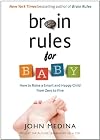
What do the best supported scientific studies have to tell us about how to raise a smart, moral, happy child? Not as much as the shelves upon shelves of parenting books would imply.
Brain Rules for Baby focuses only on the parenting advice that can be backed up by research. As Medina points out in his conclusion, whether you're concerned about baby's intelligence, morality, or happiness, or your relationship with your spouse, much of this research comes back to two key principles: the show more importance of empathy (both having it as a parent and developing it in your child) and the importance of responding to your child's emotional world.
The book has lots of specific tips, but the summary version is that most gimmicky parenting techniques are just that -- gimmicks. Interact with your child person-to-person and it doesn't matter what you're listening to. Let them have open ended, creative play where they lead the way and don't stress if they aren't learning another language.
There are a lot of specific tips which are valuable, but the key thing to remember is that you can't make your baby smart (or happy or good). You can just make your baby feel loved and safe, and in that environment their natural curiosity will take over and lead to the rest. show less
Brain Rules for Baby focuses only on the parenting advice that can be backed up by research. As Medina points out in his conclusion, whether you're concerned about baby's intelligence, morality, or happiness, or your relationship with your spouse, much of this research comes back to two key principles: the show more importance of empathy (both having it as a parent and developing it in your child) and the importance of responding to your child's emotional world.
The book has lots of specific tips, but the summary version is that most gimmicky parenting techniques are just that -- gimmicks. Interact with your child person-to-person and it doesn't matter what you're listening to. Let them have open ended, creative play where they lead the way and don't stress if they aren't learning another language.
There are a lot of specific tips which are valuable, but the key thing to remember is that you can't make your baby smart (or happy or good). You can just make your baby feel loved and safe, and in that environment their natural curiosity will take over and lead to the rest. show less
Brain Rules for Baby (Updated and Expanded): How to Raise a Smart and Happy Child from Zero to Five by John Medina
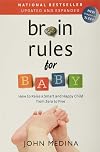
Wonderful, straightforward, & engagingly written for parents-to-be, parents, or grandparents like me who want to encourage my amazing grandbabies!!! Written with current cultural references, excellent real life anecodotes, and yes the latest brain research findings, BUT not so scientific that we mere mortals can grasp the concepts. Best of all, written with humor and insight into the incredible challenges facing all parents to raise a child well. Author is a UW professor developmental show more molecular biologist, and yes a parent himself. Arranged to help readers take away key concepts & practical tips for putting such ideas to immediate use with the little darlins' .... bought one for my son & his wife when they were expecting; bought one for myself; bought one for my daughter, mother of two, and a doula. Is there a youngster in your life? Go buy this book now... seriously. show less
Brain Rules (Updated and Expanded): 12 Principles for Surviving and Thriving at Work, Home, and School by John Medina
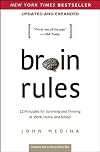
Short, but informative and engaging. I appreciate that Medina explains the biology clearly, tries not to generalize too much (even the "principles" of the title are more suggestions and ideas for future research), and emphasizes that there is so much about the brain that we still don't understand. This would be too basic for those who already know some neuroscience, but for me it was about right.
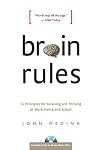
Although the brain often seems to be the most overlooked tool in trainer-teacher-learners' toolkits, great writers like developmental molecular biologist John Medina are doing a lot to move us past that that oversight through books like "Brain Rules: 12 Principles for Surviving and Thriving at Work, Home, and School." Medina is never less than completely engaging, and his 12 rules about how the brain functions in learning are drawn from well-documented research, his own very funny show more observations, and his continual call for more research to help fill in the numerous gaps we still have in our knowledge: "This book is a call for research simply because we don't know enough to be prescriptive," he disarmingly admits (p. 4). Among the rules he documents: exercise boosts brain power; every brain is wired differently; stressed brains don't learn well; and stimulate more of the senses simultaneously to stimulate more effective learning. This is not a book for those comfortable with the status quo; in fact, Medina clearly expects us to approach his work with minds completely open to ideas that might initially strike us as ludicrous. And he encourages us to imagine (and create) learning spaces that inspire and sustain curiosity as opposed to the age-old model of lecture halls where learning is an instructor-centric endeavor. show less
Lists
Awards


You May Also Like


Associated Authors
Statistics
- Works
- 27
- Members
- 3,421
- Popularity
- #7,440
- Rating
- 3.9
- Reviews
- 71
- ISBNs
- 104
- Languages
- 12
- Favorited
- 1