
Alex Wright (1)
Author of Glut: Mastering Information Through the Ages
For other authors named Alex Wright, see the disambiguation page.
About the Author
Alex Wright is a writer and information architect whose articles have appeared in publications including Salon, The Believer, The Christian Science Monitor, and Harvard Magazine. He has led information architecture projects for the New York Times, Harvard University, and the Long Now Foundation, show more among others show less
Works by Alex Wright
Empire of Ink: The Printers, Rogues, and Radicals Who Invented the American Newspaper (2026) 20 copies, 1 review
Tagged
Common Knowledge
- Canonical name
- Wright, Alex
- Gender
- male
Members
Reviews
Empire of Ink: The Printers, Rogues, and Radicals Who Invented the American Newspaper by Alex Wright
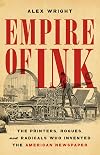
The United States, in a very real sense, printed itself into existence. from Empire of Ink by Alex Wright
When I was a girl my best friend and I dreamed about starting a newspaper, planning to use a shed near her house, talking about how we would write it and distribute it.
So it was fascinating to learn that in 1861 a twelve-year-old girl did start her own paper and had three thousand subscribers! Her father had won a printing press in a poker game and her brother printed small jobs. show more ‘Little Nellie’s Paper’ was filled with “poems, observations on the weather, and the assorted musings of a twelve-year-old girl on small town life.” She “delved into local history,” and gathered a “stable of contributors.”
This history is full of surprises and stories. Mark Twain impoverished himself supporting a failed new printing press invention. He had started as a printer’s devil and later worked for a newspaper in the West when editors wore guns for protection.
From the beginning, American newspapers differed from the presses controlled by royal rulers. They could hold authorities to account and flame political movements. Sensational stories fueled readership while advertising revenue spurred the size and number of newspapers.
Wright offers up a very readable and exciting history and concludes with an analysis of contemporary pressures altering newspapers and how people get information. He predicts that we are at a historical tipping point of change, “an echo, however distorted, of the chaotic and pluralistic press culture of the nineteenth century.”
Thanks to Basic Books for a free book through NetGalley. show less
When I was a girl my best friend and I dreamed about starting a newspaper, planning to use a shed near her house, talking about how we would write it and distribute it.
So it was fascinating to learn that in 1861 a twelve-year-old girl did start her own paper and had three thousand subscribers! Her father had won a printing press in a poker game and her brother printed small jobs. show more ‘Little Nellie’s Paper’ was filled with “poems, observations on the weather, and the assorted musings of a twelve-year-old girl on small town life.” She “delved into local history,” and gathered a “stable of contributors.”
This history is full of surprises and stories. Mark Twain impoverished himself supporting a failed new printing press invention. He had started as a printer’s devil and later worked for a newspaper in the West when editors wore guns for protection.
From the beginning, American newspapers differed from the presses controlled by royal rulers. They could hold authorities to account and flame political movements. Sensational stories fueled readership while advertising revenue spurred the size and number of newspapers.
Wright offers up a very readable and exciting history and concludes with an analysis of contemporary pressures altering newspapers and how people get information. He predicts that we are at a historical tipping point of change, “an echo, however distorted, of the chaotic and pluralistic press culture of the nineteenth century.”
Thanks to Basic Books for a free book through NetGalley. show less
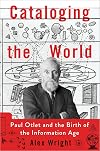
Here comes Alex Wright again, the author of “Glut: Mastering Information Through the Ages”, in yet another well-researched and beautifully written book, “Cataloguing the World: Paul Otlet and the Birth of the Information Age”. Alex Wright is a librarian, an information architect, a professor and an author. It is fair to say, Alex Wright does not write as often but when he does, he does it with meticulous detail and professionalism. Our library here at Southampton Solent University show more just ordered a copy of this book. He is also such a fascinating storyteller. In this book, he tells us that a decade before Vannevar Bush wrote his seminal “As We May Think” article in 1945, before the invent of the World Wide Web by Sir Tim Berners-Lee (1989), well before the Google search engine, there lived a lawyer-turned librarian in Belgium by the name Paul Otlet, who in the 1930s envisioned an inter-connected web of multi-media documents on a screen which looked like today’s computer. He saw the the world wide web coming.
Here is Otlet’s vision in his own words: "Everything in the universe, and everything of man, would be registered at a distance as it was produced. In this way a moving image of the world will be established, a true mirror of his memory. From a distance, everyone will be able to read text, enlarged and limited to the desired subject, projected on an individual screen. In this way, everyone from his armchair will be able to contemplate creation, as a whole or in certain of its parts." Paul Otlet
The book is a biography of a person who spent all his life striving to help achieve a peaceful and knowledge-able world through his efforts of building an international library and a huge indexing and classification system. Alex presents Otlet as a giant man of international stature who has nonetheless remained rather an obscure and uncredited visionary.
This book is also a biography of ideas rather than merely an account of the personal life of Otlet. As Wright delves deep in the interconnectedness of ideas and visions, he shows us a thread of ideas of knowledge organisation and classification schemes dating back from the first biggest library of Alexandria’s scrolls to Conrad Gessner’s catalogue, Bacon’s and Melvil Dewey’s classification schemes and from the memex to the creation of the world’s free and open encyclopedia, i.e. Wikipedia. As it is noted in the book, Otlet grew up with fascination for classification schemes to the extent that he created one when he was only fifteen. He then later created the Universal Decimal Classification system. Otlet began work in libraries at an early age and it is reported that he was a voracious reader.
The book portrays Otlet as a librarian, a peace advocate and visionary. It is stated that Otlet combined it all with an incredible passion until one gloomy day when his beloved country Belgium fell under the siege of Hitler. Thus, Otlet’s dream to build the world’s first paper-based Google-like index of global knowledge-base was tarnished by the Nazi’s conquest and he was forced to abandon the building he used to develop his library.
What was once Otlet’s creation of a vibrant library with millions of books, magazines, newspapers, photographs and other relevant documents along with more than 15 million individual catalogue index card entries of published works which were all kept in a vast complex building of 150 rooms at the Palais Mondial in Brussels was confiscated by the Nazis, forcing Otlet to relocate his collection to another unsuitable building and leaving a significant portion of his collection to perish. As Wright tells us what is left from that is a historical footprint of great endeavour which was only recently uncovered by researchers. As Alex Wright states in this book, apparently the Nazi’s saw no value in Otlet's vision and collections. After all, Otlet was an internationalist and promoter of world peace, an ideology in stark opposition to the Hitler's destructive idea of narcissism.
Otlet writes “what the Nazis saw as a pile of rubbish, Otlet saw as the foundation for a global network that, one day, would make knowledge freely available to people all over the world” (p.8). What is astonishing about Otlet, as Alex Wright notes, is that his vision of a technology which resembles today’s computers and a network similar like that of the Internet upon which his index of world knowledge resides, which is the web. What an incredibly visionary person Otlet was. This led many researchers including Boyd Rayward, Alex Wright himself, the Mundaneum museum in Mons, Belgium and even Google itself not only chronicle Otlet’s works but also to acknowledge him as one of the precursors of the technology that came many years after Otlet. Hence this book that chronicles Paul Otlet’s history.
Wright notes that Otlet’s vision was to build a centralised networked library, the Mundanem at an utopian city he thought would be Belgium (perhaps he saw the EU but not Brexit perhaps), whereby “that city would sit at the center of a new world government, transnational organisation (perhaps much like the UN), consisting of an international congress, judiciary, university, and a sprawling network of affiliated institutions and associations” p.9.
Wright loves Paul Otlet. He also seems to love the history of ideas and libraries. I may safely say that for both Alex Wright and Paul Otlet it seems that libraries are not just mere collections of books but are centres of knowledge and promoters of world peace. Thanks to Alex Wright and others who brought his story to its right place, Paul Otlet is now considered as one of the great visionaries along with Vannevar Bush, Douglas Engelbart, Ted Nelson and Tim Berners-Lee.
Reading this book, one can see that whilst Otlet was a practical person, his ideas and visions surpassed his practice. It can be seen he was such an optimist and peace loving man. As Wright notes Otlet “remained sure in his convictions” and was “a man driven by a sense of noble purpose”. Otlet indeed thought to catalogue the world – in a way that is happening with the world wide web, with Google, Linked Data and the Semantic Web. Hence, Otlet saw all this coming. show less
Here is Otlet’s vision in his own words: "Everything in the universe, and everything of man, would be registered at a distance as it was produced. In this way a moving image of the world will be established, a true mirror of his memory. From a distance, everyone will be able to read text, enlarged and limited to the desired subject, projected on an individual screen. In this way, everyone from his armchair will be able to contemplate creation, as a whole or in certain of its parts." Paul Otlet
The book is a biography of a person who spent all his life striving to help achieve a peaceful and knowledge-able world through his efforts of building an international library and a huge indexing and classification system. Alex presents Otlet as a giant man of international stature who has nonetheless remained rather an obscure and uncredited visionary.
This book is also a biography of ideas rather than merely an account of the personal life of Otlet. As Wright delves deep in the interconnectedness of ideas and visions, he shows us a thread of ideas of knowledge organisation and classification schemes dating back from the first biggest library of Alexandria’s scrolls to Conrad Gessner’s catalogue, Bacon’s and Melvil Dewey’s classification schemes and from the memex to the creation of the world’s free and open encyclopedia, i.e. Wikipedia. As it is noted in the book, Otlet grew up with fascination for classification schemes to the extent that he created one when he was only fifteen. He then later created the Universal Decimal Classification system. Otlet began work in libraries at an early age and it is reported that he was a voracious reader.
The book portrays Otlet as a librarian, a peace advocate and visionary. It is stated that Otlet combined it all with an incredible passion until one gloomy day when his beloved country Belgium fell under the siege of Hitler. Thus, Otlet’s dream to build the world’s first paper-based Google-like index of global knowledge-base was tarnished by the Nazi’s conquest and he was forced to abandon the building he used to develop his library.
What was once Otlet’s creation of a vibrant library with millions of books, magazines, newspapers, photographs and other relevant documents along with more than 15 million individual catalogue index card entries of published works which were all kept in a vast complex building of 150 rooms at the Palais Mondial in Brussels was confiscated by the Nazis, forcing Otlet to relocate his collection to another unsuitable building and leaving a significant portion of his collection to perish. As Wright tells us what is left from that is a historical footprint of great endeavour which was only recently uncovered by researchers. As Alex Wright states in this book, apparently the Nazi’s saw no value in Otlet's vision and collections. After all, Otlet was an internationalist and promoter of world peace, an ideology in stark opposition to the Hitler's destructive idea of narcissism.
Otlet writes “what the Nazis saw as a pile of rubbish, Otlet saw as the foundation for a global network that, one day, would make knowledge freely available to people all over the world” (p.8). What is astonishing about Otlet, as Alex Wright notes, is that his vision of a technology which resembles today’s computers and a network similar like that of the Internet upon which his index of world knowledge resides, which is the web. What an incredibly visionary person Otlet was. This led many researchers including Boyd Rayward, Alex Wright himself, the Mundaneum museum in Mons, Belgium and even Google itself not only chronicle Otlet’s works but also to acknowledge him as one of the precursors of the technology that came many years after Otlet. Hence this book that chronicles Paul Otlet’s history.
Wright notes that Otlet’s vision was to build a centralised networked library, the Mundanem at an utopian city he thought would be Belgium (perhaps he saw the EU but not Brexit perhaps), whereby “that city would sit at the center of a new world government, transnational organisation (perhaps much like the UN), consisting of an international congress, judiciary, university, and a sprawling network of affiliated institutions and associations” p.9.
Wright loves Paul Otlet. He also seems to love the history of ideas and libraries. I may safely say that for both Alex Wright and Paul Otlet it seems that libraries are not just mere collections of books but are centres of knowledge and promoters of world peace. Thanks to Alex Wright and others who brought his story to its right place, Paul Otlet is now considered as one of the great visionaries along with Vannevar Bush, Douglas Engelbart, Ted Nelson and Tim Berners-Lee.
Reading this book, one can see that whilst Otlet was a practical person, his ideas and visions surpassed his practice. It can be seen he was such an optimist and peace loving man. As Wright notes Otlet “remained sure in his convictions” and was “a man driven by a sense of noble purpose”. Otlet indeed thought to catalogue the world – in a way that is happening with the world wide web, with Google, Linked Data and the Semantic Web. Hence, Otlet saw all this coming. show less
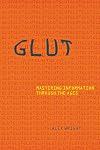
Wright's beautifully written book, Glut is the right book for you. Among other things, this book is a deeper exploration of the rich history of traditional information revolutions and how networks and hierarchies have co-existed for millennia mutually shaping each other. As Wright notes, the contributions of librarians from Callimachus (Library of Alexandria) in the 3rd Century BC to Cutter and Dewey in the 19th Century to Paul Otlet (the Mundaneum) and Eugene Garfield (precursor of show more bibliometrics and page ranking), in the 20th century A.D. to the present information organisation systems including the web has been phenomenon. The stories are fascinating.
Central to Wright's discussion is the role of libraries and librarians who contributed greatly such as Paul Otlet, who as Wright persuasively argues, envisioned today's web in the 1930's, well before Vannavar Bush. Wright discusses in great detail how Otlet's contributions could be on par with that of Vannevar Bush and Ted Nelson, all forbearers to Tim Berners-Lee's web. Important in this regard is the part of the discussion in the book on how Otlet came to conclude that catalogues and indexes available at the time could only guide the reader "as far as the individual book" but not to the relationship of the contents in other books; then Otlet saw the possibility of creating semantic links between documents (the "réseau").
The book is an important read for information architects, librarians and anyone interested about the web. It main contention is that hierarchies (traditional information organisation systems such as taxonomies) vis-à-vis networks (traditional tribal folk-categorisation systems and today's folksonomies) are not in opposition. Instead, as Wright argues, they complement each other. I think it is an interesting balance between ontologies and web 2.0 approaches. show less
Central to Wright's discussion is the role of libraries and librarians who contributed greatly such as Paul Otlet, who as Wright persuasively argues, envisioned today's web in the 1930's, well before Vannavar Bush. Wright discusses in great detail how Otlet's contributions could be on par with that of Vannevar Bush and Ted Nelson, all forbearers to Tim Berners-Lee's web. Important in this regard is the part of the discussion in the book on how Otlet came to conclude that catalogues and indexes available at the time could only guide the reader "as far as the individual book" but not to the relationship of the contents in other books; then Otlet saw the possibility of creating semantic links between documents (the "réseau").
The book is an important read for information architects, librarians and anyone interested about the web. It main contention is that hierarchies (traditional information organisation systems such as taxonomies) vis-à-vis networks (traditional tribal folk-categorisation systems and today's folksonomies) are not in opposition. Instead, as Wright argues, they complement each other. I think it is an interesting balance between ontologies and web 2.0 approaches. show less
Paul Otlet was a Belgian who lived through one of the most turbulent centuries in human history - born in 1868, he died in 1944. Hos obsession was to classify all human knowledge in a consistent way and provide practical ways to access that knowledge.
He began by developing methods to describe existing works - books, articles, etc. - on index cards. He later extended this to allow index entries not just for complete works, but for ideas or concepts within a work. Later still, he worked on show more designs for technologies to access and retrieve information through a workstation he called a Mundaneum.
Otlet is important for three reasons: first, much of his work on classification is still relevant and in use today; second, his approach was always very practical and based on actual, deliverable technologies or capabilities; and, third, he believed in a centralised hierarchical structure for managing knowledge and the access to it (although not necessarily for the centralised storage of that knowledge).
ABout a third of this book discusses the history of knowledge classification and then looks at the current Internet technologies and structures that address this issue. The author highlights areas of commonality and differences from Otlet’s work.
An interesting and highly relevant subject fore today’s electronic world, this work is let down by two weaknesses. The writing is too dry to make this an easy read. Perversely for a biography, too much time is devoted to the ups and downs and ins and outs of Otlet’s work. There should be more discussion of how the issues of who owns and manages classification and access to knowledge, with what objectives in mind, are developing on the Internet. show less
He began by developing methods to describe existing works - books, articles, etc. - on index cards. He later extended this to allow index entries not just for complete works, but for ideas or concepts within a work. Later still, he worked on show more designs for technologies to access and retrieve information through a workstation he called a Mundaneum.
Otlet is important for three reasons: first, much of his work on classification is still relevant and in use today; second, his approach was always very practical and based on actual, deliverable technologies or capabilities; and, third, he believed in a centralised hierarchical structure for managing knowledge and the access to it (although not necessarily for the centralised storage of that knowledge).
ABout a third of this book discusses the history of knowledge classification and then looks at the current Internet technologies and structures that address this issue. The author highlights areas of commonality and differences from Otlet’s work.
An interesting and highly relevant subject fore today’s electronic world, this work is let down by two weaknesses. The writing is too dry to make this an easy read. Perversely for a biography, too much time is devoted to the ups and downs and ins and outs of Otlet’s work. There should be more discussion of how the issues of who owns and manages classification and access to knowledge, with what objectives in mind, are developing on the Internet. show less
Lists
You May Also Like


Associated Authors
Statistics
- Works
- 4
- Members
- 808
- Popularity
- #31,570
- Rating
- 3.6
- Reviews
- 20
- ISBNs
- 32
- Languages
- 1