
Howard S. Becker (1928–2023)
Author of Writing for Social Scientists: How to Start and Finish Your Thesis, Book, or Article
About the Author
Howard S. Becker has made major contributions to the sociology of deviance, sociology of art, and sociology of music. He received a PhD from the University of Chicago, where he was also an instructor in sociology and social sciences. He was professor of sociology at Northwestern University for show more twenty-five years and later became a professor of sociology and an adjunct professor of music at the University of Washington. He lives and works in San Francisco and Paris. show less
Image credit: Howard S. Becker à l'École des hautes études en sciences sociales, à Paris. By Thierry Caro - Own work, CC BY-SA 3.0, https://commons.wikimedia.org/w/index.php?curid=22562108
Series
Works by Howard S. Becker
Writing for Social Scientists: How to Start and Finish Your Thesis, Book, or Article (1994) 644 copies, 7 reviews
Tricks of the Trade: How to Think about Your Research While You're Doing It (1998) 379 copies, 1 review
Making the Grade: The Academic Side of College Life (Foundations of Higher Education) (1968) 7 copies, 1 review
Mozart, el asesinato y los límites del sentido común: Cómo construir teoría a partir de casos (Sociología y política) (Spanish Edition) (2014) 5 copies, 1 review
Comment parler de la société : Artistes, écrivains, chercheurs et représentations sociales (2009) 4 copies
Cómo fumar marihuana y tener un buen viaje: Una mirada sociológica (Mínima) (Spanish Edition) (2019) 2 copies
Uma teoria da ação coletiva 2 copies
Historical Sociology 1 copy
History of ethnography 1 copy
Tagged
Common Knowledge
- Legal name
- Becker, Howard Saul
- Birthdate
- 1928-04-18
- Date of death
- 2023-08-16
- Gender
- male
- Education
- University of Chicago (BA|1946|MA|Ph.D|1951)
- Occupations
- sociologist
professor - Organizations
- University of Chicago
Stanford University
Northwestern University
University of Washington - Awards and honors
- Guggenheim Fellowship (1978-1979)
Charles Horton Cooley Award (1980)
Common Wealth Award (1981)
Cooley/Mead Award (1985)
George Herbert Mead Award (1987) - Relationships
- Anderson, Elijah (student)
- Nationality
- USA
- Birthplace
- Chicago, Illinois, USA
- Places of residence
- Chicago, Illinois, USA
San Francisco, California, USA
Paris, France - Place of death
- San Francisco, California, USA
- Associated Place (for map)
- USA
Members
Reviews
Writing for Social Scientists: How to Start and Finish Your Thesis, Book, or Article by Howard S. Becker
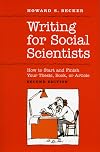
I love books about writing, which is one reason I have so many of them. After reading Becker’s Writing for Social Scientists I understand that reading them is also part of my ritual to avoid actually writing. For me Becker’s book is one of the most useful books on writing I have found in decades but a beginning writer might not share that opinion. Early on the book dismisses the idea that it is going to rehash the all rules we learned in English classes and from style guides. Becker show more focuses on getting people to sit down and write. He exposes our avoidance strategies and our fears then he shows us how to overcome them.
Although the title claims that it is for ‘social scientists’ the techniques and ideas in the book apply to most writers, the first half covers writing problems that even fiction writers grapple with. The second half gets deeper into nonfiction writing than the undergraduate’s mantra ‘cite your source’. Becker explains how those sources can make your job easier and when you should not use them.
The book is easy to read, it is obvious that Becker takes his own advice. I think this is an excellent book for anyone who wants to improve their writing and relieve the anxieties it can cause. show less
Although the title claims that it is for ‘social scientists’ the techniques and ideas in the book apply to most writers, the first half covers writing problems that even fiction writers grapple with. The second half gets deeper into nonfiction writing than the undergraduate’s mantra ‘cite your source’. Becker explains how those sources can make your job easier and when you should not use them.
The book is easy to read, it is obvious that Becker takes his own advice. I think this is an excellent book for anyone who wants to improve their writing and relieve the anxieties it can cause. show less

I really love ethnographic studies and this was a very interesting one to read as a current college student. This book is a little out of date and it does read that way a little bit. A lot of the language seems old and you can absolutely see how there have been many changes in the way colleges work and how students interact with that environment. One thing that I think is very different is students expectations of teachers. A lot of students now will research teachers before enrolling in a show more class and they have to rely a lot less on just what a professor says when figuring out how to get a good grade in the class. Overall I think this was very interesting and would love to see someone replicate this study with college today. show less
Tricks of the Trade: How to Think about Your Research While You're Doing It (Chicago Guides to Writing, Editing, and Publishing) by Howard S. Becker
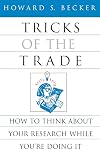
Pursuing excellence in research requires much self-discipline. Mentors are often the first ones to instill basic habits, but any one mentor (or even any group of mentors) lacks the ability to teach how to think about research completely. Indeed, mastering the art of research is a lifelong task. Fortunately, books like Becker’s provide good, patient tutoring on the path of a career in research. He provides “tricks” that specifically address those in the social sciences throughout the show more whole process of research.
Becker divides his book into several large chapters, including imagery, sampling, concepts, and logic. These cover the whole of the research process for those in the social sciences. (Caveat: I do not work in the social sciences but in informatics; I am reading this book to communicate with colleagues better.) Topics move from observation to data collection to theory to rigorous, critical examination. They demystify how a researcher can transform mere experiences into widely accepted theory.
This book would be great for a class on research methods, especially those interested in how qualitative research works. By itself, this book is not as much of an introduction as something to build with after an introduction. It seems most suitable late in an introductory course or at any point in an advanced course. Or after an introduction, those interested in learning more but without access to appropriate teaching can also benefit from Becker’s clear, engaging prose.
Graduate students in the social sciences, in particular, will benefit from this book, but its specialized nature does not restrict it to this primary audience. Practitioners, teachers, and anyone else involved in data collection in the social sciences can hone their skills through Becker’s wisdom. Indeed, though published almost 25 years ago, this book offers mountains of timeless advice that could just spur one’s research skills to the next level. show less
Becker divides his book into several large chapters, including imagery, sampling, concepts, and logic. These cover the whole of the research process for those in the social sciences. (Caveat: I do not work in the social sciences but in informatics; I am reading this book to communicate with colleagues better.) Topics move from observation to data collection to theory to rigorous, critical examination. They demystify how a researcher can transform mere experiences into widely accepted theory.
This book would be great for a class on research methods, especially those interested in how qualitative research works. By itself, this book is not as much of an introduction as something to build with after an introduction. It seems most suitable late in an introductory course or at any point in an advanced course. Or after an introduction, those interested in learning more but without access to appropriate teaching can also benefit from Becker’s clear, engaging prose.
Graduate students in the social sciences, in particular, will benefit from this book, but its specialized nature does not restrict it to this primary audience. Practitioners, teachers, and anyone else involved in data collection in the social sciences can hone their skills through Becker’s wisdom. Indeed, though published almost 25 years ago, this book offers mountains of timeless advice that could just spur one’s research skills to the next level. show less
Writing for social scientists: how to start and finish your thesis, book, or article (2nd edition) by Howard S. Becker
There is more than meets the eye in this book. Becker operates on two levels to show what it is that draws us to writing and how that, in turn, itself can be an obstacle - and how it can be managed. This is a great book.
Lists
Awards

You May Also Like


Associated Authors
Statistics
- Works
- 56
- Members
- 1,894
- Popularity
- #13,587
- Rating
- 3.9
- Reviews
- 16
- ISBNs
- 131
- Languages
- 9
- Favorited
- 1