
John Fitzgerald Kennedy (1) (1917–1963)
Author of Profiles in Courage
For other authors named John Fitzgerald Kennedy, see the disambiguation page.
About the Author
Image credit: John F. Kennedy, 1961-63 (Portrait)
Works by John Fitzgerald Kennedy
Listening In: The Secret White House Recordings of John F. Kennedy (2012) — Author — 192 copies, 2 reviews
Let the Word Go Forth: The Speeches, Statements, and Writings of John F. Kennedy 1947 to 1963 (1988) — Contributor — 115 copies
The Wit and Wisdom of John F. Kennedy: An A-to-Z Compendium of Quotations (1996) 17 copies, 1 review
Public papers of the Presidents of the United States: John F. Kennedy ; containing the public messages, speeches, and statements of the President, 1961-1963 8 copies, 1 review
Public Papers of the Presidents of the United States, John F. Kennedy, 1962, January 1 to December 31, 1962 (1963) 6 copies
Public Papers of the Presidents of the United States, John F. Kennedy, 1963, January 1 to November 22, 1963 (1964) 6 copies
John F. Kennedy, 1917-1963: Chronology-documents-bibliographical AIDS (The Presidential Chronologies) (1971) 4 copies
The Cuban missile crisis: President Kennedy's address to the nation, October 22, 1962 (Milestone documents in the National Archives) (1988) 3 copies
25 Classic Speeches 2 copies
A John F. Kennedy memorial miniature 2 copies
JFK: The Kennedy Tapes, Vol. I, Original Speeches of the Presidential Years (1992) 2 copies, 1 review
JFK: The Kennedy Tapes; Original Speeches of the Presidential Years: 1960-1963 [Audio Book] [Cassette] (1992) 2 copies
Quotations from the Scriptures 2 copies
The Kennedy Vision: Selections From the Speeches and Writings of John F. Kennedy and Robert F. Kennedy (1969) 2 copies
The Words of John F. Kennedy 1 copy
Rasgos de valor 1 copy
The Wit of President Kennedy 1 copy
Non chiederti cosa il tuo paese può fare per te, chiediti cosa puoi fare tu per il tuo paese (2014) 1 copy
The wisdom of JFK 1 copy
Obiettivo nuovo mondo 1 copy
John F. Kennedy on education 1 copy
The Cumulated indexes to the public papers of the Presidents of the United States, John F. Kennedy, 1961-1963 (1977) 1 copy
Toward a Strategy of Peace (United States. Arms Control and Disarmament Agency. Publication) (1963) 1 copy
Associated Works
Out of the Best Books: An Anthology of Literature, Vol. 4: The World Around Us (1968) — Contributor — 28 copies
Tagged
Common Knowledge
- Legal name
- Kennedy, John Fitzgerald
- Other names
- KENNEDY, John Fitzgerald
KENNEDY, John F. - Birthdate
- 1917-05-29
- Date of death
- 1963-11-22
- Gender
- male
- Education
- Harvard University (B.S. ∙ International Affairs ∙ 1940)
- Occupations
- military officer (United States Navy)
U.S. Congressman (1947-1953)
U.S. Senator (1953-1960)
politician - Organizations
- United States Navy
United States House of Representatives
United States Senate
Democratic Party - Awards and honors
- Navy and Marine Corps Medal
Presidential Medal of Freedom (1963)
Time Magazine, Man of the Year (1961)
Laetare Medal (1961) - Relationships
- Kennedy, Rose Fitzgerald (mother)
Kennedy, Joseph P. (father)
Onassis, Jacqueline Kennedy (wife)
Kennedy, Robert F. (brother)
Kennedy, Edward M. (brother)
Kennedy, Caroline (daughter) (show all 13)
Lawford, Christopher Kennedy (nephew)
Kennedy, Robert F., Jr. (nephew)
Shriver, Maria (niece)
O'Donnell, Kenneth P. (advisor)
Bundy, McGeorge (National Security Advisor)
Salinger, Pierre (Press Secretary)
Kennedy, John F., Jr. (son) - Cause of death
- assassination
- Nationality
- USA
- Birthplace
- Brookline, Massachusetts, USA
- Places of residence
- Brookline, Massachusetts, USA (birth)
The White House, Washington, D.C., USA - Place of death
- Dallas, Texas, USA
- Burial location
- Arlington National Cemetery, Arlington, Virginia, USA
- Associated Place (for map)
- USA
Members
Reviews
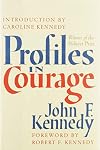
Kennedy was, and still is, many things to many people, but one of his aspects that doesn't get as much attention as it should is his writing. Profiles in Courage is a focused review of eight Senators in US history, chronicling instances where that man defied the pressures of various forces - his party, his state legislature, his President, but above all his constituents the American people - in a moment of national crisis, enduring insults from all sides in the conviction that the fevers of show more the moment would eventually pass and their lonely stands would be vindicated by history. Now, I personally happen to believe that there are few institutions more contemptible than the Senate, and I think that this prejudice is rightly shared by anyone regardless of partisanship who has paid even a bit of attention to the almost unbelievably corrupt bargains that take place there (see: TARP, the stimulus, health care reform, financial reform), so I was less than thrilled at the prospect of reading a self-congratulatory (Kennedy was a sitting Senator when he wrote the book) paean to one of the sorriest gangs of grandées in history. But by the end of it I was extremely impressed, not only by its scholarship and writing quality, but that Kennedy had actually made me admire some Senators of the United States. The underlying theme is that in order to tell the difference between an actual act of courage and your everyday Lieberman or Collins-ish fit of unprincipled to-thine-own-lobbyist-be-true petulance, the Senator in question has to be acting out of loyalty to both the future of the country, and to their own inner moral voice. This is how Kennedy can group Sam Houston's refusal to vote for Texas to join the Confederacy with George Norris' filibuster of the Armed Ship Bill in the runup to World War 1: in each case, the Senator was confronted with the dilemma of a clash between their own carefully-reasoned personal convictions, and their sense that they should represent the wishes of the people in their states. Kennedy was elected after the passage of the 17th Amendment, and discusses it in the fascinating final chapter, where he raises many good questions: What's the most democratic method to counter the flaws of democracy? When should the need for compromise outweigh the need to take a stand? Does it really serve the national interest to allow one man to obstruct everyone else? Should men subdue their own consciences in the interests of their party and their cause, or vice versa? He also links his notion of political courage to the virtue that everyday normal people would consider courage, thus placing the book a step above a mere political biography. Kennedy's Pulitzer was well-deserved, even if his adviser Ted Sorensen wrote a good deal of it. I'd previously thought that Barack Obama's books were fairly well-written, but this blew them away. show less
This is a deeply problematic book, and the fact that it is so widely lauded as a classic by many very intelligent people is a sign that our political ideals are based more on the idea of winning some game than of producing the best outcome for our country. Although it's not entirely untrue that some of the senators Kennedy profiled did show enormous courage, this is not necessarily a good thing in and of itself. Indeed, a number of the senators in this book have explicitly negative legacies. show more The most egregious is Lucius Lamar, who Kennedy praises for giving a nice speech for his political enemy Charles Sumner (who has much more right to be praised than Lamar does) and for going against the Southern tradition of a senator's vote being dictated by the state legislature, on the issue of free silver. What Kennedy does not mention is Lamar's central role in the fight against abolition and reconstruction in Mississippi -- in fact, Lamar was responsible for the infamous "Mississippi Plan," in which black voters were massacred, terrorized, and kept from the polls to ensure a Democratic victory in the 1875 elections. Whether or not the person responsible for such an egregious violation of democracy (Lamar wrote of the "blackest tyranny" of the "brute masses") was a good orator is beside the point -- it is impossible for a learned observer to call such a person courageous.
Of course Kennedy can be somewhat forgiven on this front, because he didn't write the book himself. Instead he gave the task to his speechwriter Thomas Sorenson, who is clearly not invested in the book. The writing is melodramatic and childish, and the sourcing incredibly sloppy (at least for the Lamar chapter, which again is the one I am the most familiar with). I doubt that either Kennedy or Sorenson even knew of Lamar's role in the Mississippi Plan. Nevertheless, we do get some idea of Kennedy's own beliefs filtered through Sorenson -- particularly his fascination with big, aristocratic families and the superior morality of the "genius." There is a distinct anti-democratic strain in this novel, which blames the "masses" for expecting to know better than their educated leaders. That Kennedy's millionaire father bought the Pulitzer (over the Committee's misgivings) just goes to show how deeply the belief in money and genius ran in that family.
Falsely attributed, sloppily sourced, and illegitimately awarded -- this book is a prime example of the corrupt, selfish view of politics held by JFK and his father. It suffers, as does the legacy of Kennedy himself, from a sick conception of politics as noble struggle, a Nietzschean proving ground where young aristocrats (like Kennedy and many of the senators mentioned) can get the power and respect they feel like they deserve. Skip this book unless you want an insight into the Kennedy family (who, to be fair, did produce a few genuinely inspiring politicans). show less
Of course Kennedy can be somewhat forgiven on this front, because he didn't write the book himself. Instead he gave the task to his speechwriter Thomas Sorenson, who is clearly not invested in the book. The writing is melodramatic and childish, and the sourcing incredibly sloppy (at least for the Lamar chapter, which again is the one I am the most familiar with). I doubt that either Kennedy or Sorenson even knew of Lamar's role in the Mississippi Plan. Nevertheless, we do get some idea of Kennedy's own beliefs filtered through Sorenson -- particularly his fascination with big, aristocratic families and the superior morality of the "genius." There is a distinct anti-democratic strain in this novel, which blames the "masses" for expecting to know better than their educated leaders. That Kennedy's millionaire father bought the Pulitzer (over the Committee's misgivings) just goes to show how deeply the belief in money and genius ran in that family.
Falsely attributed, sloppily sourced, and illegitimately awarded -- this book is a prime example of the corrupt, selfish view of politics held by JFK and his father. It suffers, as does the legacy of Kennedy himself, from a sick conception of politics as noble struggle, a Nietzschean proving ground where young aristocrats (like Kennedy and many of the senators mentioned) can get the power and respect they feel like they deserve. Skip this book unless you want an insight into the Kennedy family (who, to be fair, did produce a few genuinely inspiring politicans). show less
I never realized this book was about politician who stuck to what they knew was right! That's what happens when you hear about something so much but you never actually think to LOOK at it. A slim volume, all about people (mostly men, consider the times) who voted or stood for something that was basically guaranteed to lose them the next election.
When I finished the book, I wrote to the Library of Congress and nominated Liz Cheney for an award. It is too soon for her, but she spectacularly show more exemplified an elected official who stood for something all the while knowing it was her death knell. show less
When I finished the book, I wrote to the Library of Congress and nominated Liz Cheney for an award. It is too soon for her, but she spectacularly show more exemplified an elected official who stood for something all the while knowing it was her death knell. show less

In these days of political upheaval, I turned to John F. Kennedy, one of the heroes of my childhood, and to reread his account of those brave politicians who acted, not in their own interests, but in the interest of their country. I especially wanted to re-read his account of the Andrew Johnson impeachment and Edmund Ross, who voted for acquittal. It is eerily pertinent. Johnson decided to follow the path laid out by Abraham Lincoln to reunite the country. The radicals wanted to punish the show more south. So impeachment and removal was their way of getting rid of their obstacle. So it was with Clinton and so it is with Trump; a use of impeachment frowned upon by the Constitution. Edmund Ross and others refused to follow the others and for this he was vilified.
There are many other examples of courage in this book. We ought to take a deep breath and listen to these words by a Democrat who would no longer be welcome in his own party. It might make a difference. show less
There are many other examples of courage in this book. We ought to take a deep breath and listen to these words by a Democrat who would no longer be welcome in his own party. It might make a difference. show less
Lists
Awards


You May Also Like
Associated Authors
Statistics
- Works
- 96
- Also by
- 8
- Members
- 5,782
- Popularity
- #4,262
- Rating
- 3.8
- Reviews
- 53
- ISBNs
- 150
- Languages
- 9
- Favorited
- 2


