

David Nirenberg
Author of Anti-Judaism: The Western Tradition
About the Author
David Nirenberg is the Deborah R. and Edgar D. Jannotta Professor of Medieval History and Social Thought at the University of Chicago, where he is also director of the Neubauer Family Collegium for Culture and Society.
Works by David Nirenberg
Neighboring Faiths: Christianity, Islam, and Judaism in the Middle Ages and Today (2014) 45 copies, 1 review
Uncountable: A Philosophical History of Number and Humanity from Antiquity to the Present (2021) 28 copies
Judaism and Christian Art: Aesthetic Anxieties from the Catacombs to Colonialism (2011) — Editor — 9 copies
Aesthetic theology and its enemies : Judaism in Christian painting, poetry, and politics (2015) 8 copies
Associated Works
A Man of Three Worlds: Samuel Pallache, a Moroccan Jew in Catholic and Protestant Europe (2003) — Foreword, some editions — 34 copies, 1 review
Tagged
Common Knowledge
- Canonical name
- Nirenberg, David
- Birthdate
- 1964
- Gender
- male
- Education
- Yale University (BA|1986)
Princeton University (MA|1989, PhD|1992) - Occupations
- Associate Professor of History and Director of the Center for the Study of Cultures at Rice University
- Map Location
- USA
Members
Reviews
The subtitle is somewhat misleading—Nirenberg focuses not on the entire Middle Ages, but on a period of about two hundred years or so; his examination is not of all minorities but on Jews and Muslims (and to a lesser extent lepers); and his geographical concentration is not all of Europe, or even all of Western Europe, but rather southern France and Aragon. Though it doesn't quite accord with the expectations which its title raises, this is still a very fine book.
Nirenberg rejects the show more longue durée approach which sees incidents of violence against minorities as part of an inevitable, inescapable progression which can be directly linked to present day atrocities, and which ignores what may be long periods of stability between such incidents of violence (however horrifying those incidents may be). He argues for greater contextualisation of violent incidents by historians, and questions our assumptions that medieval people acted "irrationally" in response to unquestioned stereotypes—stereotypes and institutionalised bigotry, he argues, could be harnessed by people in order to achieve specific political or economic gains. The history of minorities also requires the unpacking of the history of the majority, as they are interdependent things. Nirenberg is careful to point to the horror of the events which he's describing, but there are times when his emphasis on violence against others as a means of identity formation skirts perilously close to that argument about the inevitability of violence which he refutes in others' work. show less
Nirenberg rejects the show more longue durée approach which sees incidents of violence against minorities as part of an inevitable, inescapable progression which can be directly linked to present day atrocities, and which ignores what may be long periods of stability between such incidents of violence (however horrifying those incidents may be). He argues for greater contextualisation of violent incidents by historians, and questions our assumptions that medieval people acted "irrationally" in response to unquestioned stereotypes—stereotypes and institutionalised bigotry, he argues, could be harnessed by people in order to achieve specific political or economic gains. The history of minorities also requires the unpacking of the history of the majority, as they are interdependent things. Nirenberg is careful to point to the horror of the events which he's describing, but there are times when his emphasis on violence against others as a means of identity formation skirts perilously close to that argument about the inevitability of violence which he refutes in others' work. show less
This is an absorbing study of the history of "anti-Judaism"--related to, but distinct from, antisemitism. Nirenberg isn't interested in the persecution of Jews as people as much as the ideas that have animated hatred of Jews and Judaism, even in the absence of Jews themselves. He examines the language surrounding Jews in the New Testament and the Quran, in medieval Spanish literature and modern philosophy. What Nirenberg shows is that anti-Judaism has been a continuous presence in western show more thought. show less
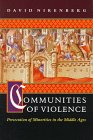
Nirenberg particularizes and differentiates the forms of violence against various minorities in 14th-century Aragon. By recognizing immediate functions and motives, he calls into question received metanarratives on the topic of the persecution of religious minorities. He makes rich use of both Christian and Jewish archival resources, including correspondence, edicts, and judicial and financial records.
In his opening arguments, Nirenberg criticizes what he calls a “structuralist” approach show more to the topic of medieval persecutions, exemplified by Robert Moore (but also present in the works of Norman Cohn and Carlo Ginzburg). He recognizes and objects to both romanticized histories of Iberian convivencia (e.g. N. Roth) and lachrymose history (Ytzakh Baer).
He theorizes violence and aggression as “forms of association” which help to reify cultural and religious boundaries, and to facilitate forms of coexistence. As a result, he comes to assert the interdependence of violence and tolerance in the multi-religious environment of medieval Iberia (and by implication, throughout medieval Europe).
In the last chapter and epilogue, he presents his most intriguing efforts to problematize the approach to medieval persecutions as symptoms of mentalites evolved over a long duree. On the one hand, he provides a detailed account of the anti-Jewish riots of Holy Week, to emphasize the ritual and customary dimensions of persecuting violence. In this case, he tries to outline a somewhat symbiotic “marriage of enemies” being transacted between Christians and Jews. And then as something of a counterbalance, he discusses the pogroms of 1348 and their context. In this case, he addresses the sense of narrative discontinuity and transformation in exemplary violence, suggesting that on this basis it should not be considered a barometer of persistent changes. show less
In his opening arguments, Nirenberg criticizes what he calls a “structuralist” approach show more to the topic of medieval persecutions, exemplified by Robert Moore (but also present in the works of Norman Cohn and Carlo Ginzburg). He recognizes and objects to both romanticized histories of Iberian convivencia (e.g. N. Roth) and lachrymose history (Ytzakh Baer).
He theorizes violence and aggression as “forms of association” which help to reify cultural and religious boundaries, and to facilitate forms of coexistence. As a result, he comes to assert the interdependence of violence and tolerance in the multi-religious environment of medieval Iberia (and by implication, throughout medieval Europe).
In the last chapter and epilogue, he presents his most intriguing efforts to problematize the approach to medieval persecutions as symptoms of mentalites evolved over a long duree. On the one hand, he provides a detailed account of the anti-Jewish riots of Holy Week, to emphasize the ritual and customary dimensions of persecuting violence. In this case, he tries to outline a somewhat symbiotic “marriage of enemies” being transacted between Christians and Jews. And then as something of a counterbalance, he discusses the pogroms of 1348 and their context. In this case, he addresses the sense of narrative discontinuity and transformation in exemplary violence, suggesting that on this basis it should not be considered a barometer of persistent changes. show less
I found this history truly rewarding, but it was a difficult read. The author has researched in the field of the history of ideas and produced an amazing analysis of how Western Civilization has used the idea of Judaism as a very productive tool of thought. This is history is not focused on Jewish people, history, or culture as much as it focuses on how Western Civilization has used the the idea of a people that are "other". He traces how Egyptians used anti-judaism as a means to bolster show more their self image especially after the Romans conquered them. There are chapters on the early Christians, on the Muslims, on Spain, and on toward modern times. One chapter discusses Shakespeare and "The Merchant of Venice" which is so interesting as there were effectively no Jews in England while Shakespeare lived. The chapters on the German philosophers is especially dense.
I remember reading Nietzsche in college and I completely blew off his remarks about Jews in the one book I had to write a paper on. Now I have a better idea why Nietzsche would have brought up the subject. Philosophers would use the concept of people who focus on literal truth as "Jewish" and would criticize one another using those terms. Spanish poets would do the same thing, even and especially after the Jews had been expelled from Spain!
I have not read such a history before. This is another gift of the Jews to Western Civilization - critical ideas for creating identity and conformity. show less
I remember reading Nietzsche in college and I completely blew off his remarks about Jews in the one book I had to write a paper on. Now I have a better idea why Nietzsche would have brought up the subject. Philosophers would use the concept of people who focus on literal truth as "Jewish" and would criticize one another using those terms. Spanish poets would do the same thing, even and especially after the Jews had been expelled from Spain!
I have not read such a history before. This is another gift of the Jews to Western Civilization - critical ideas for creating identity and conformity. show less
Lists
Awards


You May Also Like


Associated Authors
Statistics
- Works
- 10
- Also by
- 3
- Members
- 647
- Popularity
- #39,005
- Rating
- 3.9
- Reviews
- 8
- ISBNs
- 35
- Languages
- 3