
About the Author
Terry Wahls received a bachelor's degree of fine arts in studio art - painting from Drake University and a Medical Doctorate from the University of Iowa. She completed an Internal Medicine Residency at the University of Iowa and has been on faculty there since 2000. She teaches internal medicine show more residents, sees patients in a traumatic brain injury clinic, and conducts clinical trials. Her first book, The Wahls Protocol: How I Beat Progressive MS Using Paleo Principles and Functional Medicine, was published in 2014. (Bowker Author Biography) show less
Works by Terry Wahls
The Wahls Protocol: A Radical New Way to Treat All Chronic Autoimmune Conditions Using Paleo Principles (2014) 240 copies, 7 reviews
Tagged
Common Knowledge
- Canonical name
- Wahls, Terry
Members
Reviews
The Wahls Protocol: A Radical New Way to Treat All Chronic Autoimmune Conditions Using Paleo Principles by Terry Wahls
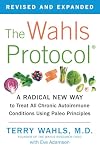
The Wahls Protocol is an inspiring and science-based guide to reclaiming health through nutrition and lifestyle change. Dr. Terry Wahls, a physician who was once confined to a wheelchair due to multiple sclerosis, shares her remarkable recovery story and the plan she created to rebuild her strength. The book combines personal testimony with deep research on how food affects cellular health and inflammation.
What makes this book stand out is its clarity and practicality. Dr. Wahls lays out show more specific levels of the protocol so readers can adapt at their own pace. She emphasizes real food, nutrient density, and removing toxins from the diet rather than relying on quick fixes. Her background in medicine gives the advice credibility, while her personal journey gives it emotional power.
Overall, The Wahls Protocol is both motivational and informative. It challenges the reader to take control of their health and proves that lifestyle and nutrition can be powerful tools in managing chronic illness. show less
What makes this book stand out is its clarity and practicality. Dr. Wahls lays out show more specific levels of the protocol so readers can adapt at their own pace. She emphasizes real food, nutrient density, and removing toxins from the diet rather than relying on quick fixes. Her background in medicine gives the advice credibility, while her personal journey gives it emotional power.
Overall, The Wahls Protocol is both motivational and informative. It challenges the reader to take control of their health and proves that lifestyle and nutrition can be powerful tools in managing chronic illness. show less
The Wahls Protocol Cooking for Life: The Revolutionary Modern Paleo Plan to Treat All Chronic Autoimmune Conditions by Terry Wahls
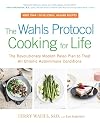
I picked up this book after reading The Wahls Protocol, where Terry Wahls shares her journey from being diagnosed with MS to becoming an advocate, and how deeply nutrition impacted her health and daily life. This cookbook is a practical follow-up, offering straightforward recipes that help you actually put her dietary approach into action.
What stood out to me is that this focus on mitochondria isn’t unique to her work. Books like Brain Energy also highlight how mitochondrial function may show more play a role in disease development. Wahls takes that idea and turns it into something very tangible. This cookbook is essentially a hands-on way to eat in a way that aims to support your mitochondria, using nutrient-dense, whole foods rather than abstract theory. show less
What stood out to me is that this focus on mitochondria isn’t unique to her work. Books like Brain Energy also highlight how mitochondrial function may show more play a role in disease development. Wahls takes that idea and turns it into something very tangible. This cookbook is essentially a hands-on way to eat in a way that aims to support your mitochondria, using nutrient-dense, whole foods rather than abstract theory. show less
The Wahls Protocol Cooking for Life The Revolutionary Modern Paleo Plan to Treat All Chronic Autoimmune Conditions by Terry Wahls

nonfiction/recipe companion book to Wahls' other book (Functional Medicine, holistic healing through food, Keto and non-Keto recipes).
This didn't go into the details of the why (for that you have to read the first book, I guess), but I liked that this is a practicing doctor who became a Functional Medicine convert (after reversing her multiple sclerosis symptoms with diet), and who still practices licensed medicine--NOT a less-credentialed person who makes money primarily through selling show more books and products, as you often see in this field (lots of desperate, terminal people provide a big market for quack schemes, unfortunately).
I also really liked that this provided recipes for three different levels of the Wahls' diet, each progressively more extreme/difficult, so that one can either stop at the level that suits their personal health, or can use them to ease themselves into the most difficult and extreme level, the Keto diet (ketosis is when your body has no sugar/carbs to burn, so it burns your fat--it is apparently super effective in speeding up the recovery time of surgery patients and even patients with Stage 4 cancers, but of course in order to get to ketosis you basically have to eliminate all sugars and carbs from your diet, so you've really got to be serious about it). Fortunately, this book includes recipes for the rest of us. show less
This didn't go into the details of the why (for that you have to read the first book, I guess), but I liked that this is a practicing doctor who became a Functional Medicine convert (after reversing her multiple sclerosis symptoms with diet), and who still practices licensed medicine--NOT a less-credentialed person who makes money primarily through selling show more books and products, as you often see in this field (lots of desperate, terminal people provide a big market for quack schemes, unfortunately).
I also really liked that this provided recipes for three different levels of the Wahls' diet, each progressively more extreme/difficult, so that one can either stop at the level that suits their personal health, or can use them to ease themselves into the most difficult and extreme level, the Keto diet (ketosis is when your body has no sugar/carbs to burn, so it burns your fat--it is apparently super effective in speeding up the recovery time of surgery patients and even patients with Stage 4 cancers, but of course in order to get to ketosis you basically have to eliminate all sugars and carbs from your diet, so you've really got to be serious about it). Fortunately, this book includes recipes for the rest of us. show less
The Wahls Protocol: How I Beat Progressive MS Using Paleo Principles and Functional Medicine by Terry Wahls
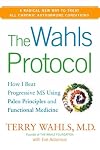
This is a well thought out book that, as the title says, uses diet and what the author calls Functional Medicine, to attack her progressive MS. She was motivated by the paleo diet movement and the Institute for Functional Medicine. That institute is based on the foundational principle that the current clinical model for treating disease, especially chronic disease, is obsolete.
I have a form of MS that my neurologist classifies as progressive relapsing. After ten years of care I have a lot of show more sympathy for the idea that a change in the way care is done could use some updating. I take a fair number of drugs. I have been through four different protocols for specifically addressing the MS. The progression of my MS has marched right along throughout all of them. I also take eleven other medications that address various symptoms that I have. All of them have been helpful in helping me maintain a better quality of life during the progression.
The effectiveness of all of them has seemed to have faded over time, though, as the various symptoms inexorably march on. I often wonder whether it is worth taking them.
I have also faithfully worked at many of the alternative therapies that Wahl talks about. For me the most effective ones have been yoga, exercise and meditation. My diet has also changed very dramatically. My calorie intake is much lower and I eat a lot of fruit. There are some meat based proteins and a lot fewer carbs. A lot more fiber.
After ten years I have found that the meditation has opened up a great gift for me: acceptance. In the history of this group we call human beings there is long, deep cultural support for that idea. It was a bit of surprise for me to discover that fact after living within a culture of great personal empowerment. There is a lot to be said for empowerment of the individual and I have lived most of my life being enriched in many senses of that word pursuing the individual goal setting and action based days that that model calls for.
I'm in a place now where I am at peace in accepting the trajectory that I am on. I say three cheers to Dr. Wahl for her rational, evidence based approach. I hope it continues to work for her and her Wahl warriors. And I hope that the clinical testing that she has correctly undertaken winds up supporting her hypothesis.
And I ask that as a society we leave room for both paths.
This is perhaps more than a book review. I hope that some folks out there find it helpful. show less
I have a form of MS that my neurologist classifies as progressive relapsing. After ten years of care I have a lot of show more sympathy for the idea that a change in the way care is done could use some updating. I take a fair number of drugs. I have been through four different protocols for specifically addressing the MS. The progression of my MS has marched right along throughout all of them. I also take eleven other medications that address various symptoms that I have. All of them have been helpful in helping me maintain a better quality of life during the progression.
The effectiveness of all of them has seemed to have faded over time, though, as the various symptoms inexorably march on. I often wonder whether it is worth taking them.
I have also faithfully worked at many of the alternative therapies that Wahl talks about. For me the most effective ones have been yoga, exercise and meditation. My diet has also changed very dramatically. My calorie intake is much lower and I eat a lot of fruit. There are some meat based proteins and a lot fewer carbs. A lot more fiber.
After ten years I have found that the meditation has opened up a great gift for me: acceptance. In the history of this group we call human beings there is long, deep cultural support for that idea. It was a bit of surprise for me to discover that fact after living within a culture of great personal empowerment. There is a lot to be said for empowerment of the individual and I have lived most of my life being enriched in many senses of that word pursuing the individual goal setting and action based days that that model calls for.
I'm in a place now where I am at peace in accepting the trajectory that I am on. I say three cheers to Dr. Wahl for her rational, evidence based approach. I hope it continues to work for her and her Wahl warriors. And I hope that the clinical testing that she has correctly undertaken winds up supporting her hypothesis.
And I ask that as a society we leave room for both paths.
This is perhaps more than a book review. I hope that some folks out there find it helpful. show less
You May Also Like


Associated Authors
Statistics
- Works
- 3
- Members
- 327
- Popularity
- #72,481
- Rating
- 4.1
- Reviews
- 11
- ISBNs
- 17