
Magdalen Nabb (1947–2007)
Author of Death of an Englishman
About the Author
Magdalen Nabb 1947 - 2007 Children's author and crime writer Magdalen Nabb was born in Lancashire, England on January 16, 1947. She is the author of the Salvatore Guarnaccia series and the Josie Smith books. Her book Josie Smith was runner-up for the Guardian Children's Fiction Award in 1989 and show more Josie Smith and Eileen won the Smarties Book Prize in l99l. Occasionally she writes journalistic pieces for English, German, and Italian newspapers. Her final novel, Vita Nuova, was posthumously published in 2008. She died because of a stroke while in Florence, Italy, on August 18, 2007. She was 60 years old. (Bowker Author Biography) show less
Image credit: http://diasquevoam.blogspot.com
Series
Works by Magdalen Nabb
Associated Works
Tagged
Common Knowledge
- Birthdate
- 1947-01-16
- Date of death
- 2007-08-18
- Gender
- female
- Education
- Convent Grammar School, Bury
- Occupations
- potter
crime novelist
children's book author
teacher - Agent
- Diogenes Verlag, Zürich
- Relationships
- Simenon, Georges (long-time correspondent)
- Short biography
- According to her Web site, Magdalen Nabb was born in Church, a moorland village in Lancashire, England. She studied art and, later, pottery which she taught in an English art school whilst exhibiting her own work until 1975 when she moved to Florence, Italy. There, she continued to work on pottery in a majolica studio in Montelupo Fiorentino, a pottery town near Florence, and began writing. It was in Montelupo that she met the model for Marshal Guarnaccia. The town itself, with its tumbledown factories and its wonderful restaurant, are featured in The Marshal and the Murderer. She lived and wrirote in Florence, near enough to the carabinieri station in the Pitti Palace to stroll there regularly and have a chat with the marshal who kept her up to date on crime in the city. She wrote for adults and for children and did occasional journalistic pieces for English, German and Italian papers.
- Nationality
- UK
- Birthplace
- Church, Lancashire, England, UK
- Places of residence
- Church, Lancashire, England, UK (birth)
Florence, Tuscany, Italy
Ramsbottom, Lancashire, England, UK - Place of death
- Florence, Tuscany, Italy
- Map Location
- England, UK
Members
Reviews

It’s a few days before Christmas and all Marshal Salvatore Guarnaccia, a Sicilian based in Florence, wants to do is travel south to spend the holiday with his family. But he is in bed sick with the flu. The city's police stations are understaffed due to the impending holidays and anyway Pitti station usually only has minor crimes to deal with, so when a call comes through about a murder Carabinieri Bacci, a young cadet still at police school, is unsure whether to wake the Marshal or begin show more investigating himself. Bacci is always impeccably dressed, well intentioned and knows all the textbook procedures has absolutely no practical experience.
When Bacci arrives alone at a small apartment complex he discovers the body of Mr. Langley-Smythe, a seemingly respectable English bachelor who had previously worked for the British embassy in Rome before retiring to Florence. More puzzling however, is an ancient Roman majolica bust found nearby and a safe filled with various foreign banknotes. Langley-Smythe was an apparent reclusive miser with no known friends or enemies, so who shot him in the back and where did all the money come from?
Being a British citizen with some influential family members two detectives from New Scotland Yard are sent to assist in the investigation. The British detectives have very limited Italian language skills whilst Bacci's Captain speaks no English at all so Bacci is kept on the investigation to act as an interpreter.
Initially it seemed somewhat disconcerting that Guarnaccia is pretty well permanently laid up in bed and has very little involvement in the actual investigation given that he is supposedly the central figure of these books. Initially we only see him through Bacci's eyes, who regards him as an obese old man with possible Mafia links. But as the book reaches its climax we see Guarnaccia in a very different light, as a sensitive man and a good detective.
It's always interesting to see how different cultures react to one another when thrown together in a situation, throw in the added complication of a language barrier and you have the ingredients of an interesting tale, and Nabb seems to have been a keen observer.
There is a real motley crew of neighbours living in the victim's apartment block who add both colour and humour. We are shown the role of Italian night guards, given a glimpse into the relations between the North and the South of the country, the shady world of illegal antique exports and Nabb takes a sly poke at British ex-pats who live in the country without bothering to try to learn the language or the food. But the most important element is the city itself. You can almost visualise its narrow streets with its once grand buildings now struggling under the ravages of modern traffic.
In truth I'm not a real fan of detective novels but it felt like a homage to the Sherlock Holmes' novels, where others do all the grunt work and then Holmes or in this case Guarniccia with a piece of insight solves the crime. This also had the distinction that come the end of the book I felt that the murderer was the real victim here.
I found this a quick, entertaining read with some interesting characters. I'm curious to learn more about the Marshal and I cannot help but feel that Nabb was only testing the water with this book so surely those that follow must be even better so consequently I will be keeping my eyes peeled for the next book in the series. show less
When Bacci arrives alone at a small apartment complex he discovers the body of Mr. Langley-Smythe, a seemingly respectable English bachelor who had previously worked for the British embassy in Rome before retiring to Florence. More puzzling however, is an ancient Roman majolica bust found nearby and a safe filled with various foreign banknotes. Langley-Smythe was an apparent reclusive miser with no known friends or enemies, so who shot him in the back and where did all the money come from?
Being a British citizen with some influential family members two detectives from New Scotland Yard are sent to assist in the investigation. The British detectives have very limited Italian language skills whilst Bacci's Captain speaks no English at all so Bacci is kept on the investigation to act as an interpreter.
Initially it seemed somewhat disconcerting that Guarnaccia is pretty well permanently laid up in bed and has very little involvement in the actual investigation given that he is supposedly the central figure of these books. Initially we only see him through Bacci's eyes, who regards him as an obese old man with possible Mafia links. But as the book reaches its climax we see Guarnaccia in a very different light, as a sensitive man and a good detective.
It's always interesting to see how different cultures react to one another when thrown together in a situation, throw in the added complication of a language barrier and you have the ingredients of an interesting tale, and Nabb seems to have been a keen observer.
There is a real motley crew of neighbours living in the victim's apartment block who add both colour and humour. We are shown the role of Italian night guards, given a glimpse into the relations between the North and the South of the country, the shady world of illegal antique exports and Nabb takes a sly poke at British ex-pats who live in the country without bothering to try to learn the language or the food. But the most important element is the city itself. You can almost visualise its narrow streets with its once grand buildings now struggling under the ravages of modern traffic.
In truth I'm not a real fan of detective novels but it felt like a homage to the Sherlock Holmes' novels, where others do all the grunt work and then Holmes or in this case Guarniccia with a piece of insight solves the crime. This also had the distinction that come the end of the book I felt that the murderer was the real victim here.
I found this a quick, entertaining read with some interesting characters. I'm curious to learn more about the Marshal and I cannot help but feel that Nabb was only testing the water with this book so surely those that follow must be even better so consequently I will be keeping my eyes peeled for the next book in the series. show less

There's a wonderful sense of place in this book. Not the Florence that the tourists see, perhaps, but the Florence where the trauma of the 1966 Flood lies just below the surface and the residents face daily frustration trying to find a store open during August. The author's portrayal of the Carabineri is fairly true to what Italians might expect. The problem of turnover with young and clueless National Service recruits constantly joining the barracks (and leaving soon after they get a clue) show more is probably quite accurate. And it's brilliant to have a Sicilian protagonist, because he is a bit of an outsider, like the reader. I occasionally felt that the author, despite having lived in Italy, may have over-compensated or over-translated for British readers' sensibilities. I couldn't wrap my mind around someone giving a person's weight at 25 stones when I'd expect kilos. When I fact-checked, Italy not only had adopted the metric system by 1970, it had already been the standard for over 100 years by that point. Minor quibble. I enjoyed the book a lot, and the mystery was well done. The Marshal wasn't quick to come to the point (and who could be, in the August heat of Italy), but it was a more pleasant book that way. It would have been a keeper, but ironically, the book got forgotten outside in an unexpected thunderstorm and became as waterlogged as the books of Florence in 1966. It's a high compliment to the book that I made the effort to dry it out enough to read the last 150 pages. I also should say that it surprised me to discover that it was 6th in a series. I never felt that I came in too late and missed something, nor did the author spend time in tedious recapitulation. Unusual! show less
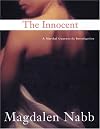
Nabb changes pace with this Marshal Guarnaccia story, the 13th in the series. She returns to a more conventional style of storytelling in this account of the investigation of the murder of a Japanese young woman who is an apprentice to a world-famous shoe craftsman.
While the plot is very good, what makes this book truly interesting is the Marshal himself. Over the last few books, including Some Bitter Taste and Property of Blood and now The Innocent, Guarnaccia's emotional involvement with show more his children has evolved. While as far as the story is concerned, he is still too busy to take as active a part in his family life as he would like, his worry about his children, especially the young one, Totó, is directly related to what he must deal with in his professional life. Teresa his wife continues to grow in importance to the stories, providing support and what Guarnaccia sees as a "woman's common sense" to his cases and his emotional reaction to them.
The Marshal continues to become more complex and the books continue to improve. A distinct contrast with Donna Leon's Commisario Brunetti series, Guarnaccia does not have Brunetti's sophistication nor does Teresa have Paola's glamor and intellectual chic. But both investigators are attractive figures in dramatically different ways, and the family lives are believable and evoke empathy. Florence is not Venice, although the former continues to be portrayed in more detail as the series goes on.
Highly recommended. There isn't a bad book in the series. show less
While the plot is very good, what makes this book truly interesting is the Marshal himself. Over the last few books, including Some Bitter Taste and Property of Blood and now The Innocent, Guarnaccia's emotional involvement with show more his children has evolved. While as far as the story is concerned, he is still too busy to take as active a part in his family life as he would like, his worry about his children, especially the young one, Totó, is directly related to what he must deal with in his professional life. Teresa his wife continues to grow in importance to the stories, providing support and what Guarnaccia sees as a "woman's common sense" to his cases and his emotional reaction to them.
The Marshal continues to become more complex and the books continue to improve. A distinct contrast with Donna Leon's Commisario Brunetti series, Guarnaccia does not have Brunetti's sophistication nor does Teresa have Paola's glamor and intellectual chic. But both investigators are attractive figures in dramatically different ways, and the family lives are believable and evoke empathy. Florence is not Venice, although the former continues to be portrayed in more detail as the series goes on.
Highly recommended. There isn't a bad book in the series. show less
This is the first book in this series that I have read and I felt I was starting a little behind. It seemed it was assumed the reader would already know who the Marshal was and what his position was. Only I didn’t and I had a little trouble figuring out how he fit into the Florence law enforcement structure. The beginning felt a little slow but that helped set the stage for the slow pace of all of Florence in August. There are a lot of interesting characters here and they are all written show more so they feel real and believable. And the Marshall becomes involved with all of them, as every witness and suspect seems to have a problem that the Marshall tries to fix even though he has a murder to solve. And as he tries to figure out who this old madwoman was he learns about the floods that devastated lives in years past, delves into the plight of the mentally ill and tries to work within the tight knit community that has its own rules. So the book has a lot of parts. But they are all woven in seamlessly so nothing feel extraneous or out of place and the book is about the community and the people and not just this one case. I liked the writing and the story but I think I would have enjoyed it more if I had read the others in the series so I would know the history of the characters that I feel like I was missing. show less
Lists
Awards


You May Also Like


Associated Authors
Statistics
- Works
- 30
- Also by
- 3
- Members
- 3,188
- Popularity
- #8,016
- Rating
- 3.4
- Reviews
- 82
- ISBNs
- 288
- Languages
- 9
- Favorited
- 3