
Patrick M. Lencioni
Author of The Five Dysfunctions of a Team: A Leadership Fable
About the Author
Patrick Lencioni has written numerous business books including The Five Dysfunctions of a Team, The Three Signs of a Miserable Job, The Three Big Questions for a Frantic Family, and The Ideal Team Player: How to Recognize and Cultivate the Three Essential Virtues. As president and founder of The show more Table Group, he has consulted to CEOs and leadership teams in organizations ranging from Fortune 500 companies and professional sports teams to universities and non-profits. In addition to his books, his work has been featured in numerous publications including Harvard Business Review, The Wall Street Journal, Fortune, and USA Today. (Bowker Author Biography) show less
Image credit: ChurchLeaders.com
Series
Works by Patrick M. Lencioni
Overcoming the Five Dysfunctions of a Team: A Field Guide for Leaders, Managers, and Facilitators (2005) 1,398 copies, 10 reviews
Death by Meeting: A Leadership Fable about Solving the Most Painful Problem in Business (2004) 1,314 copies, 14 reviews
The Advantage: Why Organizational Health Trumps Everything Else In Business (2012) 1,303 copies, 12 reviews
The Ideal Team Player: How to Recognize and Cultivate The Three Essential Virtues (J-B Lencioni Series) (2016) 804 copies, 9 reviews
Silos, Politics and Turf Wars: A Leadership Fable About Destroying the Barriers That Turn Colleagues Into Competitors (2006) 654 copies, 8 reviews
The Three Signs of a Miserable Job: A Fable for Managers (And Their Employees) (2007) 551 copies, 6 reviews
Getting Naked: A Business Fable About Shedding The Three Fears That Sabotage Client Loyalty (2009) 353 copies, 5 reviews
The 6 Types of Working Genius: A Better Way to Understand Your Gifts, Your Frustrations, and Your Team (2022) 261 copies, 5 reviews
The 3 Big Questions for a Frantic Family: A Leadership Fable... About Restoring Sanity To The Most Important Organization In Your Life (2008) 236 copies, 5 reviews
The Motive: Why So Many Leaders Abdicate Their Most Important Responsibilities (J-B Lencioni Series) (2021) 201 copies, 1 review
The Truth About Employee Engagement: A Fable About Addressing the Three Root Causes of Job Misery (2015) 173 copies, 2 reviews
The Five Dysfunctions of a Team, Manga Edition: An Illustrated Leadership Fable (2008) 69 copies, 2 reviews
Managing for Employee Engagement: A Workshop Based on The Three Signs of a Miserable Job Deluxe Facilitator's Guide Set (2011) 3 copies
The Five Dysfuntions of a Team and Overcoming the Five Dysfuntions of a Team a Field Guide for Leaders, Managers and Fac (2002) 2 copies
Optimisez Votre Équipe 1 copy
Associated Works
The Imperfect Board Member: Discovering the Seven Disciplines of Governance Excellence (2006) — Foreword, some editions — 138 copies
Derailed: Five Lessons Learned from Catastrophic Failures of Leadership (NelsonFree) (2009) — Foreword — 70 copies, 1 review
Tagged
Common Knowledge
- Birthdate
- 1965-07-23
- Gender
- male
- Occupations
- consultant
author
speaker - Organizations
- The Table Group
Bain & Company
Oracle Corporation
Sybase - Nationality
- USA
- Places of residence
- Alamo, California, USA
Bakersfield, California, USA - Associated Place (for map)
- California, USA
Members
Reviews
The Five Dysfunctions of a Team: A Leadership Fable (J-B Lencioni Series Book 43) by Patrick Lencioni
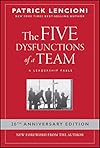
For all the attention that it has received over the years from scholars, coaches, teachers, and the media, teamwork is as elusive as it has ever been within most organizations. The fact remains that teams, because they are made up of imperfect human beings, are inherently dysfunctional.
This was not bad, and I really thought it was going to be when I realized three quarters of the book was a fictional story about a CEO implementing the model of team dynamics the book espouses. The above quote show more from the introduction made me feel much better; it's rare for a management book to begin with a frank recognition of the darkness of the human heart. However, the model boils that down to only five main dysfunctions, and I question whether the treatments offered for them are really all that effective (although just walking the talk and becoming effective at discipline are a world of good medicine, there can be no doubt). That said, it's a quick read and the concepts (which take about twenty pages to actually lay out) may be made marginally more memorable by the 'fable,' but you could also go straight to page 187 (in the edition I read) and finish the book from there. I will say that it is refreshing to read a management book that has one simple, straightforward model, giving it a chance of actually being used. Also, it is not a baloney bunch of corporate speak; it is good sense. (If good sense were practiced by any significant population of leadership out there, we could dispense with this whole genre, but it isn't, so maybe a few folks will read this and improve.)
**Edited 6/30/15 to fix typo** show less
This was not bad, and I really thought it was going to be when I realized three quarters of the book was a fictional story about a CEO implementing the model of team dynamics the book espouses. The above quote show more from the introduction made me feel much better; it's rare for a management book to begin with a frank recognition of the darkness of the human heart. However, the model boils that down to only five main dysfunctions, and I question whether the treatments offered for them are really all that effective (although just walking the talk and becoming effective at discipline are a world of good medicine, there can be no doubt). That said, it's a quick read and the concepts (which take about twenty pages to actually lay out) may be made marginally more memorable by the 'fable,' but you could also go straight to page 187 (in the edition I read) and finish the book from there. I will say that it is refreshing to read a management book that has one simple, straightforward model, giving it a chance of actually being used. Also, it is not a baloney bunch of corporate speak; it is good sense. (If good sense were practiced by any significant population of leadership out there, we could dispense with this whole genre, but it isn't, so maybe a few folks will read this and improve.)
**Edited 6/30/15 to fix typo** show less
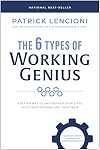
I have read nearly every book Lencioni has written (all except _The Advantage_)--in fact, the company I work for tipped me off to him as an author, even providing copies of/asking us to read _The Five Dysfunctions of a Team_ and _The Ideal Team Player_. I'll admit up front that my department has implemented the ITP accordingly and incorporates it into hiring discussions.
So, I was really excited when I found out about this book (and got a copy on NetGalley)!
It absolutely lived up to my show more expectations. I spent a good portion of last year reading Marcus Buckingham's books on strengths-based leadership and work (_First, Break All the Rules_, _Next, Discover Your Strengths_, and _Go Put Your Strengths to Work_), and found this to be a refreshing addition to that series. (And, frankly, it's more up to date: _Go Put Your Strengths to Work_ released in 2007, and while the core messaging is still absolutely relevant, its corresponding online content has shifted over to and folded into the Clifton Strengths, under the Gallup Group umbrella. Fine and dandy, but nice to have fresh material still affiliated with the author--Buckingham has moved on.)
As ever, Lencioni presents his findings and material via a leadership fable. It's a bit more casual in tone than I remember some of the other fables, but nevertheless remains in his classic style. (I'll note the one reason I don't give it a full 5 stars is simply due to language, especially vis-a-vis the church and faith thread [which I loved] weaved throughout.) He includes plenty of material post-fable, along with a direction to his website for even more. I'm really excited about that element; I love to learn, and the idea of a certification in this material intrigues me.
I think individuals and teams can learn a lot from the book and corresponding material, and look forward to doing my own self-analysis.
4.5/5 stars.
I received an eARC of the book from the publisher via NetGalley. All opinions are my own. show less
So, I was really excited when I found out about this book (and got a copy on NetGalley)!
It absolutely lived up to my show more expectations. I spent a good portion of last year reading Marcus Buckingham's books on strengths-based leadership and work (_First, Break All the Rules_, _Next, Discover Your Strengths_, and _Go Put Your Strengths to Work_), and found this to be a refreshing addition to that series. (And, frankly, it's more up to date: _Go Put Your Strengths to Work_ released in 2007, and while the core messaging is still absolutely relevant, its corresponding online content has shifted over to and folded into the Clifton Strengths, under the Gallup Group umbrella. Fine and dandy, but nice to have fresh material still affiliated with the author--Buckingham has moved on.)
As ever, Lencioni presents his findings and material via a leadership fable. It's a bit more casual in tone than I remember some of the other fables, but nevertheless remains in his classic style. (I'll note the one reason I don't give it a full 5 stars is simply due to language, especially vis-a-vis the church and faith thread [which I loved] weaved throughout.) He includes plenty of material post-fable, along with a direction to his website for even more. I'm really excited about that element; I love to learn, and the idea of a certification in this material intrigues me.
I think individuals and teams can learn a lot from the book and corresponding material, and look forward to doing my own self-analysis.
4.5/5 stars.
I received an eARC of the book from the publisher via NetGalley. All opinions are my own. show less

We were assigned this book for preparation for our quarterly manager's roundtable and I'm pretty confident that Lencioni is my favorite business book author. His use of fictional scenarios and tying them easily to the principles he's trying to teach is endearing and puts it well above other business books I've been assigned.
The "fable" parts humanize theory, I'm engaged in how the story progresses and when the second part of the book references specific characters, the ideas really click in show more mind. I will be using "hungry, humble, smart" for my own team evaluation and am very keen to read other Lencioni books in this genre. show less
The "fable" parts humanize theory, I'm engaged in how the story progresses and when the second part of the book references specific characters, the ideas really click in show more mind. I will be using "hungry, humble, smart" for my own team evaluation and am very keen to read other Lencioni books in this genre. show less

I thought the fictional company was a genius move, a way of incorporating business theory and applying it to a situation that we can easily understand, and be invested in. I've known nearly every type of personality that Lencioni constructs and I couldn't believe how interested in the story I was. It forced me to look back at all the successful teams I've been apart of, and all the terrible teams I've been a part of and it's remarkable how true the book's lessons are and how they apply to show more all types of organizations in real life. Terrific! show less
Lists
Awards


You May Also Like


Associated Authors
Statistics
- Works
- 54
- Also by
- 5
- Members
- 13,581
- Popularity
- #1,706
- Rating
- 3.9
- Reviews
- 156
- ISBNs
- 265
- Languages
- 20
- Favorited
- 3