
Emily Rosenberg
Author of Spreading the American Dream : American Economic and Cultural Expansion, 1890-1945
About the Author
Emily S. Rosenberg is DeWitt Wallace Professor of History at Macalester College.
Works by Emily Rosenberg
Spreading the American Dream : American Economic and Cultural Expansion, 1890-1945 (1982) 102 copies, 2 reviews
Financial Missionaries to the World: The Politics and Culture of Dollar Diplomacy, 1900-1930 (2003) 37 copies
Associated Works
A Century of Revolution: Insurgent and Counterinsurgent Violence during Latin America’s Long Cold War (2010) — Series Editor — 47 copies, 1 review
Tagged
Common Knowledge
- Gender
- female
- Occupations
- author
- Nationality
- USA
- Birthplace
- Sheridan, Wyoming, USA
- Associated Place (for map)
- Wyoming, USA
Members
Reviews
A Date Which Will Live: Pearl Harbor in American Memory (American Encounters/Global Interactions) by Emily S. Rosenberg

Rosenberg traces the memory of the attack on Pearl Harbor, connecting it with 9/11. This is a fascinating book. She covers historical memory, and how media affect that memory. One telling account is of a survivor of Pearl Harbor who "remembers" seeing the smiling faces of a Japanese pilot as he dropped the bombs; this is obviously an implanted from some movie.
I do not agree with all of her conclusions, but it is a must read for anyone who thinks memory is infallible.
I do not agree with all of her conclusions, but it is a must read for anyone who thinks memory is infallible.
Spreading the American Dream: American Economic and Cultural Expansion, 1890-1945 (American Century) by Emily Rosenberg
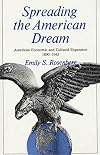
This is a groundbreaking work about how the United States tried to establish itself on the international system from the late 19th to the mid 20th century. Rosenberg argues that although the United States preached free markets and limited government, the USG played an integral in the penetration by American businesses in many international fields. In particularly, the USG thought that US companies should have a large stake in the international transportation and communication industries. She show more traces three phases of this. The first is the promotional state, where the USG actively pushed companies into key fields. The second was the cooperative state, which was when the USG worked with companies to expand their influence, in particular with things like radio and transportation. After the Great Depression, it moved to a regulatory state, where the state intervened in a variety of ways in the domestic economy, but pushed for free trade internationally. After the war, the regulatory state continued as the government pushed its Cold War message internationally, which was free trade and democracy.
Rosenberg's overall point, which she makes quite clear, is that the United States Government consistently pushed for free trade and free markets while constantly using its own clout to gain advantages for US companies. This two-faced approach has essentially given the United States a built in advantage in the international economic and political system.
This is a great book for a specialist on international relations and a good book for someone interested in the building of the postwar international system. I have already used some of her ideas when I teach US History classes and I am sure I use it more in the future. show less
Rosenberg's overall point, which she makes quite clear, is that the United States Government consistently pushed for free trade and free markets while constantly using its own clout to gain advantages for US companies. This two-faced approach has essentially given the United States a built in advantage in the international economic and political system.
This is a great book for a specialist on international relations and a good book for someone interested in the building of the postwar international system. I have already used some of her ideas when I teach US History classes and I am sure I use it more in the future. show less
A Date Which Will Live: Pearl Harbor in American Memory (American Encounters/Global Interactions) by Emily S. Rosenberg
An ok book had to read it for school, wasn't something I would have read otherwise.
Lists
Awards

You May Also Like


Associated Authors
Statistics
- Works
- 10
- Also by
- 1
- Members
- 228
- Popularity
- #98,696
- Rating
- 3.7
- Reviews
- 4
- ISBNs
- 19
- Languages
- 2