
Emily Chase
Author of Princess Who?
About the Author
Disambiguation Notice:
Emily Chase is one pseudonym used by varius author, one of them is the romance writer Julie Garwood.
Series
Works by Emily Chase
Twijfels 1 copy
Tagged
Common Knowledge
- Gender
- female
- Disambiguation notice
- Emily Chase is one pseudonym used by varius author, one of them is the romance writer Julie Garwood.
Members
Reviews

While I was searching for a different series from back in the day, I came across this YA novel from the '80s, the first in The Girls of Canby Hall series. I liked the cover art in general, but what particularly got my attention was the smiling girl rockin' her Afro.
I rock an Afro these days too. I decided to give the novel a try.
Now, given that the series was written by different authors all under the pseudonym "Emily Chase," I figure the books' styles probably differ somewhat. With that show more said, I'd say the series gets off to a good start with Book One.
It isn't the super-corny, thoroughly predictable kind of story with one-dimensional characters I wouldn't have been surprised to find. Rather, the style here has got some noteworthy originality, especially in terms of the humor. (Which managed to make me literally laugh out loud more than once. A rarity!)
The main characters and their backstories are nicely developed. While one of the girls cries a lot and she's quick to jump to melodramatic thinking, melodrama isn't this novel's style in general.
Now, because Faith is the only Black girl at the boarding school, the issue of race comes up. I found the writing on the issue to be a tad awkward here and there, in ways I won't get into. Even so, the story effectively reflects how prejudging or making presumptions can go both ways—and the need for understanding and a willingness to listen in relationships isn't one-sided.
On a different note, the proclaimed "home vs. school" mindset change that one of the main characters comes to in the end could have used better fleshing out on the way there, to make it convincing. Like, don't just tell us in the last chapter, "Now she's changed!" so that she fits the ending with the other girls. Show her attitude actually changing as the story goes along.
Nonetheless, I quite enjoyed this series opening. I'll probably skip Book Two, which looks/sounds like it takes a pretty sharp, pretty dark turn compared to the first book—as if maybe the series suddenly reaches for Nancy Drew danger vibes or something. Book Three looks more in line with where the series has started, so I think that'll be my next Canby Hall stop.
Note:
• a scene of underage drinking, accompanied by a character's feelings of guilt but no displays of drunkenness
• a brief mention of a significant violent crime in the past but no further violence show less
I rock an Afro these days too. I decided to give the novel a try.
Now, given that the series was written by different authors all under the pseudonym "Emily Chase," I figure the books' styles probably differ somewhat. With that show more said, I'd say the series gets off to a good start with Book One.
It isn't the super-corny, thoroughly predictable kind of story with one-dimensional characters I wouldn't have been surprised to find. Rather, the style here has got some noteworthy originality, especially in terms of the humor. (Which managed to make me literally laugh out loud more than once. A rarity!)
The main characters and their backstories are nicely developed. While one of the girls cries a lot and she's quick to jump to melodramatic thinking, melodrama isn't this novel's style in general.
Now, because Faith is the only Black girl at the boarding school, the issue of race comes up. I found the writing on the issue to be a tad awkward here and there, in ways I won't get into. Even so, the story effectively reflects how prejudging or making presumptions can go both ways—and the need for understanding and a willingness to listen in relationships isn't one-sided.
On a different note, the proclaimed "home vs. school" mindset change that one of the main characters comes to in the end could have used better fleshing out on the way there, to make it convincing. Like, don't just tell us in the last chapter, "Now she's changed!" so that she fits the ending with the other girls. Show her attitude actually changing as the story goes along.
Nonetheless, I quite enjoyed this series opening. I'll probably skip Book Two, which looks/sounds like it takes a pretty sharp, pretty dark turn compared to the first book—as if maybe the series suddenly reaches for Nancy Drew danger vibes or something. Book Three looks more in line with where the series has started, so I think that'll be my next Canby Hall stop.
Note:
• a scene of underage drinking, accompanied by a character's feelings of guilt but no displays of drunkenness
• a brief mention of a significant violent crime in the past but no further violence show less

Well! I must say that Book Four of the 1980s Canby Hall YA series has left me feeling rather entertained. Even if I'm a tiny bit disappointed that the scene depicted on the book's front cover is only that: a scene on a book cover. In the story itself, there's no party with the girls and guys all dressed-up and coupled-up out on a big dance floor.
Darn.
In any case, boarding school roommates Faith, Dana, and Shelley are still as tight as expected. Their different backgrounds have come to make show more them more interesting to each other. That's good!
But there's an aside, a situation that formed in Book Three, that I'm still not wild about. One of the main characters has two boyfriends now. While she/the story takes a couple of brief moments to explain why she and her roommates are pretty much just accepting the situation, I don't like it—not because there's anything wrong with someone simply dating more than one person at a time but because it isn't clear whether the two boyfriends in this triangle know about each other. It seems that one guy is a longtime hometown sweetheart whose girlfriend is leaving him in the dark about the new boyfriend she's got for herself while she's away at boarding school. And neither of her roommates are even questioning her about it.
Ick.
Then, in relation to a different situation, there's the matter of this novel's climax. It's so incredibly contrived, exploding out of absolutely nowhere at just the perfect minute, going to the limit to throw multiple clichés into the mix in the most obvious way. A way to conveniently bring one of the main characters to a change of heart on a key issue before the book is over.
I found the whole scene to be so unbelievable, so laughable, that I…laughed. I mean, no, the climax isn't meant to be funny, but my old-fashioned, nostalgic side enjoyed that turn of events because it's the kind of fantastically corny thing that wouldn't fly in a novel written today. Not even a YA novel.
Bwah-ha! Sometimes you just gotta love old fiction.
And of course, there's more that my nostalgic side got a kick out of, here. Like an allusion to Canby Hall students using typewriters. And one of the characters making a trip to the record shop to buy a record—not because records are back in style but because they haven't gone out of style yet.
Love it!
Now. Here's where we are so far.
I skipped Canby Hall Girls Book Two because the danger/suspense conveyed by the cover looks out of place for this "everyday teenage life" series. And I didn't exactly enjoy Book Three, since it's got an insufficient amount of plot, an unconvincing central conflict, and the two-boyfriend thing.
So, I imagined at first that this fourth book might be the last I'd read in the series. However, I took a peek ahead. I can admittedly be a pushover for cover art now and again, and I really like the green and summery, outdoor-lunchie, three-besties look of the fifth book.
Plus, a skim over the blurb alerted me to the possibility that the two-boyfriend thing may finally come to a head in that next novel.
So, I confess that on account of my curiosity over that matter, I plan to continue on to Book Five. Whether or not the boyfriend thing is handled to my satisfaction will likely be what determines if I'll be reading more of this series after that.
Note:
• contains some threats of violence from armed perpetrators show less
Darn.
In any case, boarding school roommates Faith, Dana, and Shelley are still as tight as expected. Their different backgrounds have come to make show more them more interesting to each other. That's good!
But there's an aside, a situation that formed in Book Three, that I'm still not wild about. One of the main characters has two boyfriends now. While she/the story takes a couple of brief moments to explain why she and her roommates are pretty much just accepting the situation, I don't like it—not because there's anything wrong with someone simply dating more than one person at a time but because it isn't clear whether the two boyfriends in this triangle know about each other. It seems that one guy is a longtime hometown sweetheart whose girlfriend is leaving him in the dark about the new boyfriend she's got for herself while she's away at boarding school. And neither of her roommates are even questioning her about it.
Ick.
Then, in relation to a different situation, there's the matter of this novel's climax. It's so incredibly contrived, exploding out of absolutely nowhere at just the perfect minute, going to the limit to throw multiple clichés into the mix in the most obvious way. A way to conveniently bring one of the main characters to a change of heart on a key issue before the book is over.
I found the whole scene to be so unbelievable, so laughable, that I…laughed. I mean, no, the climax isn't meant to be funny, but my old-fashioned, nostalgic side enjoyed that turn of events because it's the kind of fantastically corny thing that wouldn't fly in a novel written today. Not even a YA novel.
Bwah-ha! Sometimes you just gotta love old fiction.
And of course, there's more that my nostalgic side got a kick out of, here. Like an allusion to Canby Hall students using typewriters. And one of the characters making a trip to the record shop to buy a record—not because records are back in style but because they haven't gone out of style yet.
Love it!
Now. Here's where we are so far.
I skipped Canby Hall Girls Book Two because the danger/suspense conveyed by the cover looks out of place for this "everyday teenage life" series. And I didn't exactly enjoy Book Three, since it's got an insufficient amount of plot, an unconvincing central conflict, and the two-boyfriend thing.
So, I imagined at first that this fourth book might be the last I'd read in the series. However, I took a peek ahead. I can admittedly be a pushover for cover art now and again, and I really like the green and summery, outdoor-lunchie, three-besties look of the fifth book.
Plus, a skim over the blurb alerted me to the possibility that the two-boyfriend thing may finally come to a head in that next novel.
So, I confess that on account of my curiosity over that matter, I plan to continue on to Book Five. Whether or not the boyfriend thing is handled to my satisfaction will likely be what determines if I'll be reading more of this series after that.
Note:
• contains some threats of violence from armed perpetrators show less

When I discovered this 1980s YA series, The Girls of Canby Hall, I rather enjoyed Book One. It's an overall upbeat story of new friends at their new school, with some noteworthy originality to the read.
Next, I decided to skip the second book. The depiction of danger on the dark cover makes it look like the series must switch from its "everyday fiction" opening in the first book to make an attempt at "nail-biting suspense" in the next.
Too much of a leap, there. (Whether or not the second show more story itself is as dramatic as the darker edition of its book cover suggests.)
Granted, "Emily Chase" is a collective pseudonym for different authors writing different books in the series. Hence, some minor writing differences are to be expected—much as it is with The Nancy Drew Files mystery series of the same era. But when it comes to vintage YA, when I do want suspenseful, harrowing action instead of the ups and downs of common teenage life, I'll just read about, yeah, the high-flying crime-fighting of career detective Nancy Drew.
Not about the Canby Hall boarding school girls.
Anyhow!
Even allowing for expected differences in the writing, I didn't enjoy Canby Hall Book Three as much as I'd hoped. It's just too obvious that it's got more pages than plot, while again and again, the story rehashes the details regarding two of the main characters' present problems, especially Dana's. And, yes, while the girls' individual problems themselves are legit, the novel's main feature—the friendship fallout—is contrived and overblown.
On a different note, I can understand someone having romantic feelings for more than one person. But if you start acting on those feelings, spending more and more time with your new crush while keeping it from the person you're already in a committed relationship with, the one you say you love—that's cheating. With or without kissing or whatever.
It isn't like the Canby Hall heroine in question isn't mature enough to know exactly what she's doing. But the story paints her situation more like a dilemma that her sensitive, torn self just can't help, and the book leaves the issue unresolved.
To be addressed as the series continues, I'm sure. Maybe she'll see the light later on and realize, "Oh, no! I'm a cheater!" But so far, I don't like how this thing has played out.
However, the read still gave my nostalgic side the '80s-ness I wanted out of it.
A Walkman with cassette tapes. A guy driving a station wagon. A girl calling her mother on the telephone and getting the answering machine. And not all of the characters even knowing what answering machines are yet! I get such a kick out of that stuff.
Also, as it was up to one of the main characters to keep her head on straight in this book, she did. That, and the '80s, kept this on a readable level for me.
I plan on checking out at least one more book in the series.
Note:
• a brief mention of a significant violent crime in the past but no further violence show less
Next, I decided to skip the second book. The depiction of danger on the dark cover makes it look like the series must switch from its "everyday fiction" opening in the first book to make an attempt at "nail-biting suspense" in the next.
Too much of a leap, there. (Whether or not the second show more story itself is as dramatic as the darker edition of its book cover suggests.)
Granted, "Emily Chase" is a collective pseudonym for different authors writing different books in the series. Hence, some minor writing differences are to be expected—much as it is with The Nancy Drew Files mystery series of the same era. But when it comes to vintage YA, when I do want suspenseful, harrowing action instead of the ups and downs of common teenage life, I'll just read about, yeah, the high-flying crime-fighting of career detective Nancy Drew.
Not about the Canby Hall boarding school girls.
Anyhow!
Even allowing for expected differences in the writing, I didn't enjoy Canby Hall Book Three as much as I'd hoped. It's just too obvious that it's got more pages than plot, while again and again, the story rehashes the details regarding two of the main characters' present problems, especially Dana's. And, yes, while the girls' individual problems themselves are legit, the novel's main feature—the friendship fallout—is contrived and overblown.
On a different note, I can understand someone having romantic feelings for more than one person. But if you start acting on those feelings, spending more and more time with your new crush while keeping it from the person you're already in a committed relationship with, the one you say you love—that's cheating. With or without kissing or whatever.
It isn't like the Canby Hall heroine in question isn't mature enough to know exactly what she's doing. But the story paints her situation more like a dilemma that her sensitive, torn self just can't help, and the book leaves the issue unresolved.
To be addressed as the series continues, I'm sure. Maybe she'll see the light later on and realize, "Oh, no! I'm a cheater!" But so far, I don't like how this thing has played out.
However, the read still gave my nostalgic side the '80s-ness I wanted out of it.
A Walkman with cassette tapes. A guy driving a station wagon. A girl calling her mother on the telephone and getting the answering machine. And not all of the characters even knowing what answering machines are yet! I get such a kick out of that stuff.
Also, as it was up to one of the main characters to keep her head on straight in this book, she did. That, and the '80s, kept this on a readable level for me.
I plan on checking out at least one more book in the series.
Note:
• a brief mention of a significant violent crime in the past but no further violence show less
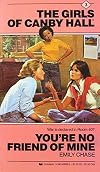
my sister recently unearthed this novel from my dad's attic, and i was like, "finally!" as a kid, i wanted to read it so bad because there are teenagers on the cover!! but overall, it was a letdown. a couple notable-ish things:
1. i have read two early 1980's novels for female teenagers in about as many days, and BOTH had minor characters named Doris. this doesn't seem realistic. i think i would have enjoyed both novels more if there were more Staceys, Traceys, and Lisas.
2. this passage show more illustrates nicely why i read shit like this:
Dana hurriedly scrawled her name on the sign-out sheet
taped on the outside of the door. Along with the room number,
there were artistic renditions of their names. Each roommate had
done her own.
Dana had written her name in an elaborate, arty print;
Faith's was in fat, balloony letters; Shelley had cut letters out
magazines and pasted them together--"like a ransom note," Dana
had said. Shelley had actually been kidnapped only a month
earlier and didn't think Dana's comment was very funny.
i do think Dana's comment is _very funny_, but i would NEVER laugh about it in front of Shelley, you know?
2a. one reason i would laugh at Dana's jokes despite how offensive they might be to Shelley or anyone else is that Dana has really neat gear: "Dana slipped some tapes into her Walkman, clapped on the headphones, and flopped onto her bed, facing the wall." tapeS?! is like a dual-deck thing? can she make mixes using her Walkman? i want one. show less
1. i have read two early 1980's novels for female teenagers in about as many days, and BOTH had minor characters named Doris. this doesn't seem realistic. i think i would have enjoyed both novels more if there were more Staceys, Traceys, and Lisas.
2. this passage show more illustrates nicely why i read shit like this:
Dana hurriedly scrawled her name on the sign-out sheet
taped on the outside of the door. Along with the room number,
there were artistic renditions of their names. Each roommate had
done her own.
Dana had written her name in an elaborate, arty print;
Faith's was in fat, balloony letters; Shelley had cut letters out
magazines and pasted them together--"like a ransom note," Dana
had said. Shelley had actually been kidnapped only a month
earlier and didn't think Dana's comment was very funny.
i do think Dana's comment is _very funny_, but i would NEVER laugh about it in front of Shelley, you know?
2a. one reason i would laugh at Dana's jokes despite how offensive they might be to Shelley or anyone else is that Dana has really neat gear: "Dana slipped some tapes into her Walkman, clapped on the headphones, and flopped onto her bed, facing the wall." tapeS?! is like a dual-deck thing? can she make mixes using her Walkman? i want one. show less
Lists
You May Also Like


Statistics
- Works
- 41
- Members
- 1,194
- Popularity
- #21,529
- Rating
- 3.0
- Reviews
- 8
- ISBNs
- 65
- Languages
- 2