
About the Author
Works by Julie K. Norem
Tagged
Common Knowledge
- Birthdate
- 1960
- Gender
- female
- Occupations
- professor (psychology|Wellesley College)
- Short biography
- Julie K. Norem joined the faculty at Wellesley College in 1992, and she teaches courses in personality psychology, research methods, as well as a seminar on optimism and pessimism. Her research focuses on the strategies people use to pursue their goals, with an emphasis on the strategy of defensive pessimism; and on the ways self-knowledge influences adaptation, performance, and social relationships, particularly among those who feel like impostors.
Professor Norem received her A.B. in Behavioral Sciences from the University of Chicago in 1982, and her Ph.D. in Psychology from the University of Michigan in 1987. She was a professor at Northeastern University before coming to Wellesley College.
Dr. Norem has written numerous book chapters and articles for scholarly journals, including empirical papers based on her own research and theoretical review and commentary, and has presented dozens of papers at scientific conferences across the country and abroad. She has also been Associate Editor of both the Journal of Research in Personality and the Personality and Social Psychology Review. She sits on the editorial board of several scholarly journals, and has held a variety of appointed and elected positions in the Society of Personality and Social Psychology. She is currently a founding member and on the Steering Committee of the Association for Research in Personality.
http://www.wellesley.edu/psychology/f... - Places of residence
- Wellesley, Massachusetts, USA
- Associated Place (for map)
- Massachusetts, USA
Members
Reviews
The Positive Power of Negative Thinking: Using Defensive Pessimism to Harness Anxiety and Perform at Your Peak by Julie Norem
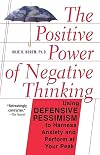
In The Positive Power of Negative Thinking, author Julie Norem compares defensive pessimism---a strategy for managing existing anxiety by identifying and addressing possible negative outcomes before undertaking an endeavor---with its counterpart, strategic optimism---a strategy used by people with low baseline levels of anxiety to relax before a big event and avoid triggering anxious feelings. Both strategies, Norem contends, can optimize performance for different personalities in different show more situations. Each strategy has its own risks and benefits, and the secret is knowing which is the right fit for each of us in any particular circumstance.
I've had this book on my to-read list for more than four years, since I read David Rakoff's [b:Half Empty|7957361|Half Empty|David Rakoff|https://d.gr-assets.com/books/1425387545s/7957361.jpg|11689137], which references Norem's research. Reading about defensive pessimism, I could easily identify situations in which I instinctively and successfully use this strategy, like when preparing for a road trip or putting together homeschool curricula for my kids. I could also identify situations in which I instead engage in avoidance and self-handicapping rather than risk feeling the full force of my anxiety, like in the case of the unfinished novel I've been thinking about daily but not writing on since 2010.
Thinking of defensive pessimism, avoidance, and self-handicapping as different responses to anxiety has caused a welcome shift in my thinking. I spent an evening this week listing in my journal all of the negatives about working on my novel, and then wrote out potential ways that I could manage the anxiety around these so that I can actually write down the scenes that play out in my mind. So far, I've not actually sat down to write on the novel, but I consider this a positive move in that direction. At the very least, when I schedule a morning writing session and then ignore my alarm and then don't have enough time to write before the kids and I need to begin our lessons, I can identify this as avoidance. (Putting a name on it has to have some value, right?)
Despite its potential helpfulness in making progress on my personal goals, there are two things that keep me from loving this book. First, it's too long for the amount of information it includes. This isn't as extreme as in other self-helpy books I've read, but I think I could have gotten the basic idea in about half the number of words. Second, it brought up so many tangential issues that I sometimes couldn't figure out how they fit in with the defensive pessimism/strategic optimism duality Norem presents. As helpful as it was to read about avoidance and self-handicapping as ways to avoid feeling their existing anxiety, it wasn't clear how they fit. Are there corresponding negative ways of avoiding anxiety that temperamentally non-anxious people use if they're not using strategic optimism? Or do the negatives for them come in when their strategic optimism tips into the non-strategic version?
I think the book would have been stronger had Norem maintained a tighter focus and left some of the other stuff out, but I did enjoy it, and I'm glad that I picked it up finally. show less
I've had this book on my to-read list for more than four years, since I read David Rakoff's [b:Half Empty|7957361|Half Empty|David Rakoff|https://d.gr-assets.com/books/1425387545s/7957361.jpg|11689137], which references Norem's research. Reading about defensive pessimism, I could easily identify situations in which I instinctively and successfully use this strategy, like when preparing for a road trip or putting together homeschool curricula for my kids. I could also identify situations in which I instead engage in avoidance and self-handicapping rather than risk feeling the full force of my anxiety, like in the case of the unfinished novel I've been thinking about daily but not writing on since 2010.
Thinking of defensive pessimism, avoidance, and self-handicapping as different responses to anxiety has caused a welcome shift in my thinking. I spent an evening this week listing in my journal all of the negatives about working on my novel, and then wrote out potential ways that I could manage the anxiety around these so that I can actually write down the scenes that play out in my mind. So far, I've not actually sat down to write on the novel, but I consider this a positive move in that direction. At the very least, when I schedule a morning writing session and then ignore my alarm and then don't have enough time to write before the kids and I need to begin our lessons, I can identify this as avoidance. (Putting a name on it has to have some value, right?)
Despite its potential helpfulness in making progress on my personal goals, there are two things that keep me from loving this book. First, it's too long for the amount of information it includes. This isn't as extreme as in other self-helpy books I've read, but I think I could have gotten the basic idea in about half the number of words. Second, it brought up so many tangential issues that I sometimes couldn't figure out how they fit in with the defensive pessimism/strategic optimism duality Norem presents. As helpful as it was to read about avoidance and self-handicapping as ways to avoid feeling their existing anxiety, it wasn't clear how they fit. Are there corresponding negative ways of avoiding anxiety that temperamentally non-anxious people use if they're not using strategic optimism? Or do the negatives for them come in when their strategic optimism tips into the non-strategic version?
I think the book would have been stronger had Norem maintained a tighter focus and left some of the other stuff out, but I did enjoy it, and I'm glad that I picked it up finally. show less
You May Also Like
Associated Authors
Statistics
- Works
- 3
- Members
- 99
- Popularity
- #191,537
- Rating
- 3.6
- Reviews
- 1
- ISBNs
- 7
- Languages
- 2


