

Yehuda Amichai (1924–2000)
Author of Selected Poetry of Yehuda Amichai
About the Author
Yehuda Amichai was born in Germany and immigrated to Palestine in 1936. His novels and poetry are innovative in their use of Hebrew terms. Following World War II and Israel's War of Independence in 1948, Amichai began to introduce new words of technical, legal, and administrative meaning into his show more poetry to replace sacral phrases. Amichai's poetry reflects the modernizing of the Hebrew language within the last 45 years. "One of Amichai's most characteristic effects in his poetry is the mingling of past and present, ancient and modern, person and place: the here and now for him inevitably recalls the past" (Judaica Book News). One of Israel's most highly regarded poets, Amichai shared the Israel Prize for Literature with Amir Gilboa in 1981. (Bowker Author Biography) show less
Works by Yehuda Amichai
Poems 11 copies
מאחורי כל זה מסתתר אושר גדול 3 copies
שלוה גדולה : שאלות ותשובות 3 copies
Šîrîm : 1962-1948 3 copies
AKHZIV, CAESAREA AND ONE LOVE / Akhziv, Kesaryah ve-ahavah ahat : Etchings by Deganit Partouche-Cohen (Hebrew and English Edition) (1996) 3 copies
Antologia 3 copies
Ba-ruaḥ ha-noraʾah ha-zot 2 copies
שירי יהודה עמיחי - א 2 copies
לא מעכשיו לא מכאן 2 copies
Ein Koffer spricht — Lyrics — 2 copies
שירי אהבה 2 copies
במרחק שתי תקוות : שירים 1 copy
ולא על מנת לזכור 1 copy
בגנה הצבורית 1 copy
עכשיו ברעש - שירים 1963-1968 1 copy
ברוח הנוראה הזאת 1 copy
מי יתנני מלון 1 copy
עכשיו ברעש : שירים 1963-1968 1 copy
Clavats a la carn del món 1 copy
Queda't amb mi. 1 copy
Света земја 1 copy
הזמן 1 copy
The Times My Father Died 1 copy
יהודה עמיחי 1 copy
Nel giardino pubblico §§§ 1 copy
ʻOd shire ahavah 1 copy
sha'at ha'chasar 1 copy
Listen [1] 1 copy
What Roni Did in New York 1 copy
הזנב השמן של הנומה 1 copy
הגנה השמן של הנומה 1 copy
שירי אהבה : מהדורה דו-לשונית 1 copy
מה שקרה לרוני בניו-יורק 1 copy
עכשיו ברעש 1 copy
שירי אהבה 1 copy
Associated Works
World Poetry: An Anthology of Verse from Antiquity to Our Time (1998) — Contributor — 499 copies, 2 reviews
Against Forgetting: Twentieth-Century Poetry of Witness (1993) — Contributor — 377 copies, 2 reviews
Teaching with Fire: Poetry That Sustains the Courage to Teach (2003) — Contributor — 224 copies, 1 review
The Jewish caravan : great stories of twenty-five centuries (1965) — Contributor, some editions — 140 copies
Israeli Stories: A Selection of the Best Contemporary Hebrew Writing (1965) — Contributor — 123 copies, 1 review
Answering Back: Living Poets Reply to the Poetry of the Past (2007) — Contributor — 119 copies, 1 review
Leading from Within: Poetry That Sustains the Courage to Lead (2007) — Contributor — 114 copies, 3 reviews
The Poetry of Survival: Post-War Poets of Central and Eastern Europe (1991) — Contributor — 46 copies
Tagged
Common Knowledge
- Canonical name
- Amichai, Yehuda
- Legal name
- יהודה עמיחי
- Other names
- Pfeuffer, Ludwig (birth)
- Birthdate
- 1924-05-03
- Date of death
- 2000-09-22
- Gender
- male
- Education
- Hebrew University of Jerusalem (biblical texts ∙ Hebrew literature)
- Occupations
- poet
teacher
translator - Organizations
- Hebrew University
Palmach (member)
Haganah (member)
British Army Jewish Brigade
Israel Defense Forces
British Army (WWII) (show all 9)
Israeli Army (War of Independence)
University of California, Berkeley
New York University - Awards and honors
- Bialik Prize (1976)
Israel Prize (Literature, 1982)
Shlonsky Prize (1957)
Brenner Prize (1969)
American Academy of Arts and Letters (Foreign Honorary - Literature ∙ 1986)
Würzburg's Prize for Culture (1981) (show all 11)
Agnon Prize (1986)
Malraux Prize (1994)
Literary Lion Award (1994)
Macedonia's Golden Wreath Award (1995)
Bjornson Poetry Award (1996) - Short biography
- Yehuda Amichai was Israel's great modern poet, one of the first to write in colloquial Hebrew.
At age 76, he died of cancer. - Cause of death
- cancer
- Nationality
- Germany (birth)
Israel - Birthplace
- Würzburg, Germany
- Places of residence
- Palestine
Jerusalem, Israel - Place of death
- Jerusalem, Israel
- Map Location
- Israel
Members
Reviews

Since I rarely read poetry, I don't have a lot of context to evaluate this collection. Poetry seems to be as much about the feeling as the content, so I'll just concentrate on the impressions it left with me. Isolation seems to be a recurring theme in the collection, both external and internal. There is absence of psychological intimacy and a disconnect between thought and feeling. There is also a heaviness to the poems in the collection – the weight of the past and the heaviness of the show more present. The poems aren't particularly sorrowful, but there's a definite absence of joy. Most of the poems don't seem particularly religious to me, but religious imagery appears throughout the collection, as in “Sort of Apocalypse” which begins “The man under his fig tree telephoned the man under his vine”.
Yehuda Amichai was an immigrant to Israel, and I think that comes across in this collection of his poetry. There's a sense of being cut off from his past, of being in a different place, a strange place, a home that isn't yet home. Even though the English translation is very good and was awarded the National Jewish Book Award for translated poetry, I can't help but feel I've missed something by being unable to read it in its original Hebrew. I borrowed this from the library and liked it well enough to want to add a selection of Amichai's poetry to my personal library. show less
Yehuda Amichai was an immigrant to Israel, and I think that comes across in this collection of his poetry. There's a sense of being cut off from his past, of being in a different place, a strange place, a home that isn't yet home. Even though the English translation is very good and was awarded the National Jewish Book Award for translated poetry, I can't help but feel I've missed something by being unable to read it in its original Hebrew. I borrowed this from the library and liked it well enough to want to add a selection of Amichai's poetry to my personal library. show less
Two of my favourite poems by Yehuda Amichai
God-Full-of-Mercy, The Prayer For the Dead
If God was not full of mercy,
Mercy would have been in the world,
Not just in Him.
I, who plucked flowers in the hills
And looked down into all the valleys,
I, who brought corpses down from the hills,
Can tell you that the world is empty of mercy.
I, who was King of Salt at the seashore,
Who stood without a decision at my window,
Who counted the steps of angels,
Whose heart lifted weights of anguish
In the horrible show more contests.
I, who use only a small part
Of the words in the dictionary.
I, who must decipher riddles
I don't want to decipher,
Know that if not for the God-full-of-mercy
There would be mercy in the world,
Not just in Him.
Translated from the Hebrew by Barbara and Benjamin Harshav
~~~~~~~~~~~~~~~~~~~~~~~~~~~~
I Walked Past A House Where I Lived Once
I walked past a house where I lived once:
a man and a woman are still together in the whispers there.
Many years have passed with the quiet hum
of the staircase bulb going on
and off and on again.
The keyholes are like little wounds
where all the blood seeped out. And inside,
people pale as death.
I want to stand once again as I did
holding my first love all night long in the doorway.
When we left at dawn, the house
began to fall apart and since then the city and since then
the whole world.
I want to be filled with longing again
till dark burn marks show on my skin.
I want to be written again
in the Book of Life, to be written every single day
till the writing hand hurts.
~~~~~~~~~~~~~~~~~~~~~~~~~~~~~~~~~~~~~~~~
Each time I re-read this, I receive a good soul-scraping.
I carry them around with me like British civilians in the Second World War carried around their gas masks.
It was always there: an appendage, and a weight that after a while became invisible; and that despite its invisibility became a necessary burden which one absolutely could not give up. Without it, one couldn't breathe. Without it, one lost all hope. But with the talisman strapped on, one could still look for tomorrow's sun to shine, amid the ruins.
Despite the despair and seeming hopelessness, Amichai gives me hope that the sun will shine, amid the ruins.
(It's taken such a long time to find these words, having finished a few collections of his works almost a month ago.)
Thank you Other Julie for the introduction. show less
God-Full-of-Mercy, The Prayer For the Dead
If God was not full of mercy,
Mercy would have been in the world,
Not just in Him.
I, who plucked flowers in the hills
And looked down into all the valleys,
I, who brought corpses down from the hills,
Can tell you that the world is empty of mercy.
I, who was King of Salt at the seashore,
Who stood without a decision at my window,
Who counted the steps of angels,
Whose heart lifted weights of anguish
In the horrible show more contests.
I, who use only a small part
Of the words in the dictionary.
I, who must decipher riddles
I don't want to decipher,
Know that if not for the God-full-of-mercy
There would be mercy in the world,
Not just in Him.
Translated from the Hebrew by Barbara and Benjamin Harshav
~~~~~~~~~~~~~~~~~~~~~~~~~~~~
I Walked Past A House Where I Lived Once
I walked past a house where I lived once:
a man and a woman are still together in the whispers there.
Many years have passed with the quiet hum
of the staircase bulb going on
and off and on again.
The keyholes are like little wounds
where all the blood seeped out. And inside,
people pale as death.
I want to stand once again as I did
holding my first love all night long in the doorway.
When we left at dawn, the house
began to fall apart and since then the city and since then
the whole world.
I want to be filled with longing again
till dark burn marks show on my skin.
I want to be written again
in the Book of Life, to be written every single day
till the writing hand hurts.
~~~~~~~~~~~~~~~~~~~~~~~~~~~~~~~~~~~~~~~~
Each time I re-read this, I receive a good soul-scraping.
I carry them around with me like British civilians in the Second World War carried around their gas masks.
It was always there: an appendage, and a weight that after a while became invisible; and that despite its invisibility became a necessary burden which one absolutely could not give up. Without it, one couldn't breathe. Without it, one lost all hope. But with the talisman strapped on, one could still look for tomorrow's sun to shine, amid the ruins.
Despite the despair and seeming hopelessness, Amichai gives me hope that the sun will shine, amid the ruins.
(It's taken such a long time to find these words, having finished a few collections of his works almost a month ago.)
Thank you Other Julie for the introduction. show less
This is one of my favorite books of all time. I have always liked Yehuda Amichai's poetry and this bilingual edition is absolutely perfect for those of us who want to be able to read it in the original as well. The translation is excellent. Amichai's work manages to combine tenderness with Israeli wit and cynicism, and especially moving are the words about his father. Highly recommended.
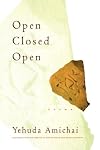
According to the book jacket Amichai is Israels leading poet. This was his last book of poetry. Many of the poems in this collection are inspired by a small piece of stone that Amichai kept on his desk - a fragment from a Jewish tombstone from a cemetery that was destroyed a thousand years ago. The fragment reads "amen" Most of the poems are about or reference religion and Jewish culture/ history. Amichai has a unique style and the poems are lovely and funny. Here's an example:
When God show more packed up and left the country, He left the Torah
with the Jews.They have been looking for Him ever since,
shouting,"Hey, you forgot something, you forgot."
and other people think shouting is the prayer of the Jews. show less
When God show more packed up and left the country, He left the Torah
with the Jews.They have been looking for Him ever since,
shouting,"Hey, you forgot something, you forgot."
and other people think shouting is the prayer of the Jews. show less
Lists
Awards


You May Also Like


Associated Authors
Statistics
- Works
- 111
- Also by
- 18
- Members
- 1,607
- Popularity
- #16,043
- Rating
- 4.1
- Reviews
- 10
- ISBNs
- 107
- Languages
- 15
- Favorited
- 13
