
Stephen Greenleaf
Author of Book Case
About the Author
Image credit: Stephen Greenleaf
Series
Works by Stephen Greenleaf
Iris 2 copies
D.T. Jones [Bind] 1 1 copy
Associated Works
The Eyes Have It: The First Private Eye Writers of America Anthology (1984) — Contributor — 17 copies
Tagged
Common Knowledge
- Birthdate
- 1942-07-07
- Gender
- male
- Occupations
- attorney
- Nationality
- USA
- Places of residence
- San Francisco, California, USA
Seattle, Washington, USA - Associated Place (for map)
- USA
Members
Reviews

Unusual detective story in that the killer is known and the P.I. is hired to provide evidence he is sane. Marsh Tanner was first hired to find the killer of Diane Usser, wife of a famed Berkeley law professor, by her parents. Tanner reluctantly agrees to poke around. He learns that Lawrence, Diane's husband, was famed for his brilliant use of the insanity defense to "get off" many supposedly psychotic killers.
Diane had been stabbed to death. She was naked and appeared to have been involved show more in some kind of tryst when she was killed. Lawrence found her dying. He was charged with her murder shortly after Tanner took the case, which seemed to be the end of it until Diane's mother shows up in his office. She says they had received a phone call from someone claiming to know that Lawrence was indeed the killer, but he intended to use his brilliant legal skills and knowledge of the insanity defense to get himself off. She wants Tanner to find evidence that Lawrence is *not* mad so that he'll be convicted and executed.
The more Tanner investigates the more peculiar he finds the case to be and when Usser insists he committed the crime and pleads guilty by reason of insanity, Tanner realizes he can't possibly have killed his wife even though he insists he had. Usser has his own reasons and one is really cute. "You accuse me of planning to manufacture the symptoms of mental illness, to prevail at my trial by feigning insanity. Well, did you know that since 1898 the impersonation of mental illness by a prisoner awaiting trial has been known as the Ganser Syndrome? And that some psychiatrists consider such an impersonation in and of itself as a manifestation of psychosis?"
Part of the appeal of Greenleaf, aside from the string resemblance to Ross MacDonald, is Tanner's sense of outrage and sixties quasi-radicalism. In a discussion with Usser about the economic disparity of the justice system, Tanner replies he's not sure it matters anymore. "I guess because outrage at economic disparity implies that all problems admit to economic solutions. We seem to be building a world where money is the measure of everything. Everything has a price tag; everything is measured by its financial aspect. I read the other day that a student decided not to go to medical school because it wouldn't be a good return on investment. That seems a little off the track."
I am reading all of Greenleaf's Tanner books. They are excellent. show less
Diane had been stabbed to death. She was naked and appeared to have been involved show more in some kind of tryst when she was killed. Lawrence found her dying. He was charged with her murder shortly after Tanner took the case, which seemed to be the end of it until Diane's mother shows up in his office. She says they had received a phone call from someone claiming to know that Lawrence was indeed the killer, but he intended to use his brilliant legal skills and knowledge of the insanity defense to get himself off. She wants Tanner to find evidence that Lawrence is *not* mad so that he'll be convicted and executed.
The more Tanner investigates the more peculiar he finds the case to be and when Usser insists he committed the crime and pleads guilty by reason of insanity, Tanner realizes he can't possibly have killed his wife even though he insists he had. Usser has his own reasons and one is really cute. "You accuse me of planning to manufacture the symptoms of mental illness, to prevail at my trial by feigning insanity. Well, did you know that since 1898 the impersonation of mental illness by a prisoner awaiting trial has been known as the Ganser Syndrome? And that some psychiatrists consider such an impersonation in and of itself as a manifestation of psychosis?"
Part of the appeal of Greenleaf, aside from the string resemblance to Ross MacDonald, is Tanner's sense of outrage and sixties quasi-radicalism. In a discussion with Usser about the economic disparity of the justice system, Tanner replies he's not sure it matters anymore. "I guess because outrage at economic disparity implies that all problems admit to economic solutions. We seem to be building a world where money is the measure of everything. Everything has a price tag; everything is measured by its financial aspect. I read the other day that a student decided not to go to medical school because it wouldn't be a good return on investment. That seems a little off the track."
I am reading all of Greenleaf's Tanner books. They are excellent. show less

OK, so by Greenleaf standards, this one is not quite up to par. It's far above the run-of-the-mill detective stories and still belongs in the class with Ross MacDonald whose writing his resembles.
Tanner’s long-time secretary, Peggy, is getting some rather salacious phone calls. Then one night she’s pushed down the stars and Tanner intervenes. Unlike the other books I have read in the Tanner series, this one gets personal and perhaps a bit heavy on the side of psychobabble. Lots of show more speculation as to why Peggy might have "encouraged" the moron with a concomitant excessive dose of guilt, etc. I don’t remember Maugham's Of Human Bondage that well, but my goodness, Peggy seems unable to break with this guy. It’s never satisfactorily explained. I kept wondering, “now, why would you do that?” or “hey guys, cop time, bring in the heavies.”
On the other hand, there is a plot twist at the end I just did not see coming.
I like Ruthie. She’s a stitch who has the most crass similes and metaphors imaginable. "That warning's about as useless as a condom on a canary." show less
Tanner’s long-time secretary, Peggy, is getting some rather salacious phone calls. Then one night she’s pushed down the stars and Tanner intervenes. Unlike the other books I have read in the Tanner series, this one gets personal and perhaps a bit heavy on the side of psychobabble. Lots of show more speculation as to why Peggy might have "encouraged" the moron with a concomitant excessive dose of guilt, etc. I don’t remember Maugham's Of Human Bondage that well, but my goodness, Peggy seems unable to break with this guy. It’s never satisfactorily explained. I kept wondering, “now, why would you do that?” or “hey guys, cop time, bring in the heavies.”
On the other hand, there is a plot twist at the end I just did not see coming.
I like Ruthie. She’s a stitch who has the most crass similes and metaphors imaginable. "That warning's about as useless as a condom on a canary." show less
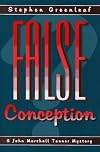
There’s something about a really well-written mystery that makes it a real pleasure to read. Such is the case with Stephen Greenleaf’s Tanner novels and False Conception is no exception.
Tanner is hired by his friend, Russell, an attorney, to investigate a surrogate. Seems some very wealthy clients of his, the Colberts, scions of a wealthy fashion empire, who wish to remain completely anonymous, want to implant an embryo in Stuart Colbert’s former secretary (for $100,000). At least show more that’s the story. It gets complicated because Russell must write up a contract without knowing the the law will be regarding surrogate rights and those of the biological parents. Russell needs Tanner to check out the former secretary without her knowledge and especially without her finding out who the the parents are of the child she will bear. The parents want to make sure no one will ever find out how the conception was brought to fruition, not realizing they are being manipulated by Stuart’s father.
As is axiomatic in Greenleaf and Ross MacDonald, the investigation turns over piles of corruption, hatred, and incest and once the links are connected hidden motives pop to the fore.
The reader is treated to passages such as this, “Because it was his office, Stuart Colbert looked comfortable and self-possessed and bursting with something to say. From the heat in his eyes and the flush to his face, I guessed it wouldn’t be pleasant. He was wiry and small, with an aesthete’s high forehead, a lizard’s bulbous eyes, and a languid smirk that declared he was master of all he surveyed. He struck me as a cold fish—judgmental, sanctimonious, arrogant, didactic—and a trifle jejune underneath. All to be expected, I suppose, given that his only source of early nourishment had come from a silver spoon. “
Excellent. Really hard to put this one down. show less
Tanner is hired by his friend, Russell, an attorney, to investigate a surrogate. Seems some very wealthy clients of his, the Colberts, scions of a wealthy fashion empire, who wish to remain completely anonymous, want to implant an embryo in Stuart Colbert’s former secretary (for $100,000). At least show more that’s the story. It gets complicated because Russell must write up a contract without knowing the the law will be regarding surrogate rights and those of the biological parents. Russell needs Tanner to check out the former secretary without her knowledge and especially without her finding out who the the parents are of the child she will bear. The parents want to make sure no one will ever find out how the conception was brought to fruition, not realizing they are being manipulated by Stuart’s father.
As is axiomatic in Greenleaf and Ross MacDonald, the investigation turns over piles of corruption, hatred, and incest and once the links are connected hidden motives pop to the fore.
The reader is treated to passages such as this, “Because it was his office, Stuart Colbert looked comfortable and self-possessed and bursting with something to say. From the heat in his eyes and the flush to his face, I guessed it wouldn’t be pleasant. He was wiry and small, with an aesthete’s high forehead, a lizard’s bulbous eyes, and a languid smirk that declared he was master of all he surveyed. He struck me as a cold fish—judgmental, sanctimonious, arrogant, didactic—and a trifle jejune underneath. All to be expected, I suppose, given that his only source of early nourishment had come from a silver spoon. “
Excellent. Really hard to put this one down. show less
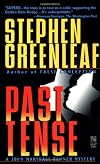
This is a masterpiece of the semi-hard-boiled detective genre; all the elements, and then some. I could see the ending coming, as could our hero, but it came with a bang anyway. And thank goodness I had the foresight to take the next one in the series out of the library at the same time. I don't know how I could have put this one down if I hadn't had the next one right there on the table to pick up immediately. Don't start with this one if you haven't read any of the Marsh Tanner series show more before. He has a past, and you need to know a bit of it before you read Past Tense.
Reviewed in 2007 show less
Reviewed in 2007 show less
Awards


You May Also Like


Associated Authors
Statistics
- Works
- 27
- Also by
- 6
- Members
- 1,126
- Popularity
- #22,819
- Rating
- 3.8
- Reviews
- 28
- ISBNs
- 117
- Languages
- 7
- Favorited
- 1