
Horace McCoy (1897–1955)
Author of They Shoot Horses, Don't They?
About the Author
Disambiguation Notice:
The book Crime novels : American noir of the 1930s and 40s contains works by several authors, but only one They Shoot Horses, Don't They? by Horace McCoy. It was edited by Robert Polito.
Image credit: NYWT&S Collection, Library of Congress
Works by Horace McCoy
Associated Works
The Arbor House Treasury of Detective and Mystery Stories from the Great Pulps (1983) — Contributor — 53 copies, 3 reviews
Tagged
Common Knowledge
- Birthdate
- 1897-04-14
- Date of death
- 1955-12-15
- Gender
- male
- Occupations
- bouncer
screenwriter
newspaper reporter - Organizations
- United States Army Air Corps
Dallas Journal - Nationality
- USA
- Birthplace
- Pegram, Tennessee, USA
- Places of residence
- Dallas, Texas, USA
Los Angeles, California, USA - Place of death
- Beverly Hills, California, USA
- Disambiguation notice
- The book Crime novels : American noir of the 1930s and 40s contains works by several authors, but only one They Shoot Horses, Don't They? by Horace McCoy. It was edited by Robert Polito.
- Associated Place (for map)
- USA
Members
Reviews
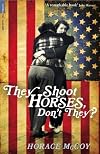
Horace McCoy’s 1935 novel They Shoot Horses, Don’t They? contains one of the bleakest lines in all of literature. It’s where Gloria, who dances in the marathon dance, asks without a trace of irony or black humor, ”Why are these high-powered scientists always screwing around trying to prolong life instead of finding pleasant ways to end it?” Can there ever be a more negative, more downbeat, pessimistic view of life?
Turns out, Gloria was raised in the most dreadful way, by abusive, show more cruel people in West Texas. She eventually escaped, moving to Los Angeles, looking to make it in Hollywood movies. Can there ever be a staler, more pathetic aspiration, to see the pretend, artificial world of Hollywood as your salvation?
To be abused and debased as a child growing up and then, as a young adult, to be pushed into marathon dancing – the true bloodsport of the Great Depression. And then, after receiving your fifty dollars for a month and a week of marathon dancing, handing your partner a pistol and asking him to blow your brains out. Vintage 1930s America captured in Horace McCoy’s outstanding classic. show less
A very odd little tale, verging on the bizarre if wasn't for the fact that those crazy dance marathons actually happened. McCoy's writing is very taut and contains a heavy dose of dialogue reminiscent of pulp noir fiction that flows along nicely. Apparently the structure - Robert's flashbacks from the dock - was considered experimental when written in the 30s, but I think it works exceedingly well.
The images evoked are a vivid portrait of the misery and despair of many in the depression era show more and the whole package turns out to be a weird existential look at the times. show less
The images evoked are a vivid portrait of the misery and despair of many in the depression era show more and the whole package turns out to be a weird existential look at the times. show less
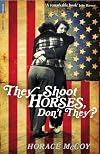
"For the first week we had to dance, but after that you didn't. All you had to do was keep moving." (pg. 24)
A cracking short read, the great appeal of They Shoot Horses, Don't They? by Horace McCoy is its originality. Though conventionally hard-boiled in style and unremarkable (though certainly capable) in pace, character and dialogue, the book is so unique an idea that, as a jaded long-time reader, I was thankful for every minute of it.
The central metaphor – mirrored in the title – is show more absolutely exquisite. The book follows two depressed, directionless young people during a time of acute economic hardship, humiliatingly reduced to competing in an exhausting dance marathon merely to find their next meal. This becomes, in McCoy's hands, a metaphor for the grind of modern, moribund life, where you are herded into things you find demeaning and are expected to jump for a few scattered coins, and they work you and work you and when you eventually, inevitably, drop down exhausted and defeated they take you out and shoot you like a horse with a broken leg. Without ever over-explaining it, McCoy laces every line of his short novel with the implications of this metaphor, and the result is a literary experience that is entirely effortless.
Indeed, the book is almost accidental literature; McCoy was a pulp crime writer embittered by his life – having been whacked in the face by the Great Depression – who had hit upon the idea for the novel while working at one of these dance marathons (unfortunately, they were real). When the French existentialists (quite rightly) praised it as a kindred spirit to their school, there's an element of elevation rather than discovery.
That said, it is – for us – discovery; the book is a hidden gem and incredibly relevant for a contemporary generation that has faced two historic recessions in little over ten years, and all during a time of social and cultural disconnect. They Shoot Horses, Don't They? reminded me, in some ways, of the 2019 Joker movie, in that it tells a sad and necessary story about social and economic hardship in an appealing and original way. Bitter pills never tasted so sweet. show less
A cracking short read, the great appeal of They Shoot Horses, Don't They? by Horace McCoy is its originality. Though conventionally hard-boiled in style and unremarkable (though certainly capable) in pace, character and dialogue, the book is so unique an idea that, as a jaded long-time reader, I was thankful for every minute of it.
The central metaphor – mirrored in the title – is show more absolutely exquisite. The book follows two depressed, directionless young people during a time of acute economic hardship, humiliatingly reduced to competing in an exhausting dance marathon merely to find their next meal. This becomes, in McCoy's hands, a metaphor for the grind of modern, moribund life, where you are herded into things you find demeaning and are expected to jump for a few scattered coins, and they work you and work you and when you eventually, inevitably, drop down exhausted and defeated they take you out and shoot you like a horse with a broken leg. Without ever over-explaining it, McCoy laces every line of his short novel with the implications of this metaphor, and the result is a literary experience that is entirely effortless.
Indeed, the book is almost accidental literature; McCoy was a pulp crime writer embittered by his life – having been whacked in the face by the Great Depression – who had hit upon the idea for the novel while working at one of these dance marathons (unfortunately, they were real). When the French existentialists (quite rightly) praised it as a kindred spirit to their school, there's an element of elevation rather than discovery.
That said, it is – for us – discovery; the book is a hidden gem and incredibly relevant for a contemporary generation that has faced two historic recessions in little over ten years, and all during a time of social and cultural disconnect. They Shoot Horses, Don't They? reminded me, in some ways, of the 2019 Joker movie, in that it tells a sad and necessary story about social and economic hardship in an appealing and original way. Bitter pills never tasted so sweet. show less
In the background of the marathon dance events, organized so that money can be made on the suffering of others, during the time when people had nothing to eat (period post 1929) so were willing to do whatever necessary, we are told a story of a woman who is at the end of her strength, person slowly growing ever so bitter and cruel, and who, definitely being aware of it, decides that that is it and that life has no point. She is even bitter because she just cannot end herself, while suffering show more the very thought that extinguishing of her own life would not register anywhere. Everything she touches, or that touches her, just feels dirty,corrupt, even kind acts from people that do happen, but finally end up as misinterpreted or ignored by her. It is story of a person that from early age got chewed by the very society and then spit out, without that energy spark that should drive humans onward, left as if there is no future ahead (or to be more precise no future she wants, that she sees in various high society stories and glamor magazines (very disturbing elements here with modern social media)).
There are a lot of people like this in every age and time, even today, and some like to name them nihilists, but these are not intellectuals that seek oblivion of everything, all the while keeping themselves outside any harm.
These are ordinary people who could have normal lives but at some point decided that if they cannot have what they want then nothing matters, and they just made the headlong plunge into the black hole of emotions. They do not pretend for shock value to want to die - they actually want it. And times of crisis only underline the difficulties, and only exacerbate the negativity. In the end folks like this just take with them those that try to enjoy life as much as is possible, which is what happens to her dance partner. People who will try to help, feel the pain and then, through innate naivete or stupidity, might even try to help these depression-holes out of their misery. Only to end up with their own life destroyed in the process.
This is short read, but very difficult one. It is truly heartbreaking seeing someone willing to give up of this gift called life just because at the moment things do not go their way. Nobody knows how they would react in situations like this, and hopefully one will never know, but it is difficult to just see people ..... implode. Terrible.
Very interesting novel, I was aware of the movie but not the book. Difficult read, but it is more than obvious that it contains autobiographical elements. It is not quick read, starts slowly but then with each chapter (I especially like parallel sections from the trial to show the level of madness) accelerates into the spiral of darkness that can only end in one way. Very dark novel.
Recommended to people interested in societal extremes, and reactions of people under accumulated stress. show less
There are a lot of people like this in every age and time, even today, and some like to name them nihilists, but these are not intellectuals that seek oblivion of everything, all the while keeping themselves outside any harm.
These are ordinary people who could have normal lives but at some point decided that if they cannot have what they want then nothing matters, and they just made the headlong plunge into the black hole of emotions. They do not pretend for shock value to want to die - they actually want it. And times of crisis only underline the difficulties, and only exacerbate the negativity. In the end folks like this just take with them those that try to enjoy life as much as is possible, which is what happens to her dance partner. People who will try to help, feel the pain and then, through innate naivete or stupidity, might even try to help these depression-holes out of their misery. Only to end up with their own life destroyed in the process.
This is short read, but very difficult one. It is truly heartbreaking seeing someone willing to give up of this gift called life just because at the moment things do not go their way. Nobody knows how they would react in situations like this, and hopefully one will never know, but it is difficult to just see people ..... implode. Terrible.
Very interesting novel, I was aware of the movie but not the book. Difficult read, but it is more than obvious that it contains autobiographical elements. It is not quick read, starts slowly but then with each chapter (I especially like parallel sections from the trial to show the level of madness) accelerates into the spiral of darkness that can only end in one way. Very dark novel.
Recommended to people interested in societal extremes, and reactions of people under accumulated stress. show less
Lists
Awards


You May Also Like


Associated Authors
Statistics
- Works
- 26
- Also by
- 6
- Members
- 1,656
- Popularity
- #15,515
- Rating
- 3.9
- Reviews
- 76
- ISBNs
- 121
- Languages
- 17
- Favorited
- 6