
Carmine Infantino (1925–2013)
Author of Star Wars Omnibus: A Long Time Ago..., Volume 1
About the Author
Image credit: Exhibition Hall, New York Comic Con 2008, photo by Lampbane
Series
Works by Carmine Infantino
Stan Lee Presents the Marvel Comics Illustrated Version of Star Wars (1981) — Illustrator — 28 copies
Batman in Detective Comics, Vol. II: Featuring the Complete Covers of the Second 25 Years (Tiny Folios) (1994) — Illustrator — 21 copies, 1 review
What If...? [1977] #17 - What If Ghost Rider, Spider-Woman, and Captain Marvel were Villains? (1979) — Illustrator — 4 copies, 1 review
Amazing World of DC Comics No. 1 2 copies
Spider-Woman [1978] #19 — Illustrator — 2 copies
Lair Of The Ice Worm 1 copy
DC Super-Stars #8 — Illustrator — 1 copy
Ghost Rider, Vol. 2 #43 — Illustrator — 1 copy
Ghost Rider, Vol. 2 #44 — Illustrator — 1 copy
Mystery in Space [1951] #87 — Illustrator — 1 copy
Mystery in Space [1951] #88 — Illustrator — 1 copy
Marvel Preview #14: Star-Lord — Illustrator — 1 copy
Detective Comics (1937) #156 1 copy
Detective Comics (1937) #147 1 copy
Detective Comics (1937) #145 1 copy
House of Mystery # 208 1 copy
Spider-Woman [1978] #6 — Illustrator — 1 copy
Red Tornado (1985-) #1 1 copy
Mystery in Space [1951] #90 — Illustrator — 1 copy
Associated Works
Legion of Super-Heroes: The Great Darkness Saga: The Deluxe Edition (2010) — Illustrator — 130 copies, 2 reviews
Batman Cover to Cover: The Greatest Comic Book Covers of the Dark Knight (2005) — Illustrator — 56 copies, 2 reviews
Marvel Masterworks, Volume 106: Atlas Era Journey Into Mystery Volume 1 [#1-10] (2008) — Illustrator — 30 copies
Marvel Masterworks, Volume 140: Atlas Era Strange Tales Volume 3 [#21-30] (1953) — Illustrator — 19 copies
Mystery in Space [1951] #89 — Illustrator — 1 copy
Strange Adventures [1950] #201 — Cover artist — 1 copy
The Flash [1959] #164 — Penciller; Cover artist — 1 copy
Tagged
Common Knowledge
- Canonical name
- Infantino, Carmine
- Birthdate
- 1925-05-24
- Date of death
- 2013-04-04
- Gender
- male
- Education
- School of Industrial Art, Manhattan
- Occupations
- comic book artist
- Organizations
- DC Comics
- Awards and honors
- Alley Award for Best Artist (1961, 1963)
Alley Award for Best Pencil Artist (1962, 1964)
Alley Award (Special Award, 1969) - Nationality
- USA
- Birthplace
- Brooklyn, New York, USA
- Place of death
- Manhattan, New York, USA
- Associated Place (for map)
- New York, USA
Members
Reviews
In The Amazing World of Carmine Infantino: An Autobiography, Carmine Infantino and J. David Spurlock explore Infantino’s biography from youth, through his Golden Age comics work, the changes of the Silver Age and the 1960s, and his freelancing later on. Infantino, one of the giants of the field, worked for both Marvel and DC as well as smaller companies and animation, so his insights will both entertain and inform comic book aficionados. Further, this volume forefronts the art, both show more Infantino’s own work and work indicative of the periods he describes, using its unique size to better showcase artistic samples. Most interestingly for fans are some examples of never-before-published work and preliminary sketches.
Discussing the postwar state of the industry after the comic book moral panic, Infantino writes, “The business was wounded pretty badly by the Kefauver hearings and Wertham, really doing a number on us. DC called everyone in and told us we had to take a two- or three-dollar page rate reduction. We were naturally upset, but they said it was either that or no work” (pg. 38). He continues, “DC became a closed shop for years. New artists came by looking for work, including Neal Adams, but no new talent was hired for years. Those of use who were there were lucky to be getting work” (pg. 39).
Infantino writes of the Silver Age revival, “One day in 1956, I brought a job in – I think it was a romance – and, without fanfare, Julie said to me, ‘You’re going to draw a super-hero again.’ I was surprised because they hadn’t been selling. Of the hundreds of costumed characters created in the ’40s, only Superman, Batman, and Wonder Woman survived in their own titles. Julie [Julius Schwartz] said, ‘You’re going to be doing The Flash’” (pg. 50). He continues, “The Flash jump-started the whole super-hero business again and went a long way in saving the comic book business from extinction” (pg. 54). Not only did Infantino help revive superheroes, he played a key role in re-designing Batman for the 1960s with a look that influenced the ABC television series. Infantino writes, “Batman became the most popular comic book character in the world. We were getting an unheard of 95% sell-through with print-runs up to 900,000 copies per issue!” (pg. 67).
The book also features several testimonials from Infantino’s compatriots in the business. Arnold Drake discusses his difficulty creating Deadman for DC and the way Infantino helped him: “I told [DC editor Jack] Miller about my idea for a new character named Deadman and even produced a rough sketch of what he might look like. Well, Jack let me know in no uncertain terms that the Comics Code censors would never allow a character named ‘Dead-man.’ Fully rejected and with all the wind out of my sails, I prepared for my exit. At that point I noticed Carmine behind and out of Miller’s view. He was gesturing with his fist up in the air, that I should not give up but really give it to Miller… Following Carmine’s instigation, I proceeded to lay into Miller; that we couldn’t run around paralyzed in constant fear of what the Code might do. I told him the company had to proceed with every good idea and leave the Code’s business to the Code. Well, it worked” (pgs. 70-71).
Spurlock writes, “One of Carmine’s most notable mandates as Editorial Director was the infuse relevancy into the comics line. The most recognized series of its day was the lauded Green Lantern/Green Arrow” (pg. 99). Discussing the business side of things, Infantino writes, “With rare exceptions, like the super-hero boom of the early ’40s and the Batman boom of the mid-’60s, the comic book business tends to make more money on licensing of characters for film, TV, toys, etc., than it does in publishing” (pg. 125). Overall, the book will appeal to fans of Golden- and Silver-Age comic books, particularly with its emphasis on Infantino’s art. Some of the remembrances may be contradicted by other sources, but it’s still a lovely memoir intended more for the fans than cultural historians. show less
Discussing the postwar state of the industry after the comic book moral panic, Infantino writes, “The business was wounded pretty badly by the Kefauver hearings and Wertham, really doing a number on us. DC called everyone in and told us we had to take a two- or three-dollar page rate reduction. We were naturally upset, but they said it was either that or no work” (pg. 38). He continues, “DC became a closed shop for years. New artists came by looking for work, including Neal Adams, but no new talent was hired for years. Those of use who were there were lucky to be getting work” (pg. 39).
Infantino writes of the Silver Age revival, “One day in 1956, I brought a job in – I think it was a romance – and, without fanfare, Julie said to me, ‘You’re going to draw a super-hero again.’ I was surprised because they hadn’t been selling. Of the hundreds of costumed characters created in the ’40s, only Superman, Batman, and Wonder Woman survived in their own titles. Julie [Julius Schwartz] said, ‘You’re going to be doing The Flash’” (pg. 50). He continues, “The Flash jump-started the whole super-hero business again and went a long way in saving the comic book business from extinction” (pg. 54). Not only did Infantino help revive superheroes, he played a key role in re-designing Batman for the 1960s with a look that influenced the ABC television series. Infantino writes, “Batman became the most popular comic book character in the world. We were getting an unheard of 95% sell-through with print-runs up to 900,000 copies per issue!” (pg. 67).
The book also features several testimonials from Infantino’s compatriots in the business. Arnold Drake discusses his difficulty creating Deadman for DC and the way Infantino helped him: “I told [DC editor Jack] Miller about my idea for a new character named Deadman and even produced a rough sketch of what he might look like. Well, Jack let me know in no uncertain terms that the Comics Code censors would never allow a character named ‘Dead-man.’ Fully rejected and with all the wind out of my sails, I prepared for my exit. At that point I noticed Carmine behind and out of Miller’s view. He was gesturing with his fist up in the air, that I should not give up but really give it to Miller… Following Carmine’s instigation, I proceeded to lay into Miller; that we couldn’t run around paralyzed in constant fear of what the Code might do. I told him the company had to proceed with every good idea and leave the Code’s business to the Code. Well, it worked” (pgs. 70-71).
Spurlock writes, “One of Carmine’s most notable mandates as Editorial Director was the infuse relevancy into the comics line. The most recognized series of its day was the lauded Green Lantern/Green Arrow” (pg. 99). Discussing the business side of things, Infantino writes, “With rare exceptions, like the super-hero boom of the early ’40s and the Batman boom of the mid-’60s, the comic book business tends to make more money on licensing of characters for film, TV, toys, etc., than it does in publishing” (pg. 125). Overall, the book will appeal to fans of Golden- and Silver-Age comic books, particularly with its emphasis on Infantino’s art. Some of the remembrances may be contradicted by other sources, but it’s still a lovely memoir intended more for the fans than cultural historians. show less

Having finished Birds of Prey, it's time to move on to my next comics-reading project: Project Crisis!, which is a journey through the spine of the DC Universe, its various "crisis" crossovers. Starting with the old "crises on multiple Earths," I'll then move on to Crisis on Infinite Earths, Zero Hour: Crisis in Time, Identity Crisis, Infinite Crisis, and Final Crisis. There's a lot there, and much of it is well-regarded for what it did, not how it did it, so I'm curious to see what I'll show more think of it all.
Before all those big, multiverse-shattering mega-events, though, comics the stories collected in Crisis on Multiple Earths: The Team-Ups, Volume One. Here we have nine single-issue stories, most of which are about superheroes crossing the dimensional boundaries between Earth-One and Earth-Two. These stories aren't exactly the most sophisticated by modern standards, but there's a certain thrill to them-- Gardner Fox correctly identifies, I think, that the idea of there being multiple Earths is just fun, and working your way through all its various permutations is guaranteed to be interesting.
"Flash of Two Worlds!" of course introduced all this parallel-Earth malarkey to DC, and is justly famous, but I also enjoyed "Double Danger on Earth!", where Jay Garrick crosses from Earth-Two to Earth-One in pursuit of a vital meteorite that was destroyed on his world but might still exist on Barry Allen's, or "Invader from the Dark Dimension!", where strange creatures from a dimension outside of both Earths, made up of pure darkness, menace our heroes. Fox never really repeats his old triumphs, continually aiming to do something new and unusual.
The only story here not written by Gardner Fox is "Secret Origin of the Guardians!", John Broome's somewhat overcomplicated tale of the two Green Lanterns meeting one another. It lacks the energy that Fox brings to his stories-- not to mention that delightful Carmine Infantino art that features in all the Flash stories.
Interestingly, there are also a couple stories here that don't feature trans-dimensional team-ups, but team-ups isolated to Earth-Two. "Solomon Grundy Goes on a Rampage!" and "Perils of the Psycho-Pirate!" feature Doctor Fate, Hourman, and the Earth-Two Green Lantern in somewhat typical superhero team-ups, while "Mastermind of Menaces!" does the same for Starman and the Black Canary. Then there's one last story, "The Hour Hourman Died!" which has no team-up element at all, but it's called a "bonus feature," so I guess that's okay. Most of these stories are fine, but lack the certain frisson that comes from the parallel-Earth setup. "The Hour Hourman Died!" is pretty neat, though-- a clever concept.
DC Comics Crises: Next in sequence » show less
Before all those big, multiverse-shattering mega-events, though, comics the stories collected in Crisis on Multiple Earths: The Team-Ups, Volume One. Here we have nine single-issue stories, most of which are about superheroes crossing the dimensional boundaries between Earth-One and Earth-Two. These stories aren't exactly the most sophisticated by modern standards, but there's a certain thrill to them-- Gardner Fox correctly identifies, I think, that the idea of there being multiple Earths is just fun, and working your way through all its various permutations is guaranteed to be interesting.
"Flash of Two Worlds!" of course introduced all this parallel-Earth malarkey to DC, and is justly famous, but I also enjoyed "Double Danger on Earth!", where Jay Garrick crosses from Earth-Two to Earth-One in pursuit of a vital meteorite that was destroyed on his world but might still exist on Barry Allen's, or "Invader from the Dark Dimension!", where strange creatures from a dimension outside of both Earths, made up of pure darkness, menace our heroes. Fox never really repeats his old triumphs, continually aiming to do something new and unusual.
The only story here not written by Gardner Fox is "Secret Origin of the Guardians!", John Broome's somewhat overcomplicated tale of the two Green Lanterns meeting one another. It lacks the energy that Fox brings to his stories-- not to mention that delightful Carmine Infantino art that features in all the Flash stories.
Interestingly, there are also a couple stories here that don't feature trans-dimensional team-ups, but team-ups isolated to Earth-Two. "Solomon Grundy Goes on a Rampage!" and "Perils of the Psycho-Pirate!" feature Doctor Fate, Hourman, and the Earth-Two Green Lantern in somewhat typical superhero team-ups, while "Mastermind of Menaces!" does the same for Starman and the Black Canary. Then there's one last story, "The Hour Hourman Died!" which has no team-up element at all, but it's called a "bonus feature," so I guess that's okay. Most of these stories are fine, but lack the certain frisson that comes from the parallel-Earth setup. "The Hour Hourman Died!" is pretty neat, though-- a clever concept.
DC Comics Crises: Next in sequence » show less
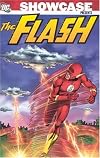
‘Showcase Presents The Flash: Volume 1’ has stories from Showcase # 4, 8, 13 and 14 and from Flash # 105-119. Apart from the special feature, see below, this takes us from 1956 to early 1961. Eisenhower was President, the dollar was worth something, America was the world’s creditor and, apart from a few threatening communists abroad, all was right with the world.
The book opens with ‘The Rival Flash’, a story from Flash Comics # 104, February 1949 with a script by Robert Kanigher show more and art by Carmine Infantino and Frank Giacoia. This features the Golden Age Flash, Jay Garrick, in a story where bad guys copy his powers. It is interesting to see how Infantino’s art has changed seven years later in Showcase # 4, October 1956 with ‘Mystery Of The Human Thunderbolt’ in which police scientist Barry Allen is struck by lightning while standing next to some chemicals in his laboratory and gets super-speed. This was also written by Robert Kanigher but inked by Joe Kubert, as was the second story. This combination of two acknowledged masters makes for very good work. Over the next few issues, Infantino developed a very clean, spacious style but there are subtle differences depending on the inking. Most of it is by Joe Giella, which is fine, but I liked the work of Frank Giacoia and Murphy Anderson better. Infantino used a lot of wide narrow panels, useful for showing the speed trail where the Flash has been.
The stories are entertaining, too, in their way. Being able to run fast would not normally be a very useful super-power but it is transformed utterly by DC pseudo-science. The chief pseudo-scientist is writer John Broome, who has the Flash running fast enough to time travel in only the second story. When launched into space by the Master of the Elements in Showcase # 13, the Flash manages to vibrate himself to get caught in the Moon’s gravitational pull, swing around it and return to Earth. His only protection was his costume but he was able to hold his breath as it only took a minute. By running very fast, he can pass straight through solid objects leaving them intact. (Don’t try this at home!) By spinning very fast, in The Flash # 107, he can slip through the solid Earth down into the hollow interior where the Bird People live. However, when he runs too fast down there the strange atmosphere, called Mola, solidifies around him so he is trapped and has to suffer the gloating of the super-intelligent gorilla that tricked him. The villains, you see, are equipped with similar John Broome pseudo-science so good and evil are pretty evenly matched. In The Flash # 106, the Pied Piper can stop him dead with a vibratory aura and the Mirror Master can shrink himself and Flash to three inches high by clever use of mirrors in The Flash # 109. It was marvellous what you could get away with in those innocent days.
An interesting aside about gorillas. They featured frequently on DC covers of this issue and I read somewhere online, admittedly a world of unverifiable half-truth, that top DC men used to study the sales figures in tandem with the covers. Someone noted that covers with gorillas on sold better and so demanded more gorillas. I also read an interview with John Broome in which he said the covers were sometimes drawn first and he had to come up with a story to suit. So a DC boss orders Infantino to draw a cover with a gorilla on and Mister Broome has to dream up a plot featuring said ape. I don’t think this is how Joseph Conrad used to work.
Anyway, like most heroes, the Flash has a girlfriend, Iris West, a reporter on Picture News. The running joke is that Barry Allen is always late for their dates and she calls him the slowest man alive. This was in the days before soap opera took hold in comics so they have the odd tiff about Barry’s perpetual tardiness but are not forever falling in and out of love in true romantic style. Frankly, it’s a bit of a relief.
Iris has a young nephew called Wally West, who is president of the Flash Fan Club in his home town. She brings him to Barry, a friend of the Flash as far as she knows, so that he can introduce the boy to his hero. The Flash soon appears and Wally asks him how he got his power. The Flash takes him into a laboratory full of chemicals and explains that he was standing in such a laboratory when lightning struck. Then…lightning strikes! Wally West is bathed in electro-chemical soup and gets super-speed, too, just like his hero. The Flash calls it a billion to one chance but I suspect it is slightly more than that. Wally talks about the ‘cats’ back home to show he is young and says ’jumping jets!’ and ’jeepers weepers!’ when he is surprised. This is certainly preferable to the language heard in modern playgrounds.
In The Flash # 112, the Elongated Man first appears in another burst of wondrous science. Ralph Dibny was fascinated by India rubber men in the circus and, after long research, he noticed that they all drank Gingold soda water, one ingredient of which is the juice of a little known tropical fruit. Ralph isolates the essence of the fruit by chemical means and drinks the resulting potion. Afterwards, he gets very stretchable and starts to upstage the Flash in super-heroics but they become friends in the end.
This is an interesting document in comics history. Not as interesting as the original four colour comic, of course, but a lot cheaper. The revival of the Flash in the second half of the 1950s is regarded by fans and professionals alike as the beginning of the Silver Age of comics. I don’t know which age we’re in now – the Bronze? – but I grew up in the ‘Silver Age’ so this is my era. Furthermore, since I mostly read the products of a rival company in the sixties, these ‘Showcase’ editions give me the chance to catch up on the stuff I missed. I sometimes feel that I didn’t miss much, to be honest, but they provide a useful back story for the better stuff DC started doing in the seventies.
Eamonn Murphy
This review first appeared at https://www.sfcrowsnest.info/ show less
The book opens with ‘The Rival Flash’, a story from Flash Comics # 104, February 1949 with a script by Robert Kanigher show more and art by Carmine Infantino and Frank Giacoia. This features the Golden Age Flash, Jay Garrick, in a story where bad guys copy his powers. It is interesting to see how Infantino’s art has changed seven years later in Showcase # 4, October 1956 with ‘Mystery Of The Human Thunderbolt’ in which police scientist Barry Allen is struck by lightning while standing next to some chemicals in his laboratory and gets super-speed. This was also written by Robert Kanigher but inked by Joe Kubert, as was the second story. This combination of two acknowledged masters makes for very good work. Over the next few issues, Infantino developed a very clean, spacious style but there are subtle differences depending on the inking. Most of it is by Joe Giella, which is fine, but I liked the work of Frank Giacoia and Murphy Anderson better. Infantino used a lot of wide narrow panels, useful for showing the speed trail where the Flash has been.
The stories are entertaining, too, in their way. Being able to run fast would not normally be a very useful super-power but it is transformed utterly by DC pseudo-science. The chief pseudo-scientist is writer John Broome, who has the Flash running fast enough to time travel in only the second story. When launched into space by the Master of the Elements in Showcase # 13, the Flash manages to vibrate himself to get caught in the Moon’s gravitational pull, swing around it and return to Earth. His only protection was his costume but he was able to hold his breath as it only took a minute. By running very fast, he can pass straight through solid objects leaving them intact. (Don’t try this at home!) By spinning very fast, in The Flash # 107, he can slip through the solid Earth down into the hollow interior where the Bird People live. However, when he runs too fast down there the strange atmosphere, called Mola, solidifies around him so he is trapped and has to suffer the gloating of the super-intelligent gorilla that tricked him. The villains, you see, are equipped with similar John Broome pseudo-science so good and evil are pretty evenly matched. In The Flash # 106, the Pied Piper can stop him dead with a vibratory aura and the Mirror Master can shrink himself and Flash to three inches high by clever use of mirrors in The Flash # 109. It was marvellous what you could get away with in those innocent days.
An interesting aside about gorillas. They featured frequently on DC covers of this issue and I read somewhere online, admittedly a world of unverifiable half-truth, that top DC men used to study the sales figures in tandem with the covers. Someone noted that covers with gorillas on sold better and so demanded more gorillas. I also read an interview with John Broome in which he said the covers were sometimes drawn first and he had to come up with a story to suit. So a DC boss orders Infantino to draw a cover with a gorilla on and Mister Broome has to dream up a plot featuring said ape. I don’t think this is how Joseph Conrad used to work.
Anyway, like most heroes, the Flash has a girlfriend, Iris West, a reporter on Picture News. The running joke is that Barry Allen is always late for their dates and she calls him the slowest man alive. This was in the days before soap opera took hold in comics so they have the odd tiff about Barry’s perpetual tardiness but are not forever falling in and out of love in true romantic style. Frankly, it’s a bit of a relief.
Iris has a young nephew called Wally West, who is president of the Flash Fan Club in his home town. She brings him to Barry, a friend of the Flash as far as she knows, so that he can introduce the boy to his hero. The Flash soon appears and Wally asks him how he got his power. The Flash takes him into a laboratory full of chemicals and explains that he was standing in such a laboratory when lightning struck. Then…lightning strikes! Wally West is bathed in electro-chemical soup and gets super-speed, too, just like his hero. The Flash calls it a billion to one chance but I suspect it is slightly more than that. Wally talks about the ‘cats’ back home to show he is young and says ’jumping jets!’ and ’jeepers weepers!’ when he is surprised. This is certainly preferable to the language heard in modern playgrounds.
In The Flash # 112, the Elongated Man first appears in another burst of wondrous science. Ralph Dibny was fascinated by India rubber men in the circus and, after long research, he noticed that they all drank Gingold soda water, one ingredient of which is the juice of a little known tropical fruit. Ralph isolates the essence of the fruit by chemical means and drinks the resulting potion. Afterwards, he gets very stretchable and starts to upstage the Flash in super-heroics but they become friends in the end.
This is an interesting document in comics history. Not as interesting as the original four colour comic, of course, but a lot cheaper. The revival of the Flash in the second half of the 1950s is regarded by fans and professionals alike as the beginning of the Silver Age of comics. I don’t know which age we’re in now – the Bronze? – but I grew up in the ‘Silver Age’ so this is my era. Furthermore, since I mostly read the products of a rival company in the sixties, these ‘Showcase’ editions give me the chance to catch up on the stuff I missed. I sometimes feel that I didn’t miss much, to be honest, but they provide a useful back story for the better stuff DC started doing in the seventies.
Eamonn Murphy
This review first appeared at https://www.sfcrowsnest.info/ show less
I bought all of these comics when they came out originally. As a kid I lived for every new Star Wars story. Rereading them made me chuckle. Their was no canon at the time and the Marvel writers just went hog wild. If you have a problem with Jar Jar you are going to love Jax. This was the only way to get extra Star Wars while you waited for the movie. They sold incredibly well at the time.
Some of the stories are great but others don't hold up well. I would have given them a 5 as a kid now show more they are more like a 3.5. A great walk down memory lane. show less
Some of the stories are great but others don't hold up well. I would have given them a 5 as a kid now show more they are more like a 3.5. A great walk down memory lane. show less
You May Also Like


Associated Authors
Statistics
- Works
- 85
- Also by
- 60
- Members
- 972
- Popularity
- #26,497
- Rating
- 3.8
- Reviews
- 21
- ISBNs
- 40
- Languages
- 4