
Clement Wood (1888–1950)
Author of The Complete Rhyming Dictionary: Including The Poet's Craft Book
About the Author
Clement Wood was a writer, lawyer, and schoolteacher who was born in Alabama in 1883. Wood's work as editor for The Complete Rhyming Dictionary is his best remembered contribution to modern poets everywhere. Clement Wood died in 1950. (Bowker Author Biography)
Works by Clement Wood
Complete Rhyming Dictionary: The Essential Handbook for Poets and Song Writers (1943) 154 copies, 1 review
The Outline of Man's Knowledge: The Story of History, Science, Literature, Art, Religion, Philosophy (1930) 19 copies
A history of the world 3 copies
Hints on writing poetry 3 copies
An Introduction to Philology (The Science of Language) (Little Blue Book Number 708) (1924) 3 copies
A Book of Nonsense Poems 3 copies
Auction Bridge for Beginners 2 copies
Poets' and songwriters' guide; the complete book of scansion for writers of poetry, verse, song lyrics and prose (1948) 2 copies
Sociology for beginners 2 copies
Poetry of the southern states 2 copies
Flesh 2 copies
The Making of the Old Testament 2 copies
More power to Your Words 2 copies
The earth turns south 2 copies
The Craft of Poetry 2 copies
The 1941 quiz book 1 copy
The Coffin 1 copy
Desire 1 copy
Glad of earth 1 copy
Poets of America 1 copy
Glad to Earth 1 copy
Other men's wives 1 copy
Mountain 1 copy
Great women of antiquity 1 copy
Byron and the Women He Loved 1 copy
Best Irish Jokes 1 copy
Sex in psychoanalysis 1 copy
Sorry Wrong Corpse 1 copy
Associated Works
The Best Short Stories of 1922 and the Yearbook of the American Short Story (2017) — Contributor — 7 copies
Tagged
Common Knowledge
- Legal name
- Wood, Clement Richardson
- Birthdate
- 1888-09-01
- Date of death
- 1950-10-26
- Gender
- male
Members
Reviews
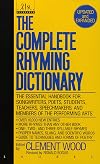
This is an updated version of Clement Wood's original work from 1936, which I have reviewed separately, although LibraryThing seems to have combined the two. There is little difference, except for the addition of 10,000 new entries. Wood's original essay on "The Poet's Craft" is included basically intact, except for at least one slight edit, which replaces the N-word with "peoples". Other than that, the original essay, with its references and quotes to poets both well-known and largely show more forgotten--including Clement Wood himself--appears unchanged. (Wood was a prolific writer of all types of books, including poetry, pulp fiction, pornography, and pretty much anything else you can imagine, as well as being a socialist and atheist--which didn't sit too well with many folks in Alabama, where he grew up.)
I do find it a bit amazing that his highly opinionated and prescriptive essay is still in print, but I guess rhyming dictionaries are not on the top of the list for paying anyone to make substantial updates. In any case, it is mostly a good introduction, though he dwells too long on really obscure French forms of poetry. I am convinced that Stephen Fry used Wood's work as the basis for his brilliant "The Ode Not Taken" which provides, in a much more modern and humorous manner, the same sort of instruction, minus the non-essentials, and with integrated exercises along the way--in line with Wood's own suggestion.
As for the rhyming dictionary itself, it is laid out in a phonetic arrangement that takes a while to get used to compared to a rhyming dictionary that includes an index (or an ebook where you can easily search for the word you want to rhyme with). But by omitting an index, there is a whole lot more room for actual rhymes.
This newer version continues to insist, quite vehemently, that "north" and "forth" (and "nor" and "fore" as well) don't rhyme because the 'o' sound is different. The contention is that the 'o' in "old" and the 'o' in "for" are different sounds. But I don't buy it. Nor do the Penguin Rhyming Dictionary or Merriam-Webster Rhyming Dictionary I bought at the same time.
Of all four rhyming dictionaries I purchased, the M-W, which is organized alphabetically by the letters to be rhymed (such as "orth") may be the easiest to use. It doesn't really require an index, and you don't have to look at a lot of phonetic symbols. show less
I do find it a bit amazing that his highly opinionated and prescriptive essay is still in print, but I guess rhyming dictionaries are not on the top of the list for paying anyone to make substantial updates. In any case, it is mostly a good introduction, though he dwells too long on really obscure French forms of poetry. I am convinced that Stephen Fry used Wood's work as the basis for his brilliant "The Ode Not Taken" which provides, in a much more modern and humorous manner, the same sort of instruction, minus the non-essentials, and with integrated exercises along the way--in line with Wood's own suggestion.
As for the rhyming dictionary itself, it is laid out in a phonetic arrangement that takes a while to get used to compared to a rhyming dictionary that includes an index (or an ebook where you can easily search for the word you want to rhyme with). But by omitting an index, there is a whole lot more room for actual rhymes.
This newer version continues to insist, quite vehemently, that "north" and "forth" (and "nor" and "fore" as well) don't rhyme because the 'o' sound is different. The contention is that the 'o' in "old" and the 'o' in "for" are different sounds. But I don't buy it. Nor do the Penguin Rhyming Dictionary or Merriam-Webster Rhyming Dictionary I bought at the same time.
Of all four rhyming dictionaries I purchased, the M-W, which is organized alphabetically by the letters to be rhymed (such as "orth") may be the easiest to use. It doesn't really require an index, and you don't have to look at a lot of phonetic symbols. show less

I bought this after reading reviews of some newer versions which said that they didn't include the long introductory part on The Poet's Craft. However, my newer version does include it, with at least one slight edit, which replaces the N-word with "peoples". Other than that, the original 1936 essay, with its references and quotes to poets both well-known and largely forgotten--including Clement Wood himself--appears intact. (Wood was a prolific writer of all types of books, including poetry, show more pulp fiction, pornography, and pretty much anything else you can imagine, as well as being a socialist and atheist--which didn't sit too well with many folks in Alabama, where he grew up.)
I do find it a bit amazing that his highly opinionated and prescriptive essay is still in print, but I guess rhyming dictionaries are not on the top of the list for paying anyone to make substantial updates. In any case, it is mostly a good introduction, though he dwells too long on really obscure French forms of poetry. I am convinced that Stephen Fry used Wood's work as the basis for his brilliant "The Ode Not Taken" which provides, in a much more modern and humorous manner, the same sort of instruction, minus the non-essentials, and with integrated exercises along the way--in line with Wood's own suggestion.
As for the rhyming dictionary itself, it is laid out in a phonetic arrangement that takes a while to get used to compared to a rhyming dictionary that includes an index (or an ebook where you can easily search for the word you want to rhyme with). But by omitting an index, there is a whole lot more room for actual rhymes. I haven't done any sort of comparison with the newer edition, which claims to include 10,000 new entries, but the arrangement is the same.
Both books also insist that "north" and "forth" (and "nor" and "fore" as well) don't rhyme because the 'o' sound is different. The contention is that the 'o' in "old" and the 'o' in "for" are different sounds. But I don't buy it. Nor does the Penguin Rhyming Dictionary or Merriam-Webster Rhyming Dictionary I bought at the same time.
Of all four rhyming dictionaries, the M-W, which is organized alphabetically by the letters to be rhymed (such as "orth") may be the easiest to use. It doesn't really require an index, and you don't have to look at a lot of phonetic symbols. show less
I do find it a bit amazing that his highly opinionated and prescriptive essay is still in print, but I guess rhyming dictionaries are not on the top of the list for paying anyone to make substantial updates. In any case, it is mostly a good introduction, though he dwells too long on really obscure French forms of poetry. I am convinced that Stephen Fry used Wood's work as the basis for his brilliant "The Ode Not Taken" which provides, in a much more modern and humorous manner, the same sort of instruction, minus the non-essentials, and with integrated exercises along the way--in line with Wood's own suggestion.
As for the rhyming dictionary itself, it is laid out in a phonetic arrangement that takes a while to get used to compared to a rhyming dictionary that includes an index (or an ebook where you can easily search for the word you want to rhyme with). But by omitting an index, there is a whole lot more room for actual rhymes. I haven't done any sort of comparison with the newer edition, which claims to include 10,000 new entries, but the arrangement is the same.
Both books also insist that "north" and "forth" (and "nor" and "fore" as well) don't rhyme because the 'o' sound is different. The contention is that the 'o' in "old" and the 'o' in "for" are different sounds. But I don't buy it. Nor does the Penguin Rhyming Dictionary or Merriam-Webster Rhyming Dictionary I bought at the same time.
Of all four rhyming dictionaries, the M-W, which is organized alphabetically by the letters to be rhymed (such as "orth") may be the easiest to use. It doesn't really require an index, and you don't have to look at a lot of phonetic symbols. show less
The text/content is useful and thorough, the introductory primer on poetry is helpful. I made the mistake of assuming this edition was the same in other respects as a copy of this work which I have from Doubleday 1991. However, this edition turns out to be mass-market quality: cheap paper and diminutive size, lower quality binding. Much prefer the 1991 Doubleday which I have but is falling apart from use.

Pubilshed in 1942, *this Book is NOT about the Beats or the Beat Style of Writing*. I've considered if this book may be a book that Allen Ginsberg was reading while at University before his breakdown. It may have been a required textbook used in a class at Columbia. My research is inconclusive without reviewing Course syllabus from that period or verification from an eye witness. Don't ask me to prove it, my notes are long gone.
Regardless, this book is a prime example of what the Beats were show more opposing in terms of writing conventions in their era. I think Kerouac or Burroughs mentioned something about knowing the rules in order to break them good and proper, nes pas? Therefore, I would recommend this book for Beat literature readers and students who are are trying to understand the Beat "mind'.
On it's own, the book is fairly dull reading, and is, of course, completely out-of -date in terms of possible forms. The author is well-published-- which meant more at the time than in the current state of the publishing industry, and certainly is knowledgeable about the subject.. I'm sure there are more contemporary, readable, easier-to-locate books that one can use to learn how to write like the old masters, if that is one's objective. show less
Regardless, this book is a prime example of what the Beats were show more opposing in terms of writing conventions in their era. I think Kerouac or Burroughs mentioned something about knowing the rules in order to break them good and proper, nes pas? Therefore, I would recommend this book for Beat literature readers and students who are are trying to understand the Beat "mind'.
On it's own, the book is fairly dull reading, and is, of course, completely out-of -date in terms of possible forms. The author is well-published-- which meant more at the time than in the current state of the publishing industry, and certainly is knowledgeable about the subject.. I'm sure there are more contemporary, readable, easier-to-locate books that one can use to learn how to write like the old masters, if that is one's objective. show less
You May Also Like


Associated Authors
Statistics
- Works
- 95
- Also by
- 8
- Members
- 1,323
- Popularity
- #19,430
- Rating
- 3.9
- Reviews
- 9
- ISBNs
- 21
- Languages
- 1
- Favorited
- 1