
Adam Kirsch
Author of The People and the Books: 18 Classics of Jewish Literature
About the Author
Adam Kirsch is the book critic of the New York Sun.
Image credit: Poetry Foundation
Works by Adam Kirsch
The Blessing and the Curse: The Jewish People and Their Books in the Twentieth Century (2020) 51 copies, 3 reviews
Come and Hear: What I Saw in My Seven-and-a-Half-Year Journey through the Talmud (2021) 25 copies, 2 reviews
Associated Works
Counterpoints: 25 Years of The New Criterion on Culture and the Arts (2007) — Contributor — 48 copies
Tagged
Common Knowledge
- Canonical name
- Kirsch, Adam
- Birthdate
- 1976
- Gender
- male
- Education
- Harvard University (BA|1997)
- Occupations
- poet
literary critic - Organizations
- The New York Sun
The New Republic - Awards and honors
- The New Criterion Poetry Prize (2002)
- Relationships
- Kirsch, Jonathan (father)
- Nationality
- USA
- Birthplace
- Los Angeles, California, USA
- Places of residence
- Los Angeles, California, USA
- Associated Place (for map)
- Los Angeles, California, USA
Members
Reviews
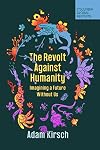
I always look forward to Columbia Global Reports. They tend to be short and jampacked. A single topic, usually controversial, intensely written up, with insights not available on facebook or twitter, let alone linkedin. This latest one is The Revolt Against Humanity, by Adam Kirsch. It does not disappoint.
It could be that humans disappear altogether, selected out of existence by a plague or a war or by an unlivable change in the ecosphere. Because homo sapiens is not just parasitic and show more detrimental to the planet, it is by far the most invasive species, and we all know how destructive invasive species can be, settling where they don’t belong and upsetting the balance of everything. Even its waste is horrific. It’s the only species whose waste is toxic to the planet instead of beneficial. I could go on. Doesn’t matter. They’re gone for the purposes of this book.
There are two sides to this story. Some think Man is on his way out, and sooner than later. And that he deserves it. There are far too many. They’ve caused horrendous perversions of the Earth through overfarming, overfertilizing, making their cattle the largest measure of biomass in the realm, wiping out thousands of other species, burning everything in sight, etc. etc. That this cannot go on indefinitely is self-evident to them. And it’s not such a big deal. If we’ve learned anything, it’s that species come and go in an endless parade. It is the normal state of being on planet Earth. This particularly nasty species will end just as almost every other one has, without fanfare or mourning or reprieve. The fact that we can see it coming and, needless to add, that it is us we’re discussing, is what is different.
The other group supports what futurist Ray Kurzweil calls the singularity, in which the contents of everyone’s brain is uploaded into an electronic brain data warehouse, which continues to operate based on all its accumulated and available human wisdom. Plague-proof, ecology-proof and likely even war-proof, Kirsch posits this outcome as feasible. It means that human life is not for nothing, that wisdom gained through living will not have to be relearned, and progress will be achieved faster and easier. It might even mean an individual’s personality and character might survive forever in this state. It’s a kind of immortality. Or hell, depending.
There is also a subset of the tech-adapted, often called cyborgs, in which parts of humans are replaced by machinery, giving rise to a race of supermen, not subject to ordinary mortality tables. This is already well underway, quite remarkably without any controversy, protest or outrage. People have gotten used to the idea of pacemakers, artificial limbs, brainwave-controlled electronic hands, and of course organ transplants, from other people, animals, or grown in labs. At what point does the original human being become a cyborg is not even asked any more. We accept that such things are necessary for some people, and in some cases, they are improvements. So cyborgs don’t participate in the controversy of what comes after we’ve gone, because they don’t alter mortality - yet.
The wipeout scenario of humanity is actually favored by a growing number of people. Kirsch calls them the Anthropocene anti-humanists, a very Gulliverian term. The singularity fans are called transhumanists. That’s the whole setup for the book.
Kirsch does a literature review. He has collected pithy quotes from the proponents of both sides. They both make interesting points as well as a lot of nonsense. And neither side has the wherewithal to make a claim of reality for their position. The anti-humanists just think enough is enough, and the transhumanists just don’t think there’s ever enough. They hate the very concept of mortality. Jonathan Swift would understand.
The anti-humanists are really well established. Kirsch cites anxiety and depression everywhere, along with steeply declining birthrates. Young people are not the least certain they want to bring new children into a world doomed to cataclysm. It’s bad enough if they themselves are to be the last generation. But to saddle their own offspring with that fate is not merely undesirable, but quite avoidable. He finds a South African author who says the best thing we can do for the unborn is to make sure they stay that way (David Benatar, Better Never To Have Been).
Kirsch says the environmental crisis is what really drives anti-humanists. He says proponents are “really environmental(ists) in a hurry.” In my own book, I have likened the Earth’s action against homo sapiens to be like a dog shaking off water. It will be convulsive for a while, but ultimately, the planet will settle down and move on, clean and dry. So I can relate here.
At some point, religion has to enter into it, and whether or not the universe is even valid without the presence of Man. Oddly, Kirsch does not also evaluate whether Man, with all his invasive nastiness, is really what God had in mind for a mirror image of himself. As usual, nothing can be resolved from arguing over religion. Kirsch wisely just puts it out there as contributing to the argument.
The transhumanists though, are really up against it. First of all, science and technology are lagging very badly in getting to the singularity. There is major doubt whether it can be achieved before some disaster wipes out the species first. Kirsch doesn’t go there, but the fact is, we don’t even know how the brain creates a memory or how it calls it up. My favorite example (https://medium.com/the-straight-dope/great-minds-dont-think-alike-an-intellectual-theme-park-of-the-sciences-af3daa3edfd): think of your first kiss. This is something we typically have not thought about in years, yet it can be recalled instantly. We have no idea how this works. So how do transhumanists upload all the content of a brain? And then employ it?
Then there is the all-important support feature, which Kirsch does not consider either. If humans have disappeared, who is going to maintain, manage and upgrade the massive systems required to keep the singularity operating? And what exactly will this singularity do alone in the world? Travel to another planet just because it has the 100,000 years it would need available to do it?
From this you can see that once again, a Columbia Global Report inspires much cogitation. It exposes a concept most people spend zero time considering, and fills in just enough detail to make readers want to argue.
This is what I appreciate in the series.
David Wineberg show less
It could be that humans disappear altogether, selected out of existence by a plague or a war or by an unlivable change in the ecosphere. Because homo sapiens is not just parasitic and show more detrimental to the planet, it is by far the most invasive species, and we all know how destructive invasive species can be, settling where they don’t belong and upsetting the balance of everything. Even its waste is horrific. It’s the only species whose waste is toxic to the planet instead of beneficial. I could go on. Doesn’t matter. They’re gone for the purposes of this book.
There are two sides to this story. Some think Man is on his way out, and sooner than later. And that he deserves it. There are far too many. They’ve caused horrendous perversions of the Earth through overfarming, overfertilizing, making their cattle the largest measure of biomass in the realm, wiping out thousands of other species, burning everything in sight, etc. etc. That this cannot go on indefinitely is self-evident to them. And it’s not such a big deal. If we’ve learned anything, it’s that species come and go in an endless parade. It is the normal state of being on planet Earth. This particularly nasty species will end just as almost every other one has, without fanfare or mourning or reprieve. The fact that we can see it coming and, needless to add, that it is us we’re discussing, is what is different.
The other group supports what futurist Ray Kurzweil calls the singularity, in which the contents of everyone’s brain is uploaded into an electronic brain data warehouse, which continues to operate based on all its accumulated and available human wisdom. Plague-proof, ecology-proof and likely even war-proof, Kirsch posits this outcome as feasible. It means that human life is not for nothing, that wisdom gained through living will not have to be relearned, and progress will be achieved faster and easier. It might even mean an individual’s personality and character might survive forever in this state. It’s a kind of immortality. Or hell, depending.
There is also a subset of the tech-adapted, often called cyborgs, in which parts of humans are replaced by machinery, giving rise to a race of supermen, not subject to ordinary mortality tables. This is already well underway, quite remarkably without any controversy, protest or outrage. People have gotten used to the idea of pacemakers, artificial limbs, brainwave-controlled electronic hands, and of course organ transplants, from other people, animals, or grown in labs. At what point does the original human being become a cyborg is not even asked any more. We accept that such things are necessary for some people, and in some cases, they are improvements. So cyborgs don’t participate in the controversy of what comes after we’ve gone, because they don’t alter mortality - yet.
The wipeout scenario of humanity is actually favored by a growing number of people. Kirsch calls them the Anthropocene anti-humanists, a very Gulliverian term. The singularity fans are called transhumanists. That’s the whole setup for the book.
Kirsch does a literature review. He has collected pithy quotes from the proponents of both sides. They both make interesting points as well as a lot of nonsense. And neither side has the wherewithal to make a claim of reality for their position. The anti-humanists just think enough is enough, and the transhumanists just don’t think there’s ever enough. They hate the very concept of mortality. Jonathan Swift would understand.
The anti-humanists are really well established. Kirsch cites anxiety and depression everywhere, along with steeply declining birthrates. Young people are not the least certain they want to bring new children into a world doomed to cataclysm. It’s bad enough if they themselves are to be the last generation. But to saddle their own offspring with that fate is not merely undesirable, but quite avoidable. He finds a South African author who says the best thing we can do for the unborn is to make sure they stay that way (David Benatar, Better Never To Have Been).
Kirsch says the environmental crisis is what really drives anti-humanists. He says proponents are “really environmental(ists) in a hurry.” In my own book, I have likened the Earth’s action against homo sapiens to be like a dog shaking off water. It will be convulsive for a while, but ultimately, the planet will settle down and move on, clean and dry. So I can relate here.
At some point, religion has to enter into it, and whether or not the universe is even valid without the presence of Man. Oddly, Kirsch does not also evaluate whether Man, with all his invasive nastiness, is really what God had in mind for a mirror image of himself. As usual, nothing can be resolved from arguing over religion. Kirsch wisely just puts it out there as contributing to the argument.
The transhumanists though, are really up against it. First of all, science and technology are lagging very badly in getting to the singularity. There is major doubt whether it can be achieved before some disaster wipes out the species first. Kirsch doesn’t go there, but the fact is, we don’t even know how the brain creates a memory or how it calls it up. My favorite example (https://medium.com/the-straight-dope/great-minds-dont-think-alike-an-intellectual-theme-park-of-the-sciences-af3daa3edfd): think of your first kiss. This is something we typically have not thought about in years, yet it can be recalled instantly. We have no idea how this works. So how do transhumanists upload all the content of a brain? And then employ it?
Then there is the all-important support feature, which Kirsch does not consider either. If humans have disappeared, who is going to maintain, manage and upgrade the massive systems required to keep the singularity operating? And what exactly will this singularity do alone in the world? Travel to another planet just because it has the 100,000 years it would need available to do it?
From this you can see that once again, a Columbia Global Report inspires much cogitation. It exposes a concept most people spend zero time considering, and fills in just enough detail to make readers want to argue.
This is what I appreciate in the series.
David Wineberg show less
A fascinating jaunt through eighteen different books, different time periods, different authors, different relationships to God, different relationships between Jews and non-Jews. The diversity of backstories -- from Moses to Moses to Moses! I love how Kirsch threaded the same themes throughout the eighteen chapters. I was surprised by how often Jewish writers tried to bridge the Bible with the science of the time, from Philo all the way to Moses Mendelsson, though the religious philosophies show more sometimes bored me. I had no good knowledge of the Zohar or the Kabbalah, or of the Nachman of Breslov -- and I'd never heard of the Tsenerene, or of Philos -- and this book offered an excellent introduction to those figures and books. I wish the book had more of a thrust, or a more substantial conclusion to tie up the many overlapping themes and undercurrents. show less

Who wants To Be a Jewish Writer
By Adam Kirsch
A worthy book of essays to those who have an interest in literature, the Jewish experience and tradition, liberalism and universal idealism. Adam Kirsch is a critic whose intelligence brings insights to these subjects.
Some of the writers he touches on include Walter Benjamin, Stefan Zweig, Franz Kafka, Seamus Heaney, Cynthia Ozick, Hannah Arendt, Roza Luxemburg, Isaac Deutscher, Tony Kushner and Milton Heidegger. The breath of this list is an show more indication of the author’s wide interests.
Literature, poetry, philosophy, American liberalism, socialism, secular and religious tensions are subjects well explored.
In one essay Kirsch asks: “Is a Jewish intellectual still doing something Jewish when he studies Kant instead of the Talmud?”. In part he answers through the art critic Harold Rosenberg stating “both are engaged in the Jewish activity of interpretation, the discovery of meanings in texts." show less
By Adam Kirsch
A worthy book of essays to those who have an interest in literature, the Jewish experience and tradition, liberalism and universal idealism. Adam Kirsch is a critic whose intelligence brings insights to these subjects.
Some of the writers he touches on include Walter Benjamin, Stefan Zweig, Franz Kafka, Seamus Heaney, Cynthia Ozick, Hannah Arendt, Roza Luxemburg, Isaac Deutscher, Tony Kushner and Milton Heidegger. The breath of this list is an show more indication of the author’s wide interests.
Literature, poetry, philosophy, American liberalism, socialism, secular and religious tensions are subjects well explored.
In one essay Kirsch asks: “Is a Jewish intellectual still doing something Jewish when he studies Kant instead of the Talmud?”. In part he answers through the art critic Harold Rosenberg stating “both are engaged in the Jewish activity of interpretation, the discovery of meanings in texts." show less

In the 1920s, a study program, called Daf Yomi (Hebrew for "daily page) began in which Jews all over the world read a page (the same page) of the Talmud each day. It takes 7 1/2 years. Although it's primarily done by Orthodox Jews, Kirsch, who is secular, decided to participate in the cycle that began in August of 2012. This book is an excellent introduction to the Talmud, the importance and value of Talmud study, and why some of its oddest arguments aren't really so odd, after all.
Lists
Awards


You May Also Like


Associated Authors
Statistics
- Works
- 33
- Also by
- 3
- Members
- 728
- Popularity
- #34,884
- Rating
- 3.8
- Reviews
- 17
- ISBNs
- 44
- Languages
- 2
- Favorited
- 1