

Darcey Steinke
Author of Suicide blonde
About the Author
Works by Darcey Steinke
In the Garden 1 copy
Orgasm (short work) 1 copy
Associated Works
The Dictionary of Failed Relationships: 26 Tales of Love Gone Wrong (2003) — Contributor — 62 copies
Black Clock 3 — Contributor — 1 copy
Tagged
Common Knowledge
- Birthdate
- 1964
- Gender
- female
- Nationality
- USA
- Places of residence
- New York, New York, USA
- Map Location
- USA
Members
Reviews

Spoiler, last sentence.
This was twisted and bizarre. Ginger tries to do the minister’s daughter bit but on the rest of the days of the week, she hangs with her weird boyfriend and his sicko roommate. It sounded like they were in a filthy squat but it was hard to tell. Ginger isn’t really obsessed with Sandy, just preoccupied. The vignettes featuring Sandy were frightening though. Her madness protected her from the sadism of the psycho who had her. What he does to her and how he justifies show more what he does. She has conversations with the woodland animals in her head to block out what he might say to her. To keep herself from him, she drove herself into madness. Eventually she dies. Ginger stays trapped in her bleak life. show less
This was twisted and bizarre. Ginger tries to do the minister’s daughter bit but on the rest of the days of the week, she hangs with her weird boyfriend and his sicko roommate. It sounded like they were in a filthy squat but it was hard to tell. Ginger isn’t really obsessed with Sandy, just preoccupied. The vignettes featuring Sandy were frightening though. Her madness protected her from the sadism of the psycho who had her. What he does to her and how he justifies show more what he does. She has conversations with the woodland animals in her head to block out what he might say to her. To keep herself from him, she drove herself into madness. Eventually she dies. Ginger stays trapped in her bleak life. show less
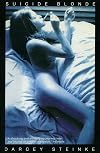
Suicide Blond’s first sentence “Was it the bourbon or the dye fumes that made the pink walls quiver like vaginal lips?” threw me off immediately. I like a little foreplay at least in the first paragraph, and the introductory sentence left me feeling like the victim of a literary drive by. This is not to say that I am prudish, especially in my reading, but this sentence was crafted just to shock the reader. It left a bad taste in my brain, but not as much as the main character. Jesse is show more self involved and shallow, as far as characters go. She blames those in her life for making her feel inadequate, but I believe she is projecting. Normally, this would not bother me, but we are supposed to identify with her and pity her, something I cannot bring myself to do. She moves from Bell to Pig to Madison, seeking someone who will ultimately take care of her and give her meaning. Jesse thinks she can punish Bell for not loving her enough by running off to live like a bad girl only to return and tell him all of the horrible things she is doing, further showing that it was not out of self discovery but to snub someone who already doesn’t care what she does. I found the rest of her characters fascinating and lifelike, albeit somewhat stereotypical. It is the protagonist that falls short and contributes to the novel’s wanting.
It would be easier to enjoy this novel were it not for the dreamy way you meander through the pages. Reading it feels ephemeral; I found myself striving towards a plot that tried to evade me at every turn. The structure is labyrinthine, and I do not mean that to be complimentary. Occasionally there is a beautiful gem of a sentence that you go back over and digest before moving on to the next random plot contrivance. It is obvious that underneath the indifference that Steinke possesses talent, she is just doing too good of a job hiding it under a boring plot.
Steinke wishes to take the reader to a place that she believes is dark and cutting edge. She wants you to see how troubled Jesse is and pity her in her own self involvement. I came away believing Jesse to be responsible for her own problems and experiencing a sense of lost time; I know I read it and I know time has passed, but there isn’t much to show or remember what happened between the covers. It was not that I found myself lost in the literary world but that I found myself in limbo just outside of it. I finished with indifference. Even Suicide Blond’s ending is anticlimactic and failed to draw me in enough to feel any kind of closure. Then again, it also failed to invest me in the story so I figure I didn’t lose out. It reads like a first novel for someone who shows great promise but just doesn’t know how to show it yet; the only problem with Suicide Blond is that Steinke has published before, which I find regretful.
By far it is not the best novel I have ever read, but Suicide Blond is also not the worst (you should hear what I have to say about House of Sand and Fog). I doubt I’ll ever pick it up again to read in its entirety, but there are a few sentences there that I, even now, want to read over again. This gives me a glimmer of hope that Steinke may put something else out that is really worth reading one day and gets across the beauty of prose that ghosts throughout the novel. I wanted to like this book. I really did. I tried, and I failed. show less
It would be easier to enjoy this novel were it not for the dreamy way you meander through the pages. Reading it feels ephemeral; I found myself striving towards a plot that tried to evade me at every turn. The structure is labyrinthine, and I do not mean that to be complimentary. Occasionally there is a beautiful gem of a sentence that you go back over and digest before moving on to the next random plot contrivance. It is obvious that underneath the indifference that Steinke possesses talent, she is just doing too good of a job hiding it under a boring plot.
Steinke wishes to take the reader to a place that she believes is dark and cutting edge. She wants you to see how troubled Jesse is and pity her in her own self involvement. I came away believing Jesse to be responsible for her own problems and experiencing a sense of lost time; I know I read it and I know time has passed, but there isn’t much to show or remember what happened between the covers. It was not that I found myself lost in the literary world but that I found myself in limbo just outside of it. I finished with indifference. Even Suicide Blond’s ending is anticlimactic and failed to draw me in enough to feel any kind of closure. Then again, it also failed to invest me in the story so I figure I didn’t lose out. It reads like a first novel for someone who shows great promise but just doesn’t know how to show it yet; the only problem with Suicide Blond is that Steinke has published before, which I find regretful.
By far it is not the best novel I have ever read, but Suicide Blond is also not the worst (you should hear what I have to say about House of Sand and Fog). I doubt I’ll ever pick it up again to read in its entirety, but there are a few sentences there that I, even now, want to read over again. This gives me a glimmer of hope that Steinke may put something else out that is really worth reading one day and gets across the beauty of prose that ghosts throughout the novel. I wanted to like this book. I really did. I tried, and I failed. show less

So many writers who write midlife memoirs these days, like Kathryn Harrison and Jeanette Walls, have dark, twisted family secrets to spill, and I'll admit that the element of emotional voyeurism is part of what makes reading memoirs fun. Still, it's a nice change to see a memoir that doesn't contain any plot elements that would interest the Lifetime network. Steinke's writing has a clean, fresh-air quality about it, particularly when she's describing her childhood. She's also led an show more interesting life; she's one of those people who seem to end up in the middle of interesting and unusual cultural moments – in this case the late-sixties Jesus movement and the late eighties New York "club kid" scene. People who've read a few of these memoirs might recognize her father, a bit of a dreamer who's seemingly unable to square his ideals with the realities of family life, from similar books, though Steinke works hard to make him a sympathetic character. The book's ending is a little diffuse than the last chapters of other coming-through-the-fire memoirs, but I'm pretty sure that Steinke considers her spiritual journey to be far from over, and real life can't always be plotted as neatly as most novels, anyway. show less

At one point in this book, the narrator says to another character that she wishes she'd cease her lyrical ramblings, which is funny because that's all the book has contained up until this point. On the 7th page I read, "And I knew my memories, childhood or otherwise, were simply times I rose into consciousness and was intensely myself. I heard the hum I always do when a memory is encasing itself and I recognize that sound as my particular and continual way of being alive." It was so lyrical show more and poetic and such total crap, I almost barfed. I almost gave up right then, but since I'd been asked to read this as part of the Go Review That Book game, I thought I'd better try harder. Scarcely seven pages later, the statement, "He thought that when he left me, I froze and when he slipped back, he set my life moving again, and the thing I hated most was that lately this was true" convinced me that my time would not be completely wasted.
The aforementioned narrator, a young lady girl woman female person lives in San Francisco and engages in risky behavior and obsessively analyzes all her relationships. As you can see, I had a difficult time defining her. I decided against "lady" because she's anything but ladylike. She's too immature to be called "woman"--when her age, 29, is revealed, I was sincerely flabbergasted. She acts 22, or less, but because of her stated age, I felt I had to discard the word "girl". She has a lot of pretty nasty sex, and I was chagrined at the very minimal mention of prophylactics. But her musings ring true. She makes a lot of very genuine and insightful observations, although I'm not sure she really learns anything. The book is almost voyeuristic in nature; it allows us to peek into this world that almost all of us will never experience. For that reason, it is worth reading. show less
The aforementioned narrator, a young lady girl woman female person lives in San Francisco and engages in risky behavior and obsessively analyzes all her relationships. As you can see, I had a difficult time defining her. I decided against "lady" because she's anything but ladylike. She's too immature to be called "woman"--when her age, 29, is revealed, I was sincerely flabbergasted. She acts 22, or less, but because of her stated age, I felt I had to discard the word "girl". She has a lot of pretty nasty sex, and I was chagrined at the very minimal mention of prophylactics. But her musings ring true. She makes a lot of very genuine and insightful observations, although I'm not sure she really learns anything. The book is almost voyeuristic in nature; it allows us to peek into this world that almost all of us will never experience. For that reason, it is worth reading. show less
Lists
Awards


You May Also Like


Associated Authors
Statistics
- Works
- 15
- Also by
- 6
- Members
- 1,133
- Popularity
- #22,651
- Rating
- 3.3
- Reviews
- 29
- ISBNs
- 50
- Languages
- 6
- Favorited
- 3