

Virgilio Piñera (1912–1979)
Author of Cold Tales
About the Author
Works by Virgilio Piñera
Teatro inconcluso 2 copies
O Grande Baro e Outras Histórias 2 copies
Poesia y Prosa 1 copy
La Vida Entera 1 copy
Dos viejos pánicos 1 copy
Poesía y crítica 1 copy
Una Broma Colosal 1 copy
POESIA Y CRITICA 1 copy
Un Fogonazo 1 copy
℗La ℗carne di Ren©♭ 1 copy
Teatro inconcluso 1 copy
Meat 1 copy
Insomnia 1 copy
Associated Works
Sudden Fiction Latino: Short-Short Stories from the United States and Latin America (2010) — Contributor — 76 copies, 15 reviews
Our Caribbean: A Gathering of Lesbian and Gay Writing from the Antilles (2008) — Contributor — 57 copies, 1 review
Cuentos fantásticos y de ciencia ficción en América Latina — Contributor — 1 copy
Tagged
Common Knowledge
- Canonical name
- Piñera, Virgilio
- Birthdate
- 1912-08-04
- Date of death
- 1979-10-18
- Gender
- male
- Education
- Universidad de La Habana (Ph.D|1940)
- Occupations
- author
playwright
poet
short story writer
essayist - Awards and honors
- Casa de las Américas Theater Award (1968)
- Nationality
- Cuba
- Birthplace
- Cárdenas, Cuba
- Places of residence
- Cárdenas, Cuba
Havana, Cuba
Buenos Aires, Argentina - Place of death
- Havana, Cuba
- Burial location
- Cárdenas, Cuba
- Associated Place (for map)
- Cuba
Members
Reviews
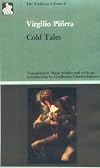
Virgilio Piñera (1912 - 1979) from Cuba - novelist, poet, essayist, playwright, short story writer. An author who refused to become part of any party, group or literary movement, an author who valued his extreme independence and bohemian lifestyle above all else. For example, as a student at the University of Havana he refused to defend his dissertation before a “bunch of donkeys." Now this, my friends, is an man and artist I can relate to. It gives me great joy to share my review of his show more outstanding collection of 43 short stories, some as short as 1 or 2 pages and others as long as 10, 20 or 30 pages. Below are two complete Virgilio microfictions followed by my write-up of a short story I'll never forget.
Insomnia
The man goes to bed early. He can’t fall asleep. He tosses and turns in bed, as might be expected. He gets tangled in the sheets. Hi lights a cigarette. He reads a little. He turns out the light again. But he can’t sleep. At three o’clock, he gets out of bed. He wakes his friend next door and confides that he can’t sleep. He asks the friend for advice. The friend advises him to take a short walk to tire himself out. And then, right away, to drink a cup of linden blossom tea and turn out the light. He does all that, but is unable to fall asleep. He gets up again. This time he goes to see a doctor. As usual, the doctor talks a lot but the man still doesn’t fall asleep. At six in the morning, he loads a revolver and blows his brains out. The man is dead, but hasn’t been able to get to sleep. Insomnia is a very persistent thing.
--------------------
Swimming
I’ve learned to swim on dry land. It turns out to be more practical than doing it in the water. There’s no fear of sinking, for one is already on the bottom, and by the same token one is drowned beforehand. It also avoids having to be fished out by the light of a lantern or in the dazzling clarity of a beautiful day. Finally, the absence of water keeps one from swelling up.
I won’t deny that swimming on dry land has an agonized quality about it. At first sight, one would be reminded of death throes. Nevertheless, this is different: at the same time one is dying, one is quite alive, quite alert, listening to the music that comes through the window and watching the worm crawl across the floor.
At first, my friends criticized this decision. They fled from my glances and sobbed in the corners. Happily, the crisis has passed. Now they know that I am comfortable swimming on dry land. Once in a while I sink my hands into the marble titles and offer them a tiny fish that I catch in the submarine depths.
--------------------
Black humor mixed in with the grotesque and absurd, anyone? With short stories like this one, is it any wonder in 1961 at age forty-nine, a couple of years following his return to his native Cuba from Argentina, Virgilio Piñera was jailed for “political and moral crimes.” After his eventual release, the author continued to live independently on the extreme margins, refusing to bow or answer to anybody or anything. ALERT: The below direct quotes from Virgilio’s story along with my comments are soaked in the blackest grotesque humor - not intended for the squeamish.
Meat
Bon Appétit, One: During a meat shortage, the townspeople initially protested but soon started devouring vegetables. However, a Mr. Ansaldo didn’t follow the order of the day. No, not at all. “With great tranquility, he began to sharpen an enormous kitchen knife and then, dropping his pants to his knees, he cut a beautiful fillet from his left buttock. Having cleaned and dressed the fillet with salt and vinegar, he passed it through the broiler and finally fried it in the big pan he used on Sundays for making tortillas.” This absurdist scene is vintage Virgilio Piñera. Many of his stories are laced with body parts cut, pasted or transformed in bizarre, impossible combinations.
A True Gentleman: Mr. Ansaldo begins to enjoy his meal but there’s s a knock at his door. Turns out, Ansaldo’s neighbor, sick of eating veggies, wants to vent his frustration. But then, “Ansaldo with an elegant gesture, showed his neighbor the beautiful fillet. When his neighbor asked about it, Ansaldo simply displayed his left buttock. The facts were laid bare.” Love the play on words. Also, Ansaldo’s great willingness and neighborliness to share his ingenuity during a meat shortage.
The Body of Comrades: Overwhelmed with admiration, the neighbor returns with the mayor of the town. “The mayor expressed to Ansaldo his intense desire that his beloved townspeople be nourished – as was Ansaldo – by drawing on their private reserves, that is to say, each from their own meat.” This whole scene and play on words has echoes of communist slogans, writing I suspect not particularly appreciated by the leaders of the new Cuban communist regime.
Bon Appétit, Two: After silencing grips from the well-educated (damn those elitist intellectuals!) the major invites Ansaldo to provide instruction and a demonstration for the masses in the town square. With the bravado of a sage on the stage, Ansaldo gives it his all (no pun intended). Following detailed instructions, the townsfolk, knives in hand, start cutting enough fillets to last each man and women one hundred and forty days (calculations provided courtesy of a distinguished physician). Tongues, lips and other delicacies are relished. But there are some minor drawbacks, such as “The prison warden could not sign a convict’s death sentence because he had eaten the fleshy tips of his fingers, which, according to the best “gourmets” (of which the warden was one), gave rise to the well-worn phrase “finger-licking good.”” Too bad such practices are restricted in modern consumer societies. I can picture a TV commercial with fingers so “finger-licking good,” - by far the most memorable commercial in the history of TV.
The story continues with hilarious jabs at society run according to uniform, scientific rules. What really comes through is Virgilio Piñera’s disdain for a public or government having little respect for privacy, nonconformity or individuality. As G. Cabrera-Infante writes in this collection’s introductory essay, “When I tell you that by reading these stories you’ll get a kick out of them I don’t mean champagne or cocaine. I’m talking of a true kick. A kick in the groin or in the stomach but most of the time a kick in the soul, where it hurts metaphysically and you bleed eternally.” show less

Cuban revolutionary literary artist and poet, Virgilio Piñera, pictured with another kind of Cuban revolutionary.
René’s Flesh by the Cuban poet, playwright, novelist and short story writer Virgilio Piñera (1912—1979). Instead of the Freudian triad of id-ego-superego, with this novel, surely one of the most irreverent novels ever written, we have the triad of meat-butchered-butcher at the butcher shop. So, for instance, if one were to make a Piñeraian slip as opposed to a Freudian show more slip, one would say something like “This is one grizzle novel!” instead of “This is one grizzly novel!” Or “I’d really like to sink my teeth into this meaty book.” Or, on a trip to the grocery store: “Excuse me, madam, excuse me, sir, would you mind shifting your slabs of meat to the left so I can walk by?” Thus with meat and nothing but meat on the menu, would anybody care to serve up a slice of life as to how you would make your own Piñeraian slip?
As translator Mark Schafer remarks in his introduction, the word flesh and the word meat are interchangeable in the Spanish language, so anytime we English-speaking readers read “flesh” it can be understood as “meat” and vice versa. Therefore, using this linguistic rule to flesh out (no pun intended) Virgilio Piñera’s vision more completely, the novel’s title could be “Rene’s Meat.” I couldn’t agree more with another reviewer noting how this Cuban novel is not for the faint of heart.
What highlights the tone of the entire work can be seen when René, age twenty, is dropped off by his father at the school where he will receive his education in pain. René meets the school’s Headmaster, a brutish, mean-spirited thug by the name of Mr. Marblo, a large man who looks about fifty and “was as bald as a billiard ball,” – well, my goodness, echoes of another petty tyrant intent on inflicting torment, Mr. Kurtz from Joseph Conrad’s Heart of Darkness.
Mr. Marblo points out to René the school’s motto: “Suffer in silence,” and then goes on to speak enthusiastically on how a student must suffer in order to learn and how knowledge must be beaten into a person without that person so much as uttering a moan, death rattle or even an ouch. (Darn, “suffer in silence” could be the motto for every football locker room, boxing club and military boot camp under the sun, not to mention scores of households where physical and emotional abuse abound).
René objects, claiming his doesn’t understand the reason he will be made to suffer in order to learn or why he requires punishment to better solve math problems or memorize history lessons. The Headmaster scoffs and replies he has heard students unload such a long-winded speech a thousand times before. What irony, Virgilio! Long-winded? René spoke three short sentences. Anyway, Mr. Marblo then delivers his own lengthy speech about the school’s philosophy, the amazing results achieved by their well-tested methods and ends by telling René he will obviously be wearing a uniform. You have to love this exchange, reminiscent of recruits entering forced military service or prisoners entering prison or inmates corralled into death camps: the authorities set the rules, however harsh or dehumanizing, and those under their charge must obey, no questions asked. Of course, in the spirit of the author’s black humor, this scene could also relate to a youngster’s entering military school or, where nuns still hit kids with rulers, the local parochial school.
When René scrutinizes the faces of those other new students, the neophytes, so called, who, like himself, are about to enter the school’s underground torture chamber, he detects how their faces are completely devoid of worry. Seen through the guise of the author’s penetrating black humor, such lack of worry or concern for one’s health and well-being speaks volumes about the previous training and rigid values these young men have all received from home and family. Ah, family! Suffer in silence, which is a positive spin on the wish to snuff out any sensitivity and the natural inclination we all have for pleasure, affection and intimacy.
As a first step of initiation, the neophytes are accosted by the second-year boys - all fifty, like hunting dogs, fling themselves at the neophytes and begin sniffing them up and down, head to toe. The author’s piercing insight as to how young people living in such a horrific environment are quickly reduced to the basest animal sense, sniffing with one’s nose. In many respects, I am reminded of the training those youths received in ancient Sparta, the goal being to transform the tenderness of youth into hard, viscous military machines. Bye, bye gentleness and kindness; hello marauding, torture and killing, especially torture and killing, both valued as the ultimate aim of life.
Somewhat thereafter, the school’s professors, all adults, make their entrance. René can see they have truly wretched bodies, bodies he describes as rags and he wonders how men with such rags as bodies can be charged with the cultivation of youth. Good question, René! Observing how an adult’s body, misshapen and in many cases bloated and haggard, is the undeniable, physical evidence of a life turned against itself. Another diabolical quality of the school is revealed: “spirit” is a meaningless term; all of life is reduced to flesh, body, and an unending human meat market. Is this perhaps the author’s bash against the philosophy of Castro and his Communism? I wouldn’t be surprised since Virgilio Piñera was branded as a pervert and criminal by the Cuban government.
But, but, but . . . the tale takes a decisive turn when René revolts against the school and everything the school represents. And René has an iron will. Predictably, the authorities call him a rebel, a hedonist (ultimate slam made by the guardians of the status quo), a student rebelling not out of pure fear as expected but rebelling out of pure contradiction. Unheard of. The authorities go even further, they label René abnormal and even worse, the most abysmal type: René is an eccentric. René’s revolt against authority culminates in an absurdist version of the black mass and his immediate expulsion. Once beyond the school’s boundaries and out on his own, the story expands into wider dimensions of absurdist black humor, a black humor with an undeniable bite since René’s world is not that far removed from many features of our own. Again, a book not for the faint of heart. Cuban literary critic Alan Ryan wrote that Virgilio Piñera makes Stephen King look like Dr. Seuss. Truer words were never spoken.
show less
Cuban revolutionary literary artist and poet, Virgilio Piñera, pictured with another kind of Cuban revolutionary.
René’s Flesh by the Cuban poet, playwright, novelist and short story writer Virgilio Piñera (1912—1979). Instead of the Freudian triad of id-ego-superego, with this novel, surely one of the most irreverent novels ever written, we have the triad of meat-butchered-butcher at the butcher shop.
So, for instance, if one were to make a Piñeraian slip as opposed to a Freudian show more slip, one would say something like “This is one grizzle novel!” instead of “This is one grizzly novel!” Or “I’d really like to sink my teeth into this meaty book.” Or, on a trip to the grocery store: “Excuse me, madam, excuse me, sir, would you mind shifting your slabs of meat to the left so I can walk by?” Thus with meat and nothing but meat on the menu, would anybody care to serve up a slice of life as to how you would make your own Piñeraian slip?
As translator Mark Schafer remarks in his introduction, the word flesh and the word meat are interchangeable in the Spanish language, so anytime we English-speaking readers read “flesh” it can be understood as “meat” and vice versa. Therefore, using this linguistic rule to flesh out (no pun intended) Virgilio Piñera’s vision more completely, the novel’s title could be “Rene’s Meat.” I couldn’t agree more with another reviewer noting how this Cuban novel is not for the faint of heart.
What highlights the tone of the entire work can be seen when René, age twenty, is dropped off by his father at the school where he will receive his education in pain. René meets the school’s Headmaster, a brutish, mean-spirited thug by the name of Mr. Marblo, a large man who looks about fifty and “was as bald as a billiard ball,” – well, my goodness, echoes of another petty tyrant intent on inflicting torment, Mr. Kurtz from Joseph Conrad’s Heart of Darkness.
Mr. Marblo points out to René the school’s motto: “Suffer in silence,” and then goes on to speak enthusiastically on how a student must suffer in order to learn and how knowledge must be beaten into a person without that person so much as uttering a moan, death rattle or even an ouch. (Darn, “suffer in silence” could be the motto for every football locker room, boxing club and military boot camp under the sun, not to mention scores of households where physical and emotional abuse abound).
René objects, claiming his doesn’t understand the reason he will be made to suffer in order to learn or why he requires punishment to better solve math problems or memorize history lessons. The Headmaster scoffs and replies he has heard students unload such a long-winded speech a thousand times before.
What irony, Virgilio! Long-winded? René spoke three short sentences. Anyway, Mr. Marblo then delivers his own lengthy speech about the school’s philosophy, the amazing results achieved by their well-tested methods and ends by telling René he will obviously be wearing a uniform.
You have to love this exchange, reminiscent of recruits entering forced military service or prisoners entering prison or inmates corralled into death camps: the authorities set the rules, however harsh or dehumanizing, and those under their charge must obey, no questions asked. Of course, in the spirit of the author’s black humor, this scene could also relate to a youngster’s entering military school or, where nuns still hit kids with rulers, the local parochial school.
When René scrutinizes the faces of those other new students, the neophytes, so called, who, like himself, are about to enter the school’s underground torture chamber, he detects how their faces are completely devoid of worry. Seen through the guise of the author’s penetrating black humor, such lack of worry or concern for one’s health and well-being speaks volumes about the previous training and rigid values these young men have all received from home and family. Ah, family! Suffer in silence, which is a positive spin on the wish to snuff out any sensitivity and the natural inclination we all have for pleasure, affection and intimacy.
As a first step of initiation, the neophytes are accosted by the second-year boys - all fifty, like hunting dogs, fling themselves at the neophytes and begin sniffing them up and down, head to toe. The author’s piercing insight as to how young people living in such a horrific environment are quickly reduced to the basest animal sense, sniffing with one’s nose.
In many respects, I am reminded of the training those youths received in ancient Sparta, the goal being to transform the tenderness of youth into hard, viscous military machines. Bye, bye gentleness and kindness; hello marauding, torture and killing, especially torture and killing, both valued as the ultimate aim of life.
Somewhat thereafter, the school’s professors, all adults, make their entrance. René can see they have truly wretched bodies, bodies he describes as rags and he wonders how men with such rags as bodies can be charged with the cultivation of youth. Good question, René! Observing how an adult’s body, misshapen and in many cases bloated and haggard, is the undeniable, physical evidence of a life turned against itself.
Another diabolical quality of the school is revealed: “spirit” is a meaningless term; all of life is reduced to flesh, body, and an unending human meat market. Is this perhaps the author’s bash against the philosophy of Castro and his Communism? I wouldn’t be surprised since Virgilio Piñera was branded as a pervert and criminal by the Cuban government.
But, but, but . . . the tale takes a decisive turn when René revolts against the school and everything the school represents. And René has an iron will. Predictably, the authorities call him a rebel, a hedonist (ultimate slam made by the guardians of the status quo), a student rebelling not out of pure fear as expected but rebelling out of pure contradiction. Unheard of. The authorities go even further, they label René abnormal and even worse, the most abysmal type: René is an eccentric.
René’s revolt against authority culminates in an absurdist version of the black mass and his immediate expulsion. Once beyond the school’s boundaries and out on his own, the story expands into wider dimensions of absurdist black humor, a black humor with an undeniable bite since René’s world is not that far removed from many features of our own. Again, a book not for the faint of heart. Cuban literary critic Alan Ryan wrote that Virgilio Piñera makes Stephen King look like Dr. Seuss. Truer words were never spoken. show less
Virgilio Piñera (1912 - 1979) from Cuba - novelist, poet, essayist, playwright, short story writer. An author who refused to become part of any party, group or literary movement, an author who valued his extreme independence and bohemian lifestyle above all else. For example, as a student at the University of Havana he refused to defend his dissertation before a “bunch of donkeys." Now this, my friends, is an man and artist I can relate to. It gives me great joy to share my review of his show more outstanding collection of 43 short stories, some as short as 1 or 2 pages and others as long as 10, 20 or 30 pages. Below are two complete Virgilio microfictions followed by my write-up of a short story I'll never forget.
Insomnia
The man goes to bed early. He can’t fall asleep. He tosses and turns in bed, as might be expected. He gets tangled in the sheets. Hi lights a cigarette. He reads a little. He turns out the light again. But he can’t sleep. At three o’clock, he gets out of bed. He wakes his friend next door and confides that he can’t sleep. He asks the friend for advice. The friend advises him to take a short walk to tire himself out. And then, right away, to drink a cup of linden blossom tea and turn out the light. He does all that, but is unable to fall asleep. He gets up again. This time he goes to see a doctor. As usual, the doctor talks a lot but the man still doesn’t fall asleep. At six in the morning, he loads a revolver and blows his brains out. The man is dead, but hasn’t been able to get to sleep. Insomnia is a very persistent thing.
--------------------
Swimming
I’ve learned to swim on dry land. It turns out to be more practical than doing it in the water. There’s no fear of sinking, for one is already on the bottom, and by the same token one is drowned beforehand. It also avoids having to be fished out by the light of a lantern or in the dazzling clarity of a beautiful day. Finally, the absence of water keeps one from swelling up.
I won’t deny that swimming on dry land has an agonized quality about it. At first sight, one would be reminded of death throes. Nevertheless, this is different: at the same time one is dying, one is quite alive, quite alert, listening to the music that comes through the window and watching the worm crawl across the floor.
At first, my friends criticized this decision. They fled from my glances and sobbed in the corners. Happily, the crisis has passed. Now they know that I am comfortable swimming on dry land. Once in a while I sink my hands into the marble titles and offer them a tiny fish that I catch in the submarine depths.
--------------------
Black humor mixed in with the grotesque and absurd, anyone? With short stories like this one, is it any wonder in 1961 at age forty-nine, a couple of years following his return to his native Cuba from Argentina, Virgilio Piñera was jailed for “political and moral crimes.” After his eventual release, the author continued to live independently on the extreme margins, refusing to bow or answer to anybody or anything. ALERT: The below direct quotes from Virgilio’s story along with my comments are soaked in the blackest grotesque humor - not intended for the squeamish.
Meat
Bon Appétit, One: During a meat shortage, the townspeople initially protested but soon started devouring vegetables. However, a Mr. Ansaldo didn’t follow the order of the day. No, not at all. “With great tranquility, he began to sharpen an enormous kitchen knife and then, dropping his pants to his knees, he cut a beautiful fillet from his left buttock. Having cleaned and dressed the fillet with salt and vinegar, he passed it through the broiler and finally fried it in the big pan he used on Sundays for making tortillas.” This absurdist scene is vintage Virgilio Piñera. Many of his stories are laced with body parts cut, pasted or transformed in bizarre, impossible combinations.
A True Gentleman: Mr. Ansaldo begins to enjoy his meal but there’s s a knock at his door. Turns out, Ansaldo’s neighbor, sick of eating veggies, wants to vent his frustration. But then, “Ansaldo with an elegant gesture, showed his neighbor the beautiful fillet. When his neighbor asked about it, Ansaldo simply displayed his left buttock. The facts were laid bare.” Love the play on words. Also, Ansaldo’s great willingness and neighborliness to share his ingenuity during a meat shortage.
The Body of Comrades: Overwhelmed with admiration, the neighbor returns with the mayor of the town. “The mayor expressed to Ansaldo his intense desire that his beloved townspeople be nourished – as was Ansaldo – by drawing on their private reserves, that is to say, each from their own meat.” This whole scene and play on words has echoes of communist slogans, writing I suspect not particularly appreciated by the leaders of the new Cuban communist regime.
Bon Appétit, Two: After silencing grips from the well-educated (damn those elitist intellectuals!) the major invites Ansaldo to provide instruction and a demonstration for the masses in the town square. With the bravado of a sage on the stage, Ansaldo gives it his all (no pun intended). Following detailed instructions, the townsfolk, knives in hand, start cutting enough fillets to last each man and women one hundred and forty days (calculations provided courtesy of a distinguished physician). Tongues, lips and other delicacies are relished. But there are some minor drawbacks, such as “The prison warden could not sign a convict’s death sentence because he had eaten the fleshy tips of his fingers, which, according to the best “gourmets” (of which the warden was one), gave rise to the well-worn phrase “finger-licking good.”” Too bad such practices are restricted in modern consumer societies. I can picture a TV commercial with fingers so “finger-licking good,” - by far the most memorable commercial in the history of TV.
The story continues with hilarious jabs at society run according to uniform, scientific rules. What really comes through is Virgilio Piñera’s disdain for a public or government having little respect for privacy, nonconformity or individuality. As G. Cabrera-Infante writes in this collection’s introductory essay, “When I tell you that by reading these stories you’ll get a kick out of them I don’t mean champagne or cocaine. I’m talking of a true kick. A kick in the groin or in the stomach but most of the time a kick in the soul, where it hurts metaphysically and you bleed eternally.” show less
Lists
Awards


You May Also Like


Associated Authors
Statistics
- Works
- 43
- Also by
- 7
- Members
- 361
- Popularity
- #66,479
- Rating
- 4.0
- Reviews
- 10
- ISBNs
- 57
- Languages
- 7