
Anneli Rufus
Author of Party of One: The Loner's Manifesto
About the Author
Works by Anneli Rufus
Associated Works
Alone in the Kitchen with an Eggplant: Confessions of Cooking for One and Dining Alone (2007) — Contributor — 584 copies, 31 reviews
Lemons and Lavender: The Eco Guide to Better Homekeeping (2012) — Foreword, some editions — 44 copies, 3 reviews
Fix It, Make It, Grow It, Bake It: The D.I.Y. Guide to the Good Life (2010) — Foreword, some editions — 33 copies, 1 review
Tagged
Common Knowledge
- Canonical name
- Rufus, Anneli
- Other names
- Rufus, Anneli S.
- Birthdate
- 1959-06-24
- Gender
- female
- Education
- University of California, Berkeley
- Nationality
- USA
- Birthplace
- Los Angeles, California, USA
- Associated Place (for map)
- California, USA
Members
Reviews

An essential defense of the people the world loves to revile--the loners--yet without whom it would be lostThe Buddha. Rene Descartes. Emily Dickinson. Greta Garbo. Bobby Fischer. J. D. Salinger: Loners, all--along with as many as 25 percent of the world's population. Loners keep to themselves, and like it that way. Yet in the press, in films, in folklore, and nearly everywhere one looks, loners are tagged as losers and psychopaths, perverts and pity cases, ogres and mad bombers, elitists show more and wicked witches. Too often, loners buy into those messages and strive to change, making themselves miserable in the process by hiding their true nature--and hiding from it. Loners as a group deserve to be reassessed--to claim their rightful place, rather than be perceived as damaged goods that need to be "fixed." In Party of One Anneli Rufus--a prize-winning, critically acclaimed writer with talent to burn--has crafted a morally urgent, historically compelling tour de force--a long-overdue argument in defense of the loner, then and now. Marshalling a polymath's easy erudition to make her case, assembling evidence from every conceivable arena of culture as well as interviews with experts and loners worldwide and her own acutely calibrated analysis, Rufus rebuts the prevailing notion that aloneness is indistinguishable from loneliness, the fallacy that all of those who are alone don't want to be, and wouldn't be, if only they knew how. show less
YES. Rufus hits the nail on the head about being a loner: we don’t hate people – we just want to be alone. We have friends. We are not “hiding” in our homes. We are not stuck up, we are not perverts, we are not socially inept. A point she brilliantly hammered home was the the headline “loners” who kill are never loners in the real sense – they are alone, not loners. They don’t want to be alone, but rather have alienated anyone who might have wanted to be around them.
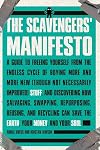
“We, the authors of this book, redefine scavenging as any way of legally acquiring stuff that does not involve paying full price.” [pg viii]
It's definitely a manifesto, written in staccato, almost poetic sentences that read like a rallying speech. It makes you feel good to be a scavenger – proud and empowered about your unusual state. It makes you want to fly your freak flag. Early on, they liken standard consumers to screaming, pouting soiled brats [pg 9] and non-consumer scavengers show more to “capitalism's naughty children, little rebels . . .” [pg 8] and tries to open your eyes to the fact that:
“Marketers have so mesmerized consumers that consumers see brand logos as their own logos, their new flags. Today the brand is the new nation, the new army, the new clan, the new religion, the new tribe. Consumers by the billions line up behind logo, vanish into logos, pour their income into brands.” [pg 12]
As the book moves along it addresses the misconceptions standard consumers have about scavengers (that they're poor or desperate or penny pinching and that used merchandise is second-rate, dirty, or suspect) and the reasons scavengers scavenge (to save money or the environment, to survive, for the mystery and the thrill of the hunt, because we prefer an item with a past). It covers the history and economics of scavenging (Pointing out a little-known fact that reinforces why reusing is preferable to recycling: “If recycling is done inefficiently, then it can be a net loss in regard to energy consumption, compared to modern mining costs.” [pg 94]), while stressing that scavenging will always be a fringe, subculture activity because it feeds off of mainstream society's cast-offs. If we were all scavengers the economy would break down.
As the authors move on from their history of the very old prejudices against scavenging and their glacially slow melt into something that could almost be called acceptance, they profile the many kinds of modern scavengers who fall into four main categories: Retail Scavengers, Urban scavengers, Social Scavengers, and Specialty Scavengers. They also discuss the spirituality of scavenging – it's a little Taoist, involves a certain amount of faith, and devoting oneself to scavenging can be like taking a vow. They end the book with a nice, common-sense scavenger code of ethics. show less
It's definitely a manifesto, written in staccato, almost poetic sentences that read like a rallying speech. It makes you feel good to be a scavenger – proud and empowered about your unusual state. It makes you want to fly your freak flag. Early on, they liken standard consumers to screaming, pouting soiled brats [pg 9] and non-consumer scavengers show more to “capitalism's naughty children, little rebels . . .” [pg 8] and tries to open your eyes to the fact that:
“Marketers have so mesmerized consumers that consumers see brand logos as their own logos, their new flags. Today the brand is the new nation, the new army, the new clan, the new religion, the new tribe. Consumers by the billions line up behind logo, vanish into logos, pour their income into brands.” [pg 12]
As the book moves along it addresses the misconceptions standard consumers have about scavengers (that they're poor or desperate or penny pinching and that used merchandise is second-rate, dirty, or suspect) and the reasons scavengers scavenge (to save money or the environment, to survive, for the mystery and the thrill of the hunt, because we prefer an item with a past). It covers the history and economics of scavenging (Pointing out a little-known fact that reinforces why reusing is preferable to recycling: “If recycling is done inefficiently, then it can be a net loss in regard to energy consumption, compared to modern mining costs.” [pg 94]), while stressing that scavenging will always be a fringe, subculture activity because it feeds off of mainstream society's cast-offs. If we were all scavengers the economy would break down.
As the authors move on from their history of the very old prejudices against scavenging and their glacially slow melt into something that could almost be called acceptance, they profile the many kinds of modern scavengers who fall into four main categories: Retail Scavengers, Urban scavengers, Social Scavengers, and Specialty Scavengers. They also discuss the spirituality of scavenging – it's a little Taoist, involves a certain amount of faith, and devoting oneself to scavenging can be like taking a vow. They end the book with a nice, common-sense scavenger code of ethics. show less

I picked this book up while perusing the "last chance" section at Barnes and Noble. It is not a self-help book, it's a treatise on how and why we're stuck in various arenas of our lives- job, relationships, bad habits, etc. Well-researched and easy to read, a lot of what Rufus has to say makes sense. One of the sections I found very interesting was about the impact capitalism (and it's opposites) have had on monogamy. As the author says, "Companies with goods and services to sell hate happy show more couples." If we are happy and feeling content with our lives, we don't need anything else to fill the void.
I feel, however, she oversimplified a few things and her bias shows. The chapter on trauma, and how our current society has made superstars of victims, feels a little whiney. And she acknowledges her own issues, which sheds light on why it felt that way. She also disparages therapy a bit, which I might take personally ;)
It's a lot of good food for thought. I guess I wish the book offered some hope for getting unstuck, which was hinted at in the introduction, but didn't surface anywhere else. show less
I feel, however, she oversimplified a few things and her bias shows. The chapter on trauma, and how our current society has made superstars of victims, feels a little whiney. And she acknowledges her own issues, which sheds light on why it felt that way. She also disparages therapy a bit, which I might take personally ;)
It's a lot of good food for thought. I guess I wish the book offered some hope for getting unstuck, which was hinted at in the introduction, but didn't surface anywhere else. show less
Lists
Awards

You May Also Like


Associated Authors
Statistics
- Works
- 12
- Also by
- 3
- Members
- 1,646
- Popularity
- #15,604
- Rating
- 3.6
- Reviews
- 42
- ISBNs
- 32