
About the Author
James W. Heisig is professor and permanent research fellow at the Nanzan Institute for Religion and Culture in Nagoya, Japan.
Image credit: via Alchetron
Series
Works by James W. Heisig
Remembering the Kanji 1: A Complete Course on How Not to Forget the Meaning and Writing of Japanese Characters (1986) 612 copies, 5 reviews
Remembering the Kanji III: Writing and Reading Japanese Characters for Upper-Level Proficiency (v. 3) (1994) 92 copies
Remembering the Hiragana: A Complete Course on How to Teach Yourself the Japanese Syllabary in 3 Hours (1990) 66 copies, 3 reviews
Remembering Simplified Hanzi: Book 1, How Not to Forget the Meaning and Writing of Chinese Characters (2008) 51 copies
Remembering Traditional Hanzi: Book 1, How Not to Forget the Meaning and Writing of Chinese Characters (2008) 26 copies
Remembering Simplified Hanzi 2: How Not to Forget the Meaning and Writing of Chinese Characters (2012) 19 copies
Remembering Traditional Hanzi 2: How Not to Forget the Meaning and Writing of Chinese Characters (2012) 14 copies, 1 review
Nothingness and Desire: A Philosophical Antiphony (Nanzan Library of Asian Religion and Culture, 23) (2013) 7 copies
Hanzi para recordar. Chino simplificado I: Curso mnemotécnico para el aprendizaje de la escritura y el significado de los caracteres chinos (Spanish and Chinese Edition) (2009) 7 copies, 2 reviews
Dialogues Two Inches above the Ground: Reflections on Buddhist-Christian Spirituality (Nanzan Studies in Religion and Cu (2003) 5 copies
Kanji para recordar 2: Guía sustemática para la lectura de los caracteres japoneses (Spanish Edition) (2015) 3 copies
Much ado about nothingness: Essays on Nishida and Tanabe (Studies in Japanese Philosophy) (Volume 1) (2015) 3 copies
Vereinfachte Hanzi lernen und behalten: Bedeutung und Schreibweise der häufigsten chinesischen Schriftzeichen - Band 1 (2009) 2 copies
Kanji Study Cards 1 copy
Associated Works
Tagged
Common Knowledge
- Birthdate
- 1944
- Gender
- male
- Education
- University of Cambridge (Ph.D.)
Loyola University - Occupations
- philosopher
Research Fellow (Nanzan Institute for Religion and Culture ∙ Nanzen University ∙ Nagoya ∙ Japan) - Organizations
- Nanzan University
- Nationality
- USA
- Places of residence
- Nagoya, Japan
- Associated Place (for map)
- Nagoya, Japan
Members
Reviews
Remembering the Hiragana: A Complete Course on How to Teach Yourself the Japanese Syllabary in 3 Hours by James W. Heisig
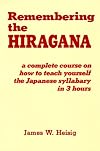
Impressively effective teaching of the hiragana. I liked the author's memorization techniques, which involve creating mental pictures that reference both the shape and the sound of the hiragana. About half of his mental pictures didn't click for me so I ended up creating my own, and this worked out just fine because I was still using his technique.
One thing to note is the claim of teaching oneself the hiragana in 3 hours. I followed the time instructions, and I truly did learn the hiragana show more in about 3 hours, spread out over a couple days. However, I also practiced off the clock, and since completing the book I have practiced a lot to keep the information imprinted in my memory. I think that this is key: the book will teach you the hiragana in 3 hours, but to truly know it you will need to practice practice practice. show less
One thing to note is the claim of teaching oneself the hiragana in 3 hours. I followed the time instructions, and I truly did learn the hiragana show more in about 3 hours, spread out over a couple days. However, I also practiced off the clock, and since completing the book I have practiced a lot to keep the information imprinted in my memory. I think that this is key: the book will teach you the hiragana in 3 hours, but to truly know it you will need to practice practice practice. show less
When I first moved to Japan I really struggled with learning the kana until someone recommended this book (and the companion katakana one). Amazingly I really did learn the hiragana in less than 3 hours, and it stuck really well. That was all over 20 years ago. I've not studied Japanese for years, but had a sudden urge to give myself a refresher course. Its simple, split into 6 lessons which should each take less than 30 minutes to complete, and it really works.
Remembering the Kanji I: A Complete Course on How Not to Forget the Meaning and Writing of Japanese Characters (Rem by James W. Heisig
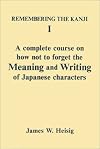
A compelling idea which, ultimately, was not as helpful as I'd hoped. Heisig's technique is to help you associate mental images with the components of a character. I found I couldn't achieve fluid reading, because I'd have to go through the process of analyzing the character and remembering the associations, rather than going directly to recognition. I found if I simply memorized the characters in the more conventional fashion of standard textbooks, I could read more fluently.
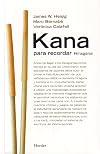
Uno de los mejores libros que han pasado por mis manos en mi época de japonés autodidacta. Usa el método mnemotécnico de la memoria imaginativa, siguiendo un orden específico para aprender el silabario.
A mi me resultó realmente útil y ameno.
A mi me resultó realmente útil y ameno.
You May Also Like


Associated Authors
Statistics
- Works
- 31
- Also by
- 1
- Members
- 1,436
- Popularity
- #17,913
- Rating
- 4.0
- Reviews
- 16
- ISBNs
- 85
- Languages
- 6