
Joseph LeDoux
Author of Synaptic Self: How Our Brains Become Who We Are
About the Author
Joseph LeDoux is the Henry and Lucy Moses Professor of Science at the Center for Neural Science and Department of Psychology, New York University.
Image credit: www.cns.nyu.edu/ledoux/
Works by Joseph LeDoux
The Deep History of Ourselves: The Four-Billion-Year Story of How We Got Conscious Brains (2019) 196 copies, 2 reviews
Gene Therapy Protocols: Volume 2: Design and Characterization of Gene Transfer Vectors (Methods in Molecular Biology) (2008) 5 copies
Associated Works
The Next Fifty Years: Science in the First Half of the Twenty-first Century (2002) — Contributor — 410 copies, 10 reviews
Tagged
Common Knowledge
- Canonical name
- LeDoux, Joseph
- Birthdate
- 1949
- Gender
- male
- Education
- University of New York, Stony Brook (PhD|1977)
- Occupations
- Professor of Neuroscience and Psychology (New York University)
- Relationships
- Gazzaniga, Michael (mentor)
- Nationality
- USA
- Associated Place (for map)
- USA
Members
Reviews
The deep history of ourselves : the four-billion-year story of how we got conscious brains by Joseph LeDoux
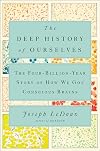
The controversial British philosopher John Gray has been insisting for years that humans are just mammals, and thus certainly not a unique creature that stands above all others. Judging from this book, Joseph LeDoux (° 1949), an eminent neuroscientist, is more or less on the same page. He does this by very meticulously establishing the close link between mankind and the evolution of life on earth, right from the start. He wants to demonstrate that the human constitution originates from the show more very beginning of life on earth and that we bear the traces of all subsequent stages. “Like all other species, we are special because we are different. Our differences are important to us because they are ours. But they are mere footnotes in a four-billion-year-old saga. Only by knowing the whole story can we truly understand who we are, and how we came to be that way.”
This book is, at least 250 pages long, a real natural history, a very detailed, yet didactic overview of the evolution of life, with a growing complexity as its common thread. LeDoux goes through all the stages and sometimes delves deeper into very specific biological issues, such as how beings transitioned to sexual reproduction, or how they developed a nervous system. Although LeDoux really does his best to explain everything as well as possible, these are pretty tough chunks.
But in the last third, this book rather turns into a completely different one. LeDoux is now diving into the field that is his own specialization, namely the human brain, and more specifically cognition. You notice that this has a completely different slant, and that LeDoux works more apologetically here, presents his own views, and takes a stand against colleagues. For example, he very extensively defends his thesis that human emotions are a by-product of our cognitive abilities, especially language, and that emotions guide our behavior. Unfortunately, he loses sight of his initial purpose, which is to illustrate how the human "building plan" (the author systematically uses the German term ‘Bauplan’) builds on that of previous beings. So, as many other reviewers noted, these are actually two books in one. Both are fascinating, but especially in the second part you get lost a bit more. Anyway, the great merit of this book certainly is an attempt to synthesize natural history. show less
This book is, at least 250 pages long, a real natural history, a very detailed, yet didactic overview of the evolution of life, with a growing complexity as its common thread. LeDoux goes through all the stages and sometimes delves deeper into very specific biological issues, such as how beings transitioned to sexual reproduction, or how they developed a nervous system. Although LeDoux really does his best to explain everything as well as possible, these are pretty tough chunks.
But in the last third, this book rather turns into a completely different one. LeDoux is now diving into the field that is his own specialization, namely the human brain, and more specifically cognition. You notice that this has a completely different slant, and that LeDoux works more apologetically here, presents his own views, and takes a stand against colleagues. For example, he very extensively defends his thesis that human emotions are a by-product of our cognitive abilities, especially language, and that emotions guide our behavior. Unfortunately, he loses sight of his initial purpose, which is to illustrate how the human "building plan" (the author systematically uses the German term ‘Bauplan’) builds on that of previous beings. So, as many other reviewers noted, these are actually two books in one. Both are fascinating, but especially in the second part you get lost a bit more. Anyway, the great merit of this book certainly is an attempt to synthesize natural history. show less
The Deep History of Ourselves: The Four-Billion-Year Story of How We Got Conscious Brains by Joseph LeDoux
LeDoux impressively presents the entire story of the evolution of Earth life, but I confined my attention to the preface, the prolog, the epilog, and the last 16 of the 66 chapters. The latter chapters deal with matters of consciousness, including the complicating aspect of emotion. Mentioning -- but not wholly buying into any of -- the standard theories of consciousness such as Integrated Information Theory, he strives to formulate a "multistate hierarchical higher-order model" in which show more "conscious experiences are higher-order states that depend on memory." He boldly opines that non-human animals do not have emotions or higher-order (self-) awareness. These characteristics are the very ones that raise doubts about whether human-species-level sanity and long-term survival are possible -- wow! This thinking, I'd venture to say, dovetails with the Doomsday Argument and the so-far negative results of SETI. (Please note, esteemed author and publisher, that the plural of "schema" is "schemata", not "schema" itself.) show less
Good, although really it should be called "the fearful brain". Someone really needs to do some research on one of the other emotions!
Good, although really it should be called "the fearful brain". Someone really needs to do some research on one of the other emotions!
Lists
Awards


You May Also Like


Associated Authors
Statistics
- Works
- 17
- Also by
- 4
- Members
- 1,900
- Popularity
- #13,550
- Rating
- 3.7
- Reviews
- 7
- ISBNs
- 74
- Languages
- 10
- Favorited
- 3