

Robert Tressell (1870–1911)
Author of The Ragged Trousered Philanthropists
About the Author
Disambiguation Notice:
Robert Tressell was a pen-name - he was called Robert Croker on his birth certificate and usually known as Robert Noonan (his mother's name).
Works by Robert Tressell
The Great Money Trick 1 copy
Associated Works
Tagged
Common Knowledge
- Legal name
- Croker, Robert
- Other names
- Noonan, Robert
- Birthdate
- 1870-04-17
- Date of death
- 1911-02-03
- Gender
- male
- Occupations
- signwriter
trade unionist (South Africa)
painter
decorator
writer - Organizations
- Social Democratic Federation
- Nationality
- UK
- Birthplace
- Dublin, Ireland
- Places of residence
- Dublin, Ireland
Johannesburg, South Africa
Cape Town, South Africa
Hastings, Sussex, England, UK - Place of death
- Liverpool, Merseyside, England, UK
- Burial location
- Liverpool, Merseyside, England, UK
- Map Location
- England, UK
- Disambiguation notice
- Robert Tressell was a pen-name - he was called Robert Croker on his birth certificate and usually known as Robert Noonan (his mother's name).
Members
Discussions
1914: Robert Tressell - The Ragged Trousered Philanthropists in Literary Centennials (June 2015)
Reviews
This book was written nearly a hundred years ago, but it doesn't have the sort of overly-descriptive wordy feel of other books from that era. Tressell has a straightforward, almost childlike style, and accordingly the story is very accessible and easy to read.
I would never consider myself a socialist (I have no left-leanings whatsoever!) so this book's great triumph is that it almost turned me red! The case that is made for socialism is compelling, you cannot but feel sympathy for the show more characters who are so badly treated by their employers, this maltreatment seemingly a direct result of the economic system in which they exist. In the 21st century, as we look back on, say, Eastern European history, we can see the flaws in the argument, yet when the activist arrived with his socialist propaganda I found myself mentally urging him on.
My main criticism of the book is its repetitiveness (how many times do we need to hear how a decorating job was bodged, paint 'slobbered' on the wall etc etc?) and lax editing. This said, the author surprised me right at the end with a scene so touching and yet delivered with such incredible simplicity that the tears were fairly rolling down my cheeks.
I'm still in favour of the free market, but I'm very glad to have read this book. show less
I would never consider myself a socialist (I have no left-leanings whatsoever!) so this book's great triumph is that it almost turned me red! The case that is made for socialism is compelling, you cannot but feel sympathy for the show more characters who are so badly treated by their employers, this maltreatment seemingly a direct result of the economic system in which they exist. In the 21st century, as we look back on, say, Eastern European history, we can see the flaws in the argument, yet when the activist arrived with his socialist propaganda I found myself mentally urging him on.
My main criticism of the book is its repetitiveness (how many times do we need to hear how a decorating job was bodged, paint 'slobbered' on the wall etc etc?) and lax editing. This said, the author surprised me right at the end with a scene so touching and yet delivered with such incredible simplicity that the tears were fairly rolling down my cheeks.
I'm still in favour of the free market, but I'm very glad to have read this book. show less
This book was completed in 1910 but published posthumously, as the Irish author died of TB at the age of 40 a year later. It’s an unabashedly socialist novel that follows the lives of a group of English working men. They earn poverty wages and live in constant fear of being unemployed. While a lot of conditions described in the book seem as true of the working poor today as a century ago, the one striking difference is that there was no safety net whatsoever. If the men were out of work show more for too long, they and their families would literally starve to death, and the only alternative was going to the workhouse, which is not really described in this novel but seems to be feared as an equivalent fate to death. The most harrowing part is when one of men believes he should murder his wife and bright young son and then himself to spare them a worse fate, and is mulling over the best way to do it. That was Stephen King-level horror. There are a lot of long speeches about socialism that are meritorious but boring and I ended up skimming through them. It was mostly this one guy Owen making the speeches, but the other men dismissed him as a nut. I think this book deserves its status as a classic. show less

“The theories that drunkenness, laziness or inefficiency are the causes of poverty are so many devices invented and fostered by those who are selfishly interested in maintaining the present states of affairs, for the purpose of preventing us from discovering the real causes of our present condition.
Published just over 100 years ago this novel is still a powerful and unfortunately relevant read. Drawn heavily from the author's own experiences the novel centres around a fictional group of show more 'working' men and their families, fighting for survival against poverty and starvation, and is sometimes referred to as the "painters' bible".
The men work for a painter and decorating firm as short term 'temporary hands'. The nature of their employment makes them and their families vulnerable to exploitation by their employers which this latter group take full advantage of. The men lead harsh lives at the whim of their bosses, with little reward for their labours, and harsh penalties for the slightest of transgressions. The author shows a great attention to detail as he uncovers the daily routine of these men's lives, their happiness, and their misery. The importance and drudgery of this work cannot be understated. These men work out of necessity rather than desire, taking very little pride in their results.
That all said and done this novel is not all gloom and down, there are some light hearted moments and there is some elements of genuine selflessness. You can imagine that the author had great fun thinking up the names of some of it's characters and in particular the company names....'Pushem and Sloggem', 'Bluffem and Doemdown', 'Dodger and Scampit',' Snatchum and Graball', 'Smeeriton and Leavit', 'Makehaste and Sloggitt' with the employers names including 'Rushton, 'Grinder', 'Starvem' and 'Sweatem' to name but a few. Equally the local newspapers are called the 'Daily Obscurer', the 'Chloroform' and the 'Daily Ananais' whilst the local MP is 'Graball D'Encloseland'.
In many respects this is not an easy read. Not because it is dull political treatise, although is plainly evident that the author was a ardent advocate of Socialism, but rather because this is a chillingly human story based on fact, one that reveals the greed and vice at the heart of a capitalist system. A system that advocates the needs of the few over the many and one which inflicts abuse and misery onto its fellow 'brothers' and 'sisters' with its failure to fairly distribute the necessities of human life. No sector of society avoids censorship. Capitalism and its advocates along with the hypocrisy within the Church are rightly slated but so too are the working class men themselves. Despite the misery of their lives they would rather perpetrate the present system's continued existence rather than thinking about changing it, attacking and criticising anyone who suggests that there could be another way. They believe that because they are poor, they and their children shouldn't enjoy the same opportunities as the rich.
Perhaps what really makes this book so uncomfortable to read is that even today, 100+ years after its publication, there are still elements of this era in working class people's lives. The workhouses may have gone but short-term and zero hours contracts still leave workers' and their families lives in a precarious, unstable situation. The relevance of this work, and it's ability to speak to us in the 21st century is a sad indictment of our own time. A must read for anyone with a social conscience. show less
Published just over 100 years ago this novel is still a powerful and unfortunately relevant read. Drawn heavily from the author's own experiences the novel centres around a fictional group of show more 'working' men and their families, fighting for survival against poverty and starvation, and is sometimes referred to as the "painters' bible".
The men work for a painter and decorating firm as short term 'temporary hands'. The nature of their employment makes them and their families vulnerable to exploitation by their employers which this latter group take full advantage of. The men lead harsh lives at the whim of their bosses, with little reward for their labours, and harsh penalties for the slightest of transgressions. The author shows a great attention to detail as he uncovers the daily routine of these men's lives, their happiness, and their misery. The importance and drudgery of this work cannot be understated. These men work out of necessity rather than desire, taking very little pride in their results.
That all said and done this novel is not all gloom and down, there are some light hearted moments and there is some elements of genuine selflessness. You can imagine that the author had great fun thinking up the names of some of it's characters and in particular the company names....'Pushem and Sloggem', 'Bluffem and Doemdown', 'Dodger and Scampit',' Snatchum and Graball', 'Smeeriton and Leavit', 'Makehaste and Sloggitt' with the employers names including 'Rushton, 'Grinder', 'Starvem' and 'Sweatem' to name but a few. Equally the local newspapers are called the 'Daily Obscurer', the 'Chloroform' and the 'Daily Ananais' whilst the local MP is 'Graball D'Encloseland'.
In many respects this is not an easy read. Not because it is dull political treatise, although is plainly evident that the author was a ardent advocate of Socialism, but rather because this is a chillingly human story based on fact, one that reveals the greed and vice at the heart of a capitalist system. A system that advocates the needs of the few over the many and one which inflicts abuse and misery onto its fellow 'brothers' and 'sisters' with its failure to fairly distribute the necessities of human life. No sector of society avoids censorship. Capitalism and its advocates along with the hypocrisy within the Church are rightly slated but so too are the working class men themselves. Despite the misery of their lives they would rather perpetrate the present system's continued existence rather than thinking about changing it, attacking and criticising anyone who suggests that there could be another way. They believe that because they are poor, they and their children shouldn't enjoy the same opportunities as the rich.
Perhaps what really makes this book so uncomfortable to read is that even today, 100+ years after its publication, there are still elements of this era in working class people's lives. The workhouses may have gone but short-term and zero hours contracts still leave workers' and their families lives in a precarious, unstable situation. The relevance of this work, and it's ability to speak to us in the 21st century is a sad indictment of our own time. A must read for anyone with a social conscience. show less
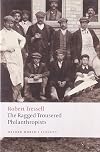
Every once in a while you come upon a book that makes you wonder "Where has this been all my life?" That was my immediate reaction on reading [The Ragged Trousered Philanthropists].
Ostensibly a story about a group of working men in Edwardian England, it is actually a devastating attack on the society of the time. As we see this crew of painters, wallpaperers, plasterers and decorative workers go about their daily lives for Rushton and Co., the precariousness of their existences and those of show more their families is revealed. Poor laws, child labour laws, education, pensions, charity, religion and politics are all revealed for the sham they truly are when it comes to the realities of the working class, employed or not.
Frank Owen, the main character, is convinced there is a better way. Owen's name is a nod to Robert Owen, the great reformer from a century before, and like him, Frank believes that socialism will provide the answers, if only his fellow workers will see the light. To this end he spends hours discussing 'The Great Money Trick' with them, demonstrating that no matter how much or how well they work, the capitalist classes will always have the money, control of resources, and property, while the people who create things with it will always want. The men in turn reply that such things "aren't for the likes of us". After all, don't school and church teach that "The poor are always with us"? They have been taught there is a natural order to the world, and they know from experience there is nothing to be gained by upsetting it. The men know on a personal level that to object or protest would lead to immediate termination; that there are hordes of unemployed willing to work for even less than they do the minute a vacancy occurs. Frank himself despaired of the future. Ill with tuberculosis he struggled on, knowing the day would come when he could no longer work.
[The Ragged Trousered Philanthropists] was written in 1911 and published posthumously in 1914. Tressell's town of Mugsborough was actually Hastings, where political corruption was rife. Tressell's name was Robert Noonan, but he took his writing name from one of the tools of his trade, the trestle. Like Frank, he was employed as a painter, giving the speech and settings of the novel an immediacy that would otherwise be difficult to obtain. Tressell's criticisms of his world ring true on every page. He viewed these ragged men as the true philanthropists of the age, for it was they who were creating the enormous wealth of the propertied classes. His writing has echoes of the humour of Dickens, but it also has many of the more sombre tones of Gissing and Hardy.
The original manuscript had 250,000 words, but was almost halved when it was first published. The 1918 edition was edited down again, to about 90,000 words. It wasn't until 1955 that the full manuscript was restored and published in its entirety. Leaving out the last third of the book in its early editions gave a completely different tone to Tressell's work. It left out the crucial "Great Oration" by Owen's friend Barrington, who is finally able to impart Frank's message, in theory if not in practice, to some of their fellow workers. For those interested in the politics of the times, it also left out the political campaigning and backroom manouevering of the Tories and Liberals, and the struggle to fill the void on the left before the full emergence of Labour.
In retrospect we know the "Golden Light" from the "risen sun of Socialism" did not work out as those early adherents had hoped, but as a piece of social history, this novel restores some of that idealism and makes you wish for just a little of that light. show less
Ostensibly a story about a group of working men in Edwardian England, it is actually a devastating attack on the society of the time. As we see this crew of painters, wallpaperers, plasterers and decorative workers go about their daily lives for Rushton and Co., the precariousness of their existences and those of show more their families is revealed. Poor laws, child labour laws, education, pensions, charity, religion and politics are all revealed for the sham they truly are when it comes to the realities of the working class, employed or not.
Frank Owen, the main character, is convinced there is a better way. Owen's name is a nod to Robert Owen, the great reformer from a century before, and like him, Frank believes that socialism will provide the answers, if only his fellow workers will see the light. To this end he spends hours discussing 'The Great Money Trick' with them, demonstrating that no matter how much or how well they work, the capitalist classes will always have the money, control of resources, and property, while the people who create things with it will always want. The men in turn reply that such things "aren't for the likes of us". After all, don't school and church teach that "The poor are always with us"? They have been taught there is a natural order to the world, and they know from experience there is nothing to be gained by upsetting it. The men know on a personal level that to object or protest would lead to immediate termination; that there are hordes of unemployed willing to work for even less than they do the minute a vacancy occurs. Frank himself despaired of the future. Ill with tuberculosis he struggled on, knowing the day would come when he could no longer work.
[The Ragged Trousered Philanthropists] was written in 1911 and published posthumously in 1914. Tressell's town of Mugsborough was actually Hastings, where political corruption was rife. Tressell's name was Robert Noonan, but he took his writing name from one of the tools of his trade, the trestle. Like Frank, he was employed as a painter, giving the speech and settings of the novel an immediacy that would otherwise be difficult to obtain. Tressell's criticisms of his world ring true on every page. He viewed these ragged men as the true philanthropists of the age, for it was they who were creating the enormous wealth of the propertied classes. His writing has echoes of the humour of Dickens, but it also has many of the more sombre tones of Gissing and Hardy.
The original manuscript had 250,000 words, but was almost halved when it was first published. The 1918 edition was edited down again, to about 90,000 words. It wasn't until 1955 that the full manuscript was restored and published in its entirety. Leaving out the last third of the book in its early editions gave a completely different tone to Tressell's work. It left out the crucial "Great Oration" by Owen's friend Barrington, who is finally able to impart Frank's message, in theory if not in practice, to some of their fellow workers. For those interested in the politics of the times, it also left out the political campaigning and backroom manouevering of the Tories and Liberals, and the struggle to fill the void on the left before the full emergence of Labour.
In retrospect we know the "Golden Light" from the "risen sun of Socialism" did not work out as those early adherents had hoped, but as a piece of social history, this novel restores some of that idealism and makes you wish for just a little of that light. show less
Lists
Awards


You May Also Like


Associated Authors
Statistics
- Works
- 3
- Also by
- 1
- Members
- 1,800
- Popularity
- #14,294
- Rating
- 4.0
- Reviews
- 42
- ISBNs
- 82
- Languages
- 2
- Favorited
- 2