
Dennis Prager
Author of The Nine Questions People Ask About Judaism
About the Author
Dennis Prager writes a syndicated column, hosts a radio show carried by 120 stations, and appears regularly on major Fox venues. He is the author of Happiness Is a Serious Problem and Hunk a Second Time.
Image credit: Dennis Prager speaking at an event in West Palm Beach, Florida. By Gage Skidmore, CC BY-SA 3.0, https://commons.wikimedia.org/w/index.php?curid=75288985
Series
Works by Dennis Prager
Raising a Jewish Child 1 copy
JUDAISM FOR NON-JEWS 1 copy
Why I Am a Jew 1 copy
Why I Revere Judaism 1 copy
Associated Works
Dialogue: A Journal of Mormon Thought - Volume 24, Number 2 (Summer 1991) (1991) — Contributor — 1 copy
Tagged
Common Knowledge
- Legal name
- Prager, Dennis Mark
- Birthdate
- 1948-08-02
- Gender
- male
- Education
- Brooklyn College (anthropology, history)
- Occupations
- radio talk show host
- Organizations
- KABC Radio, Los Angeles
Ultimate Issues journal (publisher) - Short biography
- Dennis Prager is a syndicated radio talk show host, columnist, author, and public speaker noted for his conservative political and social views.
- Nationality
- USA
- Birthplace
- Brooklyn, New York, USA
- Associated Place (for map)
- New York, USA
Members
Reviews

The book is divided into three section: Leftism, Islamism, and America. The section on leftism is the best dissection of American liberalism I've read to date and is alone worth the price of admission. Were this the only section of the book it would deserve ten stars. I found the section on Islam to be at once a respectful and forthright examination of the shortcomings of Islam and a call for it to rise above them. The section detailing America's values is all pretty rudimentary stuff for show more any thinking conservative; however Prager's articulation is both useful and beneficial.
My one (rather small) complaint about the book is Prager's less than accurate wording on some key philosophical concepts. (1) He conflates the terms "irrational" and "non-rational", attributing both to religion. True religion has aspects of the non-rational (beyond reason), but not the irrational (contrary to reason). (2) Prager calls God the "author" of the moral law--true in part but it denotes a certain arbitrariness to the moral law. More properly, God is the ground of the moral law. Goodness, Justice, et al are what they are not because of some arbitrary divine dictate, but because they are rooted in God's nature, in God who IS Goodness, Justice, et al. (3) Prager calls the heart the "generator of emotions". However, in classic Christian (i.e. Catholic) theology the heart is the root and center of the human person. "Keep your heart with all vigilance, for from it flow the springs of life" (Proverbs 4:23). With the heart we make the fundamental choice for good or evil. As such, the heart is more properly related to the will than the emotions. (4) Prager calls reason amoral and says that it is just as readily employed for evil as for good. How can this be if reason reflects the order of the universe in which there is a moral law? This flies in the face of Catholic natural law theology. Evil may appear rational IF its premises are granted, but at root it is contrary to reason. (5) Prager says that good and evil are "polar opposites". Evil is not a thing. If it were, then God would be responsible for creating it. Evil is a privation, or a subtraction, from good, as darkness is not the opposite of light, but merely the absence of light. (6) Prager says that God exists entirely outside nature. However, God is BOTH transcendent to and immanent in creation. He is the source and ground of all being. As such He sustains all of creation at every instance of its existence. (7) Prager says that nature has "no intrinsic value", but in the Bible (the Torah) which Prager quotes freely, God calls creation "good". All throughout the Bible, the majesty of creation is seen as pointing to God's existence and power.
Again, these are minor quibbles. They do not involve major themes in the book. In fact, the basic gist of Prager's arguments are right on target. If you want an incisive dissection of the essence of leftism/American liberalism that is both pithy and comprehensive, do not hesitate to procure this book. show less
My one (rather small) complaint about the book is Prager's less than accurate wording on some key philosophical concepts. (1) He conflates the terms "irrational" and "non-rational", attributing both to religion. True religion has aspects of the non-rational (beyond reason), but not the irrational (contrary to reason). (2) Prager calls God the "author" of the moral law--true in part but it denotes a certain arbitrariness to the moral law. More properly, God is the ground of the moral law. Goodness, Justice, et al are what they are not because of some arbitrary divine dictate, but because they are rooted in God's nature, in God who IS Goodness, Justice, et al. (3) Prager calls the heart the "generator of emotions". However, in classic Christian (i.e. Catholic) theology the heart is the root and center of the human person. "Keep your heart with all vigilance, for from it flow the springs of life" (Proverbs 4:23). With the heart we make the fundamental choice for good or evil. As such, the heart is more properly related to the will than the emotions. (4) Prager calls reason amoral and says that it is just as readily employed for evil as for good. How can this be if reason reflects the order of the universe in which there is a moral law? This flies in the face of Catholic natural law theology. Evil may appear rational IF its premises are granted, but at root it is contrary to reason. (5) Prager says that good and evil are "polar opposites". Evil is not a thing. If it were, then God would be responsible for creating it. Evil is a privation, or a subtraction, from good, as darkness is not the opposite of light, but merely the absence of light. (6) Prager says that God exists entirely outside nature. However, God is BOTH transcendent to and immanent in creation. He is the source and ground of all being. As such He sustains all of creation at every instance of its existence. (7) Prager says that nature has "no intrinsic value", but in the Bible (the Torah) which Prager quotes freely, God calls creation "good". All throughout the Bible, the majesty of creation is seen as pointing to God's existence and power.
Again, these are minor quibbles. They do not involve major themes in the book. In fact, the basic gist of Prager's arguments are right on target. If you want an incisive dissection of the essence of leftism/American liberalism that is both pithy and comprehensive, do not hesitate to procure this book. show less
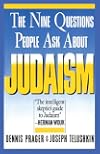
The first chapter/question is a must read for many people. However, the rest of the book is not as intelligently laid out as promised. In addition, I found myself quickly skipping pages or even entire sections due to deep philosophical disagreements: setting aside the obvious slant of orthodox Judaism and right-wing politics (which I can appreciate even if I disagree), I could not bear to read about the moral superiority of Judaism. Is this not the stuff of wars? Can be likened to Arianism? show more Perhaps I am too liberal with my belief that no group can call oneself superior, but I do believe the authors require a lesson in humility. I would be ashamed to present this book as representative of my views show less
The first chapter/question is a must read for many people. However, the rest of the book is not as intelligently laid out as promised. In addition, I found myself quickly skipping pages or even entire sections due to deep philosophical disagreements: setting aside the obvious slant of orthodox Judaism and right-wing politics (which I can appreciate even if I disagree), I could not bear to read about the moral superiority of Judaism. Is this not the stuff of wars? Can be likened to Arianism? show more Perhaps I am too liberal with my belief that no group can call oneself superior, but I do believe the authors require a lesson in humility. I would be ashamed to present this book as representative of my views show less
Excellent basic book to learn about Judaism. Prager and Telushkin, childhood friends collaborated on this book over 40 years ago. It still stands as an excellent resource. Not only did I learn facts about being Jewish, I learned truth about how to think about life itself and how to think about transmitting your own values to the next generation.
You May Also Like


Associated Authors
Statistics
- Works
- 31
- Also by
- 3
- Members
- 2,304
- Popularity
- #11,143
- Rating
- 4.1
- Reviews
- 23
- ISBNs
- 65
- Languages
- 1
- Favorited
- 1