
Richard Susskind
Author of The Future of the Professions: How Technology Will Transform the Work of Human Experts
About the Author
Professor Richard Susskind OBE is an author, speaker, and independent adviser to international professional firms and national governments. He is President of the Society for Computers and Law, IT Adviser to the Lord Chief Justice, and Chair of the Advisory Board of the Oxford Internet Institute. show more His work has been translated into more than 10 languages, and he has been invited to speak in over 40 countries. show less
Works by Richard Susskind
The Future of the Professions: How Technology Will Transform the Work of Human Experts (2015) 236 copies, 1 review
Tagged
Common Knowledge
- Legal name
- Susskind, Richard Eric
- Birthdate
- 1961-03-28
- Gender
- male
- Education
- University of Oxford (Balliol College)
University of Glasgow - Occupations
- lawyer
- Awards and honors
- Order of the British Empire (Officer, 2000)
- Nationality
- UK
UK - Birthplace
- Paisley, Scotland
- Places of residence
- Radlett, Hertfordshire, England
- Associated Place (for map)
- Radlett, Hertfordshire, England
Members
Reviews
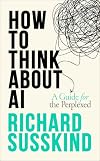
One of Clifford Simak’s favorite narrative premises in his SF novels involves a world with no (or few) humans and a vibrant, self-perpetuating species of sentient robots. Simak’s robots demonstrate, among themselves and to any remaining humans, a kind of sincere humanity that must have appeared missing to him throughout much of the tumultuous 20th century. Richard Susskind also envisions a world full of robots, but his vision is far bleaker.
As an unchecked outcome of our current show more development of AI, Susskind envisions a world where humans are becoming obsolete and incapable to contributing to society in a way that is as efficient or as effective as AI-enhanced, functionally “sentient” machines. It’s a future that he envisions to have been in the cards for decades but only readily visible since late 2022, now hastened by minimally checked capitalism and debilitating ethical shortsightedness.
Maybe I’m just a naïve humanist, but I don’t buy it. I don’t buy the premise that AI, in its current form can replace all the human labor that it appears to be capable of replacing or that it could be developed to replace much of or all of our intellectual labor. Belief in that position seems to stem from a poor concept of what intelligence is and what makes it valuable.
Susskind opts for a deflationary account of intelligence that starts and stops with the ability to gather data from our sensory equipment as we engage with the world and then process that information. He imagines that machinic improvements to data collection and data processing will increase the speed and improve the efficiency of information processing so that it surpasses what humans currently provide, making them better at work requiring this kind of intelligence. But does that make AI more intelligent?
As I see it, intelligence is not just the collection and processing of information. What people bring to the intellectual work that they do is not wholly in the processing of information, it is also in the intentionality of that work. We do the work with purpose, toward some end, in service of a motive that arises out of a world that we exist in and where that work has meaning and uptake. I say something because I want you to understand, to do, to believe. Further, what I say or write I stand behind – it is a stance, a statement about my way of being in the world and how I anticipate it intersecting with your way of being in the world. This way of being in the world and acting on it are part of intellectual labor and AI are just not in the world in the same way.
Now, if you can imagine a world of only machines then perhaps there is an argument to be made that machines, via their programming, can be thought to have some expectation about how its information is processed and shared and how it will be used and by what. But is that expectation the same kind of awareness that drives intentionality in human action? Maybe in some sense of the word, but when we are talking about a world of humans and machines interacting, intentionality is a more problematic assumption. Focusing on intentionality won’t likely alter the development of AI but it feels vital to the conversation about how and why we should talk about and perhaps legislate a place for AI.
Susskind had his finger on an important part of the issue when talking about early applications of AI in the medical and legal professions (circa 1980s). He noted that AI in the professions was considered off limits for some kinds of work, like unsupervised diagnosis of medical conditions and generating legal opinions. You know, obvious stuff where human judgment is required. This is where I think Susskind overlooks the point I’m trying to make: it is important for humans to be doing this sort of work, not because they have a unique ability, or are unsurpassed in their efficiency, or are infallible, but because they are responsible for their opinions. Humans are accountable in ways that AI are not. And I imagine that few people who are responsible for taking a stance on the basis of their intelligence and for sharing that information with intention would be willing to have that responsibility delegated to AI. I’m not. Neither am I ready for others to delegate that work to AI and share it with me. If it’s about how to operate a piece of software, maybe I’m fine with it, but in other situations the stakes are too high.
There are some provocative ideas in the book that are worth reading and grappling with, but also too many unsupported or poorly supported assumptions about the rate of growth and investment in AI and the degree to which it will crowd out most forms of human labor. There are also some strangely certain assumptions about AI intelligence reaching a level that would put it on par with humans, effectively resulting in a separate sentient race. show less
As an unchecked outcome of our current show more development of AI, Susskind envisions a world where humans are becoming obsolete and incapable to contributing to society in a way that is as efficient or as effective as AI-enhanced, functionally “sentient” machines. It’s a future that he envisions to have been in the cards for decades but only readily visible since late 2022, now hastened by minimally checked capitalism and debilitating ethical shortsightedness.
Maybe I’m just a naïve humanist, but I don’t buy it. I don’t buy the premise that AI, in its current form can replace all the human labor that it appears to be capable of replacing or that it could be developed to replace much of or all of our intellectual labor. Belief in that position seems to stem from a poor concept of what intelligence is and what makes it valuable.
Susskind opts for a deflationary account of intelligence that starts and stops with the ability to gather data from our sensory equipment as we engage with the world and then process that information. He imagines that machinic improvements to data collection and data processing will increase the speed and improve the efficiency of information processing so that it surpasses what humans currently provide, making them better at work requiring this kind of intelligence. But does that make AI more intelligent?
As I see it, intelligence is not just the collection and processing of information. What people bring to the intellectual work that they do is not wholly in the processing of information, it is also in the intentionality of that work. We do the work with purpose, toward some end, in service of a motive that arises out of a world that we exist in and where that work has meaning and uptake. I say something because I want you to understand, to do, to believe. Further, what I say or write I stand behind – it is a stance, a statement about my way of being in the world and how I anticipate it intersecting with your way of being in the world. This way of being in the world and acting on it are part of intellectual labor and AI are just not in the world in the same way.
Now, if you can imagine a world of only machines then perhaps there is an argument to be made that machines, via their programming, can be thought to have some expectation about how its information is processed and shared and how it will be used and by what. But is that expectation the same kind of awareness that drives intentionality in human action? Maybe in some sense of the word, but when we are talking about a world of humans and machines interacting, intentionality is a more problematic assumption. Focusing on intentionality won’t likely alter the development of AI but it feels vital to the conversation about how and why we should talk about and perhaps legislate a place for AI.
Susskind had his finger on an important part of the issue when talking about early applications of AI in the medical and legal professions (circa 1980s). He noted that AI in the professions was considered off limits for some kinds of work, like unsupervised diagnosis of medical conditions and generating legal opinions. You know, obvious stuff where human judgment is required. This is where I think Susskind overlooks the point I’m trying to make: it is important for humans to be doing this sort of work, not because they have a unique ability, or are unsurpassed in their efficiency, or are infallible, but because they are responsible for their opinions. Humans are accountable in ways that AI are not. And I imagine that few people who are responsible for taking a stance on the basis of their intelligence and for sharing that information with intention would be willing to have that responsibility delegated to AI. I’m not. Neither am I ready for others to delegate that work to AI and share it with me. If it’s about how to operate a piece of software, maybe I’m fine with it, but in other situations the stakes are too high.
There are some provocative ideas in the book that are worth reading and grappling with, but also too many unsupported or poorly supported assumptions about the rate of growth and investment in AI and the degree to which it will crowd out most forms of human labor. There are also some strangely certain assumptions about AI intelligence reaching a level that would put it on par with humans, effectively resulting in a separate sentient race. show less

This is a thought provoking book about on-going and predicted future changes in the practice of law and how legal services will be billed and delivered in the future. The book is not an "anti-lawyer" diatribe, as you might guess from the title, but it does lay down challenges to lawyers to consider what elements of their current workload could be undertaken differently - more quickly, cheaply, efficiently, or to a higher quality - using alternative methods of working. Susskind argues, for show more example, that the market is increasingly unlikely to tolerate expensive lawyers for tasks (guiding, advising, drafting, researching, problem-solving, and more) that can be equally or better performed by smart systems and processes. He predicts the rise, within large law firms and corporate legal departments, of senior legal professionals whose function will be to serve as a legal process analyst. "The legal process analyst is the individual who will analyze a legal matter (a deal or dispute), decompose it into its constituent tasks ***, assess the most efficient and appropriate way to carry out each, and identify the best suppliers from whom to source this work." He calls this first step "decomposition and proposed multi-sourcing” of the work, where multi-sourcing will include out-sourcing legal work to lower cost attorneys and non-attorneys located outside of the traditional law firm and, indeed, often in foreign countries. After this initial assessment is made by the legal process analyst in the law firm, a legal process manager will then swing into play to "ensure that all providers complete their decomposed work packages on time and to budget, and will also be responsible for quality controlling the various packages, supervising their output and delivery, and pulling the packages together into one seamless service for the client." (pp. xlvi-xlvii) Susskind refers to just some of these steps and processes as "commoditization, computerization, decomposing, multi-sourcing." He predicts that law firms will evolve into different forms of practice in the future and he says that the scope of on-going innovation in law firms will be from less efficient to more efficient processes, which he summarizes as follows: bespoke > standardized > systematized > packaged > commoditized. Susskind's observations and predictions arise mainly from his experiences in the United Kingdom while working as a British lawyer, law professor, and consultant to the legal profession. However, most of his ideas are transferable to the practice of law in the United States. Important limitations of his book include that he does not give consideration to the ethical rules that govern lawyer conduct in each of our fifty states and before the federal bench. Many of the concepts that he is able to contemplate in England (fee splitting among lawyers, fee splitting between lawyers and non-lawyers, and capital investment in law firms by non-attorneys, just to name three) would require serious analysis and changes to the rules governing lawyer conduct in the United States. Although the book is controversial, it provokes thought. I would recommend it to Managing Partners and anyone interested in the practice of law, including those who will oppose or feel uncomfortable with Susskind's ideas. After all, as a brilliant non-attorney friend of mine reminded me after learning about Susskind's book, “The future is dynamic and a good leader needs to understand the dynamics even if he doesn’t like them.” show less
Technical Library - shelved at: C11

Tényleg vége az klasszikus értelemben vett ügyvédi munkának? Lehet akkora hatással az IT megjelenése, térhódítása és folyamatos fejlődése, hogy e szakma eltűnjék? Vagy elegendő, ha az ügyvédek is felveszik a ritmust, s nyitottabbá válnak a számítógépek által, az internet segítségével végezhető munkára? Ilyen és ehhez hasonló kérdéseket boncolgat Richard Susskind elsőként 2008-ban megjelenő műve. Válasza a sorok között könnyen kiolvasható: nem show more lehet útjába állni a technikai fejlődének.
A kötet azt boncolgatja, hogy milyen módszerek, milyen egyéb munkavégzési lehetőségek kellenek ahhoz, hogy az ügyvédség lépést tarthasson e fejlődéssel. Susskind kiemeli a jövő jogászaiban a gondolkodás megváltoztatásának fontosságát, a nem jogvégzett emberek munkavégzésének lehetőségét, az ügyvédi munka szolgáltatásként való értelmezését.
Ajánljuk már ügyvédként dolgozó szakembereknek, ügyvédjelölteknek, egyéb jogászoknak, valamint minden, a jövőjéért felelősen gondolkodó értelmiséginek. show less
A kötet azt boncolgatja, hogy milyen módszerek, milyen egyéb munkavégzési lehetőségek kellenek ahhoz, hogy az ügyvédség lépést tarthasson e fejlődéssel. Susskind kiemeli a jövő jogászaiban a gondolkodás megváltoztatásának fontosságát, a nem jogvégzett emberek munkavégzésének lehetőségét, az ügyvédi munka szolgáltatásként való értelmezését.
Ajánljuk már ügyvédként dolgozó szakembereknek, ügyvédjelölteknek, egyéb jogászoknak, valamint minden, a jövőjéért felelősen gondolkodó értelmiséginek. show less
Oct 12, 2012 (Edited)Hungarian
Lists
Unread books (1)
You May Also Like


Associated Authors
Statistics
- Works
- 16
- Members
- 572
- Popularity
- #43,782
- Rating
- 3.7
- Reviews
- 4
- ISBNs
- 52
- Languages
- 6