
Ronald Dworkin (1931–2013)
Author of Law's Empire
About the Author
Ronald Dworkin lives in New York and in London, and has a joint appointment at New York University, where he is a professor both in the law school and the philosophy department, and at University College London
Image credit: Credit: David Shankbone, Brooklyn Book Festival, Sept. 14, 2008
Works by Ronald Dworkin
Life's Dominion: An Argument About Abortion, Euthanasia, and Individual Freedom (1993) 275 copies, 1 review
A Badly Flawed Election: Debating Bush V. Gore, the Supreme Court, and American Democracy (2002) 13 copies
Associated Works
Tagged
Common Knowledge
- Canonical name
- Dworkin, Ronald
- Legal name
- Dworkin, Ronald Myles
- Other names
- DWORKIN, Ronald Myles
DWORKIN, Ronald - Birthdate
- 1931-12-11
- Date of death
- 2013-02-14
- Gender
- male
- Education
- Harvard College (AB | 1953)
Magdalen College, Oxford University (BA | 1955)
Harvard Law School (LL.B | 1957) - Occupations
- philosopher of law
university professor - Organizations
- New York University
University College London
Yale University
University of Oxford - Awards and honors
- British Academy (Fellow, 1979)
American Philosophical Society (Fellow, 2008)
American Academy of Arts and Sciences (Member, 1979)
Balzan Prize for Jurisprudence (2012)
Henry M. Phillips Prize (1994)
Jefferson Medal (2005) (show all 12)
Henry J. Friendly Medal (2005)
Luhmann Medal (2006)
Ludvig Holberg International Memorial Prize (2007)
Héctor Fix-Zamudio International Award (2007)
Honorary Queen's Counsel
Rhodes Scholar - Relationships
- Hand, Learned (employer and mentor)
Quine, Willard Van Orman (teacher) - Cause of death
- leukemia
- Nationality
- USA
- Birthplace
- Providence, Rhode Island, USA
- Places of residence
- New York, New York, USA
London, Middlesex, England, UK - Place of death
- London, Middlesex, England, UK
- Associated Place (for map)
- USA
Members
Reviews
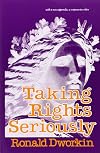
Dworkin aims at a grandly ambitious apologia for moral liberalism in this book, trying to defend an enlightenment philosophy of human rights and common welfare against attack from the Left and Right. Towards the Left, Dworkin argues against legal positivism, which says that laws are essentially arbitrary and political in nature, a matter of interest groups and power rather than justice. Towards the Right, Dworkin makes a case for judicial discretion and the use of law to advance equality show more even at the cost of liberty. Written through the mid 70s, these books deal with issues that are still salient today-civil disobediance, affirmative action, the balance between public and private interest, and the legal philosophy of Strict Constructionism.
Jeremy Bentham called human rights 'nonsense on stilts'. How then should a philosopher who considers himself a utilitarian include human rights in their system of justice? Dworkin sets up a three tiered system: at the bottom is policy-the enacted and enumerated laws and legal precedents that describe how disputes are to be resolved and the public good obtained. Policy should be describable by legal principles, the foremost being consistency--that the same principles describe all similar cases. Above principles is morality, and the idea that rights serve as a kind of override on the utilitarian calculus of politics. Drawing from Rawl's veil of ignorance, Dworkin develops fundamental rights of liberty and equality of respect (not outcomes, or even opportunity). From a utilitarian perspective, personal preferences (those affecting only yourself) are legitimate, while external preferences (those affect others) are not. Dworkin's judges are active, intelligent, moral agents, responsible for seeking balance between competing principles and interests according to their own interior sense of rightness. Ordinary citizens act as judges as well, whether in matters of conscience like avoiding the draft in an unjust war, or in selecting their representatives.
Dworkin's thinking is dense and subtle, and there's a lot for ideologues of any stripe to dislike and misinterpret in this book. From my own perspective, I'm concerned about the prescriptive vs descriptive elements of this book. Judges should be moral adjudicators balancing competing rights in a society that protects both liberty and the common good. However, after Foucault and Jasanoff, judges are agents which create knowledge and exercise power. What purpose do rights serve in a more descriptive account of the law? show less
Jeremy Bentham called human rights 'nonsense on stilts'. How then should a philosopher who considers himself a utilitarian include human rights in their system of justice? Dworkin sets up a three tiered system: at the bottom is policy-the enacted and enumerated laws and legal precedents that describe how disputes are to be resolved and the public good obtained. Policy should be describable by legal principles, the foremost being consistency--that the same principles describe all similar cases. Above principles is morality, and the idea that rights serve as a kind of override on the utilitarian calculus of politics. Drawing from Rawl's veil of ignorance, Dworkin develops fundamental rights of liberty and equality of respect (not outcomes, or even opportunity). From a utilitarian perspective, personal preferences (those affecting only yourself) are legitimate, while external preferences (those affect others) are not. Dworkin's judges are active, intelligent, moral agents, responsible for seeking balance between competing principles and interests according to their own interior sense of rightness. Ordinary citizens act as judges as well, whether in matters of conscience like avoiding the draft in an unjust war, or in selecting their representatives.
Dworkin's thinking is dense and subtle, and there's a lot for ideologues of any stripe to dislike and misinterpret in this book. From my own perspective, I'm concerned about the prescriptive vs descriptive elements of this book. Judges should be moral adjudicators balancing competing rights in a society that protects both liberty and the common good. However, after Foucault and Jasanoff, judges are agents which create knowledge and exercise power. What purpose do rights serve in a more descriptive account of the law? show less

I was expecting a critical examination of America's political institutions, but that's not what this book is. Instead it's an attempt to engage a broader audience from both (Republican and Democratic) sides in moral debate. The author sets forth "two basic principles of human dignity" and goes on to discuss American torture practices, religion and taxation from this moral vantage point. I'm not really sure what he intended to achieve with this approach. He repeatedly pleads for reasoned show more replies to his arguments, but I think he has little chance of arousing much interest in abstract moral debate among a broader public. He writes as a moral philosopher about moral philosophy. Whether he likes it or not, that very much delimits his audience to other moral philosophers. I think a more practical approach would have fit the title of this book better. For instance, he could have examined why American political institutions are so dysfunctional. For what it's worth: vetocracy, plutocracy and the dearth of alternative parties are three characteristics of American democracy which lead this European observer to wonder whether democracy is possible over there. show less
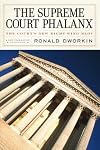
A 70-page pamphlet lamenting the U.S. Supreme Court's dramatic rightward turn due to the Bush appointments, consisting of four previously-published Dworkin articles and no new content, this wasn't at all what I had expected when I pre-ordered it from Amazon.
The book strikes a strange balance between pure polemic and actual, jurisprudential examination. The first two papers presented are almost entirely rhetoric, aimed at the Senate Judiciary Committee and their seeming incapacity to properly show more execute their duties in vetting supreme court appointees John Roberts and Samuel Alito. I found the latter two chapters more useful, and more disturbing. Chapter 3 paints a credible picture of the direction the Court is moving with regards to abortion rights in the U.S. Believers in a woman's right to her body have good cause to be concerned, as the right-wing block is already working to undermine the jurisprudential underpinnings of the Roe and Casey decisions. Chapter 4's portrayal of the more direct undermining of several key Constitutional protections by this new "phalanx" should be frightening to any reader - liberal or conservative. As the Court works to erode the theoretical bases for long-standing precedent, the entire system of stare decisis is put in question, and our ability as a people to rely on the protections we demand from our government is grossly threatened.
I'd hardly call it a must-read, but the final two chapters were informative on matters that all responsible citizens should be made aware of. show less
The book strikes a strange balance between pure polemic and actual, jurisprudential examination. The first two papers presented are almost entirely rhetoric, aimed at the Senate Judiciary Committee and their seeming incapacity to properly show more execute their duties in vetting supreme court appointees John Roberts and Samuel Alito. I found the latter two chapters more useful, and more disturbing. Chapter 3 paints a credible picture of the direction the Court is moving with regards to abortion rights in the U.S. Believers in a woman's right to her body have good cause to be concerned, as the right-wing block is already working to undermine the jurisprudential underpinnings of the Roe and Casey decisions. Chapter 4's portrayal of the more direct undermining of several key Constitutional protections by this new "phalanx" should be frightening to any reader - liberal or conservative. As the Court works to erode the theoretical bases for long-standing precedent, the entire system of stare decisis is put in question, and our ability as a people to rely on the protections we demand from our government is grossly threatened.
I'd hardly call it a must-read, but the final two chapters were informative on matters that all responsible citizens should be made aware of. show less

This is the first book of Dworkin's I've ever read, and I think I'd have gotten more out of it if I'd already been familiar with his work or if I'd read the book more slowly. The publisher notes that Dworkin's illness and death prevented him from expanding the book as he'd planned to, which also might have made it easier to absorb. I have optimistic thoughts of rereading it at some point and really thinking about it. But even on this first reading, I was intrigued by his ideas on religious show more atheism and his argument that religious freedom should be based on a right to ethical independence rather than on belief in God(s). show less
Lists
Awards


You May Also Like


Associated Authors
Statistics
- Works
- 36
- Also by
- 6
- Members
- 2,855
- Popularity
- #8,984
- Rating
- 3.9
- Reviews
- 16
- ISBNs
- 144
- Languages
- 15
- Favorited
- 3