

David Dosa
Author of Making Rounds with Oscar: The Extraordinary Gift of an Ordinary Cat
About the Author
Works by David Dosa
Tagged
Common Knowledge
- Birthdate
- 20th century
- Gender
- male
- Education
- University of Pittsburgh (MPH)
George Washington University (MD)
University of Virginia (BA) - Occupations
- geriatrician and health services researcher
- Organizations
- Brown University
- Awards and honors
- Merck New Investigator Award, American Geriatrics Society (2006)
- Nationality
- USA
- Places of residence
- Providence, Rhode Island, USA
- Associated Place (for map)
- Rhode Island, USA
Members
Reviews

This is not a warm and fuzzy story; it is more heartbreaking than heartwarming. But if you know someone with dementia, or if you fear it happening to you; or if you have had close encounters of the feline kind; or if you are a health care professional or a veterinarian, read this book.
Built on a 2007 essay in the New England Journal of Medicine that garnered much coverage in the news media, “Making Rounds With Oscar” is less about Oscar the cat than about gerontologist David Dosa’s show more journey from man of pure science to believer in the mysterious power of an animal to know what experienced doctors and nurses do not.
Dr. Dosa may have set out to examine the uncanny knack of a Rhode Island nursing home’s resident pet to know when a patient is near death and rush to their side. But what he has written is a thoughtful account of one sometimes self-centered physician’s developing ability to connect with his patients and their families and his realization that what they most need is not a name for what ails them but help in making the best of whatever kind of life remains to them.
As Dosa talks with the families of Alzheimer’s patients to find out more about Oscar’s presence in the hours before death and the comfort he gave both the dying and the living, the accrual of pain and loss is wrenching. “Until I worked with patients in the late stages of Alzheimer’s,” Dosa writes, “the expression ‘a shadow of her former self’ was just a cliché.”
Among his patients was Lino Ferretti, the pioneer in digital music. As his mental deterioration progressed, the musical genius relied on notebooks to remind himself of such basics as the names of musical instruments – and his pet names for his wife. Frank Rubenstein (one of several “fictionalized composites” in the book) faithfully tends to his beloved wife for years, until she no longer recognizes him on the anniversary of one of the most significant days of their lives. A daughter abides by her father’s request that everything possible be done to prolong his life, even though he no longer has the life he once wished to prolong at any cost.
For each of these people, Oscar kept vigil. Perhaps, Dosa speculates, the animal merely detected the scent of certain chemical compounds released as the body begins to shut down. Whatever the explanation might be, “I believe we can all learn from his example,” the doctor continues. “… Animals like Oscar can teach us through their steadfastness, their patience, and their presence: They don’t have to be anywhere else except where they are.” People suffering from dementia, unresponsive though they may be to a family member or friend, need that reassuring presence.
“Maybe,” Dosa writes of Oscar, “he was just a master of empathy. Maybe caring was his superpower.”
What a parting gift Oscar gave the dying residents of Steere House: a warming touch and the comforting vibration of a purr to ease their passing. show less
Built on a 2007 essay in the New England Journal of Medicine that garnered much coverage in the news media, “Making Rounds With Oscar” is less about Oscar the cat than about gerontologist David Dosa’s show more journey from man of pure science to believer in the mysterious power of an animal to know what experienced doctors and nurses do not.
Dr. Dosa may have set out to examine the uncanny knack of a Rhode Island nursing home’s resident pet to know when a patient is near death and rush to their side. But what he has written is a thoughtful account of one sometimes self-centered physician’s developing ability to connect with his patients and their families and his realization that what they most need is not a name for what ails them but help in making the best of whatever kind of life remains to them.
As Dosa talks with the families of Alzheimer’s patients to find out more about Oscar’s presence in the hours before death and the comfort he gave both the dying and the living, the accrual of pain and loss is wrenching. “Until I worked with patients in the late stages of Alzheimer’s,” Dosa writes, “the expression ‘a shadow of her former self’ was just a cliché.”
Among his patients was Lino Ferretti, the pioneer in digital music. As his mental deterioration progressed, the musical genius relied on notebooks to remind himself of such basics as the names of musical instruments – and his pet names for his wife. Frank Rubenstein (one of several “fictionalized composites” in the book) faithfully tends to his beloved wife for years, until she no longer recognizes him on the anniversary of one of the most significant days of their lives. A daughter abides by her father’s request that everything possible be done to prolong his life, even though he no longer has the life he once wished to prolong at any cost.
For each of these people, Oscar kept vigil. Perhaps, Dosa speculates, the animal merely detected the scent of certain chemical compounds released as the body begins to shut down. Whatever the explanation might be, “I believe we can all learn from his example,” the doctor continues. “… Animals like Oscar can teach us through their steadfastness, their patience, and their presence: They don’t have to be anywhere else except where they are.” People suffering from dementia, unresponsive though they may be to a family member or friend, need that reassuring presence.
“Maybe,” Dosa writes of Oscar, “he was just a master of empathy. Maybe caring was his superpower.”
What a parting gift Oscar gave the dying residents of Steere House: a warming touch and the comforting vibration of a purr to ease their passing. show less
 This review was written for LibraryThing Early Reviewers.
Dr. David Dosa is a geriatrician who at the age of four was terrorized by his grandmother's cat Puma. He is a man of science who seeks rational answers. He is a dog person. He is aware of the cats who reside at Steere House Nursing and Rehabilitation Center where he helps to care for dementia patients in their last days but pays no real attention to the cats. He genuinely enjoys his work and has a great deal of respect and compassion for his patients as they "unlearn" almost everything they show more ever knew. Only music, babies and animals still get their attention.
Oscar is not a people cat; he tends to hide rather than socialize with most people. One day Mary Miranda, the day shift nurse, mentions Oscar's ability to identify which patient is about to die. Dosa is skeptical but agrees to talk to the families of patients that Oscar spent time with.
As he interviews the spouses or children of former Steere House residents, Dosa learns that Oscar provides a real service not just to the dying (are they aware of his presence?) but to the grieving family members as they begin to cope with their loss. Not only does he alert the nursing staff of an imminent death in time for the family to be notified, but he remains with the patient and family through the entire process, only leaving after the undertaker has left.
Many of the people Dosa spoke to said they were so grateful to Oscar for being with them during such a difficult time in their lives. Even Dosa comes to realize that when his time comes he would rather be in a nursing home with cats than in a hospital ICU.
My only disappointment with this book is that it did not contain any pictures of Oscar or the other nursing home cats. This is a gentle book and a welcome addition to the library of anyone who cares about animals or elder care. show less
Oscar is not a people cat; he tends to hide rather than socialize with most people. One day Mary Miranda, the day shift nurse, mentions Oscar's ability to identify which patient is about to die. Dosa is skeptical but agrees to talk to the families of patients that Oscar spent time with.
As he interviews the spouses or children of former Steere House residents, Dosa learns that Oscar provides a real service not just to the dying (are they aware of his presence?) but to the grieving family members as they begin to cope with their loss. Not only does he alert the nursing staff of an imminent death in time for the family to be notified, but he remains with the patient and family through the entire process, only leaving after the undertaker has left.
Many of the people Dosa spoke to said they were so grateful to Oscar for being with them during such a difficult time in their lives. Even Dosa comes to realize that when his time comes he would rather be in a nursing home with cats than in a hospital ICU.
My only disappointment with this book is that it did not contain any pictures of Oscar or the other nursing home cats. This is a gentle book and a welcome addition to the library of anyone who cares about animals or elder care. show less
This review was written for LibraryThing Early Reviewers.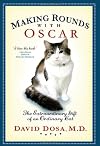
Oscar is the feline nursing home resident who somehow senses when a patient is about to die and feels it is his duty to spend time with the dying patient as the end approaches. A simple matter of chemical attraction? Instinct? Empathy & Compassion? Or something more spiritual? This is what Dr. Dosa, the primary care physician for dementia patients at Steere House Nursing Home in Rhode Island, tries to discover in this informatively sensitive and poignant book.
Actually, when I first heard show more about this book, I thought it would be all about the life of Oscar the cat…and cats in general. It is, however, much more than that. As Dr. Dosa explores the “secrets” of Oscar’s apparent ability to sense death before the medical community is able to do so, he learns about the emotional toll that old-age dementia takes on the families involved and how this kitty provides an incredible source of comfort to those whose lives he touches.
Although I admit that parts of this book brought me to tears, I think the good doctor did a great job being both compassionate and objective in his discussion of the impacts of the range of dementia he has encountered. I think it’s great that, through Oscar, Dr. Dosa develops greater empathy towards both his patients and their families while better understanding the course his own life is taking. Another example of the important role our animal friends play in our lives! show less
Actually, when I first heard show more about this book, I thought it would be all about the life of Oscar the cat…and cats in general. It is, however, much more than that. As Dr. Dosa explores the “secrets” of Oscar’s apparent ability to sense death before the medical community is able to do so, he learns about the emotional toll that old-age dementia takes on the families involved and how this kitty provides an incredible source of comfort to those whose lives he touches.
Although I admit that parts of this book brought me to tears, I think the good doctor did a great job being both compassionate and objective in his discussion of the impacts of the range of dementia he has encountered. I think it’s great that, through Oscar, Dr. Dosa develops greater empathy towards both his patients and their families while better understanding the course his own life is taking. Another example of the important role our animal friends play in our lives! show less
Making Rounds with Oscar: The Extraordinary Gift of an Ordinary Cat (Thorndike Press Large Print Nonfiction Series) by David Dosa
I absolutely loved this book! I'm an animal lover, and I've had two close relatives suffer from dementia and have to enter nursing homes. Oh, how I wish they'd had an Oscar. One thing that struck me was that he brought as much comfort to the families of the patients as to the patients themselves -- probably even more, since the patients were unconscious when Oscar began his vigils. Dosa gives a realistic, sympathetic portrayal of dementia patients that brought back memories that brought show more tears to my eyes. His facility is what every nursing home should be. Don't be scared of the subject matter -- this book has a lot of humor, too. When you love someone with dementia, you learn to look for silver linings and lighter moments. show less
This review was written for LibraryThing Early Reviewers.Lists
Awards

You May Also Like


Associated Authors
Statistics
- Works
- 1
- Members
- 880
- Popularity
- #29,100
- Rating
- 3.8
- Reviews
- 131
- ISBNs
- 41
- Languages
- 12
