
Nigel Gray (1) (1941–)
Author of A Country Far Away
For other authors named Nigel Gray, see the disambiguation page.
About the Author
Nigel Gray was born in a farm shed in Ireland. At twelve months old, during the Second World War, he was taken to England and never saw his father, nor brother and sister again. He went into a series of foster homes, a children's home, and later lived with his mother. Gray left school only show more semi-literate, and became involved in petty criminality. He planned to work his way overland to Australia and spent two years travelling and working in ten European countries. He became an anarchist, was involved in numerous political causes, was arrested many times, locked up on a number of occasions, and deported for political offences from four countries. Gray worked as an unskilled manual worker for eleven years, but earned a B. A. in English and Politics, and an M. A. in Creative Writing from British universities in the process. He went to South East Asia as part of a non-violent action group in 1967 to oppose the American War, was involved in civil unrest in several countries in 1968, worked for the Northern Ireland Civil Rights Campaign in 1972, and visited South Africa to oppose apartheid, as well as some of the Soviet Bloc countries. Gray began writing when he was in prison in Thailand. He began with performance poetry, and went on to write non-fiction, and then stories, novels, plays, and children's books. He set up a commune in Cumbria, did work for People Not Psychiatry, and established a major Arts Festival. Gray has been writing professionally for thirty years, and has more than sixty books published, in twenty-six countries and twenty-four languages, winning various awards and honours. Gray finally arrived in Western Australia in 1988, over twenty years later than he'd intended, having migrated under the special category of artists and sports people of international reputation, and has been an Australian citizen since 1990. He is a member and a past president of his branch of PEN, the writers' organization with special concern for writers throughout the world who are in imprisoned or persecuted. With respected literary critic and poet David Craig, Gray founded and edited the literary magazine Fireweed, which was published quarterly from 1974 to 1978. As a photographer, he has had work published and exhibited. North West Arts mounted a one-person exhibition of his photographs in 1977. Gray has also acted in the role of Joe Malik in Ken Campbell's epic production of Illuminatus, which opened in a warehouse Liverpool in 1976 and then moved to The Micky Theatre, Amsterdam, and the National Theatre, London in 1977. Gray has taught Literature courses for The University of Liverpool; The University of Lancaster; and The Worker's Education Association. He has taught Creative Writing courses for The University of Liverpool; The University of Leicester; The University of Western Australia; The Worker's Education Association; The Arvon Foundation; The Katherine Susannah Pritchard Foundation; and The Northampton Arts Centre. He has also taught numerous writing workshops in schools, colleges, universities, libraries, arts centers, writer's centres, centres for the unemployed, and prisons. Gray received the following writing fellowships in the course of his career, including, in the UK: East Midlands Arts 1977/79; Northampton Development Corporation 1979/80; C Day Lewis Fellowship, London 1980/81; and Eastern Arts 1981/82. In Australia he received: the WA College of Advanced Education 1988; Shire of Kalamunda 1989/1990; Edith Cowan University 1990 and 1994; and Katharine Susannah Prichard Foundation 1992. Gray has also received The Dickens Fellowship Award, and The Irish Post Award for Literature. His books have won four major international awards, been shortlisted for thirteen more, and have picked up sixteen further honours in Australia, Europe and the United States. (Bowker Author Biography) show less
Works by Nigel Gray
Associated Works
Cricket Magazine, Vol. 8, No. 1, September 1980 — Contributor — 1 copy
Tagged
Common Knowledge
- Birthdate
- 1941-04-09
- Gender
- male
- Nationality
- Ireland
Australia - Birthplace
- Ireland
- Places of residence
- Western Australia
Members
Discussions
Picture Book with a Messy Family in Name that Book (October 2013)
Reviews
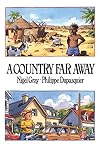
I loved the book "A Country Far Away" for a few reasons. The book is set up similarly to a graphic novel, with multiple panels on each page, separated in the middle by the text; the panels on the top are illustrated to display one boy’s life, while the panels on the bottom are meant to display a second boy’s life. The two unnamed boys live in very different places, the boy on top lives in what appears to be a third-world country, in a village with clay and straw homes and very little show more resources while the boy on the bottom lives in a first-world country, in a suburban neighborhood. The reader follows a day in the life of these two kids while reading one line of text that applies to both boys in the story, despite the vast differences in their environments. On one page, the text reads: “I helped my mom and dad. They were pleased”, the panels on top show the boy carrying pails of water, climbing coconut trees, milking a goat and slicing fruit on the dirt floor of his hut; the panels on the bottom show the other boy vacuuming the family room, mowing the lawn, and playing racquetball with his mom. On another page, the text says: “I went bike riding with my friends. I’m one of the best riders”, the top panel shows the boy riding on a bike while a group of kids run after him, they each take turns sharing the bike with joyful faces. The bottom panel shows the second boy riding dirt bikes on a track with his friends, winning a second place trophy. On one of the last pages, the text reads: “Today it rained—so we went swimming”, the top panel shows the heavy rain forming a swimming hole in the dirt, the boys swim around in the shallow water naked, while the bottom panel shows the other boy going to the indoor swim park with his dad, going down water slides and diving off the diving board. I love the way that the author chose to tell this compare and contrast story—he isn’t trying to blatantly point out the astounding differences in the two character’s livelihoods, rather he is taking a more positive liberty, showing the similarities between them. Because the text is so simple and the illustrations carry almost all of the meaning of the story, young children reading the book will be able to comprehend the text easily while observing the different realities of day to day life for each child. The message of the story is that the quality of our lives is entirely dependent on our perspective and outlook—all around the world, there are people who live in all sorts of environments with different cultures, values, resources, etc., and yet we are not all that different from one another. Doing chores for our parents such as vacuuming the carpet might seem like the most inconvenient, annoying task to perform when we would much rather do something fun; while somewhere else in the world another child is being asked to scale a tree or carry water long distances to provide basic needs for their entire family. The author’s purpose in telling this story is not meant to make the reader feel guilty for complaining about a life that is much easier in comparison to another, but rather, to ask the reader to recognize that what separates one life from another is simply the materialistic parts. show less
A Country Far Away illustrates the similarities and differences between life in Africa and life in America. The text is from the point of view of one of the boys in either of the illustrations- but because they are doing the same thing, it is as if both of them are speaking to the reader. I love the way this book used illustrations and precisely placed text and pictures to compare the two cultures. The text does not sway to either culture, which helps the reader to be non-partial and notice show more both of them. The text is easy to understand and the illustrations are eye-catching. show less
I like this book because of the specific and very detailed illustrations and because of the perspective of the characters. In order to teach the overall lesson to the reader that there is not one correct culture, but rather several cultures that perform the same tasks differently, the illustrator made horizontal pictures that compare the lives of two boys completing the same task but in different cultures. In order to show that the boys are more alike than different, the illustrator created show more a scene of both families meeting for reunion. The illustrator made a picture of both families standing almost exactly the same, but with different clothing, skin color, and a different setting. The perspective of this book was very helpful and interesting because because it was in first person, but it was not specified as to who was talking. This implies that the dialogue was from both the boy that lives in an urban development and the boy in the farmland, furthermore showing that the boys live a similar life and solve the same problems but just in different ways. show less
A remarkable and delightful book that shows how children are alike the world over, while at the same time celebrating the rich and interesting diversity of their ordinary lives. The life of a boy in an African village is compared with that of a British child in split page illustrations.
Lists
Awards


You May Also Like


Associated Authors
Statistics
- Works
- 53
- Also by
- 1
- Members
- 1,003
- Popularity
- #25,716
- Rating
- 3.7
- Reviews
- 14
- ISBNs
- 165
- Languages
- 9