
Junji Ito
Author of Uzumaki
About the Author
Series
Works by Junji Ito
Human Chair; 人間椅子; Ningen-isu 10 copies
Junji Ito: Relatos terrorÃficos (O.C.): Junji Ito: Relatos terrorÃficos núm. 02 (2016) 8 copies, 1 review
The Thing That Drifted Ashore 7 copies
The Long Dream; 長い夢; Nagai Yume 7 copies
The Woman Next Door 6 copies
Nas Montanhas do Terror 6 copies
As Esculturas sem Cabeça 5 copies
Army of One 5 copies
She is a slow walker 4 copies
Поплавлений клас 3 copies
Ribs Woman 3 copies
Snow White 3 copies
Uzumaki Vol.4 3 copies
Uzumaki Vol.5 3 copies
Uzumaki Vol.6 3 copies
SUKI: The Sense of Multi-Vernacular 2 copies
Summer time graduation vacation 2 copies
The Sad Tale of the Principal Post 2 copies
Phantom mansion 2 copies
The Sound of Grass 2 copies
Blood Bubble-Bushes 2 copies
Uzumaki Vol.7 2 copies
Uzumaki Vol.8 2 copies
Uzumaki Vol.9 2 copies
Uzumaki Vol.10 2 copies
Uzumaki Vol.11 2 copies
Uzumaki Vol.12 2 copies
Uzumaki Vol.13 2 copies
Uzumaki Vol.14 2 copies
Uzumaki Vol.15 2 copies
Uzumaki Vol.16 2 copies
Uzumaki Vol.18 2 copies
Junji Ito, Terror despedazado núm. 13 de 28 - Las caprichosas maldiciones de Sôichi 1 (2024) 2 copies
Uzumaki Vol.19 2 copies
Calafrios 2 copies
伊藤潤二自選傑作集 歪 (朝日コミックス) 2 copies
Sus ojos me persiguen 1 copy
contos de horror da mimi 1 copy
Ice Cream Bus 1 copy
Ito Junji's Dog Diary 1 copy
Glyceride 1 copy
Junji Ito: Maestro del terror - Terror insólito vol. 1 de 3 (Junji Ito: Maestro del terror - Terror insólito (O.C.)) (2023) 1 copy
Bio House; バイオハウス; Biohausu 1 copy
Fixed Face 1 copy
The Scarlet Circle 1 copy
Den of the sleep demon 1 copy
Uzumaki Vol.17 1 copy
House of the Marionettes 1 copy
Uzumaki Vol. 3 1 copy
Uzumaki Vol. 2 1 copy
Uzumaki Vol. 1 1 copy
Dissection Girl 1 copy
Nikad čovek: Knjiga 2 1 copy
Hikizuri y Oshikiri 1 copy
Mortos de Amor 1 copy
Visões Grotescas 1 copy
Umezz Kazuo and Me 1 copy
House of Puppets 1 copy
Naturaleza desbocada 1 copy
Junji ito collection shiver,fragments of horror [hardcover],dissolving classroom 3 books set (2018) 1 copy
Fashion Model: Cursed Frame 1 copy
Unbearable Maze 1 copy
Planeta Demoníaco Remina 1 copy
El umbral de lo siniestro 1 copy
Пекельна планета Реміна 1 copy
Associated Works
Tagged
Common Knowledge
- Canonical name
- Ito, Junji
- Legal name
- 伊藤潤二
- Birthdate
- 1963-07-31
- Gender
- male
- Occupations
- graphic artist
- Awards and honors
- Umezu Prize for Horror
- Nationality
- Japan
- Birthplace
- Gifu Prefecture, Japan
- Places of residence
- Gifu Prefecture, Japan
- Map Location
- Japan
Members
Reviews

Eleventh Book of the spooky season (Well Manga, but it definitely counts!)
Trying to read horror or at least books with horror elements for the whole month of October.
WOW!
Absolutely dreadful, unexpected, horrible and twisted piece of work. Watching this town devolve and fall prey to the spiral was agonizing, and turning each page was some weird new horror.
The medium felt amazing, the stark contrast of black and white and the beautiful imagery of full panel manga shots.
I don’t think show more I’ll look at a spiral the same way again. show less
Trying to read horror or at least books with horror elements for the whole month of October.
WOW!
Absolutely dreadful, unexpected, horrible and twisted piece of work. Watching this town devolve and fall prey to the spiral was agonizing, and turning each page was some weird new horror.
The medium felt amazing, the stark contrast of black and white and the beautiful imagery of full panel manga shots.
I don’t think show more I’ll look at a spiral the same way again. show less

Many of Junji Ito’s themes and motifs are simple and even nonsensical, but they tend to stick in the mind. They have the ineluctable quality of nightmares, of good horror films. His concepts have the same staying power as a cheesy slasher flick, with the advantage of impressive artwork. No matter how far he takes the mutilation and monstrosities, they are rooted in true nightmares and real-life phobias. One gets the sense that the author is of a delicate sensibility and exorcises these show more demons in his work. Maybe horrors accumulate inside his mind and he has no choice but to draw manga for temporary relief.
Inanimate objects take on ominous contortions and morph into a dramatic diorama of blood and guts in most examples. Something as tame as clay pots are twisted into mesmerizing terror in his most representative work, Uzumaki. More so than in Tomie or Gyo, this is considered his stand-out production.
Reading it once is enough to start seeing spirals, to be infected by the madness. He points out society’s flaws indirectly, and you can usually dig beneath his nonsensical fables for subtle commentary. It was easy for me to acquire a taste for this brand of obscuring reality and blending it with nightmare. There is a gnawing madness to this and most of his other stories. Everything from marionettes to advertisements to snails to hot air balloons become objects to be questioned, or even to be abhorred. In Junji Ito nothing is as it seems. But under the horrid images, I can sense humor. The surface is only one layer. The true heart of his manga lies in a pervading irony and solid sense of grotesque joy that is easy to miss if you only consider the bones of the story.
Like in any good horror story, the characters in Uzumaki are constantly acting contrary to reason. I have heard of the unsuccessful live action film based on the manga. His ideas really only work on paper if you ask me. The exaggeration becomes silly when mishandled. That's why I'm a fan of the manga alone, and will remain a fan, as we're finally getting more of his titles and collections in English. show less
Inanimate objects take on ominous contortions and morph into a dramatic diorama of blood and guts in most examples. Something as tame as clay pots are twisted into mesmerizing terror in his most representative work, Uzumaki. More so than in Tomie or Gyo, this is considered his stand-out production.
Reading it once is enough to start seeing spirals, to be infected by the madness. He points out society’s flaws indirectly, and you can usually dig beneath his nonsensical fables for subtle commentary. It was easy for me to acquire a taste for this brand of obscuring reality and blending it with nightmare. There is a gnawing madness to this and most of his other stories. Everything from marionettes to advertisements to snails to hot air balloons become objects to be questioned, or even to be abhorred. In Junji Ito nothing is as it seems. But under the horrid images, I can sense humor. The surface is only one layer. The true heart of his manga lies in a pervading irony and solid sense of grotesque joy that is easy to miss if you only consider the bones of the story.
Like in any good horror story, the characters in Uzumaki are constantly acting contrary to reason. I have heard of the unsuccessful live action film based on the manga. His ideas really only work on paper if you ask me. The exaggeration becomes silly when mishandled. That's why I'm a fan of the manga alone, and will remain a fan, as we're finally getting more of his titles and collections in English. show less
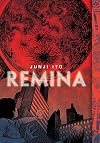
I suppose there is a case to be made for Remina being so bad it's good, but I'm not going to be the one to make it. This is a horrible B-movie in manga form as a rogue planet from deep space called Remina heads toward Earth, destroying all other planets in its path. Meanwhile, in Japan, with apocalypse looming, the crazed populace decides the blame lies with the young girl, Remina Oguro, for whom the planet was named by her scientist father.
The twists are predictable, the science is show more laughable, and the ending is just stupid beyond belief.
The imagery is eerie and unsettling, as one would expect from Junji Ito, but the dialogue and characters are stiff and wooden. And despite the book and planet being named for her, Remina is an empty sexist trope of a victim, existing only to be idolized, pursued, or literally carried like baggage by the men in her life. Sad and disgusting. show less
The twists are predictable, the science is show more laughable, and the ending is just stupid beyond belief.
The imagery is eerie and unsettling, as one would expect from Junji Ito, but the dialogue and characters are stiff and wooden. And despite the book and planet being named for her, Remina is an empty sexist trope of a victim, existing only to be idolized, pursued, or literally carried like baggage by the men in her life. Sad and disgusting. show less

This book should come with a warning. There were some really disturbing stories here. Several of them began so innocuously that I considered skipping them, but every story was worth reading and several were horrifying enough that I will probably remember them for the rest of my life.
My only real dislike, apart from the nightmares I will surely have tonight, was the dialogue. Translations are always hard, but I've seen them done better and think the writing here deserved a better translation.
My only real dislike, apart from the nightmares I will surely have tonight, was the dialogue. Translations are always hard, but I've seen them done better and think the writing here deserved a better translation.
Lists
Eerie eTales (18)
Wishlist (1)
2010s (1)
Diverse Horror (1)
Five star books (1)
Pipoca & Nanquim (7)
Cats in Fiction (1)
Awards


You May Also Like


Associated Authors
Statistics
- Works
- 239
- Also by
- 4
- Members
- 18,940
- Popularity
- #1,154
- Rating
- 3.9
- Reviews
- 424
- ISBNs
- 410
- Languages
- 13
- Favorited
- 38
