

Benedict Patrick
Author of They Mostly Come Out at Night
Series
Works by Benedict Patrick
Card Mage: Tournament Topdecker 5 copies
Tales from the Yarnsworld 1 copy
Associated Works
Tagged
Common Knowledge
- Gender
- male
- Nationality
- Northern Ireland
- Map Location
- Northern Ireland, UK
Members
Reviews

I received a copy of this book from the author in exchange for an honest review. My apologies to Mr. Patrick for not posting sooner. Life has a habit of getting in the way.
I thought I knew where From the Shadows of the Owl Queen’s Court was headed in the first few pages. The servant girl, the noble friend, the dead queen, the secret that would change everything. I had it all mapped out. But then the POV shifted and it was about a put-upon son, a deadbeat father, and their crumbling show more relationship. I was thrown but still figured I had it sorted. And then the horse sized, hairless stampeding beavers showed up and I had to admit that I knew nothing of what Mr. Patrick had in store.
In brief, Owl Queen’s Court tells the story of Nascha, an escaped slave on the run and Bradan, a man of the forest who believes he is destined to be its protector. The two eventually meet and try to escape the mysterious forest before they are overtaken by any number of potential threats. That’s the simple version anyway. It gets more complicated when the various forest entities get involved (doesn’t it always?). Nothing is simple and everything is dangerous.
There is a lot of world-building early on and it isn’t always immediately apparent what should be known and what is being slowly revealed (are giant beavers a common threat?). Luckily the world was compelling enough to drag me through my confusion and it wasn’t long before histories were explained, motives made clear, and the world began to congeal.
Patrick does this by deftly weaving together the core plot in the numbered chapters with self contained fairy tales which help define the world in the titled ones. So when you come across a dapper man with a fox tail in one chapter you’re treated to the tale of the Gentleman Fox in the next and by the time you see him again you have a much better understanding of what he might be up to. It’s all very clever.
I really liked Nascha, she was naive and inexperienced while still showing intelligence. I worried about her because the forest was dangerous and not because she couldn’t handle herself. Also, the very first thing she does after absconding from the Owl Queen’s Court is repeatedly and with great gusto screw her liberator. This is treated as something she wants and is not a big deal. And best of all she isn’t a blushing virgin! It’s just nice to see these topics handled with a degree of reality.
Conversely, Bradan comes off a bit dull, at least when next to Nascha. He just doesn’t have her charm. When he does comes alive it’s while interacting with his father, Lonan, a reclusive and troubled folk hero. They have a long history and you feel it in every interaction. Every argument. Each exchange contains the remnants of every fight they’ve ever had and you feel it weighing on them both. They are both desperate to save each other but neither knows exactly how to do it. It’s a nice bit of family drama that connects well to the adventure story.
And the first half of the book is a pretty standard adventure story; oversized, semi aquatic rodents notwithstanding. It’s when our heroes arrive at a small town that things start to get… strange. Now, I love a town full of secretive weirdos under the influence of a supernatural cult and this is no exception but there is a scene involving the entity known as The Lady of Forest in which there is a lot of/too much moaning and a large pile of slick fruit that all combined to make me very uncomfortable. Not exactly in a bad way. But the whole thing put me in mind of some of the odder bits from Miyazaki.
I thought I had this story pegged from the start but with every chapter Patrick showed me otherwise. The world is extensive and, despite my initial confusion, very well considered. It manages the rare feat of being a book filled with world-building that never feels like an encyclopedia and even when the plot feels standard it’s surrounded by so much inventive weirdness that you're constantly intrigued. I liked the adventure very much and it ends in a satisfying way but it’s really the world that I fell in love with and would keep me coming back. show less
I thought I knew where From the Shadows of the Owl Queen’s Court was headed in the first few pages. The servant girl, the noble friend, the dead queen, the secret that would change everything. I had it all mapped out. But then the POV shifted and it was about a put-upon son, a deadbeat father, and their crumbling show more relationship. I was thrown but still figured I had it sorted. And then the horse sized, hairless stampeding beavers showed up and I had to admit that I knew nothing of what Mr. Patrick had in store.
In brief, Owl Queen’s Court tells the story of Nascha, an escaped slave on the run and Bradan, a man of the forest who believes he is destined to be its protector. The two eventually meet and try to escape the mysterious forest before they are overtaken by any number of potential threats. That’s the simple version anyway. It gets more complicated when the various forest entities get involved (doesn’t it always?). Nothing is simple and everything is dangerous.
There is a lot of world-building early on and it isn’t always immediately apparent what should be known and what is being slowly revealed (are giant beavers a common threat?). Luckily the world was compelling enough to drag me through my confusion and it wasn’t long before histories were explained, motives made clear, and the world began to congeal.
Patrick does this by deftly weaving together the core plot in the numbered chapters with self contained fairy tales which help define the world in the titled ones. So when you come across a dapper man with a fox tail in one chapter you’re treated to the tale of the Gentleman Fox in the next and by the time you see him again you have a much better understanding of what he might be up to. It’s all very clever.
I really liked Nascha, she was naive and inexperienced while still showing intelligence. I worried about her because the forest was dangerous and not because she couldn’t handle herself. Also, the very first thing she does after absconding from the Owl Queen’s Court is repeatedly and with great gusto screw her liberator. This is treated as something she wants and is not a big deal. And best of all she isn’t a blushing virgin! It’s just nice to see these topics handled with a degree of reality.
Conversely, Bradan comes off a bit dull, at least when next to Nascha. He just doesn’t have her charm. When he does comes alive it’s while interacting with his father, Lonan, a reclusive and troubled folk hero. They have a long history and you feel it in every interaction. Every argument. Each exchange contains the remnants of every fight they’ve ever had and you feel it weighing on them both. They are both desperate to save each other but neither knows exactly how to do it. It’s a nice bit of family drama that connects well to the adventure story.
And the first half of the book is a pretty standard adventure story; oversized, semi aquatic rodents notwithstanding. It’s when our heroes arrive at a small town that things start to get… strange. Now, I love a town full of secretive weirdos under the influence of a supernatural cult and this is no exception but there is a scene involving the entity known as The Lady of Forest in which there is a lot of/too much moaning and a large pile of slick fruit that all combined to make me very uncomfortable. Not exactly in a bad way. But the whole thing put me in mind of some of the odder bits from Miyazaki.
I thought I had this story pegged from the start but with every chapter Patrick showed me otherwise. The world is extensive and, despite my initial confusion, very well considered. It manages the rare feat of being a book filled with world-building that never feels like an encyclopedia and even when the plot feels standard it’s surrounded by so much inventive weirdness that you're constantly intrigued. I liked the adventure very much and it ends in a satisfying way but it’s really the world that I fell in love with and would keep me coming back. show less
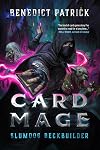
Card Mage is a rather unique coming of age fantasy story in that the immediate world is a massive city whose culture revolves around acquiring and battling magical cards in what are known as “deck gangs”. Cards when dealt, spawn actual monsters and spells to fight in arenas and passively give unique powers to their owners.
Our protagonist Hick aspires to own a card and work his way into a gang so he can provide for his dad and siblings. And perhaps make a name for himself along the way. show more When a unique card is given to him after his life has hit rock bottom, suddenly that dream is on the cusp of becoming a reality. One the authorities seem intent on stopping.
That’s the premise. Does it work? Completely. The card system is very well conceived and we are treated to a battle in the first chapter and there’s no waiting around for more. There’s also litte info dumping for building up the world. Mostly it comes from how the characters talk about their lives, but the remaining background is teased with snippets from historical scrolls at the start of each chapter, which tease how the cards were originally formed. World building like a deck - card by card if you will.
Whilst they are quite long and very frequent (and maintain the addictive feel of real card games), what is clever about the battles is they aren’t merely used as exciting fight scenes, but to progress the character arcs of the protagonists—often the strategies involved reflected the ego and state of mind of Hick as he grows in confidence.
The only issues I came across were some flat dialogue and everything proceeded rather predictably, There were very few surprises to anyone used to coming of age style fantasy stories and I had pretty much mapped out upcoming chapters ahead of time in some places.
That didn’t take away from an enjoyable read. The author has carefully thought about how his system of card magic works—both in terms of card battles and the rapport powers given to their owners. Not only in the battle arenas, but how they affect the society at all levels.
It’s a quick and straightforward read, but a unique premise and one I enjoyed thoroughly. Recommended show less
Our protagonist Hick aspires to own a card and work his way into a gang so he can provide for his dad and siblings. And perhaps make a name for himself along the way. show more When a unique card is given to him after his life has hit rock bottom, suddenly that dream is on the cusp of becoming a reality. One the authorities seem intent on stopping.
That’s the premise. Does it work? Completely. The card system is very well conceived and we are treated to a battle in the first chapter and there’s no waiting around for more. There’s also litte info dumping for building up the world. Mostly it comes from how the characters talk about their lives, but the remaining background is teased with snippets from historical scrolls at the start of each chapter, which tease how the cards were originally formed. World building like a deck - card by card if you will.
Whilst they are quite long and very frequent (and maintain the addictive feel of real card games), what is clever about the battles is they aren’t merely used as exciting fight scenes, but to progress the character arcs of the protagonists—often the strategies involved reflected the ego and state of mind of Hick as he grows in confidence.
The only issues I came across were some flat dialogue and everything proceeded rather predictably, There were very few surprises to anyone used to coming of age style fantasy stories and I had pretty much mapped out upcoming chapters ahead of time in some places.
That didn’t take away from an enjoyable read. The author has carefully thought about how his system of card magic works—both in terms of card battles and the rapport powers given to their owners. Not only in the battle arenas, but how they affect the society at all levels.
It’s a quick and straightforward read, but a unique premise and one I enjoyed thoroughly. Recommended show less

They Mostly Come Out At Night is the first published Yarnsworld novel. This is a standalone novel, with the other Yarnsworld novels taking place in the same world but not as direct sequels. It is a really cool folklore-style story with elements of horror akin to the original Grimm fairy tales. The writing is polished and well-edited. Perhaps my only complaint about this book was that the dialogue sometimes came across as stilted or awkward, breaking my immersion and making me go back to show more reread the exchange. This happened fairly rarely, and overall the writing gave me no trouble. The world is unique and fascinating. Chapters alternate between the main story and tellings of related folktales from within the book’s world. The folktale chapters ingeniously provide both history of the world, as well as foreshadowing for the main plot.
Readers who enjoy folklore should definitely make time for this one. It has some elements of horror without getting too grim or gruesome, so it would be a good choice for those interested in something spooky but lightweight on the horror scale. In the style of folklore, the plot is simple (in a good way, i.e. not overly complex), but it certainly still provides readers with a few unexpected turns and avoids feeling predictable. I would recommend it as a good in-between or on-the-side read, as well. show less
Readers who enjoy folklore should definitely make time for this one. It has some elements of horror without getting too grim or gruesome, so it would be a good choice for those interested in something spooky but lightweight on the horror scale. In the style of folklore, the plot is simple (in a good way, i.e. not overly complex), but it certainly still provides readers with a few unexpected turns and avoids feeling predictable. I would recommend it as a good in-between or on-the-side read, as well. show less
Actual rating 3.5
The prose is decent and both the setting and the author’s imagination lend some great visuals. While I did enjoy the setting, dark forest full of myths and stories, the book itself is on the shorter side and split between two different POV narratives and that collection of myths. Functionally this results in the characters and their narratives feeling secondary and a little shallow.
On a more personal level, TMCOAN is both aesthetically dark, which I liked, and narratively show more dark with several plot points(most them) concluding more depressingly than not.
The authors tries to cultivate a suitably myth-style of prose but doesn’t quite land it. show less
The prose is decent and both the setting and the author’s imagination lend some great visuals. While I did enjoy the setting, dark forest full of myths and stories, the book itself is on the shorter side and split between two different POV narratives and that collection of myths. Functionally this results in the characters and their narratives feeling secondary and a little shallow.
On a more personal level, TMCOAN is both aesthetically dark, which I liked, and narratively show more dark with several plot points(most them) concluding more depressingly than not.
The authors tries to cultivate a suitably myth-style of prose but doesn’t quite land it. show less
Awards

You May Also Like


Associated Authors
Statistics
- Works
- 12
- Also by
- 2
- Members
- 359
- Popularity
- #66,804
- Rating
- 3.7
- Reviews
- 15
- ISBNs
- 6