
Tony Johnston
Author of The Quilt Story
About the Author
Tony Johnston was born in Los Angeles, California on January 30, 1942. She received a B.A. in history and an M.A in education from Stanford University. Before becoming a full-time author, she worked as a fourth-grade teacher. She has written over 70 books for children. Her titles include Amber on show more the Mountain, the Cowboy and the Black-Eyed Pea, Day of the Dead, the Ghost of Nicholas Greebe, the Sparky and Eddie series, and the Adventures of Mole and Troll. Her first adult novel was Any Small Goodness. Her works have earned her several awards including a Children's Choice Award for Four Scary Stories and the Beatty Award in 2002 for Any Small Goodness. (Bowker Author Biography) show less
Series
Works by Tony Johnston
Levi Strauss Gets a Bright Idea: A Fairly Fabricated Story of a Pair of Pants (2011) 156 copies, 18 reviews
Vanishing Pumpkin, The 2 copies
Rabbit and Coyote 1 copy
Associated Works
Now I am Six! A Collection of Stories All About Being Six for Beginning Readers (1999) — Contributor — 169 copies, 4 reviews
Cricket Magazine, Vol. 4, No. 6, February 1977 — Contributor — 3 copies
Cricket Magazine, Vol. 5, No. 11, July 1978 — Contributor — 1 copy
Tagged
Common Knowledge
- Canonical name
- Johnston, Tony
- Birthdate
- 1942
- Gender
- female
- Occupations
- teacher
writer - Nationality
- USA
- Places of residence
- California, USA
- Associated Place (for map)
- California, USA
Members
Reviews

Opening in the home of Don Pedro, a Mexican artist who makes the papier-mâché skeletons, or calaveras, used in Day of the Dead celebrations, this engaging picture-book offers a brief exploration of how these figures are created, and then uses them to present twenty-six alphabetical scenes. Although the words profiled are in Spanish, the accompanying (skeletal) illustrations making the meaning plain, but if the reader is still confused, there is a glossary at the rear...
Having read many of show more author/artist Jeanette Winter's picture-books, I fully expected to enjoy the illustrations in Calavera Abecedario: A Day of the Dead Alphabet Book, and I was not disappointed. Vibrantly colorful, with bold hues and spooky skeletons, it is a visual treat. I appreciated that Winter profiled Don Pedro Linares in her framing story, as he was a real-life artist whose calaveras were famous throughout Mexico. The alphabet-book aspect of this title is also well done, with the artwork (as mentioned above) making meaning plain, even for readers who have no Spanish. Recommended to anyone looking for spooky alphabet books, as well as to those searching for picture-books for Day of the Dead. show less
Having read many of show more author/artist Jeanette Winter's picture-books, I fully expected to enjoy the illustrations in Calavera Abecedario: A Day of the Dead Alphabet Book, and I was not disappointed. Vibrantly colorful, with bold hues and spooky skeletons, it is a visual treat. I appreciated that Winter profiled Don Pedro Linares in her framing story, as he was a real-life artist whose calaveras were famous throughout Mexico. The alphabet-book aspect of this title is also well done, with the artwork (as mentioned above) making meaning plain, even for readers who have no Spanish. Recommended to anyone looking for spooky alphabet books, as well as to those searching for picture-books for Day of the Dead. show less

Inspired by Russian lore concerning that powerful witch Baba Yaga, author/illustrator team Tony Johnston and Tomie dePaola spin a fantastic witchy yarn set in the American southwest. Residing just outside the settlement of Santa Fe, Alice Nizzy Nazzy was a fearsome witch who lived in a house with roadrunner feet, surrounded by a fence of prickly pears. She liked to eat little children, and the parents thereabouts warned their offspring to avoid her house. But one day Manuelita found herself show more approaching that very domicile, in search of her lost sheep. Would Alice Nizzy Nazzy eat her? Or would Manuelita prove that not only was she a good child, but a clever one too...?
Johnston and dePaola collaborated on nine picture books, including the Halloween classic, The Vanishing Pumpkin, as well as that pioneer tale, The Quilt Story. Here they offer a delightful tribute to their original witchy inspiration—just as Baba Yaga has a house on chicken legs, Alice Nizzy Nazzy has one on roadrunner legs, and both witches fly through the air with a mortar—but also craft an original story with lots of southwestern flair. I don't always care for transplanted stories such as this, but Alice Nizzy Nazzy: The Witch of Santa Fe really only uses the original Russian lore as a starting point, offering something unique and entertaining, rather than the same story in a different skin. As someone who enjoys witchy fare, I enjoyed this story of a truly wicked witch, and appreciated dePaola's signature artwork as well. dePaola is know for a far gentler magic maker, in his classic Strega Nona books, but as he himself notes, this is a very different kind of witch! Recommended to picture book readers who enjoy witchy tales, and for stories of clever children outwitting their foes. show less
Johnston and dePaola collaborated on nine picture books, including the Halloween classic, The Vanishing Pumpkin, as well as that pioneer tale, The Quilt Story. Here they offer a delightful tribute to their original witchy inspiration—just as Baba Yaga has a house on chicken legs, Alice Nizzy Nazzy has one on roadrunner legs, and both witches fly through the air with a mortar—but also craft an original story with lots of southwestern flair. I don't always care for transplanted stories such as this, but Alice Nizzy Nazzy: The Witch of Santa Fe really only uses the original Russian lore as a starting point, offering something unique and entertaining, rather than the same story in a different skin. As someone who enjoys witchy fare, I enjoyed this story of a truly wicked witch, and appreciated dePaola's signature artwork as well. dePaola is know for a far gentler magic maker, in his classic Strega Nona books, but as he himself notes, this is a very different kind of witch! Recommended to picture book readers who enjoy witchy tales, and for stories of clever children outwitting their foes. show less

Author Tony Johnston and illustrator Jim LaMarche, who previously collaborated on the lovely Winter Is Coming, return to the picture-book form here, producing a title that is as poignant and moving as it is breathtakingly beautiful. A young girl dreams of seeing a puma - AKA: mountain lion, cougar, painter, etc. - and, with the encouragement of her grandmother, sets out a salt lick, hoping to lure one close to her ranch home. Her grandmother advises patience, letting her know that some show more dreams are long-term, taking years to come to fruition, if they ever do. But eventually, after a long time, the girl is rewarded with a glimpse of one of these elusive "ghosts of the mountain." Deeply moved and inspired, the girl chooses a new dream: to help save the endangered puma, so others might someday see it as well...
It's the rare book that earns a full five stars from me, but Puma Dreams manages it, providing both the aesthetic and emotional epiphanies necessary to make it a true classic, in my estimation. The text is simple but poetic, with a frequently insightful turn of phrase that had me stopping and rereading. From the description of pumas as creatures who "keep shy of people and to themselves. Quiet. Like secrets," to the girl's feeling, after finally seeing this elusive cat, that "the puma will always glisten there, a great golden ghost," Johnston's language here is beautifully descriptive, and emotionally resonant. LaMarche's artwork, created using acrylics, colored pencil and opaque ink, is simply gorgeous, skillfully capturing the girl and her grandmother, and the majesty of the natural world around them. The artist is at the top of his game here, and his illustrations work perfectly with the text. Looking back, it seems astonishing to me that this book wasn't awarded a Caldecott Honor (at the very least) in 2020. I don't often second guess awards committees - such judgements are of course subjective - but they really missed the ball with this one. Highly recommended, to all picture-book readers looking for lovely stories about children and their interaction with the natural world, and to fellow Jim LaMarche fans. show less
It's the rare book that earns a full five stars from me, but Puma Dreams manages it, providing both the aesthetic and emotional epiphanies necessary to make it a true classic, in my estimation. The text is simple but poetic, with a frequently insightful turn of phrase that had me stopping and rereading. From the description of pumas as creatures who "keep shy of people and to themselves. Quiet. Like secrets," to the girl's feeling, after finally seeing this elusive cat, that "the puma will always glisten there, a great golden ghost," Johnston's language here is beautifully descriptive, and emotionally resonant. LaMarche's artwork, created using acrylics, colored pencil and opaque ink, is simply gorgeous, skillfully capturing the girl and her grandmother, and the majesty of the natural world around them. The artist is at the top of his game here, and his illustrations work perfectly with the text. Looking back, it seems astonishing to me that this book wasn't awarded a Caldecott Honor (at the very least) in 2020. I don't often second guess awards committees - such judgements are of course subjective - but they really missed the ball with this one. Highly recommended, to all picture-book readers looking for lovely stories about children and their interaction with the natural world, and to fellow Jim LaMarche fans. show less
On the back of the title page, tucked above the copyright information, is a small glossary explaining forest terms.
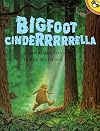
The humorous tone is set immediately. “… Lived a dashing Bigfoot prince. He was tall and dark as a Douglas fir – with feet like cedar stumps. He was as odoriferous as his tree-home was coniferous. And so horrendously hairy that Bigfoot women near and far long day to marry him.” The Bigfoot in the illustration is cute with no hair on his face or feet, a large show more barrel-chested body, skinny arms and tiny hands, and a huge nose.
The text is rich with interesting vocabulary and clever comparisons, “sour as little green berries”, “golden as a banana slug, with feet like log canoes” and “teased her like stinging mosquitoes”.
Rrrrrella’s mean step sisters and stepmother make her do all the work. The Prince has a contest, whoever can roll him off a log into the river will become his wife. Rrrrrella is left at home wishing she could go to the fun-fest. Her beary Godfather provides her with enormous wooden bark-clogs and tangles her fur. Rrrrrella is the last to compete and the only one to dunk the prince. When she runs off, the Prince uses the abandoned bark-clog to find her again.
If the child is familiar with the original Cinderella story, this would be a hilarious follow-up. As well, throughout the text are valuable messages on protecting the old-growth forest and that beauty is a concept created by society. show less
The humorous tone is set immediately. “… Lived a dashing Bigfoot prince. He was tall and dark as a Douglas fir – with feet like cedar stumps. He was as odoriferous as his tree-home was coniferous. And so horrendously hairy that Bigfoot women near and far long day to marry him.” The Bigfoot in the illustration is cute with no hair on his face or feet, a large show more barrel-chested body, skinny arms and tiny hands, and a huge nose.
The text is rich with interesting vocabulary and clever comparisons, “sour as little green berries”, “golden as a banana slug, with feet like log canoes” and “teased her like stinging mosquitoes”.
Rrrrrella’s mean step sisters and stepmother make her do all the work. The Prince has a contest, whoever can roll him off a log into the river will become his wife. Rrrrrella is left at home wishing she could go to the fun-fest. Her beary Godfather provides her with enormous wooden bark-clogs and tangles her fur. Rrrrrella is the last to compete and the only one to dunk the prince. When she runs off, the Prince uses the abandoned bark-clog to find her again.
If the child is familiar with the original Cinderella story, this would be a hilarious follow-up. As well, throughout the text are valuable messages on protecting the old-growth forest and that beauty is a concept created by society. show less
Lists
Youth: Holidays (2)
Five in a Row (1)
Our books (1)
Youth: Music (1)
Back to School (1)
FAB Pilot Books (1)
Five in a Row (1)
Awards


You May Also Like


Associated Authors
Statistics
- Works
- 122
- Also by
- 8
- Members
- 18,609
- Popularity
- #1,176
- Rating
- 4.0
- Reviews
- 443
- ISBNs
- 422
- Languages
- 3
- Favorited
- 1