This topic is currently marked as "dormant"—the last message is more than 90 days old. You can revive it by posting a reply.
1tash99
Back for another year, yay! This is where I was last year, I'm hoping to get that many books under my belt again this year. I have no particular reading goals, other than a vague hope that I manage read more books than I buy. I'll just read whatever takes my fancy as I go, and I'm always happy to take suggestions. Looking forward to another great year!
I'm also doing the 11 in 11 challenge, and my thread is here.
I'll be keeping a list at the top of my thread, with reviews further down.
December
106. The Tiny Wife, Andrew Kaufman
November
105. The Wee Free Men, Terry Pratchett
104. Billy Budd and Other Stories, Herman Melville
103. The King's English, Kingsley Amis
102. The Great Gatsby, F. Scott Fitzgerald
101. My Family and Other Animals, Gerard Durrell
100. Abraham Lincoln, Thomas Keneally
99. A Storm of Swords 1: Steel and Snow, George R R Martin
98. The Handmaid's Tale, Margaret Atwood
October
97. John Dies at the End, David Wong
96. Mantissa, John Fowles
95. The Quiet American, Graham Greene
94. The Mills on the Floss, George Eliot
93. The Fifth Elephant, Terry Pratchett
92. The Capitalism Delusion, Bob Ellis
91. Men at Arms, Terry Pratchett
September
90. Jane Eyre, Charlotte Bronte
89. The Woman in Black, Susan Hill
88. The Trouble With Alice, Olivia Glazebrook
87. Animal People, Charlotte Wood
86. Noodles on Our Ceiling, Annette Kelleher
85. The Pill and Other Forms of Hormonal Contraception, John Guillebaud
84. The Language of Flowers, Vanessa Diffenbaugh
83. A Fortunate Life, AB Facey
82. Vile Bodies, Evelyn Waugh
August
81. Make Room! Make Room!, Harry Harrison
80. A Clash of Kings, George R R Martin
79. The Long Goodbye, Meghan O'Rourke
78. How I Became a Famous Novelist, Steve Hely
77. Nanberry, Jackie French
76. Game of Thrones, George R R Martin
July
75. At Home in the World, Joyce Maynard
74. The Well of Loneliness, Radclyffe Hall
73. Spook, Mary Roach
72. Fool, Christopher Moore
71. Gertrude and Claudius, John Updike
70. The Go-Between, L. P. Hartley
69. Novel with Cocaine, M. Ageyev
68. The Lost Books of the Odyssey, Zachary Mason
June
67. Mary and Maria, and Matilda, Mary Wollstonecraft and Mary Shelley
66. How I Live Now, Meg Rosoff
65. The House of the Mosque, Kader Abdolah
64. The Radetzky March, Joseph Roth
63. Swamplandia!, Karen Russell
62. Bright Lights, Big City, Jay McInerney
61. The Seas, Samantha Hunt
60. Natasha and other stories, David Bezmozgis
59. Micromegas and other short fictions, Voltaire
58. Memoirs of a Nun, Denis Diderot
57. A Visit from the Goon Squad, Jennifer Egan
56. Notes on a Scandal, Zoe Heller
55. Children in Exile, James Fenton
54. The Siren and Selected Writings, Giuseppe Tomasi di Lampedusa
May
53. The Happy Life, David Malouf
52. The Possessed, Elif Batuman
51. Ill Fares the Land, Tony Judt
50. La Dame aux Camellias, Alexandre Dumas fils
April
49. The Glass House, Simon Mawer
48. Howl's Moving Castle, Diana Wynne Jones
47. King Leopold's Ghost, Adam Hochschild
46. The Small Hand, Susan Hill
45. Mr. Chartwell, Rebecca Hunt
44. Guardian Bedside Reader 2010
43. An Experiment in Criticism, C.S. Lewis
42. Short Stories, Henry Lawson
41. Harbour, John Ajvide Lindqvist
40. Johannes Cabal the Detective, Jonathan L Howard
39. Death Interrupted, Jose Saramago
38. South, Earnest Shackleton
37. Eats, Shoots and Leaves, Lynne Truss
36. Mr Briggs' Hat, Kate Colquhoun
35. When God was a Rabbit, Sarah Winman
34. Brave New World, Aldous Huxley
33. Shade's Children, Garth Nix
32. The Magician's Book, Laura Miller
March
31. Storm Front, Jim Butcher
30. Blindsight, Peter Watts
29. The Prime of Miss Jean Brodie, Muriel Spark
28. Orson Welles, John Russell Taylor
27. Shambling Towards Hiroshima, James Morrow
26. God Bless You, Mr. Rosewater, Kurt Vonnegut
25. I Shall Wear Midnight, Terry Pratchett
24. The World in the Evening, Christopher Isherwood
February
23. Eating Animals, Jonathan Safran Foer
22. Drylands, Thea Astley
21. The Last Continent, Terry Pratchett
20. Ward No. 6 and Other Stories, Anton Chekhov
19. Woman: An Intimate Geography, Natalie Angier
18. Once More with Footnotes, Terry Pratchett
17. The Road, Cormac McCarthy
16. Tortilla Flat, John Steinbeck
15. How to Make Gravy, Paul Kelly
January
14. Strangers on a Train, Patricia Highsmith
13. 92 Days, Evelyn Waugh
12. Neverwhere, Neil Gaiman
11. Magnificent Desolation, Buzz Aldrin
10. In Praise of Older Women, Stephen Vizinczey
9. Them: Adventures with Extremists, Jon Ronson
8. The Memory Chalet, Tony Judt
7. Swallows and Amazons, Arthur Ransome
6. Dawn of the Dumb, Charlie Brooker
5. The Way by Swann's, Marcel Proust
4. The Robber Bride, Margaret Atwood
3. The Wasp Factory, Iain Banks
2. Hangover Square, Patrick Hamilton
1. Fragile Things, Neil Gaiman
I'm also doing the 11 in 11 challenge, and my thread is here.
I'll be keeping a list at the top of my thread, with reviews further down.
December
106. The Tiny Wife, Andrew Kaufman
November
105. The Wee Free Men, Terry Pratchett
104. Billy Budd and Other Stories, Herman Melville
103. The King's English, Kingsley Amis
102. The Great Gatsby, F. Scott Fitzgerald
101. My Family and Other Animals, Gerard Durrell
100. Abraham Lincoln, Thomas Keneally
99. A Storm of Swords 1: Steel and Snow, George R R Martin
98. The Handmaid's Tale, Margaret Atwood
October
97. John Dies at the End, David Wong
96. Mantissa, John Fowles
95. The Quiet American, Graham Greene
94. The Mills on the Floss, George Eliot
93. The Fifth Elephant, Terry Pratchett
92. The Capitalism Delusion, Bob Ellis
91. Men at Arms, Terry Pratchett
September
90. Jane Eyre, Charlotte Bronte
89. The Woman in Black, Susan Hill
88. The Trouble With Alice, Olivia Glazebrook
87. Animal People, Charlotte Wood
86. Noodles on Our Ceiling, Annette Kelleher
85. The Pill and Other Forms of Hormonal Contraception, John Guillebaud
84. The Language of Flowers, Vanessa Diffenbaugh
83. A Fortunate Life, AB Facey
82. Vile Bodies, Evelyn Waugh
August
81. Make Room! Make Room!, Harry Harrison
80. A Clash of Kings, George R R Martin
79. The Long Goodbye, Meghan O'Rourke
78. How I Became a Famous Novelist, Steve Hely
77. Nanberry, Jackie French
76. Game of Thrones, George R R Martin
July
75. At Home in the World, Joyce Maynard
74. The Well of Loneliness, Radclyffe Hall
73. Spook, Mary Roach
72. Fool, Christopher Moore
71. Gertrude and Claudius, John Updike
70. The Go-Between, L. P. Hartley
69. Novel with Cocaine, M. Ageyev
68. The Lost Books of the Odyssey, Zachary Mason
June
67. Mary and Maria, and Matilda, Mary Wollstonecraft and Mary Shelley
66. How I Live Now, Meg Rosoff
65. The House of the Mosque, Kader Abdolah
64. The Radetzky March, Joseph Roth
63. Swamplandia!, Karen Russell
62. Bright Lights, Big City, Jay McInerney
61. The Seas, Samantha Hunt
60. Natasha and other stories, David Bezmozgis
59. Micromegas and other short fictions, Voltaire
58. Memoirs of a Nun, Denis Diderot
57. A Visit from the Goon Squad, Jennifer Egan
56. Notes on a Scandal, Zoe Heller
55. Children in Exile, James Fenton
54. The Siren and Selected Writings, Giuseppe Tomasi di Lampedusa
May
53. The Happy Life, David Malouf
52. The Possessed, Elif Batuman
51. Ill Fares the Land, Tony Judt
50. La Dame aux Camellias, Alexandre Dumas fils
April
49. The Glass House, Simon Mawer
48. Howl's Moving Castle, Diana Wynne Jones
47. King Leopold's Ghost, Adam Hochschild
46. The Small Hand, Susan Hill
45. Mr. Chartwell, Rebecca Hunt
44. Guardian Bedside Reader 2010
43. An Experiment in Criticism, C.S. Lewis
42. Short Stories, Henry Lawson
41. Harbour, John Ajvide Lindqvist
40. Johannes Cabal the Detective, Jonathan L Howard
39. Death Interrupted, Jose Saramago
38. South, Earnest Shackleton
37. Eats, Shoots and Leaves, Lynne Truss
36. Mr Briggs' Hat, Kate Colquhoun
35. When God was a Rabbit, Sarah Winman
34. Brave New World, Aldous Huxley
33. Shade's Children, Garth Nix
32. The Magician's Book, Laura Miller
March
31. Storm Front, Jim Butcher
30. Blindsight, Peter Watts
29. The Prime of Miss Jean Brodie, Muriel Spark
28. Orson Welles, John Russell Taylor
27. Shambling Towards Hiroshima, James Morrow
26. God Bless You, Mr. Rosewater, Kurt Vonnegut
25. I Shall Wear Midnight, Terry Pratchett
24. The World in the Evening, Christopher Isherwood
February
23. Eating Animals, Jonathan Safran Foer
22. Drylands, Thea Astley
21. The Last Continent, Terry Pratchett
20. Ward No. 6 and Other Stories, Anton Chekhov
19. Woman: An Intimate Geography, Natalie Angier
18. Once More with Footnotes, Terry Pratchett
17. The Road, Cormac McCarthy
16. Tortilla Flat, John Steinbeck
15. How to Make Gravy, Paul Kelly
January
14. Strangers on a Train, Patricia Highsmith
13. 92 Days, Evelyn Waugh
12. Neverwhere, Neil Gaiman
11. Magnificent Desolation, Buzz Aldrin
10. In Praise of Older Women, Stephen Vizinczey
9. Them: Adventures with Extremists, Jon Ronson
8. The Memory Chalet, Tony Judt
7. Swallows and Amazons, Arthur Ransome
6. Dawn of the Dumb, Charlie Brooker
5. The Way by Swann's, Marcel Proust
4. The Robber Bride, Margaret Atwood
3. The Wasp Factory, Iain Banks
2. Hangover Square, Patrick Hamilton
1. Fragile Things, Neil Gaiman
2tash99
1. Fragile Things, Neil Gaiman
I was ambivalent about Gaiman for a long time for some reason, but I'm a fully fledged cheerleader these days. Fragile Things is a wonderful collection of short stories (though I must admit to not being that keen on the poetry), each of which has the feel of a dream or a nightmare. They are often inconclusive, wispy little things, though they are just as likely to be sharp, witty retellings of old stories.
My favourite was definitely the first one, 'A Study in Emerald', written as a Sherlock Holmes meets H.P. Lovecraft style of thing. Good stuff. 'The Monarch of the Glen' was great as well, a reimagining of Beowulf. In fact, it would be easier to mention the stories I didn't like than it would be to list the ones that I did like. Um. I didn't really like the story 'Feeders and Eaters', but that was more because it gave me the proper creeps than anything else. Otherwise a great start to my reading year.
I was ambivalent about Gaiman for a long time for some reason, but I'm a fully fledged cheerleader these days. Fragile Things is a wonderful collection of short stories (though I must admit to not being that keen on the poetry), each of which has the feel of a dream or a nightmare. They are often inconclusive, wispy little things, though they are just as likely to be sharp, witty retellings of old stories.
My favourite was definitely the first one, 'A Study in Emerald', written as a Sherlock Holmes meets H.P. Lovecraft style of thing. Good stuff. 'The Monarch of the Glen' was great as well, a reimagining of Beowulf. In fact, it would be easier to mention the stories I didn't like than it would be to list the ones that I did like. Um. I didn't really like the story 'Feeders and Eaters', but that was more because it gave me the proper creeps than anything else. Otherwise a great start to my reading year.
4alcottacre
Glad to see you back, Tash!
I already have Fragile Things in the BlackHole. Glad to see you liked it and that your reading year is starting well.
I already have Fragile Things in the BlackHole. Glad to see you liked it and that your reading year is starting well.
5tash99
Thanks guys!
2. Hangover Square, Patrick Hamilton
I first read about Patrick Hamilton on the very excellent books blog Asylum, and was intrigued. And as luck would have it, I found a copy of Hangover Square just a few weeks later in a charity shop.
It was absolutely wonderful and I inhaled it in an evening. The blackest of black humour, and the most compassionately drawn protagonist I've come across in a long time, it was a total joy to read.
The main character is George Harvey Bone, a strange, sad man given to what he calls 'dead' moods, in which he completely shuts down;
It was a noise inside his head, and yet it was not a noise. It was the sound which a noise makes when it abruptly ceases
There’s a suggestion that it is schizophrenia, but it isn’t ever called that in the narrative. It’s just a mood in which he becomes cold, detached, and oh, yes – murderous. The object of his obsessive devotion is the cruel, bitchy, failed actress Netta, and when George is in his normal state of being he prostrates himself to please her. No humiliation is too much to sway his love. But when he’s in his ‘dead’ mood, he inevitably starts to think of how he will murder her. It’s the switch between George the lovesick puppy dog and George the hard eyed killer that draws the plot along. You know he’s going to do something horrible to someone – he keeps talking of how he’s going to kill Netta, and then, creepily, he keeps repeating that he will go to Maidenhead where ‘everything will be better’ – but the author does a great job of keeping the reader guessing right up until the critical moment.
It may not sound funny, but it is, though it is quite a a subtle humour, and it is not funny in the way that you can pull out a line to point to. Rather, it’s the slow, sad build up of events and the descriptions characters that makes it so. I particularly liked this description of Netta;
She only liked what affected her personally and physically and immediately – sleep, warmth, a certain amount of company and talk, drinks, getting drunk, good food, taxis, ease. She was not even responsive to adulation, save when, coming from a man, it promised to further these necessities. She was atrophied. She looked like a Byron beauty, but she was a fish.
But the humour isn't really the main focus of the book, and the comedy takes a backseat to the carefully, empathetically drawn portrait of a man crumbling in the face of the indifference of a preoccupied world.
2. Hangover Square, Patrick Hamilton
I first read about Patrick Hamilton on the very excellent books blog Asylum, and was intrigued. And as luck would have it, I found a copy of Hangover Square just a few weeks later in a charity shop.
It was absolutely wonderful and I inhaled it in an evening. The blackest of black humour, and the most compassionately drawn protagonist I've come across in a long time, it was a total joy to read.
The main character is George Harvey Bone, a strange, sad man given to what he calls 'dead' moods, in which he completely shuts down;
It was a noise inside his head, and yet it was not a noise. It was the sound which a noise makes when it abruptly ceases
There’s a suggestion that it is schizophrenia, but it isn’t ever called that in the narrative. It’s just a mood in which he becomes cold, detached, and oh, yes – murderous. The object of his obsessive devotion is the cruel, bitchy, failed actress Netta, and when George is in his normal state of being he prostrates himself to please her. No humiliation is too much to sway his love. But when he’s in his ‘dead’ mood, he inevitably starts to think of how he will murder her. It’s the switch between George the lovesick puppy dog and George the hard eyed killer that draws the plot along. You know he’s going to do something horrible to someone – he keeps talking of how he’s going to kill Netta, and then, creepily, he keeps repeating that he will go to Maidenhead where ‘everything will be better’ – but the author does a great job of keeping the reader guessing right up until the critical moment.
It may not sound funny, but it is, though it is quite a a subtle humour, and it is not funny in the way that you can pull out a line to point to. Rather, it’s the slow, sad build up of events and the descriptions characters that makes it so. I particularly liked this description of Netta;
She only liked what affected her personally and physically and immediately – sleep, warmth, a certain amount of company and talk, drinks, getting drunk, good food, taxis, ease. She was not even responsive to adulation, save when, coming from a man, it promised to further these necessities. She was atrophied. She looked like a Byron beauty, but she was a fish.
But the humour isn't really the main focus of the book, and the comedy takes a backseat to the carefully, empathetically drawn portrait of a man crumbling in the face of the indifference of a preoccupied world.
6alcottacre
I read and enjoyed Hamilton's The Slaves of Solitude, Tash. If you have not read that one, I highly recommend it. In the meantime, Hangover Square is one I will have to keep looking for.
7arubabookwoman
I enjoyed The Slaves of Solitude too. I've had Hangover Square on my list for ages, and just having come across it yet in a used book store. I do have his Twenty Thousand Streets Under the Sky trilogy on my shelf, and hope to get to it this year. It's always nice to discover a new author!
8tash99
#6,7
I'm definitely planning on reading something else by Hamilton as soon as I can, and on the basis of two votes I'll try and make it The Slaves of Solitude. As you say, always great to find a new author, and even better to find out that they've got stacks of books waiting for you!
I'm definitely planning on reading something else by Hamilton as soon as I can, and on the basis of two votes I'll try and make it The Slaves of Solitude. As you say, always great to find a new author, and even better to find out that they've got stacks of books waiting for you!
9tash99
3. The Wasp Factory, Iain Banks
So, I was wrong when I said that Hangover Square is the blackest of humour. Hangover Square is a cakewalk through a field of particularly mentally well adjusted tulips in comparison to the horrors that lurk within these pages. The Wasp Factory is the most nastily twisted, should-I-really-be-laughing-at-this funny book I think I’ve ever read. It concerns Frank, a strange, socially isolated boy devoted to his own unique mystic rituals, which often seem to involve the murder and torture of small animals and birds. And who, in his sixteen years, has managed to dispatch no less than three of his relatives. When his older brother Eric escapes from the psychiatric institute he had been confined to after committing some especially gruesome acts and makes it clear that he is on his way home, Frank is thrown into a state of excitement and fear and he spends his time consulting his various fortune telling devices.
Now, I like my humour like I like my chocolate – dark, bitter, and a little bit nutty (sorry about that, the comparison has a lot to do with the fact that we are still knee deep in Christmas chocolates and all of my analogies, and indeed many of my metaphors have, as you might say, chocolate centres), and this book is all of those things, though I don’t know how good I actually think it is. For a murdering loony, Frank is actually quite sympathetic, and it is to Banks’ credit that he has created a character with such huge, obvious defects that you can nevertheless really start to like. Apart from the horrible stuff he does to (among other things) a warren full of rabbits, he is really just a misunderstood, lonely teenage boy.
Having said that, I did find it quite patchy – Banks has a huge, often creepy imagination, and there are great scenes, but I find that the bits in between feel a bit like filler. He has some great lines;
{my uncle} was a man of such weapons grade stupidity his mental faculties would probably have improved with the onset of senile dementia.
and overall I did enjoy reading the book and I would probably read other books by Banks (though I’ve long ago given up on his Iain M Banks books), but I also finished it and felt a tiny bit dirty, just because of the levels of bizarre cruelty. If nothing else, it made an impression.
So, I was wrong when I said that Hangover Square is the blackest of humour. Hangover Square is a cakewalk through a field of particularly mentally well adjusted tulips in comparison to the horrors that lurk within these pages. The Wasp Factory is the most nastily twisted, should-I-really-be-laughing-at-this funny book I think I’ve ever read. It concerns Frank, a strange, socially isolated boy devoted to his own unique mystic rituals, which often seem to involve the murder and torture of small animals and birds. And who, in his sixteen years, has managed to dispatch no less than three of his relatives. When his older brother Eric escapes from the psychiatric institute he had been confined to after committing some especially gruesome acts and makes it clear that he is on his way home, Frank is thrown into a state of excitement and fear and he spends his time consulting his various fortune telling devices.
Now, I like my humour like I like my chocolate – dark, bitter, and a little bit nutty (sorry about that, the comparison has a lot to do with the fact that we are still knee deep in Christmas chocolates and all of my analogies, and indeed many of my metaphors have, as you might say, chocolate centres), and this book is all of those things, though I don’t know how good I actually think it is. For a murdering loony, Frank is actually quite sympathetic, and it is to Banks’ credit that he has created a character with such huge, obvious defects that you can nevertheless really start to like. Apart from the horrible stuff he does to (among other things) a warren full of rabbits, he is really just a misunderstood, lonely teenage boy.
Having said that, I did find it quite patchy – Banks has a huge, often creepy imagination, and there are great scenes, but I find that the bits in between feel a bit like filler. He has some great lines;
{my uncle} was a man of such weapons grade stupidity his mental faculties would probably have improved with the onset of senile dementia.
and overall I did enjoy reading the book and I would probably read other books by Banks (though I’ve long ago given up on his Iain M Banks books), but I also finished it and felt a tiny bit dirty, just because of the levels of bizarre cruelty. If nothing else, it made an impression.
10alcottacre
#9: That book just does not sound like one for me. I am glad you enjoyed it though, Tash!
11tash99
5. The Way by Swann's, Marcel Proust
I read all of In Search of Lost Time when I went through a serious Francophile phase in my first year of uni (seriously, I had a picture of Roland Barthes and Proust over my desk - I was a proper swotty little nerd), and I adored it.
It's still an amazing story, and has an entirely undeserved reputation for being difficult to read. Time consuming sure, but not really difficult. And it is so much funnier than it ever gets credit for. My favourite parts are the dinner party scenes with Swann and the Verdurin's tedious little set of 'faithfuls', with everyone talking at cross-purposes and terrified of making gaffes, with the end result being that no one really understands what anyone else is on about. Luckily, it doesn't matter, because no one is really listening to anyone else anyway.
Back then I read the Moncrieff and Kilmartin translation, but this time I read the newer Lydia Davis version. I don't know if I've changed or if it's just the difference in translation, but I didn't enjoy it anywhere as much as much as I did the first time around. According to the translator’s introduction the Moncrieff translation made a lot of mistakes and took a lot of liberties with the text, and this newer version sticks more faithfully to the French. I don't know whether it does or not (my Francophile phase only lasted two years, and my French is definitely not up to tackling Proust), but I do know that what I liked about the other translation was the exuberance of the language. This version I found to be a bit on the dry side and nowhere near as much fun to read. On the other hand, it was a bit easier to understand what was going on so I suppose it has that going for it. I think I'm in the minority on this one, and the new translation has been almost universally praised, so maybe I'm just showing my ignorance. I'd like to find time for the next book sometime soon, but I think I'll switch back to the Moncrieff version.
I read all of In Search of Lost Time when I went through a serious Francophile phase in my first year of uni (seriously, I had a picture of Roland Barthes and Proust over my desk - I was a proper swotty little nerd), and I adored it.
It's still an amazing story, and has an entirely undeserved reputation for being difficult to read. Time consuming sure, but not really difficult. And it is so much funnier than it ever gets credit for. My favourite parts are the dinner party scenes with Swann and the Verdurin's tedious little set of 'faithfuls', with everyone talking at cross-purposes and terrified of making gaffes, with the end result being that no one really understands what anyone else is on about. Luckily, it doesn't matter, because no one is really listening to anyone else anyway.
Back then I read the Moncrieff and Kilmartin translation, but this time I read the newer Lydia Davis version. I don't know if I've changed or if it's just the difference in translation, but I didn't enjoy it anywhere as much as much as I did the first time around. According to the translator’s introduction the Moncrieff translation made a lot of mistakes and took a lot of liberties with the text, and this newer version sticks more faithfully to the French. I don't know whether it does or not (my Francophile phase only lasted two years, and my French is definitely not up to tackling Proust), but I do know that what I liked about the other translation was the exuberance of the language. This version I found to be a bit on the dry side and nowhere near as much fun to read. On the other hand, it was a bit easier to understand what was going on so I suppose it has that going for it. I think I'm in the minority on this one, and the new translation has been almost universally praised, so maybe I'm just showing my ignorance. I'd like to find time for the next book sometime soon, but I think I'll switch back to the Moncrieff version.
12tash99
My computer hates me and keeps eating things that I've posted. What should have come up before the last post was my review of book #4 for 2011, The Robber Bride, by Margaret Atwood. It was an insightful, witty review that probably would have changed the lives of all who read it (yeah, right), but I'm too grumpy to redo it.
Short story, The Robber Bride - good read, but not as good as other books I've read by Atwood.
Going to throw computer in the garden pond now, unless it knows what's good for it and brings back my deleted files...
Short story, The Robber Bride - good read, but not as good as other books I've read by Atwood.
Going to throw computer in the garden pond now, unless it knows what's good for it and brings back my deleted files...
13alcottacre
You tell that mean old computer, Tash!
14tash99
I've tried putting an old, broken hard drive next to the computer and pointing to it as an example of what happens to technology that lets me down. It was supposed to be a sort of threat, but it doesn't seem to have worked and it's only getting grouchier. Touche, old laptop. You win this round...
15tash99
6. Dawn of the Dumb, Charlie Brooker
I read most of this over Christmas and New Years, when my concentration levels were at a bit of a low point and I just needed something light. And it did the job nicely. A collection of Brooker's cynical, misanthropic TV reviews and occasional columns, it was one of those pick-up-put-down books that had me chuckling so much that my husband threatened to take it away from me at one point.
I read most of this over Christmas and New Years, when my concentration levels were at a bit of a low point and I just needed something light. And it did the job nicely. A collection of Brooker's cynical, misanthropic TV reviews and occasional columns, it was one of those pick-up-put-down books that had me chuckling so much that my husband threatened to take it away from me at one point.
16DeltaQueen50
What a great review of Wasp Factory! I read it last year and enjoyed (can I even say that?) it. A book that is hard to describe to other people without sounding rather strange yourself - you did an excellent job of staying on the right side of normal while laying out the details. It wasn't one of my top read of last year, but it certainly stayed with me!
17tash99
I know what you mean - it's hard to say 'there's this book about a kid who tortures animals, and it's really, really funny' without people starting to worry about your state of mind. So thanks for the 'right side of normal' comment!
18tash99
I've never met a bandwagon I didn't like, so I've done that Biblioz thing too. From 21/03/1984, and I haven't read a single one. I've seen the film version of Pet Sematary, does that count?
Fiction 1 THE AQUITAINE PROGRESSION Robert Ludlum
Fiction 2 SMART WOMEN Judy Blume
Fiction 3 ALMOST PARADISE Susan Isaacs
Fiction 4 PET SEMATARY Stephen King
Fiction 5 WHO KILLED THE ROBINS FAMILY? Bill Adler
Fiction 6 POLAND James A. Michener
Fiction 7 LORD OF THE DANCE Andrew M. Greeley
Fiction 8 THE NAME OF THE ROSE Umberto Eco
Fiction 9 THE STORY OF HENRI TOD William F. Buckley Jr
Fiction 10 THE BUTTER BATTLE BOOK Dr. Seuss
Fiction 11 NIGHT SKY Clare Francis
Fiction 12 UNTO THIS HOUR Tom Wicker
Fiction 13 THE JOURNEYER Gary Jennings
Fiction 14 BERLIN GAME Len Deighton
Fiction 15 DREAM WEST David Nevin
Non-Fiction 1 MAYOR Edward I. Koch with William Rauch
Non-Fiction 2 MOTHERHOOD: The Second Oldest Profession Erma Bombeck o
Non-Fiction 3 LINES AND SHADOWS Joseph Wambaugh
Non-Fiction 4 THE MARCH OF FOLLY Barbara W. Tuchman
Non-Fiction 5 TOUGH TIMES NEVER LAST BUT TOUGH PEOPLE DO! Robert H.
Non-Fiction 6 ON WINGS OF EAGLES Ken Follett
Non-Fiction 7 THE DISCOVERERS Daniel J. Boorstin
Non-Fiction 8 ONE WRITER'S BEGINNINGS Eudora Welty
Non-Fiction 9 IN SEARCH OF EXCELLENCE Thomas J. Peters and Robert H. Waterman
10 PEOPLE OF THE LIE M. Scott Peck 11 APPROACHING HOOFBEATS: HORSEMEN OF THE APOCALYPSE, Billy Graham
Non-Fiction 12 TOUGH-MINDED FAITH FOR TENDERHEARTED PEOPLE, Robert H. Schuller
Non-Fiction 13 Selections from the BEST OF JAMES HERRIOT
Non-Fiction 14 A LIGHT IN THE ATTIC Shel Silverstein
Fiction 1 THE AQUITAINE PROGRESSION Robert Ludlum
Fiction 2 SMART WOMEN Judy Blume
Fiction 3 ALMOST PARADISE Susan Isaacs
Fiction 4 PET SEMATARY Stephen King
Fiction 5 WHO KILLED THE ROBINS FAMILY? Bill Adler
Fiction 6 POLAND James A. Michener
Fiction 7 LORD OF THE DANCE Andrew M. Greeley
Fiction 8 THE NAME OF THE ROSE Umberto Eco
Fiction 9 THE STORY OF HENRI TOD William F. Buckley Jr
Fiction 10 THE BUTTER BATTLE BOOK Dr. Seuss
Fiction 11 NIGHT SKY Clare Francis
Fiction 12 UNTO THIS HOUR Tom Wicker
Fiction 13 THE JOURNEYER Gary Jennings
Fiction 14 BERLIN GAME Len Deighton
Fiction 15 DREAM WEST David Nevin
Non-Fiction 1 MAYOR Edward I. Koch with William Rauch
Non-Fiction 2 MOTHERHOOD: The Second Oldest Profession Erma Bombeck o
Non-Fiction 3 LINES AND SHADOWS Joseph Wambaugh
Non-Fiction 4 THE MARCH OF FOLLY Barbara W. Tuchman
Non-Fiction 5 TOUGH TIMES NEVER LAST BUT TOUGH PEOPLE DO! Robert H.
Non-Fiction 6 ON WINGS OF EAGLES Ken Follett
Non-Fiction 7 THE DISCOVERERS Daniel J. Boorstin
Non-Fiction 8 ONE WRITER'S BEGINNINGS Eudora Welty
Non-Fiction 9 IN SEARCH OF EXCELLENCE Thomas J. Peters and Robert H. Waterman
10 PEOPLE OF THE LIE M. Scott Peck 11 APPROACHING HOOFBEATS: HORSEMEN OF THE APOCALYPSE, Billy Graham
Non-Fiction 12 TOUGH-MINDED FAITH FOR TENDERHEARTED PEOPLE, Robert H. Schuller
Non-Fiction 13 Selections from the BEST OF JAMES HERRIOT
Non-Fiction 14 A LIGHT IN THE ATTIC Shel Silverstein
19alcottacre
#18: I do not think watching the film version counts. Sorry, Tash.
I have read more of the nonfiction on the list than the fiction, although Deighton's trilogy is in the BlackHole. I loved Eudora Welty's One Writer's Beginnings.
I have read more of the nonfiction on the list than the fiction, although Deighton's trilogy is in the BlackHole. I loved Eudora Welty's One Writer's Beginnings.
20tash99
I'm pretty unimpressed with the list in general, though I am keen to read some Eudora Welty.
21tash99
7. Swallows and Amazons, Arthur Ransome
A bit of nostalgia from a more innocent age, when you could name a character in a kid's book 'Titty', and no one at all would snigger. Reading it again now, it doesn't seem that well written or that interesting, but I remember reading it as a child and thinking it was a great adventure story. Four siblings camp out on an island in the lake near to where they are staying on holiday with their mother. They go sailing, fishing, swimming, and have a 'war' with two sisters who call themselves the Amazons. It's all very jolly, upper-middle class stuff.
A bit of nostalgia from a more innocent age, when you could name a character in a kid's book 'Titty', and no one at all would snigger. Reading it again now, it doesn't seem that well written or that interesting, but I remember reading it as a child and thinking it was a great adventure story. Four siblings camp out on an island in the lake near to where they are staying on holiday with their mother. They go sailing, fishing, swimming, and have a 'war' with two sisters who call themselves the Amazons. It's all very jolly, upper-middle class stuff.
22tash99
8. The Memory Chalet, Tony Judt
Reading this, it's hard to remember that it was written by someone in the last stages of a debilitating illness, the writing is just so lucid and devoid of self-pity. A series of autobiographical essays written towards the end of Judt's life when he was almost completely paralysed due to ALS, he found himself whiling away the lonely, wakeful nights constructing what he’s called a ‘memory chalet’. This was his name for the mnemonic device he used to think over his life experiences, in which he methodically visualised the rooms of a chalet he once stayed in as a child to help him order his memories, so that he could dictate his work to a scribe the next day. The essays are interlinked in a fairly loose way, and often the focus of one essay will turn out to be incidental to the theme of the next essay. He talks about his family, his education, his professional life, and the political history of his life. But what makes this such a moving book is the fact that he faced his fate in a way that could be called courageous, if it wasn’t so matter-of-fact;
Reading this, it's hard to remember that it was written by someone in the last stages of a debilitating illness, the writing is just so lucid and devoid of self-pity. A series of autobiographical essays written towards the end of Judt's life when he was almost completely paralysed due to ALS, he found himself whiling away the lonely, wakeful nights constructing what he’s called a ‘memory chalet’. This was his name for the mnemonic device he used to think over his life experiences, in which he methodically visualised the rooms of a chalet he once stayed in as a child to help him order his memories, so that he could dictate his work to a scribe the next day. The essays are interlinked in a fairly loose way, and often the focus of one essay will turn out to be incidental to the theme of the next essay. He talks about his family, his education, his professional life, and the political history of his life. But what makes this such a moving book is the fact that he faced his fate in a way that could be called courageous, if it wasn’t so matter-of-fact;
Perhaps the most dispiriting consequence of my present disease – more depressing even than its practical, daily, manifestations – is the awareness that I shall never again ride the rails. This knowledge weighs on me like a leaden blanket, pressing me ever deeper into that gloom-laden sense of an ending that marks the truly terminal disease: the understanding that some things will never be. This absence is more than just the loss of pleasure, the deprivation of freedom, much less the exclusion of new experiences. Remembering Rilke, it constitutes the very loss of myself – or at least, that better part of myself that most readily found contentment and peace.
23mamzel
Your list brought to my attention a book I remember and I think I would really enjoy - The Aquitaine Progression. I wonder if I can find it somewhere. I read Swallows and Amazons a while ago but I can't remember where I found it. It was exactly as you describe it.
24tash99
I've never read any of Ludlum's books, but I am getting on a 26 hour flight the day after tomorrow so it might be the perfect opportunity to try one - I quite like the Bourne movies, so I might start with one of them
25tash99
9. Them: Adventures with Extremists, Jon Ronson
A series of interlinked essays about Ronson's experiences with various fringe dwellers - the Klu Klux Klan, David Icke and his followers (who believe that twelve foot llizards rule the world), Islamic fundamentalists, amongst others - in which he tries to understand where they're coming from. The great thing about Ronson is that he doesn't come across as someone just out to poke fun at people who think differently from him - he sees all of the people he interviews as real people, not just potential lunatics, and you almost always get the sense that he usually ends up quite liking them, even when he strongly disagrees with their ideas. This makes the essays much more interesting than if he'd come to his subjects with an attitude of making his readers complicit in a sort of 'oooh, look at these nutters' sniggering.
A series of interlinked essays about Ronson's experiences with various fringe dwellers - the Klu Klux Klan, David Icke and his followers (who believe that twelve foot llizards rule the world), Islamic fundamentalists, amongst others - in which he tries to understand where they're coming from. The great thing about Ronson is that he doesn't come across as someone just out to poke fun at people who think differently from him - he sees all of the people he interviews as real people, not just potential lunatics, and you almost always get the sense that he usually ends up quite liking them, even when he strongly disagrees with their ideas. This makes the essays much more interesting than if he'd come to his subjects with an attitude of making his readers complicit in a sort of 'oooh, look at these nutters' sniggering.
26alcottacre
#25: The Ronson book looks interesting. I will have to give it a shot! Thanks for the recommendation, Tash.
27tash99
10. In Praise of Older Women, Stephen Vizinczey
Subtitled 'The Amorous Recollections of Andras Vajda', this is a fictional autobiography of one man's romantic and sexual education. It is a tender, affectionate story and is as much about the pursuit of emotional satisfaction as it is about physical desire. The protagonist is not some sleazy Casanova, rather he is a lover of Women with a capital 'w'. He's not just after sex, he likes women in general;
It's obvious that this enthusiasm {for women} had a great deal to do with my later luck with women. And though I hope this memoir will be instructive, I have to confess that it won't make women more attracted to you than you are to them. If deep down you hate them, if you dream of humiliating them, if you enjoy ordering them around, then you are likely to be paid back in kind. They will want and love you just as much as you want and love them - and praise be to their generosity.
He describes his childhood in the early days of WWII in Hungary as the start of his obsession; living with his widowed mother, he finds himself in the role of procurer of aristocratic women for American officers, and the exposure to this heady mixture of sexual desire and social upheaval marks him for life. Living through the turbulent times of Soviet repression and the eventual Hungarian revolution, this is a book that speaks of a longing to be free to act out desires without consequences, though the narrator is no free-love preaching hippie. Rather, he is a funny, generous, warm person and his attraction for and to the opposite sex is completely believable.
Subtitled 'The Amorous Recollections of Andras Vajda', this is a fictional autobiography of one man's romantic and sexual education. It is a tender, affectionate story and is as much about the pursuit of emotional satisfaction as it is about physical desire. The protagonist is not some sleazy Casanova, rather he is a lover of Women with a capital 'w'. He's not just after sex, he likes women in general;
It's obvious that this enthusiasm {for women} had a great deal to do with my later luck with women. And though I hope this memoir will be instructive, I have to confess that it won't make women more attracted to you than you are to them. If deep down you hate them, if you dream of humiliating them, if you enjoy ordering them around, then you are likely to be paid back in kind. They will want and love you just as much as you want and love them - and praise be to their generosity.
He describes his childhood in the early days of WWII in Hungary as the start of his obsession; living with his widowed mother, he finds himself in the role of procurer of aristocratic women for American officers, and the exposure to this heady mixture of sexual desire and social upheaval marks him for life. Living through the turbulent times of Soviet repression and the eventual Hungarian revolution, this is a book that speaks of a longing to be free to act out desires without consequences, though the narrator is no free-love preaching hippie. Rather, he is a funny, generous, warm person and his attraction for and to the opposite sex is completely believable.
28tash99
11. Magnificent Desolation, Buzz Aldrin
Buzz is by far my favourite astronaut.
And here's why; he did a guest voice on The Simpsons, and agreed to let them mock him for being the second man on the moon (Buzz: 'second comes right after first!'). He punched a guy who accused him of lying about the moon landing, something that should really happen to more moon hoax conspiracy nutters. If you do a Google videos search and type in Buzz Aldrin, the first thing to pop up is a video of that magic moment. And he's been amazingly honest about his history of dealing with depression and alcoholism, which is something I admire him for immensely. Plus, you know, he was only the second person ever to be on the freaking moon.
I really enjoyed this book, especially the opening chapters describing the moon landing. Aldrin and his co-writer Ken Abraham do a fantastic job of conveying the exhilaration of those few hours, describing the thrill of the situation as well as the constant awareness that the eyes of the world were on them, and everything had to go flawlessly. It also brought home to me (a child of the 80's for whom access to computers is a way of life) how bare bones this mission was. They had two computers on board, each with a memory of about 74 kilobytes. On an earlier mission the computers had failed and Aldrin had to make calculations with a slide rule (I was in the London Science Museum last week and they had slide rules in a display cabinet marked 'The History of Calculation'). And as Aldrin points out, the Wright brothers had only managed to get a plane off the air in 1903, the same year Aldrin's mother was born. I mean... what do you say to that?
Aldrin talks about the incredible highs and lows of his life with remarkable candor, discussing his slide into depression and alcoholism, and the pain of his failing marriage without sentimentality. He also talks passionately about the need for continuing space exploration, and his desire to see more space tourism over the next decades.
Buzz is by far my favourite astronaut.
And here's why; he did a guest voice on The Simpsons, and agreed to let them mock him for being the second man on the moon (Buzz: 'second comes right after first!'). He punched a guy who accused him of lying about the moon landing, something that should really happen to more moon hoax conspiracy nutters. If you do a Google videos search and type in Buzz Aldrin, the first thing to pop up is a video of that magic moment. And he's been amazingly honest about his history of dealing with depression and alcoholism, which is something I admire him for immensely. Plus, you know, he was only the second person ever to be on the freaking moon.
I really enjoyed this book, especially the opening chapters describing the moon landing. Aldrin and his co-writer Ken Abraham do a fantastic job of conveying the exhilaration of those few hours, describing the thrill of the situation as well as the constant awareness that the eyes of the world were on them, and everything had to go flawlessly. It also brought home to me (a child of the 80's for whom access to computers is a way of life) how bare bones this mission was. They had two computers on board, each with a memory of about 74 kilobytes. On an earlier mission the computers had failed and Aldrin had to make calculations with a slide rule (I was in the London Science Museum last week and they had slide rules in a display cabinet marked 'The History of Calculation'). And as Aldrin points out, the Wright brothers had only managed to get a plane off the air in 1903, the same year Aldrin's mother was born. I mean... what do you say to that?
Aldrin talks about the incredible highs and lows of his life with remarkable candor, discussing his slide into depression and alcoholism, and the pain of his failing marriage without sentimentality. He also talks passionately about the need for continuing space exploration, and his desire to see more space tourism over the next decades.
29tash99
12. Neverwhere, Neil Gaiman
Gaiman's usual standard of comic fantasy invention, but not as well written as some of his other books. I think it was written after the script for the TV series of Neverwhere, and it is let down slightly by the fact that it sometimes feels a bit cobbled together. The individial scenes are great, the characters are great, but there are a lot of bits of explanation that get slotted in between the lines from the script. But who cares? It was an absorbing, funny book with a strong Douglas Adams and Terry Pratchett flavour alongside Gaiman's own style.
edited to fix touchstones
Gaiman's usual standard of comic fantasy invention, but not as well written as some of his other books. I think it was written after the script for the TV series of Neverwhere, and it is let down slightly by the fact that it sometimes feels a bit cobbled together. The individial scenes are great, the characters are great, but there are a lot of bits of explanation that get slotted in between the lines from the script. But who cares? It was an absorbing, funny book with a strong Douglas Adams and Terry Pratchett flavour alongside Gaiman's own style.
edited to fix touchstones
30alcottacre
#28: I will have to look for that one. Thanks for the recommendation, Tash!
31arubabookwoman
Slide rules in a museum! That really makes me feel old--that's the way I learned calculus. Yikes!
32tash99
#31 Because I seem to have a bit too much time on my hands at the moment, I idly googled 'slide rule', and look what popped up; the Slide Rule Museum.
I love people. There's nothing so obscure or so boring (to outsiders) that someone somewhere hasn't devoted their life to it.
I love people. There's nothing so obscure or so boring (to outsiders) that someone somewhere hasn't devoted their life to it.
33tash99
13. 92 Days, Evelyn Waugh
Waugh's grudgingly written diary from his trip to British Guiana and Brazil in the early 1930s, this is one of the least enthusiastic travel narratives I've ever read. In the afterword it is mentioned that Waugh had gone overseas as a way of coping with his wife's infidelities and his divorce from her, but there is no mention of this in the book and Waugh's reasons for choosing Guiana are left unclear throughout the text. He makes some mention of wanting to go somewhere that no one knew anything about, but aside from that he seems to have picked it because of its distance away from England, and its isolation.
Starting in Georgetown, Waugh spent 92 days travelling through the Guyanese savannah and bush up towards the border with Brazil, with the intention of taking a boat from there back to England. Only to find that the boats were so infrequent that he would have spent months waiting for the off chance that a) a boat would arrive, and b) the captain would be willing to take him. So he set off back to Georgetown. And that's about it, really.
This is an odd, bitter book with a strangely flat feel to it, and Waugh clearly found it difficult to find anything nice to say about the country or its inhabitants, describing the Guyanese Indians in a charmingly forward-thinking way as
...unattractive, squat and dingy, with none of the grace one expects in savages. They seemed to have singularly little interest in personal adornment. Their hair was lank and ragged with none of the ochre powder, bone combs and skewers, the high architectural coiffes and poodle-like shavings beloved by the African.
He's as complementary about the landscape as he is about the people, describing a country of extremes of temperature, with terrain that is difficult to traverse, and which is seemingly plagued by various bloodsucking insects. Most of the text is taken up with descriptions of the difficulties of travel, and the majority of what remains is snide comments about his travelling companions.
But somehow, it works quite well. Or as well as a book by a whiny racist can work. (No, that's not fair. He doesn't whine as such, he just seems stunned and disconsolate that his trip hadn't quite gone as he'd planned. He is a racist, though.) The man could turn a phrase with the best of them, and it is to his credit that each description of the stages of a tedious journey manages to be interesting, if only because of Waugh's beautiful writing.
And there are odd moments of joy, as in his description of the pleasure of bathing in a stream after a long day's trek;
it was as keen a physical sensation as I have ever known, excluding nothing, to sit on a tacuba across a fast flowing mountain creek, dabble one's legs knee-deep and pour calabash after calabash of cellar-cool water over one's head and shoulders, to lie full length on the polished rock and let the stream flow over one eddying and cascading.
But overall, I think this is really only for Waugh completists and die-hard travel narrative fans.
Waugh's grudgingly written diary from his trip to British Guiana and Brazil in the early 1930s, this is one of the least enthusiastic travel narratives I've ever read. In the afterword it is mentioned that Waugh had gone overseas as a way of coping with his wife's infidelities and his divorce from her, but there is no mention of this in the book and Waugh's reasons for choosing Guiana are left unclear throughout the text. He makes some mention of wanting to go somewhere that no one knew anything about, but aside from that he seems to have picked it because of its distance away from England, and its isolation.
Starting in Georgetown, Waugh spent 92 days travelling through the Guyanese savannah and bush up towards the border with Brazil, with the intention of taking a boat from there back to England. Only to find that the boats were so infrequent that he would have spent months waiting for the off chance that a) a boat would arrive, and b) the captain would be willing to take him. So he set off back to Georgetown. And that's about it, really.
This is an odd, bitter book with a strangely flat feel to it, and Waugh clearly found it difficult to find anything nice to say about the country or its inhabitants, describing the Guyanese Indians in a charmingly forward-thinking way as
...unattractive, squat and dingy, with none of the grace one expects in savages. They seemed to have singularly little interest in personal adornment. Their hair was lank and ragged with none of the ochre powder, bone combs and skewers, the high architectural coiffes and poodle-like shavings beloved by the African.
He's as complementary about the landscape as he is about the people, describing a country of extremes of temperature, with terrain that is difficult to traverse, and which is seemingly plagued by various bloodsucking insects. Most of the text is taken up with descriptions of the difficulties of travel, and the majority of what remains is snide comments about his travelling companions.
But somehow, it works quite well. Or as well as a book by a whiny racist can work. (No, that's not fair. He doesn't whine as such, he just seems stunned and disconsolate that his trip hadn't quite gone as he'd planned. He is a racist, though.) The man could turn a phrase with the best of them, and it is to his credit that each description of the stages of a tedious journey manages to be interesting, if only because of Waugh's beautiful writing.
And there are odd moments of joy, as in his description of the pleasure of bathing in a stream after a long day's trek;
it was as keen a physical sensation as I have ever known, excluding nothing, to sit on a tacuba across a fast flowing mountain creek, dabble one's legs knee-deep and pour calabash after calabash of cellar-cool water over one's head and shoulders, to lie full length on the polished rock and let the stream flow over one eddying and cascading.
But overall, I think this is really only for Waugh completists and die-hard travel narrative fans.
34arubabookwoman
#32--Amazing!
35alcottacre
#33: I think I can safely skip that one!
36scaifea
Adding Magnificent Desolation to my wishlist - sounds really good!
37Cynara
#33
Reminds me of The Happy Isles of Oceania by Paul Theroux; he seems to hate every minute of it, possibly because his marriage is also dissolving.
Reminds me of The Happy Isles of Oceania by Paul Theroux; he seems to hate every minute of it, possibly because his marriage is also dissolving.
38Whisper1
Hi There
I'm compiling a list of birthdays of our group members. If you haven't done so already, would you mind stopping by this thread and posting yours.
Thanks.
http://www.librarything.com/topic/105833
I'm compiling a list of birthdays of our group members. If you haven't done so already, would you mind stopping by this thread and posting yours.
Thanks.
http://www.librarything.com/topic/105833
39tash99
#37 I've had that one on my wishlist for a while, I'll have to see if my library has it - there's something schadenfreude-ly appealing about people going to fabulous places and being miserable.
41tash99
14. Strangers on a Train, Patricia Highsmith
And Bruno, he and Bruno. Each was what the other had chosen not to be, the cast-off self, what he thought he hated but perhaps in reality loved.
Two men meet by chance on a train. Guy is going home to Texas to see his estranged, manipulative wife, to try and get her to agree to a divorce so that he can marry his new girlfriend. Bruno, on his way to Santa Fe, is a spoilt drunk who hates his father and worships his mother to a degree that is downright creepy.
As they tell each other their stories, Bruno concocts a plan. Each man has a person in his life he hates. Both men would be better off if that person was dead. So why not kill each other's problem person? There would be no way to connnect the murderer to the victim, and both men would be free. Guy refuses, and walks away. But it is too late. Bruno is determined to carry out the plan, and before Guy knows it his wife is dead.
This is one of those 'down the rabbit hole' books, in which a largely blameless person finds themselves caught up in nightmarish events they are unable to control. Having dispatched Guy's wife, Bruno begins a campaign of harassement, determined that Guy fulfil his end of the bargain. But at the same time, Bruno begins to believe that Guy is his friend, and little by little, inveigels his way into Guy's life. It's a claustrophobic little thriller, and Highsmith does a fantastic job of conveying the mental disintegration of Guy in the face of Bruno's relentless pressure. The more insistent Bruno becomes, the more disordered Guy's thoughts become until he starts to recognise Bruno's madness in his own behaviour.
Highsmith does creepy psycho-drama so well, and I think that what makes an impression more than anything else is the fact that these characters are believable in their madness. Bruno is intense and improbable, but not impossible. My only problem with it was that it seemed like such a stretch that Guy wouldn't have gone to the police right at the start, but if you allow yourself to overlook that, this is an almost perfect little page-turner.
And Bruno, he and Bruno. Each was what the other had chosen not to be, the cast-off self, what he thought he hated but perhaps in reality loved.
Two men meet by chance on a train. Guy is going home to Texas to see his estranged, manipulative wife, to try and get her to agree to a divorce so that he can marry his new girlfriend. Bruno, on his way to Santa Fe, is a spoilt drunk who hates his father and worships his mother to a degree that is downright creepy.
As they tell each other their stories, Bruno concocts a plan. Each man has a person in his life he hates. Both men would be better off if that person was dead. So why not kill each other's problem person? There would be no way to connnect the murderer to the victim, and both men would be free. Guy refuses, and walks away. But it is too late. Bruno is determined to carry out the plan, and before Guy knows it his wife is dead.
This is one of those 'down the rabbit hole' books, in which a largely blameless person finds themselves caught up in nightmarish events they are unable to control. Having dispatched Guy's wife, Bruno begins a campaign of harassement, determined that Guy fulfil his end of the bargain. But at the same time, Bruno begins to believe that Guy is his friend, and little by little, inveigels his way into Guy's life. It's a claustrophobic little thriller, and Highsmith does a fantastic job of conveying the mental disintegration of Guy in the face of Bruno's relentless pressure. The more insistent Bruno becomes, the more disordered Guy's thoughts become until he starts to recognise Bruno's madness in his own behaviour.
Highsmith does creepy psycho-drama so well, and I think that what makes an impression more than anything else is the fact that these characters are believable in their madness. Bruno is intense and improbable, but not impossible. My only problem with it was that it seemed like such a stretch that Guy wouldn't have gone to the police right at the start, but if you allow yourself to overlook that, this is an almost perfect little page-turner.
42tash99
15. How to Make Gravy, Paul Kelly
Not just a good music biography, this is a flat out top notch book against anything from any other contemporary biographer you care to name. Paul Kelly (singer, songwriter and all round national treasure) has written a book that makes me want to use an epithet I usually loathe, but here goes anyway; this book is unputdownable. And it's not just for fans - I like Kelly's music well enough, though I wouldn't call myself a fan as such, and I found it fascinating.
For the last couple of years Kelly has performed a show called A-Z at the Sydney Festival in which he picks a list of his favourite songs which he then performs in alphabetical order over four nights, with a different play list each night. His book is arranged around the same format. Divided into four sections, each mini-chapter (chapterette?) is headed by the lyrics of one of his songs, and then followed by a peice inspired by the song. Sometimes this takes the form of a straight autobiographical reminiscence, but they are also letters to and from Kelly, musings on politics, history and sport, or they are games or lists of songs that inspired him, or shaggy dog stories.
His tone is unashamedly philosophical, dryly witty, and full of love and admiration for the various people who have come into his life. I am a cynical husk of a human being, but even I found this book hugely life affirming and uplifting. I can't recommend it highly enough.
Not just a good music biography, this is a flat out top notch book against anything from any other contemporary biographer you care to name. Paul Kelly (singer, songwriter and all round national treasure) has written a book that makes me want to use an epithet I usually loathe, but here goes anyway; this book is unputdownable. And it's not just for fans - I like Kelly's music well enough, though I wouldn't call myself a fan as such, and I found it fascinating.
For the last couple of years Kelly has performed a show called A-Z at the Sydney Festival in which he picks a list of his favourite songs which he then performs in alphabetical order over four nights, with a different play list each night. His book is arranged around the same format. Divided into four sections, each mini-chapter (chapterette?) is headed by the lyrics of one of his songs, and then followed by a peice inspired by the song. Sometimes this takes the form of a straight autobiographical reminiscence, but they are also letters to and from Kelly, musings on politics, history and sport, or they are games or lists of songs that inspired him, or shaggy dog stories.
His tone is unashamedly philosophical, dryly witty, and full of love and admiration for the various people who have come into his life. I am a cynical husk of a human being, but even I found this book hugely life affirming and uplifting. I can't recommend it highly enough.
43tash99
16. Tortilla Flat, John Steinbeck
Ah, the pleasures of rediscovering a favourite author. I loved this book, and it reminded me of why I used to like Steinbeck so much as a teenager.
It's gentle and funny, and has an almost fable-like quality, a sort of deceptive simplicity with a warm golden glow throughout. It's supposed to be a sort of retelling of the story of King Arthur, with a group of paisanos in Monterey standing in for the knights of the round table. One of them, Danny, inherits two houses which he lets his friends live in. Until one of them burns down, then they all live in the one house. Over time, Danny accumulates a loyal group of friends/dependents who get into various scrapes as they pursue their two aims in life; to procure and drink as much wine as humanly possible, and to avoid work whenever they can.
Apparently there has been a bit of a kerfuffle about the portrayal of the paisanos in this book, and it is considered in some circles to be a teensy bit racist. But however inaccurate it may be about the people it is describing, I don't think for a second it was done with any malice. I don't know if that excuses it, but then I don't really know anything about the culture it describes, so I don't know how fair it is to the book to call it racist. Whether is it or it isn't, I just found it to be blissfully sunshiney reading.
Ah, the pleasures of rediscovering a favourite author. I loved this book, and it reminded me of why I used to like Steinbeck so much as a teenager.
It's gentle and funny, and has an almost fable-like quality, a sort of deceptive simplicity with a warm golden glow throughout. It's supposed to be a sort of retelling of the story of King Arthur, with a group of paisanos in Monterey standing in for the knights of the round table. One of them, Danny, inherits two houses which he lets his friends live in. Until one of them burns down, then they all live in the one house. Over time, Danny accumulates a loyal group of friends/dependents who get into various scrapes as they pursue their two aims in life; to procure and drink as much wine as humanly possible, and to avoid work whenever they can.
Apparently there has been a bit of a kerfuffle about the portrayal of the paisanos in this book, and it is considered in some circles to be a teensy bit racist. But however inaccurate it may be about the people it is describing, I don't think for a second it was done with any malice. I don't know if that excuses it, but then I don't really know anything about the culture it describes, so I don't know how fair it is to the book to call it racist. Whether is it or it isn't, I just found it to be blissfully sunshiney reading.
44tash99
17. The Road, Cormac McCarthy
Wow, what a total orgy of misery that was. Maybe I shouldn't have read it after the eternal sunshine of Tortilla Flat. Or maybe it's just a miserable bloody book. I mean, it's bleak almost to the point of parody. Oh,noes! Cannibals! Dust! Starvation! Cold! Dead mothers! More Cannibals! And now I'm coughing blood! The horror...
Don't get me wrong, it's an incredibly well written book if you can stomach the relentless ash-ridden nightmare he describes, and McCarthy deserves all the praise he has had heaped upon him for it. I did like No Country for Old Men a lot, so this isn't a dismissal of the man's entire gloomy oeuvre. I suppose that if what you want is an uplifting, feelgood story, Cormac 'Eeyore' McCarthy is not the guy you go to. But being able to recognise 'that was well written' does not always translate into 'and I liked it'.
Blurgh.
Wow, what a total orgy of misery that was. Maybe I shouldn't have read it after the eternal sunshine of Tortilla Flat. Or maybe it's just a miserable bloody book. I mean, it's bleak almost to the point of parody. Oh,noes! Cannibals! Dust! Starvation! Cold! Dead mothers! More Cannibals! And now I'm coughing blood! The horror...
Don't get me wrong, it's an incredibly well written book if you can stomach the relentless ash-ridden nightmare he describes, and McCarthy deserves all the praise he has had heaped upon him for it. I did like No Country for Old Men a lot, so this isn't a dismissal of the man's entire gloomy oeuvre. I suppose that if what you want is an uplifting, feelgood story, Cormac 'Eeyore' McCarthy is not the guy you go to. But being able to recognise 'that was well written' does not always translate into 'and I liked it'.
Blurgh.
45alcottacre
Boy, you have been busy, Tash!
Adding How to Make Gravy to the BlackHole. Thanks for the recommendation.
Adding How to Make Gravy to the BlackHole. Thanks for the recommendation.
46Cynara
The Theroux book is quite readable; I found it miserable, but it might be funny-miserable if you went in knowing that it's a several-month-amphibious-bitchfest about one of the most lovely landscapes anywhere.
48scaifea
#44: I feel exactly the same way about McCarthy, although I've not read The Road (but All the Pretty Horses instead). Not an uplifting guy.
49tash99
#48 I still like him and will read more of his books when I can get myself into the right frame of mind (All the Pretty Horses is next on my list), but I have an aversion to apocalyptic literature and film and have done ever since some cruel primary school teacher made us read When the Wind Blows by Raymond Briggs, which is practically child abuse to my way of thinking. I know that we're doomed as a species, why remind me of it?
I prefer escapism sometimes, which is why I read this next;
18. Once More with Footnotes, Terry Pratchett
A collection of short stories, newspaper articles, speeches and introductions to other books, I found this to be a bit patchy. The highlight was a short story about the Lancre witches called The Sea and the Little Fishes, and there are a few other very, very short (as in 5-6 page) mini-stories involving Death and the City Watch. Good as an extremely light before bed read, but probably not worth it unless you're a Pratchett-tragic like me.
I prefer escapism sometimes, which is why I read this next;
18. Once More with Footnotes, Terry Pratchett
A collection of short stories, newspaper articles, speeches and introductions to other books, I found this to be a bit patchy. The highlight was a short story about the Lancre witches called The Sea and the Little Fishes, and there are a few other very, very short (as in 5-6 page) mini-stories involving Death and the City Watch. Good as an extremely light before bed read, but probably not worth it unless you're a Pratchett-tragic like me.
50scaifea
Yeah, I think I'm done with McCarthy. I need happy. Speaking of which, I need to read some Pratchett - I can't believe I never (sort of) have! (I've read Good Omens.)
51Whisper1
I like your description of Strangers on a Train. I've added it to my to be read list.
52tash99
19. Woman: An Intimate Geography, Natalie Angier
You know how sometimes you're reading a book, and you're not really enjoying it, but you keep thinking; 'this must get better soon'. So you keep reading. And then it doesn't get better, and you just end up annoyed with yourself for reading the whole thing?
Yeah.
I'm not really sure what this book was was trying to be. It was sort of a book about feminism, and sort of a pop science book about female anatomy, with a sort of whimsical and sort of serious tone. But it was mostly just perplexing. The writing grated on me - it's all a bit overblown and verbose;
So while natural selection may have been hamstrung by ovarian physiology, unable to augment a woman's follicular capacity beyond a standard primate model, it has flexed its muscles rather floridly on a woman's lifespan. And now we must emphasise the her-ness of female longevity.
Why use one word when several dozen will do, eh?
The author also uses lots of archaic and obscure language - what does 'altricial' mean? or 'piloerecting'? Maybe I'm just showing my ignorance, but I couldn't help but wonder why anyone use those words when they only serve to make the meaning less, not more, clear. This is a popular science book and many of the concepts are complex enough without the ten dollar words, so why not just use simple language? Is it possibly a little bit so that you can show off that you know lots of big words?
But the most annoying thing was the fact that, for several pages in the middle of each chapter, the style settled down and it was actually an intelligent, interesting book on a topic that really should have been written about for a general audience long ago. I'm afraid this one is heading straight to the charity shop (now that I think of it, that's where I got this copy from. Hmmm, maybe there was a good reason for that...)
You know how sometimes you're reading a book, and you're not really enjoying it, but you keep thinking; 'this must get better soon'. So you keep reading. And then it doesn't get better, and you just end up annoyed with yourself for reading the whole thing?
Yeah.
I'm not really sure what this book was was trying to be. It was sort of a book about feminism, and sort of a pop science book about female anatomy, with a sort of whimsical and sort of serious tone. But it was mostly just perplexing. The writing grated on me - it's all a bit overblown and verbose;
So while natural selection may have been hamstrung by ovarian physiology, unable to augment a woman's follicular capacity beyond a standard primate model, it has flexed its muscles rather floridly on a woman's lifespan. And now we must emphasise the her-ness of female longevity.
Why use one word when several dozen will do, eh?
The author also uses lots of archaic and obscure language - what does 'altricial' mean? or 'piloerecting'? Maybe I'm just showing my ignorance, but I couldn't help but wonder why anyone use those words when they only serve to make the meaning less, not more, clear. This is a popular science book and many of the concepts are complex enough without the ten dollar words, so why not just use simple language? Is it possibly a little bit so that you can show off that you know lots of big words?
But the most annoying thing was the fact that, for several pages in the middle of each chapter, the style settled down and it was actually an intelligent, interesting book on a topic that really should have been written about for a general audience long ago. I'm afraid this one is heading straight to the charity shop (now that I think of it, that's where I got this copy from. Hmmm, maybe there was a good reason for that...)
53alcottacre
#52: OK, I am not touching that one. Better luck with your next read, Tash!
54tash99
Thanks - I'm reading Ward No.6 and The Last Continent at the moment and having much better luck with them!
55alcottacre
Good!
56Whisper1
Good luck with these next reads. I'll be sure to check back for your comments regarding them.
57tash99
20. Ward No. 6 and Other Stories, Anton Chekhov
It is a little known fact that as a young man Chekhov was bitten by a radioactive spider which gave him superpowers that allowed him to read people's minds. I assume. How else could he have managed to get inside the heads of so many different men and women and tell you what they would have been thinking? These short stories are to writing what impressionist painting is to art - in the same way that a bunch of dots on a canvas can tell you more about an object than an exact rendering, Chekhov doesn't try to show "a person", he shows the things about a person that make them an individual. And in the same way that life does not necessarily tie up loose ends, these stories are often tantilisingly inconclusive and their meaning is elusive.
I especially liked this little snippet of a story.
21. The Last Continent, Terry Pratchett
Some classic Pratchettisms in this book;
*Knowledge is dangerous, which is why governments often clamp down on people able to think thoughts above a certain calibre.
*PEOPLE'S LIVES DO PASS IN FRONT OF THEIR EYES BEFORE THEY DIE. THE PROCESS IS CALLED 'LIVING'.
*It is very easy to ridiculously confused about the tenets of time travel, but most things can be solved by a sufficiently large ego.
It is a little known fact that as a young man Chekhov was bitten by a radioactive spider which gave him superpowers that allowed him to read people's minds. I assume. How else could he have managed to get inside the heads of so many different men and women and tell you what they would have been thinking? These short stories are to writing what impressionist painting is to art - in the same way that a bunch of dots on a canvas can tell you more about an object than an exact rendering, Chekhov doesn't try to show "a person", he shows the things about a person that make them an individual. And in the same way that life does not necessarily tie up loose ends, these stories are often tantilisingly inconclusive and their meaning is elusive.
I especially liked this little snippet of a story.
21. The Last Continent, Terry Pratchett
Some classic Pratchettisms in this book;
*Knowledge is dangerous, which is why governments often clamp down on people able to think thoughts above a certain calibre.
*PEOPLE'S LIVES DO PASS IN FRONT OF THEIR EYES BEFORE THEY DIE. THE PROCESS IS CALLED 'LIVING'.
*It is very easy to ridiculously confused about the tenets of time travel, but most things can be solved by a sufficiently large ego.
58alcottacre
#57: I am with you on Chekhov, Tash. I really need to read more of his work. I read a book of his short stories several years ago and greatly enjoyed it.
59tash99
22. Drylands, Thea Astley
I'm going to have to come back to this one, it needs a bit of mulling over.
23. Eating Animals, Jonathan Safran Foer
I liked this book because it reflects my ambivalence to the whole meat/no-meat debate.
I was a vegan for a long time, but I had sort of drifted away from it since I got married. I'm back on the meat-free wagon these days, much to the chagrin of my committed carnivore of a husband, who is not getting nearly as many steaks as he used to. My reason for not eating animal products is not that I don't like them, it's that I have a problem with the processes that produce them and prefer not to get involved.
But then I also have a problem with people who bang on about being vegetarian/vegan because they make it look so dreary and so often come off sounding self-important (As the joke goes, how do you know if someone's a vegan? Don't worry, they'll tell you). Most of the vegos I know don't really talk about it, and it doesn't come up unless we're having dinner. But I have known a couple of those really preachy types, too, and they make us all look like nongs.
And the quandries the author explores in this book reflect how I see the issues nicely. On the one hand, he is refreshingly honest about the fact that he likes meat, misses it, and could possibly be induced to eat it again under certain circumstances. I find that lots of veggie resources talk about meat as if it's disgusting, or as if it's unnatural for us to be eating it, views which I definitely do not subscribe to. So it's nice to read something that acknowledges that meat is a tasty, tasty ethical conundrum.
He discusses the sadly too prevalent idea that vegetarianism is still, in this day and age, seen as a radical stance of some sort, and makes the point that vegetarianism is one of the few ethical stances that people feel completely comfortable challengeing. Some people see vegetarianism as an excuse to be rude, to ridicule, and to hold vegetarians up to ridiculous ethical standards as if, because you don't eat meat, you've elected yourself arbiter of all that is right and moral in this world. He has some great discussions of the flawed logic that goes on on both sides of the debate, which makes for very interesting reading.
But as much as I agreed with most of the points he was making, I found this book quite irritating to read at times. For one, he falls into the same old trap of getting shrill and shouty about animal rights. I agree with him wholeheartedly on virtually everything he was saying, but the fact is that vegetarians and vegans already know all this stuff, which why they have made the choices they have, and they don't need to hear about the horrible things that go on on the killing floor yet again. And meat eaters are likely to read his tone as hectoring and accusatory. The facts are pretty unpleasant in themselves, and anyone who knows them shouldn't need to have to be told to feel sad about it. I know it's a difficult topic do discuss at all, let alone dispassionately, but there has to be some middle way of approaching it that won't make meat eaters feel like scum.
I also found the tone 'I'm doing this for my son *sniff and wipe away a single tear*' that he comes back to again and again really annoying. It's a noble motive, but I got the impression that he had basically already decided to raise his kid vegetarian, and so the 'won't somebody please think of the children!' theme seemed a bit tacked on for emotional impact.
But then I find Safran Foer's fiction pretty artifical too, so I suppose it shouldn't have come as that much of a suprise that I find his non-fiction writing grating. Overall this is an interesting book that will leave you with lots to think about. I like the fact that he doesn't try to tell anyone else what to do, and he doesn't pretend to have all the answers. If you're considering going over to the dark side (to commune with our tofu lord and master - we sacrifice lentils at the full moon and dance around in our pleather shoes), it's a great introduction to the issues.
I'm going to have to come back to this one, it needs a bit of mulling over.
23. Eating Animals, Jonathan Safran Foer
I liked this book because it reflects my ambivalence to the whole meat/no-meat debate.
I was a vegan for a long time, but I had sort of drifted away from it since I got married. I'm back on the meat-free wagon these days, much to the chagrin of my committed carnivore of a husband, who is not getting nearly as many steaks as he used to. My reason for not eating animal products is not that I don't like them, it's that I have a problem with the processes that produce them and prefer not to get involved.
But then I also have a problem with people who bang on about being vegetarian/vegan because they make it look so dreary and so often come off sounding self-important (As the joke goes, how do you know if someone's a vegan? Don't worry, they'll tell you). Most of the vegos I know don't really talk about it, and it doesn't come up unless we're having dinner. But I have known a couple of those really preachy types, too, and they make us all look like nongs.
And the quandries the author explores in this book reflect how I see the issues nicely. On the one hand, he is refreshingly honest about the fact that he likes meat, misses it, and could possibly be induced to eat it again under certain circumstances. I find that lots of veggie resources talk about meat as if it's disgusting, or as if it's unnatural for us to be eating it, views which I definitely do not subscribe to. So it's nice to read something that acknowledges that meat is a tasty, tasty ethical conundrum.
He discusses the sadly too prevalent idea that vegetarianism is still, in this day and age, seen as a radical stance of some sort, and makes the point that vegetarianism is one of the few ethical stances that people feel completely comfortable challengeing. Some people see vegetarianism as an excuse to be rude, to ridicule, and to hold vegetarians up to ridiculous ethical standards as if, because you don't eat meat, you've elected yourself arbiter of all that is right and moral in this world. He has some great discussions of the flawed logic that goes on on both sides of the debate, which makes for very interesting reading.
But as much as I agreed with most of the points he was making, I found this book quite irritating to read at times. For one, he falls into the same old trap of getting shrill and shouty about animal rights. I agree with him wholeheartedly on virtually everything he was saying, but the fact is that vegetarians and vegans already know all this stuff, which why they have made the choices they have, and they don't need to hear about the horrible things that go on on the killing floor yet again. And meat eaters are likely to read his tone as hectoring and accusatory. The facts are pretty unpleasant in themselves, and anyone who knows them shouldn't need to have to be told to feel sad about it. I know it's a difficult topic do discuss at all, let alone dispassionately, but there has to be some middle way of approaching it that won't make meat eaters feel like scum.
I also found the tone 'I'm doing this for my son *sniff and wipe away a single tear*' that he comes back to again and again really annoying. It's a noble motive, but I got the impression that he had basically already decided to raise his kid vegetarian, and so the 'won't somebody please think of the children!' theme seemed a bit tacked on for emotional impact.
But then I find Safran Foer's fiction pretty artifical too, so I suppose it shouldn't have come as that much of a suprise that I find his non-fiction writing grating. Overall this is an interesting book that will leave you with lots to think about. I like the fact that he doesn't try to tell anyone else what to do, and he doesn't pretend to have all the answers. If you're considering going over to the dark side (to commune with our tofu lord and master - we sacrifice lentils at the full moon and dance around in our pleather shoes), it's a great introduction to the issues.
60alcottacre
I will have to look at Eating Animals. I recently went back to being a vegetarian and like you, Tash, am married to a carnivore hubby. I will never be a vegan though.
61tash99
I tend to cycle through omnivore/vegetarian/vegan diets on a pretty regular basis, and I'd say I probably mainly vegetarian. I like vegan food and feel that I'm most comfortable morally as a vegan, but it's a pretty intense lifestyle committment and I'm not alway up to it. On the positive side, though my husband would like more meat, he did say that he likes the variety of the vegan/veggo diet, and he's very understanding of my food-whims
62alcottacre
#61: The carnivores at my house eat vegetarian every other night whether they want to or not. I will never be a vegan because I refuse to give up cheese.
63tash99
Haven't been around much because, hooray, I have finally managed to fool some poor sod into giving me a job and I have been flat out with the working. Which is great for, y'know, being able to eat and pay rent, but sucky for having time to read. Still, I'm sure I'll find more time for it once I settle in.
24. The World in the Evening, Christopher Isherwood
As this books opens the narrator, Stephen (an impossibly wealthy and attractive man), is at a ritzy party, where he is miserable. He suspects that his wife Jane is off canoodling with another man, so he follows her and finds proof of her adultery. In a rage, he trashes their Hollywood mansion, and runs away to his aunt’s house to recover. While there he (unintentionally?) steps in front of a truck and must spend months recuperating under the care of Gerda, a German woman who has fled the Nazi regime. While he is incapacitated, he reminisces about his life with his first wife, Elizabeth, a brilliant writer who died very young, and about his own chequered past. He also quietly falls for Gerda, and possibly also for Bob, the partner of the town doctor.
So far, so melodramatic. But this is a book that is so much richer than the plot suggests. The writing is utterly fluid and light as a feather. Isherwood is one of those very clever writers who make it seem so easy that you sometimes forget that what you’re reading is actually an immaculately put together story. There’s nothing showy here, but each word is carefully thought out. I think of writing like this as being like the ‘natural’ make-up look. Lots of work and a lot of make-up goes into making women look as if all you’re seeing is their bare face.
This is a story about relationships that teeter between love and dependence. They often seem fragile to outsiders, held together only through the character’s mutual need, but Isherwood shows us that these seeming brittle relationships are vital to the people involved in them, and that they can be amazingly strong.
Stephen is an unreliable narrator, and as he jumps back and forth between present day and his past, we start to realise that not everything with his first wife was as perfect as we’d initially been led to believe. For one, he reveals that he had been cheating on Elizabeth for some time before she died. His apparent loathing of Jane is revealed to be nowhere near as virulent as we had thought at the start – to begin with, the reader is led to see Jane as a gold digging slut, but when Stephen has had time to reflect, he realises that his feeling towards here are the end result of a host of other emotions and experiences, none of which he had ever managed to properly address, and most of which are not her fault.
I’m officially an Isherwood cheerleader now. He’s so good at depicting the inner lives of people, baring their emotions in a non-judgemental, honest way, and mining a rich vein of melancholia and loneliness in a way that feels defiantly uplifting.
24. The World in the Evening, Christopher Isherwood
As this books opens the narrator, Stephen (an impossibly wealthy and attractive man), is at a ritzy party, where he is miserable. He suspects that his wife Jane is off canoodling with another man, so he follows her and finds proof of her adultery. In a rage, he trashes their Hollywood mansion, and runs away to his aunt’s house to recover. While there he (unintentionally?) steps in front of a truck and must spend months recuperating under the care of Gerda, a German woman who has fled the Nazi regime. While he is incapacitated, he reminisces about his life with his first wife, Elizabeth, a brilliant writer who died very young, and about his own chequered past. He also quietly falls for Gerda, and possibly also for Bob, the partner of the town doctor.
So far, so melodramatic. But this is a book that is so much richer than the plot suggests. The writing is utterly fluid and light as a feather. Isherwood is one of those very clever writers who make it seem so easy that you sometimes forget that what you’re reading is actually an immaculately put together story. There’s nothing showy here, but each word is carefully thought out. I think of writing like this as being like the ‘natural’ make-up look. Lots of work and a lot of make-up goes into making women look as if all you’re seeing is their bare face.
This is a story about relationships that teeter between love and dependence. They often seem fragile to outsiders, held together only through the character’s mutual need, but Isherwood shows us that these seeming brittle relationships are vital to the people involved in them, and that they can be amazingly strong.
Stephen is an unreliable narrator, and as he jumps back and forth between present day and his past, we start to realise that not everything with his first wife was as perfect as we’d initially been led to believe. For one, he reveals that he had been cheating on Elizabeth for some time before she died. His apparent loathing of Jane is revealed to be nowhere near as virulent as we had thought at the start – to begin with, the reader is led to see Jane as a gold digging slut, but when Stephen has had time to reflect, he realises that his feeling towards here are the end result of a host of other emotions and experiences, none of which he had ever managed to properly address, and most of which are not her fault.
I’m officially an Isherwood cheerleader now. He’s so good at depicting the inner lives of people, baring their emotions in a non-judgemental, honest way, and mining a rich vein of melancholia and loneliness in a way that feels defiantly uplifting.
64tash99
25. I Shall Wear Midnight, Terry Pratchett
This was an audiobook, bought for me as a gift to tide me over on those long bus rides to work. Stephen Briggs, who narrates, is perfect. He uses accents and slight changes in the tone of his voice to indicate different characters, and it works really, really well. He also has great comic....timing and makes the gags work just as well off the page as they do on it.
As for the book itself, it is considerably darker than most of Sir Terry's previous stories, especially when you take into consideration this it is ostensibly aimed at a young adult market. I don't like to read too much into the book about the author's own life, but it does quite often feel that Pratchett addressing his own situation. There is a lot of talk of morality, and of the ways in which people are perceived and remembered, and a recurring theme is that people are not always what they seem and that it is valuable to remember that this may well be because it suits them for people to see them that way.
This was an audiobook, bought for me as a gift to tide me over on those long bus rides to work. Stephen Briggs, who narrates, is perfect. He uses accents and slight changes in the tone of his voice to indicate different characters, and it works really, really well. He also has great comic....timing and makes the gags work just as well off the page as they do on it.
As for the book itself, it is considerably darker than most of Sir Terry's previous stories, especially when you take into consideration this it is ostensibly aimed at a young adult market. I don't like to read too much into the book about the author's own life, but it does quite often feel that Pratchett addressing his own situation. There is a lot of talk of morality, and of the ways in which people are perceived and remembered, and a recurring theme is that people are not always what they seem and that it is valuable to remember that this may well be because it suits them for people to see them that way.
65tash99
26. God Bless You, Mr. Rosewater, Kurt Vonnegut
I'm feeling lazy today, so I'll just say that I didn't like this as much as I have loved other Vonnguts I've read, but a bad Vonnegut is still better than a good book by (insert name of mediocre author here).
Here's a quote from the jacket of the book, which I think sums it up far more succinctly than I could; 'Mr. Vonnegut is so funny you can read him for his wild hilarity first, and almost with surprise pick up the fierce, hard moral on the way. And, as seldom happens in fiecer-looking satires on the American way of life, there really is a hard, fruitful stone in the middle of all the stylish jokes, and a hard, fruitful love that in the end breaks through the crusty hatred'.
And here are some quotes I liked from the book;
Thus did a handful of rapacious citizens come to control all that was worth controlling in America. Thus was the savage and stupid and entirely inappropriate and unnecessary and humorless American class system created. Honest, industrious, peaceful citizens werew classed as bloodsuckers, if they asked to be paid a living wage.
{I would} sprinkle some water on the babies, say, 'Hello babies. Welcome to Earth. It's hot in the summer and cold in the winter. It's round and wet and crowded. At the outside, babies, you've got about a hundred years here. There's only one rule I know of, babies-:"God damn it, you've got to be kind'".
...if we can't find reasons and methods for treasuring human beings because they are human beings, then we might as well, as has so often been suggested, rub them out.
I'm feeling lazy today, so I'll just say that I didn't like this as much as I have loved other Vonnguts I've read, but a bad Vonnegut is still better than a good book by (insert name of mediocre author here).
Here's a quote from the jacket of the book, which I think sums it up far more succinctly than I could; 'Mr. Vonnegut is so funny you can read him for his wild hilarity first, and almost with surprise pick up the fierce, hard moral on the way. And, as seldom happens in fiecer-looking satires on the American way of life, there really is a hard, fruitful stone in the middle of all the stylish jokes, and a hard, fruitful love that in the end breaks through the crusty hatred'.
And here are some quotes I liked from the book;
Thus did a handful of rapacious citizens come to control all that was worth controlling in America. Thus was the savage and stupid and entirely inappropriate and unnecessary and humorless American class system created. Honest, industrious, peaceful citizens werew classed as bloodsuckers, if they asked to be paid a living wage.
{I would} sprinkle some water on the babies, say, 'Hello babies. Welcome to Earth. It's hot in the summer and cold in the winter. It's round and wet and crowded. At the outside, babies, you've got about a hundred years here. There's only one rule I know of, babies-:"God damn it, you've got to be kind'".
...if we can't find reasons and methods for treasuring human beings because they are human beings, then we might as well, as has so often been suggested, rub them out.
66tash99
27. Shambling Towards Hiroshima, James Morrow
Hooray, hooray, a book with a clever and original hook that also manages to be a really entertaining story. I'll go a long way to get my paws on one of these - in this case, to a library half an hour away (OK, not that far, but I would have gone further), and it was totally worth it.
The gimmick here, if that's not too much of a pejorative word, is that the book is narrated by Syms Thorley, a B-grade horror movie actor in the 1940s. As World War Two staggers towards a close, he is approached by the US Navy, who commandeer him to act the part of a lifetime. They have created huge, fire breathing, mutant iguanas, which they intend to unleash upon Japan as an alternative to the atom bomb. But before they take that step, they want to try and cow the Japanese into surrendering by giving them a sneak preview of what they have planned. Which is where Syms comes in. They want him to act the part of a dwarf giant mutant iguana in a show for Japanese diplomats so that they can take the story home and, hopefully, avert the use of the lizards or bombs. Set amongst a cast of oddball movie types, Hollywood schlock film trivia and reimagined history, Syms is a hugely symphathetic, laconically funny character who takes mummies, werewolves and mad scientists in his stride.
This is essentially a satire of the weapons industry and of war mongering, but it doesn't ram it home too high handedly. Instead, Morrow focuses on the emotional impact of knowing that something you're involved with has lead directly to the suffering of other humans, ending his story with an melancholy twist.
I loved it. No, wait. That needs more emphasis in the form of additional vowels; I looooooved it.
Hooray, hooray, a book with a clever and original hook that also manages to be a really entertaining story. I'll go a long way to get my paws on one of these - in this case, to a library half an hour away (OK, not that far, but I would have gone further), and it was totally worth it.
The gimmick here, if that's not too much of a pejorative word, is that the book is narrated by Syms Thorley, a B-grade horror movie actor in the 1940s. As World War Two staggers towards a close, he is approached by the US Navy, who commandeer him to act the part of a lifetime. They have created huge, fire breathing, mutant iguanas, which they intend to unleash upon Japan as an alternative to the atom bomb. But before they take that step, they want to try and cow the Japanese into surrendering by giving them a sneak preview of what they have planned. Which is where Syms comes in. They want him to act the part of a dwarf giant mutant iguana in a show for Japanese diplomats so that they can take the story home and, hopefully, avert the use of the lizards or bombs. Set amongst a cast of oddball movie types, Hollywood schlock film trivia and reimagined history, Syms is a hugely symphathetic, laconically funny character who takes mummies, werewolves and mad scientists in his stride.
This is essentially a satire of the weapons industry and of war mongering, but it doesn't ram it home too high handedly. Instead, Morrow focuses on the emotional impact of knowing that something you're involved with has lead directly to the suffering of other humans, ending his story with an melancholy twist.
I loved it. No, wait. That needs more emphasis in the form of additional vowels; I looooooved it.
67tash99
28. Orson Welles, John Russell Taylor
I bought this book for two reasons; one, it was only two bucks in the bargain bin of the second hand bookshop, and two, this is the cover:
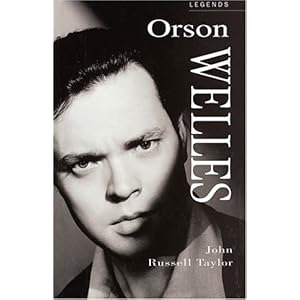
How could I resist that smouldering gaze?
As it turns out, it was a pretty average book but I have to say that that didn't come as too much of a shock given that everything about it screams 'cobbled together', from the shoddy binding to the insistence on having each page decorated with a really cheesy star border. It feels a bit like an essay written by a high schooler, in that there's a lot of facts that would have been very easy to look up in other, better books, and it feels a bit like a copy and paste job with no real attempt at understanding or interpretation. I'm not really the type to read celebrity biographies, mostly because I'm just not really that interested, but also because I tend to feel that there's a big risk that you'll find out that someone you actually quite fancy is a total arsehole or else dull beyond belief. But I do have a fascination with Welles for some reason, and I'm keen to read the Barbara Leaming authorised bio of him, which I've heard good things about. But until then, I found this to be a blandly inoffensive little Sunday morning read.
I bought this book for two reasons; one, it was only two bucks in the bargain bin of the second hand bookshop, and two, this is the cover:
How could I resist that smouldering gaze?
As it turns out, it was a pretty average book but I have to say that that didn't come as too much of a shock given that everything about it screams 'cobbled together', from the shoddy binding to the insistence on having each page decorated with a really cheesy star border. It feels a bit like an essay written by a high schooler, in that there's a lot of facts that would have been very easy to look up in other, better books, and it feels a bit like a copy and paste job with no real attempt at understanding or interpretation. I'm not really the type to read celebrity biographies, mostly because I'm just not really that interested, but also because I tend to feel that there's a big risk that you'll find out that someone you actually quite fancy is a total arsehole or else dull beyond belief. But I do have a fascination with Welles for some reason, and I'm keen to read the Barbara Leaming authorised bio of him, which I've heard good things about. But until then, I found this to be a blandly inoffensive little Sunday morning read.
68Cynara
Leaming's good; I'd say that Simon Callow's bio is better, if you don't mind the greater length. Welles worked his legendary charm on Leaming, I think; nothing wrong with that, but you have to keep it in mind when reading her book.
70Cynara
Well, wait before you thank me - Callow's bio weighs in at two volumes so far, with one to go. The first volume, The Road to Xanadu is really magnificent, even if it is a bit too detailed about Welles' school days. He really captures personalities, and the mad creative stampede Welles lived in.
The second, Hello Americans I didn't find quite as compelling, though that might be partly the fault of Welles' life. I want to resist the view of him as washed-up before he was thirty, but somehow even as his art remained vital, his success and his personal life lost momentum.
The second, Hello Americans I didn't find quite as compelling, though that might be partly the fault of Welles' life. I want to resist the view of him as washed-up before he was thirty, but somehow even as his art remained vital, his success and his personal life lost momentum.
71tash99
Wow, that's a hellava lot of Welles. Hmm - might think about saving that one for a long holiday. And I agree, I don't like to think of him as 'washed up', but as unlucky, and just as having so many ideas that he ended up tripping over himself a lot of the time.

74Cynara
>#71 That's not a bad way of putting it; certainly that's what happened with The Magnificent Ambersons, his carnival picture, and the rights to Kane.
75gennyt
Happy birthday for yesterday (I think?). Just reading through some of your reviews above: was interested to see what you said about The Wasp Factory - I've read most of Iain Banks (and none of the Iain M. Banks) but never that one, I guess I have always been put off by the idea of the cruelty in it. Not that there isn't quite often a cruel streak in some of his others, especially in Complicity. I know what you mean about feeling a little bit dirty after reading him, sometimes.
But I think I enjoyed The Road a lot more than you - the tenacity of that father-son relationship, despite all the horrors they endure, gave it a fundamentally positive feeling for me. It's the only one of his I've read so far...
But I think I enjoyed The Road a lot more than you - the tenacity of that father-son relationship, despite all the horrors they endure, gave it a fundamentally positive feeling for me. It's the only one of his I've read so far...
76tash99
Aww, thanks for the birthday wishes everyone! I had a lovely day, with lots of cake and champagne. And my husband gave me the first (HUGE) volume of Mark Twain's autobiography, which I'm really excited about starting this weekend.
#71 I think as well that he suffered a lot for being labelled as a boy wonder and a genius when he was so young, and it must be hard for anyone who makes it big really young not to feel like they have to keep topping that first success.
#75 You're absolutely right, the relationship between the two of them was incredible. That unquestioning devotion was heartbreaking and it made me keep reading the book long after I really wanted to put it down.
#71 I think as well that he suffered a lot for being labelled as a boy wonder and a genius when he was so young, and it must be hard for anyone who makes it big really young not to feel like they have to keep topping that first success.
#75 You're absolutely right, the relationship between the two of them was incredible. That unquestioning devotion was heartbreaking and it made me keep reading the book long after I really wanted to put it down.
77arubabookwoman
Belated Happy Birthday! Enjoying your reviews.
78tash99
29. The Prime of Miss Jean Brodie, Muriel Spark
Last year I read Singled Out by Virginia Nicholson, an incredibly moving book about the 'surplus women', the generation of girls who found themselves deprived of potential husbands after the devastation of WWI. It did a great job of explaining what life must have been like for someone who has been raised to expect that marriage and children as their birthright (or as a burden, perhaps). But, as well written as it was, it really can't match up to The Prime of Miss Jean Brodie in exploring what it must have been like to be in that society, or to be a woman who finds herself condemned to spinsterhood.
I thought this was going to be a jolly boarding school romp, and was quite surprised to find that it is actually a pleasingly dark and sinister comedy. I can't say I liked it that much - there was something indefinable about it that left me cold - but I did think it was very cleverly written. Muriel Spark does a great job of hinting at the reality of situations without having to spell them out, mainly because most of the story is told through the eyes of Miss Brodie's pet students. They understand a lot more than the grownups around them give them credit for, and Spark endows several of them with convincingly rich inner lives that the adults around them are oblivious to.
Last year I read Singled Out by Virginia Nicholson, an incredibly moving book about the 'surplus women', the generation of girls who found themselves deprived of potential husbands after the devastation of WWI. It did a great job of explaining what life must have been like for someone who has been raised to expect that marriage and children as their birthright (or as a burden, perhaps). But, as well written as it was, it really can't match up to The Prime of Miss Jean Brodie in exploring what it must have been like to be in that society, or to be a woman who finds herself condemned to spinsterhood.
I thought this was going to be a jolly boarding school romp, and was quite surprised to find that it is actually a pleasingly dark and sinister comedy. I can't say I liked it that much - there was something indefinable about it that left me cold - but I did think it was very cleverly written. Muriel Spark does a great job of hinting at the reality of situations without having to spell them out, mainly because most of the story is told through the eyes of Miss Brodie's pet students. They understand a lot more than the grownups around them give them credit for, and Spark endows several of them with convincingly rich inner lives that the adults around them are oblivious to.
79tash99
30. Blindsight, Peter Watts
Vampires.....in.....spaceeee!!!!!
Yes, that is how this was described to me. I'm not much of a sci-fi reader but I had to investigate this one on the basis of the description alone, and I'm so glad I did.
Set in the year 2082, humanity is pampered but basically obsolete. More and more people choose to live in the personally constructed artificial reality of Heaven, though the institutes that support the ascended are the targets of attacks from groups who protest at human beings being kept in a state of blissful uselessness. But life on earth is generally humming along reasonably satisfyingly when with no warning aliens make contact with earth, in suitably dramatic fashion. A small team is sent to return contact and to try and figure out how to deal with this development. In the team are the narrator, Siri, who is along as an observer. Siri had half his brain removed when he was a child, as a last-ditch cure for epilepsy, and while the treatment worked it also left him emotionally crippled but capable of 'synthesising' - meaning he doesn't understand emotion, but he is capable of reading it to a precise degree in other people. Also along are Susan James, a linguist who has had her brain segemented so that it can support four seperate personalities, and Sarasti, who is a vampire. Which manages to not be odd. In fact, there are a lot of plot points that should have been ridiculous, but which just work here.
Watts is a marie biologist, and he clearly knows his science back to front so that even when there are things that sound really stupid when you try and describe them, they sound perfectly reasonable on the page. The great thing about this book, in fact, is that Watts wears the sci-fi aspect of the book so lightly. As with the best fiction in any genre it addresses something fundamental about human nature and at heart this is a book that looks seriously at what would actually happen if humanity was to meet proper aliens. Not man-in-a-latex-mask aliens. Aliens who are so alien we don't even have language to describe them, which is so much more convincing. It's a brilliant exploration of the fundamental problems of communication, and I haven't been able to stop thinking about it since I finished it.
I've been in a bit of a reading lull lately, but I ate this book up in an afternoon on the weekend, and I will definitely read it again.
Vampires.....in.....spaceeee!!!!!
Yes, that is how this was described to me. I'm not much of a sci-fi reader but I had to investigate this one on the basis of the description alone, and I'm so glad I did.
Set in the year 2082, humanity is pampered but basically obsolete. More and more people choose to live in the personally constructed artificial reality of Heaven, though the institutes that support the ascended are the targets of attacks from groups who protest at human beings being kept in a state of blissful uselessness. But life on earth is generally humming along reasonably satisfyingly when with no warning aliens make contact with earth, in suitably dramatic fashion. A small team is sent to return contact and to try and figure out how to deal with this development. In the team are the narrator, Siri, who is along as an observer. Siri had half his brain removed when he was a child, as a last-ditch cure for epilepsy, and while the treatment worked it also left him emotionally crippled but capable of 'synthesising' - meaning he doesn't understand emotion, but he is capable of reading it to a precise degree in other people. Also along are Susan James, a linguist who has had her brain segemented so that it can support four seperate personalities, and Sarasti, who is a vampire. Which manages to not be odd. In fact, there are a lot of plot points that should have been ridiculous, but which just work here.
Watts is a marie biologist, and he clearly knows his science back to front so that even when there are things that sound really stupid when you try and describe them, they sound perfectly reasonable on the page. The great thing about this book, in fact, is that Watts wears the sci-fi aspect of the book so lightly. As with the best fiction in any genre it addresses something fundamental about human nature and at heart this is a book that looks seriously at what would actually happen if humanity was to meet proper aliens. Not man-in-a-latex-mask aliens. Aliens who are so alien we don't even have language to describe them, which is so much more convincing. It's a brilliant exploration of the fundamental problems of communication, and I haven't been able to stop thinking about it since I finished it.
I've been in a bit of a reading lull lately, but I ate this book up in an afternoon on the weekend, and I will definitely read it again.
80tash99
31. Storm Front, Jim Butcher
Another recommendation, this time from someone who has never steered me wrong. Until now. The book is quite funny in parts, but I found it predictable and a bit cheesy - I just want to find another comic fantasy writer I can enjoy as much as Terry Pratchett. I've tried Robert Rankin, Jim Butcher and Tom Holt, and none of them are a patch on the Pratt.
On the plus side, the narrator of the audio book is fantastic - he does all the characters really well, he has good comic timing, and he has a lovely voice. I'd look for other books read by him, but I don't know that I'd bother with another of the Harry Dresden books.
Edited to add a quote that from this book that made me laught; Just because you're paranoid, doesn't mean an invisible demon isn't about to eat your face.
Another recommendation, this time from someone who has never steered me wrong. Until now. The book is quite funny in parts, but I found it predictable and a bit cheesy - I just want to find another comic fantasy writer I can enjoy as much as Terry Pratchett. I've tried Robert Rankin, Jim Butcher and Tom Holt, and none of them are a patch on the Pratt.
On the plus side, the narrator of the audio book is fantastic - he does all the characters really well, he has good comic timing, and he has a lovely voice. I'd look for other books read by him, but I don't know that I'd bother with another of the Harry Dresden books.
Edited to add a quote that from this book that made me laught; Just because you're paranoid, doesn't mean an invisible demon isn't about to eat your face.
81mamzel
For comic fantasy, have you tried Jasper Fforde's Thursday Next serie?. Time travel, people popping into books, characters popping out of books, pet dodos, etc.
82tash99
That's the other one I was trying to think of when I wrote that. I couldn't get into the Fforde books either, and I thought for sure I'd love them. Sigh. The search continues.
83Cynara
The Dresden File books do get much, much better. You might try skipping the next couple and trying again with Grave Peril, book 3; by book 7 or so, I think they're a the top of the genre.
84tash99
Hmm, you might have talked me into it. I didn't actually dislike the book, it just didn't make me want to read the rest of the series, but if you reckon they get better it might be worth giving them another go.
85Cynara
My main reaction to the first book was a thundering 'meh'. If my TBR stack hadn't gotten a bit slender later that year, and if I hadn't gotten into my local library's hold system in a serious way, I probably wouldn't have continued.
I'm a big fan now. Butcher was a very 'young' author when he wrote book one, and the humour and characterization have improved significantly.
I'm a big fan now. Butcher was a very 'young' author when he wrote book one, and the humour and characterization have improved significantly.
87Cynara
I hope you enjoy it, now that I've talked you into it. Will you continue to #2 or skip ahead a bit?
88tash99
Not sure yet - I have to take some books back to the library tomorrow, so I think I'll just take pot luck. Usually the OCD part of my brain would insist that I read them in order, but I'm going to live on the edge for once!
89tash99
32. The Magician's Book, Laura Miller
This is one of those books that felt as if it must have been specially commissioned just for me, I identified with it so much. The stated focus of the book an exploration of the conflicting feelings surrounding reading The Lion, the Witch and the Wardrobe as an adult, with an understanding of the heavy handed Christian symbolism they contain. This is something that I have felt myself, and which seems to get mentioned whenever the Narnia books come up in conversation. Like Miller, I read the Chronicles as a child and loved (most) of them and the fact that they were based so solidly in Christian mythology went completely over my head. But when I tried to read them again as an adult (and with a degree in English Literature under my belt), the obvious symbolism just felt clunky and, well... icky. And it’s not just atheists like me who feel this – I’ve spoken to believers who feel the same way. Miller does a great job of exploring what it is about the books that is so off putting for many of the adult readers who loved them as children, delving into Lewis’s inspirations for the books as well as his personal life in an attempt to understand the books better.
The book takes a wider view as well, and it is also a book about trying to recapture the joy with which we read as children, and about what it means to be a reader at all. Ultimately, it is about that great, possibly unanswerable question; why do some books resonate with you so strongly that you would give anything at all to be given the chance to inhabit the worlds they describe? What is it that makes this book irresistible, but that book merely entertaining? Why does this book leave you cold today, when yesterday it set your imagination on fire? In the end, Miller seems to say that these things are not quantifiable, but that isn’t the same as saying that the questions aren’t worth asking.
This is one of those books that felt as if it must have been specially commissioned just for me, I identified with it so much. The stated focus of the book an exploration of the conflicting feelings surrounding reading The Lion, the Witch and the Wardrobe as an adult, with an understanding of the heavy handed Christian symbolism they contain. This is something that I have felt myself, and which seems to get mentioned whenever the Narnia books come up in conversation. Like Miller, I read the Chronicles as a child and loved (most) of them and the fact that they were based so solidly in Christian mythology went completely over my head. But when I tried to read them again as an adult (and with a degree in English Literature under my belt), the obvious symbolism just felt clunky and, well... icky. And it’s not just atheists like me who feel this – I’ve spoken to believers who feel the same way. Miller does a great job of exploring what it is about the books that is so off putting for many of the adult readers who loved them as children, delving into Lewis’s inspirations for the books as well as his personal life in an attempt to understand the books better.
The book takes a wider view as well, and it is also a book about trying to recapture the joy with which we read as children, and about what it means to be a reader at all. Ultimately, it is about that great, possibly unanswerable question; why do some books resonate with you so strongly that you would give anything at all to be given the chance to inhabit the worlds they describe? What is it that makes this book irresistible, but that book merely entertaining? Why does this book leave you cold today, when yesterday it set your imagination on fire? In the end, Miller seems to say that these things are not quantifiable, but that isn’t the same as saying that the questions aren’t worth asking.
90tash99
33. Shade's Children, Garth Nix
Gosh, but Garth Nix can write a good story. Reading this immediately after finishing The Magician’s Book, the question of why his stories are so gripping pestered me all through it. It’s partly the plot; in an undefined time in the future the adults have disappeared and the world is ruled by the Myrmidons, fierce warriors who use the earth as a battleground and children as the raw materials for their genetically manipulated soldiers. A small group of children, under the direction of the shifty and untrustworthy Shade, fight back where they can, using the variety of powers they have developed since the world Changed.
And it’s partly the characters that make Nix’s books so good. For one, he writes teenage girls and young women astoundingly well, striking just the right balance of strength and emotional vulnerability. I find so often that depictions of girls and women as ‘tough’ tend to be really patronising. They emphasise the sexuality of the female character, while at the same time playing her toughness for titillation as if it’s somehow transgressive (e.g. any Angelina Jolie film ever made), with the result that the character ends up a caricature with bouncy boobs and a gun. Nix’s female characters (I’m thinking of Sabriel and Lirael as well as Ella, one of the main characters in Shade’s Children) are definitely girls with rich emotional lives. They notice boys and they want to do more than just hold hands. But they are capable of dealing with a range of emotions and impulses at the same time, so that their desire to make an emotional connection co-exists with an ability to act rationally and decisively in order to deal with the situation at hand.
Finally, Nix is a master of creating a fantasy world that plays out as real. He describes and explains as much as is necessary to help the plot along, and the result is that the landscapes he moves his characters through feel like real places. He has a knack for describing a setting in just a few words, but in a way that paints a detailed picture.
My only criticism is that the ending was a bit unsatisfying, and all the emotional build up of the rest of the book wasn’t done justice. Otherwise, this is an altogether brilliant piece of young adult fantasy.
Gosh, but Garth Nix can write a good story. Reading this immediately after finishing The Magician’s Book, the question of why his stories are so gripping pestered me all through it. It’s partly the plot; in an undefined time in the future the adults have disappeared and the world is ruled by the Myrmidons, fierce warriors who use the earth as a battleground and children as the raw materials for their genetically manipulated soldiers. A small group of children, under the direction of the shifty and untrustworthy Shade, fight back where they can, using the variety of powers they have developed since the world Changed.
And it’s partly the characters that make Nix’s books so good. For one, he writes teenage girls and young women astoundingly well, striking just the right balance of strength and emotional vulnerability. I find so often that depictions of girls and women as ‘tough’ tend to be really patronising. They emphasise the sexuality of the female character, while at the same time playing her toughness for titillation as if it’s somehow transgressive (e.g. any Angelina Jolie film ever made), with the result that the character ends up a caricature with bouncy boobs and a gun. Nix’s female characters (I’m thinking of Sabriel and Lirael as well as Ella, one of the main characters in Shade’s Children) are definitely girls with rich emotional lives. They notice boys and they want to do more than just hold hands. But they are capable of dealing with a range of emotions and impulses at the same time, so that their desire to make an emotional connection co-exists with an ability to act rationally and decisively in order to deal with the situation at hand.
Finally, Nix is a master of creating a fantasy world that plays out as real. He describes and explains as much as is necessary to help the plot along, and the result is that the landscapes he moves his characters through feel like real places. He has a knack for describing a setting in just a few words, but in a way that paints a detailed picture.
My only criticism is that the ending was a bit unsatisfying, and all the emotional build up of the rest of the book wasn’t done justice. Otherwise, this is an altogether brilliant piece of young adult fantasy.
91alcottacre
I am not going to try and catch up with all your reviews, Tash, but I will read them for the rest of the year. I promise :)
92tash99
34. Brave New World, Aldous Huxley
Finally got around to reading this this morning and I have to say I was a bit disappointed. I've read a few of Huxley's other books (Antic Hay and Point Counter Point), and thought they were quite good. I don't know why it's taken me so long to get around to his most famous book.
I found it quite heavy handed and a bit flat. I assume the future he sets up is supposed to be a terrifying dystopia, but it was probably the least sinister depiction of one I've ever read. OK, so babies come from bottles and I can totally see how that would have been a bit spooky when the book was written. But even when I try and read the book from that standpoint it just doesn't seem that bad. Even the lower castes are well taken care of. Sure they have to do the grunt work, but they're well fed and disease free. So you're basically telling me that this future consists of easy work, guilt free shagging and helicopter rides, and you expect me to shrink in terror?
I'm being flip on purpose, but before I read the book my impression of the world it describes was more along the lines of 1984/Farenheit 451/Soylent Green and this just didn't seem too bad in comparison. In Orwell's future your punishment for questioning the system is to have your head stuck in a rat cage. In Huxley's world you get sent to an island with other like minded people, which Helmholtz seems to quite look forward to. Or am I missing something? Is 'going to the island' euphemism for 'getting your face eaten by a rat'? Basically, I was a bit disappointed that his condemnation of mindless consumerism didn't go far enough - it all seems pretty normal by today's standards.
Either way, I can't say this did anything for me. I found that I couldn't connect with any of the characters on any level, and I didn't really care what happened to them. "Thundering meh" indeed.
Finally got around to reading this this morning and I have to say I was a bit disappointed. I've read a few of Huxley's other books (Antic Hay and Point Counter Point), and thought they were quite good. I don't know why it's taken me so long to get around to his most famous book.
I found it quite heavy handed and a bit flat. I assume the future he sets up is supposed to be a terrifying dystopia, but it was probably the least sinister depiction of one I've ever read. OK, so babies come from bottles and I can totally see how that would have been a bit spooky when the book was written. But even when I try and read the book from that standpoint it just doesn't seem that bad. Even the lower castes are well taken care of. Sure they have to do the grunt work, but they're well fed and disease free. So you're basically telling me that this future consists of easy work, guilt free shagging and helicopter rides, and you expect me to shrink in terror?
I'm being flip on purpose, but before I read the book my impression of the world it describes was more along the lines of 1984/Farenheit 451/Soylent Green and this just didn't seem too bad in comparison. In Orwell's future your punishment for questioning the system is to have your head stuck in a rat cage. In Huxley's world you get sent to an island with other like minded people, which Helmholtz seems to quite look forward to. Or am I missing something? Is 'going to the island' euphemism for 'getting your face eaten by a rat'? Basically, I was a bit disappointed that his condemnation of mindless consumerism didn't go far enough - it all seems pretty normal by today's standards.
Either way, I can't say this did anything for me. I found that I couldn't connect with any of the characters on any level, and I didn't really care what happened to them. "Thundering meh" indeed.
93alcottacre
I love the 'thundering meh' comment! I may steal it!
94tash99
I can't take credit for that, I'm quoting Cynara (at post #85) - it's wonderfully evocative, don't you think?
95alcottacre
Yes, it is.
96tash99
#91 We must have overlapped, didn't see that comment. No worries - since I started working again I've barely had time for books, let alone LT-ing, so I'm just glad you popped in!
97alcottacre
I have been off LT for about 6 weeks now. I just started back again yesterday.
99alcottacre
Everything is fine. Thanks!
100Cynara
Great reviews! The Magician's Book: A Skeptic's Adventures in Narnia is going on my library list, and I'm very curious about the Nix book you reviewed, too. I read his Abhorsen trilogy; while I loved, loved, loved his worldbuilding and found a lot to like about his main characters, for some reason I found the books emotionally unsatisfying. Was it the ending? Did the relationships just not click for me? Something like that; great fantasy is cathartic, and this trilogy never clicked for me emotionally, as much as my brain loved it. Do you think I should try Shade's Children?
101tash99
I've got a feeling that you might that the emotional angle is even less satisfying in Shade's Children. I actually thought it was going to be the first in a series, because as I got to the last twenty pages or so I kept thinking that there was no way he was going to be able to wrap it all up in the space left. And there wasn't and I felt like I was left hanging a bit. But in terms of pure page turning entertainment it does really well. I'd recommend it, but with a warning that it doesn't end satisfyingly.
103tash99
I reckon it's one of those rainy day/hungover books. It might not be perfect, but sometimes you need an easy read that you know you're going to at least enjoy reading, but which you don't need to get too invested in (which is exactly why I always have a pile of PG Wodehouse on hand!) and I think this might be one of those books.
104tash99
35. When God Was a Rabbit, Sarah Winman
This is one of those books that you have probably heard a lot about, and if you haven't already heard about it, you will soon. If you're a cynic like me your instinct might be to recoil from the hype in horror, which you should not do. Listen up. This is amazing, and you need to go and get it and read it, like, today.
Just so you know I haven't been brainwashed into the Sarah Winman cult, I will start by telling you the things I didn't like about it. It is a bit cheesy and sometimes takes the easy emotional route. The narrator remains distant, and it's hard to connect with her. The characters are sometimes a bit too 'ooh, look, isn't he whimsical?'.
But. It is also delicate and sweet, and it is at heart just a lovely, lovely story about what love is. Not just romantic love, not just family love, but about what it means to make a connection with another human being, and the book's flaws couldn't detract from the overall effect the book had on me. The narrator is Elly, and she tells us the story of her life from a odd childhood, to an odd, lonely adulthood, weaving in the strands of the lives of her family, her best friend Jenny Penny, and the various other people who touch her life in one way or another. As Elly says to her brother, the reason we need these people is;
...you were the only person who knew everything. Because you were there. And you were my witness. And you made sense of the fucked-up mess I become every now and then. And I could at least look at you and think, at least he knows why I am the way I am.
The writing is assured and, though it is sometimes a bit blowsy and wears the fact that it is a first novel on its sleeve, is generally effortless and carefully wrought without getting carried away, as in this description of those who jumped from the twin towers;
They tumbled out, just a couple at first, then more, like wounded archers from distant ramparts. And then I saw them, the people of my future dreams. I saw them hold hands and jump; witnessed the last seconds of their friendship and they never let go. Who reassured who? Who could do that? That brief moment of fresh air when they were free, when they could remember how it was before; a brief moment of sunshine, a brief moment of friends holding hands. And they never let go. Friends never let go.
I devoured this in two days, and I wish there had been a bit more of it. I just hope Winman can come up with something as good next time.
This is one of those books that you have probably heard a lot about, and if you haven't already heard about it, you will soon. If you're a cynic like me your instinct might be to recoil from the hype in horror, which you should not do. Listen up. This is amazing, and you need to go and get it and read it, like, today.
Just so you know I haven't been brainwashed into the Sarah Winman cult, I will start by telling you the things I didn't like about it. It is a bit cheesy and sometimes takes the easy emotional route. The narrator remains distant, and it's hard to connect with her. The characters are sometimes a bit too 'ooh, look, isn't he whimsical?'.
But. It is also delicate and sweet, and it is at heart just a lovely, lovely story about what love is. Not just romantic love, not just family love, but about what it means to make a connection with another human being, and the book's flaws couldn't detract from the overall effect the book had on me. The narrator is Elly, and she tells us the story of her life from a odd childhood, to an odd, lonely adulthood, weaving in the strands of the lives of her family, her best friend Jenny Penny, and the various other people who touch her life in one way or another. As Elly says to her brother, the reason we need these people is;
...you were the only person who knew everything. Because you were there. And you were my witness. And you made sense of the fucked-up mess I become every now and then. And I could at least look at you and think, at least he knows why I am the way I am.
The writing is assured and, though it is sometimes a bit blowsy and wears the fact that it is a first novel on its sleeve, is generally effortless and carefully wrought without getting carried away, as in this description of those who jumped from the twin towers;
They tumbled out, just a couple at first, then more, like wounded archers from distant ramparts. And then I saw them, the people of my future dreams. I saw them hold hands and jump; witnessed the last seconds of their friendship and they never let go. Who reassured who? Who could do that? That brief moment of fresh air when they were free, when they could remember how it was before; a brief moment of sunshine, a brief moment of friends holding hands. And they never let go. Friends never let go.
I devoured this in two days, and I wish there had been a bit more of it. I just hope Winman can come up with something as good next time.
105alcottacre
#104: I am going to have to see if I can find that one. Your review intrigues me.
107alcottacre
I checked and my local library does not have it. Hopefully I can find it elsewhere.
108tash99
Two books now that have been collecting dust on the nightstand for far too long. I find it almost impossible to give up on a book, and I force myself to finish pretty much everything I read which means that I quite often have books hanging around for weeks or even months. They get read in a few pages every now and then, and the longer it takes me to finish them, the more I start to resent them. This morning I decided to put these two out of my misery, mainly because I couldn't stand seeing them on my bedside table every morning.
And with that promising intro;
36. Mr Briggs' Hat, Kate Colquhoun (touchstones don't seem to work)
Alarm bells ring when the cover describes an author as 'well-connected' (unless it's a political commentary), because all it makes me think is that the only way this person could have got their book published is that they knew someone in the publishing industry.
Not that I'm suggesting for a minute that this is the case here. This is a quite well written, obviously very well researched book, and there is no good reason for me no to have liked it. But I think that the things it has going for it are the same things that put me off. Yes, it is capably written and the author has a knack for explaining a complicated narrative clearly. And yet... it's so bloodless and neat. Which is ironic, given the subject matter. This is the story of the first ever murder on a train in Britain, and it follows the police investigation as they track the murderer down, pursuing him from London to New York, which at the time was in the grip of the Civil War.
The jacket also says 'in the tradition of The Suspicions of Mr Whicher', and there's a tiny part of my brain that wonders whether it wasn't written to cash in on the current interest in old-timey detective stories. Maybe I'm being massively unfair. But I feel that this was a bit of a wasted opportunity. The story is fascinating, but there's never any opportunity to connect with the people involved, and it all feels a bit superficial. I would have liked to have had more about the paranoia about trains felt by many people at the time, and more about the relationship between America and England. I also would have liked to have had more about the police involved in the case.
37. Eats, Shoots and Leaves, Lynne Truss
Lynne Truss is so annoying that she make's me not, want to use punctuation - properly -ever, again. And the most irritating thing about her is that you get the impression that if you confronted her and said 'you are very irritating' to her face, she would smile (irritatingly) and say something irritating, and wouldn't listen to a word you'd said. And before anyone says it, I know the book is meant to be light hearted but I found that most of her attempts at humour fell flat.
I suspect that the reason I hated this book so much is that I was never taught grammar (or basic mathematics, amongst many other things) at school. I went to an international school in Thailand, and looking back I suspect that they had some sort of half-arsed Montessori thing going (this is not to knock Montessori in general, just this particular school), and they never bothered teaching us anything useful. So my understanding of grammar has been pieced together from all sorts of places, mostly sugar packets and George Carlin rants, and I find the contention that you are stupid and doomed to a life of confusion and misery if you don't know where to use a semi-colon snobby and pretty sad.
edited for touchstones, which don't seem to be working
And with that promising intro;
36. Mr Briggs' Hat, Kate Colquhoun (touchstones don't seem to work)
Alarm bells ring when the cover describes an author as 'well-connected' (unless it's a political commentary), because all it makes me think is that the only way this person could have got their book published is that they knew someone in the publishing industry.
Not that I'm suggesting for a minute that this is the case here. This is a quite well written, obviously very well researched book, and there is no good reason for me no to have liked it. But I think that the things it has going for it are the same things that put me off. Yes, it is capably written and the author has a knack for explaining a complicated narrative clearly. And yet... it's so bloodless and neat. Which is ironic, given the subject matter. This is the story of the first ever murder on a train in Britain, and it follows the police investigation as they track the murderer down, pursuing him from London to New York, which at the time was in the grip of the Civil War.
The jacket also says 'in the tradition of The Suspicions of Mr Whicher', and there's a tiny part of my brain that wonders whether it wasn't written to cash in on the current interest in old-timey detective stories. Maybe I'm being massively unfair. But I feel that this was a bit of a wasted opportunity. The story is fascinating, but there's never any opportunity to connect with the people involved, and it all feels a bit superficial. I would have liked to have had more about the paranoia about trains felt by many people at the time, and more about the relationship between America and England. I also would have liked to have had more about the police involved in the case.
37. Eats, Shoots and Leaves, Lynne Truss
Lynne Truss is so annoying that she make's me not, want to use punctuation - properly -ever, again. And the most irritating thing about her is that you get the impression that if you confronted her and said 'you are very irritating' to her face, she would smile (irritatingly) and say something irritating, and wouldn't listen to a word you'd said. And before anyone says it, I know the book is meant to be light hearted but I found that most of her attempts at humour fell flat.
I suspect that the reason I hated this book so much is that I was never taught grammar (or basic mathematics, amongst many other things) at school. I went to an international school in Thailand, and looking back I suspect that they had some sort of half-arsed Montessori thing going (this is not to knock Montessori in general, just this particular school), and they never bothered teaching us anything useful. So my understanding of grammar has been pieced together from all sorts of places, mostly sugar packets and George Carlin rants, and I find the contention that you are stupid and doomed to a life of confusion and misery if you don't know where to use a semi-colon snobby and pretty sad.
edited for touchstones, which don't seem to be working
109alcottacre
Well, you have got them both out of the way now and can go on to books you will enjoy more! I hope you find something that catches your fancy and does not have to be endured :)
111alcottacre
I started doing it about 5 years ago. Life is just too short.
112tash99
I've been reading quite a bit lately, but haven't had the energy to write reviews for anything, but what with the five day public holiday we're having here, I figured it was as good a time as any to get up to date. So here we go.
38. South, Earnest Shackleton
They just don't make them like this anymore. What an amazing story of courage, persistance and plain old-fashioned gentlemanly reluctance to complain. I listened to the audio book version of this, read exceptionally well by Geoffrey Howard, and it was just gripping.
39. Death Interrupted, Jose Saramago
What happens when death stops coming for people who are due to die? This is a melancholy, funny satire about the consequences of the end of death in one country. The prose style is a little odd, with sentences that run on in a way that takes a few pages to get used to, and there are a few other little stylistic quirks that are annoying and charming in equal measure.
40. Johannes Cabal the Detective, Jonathan L Howard
The second in the Johannes Cabal series, I would definitely recommend these for anyone who likes Terry Pratchett, Jim Butcher or Robert Rankin. Cabal is an infamous necromancer whose pursuit of the secret of reanimation is constantly thwarted by his run-ins with various enemies - in the previous book it was Satan, but here it is slightly less hyperbolic as he grapples with an ambitious nobleman in a reimagined European past. Airships, murders and wisecracking ensue. Great fun.
My favourite quote;
There is possibly no insult so calculated to sting the English as the suggestion that they may at any time be considered foreign, as this flies in the face of the obvious truth that the whole of Creation actually belongs to the English, and they are just allowing everybody else to camp on bits of it out of a national sense of noblesse oblige.
41. Harbour, John Ajvide Lindqvist
It started well and seemed as if it was going to be a great ghost story, but it sort of lost direction and got a bit flabby in the middle, and then ended disappointingly – how I felt about the book is probably summed up best with a quote from it; When the monster shows its ugly mug at the end, it’s always a disappointment. But the writing was generally good, and Lindvqist gives great atmosphere - there is a well maintained level of spooky not-quite-rightness throughout the whole book. I've heard that Let the Right One In is much better, and I'm going to try that one soon.
42. Short Stories, Henry Lawson
Unjustly unread outside of school and university classes (which is where I first encountered him), Lawson is easily Australia's Mark Twain. A great ear for dialects and for patterns of speech, and emotionally pitch perfect. My favourite was definitely The Drover’s Wife, which is well worth a read.
43. An Experiment in Criticism, C.S. Lewis
Laura Miller referenced this a lot in The Magician’s Book, and I felt I had to read it. It is perhaps the best book I’ve ever read on the whys of reading, and I feel refreshed after reading it, I’ve been reminded of why I read. Having said that, Lewis can be an appalling prig and this book sometimes feels like an attempt to explain why the books he likes are better than the books some other people like. But it is still an absolute must if you're the kind of person who gets all gooey about books.
It may be the beautiful, the terrible, the awe-inspiring, the exhilarating, the pathetic, the comic or merely piquant. Literature gives the entree to them all. Those of us who have been true readers all our life seldom fully realise the enormous extension of our being which we owe to authors. We realise it best when we talk with an unliterary firnd. He may be full of goodness and good sense, but he inhabits a tiny world. In it, we should be suffocated. The man who is contended to be only himself, and therefore less of a self, is in prison. My own eyes are not enough for me, I will see through those of others. Reality, even seen through the eyes of many, is not enough. I will see what others have invented. Even the eyes of humanity are not enough. I regret that the brutes cannot write books.
44. Guardian Bedside Reader 2010
Selections from the Guardian newspaper, the standard of writing is generally pretty good. I would have preferred fewer articles about the British election, though I do understand why there were so many. Like it says on the tin, this is a great bedside book.
45. Mr. Chartwell, Rebecca Hunt
Esther is a young widow living alone in London in the sixties, and decides that what she really needs is a lodger. The only respondent to her advertisement is Mr Chartwell, a six foot seven black dog, who happens also to be the literal, physical manifestation of Winston Churchill’s depression. Despite her initial reluctance, Ether agrees to let Mr Chartwell stay, and the relationship that develops between them is initially tense and wary, but it develops into something oddly fragile and tender.
I loved this book to pieces and I want to read it again – I flew through it in a night, and I want to go back and take a bit more time with it. The characters are perfect, from Esther to Winston Churchill himself, and their cast of supporting characters. Hunt steers clear of quirky for the sake of quirky, but manages makes this strange, charming little story one of the funniest things I’ve read in a long time. Mr Chartwell may be the incarnation of depression, but he is also fundamentally a dog, and tends to do doggy things – there’s a scene in which Mr Chartwell makes an attempt to do something nice for Esther by cooking her a meal, which had me crying with laughter.
46. The Small Hand, Susan Hill
I’m on a bit of a ghost story kick at the moment, but unfortunately this one missed the mark even more than Harbour. Similarly, it started well but flopped to a close with a really unsatisfying ending. I’d heard quite good things, but I found that there was something a bit false about it. If anyone has any suggestions for a really creepy ghost story, I’d love to hear them.
Edited - touchstones seem to be playing up, sorry.
38. South, Earnest Shackleton
They just don't make them like this anymore. What an amazing story of courage, persistance and plain old-fashioned gentlemanly reluctance to complain. I listened to the audio book version of this, read exceptionally well by Geoffrey Howard, and it was just gripping.
39. Death Interrupted, Jose Saramago
What happens when death stops coming for people who are due to die? This is a melancholy, funny satire about the consequences of the end of death in one country. The prose style is a little odd, with sentences that run on in a way that takes a few pages to get used to, and there are a few other little stylistic quirks that are annoying and charming in equal measure.
40. Johannes Cabal the Detective, Jonathan L Howard
The second in the Johannes Cabal series, I would definitely recommend these for anyone who likes Terry Pratchett, Jim Butcher or Robert Rankin. Cabal is an infamous necromancer whose pursuit of the secret of reanimation is constantly thwarted by his run-ins with various enemies - in the previous book it was Satan, but here it is slightly less hyperbolic as he grapples with an ambitious nobleman in a reimagined European past. Airships, murders and wisecracking ensue. Great fun.
My favourite quote;
There is possibly no insult so calculated to sting the English as the suggestion that they may at any time be considered foreign, as this flies in the face of the obvious truth that the whole of Creation actually belongs to the English, and they are just allowing everybody else to camp on bits of it out of a national sense of noblesse oblige.
41. Harbour, John Ajvide Lindqvist
It started well and seemed as if it was going to be a great ghost story, but it sort of lost direction and got a bit flabby in the middle, and then ended disappointingly – how I felt about the book is probably summed up best with a quote from it; When the monster shows its ugly mug at the end, it’s always a disappointment. But the writing was generally good, and Lindvqist gives great atmosphere - there is a well maintained level of spooky not-quite-rightness throughout the whole book. I've heard that Let the Right One In is much better, and I'm going to try that one soon.
42. Short Stories, Henry Lawson
Unjustly unread outside of school and university classes (which is where I first encountered him), Lawson is easily Australia's Mark Twain. A great ear for dialects and for patterns of speech, and emotionally pitch perfect. My favourite was definitely The Drover’s Wife, which is well worth a read.
43. An Experiment in Criticism, C.S. Lewis
Laura Miller referenced this a lot in The Magician’s Book, and I felt I had to read it. It is perhaps the best book I’ve ever read on the whys of reading, and I feel refreshed after reading it, I’ve been reminded of why I read. Having said that, Lewis can be an appalling prig and this book sometimes feels like an attempt to explain why the books he likes are better than the books some other people like. But it is still an absolute must if you're the kind of person who gets all gooey about books.
It may be the beautiful, the terrible, the awe-inspiring, the exhilarating, the pathetic, the comic or merely piquant. Literature gives the entree to them all. Those of us who have been true readers all our life seldom fully realise the enormous extension of our being which we owe to authors. We realise it best when we talk with an unliterary firnd. He may be full of goodness and good sense, but he inhabits a tiny world. In it, we should be suffocated. The man who is contended to be only himself, and therefore less of a self, is in prison. My own eyes are not enough for me, I will see through those of others. Reality, even seen through the eyes of many, is not enough. I will see what others have invented. Even the eyes of humanity are not enough. I regret that the brutes cannot write books.
44. Guardian Bedside Reader 2010
Selections from the Guardian newspaper, the standard of writing is generally pretty good. I would have preferred fewer articles about the British election, though I do understand why there were so many. Like it says on the tin, this is a great bedside book.
45. Mr. Chartwell, Rebecca Hunt
Esther is a young widow living alone in London in the sixties, and decides that what she really needs is a lodger. The only respondent to her advertisement is Mr Chartwell, a six foot seven black dog, who happens also to be the literal, physical manifestation of Winston Churchill’s depression. Despite her initial reluctance, Ether agrees to let Mr Chartwell stay, and the relationship that develops between them is initially tense and wary, but it develops into something oddly fragile and tender.
I loved this book to pieces and I want to read it again – I flew through it in a night, and I want to go back and take a bit more time with it. The characters are perfect, from Esther to Winston Churchill himself, and their cast of supporting characters. Hunt steers clear of quirky for the sake of quirky, but manages makes this strange, charming little story one of the funniest things I’ve read in a long time. Mr Chartwell may be the incarnation of depression, but he is also fundamentally a dog, and tends to do doggy things – there’s a scene in which Mr Chartwell makes an attempt to do something nice for Esther by cooking her a meal, which had me crying with laughter.
46. The Small Hand, Susan Hill
I’m on a bit of a ghost story kick at the moment, but unfortunately this one missed the mark even more than Harbour. Similarly, it started well but flopped to a close with a really unsatisfying ending. I’d heard quite good things, but I found that there was something a bit false about it. If anyone has any suggestions for a really creepy ghost story, I’d love to hear them.
Edited - touchstones seem to be playing up, sorry.
113tash99
47. King Leopold's Ghost, Adam Hochschild
This is a fascinating book about the Scramble for Africa and the Belgian Congo, a period of history I knew very little about outside of having read Heart of Darkness. I came away from it wanting to know more about the subject and the people involved, particularly Henry Stanley Stanley, and Edmund Dene Morel and Roger Casement, the leaders of the humanitarian movement against King Leopold's Belgian Congo, and I think in the end one of the most complimentary things you could say about a non-fiction book is that it has provoked a need to find out more about the world.
48. Howl's Moving Castle, Diana Wynne Jones
Funny and imaginative. But is it sacrilege to admit that I liked the film better? It's a small margin, but I think the film wins out for me.
This is a fascinating book about the Scramble for Africa and the Belgian Congo, a period of history I knew very little about outside of having read Heart of Darkness. I came away from it wanting to know more about the subject and the people involved, particularly Henry Stanley Stanley, and Edmund Dene Morel and Roger Casement, the leaders of the humanitarian movement against King Leopold's Belgian Congo, and I think in the end one of the most complimentary things you could say about a non-fiction book is that it has provoked a need to find out more about the world.
48. Howl's Moving Castle, Diana Wynne Jones
Funny and imaginative. But is it sacrilege to admit that I liked the film better? It's a small margin, but I think the film wins out for me.
114tash99
49. The Glass Room, Simon Mawer
Everything I had heard about this book made me want to read it. Then I'd look at the awful cover;

and think 'eh, not for me'.
But I overcame my squeamishness and read it anyway, and loved it, which is exactly why we have the cliche about books and covers and whether we should judge them.
On one level, this is a book about a family and how they deal with the events of the world around them - the Landauers are a wealthy family in Czechoslovakia between the world wars. As newlyweds Viktor and Leisel Landauer decide to build a house that defies tradition and embraces the modern age, but as war encroaches on their comfortable lives they have to decide whether to risk staying in their beautiful house or fleeing abroad.
But on another level this is a book about performance, observation and art. The Landauers' construction of their ultra-modern house is observed with mingled horror and envy by their friends and acquaintances, and when it is finished the house becomes an actual stage in which they host performances as the intertwined dramas of various lives play out. As their architect says 'a work of art like this demands that the life lived in it be a work of art as well'.
It is a carefully constructed plot, and though it feels very deliberate and measured Mawer manages to make that fact the most enjoyable part of the book. It could so easily have made it a heavy and plodding book to read, but Mawer somehow makes it work. The characters are important, but they are almost secondary in some ways to the great dance that Mawer sets them in.
This was a library book but, if I can find a copy with a less hideous cover, I might buy it because I think I would really enjoy reading it again.
50 La Dame aux Camelias, Alexandre Dumas
I love melodrama - one of my favourite books from the year before last was The Monk by Matthew Lewis - and this is some pretty intensely over the top melodrama. Based on real events in the life of Alexandre Dumas fils, it was later adapted by Bizet and became the opera La Traviata. It tells the story of the ill-fated love affair between Armand, a young man of moderate means living in Paris, and Marguerite, a courtesan. Armand falls for Marguerite immediately upon meeting her and moons around after her until he finally convinces her to be his lover and no one else's. Then some things happen and they can't be together, there's some misunderstandings, some noble refusals to let the other person suffer, then someone dies (pssst: it's not Armand - that's not a spoiler) and it's all very sad.
It's not a very good book, and certainly not up to Dumas senior's standards (now there was a man could spin a trashy yarn like a champ), but it is so much fun to read. Here's a representative line; "You ask if I forgive you; oh! With all my heart, my dear, for the hurt you sought to do me was but a token of the love you bore me'. Here's another; "This love of ours, my dearest Armand, is no ordinary love. You love me as though I'd never belonged to anyone else, and I tremble for fear that with time, regretting that you ever loved me and turning my past into a crime to hold against me, you might force me to resume the life from which you took me. Remember this: now that I've tasted a new kind of life, I should die if I had to take up the old one. So tell me you'll never leave me."
It's only a short book, and I ate it up in an evening, with a hot chocolate and piece of cake to go with it. Big, gooey, dumb fun.
51. Ill Fares the Land, Tony Judt
Much more serious stuff here, about the fact that politics in most countries these days is a flat out joke. I don't know about you guys overseas, but here in Australia the nicest way I can think to describe our ruling party is 'the lesser of two evils'. But what to do about it? As someone who hovers in between Gens X and Y, I am apathetic and disillusioned about politics, and I, along with my contemporaries, need the kick up the bum that Tony Judt wanted us to get.
This is essentially an extended essay, and the point is basically 1) You really need to pay your taxes, 2) You really need to make your government accountable for the things they do, and 3) You really need to take care of those people who cannot take care of themselves if you want to be considered a grownup nation. I suppose it is quite pessimistic in some ways, but I can only hope that people who read it - especially people of my age - feel that they have had a fire set under them, and that positive change may just be possible.
I am a big fan of Judt's writing, and this is a fantastic book. This is probably my favourite passage;
This cohort of politicians have in common the enthusiasm that they fail to inspire in the electors of their respective countries. They do not seem to believe very firmly in any coherent set of principles and policies; and though none of them - with the possible exception of Blair - is as execrated as former president George W Bush..., they form a striking contrast to the statesmen of the World War Two generation. They convey neither conviction nor authority.
52. The Possessed, Elif Batuman
Another fabulous non-fiction book, this time about (in very general terms) Russian literature. It is really a series of sketches of situations and people rather than a narrative, though there is a theme that runs through it of the simultaneous absurdity and pleasure of academic scholarship.
My only negative comment would be that she sometimes makes it sound as if the things she ends up doing (living in Uzbekistan studying Uzbek poetry, for example) have happened to her almost by accident, as if it was not due to any action taken by her, which I thought injected a note almost of ditzy 'whoops, what am I doing here!' silliness that I don't buy because she is clearly a formidably intelligent person (unless that was meant to
demonstrate the ultimately unpredictable paths an academic life tends to take?)
But on the whole I enjoyed this very much, and Batuman is a very entertaining writer with a lovely voice and a wry sense of humour.
edited to try and fix stupid touchstones
Everything I had heard about this book made me want to read it. Then I'd look at the awful cover;

and think 'eh, not for me'.
But I overcame my squeamishness and read it anyway, and loved it, which is exactly why we have the cliche about books and covers and whether we should judge them.
On one level, this is a book about a family and how they deal with the events of the world around them - the Landauers are a wealthy family in Czechoslovakia between the world wars. As newlyweds Viktor and Leisel Landauer decide to build a house that defies tradition and embraces the modern age, but as war encroaches on their comfortable lives they have to decide whether to risk staying in their beautiful house or fleeing abroad.
But on another level this is a book about performance, observation and art. The Landauers' construction of their ultra-modern house is observed with mingled horror and envy by their friends and acquaintances, and when it is finished the house becomes an actual stage in which they host performances as the intertwined dramas of various lives play out. As their architect says 'a work of art like this demands that the life lived in it be a work of art as well'.
It is a carefully constructed plot, and though it feels very deliberate and measured Mawer manages to make that fact the most enjoyable part of the book. It could so easily have made it a heavy and plodding book to read, but Mawer somehow makes it work. The characters are important, but they are almost secondary in some ways to the great dance that Mawer sets them in.
This was a library book but, if I can find a copy with a less hideous cover, I might buy it because I think I would really enjoy reading it again.
50 La Dame aux Camelias, Alexandre Dumas
I love melodrama - one of my favourite books from the year before last was The Monk by Matthew Lewis - and this is some pretty intensely over the top melodrama. Based on real events in the life of Alexandre Dumas fils, it was later adapted by Bizet and became the opera La Traviata. It tells the story of the ill-fated love affair between Armand, a young man of moderate means living in Paris, and Marguerite, a courtesan. Armand falls for Marguerite immediately upon meeting her and moons around after her until he finally convinces her to be his lover and no one else's. Then some things happen and they can't be together, there's some misunderstandings, some noble refusals to let the other person suffer, then someone dies (pssst: it's not Armand - that's not a spoiler) and it's all very sad.
It's not a very good book, and certainly not up to Dumas senior's standards (now there was a man could spin a trashy yarn like a champ), but it is so much fun to read. Here's a representative line; "You ask if I forgive you; oh! With all my heart, my dear, for the hurt you sought to do me was but a token of the love you bore me'. Here's another; "This love of ours, my dearest Armand, is no ordinary love. You love me as though I'd never belonged to anyone else, and I tremble for fear that with time, regretting that you ever loved me and turning my past into a crime to hold against me, you might force me to resume the life from which you took me. Remember this: now that I've tasted a new kind of life, I should die if I had to take up the old one. So tell me you'll never leave me."
It's only a short book, and I ate it up in an evening, with a hot chocolate and piece of cake to go with it. Big, gooey, dumb fun.
51. Ill Fares the Land, Tony Judt
Much more serious stuff here, about the fact that politics in most countries these days is a flat out joke. I don't know about you guys overseas, but here in Australia the nicest way I can think to describe our ruling party is 'the lesser of two evils'. But what to do about it? As someone who hovers in between Gens X and Y, I am apathetic and disillusioned about politics, and I, along with my contemporaries, need the kick up the bum that Tony Judt wanted us to get.
This is essentially an extended essay, and the point is basically 1) You really need to pay your taxes, 2) You really need to make your government accountable for the things they do, and 3) You really need to take care of those people who cannot take care of themselves if you want to be considered a grownup nation. I suppose it is quite pessimistic in some ways, but I can only hope that people who read it - especially people of my age - feel that they have had a fire set under them, and that positive change may just be possible.
I am a big fan of Judt's writing, and this is a fantastic book. This is probably my favourite passage;
This cohort of politicians have in common the enthusiasm that they fail to inspire in the electors of their respective countries. They do not seem to believe very firmly in any coherent set of principles and policies; and though none of them - with the possible exception of Blair - is as execrated as former president George W Bush..., they form a striking contrast to the statesmen of the World War Two generation. They convey neither conviction nor authority.
52. The Possessed, Elif Batuman
Another fabulous non-fiction book, this time about (in very general terms) Russian literature. It is really a series of sketches of situations and people rather than a narrative, though there is a theme that runs through it of the simultaneous absurdity and pleasure of academic scholarship.
My only negative comment would be that she sometimes makes it sound as if the things she ends up doing (living in Uzbekistan studying Uzbek poetry, for example) have happened to her almost by accident, as if it was not due to any action taken by her, which I thought injected a note almost of ditzy 'whoops, what am I doing here!' silliness that I don't buy because she is clearly a formidably intelligent person (unless that was meant to
demonstrate the ultimately unpredictable paths an academic life tends to take?)
But on the whole I enjoyed this very much, and Batuman is a very entertaining writer with a lovely voice and a wry sense of humour.
edited to try and fix stupid touchstones
115alcottacre
Wow, Tash! You have been busy since last I visited. The BlackHole is groaning with all the additions!
116JanetinLondon
Hi. (Not sure if I have posted here before, but I do follow you!) I liked your comments about Ill Fares the Land. I was meaning to read it anyway, but now it's moving even higher up the list. I'm much older than you are, but I'm sure my generation also needs a reminder that we used to be so much more idealistic about politics and shouldn't give up. And I'm thrilled that it delivers such a strong message to younger people, who will have to shoulder so much of the burden.
117arubabookwoman
I'm enjoying following your reading, and your always intelligent comments on the books you read. I love your description of the three things a country must do to be considered "grownup" from Tony Judt's book. That is one I've added to the wishlist, and hope to persuade my adult kids to read, since they sometimes seem curiously apolitical to me (very dangerous in my view).
Also adding Mr. Chartwell and Death With Interruptions to the wishlist.
Also adding Mr. Chartwell and Death With Interruptions to the wishlist.
118tash99
#116 I think a big part of it is that we all need to feel a bit less powerless. I was listening to a podcast the other day, and someone was talking about the first ever Gay Pride parade in London in the 70s. A handful of people turned up, and were treated roughly by police and hassled by the crowds. Fast forward a few decades and gay pride parades regularly draw hundreds of thousands of participants and well wishers, and it is the homophobes who are considered the aberration. Maybe my generation just needs to realise that change can't come just by changing your facebook profile picture, and that we need to actually work at it - I'm trying to put my money where my mouth is, and have made a resolution to start getting a bit more involved. Sorry, that was a slightly longer reply than I meant to write.
#117 It is really readable and not at all preachy, so it's probably a good one to go with!
#117 It is really readable and not at all preachy, so it's probably a good one to go with!
119tash99
53. Quarterly Essay: The Happy Life, David Malouf
For the privileged few, life is better now than it has ever been. We are largely protected from famine, disease and premature death, and yet as a society we are unhappier now than we have ever been. Malouf explores this idea, and argues that it is the very search for happiness that is making us unhappy; "the irritant in human nature that makes the pearl is our essential restlessness, our dissatisfaction, our unrest; a lack in us that has endlessly to be filled". In other words, happiness in itself is not a healthy or even logical goal. Rather, the pursuit of a life of self-awareness and self-sufficiency, of philosophical fulfillment, is the key to contentment.
Malouf is a wonderful writer, and a national treasure - I met him at a book signing a few weeks ago, and he's a lovely chap, too, and I can't recommend this essay highly enough. There's an extract of the essay here.
For the privileged few, life is better now than it has ever been. We are largely protected from famine, disease and premature death, and yet as a society we are unhappier now than we have ever been. Malouf explores this idea, and argues that it is the very search for happiness that is making us unhappy; "the irritant in human nature that makes the pearl is our essential restlessness, our dissatisfaction, our unrest; a lack in us that has endlessly to be filled". In other words, happiness in itself is not a healthy or even logical goal. Rather, the pursuit of a life of self-awareness and self-sufficiency, of philosophical fulfillment, is the key to contentment.
Malouf is a wonderful writer, and a national treasure - I met him at a book signing a few weeks ago, and he's a lovely chap, too, and I can't recommend this essay highly enough. There's an extract of the essay here.
120alcottacre
I have heard of Malouf, but not read anything of his yet. Thanks for posting the link to the essay, Tash.
121tash99
54. The Siren and Selected Writings, Guiseppe di Lampedusa
As a collection of short stories, essays and other fragments from the author of The Leopard, this book doesn't really stand alone. But as a book that provides and insight into the life and thoughts of the author it is outstanding.
There are some short stories, a section of his autobiography and some essays, almost all unfinished at the time of his death. The highlight is the fabulous story The Professor and the Siren, a dreamy, sensual story that explores some of Lampedusa's pet themes of sex and decay.
The final section of the book consists of selections from Lampedusa’s essays about literature. Some of them I found quite interesting, but not having read some of the authors I have to admit to having skimmed some of them. What I did take away from this section was the fact that Lampedusa was a great reader, and devoured books at an astonishing rate. But he didn’t sit down to write anything until the last years of his life, and it made me wonder how many other authors would have benefited from doing this. There are so many mediocre books churned out every year, and so many books by very young authors getting published, but maybe we’re going in the wrong direction. Some of my favourite books are by authors who only wrote one major novel, though they may also have written other things as well (Lampedusa, Harper Lee, Oscar Wilde, Sylvia Plath, John Kennedy Toole). Maybe we need fewer books, written by people who have taken longer to write them?
If you’re already a Leopard-ite, I can’t recommend this highly enough. But if you haven’t read the novel, you probably won’t get a lot out of this collection.
55. Children of Exile, James Fenton
I'm not great at talking about poetry (I generally come down to 'I liked the bits where they rhymes were, but I also liked some of the bits where there weren't rhymes'), but I can say that I enjoyed this book very much. The poems are playful and witty, though they also address the consequences of political unrest in Asia with compassion.
My favourite poems were Children in Exile, Nest of Vampires, A Vacant Possession, The Skip, and God, A Poem, which contains these great lines;
...the fact is,
in soteriological terms,
I'm a crude existential malpractice,
and you are a diet of worms'.
56. Notes on a Scandal, Zoe Heller
You know how sometimes a book hovers on your periphery for years and years, and you just know that you're going to to enjoy reading it, but you somehow never find time for it? This was one of those books. I've picked it up in bookshops and libraries so many times, and thought 'hmm, maybe next time'.
I finally got around to reading it, and I enjoyed it as much as I knew I would. I know it was a big seller and then it was made into a movie a few years ago, so it might be that you already know the plot, so I'll make this brief. Barbara is a teacher at a school with a lot of problem students, and she narrates the affair one of the other teachers has with a student.
Barbara is such an interesting character. She should be repellent, but Heller does an amazing job of making her just sympathetic enough that, as much as you can't like her, you can certainly feel compassion for her. She's so heart wrenchingly lonely, with such a brittle shell built up around her. She resorts to disapproval of her colleagues to explain why they don't like her, so that she can cling to the idea that she is unpopular because they see her has superior to them. Sheba is slightly less convincing, but still an intriguing character who allows herself to be swept up in an inappropriate relationship because, though she has a family and friends, she feels herself to be just as unloved and unremarked as Barabara does. A juicy psychological study, this was a great read.
57. A Visit from the Good Squad, Jennifer Egan
A one sentence summary would read; 'gosh, life's really complicated, isn't it?'
This was a fun, quick read, but I don't really understand why it won the Pulitzer. I suppose it's because of the way in which Egan addresses the idea of connectivity and the ways in which our lives overlap. She uses a host of characters whose lives are vaguely linked by the two main characters to show how the results of actions and events by seemingly unconnected people can intersect, and she does that very well.
Maybe I'm missing something, but then maybe this is just not my sort of book. It felt a bit sort of Douglas Coupland-y in that it addresses The Modern World, and in that the characters are largely canvases for Very Important Ideas. It was alright, but I suppose not really my sort of thing.
As a collection of short stories, essays and other fragments from the author of The Leopard, this book doesn't really stand alone. But as a book that provides and insight into the life and thoughts of the author it is outstanding.
There are some short stories, a section of his autobiography and some essays, almost all unfinished at the time of his death. The highlight is the fabulous story The Professor and the Siren, a dreamy, sensual story that explores some of Lampedusa's pet themes of sex and decay.
The final section of the book consists of selections from Lampedusa’s essays about literature. Some of them I found quite interesting, but not having read some of the authors I have to admit to having skimmed some of them. What I did take away from this section was the fact that Lampedusa was a great reader, and devoured books at an astonishing rate. But he didn’t sit down to write anything until the last years of his life, and it made me wonder how many other authors would have benefited from doing this. There are so many mediocre books churned out every year, and so many books by very young authors getting published, but maybe we’re going in the wrong direction. Some of my favourite books are by authors who only wrote one major novel, though they may also have written other things as well (Lampedusa, Harper Lee, Oscar Wilde, Sylvia Plath, John Kennedy Toole). Maybe we need fewer books, written by people who have taken longer to write them?
If you’re already a Leopard-ite, I can’t recommend this highly enough. But if you haven’t read the novel, you probably won’t get a lot out of this collection.
55. Children of Exile, James Fenton
I'm not great at talking about poetry (I generally come down to 'I liked the bits where they rhymes were, but I also liked some of the bits where there weren't rhymes'), but I can say that I enjoyed this book very much. The poems are playful and witty, though they also address the consequences of political unrest in Asia with compassion.
My favourite poems were Children in Exile, Nest of Vampires, A Vacant Possession, The Skip, and God, A Poem, which contains these great lines;
...the fact is,
in soteriological terms,
I'm a crude existential malpractice,
and you are a diet of worms'.
56. Notes on a Scandal, Zoe Heller
You know how sometimes a book hovers on your periphery for years and years, and you just know that you're going to to enjoy reading it, but you somehow never find time for it? This was one of those books. I've picked it up in bookshops and libraries so many times, and thought 'hmm, maybe next time'.
I finally got around to reading it, and I enjoyed it as much as I knew I would. I know it was a big seller and then it was made into a movie a few years ago, so it might be that you already know the plot, so I'll make this brief. Barbara is a teacher at a school with a lot of problem students, and she narrates the affair one of the other teachers has with a student.
Barbara is such an interesting character. She should be repellent, but Heller does an amazing job of making her just sympathetic enough that, as much as you can't like her, you can certainly feel compassion for her. She's so heart wrenchingly lonely, with such a brittle shell built up around her. She resorts to disapproval of her colleagues to explain why they don't like her, so that she can cling to the idea that she is unpopular because they see her has superior to them. Sheba is slightly less convincing, but still an intriguing character who allows herself to be swept up in an inappropriate relationship because, though she has a family and friends, she feels herself to be just as unloved and unremarked as Barabara does. A juicy psychological study, this was a great read.
57. A Visit from the Good Squad, Jennifer Egan
A one sentence summary would read; 'gosh, life's really complicated, isn't it?'
This was a fun, quick read, but I don't really understand why it won the Pulitzer. I suppose it's because of the way in which Egan addresses the idea of connectivity and the ways in which our lives overlap. She uses a host of characters whose lives are vaguely linked by the two main characters to show how the results of actions and events by seemingly unconnected people can intersect, and she does that very well.
Maybe I'm missing something, but then maybe this is just not my sort of book. It felt a bit sort of Douglas Coupland-y in that it addresses The Modern World, and in that the characters are largely canvases for Very Important Ideas. It was alright, but I suppose not really my sort of thing.
122alcottacre
#121: You remind me that I still need to get to The Leopard. I think I only bought it 2 years ago :(
124tash99
58. Memoirs of a Nun, Denis Diderot
The story behind this novel might actually be more intriguing than the book itself. Diderot and some of his literary buddies were friends with an older nobleman named Croismare, who was known to be a bit of a soft touch. Croismare had moved away from Paris, and Diderot and co. couldn't convince him to come back. So they devised a scheme. Was it a wacky scheme, I hear you ask? All the best ones are, I reply.
They invented a young woman, Susan Simonin, and started writing letters 'from' her to Croismare, in which they had their invented girl claim that she had been forced to become a nun against her will, and that, having been badly treated in the convents, she had escaped to Paris, where she was dying in poverty and would surely perish without his help. Apparently practical jokes were a bit different in eighteenth century France. Croismare eventually went back to Paris, and the whole hilarious prank was revealed.
However, Diderot was so moved by his own invention that he reworked the letters into this novel. It is still in the form of a letter to a nobleman, but it reads more like a confession than a plea for help. Susan, our reluctant nun, is a beautiful, talented young girl with two older sisters. The older sisters are treated kindly and generously, while Susan is barely tolerated by her parents. As time goes on, she realises that their hostility towards her is because she is the result of an affair her mother had. She is not allowed to inherit anything, and her parents eventually shut her away in a convent so that they can forget about her. But she resists her fate, especially after she finds that the convents are rife with favouritism, predatory older women, corruption and cruelty.
Though the novel condemns a lot of religious practices and depicts the hypocrisy of many of the people who claim to be religious, the theme here is more about the cruelty of forcing religion on someone who doesn't have the vocation for it. Susan is a faithfully religious girl, but she recognises that she simply doesn't have a calling to be a nun, and that if forced to stay in the convent she will either go mad, or become corrupt.
It's all a bit melodramatic, but it has a vein of emotional truth to it. Susan is a pitiable character, but she is also given remarkable strength and determination, and as a reader you really start to cheer for her. Overall though this is a bit of an odd book, and though I quite enjoyed it I'm not really sure who I could recommend it to.
The story behind this novel might actually be more intriguing than the book itself. Diderot and some of his literary buddies were friends with an older nobleman named Croismare, who was known to be a bit of a soft touch. Croismare had moved away from Paris, and Diderot and co. couldn't convince him to come back. So they devised a scheme. Was it a wacky scheme, I hear you ask? All the best ones are, I reply.
They invented a young woman, Susan Simonin, and started writing letters 'from' her to Croismare, in which they had their invented girl claim that she had been forced to become a nun against her will, and that, having been badly treated in the convents, she had escaped to Paris, where she was dying in poverty and would surely perish without his help. Apparently practical jokes were a bit different in eighteenth century France. Croismare eventually went back to Paris, and the whole hilarious prank was revealed.
However, Diderot was so moved by his own invention that he reworked the letters into this novel. It is still in the form of a letter to a nobleman, but it reads more like a confession than a plea for help. Susan, our reluctant nun, is a beautiful, talented young girl with two older sisters. The older sisters are treated kindly and generously, while Susan is barely tolerated by her parents. As time goes on, she realises that their hostility towards her is because she is the result of an affair her mother had. She is not allowed to inherit anything, and her parents eventually shut her away in a convent so that they can forget about her. But she resists her fate, especially after she finds that the convents are rife with favouritism, predatory older women, corruption and cruelty.
Though the novel condemns a lot of religious practices and depicts the hypocrisy of many of the people who claim to be religious, the theme here is more about the cruelty of forcing religion on someone who doesn't have the vocation for it. Susan is a faithfully religious girl, but she recognises that she simply doesn't have a calling to be a nun, and that if forced to stay in the convent she will either go mad, or become corrupt.
It's all a bit melodramatic, but it has a vein of emotional truth to it. Susan is a pitiable character, but she is also given remarkable strength and determination, and as a reader you really start to cheer for her. Overall though this is a bit of an odd book, and though I quite enjoyed it I'm not really sure who I could recommend it to.
125tash99
59. Micromegas and Other Short Fictions, Voltaire
Voltaire on women’s rights, from ‘Women, Submit Yourselves to Your Husbands’;
Are we women slaves, then? Is it not enough that a man, having married me, has the right to give me a nine-months’ illness, which is sometimes fatal? Is it not enough that I should bring forth with great pain a child who may appear in court against me when he comes of age?... Is not all this enough, without someone coming along and saying to me: Obey!
On the idea of an embryo having a soul, from ‘Lord Chesterfield’s Ears’;
I have found it difficult to conceive that this so called simple soul could exist prior to the formation of its body. For what can it have been doing down the centuries before being a human soul? And who are we to imagine a simple entity, a metaphysical entity, which waits for an eternity for its turn to animate a piece of matter for a few minutes? What becomes of this unknown entity, if the foetus it is meant to animate dies in the womb? It seems to me still more ridiculous that God should create a soul at the moment a man lies with a woman, and blasphemous that He should await the consummation of an adultery, or an incest, to reward such turpitudes by creating souls in their image.
In other stories we find criticism of animal cruelty, support for the education of girls, scathing attacks on the hypocrisy of organised religion and the excoriation of anyone who blinkers themselves to reality in favour of a world of fantasy, whether that world is religious or ideological. Voltaire’s world view is so stunningly modern that it’s easy sometimes to forget that he was writing two hundred years ago. His writing is brilliantly ironic, delightfully caustic, and firmly based in the realm of reason. In a world of Glenn Becks and Michelle Bachmanns his rationality is like a life raft.
Voltaire on women’s rights, from ‘Women, Submit Yourselves to Your Husbands’;
Are we women slaves, then? Is it not enough that a man, having married me, has the right to give me a nine-months’ illness, which is sometimes fatal? Is it not enough that I should bring forth with great pain a child who may appear in court against me when he comes of age?... Is not all this enough, without someone coming along and saying to me: Obey!
On the idea of an embryo having a soul, from ‘Lord Chesterfield’s Ears’;
I have found it difficult to conceive that this so called simple soul could exist prior to the formation of its body. For what can it have been doing down the centuries before being a human soul? And who are we to imagine a simple entity, a metaphysical entity, which waits for an eternity for its turn to animate a piece of matter for a few minutes? What becomes of this unknown entity, if the foetus it is meant to animate dies in the womb? It seems to me still more ridiculous that God should create a soul at the moment a man lies with a woman, and blasphemous that He should await the consummation of an adultery, or an incest, to reward such turpitudes by creating souls in their image.
In other stories we find criticism of animal cruelty, support for the education of girls, scathing attacks on the hypocrisy of organised religion and the excoriation of anyone who blinkers themselves to reality in favour of a world of fantasy, whether that world is religious or ideological. Voltaire’s world view is so stunningly modern that it’s easy sometimes to forget that he was writing two hundred years ago. His writing is brilliantly ironic, delightfully caustic, and firmly based in the realm of reason. In a world of Glenn Becks and Michelle Bachmanns his rationality is like a life raft.
126tash99
60. Natasha and Other Stories, David Bezmozgis
Ah, the shallow reasons we choose to read books. In this case, it was because the name of the book is the same as my name. I was also quite taken with the design of the cover;

Happily, it turned out to be a much better book than my shallow reasons for choosing it would have suggested. It's a collection of loosely connected stories about the lives of a Latvian family who have immigrated to Canada, and while it might be a bit light on providing any meaningful insight into what it's like to be an immigrant, it does work really well if you read it as a series of impressions of a life. I gather it got a lot of hype, with people calling Bezmozgis the next Roth, or the next Malamud, or the next Babel, all of which is a bit unfair build up, given that this is A) a first novel, and B) a scant 150 pages, though the comparisons are not in any way fanciful. I think the comparison to Babel is probably closest, in that Bezmozgis tends to records lots of little details of people and they things they do, but is confident to let them stand alone without trying to spell everything out.
I liked the first story, 'Tapka', and the last story, 'Minyan', and I think they're the strongest and most emotionally convincing. 'Minyan' is a bittersweet little story set in a Jewish retirement home that is very popular and subsequently very difficult to get a room in. Herschel and Itzik are two widowers who - scandalously - live together in a one bedroom apartment. I don't want to spoil it for anyone planning on reading this, so I'll just say that it takes a lot to get me to cry when I'm reading a book, but I cried reading 'Minyan'.
Ah, the shallow reasons we choose to read books. In this case, it was because the name of the book is the same as my name. I was also quite taken with the design of the cover;

Happily, it turned out to be a much better book than my shallow reasons for choosing it would have suggested. It's a collection of loosely connected stories about the lives of a Latvian family who have immigrated to Canada, and while it might be a bit light on providing any meaningful insight into what it's like to be an immigrant, it does work really well if you read it as a series of impressions of a life. I gather it got a lot of hype, with people calling Bezmozgis the next Roth, or the next Malamud, or the next Babel, all of which is a bit unfair build up, given that this is A) a first novel, and B) a scant 150 pages, though the comparisons are not in any way fanciful. I think the comparison to Babel is probably closest, in that Bezmozgis tends to records lots of little details of people and they things they do, but is confident to let them stand alone without trying to spell everything out.
I liked the first story, 'Tapka', and the last story, 'Minyan', and I think they're the strongest and most emotionally convincing. 'Minyan' is a bittersweet little story set in a Jewish retirement home that is very popular and subsequently very difficult to get a room in. Herschel and Itzik are two widowers who - scandalously - live together in a one bedroom apartment. I don't want to spoil it for anyone planning on reading this, so I'll just say that it takes a lot to get me to cry when I'm reading a book, but I cried reading 'Minyan'.
127tash99
61. The Seas, Samantha Hunt
The teenage narrator of The Seas is an oddity. The most striking thing is her strange relationship with water and the sea – her father disappeared when she was a child, and she’s convinced it’s because he was a mermaid who had to return home (though others maintain it’s because he drowned), and that one day he will come back for her. In the meantime, she seems to move through life as if underwater, barely connecting with other people and seemingly unaware of the real world. She also has a strange relationship with Jude, a beautiful, damaged soldier who has returned home from the Iraq war and who seems to have eyes for every girl in town except her, though there may be a good reason for his behaviour.
I really enjoyed this book - the writing is just lovely, with a sort of liquid lyricism to it that flows beautifully, and Hunt does a fantastic job of bringing everything back to water and to the sea without it ever seeming contrived. I particularly liked the character of Jude, and the delicate relationship between him and the narrator is handled perfectly. Jude’s story about his time in Iraq is heartbreaking, and the desert setting contrasts nicely with the rest of the book. I also liked that Hunt leaves the question of the narrator’s sanity open, and lets you decide for yourself if what you’re reading is the truth. Will seek out Hunt’s earlier book.
The teenage narrator of The Seas is an oddity. The most striking thing is her strange relationship with water and the sea – her father disappeared when she was a child, and she’s convinced it’s because he was a mermaid who had to return home (though others maintain it’s because he drowned), and that one day he will come back for her. In the meantime, she seems to move through life as if underwater, barely connecting with other people and seemingly unaware of the real world. She also has a strange relationship with Jude, a beautiful, damaged soldier who has returned home from the Iraq war and who seems to have eyes for every girl in town except her, though there may be a good reason for his behaviour.
I really enjoyed this book - the writing is just lovely, with a sort of liquid lyricism to it that flows beautifully, and Hunt does a fantastic job of bringing everything back to water and to the sea without it ever seeming contrived. I particularly liked the character of Jude, and the delicate relationship between him and the narrator is handled perfectly. Jude’s story about his time in Iraq is heartbreaking, and the desert setting contrasts nicely with the rest of the book. I also liked that Hunt leaves the question of the narrator’s sanity open, and lets you decide for yourself if what you’re reading is the truth. Will seek out Hunt’s earlier book.
128JanetinLondon
Hi. I'm enjoying your reviews, especially as I have usually agreed with your opinion on the ones I have read. I am going to look for Natasha, and am wondering what you thought of The Seas, which I read recently, and of The Radetzky March, which I read last year - is it your plan to review them later?
129tash99
Hi - yep, that was the plan. My reading has got a bit ahead of my reviewing, and I wrote couple of reviews then sort of ran out of steam! My review for The Seas is above, and I'm hoping to get to the others tonight as well. Be interested to see what you thought, too!
130tash99
62. Bright Lights, Big City, Jay McInerney
Another book that had been hovering on my periphery for years that I finally got around to reading. I have to say that I really wish I'd read this when I was eighteen because I think I would have loved it then, back when I was very keen on Chuck Palahnuik and Bret Easton Ellis. Reading it now I just found it a bit tiresome. I would give it as a gift to someone in their late teens/early twenties who is starting to feel terribly grown up and full of ennui, as I did then, but I think if I was in the mood for a little-boy-lost tale of grief these I'd take The Catcher in the Rye over Bright Lights, Big City in a heartbeat.
Another book that had been hovering on my periphery for years that I finally got around to reading. I have to say that I really wish I'd read this when I was eighteen because I think I would have loved it then, back when I was very keen on Chuck Palahnuik and Bret Easton Ellis. Reading it now I just found it a bit tiresome. I would give it as a gift to someone in their late teens/early twenties who is starting to feel terribly grown up and full of ennui, as I did then, but I think if I was in the mood for a little-boy-lost tale of grief these I'd take The Catcher in the Rye over Bright Lights, Big City in a heartbeat.
131JanetinLondon
Nice review of The Seas. I'm too pathetic to link my review here, but it's in post 180 of my current thread if you want to have a look. Like you, I liked that it wasn't exactly clear what the "truth" of her story was, and it did feel like swimming underwater trying to read it at times.
132tash99
63. Swamplandia!, Karen Russell
I've read a few books this year that I think really deserve their own genre. I'm thinking of calling it something along the lines of Deceptively Whimsical. They're the books that you look at and think 'uh oh, someone has tried to be quirky', or - even more sinisterly - tried to be (urgh) wacky. But then you actually read them and find that they have so much more to offer that just whimsical quirks. I'm thinking of books like Mr Chartwell, When God Was a Rabbit and Shambling Towards Hiroshima. And now Swamplandia!. This isn't to say that they're the most amazingly brilliant books ever written, just that they take unusual ideas and really explore them, and make them more than just a hook to get your attention.
The hook in Swamplandia! is that it is set in an alligator/swamp theme park called (wait for it) Swamplandia, run by the Bigtree family, an supposedly native American family of alligator wrestlers. The star performer is the mother of the family, Hilola, whose act consists of diving into a tank of alligators and swimming through them without protection. But when she dies, and a new theme park opens up nearby, the tourists stop visiting Swamplandia, and the family starts to fall apart. I'm not sure how much of this next bit should be considered a spoiler, so maybe skip the next two paragraphs if you don't want to know anything too detailed about the plot.
The eldest child, Kiwi, flees to the mainland to try and earn enough money to save the park. This thread was for me the weakest, and I found it a bit shallow compared to the rest of the story - I have to admit to skimming it a little bit to get back to what I thought was the main part of the book.
Then the father, Chief Bigtree also goes to the mainland on a mysterious business trip, and the two daughters, Osceola and Ava (who narrates most of the book) are left behind on the family home in the swamp. Osceola develops a fascination with the supernatural, claims to be dating ghosts, and frequently disappears with her 'boyfriends' overnight. Ava isn't too worried about this behaviour, though she does wonder how long she can tolerate it for, but then one day Osceola leaves a note telling Ava she has eloped with her ghostly boyfriend. Ava decides to follow her into the underworld to save her, and enlists the help of the Bird Man, an itinerant who seems to be able to control birds.
This is a book about grief, and the odd things it does to people. Each member of the family retreats to a fantasy world of sorts, from Kiwi's dream of saving the park, to Osceola's belief that she has found true love, to Ava's adventure and her subsequent tragedy. But each character is exposed to reality in an utterly heart wrenching fashion, and finds that their carefully constructed fantasies just don't hold up. That's not to say that this is a bleak book, by any means. The characters may have been damaged by their experiences, but you're left with the feeling that their glimpse of reality has started to break down the things that are preventing them from living happy lives that are better than their fantasies could have ever been.
I didn't love the book, and I occasionally found it to be a tiny bit over done (if that's a thing) and it sometimes felt a bit forced. The ending in general let the book down a bit and it felt a little bit as if the author wasn't quite sure what to do with everything that had happened, and the issue of what happened to Ava particularly bugged me - I felt that that was quite a big thing to have left unresolved. Having said all that, I would say that I did enjoy most of it, and would certainly read other books by the author.
I've read a few books this year that I think really deserve their own genre. I'm thinking of calling it something along the lines of Deceptively Whimsical. They're the books that you look at and think 'uh oh, someone has tried to be quirky', or - even more sinisterly - tried to be (urgh) wacky. But then you actually read them and find that they have so much more to offer that just whimsical quirks. I'm thinking of books like Mr Chartwell, When God Was a Rabbit and Shambling Towards Hiroshima. And now Swamplandia!. This isn't to say that they're the most amazingly brilliant books ever written, just that they take unusual ideas and really explore them, and make them more than just a hook to get your attention.
The hook in Swamplandia! is that it is set in an alligator/swamp theme park called (wait for it) Swamplandia, run by the Bigtree family, an supposedly native American family of alligator wrestlers. The star performer is the mother of the family, Hilola, whose act consists of diving into a tank of alligators and swimming through them without protection. But when she dies, and a new theme park opens up nearby, the tourists stop visiting Swamplandia, and the family starts to fall apart. I'm not sure how much of this next bit should be considered a spoiler, so maybe skip the next two paragraphs if you don't want to know anything too detailed about the plot.
The eldest child, Kiwi, flees to the mainland to try and earn enough money to save the park. This thread was for me the weakest, and I found it a bit shallow compared to the rest of the story - I have to admit to skimming it a little bit to get back to what I thought was the main part of the book.
Then the father, Chief Bigtree also goes to the mainland on a mysterious business trip, and the two daughters, Osceola and Ava (who narrates most of the book) are left behind on the family home in the swamp. Osceola develops a fascination with the supernatural, claims to be dating ghosts, and frequently disappears with her 'boyfriends' overnight. Ava isn't too worried about this behaviour, though she does wonder how long she can tolerate it for, but then one day Osceola leaves a note telling Ava she has eloped with her ghostly boyfriend. Ava decides to follow her into the underworld to save her, and enlists the help of the Bird Man, an itinerant who seems to be able to control birds.
This is a book about grief, and the odd things it does to people. Each member of the family retreats to a fantasy world of sorts, from Kiwi's dream of saving the park, to Osceola's belief that she has found true love, to Ava's adventure and her subsequent tragedy. But each character is exposed to reality in an utterly heart wrenching fashion, and finds that their carefully constructed fantasies just don't hold up. That's not to say that this is a bleak book, by any means. The characters may have been damaged by their experiences, but you're left with the feeling that their glimpse of reality has started to break down the things that are preventing them from living happy lives that are better than their fantasies could have ever been.
I didn't love the book, and I occasionally found it to be a tiny bit over done (if that's a thing) and it sometimes felt a bit forced. The ending in general let the book down a bit and it felt a little bit as if the author wasn't quite sure what to do with everything that had happened, and the issue of what happened to Ava particularly bugged me - I felt that that was quite a big thing to have left unresolved. Having said all that, I would say that I did enjoy most of it, and would certainly read other books by the author.
133tash99
64. The Radetzky March, Joseph Roth
Follows three generations of the Trotta family up to the start of World War One. The first of the Trottas saved the Kaiser and was made a nobleman, much to his mingled horror and delight. The next in line became a high ranking civil servant, and the third followed in his grandfather's footsteps by joining the military. Roth traces the descent of Europe into war through the lives of the three men and their Kaiser, and comes up with a very pessimistic conclusion - we didn't start out that well, we're only getting worse over time, and no one really knows what they're doing.
For all that this is a bleak book, it is a fascinating book to read. Partly because I'm intrigued by the decades that straddle 1900, and find it difficult to imagine being born into a world of horse carts and oil lamps then becoming an adult in a world of electric light and motorcars, and this provides an interesting look at a certain section of society at that time, giving information about what they ate, what they wore, and how they interacted. And it is also interesting for its scathing view of dynastic inheritance - the Trottas are ennobled sort of by accident, and are mostly unsuited to their roles. The first Trotta receives his honours, and all he wants to do is potter about in a garden, like his father before him. The second Trotta is a magnificent specimen of a civil servant, but he is emotionally stunted, and can't show his love for his son until it is far too late to be useful. And the third Trotta is a terrible soldier and a bit useless in general, and all he wants out of life is what he would have had had his grandfather not been ennobled - namely, to potter about in a garden.
I found this a bit heavy going at times, mainly because it was a bit on the bleak side and needed to take a break every now and then. I don't know if I can say that I liked it particularly, but I did admire it.
Follows three generations of the Trotta family up to the start of World War One. The first of the Trottas saved the Kaiser and was made a nobleman, much to his mingled horror and delight. The next in line became a high ranking civil servant, and the third followed in his grandfather's footsteps by joining the military. Roth traces the descent of Europe into war through the lives of the three men and their Kaiser, and comes up with a very pessimistic conclusion - we didn't start out that well, we're only getting worse over time, and no one really knows what they're doing.
For all that this is a bleak book, it is a fascinating book to read. Partly because I'm intrigued by the decades that straddle 1900, and find it difficult to imagine being born into a world of horse carts and oil lamps then becoming an adult in a world of electric light and motorcars, and this provides an interesting look at a certain section of society at that time, giving information about what they ate, what they wore, and how they interacted. And it is also interesting for its scathing view of dynastic inheritance - the Trottas are ennobled sort of by accident, and are mostly unsuited to their roles. The first Trotta receives his honours, and all he wants to do is potter about in a garden, like his father before him. The second Trotta is a magnificent specimen of a civil servant, but he is emotionally stunted, and can't show his love for his son until it is far too late to be useful. And the third Trotta is a terrible soldier and a bit useless in general, and all he wants out of life is what he would have had had his grandfather not been ennobled - namely, to potter about in a garden.
I found this a bit heavy going at times, mainly because it was a bit on the bleak side and needed to take a break every now and then. I don't know if I can say that I liked it particularly, but I did admire it.
134tash99
65. The House of the Mosque, Kader Abdolah
Apparently this was voted the second best book of all time in the Netherlands, where it was originally published. That's a pretty big call. I don't know if I would rate it quite that highly, but I did really enjoy reading it.
Set around the time just before and immediately after the Iranian revolution in the 1970s, it follows the fortunes of the family who live in the house attached to the most influential mosque in the city. Traditionally a member of the family had served as the imam, and the other men of the house were powerful in the bazaar, and when the book opens the family is contentedly pursuing their preordained paths through life.
But as the revolution ramps up the clarity of their lives is muddied and they find themselves falling out of favour in the city. Some members of the family thrive in the new world, while others find themselves increasingly detached from it. Some chose to rebel against it.
I read this after I heard an interview with the author, an Iranian political exile. He talked about the common perception of Iranians as ascetics crazed by religious violence, and that he'd wanted to challenge this idea. So the people in this book are just that - they're people. They are extremely religious, but some are not. They are kind. Or they aren't. They are very traditional, except when they aren't. And - a point he was quite insistent on - they are sensual and have romantic and sexual appetites that we might sometimes forget to allow them to have, given that we in the West are so often led by the few depictions we have of people in the Arab world as remote 'others'.
If for no other reason, this is a great book just because it strips away that way of looking at 'others', and makes them people like any other. Happily, it is also a lovely book to read and you get a very strong feel for the day to day life of the family in the house of the mosque. In the early stages before the revolution, Adbolah pulls his readers gently into the rhythms of life in the house; the rituals, the food, the relationships between his characters. As time goes on this rhythm becomes less smooth, reflecting the increasing unrest in the outside world and suggesting the grief of seeing your country turn into something you can no longer love, and from somewhere that was your home into a place where you could die for your beliefs.
Apparently this was voted the second best book of all time in the Netherlands, where it was originally published. That's a pretty big call. I don't know if I would rate it quite that highly, but I did really enjoy reading it.
Set around the time just before and immediately after the Iranian revolution in the 1970s, it follows the fortunes of the family who live in the house attached to the most influential mosque in the city. Traditionally a member of the family had served as the imam, and the other men of the house were powerful in the bazaar, and when the book opens the family is contentedly pursuing their preordained paths through life.
But as the revolution ramps up the clarity of their lives is muddied and they find themselves falling out of favour in the city. Some members of the family thrive in the new world, while others find themselves increasingly detached from it. Some chose to rebel against it.
I read this after I heard an interview with the author, an Iranian political exile. He talked about the common perception of Iranians as ascetics crazed by religious violence, and that he'd wanted to challenge this idea. So the people in this book are just that - they're people. They are extremely religious, but some are not. They are kind. Or they aren't. They are very traditional, except when they aren't. And - a point he was quite insistent on - they are sensual and have romantic and sexual appetites that we might sometimes forget to allow them to have, given that we in the West are so often led by the few depictions we have of people in the Arab world as remote 'others'.
If for no other reason, this is a great book just because it strips away that way of looking at 'others', and makes them people like any other. Happily, it is also a lovely book to read and you get a very strong feel for the day to day life of the family in the house of the mosque. In the early stages before the revolution, Adbolah pulls his readers gently into the rhythms of life in the house; the rituals, the food, the relationships between his characters. As time goes on this rhythm becomes less smooth, reflecting the increasing unrest in the outside world and suggesting the grief of seeing your country turn into something you can no longer love, and from somewhere that was your home into a place where you could die for your beliefs.
135tash99
66. How I Live Now, Meg Rosoff
Something else I'd been meaning to read for ages and finally got around to (can I just take a moment to say that unemployment is awsome in some ways). It reminded me a lot of Stolen, by Lucy Christopher, which I read last year and adored.
Like Stolen, this is a novel about a teenage girl who finds herself in a terrible and frightening situation where she has to learn to grow up very quickly and shed the problems of her previous life, which are suddenly revealed to be minor in comparison.
The narrator here is Daisy, a teenager from New York who has been sent to live with her cousins in the English countryside as her father and his new wife find themselves unable to deal with her. She is presumably anorexic, though she never actually calls it that, she just talks about the sense of power she found in refusing to eat when she feels otherwise totally powerless.
She quickly falls into life with her cousins. The only adult in the picture is her aunt, who soon takes off on a business trip and leaves the children to their own devices. Under the influence of the gentle English summer and the warmth of the family, Daisy starts to unwind and feel accepted. When she falls for her cousin, Edmund, and they become infatuated with each other it seems the most natural thing in the world and she avoids thinking about what kind of future they could have together. They are so blissfully happy that they ignore the rumblings of danger in the outside world, until they are swept up in events and are torn apart. What follows is the harrowing story of Daisy trying to save her cousins and herself.
For the most part I enjoyed this book. I think Rosoff handles the war that envelops the children really well, and gives the reader just enough information about the situation to feel the terror they are feeling, without going into too much detail. But I found the book as a whole a bit shallow. I know it's a young adult novel, but it could have dug into some of the issues in a bit more detail - for example, the story of cousins falling in love could easily have made a gripping story in itself, as could the story of the four children trying to evade the horrors of the shadowy war that rages around them. Having said that, I still maintain that some of the best stories being published at the moment are in the young adult field - they tackle interesting ideas and issues from all sorts of fascinating angles, and I think the fact that teenagers have the option of reading these slightly darker stories is fantastic. I know I ate up books like Came Back to Show You I Could Fly and People Might Hear You when I was a teenager, and I would have loved this then. Very readable, and I flew through it in a couple of very absorbing hours.
Something else I'd been meaning to read for ages and finally got around to (can I just take a moment to say that unemployment is awsome in some ways). It reminded me a lot of Stolen, by Lucy Christopher, which I read last year and adored.
Like Stolen, this is a novel about a teenage girl who finds herself in a terrible and frightening situation where she has to learn to grow up very quickly and shed the problems of her previous life, which are suddenly revealed to be minor in comparison.
The narrator here is Daisy, a teenager from New York who has been sent to live with her cousins in the English countryside as her father and his new wife find themselves unable to deal with her. She is presumably anorexic, though she never actually calls it that, she just talks about the sense of power she found in refusing to eat when she feels otherwise totally powerless.
She quickly falls into life with her cousins. The only adult in the picture is her aunt, who soon takes off on a business trip and leaves the children to their own devices. Under the influence of the gentle English summer and the warmth of the family, Daisy starts to unwind and feel accepted. When she falls for her cousin, Edmund, and they become infatuated with each other it seems the most natural thing in the world and she avoids thinking about what kind of future they could have together. They are so blissfully happy that they ignore the rumblings of danger in the outside world, until they are swept up in events and are torn apart. What follows is the harrowing story of Daisy trying to save her cousins and herself.
For the most part I enjoyed this book. I think Rosoff handles the war that envelops the children really well, and gives the reader just enough information about the situation to feel the terror they are feeling, without going into too much detail. But I found the book as a whole a bit shallow. I know it's a young adult novel, but it could have dug into some of the issues in a bit more detail - for example, the story of cousins falling in love could easily have made a gripping story in itself, as could the story of the four children trying to evade the horrors of the shadowy war that rages around them. Having said that, I still maintain that some of the best stories being published at the moment are in the young adult field - they tackle interesting ideas and issues from all sorts of fascinating angles, and I think the fact that teenagers have the option of reading these slightly darker stories is fantastic. I know I ate up books like Came Back to Show You I Could Fly and People Might Hear You when I was a teenager, and I would have loved this then. Very readable, and I flew through it in a couple of very absorbing hours.
136tash99
67. Mary and Maria, and Matilda, Mary Wollstonecraft and Mary Shelley
A collection of three stories, two by proto-feminist super hero Mary Wollstonecraft and one by the original Bride of Frankenstein, Mary Shelley. Each story has as its main character a woman who has been in some way oppressed by the patriarchy, with melodramatic results.
I'm being a bit snarky, which is silly because I did actually quite like these stories. As an author of fiction, Mary the Younger is definitely the more entertaining and readable, and her story Matilda is probably the best of the three. Its eponymous heroine is a young girl whose mother died in childbirth, and who has never known her father as he fled the country after the death of his wife to escape from his grief. He returns when Matilda is fifteen, and after a few happy months together he starts to withdraw from her, eventually admitting that he can't be around her because he has fallen in love with her. Left alone once again, Matilda isolates herself from society. Shelley's father and publisher, William Godwin, refused to publish the book at the time, and I can see why - though there is nothing prurient about it, it is an odd little story and I can see why he might have been a bit unwilling to have it out in public.
Matilda is a critique of the dependence of women on men, but it isn't too didactic, focusing more on putting the reader into the mind of a distraught young woman. Wollstonecraft's stories are much more explicit in their advocacy of women's rights, and she puts long speeches into the mouths of her characters damning the society that treats women and the poor as less than human. She is is particularly prone to this in Maria, which was unfinished at the time of her death (BTW, Wollstonecraft was a fascinating and tragic figure - there's a potted history here, if you're interested), leaving only the notes for the remainder of the story, which make for pretty tantalising reading in themselves;
A prosecution for adultery commenced - Trial - Darnford sets out for France - Letters - Once more pregnant - He returns - Mysterious behaviour - Visit - Expectation - Discovery - Interview - Consequence
I thought it was a really interesting read for anyone interested in the early days of feminist thought. I'd love to read more of Shelley's fiction, but I think I'll stick to Wollstonecraft's essays.
A collection of three stories, two by proto-feminist super hero Mary Wollstonecraft and one by the original Bride of Frankenstein, Mary Shelley. Each story has as its main character a woman who has been in some way oppressed by the patriarchy, with melodramatic results.
I'm being a bit snarky, which is silly because I did actually quite like these stories. As an author of fiction, Mary the Younger is definitely the more entertaining and readable, and her story Matilda is probably the best of the three. Its eponymous heroine is a young girl whose mother died in childbirth, and who has never known her father as he fled the country after the death of his wife to escape from his grief. He returns when Matilda is fifteen, and after a few happy months together he starts to withdraw from her, eventually admitting that he can't be around her because he has fallen in love with her. Left alone once again, Matilda isolates herself from society. Shelley's father and publisher, William Godwin, refused to publish the book at the time, and I can see why - though there is nothing prurient about it, it is an odd little story and I can see why he might have been a bit unwilling to have it out in public.
Matilda is a critique of the dependence of women on men, but it isn't too didactic, focusing more on putting the reader into the mind of a distraught young woman. Wollstonecraft's stories are much more explicit in their advocacy of women's rights, and she puts long speeches into the mouths of her characters damning the society that treats women and the poor as less than human. She is is particularly prone to this in Maria, which was unfinished at the time of her death (BTW, Wollstonecraft was a fascinating and tragic figure - there's a potted history here, if you're interested), leaving only the notes for the remainder of the story, which make for pretty tantalising reading in themselves;
A prosecution for adultery commenced - Trial - Darnford sets out for France - Letters - Once more pregnant - He returns - Mysterious behaviour - Visit - Expectation - Discovery - Interview - Consequence
I thought it was a really interesting read for anyone interested in the early days of feminist thought. I'd love to read more of Shelley's fiction, but I think I'll stick to Wollstonecraft's essays.
137tash99
68. The Lost Books of the Odyssey, Zachary Mason
A series of stories that rework the Odyssey, again and again, from every conceivable angle, Mason turns Homer's work into an endlessly repeating and endlessly evolving mobius of fiction. I suppose it's obvious comparison, but it reminded me of nothing so much as Jorge Luis Borges, and if you like his works you'll love this. It has a similar sense of playfulness, and like Borges' stories, it is undercut by a constant thread of melancholy. I had to restrain myself from ploughing through it in an afternoon, which would have been very easy to do, and forced myself to take it a few pages at a time.
This is the shortest story in the book, thought it would be worth sharing;
Fragment
A single fragment is all that survives of the forty-fifth book of the Odyssey:
Odysseus, finding that his reputation for trickery preceded him, started inventing histories for himself and disseminating them wherever he went. This had the effect of clouding perception and distorting expectation, making it easier for him to work as he was wont, and the unexpected effect that one of his lies became, with minor variations, the Odyssey of Homer.
A series of stories that rework the Odyssey, again and again, from every conceivable angle, Mason turns Homer's work into an endlessly repeating and endlessly evolving mobius of fiction. I suppose it's obvious comparison, but it reminded me of nothing so much as Jorge Luis Borges, and if you like his works you'll love this. It has a similar sense of playfulness, and like Borges' stories, it is undercut by a constant thread of melancholy. I had to restrain myself from ploughing through it in an afternoon, which would have been very easy to do, and forced myself to take it a few pages at a time.
This is the shortest story in the book, thought it would be worth sharing;
Fragment
A single fragment is all that survives of the forty-fifth book of the Odyssey:
Odysseus, finding that his reputation for trickery preceded him, started inventing histories for himself and disseminating them wherever he went. This had the effect of clouding perception and distorting expectation, making it easier for him to work as he was wont, and the unexpected effect that one of his lies became, with minor variations, the Odyssey of Homer.
139alcottacre
How I Live Now is one of the books I have been meaning to read for ages and ages too, Tash. I need to see where I put my copy of it. . .
140tash99
Thanks for popping in guys!
With this next review I am OFFICIALLY up to date, huzzah! I've been reading faster than I have been reviewing, and had built up quite a back log of books to write about. It's funny, but I've been unemployed for three weeks, and I seem to get less done now that I have nothing to do that I ever managed when I was busy all the time.
69. Novel with Cocaine, M Ageyev
I am a sucker for a book with a mysterious origin story, and this one has a doozy. In the 1930s the manuscript of this Russian novel turned up at the offices of a French journal based in Istanbul. The author remains unknown to this very day... Intrigued? I know I was.
Unfortunately, I didn't enjoy the book as much as I enjoyed reading about its origins. It's a funny little thing that feels quite scattered and inconsistent. The narrator is a young man living in Russia just before the 1917 revolution, and the book charts his decent into cocaine addiction. It's basically a series of riffs on the theme of unfulfilling and unfulfilled obsession, first for women and later for cocaine.
The odd thing is that the first half of the book is about his school days, and the narrator describes a few episodes of his childhood - an argument between a student and a priest, the competition of the schoolboys to be the best in the class, the narrator's escapades with girls. But then it changes gear quite suddenly and starts to describe how he is introduced to cocaine and his rapid descent into addiction.
The imagery of his introduction to the drug is probably the best part of the book, and the simultaneous horror and thrill feels as if it was written by someone describing first hand experiences. As Vadim starts to spiral downwards, his terror and determination to go on taking the drug is gripping, and the second half of the book was by far the stronger for me.
I suppose you could read the madness of his addiction as a metaphor for the impulsive and ultimately destructive elements of the Russian revolution, but I think it's only moderately successful in this, if that is what it was aiming it - it's just too uneven in tone and subject. It's an interesting little curio of a time and place, but I don't know that I would urge anyone to read it unless they were especially interested in the literature of addiction, or a hardcore Russian history fan.
With this next review I am OFFICIALLY up to date, huzzah! I've been reading faster than I have been reviewing, and had built up quite a back log of books to write about. It's funny, but I've been unemployed for three weeks, and I seem to get less done now that I have nothing to do that I ever managed when I was busy all the time.
69. Novel with Cocaine, M Ageyev
I am a sucker for a book with a mysterious origin story, and this one has a doozy. In the 1930s the manuscript of this Russian novel turned up at the offices of a French journal based in Istanbul. The author remains unknown to this very day... Intrigued? I know I was.
Unfortunately, I didn't enjoy the book as much as I enjoyed reading about its origins. It's a funny little thing that feels quite scattered and inconsistent. The narrator is a young man living in Russia just before the 1917 revolution, and the book charts his decent into cocaine addiction. It's basically a series of riffs on the theme of unfulfilling and unfulfilled obsession, first for women and later for cocaine.
The odd thing is that the first half of the book is about his school days, and the narrator describes a few episodes of his childhood - an argument between a student and a priest, the competition of the schoolboys to be the best in the class, the narrator's escapades with girls. But then it changes gear quite suddenly and starts to describe how he is introduced to cocaine and his rapid descent into addiction.
The imagery of his introduction to the drug is probably the best part of the book, and the simultaneous horror and thrill feels as if it was written by someone describing first hand experiences. As Vadim starts to spiral downwards, his terror and determination to go on taking the drug is gripping, and the second half of the book was by far the stronger for me.
I suppose you could read the madness of his addiction as a metaphor for the impulsive and ultimately destructive elements of the Russian revolution, but I think it's only moderately successful in this, if that is what it was aiming it - it's just too uneven in tone and subject. It's an interesting little curio of a time and place, but I don't know that I would urge anyone to read it unless they were especially interested in the literature of addiction, or a hardcore Russian history fan.
141alcottacre
#140: I think I will give that one a pass :)
142tash99
70. The Go-Between, L. P. Hartley
After an unpromising start I think this is very much in danger of ending up on my favourite books list. I just couldn't make any progress to begin with, and it took me a week to drag myself through the first forty pages or so. I put it aside and went on to other books, but because The Go-Between had come to me highly recommended by I felt I had to push on.
I’m glad I did, because it turned out to be all kinds of wonderful.
The narrator is Leo, an older man reminiscing about something that happened to him as a child, which turned out to be the defining event of his life.
An only child being raised by his widowed mother, Leo is sent to a mid-range public school where he finds himself left out socially and financially. After a few false starts he eventually settles in and hauls himself a few rungs higher up the ladder, high enough that he is invited to another boy’s home for the summer holidays. Marcus Maudsley’s family are wealthy, patrician types whose house is filled with all sorts of interesting people, including his older sister Marian, a vibrant and beautiful young woman Leo comes to adore. Marian starts using Leo as a messenger, getting him to carry notes between her and Ted Burgess, the local muscle bound, tanned and sweaty farmer (whose rippling biceps I definitely did not imagine in lurid detail). Leo’s innocence, or at least his blind refusal to believe that Marian and Ted could be doing anything wrong eventually causes the situation to fall apart and his summer of bliss becomes a nightmare from which he never really recovers.
This is a perfect little book. Leo’s floundering in a world that is both too adult and too socially removed from his experience for him to fully comprehend is utterly gripping, and though there are times when you can’t help but feel that the young Leo needs a good stern talking to, his nervousness feels very real. Looking back as an adult Leo is aware of how solipsistic his behaviour had been, and he is obscurely ashamed of his younger self’s cluelessness, and his failure to understand the true motivations of the other characters - he describes himself as 'a foreigner in the world of emotions, ignorant of their language but compelled to listen to it.'
After an unpromising start I think this is very much in danger of ending up on my favourite books list. I just couldn't make any progress to begin with, and it took me a week to drag myself through the first forty pages or so. I put it aside and went on to other books, but because The Go-Between had come to me highly recommended by I felt I had to push on.
I’m glad I did, because it turned out to be all kinds of wonderful.
The narrator is Leo, an older man reminiscing about something that happened to him as a child, which turned out to be the defining event of his life.
An only child being raised by his widowed mother, Leo is sent to a mid-range public school where he finds himself left out socially and financially. After a few false starts he eventually settles in and hauls himself a few rungs higher up the ladder, high enough that he is invited to another boy’s home for the summer holidays. Marcus Maudsley’s family are wealthy, patrician types whose house is filled with all sorts of interesting people, including his older sister Marian, a vibrant and beautiful young woman Leo comes to adore. Marian starts using Leo as a messenger, getting him to carry notes between her and Ted Burgess, the local muscle bound, tanned and sweaty farmer (whose rippling biceps I definitely did not imagine in lurid detail). Leo’s innocence, or at least his blind refusal to believe that Marian and Ted could be doing anything wrong eventually causes the situation to fall apart and his summer of bliss becomes a nightmare from which he never really recovers.
This is a perfect little book. Leo’s floundering in a world that is both too adult and too socially removed from his experience for him to fully comprehend is utterly gripping, and though there are times when you can’t help but feel that the young Leo needs a good stern talking to, his nervousness feels very real. Looking back as an adult Leo is aware of how solipsistic his behaviour had been, and he is obscurely ashamed of his younger self’s cluelessness, and his failure to understand the true motivations of the other characters - he describes himself as 'a foreigner in the world of emotions, ignorant of their language but compelled to listen to it.'
143tash99
71. Gertrude and Claudius, John Updike
A look at the Hamlet story from the perspective of Claudius and Gertrude, Updike's adaptation tries to give everyone's favorite 'uncle-father and aunt-mother' a bit of back story. It was quite readable and as a stand alone story it was entertaining. It was only when Updike started bringing in the Hamlet of Shakespeare and bending his story to meet his own that it started to feel a bit forced.
A look at the Hamlet story from the perspective of Claudius and Gertrude, Updike's adaptation tries to give everyone's favorite 'uncle-father and aunt-mother' a bit of back story. It was quite readable and as a stand alone story it was entertaining. It was only when Updike started bringing in the Hamlet of Shakespeare and bending his story to meet his own that it started to feel a bit forced.
144tash99
72. Fool, Christopher Moore
I'm going to say my snippy thing first. I was quite enjoying this, but there was something about the writing that just didn't sit right. The author is American, and he has his characters use lots of English slang and accents, but something was just a tiny bit off. The characters talk in various regional accents and use bits of slang and phrases that suddenly shift mid-sentence into something else - so for the first half of a scene a character would be written as having a comedy Cornwall accent, which then shifted into Cockney and then back again. I wouldn't even have commented on it except that Moore makes quite a big deal of the accents and slang, so it's quite noticeable, and I found it a bit disorientating, as I imagine an American reader might be reading a book in which a character slips from Louisiana drawl to New York sarcasm to Valley Girl vapidity.
That aside, I did enjoy this immensely. My second retelling of a Shakespeare story in a row, and I have to say I liked this more than the Updike reimagining of Hamlet. Because I am a pleb. But this was so much more fun to read.
Told from the perspective of the fool in King Lear, Moore has taken Shakespeare's story of madness and torment and turned it into a smutty, exuberant and silly tale. Pocket (the fool), along with his apprentice and a disguised Earl of Kent, engineers the downfall of Regan and Goneril after Lear's decision to hand over his kingdom to them, and to reject Cordelia. Pocket manipulates, bullies and be-spells just about every other character in the play to avenge his beloved Cordelia. Hijinks ensure, not to mention shenanigans. Shakespeare would be surprised to say the least to see the witches from Macbeth turn up, offering magic spells and bum jokes, and I don't seem to recall there being a character in the original play called Jeff the King, but those would probably be the least of his issues with this puerile and wholly entertaining retelling.
I'm going to say my snippy thing first. I was quite enjoying this, but there was something about the writing that just didn't sit right. The author is American, and he has his characters use lots of English slang and accents, but something was just a tiny bit off. The characters talk in various regional accents and use bits of slang and phrases that suddenly shift mid-sentence into something else - so for the first half of a scene a character would be written as having a comedy Cornwall accent, which then shifted into Cockney and then back again. I wouldn't even have commented on it except that Moore makes quite a big deal of the accents and slang, so it's quite noticeable, and I found it a bit disorientating, as I imagine an American reader might be reading a book in which a character slips from Louisiana drawl to New York sarcasm to Valley Girl vapidity.
That aside, I did enjoy this immensely. My second retelling of a Shakespeare story in a row, and I have to say I liked this more than the Updike reimagining of Hamlet. Because I am a pleb. But this was so much more fun to read.
Told from the perspective of the fool in King Lear, Moore has taken Shakespeare's story of madness and torment and turned it into a smutty, exuberant and silly tale. Pocket (the fool), along with his apprentice and a disguised Earl of Kent, engineers the downfall of Regan and Goneril after Lear's decision to hand over his kingdom to them, and to reject Cordelia. Pocket manipulates, bullies and be-spells just about every other character in the play to avenge his beloved Cordelia. Hijinks ensure, not to mention shenanigans. Shakespeare would be surprised to say the least to see the witches from Macbeth turn up, offering magic spells and bum jokes, and I don't seem to recall there being a character in the original play called Jeff the King, but those would probably be the least of his issues with this puerile and wholly entertaining retelling.
145alcottacre
#142: I already have that one in the BlackHole or I would add it again. I am glad to see you enjoyed it so much, Tash.
146tash99
It's a great summer book - and I understand that on your side of the world you're having a doozy! - and allows you to indulge in a fantasy world where you wear lovely white floaty dresses and have chilled wine brought to you by faithful servants, while lovelorn suitors gaze at you worshipfully. What's not to like?
147tash99
73. Spook: Science Tackles the Afterlife, Mary Roach
I found this somehow less satisfying than the other books I have read by this author. Partly because I think that in this book she often feels as if she's mocking her subjects. Jon Ronson is the master of treating his obviously wackaloon subjects with respect, but Roach falls short of that standard and it feels as if she spends most of the book laughing at her interviewees behind her hand while at the same time loudly professing to be neutral.
On the other hand, she does have a great instinct for finding the funny perspective in just about any situation, so I suppose she can be forgiven for sometimes taking it too far. As always, you don't read Roach's books so much for the information as for the entertainment value - she's a lot like Bill Bryson in that you know that you have to take a lot of what she says with a grain of salt.
Wow, I'm not doing a good job of recommending this book at all, am I? Because I am trying to recommend it, in my own little way. I really did like it, lots and lots. It's good for a laugh, and great for learning about some of the odd little quirks of the human mind.
148tash99
74. The Well of Loneliness, Radclyffe Hall
I tried to like this, I really did, but it was a bit too melodramatic even for me. I mean, I appreciated it as a work of social import – as it says in the introduction; ‘tremulous daughters have given it to their mothers, preparing the grounds for revelations yet to come; mothers have given it to daughters to indicate that personal revelations will be sympathetically received. Close female friends have given it to each other as a delicate hint that friendship could include yet more’. But as a fiction? Not so much.
It’s the story of the Gordons, a wealthy landowning family in England at the dawn of the twentieth century. After years of marriage, Sir Philip and his beautiful wife Anna conceive the baby they never thought they would have. Philip is certain that the child will his heir, and prepares himself for the arrival of his son, even deciding that the boy’s name will be Stephen. But – whoops! – the child is in fact a girl. Philip, in a brilliant display of parental apathy, decides ‘what the hell, let’s call her Stephen anyway’. Because why should he have to think of an alternative to Stephan? Like, I don’t know, Stephanie? But whatever.
As she grows up Stephen proves to be a bit unusual, at least in the highly gendered atmosphere of early twentieth century England; she prefers wearing trousers to dresses, fencing and riding to playing with dolls, she loathes playing with other little girls, and she develops a crush on a housemaid. Her mother can’t stand to be around her, and her father, though kind, is often distant. Everyone seems to know that there is something odd about Stephen, but no one talks of it. Eventually she finds herself infatuated with the wife of a neighbour, and her true nature becomes clear to her at last. The first half of the book follows her life as she comes to terms with her ‘unnatural’ love for women, and the second half follows her as she tries to accept who she is and to find someone to share her life with.
In parts this is a fascinating book. Stephen becomes a writer and moves to Paris, at a time when Gertrude Stein and her Lost Generation were running wild, what with their literary salons and their bohemian lifestyles. She falls into a society of people who understand what she is. And when the war breaks out she finds work as an ambulance driver and meets Mary, with whom she falls deeply in love.
Running through all of this is a recurring cry of pain for the ‘inverts’, whose lives had to be lived in secrecy, constantly frightened that someone would find them out. The final lines of the book, which are howled in anguish (I won’t tell you who by) are ‘Acknowledge us, oh God, before the whole world! Give us also the right to our existence!’. There is a heartbreaking scene in which Stephen reflects that she will never walk arm in arm down the street with a lover –that publicly expressed affection is for heterosexuals only;
Wherever they {straight couples} went older folk would remember, and remembering would smile on their love and speak gently. To know that the whole world was glad of your gladness, must surely bring heaven very near to the world.
Having said all that it seems mean to call the book melodramatic. Written in the 1930s (when it caused a bit of a to-do which ended in an obscenity trial), it is an appeal to the world to accept ‘inverts’. A great deal of emotion was clearly poured into it, and I have a huge amount of sympathy for the lives that are being described here. It’s sad to think that in many places around the world people like Stephen still live in fear. But... it is a proper slice of melodrama that occasionally borders on the parodic, and I found it a bit difficult to plough through to the last pages of this four hundred plus page book. There were lots of things that could easily have been left out, and I think it would have been a much better, much more enjoyable book had it been a bit leaner. But it is an interesting story, and Stephen is an intriguing character who reminded me a lot of Virginia Woolf’s Orlando (not just because of the blurred gender identity, they have a few other things in common). If you have an interest in GLBT fiction, censored literature or the culture of the pre-war period, it’s definitely worth a read.
I tried to like this, I really did, but it was a bit too melodramatic even for me. I mean, I appreciated it as a work of social import – as it says in the introduction; ‘tremulous daughters have given it to their mothers, preparing the grounds for revelations yet to come; mothers have given it to daughters to indicate that personal revelations will be sympathetically received. Close female friends have given it to each other as a delicate hint that friendship could include yet more’. But as a fiction? Not so much.
It’s the story of the Gordons, a wealthy landowning family in England at the dawn of the twentieth century. After years of marriage, Sir Philip and his beautiful wife Anna conceive the baby they never thought they would have. Philip is certain that the child will his heir, and prepares himself for the arrival of his son, even deciding that the boy’s name will be Stephen. But – whoops! – the child is in fact a girl. Philip, in a brilliant display of parental apathy, decides ‘what the hell, let’s call her Stephen anyway’. Because why should he have to think of an alternative to Stephan? Like, I don’t know, Stephanie? But whatever.
As she grows up Stephen proves to be a bit unusual, at least in the highly gendered atmosphere of early twentieth century England; she prefers wearing trousers to dresses, fencing and riding to playing with dolls, she loathes playing with other little girls, and she develops a crush on a housemaid. Her mother can’t stand to be around her, and her father, though kind, is often distant. Everyone seems to know that there is something odd about Stephen, but no one talks of it. Eventually she finds herself infatuated with the wife of a neighbour, and her true nature becomes clear to her at last. The first half of the book follows her life as she comes to terms with her ‘unnatural’ love for women, and the second half follows her as she tries to accept who she is and to find someone to share her life with.
In parts this is a fascinating book. Stephen becomes a writer and moves to Paris, at a time when Gertrude Stein and her Lost Generation were running wild, what with their literary salons and their bohemian lifestyles. She falls into a society of people who understand what she is. And when the war breaks out she finds work as an ambulance driver and meets Mary, with whom she falls deeply in love.
Running through all of this is a recurring cry of pain for the ‘inverts’, whose lives had to be lived in secrecy, constantly frightened that someone would find them out. The final lines of the book, which are howled in anguish (I won’t tell you who by) are ‘Acknowledge us, oh God, before the whole world! Give us also the right to our existence!’. There is a heartbreaking scene in which Stephen reflects that she will never walk arm in arm down the street with a lover –that publicly expressed affection is for heterosexuals only;
Wherever they {straight couples} went older folk would remember, and remembering would smile on their love and speak gently. To know that the whole world was glad of your gladness, must surely bring heaven very near to the world.
Having said all that it seems mean to call the book melodramatic. Written in the 1930s (when it caused a bit of a to-do which ended in an obscenity trial), it is an appeal to the world to accept ‘inverts’. A great deal of emotion was clearly poured into it, and I have a huge amount of sympathy for the lives that are being described here. It’s sad to think that in many places around the world people like Stephen still live in fear. But... it is a proper slice of melodrama that occasionally borders on the parodic, and I found it a bit difficult to plough through to the last pages of this four hundred plus page book. There were lots of things that could easily have been left out, and I think it would have been a much better, much more enjoyable book had it been a bit leaner. But it is an interesting story, and Stephen is an intriguing character who reminded me a lot of Virginia Woolf’s Orlando (not just because of the blurred gender identity, they have a few other things in common). If you have an interest in GLBT fiction, censored literature or the culture of the pre-war period, it’s definitely worth a read.
149alcottacre
#147: I have no interest in ghosts, so that particular Roach book has never appealed to me. Your review does not make me want to read it either. I think I will just stay away.
150tash99
I guess it's less about ghosts as a phenomenon and more about people who believe in them, but I'm still not going to try and recommend it!
151tash99
75. At Home in the World, Joyce Maynard
I enjoyed reading this, but I don't know if that's the same as saying that I think it's a good book. It's a memoir that focuses largely on the author's strange relationship with her parents and her affair with J.D. Salinger, and though she does talk about other aspects of her life most things come back to these three essentially toxic relationships.
Maynard's father was a charming but ultimately pathetic alcoholic, her mother was a neurotic who lived through her daughter's achievements, and J.D Salinger was basically a sociopath who took advantage a series of young women. But were they those things? It's kind of hard to tell, as everything is told from the point of view of the author, which is that she is essentially the victim of everyone else's actions but her own. She is never to blame, even for the most bizarre behaviour - it is always other people who have made her act that way.
The enjoyment of reading this comes from the car-crash aspect. She lurches from one disaster to the next, barely keeping her head above water most of the time, and I'm afraid that the conclusion I drew about her is that she's just completely nuts. But in a morbidly entertaining way.
I enjoyed reading this, but I don't know if that's the same as saying that I think it's a good book. It's a memoir that focuses largely on the author's strange relationship with her parents and her affair with J.D. Salinger, and though she does talk about other aspects of her life most things come back to these three essentially toxic relationships.
Maynard's father was a charming but ultimately pathetic alcoholic, her mother was a neurotic who lived through her daughter's achievements, and J.D Salinger was basically a sociopath who took advantage a series of young women. But were they those things? It's kind of hard to tell, as everything is told from the point of view of the author, which is that she is essentially the victim of everyone else's actions but her own. She is never to blame, even for the most bizarre behaviour - it is always other people who have made her act that way.
The enjoyment of reading this comes from the car-crash aspect. She lurches from one disaster to the next, barely keeping her head above water most of the time, and I'm afraid that the conclusion I drew about her is that she's just completely nuts. But in a morbidly entertaining way.
153tash99
76. Game of Thrones, George R R Martin
Why, hello bandwagon! Yes, I would love to jump on you, thanks so much for asking!
I loved this book, and when I realised I was only 100 pages away from the end I ran out to buy the next in the series so I can keep going straight away. I don't think there's a lot I can add to any discussion of the series, seeing as I understand that they're quite the rage at the moment and I'm sure everyone knows at least the basic concept. All I will add is the following;
Favourite characters; Jon Snow and Arya Stark
Least favourite characters: Obviously it's Joffrey. I just hate him so much.
Why, hello bandwagon! Yes, I would love to jump on you, thanks so much for asking!
I loved this book, and when I realised I was only 100 pages away from the end I ran out to buy the next in the series so I can keep going straight away. I don't think there's a lot I can add to any discussion of the series, seeing as I understand that they're quite the rage at the moment and I'm sure everyone knows at least the basic concept. All I will add is the following;
Favourite characters; Jon Snow and Arya Stark
Least favourite characters: Obviously it's Joffrey. I just hate him so much.
154alcottacre
Not reading the series until he finishes it! Nope, not me :)
155tash99
#152 Thanks! Here's to another 75!
and
#154
I know exactly what you mean, but I just couldn't resist. I understand why he has such rabid fans now, I just hope he continues in good health for many years to come!
and
#154
I know exactly what you mean, but I just couldn't resist. I understand why he has such rabid fans now, I just hope he continues in good health for many years to come!
156alcottacre
#155: I just hope he continues in good health for many years to come!
Especially considering how many years it is between books!
Especially considering how many years it is between books!
157tash99
77. Nanberry, Jackie French
Set in and around Sydney and Manly at the time of the first fleet, this is a fascinating story for younger teenage readers. The main characters are all based on real people, including the colony’s surgeon John White, his adopted Aboriginal son Nanberry, and a convict girl called Rachel Tuner who would eventually become one of the colony's most influential women.
Their lives are connected, and the story moves between each of their perspectives to build up a picture of life in colonial Sydney, starting with a description of an outbreak of disease that kills most of the aboriginal population of the area. Surgeon White finds Nanberry, an aboriginal child who has survived the plague but been left an orphan, and adopts him. Nanberry struggles to find a place between the two societies, finding that he is not completely accepted by either group. White's maid is Rachel Turner, a young girl who was briefly famous in England for being (probably) the first person ever to be defended in court - not that it helped, as she was sent to Australia anyway. She and White begin a relationship, and their son's story fills out the last third of the book.
Something I really respected about this book is French's ability to talk about the more 'adult' aspects of life in the prison colony in a way that makes them entirely appropriate to a younger reader. The drunken and miserable convicts are painted with compassion, but she doesn't shy away from pointing out that they were a bunch of criminals who made life very dangerous for the handful of women prisoners. She is also frank about the relationship that develops between Rachel and Surgeon White, painting a picture of two people who find comfort in each other under difficult circumstances.
Set in and around Sydney and Manly at the time of the first fleet, this is a fascinating story for younger teenage readers. The main characters are all based on real people, including the colony’s surgeon John White, his adopted Aboriginal son Nanberry, and a convict girl called Rachel Tuner who would eventually become one of the colony's most influential women.
Their lives are connected, and the story moves between each of their perspectives to build up a picture of life in colonial Sydney, starting with a description of an outbreak of disease that kills most of the aboriginal population of the area. Surgeon White finds Nanberry, an aboriginal child who has survived the plague but been left an orphan, and adopts him. Nanberry struggles to find a place between the two societies, finding that he is not completely accepted by either group. White's maid is Rachel Turner, a young girl who was briefly famous in England for being (probably) the first person ever to be defended in court - not that it helped, as she was sent to Australia anyway. She and White begin a relationship, and their son's story fills out the last third of the book.
Something I really respected about this book is French's ability to talk about the more 'adult' aspects of life in the prison colony in a way that makes them entirely appropriate to a younger reader. The drunken and miserable convicts are painted with compassion, but she doesn't shy away from pointing out that they were a bunch of criminals who made life very dangerous for the handful of women prisoners. She is also frank about the relationship that develops between Rachel and Surgeon White, painting a picture of two people who find comfort in each other under difficult circumstances.
158alcottacre
#157: I had not heard of Nanberry before. Thanks for the review, Tash. I will see if my local library has the book.
159tash99
Just a quick catch up, as my reading is getting ahead of my reviewing again.
78. How I Became a Famous Novelist, Steve Hely
Steve Hely has written for 30 Rock, David Letterman and the American version of The Office, and if that comic sensibility appeals to you I can pretty much guarantee that you’ll enjoy this.
Our hero is Pete Taslaw, an over-educated, under-employed twenty-something who goes into a meltdown when he discovers his college girlfriend is getting married. The only solution, as he sees it, is to become a famous author to prove to her that he is better than her fiancé, and that she should never have left him. He sets about distilling the formulas of each of the writers on the best seller list and cynically copycatting them - usually in a caffeine/alcohol/experimental medication-induced haze. He eventually does find fame, but not quite as he had envisaged it.
Very funny, and I liked the fact that it wasn't just a spray aimed at people who read James Pattersons and Oprah recommendations (though that was great) - it also makes fun of people who take capital L Literature too seriously as well. In fact, pretty much everyone cops a serve here.
This bit in particular cracked me up - my experience at my first publishing job was a lot like this;
{terrible books} sell ten million copes and they make movies out of them. I used to cry, every night, literally, I would get a milkshake and put vodka in it and cry because I thought I must be stupid. I had these dreams, every night, where everybody speaks some foreign language and I don't know it
79. The Long Goodbye, Meghan O'Rourke
Is it too awful to call a memoir about grief self-indulgent? Because I really found this excruciating. Not the grief part, I hasten to add, which is heartbreaking, but the writing style. It's the kind of writing that just screams that the author has been to a creative writing course at some point and learned the art of writing in 30 days or your course fee is free. The result is this cookie-cutter, utterly generic writing style with little to no personality. I probably wouldn't have finished it if I hadn't committed to reviewing it somewhere.
80. Clash of Kings, George R R Martin
Wow, that got old quickly. I think maybe I should have had a little break between books with this series. The pace is glacial, and there's a huge amount of repetition - there's only so many times you can read about what kind of armour someone was wearing before your eyes start to glaze over.
And yet... it's like candy corn. You know you've had enough after 300 pages/half the bag, you know you should give it a rest or you'll spoil it for yourself, but you just can't stop. What's more, I really, really love the characters, and that need to know what will happen to them next kept me turning the pages well after my bedtime. I think I'll give it a couple of weeks, but I'm definitely going to pick up the next one eventually.
81. Make Room! Make Room!, Harry Harrison
People talk about George Orwell, they talk about Aldous Huxley, but it you want a scarily accurate vision of the future, Harry Harrison is your man.
It's not a great book, by any means - it's sort of a mishmash of plot lines and none of them were satisfactorily resolved to my mind, though there is some decent noir-ish detective stuff going on.
But the vision of the future it presents is scary and scarily prescient. Written in the late sixties, it's set in 1999. In this future New York City's population has sky-rocketed to 30 million, while the total world population has passed 7 billion. There's very few jobs, most people are crowded into slums, food and water are scarce because of a series of environmental disasters, and the people are restless. But what makes it so terrifying is the banality of people's existence. There's no Newspeak, no Five Minute Hate, no fancy helicopters and tightly segregated gene pools. There's just dirt and hunger and people trying to get by as best they can. The wealthy can afford to live in gated communities and have access to a better quality of life - booze and the occasional steak, air conditioning and showers - but their lives are as essentially as constrained and gritty as everyone else's.
After a meandering plot that sort of shuffles between a love story and a detective story, Harrison finally settles down and makes his point emphatically at the end of the book - over population and reckless consumption is killing our planet, and will eventually kill us. It's a bit heavy handed, but no less important for that.
82. Vile Bodies, Evelyn Waugh
No less pessimistic about the fate of humanity than Harrison, Waugh is by far the better writer. Depicting a society spinning out of control, in a whirl of parties and moral decay, Waugh is at his most caustic and most entertaining. It think this might be my favourite of his books. It's either this or Decline and Fall.
78. How I Became a Famous Novelist, Steve Hely
Steve Hely has written for 30 Rock, David Letterman and the American version of The Office, and if that comic sensibility appeals to you I can pretty much guarantee that you’ll enjoy this.
Our hero is Pete Taslaw, an over-educated, under-employed twenty-something who goes into a meltdown when he discovers his college girlfriend is getting married. The only solution, as he sees it, is to become a famous author to prove to her that he is better than her fiancé, and that she should never have left him. He sets about distilling the formulas of each of the writers on the best seller list and cynically copycatting them - usually in a caffeine/alcohol/experimental medication-induced haze. He eventually does find fame, but not quite as he had envisaged it.
Very funny, and I liked the fact that it wasn't just a spray aimed at people who read James Pattersons and Oprah recommendations (though that was great) - it also makes fun of people who take capital L Literature too seriously as well. In fact, pretty much everyone cops a serve here.
This bit in particular cracked me up - my experience at my first publishing job was a lot like this;
{terrible books} sell ten million copes and they make movies out of them. I used to cry, every night, literally, I would get a milkshake and put vodka in it and cry because I thought I must be stupid. I had these dreams, every night, where everybody speaks some foreign language and I don't know it
79. The Long Goodbye, Meghan O'Rourke
Is it too awful to call a memoir about grief self-indulgent? Because I really found this excruciating. Not the grief part, I hasten to add, which is heartbreaking, but the writing style. It's the kind of writing that just screams that the author has been to a creative writing course at some point and learned the art of writing in 30 days or your course fee is free. The result is this cookie-cutter, utterly generic writing style with little to no personality. I probably wouldn't have finished it if I hadn't committed to reviewing it somewhere.
80. Clash of Kings, George R R Martin
Wow, that got old quickly. I think maybe I should have had a little break between books with this series. The pace is glacial, and there's a huge amount of repetition - there's only so many times you can read about what kind of armour someone was wearing before your eyes start to glaze over.
And yet... it's like candy corn. You know you've had enough after 300 pages/half the bag, you know you should give it a rest or you'll spoil it for yourself, but you just can't stop. What's more, I really, really love the characters, and that need to know what will happen to them next kept me turning the pages well after my bedtime. I think I'll give it a couple of weeks, but I'm definitely going to pick up the next one eventually.
81. Make Room! Make Room!, Harry Harrison
People talk about George Orwell, they talk about Aldous Huxley, but it you want a scarily accurate vision of the future, Harry Harrison is your man.
It's not a great book, by any means - it's sort of a mishmash of plot lines and none of them were satisfactorily resolved to my mind, though there is some decent noir-ish detective stuff going on.
But the vision of the future it presents is scary and scarily prescient. Written in the late sixties, it's set in 1999. In this future New York City's population has sky-rocketed to 30 million, while the total world population has passed 7 billion. There's very few jobs, most people are crowded into slums, food and water are scarce because of a series of environmental disasters, and the people are restless. But what makes it so terrifying is the banality of people's existence. There's no Newspeak, no Five Minute Hate, no fancy helicopters and tightly segregated gene pools. There's just dirt and hunger and people trying to get by as best they can. The wealthy can afford to live in gated communities and have access to a better quality of life - booze and the occasional steak, air conditioning and showers - but their lives are as essentially as constrained and gritty as everyone else's.
After a meandering plot that sort of shuffles between a love story and a detective story, Harrison finally settles down and makes his point emphatically at the end of the book - over population and reckless consumption is killing our planet, and will eventually kill us. It's a bit heavy handed, but no less important for that.
82. Vile Bodies, Evelyn Waugh
No less pessimistic about the fate of humanity than Harrison, Waugh is by far the better writer. Depicting a society spinning out of control, in a whirl of parties and moral decay, Waugh is at his most caustic and most entertaining. It think this might be my favourite of his books. It's either this or Decline and Fall.
160weejane
Hello Tash! I cannot believe I just found your thread! I really love the books you have been reading. I love Steinbeck and have been wanting to read Tortilla Flat for a while.
Last year, my class read King Leopold's Ghost for summer reading and we all thought it was poorly written and organized.
I will certainly be watching to see what you read as I already added several books to my TBR list!
Last year, my class read King Leopold's Ghost for summer reading and we all thought it was poorly written and organized.
I will certainly be watching to see what you read as I already added several books to my TBR list!
161tash99
Hi, thanks for dropping by. Interesting that you thought that about King Leopold's Ghost - it's been a while so I don't really remember much about the writing style, I just remember being gobsmacked by the history of the Congo, and thinking what an eye opener it was about why parts of Africa are the way they are.
Glad to meet another Steinbeck fan, hope you get a chance to read Tortilla Flat soon!
Glad to meet another Steinbeck fan, hope you get a chance to read Tortilla Flat soon!
162tash99
83. A Fortunate Life, A.B. Facey
When he was in his early 80s Albert Facey sat down at his kitchen table to write his his autobiography with the intention of self-publishing some copies for his friends and family. But it ended up in the hands of a small publisher who put it out into the shops, and everyone was amazed to find that the book became a hit, selling 250, 000 copies in four years.
It's easy to see why. If anyone ever wanted to know how traditional white Australian society sees as ideal version of itself, this is the book to direct them to. Facey was everything we like to think we are as a nation; honest, hard working, devoid of self-pity, self-deprecating and loyal. In short, when people chuck around a vague word like 'mateship' (like our zombie of an ex-prime minister, John 'The Lizard' Howard in the preamble to our constitution), this is what they mean.
Born in Victoria in 1894, Facey was raised by his grandmother after his father died and his mother moved away to remarry. His grandmother soon packed him and his siblings up and moved them all out to Western Australia to be with his aunt's family on their property. His aunt's family had taken advantage of the cheap land offered by the government to settlers, and were working on clearing land for wheat, work Facey was expected to help with from an early age. But with too many kids in the family and not enough money to feed them all, he was sent to work on a neighbour's farm at the age of nine. And that pretty much set the tone for the rest of his life. He never attended school or had a home for more than a few months at a time, instead travelling to wherever the farming or mustering work was and rarely seeing his family.
When the First World War broke out Facey signed up and was in the landing party at Gallipoli, where he served for four months before an injury saw him discharged. After that he married, found work on and off as a tram driver, worked in the unions and local council and raised a family, all while trying to deal with the crippling pain of his war wounds.
And that's about it. A hard life, but in many ways not an especially heroic or remarkable one for his generation. But what makes this book so inspiring and so important is Facey's storytelling style. It is very simple, a reflection of his lack of education. The language is basic and the narrative tends to be a bit episodic and uneven in places, but that only makes it more enjoyable to read because it only makes it feel more as if you're sitting with Facey, listening to him tell you about his life.
In spite of his sometimes quite grim childhood he always finds a way to reflect that things could have been worse, and to find the beauty and pleasure in every situation. Even while working for cattle rustlers who beat him almost to death he finds things to be happy about. If this is making it sound all a bit Forrest Gumpy, fear not. Sentimentality does not come into it here, and neither does religion. In fact, one of the only two moments of bitterness in the book is aimed at organised religion for doing so little to actually help people in their lives. Rather, he takes pleasure in the company of animals and listening to the birds in the bush, in taking pride in a job well done, and in the friends he made wherever he went, and eventually, in his own beloved family.
I cannot recommend this book highly enough.
When he was in his early 80s Albert Facey sat down at his kitchen table to write his his autobiography with the intention of self-publishing some copies for his friends and family. But it ended up in the hands of a small publisher who put it out into the shops, and everyone was amazed to find that the book became a hit, selling 250, 000 copies in four years.
It's easy to see why. If anyone ever wanted to know how traditional white Australian society sees as ideal version of itself, this is the book to direct them to. Facey was everything we like to think we are as a nation; honest, hard working, devoid of self-pity, self-deprecating and loyal. In short, when people chuck around a vague word like 'mateship' (like our zombie of an ex-prime minister, John 'The Lizard' Howard in the preamble to our constitution), this is what they mean.
Born in Victoria in 1894, Facey was raised by his grandmother after his father died and his mother moved away to remarry. His grandmother soon packed him and his siblings up and moved them all out to Western Australia to be with his aunt's family on their property. His aunt's family had taken advantage of the cheap land offered by the government to settlers, and were working on clearing land for wheat, work Facey was expected to help with from an early age. But with too many kids in the family and not enough money to feed them all, he was sent to work on a neighbour's farm at the age of nine. And that pretty much set the tone for the rest of his life. He never attended school or had a home for more than a few months at a time, instead travelling to wherever the farming or mustering work was and rarely seeing his family.
When the First World War broke out Facey signed up and was in the landing party at Gallipoli, where he served for four months before an injury saw him discharged. After that he married, found work on and off as a tram driver, worked in the unions and local council and raised a family, all while trying to deal with the crippling pain of his war wounds.
And that's about it. A hard life, but in many ways not an especially heroic or remarkable one for his generation. But what makes this book so inspiring and so important is Facey's storytelling style. It is very simple, a reflection of his lack of education. The language is basic and the narrative tends to be a bit episodic and uneven in places, but that only makes it more enjoyable to read because it only makes it feel more as if you're sitting with Facey, listening to him tell you about his life.
In spite of his sometimes quite grim childhood he always finds a way to reflect that things could have been worse, and to find the beauty and pleasure in every situation. Even while working for cattle rustlers who beat him almost to death he finds things to be happy about. If this is making it sound all a bit Forrest Gumpy, fear not. Sentimentality does not come into it here, and neither does religion. In fact, one of the only two moments of bitterness in the book is aimed at organised religion for doing so little to actually help people in their lives. Rather, he takes pleasure in the company of animals and listening to the birds in the bush, in taking pride in a job well done, and in the friends he made wherever he went, and eventually, in his own beloved family.
I cannot recommend this book highly enough.
163tash99
84. The Language of Flowers, Vanessa Diffenbaugh
I enjoyed this a lot, though I did have a few little nitpicks with it - mainly the fact that it's all a bit too pat. Victoria finds all these people magically willing to help her out without expecting anything in return. People who seem to have never-ending envelopes of cash to hand out, and people with bottomless reserves of patience and forgiveness.
Having said that, I thought overall that it was a fun story with an interesting and original hook, and it's very nicely written.
I enjoyed this a lot, though I did have a few little nitpicks with it - mainly the fact that it's all a bit too pat. Victoria finds all these people magically willing to help her out without expecting anything in return. People who seem to have never-ending envelopes of cash to hand out, and people with bottomless reserves of patience and forgiveness.
Having said that, I thought overall that it was a fun story with an interesting and original hook, and it's very nicely written.
164tash99
85. The Pill and Other Forms of Hormonal Contraception, John Guillebaud
I noticed this in the library, and picked it up out of curiosity - I suppose with any medication you should really educate yourself about it instead of just blindly following the same old routine day in day out. It's part of an Oxford University Press series called The Facts, and it was very interesting. It covers the history of hormonal contraception, how the pill works, and possible side effects. I would definitely recommend it for anyone interested in the topic.
I noticed this in the library, and picked it up out of curiosity - I suppose with any medication you should really educate yourself about it instead of just blindly following the same old routine day in day out. It's part of an Oxford University Press series called The Facts, and it was very interesting. It covers the history of hormonal contraception, how the pill works, and possible side effects. I would definitely recommend it for anyone interested in the topic.
165tash99
86. Noodles on our Ceiling (no touchstone), Annette Kelleher
I was digging out some chapter books for my nephew the other day (gosh, I remember when he was only a tiny baby, and now he's reading Roald Dahl - how time flies!), when I stumbled across this one.
It is in the almost unthinkable position of being pretty much un-Googleable these days and seems to be forgotten (though I did manage to find a copy for sale on Biblioz for $40 - possibly more a reflection of it's scarcity than its quality), but it was one of my favourites when I was about 10. It's about a family who move to the country to live on a farm, and it struck a chord with me at the time because my parents were in the process of moving us to a property on the south coast with no running water or electricity. Like the book's narrator, Anastasia, I was less than thrilled about the move and I read her sneaky schemes to try and get the family moved back to the city with glee, making notes for when I had to try and force my parents to take us home.
I've been off work today with the flu, and this provided an easy read and a nice little stroll down memory lane.
I was digging out some chapter books for my nephew the other day (gosh, I remember when he was only a tiny baby, and now he's reading Roald Dahl - how time flies!), when I stumbled across this one.
It is in the almost unthinkable position of being pretty much un-Googleable these days and seems to be forgotten (though I did manage to find a copy for sale on Biblioz for $40 - possibly more a reflection of it's scarcity than its quality), but it was one of my favourites when I was about 10. It's about a family who move to the country to live on a farm, and it struck a chord with me at the time because my parents were in the process of moving us to a property on the south coast with no running water or electricity. Like the book's narrator, Anastasia, I was less than thrilled about the move and I read her sneaky schemes to try and get the family moved back to the city with glee, making notes for when I had to try and force my parents to take us home.
I've been off work today with the flu, and this provided an easy read and a nice little stroll down memory lane.
166elkiedee
Interesting to see some of your reviews - I recently got a review copy of David Bezmozgis' 2nd book, The Free World. And I bought a strangely pink Penguin Modern Classic copy of Hangover Square in a charity shop on Saturday.
The Glass Room has a very different cover here.
The Glass Room has a very different cover here.
167tash99
Hmm, I didn't know Bezmozgis had another book - I'll have to hunt it down, thanks for telling me!
168tash99
87. Animal People, Charlotte Wood
This is one of those books that creeps up on you. I started it yesterday morning and wasn't that interested to begin with, but about a third of the way through something about it clicked with me. I was swept into the story, and didn't put it down until I finished it a couple of hours later.
It's a simple story that tells the story in the day of a life of Stephen, a middle aged guy who works in the kiosk at a zoo. Everyone sees him as a loser, and on the surface he is. Dead end job, unimpressive rented home in a crappy neighbourhood, hostile family. The one ray on sunshine in his life is Fiona, his girlfriend, and her two young daughters. In the eyes of everyone who knows the two of them, she's just slumming it with Stephen. She has a successful career, a beautiful home - no one understands why she's with a no hoper like Stephen, least of all Stephen himself, which is why he is planning on breaking up with her.
We follow Stephen's day as he interacts with various people - neighbours, shop assistants, work mates, Stephen's family and then Fiona's family - and with animals, both pets and zoo animals. Everything he does is overshadowed by the knowledge that he is going to have to dump Fiona, to free her of his pathetic company, and by the end of the book he is in utter torment.
The thread that runs through the book is one of where and how we find compassion, and there is a recurring idea that people (and animals) that might seem pathetic on a first impression have rich inner lives of their own, and that maybe we shouldn't judge them too harshly. Again and again, Stephen is surprised that his initial impression of a person or a situation has turned out to be way off base, and in the end he finds himself broken down, but hopeful.
This was a lovely book to read - deceptively simple and with a wonderful vein of satirical, sharp humour threaded through.
169tash99
88. The Trouble With Alice, Olivia Glazebrook
Starts strongly - a couple on holiday in Jordan are driven off a cliff in their car. She's pregnant, and the injuries cause her to miscarry. The weaknesses in the couple's relationship - the age difference, the conflicting world views and hopes for the future - come to the fore and all seems to crumble around them. Add in his cantankerous, manipulative father, and it all gets very messy.
It was a good Sunday afternoon read. A bit Ian McEwan-y, that sort of upper-middle class emotional drama, though it got a bit wobbly towards the end. I believe it is the author's first novel, and I would certainly be interested in reading further books by her.
Starts strongly - a couple on holiday in Jordan are driven off a cliff in their car. She's pregnant, and the injuries cause her to miscarry. The weaknesses in the couple's relationship - the age difference, the conflicting world views and hopes for the future - come to the fore and all seems to crumble around them. Add in his cantankerous, manipulative father, and it all gets very messy.
It was a good Sunday afternoon read. A bit Ian McEwan-y, that sort of upper-middle class emotional drama, though it got a bit wobbly towards the end. I believe it is the author's first novel, and I would certainly be interested in reading further books by her.
170tash99
89. The Woman in Black, Susan Hill
I needed a good, scary ghost story. This was not it. I read The Small Hand a while back and was similarly disappointed. I am now done with Susan Hill.
90. Jane Eyre, Charlotte Bronte
One of my most absolute favourite books of all time. The older I get the more I think that Mr Rochester would in the real world be (in the words of the brilliant Kate Beaton) a 'sketchy dude', but as a fictional romantic lead I love him with all my heart. And Jane, of course. She sticks to her guns, and by doing what she feels to be right (and a string of improbable coincidences), lands her man. Utter bliss.
91. Men at Arms, Terry Pratchett
Yet another reread. I'm going to need some new copies of these books, the ones I've got are starting to get seriously worn out.
92. The Capitalism Delusion, Bob Ellis
Bob Ellis's wonderfully crotchety, completely and utterly pissed of screed makes the thundering point that capitalism as is stands today cannot possibly continue. How can anyone possibly defend 'the free market' when it awards the incompetent CEOs of companies million dollar bonuses of tax payer money after they have been bailed out by their governments, while children die of AIDS in Africa because the medicine they need costs more than their parents earn in a year? The system is broken, and Bob - everyone's favourite grumpy grandpa - makes an eloquent argument against the system, and some intelligent (and some whacked-out) solutions.
93. The Fifth Elephant, Terry Pratchett
I have been engrossed in The Mill on the Floss for the last week, but I've had a nasty cold for the last few days and needed something lighter. Step forward Terry Pratchett.
I needed a good, scary ghost story. This was not it. I read The Small Hand a while back and was similarly disappointed. I am now done with Susan Hill.
90. Jane Eyre, Charlotte Bronte
One of my most absolute favourite books of all time. The older I get the more I think that Mr Rochester would in the real world be (in the words of the brilliant Kate Beaton) a 'sketchy dude', but as a fictional romantic lead I love him with all my heart. And Jane, of course. She sticks to her guns, and by doing what she feels to be right (and a string of improbable coincidences), lands her man. Utter bliss.
91. Men at Arms, Terry Pratchett
Yet another reread. I'm going to need some new copies of these books, the ones I've got are starting to get seriously worn out.
92. The Capitalism Delusion, Bob Ellis
Bob Ellis's wonderfully crotchety, completely and utterly pissed of screed makes the thundering point that capitalism as is stands today cannot possibly continue. How can anyone possibly defend 'the free market' when it awards the incompetent CEOs of companies million dollar bonuses of tax payer money after they have been bailed out by their governments, while children die of AIDS in Africa because the medicine they need costs more than their parents earn in a year? The system is broken, and Bob - everyone's favourite grumpy grandpa - makes an eloquent argument against the system, and some intelligent (and some whacked-out) solutions.
93. The Fifth Elephant, Terry Pratchett
I have been engrossed in The Mill on the Floss for the last week, but I've had a nasty cold for the last few days and needed something lighter. Step forward Terry Pratchett.
171tash99
I'm not dead! I've just started a new job which I love, but which is also a massive time suck, and I sort of forgot about this whole posting lark for a while. So we have backlog again.
94. The Mill on the Floss, George Eliot
I grew to love George Eliot after being forced to get through Middlemarch in uni (Stockholm syndrome?) and have been making an effort to get though all her books. This is the second time that I've read this one all the way through, though I've dipped in a few times in between because I just love the writing so much.
I love this;
We could never have loved the earth so well if we had had no childhood in it, - if it were not the earth where the same flowers came up again every spring that we used to gather with our tiny fingers as we sat lisping to ourselves on the grass… What novelty is worth that sweet monotony where everything is known, and loved because it is known?
And jeeze she could be funny when she wanted to. The awful aunts in this book are hilarious, and the verbal slapstick that goes on between them and Maggie's mother is so much fun to read. It's a sort of Dicken-ish gift for drawing characters. I think I'm going to try Silas Marner next.
95. The Quiet American, Graham Greene
Graham Greene is the kind of author that, should you wish to, you could engage with on a very deep level (especially when he starts banging on about Catholicism), but I have to admit that my love for his books has a lot more to do with the fact that they're also cracking stories.
And he does a great line in downtrodden, imperfect characters who should by all rights be completely repellant, but who are so vulnerable, and who you can identify with in such a strange way that they worm themselves into your brain and you can't stop thinking about them.
96. Mantissa, John Fowles
A playful, sensual bit of what I can only describe as intellectual frippery, Fowles plays with the structure of narrative and bends his story almost until it breaks. I don't know that it's that good as a novel, but it's a hell of a lot of fun. Terribly meta, and if you like that sort of thing you'll be in heaven.
97. John Dies at the End, David Wong
Oh God, I loved this so completely intensely. It's messy as hell and could have used quite a bit of tightening up, but who cares when it's this much fun. It's all a bit anarchic in terms on plot, but essentially there are these guys who get involved with a drug called soy sauce that allows you to see the other, nightmare dimension that intersects with out own. In terms of influences, I suppose we're talking B-grade horror films, Stephen King and a healthy dose of snarky humour, written by someone who is clearly far too intelligent to be slumming it like this. But I'm glad he did. Looking forward to the sequel, and to the movie.
98. The Handmaid's Tale, Margaret Atwood
Ehhhhh. I like some of Margaret Atwood's books (loved Oryx and Crake, The Penelopiad and The Year of the Flood, and The Robber Bride was pretty good), but this just felt like it had been written specifically for high school English students to help them learn how to interpret a text. There are THEMES, and there MOTIFS and all sorts, and I just couldn't get into it. It just felt very clumsy, and I was disappointed.
99. A Storm of Swords 1: Steel and Snow, George R R Martin
Damn you, George R R Martin, and your stupidly addictive stories. I literally have about fifteen minutes a day at the moment for reading, and I've been using that up plowing through this series. Part of me almost wants to finish the things so I can get my life back. But a bigger part of me never wants it to end.
100. Abraham Lincoln, Thomas Keneally
Two things attracted me to this - one, that it was written by Thomas 'Schindler's List' Kenneally, and two, that it is quite short and I wasn't sure how much time I wanted to devote to a biography of Abraham Lincoln. Since finishing this book I have learned two things. One, that non-fiction is possibly not Tom's forte, and two, that the life one of the most influential men in American history probably deserves a bit more attention. It was fine, but I don't really feel as if I learned more than I would have had I read the wikipedia entry on Lincoln.
101. My Family and Other Animals, Gerard Durrell
Every time I read this I get incredibly jealous, and start planning how I'm going to run away to Corfu to live a life of bohemian eccentricity.
Then I start to think that Corfu probably isn't as idyllic as it was in the 40s. And it occurs to me that though life would have been amazing for an inquisitive child, for a single mother or a bored teenager, it might have been less carefree. Then I feel better about not living on an island paradise, and go back to enjoying the book.
94. The Mill on the Floss, George Eliot
I grew to love George Eliot after being forced to get through Middlemarch in uni (Stockholm syndrome?) and have been making an effort to get though all her books. This is the second time that I've read this one all the way through, though I've dipped in a few times in between because I just love the writing so much.
I love this;
We could never have loved the earth so well if we had had no childhood in it, - if it were not the earth where the same flowers came up again every spring that we used to gather with our tiny fingers as we sat lisping to ourselves on the grass… What novelty is worth that sweet monotony where everything is known, and loved because it is known?
And jeeze she could be funny when she wanted to. The awful aunts in this book are hilarious, and the verbal slapstick that goes on between them and Maggie's mother is so much fun to read. It's a sort of Dicken-ish gift for drawing characters. I think I'm going to try Silas Marner next.
95. The Quiet American, Graham Greene
Graham Greene is the kind of author that, should you wish to, you could engage with on a very deep level (especially when he starts banging on about Catholicism), but I have to admit that my love for his books has a lot more to do with the fact that they're also cracking stories.
And he does a great line in downtrodden, imperfect characters who should by all rights be completely repellant, but who are so vulnerable, and who you can identify with in such a strange way that they worm themselves into your brain and you can't stop thinking about them.
96. Mantissa, John Fowles
A playful, sensual bit of what I can only describe as intellectual frippery, Fowles plays with the structure of narrative and bends his story almost until it breaks. I don't know that it's that good as a novel, but it's a hell of a lot of fun. Terribly meta, and if you like that sort of thing you'll be in heaven.
97. John Dies at the End, David Wong
Oh God, I loved this so completely intensely. It's messy as hell and could have used quite a bit of tightening up, but who cares when it's this much fun. It's all a bit anarchic in terms on plot, but essentially there are these guys who get involved with a drug called soy sauce that allows you to see the other, nightmare dimension that intersects with out own. In terms of influences, I suppose we're talking B-grade horror films, Stephen King and a healthy dose of snarky humour, written by someone who is clearly far too intelligent to be slumming it like this. But I'm glad he did. Looking forward to the sequel, and to the movie.
98. The Handmaid's Tale, Margaret Atwood
Ehhhhh. I like some of Margaret Atwood's books (loved Oryx and Crake, The Penelopiad and The Year of the Flood, and The Robber Bride was pretty good), but this just felt like it had been written specifically for high school English students to help them learn how to interpret a text. There are THEMES, and there MOTIFS and all sorts, and I just couldn't get into it. It just felt very clumsy, and I was disappointed.
99. A Storm of Swords 1: Steel and Snow, George R R Martin
Damn you, George R R Martin, and your stupidly addictive stories. I literally have about fifteen minutes a day at the moment for reading, and I've been using that up plowing through this series. Part of me almost wants to finish the things so I can get my life back. But a bigger part of me never wants it to end.
100. Abraham Lincoln, Thomas Keneally
Two things attracted me to this - one, that it was written by Thomas 'Schindler's List' Kenneally, and two, that it is quite short and I wasn't sure how much time I wanted to devote to a biography of Abraham Lincoln. Since finishing this book I have learned two things. One, that non-fiction is possibly not Tom's forte, and two, that the life one of the most influential men in American history probably deserves a bit more attention. It was fine, but I don't really feel as if I learned more than I would have had I read the wikipedia entry on Lincoln.
101. My Family and Other Animals, Gerard Durrell
Every time I read this I get incredibly jealous, and start planning how I'm going to run away to Corfu to live a life of bohemian eccentricity.
Then I start to think that Corfu probably isn't as idyllic as it was in the 40s. And it occurs to me that though life would have been amazing for an inquisitive child, for a single mother or a bored teenager, it might have been less carefree. Then I feel better about not living on an island paradise, and go back to enjoying the book.
172JanetinLondon
Wow, you've read some great stuff while you've been away! I really know what you mean about George R.R. Martin. I have also read up to that one, and have been desperately trying NOT to read the next one yet - luckily I don't actually own it, so will have to reserve it at the library. But that could happen tomorrow.....

