This topic is currently marked as "dormant"—the last message is more than 90 days old. You can revive it by posting a reply.
1baswood
I've been around a bit, read lots of stuff and the club read 2011 group looks to be the sort of place where I can give some shape to my reading this year Where to start? Why not start from the beginning and so armed with my The concise cambridge history of English literature I figure that 14th and 15th century middle english texts are the earliest I can manage. I have spent the last two months reading Chaucer and have really enjoyed the stories and the poetry and so:
Category 1 14th and 15th century literature and on my reading list are:
The visions of piers plowman William Langland
Sir Gawain and the green knight anonymous
Confessio amantis John Gower
Book of Margery Kempe margery kempe
The Paston letters
Mort D'Arthur Thomas Mallory
If anyone wants to join in with this project let me know
Category 2 14th and 15th century history and art.
This follows on from category 1 as I find that reading one subject inevitably leads to reading around that subject. Reading list so far:
The perfect king, the life of Edward III,Ian Mortimer
Sieges of the middle ages, Philip Warner
Chronicles, Jean froissart
Medieval philosophy a new history of western philosophy volume 2, Anthony Kenny
Bond men made free, R H Hilton
Category 3 - 20th century novels
Many of these will be re-reads I think
Category 4 - Pulp fiction (Sci-fi, crime and mystery thrillers, historical novels) On my list so far:
The floating book, Michelle Lovric
Therapy, Jonathan kellerman
2001 A space odyssey, Arthur C Clarke
carrion comfort, Dan simmons
Cradle song, Rbert Edric
Category 5 - Poetry
I'm dipping into at the moment:
Collected poems, Ted Hughes
Collected poems, Lawrence Durrell
Robert Graves, selected by himself
New collected poems, Elizabeth Jennings
52 ways of looking at a poem, Ruth Padel
Category 6 - Contemporary novels
Prizewinners and recommendations. On the list:
2666, Roberto Bolano
Divisadero, Michael Ondaatje
The god of small things, Arundhati Roy
Category 7 - Non Fiction
On the list:
The french revolution a history, Thomas Carlyle
Culture and Imperialism, Edward W Said
Category 8 - Literary and Art criticism
I love to read further and get others opinions on stuff I Read
The poetry of Chaucer, John Gardner
I plan to add to my reading lists and to write about and comment on the books I have read on this thread.
The last five books I have read are:
The riverside Chaucer
I finally got to grips with the middle English and was able to enjoy the poetry and stories. There is more to Chaucer than the canterbury tales. I enjoyed the love poetry of The Book of the Duchess and the truly wonderful Troilus and Criseyde. Then there is the adrenelin rush of the House of Fame and the witty Parliament of Fowles. The Riverside Chaucer gives as many notes and comments on the texts as you could wish for and a potted history of the life of Chaucer. A five star book
The diversions of Purley and other poems, Peter Ackroyd
I struggled with some of these poems. Ackroyd's cut and paste style means that as a reader you have to work hard at making the connections. I could pick out a handful of poems that I really enjoyed, but many more were annoyingly elusive. The frequent use of clichees is another element of his style that I did not like.
The echo, Minette Walters
Quite well written, but I found some of the characters particularly unbelievable. A mystery story rather than a crime thriller. Held my attention
Father and Son, Ivan Turgenev
Wonderful lyrical prose, thoroughly engrossing.
Trial by fire the hundred years war , Jonathan Sumption
Superb narrative history
As you can gather from all this I am particularly excited by the 14th and 15th century stuff. Who knows I might get on to the 16th century next year and that means Spenser and Shakesperare
Category 1 14th and 15th century literature and on my reading list are:
The visions of piers plowman William Langland
Sir Gawain and the green knight anonymous
Confessio amantis John Gower
Book of Margery Kempe margery kempe
The Paston letters
Mort D'Arthur Thomas Mallory
If anyone wants to join in with this project let me know
Category 2 14th and 15th century history and art.
This follows on from category 1 as I find that reading one subject inevitably leads to reading around that subject. Reading list so far:
The perfect king, the life of Edward III,Ian Mortimer
Sieges of the middle ages, Philip Warner
Chronicles, Jean froissart
Medieval philosophy a new history of western philosophy volume 2, Anthony Kenny
Bond men made free, R H Hilton
Category 3 - 20th century novels
Many of these will be re-reads I think
Category 4 - Pulp fiction (Sci-fi, crime and mystery thrillers, historical novels) On my list so far:
The floating book, Michelle Lovric
Therapy, Jonathan kellerman
2001 A space odyssey, Arthur C Clarke
carrion comfort, Dan simmons
Cradle song, Rbert Edric
Category 5 - Poetry
I'm dipping into at the moment:
Collected poems, Ted Hughes
Collected poems, Lawrence Durrell
Robert Graves, selected by himself
New collected poems, Elizabeth Jennings
52 ways of looking at a poem, Ruth Padel
Category 6 - Contemporary novels
Prizewinners and recommendations. On the list:
2666, Roberto Bolano
Divisadero, Michael Ondaatje
The god of small things, Arundhati Roy
Category 7 - Non Fiction
On the list:
The french revolution a history, Thomas Carlyle
Culture and Imperialism, Edward W Said
Category 8 - Literary and Art criticism
I love to read further and get others opinions on stuff I Read
The poetry of Chaucer, John Gardner
I plan to add to my reading lists and to write about and comment on the books I have read on this thread.
The last five books I have read are:
The riverside Chaucer
I finally got to grips with the middle English and was able to enjoy the poetry and stories. There is more to Chaucer than the canterbury tales. I enjoyed the love poetry of The Book of the Duchess and the truly wonderful Troilus and Criseyde. Then there is the adrenelin rush of the House of Fame and the witty Parliament of Fowles. The Riverside Chaucer gives as many notes and comments on the texts as you could wish for and a potted history of the life of Chaucer. A five star book
The diversions of Purley and other poems, Peter Ackroyd
I struggled with some of these poems. Ackroyd's cut and paste style means that as a reader you have to work hard at making the connections. I could pick out a handful of poems that I really enjoyed, but many more were annoyingly elusive. The frequent use of clichees is another element of his style that I did not like.
The echo, Minette Walters
Quite well written, but I found some of the characters particularly unbelievable. A mystery story rather than a crime thriller. Held my attention
Father and Son, Ivan Turgenev
Wonderful lyrical prose, thoroughly engrossing.
Trial by fire the hundred years war , Jonathan Sumption
Superb narrative history
As you can gather from all this I am particularly excited by the 14th and 15th century stuff. Who knows I might get on to the 16th century next year and that means Spenser and Shakesperare
2urania1
You have a interesting reading challenge set for yourself. You also read some excellent books last year.
3Cait86
Welcome! I love Sir Gawain and the Green Knight, and anything related to Arthurian Legend. I might be in for a reread.
4janemarieprice
Welcome! Some interesting stuff here. I'm planning on reading 2666 this year as well. Also interested to see what you have to say about Robert Graves's poetry. I've read three of his novels and loved them but haven't gotten to any of his poetry or nonfiction yet.
5baswood
Thank you for the welcome to the group. I have just got time to review the first book I have started and finished in 2011. I need to be quick because Lynn (my wife) has invited her art teacher round for lunch and has gone out to visit a sick friend this morning, so I have some housework to do and a pudding to make. (Its apple and blackcurrent crumble)
The floating book, Michelle Lovric
This is in my pulp fiction category. I tend to read my pulp last thing at night before I go to bed and so the first criteria is: did the book hold my attention enough to stop me falling asleep? The answer to this is yes in fact last night I was still reading at 2am. This is a historical novel whose main story line is set in late 15th century Venice (Italy). It tells the story of a German immigrant who comes to Venice to set up one of the first printing presses in the city marries a local woman and tries to integrate and succeed in his business. There is a parallel story line set in 63BC concerning the obsessional love of the poet Catullus. This takes up much less book space but ingeniously links with the main story line as The German printer is the first person in Venice who dares to print the love poems of Catullus and his obsessional love is a major theme of the Venice story.
There is an author's note at the end of the book that explains that much of the story is based on historical fact as are some of the leading characters. I should have read this note before I read the novel and then it would have stopped me wondering as I read how much of it was historically accurate. The major themes of the book are passionate/obsessional love, the problems of immigrants, witchcraft and the struggles of setting up a printing press in a foreign city. These are interwoven into a well thought out plot, which gathers momentum nicely as the book progresses. The invented character Sosia is a superb femme fatale and her explosive presence gives much of the novel its power. The quality of the writing is good if a little uneven at times ,however there are some quotable bits which I like;
"Ive come to the conclusion that every word we read sticks to our mind like specks of oat in a pot, whether we like it or not".
"I deserve to be cuckolded by better than that".
"Its not healthy for the soul to be sealed up in a bubble of just two people, no matter what rainbows appear inside.
Period detail is good, the characters come alive and Venice in the 15th century is thoughtfully evoked. There is also a brilliant description of a journey across the alps that stays in the memory. It also made me want to read more of the poems of Catullus, a few are translated by Lovric and appear at the start of chapters. Conclusion - Better than a three star rating
The floating book, Michelle Lovric
This is in my pulp fiction category. I tend to read my pulp last thing at night before I go to bed and so the first criteria is: did the book hold my attention enough to stop me falling asleep? The answer to this is yes in fact last night I was still reading at 2am. This is a historical novel whose main story line is set in late 15th century Venice (Italy). It tells the story of a German immigrant who comes to Venice to set up one of the first printing presses in the city marries a local woman and tries to integrate and succeed in his business. There is a parallel story line set in 63BC concerning the obsessional love of the poet Catullus. This takes up much less book space but ingeniously links with the main story line as The German printer is the first person in Venice who dares to print the love poems of Catullus and his obsessional love is a major theme of the Venice story.
There is an author's note at the end of the book that explains that much of the story is based on historical fact as are some of the leading characters. I should have read this note before I read the novel and then it would have stopped me wondering as I read how much of it was historically accurate. The major themes of the book are passionate/obsessional love, the problems of immigrants, witchcraft and the struggles of setting up a printing press in a foreign city. These are interwoven into a well thought out plot, which gathers momentum nicely as the book progresses. The invented character Sosia is a superb femme fatale and her explosive presence gives much of the novel its power. The quality of the writing is good if a little uneven at times ,however there are some quotable bits which I like;
"Ive come to the conclusion that every word we read sticks to our mind like specks of oat in a pot, whether we like it or not".
"I deserve to be cuckolded by better than that".
"Its not healthy for the soul to be sealed up in a bubble of just two people, no matter what rainbows appear inside.
Period detail is good, the characters come alive and Venice in the 15th century is thoughtfully evoked. There is also a brilliant description of a journey across the alps that stays in the memory. It also made me want to read more of the poems of Catullus, a few are translated by Lovric and appear at the start of chapters. Conclusion - Better than a three star rating
6baswood
The second review of the year and its something that's dear to my heart at the moment
The poetry of Chaucer, John Gardner
I knew I was going to like this book when I read this from Gardner's Preface
"Because we can never be sure of ourselves, we should listen patiently to other's opinions, recognize that we are all clowns, that the world, alas, contains no longer any bareback riders, lion tamers or acrobats, just us clowns. And having made that discovery, we should settle our restless hearts and get on with the circus."
Gardner's admiration and love of the works of Geoffrey Chaucer pour out from his book. He states that the Canterbury Tales were a culmination of a lifetime of reflection, doubt, faith and brilliant meticulous writing. 120 pages are taken up with criticism of The Canterbury Tales but 215 pages are taken up by criticism of the other works. This is a turn-around from other books of criticism that I have read which tend to focus on the Canterbury tales to the exclusion of the other poems. Gardner's major theme therefore is the development of Chaucer's art and therefore he takes us through the works chronologically. Starting with The Book of the Duchess and continuing through chapter by chapter; The Parliament of Fowles, Anelida and Arcite and the shorter poems, Troilus and Criseyde, The House of Fame, and The Legend of Good Women. Gardner is well grounded in 14th century thought and so their is some excellent commentary on the effects of the philosophies of Boethius, Thomas of Ockham and Paganism on Chaucer's works. I found the whole book a delight with many insights and for me who has just read the Riverside Chaucer it was unputdownable.
John Gardner himself is interesting. I could find no reference to his work in my Riverside Chaucer and I have since discovered that a previous book of his The life and times of Chaucer was attacked by the academic community on grounds of plagiarism. I have recently read his life and times and it is excellent.
I was wondering therefore if the reason for his Poetry of Chaucer is not so well known is because of this fall out with the academics. If this is so then it is a pity because his writing on Chaucer is very fine indeed.
I would recommend this to anyone with an interest in Chaucer and rate it worth 4 stars.
The poetry of Chaucer, John Gardner
I knew I was going to like this book when I read this from Gardner's Preface
"Because we can never be sure of ourselves, we should listen patiently to other's opinions, recognize that we are all clowns, that the world, alas, contains no longer any bareback riders, lion tamers or acrobats, just us clowns. And having made that discovery, we should settle our restless hearts and get on with the circus."
Gardner's admiration and love of the works of Geoffrey Chaucer pour out from his book. He states that the Canterbury Tales were a culmination of a lifetime of reflection, doubt, faith and brilliant meticulous writing. 120 pages are taken up with criticism of The Canterbury Tales but 215 pages are taken up by criticism of the other works. This is a turn-around from other books of criticism that I have read which tend to focus on the Canterbury tales to the exclusion of the other poems. Gardner's major theme therefore is the development of Chaucer's art and therefore he takes us through the works chronologically. Starting with The Book of the Duchess and continuing through chapter by chapter; The Parliament of Fowles, Anelida and Arcite and the shorter poems, Troilus and Criseyde, The House of Fame, and The Legend of Good Women. Gardner is well grounded in 14th century thought and so their is some excellent commentary on the effects of the philosophies of Boethius, Thomas of Ockham and Paganism on Chaucer's works. I found the whole book a delight with many insights and for me who has just read the Riverside Chaucer it was unputdownable.
John Gardner himself is interesting. I could find no reference to his work in my Riverside Chaucer and I have since discovered that a previous book of his The life and times of Chaucer was attacked by the academic community on grounds of plagiarism. I have recently read his life and times and it is excellent.
I was wondering therefore if the reason for his Poetry of Chaucer is not so well known is because of this fall out with the academics. If this is so then it is a pity because his writing on Chaucer is very fine indeed.
I would recommend this to anyone with an interest in Chaucer and rate it worth 4 stars.
7baswood
2001 a space odyssey, Arthur C Clarke
See the movie. Read the Book. The frontpiece to the book describes it as based on the screenplay by Arthur C Clarke and Stanley Kubrick. It would seem that the movie was being made in conjunction with the writing of the novel. The movie being released some months before the novel appeared due to rights issues.
Like many people I have seen the movie both at the cinema and on TV and so the question for me was; how does the book hold up after familiarisation with the movie? Well it holds up pretty good. I have always been confused by the ending to the movie, but it all becomes perfectly clear in the book. It's almost worth reading for this reason alone. The book is well written with enough suspense contained in the familiar story line to keep you reading. Where the novel takes off however is in the brilliant description of the journey through the stargate.
The novel was originally published in 1968 at the height of the American space program and I think this benefits the novel in a number of ways. Clarke captures the feel for astronauts working in space, the meticulous care that was needed, the training that had to be undergone by the kind of people that regularly appeared on our TV screens at that time. He has made Dave Bowman almost as famous as the moon astronauts
Its always fun to look back at sci fi novels published in the sixties to see how accurate they were in predicting the future. Well obviously we hadn't made made any discoveries of alien artifacts by 2001 and Clarke's prediction of a working moonbase being established in 1994 was way off target. However he was more accurate when talking about handheld newspads being standard and that;
"the more wonderful the means of communication, the more trivial, tawdry or depressing its contents seemed to be"
Thank you Arthur. ( )
See the movie. Read the Book. The frontpiece to the book describes it as based on the screenplay by Arthur C Clarke and Stanley Kubrick. It would seem that the movie was being made in conjunction with the writing of the novel. The movie being released some months before the novel appeared due to rights issues.
Like many people I have seen the movie both at the cinema and on TV and so the question for me was; how does the book hold up after familiarisation with the movie? Well it holds up pretty good. I have always been confused by the ending to the movie, but it all becomes perfectly clear in the book. It's almost worth reading for this reason alone. The book is well written with enough suspense contained in the familiar story line to keep you reading. Where the novel takes off however is in the brilliant description of the journey through the stargate.
The novel was originally published in 1968 at the height of the American space program and I think this benefits the novel in a number of ways. Clarke captures the feel for astronauts working in space, the meticulous care that was needed, the training that had to be undergone by the kind of people that regularly appeared on our TV screens at that time. He has made Dave Bowman almost as famous as the moon astronauts
Its always fun to look back at sci fi novels published in the sixties to see how accurate they were in predicting the future. Well obviously we hadn't made made any discoveries of alien artifacts by 2001 and Clarke's prediction of a working moonbase being established in 1994 was way off target. However he was more accurate when talking about handheld newspads being standard and that;
"the more wonderful the means of communication, the more trivial, tawdry or depressing its contents seemed to be"
Thank you Arthur. ( )
8krazy4katz
So, do you think you will read the rest of the books in the 2001 series? I read them -- not as good, but still fun.
k4k
k4k
10janemarieprice
7-9: I read all of them as well (also a completest). I agree with krazy4katz - they weren't memorable but entertaining.
11baswood
Friday night - well actually early Saturday morning in France and my reading for the week ahead is:
The visions of piers plowman, William Langland
I'm just starting to get to grips with the "middle English" of this 14th century book. Its fairly tough going and I can only face it in the mornings when I'm fresh, but just starting to get something from it.
The perfect king the life of Edward III, Ian Mortimer
Really enjoying this. A well written historical biography.
Therapy, Jonathan Kellerman
An Alex Delaware story. He is a criminal psychologist working with the police. I have previously read a couple of these thriller/policiers novels and enjoyed Kellerman's easy going style. Sometimes for me he overdoes the violence, but this ones OK so far
Montaillou : Cathars and catholics in a French village, 1294-1324, Emmanuel Leroy Ladurie
the guys over at the Medieval Europe Group have recommended this. The actual village of Montaillou is a few hours drive from where I live. I have managed to borrow this from a friend and so I will start reading as soon as possible. The book comes in a presentation case with a flyer advertising a sort of medieval "historique and culturel" weekend in August. I might be tempted.
The autumn of the middle ages, Johan Huizinga
Very excited by this, which arrived in the post this morning. This is a translation from a Dutch text published in 1921. The first chapter starts as follows:
"When the world was half a thousand years younger all events had much sharper outlines than now. The distance between sadness and joy, between good and bad fortune, seemed to be much greater than for us: every experience had that degree of directness that joy and sadness still have in the mind of a child."
Well this certainly makes me want to plunge on into this. Thanks again you guys at the Medieval Europe Group as it was another recommendation from them.
The visions of piers plowman, William Langland
I'm just starting to get to grips with the "middle English" of this 14th century book. Its fairly tough going and I can only face it in the mornings when I'm fresh, but just starting to get something from it.
The perfect king the life of Edward III, Ian Mortimer
Really enjoying this. A well written historical biography.
Therapy, Jonathan Kellerman
An Alex Delaware story. He is a criminal psychologist working with the police. I have previously read a couple of these thriller/policiers novels and enjoyed Kellerman's easy going style. Sometimes for me he overdoes the violence, but this ones OK so far
Montaillou : Cathars and catholics in a French village, 1294-1324, Emmanuel Leroy Ladurie
the guys over at the Medieval Europe Group have recommended this. The actual village of Montaillou is a few hours drive from where I live. I have managed to borrow this from a friend and so I will start reading as soon as possible. The book comes in a presentation case with a flyer advertising a sort of medieval "historique and culturel" weekend in August. I might be tempted.
The autumn of the middle ages, Johan Huizinga
Very excited by this, which arrived in the post this morning. This is a translation from a Dutch text published in 1921. The first chapter starts as follows:
"When the world was half a thousand years younger all events had much sharper outlines than now. The distance between sadness and joy, between good and bad fortune, seemed to be much greater than for us: every experience had that degree of directness that joy and sadness still have in the mind of a child."
Well this certainly makes me want to plunge on into this. Thanks again you guys at the Medieval Europe Group as it was another recommendation from them.
12janeajones
Piers Plowman is a dream vision that keeps beginning again -- it's pretty trippy in its structure. The Huizinga is a wonderful book -- one that led me into medieval academia -- enjoy!
13janemarieprice
11 - a lot of interesting things there. I particularly like the quote you pulled from The Autumn of the Middle Ages.
14baswood
4) Therapy, Jonathan kellerman
An Alex Delaware murder mystery. It is one of a series of books featuring Alex Delaware; a psychologist and his friend Milo Sturgis (a gay detective). I had read a couple of Kellerman's books in this series a few years ago and halfway through this one I was wandering if it was one of those that I had already read.
Here in deepest South West France there is a yearly bookswop organised by the ex pat Brit community. It is held in August usually on a burning hot summers day and we all turn up at a big rambling farmhouse where there are rows and rows of books laid out on trestle tables. There is wine to drink people to chat to and of course empty carrier bags to fill to bursting point with books. You can take away as many as you can stagger back to the car with. The books have been donated throughout the year and so the problem is that you are more than likely to pick up a book that you have donated either earlier in the year or in previous years.
Further on into the book and with the introduction of Spike the dog, I was convinced I had read it, perhaps this points to a to a marked similarity in the story lines. I certainly remember the descriptions of time spent in doctors/psychologist waiting rooms that seem to feature as well as the noiresque feel to the novel. Anyway back to Therapy, which I enjoyed. The plot centres around a series of murders that are linked back to a group of psychologists practising in Los Angeles. How and why they are involved is the mystery that moves the story along.
The novel is written in the first person from the point of view of Alex Delaware. This gives the story some immediacy. The terse conversations between Milo and Alex and the pithy descriptions given to many of the characters add to a kind of hard boiled style. The writing flows well and the story moves along fast enough.
It was not until the final unravelling of the plot that I realised I had not read it before. It is a well written mystery novel and I would rate it worth three stars, but I will be taking it to the bookswop next year.
An Alex Delaware murder mystery. It is one of a series of books featuring Alex Delaware; a psychologist and his friend Milo Sturgis (a gay detective). I had read a couple of Kellerman's books in this series a few years ago and halfway through this one I was wandering if it was one of those that I had already read.
Here in deepest South West France there is a yearly bookswop organised by the ex pat Brit community. It is held in August usually on a burning hot summers day and we all turn up at a big rambling farmhouse where there are rows and rows of books laid out on trestle tables. There is wine to drink people to chat to and of course empty carrier bags to fill to bursting point with books. You can take away as many as you can stagger back to the car with. The books have been donated throughout the year and so the problem is that you are more than likely to pick up a book that you have donated either earlier in the year or in previous years.
Further on into the book and with the introduction of Spike the dog, I was convinced I had read it, perhaps this points to a to a marked similarity in the story lines. I certainly remember the descriptions of time spent in doctors/psychologist waiting rooms that seem to feature as well as the noiresque feel to the novel. Anyway back to Therapy, which I enjoyed. The plot centres around a series of murders that are linked back to a group of psychologists practising in Los Angeles. How and why they are involved is the mystery that moves the story along.
The novel is written in the first person from the point of view of Alex Delaware. This gives the story some immediacy. The terse conversations between Milo and Alex and the pithy descriptions given to many of the characters add to a kind of hard boiled style. The writing flows well and the story moves along fast enough.
It was not until the final unravelling of the plot that I realised I had not read it before. It is a well written mystery novel and I would rate it worth three stars, but I will be taking it to the bookswop next year.
15baswood
#12 Thanks janeajones. I love your description of the structure of Piers plowman as being "pretty trippy". I will try and remember this as I struggle to get to grips with some of the middle English. I am looking forward to reading the Johan Huizinga book, but I must first read Montaillou as I have borrowed this from a friend and can't hang onto it for too long.
16baswood
5) The perfect king the life of Edward III, Ian Mortimer
This is a biography of King Edward III written by a medieval historian but aimed also at the more general reader. The question I asked myself when I started reading was; does it achieve its aims and on coming to the end of a rattling good read I am not really sure. I have recently read other books about the 14th century most notably The hundred years war trial by battle, Jonathan Sumption and so I know the story and the incidents described were familiar to me. How I would rate this book coming to this period in history for the first time I don't know. (I will have to get my wife Lynn to read it and see what she thinks.)
Ian Mortimer says in his introduction that "In historical biography to err on the side of caution is still to err" and so the reader of this book can expect to get some controversial points of view and Mortimer does not disappoint. He says that Victorian historians tended to dismiss Edwards III's claims to be a great king on the grounds that he was little more than a warmonger a religious cynic and a brutal thug. A king who indulged in continental wars at the expense of the economic and social welfare of his own country. Mortimer says that he should be judged by medieval standards and that to judge him by modern standards misses the point. He makes a convincing case for Edward III being the perfect king for his times.
So can we judge medieval standards from Mortimer's book? How well does he recreate a medieval scenario.? I think he does this pretty well (although Sumption's better). There are exciting and vivid narrative descriptions of all the major battles. A real feel for the life of a chivalric Knight and courtiers to the king, the intrigue plotting and sheer bare faced powergames that were a part of everday life for the aristocracy are well portrayed. This is juxtaposed with the horrors of a medieval battlefield and the devastation caused by the plague.
The narrative thread is extremely well handled and Mortimer's free flowing technique never gets bogged down. The characters of the King and his family emerge from the history and the Kings declining years are poignantly described.
There is certainly enough here for the committed historian, plenty of notes and appendices and Mortimer's contention that Edward II was not murdered and his continued existence had an effect on his sons kingship gets another airing.
I really enjoyed this superbly written book and I would rate it worth 4.5 stars. I would also say to you lovers of historical novels to give this real history a try.
This is a biography of King Edward III written by a medieval historian but aimed also at the more general reader. The question I asked myself when I started reading was; does it achieve its aims and on coming to the end of a rattling good read I am not really sure. I have recently read other books about the 14th century most notably The hundred years war trial by battle, Jonathan Sumption and so I know the story and the incidents described were familiar to me. How I would rate this book coming to this period in history for the first time I don't know. (I will have to get my wife Lynn to read it and see what she thinks.)
Ian Mortimer says in his introduction that "In historical biography to err on the side of caution is still to err" and so the reader of this book can expect to get some controversial points of view and Mortimer does not disappoint. He says that Victorian historians tended to dismiss Edwards III's claims to be a great king on the grounds that he was little more than a warmonger a religious cynic and a brutal thug. A king who indulged in continental wars at the expense of the economic and social welfare of his own country. Mortimer says that he should be judged by medieval standards and that to judge him by modern standards misses the point. He makes a convincing case for Edward III being the perfect king for his times.
So can we judge medieval standards from Mortimer's book? How well does he recreate a medieval scenario.? I think he does this pretty well (although Sumption's better). There are exciting and vivid narrative descriptions of all the major battles. A real feel for the life of a chivalric Knight and courtiers to the king, the intrigue plotting and sheer bare faced powergames that were a part of everday life for the aristocracy are well portrayed. This is juxtaposed with the horrors of a medieval battlefield and the devastation caused by the plague.
The narrative thread is extremely well handled and Mortimer's free flowing technique never gets bogged down. The characters of the King and his family emerge from the history and the Kings declining years are poignantly described.
There is certainly enough here for the committed historian, plenty of notes and appendices and Mortimer's contention that Edward II was not murdered and his continued existence had an effect on his sons kingship gets another airing.
I really enjoyed this superbly written book and I would rate it worth 4.5 stars. I would also say to you lovers of historical novels to give this real history a try.
17baswood
6) Montaillou Cathars and Catholics in a French village 1294-1324, Emmanuel Leroy Ladurie
This book was written from an examination of the inquisition register compiled by Jacques Fournier, Bishop of Pamiers, a zealous churchman who went on to become a pope at Avignon under the name of Benedict XII. Much of the material was gleaned from the villagers themselves. They were all rounded up in 1308 and examined by Fournier some ended up being burnt at the stake.
Catharism was a Christian heresy and was ruthlessly stamped out by the catholic church. The last Cathar stronghold at Montsegur fell to the catholics in 1244 and so the small village of Motaillou was an isolated pocket of Catharism that briefly flowered 50 years after Monsegur was destroyed. This book is not therefore a history of Catharism nor of the village of Montaillou but is akin to an anthropological study at a particular moment in time.
There is some fascinating detail here. The people of this Pyrenean mountain village led a Kafkaesque existence. With over half the houses sheltering the heretics and the other half being more or less orthodox catholics. The local vicar seems to have been a sort of double agent. All were in fear of being denounced at the inquisition. It is the goings on in the village that are brought vividly to life: the dominant clans, social relationships, the mental outlook, concepts of time and space, sexual liaisons, childhood and death and the position of women.
There are also some brilliant chapters on the shepherds who seemed to lead a sort of nomadic existence in the mountains, coming down to the villages and providing an escort service for the heretics. Pierre Maury was one of these freewheeling shepherds and is described as:
"detached from the goods of this world careless of the almost inevitable certainty of being arrested at some time by the inquisition, leading a life that was both passionate and passionately interesting, Pierre Maury was a happy shepherd."
Life for the women in the village was not so happy as this proverb demonstrates:
Qui bat sa femme avec un coussin
Croit lui faire mal et ne lui fait rien
Roughly translated says "the man who beats his wife with a cushion thinks he is hurting her but isn't doing anything"
The book is not a difficult read and the translation by Barbara Bray seems adequate, however there is quite a bit of repetition of incidents and its not always clear who is who, this is not helped by some of the characters having the same or very similar names. As a snapshot of life in a 14th century mountain village at a particular moment in time it is thoroughly absorbing and I would rate it worth 3.5 stars
This book was written from an examination of the inquisition register compiled by Jacques Fournier, Bishop of Pamiers, a zealous churchman who went on to become a pope at Avignon under the name of Benedict XII. Much of the material was gleaned from the villagers themselves. They were all rounded up in 1308 and examined by Fournier some ended up being burnt at the stake.
Catharism was a Christian heresy and was ruthlessly stamped out by the catholic church. The last Cathar stronghold at Montsegur fell to the catholics in 1244 and so the small village of Motaillou was an isolated pocket of Catharism that briefly flowered 50 years after Monsegur was destroyed. This book is not therefore a history of Catharism nor of the village of Montaillou but is akin to an anthropological study at a particular moment in time.
There is some fascinating detail here. The people of this Pyrenean mountain village led a Kafkaesque existence. With over half the houses sheltering the heretics and the other half being more or less orthodox catholics. The local vicar seems to have been a sort of double agent. All were in fear of being denounced at the inquisition. It is the goings on in the village that are brought vividly to life: the dominant clans, social relationships, the mental outlook, concepts of time and space, sexual liaisons, childhood and death and the position of women.
There are also some brilliant chapters on the shepherds who seemed to lead a sort of nomadic existence in the mountains, coming down to the villages and providing an escort service for the heretics. Pierre Maury was one of these freewheeling shepherds and is described as:
"detached from the goods of this world careless of the almost inevitable certainty of being arrested at some time by the inquisition, leading a life that was both passionate and passionately interesting, Pierre Maury was a happy shepherd."
Life for the women in the village was not so happy as this proverb demonstrates:
Qui bat sa femme avec un coussin
Croit lui faire mal et ne lui fait rien
Roughly translated says "the man who beats his wife with a cushion thinks he is hurting her but isn't doing anything"
The book is not a difficult read and the translation by Barbara Bray seems adequate, however there is quite a bit of repetition of incidents and its not always clear who is who, this is not helped by some of the characters having the same or very similar names. As a snapshot of life in a 14th century mountain village at a particular moment in time it is thoroughly absorbing and I would rate it worth 3.5 stars
18baswood
Start of a new week and I have on my to read pile:
The God of small things, Arundhati Roy
I'm part way into this and really enjoying it
Carrion comfort, Dan Simmons
A fantasy novel which is over 900 pages. That should keep me quiet.
The Autumn of the middle ages, Johan Huizinga
Reaching further back from the 14th century.
I'm also still reading Piers Plowman by William Langland
The God of small things, Arundhati Roy
I'm part way into this and really enjoying it
Carrion comfort, Dan Simmons
A fantasy novel which is over 900 pages. That should keep me quiet.
The Autumn of the middle ages, Johan Huizinga
Reaching further back from the 14th century.
I'm also still reading Piers Plowman by William Langland
19deebee1
#17 fascinating subject, baswood, and one i've been tempted to read about since I visited that part of France the other year. This book seems like a good place to start.
Looking forward to what you think of The Autumn of the Middle Ages. I love the opening lines that you quote.
Looking forward to what you think of The Autumn of the Middle Ages. I love the opening lines that you quote.
20janeajones
17> I read Montaillou years ago -- your review brought lots of it back to me. I've always found the Cathars fascinating. Enjoy the Huizinga!
21Poquette
Barry -- I just found your thread here. This is great! I'm so inspired by your reading program. Hope to finish some of my books and dive into some of your suggestions. The Huizinga, which I own and have not read, ought to be near the top of my list.
22baswood
7) The God of small things, Arundhati Roy
Arundhati Roy's family live in the southern Indian state of Karela where this book is based. It is a place of waterways, lakes, and rivers in semi tropical countryside but with the press of humanity never very far away. Back in the 1970's I spent six months travelling round India and Karela was one of my favorite places and so reading this excellent novel brought back huge memories for me.
The story is told in fractured time-spans. The reader is aware from early on that this is a tragic tale of a family who have been destroyed by events that have spiralled out of their control. Everyone is damaged. Nobody can escape their fate and it is fate that is the real star of this book. Politics, the caste system, family rivalries, the striving to get ahead all serve to bend and break Roy's characters as they struggle against their destiny. This is no melodrama but a tragedy that reverberates and encompasses a country and people that are fighting to come to terms with the modern world
Roy's story is told in a magnificent prose style that for much of the time reads like poetry, but with an impish and very Indian wordplay that kept surprising me with its wit and playfulness. Estha one of the twins central to the story has been so traumatised by events that he refuses to speak and Roy brilliantly evokes his state of mind comparing it with the brooding landscape by her use of alliteration:
"Once the quietness arrived it stayed and spread in Estha. It reached out of his head and enfolded him in its swampy arms..... it sent its stealthy, suckered tentacles inching along the insides of his skull, hoovering the knolls and dells of his memory."
Fine writing indeed and then we have examples of typical Indian notices and public signs, this is seen in the airport carpark:
"For V D Sex Complaints contact Dr O. K. Joy"
The brutal police are described as "Hairy fairies with lethal wands" and the sign in the police station says:
Politeness
Obedience
Loyalty
Intelligence
Courtesy
Efficiency
There is so much to enjoy in this powerful intelligent novel. It is my first five star read of 2011 and I will be rereading it again quite soon.
Arundhati Roy's family live in the southern Indian state of Karela where this book is based. It is a place of waterways, lakes, and rivers in semi tropical countryside but with the press of humanity never very far away. Back in the 1970's I spent six months travelling round India and Karela was one of my favorite places and so reading this excellent novel brought back huge memories for me.
The story is told in fractured time-spans. The reader is aware from early on that this is a tragic tale of a family who have been destroyed by events that have spiralled out of their control. Everyone is damaged. Nobody can escape their fate and it is fate that is the real star of this book. Politics, the caste system, family rivalries, the striving to get ahead all serve to bend and break Roy's characters as they struggle against their destiny. This is no melodrama but a tragedy that reverberates and encompasses a country and people that are fighting to come to terms with the modern world
Roy's story is told in a magnificent prose style that for much of the time reads like poetry, but with an impish and very Indian wordplay that kept surprising me with its wit and playfulness. Estha one of the twins central to the story has been so traumatised by events that he refuses to speak and Roy brilliantly evokes his state of mind comparing it with the brooding landscape by her use of alliteration:
"Once the quietness arrived it stayed and spread in Estha. It reached out of his head and enfolded him in its swampy arms..... it sent its stealthy, suckered tentacles inching along the insides of his skull, hoovering the knolls and dells of his memory."
Fine writing indeed and then we have examples of typical Indian notices and public signs, this is seen in the airport carpark:
"For V D Sex Complaints contact Dr O. K. Joy"
The brutal police are described as "Hairy fairies with lethal wands" and the sign in the police station says:
Politeness
Obedience
Loyalty
Intelligence
Courtesy
Efficiency
There is so much to enjoy in this powerful intelligent novel. It is my first five star read of 2011 and I will be rereading it again quite soon.
23baswood
I have been invited to join a Book Club. Going to one of these will be a first for me. The books that have been chosen are Room, Emma Donoghue and Translations, Brian Friel.
They have both arrived in the post today. Neither of these would I have selected myself to read so I suppose that's a good thing. There has been lots of discussion about Room by people in the Club read 2011, which I have been following and reactions to it have not been altogether positive. Translations looks interesting its a play set in Ireland in 1833 and there was a stellar cast of actors in the first presentation including; Liam Neeson, Brenda Scalon, Ray McAnally and Stephen Rea
They have both arrived in the post today. Neither of these would I have selected myself to read so I suppose that's a good thing. There has been lots of discussion about Room by people in the Club read 2011, which I have been following and reactions to it have not been altogether positive. Translations looks interesting its a play set in Ireland in 1833 and there was a stellar cast of actors in the first presentation including; Liam Neeson, Brenda Scalon, Ray McAnally and Stephen Rea
24kidzdoc
Nice review of The God of Small Things. I think I have this book, although my LT library indicates otherwise.
Count me amongst the fans of Room.
Count me amongst the fans of Room.
25auntmarge64
Loved Room. It's certainly something I'd never have picked up if I hadn't seen reviews, but it was superb and had me hooked immediately.
26baswood
The Autumn of the Middle ages, Johan Huizinga
This wonderful book has kept me enthralled over the last four days. This is a translation from a Dutch edition published in 1921, made in 1996 by Payton and Hammitzsch. Huizinga takes a critical look at the history of fourteenth and fifteenth century France and the Low Countries with a view to understanding why people acted the way they did at this period in History.
The writing/translation flows magnificently as Huizinga covers topics such as: the passionate intensity of life, the static social structure, failure of knighthood, the preoccupation of death and fear of life, power of religious imagery, the dualism of piety and worldliness, a failure of imagination and art and literature. Huizinga takes a bleak view of the period and says at the end of the first chapter:
"It is an evil world. The fires of hatred and violence burn fiercely. Evil is powerful, the devil covers a darkened earth with his black wings. And soon the end of the world is expected. But mankind does not repent, the church struggles, and the preachers and poets warn and lament in vain."
Huizinga warns us that to understand the culture the reader should transpose his/her thoughts into the minds of the the medievals' and no matter how incomprehensible they are to us we must accept them. The real strength of the book is the attempt to see the world through the eyes of the participants in the history. We learn that they are intensely passionate, cruel aggressive but easily reduced to tears, a belief that God made the world good but man's sinfulness has made it miserable, a mind stuffed with religious imagery and proverbs preventing critical thought and a propensity to take every thought and argument to the highest level (God)
This book has given me an insight to books that I have recently read on this period I have a better understanding of why King Edward III was so intent on securing his French territories and why Chaucer wrote the way he did.
The book was first published in 1919 and academic study of the late middle ages has moved on since then. This is no reason to ignore this marvellous book which gives a view of the period that still has plenty to offer.
A five star read
This wonderful book has kept me enthralled over the last four days. This is a translation from a Dutch edition published in 1921, made in 1996 by Payton and Hammitzsch. Huizinga takes a critical look at the history of fourteenth and fifteenth century France and the Low Countries with a view to understanding why people acted the way they did at this period in History.
The writing/translation flows magnificently as Huizinga covers topics such as: the passionate intensity of life, the static social structure, failure of knighthood, the preoccupation of death and fear of life, power of religious imagery, the dualism of piety and worldliness, a failure of imagination and art and literature. Huizinga takes a bleak view of the period and says at the end of the first chapter:
"It is an evil world. The fires of hatred and violence burn fiercely. Evil is powerful, the devil covers a darkened earth with his black wings. And soon the end of the world is expected. But mankind does not repent, the church struggles, and the preachers and poets warn and lament in vain."
Huizinga warns us that to understand the culture the reader should transpose his/her thoughts into the minds of the the medievals' and no matter how incomprehensible they are to us we must accept them. The real strength of the book is the attempt to see the world through the eyes of the participants in the history. We learn that they are intensely passionate, cruel aggressive but easily reduced to tears, a belief that God made the world good but man's sinfulness has made it miserable, a mind stuffed with religious imagery and proverbs preventing critical thought and a propensity to take every thought and argument to the highest level (God)
This book has given me an insight to books that I have recently read on this period I have a better understanding of why King Edward III was so intent on securing his French territories and why Chaucer wrote the way he did.
The book was first published in 1919 and academic study of the late middle ages has moved on since then. This is no reason to ignore this marvellous book which gives a view of the period that still has plenty to offer.
A five star read
27baswood
#24 and #25
Two votes for Room then. I will be reading it early this month and am looking forward to it a bit more now.
The Autumn of the Middle ages., which I finished yesterday had an introduction by the translators in which they give Huizinga's views on America:
"Huizinga thought American life to suffer from its lack of social forms; he considered Americans to be materialistic and far,far too hasty in the pursuit of their affairs. He invented a motto for America "This Here, and Soon" to characterize this haste, which he thought, all too often led to superficiality.
Huizinga was saying this about the 1920's. Any relevance today I wonder?
Two votes for Room then. I will be reading it early this month and am looking forward to it a bit more now.
The Autumn of the Middle ages., which I finished yesterday had an introduction by the translators in which they give Huizinga's views on America:
"Huizinga thought American life to suffer from its lack of social forms; he considered Americans to be materialistic and far,far too hasty in the pursuit of their affairs. He invented a motto for America "This Here, and Soon" to characterize this haste, which he thought, all too often led to superficiality.
Huizinga was saying this about the 1920's. Any relevance today I wonder?
28baswood
Music
Last week I was listening to; Rosemary Lane (1971) and It don't bother me (1965) which are two early recordings by Bert Jansch. On both these discs he demonstrates his extraordinary acoustic guitar style. I missed these first time around although I know most of the stuff he did with Pentangle. Some memorable tunes and excellent playing with a voice tinged with melancholia.
Last week I was listening to; Rosemary Lane (1971) and It don't bother me (1965) which are two early recordings by Bert Jansch. On both these discs he demonstrates his extraordinary acoustic guitar style. I missed these first time around although I know most of the stuff he did with Pentangle. Some memorable tunes and excellent playing with a voice tinged with melancholia.
29janemarieprice
26 - Nice review. I've added it to the wishlist.
27 - It's funny to me when reading historical accounts how little things change (especially peoples' attitudes towards change).
27 - It's funny to me when reading historical accounts how little things change (especially peoples' attitudes towards change).
30baswood
9) Carrion Comfort, Dan Simmons
At 992 pages this fantasy/horror novel is far, far too long. A small group of individuals have the power to enter the mind and control most other human beings. A determined bunch of individuals whose nearest and dearest have been killed by these mind vampires risk everything to track them down.
This is real horror schlock territory and reads at times like a film script for a mindless summer blockbuster. Dan Simmons writes well and can deliver action/thriller sequences with the best of them, however the underlying plot of this novel is weak and the links between the action set pieces lack real tension. At times it feels like there are two or three novels fighting to get out as viewpoints change and time sequences overlap.
I ask myself why I spent so much time reading this and have come to the conclusion that I need to be a bit more selective when reading some of the longer fantasy and sci-fi tomes. I hate to give up on a book especially when I am being entertained and the writing is good, but when I finally put this down I felt more relieved at having finished it than anything else.
I would rate this at 2.5 stars
At 992 pages this fantasy/horror novel is far, far too long. A small group of individuals have the power to enter the mind and control most other human beings. A determined bunch of individuals whose nearest and dearest have been killed by these mind vampires risk everything to track them down.
This is real horror schlock territory and reads at times like a film script for a mindless summer blockbuster. Dan Simmons writes well and can deliver action/thriller sequences with the best of them, however the underlying plot of this novel is weak and the links between the action set pieces lack real tension. At times it feels like there are two or three novels fighting to get out as viewpoints change and time sequences overlap.
I ask myself why I spent so much time reading this and have come to the conclusion that I need to be a bit more selective when reading some of the longer fantasy and sci-fi tomes. I hate to give up on a book especially when I am being entertained and the writing is good, but when I finally put this down I felt more relieved at having finished it than anything else.
I would rate this at 2.5 stars
31baswood
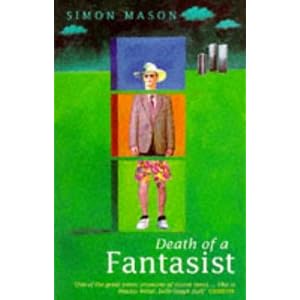
10) Death of a fantasist, Simon Mason
I don't know where I picked up this book, but the blurb on the front cover reckons it is 'One of the great comic creations of recent times' this is from the Observer newspaper and there are other glowing comments from The Sunday Times and Time Out. I looked on LT to find that only four other people have it in their libraries with no evidence of anyone having read it. Perhaps it is an undiscovered gem a real diamond in the rough; I started reading with anticipation.
The hero; Dudley the fantasist of the novel is in a deadend job in publishing in Oxford. He discovers his wife is having an affair and he finds it difficult to get out of bed in the morning. he has recently struck up a friendship with the morose Martin who he vaguely remembers from schooldays. Martin has been nominated for one of the advertising Oscars in New York and asks Dudley to accompany him. They fly to New where they meet Belle LaRose who will look after the pair for a week of publicity interviews culminating in the Oscar awards.
Dudley is not quite 'One of the great comic creations of recent times' (1994), especially as the author fails to elicit in me any sympathy for him. He stumbles through life with a vain hope of being successful and his only talent appears to be an ability to tell stories and to talk loquaciously about anything and everything. He soon finds out that his friend Martin is a sociopath and the trip to America brings out the worst in him. The novel takes on a darker feel as Martin soon becomes uncontrollable and purloins Dudley's razor.
The writing is witty and it kept me amused. There is plenty of healthy cynicism about the advertising industry and Dudley's wanderings in Central Park have a touch of underlying menace to them. The darker turn the book takes is handled well with Dudley managing to appear less and less connected to reality.
I think that Simon Mason struggles too hard at times to make the wit flow and overdoes it on occasions:
"Ask not for whom the car alarm whoops, it whoops for thee" is perhaps one of the worst witticisms in the book but there are others.
Not an undiscovered gem but not a bad read. The writing is for the most part intelligent and the novel builds towards its climax. I even laughed out loud a couple of times. I would rate the novel at 3 stars.
32baswood
We have had the most beautiful weather this week in the South West of France: temperatures have been up to 20 degrees centigrade with plenty of warm sunshine. I have been busy working in the vegetable garden and exploring the local countryside so less time for reading.
33baswood
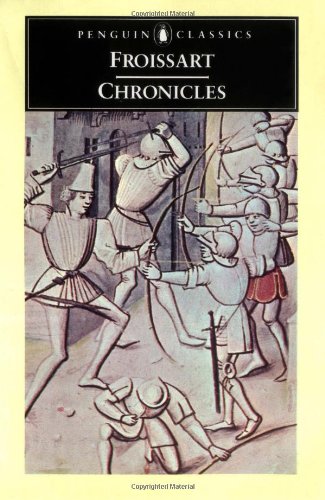
11) Chronicles, Froissart
This penguin classic edition was translated by Geoffrey Brereton and contains selections from the four books of chronicles written in the 14th century by Jean Froissart, who was at various times attached to the courts of Edward III, Richard II, and the Count of Foix. The chronicles were contemporaneous documents that recorded some of the major events of 14th century France and England. Froissart was writing for the educated classes of his time and so his accounts of events had to be realistic. They are in fact more than that as he has his own inimitable style that makes his narratives flow and the events described come alive on the page. He has been described as a forerunner of modern day journalists and I can certainly see why people hold this view.
His narrative accounts of the battles of Poitiers, Crecy, the siege of Calais and the peasants revolt of 1381 have been used extensively by modern day historians. In Froissart's hands they give a real feel for the age in which he was writing. There is plenty of information about how people lived and how they reacted. When he writes more provincially when he was attached to the Count of Foix we get some marvellous medieval tales of haunting, shape changing and sorcery. There is much here for the modern reader, I was enthralled by the descriptions of tournaments, coronations and marriages. His descriptions of the battlefield are at times frighteningly realistic and shot through with medieval lore
I learned much about the period from this book, but at the same time it is very entertaining. Froissart says that the French had come to the battlefield of Poitiers "splendidly provided like men who felt certain in advance of victory. They were routed and there was gold, silver plate, precious jewels, ornamental chests, and splendid cloaks pilfered from the aftermath. At other times the reader is hurled back into the realms of the 14th century when in a narrative description of Edward II's attempted escape from his pursuers we get Froissart saying
"Their plan was to escape to Wales.... but their sins weighed so heavily against them that God would not permit it."
We are told this about one of the brigand leaders that roamed France when King John was a prisoner in England
"This Sir Eustace performed many fine feats of arms and no one could stand up to him, for he was young and deeply in love and full of enterprise."
The English doctor who nursed King Charles VI back from an attack of "madness" goes back to England with a substantial reward but Friossart says of him:
"His only pleasure in life had been to amass great piles of florins. There were days when he hardly spent a penny of his own, but went round getting free meals and drinks wherever he could. All doctors suffer from such weaknesses"
This is a marvellous read and for me it is a 5 star book
34zenomax
Excellent excerpts you've provided Baswood. I particularly like the illustrative discourse on the weaknesses of doctors...
Looks like a splendid book.
Looks like a splendid book.
35baswood
12) Room, Emma Donoghue
I enjoyed Room. I found it easy to read with enough about it to linger in my thoughts, when I had finished reading
A difficult task to set the this novel's viewpoint as that of a five year old who is has been entrapped in a small room with his mother for the whole of his life. Jack tells his story in the first person and Donoghue pulls off quite brilliantly the trick of making it seem like it is a five year old speaking. Everything in the room is personified by Jack's lively imagination and this brings home the claustrophobic existence that mother and son are forced to endure. Observing Jack's reactions and thought processes made me wonder if Jack was suffering from autism of some kind and if so whether this could have been brought on by his unusual environment.
When Jack is out of the room then the novel changes perspective as it must do.
It is still Jack's story, but the drama of his situation has lapsed somewhat, but Donoghue uses this well to produce some hilarious moments, mainly at poor Grandma's expense. The mother and son relationship is at times in abeyance until the well worked ending.
I think that by choosing to tell this story from Jack's viewpoint Donoghue has both made her book original and true to life, but has also severely limited the drama and thought provoking analysis that one might expect from such a horrific story. After all the viewpoint of a barely five year old is somewhat restrictive.
I would struggle to rate this as a four star read so will settle with 3.5
I enjoyed Room. I found it easy to read with enough about it to linger in my thoughts, when I had finished reading
A difficult task to set the this novel's viewpoint as that of a five year old who is has been entrapped in a small room with his mother for the whole of his life. Jack tells his story in the first person and Donoghue pulls off quite brilliantly the trick of making it seem like it is a five year old speaking. Everything in the room is personified by Jack's lively imagination and this brings home the claustrophobic existence that mother and son are forced to endure. Observing Jack's reactions and thought processes made me wonder if Jack was suffering from autism of some kind and if so whether this could have been brought on by his unusual environment.
When Jack is out of the room then the novel changes perspective as it must do.
It is still Jack's story, but the drama of his situation has lapsed somewhat, but Donoghue uses this well to produce some hilarious moments, mainly at poor Grandma's expense. The mother and son relationship is at times in abeyance until the well worked ending.
I think that by choosing to tell this story from Jack's viewpoint Donoghue has both made her book original and true to life, but has also severely limited the drama and thought provoking analysis that one might expect from such a horrific story. After all the viewpoint of a barely five year old is somewhat restrictive.
I would struggle to rate this as a four star read so will settle with 3.5
36Poquette
Barry, I noted that elsewhere you said that you're beginning The Consolation of Philosophy. As you know, I've been on a bit of a Boethius kick for a while, so I'll be interested in your reaction. I've got to finish up my book of essays on Boethius edited by John Marenbon so I can move on.
37baswood
13) The vision of Piers Plowman, William Langland
I read the version published in Everyman and edited by A. V. C. Schmidt. This is the B text in Middle English and I found it a struggle to read. Having just read the Riverside Chaucer I was fairly optimistic I would cope with this, but Langland's English is different again and it has taken me about six weeks to read it through.
At the start of the poem Will is found wandering around the countryside and becoming tired he lays down to sleep and has a dream vision. This happens eight times during the course of the poem and so it does feel that the it stops and starts, sometimes covering ground previously covered. If I had to summarise the poem I would say that these visions demonstrate to Will what it takes to be a good Christian. The visions are in effect sermons or homily's in an allegorical framework, which at times spring into life and make it worthwhile to struggle on with the text. An example is the description of Gluttony:
His guttes gonne to gothelen as two gredy sowes;
He pissed a potel in a Paternoster-while
And blew his rounde ruwet at his ruggebones ende
That all that herde that horn helde hir nose after....
This example shows the alliteration that runs through the whole poem and makes it fun to read aloud
The poem has been the subject of much literary criticism and has been described as:
"An attack on church and state, a poem with unity"
or
"Has a tendency to rambling and vagueness sometimes degenerating into incoherence."
For me the answer lies somewhere between these two viewpoints. There are certainly vigorous attacks on the clergy especially the mendicant friars and on rich people in general, with an exhortation for the common man to follow the scriptures. This led me to wonder what audience had Langland in mind when he wrote the poem. It would have been far out of the reach of even the educated common man.
The text contains many Latin phrases, which are translated in footnotes in this version. The glosses beside the text are sometimes essential for an understanding but sometimes they get in the way and I found it was better to ignore them and just plough through reading aloud. This is not an essential read, but then I am glad I took the time to battle with it, perhaps I would have been better to have read it in translation, but then I would have missed out on the poetry of the original. Rating it is difficult but I'll give it 3.5 stars.
38baswood


14) La France de Raymond Depardon
This is the catalogue from the photographic exhibition at the Nationale Biblioteque in Paris. Depardon was commissioned to take picture of France and he had planned to do so using a large format camera and shooting in black and white which is his normal method. However he was unhappy with initial results and switched to a medium format camera using kodak colour film. His use of colour and drawing on his discipline of large format camera work has produced some marvellous pictures. He wanted to take pictures in the style of Walker Evans but soon realised that the Poitou-Charente in France is not the same as Alabama in the USA. However many of the pictures reminded me of Walker Evans: the shop fronts, the down at heel cafes and garages etc. Depardon says he wants to capture the space in between the towns and the countryside and so many of the pictures are of urban sprawl leeching into the surrounding country.
This is not digital photography every shot is carefully set up and once Depardon is under his red cloth behind his tripod and camera then there is no further movement he can make he can only wait for the light to be right.
Using a medium format camera has meant that the prints produced can be quite large with no loss of clarity. When I saw the pictures in the National Biblioteque the colours glowed beautifully. The catalogue is a lavish production of all the pictures that were on show and they continue to give me so much pleasure.
39janemarieprice
38 - Very nice. I just spent a little time looking through other images from the show.
40zenomax
Yes very nice indeed. I like the idea of the space between town and countryside as well - such transitions between two different realities always peeks my interest.
The images themselves are wonderful - it seems that the more utilitarian and everyday camera technology becomes, the less of an artform the output.
The images themselves are wonderful - it seems that the more utilitarian and everyday camera technology becomes, the less of an artform the output.
41baswood
Jane
Glad you were able to see more of the photo's from the show
Zenomax
I agree with your thoughts on camera technology. It has become so much easier to take technically proficient photographs, which can then be enhanced using computer programmes. The photograph as an art form has always had to struggle to be accepted as such and more recently it has become harder.
Glad you were able to see more of the photo's from the show
Zenomax
I agree with your thoughts on camera technology. It has become so much easier to take technically proficient photographs, which can then be enhanced using computer programmes. The photograph as an art form has always had to struggle to be accepted as such and more recently it has become harder.
42dchaikin
baswood, I'm just catching up with your thread and so reading about all these wonderful medieval texts and books on medieval Europe at once. Fascinating stuff, I've really enjoyed reading through your reviews here. Thinking about that Huizinga book.
43Poquette
Barry,
In thinking about your comment over on my thread about expanding your reading horizon to include writers before the 14th century, I have two equal and opposite thoughts, for what their worth. On the one hand, I have been admiring your "From the beginning" project. It is so nice and compact and will, quite admirably I think, turn you into something of an expert before you are done. I applaud your effort.
On the other hand, it can't help but increase the depth of your understanding to include in your studies some literature that preceded your chosen period. This came home to me as I began reading The High Medieval Dream Vision, which actually concentrates on poetic visionary writing in the 11th to 14th centuries, of which Piers Plowman was an obvious example, and the Consolation of Philosophy was an early prototype. Since you are now or have been imbibing examples of this genre -- not to mention some early works of Chaucer -- you might profit by the detour.
In thinking about your comment over on my thread about expanding your reading horizon to include writers before the 14th century, I have two equal and opposite thoughts, for what their worth. On the one hand, I have been admiring your "From the beginning" project. It is so nice and compact and will, quite admirably I think, turn you into something of an expert before you are done. I applaud your effort.
On the other hand, it can't help but increase the depth of your understanding to include in your studies some literature that preceded your chosen period. This came home to me as I began reading The High Medieval Dream Vision, which actually concentrates on poetic visionary writing in the 11th to 14th centuries, of which Piers Plowman was an obvious example, and the Consolation of Philosophy was an early prototype. Since you are now or have been imbibing examples of this genre -- not to mention some early works of Chaucer -- you might profit by the detour.
44baswood
#42
Hi Dan, I have been looking at your library and enjoyed reading through your reviews. I note that you have The finkler question on your current reading pile, which I hope to be getting to very soon.
Hi Dan, I have been looking at your library and enjoyed reading through your reviews. I note that you have The finkler question on your current reading pile, which I hope to be getting to very soon.
45baswood
Suzanne,
One of the joys of reading is to see where your current reading will take you to next. When I originally started my reading project I thought I would read Chaucer and Piers plowman and then hurry along to Edmond Spenser and the Silver poets. This is not going to happen. As you know I have become interested in The middle ages as a subject in itself and there is still much I want to read. An understanding of the period certainly increases the enjoyment of reading literature from the period and then of course there is the source material. All this together with recommendations from other LT readers will mean I will be going backwards in time before going forwards.
Already on my to read pile I have The Decameron. I have picked up also The world of Piers Plowman, Jeanne Krochalis and Edward Peters which claims to provide background material that is difficult to come by. Sir Gawain and the Green Knight, Simon Armitage arrived in the post yesterday and I have also a couple of versions of this in middle english and there is a pile of history books to read as well. I am also wondering whether I might read The Divine Comedy. I think the detour, as you put it, is turning into a journey all of its own
Of course I will be interested in what you think of The High Medieval Dream Vision
One of the joys of reading is to see where your current reading will take you to next. When I originally started my reading project I thought I would read Chaucer and Piers plowman and then hurry along to Edmond Spenser and the Silver poets. This is not going to happen. As you know I have become interested in The middle ages as a subject in itself and there is still much I want to read. An understanding of the period certainly increases the enjoyment of reading literature from the period and then of course there is the source material. All this together with recommendations from other LT readers will mean I will be going backwards in time before going forwards.
Already on my to read pile I have The Decameron. I have picked up also The world of Piers Plowman, Jeanne Krochalis and Edward Peters which claims to provide background material that is difficult to come by. Sir Gawain and the Green Knight, Simon Armitage arrived in the post yesterday and I have also a couple of versions of this in middle english and there is a pile of history books to read as well. I am also wondering whether I might read The Divine Comedy. I think the detour, as you put it, is turning into a journey all of its own
Of course I will be interested in what you think of The High Medieval Dream Vision
46dchaikin
#44 - I finished the Finkler Question, but haven't reviewed it yet...an actually I'm not sure how to review it...I'm not sure if i liked it or not.
47baswood
My wife Lynn is currently reading The Finkler Question and she is underwhelmed by it. I will have to read it soon as we have borrowed it from a friend.
48baswood
15) Such a long Journey, Rohinton Mistry
This is Rohinton Mistry's first novel published in 1991 and shortlisted for the Booker prize of that year. It is the story of a community living in and around an old block of flats in Bombay(Mumbai). Gustad Noble and his family struggle to keep pace with the rising cost of living brought about by the corrupt government of Indira Gandhi and the war with Pakistan in 1971. Tensions within his family combine with illness and a corrosion of the society around him to test his strength and humanity.
Gustad gets involved in a plot to fund freedom fighters in East Pakistan, through his friendship with a member of the Indian secret service. While this storyline places Gustad at risk and adds tension to the story I found it the least successful part of the novel. It is the characters in and around Khodadad Building that bring this novel to life. There are some marvellous portraits drawn by Mistry; Tehmal the mentally impaired youth that only Gustade can understand, Dinshawji, Gustads work colleague fighting a terminal illness with humour and high spirits, Peerbhoy the Paanwalla dispensing paan and tall stories outside the local brothel, Miss Kalpitia a Miss Haversham like figure who casts spells for and on the inhabitants of the Building. Many more characters provide a rich tapestry of Indian urban life and are expertly woven into the plot.
Gustad's family are Zoroastrians and Mistry gives us a peek into the religious life of the family: the funerals and the towers of silence, the prayers and the ritual of kusti and how they fit into a society where they are in a minority. This is such a well written book full of atmosphere and character development. Mistry brilliantly shows us the proud Gustad bearing up to the challenges that threaten to tear him apart and becoming more human in the process. Through all the adversity Mistry gives his characters dignity and hope. There is an optimism that despite all of the things happening to them, which are beyond their control and which show no sign of changing for the better, the characters in the story will get through it all and India will endure.
This excellent novel with its superb characters and descriptions of Indian urban life deserves to be read especially if you have enjoyed A fine balance
This is every bit as good and I would give it something over 4 stars.
49dchaikin
#48 A Fine Balance is on my wishlist, and a book I would really like to get to. I'll try to keep this one in mind for when I get there.
50Poquette
Barry, an intriguing review of the Mistry book. I'm adding it to my list and hoping I'll get it, but the TBR is now beginning to depress me. So many books and so little time . . .
51baswood
Dan & Suzanne,
That's the problem with reading these threads, so many interesting books out there. I read all the reviews that people post and then agonise whether I can squeeze another book into my reading schedule. I have had to buy another bookcase for my room and already this is half full of books that I have bought mainly due to recommendations. Where will it all end.......
That's the problem with reading these threads, so many interesting books out there. I read all the reviews that people post and then agonise whether I can squeeze another book into my reading schedule. I have had to buy another bookcase for my room and already this is half full of books that I have bought mainly due to recommendations. Where will it all end.......
52baswood
16) The Consolation of Philosophy, Boethius
Boethius was the adopted son of Symmachus a highly committed christian and consul at Rome in the late 5th century AD. Boethius in his turn also became consul and the was then appointed by Theodric (King of Italy) to a high ranking position at his court at Ravenna. After a year in post Boethius fell foul of court intrigue and was imprisoned on charges of treason. Whilst in prison and hopeful of reprieve he wrote the Consolation of philosophy. His reprieve never came and he was executed around 525 AD.
The Consolation is not a religious tract, it is more a philosophical argument for the existence of God and its aim is to provide comfort to all unfortunate souls who find themselves like Boethius in extreme distress. There are five short books: Book 1: introduces the persona of philosophy and Boethius pours out to her his woes. She promises to provide medicine to cure his moral sickness. Book 2: is a condemnation of the material advantages that Boethius has already enjoyed and looks forward to a time when these will no longer be needed. Book 3: examines the nature of true happiness and the search for true good and puts forward the idea that the perfect good in which lies true happiness is God. Book 4: examines whether God apportions appropriate justice to good and evil men in the world and attempts to explain the apparent irrationality in which the widespread operation of chance seems to be at odds with Gods wise governance. Book 5: asks the question; how can man's free will be reconciled with divine providence. a summary of the arguments then lead the prisoner to spiritual freedom, to shake off the shackles of earthly serfdom and rise to be at one with God.
When philosophy first visits Boethius he is surrounded by the muses of poetry, which she drives away calling them "these harlots". A question the reader might ask is whether Boethius would have been better off sticking with the muses of poetry. I think the logical arguments that are easily followed would convince many people that philosophy is the better bet. There are of course gaps in the logic to the modern mind but overall I thought that much of what is said seemed to speak to me down the ages. The one big issue that is not examined satisfactorily is why there is evil in the world If God is omnipotent, A knotty question I know but the consolation seems to shy away from this.
I read the Oxford world's classics edition translated and introduced by P G Walsh, which I found to be excellent. Each chapter of text is either introduced or followed by a poem and these are worth the price of the book alone. They either sum up the text or give additional information. I loved them. Walsh provides plenty of background information and his notes are easy to follow and precise. The only advice I would give to readers before starting the book would be to make sure that they are familiar with the basic tenets of Neoplatonism. Walsh has a short chapter on it but to get the most out of the consolation which is based on neoplatonism do a bit of background reading.
I will return to this marvellous little book, especially those poems and I would rate this a 5 star read.
53janeajones
Great review. I've never managed to get through Boethius (probably because of my antipathy to religion in general -- I definitely would prefer to talk the the Muses of Poetry rather than Philosophy) That said, Boethius certainly was a major presence in the MA -- even Chaucer translated the Consolation.
54Poquette
Barry, my first impulse was to thank you for your wonderful review of the Consolation which, as you know, is such a favorite of mine. You have captured its essence beautifully. May I add my voice in support of the P.G. Walsh translation. As you pointed out, because there are so many classical allusions particularly in the poetry, his notes are invaluable and help to make the poetry come to life. Excellent job! Bravo!
55bragan
I almost bought a copy of The Consolation of Philosophy after reading an engaging discussion of it in Jennifer Michael Hecht's Doubt: A History. I don't know why I didn't, but it's back on my wishlist now, anyway. Like janeajones, I have a certain antipathy to religion, but I do sometimes find myself interested in reading other people's ideas about it, particularly when they have an important influence on culture.
56baswood
Hi janeajones and Bragan.
Like yourselves I am not a follower of any formal religion and I suppose I would describe myself as agnostic. I read the Consolation of Philosophy following my interest in Chaucer and and late medieval literature in general. As you say Boethius had a tremendous influence on late medieval thought and I wanted to read him for myself to give me more of an insight into how people in the middle ages saw the world. I was surprised however at just how much of the consolation is relevant to my thinking today(my own world view if you like). The consolation could be described as a route to God through philosophy rather than faith; I could almost buy that. Also the writing as translated by Walsh is a joy to read and those poems are great.
Like yourselves I am not a follower of any formal religion and I suppose I would describe myself as agnostic. I read the Consolation of Philosophy following my interest in Chaucer and and late medieval literature in general. As you say Boethius had a tremendous influence on late medieval thought and I wanted to read him for myself to give me more of an insight into how people in the middle ages saw the world. I was surprised however at just how much of the consolation is relevant to my thinking today(my own world view if you like). The consolation could be described as a route to God through philosophy rather than faith; I could almost buy that. Also the writing as translated by Walsh is a joy to read and those poems are great.
57baswood
Hi Susanne,
It is me that should be thanking you, as you recommended to me the translation by P G Walsh. Glad you liked my review. Keep the recommendations coming
It is me that should be thanking you, as you recommended to me the translation by P G Walsh. Glad you liked my review. Keep the recommendations coming
58Poquette
Barry, I almost could have written #56. I too am on the agnostic fence with perhaps some deistic overtones. Many have questioned Boethius's religious faith because he chose Lady Philosophy as his guide. But how ingenious it was to argue for a path to God by choosing a neutral guide.
59JanetinLondon
I enjoyed your review of Such a Long Journey. I read it recently, too, and really liked it. I picked it up because I read it had been banned by Mumbai University for its unflattering portrayal of one of the political parties (can't remember which at the moment - Shiv Sena??) - I didn't think it was particularly unflattering, and felt perhaps Indian politicians are even more sensitive to criticism than western ones, but it doesn't seem there was any reason to ban the book in my opinion.
60dchaikin
#58 - Sounds intentionally insidious. Once you introduce something outside faith to argue for God, you open up the possibility that one can use the same method of argument against God. There is no logical arguments against faith, which isn't a logical stance. But there are many different ways to go if you focus on a philosophical path.
62baswood
Hi Janet,
Glad you enjoyed the review. You were right about the banning of the book recently. It was Shiv Sena. I found the extract below from the NZSA freedom watch website. Very sensitive politicians or perhaps they just wanted more publicity
"On 19 October 2010 the award-winning novel by Indian-born Canadian author Rohinton Mistry Such a Long Journey was cut from Mumbai University’s reading list after complaints from an extremist group, nationalist Shiv Sena, which has a reputation for using violence to intimidate opponents. The Guardian newspaper gives the following background:
The banned book is set in India in the 1970s. Published in 1991 and shortlisted for the Booker prize, it describes the life and loves of a bank clerk from Mumbai's Parsee community against a background of political unrest. The Shiv Sena are described in broadly negative terms.
Mohan Rawale, a Shiv Sena official, said the book was full of "very bad, very insulting words", especially about Bal Thackeray, 83, the group's founder and leader.
"It is our culture that anything with insulting language should be deleted. Writers can't just write anything. They can't write wrong things," said Rawale, who admitted not having read the book.
The campaign to ban Such a Long Journey was launched by Aditya Thackeray, the leader's grandson and son of the current executive president of Shiv Sena, who is head of the group's youth wing. Analysts say the group is using the issue to launch Aditya Thackeray's political career"
Glad you enjoyed the review. You were right about the banning of the book recently. It was Shiv Sena. I found the extract below from the NZSA freedom watch website. Very sensitive politicians or perhaps they just wanted more publicity
"On 19 October 2010 the award-winning novel by Indian-born Canadian author Rohinton Mistry Such a Long Journey was cut from Mumbai University’s reading list after complaints from an extremist group, nationalist Shiv Sena, which has a reputation for using violence to intimidate opponents. The Guardian newspaper gives the following background:
The banned book is set in India in the 1970s. Published in 1991 and shortlisted for the Booker prize, it describes the life and loves of a bank clerk from Mumbai's Parsee community against a background of political unrest. The Shiv Sena are described in broadly negative terms.
Mohan Rawale, a Shiv Sena official, said the book was full of "very bad, very insulting words", especially about Bal Thackeray, 83, the group's founder and leader.
"It is our culture that anything with insulting language should be deleted. Writers can't just write anything. They can't write wrong things," said Rawale, who admitted not having read the book.
The campaign to ban Such a Long Journey was launched by Aditya Thackeray, the leader's grandson and son of the current executive president of Shiv Sena, who is head of the group's youth wing. Analysts say the group is using the issue to launch Aditya Thackeray's political career"
63janeajones
Well -- I've put Such a Long Journey on my wishlist -- first because of your review, and then because of the banning and then because of the references to Bal Thackeray, whom Salman Rushdie skewers in The Moor's Last Sigh.
64baswood
Yesterday I went to a meeting of a local book club. The first time I have been to such a meeting. I enjoyed myself. It took me back to the time when I was doing Open University courses. The books we had read and were going to talk about were Room and Translations, Brian Friel. Everybody was enthusiastic about Room and it was good to hear how people had got so emotionally involved with it. I had enjoyed Room but I had some reservations about it and so we had a lively discussion.
Not everybody had gotten round to reading Translations which was a shame because it is excellent. It is a play and so some people were put off by that and others could not manage to read two books in the time scale (its six weeks). For goodness sake I thought we are all retired expats with nothing much to do but look after our old houses. One lady said she felt guilty about reading a book in the afternoons. I said I felt guilty if I didn't manage to read a book in the afternoons.
Of course because the venues for the meetings are held at club members homes, then I will get the opportunity to look round at least eight more houses, just to inspect their bookshelves you understand. I told them all about Librarything and so I need to be a bit careful in case they find me on here. The books we have chosen to read for our next meeting are The junior officers' reading club, Patrick Hennessey and The Vagabond, Colette
Not everybody had gotten round to reading Translations which was a shame because it is excellent. It is a play and so some people were put off by that and others could not manage to read two books in the time scale (its six weeks). For goodness sake I thought we are all retired expats with nothing much to do but look after our old houses. One lady said she felt guilty about reading a book in the afternoons. I said I felt guilty if I didn't manage to read a book in the afternoons.
Of course because the venues for the meetings are held at club members homes, then I will get the opportunity to look round at least eight more houses, just to inspect their bookshelves you understand. I told them all about Librarything and so I need to be a bit careful in case they find me on here. The books we have chosen to read for our next meeting are The junior officers' reading club, Patrick Hennessey and The Vagabond, Colette
65baswood
17) Translations, Brian Friel
I almost feel guilty calling this my number 17 read this year as it is barely 60 pages, but in my defence I did read it twice and the second time I read it was straight after the first time-it was that good.
Its a short three act play set in Ireland in 1833. English soldiers from the Royal Engineers have set up camp near a small catholic community in order to check the maps of the area and to Anglicise the place names. All three acts take place in the local hedge school and centre on the worsening relations between the soldiers and the locals. It is however so much more than that. During its short duration the play covers issues such as : the importance of language, failure of communications, cultural differences, community, colonialism, development and change, difficulties of making a living, and terrorism. I forgot to mention love, there are even star crossed lovers to tear at the heart strings.
The writing is superb, hardly a word wasted and after its hour and a half duration the characters will live long in the memory. The 60 year old "infant prodigy" who is fluent in Gaelic, Greek and Latin but does not speak any English. Hugh the drunken master of the school who is convinced that he is going to be master of the new proper school. Sarah who has a severe speech impediment and so has no language and doesn't count for anything. George Yolland a reluctant soldier who falls in love with the countryside and wants to be accepted by the community, but of course cannot understand anything they say.
Together with the tragedy there is much wit and humour and I found myself identifying with the Yolland character and his attempts to integrate into a different culture. There are some memorable lines (the sign of a good play):
George Yolland "Even if I did speak Irish I would always be an outsider here, wouldn't I? I may learn the password but the language of the tribe will always elude me.
Hugh "English succeeds in making it sound .....plebeian
Hugh "I'm afraid we are not familiar with your literature, Lieutenant. We feel closer to the warm mediterranean. We tend to overlook your island.
Of course to really appreciate a play it needs to be seen in performance in a theatre with a live audience, so that you can be caught up in the emotions and can laugh along with the jokes. What a performance it must have been at its first presentation at the Guildhall in Derry, with Liam Neeson, Ray McAnally and Stephen Rae in the cast.
Translations is a 5 star play for me and I am already looking forward to reading it again.
I almost feel guilty calling this my number 17 read this year as it is barely 60 pages, but in my defence I did read it twice and the second time I read it was straight after the first time-it was that good.
Its a short three act play set in Ireland in 1833. English soldiers from the Royal Engineers have set up camp near a small catholic community in order to check the maps of the area and to Anglicise the place names. All three acts take place in the local hedge school and centre on the worsening relations between the soldiers and the locals. It is however so much more than that. During its short duration the play covers issues such as : the importance of language, failure of communications, cultural differences, community, colonialism, development and change, difficulties of making a living, and terrorism. I forgot to mention love, there are even star crossed lovers to tear at the heart strings.
The writing is superb, hardly a word wasted and after its hour and a half duration the characters will live long in the memory. The 60 year old "infant prodigy" who is fluent in Gaelic, Greek and Latin but does not speak any English. Hugh the drunken master of the school who is convinced that he is going to be master of the new proper school. Sarah who has a severe speech impediment and so has no language and doesn't count for anything. George Yolland a reluctant soldier who falls in love with the countryside and wants to be accepted by the community, but of course cannot understand anything they say.
Together with the tragedy there is much wit and humour and I found myself identifying with the Yolland character and his attempts to integrate into a different culture. There are some memorable lines (the sign of a good play):
George Yolland "Even if I did speak Irish I would always be an outsider here, wouldn't I? I may learn the password but the language of the tribe will always elude me.
Hugh "English succeeds in making it sound .....plebeian
Hugh "I'm afraid we are not familiar with your literature, Lieutenant. We feel closer to the warm mediterranean. We tend to overlook your island.
Of course to really appreciate a play it needs to be seen in performance in a theatre with a live audience, so that you can be caught up in the emotions and can laugh along with the jokes. What a performance it must have been at its first presentation at the Guildhall in Derry, with Liam Neeson, Ray McAnally and Stephen Rae in the cast.
Translations is a 5 star play for me and I am already looking forward to reading it again.
66janeajones
I read Translations for the first time a couple of years ago when I was teaching it in English Lit -- I found it fascinating, and I think my students enjoyed it too. I'd love to see a production.
67Poquette
Barry, your book group is a hoot! Especially love the guilt part. Are you serious? How could one feel guilty about reading in the afternoon??? I'm with you. An afternoon spent not reading is a wasted afternoon. IMHO.
As for the chances of them discovering you on here, don't worry too much. My own brother, who has cataloged his library here, has never bothered to come check out my thread even though I've mentioned it. His eyes would probably glaze over if he did, so it's probably just as well. Not to worry. ;-)
As for the chances of them discovering you on here, don't worry too much. My own brother, who has cataloged his library here, has never bothered to come check out my thread even though I've mentioned it. His eyes would probably glaze over if he did, so it's probably just as well. Not to worry. ;-)
68baswood
Suzanne, Yes the book group is a hoot. When I look back on it. When there was a discussion about whether people could manage to read two books in the time, someone suggested we watch a film instead. I thought surely this would make it a film club.
The dynamics of the group I think will be interesting. From what I can gather it was a women only group who because of loss of membership wanted to attract more people. I don't think they were expecting three men to turn up. One of the men is a published author, an American now living in France who spent a good part of his life as a hermit/monk. A spiritual man who has interesting things to say about the art of writing. The other man is a friend of mine who wanders all over the place in his thoughts but usually comes up with something thought provoking. We will see how it all develops.
The dynamics of the group I think will be interesting. From what I can gather it was a women only group who because of loss of membership wanted to attract more people. I don't think they were expecting three men to turn up. One of the men is a published author, an American now living in France who spent a good part of his life as a hermit/monk. A spiritual man who has interesting things to say about the art of writing. The other man is a friend of mine who wanders all over the place in his thoughts but usually comes up with something thought provoking. We will see how it all develops.
70baswood
Its English. We are all very English (apart from the American of course who is not English at all)
71baswood


Music
Spectacular strings, virtuoso pieces for strings - Michael Erxleben
Music by Ottorino Respighi and camille Saint-Saens. These are transcriptions from baroque works given the 19th century romantic treatment by Respighi and Saint-saens. For me they work really well. This is a demonstration disc recording and the strings sound wonderful. Brilliant solo violin by Erxleben. This has been on my disc player all week.
Zima Junction - Mark Burgess and the sons of God
Mark Burgess is the lead singer and bass player with the jangly guitar group "Chameleons" These tracks were originally demos for that group and most of them sound like it. A couple of strong songs does not a good CD make.
Bill La Bounty - This night can't last forever
A 1970's songwriter who made a few records. Instantly forgettable. Too MOR for me.
72amandameale
Hello Barry
It has taken me all this time to find "baswood"'s thread and a very entertaining thread it is. I'll be interested to hear about 2666 when you get to it. I own it but I'm daunted by the size.
It has taken me all this time to find "baswood"'s thread and a very entertaining thread it is. I'll be interested to hear about 2666 when you get to it. I own it but I'm daunted by the size.
73baswood
Hi Amanda, glad you found me at last. I have still got 2666 on my to read pile. I think that Le Salon are doing a group read of it later this year and so I might wait until they get started
I had a peek at your library. You have some great books. I am a big fan of Patrick White. I read fringe of leaves recently and I must have read most of his novels at some time or another, but he is an author I look forward to re-reading and so I might read some more this year
I had a peek at your library. You have some great books. I am a big fan of Patrick White. I read fringe of leaves recently and I must have read most of his novels at some time or another, but he is an author I look forward to re-reading and so I might read some more this year
74zenomax
~70 - ok, wasn't sure if you were 'in' with the locals. Assuming here that this is all taking place in France.
What do you think of Colette? I think you are reading her for your next book group get together?
~71 - interesting array of musical styles there. I like mixing music in with reading - sometimes a randon track seems to mesh closely with what you are reading - producing something more than the sum of the 2.
What do you think of Colette? I think you are reading her for your next book group get together?
~71 - interesting array of musical styles there. I like mixing music in with reading - sometimes a randon track seems to mesh closely with what you are reading - producing something more than the sum of the 2.
75baswood
Hi zenomax,
My french isn't good enough to join a french speaking book club, but last year I did read Le ble en herbe by Colette in french. It took me the best part of four months to read it and although I did struggle with the french I could not fail to admire the sensuous language. I am looking forward to reading more but in translation this time.
I can't listen to music and read a book at the same time, one or the other would pass me by in some sort of blur. I do however tune into music when watching films. I always seem to be very aware of the music and will often judge a film by how good the music score fits with the visual experience.
My french isn't good enough to join a french speaking book club, but last year I did read Le ble en herbe by Colette in french. It took me the best part of four months to read it and although I did struggle with the french I could not fail to admire the sensuous language. I am looking forward to reading more but in translation this time.
I can't listen to music and read a book at the same time, one or the other would pass me by in some sort of blur. I do however tune into music when watching films. I always seem to be very aware of the music and will often judge a film by how good the music score fits with the visual experience.
76zenomax
Have you seen Derek Jarman's final film, Blue?
Just been looking at excerpts on youtube - looks very interesting.
Just been looking at excerpts on youtube - looks very interesting.
77baswood
No not seem the film, but have just been tuning into youtube. At first glance the soundtrack is the film. Very interesting and the final 7 min section is haunting.
78baswood
18) Sieges of the middle ages, Philip Warner I read this to continue with background reading on the middle ages. I should not have bothered with this
I wanted to find out more about military tactics during the period of the 100 years war and the book started out promisingly enough with an overview of siege techniques some weaponry and castle building. Barely a quarter of the way through it then turned itself into a galloping history; covering a 450 year period in a 160 pages. Some of the more famous sieges of the period were covered but in such a superficial fashion that it was difficult to gain any knowledge about them.
I am not sure who this book was aimed at. The casual reader would be bored with the one dimensional history and it is of little use to the more knowledgeable reader. I suppose it might serve as a basic introduction. It was originally published in 1968.
I could only rate this as 2 stars.
I wanted to find out more about military tactics during the period of the 100 years war and the book started out promisingly enough with an overview of siege techniques some weaponry and castle building. Barely a quarter of the way through it then turned itself into a galloping history; covering a 450 year period in a 160 pages. Some of the more famous sieges of the period were covered but in such a superficial fashion that it was difficult to gain any knowledge about them.
I am not sure who this book was aimed at. The casual reader would be bored with the one dimensional history and it is of little use to the more knowledgeable reader. I suppose it might serve as a basic introduction. It was originally published in 1968.
I could only rate this as 2 stars.
79baswood


La profondeur des champs sillon 2, Daniel Michiels
This is a catalogue from a black and white photo exhibition that I saw last week at the Abbye de Flaran near Valence-sur-baise here in the Gers. The subject of the photos was the farm and the countryside with an underlying theme of death and decay. Some good images that were taken with care and I enjoyed the exhibition. Perhaps a few too many dead animals for me.
80Poquette
Barry, despite the death and decay, the photos are evocative in a way that only black-and-white photos can be.
82baswood
Hi Suzanne and zenomax,
The picture of the dead wild boar and the hunting dog is particularly evocative at the moment here in the Gers. We are just coming to the end of the hunting season. (This last week I have been watching the hunt from the windows in the front of the house that have views across the fields to the woods.) The annual hunt dinner for our tiny village takes place next Sunday and I will be helping in the kitchen and serving the food at the village hall
The picture of the dead wild boar and the hunting dog is particularly evocative at the moment here in the Gers. We are just coming to the end of the hunting season. (This last week I have been watching the hunt from the windows in the front of the house that have views across the fields to the woods.) The annual hunt dinner for our tiny village takes place next Sunday and I will be helping in the kitchen and serving the food at the village hall
83Poquette
Speaking of the Gers, this weekend I saw some gorgeous photos of La Romieu. Is that near you?
84baswood
Suzanne, La Romieu is in the north of the Gers department and we are in the South West near Marciac and about I hour and 30 mins drive. We have not been to la Romieu yet, but will try and go next time we visit L'Abbaye de Flaran which is quite nearby
85Poquette
I finally looked you up in my now old (1985 -- yikes! It's been 25 years since I bought that thing?) Times Atlas, so I have a clear picture of exactly where you are. And I saw Valence-sur-Baïse and La Romieu as well. I dare say getting to a direct road is half the battle. You picked a beautiful part of the world to settle in.
86baswood
19) Shriek: an afterword by Jeff vandermeer.
A fantasy novel that builds a convincing world.This for me is the major strength of this book along with good writing and attention to detail. I found myself immersed in Vandermeer's city of Ambergris. A city where humanoids live above a world of fungi that insidiously seeps into their world. The spores are everywhere ingested and digested, changing, modifying and killing the largely unsuspecting humans.
The story is told via the journal of Janice, sister to the historian Duncan. We first meet Janice as she hosts a party and realise that this is a fundamental event in her and her brother's life. Duncan we learn has been missing for some time and the journal tells the back story. It jumps around in time and has at some point been edited by Duncan. Janice has been the owner of a trendy art gallery but is now in reduced circumstances, she has always had a close relationship with her brother and a difficult one with his lover the toast of the town Mary Sabon. In time honoured fashion Duncan has unearthed secrets of the fungi world seething below the city, but his research and warnings have increasingly been discredited and Duncan is changing.....
Vandermer's technique in the use of the journal to fracture time and to give different voices to the story is done in masterly fashion. I never lost sight of the storyline and enjoyed the interjections by Duncan that fleshed out the continuing mystery. Power in Ambergris is shared by it's two publishing houses.
It is a city that has lost 25000 people in its recent past through an unexplained event known as "The Silence" and more recently a city that is disfigured by a war between various factions.
The novel is in two parts: the first deals with creating the world filling in the history and peopling it with characters that move the plot along. Part two blazes in with Janice's story of the war and its aftermath, here the writing takes on an urgency that propels the story forward. There are underlying themes of identity, alienation and obsession.
I found my attention wandering away from the book at times, but this is not unusual for me while reading books in the fantasy genre. I have come to the conclusion that this maybe because many writers seem to take their creations so seriously. There seems to be no room for humour in these tomes. I want to say to them "For goodness sake guys lighten up"
Shriek was good enough for me to want to read the couple of other books Vandermeer has written based on the city of Ambergris. A strange and fascinating place so well described. I would rate this book at 3.5 stars.
87Poquette
Hi Barry,
I was struck by your opening statement: "A fantasy novel that builds a convincing world." This propensity toward world-building that is common to fantasy and science fiction has a long and illustrious history. I was thinking about it while reading The Pagan Dream. Almost all the Renaissance figures Godwin writes about were engaged in creating a personal universe in microcosm in one way or another, whether it was building temples to the gods, decorating palaces, creating magnificent gardens, or composing operas -- the list goes on. One of the attractions of sci fi is exactly this feature which allows the reader to participate, all be it vicariously, in an alien world.
I haven't read any Vandermeer, but I'll keep it in mind. Thanks for your excellent review!
I was struck by your opening statement: "A fantasy novel that builds a convincing world." This propensity toward world-building that is common to fantasy and science fiction has a long and illustrious history. I was thinking about it while reading The Pagan Dream. Almost all the Renaissance figures Godwin writes about were engaged in creating a personal universe in microcosm in one way or another, whether it was building temples to the gods, decorating palaces, creating magnificent gardens, or composing operas -- the list goes on. One of the attractions of sci fi is exactly this feature which allows the reader to participate, all be it vicariously, in an alien world.
I haven't read any Vandermeer, but I'll keep it in mind. Thanks for your excellent review!
88baswood
Suzanne,
Interesting thoughts about world building and creating a personal universe. Of course the Renaissance figures in The pagan Dream would be much more concrete than a fantasy alien world, but the dream visions certainly have some similarities. The medieval dream visions were there to impart a message to the reader/listener and this would probably be religious and/or moral. This is not unlike many of the novels in the modern fantasy genre. Here's a thought - Chaucer the father of the English fantasy novelists with his House of fame only beaten to the punch for the worldwide title by Dante
Interesting thoughts about world building and creating a personal universe. Of course the Renaissance figures in The pagan Dream would be much more concrete than a fantasy alien world, but the dream visions certainly have some similarities. The medieval dream visions were there to impart a message to the reader/listener and this would probably be religious and/or moral. This is not unlike many of the novels in the modern fantasy genre. Here's a thought - Chaucer the father of the English fantasy novelists with his House of fame only beaten to the punch for the worldwide title by Dante
89baswood
20) The world of Piers Plowman, Jeanne Krochalis
This is a book that aims to present background reading for people that are reading or have read Langland's Piers Plowman The introduction surmises that the original readers of Piers Plowman in the 14th century may well have been familiar with some or all of the texts represented in this book. Some of the texts come from the same manuscript/book that contained Piers plowman.
For the most part we get extracts from longer texts, which are enough to give a flavour of the works as a whole, the majority of the extracts are between 1 to 4 pages in length some are in middle english with glosses and others are modern translations from original Latin texts. All are introduced with a brief summary and history and information as to where they can be found. The authors wherever possible link the extracts to relevant sections in Piers Plowman.
There is a good selection. Of course there are extracts from sermons and the lives of saints along with criticisms of the priesthood and extracts from Papal Bulls. There is information on the model of the universe and the heavens as well as England and the city of London (some of the extracts date from the 12th and 13th centuries). There are instructions for those considering a devotional life and criticisms and condemnations of Wycliffe and the Lollards. There are extracts from Guild and fraternity documents and moral treatise.
I thought I might just dip into this book, but found it interesting enough to read through. There are some gems:
The revelation of Golias the bisshoppe, which is a dream vision in verse form detailing the corruption of the clergy from the Pope downwards.
Instructions for the purchasing of indulgences and the protections you would gain and how much you should pay
William Fittzstephen's Description of London 1180, "the mild sky doth soften hearts of man"
"If deth go faste on a man speke to him thus" are instructions to assist a person in Holy dying.
This is not an essential book but to anyone interested in reading the sort of literature that was in evidence in the late middle ages, then this is a good introduction. Difficult to assess this book but I would give it 3.5 stars because it does achieve what it sets out to do.
This is a book that aims to present background reading for people that are reading or have read Langland's Piers Plowman The introduction surmises that the original readers of Piers Plowman in the 14th century may well have been familiar with some or all of the texts represented in this book. Some of the texts come from the same manuscript/book that contained Piers plowman.
For the most part we get extracts from longer texts, which are enough to give a flavour of the works as a whole, the majority of the extracts are between 1 to 4 pages in length some are in middle english with glosses and others are modern translations from original Latin texts. All are introduced with a brief summary and history and information as to where they can be found. The authors wherever possible link the extracts to relevant sections in Piers Plowman.
There is a good selection. Of course there are extracts from sermons and the lives of saints along with criticisms of the priesthood and extracts from Papal Bulls. There is information on the model of the universe and the heavens as well as England and the city of London (some of the extracts date from the 12th and 13th centuries). There are instructions for those considering a devotional life and criticisms and condemnations of Wycliffe and the Lollards. There are extracts from Guild and fraternity documents and moral treatise.
I thought I might just dip into this book, but found it interesting enough to read through. There are some gems:
The revelation of Golias the bisshoppe, which is a dream vision in verse form detailing the corruption of the clergy from the Pope downwards.
Instructions for the purchasing of indulgences and the protections you would gain and how much you should pay
William Fittzstephen's Description of London 1180, "the mild sky doth soften hearts of man"
"If deth go faste on a man speke to him thus" are instructions to assist a person in Holy dying.
This is not an essential book but to anyone interested in reading the sort of literature that was in evidence in the late middle ages, then this is a good introduction. Difficult to assess this book but I would give it 3.5 stars because it does achieve what it sets out to do.
90janeajones
Sounds intriguing -- I may have to give this one a look someday.
91baswood
#90
I am not sure who the book is aimed at. It looks and feels like it could be for pupils who are taking courses in medieval studies.
I am not sure who the book is aimed at. It looks and feels like it could be for pupils who are taking courses in medieval studies.
92baswood
21) The Finkler question, Howard Jacobson A superb novel and in my opinion fully deserved to win the Man Booker prize 2010
I was hooked from the start by its great opening line "He should have seen it coming" and from then on the novel had me in its grip right through to the end. The book is both funny and sad and like many great novels sweeps the reader along into the realms of tragedy. The humour is one aspect of the book that keeps nudging you along, sometimes witty sometimes black and sometimes just plain laugh out loud funny. Jacobson laughs at his characters: their foibles, their self righteousness, their pride and in Treslove's case his ineptitude. He also pulls off the trick of his characters laughing at themselves and so I found myself laughing both with them and at them. Jacobson comments towards the end of the novel that "You never know what a Jew was or was not going to find funny"
The books title led me to ask what is The Finkler question? One answer is and a major thread running through the novel is the pressures on Jews living in Western societies in today's increasingly hostile world. All aspects are covered and each person in the novel finds him/herself coping with the feeling that there is a continual battle to justify their existence in the world. Even the non Jew Treslove who desperately wants to become part of the Jewish culture is affected he becomes a kind of a sponge for the feelings of the Jews around him.
For me the big theme and therefore the Finkler question is guilt. Everybody tries to deal with or cover up their guilt. The tragedy is that mostly they fail and either destroy themselves or become so bent out of shape as to become unrecognisable to themselves and to others. Along with the guilt comes grief and this is reflected by many of the characters suffering actual grief for a lost love or friendship.
I know that some readers have found the characters annoying especially Treslove. I found them very human and sad person that I am I could identify with most of them. On a personal note my first wife was Jewish and we lived with her family for a while and so like Treslove I found myself absorbing the culture all around me, which is all embracing; you can get kind of smothered by it all and this comes across in Jacobson's novel. Many of the Yiddish phrases used had become part of my language and brought back all sorts of fond memories.
There are other important themes running through this novel: friendship, fidelity, hatred, ageing, cross cultural difficulties to name a few all given intelligent and thought provoking analysis by Jacobson. This is a great novel and a 5 star read
I was hooked from the start by its great opening line "He should have seen it coming" and from then on the novel had me in its grip right through to the end. The book is both funny and sad and like many great novels sweeps the reader along into the realms of tragedy. The humour is one aspect of the book that keeps nudging you along, sometimes witty sometimes black and sometimes just plain laugh out loud funny. Jacobson laughs at his characters: their foibles, their self righteousness, their pride and in Treslove's case his ineptitude. He also pulls off the trick of his characters laughing at themselves and so I found myself laughing both with them and at them. Jacobson comments towards the end of the novel that "You never know what a Jew was or was not going to find funny"
The books title led me to ask what is The Finkler question? One answer is and a major thread running through the novel is the pressures on Jews living in Western societies in today's increasingly hostile world. All aspects are covered and each person in the novel finds him/herself coping with the feeling that there is a continual battle to justify their existence in the world. Even the non Jew Treslove who desperately wants to become part of the Jewish culture is affected he becomes a kind of a sponge for the feelings of the Jews around him.
For me the big theme and therefore the Finkler question is guilt. Everybody tries to deal with or cover up their guilt. The tragedy is that mostly they fail and either destroy themselves or become so bent out of shape as to become unrecognisable to themselves and to others. Along with the guilt comes grief and this is reflected by many of the characters suffering actual grief for a lost love or friendship.
I know that some readers have found the characters annoying especially Treslove. I found them very human and sad person that I am I could identify with most of them. On a personal note my first wife was Jewish and we lived with her family for a while and so like Treslove I found myself absorbing the culture all around me, which is all embracing; you can get kind of smothered by it all and this comes across in Jacobson's novel. Many of the Yiddish phrases used had become part of my language and brought back all sorts of fond memories.
There are other important themes running through this novel: friendship, fidelity, hatred, ageing, cross cultural difficulties to name a few all given intelligent and thought provoking analysis by Jacobson. This is a great novel and a 5 star read
93GCPLreader
great positive review-- thumbs up from me :o)
94baswood
#93
I was surprised at the relatively low rating the book has got on LT with some readers in Group read 2011 really struggling with it. I wonder why because it is so well written.
I was surprised at the relatively low rating the book has got on LT with some readers in Group read 2011 really struggling with it. I wonder why because it is so well written.
95Poquette
Yours is the first positive review I've seen -- although I haven't gone to the book page to see what's there -- mostly going by what I've seen in this forum. I trust your judgment, though, Barry, so I may add this to the list. It sounds just quirky enough to appeal to me!
96baswood
Suzanne, In an article in the Guardian Newspaper Sir Andrew Motion said that The Finkler Question was the best book of those shortlisted for the Man Booker prize. He said that it was "A book for grown ups" and after reading Emma Donnoghe's Room, I Know just what he means. When it won; the headline story was that it was the first comic novel to win the prize. This is very misleading, because it is so much more than that.
I will be reading C, Tom McCarthy later this week, which was another shortlisted book so I can make more comparisons.
I will be reading C, Tom McCarthy later this week, which was another shortlisted book so I can make more comparisons.
97GCPLreader
There are 53 4- and 5- star ratings here on LT for Finkler. I suspect that many of the negative reviewers felt the need to speak up since it was an award winner. Can't wait to hear your thoughts on C. I do want to read it, but the next Booker nominee I'm geared up for is Skippy Dies which seems more accessible.
98kidzdoc
Great review of The Finkler Question; I also enjoyed it, and had a similar view about it.
99baswood
Thanks kidzdoc. I am on to C, Tom McCarthy next, which I don't believe you have read. I have also rediscovered Graham Greene and can't get enough of his novels at the moment.
100kidzdoc
I did read C, but didn't like it. I'll be curious to see what you think of it.
I'll probably read Skippy Dies later this year.
I'll probably read Skippy Dies later this year.
101baswood

Bond men made free: Medieval peasant movements and the English rising of 1381, Rodney Hilton
"conflict is part of existence and that nothing is gained without a struggle" and so ends the final sentence of this excellent book
The first part of the book looks at mass movements (revolts) of peasant societies in 14th century Europe. It does a good job of describing the organisation of peasant societies before going on to examine similarities in the major peasant revolts: The Jacquerie in Northern France 1358, Maritime Flanders 1323-28, Tuchin bandits in the Auvergne 1363-84 and later the wars of Ramensas in catelonia in 1460-1480. These revolts were all unsuccessful, but serve to place in context the Great Uprising in South East England of 1381.
The second part examines the 1381 uprising, initially by providing a brief narrative history and then going on to discuss the causes, organisation, aims and effects of the revolt. Hilton does a good job in dispelling some of the myths that have grown up around the retelling of this period of history. Myths that were perpetrated by the chroniclers of the period who were all aghast at the events taking place. After all leading members of the government were summarily executed by the rebels as were lawyers and many others connected with the judiciary. They perpetrated the myth of a peasant rabble out of control when it could more accurately be described as an uprising by the third estate against injustices caused by excessive taxation and erosion of hard won rights.
Hilton believes that rural societies in the late middle ages were characterised by conflict between Lords and peasants. These were exacerbated in England due to economic pressures caused by plague and an unsuccessful and expensive war in France. The rebel leaders Wat Tyler, John Ball, and Jack Straw demanded a complete social revolution and believed they had the support of the king. Their misunderstanding of the monarchy and the entrenched positions of the nobility, the clergy and the new merchant class were much too powerful to allow the uprising to have any chance of success.
Hilton's analysis of the uprising is considered and thoughtful. The writing is lively and he puts forward his ideas and theories with due reference to other historians.
I would rate this as a 4 star read
102zenomax
Barry - I am shamefully ignorant of this activity, other than knowing the names of Tyler and Straw.
I am very interested in such events, particularly when combined with millenialism. One project I have this year is to read around peasant/working class millenial movements. My main focus has been the ranters, diggers, levellers etc and the concept of the Norman Yoke. But I may need to revise my reading back through the centuries. Thanks for the review above, very interesting.
I am very interested in such events, particularly when combined with millenialism. One project I have this year is to read around peasant/working class millenial movements. My main focus has been the ranters, diggers, levellers etc and the concept of the Norman Yoke. But I may need to revise my reading back through the centuries. Thanks for the review above, very interesting.
103baswood
Hi Zeno
Hilton in Bond men made free does address issues relating to millennialism. There was a feeling in the 12 & 13th centuries that Christ was going to reappear imminently and the whole world order would be changed. This was particularly the case in Italy and France and underpinned by the various peasant led crusades. Ideas from the continent where many English and Welsh peasants fought in the 100 years war may have had some influence on the reasons for the 1381 uprising.
Hilton in Bond men made free does address issues relating to millennialism. There was a feeling in the 12 & 13th centuries that Christ was going to reappear imminently and the whole world order would be changed. This was particularly the case in Italy and France and underpinned by the various peasant led crusades. Ideas from the continent where many English and Welsh peasants fought in the 100 years war may have had some influence on the reasons for the 1381 uprising.
104baswood

Soft Machine - Third
Released in 1970 and considered a landmark recording by music critics at the time. I have been listening to a transcription that I made to a CD from my original LP and was interested to see how it stood the test of time. Its a double LP and each group member was given a side to express themselves. This idea was popular at the time and I can remember thinking - 'oh no this means that the drummer gets a whole side' The drummer with the soft machine was Robert Wyatt and he came up with "The moon in June" which to my ears is the reason why this release should be heard by all music lovers.
The Soft machine were at the cutting edge of mixing rock/jazz and classical influences, but it does not always work on this release. There are four tracks and Facelift on side one is atrocious. A muddy recording (muddy even for 1970) of experimental keyboards and noise which goes nowhere. Side two has "Slightly all the time" which features the jazz/rock playing of the group done to no better standard than other groups at the time but a good listen.
We have to wait for side three's "The moon in June" to hear truly original music. Robert Wyatts thin reedy improvised vocals over Mike Ratledge's keyboards which swoop and dive for nine glorious minutes is sensational. There follows tempo changes new themes more keyboard improvisations and then some startling violin playing. The group mesh superbly and the level of musicianship is maintained on side four where the group use all their influences to great effect on "Out Bloody Rageous" ending with Ratledges keyboard writing that rivals the best of Philip Glass.
"Living can be lovely, here in New York State
Ah, but I wish that I were home
And I wish I were home again - back home again, home again
There are places and people that I'm so glad to have seen
Ah, but I miss the trees, and I wish that I were home again
Back home again
The sun shines here all summer
Its nice cause you can get quite brown
Ah, but I miss the rain - ticky tacky ticky
And I wish that I were home again - home again, home again...
Living is easy here in New York State
Ah, but I wish that I were home again
Just before we go on to the next part of our song
Let's all make sure we've got the time
Music-making still performs the normal functions -
background noise for people scheming, seducing, revolting and teaching
That's all right by me, don't think that I'm complaining
After all, it's only leisure time, isn't it ?"
Lyrics from The Moon in June
106baswood
Robert #105
Its a great video, but it is very different from the studio version on "Third"
The video does however feature Wyatt's great drumming.
Its a great video, but it is very different from the studio version on "Third"
The video does however feature Wyatt's great drumming.
107zenomax
For me it seems strange to see RW young. And a drummer. And not confined to a wheelchair.
Bliss was it in that dawn to be alive...
(I am guessing - as a creature of the post punk years myself)
Bliss was it in that dawn to be alive...
(I am guessing - as a creature of the post punk years myself)
108baswood
Hi Zeno,
One of the advantages of being 60 is that I was a teenager in the 1960's when everybody talked about music (well everybody I Knew) and could still appreciate the punk explosion in 1977 and the new wave stuff that came after that.
One of the advantages of being 60 is that I was a teenager in the 1960's when everybody talked about music (well everybody I Knew) and could still appreciate the punk explosion in 1977 and the new wave stuff that came after that.
109Poquette
Re #101 - Your excellent introduction to Bond Men Made Free makes me realize how far removed the lives of medieval peasants were from the milieu that I have been reading about. It is almost inconceivable what their circumstances were. It is little wonder they revolted numerous times and in numerous places. When I come down off my high horse (bookwise, I mean) I'd like to read this. It would be no doubt revealing to compare the world view of the peasant classes vis-a-vis that of the aristocracy. Seems like their lives were all dominated by a religious outlook, but the differences must lay in the details. Thanks for bringing this to our attention!
110baswood
Hi Suzanne,
#109 Hilton claims in Bond Men Made Free that the nobility thought that the rural peasantry were different creatures from themselves: a different race.
#109 Hilton claims in Bond Men Made Free that the nobility thought that the rural peasantry were different creatures from themselves: a different race.
111Poquette
Hi Barry,
My first reaction to your comment was shock. But then I immediately thought of World War I. I've been reading A World Undone along with the folks over in Le Salon, and the contempt with which the powers that be -- from the Kaiser, the Tsar and heads of more democratic regimes down to the generals -- viewed the men in arms (and civilian populations in their wake) is just appalling. Nobody seemed to care that they were responsible for decimating the lifeblood of their own countries. Perhaps the elites thought of the millions who died as a "different race" as well. Such callousness among civilized peoples seems just unthinkable. We wring our hands over places like Cambodia and Rwanda and Darfur, but how are they any different from what happened among the purportedly most civilized countries in the world almost a century ago?
My first reaction to your comment was shock. But then I immediately thought of World War I. I've been reading A World Undone along with the folks over in Le Salon, and the contempt with which the powers that be -- from the Kaiser, the Tsar and heads of more democratic regimes down to the generals -- viewed the men in arms (and civilian populations in their wake) is just appalling. Nobody seemed to care that they were responsible for decimating the lifeblood of their own countries. Perhaps the elites thought of the millions who died as a "different race" as well. Such callousness among civilized peoples seems just unthinkable. We wring our hands over places like Cambodia and Rwanda and Darfur, but how are they any different from what happened among the purportedly most civilized countries in the world almost a century ago?
112dchaikin
baswood, catching up and just saw your Finkler Question review. Great review, thumbed from me (along with other reviews here)...ok, now I need to go back and read the rest of your thread.
114baswood
Suzanne, #111 I wonder what Col Gaddafi thinks about the people he is bombing in Libya at the moment.
It frightens me this idea of civilization. Don't get me wrong I am more than happy to be living in a civilized country, but I often wonder how much of a veneer this idea of civilization is. How much would it take for us in the West to lose our civilization?
Back to the books. I notice that you are participating in the salon group reads. I have to admit I have been lurking on the edges of that group. I think I might take the plunge when the salon gets to reading 2666 by Robert Bolano and then there is Spensers The Faerie Queene in the summer. later in the year they are reading The Magic Mountain by Thomas Mann one of my favourite books. Lots to look forward to.
It frightens me this idea of civilization. Don't get me wrong I am more than happy to be living in a civilized country, but I often wonder how much of a veneer this idea of civilization is. How much would it take for us in the West to lose our civilization?
Back to the books. I notice that you are participating in the salon group reads. I have to admit I have been lurking on the edges of that group. I think I might take the plunge when the salon gets to reading 2666 by Robert Bolano and then there is Spensers The Faerie Queene in the summer. later in the year they are reading The Magic Mountain by Thomas Mann one of my favourite books. Lots to look forward to.
115Poquette
Barry, Col Gaddafi fits right in, doesn't he?
"Civilization" is a whole other subject! Part of the problem, I believe, stems from the illusion we've created for ourselves that we are "civilized." And I'm particularly aware of how the players in World War I were operating very much under that illusion. And we know how -- paraphrasing Eliot -- things fell apart. Sometime when we've both had a couple of stiff drinks . . .
Regarding the group reads, I had similar thoughts, especially regarding The Faerie Queen in view of new insights gleaned from Yates, and The Magic Mountain as well. Don't know the Bolano book. Will have to look into that. That's the closest thing to a book group I'm going to find that is willing to embark on books like these. Indeed, much to look forward to.
"Civilization" is a whole other subject! Part of the problem, I believe, stems from the illusion we've created for ourselves that we are "civilized." And I'm particularly aware of how the players in World War I were operating very much under that illusion. And we know how -- paraphrasing Eliot -- things fell apart. Sometime when we've both had a couple of stiff drinks . . .
Regarding the group reads, I had similar thoughts, especially regarding The Faerie Queen in view of new insights gleaned from Yates, and The Magic Mountain as well. Don't know the Bolano book. Will have to look into that. That's the closest thing to a book group I'm going to find that is willing to embark on books like these. Indeed, much to look forward to.
116baswood
23) The Comedians, Graham Greene
The only thing funny about this book is Greene's own preface, where he writes to a past publisher and jokes about suing himself for libel. Even this turns ominously to doom and darkness when Greene talks about Haiti. He says
"Poor Haiti itself and the character of Doctor Duvalier's rule are not invented, the latter not even blackened for dramatic effect. Impossible to deepen that night"
This is a dark dark noir thriller. The merciless totalitarian rule of Papa Doc provides an all embracing claustrophobia that Greene's characters strive to come to terms with and ultimately to free themselves from. Everybody gets trapped in the malignancy. Nobody is who they seem and the paranoia is palpable as all motives are suspected.
The novel is written in the first person. Mr Brown is drawn back to Haiti maybe for love maybe to salvage a hotel he owns. He is world weary but has to take action as he is immediately immersed into the corruption of the capital Port au Prince as soon as his ship docks. It is night time and a government minister is seeking refuge in his hotel. He commits suicide rather than be taken alive by the Tonton Macoute and Brown must extricate himself from the repercussions that are bound to follow. Like this first incident much of the action takes place at night. There are curfews and power cuts everybody is running scared. Brown tries to sort out his life and is goaded into further action as more and more people around him are murdered or hiding in fear of their lives.
Greene populates this book with unforgettable characters.The American Mr Smith a one time presidential candidate. Mr Jones a teller of tall stories with a murky past. Martha the ambassadors wife torn between duty and love and the communist Doctor Magiots a fearless supporter of an alternative regime.
There is voodoo, a naive guerrilla movement and despicable diplomacy all part of the melting pot used by the zombie like Papa Doc to maintain his iron grip on the country. Greene's book is a searing indictment of that corrupt regime and can be read with reference to many other regimes that hold power by fear of the gun or worse. Greene makes a concerted plea towards the end of this novel that we should not be indifferent to peoples suffering under these conditions. Greene has a priest delivering a sermon when nothing has changed apart from the need to remember the dead. He says:
"The church condemns violence, but it condemns indifference more harshly. Violence can be the expression of love, indifference never."
This powerful novel was a 5 star read for me.
117dchaikin
baswood - so you know, I'm going to give The Faerie Queen and The Magic Mountain a try with Le Salon. I probably won't do 2666 as there are other things I want to read in April.
119baswood
24) Sir Gawain and the Green Knight, Simon Armitage
Sir Gawain and the Green knight, Marie Borroff
Sir Gawain and the Green Knight, Anonymous
I read all three versions. Starting with the 1967 translation by Borroff and then the Middle English version. I completed the cycle with Simon Armitage's 2007 modern translation.
This is an exciting, dramatic and fast moving poem that can be appreciated for it's brilliant alliterative poetry and for its satisfying and intriguing narrative. It has all the elements of an Arthurian romance. Its opens with the young King Arthur holding court with the knights of the round table who are celebrating the new year. Arthur is described by Armitage:
"He brimmed with ebullience, being almost boyish
in his love of life, and what he liked the least
was to sit still while watching the seasons slip by"
They are all deep in revelry when Arthur calls for a story, but they are rudely interrupted by the appearance of the giant Green Knight. He throws down a challenge to Arthur, which is accepted on his behalf by Sir Gawain. The Green Knight stands to take a mortal blow from Gawain with the proviso that he will do the same same to him in one years time. Gawain is faced by a seemingly impossible quest and sets off towards the end of the year to confront his nemesis. He travels through wild and distant lands and is on the point of exhaustion when after a fervent prayer he comes upon a grand castle. He is welcomed inside by the Lord and almost at once finds himself involved in yet another game/test. The Lord goes out hunting leaving Gawain to rest, however it soon becomes apparent that Gawain will be sorely tested by the Lords wife who is bent on learning from him the art of love. Gawains stature as a chivalric Knight is tested to breaking point by the beautiful lady who spends three days seducing him while her husband is away hunting. Gawain must still face his final confrontation with the magically invincible Green Knight. He survives but the quest has found him wanting: he has proven to be less than heroic when faced with death. he has suffered a loss of faith and he has been deceitful, all which have undermined the code of chivalry, but curiously have made Gawain seem more human
Although a medieval tale this is not allegorical nor is it a dream vision; it is a straight romance with some excellent story telling There is both high drama and comedy in many of the incidents. The entrance of the Green Knight and his challenge to the round table knights that results in the famous beheading sequence. The tales of the hunt; the rounding up of the deer, the battle with the wild boar and the fox chase are all vividly brought to life. High Comedy when Gawain finds himself naked in bed pretending to be asleep but aware that the Lord's wife has crept into his chamber to talk of love. He must resist her advances and maintain his dignity without breaking his chivalric code.
Sir Gawain and the Green knight, Marie Borroff
Sir Gawain and the Green Knight, Anonymous
I read all three versions. Starting with the 1967 translation by Borroff and then the Middle English version. I completed the cycle with Simon Armitage's 2007 modern translation.
This is an exciting, dramatic and fast moving poem that can be appreciated for it's brilliant alliterative poetry and for its satisfying and intriguing narrative. It has all the elements of an Arthurian romance. Its opens with the young King Arthur holding court with the knights of the round table who are celebrating the new year. Arthur is described by Armitage:
"He brimmed with ebullience, being almost boyish
in his love of life, and what he liked the least
was to sit still while watching the seasons slip by"
They are all deep in revelry when Arthur calls for a story, but they are rudely interrupted by the appearance of the giant Green Knight. He throws down a challenge to Arthur, which is accepted on his behalf by Sir Gawain. The Green Knight stands to take a mortal blow from Gawain with the proviso that he will do the same same to him in one years time. Gawain is faced by a seemingly impossible quest and sets off towards the end of the year to confront his nemesis. He travels through wild and distant lands and is on the point of exhaustion when after a fervent prayer he comes upon a grand castle. He is welcomed inside by the Lord and almost at once finds himself involved in yet another game/test. The Lord goes out hunting leaving Gawain to rest, however it soon becomes apparent that Gawain will be sorely tested by the Lords wife who is bent on learning from him the art of love. Gawains stature as a chivalric Knight is tested to breaking point by the beautiful lady who spends three days seducing him while her husband is away hunting. Gawain must still face his final confrontation with the magically invincible Green Knight. He survives but the quest has found him wanting: he has proven to be less than heroic when faced with death. he has suffered a loss of faith and he has been deceitful, all which have undermined the code of chivalry, but curiously have made Gawain seem more human
Although a medieval tale this is not allegorical nor is it a dream vision; it is a straight romance with some excellent story telling There is both high drama and comedy in many of the incidents. The entrance of the Green Knight and his challenge to the round table knights that results in the famous beheading sequence. The tales of the hunt; the rounding up of the deer, the battle with the wild boar and the fox chase are all vividly brought to life. High Comedy when Gawain finds himself naked in bed pretending to be asleep but aware that the Lord's wife has crept into his chamber to talk of love. He must resist her advances and maintain his dignity without breaking his chivalric code.
120janemarieprice
Doing some catching up today.
You intrigued me with Shriek so I added it to the wishlist.
Very interesting thoughts and conversation on Bond Men Made Free.
119 - I read the Tolkien translation of Gawain when I took my Medieval series in college. I'd be interested in how you think the two translations you read compare.
You intrigued me with Shriek so I added it to the wishlist.
Very interesting thoughts and conversation on Bond Men Made Free.
119 - I read the Tolkien translation of Gawain when I took my Medieval series in college. I'd be interested in how you think the two translations you read compare.
121janeajones
I think SGGK is my favorite medieval romance. It's utterly human, beautifully done and full of games within games -- the revelry at the court, the Beheading Game, the trek in the Wilderness, the hunt, the seduction. It strikes me as the perfect exemplar of Huizinga's Homo Ludens.
122baswood
#119, 120 and121 Sir Gawain and the Green Knight
Hi Jane and Jane
There is so much to be read into Sir Gawain and the Green Knight apart from the delight in the story telling and the wonderful poetry. For me key themes include Christianity versus paganism, salvation versus temptation, courtly love versus nature and faith versus loyalty. I agree with you Jane it is utterly human and this is evident in the fact that Gawain is less than perfect. There is also that outburst against "wily womankind". The Green Knight himself is allowed to clearly deliver the message of the story to those reading/listening at the time "to put pride on trial"
I was conscious of comparing the two modern translations as I was reading and a short example may help. This is how they translate the description of the Green Knight's axe that he parades in front of Arthur's knights:
" and in the other hand held the mother of all axes,
a cruel piece of kit I kid you not:
the head was an ell in length at least"
Armitage
"And an axe in his other, a huge and immense,
A wicked piece of work in words to expound:
The head on its haft was an ell long"
Borroff
The Armitage translation is more up to date and his narrative flows beautifully He is particularly strong when describing the countryside and the changing of the seasons - there is real poetry here. He is also good at bringing out the humour in the story. He is more inventive in rendering the alliteration but it seems to work pretty well. The Borroff translation is from 1967. She is more inclined to stay faithful to the alliterative line, which gives her translation its own particular voice and it is one that I found particularly attractive. She is also very good at bringing the hunting scenes to life; the rhythmic flow that she achieves is very effective here. I am very glad to have read both translations. It is of course well worth reading the middle English text once you have a reasonable grip of the storyline. You wont understand everything but the sounds of the words transcend the meaning at times.
.
Hi Jane and Jane
There is so much to be read into Sir Gawain and the Green Knight apart from the delight in the story telling and the wonderful poetry. For me key themes include Christianity versus paganism, salvation versus temptation, courtly love versus nature and faith versus loyalty. I agree with you Jane it is utterly human and this is evident in the fact that Gawain is less than perfect. There is also that outburst against "wily womankind". The Green Knight himself is allowed to clearly deliver the message of the story to those reading/listening at the time "to put pride on trial"
I was conscious of comparing the two modern translations as I was reading and a short example may help. This is how they translate the description of the Green Knight's axe that he parades in front of Arthur's knights:
" and in the other hand held the mother of all axes,
a cruel piece of kit I kid you not:
the head was an ell in length at least"
Armitage
"And an axe in his other, a huge and immense,
A wicked piece of work in words to expound:
The head on its haft was an ell long"
Borroff
The Armitage translation is more up to date and his narrative flows beautifully He is particularly strong when describing the countryside and the changing of the seasons - there is real poetry here. He is also good at bringing out the humour in the story. He is more inventive in rendering the alliteration but it seems to work pretty well. The Borroff translation is from 1967. She is more inclined to stay faithful to the alliterative line, which gives her translation its own particular voice and it is one that I found particularly attractive. She is also very good at bringing the hunting scenes to life; the rhythmic flow that she achieves is very effective here. I am very glad to have read both translations. It is of course well worth reading the middle English text once you have a reasonable grip of the storyline. You wont understand everything but the sounds of the words transcend the meaning at times.
.
123janeajones
I have read the ME text -- all that Northern dialect takes a bit of concentration to get through -- but it's gorgeous:
and an ax in his oþer a hoge and vnmete
a spetos sparþe to expoun in spelle quoso my3t
þe hede of an eln3erde þe large lenkþe hade
þe grayn al of grene stele and of golde hewen
þe bit burnyst bry3t with a brod egge
as wel schapen to schere as scharp rasores
and an ax in his oþer a hoge and vnmete
a spetos sparþe to expoun in spelle quoso my3t
þe hede of an eln3erde þe large lenkþe hade
þe grayn al of grene stele and of golde hewen
þe bit burnyst bry3t with a brod egge
as wel schapen to schere as scharp rasores
124baswood
#123
Oh thats great isn't it Jane. Try saying that brilliant last line after you have had a few drinks.
Oh thats great isn't it Jane. Try saying that brilliant last line after you have had a few drinks.
125janeajones
;-)
126janemarieprice
122 - Interesting. Unfortunately I don't have the Tolkien translation handy. I'll try to remember to look this passage up when I'm back home in a month or so. Near the beginning I take it.
127Poquette
Barry - I very much enjoyed your review of Sir Gawain. It brought the whole thing back. Haven't read it in years. Was looking for my copy and it's missing. The surprising thing to me about Gawain's "quest" is that even though it isn't a dream vision, the whole thing seems dreamlike in the sense that the Green Knight is completely out of this world, and Gawain's blithe acceptance of the challenge in the stead of his Lord King Arthur seems kind of unreal. And then at the end, when we see he falls short of his ideals which are so beautifully spelled out at the beginning, his failings seem almost not worth mentioning. He merely flinches when the axe is about to fall, and his secreting away of the magical girdle was nothing compared to withstanding the onslaught of three days of seduction by a disguised witch, no less. I guess that is what separates the romance from the more serious medieval allegorical tale. All of this is to confirm how light and amusing and thoroughly entertaining the whole thing is. As you say, the descriptions of the various events are wonderfully engaging.
129baswood
Hi Suzanne, It was a first read for me and I was surprised by how entertaining it was. It is one of those poems that you can keep going back to and no doubt I will. There is a whole bunch of essays on the Luminarium website, which I am toiling through.
130baswood
25} C, Tom McCarthy
This was shortlisted for the 2010 Man Booker prize and at one time it was the Bookies favourite to win. I can see why, but for me this novel flatters to deceive.
I remember reading plenty of novels like this in the 1960's written in the modernist tradition. Reading C took me back to that time , but in 2011 I found this stylistic approach to be out dated. The detachment of the anti-hero Serge Carrefax from the events around him did not work for me.
There are four parts to the novel: Caul, Chute, Crash and Call which relate major events in the life of Serge. Caul describes his childhood and his fascination/obsession with radio/codes and his sister and his sojourn at a health spa. Chute finds him with the RAF as an observer in the first world war, seemingly unaffected by the death and destruction around him and and admitting that he enjoyed the war. He is leading the life of a dilettante in Crash; roaming around London and nurturing his addiction to hard drugs. Finally in Call he is in colonial/post colonial Egypt working on a new radio installation.
Serge leads a charmed life, violent and disturbing events happen around him and he seems somehow not to be a part of them. His detachment even when facing death makes it hard for the reader to have any connection with him. He is like a cypher that logs incidents/occurrences in his vicinity, shallow and unfeeling.
McCarthy is very good at setting the scene and his descriptions of: the regime of the Spa town, the confusion and stupidity of much of the war, the bungling determination of colonialism are very well described. A constant theme throughout the novel is the codes, signals and the just audible presence of machinery that Serge is more in tune with than other people. This effectively places Serge outside of normal human existence, to continue with his observations and obsessions. The writing is witty at times but naming the female Egyptian tomb archaeologist Laura is a poor joke. Obsession and addiction is another major theme, many of the characters share these characteristics with Serge.
There is a good novel trying to get out of this stylistic mess. McCarthy is too clever by half. The blurb on the back cover suggests that this book can be enjoyed as much as dissected and discussed: why bother I would say. I would rate this book as a 3 star read
This was shortlisted for the 2010 Man Booker prize and at one time it was the Bookies favourite to win. I can see why, but for me this novel flatters to deceive.
I remember reading plenty of novels like this in the 1960's written in the modernist tradition. Reading C took me back to that time , but in 2011 I found this stylistic approach to be out dated. The detachment of the anti-hero Serge Carrefax from the events around him did not work for me.
There are four parts to the novel: Caul, Chute, Crash and Call which relate major events in the life of Serge. Caul describes his childhood and his fascination/obsession with radio/codes and his sister and his sojourn at a health spa. Chute finds him with the RAF as an observer in the first world war, seemingly unaffected by the death and destruction around him and and admitting that he enjoyed the war. He is leading the life of a dilettante in Crash; roaming around London and nurturing his addiction to hard drugs. Finally in Call he is in colonial/post colonial Egypt working on a new radio installation.
Serge leads a charmed life, violent and disturbing events happen around him and he seems somehow not to be a part of them. His detachment even when facing death makes it hard for the reader to have any connection with him. He is like a cypher that logs incidents/occurrences in his vicinity, shallow and unfeeling.
McCarthy is very good at setting the scene and his descriptions of: the regime of the Spa town, the confusion and stupidity of much of the war, the bungling determination of colonialism are very well described. A constant theme throughout the novel is the codes, signals and the just audible presence of machinery that Serge is more in tune with than other people. This effectively places Serge outside of normal human existence, to continue with his observations and obsessions. The writing is witty at times but naming the female Egyptian tomb archaeologist Laura is a poor joke. Obsession and addiction is another major theme, many of the characters share these characteristics with Serge.
There is a good novel trying to get out of this stylistic mess. McCarthy is too clever by half. The blurb on the back cover suggests that this book can be enjoyed as much as dissected and discussed: why bother I would say. I would rate this book as a 3 star read
131kidzdoc
#130: Great review of the McCarthy "novel", or whatever you want to call it. I couldn't agree more; it was a mess. You'd have to pay me to read anything else by him.
132dchaikin
baswood - great review, doesn't make me want to read it...
As for the really interesting Sir Gawain conversation..."as wel schapen to schere as scharp rasores"...is there really any translation that can capture that?
As for the really interesting Sir Gawain conversation..."as wel schapen to schere as scharp rasores"...is there really any translation that can capture that?
133baswood
#121. Jane, You have piqued my interest with Homo Ludens, Johan Huizinga. I will definitely look out for that one after enjoying his The autumn of the middle ages so much.
#131 & 132 Hi Dan and Darryl Thanks for your comments. Life is too short to read some books. C, Tom McCarthy doesn't quite fall into that category, but its very close. After a day or two's reflection I sometimes think better of a book than the moment when I have just finished reading it. Not this one however.
#131 & 132 Hi Dan and Darryl Thanks for your comments. Life is too short to read some books. C, Tom McCarthy doesn't quite fall into that category, but its very close. After a day or two's reflection I sometimes think better of a book than the moment when I have just finished reading it. Not this one however.
134baswood
26) Edward Prince of Wales and Aquitaine, Richard Barber
A concise well written history that would appeal to the general reader and the student.
Many people will have heard of "The Black Prince" and Barber sets himself the task of writing a biography, while admitting that we know very little about him from official records. It is to Barber's credit that he does not stray too far from what is known and concentrates on building the history of the 100 years war around Edward as a central figure. While Edward was alive and well the English were winning the war against France. Edward was the stuff of legend for his prowess as a warrior and leader of men and his involvement in the battles of Crecy 1346, Poitiers 1356, Najera 1367, and Limoges 1370, have been justly celebrated ever since. He was expected to take over the kingship from his father Edward III, but unfortunately died before his father.
There are few words wasted here and Barber tell his narrative history in 240 pages.(notes references and an index take up another 50 pages). His final sentence sums up what I think is an interesting leitmotif in the book.
"And when we have sought out the dry facts and dull realities, it is to that legend that we return in the end, more enduring than any mere history."
Barber himself has done an excellent job in sorting out the dry facts and dull realities and it is with some honesty that he says that this is almost in vain. The final chapter titled "The Legend" compares the writings of the chroniclers of the time particularly Froissart with each other and those dry facts. It does an excellent job in pointing out how those legends come into being and leads the reader to consider which is the most valuable the legend or the history.
This is worth reading if only for that final short chapter. I thoroughly enjoyed this and for me a 4 star read
A concise well written history that would appeal to the general reader and the student.
Many people will have heard of "The Black Prince" and Barber sets himself the task of writing a biography, while admitting that we know very little about him from official records. It is to Barber's credit that he does not stray too far from what is known and concentrates on building the history of the 100 years war around Edward as a central figure. While Edward was alive and well the English were winning the war against France. Edward was the stuff of legend for his prowess as a warrior and leader of men and his involvement in the battles of Crecy 1346, Poitiers 1356, Najera 1367, and Limoges 1370, have been justly celebrated ever since. He was expected to take over the kingship from his father Edward III, but unfortunately died before his father.
There are few words wasted here and Barber tell his narrative history in 240 pages.(notes references and an index take up another 50 pages). His final sentence sums up what I think is an interesting leitmotif in the book.
"And when we have sought out the dry facts and dull realities, it is to that legend that we return in the end, more enduring than any mere history."
Barber himself has done an excellent job in sorting out the dry facts and dull realities and it is with some honesty that he says that this is almost in vain. The final chapter titled "The Legend" compares the writings of the chroniclers of the time particularly Froissart with each other and those dry facts. It does an excellent job in pointing out how those legends come into being and leads the reader to consider which is the most valuable the legend or the history.
This is worth reading if only for that final short chapter. I thoroughly enjoyed this and for me a 4 star read
135Poquette
Barry - It's funny how random little factoids stick in one's mind. There are only two things I know about The Black Prince: one, that he was buried at Canterbury Cathedral, which I visited a few years ago and saw his shrine there; and two, that he captured John the Good, king of France, whom he treated very well and, most important of all, who was the father of Jean, Duc de Berry, the patron behind two glorious books of hours, facsimiles of which I am pleased to have copies -- The Tres Riches Heures and The Belles Heures -- and which I have pored over from time to time. I only know the latter bit because at some point I was interested in learning more about the famous Duc de Berry.
All that aside, thanks for bringing this book to my attention.
All that aside, thanks for bringing this book to my attention.
136baswood
Suzanne, The Royal family at that time were mostly buried at Westminster Abbey, but the Black prince's will specified that he should be buried at Canterbury because of his devotion to that cathedral. The curious thing about John the good was that he died in England. After his capture at Poitiers he was taken to England while the Dauphin raised money for his ransom. Part of the money was raised and John went back to France, however he could not raise the rest of the money and so he voluntarily went back to captivity in England, whilst the rest of the money was found. He died in England shortly after returning there. It would seem he got on well with his cousins in England.
I have recently bought Books of hours and their owners, John Harthanwhich of course has copies of a few of the pages from the Duc de Berry's books of hours. I realised when I checked them out that I had seen a couple of the originals in Paris last year at the wonderful La France en 1500 exhibition at the Grand Palais. I am not sure which ones I saw because I did not buy the official catalogue. The reason I didn't buy the catalogue was because we already had the Monet catalogue and the Depardon catalogue and felt we could not carry another one as it was a long walk to the train station. I have just checked and I could buy it on line, so that's something to think about.
I have recently bought Books of hours and their owners, John Harthanwhich of course has copies of a few of the pages from the Duc de Berry's books of hours. I realised when I checked them out that I had seen a couple of the originals in Paris last year at the wonderful La France en 1500 exhibition at the Grand Palais. I am not sure which ones I saw because I did not buy the official catalogue. The reason I didn't buy the catalogue was because we already had the Monet catalogue and the Depardon catalogue and felt we could not carry another one as it was a long walk to the train station. I have just checked and I could buy it on line, so that's something to think about.
138baswood
27) Doomsday Book, Connie Willis
After all the discussion on the thread Science-Fiction for non SF readers, I find myself reading a novel that possibly could be recommend to literary fiction readers, however although it features time travel as a plot mechanism I would struggle to label it Science Fiction.
A young historian (Kivrin) is sent back to a village near Oxford in the the middle ages and mistakenly lands in 1348 a plague year in Southern England. She has been sent from Oxford in the year 2054, which itself suffers a health epidemic and closes the facility to bring Kivrin back. There may or may not be a link between the epidemics and the novel alternates between the two time periods.
The depiction of the middle age village and the battle against the plague is very well done indeed. The characters and their relationships within the village are well portrayed and the effects of the plague on the community are frighteningly realistic. While the scenario here is very successful the same cannot be said for the corresponding storyline in 2054 Oxford. In fact this scenario seems horribly outdated. The handling of the epidemic is amateurish in the extreme, no central co-ordination people having trouble getting connected by telephone and generally a feeling of making it up as they go along with one of the most effective operators a 12 year old boy.
Connie Willis published this novel in 1992 just at the dawn of the telecommunication and computer revolution, but her Oxford of 2054 reads to me more like Oxford in the 1980's. She also tries to bring in a sort of comedy of manners approach particularly in the 2054 storyline and here her writing seems to unravel a little. We have eccentric stock "English" characters; the over protective mother, the precocious schoolboy, the boffin Dunworthy and the acting head of the team Gilchrist who will jeopardize everything to keep his position. The arrival of an American bell ringing team who get caught up in the quarantine then proceed to make much of the action border on farce. It is not funny and it does not work. Some of this storyline is inconsequential at best and at times badly overwritten. Peoples thought processes are at times repeated ad nauseum and this sloppy writing then leaches a little into the otherwise taught middle age story. Characters become annoying and serve to hinder the novel rather than enhance it.
There are two sides to this novel. For me with an interest in the middle ages the historical fiction of the plague village was fascinating and well researched. My love of a good rattling yarn was also satisfied, however I had to wade through chunks of some poorly written fiction to get there. I am not sure that a lover of literary fiction would rate this very highly and it might well make him/her feel that their suspicions that most science fiction was poorly written were justified
I would rate this at 3.5 stars
139Poquette
Interesting review, Barry. I read Doomsday Book back in the mid '90s when I was on a real science fiction kick. My recollection is that it was a mixed bag. I was not inspired to read anything else by Connie Willis. It is especially interesting to have an Englishman's perspective.
140baswood
Hi Susanne, I won't be rushing to read much else by Connie Willis either, especially as this is one of her most highly rated novels. It seems a shame really as she had obviously put great effort into researching the medieval story and then had messed up badly on the Oxford in the future story. The book also gave me a feeling of an American author writing about cutesy quaint old England.
141baswood
I am still reading poems by Robert Graves selected by himself. Here is one written in 1920 I think, when Graves was trying to reconcile the guilt he felt because of his actions in the first world war:
Reproach
Your grieving moonlight face looks down
Through the forest of my fears,
Crowned with spiny bramble-crown,
Bedewed with evening tears
Why do you say "untrue, unkind",
Reproachful eyes that vex my sleep?
Straining in memory, I can find
No cause why you should weep.
Untrue? But when, what broken oath?
Unkind? I know not even your name.
Unkind, untrue, you brand me both,
Scalding my heart with shame.
The black trees shudder, dropping snow,
The stars tumble and spin.
Speak, speak, or how may a child know
His ancestral sin?
Reproach
Your grieving moonlight face looks down
Through the forest of my fears,
Crowned with spiny bramble-crown,
Bedewed with evening tears
Why do you say "untrue, unkind",
Reproachful eyes that vex my sleep?
Straining in memory, I can find
No cause why you should weep.
Untrue? But when, what broken oath?
Unkind? I know not even your name.
Unkind, untrue, you brand me both,
Scalding my heart with shame.
The black trees shudder, dropping snow,
The stars tumble and spin.
Speak, speak, or how may a child know
His ancestral sin?
142Poquette
A moving poem, Barry, especially for those of us who have been reading about WWI. You should post this over on the A World Undone thread. They would appreciate it, I'm sure.
143baswood
Hi Suzanne. I am still lurking on the edge of Le Salon. I plan to "sign up" in mid April when they start on 2666. (Its a bit of a tome weighing in at nearly 900 pages.) Their group reads look interesting for the rest of the year as well, but I didn't fancy their next book Digging Deeper
144Poquette
All the group reads and challenges are really messing up my initial agenda. I've also decided to participate in the so-called "rebel read" of The Confidence Man by Melville also at Le Salon. Have only read Moby Dick and Bartleby the Scrivener and look forward to reading something lighter by him. But I've suddenly gotten frightfully busy with my work and am having difficulty fitting in time to read. This is all too much to be borne!
145baswood

28) Stamboul Train, Graham Greene The above is the original penguin cover from 1963
Published in 1932 this was Graham Greene's first real success as a novelist, which he described as an entertainment. The action takes place in and around the Orient Express as it travels from Ostend to Constantinople. We are in typical Greene noir territory from the rainy windswept terminus at Ostend to the bleak, icy winter landscape at a desolate village station in the Balkans, where the climax to the story takes place. Most of the action takes place at night; torchlights flash and people hide their faces. The movement of the train and the scenery flashing by provides snapshots of lives outside of the train; the artificial cramped space that the characters occupy, they seem herded together, bumping in to each other as they influence each others destinies.
Greene quickly and skillfully introduces us to the main characters in his drama, sketching in their background so that they are ready and primed to play their parts. All the characters are dishonest in varying degrees, they are pinched and cold as they try to get ahead in the uncertain world of 1930's Europe. There is: Carol Muskar a chorus girl whose only chance of work is in a club in Constantinople almost an innocent abroad, Dr Czinner travelling under an alias and preparing to co-ordinate a revolution in Belgrade, Q C Savory a vapid best selling novelist and Joseph Grunlich a career criminal on the run for murder.
Greene's two most fleshed out characters are what we would consider today stereotypical and it is useful to remind ourselves that this was written in the 1930's: Carleton Myatt is a Jew and we are constantly reminded of his Jewish traits, he is obsessed with business and the price of goods, not to be trusted, fearing the Christians around him with whom he must do business, but laughing as he outsmarts them at every turn. Mabel Warner is a lesbian given a "butch" personality, an alcoholic press reporter who will do anything to keep her younger lover Janet Pardoe, who is also traveling on the train. Greene has been accused of anti-semitism and certainly the Jew Myatt along with the lesbian Warner are the arch manipulators, the most dishonest of his characters
The novel might seem a little pedestrian as a thriller by today's standards. There are few twists and turns, however there is some suspense and a well worked out story line and of course plenty of period detail. I read this for the excellent writing, the characterisation and the noir like atmosphere that pervades everything. I would rate this as 3.5 stars.
146baswood


Music
This week I have been listening to the above couple of CD's
Now he sobs, now he sings - Chick Corea This is the Chick Corea trio recorded in 1968 a year before Chick joined Miles Davis for those marvellous In a silent waysessions. With Roy Haynes on drums and Miroslav Virtous on bass the trio created some wonderful music. The style of playing is hard bop but with influences from the avant garde school. Corea on acoustic piano plays brilliantly on mainly original compositions, Superb solos from all group members with imaginative interplay in tempos that are mainly presto or faster. This set is highly recommended
In 2010 a mere 42 years later I saw Chick Corea's freedom group live at the Marciac jazz festival, who had Roy Haynes with him, now 89 years young. They had Kenny Garrett in the group and proved that they were still playing exciting jazz. Roy Haynes drum solo brought the house down.
Album of the year - Faith no More Cheeky title for a CD and this was probably the last studio recording by Faith no More; a group that managed to incorporate heavy metal, hip-hop, funk and progressive rock into their playing. For me this doesn't always work and elements of their music seem dumbed down to appeal to a cross over audience. There are a couple of good tunes on this CD and the playing is competent with good vocals from Mike Patton. Not bad
147baswood
http://www.youtube.com/watch?v=6ccg0CeRMaI A link to an extract from Chick Corea's Freedom group concert in Marciac last year
148zenomax
Interesting music choice Barry.
I have kind of heard the name Faith No More but without ever really listening to them. I'll have a listen when I get home tonight.
Jazz - my jazz tastes are very very specific - Miles Davis & John Coltrane. There are very few others I will contemplate listening to (those few being Mingus, Charlie Parker, and Louis Armstrong/Ella Fitzgerald). Anything else I'm not really interested in, which is strange because in other musical genres I love experimenting, looking into the outer reaches to see what is there.
Don't know why my mind is closed off to the majority of jazz - perhaps I see it as something more important - or less important - or fundamentally different from the rest of music?
The one great thing about jazz is how it is not ageist - the older you are the more revered you are. Perhaps jazz is something which you never master, but just go on learning about into infinity....
I have kind of heard the name Faith No More but without ever really listening to them. I'll have a listen when I get home tonight.
Jazz - my jazz tastes are very very specific - Miles Davis & John Coltrane. There are very few others I will contemplate listening to (those few being Mingus, Charlie Parker, and Louis Armstrong/Ella Fitzgerald). Anything else I'm not really interested in, which is strange because in other musical genres I love experimenting, looking into the outer reaches to see what is there.
Don't know why my mind is closed off to the majority of jazz - perhaps I see it as something more important - or less important - or fundamentally different from the rest of music?
The one great thing about jazz is how it is not ageist - the older you are the more revered you are. Perhaps jazz is something which you never master, but just go on learning about into infinity....
149baswood
Hi zenomax
Most of the live music I listen to these days is jazz. This is because my nearest town is Marciac which has become a home for jazz in France. The Marciac jazz festival attracts the biggest names in jazz for its two week festival in August http://www.jazzinmarciac.com/ete.html?PHPSESSID=8c836553c121be501cf6784568b6c546
The small town of 1,300 people hosts about 40,000 people for the festival. A concert hall structure is erected on the rugby field and this seats 5,500 people for concerts every night. During the day time there is free jazz in the town square and at night there is plenty of music around the town and of course being France there are innumerable restaurants. I won't be reading much during the festival. There are smaller jazz concerts throughout the year and the town has just finished building a new 600 seater concert hall.
You are right about jazz not being ageist. There are plenty of performers in their 70's and 80's still playing. There will be a few at Marciac this summer.
Most of the live music I listen to these days is jazz. This is because my nearest town is Marciac which has become a home for jazz in France. The Marciac jazz festival attracts the biggest names in jazz for its two week festival in August http://www.jazzinmarciac.com/ete.html?PHPSESSID=8c836553c121be501cf6784568b6c546
The small town of 1,300 people hosts about 40,000 people for the festival. A concert hall structure is erected on the rugby field and this seats 5,500 people for concerts every night. During the day time there is free jazz in the town square and at night there is plenty of music around the town and of course being France there are innumerable restaurants. I won't be reading much during the festival. There are smaller jazz concerts throughout the year and the town has just finished building a new 600 seater concert hall.
You are right about jazz not being ageist. There are plenty of performers in their 70's and 80's still playing. There will be a few at Marciac this summer.
151baswood

29) Secrets of the Flesh A life of Colette, Judith Thurman
Colette's published works run to nearly 80 volumes. She lived the life of a libertine in fin de siecle France, was active in the first world war, was a showgirl actress and playwright, she lived with her Jewish husband in Paris during the second world war. She had many lovers of both sexes was married three times and at 49 years old she seduced her 16 year old stepson. Towards the end of her life she was the grand dame of French literature and was the first woman to be given a state funeral by the French Republic. Her life is well documented and seven volumes of her letters have been published.
With this wealth of information the would be biographer is spoilt for choice as to how she might slant her book. Perhaps a straight narrative life and times, or perhaps a more risque book that dwells on Colette's sex life, perhaps an in-depth analysis of her published works or a focus on how she was viewed by her contemporaries. Judith Thurman has opted for an all encompassing approach skilfully pulling together all these threads to produce a thoughtful and vivid life of this great French author. Colette's story is told in a lively narrative style with enough details of contemporary events/issues in France to give the story the required perspective and to provide the necessary background for the reader. Her major published works are analysed succinctly as they occur in the narrative and consideration is given as to how they fit into the oeuvre. My fears that the "Secrets of the Flesh" title might be an indication of a salacious romp through Colette's sex life were unfounded. This is a well rounded biography.
If I had to describe the underlying approach to this biography I would sat it was psychoanalytical. Thurman attempts to show how the major influences on Colette's life affected the subject matter of her fiction:
she was dominated too early and too long by exploitative masters-first her mother then her husband-.....The rivalry bred of her primitive anxieties-her fathers indifference, her mothers romance with Achille(her son), her feelings of exclusion- was one of Colette's strongest passions, if not her predominate one; and she couldn't avoid, indeed perversely sought to reconstitute, the original love triangles of her child hood in most of her adult relationships and in all her fiction
Thurman says at one point;
she became a young woman with a weakness for bondage and an old woman with a genius for domination
A biography should leave the reader with an impression of it's subject and this one certainly does. Thurman has an obvious admiration for her subject particularly her literary merit and her energy and her desire to "become herself", but this is no panegyric. Thurman says that her life was a "voyage egoiste" and I would add that she seems to me to have been a supreme egoist, greedy for love, for pleasure and of course for food. Like most people there are contradictions and Colette fought hard to make her way in a world dominated by men and yet there is that famous quote about the suffragette movement:
you know what the feminist deserves - the whip and the harem
This is a well researched book with plenty of notes and sources. Use is made throughout of correspondence and other primary sources. Having read it I am now keen to read more of Colette's fiction. A very good biography which I thoroughly enjoyed and would rate it at 4.5 stars
152janeajones
Oh -- I think I must have that one -- it's been ages since I read Colette, but maybe it's time for another look-see -- oh why haven't I retired yet????
153Poquette
Barry, would love to read the Collette bio. I have another book by Judith Thurman -- a biography of Isak Dinesen (Karen Blixen) which is very good. Your high praise makes it a must read.
154baswood
Hi Jane, retirement is the best job I've ever had.
Suzanne, I rambled on a bit on your thread about the vagaries of the local postal services. Our book group read for next week is The vagabond, Colette, which I ordered six weeks ago along with the biography. I am still waiting for the vagabond, but enjoyed the biography so much it doesn't matter. I suppose I should be reading it in French anyway, but that takes me far too long.
The other book I'm reading for the book group is The Junior Officers Reading Club, Patrick Hennessey which I am hating.
Suzanne, I rambled on a bit on your thread about the vagaries of the local postal services. Our book group read for next week is The vagabond, Colette, which I ordered six weeks ago along with the biography. I am still waiting for the vagabond, but enjoyed the biography so much it doesn't matter. I suppose I should be reading it in French anyway, but that takes me far too long.
The other book I'm reading for the book group is The Junior Officers Reading Club, Patrick Hennessey which I am hating.
155Poquette
Barry, I just saw your screed on my thread. Perversely, I'm somewhat heartened to learn that there is at least one disadvantage to having moved to that remote paradise of the Gers. Nonetheless, to quote one of our former Presidents, "I feel your pain."
There may be a solution for you, and that would be in the form of a Kindle or some other e-book reader. I don't share your mail problems, but here in the Las Vegas area, it is only by some miracle of serendipity that one finds what one is looking for in a bookshop. Of course the Borders and Barnes & Nobles are ubiquitous, and while there are a few used book stores, they seldom yield what I'm looking for. So in a way, we are in the same soup. I finally succumbed and bought a Kindle when the price went down to a level that my own brother said I couldn't afford to pass up! I could take up pages of your thread singing Kindle's praises -- outstanding readability first and foremost -- but the main point I want to make is that you can get books instantaneously. No more vagaries of the postal service to deal with. The downside is that not everything one wants to read is yet available electronically. But I suspect eventually it will be. Just a thought . . .
There may be a solution for you, and that would be in the form of a Kindle or some other e-book reader. I don't share your mail problems, but here in the Las Vegas area, it is only by some miracle of serendipity that one finds what one is looking for in a bookshop. Of course the Borders and Barnes & Nobles are ubiquitous, and while there are a few used book stores, they seldom yield what I'm looking for. So in a way, we are in the same soup. I finally succumbed and bought a Kindle when the price went down to a level that my own brother said I couldn't afford to pass up! I could take up pages of your thread singing Kindle's praises -- outstanding readability first and foremost -- but the main point I want to make is that you can get books instantaneously. No more vagaries of the postal service to deal with. The downside is that not everything one wants to read is yet available electronically. But I suspect eventually it will be. Just a thought . . .
156bonniebooks
Really interesting review, Barry, even if--or maybe because-- I don't want to read the book.
157baswood

The Junior Officers' Reading Club: killing time and fighting wars, Patrick Hennessey
I should not have read this book
I certainly should not be reviewing this book
I firmly believe that British troops should not have been sent to Iraq and certainly should not be in Afghanistan. Messrs Bush and Blair and their shamefully dishonest governments have much to answer for. They are responsible for giving Patrick Hennessey and his ilk the licence to play out their violent video fantasy's for real in far away foreign countries.
This book is the memoirs of a junior British officer; a platoon leader in Iraq and Afghanistan. He describes his training at Sandhurst which is all in his words "marching , ironing and shouting". and which drives the recruits to the limits of their physical capabilities. His first tour of duty is in Baghdad, where he is disappointed that he has not fired a gun in anger, however his platoon receives the wonderful news that they are being sent to Afghanistan. A real chance to kick ass.
This book celebrates the glory and excitement of modern day warfare. The adrenaline rush of being able to go to foreign countries and kill as many of the inhabitants as they can. At times it reads like a glorified video game. Here is Hennessey riding in a snatch vehicle in Baghdad itching to shoot somebody:
breathing calm and regulated now, finger almost indecently flirting with the safety catch.... an incredible and unplaceable feeling of responsibility, sinister and strangely ecstatic, bewildering calm and almost elation to have this stranger perfectly lined up, a fraction of a second-two silent fractional movements and one 5.56 tracer round away from me and eternity and slowly from under his robe he takes out another bottle of coke and takes a swig
Hennessey describes the thrill of battle like this:
try and piece together what it is about the contact battle that ramps the heartbeat up so high and pumps adrenaline and euphoria through the veins in such a heady rapid mix....and wonder what compares: the winning goal scoring punch, the first kiss, the triumphant knicker peeling moment? Nowhere else sells bliss like this, surely?
Hennessey dreams about getting medals to show:
to shout from the rafters that what we had done was not wrong, not bad, but glorious and heroic, and we wern't sick to feel that it had all been such fucking good fun
Hennessey's platoon were responsible for killing nearly 200 Taliban. There was no respect for the dead and it was just bad luck if one of their own took a hit. It was all in the game. Modern weaponry and its effects is described in loving detail. The Afghani people might as well be from a different planet.
The title of the book is misleading there are two pages of the 300 devoted to the reading club. More space is given to the delights of TV programs like "24" and "Greys Anatomy". Hennessey uses quite a few cliches but on the whole his writing is tolerably good.
This book made me angry I can only give it 1 star.
158baswood
#155 Suzanne, I am still thinking about a kindle. A friend of mine here has one and I have been shown how to use one. You sound very enthusiastic about yours. I might succumb
159Poquette
Let me know if you have any questions about the Kindle -- PM if you want.
I'll be sure to avoid the Hennessey book. Wow!
I'll be sure to avoid the Hennessey book. Wow!
160kidzdoc
I need to keep up with this thread more closely!
I think I have "Now He Sings, Now He Sobs" , but it's not on my iPod. Thanks for the reminder; I'll look for this album today or tomorrow. (Must listen to more Chick Corea.)
The lineup for this year's jazz festival in Marciac is amazing! I'll have to go there in the future. I go to the San Francisco Jazz Festival almost every autumn, along with hundreds of Europeans that seem to outnumber the Americans there, but the Marciac festival looks even better.
I've been neglectful of jazz for the past few months, except for occasional posts on Facebook. There are several other jazzheads in this group; hopefully you'll encourage us to become more active.
One of my favorite new pianists is Robert Glasper. I bought his latest(?) album "Double Booked" in San Francisco last year; oddly enough, I haven't listened to it yet. I'll listen to it tonight and tomorrow, and review it later this week on my thread.
As I was typing this I listened to the first song on the album, "No Worries", which I love. Here's a YouTube version of the song from the album:
The Robert Glasper Trio - No Worries
I'm also a fan of Brad Mehldau; I've seen him perform at Carnegie Hall, and at the San Francisco and Atlanta Jazz Festivals (and I noticed that he will be performing in Marciac this year).
Nice review of Stamboul Train. I haven't read anything by Graham Greene yet, but I have several of his books on my wish list (The Comedians, Our Man in Havana, The Quiet American), and I bought The Heart of the Matter last week.
I think I have "Now He Sings, Now He Sobs" , but it's not on my iPod. Thanks for the reminder; I'll look for this album today or tomorrow. (Must listen to more Chick Corea.)
The lineup for this year's jazz festival in Marciac is amazing! I'll have to go there in the future. I go to the San Francisco Jazz Festival almost every autumn, along with hundreds of Europeans that seem to outnumber the Americans there, but the Marciac festival looks even better.
I've been neglectful of jazz for the past few months, except for occasional posts on Facebook. There are several other jazzheads in this group; hopefully you'll encourage us to become more active.
One of my favorite new pianists is Robert Glasper. I bought his latest(?) album "Double Booked" in San Francisco last year; oddly enough, I haven't listened to it yet. I'll listen to it tonight and tomorrow, and review it later this week on my thread.
As I was typing this I listened to the first song on the album, "No Worries", which I love. Here's a YouTube version of the song from the album:
The Robert Glasper Trio - No Worries
I'm also a fan of Brad Mehldau; I've seen him perform at Carnegie Hall, and at the San Francisco and Atlanta Jazz Festivals (and I noticed that he will be performing in Marciac this year).
Nice review of Stamboul Train. I haven't read anything by Graham Greene yet, but I have several of his books on my wish list (The Comedians, Our Man in Havana, The Quiet American), and I bought The Heart of the Matter last week.
161Rebeki
Hi baswood, I thought I'd hunt out your thread after finally reading your comment on my thread. I see you've now read The Comedians and, based on your review, I think I should get round to it sooner rather than later!
I'm also pleased to see that you think so highly of The God of Small Things, which is my reading group's book for May. I don't have your background knowledge of India, but I hope I'll find it just as "enjoyable".
I'm also pleased to see that you think so highly of The God of Small Things, which is my reading group's book for May. I don't have your background knowledge of India, but I hope I'll find it just as "enjoyable".
162baswood
Hi Darryl,
Really enjoyed the link to The Robert Glasper trio. Its great to hear young jazz pianists, especially ones like Glasper who seem to be developing their own style. I will search out one of his CD's
I am also a big fan of Brad Mehldau. I saw him two years ago at the Marciac festival where he did a solo piano set, which was fantastic, he got a standing ovation at the end of a beautiful set. He has recently released a CD and video of that concert and a friend here has got two copies (one ordered by mistake). I have a birthday coming next week and so I am hopeful that one of those copies will be winging my way.
Would it be "against the rules" to open up a music thread for the jazzheads in this group, I wonder?
My music tastes are eclectic: I listen to a lot of world music and of course much rock music from the 60's and 70's. I also sometimes flirt with heavy metal and grunge.
Hope you enjoy Graham Greene when you get to him. You might find him a little dated, but his novels can be powerful in atmosphere.
Barry
Really enjoyed the link to The Robert Glasper trio. Its great to hear young jazz pianists, especially ones like Glasper who seem to be developing their own style. I will search out one of his CD's
I am also a big fan of Brad Mehldau. I saw him two years ago at the Marciac festival where he did a solo piano set, which was fantastic, he got a standing ovation at the end of a beautiful set. He has recently released a CD and video of that concert and a friend here has got two copies (one ordered by mistake). I have a birthday coming next week and so I am hopeful that one of those copies will be winging my way.
Would it be "against the rules" to open up a music thread for the jazzheads in this group, I wonder?
My music tastes are eclectic: I listen to a lot of world music and of course much rock music from the 60's and 70's. I also sometimes flirt with heavy metal and grunge.
Hope you enjoy Graham Greene when you get to him. You might find him a little dated, but his novels can be powerful in atmosphere.
Barry
163baswood
Hi Rebecca,
The God of Small Things what an excellent choice for your reading group. Hope you enjoy it. It has got to be better than my reading group's choice which was The Junior Officers' Reading Club
The God of Small Things what an excellent choice for your reading group. Hope you enjoy it. It has got to be better than my reading group's choice which was The Junior Officers' Reading Club
164Rebeki
Ha, yes, I imagine it will be. Your review of the latter has convinced me that it's definitely not something I'd enjoy reading!
165kidzdoc
#162: I'm glad that you liked the selection from Robert Glasper's album. This songs on this album, like the other two I own by him, are equally split between straightforward modern jazz and experimental music. I prefer the modern jazz cuts, but I like the experimental selections as well.
Thanks for the information about Brad Mehldau's new album "Live in Marciac", which has garnered great reviews on iTunes and Amazon. I'll definitely pick it up soon.
I would encourage you to start a jazzhead thread. Avaland created a thread on Club Read last year (link here), but there were only 11 messages on it all year. Hopefully we'll get greater participation this year. On the other hand, given the minimal participation we had last year, and your interest in world music (which I also share), would it be better to have a general Music thread?
Thanks for the information about Brad Mehldau's new album "Live in Marciac", which has garnered great reviews on iTunes and Amazon. I'll definitely pick it up soon.
I would encourage you to start a jazzhead thread. Avaland created a thread on Club Read last year (link here), but there were only 11 messages on it all year. Hopefully we'll get greater participation this year. On the other hand, given the minimal participation we had last year, and your interest in world music (which I also share), would it be better to have a general Music thread?
167baswood
#159 Thanks Suzanne, I am still thinking about it. I need to speak first to my friend here in France about the availability of downloads in France. I have noticed on the Amazon site that many books for sale are only available in the UK so need to check that out.
168baswood
It was my second meeting with the book club people yesterday and I am glad to say that everyone hated the Junior Officers Reading Club, Patrick Hennessey Of the nine people in the group only two of us had managed to read it: all the others had given up in disgust. Interestingly a group member had served in the British forces in Afghanistan and said it was nothing like Hennessey had described in the book.
The other book that was discussed was The Vagabond, Colette and we found we had a real fan of Colette amongst us. He had brought a superb collection of black and white photos to pass round and was very knowledgeable about her writing. He also revealed if he had the chance to go back and do one thing in his life it would be to sleep with Colette. I thought that was sweet.
The other book that was discussed was The Vagabond, Colette and we found we had a real fan of Colette amongst us. He had brought a superb collection of black and white photos to pass round and was very knowledgeable about her writing. He also revealed if he had the chance to go back and do one thing in his life it would be to sleep with Colette. I thought that was sweet.
169bonniebooks
157: Ugh! Those quotes make me feel both angry and sad. Sometimes I want to read books in which the authors have very opposing views to mine, but I'm pretty sure I would feel disgusted if I had to read the whole book.
170baswood
31) Beowulf, Seamus Heaney
This is a romp of a read. Nothing to subtle here. an epic poem probably written in the early 8th century and translated here by Seamus Heaney. Not having read the Old English text I can't judge how accurate Heaney's translation. I can however say that this rendition is lively and full of atmosphere. It is a dark poem of battles and magic full of action: here is Beowulf boasting of his exploits when fighting the sea beasts:
My flesh was not for feasting on,
there would be no monsters gnawing and gloating
over their banquets at the bottom of the sea.
Instead, in the morning mangled and sleeping
the sleep of the sword, they slopped and floated
like the oceans leavings.
Did I mention that this poem was blood thirsty well it is very blood thirsty, Beowulf fights three epic battles; with the monster Grendel, then with Grendel's mother and finally with the dragon. They all come vividly to life in Heaney's translation. Heaney uses free verse with an alliterative line that makes it effective when reading aloud.
I thoroughly enjoyed this and would rate it at 4 stars
This is a romp of a read. Nothing to subtle here. an epic poem probably written in the early 8th century and translated here by Seamus Heaney. Not having read the Old English text I can't judge how accurate Heaney's translation. I can however say that this rendition is lively and full of atmosphere. It is a dark poem of battles and magic full of action: here is Beowulf boasting of his exploits when fighting the sea beasts:
My flesh was not for feasting on,
there would be no monsters gnawing and gloating
over their banquets at the bottom of the sea.
Instead, in the morning mangled and sleeping
the sleep of the sword, they slopped and floated
like the oceans leavings.
Did I mention that this poem was blood thirsty well it is very blood thirsty, Beowulf fights three epic battles; with the monster Grendel, then with Grendel's mother and finally with the dragon. They all come vividly to life in Heaney's translation. Heaney uses free verse with an alliterative line that makes it effective when reading aloud.
I thoroughly enjoyed this and would rate it at 4 stars
171Poquette
Hi Barry, your review of Seamus Heaney's translation reminds me that I want to read it. I read an older translation back at university but the reviews at the time Heaney's version came out made it sound very appealing. It is an amazing work, considering everything.
172baswood

Grendel by John Gardner
Oh this is good fun. John Gardner subverts and reinvents the Beowulf saga. Gardner tells the tale from the monster Grendel's perspective. Mostly it is in the first person, but in typical modernist tradition this can change, for example an extract from a drama will suddenly appear:
I resolved, absolutely and finally, to kill myself, for love of the baby Grendel that used to be. But the next instant, for no particular reason, I changed my mind.
Balance is everything, sliding down slime........
Cut B
After the murder of Halga the Good
dear younger brother of bold king Hrothgar
(helm of the Scyldings, sword-hilt handler,
bribe-gold bender.......
Grendel is a nihilist monster, sort of stumbling towards some idea of why he exists, realising that there is no one in the world like him. Gardner does not evoke our sympathies for Grendel, but then the humans in the story hardly fare any better as we see them through Grendel's eyes: their pointless fighting, their pride and their lust for power. All of this means nothing to the monster but his frustration with them leads him to go on his killing spree.
There are many highlights as Gardner continues to play around, having fun with the genres of the modernist novel and the saga.There is Grendel's philosophical discussion with the dragon, where he is in fear of his life because he cannot grasp the dragon's thoughts. The dragon expounds his wisdom ie:
Limited to a finite individual occasion, importance ceases to be important. In some sense or other-we can skip the details-importance is derived from the immanence of infinitude in the finite
Of course Grendel fails to understand and the dragon keeps trying to simplify his ideas until finally he says:
My advice to you, my violent friend, is to seek out gold and sit on it
There are witty asides on religion and the power of the story teller: the person who tells the story shapes the history and Gardner also gets on with the story in hand, telling of the arrival of Beowulf and the fight with Grendel. It is as bloodthirsty and as exciting as the original.
There is much to enjoy here and particularly if you have read the Beowulf saga, this is sure to amuse and delight. I rate it at 4 stars
173baswood
#171 Hi Suzanne, Its worth picking up Grendel by John Gardner if you are going to read the Seamus Heaney. It's good fun.
174GCPLreader
I enjoyed the Heaney last year, so I'm excited to see this recommendation. :o)
175Poquette
#173 - Funny enough, Barry, I actually HAVE Grendel on my shelf! Somehow I had forgotten about that. Maybe I'll do a comparison read. Good suggestion.
177Poquette
Barry - Did you notice you've been welcomed into the group over at Le Salon? Check out the
welcome thread.
welcome thread.
178baswood

Strangers on a Train by Patricia Highsmith. I read this because of my Knights of the round table challenge and found myself really enjoying this psychological murder story.
The book was published in 1950, but it wears its years lightly. The plot is familiar to modern day readers, not only because of film versions but there have been many variations on the theme. Two strangers meet on a train. Bruno is a sociopath, hopelessly in love with his mother and willing to murder his step father to have her to himself. Guy is an up and coming architect who is desperately trying to free himself from his estranged wife Miriam so that he can marry Anne his girlfriend. Bruno suggests that he should murder Miriam and in return Guy should murder his step father; it would be the perfect crime because both murders would be motiveless as long as Bruno and Guy hide any connection between the two of them.
Bruno proves to be a skillful manipulator and the weaker Guy soon finds himself hopelessly entangled in his machinations. The murders are committed and the plot line revolves around the possible discovery of the murderers by a dogged detective who feels sure that Bruno is involved in some way with his step fathers death. There is plenty of suspense and Highsmith handles the excitement of the murders well. The focus is on Guy who oscillates between extreme guilt and a feeling of freedom to get on with his life. The characters of both Guy and Bruno are very well drawn and the readers sympathy is with the weak willed Guy, but only up to a point because there is more to this novel than Guys guilt.
The strong characters are the women; Bruno's mother and Guys girlfriend Anne, both men commit the murders so that they are free to seal their relationships with their women. It is Highsmith's skill to depict her female characters to be both very human and very strong without bearing any responsibility for the actions of their men. Although they do not figure very much in the plot the readers sympathy is also with them.
Another major theme is the relationship between the two men. Bruno becomes obsessed with Guy. He appears to be all that Bruno is not. A successful career man and artist, a man able to forge successful relationships with women and admired by his peer group. There is more however and a sexual frisson develops, which both men feel, but can hardly contemplate:
Guy felt an unpleasant twitch in his upper lip. He might have been Bruno's lover, he thought suddenly, to whom Bruno had brought a present, a peace offering.
Highsmith tentatively explores this aspect of their relationship and it made me think of Enduring Love by Ian McEwan where the idea of obsessional love drives the plot of this novel. Highsmith's novel is a toned down but more subtle expose of obsession and its consequences.
There is more to this novel than a clever murder story and I will look to read more by Patricia Highsmith. I would rate this as a 4 star read
179baswood

Celebrated my birthday in Bordeaux, drinking a bottle of Rose Clairet and reading Colette. Felt very French.
180Poquette
Patricia Highsmith has made quite a mark in Hollywood, what with Stranger and the two Ripley yarns. Have often wondered about her actual writing. Some day . . .
Great picture from Bordeaux. Ah, the life you lead!
Great picture from Bordeaux. Ah, the life you lead!
181GCPLreader
wonderful review of Strangers-- can't wait to read it. and a very happy belated birthday to you! :o)
184bonniebooks
Ooh la la!
Enjoyed your review of Strangers on a Train. Wouldn't it have been something to have read this book before having experienced this plot idea over and over again on TV?
Enjoyed your review of Strangers on a Train. Wouldn't it have been something to have read this book before having experienced this plot idea over and over again on TV?
185baswood
34) The Vagabonde, Colette Colette does what she does best; she writes about love, but for her this was always synonymous with entrapment and this theme is fully explored in this wonderful novel.
It was published in 1911 and Colette wrote most of it while she was on the road with a dance and mime act. She wrote it backstage, on trains and in hotel rooms and the immediacy of the writing comes through by her use of the first person in her narrative. We feel the cold backstage dressing rooms, the cramped and poorly lit hotel rooms, the struggle for survival with her fellow artists, their wary camaraderie and battles with ill health. Colette like her heroine (Rennee) was obsessive about her backstage dressing room preparations which were interrupted by admirers and would be lovers.
The vagabonde is Renee who has recently extricated herself from a tyrannical husband Adolphe Taillandy and has sought to earn her living on the stage while writing a novel when she can. Collete at this time had just left her husband Willy Gauthier-Villars and Taillandy is obviously based on him:
As far as I am concerned, the only genius he had was for lying. No woman, none of his women, could possibly have appraised and admired, feared and cursed his passion for lying as much as I did. Adolphe Taillandy used to lie feverishly, voluptuously, untiringly, almost involuntary. For him adultery was merely a type of falsehood, and by no means the most delectable.
Rennee in the novel attracts the attention of a rich admirer and when he comes backstage she treats him with disdain, his persistence pays off and she eventually thinks that she might be in love with her 'Big Noodle'. He offers her a life of ease and luxury, but she hesitates unwilling to give up her hard won independent life.
Colette writes beautifully breathing fire and passion into a story of love ,loss and fear of the future, without any trace of a cool Freudian analytical approach. She tells her would be lover;
I refuse to see the most beautiful countries of the world microscopically reflected in the amorous mirror of your eyes
Renee goes on tour with her mime and dance group and the novels climax is written as a series of letters exchanged between Renee and her 'Big Noodle' who stays behind in Paris. Colette writes some beautiful love letters which point subtly to the denouement of her novel. Fine writing indeed:
To speak the truth is one thing, but the whole truth that cannot , must not be said
I thoroughly enjoyed this marvellous book and would rate it a five star read
186theaelizabet
I read The Vagabond this past summer and it was my first Colette, too. I loved the way the writer Rene would become, blossomed in the letters she wrote. I think this will be my summer for the Cheri novels.
187zenomax
Colette never lets you down.
I remember buying my first Colette after visiting her grave at Pere Lachaise. Visited Proust's at the same time.
Such joys.
I remember buying my first Colette after visiting her grave at Pere Lachaise. Visited Proust's at the same time.
Such joys.
188baswood
#186 Hi thea. A bit of a coincidence as I have just watched the Stephen Frears film Cheri on T V tonight. I thought Michelle Pfeiffer and Rupert friend were excellent as the lovers. The film has a beautiful understated quality about it and the period detail looks sumptuous. Last night I also ordered the Cheri novels online and so I hope to be reading them soon.
#187 Nice to know that you are also a fan of Colette zeno. I was browsing in a bookshop in Bordeaux and was very tempted to buy a collection of Colette's journalism, which I am told is very good. I resisted the temptation because of the price and a fear that I would never read it as my French isn't quite good enough. One day perhaps.
Thea, zeno its a bit of a first Colette post. Do you remember where you were or when you read your first Colette? I read my first Colette a couple of years ago "Le ble en Herbe" it took me four months, but it was worth struggling with the French
#187 Nice to know that you are also a fan of Colette zeno. I was browsing in a bookshop in Bordeaux and was very tempted to buy a collection of Colette's journalism, which I am told is very good. I resisted the temptation because of the price and a fear that I would never read it as my French isn't quite good enough. One day perhaps.
Thea, zeno its a bit of a first Colette post. Do you remember where you were or when you read your first Colette? I read my first Colette a couple of years ago "Le ble en Herbe" it took me four months, but it was worth struggling with the French
189QuentinTom
I first read Colette in 1988, I think it was, in my first year at college, on the recommendation of a friend. It was the Cheri novels. I identified with Cheri in that reading, now, though, I would identify with Lea. How sad.
Fascinating thread. Love, love the jazz.
Fascinating thread. Love, love the jazz.
190Poquette
Barry, you've convinced me that Colette has to move up my list for next year. Lovely review.
191zenomax
188 Barry I first read her in 1996 when I was wooing my future wife in Paris. As I mentioned above, we visited Pere Lachaise, ostensibly to track down Jim Morrison for my wife's teenage son (one of 3 step children I have inherited).
I really like Colette's Sido stories about her mother (and father).
I also have a second hand book of excerpts from her various writings which include vignettes of famous people she met, including one piece on Proust - which really brought him to life for me.
I really like Colette's Sido stories about her mother (and father).
I also have a second hand book of excerpts from her various writings which include vignettes of famous people she met, including one piece on Proust - which really brought him to life for me.
192baswood
Hi tomcatMurr good to see you here - now that's a thought: who do you identify with in the novels you read. I can't think of anybody I have read about recently, only perhaps Grendel
zeno, Colette must have special memories for you. Three step children - my goodness you are a brave man. (steps back in admiration and trips over his TBR pile)
I will track down more stuff by Colette. I'm thinking I should have bought that book in Bordeaux. Changing the author I have now ordered the complete short stories by Franz Kafka, but now with you mentioning Proust I realise I have not read anything by him - another huge gap looms.
Suzanne a treat in store for you next year
zeno, Colette must have special memories for you. Three step children - my goodness you are a brave man. (steps back in admiration and trips over his TBR pile)
I will track down more stuff by Colette. I'm thinking I should have bought that book in Bordeaux. Changing the author I have now ordered the complete short stories by Franz Kafka, but now with you mentioning Proust I realise I have not read anything by him - another huge gap looms.
Suzanne a treat in store for you next year
193zenomax
Barry - I will be careful not to recommend any more authors for a while! (I won't mention Robert Musil or Walter Benjamin, for instance).
There was a salon reading of Proust's ISOLT last year - might be worth digging out the thread(s).
There was a salon reading of Proust's ISOLT last year - might be worth digging out the thread(s).
195baswood
Thanks Suzanne, do you think its anything to do with those folk over at the Salon.
Great excitement my kindle has arrived in England and is being smuggled over here in brown paper wrapping.
#193 zeno your just a very naughty boy.
Great excitement my kindle has arrived in England and is being smuggled over here in brown paper wrapping.
#193 zeno your just a very naughty boy.
196Poquette
Barry, I think it has everything to do with it. How else do you suppose the HP stayed up there for four days?!@#?? But I'm not going to knock it. It's nice to have 15 minutes of fame! ;-)
197QuentinTom
your reviews stayed up there because they're good reviews.
:)
:)
198baswood
Pilgrimage to Cythera - Antoine Watteau
The Story of Art, E H Gombrich Enjoying this and am now up to the 18th Century where Gombrich says nice things about one of my favourite artists Antoine Watteau.
200baswood

35) The Story of Art, E H Gombrich
It is the job of the historian to make intelligible what actually happens, it is the job of the critic to criticise what happens.
E H Gombrich (30-03-1909 to 03-11-2001) was both an art historian and an art critic. He was asked to write a text book on the history of art for young people, however his love of art and experience as an art critic resulted in this being much more than a mere text book. He said he wanted to "open eyes and not set tounges wagging" and so he kept technical details to a minimum. His modus operandi was to demonstrate, with reference to the many superb illustrations, what the artist was trying to achieve and what we the viewer should be looking for when we view a painting, sculpture or building.
Gombricht does not stray far from the western canon and guides the reader through primitive art, Egyptian art, Classical art, Medieval art, the Renaissance (where he is particularly strong), Northern European art, Neo classicism, Pre-Raphaelites, the Impressionists, Expressionism, Modern Art and Experimental Art. He is keen to point out that art has not developed through all of these phases, but that they are links in a chain. He manages to pack into his story enough historical context so that he can demonstrate why artists painted as they did, why art has changed through the ages and what the viewer of art demanded from the artists. It is a full and well rounded history.
He tackles head on issues for the beginner in art appreciation, encouraging them to go and see as much art as possible. He explains that much great art is not so concerned with an accurate depiction of its subject; it does not aim to look "like real". The artist is more concerned with showing a thought, a feeling, or an idea and in addition will have issues in separating out what he sees from what he knows. The arrangement of form and the selection of colours are of prime concern to the painter.
It has been said that Gombrich was no lover of modern art, but you would never guess this from his book. His writing about the impressionists and those that followed is extremely interesting and his thoughts on the influence of the art critics gives much food for thought. Throughout the book the thoughts and ideas expressed will be of interest to the art lover as well as the beginner and his point about the crisis for the art critic in todays art world bears repetition. He says that the critics got it horribly wrong when they denigrated the impressionists at their first few exhibitions in Paris and ever since they have been afraid of missing the boat again. He laments that today (1960's when he was writing) critics are little more than chroniclers of art, more concerned with not making a false step than indulging in serious criticism. He says in his postscript to the 1966 edition:
I took it for granted it was the duty of the critic and of the historian to explain and to justify all artistic experiments in the face of hostile criticism. Today the problem is rather that the shock has worn off and that almost anything experimental seems acceptable to the press and the public. If anybody needs a champion today it is the artist who shuns rebellious gestures.
He goes on to say:
We have no guarantee that our new responsiveness will not lead us to neglect a real genius among us who forges ahead regardless of fashion and publicity. Moreover the absorption in the present could easily cut us off from our heritage if we came to regard the art of the past as the mere foil against which the new conquests acquire meaning.
In this postscript Gombrich the art critic takes the reins from Gombrich the historian, but it no less fascinating for that. This is a superb story of art, full of insight and an excellent introduction for the beginner and still thought provoking for the art lover.
A final word from Gombrich
There is really no such thing as Art. There are only artists - men and women, that is, who are favoured with the wonderful gift of balancing shapes and colours till they are "right"
201Poquette
Barry, I admire you for reading the entire book. I have only used it as a reference book and have dipped into it here and there, but I can see from your review that one could benefit from actually sitting down and reading it from cover to cover. I just recently learned of Gombrich's association with the Warburg Institute and his overall importance to the art world. Thanks for inspiring me to actually read one of my own books!
BTW, I share your enjoyment of the Watteau. It is such a deliciously ambiguous painting. I've never been certain whether they were in the process of coming or going. You can tell yourself the story either way.
BTW, I share your enjoyment of the Watteau. It is such a deliciously ambiguous painting. I've never been certain whether they were in the process of coming or going. You can tell yourself the story either way.
202dchaikin
baswood - Part of me has thought of reading this book, and part of me has thought that was a silly idea, that it's only a book to page through, reading only parts of interest at that moment - or something like that. Anyway, very interested that you did sit down and read it all the way through and very interested in your impression - a nice review of some value.
203baswood
Hi Dan and Suzanne,
I should not start a review just before dinner time; had to go and cook and so I have just got back to my computer and have added a bit more to the review. I found Gombrich's postscript written in 1966 about Experimental art really worth reading and so I would recommend this to you.
I came across Gombrich when I did a History of art course at the open university. I have dipped into his Art and Illusion: A study in the psychology of pictorial representation and having rediscovered it on my bookshelf, I think I will read it soon.
Suzanne it seems I am hard pushed to read a book that you haven't got on your shelves.
I should not start a review just before dinner time; had to go and cook and so I have just got back to my computer and have added a bit more to the review. I found Gombrich's postscript written in 1966 about Experimental art really worth reading and so I would recommend this to you.
I came across Gombrich when I did a History of art course at the open university. I have dipped into his Art and Illusion: A study in the psychology of pictorial representation and having rediscovered it on my bookshelf, I think I will read it soon.
Suzanne it seems I am hard pushed to read a book that you haven't got on your shelves.
204Poquette
Yikes! Am I that bad? Actually, there are quite a few I don't have: Don't have any Colette -- a serious deficit in my library, IMHO. In fact, don't have most of the fiction you've been reading, and I don't have Froissart's Chronicles, nor Beowulf. I'd hate to get into a food fight over who has more or less of whose books! On second thought, however, a food fight sounds good just at this moment. I feel a midnight snack coming on!
205QuentinTom
Excellent review of Gombrich. I thoroughly recommend Art and Illusion.
Bas, which courses did you do with the OU? I am also an OU allumnus. I did my BA with them from 1994 to 2001. In those days it was a fantastic institution.
Bas, which courses did you do with the OU? I am also an OU allumnus. I did my BA with them from 1994 to 2001. In those days it was a fantastic institution.
206baswood
Hi Tomcat,
I am a big fan of the OU. If I was still working and living in England I would still be doing modules. They are a bit expensive for me now and I would miss out on the seminars. I did an introductory course in the humanities and then a history module: The enlightenment and A History of art course.
I thought the materials provided were excellent and I made many new friends at the seminars etc.. The level of teaching although variable was always good. I did the courses purely for enjoyment and met quite a few other people doing the same thing.
I am not such a big fan of academia after an exasperating year at Newcastle University after I left school and so the OU was just made for a dabbler like me
I am a big fan of the OU. If I was still working and living in England I would still be doing modules. They are a bit expensive for me now and I would miss out on the seminars. I did an introductory course in the humanities and then a history module: The enlightenment and A History of art course.
I thought the materials provided were excellent and I made many new friends at the seminars etc.. The level of teaching although variable was always good. I did the courses purely for enjoyment and met quite a few other people doing the same thing.
I am not such a big fan of academia after an exasperating year at Newcastle University after I left school and so the OU was just made for a dabbler like me
207janemarieprice
Really behind here and catching up with some of your older reviews.
157 - Disgusting, but I thumbed the review because that one needs to be higher.
170/172 - Nice paired reviews. Put Grendel on the wishlist.
200 - Also went on the wishlist. Wish we would have had a good textbook for all my art, architecture, etc. surveys.
Way back at 122, I brought my Gawain, the Tolkien translation back from my parents house. Lines 208-210:
"and an ax in his oþer a hoge and vnmete
a spetos sparþe to expoun in spelle quoso my3t
þe hede of an eln3erde þe large lenkþe hade"
"and in the other hand held the mother of all axes,
a cruel piece of kit I kid you not:
the head was an ell in length at least"
Armitage
"And an axe in his other, a huge and immense,
A wicked piece of work in words to expound:
The head on its haft was an ell long"
Borroff
"and an axe in the other, ugly and monstrous,
a ruthless weapon aright for one in rhyme to describe:
the head was as large and as long as an ellwand,"
Tolkien
157 - Disgusting, but I thumbed the review because that one needs to be higher.
170/172 - Nice paired reviews. Put Grendel on the wishlist.
200 - Also went on the wishlist. Wish we would have had a good textbook for all my art, architecture, etc. surveys.
Way back at 122, I brought my Gawain, the Tolkien translation back from my parents house. Lines 208-210:
"and an ax in his oþer a hoge and vnmete
a spetos sparþe to expoun in spelle quoso my3t
þe hede of an eln3erde þe large lenkþe hade"
"and in the other hand held the mother of all axes,
a cruel piece of kit I kid you not:
the head was an ell in length at least"
Armitage
"And an axe in his other, a huge and immense,
A wicked piece of work in words to expound:
The head on its haft was an ell long"
Borroff
"and an axe in the other, ugly and monstrous,
a ruthless weapon aright for one in rhyme to describe:
the head was as large and as long as an ellwand,"
Tolkien
208baswood
Hi Jane, nice to see you here again.
It's interesting comparing the translations of the Gawain. From this very short extract Armitage comes off worst I think because of the modern usage, however despite that his line flows the best.
It's interesting comparing the translations of the Gawain. From this very short extract Armitage comes off worst I think because of the modern usage, however despite that his line flows the best.
209janemarieprice
208 - Agreed. What's interesting is that all three throw in some historical usages but in different places. I can't imagine what goes into those decisions. I was going through this reading some Spanish poetry with my husband. It helped to have him give more rounded explanations of words and why they might have chosen the translation they did. I'd be interested to find a heavily annotated translation of something that describes the process.
210baswood

36) 2666 by Robert Bolano
This book has been hailed as the first great book of the 21st century (Complete Review). Its 893 pages have been reviewed by 77 LT members alone and it is owned by 2,643 people.
It is a huge sprawl of a novel divided into five distinct parts that although connected have very little narrative drive. It is an unfinished novel written by a dying man who wished it to be published as five separate books. There are no resolutions, nothing is tidy and a strong stomach is needed to digest the countless violent deaths that occur with increasing rapidity. The novel is misogynistic, racist and sexist with an author more in love with literature than his fellow human beings. He keeps many of his character's emotions at arms length any humour is of the blackest kind and its cast of thousands can be bewildering. Having said all that it is a novel of striking originality, a major achievement and for the most part very readable.
The subjects that link the novel are the murders of hundreds of women in the northern Mexican town of Santa Teresa, the search for a reclusive author who might have been a Nazi sympathiser and the murderer of Jews in the Second world war. The major themes that emerge are the impotency of individuals when faced with an almost global evil, The ineffectiveness of art when faced with brutal reality, the brevity of life and how that can be so easily taken away from those with little power or money and the violence that lives just below the surface of any civilization. The book literally teams with ideas, fascinating digressions and dream states, so much so that any attempt to enumerate and expand on these would take pages of script. needless to say for those who want to undertake a detailed analysis then there are enough talking points to keep them busy for the rest of the year.
The reason for Bolano's wish to have his novel published as five separate books was apparently financial, but I think a case could be made on artistic grounds. Being new to Bolano's oeuvre I found that Part 5: The part about Archimboldi, more readily demonstrates the power and sweep of Bolano's vision. Not only does this part have the broadest narrative drive it also brings us closer to the thoughts and feelings of his characters. There is more compassion and humanity shown here despite its subject matter, which is Archimboldi's war career and its aftermath in a destroyed Germany. This part of the book stands easily on its own and I for one would liked to have read this part first and gone back to the previous parts. There are some loose ends tied up here and one mystery solved, however this is not a mystery or detective story, as such and enjoyment would not be spoilt by reading this part first.
The other four parts each have a distinct style and stand on their own. Part 1: The Part about the Critics, follows four academics search for the mysterious Archimboldi. It is written in a cold almost analytical style that reflects the world of Academia and allows Bolano to compare their sheltered and privileged lives with their detachment from reality. It is almost a parody as the infighting, competition and obsession with a creative talent dominates their lives and relationships. It allows Bolano to indulge in some pastiche as well as his knowledge of world literature. The academic trail leads them to Santa Teresa where they become tourists hardly touched by the violence of the city.
Part 2: The part about Amalfitano: takes us closer to reality. Amalfitano moves to Santa Teresa where the violence and his impotence in being unable to protect his wife and daughter leads to his mental breakdown. Bolano has the murders lurking on the edge of our vision hanging like some sword of Damocles over his characters. The atmosphere is brooding and dark and the sense of dread is well handled.
Part 3: The part about Fate: finds us in noir thriller land as Oscar Fate a journalist in Santa Teresa to cover a boxing match gets very close to the violence and murder. He takes action and risks his life to save Amalfitano's daughter. This part is exciting and fast paced, but still Bolano effortlessly interweaves his digressions and dream states without losing his focus on the tension in his story line.
Part 4: The part about the Crimes: a dramatic change of style again as Bolano takes us into the horror of the criminal world of Santa Teresa. This is the longest section and much of it is a clinical newspaper type reportage of the murders of women. The discovery of the bodies and the clinical details of their assaults are described in almost pornographic relish as they occur over a four year period. Hundreds of unsolved crimes are listed with their forensic detail, piling up to amount to mind numbing horror. A parody of the modern detective forensic novel perhaps, with the inefficiency and corruption of the police force implicit in the details. This long section spells out the evils of a modern capitalist society running unchecked and is a political commentary as much as anything else.
This is a powerful novel that covers huge areas of modern society and its evils. Superbly written, intelligent and endlessly thought provoking. A book that I will come back to and will read the parts as separate novels now that I have the whole sweep of the thing in my head. A flawed masterpiece that I would rate as 4.5 stars
211QuentinTom
Excellent review. Can't wait to read the book.
212dchaikin
wow baswood, I take it you took to this one. A lot when into that review. Well done! I'll keep this in mind if I can get to this book.
213Poquette
First-rate review, Barry. My reading is so far behind, but you've inspired me to keep going, despite all the exigencies of living that are imposing themselves just now!
214StevenTX
A great review of 2666! I've had The Savage Detectives on my must-read list for this year, and now I'm even more eager to read it so I can follow it up with 2666.
215theaelizabet
Barry, let me join others in applauding your excellent review. When I finally get to 2666, I will undoubtedly refer back to it.
216janemarieprice
Great review! I'm almost finished with The Part about Amalfitano and find the whole thing enjoyable in an odd way.
219baswood
Connections
I am reading Divisadero by Michael Ondaatje purely because I have enjoyed His English Patient and Anil's ghost. I like his lyrical writing style, however there is very little evidence of this in the first part of Divisadero.
Reading on I discover that part of story is set in the Gers (where I live) and then one of his characters has done a portrait of Georges Wague who worked with and taught Colette how to be a mime artist. I have recently read a biography of Colette and her novel The Vagabonde which is based around her experiences as a mime artist. Reading on I come to this:
This is where I learned that sometimes we enter art to hide within it. It is where we can go to save ourselves, where a third person voice protects us. Just as there is, in the real landscape of Paris in "Les Miserables", that small fictional street Victor Hugo provides for Jean Valjean to slip into, to hide from his pursuers
And I have recently read and enjoyed tomcatmurr's review of Les Miserables.
So many coincidences and now I discover that Ondaatje has rediscovered his lyricism and I am enjoying his novel.
I am reading Divisadero by Michael Ondaatje purely because I have enjoyed His English Patient and Anil's ghost. I like his lyrical writing style, however there is very little evidence of this in the first part of Divisadero.
Reading on I discover that part of story is set in the Gers (where I live) and then one of his characters has done a portrait of Georges Wague who worked with and taught Colette how to be a mime artist. I have recently read a biography of Colette and her novel The Vagabonde which is based around her experiences as a mime artist. Reading on I come to this:
This is where I learned that sometimes we enter art to hide within it. It is where we can go to save ourselves, where a third person voice protects us. Just as there is, in the real landscape of Paris in "Les Miserables", that small fictional street Victor Hugo provides for Jean Valjean to slip into, to hide from his pursuers
And I have recently read and enjoyed tomcatmurr's review of Les Miserables.
So many coincidences and now I discover that Ondaatje has rediscovered his lyricism and I am enjoying his novel.
220Poquette
Isn't it amazing how everything seems connected to everything else? Something about degrees of separation, or synchronicity, perhaps. I too enjoyed The English Patient but haven't read his other books. Maybe someday . . .
221baswood
connections again #219
Reading on with Divisadero and I come to a 14th century pageant in a town near Nevada City with the locals transformed into European villagers.
The novel's setting switches to France and we find a traveller reading a copy of Orlando Furioso, which is a major source for Spenser's The Faerie Queene. This is the next group read over at the Salon, which I will be taking part in.
The travellers then make a journey passing to the west of Saint Justin and this is the village/commune in which I live (total population 130)
This is getting kinda creepy
Reading on with Divisadero and I come to a 14th century pageant in a town near Nevada City with the locals transformed into European villagers.
The novel's setting switches to France and we find a traveller reading a copy of Orlando Furioso, which is a major source for Spenser's The Faerie Queene. This is the next group read over at the Salon, which I will be taking part in.
The travellers then make a journey passing to the west of Saint Justin and this is the village/commune in which I live (total population 130)
This is getting kinda creepy
222Cait86
Interesting to read about your connections to Divisadero, a book about multiple seemingly disconnected stories that are actually quite connected! I'm looking forward to more of your thoughts on the book - I love Ondaatje, but thought Divisadero paled in comparison to his other works. Oh, and if you haven't read In the Skin of a Lion, please do; it is his best novel, IMO.
223baswood

37) Divisadero by Michael Ondaatje
I find this a confused novel. There seems to be a conflict in Ondaatje's approach to this book. He develops strong storylines that tend to peter out or stop suddenly while he explores timeshifts and a story within a story that veers toward a postmodernist style. It is as though the strong narrative lines do not allow him space to pour out his lyrical prose on which his reputation stands. The result is three of four interconnected stories that hang together precariously by dint of having familiar characters in each one, although a recurring theme is characters changing their names to sever connections with their past. They at times seem as confused as Ondaatje.
There is of course much fine writing but it is slow to get going as Ondaatje concentrates on the narrative tale of two sisters Claire and Anne and the hired hand Coop growing up together on a North Californian farm. Anne's father stumbles on Anne and Coop making love: a violent scene ensues involving Clair which fractures the family and the remainder of the novel follows these characters who are all running from this cathartic event. Coop flees to Tahoe where he becomes a professional poker player and this is the least successful part of the novel as Ondaaje struggles to paint the glitzy underworld atmosphere of gambling halls and poker games. Claire runs into Coop in Tahoe where she saves his life for the second time and they are abandoned by Ondaatje, who is much more interested in telling Anne's story.
The setting moves to South West France where Anne comes under the spell of Rafael a musician and traveller. Ondaatje is suddenly on safer ground, as he writes lyrically about love, desire and the beauty of the natural surroundings. Anne is researching the life of a fictional French writer; Lucien Segura. Ondaatje delves into the past of a war torn France to tell the back tale of Lucien and immediately the reader falls under the spell of some very fine writing. Ondaatje is describing a car journey through rural France:
There was now not a single lit streetlamp in the villages we passed, just our headlights veering and sweeping along two lane roads. We were alone in the world, in nameless and unseen country. I love such journeying at night. You have most of your life strapped to your back. Music in the radio comes faint and intermittent. You are wordless at last. Your friend's hand on your knee to make sure you are not drifting away. The black hedges coax you on
Ondaatje has written more books of poetry than novels and Divisidaro now slips into short episodic chapters that allows the author to demonstrate his wonderful poetic prose style. He tells of Lucien's fascination and love for Marie-Niege his brutal neighbours young wife, innocent and secret meetings, flowing water and repressed desire. We forgive Ondaatje for sometimes losing sight of his story because his writing is so fine. Lucien returns from the first world war and in a heartbreaking section cares for the ghost of Marie-Niege. Coop the gambler might just as well be in another world and possibly in another novel.
Apparently this was Ondaatje's first novel after a seven year gap and the rustiness shows. He appears to have started off writing one novel and somewhere this has turned into someting quite different. Something quite better I would say, however the book as a whole does not quite work. There are echoes and themes running through the stories, but they seem to be forced.
Because it is Ondaatje and because he writes so lyrically about the area where I have chosen to live (my village is referred to in the text) I rate this at 3.5 stars
224baswood
#222 Cait, I agree with you about Divisadero. I could see the connections but I found it all a bit forced. Not his best. I still enjoyed some of his writing and don't regret reading it. I am very much looking forward to In the Skin of a Lion
225dchaikin
#223 - nice review. Must of been interesting to have Ondaatje walking in your footsteps.
226QuentinTom
must of? *Murr faints*
228kidzdoc
Excellent review of Divisadero, Barry. I didn't think I would like this book, based on previous reviews, and I'll definitely avoid it after your comments about it.
229Cait86
Great comments on Divisadero - the writing is definitely beautiful, but the stories and characters just don't live up to it. Maybe his next book will be better - it comes out this summer, I think.
230bonniebooks
I think you're going to really like In the Skin of a Lion, as the writing is beautiful, and the story holds together much better--though Ondaatje moves between characters and back and forth in time in that one also.
Nice review of 2666. My son really wanted it, and I liked that it came in a box set rather than one book. He loved it, but I know that I wouldn't like it at all.
Nice review of 2666. My son really wanted it, and I liked that it came in a box set rather than one book. He loved it, but I know that I wouldn't like it at all.
231baswood
Bonnie, yes 2666 is not for everybody. Life is too short to read something your not going to like, especially when it's 900 pages long.
232baswood
When I am not reading or doing the other 101 things necessary to cross this vale of tears I listen to music. I have always been fascinated by how certain tracks/songs sound when grouped together. I used to spend hours fiddling around with cassette tapes. Nowadays it is much easier with computers to make up CDs of your favourite music. I group the tracks in genres of my own making and delight in the way they hang together (or not). Tonight I have been listening to a collection titled: Ballads #5 and the track listing for the CD is:
1) Neil Young - Love in mind
2) Donovan - Lalena
3) Fever Tree - Unlock my door
4) R E M - Falls to climb
5) Joni Mitchell - I wish I were in love again
6) Nena Venatsanou - On a moonlit night
7) Amy Winehouse - Back to Black
8) Radiohead - The Tourist
9) Chris Isaac - Shadow in a Mirror
10) Guillemots - Sao Paulo
11) Manolo Caracol - Carcelero Carcelero
12) Rufus Wainwright - Nobody's off the Hook
13) Georgie Fame - Funny How Time Slips Away
14) Vince Hill - Time to Carry On
15) Alan Jackson - Like a Red Rose
16) Ry Cooder - Don't think about her
17) Robert Plant - The Greatest Gift
1) Neil Young - Love in mind
2) Donovan - Lalena
3) Fever Tree - Unlock my door
4) R E M - Falls to climb
5) Joni Mitchell - I wish I were in love again
6) Nena Venatsanou - On a moonlit night
7) Amy Winehouse - Back to Black
8) Radiohead - The Tourist
9) Chris Isaac - Shadow in a Mirror
10) Guillemots - Sao Paulo
11) Manolo Caracol - Carcelero Carcelero
12) Rufus Wainwright - Nobody's off the Hook
13) Georgie Fame - Funny How Time Slips Away
14) Vince Hill - Time to Carry On
15) Alan Jackson - Like a Red Rose
16) Ry Cooder - Don't think about her
17) Robert Plant - The Greatest Gift
233amandameale
Very interesting thread, Barry. pleased to see your thumbs-up for 2666. I love everything Graham Greene writes - he is brilliant.
(But he doesn't warrant a touchstone.)
(But he doesn't warrant a touchstone.)
234baswood
Hi Amanda, Poor Graham Greene not warranting a touchstone. I am hoping to read more Greene this year. I have another five novels on my TBR pile.
235baswood

Bleed for me by Michael Robotham
This comes with a sticker on the front cover advertising that its a Channel 4 Book Club choice and it was selected by my book club as its next book. I dutifully read it.
The blurb on the back says "A writer of the highest class who can create terror from the commonplace and crush the breathe out of you" Hmmm.... perhaps this is over egging it a little. OK its a thriller; the hero is Jo O'Loughlin a psychologist who is suffering from Parkinson's disease, which slows down his super sleuthing abilities somewhat. Naturally he is having marital problems and of course he is able to pull strings through a retired police officer friend to gain access to privileged information. This book is part of a series and so presumably there is some character development and continuity with the other books in the series.
Sienna a teenage girl is accused of murdering her father who may or may not have been abusive. Jo who knows Sienna as the best friend of his own daughter, becomes suspicious of Gordon Ellis a popular teacher at the girl's school and sets out to investigate, sure in his knowledge that Sienna is innocent. Jo's estranged wife is acting as a translator for an immigrant victim who is giving evidence in a high profile trial of a group of right wing extremists, which is going on in the background. There may be a connection.
Stop me if you have heard something very similar before - this is no better or no worse than many other well written thrillers of this kind. Unfortunately there is nothing here that drags it out of the ordinary. Any discussion of this novel at my book club will be a surreal experience. I can't think why it was chosen, but perhaps I C Farraway is right in his analysis of the Age of Stupidity http://www.librarything.com/work/book/73348447
A generous three stars
236baswood
Bleed for Me was duly discussed at the book club meeting and I am pleased to say that everyone thought it was schlock. Well written schlock, but schlock none the less.
237Poquette
It's wonderful to be right, isn't it?
And by the way, if you happen to locate a copy of I C Faraway's book, do let us know.
And by the way, if you happen to locate a copy of I C Faraway's book, do let us know.
238baswood
It would appear that tomcatmurr has the only copy of I C Faraway's magnum opus. Due to it's rarity it must be extremely valuable and so I don't think there is much hope of getting hold of it sometime soon. It's not available on kindle.
239Poquette
No, not available on Kindle or anywhere else, I suspect. I see far away a picture of a hoax.
241QuentinTom
oh shirly not!
242Rebeki
#235, #236 - How are your book club books selected? I belong to a library reading group and, initially, the library selected each month's book (with no apparent basis, other, perhaps, than availability). For the last 18 months, we've each been taking it in turns to choose a book that we personally have enjoyed or would like to read and think will provoke plenty of discussion, and this system's working much better. There's a general consensus that most crime novels and thrillers, while they may be enjoyable, are not necessarily good reading group fodder...
243baswood
Hi Rebeki,
The book club that I go to chooses its books from the channel 4 book club recommendations http://www.channel4.com/programmes/the-tv-book-club/articles/category/featured-p...
This was a result of a decision made before I joined. The last two books we have read have been awful: The junior officer's reading club and Bleed for me. Looking at the channel 4 bookclub website it seems that the books are chosen by a bunch of celebs; Jo Brand, Dave Spikey and Laila Rouass. I am not too optimistic about future choices if we stick to this format and so I am going to try and steer them away from the channel 4 bookclub choices. Revolution is in the air.
I think your groups idea of members recommending books is a much better way to go.
The book club that I go to chooses its books from the channel 4 book club recommendations http://www.channel4.com/programmes/the-tv-book-club/articles/category/featured-p...
This was a result of a decision made before I joined. The last two books we have read have been awful: The junior officer's reading club and Bleed for me. Looking at the channel 4 bookclub website it seems that the books are chosen by a bunch of celebs; Jo Brand, Dave Spikey and Laila Rouass. I am not too optimistic about future choices if we stick to this format and so I am going to try and steer them away from the channel 4 bookclub choices. Revolution is in the air.
I think your groups idea of members recommending books is a much better way to go.
244Rebeki
Ah, that's interesting. I thought about watching that programme, but then decided I might be irritated by it. They seem to have featured some more promising books than the last two you read, but you're probably not the natural audience for their book choices - I assume it's an attempt to encourage non-readers or people who don't read very much to pick up (and buy!) a book - any book. Good luck with the revolution!
245baswood

39) The Discovery of France by Graham Robb
This is not a guide book or a potted history of France aimed at the tourist or the casual visitor. Graham Robb has written biographies of Balzac, Victor Hugo and Rimbaud and is considered as an expert on France and its culture and in his introduction says that he has cycled 14000 miles and spent 4 years in libraries in preparation for the writing of The Discovery of France Reading this book tells me that Robb is more comfortable in the library than in the saddle; it is a book written by an intellectual for a reader with some knowledge of France and its history. There are over 60 pages of notes and works cited, with more references to Victor Hugo than to cheese or wine (arguably more important to the average Frenchman)
Robb says that his book can be read as a social and geographical history as a collection of tales and tableaux. This is most certainly the case however he achieves more than this. He carefully builds a picture for us English speakers of what it means to be french. He demonstrates how and why they think the way they do; he attempts to get into their psyche and in this he is largely successful. The majority of the book focuses on the 18th and 19th centuries and is organised by themes rather than a linear account of the social and geographical history. It is underpinned with Robb's contention that France is not a homogeneous nation; it never was and is not so today.
Robb says that France is more a collection of individual pays, which in the past were separated by customs and toll barriers as well as language and today theses pays still lie just beneath the surface. In 1880 there were still only one fifth of Frenchman comfortable with speaking french and today there are still over 20 regional dialects recognised. France is shown until quite recently as an undiscovered country, undiscovered that is by the French. Huge difficulties were encountered in producing reliable maps with the Parisians largely unconcerned with the countryside away from the main arterial routes or beyond the suburbs of Paris. Transport is explored and again there was difficulties right up to the coming of the railways. France did not have an industrial revolution quite like that experienced in England. Any industry was fueled largely by migrant workers anxious to return to their pays as soon as it was financially viable. There were few heavily industrialised towns and where there were the local population were keen to move out to the countryside, their quality of life being much more important than amassing vast amounts of money.
Robb is very good at highlighting local customs and has plenty of fascinating stories to tell; the stilt walking shepherds of les Landes, the search for the primitive Frenchmen in the new fashionable seaside resorts in Brittany, the child migrations to the cities in the second half of the nineteenth century. The darker side of the french Psyche is also explored; the tribalism that resulted in the pitched battles between villages, the fear and hatred of the Cagots in S W France, the actions of the Vichy government and more recently the massacre of the Algerians in Paris.
The book is well written but it is not always easy to read. Robb's themed approach means that it is not always clear what links the thoughts and ideas and what period of history Robb is discussing. I would also suggest it is advisable to have a map of France handy if your geography is not up to scratch. I soon got used to the writing style and became enthralled with the main ideas and the many deviations that seemed to occur almost naturally. An invaluable book for those wishing to explore France and the french in more detail. The differences between French and English social history are used to great effect to demonstrate why the two races are so different. As an Englishman living in France I learned a great deal and some of the fog of local behaviour and customs have been lifted.
Highly recommended and I would rate it as a 4.5 star read
246Poquette
Marvelous review, Barry. That book, sadly, got buried somewhere in my TBR pile and you have reminded me that I want to read it. You remind me of another book that is one of my favorites called Portraits of France by Robert Daley. If you run out of things to read, I think you would enjoy it. I just noticed that it is available on Kindle. Just now leafing through my copy because I seemed to remember it being illustrated, but it is not, except for one not so detailed map.
Edited to add: I "thumbed" your review.
Edited to add: I "thumbed" your review.
247baswood
Thanks Suzanne. I have not heard of the Robert Daley book, but I will look out for it although I'm not exactly short of things to read at the moment.
I will start on Porius today, which I am looking forward to after all the comments and the reading around I have done. I don't intend to worry too much about the Welsh language aspect.
I will start on Porius today, which I am looking forward to after all the comments and the reading around I have done. I don't intend to worry too much about the Welsh language aspect.
248baswood
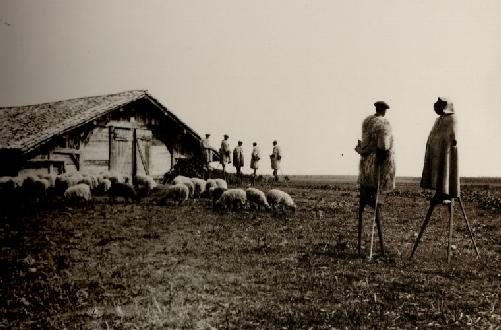

Graham Robb's The Discovery of France contains a wealth of information and one of my favourite pieces is the Stilt walking shepherds and postmen of Les Landes. Before Les Landes was planted with pine forests the huge area South of Bordeaux was little more than marshland occupied by shepherds and their sheep. Stilts were the preferred method of locomotion with a shepherd able to travel at a speed of a trotting horse. It was such an efficient mode of transport that letters in Les Landes were still being delivered by postmen on stilts in the 1930's
249Rebeki
Thanks for your very helpful review of The Discovery of France. I'd like to read this one day, but think I need a better background knowledge of France first. Considering I studied French, I am shamefully ignorant about much to do with French culture, history and geography.
250baswood
Hi Rebeki,
I certainly think it helps if you have visited France to undrstand where Robb is coming from, but armed with a map and your knowledge of french you might enjoy it. Vive la difference
I certainly think it helps if you have visited France to undrstand where Robb is coming from, but armed with a map and your knowledge of french you might enjoy it. Vive la difference
251zenomax
Evocative photos, Bas. Interesting that along with the stilts an extra long walking stick is utilised for additional balance.
The wonders of man (and woman)!
The wonders of man (and woman)!
252Mr.Durick
I have paid some attention to France over the years, but you couldn't characterize my attention as avid. I have never been there. Nevertheless I really enjoyed The Discovery of France and think I got something serious out of it. I didn't use a map when I read, and I do believe that would have improved, still further, my enjoyment.
Robert
Robert
254baswood
#251 Yes I suppose shepherds stand around a lot and so a need for a long stick for balance - a tripod effect.
255baswood
Time for a new Thread http://www.librarything.com/topic/116851
