
Laura (lindsacl)'s 2011 Reading Record - Episode 3
Talk 75 Books Challenge for 2011
Join LibraryThing to post.
This topic is currently marked as "dormant"—the last message is more than 90 days old. You can revive it by posting a reply.
1lauralkeet
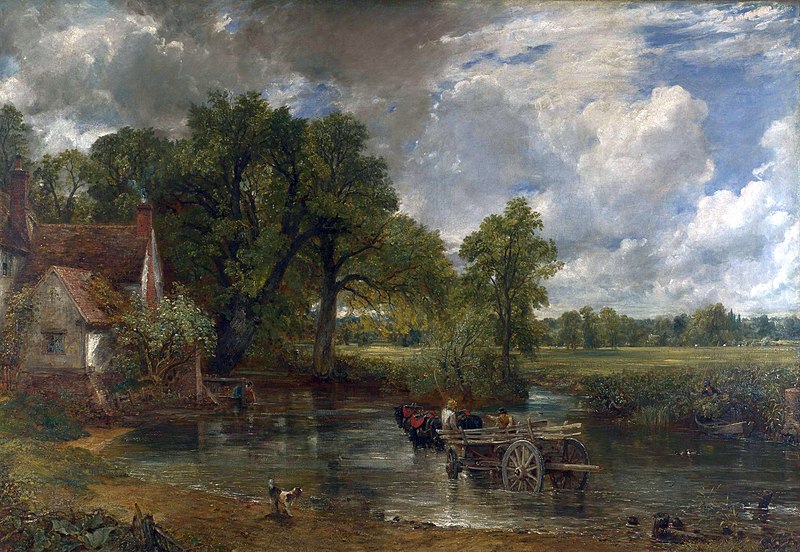
The Hay Wain, by John Constable

My 2011 Reading Resolutions
Previous 2011 threads:
Episode 1 * Episode 2 *
Books completed ("details" jumps to location in this thread where review & links can be found)
46. Remembering Babylon - details
45. Who Was Changed and Who Was Dead - details
44. When Will There be Good News? - details
43. Great House - details
42. William - details
41. All Mortal Flesh - details
40. Molly Fox's Birthday - details
39. The White Family - details
38. The Tiger's Wife - details
37. The Memory of Love - details
36. The Lieutenant - details
35. People of the Book - details
34. The Smart Swarm - details
33. My Antonia - details
32. A Dance to the Music of Time: Second Movement - details
31. A Truth Universally Acknowledged: 33 Great Writers on Why we Read Jane Austen - details
30. The Land of Green Ginger - details
29. To Darkness and to Death - details
28. An Artist of the Floating World - details
27. Mind Games (unpublished manuscript, no touchstone) - details
26. Year of Wonders - details
2lauralkeet
 Year of Wonders (
 )
)Reviewed on LibraryThing & on my blog
Why I read this now: I'm trying to read one book each month that's been gathering dust on my stacks. This is one of those.
With its subtitle, "A Novel of the Plague," I was initially worried this book would be a real downer. Far from it. Year of Wonders is the story of one village's fight to survive and keep up a sense of community. Told by Anna Frith, servant to the Rector Mompellion and his wife Elinor, the story takes place in 1665-66 as a late outbreak of bubonic plague takes hold of a Derbyshire village. The Rector is young, enthusiastic, and committed to his flock. When disease strikes and takes its first victim, Mompellion convinces the villagers to quarantine themselves as a form of protection. No one may leave the town, and arrangements are made for food and other provisions to be delivered to a safe space. But this well-intentioned action misses the mark, as increasing numbers of people are struck down, and people who once lived in harmony are filled with suspicion and fear.
But within this tragedy is a story of persistence and hope. The Rector works tirelessly to bury the dead and give pastoral care to the bereaved. Anna and Elinor, too, minister to the sick, especially the children. Anna has experienced her own share of loss, and yet finds meaning in caring for others. For a short time she tries to escape the reality of recurring death by taking an opiate, but stops when she realizes its addictive powers:
How do we tumble down a hill? A foot placed incautiously on an unsteady rock or loosened turf, an ankle twisted or a knee buckled, and of a sudden we are gone, our body lost to our own control until we find ourselves sprawled in indignity at the bottom. So it seems apt indeed to speak of the Fall. For sin, too, must always start with but a single misstep, and suddenly we are hurtling toward some uncertain stopping point. All that is sure in the descent is that we will arrive sullied and bruised and unable to regain our former place without hard effort. (p. 134)
Much later, Anna questions the religious explanation for the Plague:
Why should this thing be either a test of faith sent by God, or the evil working of the Devil in the world? One of these beliefs we embraced, the other we scorned as superstition. But perhaps each was false, equally. Perhaps the Plague was neither of God nor the Devil, but simply a thing in Nature, as the stone on which we stub a toe. ... For if we could be allowed to see the Plague as a thing in Nature merely, we did not have to trouble about some grand celestial design that had to be completed before the disease would abate. We could simply work up on it as a farmer might toil to rid his field of unwanted tare, knowing that when we found the tools and the method and the resolve, we would free ourselves, no matter if we were a village full of sinners or a host of saints. (p. 215)
Anna continues her ministry using herbal remedies learned from another member of her village, and just as the epidemic begins to fade she experiences one more staggering loss. She faces this with the same strength that saw her through the Plague year, and rides off toward an uplifting, if somewhat implausible, future.
3katiekrug
4Chatterbox
It's very odd, I crossed paths with Geraldine once or twice when we both worked at the WSJ (she covered the Middle East out of London); have read all her non-fiction and damn near everything that Tony has ever written (I use some of his articles when I teach, to prove business journalism is NOT dull...) but I have yet to read any of her novels. This must change. I hereby vow it.
Oh, I LOVE Constable. He does such wonderful skies. Seems a shame that Turner gets all the kudos these days!
5Whisper1
Another thumbs up from me for your excellent review of Year of Wonders. This book is on the shelves somewhere and I vow to find it and read it.
6lauralkeet
>4 Chatterbox:: very cool about your connection to Geraldine, Suz. Have you read her latest, Caleb's Crossing ? It was just reviewed in today's NYTimes, and the reviewer compared it (favorably) to Year of Wonders.
>5 Whisper1:: thanks for the thumb, Linda. I think you'd like this book.
7Donna828
Love the painting by Constable.
8brenzi
9Chatterbox
I need to read Geraldine's novels, though. I loved her book Seven Parts of Desire, and also Foreign Correspondence, which feels even more dated now than it did when first published, thanks to e-mail!
10Soupdragon
11lauralkeet
About the Constable painting: I must now confess that I chose this painting not just because of his talent but because it's also mentioned in a rather funny Monty Python sketch where the characters come to life in an art gallery ("Mum! The man from The Hay Wain's here!")
12alcottacre
13lauralkeet
14kidzdoc
15lauralkeet
16lauralkeet
Reviewed: Not formally reviewed
Why I read this now: A friend of mine is trying to get a novel published, and asked me to review and critique her manuscript.
This novel is the story of a small-town journalist battling OCD, who becomes embroiled in a news story she uncovers. It is a mystery/thriller with elements of romance. I enjoyed the book more than I expected to, but also had a number of suggestions for the author which I hope she finds useful!
17lauralkeet
 An Artist of the Floating World (
 )
)Reviewed on LibraryThing & on my blog
Why I read this now: It was nominated for the 1986 Booker Prize, and I'm (very) gradually working my way through past nominees.
It's 1948, and retired Japanese artist Masuji Ono is watching his country rebuild -- physically, emotionally, and politically -- after the damage wrought by the second World War. He lost loved ones and his home was damaged, as were some of his regular haunts. Now his life revolves around his two adult daughters Setsuko and Noriko, and his young grandson Ichiro. Setsuko and Ichiro live far away, but Noriko lives with her father. A marriage deal is in the works, but the sisters are nervous because a previous negotiation fell through. Ono is oblivious to the risk, and even more importantly fails to grasp that his own pre-war activities could be damaging Noriko's prospects.
Ono provides the narrative, and while there's plenty of dialogue, a great deal is inside his head. Details drip out like water from a leaky faucet. He goes off on tangents, and sometimes references important events or conversations, but doesn't fill in the details until later. He often ends a long story by saying it may not have happened exactly as he remembered it. Kazuo Ishiguro uses Noriko and Setsuko to fill in the blanks through conversations with their father. And his portrayal of the Japanese father-daughter relationship is brilliant. When Ono's daughters challenge him, they do so in a very indirect way. They make suggestions instead of overt requests, even when the matter is of the utmost importance. As Noriko's marriage negotiations begin, Setsuko is clearly worried about something from their past, and wants Ono to clear things up with certain associates:
"I wonder how Mr Kuroda is these days. I can remember how he used to come here, and you would talk together for hours in the reception room."
"I've no idea about Kuroda these days."
"Forgive me, but I wonder if it may not be wise if Father were to visit Mr Kuroda soon."
"Visit him?"
"Mr. Kuroda. And perhaps certain other such acquaintances from the past."
"I'm not sure I follow what you're saying, Setsuko."
"Forgive me, I simply meant to suggest that Father may wish to speak to certain acquaintances from his past. That is to say, before the Saitos' detective does. After all, we do not wish any unnecessary misunderstandings to arise."
"No, I suppose we don't," I said, returning to my paper.
I believe we did not discuss the matter further after that. Neither did Setsuko raise it again for the remainder of her stay last month. (p. 85)
As Ono reminisces on his pre-war artistic career the reader comes to understand his daughters' concerns. But Ono is more savvy and self-aware than he lets on, and takes a personal risk at what he judges to be a critical point in the marriage negotiations.
This is one of Ishiguro's early novels, and its style is much like The Remains of the Day, which is one of my all-time favorite books. An Artist of the Floating World is nearly as great, and highly recommended.
18phebj
19lauralkeet
20Soupdragon
Another fab review, Laura!
21brenzi
22lauralkeet
23alcottacre
24Chatterbox
25lauralkeet
Suz, I think you should!! I'm now quite interested in reading more of his books because, as I mentioned in #19, I see a real difference in style between his earlier and later books. But I need more data points to see if that's truly the case.
26chinquapin
27lauralkeet
28calm
29kidzdoc
30arubabookwoman
I'm not of the predominant view on Never Let Me Go--I didn't care for it, although I often read and like similar science-fictionish books. I've liked all his other novels, even The Unconsoled, which a lot of people didn't like.
31lauralkeet
32lauralkeet
 To Darkness and to Death ()
Reviewed on LibraryThing & on my blog
Why I read this now: I needed a fix!
This is the fourth in the Clare Fergusson/Russ Van Alstyne mystery series. This is one of the few series I read, and I enjoyed this just as much as the earlier volumes. As always, the action takes place in Millers Kill, a town in New York's Adirondacks region. Clare (an Episcopal priest) and Russ (the police chief) inevitably find themselves working together on a situation affecting the community, and equally inevitably the romantic sparks fly, but the dramatic tension remains.
This book differs from the others in that it takes place in a 24-hour period. Clare is called out early one morning to volunteer for a a search and rescue operation. Millie van der Hoeven, a young heiress and environmental activist, has gone missing. Haudenosaunee, the van der Hoeven estate, is being sold into preservation. A banquet and dance are planned for the evening, to sign official documents and celebrate the handover. But the environment benefits are offset by impact on local industry, since the property will no longer be available for logging. It's never simple, and emotions run high.
Russ gets involved a couple of hours later, as the missing person case develops into something more complex. Interestingly, the reader knows more details than either Russ or Clare. We know what's happened to the missing person. We know the details of an assault, and a mistaken identity. We know exactly who the good guys and bad guys are, and can only watch as Clare and Russ work it out. So of course, this had me wondering how Julia Spencer-Fleming would wrap things up. I mean, if I already knew everything there was to know, then where was the mystery?
Well of course there is one, and it sure did sneak up on me, delivering the "oompf" one comes to expect from a good mystery novel. And it left me eager to read more from Julia Spencer-Fleming.
33phebj
34brenzi
35alcottacre
36lauralkeet
 The Land of Green Ginger (
 )
)Reviewed on LibraryThing & on my blog
Why I read this now: It was recently reissued as a Virago Modern Classic with this new cover, and I just had to have it. When it arrived, I just had to read it. Now.
Joanna Burton was born in South Africa but raised in Yorkshire, and as a young woman had dreams of traveling around the world. But then she fell in love with Teddy Leigh, and married in haste because of the war. When Teddy returned, she realized how little she knew of him and came to understand the life that awaited her. Teddy was in poor health, and unable to follow his early dream to become a minister. The couple had a small farm but were not successful farmers. They could barely provide for themselves and their two daughters.
When a group of eastern European laborers establish a camp on the outskirts of their village, Joanna and Teddy befriend one of their leaders, Paul Szermai. They offer him lodging in their home as a way to bring in extra income. Paul's presence is welcome at first, but then causes a rift between Joanna and Teddy. Joanna tries to meet the needs of Teddy, her daughters, and Paul, as well as keep up with the farm and household chores, but it all proves a bit much. She imagines correspondence with old school friends, who have long since stopped sending letters:
She used at first to write long letters to her friends, Agnes Darlington and Rachel Harris. But as the chickens increased and the prosperity of the farm decreased, she had less and less time somehow to answer letters. Therefore the letters which she never answered dwindled and dwindled. She seemed utterly removed from the world she had known before her marriage. (p. 38)
Winifred Holtby paints a portrait of Yorkshire village life, with a rich cast of characters from all classes. She shows the stark economic divide between the upper and lower classes, sometimes by describing them directly and sometimes through witty descriptions of a scene:
The passengers on the crowded tender living Tilbury dock buttoned their coats tightly against the keen October air. Third- and first-class passengers, huddled together, regarded each other with the suspicion that precedes the separation of sheep from goats by the unequivocal barrier of a steel railing.
Holtby also depicts most of the villagers as small-minded and cruel. Rumors about Joanna and Paul abound, especially after Teddy insists they attend a dance together when he is not well enough to go. And even though there is a scene, Joanna still doesn't quite grasp how she is perceived by others. When Joanna is finally forced to face the reality of her situation she says to herself, "Bidgood had been right. It was not the truth but people's idea of the truth which made it possible for one to live in society."
Circumstances force Joanna into a dramatic decision, but one left me hopeful that she would one day realize the dreams of her youth.
38Donna828
39brenzi
40Chatterbox
41phebj
ETA: I love the cover and the name of that book (The Land of Green Ginger).
42lauralkeet

Thanks for the nice comments Peggy, Donna, Bonnie, Suz & Pat. This book started off slowly for me, but I ended up liking it in the end. I still think South Riding is her best.
43alcottacre
Speaking of Holtby, have you read her biography by Vera Brittain, Testament of Friendship? I am just curious and wondering if it is worth the read.
44lauralkeet
45alcottacre
47Soupdragon
On a different subject I just had to share with you a passage from my current book, The Good Parents which mentions one of your previous reads! Jacob is looking back at a character from his past...
"He'd been away for seven years. It was, as he told Minty, a turning point. She was a person you said those sort of things to as you drank gin and tonic and chain-smoked cigarettes with her. From her perspective, in her sixties, nothing interested her more than what she called 'the long view'. Nothing, she said in her lilting, upper-class voice seemed quite so serious anymore. She was like someone out of A Dance to the Music of Time."
48lauralkeet
>47 Soupdragon:: oh my goodness! That's really interesting, Dee. And guess what: I'm about to start the "second movement" in the Dance series (a single volume containing the novellas 4, 5, and 6). Thank you so much for sharing that quote!
49brenzi
50lauralkeet
Well ... I started a book on Friday but flung it at the wall after the requisite 50 pages. I'm not going to count it for the challenge, nor will I review it. It's called The Barn at the End of the World, and is supposed to be a spiritual memoir but it just didn't work for me. I picked it up for a book discussion group which I won't be attending. There are only 4 reviews on LT, all of them quite short. Two people thought it was marvelous, but I'm with the other two who found the author a bit pretentious and the content, lightweight.
I am not reading much this holiday weekend but have a book of essays at the ready: A Truth Universally Acknowledged. Yep, it's about reading Jane Austen. Perhaps I'll finish it over this 3-day weekend.
51Milda-TX
52LizzieD
53Chatterbox
54lauralkeet
I'm not making you do anything, Peggy !!!
55lauralkeet
 A Truth Universally Acknowledged: 33 Great Writers on Why we Read Jane Austen ()
Reviewed on LibraryThing & on my blog
Why I read this now: I've been dipping into this from time to time, and wanted to finish it.
As the title implies, this book is a collection of essays about Jane Austen's work, written by notable writers from Virginia Woolf to Lionel Trilling to Amy Bloom. Their tone ranges from academic to casual. Each essay conveys a deep and abiding respect, even love, for Jane Austen. The essays were not written specifically for this book; rather, they were written for a specific purpose in the writer's career. Because of this, there are some repetitive themes and elements. Several writers summarized Austen's upbringing, her family, and her all-too-short life. More than one expressed surprise that Austen's work never mentioned significant current events like the Napoleonic wars. Other essayists defended her in this regard. It was interesting, and sometimes humorous, to see how each author approached their task. One essay began with the phrase, "A truth universally acknowledged," while another decried this cliché.
Some of the essays discussed Austen's entire body of work, while others focused on specific novels. I began reading this book concurrent with a re-read of Pride and Prejudice, and found those specific essays enhanced my reading experience. Over the next several weeks I read an essay here and there, and then sat down to finish the book over a long weekend. I do not recommend the latter approach. The essays are so different from one to the next, that sequential reading is difficult to digest. The book did, however, reinforce my intent to re-read Austen's novels. The collection is best as a companion read, and I will take it off the shelf each time I read one of Austen's books.
I'll close with a paragraph from Janet Todd's essay, "Why I Like Jane Austen," which described better than any other my own reasons for enjoying the divine Jane:
Jane Austen seems to the writer nearest to a composer of classical music, her novels well-wrought symphonies; turbulent depths coexist with ordered surfaces and the ration of the expected to the unexpected feels just as it should. Each time I read her -- and she is one of the few novelists who can be read and reread -- I know I have not exhausted the books; something has again escaped me, as it does from a concert performance of a complex musical piece. It was beautiful, but did I listen as closely as I should? Like Lyme in Persuasion, Jane Austen's books "must be visited, and visited again."
56Whisper1
57lauralkeet
- A Dance to the Music of Time, Second Movement, by Anthony Powell: Peggy/LizzieD turned me on to this series. Each "movement" is a collection of 3 novellas; there are 12 novellas in all. I'm really enjoying the second movement
- The God Delusion - Cushla's recent review inspired me to buy this one for my Kindle. I started reading it now because it's easier to take the Kindle with me to work than the Powell (the latter is a 700-page chunkster).
My reading pace slowed this week and this may continue for a bit, but for good reasons. #1 daughter's last day of high school is today, Senior Prom is tomorrow, and graduation is June 13. My emotions are up and down. Of course I'm very happy to have an adult daughter, but also sad knowing she will soon fly the nest. I'm sure many of you have "been there, done that."
58alcottacre
59brenzi
60LizzieD
(Do you know how little it takes to make me reread a favorite? Sometimes all it takes is to see "Isobel" spelled like that! And I CAN'T restart something as huge as *Dance* this year. I can't.)
61laytonwoman3rd
62lauralkeet
I'm still reading ... the same books ... plus one my boss requires me to read -- now. :/
63Donna828
I usually read more in the summertime, but so far this year I'm reading less. Of course, it isn't officially summer yet so maybe I'll make up for lost time later in the month.
64lauralkeet
65qebo
66lauralkeet
67alcottacre
68gennyt
69Chatterbox
70lauralkeet
71lauralkeet
 A Dance to the Music of Time: Second Movement ()
Reviewed on LibraryThing & on my blog
Why I read this now: My husband decided to start the "first movement" and that inspired me to read the second (besides, I can't let him get ahead of me ...)
The "second movement" of A Dance to the Music of Time is a collection of three novellas: At Lady Molly's, Casanova's Chinese Restaurant, and The Kindly Ones. Set in England during the years just before World War II, this dance includes many characters familiar to readers of the first movement. The protagonist, Nick Jenkins, is now an established writer working for a film company. In At Lady Molly's, Anthony Powell sets the stage by introducing readers to several new characters who will figure prominently in Nick's life. They include the Tolland family (several brothers & sisters, and their stepmother), and Chips Lovell, a professional colleague whose literary role is to introduce Nick to other people and situations. Social themes are introduced as well, particularly political developments in Germany, and society's preoccupation with psychoanalysis during this time period.
While the first novella has a seemingly endless cast, Casanova's Chinese Restaurant focuses on Nick, his new wife, and their close friends the Morelands. But the dance continues, with familiar characters moving in and out of their lives, including Nick's school friends Widmerpool, Templer, and Stringham. Finally in The Kindly Ones, Powell begins in Nick's childhood, providing a complete "back story" on certain characters and lending new context to their role in the dance.
There is very little "action" in these novels. Instead, there are a myriad of social situations where the dialogue moves the action along. For example, one character will tell a story about another, and in this way we learn of marriages, affairs, deaths, and so on. One of the intriguing aspects of this series is the way Powell conveys the passing of time. It's such a critical element, and yet is only expressed indirectly. Months and years are never mentioned, and rarely do we know someone's age. We get a sense of elapsed time primarily through historical or cultural cues (i.e.; the Abdication), and only occasionally by specific mention (i.e.; "several years passed ...").
I also love Powell's turns of phrase, like this bit:
She was immaculately free from any of the traditional blemishes of a mother-in-law; agreeable always; entertaining; even, in her own way, affectionate; but always a little alarming: an elegant, deeply experienced bird -- perhaps a bird of prey -- ready to sweep down and attack from the frozen mountain peaks upon which she preferred herself to live apart.
And, at the close of Casanova's Chinese Restaurant, this powerful paragraph:
I thought of his recent remark about the Ghost Railway. He loved these almost as much as he loved mechanical pianos. Once, at least, we had been on a Ghost Railway together at some fun fair or on a seaside pier; slowly climbing sheer gradients, sweeping with frenzied speed into inky depths, turning blind corners from which black, gibbering bogeys leapt to attack, rushing headlong towards iron-studded doors, threatened by imminent collision, fingered by spectral hands, moving at last with dreadful, ever increasing momentum towards a shape that lay across the line.
A Dance to the Music of Time is a unique work, and I'm looking forward to reading the rest of this series.
73phebj
74alcottacre
76Chatterbox
77lauralkeet
Peggy, notice "Why I read this now" above my review. Chris is enjoying the first movement. He only reads a few pages each day (and he has Infinite Jest on the go at the same time, silly man), but he keeps mentioning what's going on in the book, asking me about certain characters (Widmerpool!), etc. So I think you have created another fan!
80lauralkeet
*waves to Amber*
81LizzieD
(I think that it's fantastic that your husband is reading the series too so that he'll be begging you to buy the other two volumes! I should be so lucky!)
82lauralkeet
 My Antonia ()
Reviewed on LibraryThing & on my blog
Why I read this now: I've been meaning to do so for ages.
While the train flashed through never-ending miles of ripe wheat, by country towns and bright-flowered pastures and oak groves wilting in the sun, we sat in the observation car, where the woodwork was hot to the touch and red dust lay deep over everything. The dust and heat, the burning wind, reminded us of many things. We were talking about what it is like to spend one's childhood in little towns like these, buried in wheat and corn, under stimulating extremes of climate: burning summers when the world lies green and billowy beneath a brilliant sky, when one is fairly stifled in vegetation, in the colour and smell of strong weeds and heavy harvests; blustery winters with little snow, when the whole country is stripped bare and grey as sheet-iron. We agreed that no one who had not grown up in a little prairie town could know anything about it. (from the Introduction to My Ántonia)
If you didn't grow up in a little prairie town, the next best way to experience it is through Willa Cather's writing. Set in late 19th century Nebraska, My Ántonia is narrated by Jim Burden, a young man who comes of age on the prairie and forges a lifelong friendship with a slightly older Bohemian immigrant girl. The novel moves at a leisurely pace, as life probably did in those days. Farm life is filled with hard labor. Town dwellers are considered of a higher class, with more social and educational opportunities. Jim experiences both lifestyles, beginning on the farm as a young boy and moving to town when he reaches school age. Ántonia also eventually comes to town, to work in service for a local family. There's a strong bond between the two, but one limited by age and class.
Cather paints a vivid portrait of frontier life. It's easy to visualize the landscape, to feel the dust on your arms and legs, and the cold wind blowing around the house on a winter night. And as she describes the seasons, you feel like you're right there:
There were none of the signs of spring for which I used to watch in Virginia, no budding woods or blooming gardens. There was only -- spring itself; the throb of it, the light restlessness, the vital essence of it everywhere: in the sky, in the swift clouds, in the pale sunshine, and in the warm, high wind -- rising suddenly, sinking suddenly, impulsive and playful like a big puppy that pawed you and then lay down to be petted. If I had been tossed down blindfold on that red prairie, I would have known that it was spring. (p. 120)
My Ántonia is deceptively simple. Cather recounts the simple events of prairie life: the harvest, tent dances, and town gossip. Years pass and events unfold with few plot twists. But as the novel moves toward its conclusion, there are moments of surprising depth and emotional impact which landed this book its 4-star rating.
83katiekrug
84Whisper1
I'm reading William Morris Artist, Craftsman, Pioneer..It contains lushious prints of his wall paper designs!
I'm in heaven.

85Cait86
86lauralkeet
>85 Cait86:: Cait, I've read a couple other Cather novels, and liked this one best so far. I really want to read O Pioneers! and Death Comes for the Archbishop.
88laytonwoman3rd
89lauralkeet
90Whisper1
91lauralkeet
 The Smart Swarm (
 )
)Reviewed on LibraryThing & on my blog
Why I read this now: Recently I returned to my office to find a book on my desk with a note from my boss’ assistant. The note read, “Stopped by. Mr. Boss wants you to read this book and give it to Joe Colleague when you are done.” This was that book. Sigh.
The Smart Swarm, by Peter Miller, describes phenomena from the natural world, and applies them to human communications and decision-making. What can we learn from colonies of ants, bees, or termites? Or flocks of birds? Ants are good at self-organization, creating order from chaos. Bees make use of the "wisdom of crowds" to find appropriate sites for their nests. If you have ever relied on consumer reviews to help you select a book, movie, or hotel, you have participated in the human equivalent of these processes.
The book is very accessible and easy to read. Miller adopts a format common to this type of business book: each chapter illustrates an element of his thesis, and is peppered with real-life examples from business or government. As an editor for National Geographic, Miller is good at describing scientific concepts in layman's terms. Some of his examples are more effective than others; a long segment on the Orcs in The Lord of the Rings films was neither about the natural world, nor humans. He also includes a chapter on locusts to describe the "dark side" of crowd behavior. Locusts have always been one of my least favorite bugs, and this book did nothing to improve their status.
While The Smart Swarm succeeds in showing parallels between the natural world and humans, it falls short of helping organizations adopt these principles. It is only in the last 10 pages that Miller sums up the lessons we should have learned in previous chapters ("From honeybee swarms we've learned that groups can reliably make good decisions in a timely fashion as long as they seek a diversity of knowledge and perspectives ..."). But he fails to translate this into specific actions business leaders can take to change the way their organizations run. This would have been a better book if it had taken that next step.
92qebo
93laytonwoman3rd
95Donna828
Now I'm off to the MMoA website to drool over things I don't need. ;)
96lauralkeet
 People of the Book ()
Reviewed on LibraryThing & on my blog
Why I read this now: It's part of a (slow) campaign to read books from my dusty stacks.
Dr. Hanna Heath is an Australian book conservator, sought after for her unique ability to preserve antique books. When this book opens in 1996, Hanna has been called in to work on the Sarajevo Haggadah, a 500-year-old Jewish text, and one of the oldest of its kind. The Haggadah originated in Spain, and traveled through Italy and Germany before arriving in Bosnia. Tucked into the ancient pages are evidence of its long journey: tiny fragments of butterfly wing, a strand of hair, etc. Intrigued, Hanna decides to analyze these fragments and bring the Haggadah's history to life.
Hanna's modern-day analysis is interspersed with chapters working backwards to the Haggadah's origins. While Hanna can only make inferences based on chemical analysis, author Geraldine Brooks imagines characters and situations that explain the butterfly wing, the hair fiber, and creation of the Haggadah itself. She takes us to Nazi Germany, 16th-century Venice, and 15th-century Spain, painting a vivid portrait of Jewish persecution. Each act of oppression and violence takes the Haggadah to a new country and ultimately to its final home. While this is based in fact, it is largely fiction (Brooks' Afterword clearly explains all of this).
Meanwhile in the present time, Hanna has a contentious and complicated relationship with her mother, and develops feelings for a Bosnian man involved in the Haggadah conservation. The romance was insufficiently developed, and didn't seem credible, and the denouement was a bit rushed. Still, I enjoyed reading the interconnected history of something I knew very little about.
97phebj
98brenzi
99lauralkeet
Thanks for the thumbs!
100Soupdragon
101cushlareads
I quite liked Brooks' autobiography about growing up in Australia, Foreign Correspondence, and the penpals she had as a teenager.
102laytonwoman3rd
103lauralkeet
>101 cushlareads:: how very interesting that you have seen other Haggadahs. The book certainly piqued my curiosity.
>102 laytonwoman3rd:: You won't have to look far ... I just realized Year of Wonders is the first book on this thread!
104laytonwoman3rd
105lauralkeet
106lauralkeet
 The Lieutenant ()
Reviewed on LibraryThing & on my blog
Why I read this now: It was reviewed in an early issue of Belletrista, and I snapped it up when I found it at a used book sale.
In every situation in his life, Rooke had seen that there were people with a power of personality that gave them effortless authority. It was not to do with rank or position: the governor lacked it. Rooke did not possess it either, he knew that about himself, but Silk had it, and so did Gardiner.
And so did Tagaran. (p. 175)
Daniel Rooke was an introverted boy, in love with mathematics and astronomy. He was fortunate to receive a place in the Portsmouth Naval Academy, vaulting him into a different social class and affording him the opportunity to meet the Astronomer Royal. At 15 he left school and was assigned to a ship supplying His Majesty's forces in the American colonies. He proved to be a skilled navigator, but naive as to the realities of military service. Rooke returned home permanently changed by war's violence and an early encounter with slaves in Antigua. But he was still a young man, and in 1786, when Rooke was 24, the Astronomer Royal recommended him to serve on one of the first ships taking prisoners to Australia. The journey began in 1788; serving in the same fleet was Captain Silk, a colleague from Rooke's earlier tour of duty. On arrival, the English found the landscape much less hospitable than expected, with very little edible agriculture and game. Not surprisingly, the native people were also less than thrilled by their presence.
Rooke managed to convince his commander to allow him to set up an observatory some distance from the main camp, and there he performed "official duties" in relative isolation. While the men in the main camp struggled to gain the natives' trust, Rooke received regular visits from a group of mostly women and children. He had a special rapport with a girl named Tagaran. Their mutual curiosity allowed them to bridge the language barrier, teaching each other words and progressing to real conversations. Rooke kept elaborate notebooks, trying to make a record of Tagaran's language. He developed a level of respect for Tagaran and her tribe that was far more advanced than those in the main camp. But eventually conflict arose between the main camp and the natives, and Rooke faced a series of ethical dilemmas that threatened his relationship with Tagaran and caused him to question everything he once held true. The resolution of this internal conflict was in some ways inevitable, and yet quite moving.
The Lieutenant is similar in some ways to Grenville's earlier book, The Secret River. Both explore the conflict between white settlers (invaders?) and native Australians. By focusing on feelings and inner conflict more than violence, The Lieutenant offers a rich and sophisticated take on Australia's history.
108lauralkeet
109kidzdoc
How about those Phillies! Still takin' care of business despite all those injuries.
110brenzi
111lauralkeet
>110 brenzi:: Bonnie, I think you'll enjoy The Lieutenant.
112LizzieD
113cushlareads
114lauralkeet
115lauralkeet
 The Memory of Love (
 )
)Reviewed on LibraryThing & on my blog
Why I read this now: It's Orange July, and this book made the 2011 Orange Prize shortlist.
The Memory of Love takes place shortly after Sierra Leone's Civil War (1991-99). Adrian, a British psychologist, has returned to the country following an initial short volunteer experience. He's left his wife and daughter at home in the hopes of making a difference, helping the people of Sierra Leone recover from trauma. His methods are viewed skeptically at first, but eventually he begins to have a positive impact on his patients. Kai is a brilliant young surgeon working in the same hospital, and haunted by war trauma and lost love:
And when he wakes from dreaming of her, is it not the same for him? The hollowness in his chest, the tense yearning, the loneliness he braces against every morning until he can immerse himself in work and forget. Not love. Something else, something with a power that endures. Not love, but a memory of love. (p. 185)
Kai is still in love with Nenebah, a woman who left him some time ago. He also misses his best friend Tejani, who left the country to practice medicine in the US. Kai toys with the idea of joining him, and takes steps necessary for immigration, but is clearly ambivalent about leaving other loved ones behind in Sierra Leone.
In Sierra Leone, silence rules the day: the war is simply not discussed; personal stress is suppressed, as if it's all a big secret. Most of Adrian's cases suffer from post-traumatic stress disorder, having witnessed horrific violence during the war that they have been unable to deal with on an emotional and psychological level. And then there is Elias, the patient who on the surface appears the most "normal." Elias checks himself into the hospital, knowing he is near the end of his life. He has a compelling need to unload his personal story on someone, and Adrian begins meeting with him. Elias worked at the university, first as a lecturer and ultimately as dean. While his personal circumstances kept him away from most of the violence, he and other academics were arrested under suspicion of some vaguely described wrongdoing. Elias describes his response to this event, and its impact on important people in his life, in a matter-of-fact way but gradually Adrian realizes there's much more to Elias' story.
Aminatta Forna uses patient stories, gradually revealed through Adrian's therapy, to help the reader imagine the war's events. She also builds a web of people which I found fascinating. Kai and Adrian's lives intersect first on a professional level and later in deeply personal ways. The connections between people and events unfold slowly, and for me each revelation was very emotional. This is especially true of Elias; when his "sins of omission" are revealed, his real character becomes known, as does a connection that binds him with both Adrian and Kai. The ending was especially wrenching and yet somehow, just right.
This is a superb book; I was transfixed and couldn't put it down.
116katiekrug
117kidzdoc
119lauralkeet
121gennyt
122lauralkeet
123gennyt
124lauralkeet
 The Tiger's Wife ()
Reviewed on LibraryThing & on my blog
Why I read this now: It's Orange July, and this book won the 2011 Orange Prize
In The Tiger's Wife, Téa Obreht weaves together fantastic tales filled with folklore and a bit of magical realism. Natalia and Zora are two young doctors, traveling to a remote village to administer vaccinations to local children. It's shortly after the dissolution of Yugoslavia, and political/religious tensions are still high. Just before leaving home, Natalia learns her beloved grandfather passed away while on a journey far from home. Her grandmother is justifiably distraught. She was unable to be with her husband at his death, and she doesn't understand what he was doing in the place where he was found.
Natalia mourns silently; she doesn't even confide in Zora. Her grandfather, also a doctor, was clearly a mentor and role model. As Natalia remembers visits she and her grandfather made to the zoo, she begins retelling stories he passed down to her, mostly about his life and the people of his village. The stories read like folk tales. The end of one story often led to another, to flesh out a particular character even further. This put me off at first, because I kept wanting to get back to Natalia, Zora, and the village. I struggled a bit with the magical realism in stories featuring "the deathless man," but I persevered and enjoyed them more than I thought I would.
I really wanted to love this book, but in the end I simply liked it. I spent the first half of the book frustrated, unsure where it was going. Then I got swept up in one of the stories and thought, "now we're cooking, I'm really going to like this!" I found the connections between stories interesting, and became emotionally invested in some of the characters. Unfortunately, I was unable to hold onto those feelings. Téa Obreht is clearly a talented writer, and despite my feelings about this book I'm looking forward to watching her career and reading more of her work.
125mmignano11
126lauralkeet
127LizzieD
128phebj
129brenzi
130lauralkeet
>128 phebj:: funny Pat, I originally thought about buying this one too and opted for a library loan. I'm glad I did.
>129 brenzi:: Bonnie, I'm glad you're deeply ensconced!
131alcottacre
132lauralkeet
 The White Family ()
Reviewed on LibraryThing & on my blog
Why I read this now: It's Orange July! This book was on the 2002 shortlist.
Alfred White has had a long career as a London park keeper. His days are spent patrolling the park, monitoring its condition and making sure visitors adhere to park rules. Alfred is close to retirement, and has seen a lot of change over the years. He longs for the Britain of his youth, during and after World War II. He is especially upset by the influx of foreigners, changing the ethnic mix of his London neighborhood and, consequently, the park visitors.
One day Alfred collapses on the job and is hospitalized. His sudden weakness shocks his wife and adult children, who have grown accustomed to Alfred's firm, controlling hand. His adult children have all gone their separate ways, but are brought back into contact at Alfred's bedside. Darren is an established journalist living in the US, and is on his third marriage. Shirley is in a relationship with a black man, which caused a rift with her father. Dirk has been unable to establish an independent adult life, and lives at home while working in a corner shop. He has developed disturbing extremist political and racial views.
May, the wife and mother, held this crew together over the years. Like many women of her generation, her husband made all the decisions. When Alfred went into hospital, May found she couldn't even withdraw money from the bank on her own. But May is also strong inside, in her own way, and she has a suppressed intellect that remains an important part of her life:
She always liked to have a book in her bag. In case she got stuck. In case she got lost. Or did she feel lost without her books? There wasn't any point, but she liked to have one with her, a gentle weight nudging her shoulder, keeping her company through the wind, making her more solid, more substantial, less likely to be blown away, less alone. More -- a person. (p. 19)
Through short chapters narrated by different family members, Maggie Gee develops the White family's history and the nature of the parent-child and sibling relationships. Each of the children bear scars from their father's discipline and temper. Darren appears successful on the outside, but is deeply wounded inside. Shirley has been unable to have children, and struggles with issues of faith. Dirk is a ticking time bomb, prone to alcohol-infused bouts of temper as he acts out his resentment towards anyone better off than himself. Alfred and May, for all their flaws, have shared a long and loving marriage, and are likeable in their own ways.
This book is not for the faint of heart. There's a lot of sadness, as the entire family copes with Alfred's medical condition. May considers, for the first time, that Alfred may not always be there for her. Alfred struggles with weakness & infirmity. Each of the children relive their childhood and their relationship with Alfred, and rather than bond together each of them struggles individually. There are also many disturbing moments, particularly Gee's portrayal of racism and anti-immigrant sentiment. This would have been a 4.5-star book were it not for a too-tidy denouement about Shirley which struck me as both unrealistic and unnecessary. Still, this is a well-crafted story, with a strong emotional pull and an intense and startling climax.
133phebj
134lauralkeet
135LizzieD
136brenzi
137lauralkeet
139katiekrug
140alcottacre
141lauralkeet
 Molly Fox's Birthday ()
Reviewed on LibraryThing & on my blog
Why I read this now: It's Orange July, and this book made the 2009 shortlist.
In this quiet, contemplative book, an unnamed narrator spends a day reminiscing about her long-time friend, Molly Fox.
Molly Fox is an actor, and is generally regarded as one of the finest of her generation. (She insists upon 'actor': If I wrote poems would you call me a poetess?) One of the finest but not, perhaps, one of the best known. ... She likes the fear, the danger even, of the stage, and it is for the theatre that she has done her best work. Although she often appears in contemporary drama her main interest is in the classical repertoire, and her greatest love is Shakespeare. (p. 2)
The narrator is a playwright, using Molly's house as a retreat to work on her latest play while Molly is away in New York and London. During the course of a day -- which happens to be Molly's birthday -- she relives significant moments in their lives, and reflects on their relationships with friends and siblings.
The two met many years before, when Molly was cast in the narrator's play, and supported each other through the highs and lows in their careers and relationships. The narrator's older brother, Tom, is a priest who befriended Molly and may have counseled her through some difficult situations. Molly's brother, Fergus, suffers from undefined psychological difficulties precipitated by traumatic events in his childhood.
As the narrator putters around Molly's house, she recounts several events in her relationship with Molly, painting a clear picture but one that seems just a bit too cut and dry. I suspected there was more to the story than she was letting on, perhaps more than she was willing to admit to herself. I began to pick up on tiny clues to a deeper perspective. When Fergus drops in to visit Molly but finds only the narrator at home, he stays to chat and ultimately provides critical insight to Molly's character and history, casting entirely new light on everything that was revealed before.
This was a very interesting study of memory and point of view, and how personal experience shapes relationships.
142alcottacre
143phebj
144Soupdragon
145Donna828
I hope August is a slower month so I can get to some of these books that I want to savor instead of reading them in bits and pieces.
146lauralkeet
>144 Soupdragon:: Interesting, Dee. Her novel, One by One in the Darkness was also shortlisted for the Orange Prize, so I will probably read that some January or July.
>145 Donna828:: if it's as hot where you are as it is here, you won't want to do much more than laze around and read. go for it!
147qebo
148lauralkeet
149lauralkeet

152alcottacre
153cushlareads
154lauralkeet
41.
 All Mortal Flesh ()
Reviewed on LibraryThing & on my blog
Why I read this now: I needed a break from the intensity of Orange Prize nominees. This series never disappoints!
This is the fifth book in the Clare Fergusson/Russ Van Alstyne mystery series, and I can't write this review without first mentioning something that may or may not be a spoiler. So if that matters to you, you'd better stop reading right now.
Russ is chief of police in Miller's Kill, New York. Clare is an Episcopal priest in a local church. At the beginning of this book, Russ' wife Linda is found dead in their home. At first Russ attempts to take control of the investigation, which is admittedly ridiculous. One of his officers escalates the matter to the state police and another investigator is assigned. Russ and Linda recently separated after Russ revealed his romantic relationship with Clare, so naturally both Russ and Clare are suspects. But as the investigation moves ahead a tangled web emerges, involving identity theft, animal cruelty, mistaken identity, and troubled teenagers.
Pretty soon the reader doesn't know which end is up, and that's exactly where Julia Spencer-Fleming wants us to be. And then she begins to connect the dots, slowly revealing elements of the mystery. This series is known for placing the protagonists in impossibly hazardous situations, and I was a little disappointed when I accurately predicted the scene. But there was so much more I could never have predicted, including the murderer's identity, and the shocking ending. This was my favorite book in the series so far!
155alcottacre
158brenzi
159phebj
160klobrien2
Karen O.
161lauralkeet
)Reviewed on LibraryThing & on my blog
Why I read this now: I like to read one Virago each month, and this one came highly recommended by a member of the LT Virago group. I have also really enjoyed other books by this author.
It had been different when they were all young and at school. She had felt then that they were her own, but perhaps she had been mistaken, perhaps she had not known their secret selves, and she remembered, for the first time for years, how she had once found Lydia crying in the nursery and had not been able to find out what her trouble was. It seemed to her that what she had missed then might be evading her still. She had given birth to five bodies and she would always be a stranger to their souls. This was a terrible thought and it would have been more terrible still if she had known that it was William's too.
William and Kate Nesbitt raised five children; all but the youngest, Janet, have left home to start families of their own. William has a successful career in shipping, and they live comfortably. The extended family often gathers at their home, for Sunday lunch and special occasions like Kate's birthday. William and Kate should be content, happy with the success of their children and ready to resume life as a couple.
But Kate, in particular, struggles with letting go. She's not completely happy with some of the choices her children have made, choices ranging from partners to articles of clothing. She frets constantly, where William is more pragmatic. He understands that children grow up, separate, and forge their own paths. But both William and Kate are sorely tested when their second-youngest daughter Lydia leaves her husband to live with another man. In the early twentieth century, this was simply was. not. done.
Kate is crushed because Lydia confided in William instead of her. She is outraged by Lydia's decision, and cuts off communication. She tries to prevent siblings from contacting Lydia as well. But instead of feeling satisfied, her self-righteousness leaves her feeling miserable. William is equally unhappy, but his feelings are directed more at Kate than Lydia. Who is this woman? Why has she built a wall between herself and her daughter? He is intensely irritated by Kate's petty behavior and her hardened exterior. Meanwhile, Janet is threatening to fly the nest in her own, quiet way. As she asserts her independence both William and Kate try to influence the outcome. Sadly, Kate's efforts seem controlling and shrewish. William remains a confidante, inherently good. Both Lydia and Janet's situations are resolved in the course of the novel, but not without much emotion and pain for William and Kate.
I found this book quite emotional, perhaps because I will soon experience my eldest flying the nest. Like William and Kate, my husband and I often reflect on who our children have become and hope that we continue to be involved in their lives to an appropriate degree. And I could empathize with Kate, whose efforts to forge adult relationships with her children often fell flat. E. H. Yong has a keen eye for mannerisms and foibles, as well as the dynamics of human relationships. In William, she created a very realistic family portrait that remains valid today, even though social norms have changed.
162LizzieD
163tiffin
ETA: love the Constable...have this one on a cookie tin!
164lauralkeet
165lauralkeet
 Great House ()
Reviewed on LibraryThing & on my blog
Why I read this now: This was my fifth and final book for Orange July. And despite the late posting of this review, I did finish it in July, on the 31st to be exact!
Great House is an unusual novel that makes considerable demands of the reader. The book is made up of four loosely connected stories, but I didn't pick up on that at first. Part I has four chapters -- the first part of each story -- and felt disjointed, like four unfinished, disconnected works with weak character development. At the close of Part I, I was enormously frustrated. I broke one of my cardinal rules and read some reviews of this book. They inspired me to continue reading, and I'm glad I did. I finished the first story in Part II and was flooded with emotion. The same thing happened with the second, third, and fourth stories. And suddenly the book made sense, and I was reminded of a quote I'd flagged early on:
There are moments when a kind of clarity comes over you, and suddenly you can see through walls to another dimension that you'd forgotten or chosen to ignore in order to continue living with the various illusions that make life, particularly life with other people, possible. (p. 14)
I found myself warming to the characters which include a writer telling her life story, an older man reflecting on his relationship with his adult son, a man who discovers a secret his wife kept from him for years, and the adult children of an antiques dealer. Woven through Great House are themes of exile, loss, and betrayal, all in a Jewish context. It was fascinating, and I kept flagging quotes like this:
What is the point of a religion that turns its back on the subject of what happens when life ends? Having been denied an answer -- having been denied an answer while at the same time being cursed as a people who for thousands of years have aroused in others a murderous hate -- the Jew has no choice but to live with death every day. To live with it, to set up his house in its shadow, and never to discuss its terms. (p. 175)
Towards the end I could see how Nicole Krauss was building a kind of metaphor for the Jewish experience:
if every Jewish memory were put together, every last holy fragment joined up again as one, the House would be built again, said Weisz, or rather a memory of the House so perfect that it would be, in essence, the original itself. Perhaps that is what they mean when they speak of the Messiah: a perfect assemblage of the infinite parts of the Jewish memory. (p. 279)
Well as I said, this book does make demands of the reader. I'm not even sure I understood it all, but I felt rewarded in the end.
166souloftherose
167rebeccanyc
169cushlareads
170katiekrug
171alcottacre
172thornton37814
173kidzdoc
174brenzi

I have felt kind of ambivalent but now I'm adding it to my teetering tower, maybe for Orange January.
175lauralkeet
I would be very interested to see what all of you think of Great House, it has stuck with me all this week which is saying something. Usually books fade into the background once I've finished them.
That said, I'm enjoying something much lighter right now (the third Jackson Brodie mystery) and it's just what the doctor ordered.
176alcottacre
177rebeccanyc
Since you are interested, here is my review from last year. In fact, right after I posted that review, you wrote "that sounds intriguing"! Glad you were intrigued.
178lauralkeet
>177 rebeccanyc:: Rebecca, thanks for that link! I follow so many threads that sometimes I forget who it was that first got me interested in a book. But I do think you are the one for Great House! And yeah, I guess it was "intriguing."
179alcottacre
180Donna828
182lauralkeet
183lauralkeet
 When Will There be Good News? ()
Reviewed on LibraryThing & on my blog
Why I read this now: I needed a fun read, and I wanted to read this book before the series airs on PBS Masterpiece in October.
This is the third book in the Jackson Brodie mystery series, and the best so far.
Joanna Hunter seems to have it all: she's a successful doctor and mother of a darling baby boy. But thirty years ago Joanna's life was dramatically changed by tragedy: her mother, sister, and brother were all killed in a random act of violence. Joanna appears to have left those emotional scars behind, or at least covered them up really well. Reggie Chase works for Joanna as a mother's helper. She is sixteen and forced to leave school and live on her own after her mother's recent death. Reggie has seen some hard times, but has a keen wit and a love of learning that keep her going. She admires Joanna, and is also somewhat attached to her former teacher, Ms. MacDonald, who is tutoring Reggie for her A-levels. When Joanna disappears and her husband offers a weak explanation, Reggie is sure there's trouble afoot. She follows up on a chance encounter with Detective Chief Inspector Louise Monroe, and gets her involved in finding Joanna.
Meanwhile in a parallel story, Jackson Brodie is just going about his business, traveling from London to Edinburgh. A harrowing event brings him into contact with Reggie, and then with Louise, who it turns out is an old friend. The problem is, several people think Jackson is someone else, and the person they think he is may have stolen Jackson's identity as well. And all Jackson wants to do is make it home before his wife returns from a business trip and finds him missing. But first there's the matter of Joanna Hunter that now requires his attention, too.
There's so much about the story that I can't say, because every thread is so tightly wound with all the others and I don't want to ruin it with even the tiniest spoiler. But was with Case Histories and One Good Turn, Kate Atkinson has written a compelling mystery with some major surprises, and a delightful dose of humor expressed primarily through the thoughts and actions of her well-drawn characters. I enjoyed this book from start to finish.
184alcottacre
185sibylline
186lauralkeet
187Donna828
188DorsVenabili
189lauralkeet
>188 DorsVenabili:: Ooh, a new visitor! Welcome Kerri ! I really liked Behind the Scenes ... too.
It's actually a British Series being aired by PBS. Click here for IMDB's information on it, including a trailer and episode guide.
190phebj
191brenzi
Now I'm chomping at the bit to get this one read, although I do like to space them out and I know there's only one more. But I will definitely be ready for the TV show in October.
192lauralkeet
193alcottacre
194cushlareads
195lauralkeet
 Who Was Changed and Who Was Dead ()
Reviewed on LibraryThing & on my blog
Why I read this now: I like to read at least one Virago Modern Classic each month ... this is the one for August.
This is a very quirky novel, at times comic and at others, incredibly dark. The story opens with a disturbing description of a flood sweeping through a village:
Swans were there, their long necks excavating under the dark, muddy water. All around there was a wheezy creaking noise as the water soaked into unaccustomed places, and in the distance a roar and above it the shouts of men trying to rescue animals from the low-lying fields. A passing pig squealing, its short legs madly beating the water and tearing at its throat, which was red and bleeding, and a large flat-bottomed boat followed with men inside. The boat whirled round and round in the fierce current' but eventually the pig was saved, and squealed even louder. (p. 1)
The details continue for two more pages, and then we meet Ebin Willoweed and his family, who are a pretty unique group. His crotchety, outspoken mother is constantly complaining and belittling everyone around her. He has two daughters, Emma and Hattie, the latter of mixed race. Ebin also has a young son, Dennis, who he repeatedly refers to as a "cissy." This is definitely not "Leave it to Beaver."
And the flood is only the beginning of the hardship that will befall this small village. People start dying left and right, and no one knows why. Ebin's already dysfunctional family becomes even more so, drifting from one funeral to the next while still trying to work through a host of family dramas. How can Ebin become financially and emotionally independent from his controlling mother? Will oldest daughter Emma ever escape? Can Dennis redeem himself in his father's eyes?
Barbara Comyns' very direct writing style takes some getting used to. Her words are spare, yet the characters and setting are still well drawn. Once I became accustomed to the writing I turned the pages eagerly, wanting to see what would happen next. The story was quite surreal. I hated Ebin's mother; she made me cringe on more than one occasion. The novel moved quickly from one event to the next. A great deal happens in 146 pages, but to me it felt rushed. I wanted more plot development. I wanted to be more emotionally invested: feeling sadder about the tragedies, and laughing harder at the novel's many humorous moments. This book is a favorite of Comyns fans, but I enjoyed Our Spoons Came from Woolworths more.
196rebeccanyc
198laytonwoman3rd
199lauralkeet
200alcottacre
Thanks for sharing the link to the Jackson Brodie trailer. I thought I would have problems separating Jason Isaacs from his Lucien Malfoy persona, but nope - I agree with Linda - he is Jackson Brodie.
201gennyt
202lauralkeet
204lauralkeet
 Remembering Babylon ()
Reviewed on LibraryThing & on my blog
Why I read this now: I'm working my way through Booker Prize nominees and the "1001" list. This meets both criteria.
Set in mid-19th century colonial Australia, Remembering Babylon explores issues of race and class through a young man named Gemmy Fairley. Gemmy turns up in a Queensland village, seemingly out of nowhere. He is white, but "appears" black and speaks the language of native people. He is most comfortable communicating with the three children who first discovered him, members of the McIvor family. Through various means of communication, Gemmy shares his background as a ragamuffin boy tossed from a ship, who lived with aboriginal people for 16 years. The McIvor family take him in, providing for his basic needs and giving him work to do around their property. Gemmy baffles the community:
He had started out white. No question. When he fell in with the blacks -- at thirteen, was it? -- he had been like any other child, one of their own for instance. (That was hard to swallow.) But had he remained white?
They looked at their children, even the smallest of them chattering away, entirely at home in their tongue, then heard the mere half-dozen words of English this fellow could cough up, and even those so mismanaged and distorted you could barely guess what he was on about, and you had to put to yourself the harder question. Could you lose it? Not just language, but it. It.
For the fact was, when you looked at him sometimes he was not white. His skin might be but not his features. The whole cast of his face gave him the look of one of Them. How was that, then? (p.40)
But Remembering Babylon isn't so much Gemmy's story as everyone else's. Janet, Meg, and Lachlan are forever changed after finding Gemmy. Several settlers actively work to oust Gemmy, showing their true selves and straining Jock and Ellen McIvor's relations with them. And just beyond the hubbub lives Mrs. Hutchence, an eccentric woman who offers love and kindness to everyone she meets. Malouf introduced every type of character imaginable: angry, bigoted settlers, a young schoolmaster, a preacher nearing the end of his career, etc. Most were not as well-developed as the McIvor family, and after a while I found the frequent new faces a distraction. The ending was also strange, jumping ahead in time while leaving a number of loose ends back in the 19th century. Still, this was a worthwhile read, an interesting study of human nature, set in a historic period I enjoy reading about.
206alcottacre
207Soupdragon
I'm encouraged that you think the third Jackson Brodie is the best. I have it waiting for me but was a bit put off by the second in the series after loving the first. I can't remember exactly why but something to do with too many coincidences and heightened expectations after the first, I think!
I haven't read Who was changed but judging from the Comyns that I have read, I seem to prefer the more realistic novels with an autobiographical feel. If you enjoyed Spoons, you should also like A Touch Of Mistletoe though it does seem a difficult one to find at a reasonable price.
209brenzi
210JanetinLondon
211alcottacre
212lauralkeet
213alcottacre
214gennyt
215lauralkeet
216alcottacre
217gennyt
218lauralkeet
I have been up and down (mood-wise) about this all week. Very excited for Kate of course, but also know I will miss her terribly and it marks a new phase of life for my husband and me (even though we have a second daughter at home who has 3 years of high school left).
219Donna828
220lauralkeet
221Soupdragon
Oh and thanks for visiting me on my new thread :)
222sibylline
223drneutron
224lauralkeet
225qebo
226alcottacre
227gennyt
228tiffin
229sibylline
I'll be thinking of you, Laura. Time for a really really comforting Virago?
230brenzi
231cushlareads
Like Genny, I never thought much about how hard it must have been for my parents when I took off to New Haven at the grand old age of 22, but now that I have kids I do. I was about a 27 hour flight away. It made me appreciate them so much more.
232lauralkeet
233gennyt
Good decision to take a day off to recover, too.
236laytonwoman3rd
237scaifea
238lauralkeet
NOTE TO THREAD POLICE:
New thread coming soon, with next book review ...

