This topic is currently marked as "dormant"—the last message is more than 90 days old. You can revive it by posting a reply.
1PeterKein
So, I have finished Bleak House with a gusto after renewing my commitment. I realized that the main obstacle I encountered was being unable to divest myself of Notions and Expectations. Instead of approaching it as I thought it was, or should be- I finally allowed my obstinate self to approach it as it was. If only I was more successful at doing this with Life in general.
Anyhow, I am struck that for me personally (I do not pretend to offer any insights for anyone else; I don't attempt a critical analysis- as it has been done better and worse many times before) Bleak House works in spite of its 'in spite of's' ; the almost allegorical nature of its characters, its by now caricatured description of London characters and its various sets, the easy trap of falling into a simple reading of cut and dry moralizing. Things, I dare think, that may have been in part responsible for its initial success.
The tight web of relations among characters (how many degrees separated is any one from another?) that seem to be the only inhabitants of the land and the way in which seeming coincidences function as fundamental pivot points for the novel can similarly be dismissed as unrealistic or contrived if you approach those things as having to be satisfactorily explained by the novel itself rather than accepting them prima facie or as premises to be accepted rather than conclusions to be proven.
In the end, the machine grinds on, and there is no escape either for Chesney Wold or for Bleak House. For Chesney Wold, identification of itself above the machine leads only to disillusionment and death. At best, triumph consists in placing oneself (the second Bleak House) in a way outside of the direct path (as far as we know when Ester's narrative ends), of the 'remorseless working of things' (Whitehead).
Anyhow, I am struck that for me personally (I do not pretend to offer any insights for anyone else; I don't attempt a critical analysis- as it has been done better and worse many times before) Bleak House works in spite of its 'in spite of's' ; the almost allegorical nature of its characters, its by now caricatured description of London characters and its various sets, the easy trap of falling into a simple reading of cut and dry moralizing. Things, I dare think, that may have been in part responsible for its initial success.
The tight web of relations among characters (how many degrees separated is any one from another?) that seem to be the only inhabitants of the land and the way in which seeming coincidences function as fundamental pivot points for the novel can similarly be dismissed as unrealistic or contrived if you approach those things as having to be satisfactorily explained by the novel itself rather than accepting them prima facie or as premises to be accepted rather than conclusions to be proven.
In the end, the machine grinds on, and there is no escape either for Chesney Wold or for Bleak House. For Chesney Wold, identification of itself above the machine leads only to disillusionment and death. At best, triumph consists in placing oneself (the second Bleak House) in a way outside of the direct path (as far as we know when Ester's narrative ends), of the 'remorseless working of things' (Whitehead).
2PeterKein
and I was struck how the logic used to justify the English law (that institution whose "one great principle .... is, to make business for itself") is in kind not that very different from the rhetoric today surrounding lapsing tax cut provisions for the wealthy here in the U.S.A.; substitute "job creators" and while not identical, much political argument follows along similar lines of logic (almost a "consider the children!" appeal).
As for institutions whose "one great principle" is to "make business for itself"- I fear that my place of higher education can be increasingly accused of similar aims. I wonder if it is inevitable once an institution becomes a sufficient size and structure that it can afford the convenience of forgetting the reason for its existence in conception and instead substitute protocol, policies and memoranda for its first principles.
"Repeal this statute, my good sir?" says Mr. Kenge to a smarting client. "Repeal it, my dear sir? Never, with my consent. Alter this law, sir, and what will be the effect of your rash proceeding on a class of practitioners very worthily represented, allow me to say to you, by the opposite attorney in the case, Mr. Vholes? Sir, that class of practitioners would be swept from the face of the earth. Now you cannot afford--I will say, the social system cannot afford--to lose an order of men like Mr. Vholes. Diligent, persevering, steady, acute in business. My dear sir, I understand your present feelings against the existing state of things, which I grant to be a little hard in your case; but I can never raise my voice for the demolition of a class of men like Mr. Vholes."
As for institutions whose "one great principle" is to "make business for itself"- I fear that my place of higher education can be increasingly accused of similar aims. I wonder if it is inevitable once an institution becomes a sufficient size and structure that it can afford the convenience of forgetting the reason for its existence in conception and instead substitute protocol, policies and memoranda for its first principles.
3LisaCurcio
PK, Hurrah! You have done it. What is next?
5PeterKein
I am afraid that I will not lightly go into another Dickens currently. But when I do, I think I will slip back perhaps to The Pickwick Papers? or forward to Hard Times or Great Expectations? I am not so sure.
Currently, I have to finish Perec's Life: A User's Manual that I abandoned late in 2011 and I am slowly reading Moby-Dick. I have a few other unfinished odds and ends I would like to retire.
Before Dickens, I think there will be some Conrad, Pynchon, Henry Miller and perhaps Bolano.
And now for all of this to be set aside, and what comes will come.
Currently, I have to finish Perec's Life: A User's Manual that I abandoned late in 2011 and I am slowly reading Moby-Dick. I have a few other unfinished odds and ends I would like to retire.
Before Dickens, I think there will be some Conrad, Pynchon, Henry Miller and perhaps Bolano.
And now for all of this to be set aside, and what comes will come.
6anna_in_pdx
I loved #2. So true. Dickens, were he alive today, would probably be supporting the Occupy movement. (Maybe even giving live readings at the protests!)
8anna_in_pdx
The next Dickens I wanted to read was Our Mutual Friend, per Porius' notes last year.
9DanMat
Yes, read it two years ago. Liked it very much. A little something more to it, but usual Dickens structure. Personally speaking--and I know it has its admirers--I'd skip Hard Times.
10PeterKein
Structure and Idea in Bleak House by Robert Donovan, very insightful perspective.
11PeterKein
I am going to transfer some notes I made on Life: A User's Manual that I made in another thread that I would like to transfer here as I continue reading. I will not spend as much time notating as I did below.. that I am certain (I have read much further than the notes suggest..and really haven't had much to say.. surprising).
....
What's interesting to me, in the prologue , is his discussion of Gestalt alongside his discussion of the art of puzzle-making.
As Perec points out, the main principle behind Gestalt theory is that 'the whole is greater than the sum of its parts' - that is, that a holistic, rather than an analytic, approach is necessary in order to understand an object (used as broadly as possible). This approach is necessary since there are principles of organization than do not exist within the pieces that make up the whole, but rather emerge as a consequence of being part of an organized whole, and impose themselves upon the elements themselves ("for the parts do not determine the pattern, but the pattern determines the parts"). Max Wertheimer's Productive Thinking went to great lengths to argue that, at core, creative thinking requires that one grasps the complete structure of a situation...
And yet, what is interesting to me is how much this work (perhaps by definition more than others) was built from the primacy of its elements/parts- viz. the constraints used by Perec- when constructing the novel. In this sense, the elements surely preceded the existence of the whole - even if, now, once it stands as fully constructed it is as Perec has it that "the element's existence does not precede the existence of the whole, it come neither before nor after it..."
This then ties into Perec's discussion about puzzle-making. What a puzzle-solver has is *only* the elements- out of which she must attempt to rebuild the whole. Given the discussion about Gestalt theory - this would seem impossible as the dissolution of the whole into elements (an analytic chemistry) only leaves, at best, "inert, formless elements containing little information or signifying power". Not only this, but there may be numerous local relations that any two pieces have to each other- all false for the purpose of reconstructing the whole.
And the puzzle-maker makes use of this as she determines the contours of the individual pieces, creating "falsified elements, carrying false information" by for instance, making complementary, two pieces that share some relation (color perhaps) that will mislead the puzzle-solve to assume they are to be conjoined.
At the end of the prologue we are told "puzzling is not a solitary game: every move the puzzler makes, the puzzle-maker has made before... all have been designed, calculated, and decided by the other". It is too easy to assume that we are the puzzlers and Perec, the puzzle-maker since in some aspect this is true.
And so we will certainly be asking ourselves- where has Perec made pieces fit which do not go together but only seem to (but in the world of semantics what does this distinction really mean?).
However to the extent that Gestalt's organizing principles dictate the final 'whole' and Perec's constraints, in part, dictated the elements used in the construction of the work - then while the Qualitaten of the novel we have before us are to be attributed to Perec, the novel- the Gestalten, was not constructed by Perec but by the self-organizing principles of Gestalt.
I wonder here if there is not a connection between this and Hutting's 'haze period' in that the 'elements' are ultimate obscured by the whole.
....
What's interesting to me, in the prologue , is his discussion of Gestalt alongside his discussion of the art of puzzle-making.
As Perec points out, the main principle behind Gestalt theory is that 'the whole is greater than the sum of its parts' - that is, that a holistic, rather than an analytic, approach is necessary in order to understand an object (used as broadly as possible). This approach is necessary since there are principles of organization than do not exist within the pieces that make up the whole, but rather emerge as a consequence of being part of an organized whole, and impose themselves upon the elements themselves ("for the parts do not determine the pattern, but the pattern determines the parts"). Max Wertheimer's Productive Thinking went to great lengths to argue that, at core, creative thinking requires that one grasps the complete structure of a situation...
And yet, what is interesting to me is how much this work (perhaps by definition more than others) was built from the primacy of its elements/parts- viz. the constraints used by Perec- when constructing the novel. In this sense, the elements surely preceded the existence of the whole - even if, now, once it stands as fully constructed it is as Perec has it that "the element's existence does not precede the existence of the whole, it come neither before nor after it..."
This then ties into Perec's discussion about puzzle-making. What a puzzle-solver has is *only* the elements- out of which she must attempt to rebuild the whole. Given the discussion about Gestalt theory - this would seem impossible as the dissolution of the whole into elements (an analytic chemistry) only leaves, at best, "inert, formless elements containing little information or signifying power". Not only this, but there may be numerous local relations that any two pieces have to each other- all false for the purpose of reconstructing the whole.
And the puzzle-maker makes use of this as she determines the contours of the individual pieces, creating "falsified elements, carrying false information" by for instance, making complementary, two pieces that share some relation (color perhaps) that will mislead the puzzle-solve to assume they are to be conjoined.
At the end of the prologue we are told "puzzling is not a solitary game: every move the puzzler makes, the puzzle-maker has made before... all have been designed, calculated, and decided by the other". It is too easy to assume that we are the puzzlers and Perec, the puzzle-maker since in some aspect this is true.
And so we will certainly be asking ourselves- where has Perec made pieces fit which do not go together but only seem to (but in the world of semantics what does this distinction really mean?).
However to the extent that Gestalt's organizing principles dictate the final 'whole' and Perec's constraints, in part, dictated the elements used in the construction of the work - then while the Qualitaten of the novel we have before us are to be attributed to Perec, the novel- the Gestalten, was not constructed by Perec but by the self-organizing principles of Gestalt.
I wonder here if there is not a connection between this and Hutting's 'haze period' in that the 'elements' are ultimate obscured by the whole.
12PeterKein

from http://www.borderschess.org/Perec.htm
The best account of Perec's use of the 'Knight's Tour' that I have come across- although I do remember reading somewhere (ah! found it) that the 'move' between 65-66 is implicit but the chapter is omitted (giving us 99 rather than 100 chapters)
""It will be noticed," Perec said, "that the book has 99, not 100 chapters. The little girl who appears on pages 231 and 318 is entirely responsible for this."(5) Obviously, the little girl mentioned in line 106 of the "Compendium" before cropping up at the end of chapter 65 on the lid of a biscuit tin, where she is depicted munching the corner of a petit-beurre, is not so much responsible as a metaphor for the clinamen which subtracts from the apartment house its bottom left-hand cellar room, which is never seen and never described." from 'Transformations of Constraint' - Bernard Magne; Review of Contemporary Fiction, 1993.
Also, is anyone fortunate enough to be reading/ or have access to Cahier des charges de la vie mode d'emploi?
13PeterKein
>23 RickHarsch: Bartlebooth and his 'tour' already seems to be the center of the narrative (I don't have my copy here but hints have been dropped including that of the swindle, and also the 'beginnings of the problems' or something like that- I will edit this when I get home)...
To answer your first thoughtful question- I found the following helpful. And I take it all to still suggest that what is operating above these constraints are the inherent Gestaltist principles that make 'wholes' out of 'parts'-provided the necessary parts are given.
...Perec remained true to his favourite themes of classifying and schematising places and objects (such as alternative methods for the ‘art and manner of arranging one’s books’) - and he compiled lists. These ranged from a catalogue of all the different beds in which he had slept, to a detailed description of the evolution of the Rue Vilin over a 12 year period, and his notorious Attempt at an Inventory of the Liquid and Solid Foodstuffs Ingurgitated by Me in the Course of the Year Nineteen Hundred and Seventy-Four (1976) - ‘one thrush paté... fourteen cucumber salads… seven pigs’ trotters… one chicken kebab… two guava sorbets… one Saint-Emilion ‘61… four Guinness’. 5 Another member of the Oulipo, Claude Berge, had proposed that a novel could be built around a theoretical mathematical structure known as a ten by ten Graeco-Latin bi-square, and Perec realised that by using this structure as a reference to a series of lists, such a novel would almost write itself. The bi-square and the lists would provide a starting point, but other criteria would be required in order to give the novel the structure and narrative necessary to be readable. Perec decided that four factors would be required:
1. The ten by ten Graeco-Latin bi-square.
2. The Knight’s Tour. (Perec plotted the course that a knight would take around all the squares of a chess board without landing more than once on any one square. For the purposes of the novel he used a ten by ten chessboard.)
3. An architect’s drawing depicting the front elevation of a Parisian townhouse
‘I imagine a Parisian apartment building whose façade has been removed ... so that all the rooms in the front, from the ground floor up to the attics, are instantly and simultaneously visible.’ 6
4. A ‘schedule of obligations’ - the lists
This was the recipe that Perec used to create the great La Vie mode d’emploi (1978, translated as Life: a User’s Manual).
(definitely read the rest of Matthew Gidley's article 'Georges Perec: A User’s Manual' in Frieze Magazine)
To answer your first thoughtful question- I found the following helpful. And I take it all to still suggest that what is operating above these constraints are the inherent Gestaltist principles that make 'wholes' out of 'parts'-provided the necessary parts are given.
...Perec remained true to his favourite themes of classifying and schematising places and objects (such as alternative methods for the ‘art and manner of arranging one’s books’) - and he compiled lists. These ranged from a catalogue of all the different beds in which he had slept, to a detailed description of the evolution of the Rue Vilin over a 12 year period, and his notorious Attempt at an Inventory of the Liquid and Solid Foodstuffs Ingurgitated by Me in the Course of the Year Nineteen Hundred and Seventy-Four (1976) - ‘one thrush paté... fourteen cucumber salads… seven pigs’ trotters… one chicken kebab… two guava sorbets… one Saint-Emilion ‘61… four Guinness’. 5 Another member of the Oulipo, Claude Berge, had proposed that a novel could be built around a theoretical mathematical structure known as a ten by ten Graeco-Latin bi-square, and Perec realised that by using this structure as a reference to a series of lists, such a novel would almost write itself. The bi-square and the lists would provide a starting point, but other criteria would be required in order to give the novel the structure and narrative necessary to be readable. Perec decided that four factors would be required:
1. The ten by ten Graeco-Latin bi-square.
2. The Knight’s Tour. (Perec plotted the course that a knight would take around all the squares of a chess board without landing more than once on any one square. For the purposes of the novel he used a ten by ten chessboard.)
3. An architect’s drawing depicting the front elevation of a Parisian townhouse
‘I imagine a Parisian apartment building whose façade has been removed ... so that all the rooms in the front, from the ground floor up to the attics, are instantly and simultaneously visible.’ 6
4. A ‘schedule of obligations’ - the lists
This was the recipe that Perec used to create the great La Vie mode d’emploi (1978, translated as Life: a User’s Manual).
(definitely read the rest of Matthew Gidley's article 'Georges Perec: A User’s Manual' in Frieze Magazine)
14PeterKein
Part I.
"Yes it could begin this way, right here, just like that, in a rather slow and ponderous way, in this neutral place that belongs to all and to none... " (p.3)
The building is frozen in this moment in time - almost two years since Winckler has died (p. 5). We then are given entrance into the lives of 11 Rue Simon-Crubellier. And while by the end of part I it isn't exactly shown, the number of episodes for which it is true suggests that each of the inhabitants will be somehow connected in various degrees and importance to Bartlebooth - for instance for the characters already seen to be important- we have
- Valene who gave Bartlebooth lessons in painting (and at times is the consciousness through which narration occurs- which makes sense since he has lived there longer than anyone and serves in this sense as the voice of the building itself- its memory; "The stairs, for him, were, on each floor, a memory, an emotion..." (p.61)).
- Winckler who creates the puzzles from the watercolors B. sends him
- Morellet who figures out how to restore the original look of the watercolor painting once the puzzle had been reassembled by B.
- Smautf of course, as his 'gentleman's gentleman.
but even some of the connections of the (up till now) minor characters are exposed, for instance:
- Rorschach (why the name?) who pitches a show concerning B and his 20 year trek (hints are lain that suggest he and his actions will became relevant later on)
- Jane Sutton attended Greenhill as did B. (from such pedigree but now toils as an au pair?)
- Mme. Hourcade who made the boxes in which the watercolors were shipped to Winckler.
We have some details of B's trip that spanned Jan. 1934 until Dec. 1954 - and the creation of the 500 watercolors out of which Winckler creates 500 puzzles which upon B's return he reassembles (no matter the difficulty (p. 22)) and which are then reassembled into complete watercolors without any sign of being pieces of puzzles by Morellet.
But before long we are left to feel that there is much more to the trip than we know - and we are brought back to the ominous promise of Winckler's revenge (p. 6) when we read that
"There is every reason to suppose that the contract (Winckler) signed with the multimillionaire contained a clause stipulating explicitly that he would never make any other puzzles ... " Why would there be every reason to suppose such a thing ? And then on the next page another glimpse - "It's only for me, he said one day to Valene, that they are diabolical. Bartlebooth himself would approve" (p. 28) Cryptic certainly - but clear in the direction it intends to point.
And further on,
"And Bartlebooth, though he wasn't unaware that the little secrets which cloaked his existence were the subject of contradictory and often incoherent theories about the building, didn't ever dream that anyone could come one day and upset his plans"(p. 65) after which it is almost laid out in the open viz. "the web of contradictions which he'd known for many years would tie him inexorably tighter" (p. 66).
By the end of Part I, it seems as if the whole existence of 11 Rue Simon-Crubellier and its inhabitants has been orchestrated by B and as consequence of his trip - e.g.
Morellet - "would no doubt have remained so until retirement if, like so many others', his path had not been crossed one day by Bartebooth" (p. 21)
Winckler - when asked why he came to Paris and how he met B responded with and with no more than "it was because he was young" (p. 33)
"As was his custom, Bartlebooth wanted the person who would help him... to live in the same building or as near as possible" (p. 21) - of course, as it is easier to keep the puzzle pieces close together and by putting the pieces together (the chapters) we will come to view the completed puzzle. "But no one really knew how these pieces fitted together" (65)
But we also are privy to the revenge laid out by Winckler ("Gaspard Winckler is dead, but the long and meticulous. patiently laid plot of his revenge is not finished yet" (p. 6) )- literally a puzzle master - and so are aware of a puzzle that encompasses the puzzle of B. (In fact we are told this even before we are aware of anything about B or his trip or the contradictions that are to come home to roost.) So then we are left to ask which pieces correspond to which puzzle- B's "plans", B's contradictions, and Winckler's revenge?
A wonderful "slow and ponderous way" to begin the book...
Asides:
p. 12 Who loved to eat her fill alongside Aymon? (Princess Aya?)
p. 17 Chapter Six has Mme. de Beaumont on the first floor right, rather than the second. Is this a misprint or is it intentional?
p. 28 Why Winckler's devil rings and witches mirrors?
p. 32 Winckler's discussion of the relationships between the labels quite nicely mirror the discussion of the prologue I made in an above post.
p. 39 Huffing, the New York pioneer references the character in Harry Matthew's (the only american member of Oulipo) 'The Conversions'- and it was one of Perec's constraints that he was to reference a friend in each chapter.
p. 45 Is Rorschach's trapeze artist a nod to Calvino's 'The Baron in the Trees'?
"Yes it could begin this way, right here, just like that, in a rather slow and ponderous way, in this neutral place that belongs to all and to none... " (p.3)
The building is frozen in this moment in time - almost two years since Winckler has died (p. 5). We then are given entrance into the lives of 11 Rue Simon-Crubellier. And while by the end of part I it isn't exactly shown, the number of episodes for which it is true suggests that each of the inhabitants will be somehow connected in various degrees and importance to Bartlebooth - for instance for the characters already seen to be important- we have
- Valene who gave Bartlebooth lessons in painting (and at times is the consciousness through which narration occurs- which makes sense since he has lived there longer than anyone and serves in this sense as the voice of the building itself- its memory; "The stairs, for him, were, on each floor, a memory, an emotion..." (p.61)).
- Winckler who creates the puzzles from the watercolors B. sends him
- Morellet who figures out how to restore the original look of the watercolor painting once the puzzle had been reassembled by B.
- Smautf of course, as his 'gentleman's gentleman.
but even some of the connections of the (up till now) minor characters are exposed, for instance:
- Rorschach (why the name?) who pitches a show concerning B and his 20 year trek (hints are lain that suggest he and his actions will became relevant later on)
- Jane Sutton attended Greenhill as did B. (from such pedigree but now toils as an au pair?)
- Mme. Hourcade who made the boxes in which the watercolors were shipped to Winckler.
We have some details of B's trip that spanned Jan. 1934 until Dec. 1954 - and the creation of the 500 watercolors out of which Winckler creates 500 puzzles which upon B's return he reassembles (no matter the difficulty (p. 22)) and which are then reassembled into complete watercolors without any sign of being pieces of puzzles by Morellet.
But before long we are left to feel that there is much more to the trip than we know - and we are brought back to the ominous promise of Winckler's revenge (p. 6) when we read that
"There is every reason to suppose that the contract (Winckler) signed with the multimillionaire contained a clause stipulating explicitly that he would never make any other puzzles ... " Why would there be every reason to suppose such a thing ? And then on the next page another glimpse - "It's only for me, he said one day to Valene, that they are diabolical. Bartlebooth himself would approve" (p. 28) Cryptic certainly - but clear in the direction it intends to point.
And further on,
"And Bartlebooth, though he wasn't unaware that the little secrets which cloaked his existence were the subject of contradictory and often incoherent theories about the building, didn't ever dream that anyone could come one day and upset his plans"(p. 65) after which it is almost laid out in the open viz. "the web of contradictions which he'd known for many years would tie him inexorably tighter" (p. 66).
By the end of Part I, it seems as if the whole existence of 11 Rue Simon-Crubellier and its inhabitants has been orchestrated by B and as consequence of his trip - e.g.
Morellet - "would no doubt have remained so until retirement if, like so many others', his path had not been crossed one day by Bartebooth" (p. 21)
Winckler - when asked why he came to Paris and how he met B responded with and with no more than "it was because he was young" (p. 33)
"As was his custom, Bartlebooth wanted the person who would help him... to live in the same building or as near as possible" (p. 21) - of course, as it is easier to keep the puzzle pieces close together and by putting the pieces together (the chapters) we will come to view the completed puzzle. "But no one really knew how these pieces fitted together" (65)
But we also are privy to the revenge laid out by Winckler ("Gaspard Winckler is dead, but the long and meticulous. patiently laid plot of his revenge is not finished yet" (p. 6) )- literally a puzzle master - and so are aware of a puzzle that encompasses the puzzle of B. (In fact we are told this even before we are aware of anything about B or his trip or the contradictions that are to come home to roost.) So then we are left to ask which pieces correspond to which puzzle- B's "plans", B's contradictions, and Winckler's revenge?
A wonderful "slow and ponderous way" to begin the book...
Asides:
p. 12 Who loved to eat her fill alongside Aymon? (Princess Aya?)
p. 17 Chapter Six has Mme. de Beaumont on the first floor right, rather than the second. Is this a misprint or is it intentional?
p. 28 Why Winckler's devil rings and witches mirrors?
p. 32 Winckler's discussion of the relationships between the labels quite nicely mirror the discussion of the prologue I made in an above post.
p. 39 Huffing, the New York pioneer references the character in Harry Matthew's (the only american member of Oulipo) 'The Conversions'- and it was one of Perec's constraints that he was to reference a friend in each chapter.
p. 45 Is Rorschach's trapeze artist a nod to Calvino's 'The Baron in the Trees'?
15QuentinTom
fascinating discussion of Perec. I need to read this one again.
16Porius
Very good on CD PK. Mr Vholes indeed. Remember what the Swiss Tweedledum said: 'if someone is on the top then someone must be on the bottom.
18PeterKein
Por, the thing that strikes me about Vholes is CD's continual reference to 'black'
"Dressed in black, black-gloved, and buttoned to the chin,"
""I thank you, Mr. Jarndyce," said Mr. Vholes, putting out his long black sleeve to check the ringing of the bell, "
"...dark passage bring the client to Mr. Vholes's jet-black door, in an angle profoundly dark on the brightest midsummer morning and encumbered by a black bulk-head of cellarage staircase..."
Vholes is death or the devil or some creature created out of the machine that is English law. Whichever, he is not natural (cannot eat e.g. his 'impaired digestion'). But the thing is he is seen as a solid, respectable character- which testifies to the disease that lurks deep in Victorian society.
Vholes, in my opinion, is one of the most 'evilest' characters of Bleak House. Evil, as Hannah Arndt has pointed out, can appear most banal. His outlook, his motives, his whole identity (and necessity) is created by the torturous workings of an impersonal and if it was not inanimate, then evil, System.
"Dressed in black, black-gloved, and buttoned to the chin,"
""I thank you, Mr. Jarndyce," said Mr. Vholes, putting out his long black sleeve to check the ringing of the bell, "
"...dark passage bring the client to Mr. Vholes's jet-black door, in an angle profoundly dark on the brightest midsummer morning and encumbered by a black bulk-head of cellarage staircase..."
Vholes is death or the devil or some creature created out of the machine that is English law. Whichever, he is not natural (cannot eat e.g. his 'impaired digestion'). But the thing is he is seen as a solid, respectable character- which testifies to the disease that lurks deep in Victorian society.
Vholes, in my opinion, is one of the most 'evilest' characters of Bleak House. Evil, as Hannah Arndt has pointed out, can appear most banal. His outlook, his motives, his whole identity (and necessity) is created by the torturous workings of an impersonal and if it was not inanimate, then evil, System.
20RickHarsch
Good god, what Dickens does to a man. I have yet to wander over and grab my copy of Copperfield David...perhaps I should lose my way...
21RickHarsch
I refer particularly to the maddening post 12.
23RickHarsch
Yes, but how long from finishing Bleak House did it take you to get there?
24PeterKein
oh those notes are from late last year in another thread in another group but I abandoned the text, after picking it back up last night, I transferred them here.
25PeterKein
Bertall's 'Une Maison bourgeoise' which was used on the jacket of Balzac's Pere Goriot
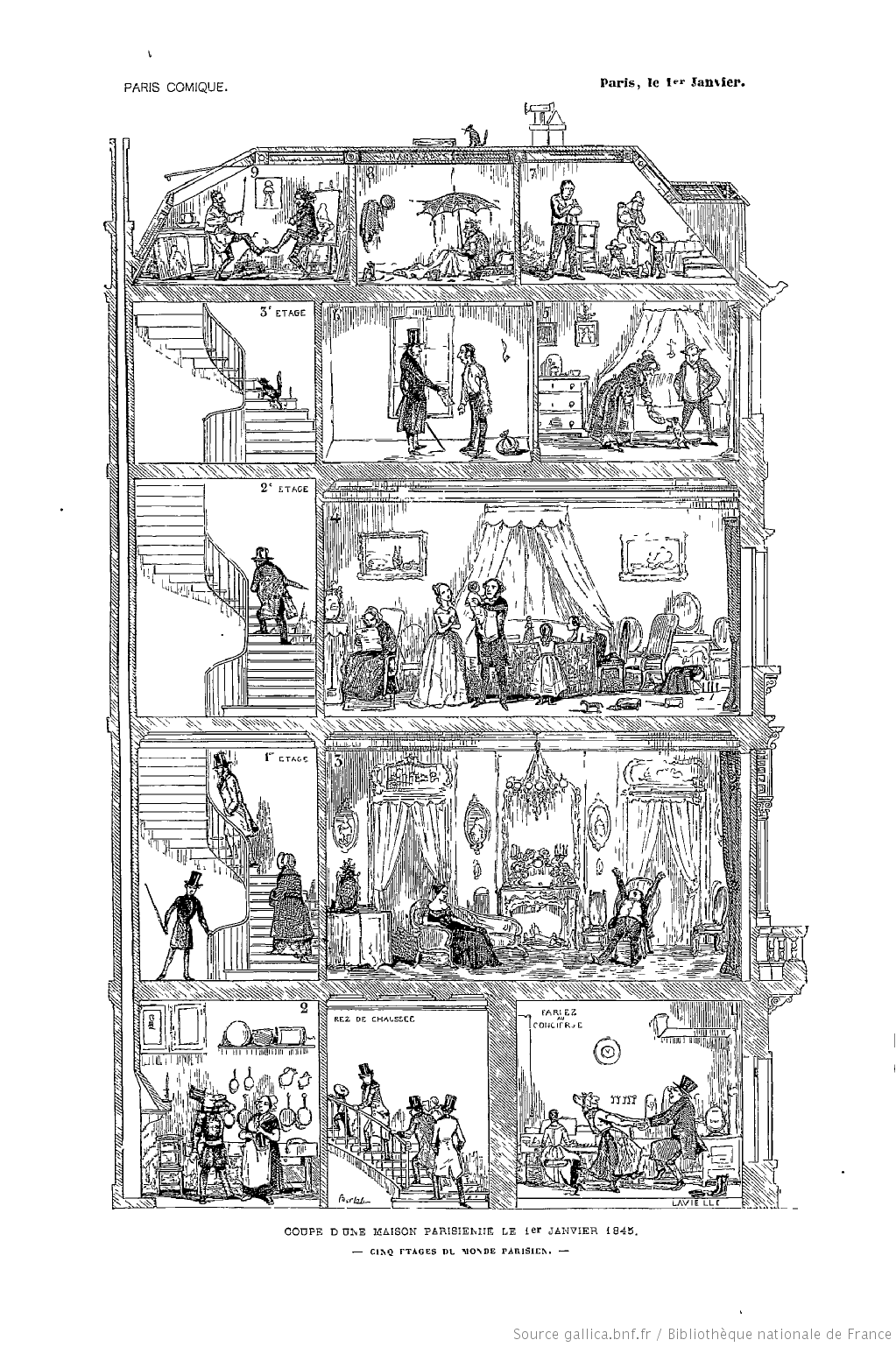
Click to enlarge
and colorized for an edition of Perec's 'la vie'
 Click to enlarge
Click to enlarge
and colorized for an edition of Perec's 'la vie'
 Click to enlarge
26RickHarsch
I indeed have had my head where sun shineth not.
27PeterKein
Cat,
Perhaps this article would get you to pick up la vie again, quicker. The quotes are from Paul Harris's 'The Invention of Forms: Perec;s "Life: A User's Manual" and a Virtual Sense of the Real'. I will not pretend to understand it all, but what is especially interesting to me is his discussion of the recursive and self-referential nature of the text and the spontaneous, infinitely generative but ultimately meaningless ("what Rosset calls the "insignificance of the real") self-organization it lends itself to. (Check your private messages).
(Oulipians Bens, Berge and Braffort define a recurrent text as "any text that contains, explicitly or implicitly, generative rules that invite the reader ... to pursue the production to infinity.")
"Structuralism thus constitutes a necessary background to, but insufficient explanation for Perec's invention of form. "
" While a structuralist conception of play would show how new events can occur within a fixed system or language game, Oulipian play foregrounds innovation at the fundamental level of form. Jean-Jacques Thomas makes the crucial distinction
It is not a novel (only?) but a "textual game" "structured by this combination of a game's rules and the perturbations of a clinamen" ( "The clinamen is the Epicurean term for the unpredictable sway of atoms that initiates their combination into forms. ")
"Raymond Queneau, the mathematician and writer who (with Franqois Le Lionnais) founded OuLiPo in 1960, defined potential literature as "research of forms, of new structures that can be used by writers in any manner they please"
(Oulipo 38; my translation). And in an OuLiPo manifesto, Le Lionnais compared the group's formal experimentation to attempts to synthesize life artificially (Le Lionnais 30-31), while mathematicians Jacques Bens, Claude Berge and Paul Braffort conceived a genre of "cellular prosody" as a direct analogue to John Conway's famous "Game of Life" computer program, cited as a prototype for Artificial Life work (Bens et al, 112)."
It is a brilliant recombination and so recreative invention ("In chapter fifty, the first paragraph describing the picture is pieced together by passages from Flaubert's Sentimental Education and Calvino's Invisible Cities.")
Perhaps this article would get you to pick up la vie again, quicker. The quotes are from Paul Harris's 'The Invention of Forms: Perec;s "Life: A User's Manual" and a Virtual Sense of the Real'. I will not pretend to understand it all, but what is especially interesting to me is his discussion of the recursive and self-referential nature of the text and the spontaneous, infinitely generative but ultimately meaningless ("what Rosset calls the "insignificance of the real") self-organization it lends itself to. (Check your private messages).
(Oulipians Bens, Berge and Braffort define a recurrent text as "any text that contains, explicitly or implicitly, generative rules that invite the reader ... to pursue the production to infinity.")
"Structuralism thus constitutes a necessary background to, but insufficient explanation for Perec's invention of form. "
" While a structuralist conception of play would show how new events can occur within a fixed system or language game, Oulipian play foregrounds innovation at the fundamental level of form. Jean-Jacques Thomas makes the crucial distinction
that the combinatoric axiomatics at work in the Oulipian enterprise are not descriptive and static, as would have been the case in the structuralist era, but rather respond to a transformational dynamic. It is an enterprise based not on a classification of states of a language but on a repertoire of operations implied in the production of a text. (23; his italics)
It is not a novel (only?) but a "textual game" "structured by this combination of a game's rules and the perturbations of a clinamen" ( "The clinamen is the Epicurean term for the unpredictable sway of atoms that initiates their combination into forms. ")
"Raymond Queneau, the mathematician and writer who (with Franqois Le Lionnais) founded OuLiPo in 1960, defined potential literature as "research of forms, of new structures that can be used by writers in any manner they please"
(Oulipo 38; my translation). And in an OuLiPo manifesto, Le Lionnais compared the group's formal experimentation to attempts to synthesize life artificially (Le Lionnais 30-31), while mathematicians Jacques Bens, Claude Berge and Paul Braffort conceived a genre of "cellular prosody" as a direct analogue to John Conway's famous "Game of Life" computer program, cited as a prototype for Artificial Life work (Bens et al, 112)."
It is a brilliant recombination and so recreative invention ("In chapter fifty, the first paragraph describing the picture is pieced together by passages from Flaubert's Sentimental Education and Calvino's Invisible Cities.")
28QuentinTom
thanks Peter, all this is exceptionally fascinating. I need to get really stuck into the Oulipo group sometime: they overlap with my love of Barthes and Braudel, and structuralist games generally.
I first read LAUM about 20 years ago, when I had no idea what Oulipo were/was. I loved the book for its sense of daily life in a Parisian apartment block - ironically, considering their avowed aim was NOT a mimesis of reality. I had spent a fair bit of time living in Paris prior to reading the novel, and for me it conjured up all kinds of memories and textures of French life.
It is an enterprise based not on a classification of states of a language but on a repertoire of operations implied in the production of a text. (23; his italics)
this is especially pertinent to Queneau's exercise de style, I think.
and I don't know how appropos this is, but it might interest you anyway, if you don't already know it
:
http://www.amazon.com/Anecdoted-Typography-Chance-Atlas-Arkhive/dp/0947757880/re...
I first read LAUM about 20 years ago, when I had no idea what Oulipo were/was. I loved the book for its sense of daily life in a Parisian apartment block - ironically, considering their avowed aim was NOT a mimesis of reality. I had spent a fair bit of time living in Paris prior to reading the novel, and for me it conjured up all kinds of memories and textures of French life.
It is an enterprise based not on a classification of states of a language but on a repertoire of operations implied in the production of a text. (23; his italics)
this is especially pertinent to Queneau's exercise de style, I think.
and I don't know how appropos this is, but it might interest you anyway, if you don't already know it
:
http://www.amazon.com/Anecdoted-Typography-Chance-Atlas-Arkhive/dp/0947757880/re...
29PeterKein
That "novel" sounds very interesting but I wonder how engaging it is? I somewhat feel this way about la vie - in that, unless you know the 'grammar' or 'story machine' that Perec used to create it, and the puzzle that each chapter contains, it can read flat at times. I am not literary enough to put Perec's puzzles back together I fear, but I can appreciate the constraints and 'forms' that went into their creation.
If you have some french, and plan on 're-playing' la vie, then I would be jealous if you did so along Perec's notebooks (Cahier des charges de la vie mode d'emploi)
If you have some french, and plan on 're-playing' la vie, then I would be jealous if you did so along Perec's notebooks (Cahier des charges de la vie mode d'emploi)

31QuentinTom
wow! interesting. I would have thought the christmas books would be the most sold in that period.
32RickHarsch
Are you kidding? All those poor people?
33PeterKein
I have finished Perec's LAUM - and my limited literary knowledge makes it difficult to appreciate it (as a novel rather than game or folly) the way some critics have. I suppose the way I feel can be summed up in the words of EM Forster
The novelist who betrays too much interest in his own method can never be more than interesting...
And the level of 'interesting' is, as I said, limited by my ignorance- and so seems to mock me as it highlights my ignorance, which, in my opinion, great novels, like fine gentlemen and gentlewomen, never do.
I am re-reading Aspects of the Novel - before I move on to Muir's Structure of the Novel (then either Welleck's Theory of Literature - or Stevick's Theory of the Novel). I still find Forster's approach disagreeable (false dichotomies and dismissing exceptions as not really exceptions) - but there is an interesting compulsion to continue reading. I have not figured this out.
The novelist who betrays too much interest in his own method can never be more than interesting...
And the level of 'interesting' is, as I said, limited by my ignorance- and so seems to mock me as it highlights my ignorance, which, in my opinion, great novels, like fine gentlemen and gentlewomen, never do.
I am re-reading Aspects of the Novel - before I move on to Muir's Structure of the Novel (then either Welleck's Theory of Literature - or Stevick's Theory of the Novel). I still find Forster's approach disagreeable (false dichotomies and dismissing exceptions as not really exceptions) - but there is an interesting compulsion to continue reading. I have not figured this out.
34QuentinTom
P, have you read the Russian formalists? Todorov? Solokhov?
...great novels, like fine gentlemen and gentlewomen, never do.
this made me chuckle.
...great novels, like fine gentlemen and gentlewomen, never do.
this made me chuckle.
35anna_in_pdx
33, 34: That is why I do not like the Alexandria Quartet. It makes me feel all bourgie and stupid.
36PeterKein
Cat, no I have not.. recommend something.
I finished Aspects of the Novel again and this time around I realize that what drives a lot of it is his theory of human nature.
He identifies "daily life, whatever it may be really, is practically composed of two lives- the life in time and the life in values". And of these two "what the story does is to narrate the life in time." He defines the story as "a narrative of events arranged in their time sequence..." And since we are all, at core, 'shockheads' "in that we want to know what happens next. That is universal and that is why the backbone of a novel has to be a story."
So if it must be universal, why is it held in so low esteem? In another post on Forster's section on story, I wonder why there seems to be exasperation with the fact that a novel tells a story. But I think I understand this more now.
The answer revolves around the question "what is the difference between people in a novel and people like the novelist, or like you, or like me..."
Again F creates a dichotomy- this time between the 'life of action' and the 'hidden life'. "The hidden life, is by definition, hidden. The hidden life that appears in external signs is hidden no longer and has entered the realm of action." And this distinction is key because "...the function of the novelist (is) to reveal the hidden life at its source."
And what is at stake here? What is it that the novel can explore by exposing its characters' hidden lives that none of us can do in daily life? First, "happiness and misery exist in the hidden life" (as he rejects Aristotle's "All human happiness and misery take the form of action."). And because "...the happiness or misery that he secretly feels proceeds from causes that he cannot quite explain, because as soon as he raises them to the level of the explicable they lose their native quality." then it seems that it is only through homo fictus that we can explore happiness and misery - at least the happiness and misery of others.
So given that the story is concerned with 'life in action' - this particular aspect of the novel explores nothing that cannot be explored via history or other forms of narrative. The hidden life, on the other hand, occurs orthogonal to the story - in the plot - which occurs "through a suspension of the time-sequence".
Incidentally, these two aspects of the novel are related to the various human faculties - the story with curiosity and the plot with 'intelligence and memory':
"A plot cannot be told to a gaping audience of cavemen...They can only be kept awake by 'and then-and then-" They can only supply curiosity." "Curiosity is one of the lowest of the human faculties". "If we would grasp the plot we must add intelligence and memory."
Anyhow, I came across a copy of The Rise of the Novel and have begun reading that instead of Muir. It is rather fascinating. Ironically it identifies the uniqueness of the novel form with its attention to the particular rather than the universal- in characters and in space and time. (Watt contrasts this tendency with older forms of narrative that deal with universals in character and circumstance). It seems to me that an argument can be made that Forster - in privileging the 'life in values' and minimizing 'life in time' is closer to these older values of narrative form.... but probably not.
I finished Aspects of the Novel again and this time around I realize that what drives a lot of it is his theory of human nature.
He identifies "daily life, whatever it may be really, is practically composed of two lives- the life in time and the life in values". And of these two "what the story does is to narrate the life in time." He defines the story as "a narrative of events arranged in their time sequence..." And since we are all, at core, 'shockheads' "in that we want to know what happens next. That is universal and that is why the backbone of a novel has to be a story."
So if it must be universal, why is it held in so low esteem? In another post on Forster's section on story, I wonder why there seems to be exasperation with the fact that a novel tells a story. But I think I understand this more now.
The answer revolves around the question "what is the difference between people in a novel and people like the novelist, or like you, or like me..."
Again F creates a dichotomy- this time between the 'life of action' and the 'hidden life'. "The hidden life, is by definition, hidden. The hidden life that appears in external signs is hidden no longer and has entered the realm of action." And this distinction is key because "...the function of the novelist (is) to reveal the hidden life at its source."
And what is at stake here? What is it that the novel can explore by exposing its characters' hidden lives that none of us can do in daily life? First, "happiness and misery exist in the hidden life" (as he rejects Aristotle's "All human happiness and misery take the form of action."). And because "...the happiness or misery that he secretly feels proceeds from causes that he cannot quite explain, because as soon as he raises them to the level of the explicable they lose their native quality." then it seems that it is only through homo fictus that we can explore happiness and misery - at least the happiness and misery of others.
So given that the story is concerned with 'life in action' - this particular aspect of the novel explores nothing that cannot be explored via history or other forms of narrative. The hidden life, on the other hand, occurs orthogonal to the story - in the plot - which occurs "through a suspension of the time-sequence".
Incidentally, these two aspects of the novel are related to the various human faculties - the story with curiosity and the plot with 'intelligence and memory':
"A plot cannot be told to a gaping audience of cavemen...They can only be kept awake by 'and then-and then-" They can only supply curiosity." "Curiosity is one of the lowest of the human faculties". "If we would grasp the plot we must add intelligence and memory."
Anyhow, I came across a copy of The Rise of the Novel and have begun reading that instead of Muir. It is rather fascinating. Ironically it identifies the uniqueness of the novel form with its attention to the particular rather than the universal- in characters and in space and time. (Watt contrasts this tendency with older forms of narrative that deal with universals in character and circumstance). It seems to me that an argument can be made that Forster - in privileging the 'life in values' and minimizing 'life in time' is closer to these older values of narrative form.... but probably not.
37RickHarsch
I don't follow all of this, PK, but as a novelist, what I would say is there is always story. I remember a Kafk diary entry that went something like this: A man sits looking out the window. already in that there is perfection. If I understand him, it is that the charater is born that easily, and therefore his story.
38PeterKein
Well Forster's Aspects of a Novel has stuck in my craw for a while.. and well, I found myself rereading it - and this time around some of the things he said made more sense (not that I agree with him). Anyhow, he would agree that there is always a story.. there has to be- but what he calls 'story' - the "and then, and then, and then" - he treats very severely and even wishes that it wasn't the case that there had to be a 'story'. Anyway, I write these notes to solidify my own thinking really....
I am sure you are aware of Hemingway's: "For sale: baby shoes, never worn."
I am sure you are aware of Hemingway's: "For sale: baby shoes, never worn."
39QuentinTom
oh, well, in that case read Felix Feneon.
great remarks on Forster, proving that there is still more to that little book than meets the eye. Ian Watts's book is also excellent.
Try also:
Todorov's The Poetics of Prose (T is contemporary, but heavily influenced by Russian Formalism)
Shklovsky's Theory of Prose (not Sholokov, as I wrote above, sorry, too much Wodka last night)
Jacobsen Language in Literature
great remarks on Forster, proving that there is still more to that little book than meets the eye. Ian Watts's book is also excellent.
Try also:
Todorov's The Poetics of Prose (T is contemporary, but heavily influenced by Russian Formalism)
Shklovsky's Theory of Prose (not Sholokov, as I wrote above, sorry, too much Wodka last night)
Jacobsen Language in Literature
40urania1
Interesting remarks on Forster. His argument appears to rest on the assumption that realism is a necessary characteristic of the novel.
41urania1
The trouble with Watt and others of his ilk. They assume that the Brits (Cervantes excepted) invented the novel.
42PeterKein
Ur,
Why do you say that?
By his separating out the 'life of action' from the 'hidden life' and distinguishing homo fictus from homo sapien - I was actually left asking what relation the novel has to real life.
Also, you see - its all about defining terms.. such as 'novel' which Watt certainly hitches (or at least parallels) to Lockean thought.
Why do you say that?
By his separating out the 'life of action' from the 'hidden life' and distinguishing homo fictus from homo sapien - I was actually left asking what relation the novel has to real life.
Also, you see - its all about defining terms.. such as 'novel' which Watt certainly hitches (or at least parallels) to Lockean thought.
43QuentinTom
>41 urania1: Well, to be fair, he is writing about the novel in English.
44urania1
PK,
I was speaking of literary realism in the strictly formal sense.
In any case, none of the ancient novels could be categorized as novels per se if we adhered to F.'s theory about the novel. Novels that engage in world building would fall off the list too.
I was speaking of literary realism in the strictly formal sense.
In any case, none of the ancient novels could be categorized as novels per se if we adhered to F.'s theory about the novel. Novels that engage in world building would fall off the list too.
46urania1
P.,
My mind is not working today. Your post deserves a longer more complex response than I am capable of formulating at the moment. And as for literary realism in the formal sense - I cannot believe I just posted such drek considering how hotly contested the definition of "literary realism" is.
My mind is not working today. Your post deserves a longer more complex response than I am capable of formulating at the moment. And as for literary realism in the formal sense - I cannot believe I just posted such drek considering how hotly contested the definition of "literary realism" is.
47RickHarsch
But Englishness is retreating into a vacuum.
48PeterKein
Ur, I will wait until tuesday... or not. Luckily I do not do this thing for a living and so I can hold incorrect understandings of everything I read, woohoo.
49PeterKein
I came across a mention of Walter Benjamin's great essay 'Unpacking my Library'. Feel like re-reading it again after I read another article titled 'Russian Formalism' by Victor Erlich. All this instead of doing what I should be doing...
also, http://citybuilderbookclub.org/
also, http://citybuilderbookclub.org/
50QuentinTom
>45 urania1: Ur, but it did, for those novelists on the ground writing in English. The context of the 'rise of the novel in other languages' is only an academic, historical construct, hindsight, perspective.
To Fielding, Defoe and Richardson, it's possible to argue that they were writing more with their English predecessors looking over their shoulder than with a consciousness of the entire development of the novel in all languages. Hell, were they even conscious that they were writing a 'novel' at all?
To Fielding, Defoe and Richardson, it's possible to argue that they were writing more with their English predecessors looking over their shoulder than with a consciousness of the entire development of the novel in all languages. Hell, were they even conscious that they were writing a 'novel' at all?
51urania1
Hell, were they even conscious that they were writing a 'novel' at all?
Michael McKeon addresses this issue in The Origins of the English Novel 1600-1740. He points out that genre distinctions as understood by Defoe's contemporaries, for example, would not match ours. The term "novel" was not clearly distinguished from other generic categories such as history, travel narrative, romance, etc. So in one sense, the answer to your question is "probably not." But they were not writing in a vacuum. I think it is safe to say that many of these novelists had read works like Daphnis and Chloe or The Satyricon. They would have been familiar with Rabelais etc. Thus they were writing out of narrative tradition that was much broader than that circumscribed by national boundaries.
In any case, Watt and his ilk are the ones drawing the genre distinction in hindsight as you note. And Watt's problem ... he wants to claim the "novel" for the Brits. Sorry it won't wash.
Michael McKeon addresses this issue in The Origins of the English Novel 1600-1740. He points out that genre distinctions as understood by Defoe's contemporaries, for example, would not match ours. The term "novel" was not clearly distinguished from other generic categories such as history, travel narrative, romance, etc. So in one sense, the answer to your question is "probably not." But they were not writing in a vacuum. I think it is safe to say that many of these novelists had read works like Daphnis and Chloe or The Satyricon. They would have been familiar with Rabelais etc. Thus they were writing out of narrative tradition that was much broader than that circumscribed by national boundaries.
In any case, Watt and his ilk are the ones drawing the genre distinction in hindsight as you note. And Watt's problem ... he wants to claim the "novel" for the Brits. Sorry it won't wash.
52QuentinTom
he wants to claim the "novel" for the Brits
I think this is a step too far. Restricting one's enquiry to the development of the novel in English is not the same as claiming the Brits invented it. Watt's focus is the former, but he is not claiming the latter, at least as far as I can recall.
I think this is a step too far. Restricting one's enquiry to the development of the novel in English is not the same as claiming the Brits invented it. Watt's focus is the former, but he is not claiming the latter, at least as far as I can recall.
53urania1
Damn it Murr,
I have got to leave in a few minutes to pick up Robbie (it is almost midnight here). I have two lengthy quotations from Watt which demonstrate my point. I don't have time to type them now. I will be back tomorrow ... sometime, with the smoking gun in hand.
I have got to leave in a few minutes to pick up Robbie (it is almost midnight here). I have two lengthy quotations from Watt which demonstrate my point. I don't have time to type them now. I will be back tomorrow ... sometime, with the smoking gun in hand.
54QuentinTom
* Murr retreats under the sofa in terror of the Bitch Queen*
55PeterKein
Hell, were they even conscious that they were writing a 'novel' at all?
I have read somewhere (and it might very well have been in Watt) that Defoe was not, but Richardson and Fielding were aware they were "doing something different".
Restricting one's enquiry to the development of the novel in English is not the same as claiming the Brits invented it.
Implicitly, entitling your book 'The Rise of the Novel' (not 'The Rise of the English novel') and then focusing on three English authors suggests that Watt is arguing for the novel being a particularly British invention. Linking it to the development of Cartesian consciousness and Lockean 'personal identity' ("an identity of consciousness through duration in time") makes this easier.
By the by, I think that Watt gets Forster wrong when he says "Forster sees the portrayal of 'life by time' as the distinctive role which the novel added to literature's more ancient preoccupation with portraying 'life by values'." In fact, I think Forster argues something almost directly opposite.
Nevertheless, the portrayal of life in all its quotidian detail (its "concrete particularity") is seen by Watt as being the essence of the novel, and something that distinguishes it from prior prose narrative. (Alongside "its use of past experience as the cause of present action: a causal connection operating through time replaces the reliance of earlier narratives on disguises and coincidences...").
I have read somewhere (and it might very well have been in Watt) that Defoe was not, but Richardson and Fielding were aware they were "doing something different".
Restricting one's enquiry to the development of the novel in English is not the same as claiming the Brits invented it.
Implicitly, entitling your book 'The Rise of the Novel' (not 'The Rise of the English novel') and then focusing on three English authors suggests that Watt is arguing for the novel being a particularly British invention. Linking it to the development of Cartesian consciousness and Lockean 'personal identity' ("an identity of consciousness through duration in time") makes this easier.
By the by, I think that Watt gets Forster wrong when he says "Forster sees the portrayal of 'life by time' as the distinctive role which the novel added to literature's more ancient preoccupation with portraying 'life by values'." In fact, I think Forster argues something almost directly opposite.
Nevertheless, the portrayal of life in all its quotidian detail (its "concrete particularity") is seen by Watt as being the essence of the novel, and something that distinguishes it from prior prose narrative. (Alongside "its use of past experience as the cause of present action: a causal connection operating through time replaces the reliance of earlier narratives on disguises and coincidences...").
56PeterKein
And I think there is an important distinction between asking "What is the first novel?" and "Where/why does the novel as genre develop?".
Ultimately however since the thing 'novel' does not exist in kind, and is historical, then it wouldn't seem too far-fetched that 'the novel' developed independently and for different reasons in different places. And even that assumes that such a thing as a 'novel' can be defined into existence in a way that is meaningful.
Ultimately however since the thing 'novel' does not exist in kind, and is historical, then it wouldn't seem too far-fetched that 'the novel' developed independently and for different reasons in different places. And even that assumes that such a thing as a 'novel' can be defined into existence in a way that is meaningful.
57RickHarsch
I like this definition I just thought up: a lengthy piece of writing that is mostly prose that the author calls a novel
58PeterKein
or perhaps... a lengthy piece of writing that is mostly prose that people not busy writing novels call novels!
I don't read this stuff for the defining which is a fool's errand I think - but I do learn a lot about what others think are the important aspects of this form of prose narrative. (And here I meant to insert a witty quote that would have won you over to my cause and left you chanting my name but I have forgotten it.)
I don't read this stuff for the defining which is a fool's errand I think - but I do learn a lot about what others think are the important aspects of this form of prose narrative. (And here I meant to insert a witty quote that would have won you over to my cause and left you chanting my name but I have forgotten it.)
59RickHarsch
I'll chant your name anyway---I think we understand each other very well.
60PeterKein
There is a beat up copy of the shorter OED at my used bookshop....the book I can afford.... I worry about shipping to -vinia (?) however......
61RickHarsch
You should--it's a lot. One of my brothers always sends my kids books for their birthdays and usually he spends more on post.
62PeterKein
Ok here is an idea - When I find one, the binding of which is tattered, I will buy it ... You tell me the beginning letters and I will find a suitable page to post to you.
63RickHarsch
you mean the Slo that precedes Slovenia?
I found this today: "...Bakhtin defines the novel as a 'multiplicity of styles'...in their mutual echoing, or as the word constantly involved in dialogue...Behind each reply in this dialogue stands a 'speaking man', and therefore the word in the novel is always socially charged nd thus necessarily polemical. There is no one-voiced novel, and, consequently, every novel by its very nature is polemical."
With Bakhtin's own elaboration it is if not a sort of true definition, a very inspiring endless spring of ideas.
I found this today: "...Bakhtin defines the novel as a 'multiplicity of styles'...in their mutual echoing, or as the word constantly involved in dialogue...Behind each reply in this dialogue stands a 'speaking man', and therefore the word in the novel is always socially charged nd thus necessarily polemical. There is no one-voiced novel, and, consequently, every novel by its very nature is polemical."
With Bakhtin's own elaboration it is if not a sort of true definition, a very inspiring endless spring of ideas.
64PeterKein
I meant any letters of your choice and I will select, rip out and send a page that contains words beginning with them. I would liken myself to a lexicologically inclined cross between Robin Hood and Scheherazade.
a progenitive description is always better than a sterile definition....
a progenitive description is always better than a sterile definition....
65RickHarsch
I have a thing for the letter a...
66LisaCurcio
As usual, you are all above my head, except that "letter a" part. I do subscribe to a blog in which today was posted an interesting letter from John Steinbeck to his editor which I think is à propos this discussion:
http://www.lettersofnote.com/2012/02/book-is-like-man.html
http://www.lettersofnote.com/2012/02/book-is-like-man.html
68Macumbeira
I think Bakhtin is my man, haven't read him, but I should
69Macumbeira
Good text Lisa !
71QuentinTom
"There is no one-voiced novel"
oh yes there is: Laura Warholic!
brilliant letter, lisa.
oh yes there is: Laura Warholic!
brilliant letter, lisa.
73anna_in_pdx
71: He was referrring to good novels.
74PeterKein
One of the basic situationist practices is the dérive, a technique of rapid passage through varied ambiences. Dérives involve playful-constructive behavior and awareness of psychogeographical effects, and are thus quite different from the classic notions of journey or stroll.
(Guy Debord Theory of the Dérive)
75RickHarsch
Whoa there! Peter are you one of the academic elites brainwashing the youth of the United States?
76PeterKein
I do not really know who this Peter is although I assure you there is nothing elite about him. Instead of answering your question I draw your attention to a quotation by Fernando Pessoa I saw scribbled on the inside of a copy of GWB's 'Decision Points' or it might have been a copy of 'Unreasonable Risk' I get them mixed up.
"inferior people cannot have a master since they have nothing for a master to be a master of."
"inferior people cannot have a master since they have nothing for a master to be a master of."
77RickHarsch
Yep, elitist indoctrinator.
78QuentinTom
>76 PeterKein: brilliant.
79RickHarsch
78> Yet another elitist indoctrinator
80PeterKein

'Is the Bookworm an Endangered Species?'
http://harpers.org/archive/2008/01/hbc-90002193
I have colleagues that openly admit to "not reading for pleasure". I realize there is no real basis for the shudder of real disgust ever time I hear it, but that disgust is as real as anything I experience.
81anna_in_pdx
80: I talked to a guy a few weeks ago who was very! definite! about not! having time! for fiction! He reads "stories" instead. If I had been facing a wall I would have slammed my head into it at that point. So I guess what he was trying to say is that novels are just too long.
82Macumbeira
80 loved that text Peter
83PeterKein
Glad to hear such things.... I just finished The Moon and Sixpence; a beautiful little query. I would write more but my thoughts seem rather personal. I will say that Maugham sets forth the kernel of his query most directly not in the story of Strickland but in Abraham.
85baswood
Interesting stuff about bookworms. I have recently read a novel where the hero a classics scholar says that "There are people that read and people that don't (he means for pleasure) and he ascertains he can tell who they are without having to ask.
It led me to think about my friends and wonder whether they are in the habit of reading for pleasure. I don't think I would be that surprised by any results.
It led me to think about my friends and wonder whether they are in the habit of reading for pleasure. I don't think I would be that surprised by any results.
86A_musing
You are all having such fun here! The bookworms article is interesting. There are so many different literary cultures, so many different approach to having books, scrolls, letters, etc. in our lives... I'm not sure it all revolves around reading for pleasure - does someone like Condi, who does not engage in extracuricular reading, nonetheless enjoy her curricular reading, and what is that curricular reading? Given her role, it could be quite fascinating. There are times I wish for a life more akin to a stereotypical Confucian bureaucrat, for whom some degree of poetic rendering and demonstrable eloquance and culture is a defined part of the duties. Should we try to dash down that pleasure/profit dichotomy instead of bemoaning the lack of pleasure reading?
87ChocolateMuse
Except that when profit is involved, so much of the pleasure is taken away, because such things become a duty.
88PeterKein
An I wonder if it isn't even more than that, the difference between machine and (hu)man; production and being.
92PeterKein
I finished Robert Alter's Imagined Cities last night. In it (and forgive me I just realized that I do not have the book available to me as I write this) he examines how six authors (Flaubert, Dickens, Woolf, Bely, Joyce and Kafka) have explored the effects of the rise of the modern city on the consciousnesses of its inhabitants in the world of the novel and conversely how the modern city is represented in consciousness for these characters. My favorite chapters are his treatment of Flaubert's Paris in The Sentimental Education & Dickens' sophisticated use of figurative language, especially metaphor, to explore the cityscape of London.
I will edit and add to this when I have the text in front of me.
This is a good, short piece about Alter's approach for the text and literary criticism in general (I am aware others are reading his The Five Books of Moses).
I will edit and add to this when I have the text in front of me.
This is a good, short piece about Alter's approach for the text and literary criticism in general (I am aware others are reading his The Five Books of Moses).
93LisaCurcio
With this, Pen of Iron and Moses, I might have to start a TBR shelf for Alter.
94PeterKein
Lisa, don't forget The Pleasures of Reading in an Ideological Age. I am wavering on whether I pick this up from the library today - but I think I will wait until I whittle the TBR a bit.
95LisaCurcio
With all of the reading we have to do, wouldn't you think we would not be reading books about reading?
96A_musing
The Alter shelf is going to get bigger than that before I'm done. He has a couple dozen books out there, including his translations, and every one of them looks interesting.
97LisaCurcio
When does/did the man have time to read and to teach?
98PeterKein
The presence of books about reading is like the presence of a friend also in the midst of an affair, their mere presence relieves the mind of much guilt associated with the time and subterfuge given over to the vice.
I have started reading Julien Gracq's The Shape of A City about Nantes. (Oh but to attend a secondary institution with such an intellectual pedigree! edit: lycee Henri IV, not lycee Clemenceau)
I have started reading Julien Gracq's The Shape of A City about Nantes. (Oh but to attend a secondary institution with such an intellectual pedigree! edit: lycee Henri IV, not lycee Clemenceau)
99PeterKein
95 & ff. re: Time Enough to Read.....
This is the ending
and this, the full episode of Time Enough At Last
Witness Mr. Henry Bemis, a charter member in the fraternity of dreamers. A bookish little man whose passion is the printed page, but who is conspired against by a bank president and a wife and a world full of tongue-cluckers and the unrelenting hands of a clock. But in just a moment, Mr. Bemis will enter a world without bank presidents or wives or clocks or anything else. He'll have a world all to himself...without anyone.
This is the ending
and this, the full episode of Time Enough At Last
100ChocolateMuse
After all the cities, you will then need to go on to Landscape and Memory afterwards...
101PeterKein
96, Yes insanely prolific. Alter also has a book co-authored with Frank Kermode, another of my lit crit heroes The Literary Guide to the Bible. As for Kermode himself - The Sense of an Ending and Shakespeare's Language deserve some space here.
100, oh if only the time.. the time.... we have a few of Schama, but not that one. I will keep an eye out for it.
100, oh if only the time.. the time.... we have a few of Schama, but not that one. I will keep an eye out for it.
102LisaCurcio
Kermode is on my list, too. I think because Porius mentioned him at some point.
103PeterKein
I want to solidify some of my thoughts on Imagined Cities here before I move on. This is not intended to be a synopsis but simply comments on some aspects of the text that interest me for other purposes.
What Alter has in mind is to "(address) the means through which literature (like painting, photography, and then film) fashions an innovative language to represent this basic shift in modern consciousness". The shift he is referring to is how one experiences space and time associated with the introduction of new technologies (e.g. glass architecture, the railroad). And in this framework, the city that represents "both an engine of change and its consequence".
Alter asks "how was a writer to cope with this new reality in the language of fiction?" He then uses six novelists to investigate answers to this question. As I mentioned above, I favor his treatments of Flaubert's Paris in The Sentimental Education & Dickens' use of metaphor to explore the cityscape of London.
Flaubert find a language to represent Walter Benjamin's "aesthetic of shock"; where "the new urban reality, reinforced by its own technological instruments, isolates the discrete moment, flashing it onto the sensorium, then rapidly proceeding to the next moment." Alter goes on to show, for example, how Flaubert's use of light and language of light (e.g. éclater, éblouir) portrays this stroboscopic phenomenology of city life. But the larger insight that I find useful is what Alter calls Flaubert's phantasmagoria "everything is seen in as constant disorientating flux, and the lines of division between perception and hallucination, waking and dreaming, blur". He distinguishes Flaubert's use of phantasmagoria from Baudelaire's use of 'fantasy'- the former being "a representation of the way the multifaceted reality of the city impinges on the senses of the individual and unlocks underground currents in his psyche... at once a process of rapid perception and free association." There is, of course, more he says about Flaubert- but I will stop here. He views this work as beautifully poised between "two literary eras"- the "realism" of the nineteenth century and the "modernism" of the twentieth.
For Dickens - he uncovers two themes- the "realism of metaphor" and also the "intimations of apocalypse" found in Dickens' exploration of London. I am only going to talk about the former and narrowly at that. One of the primary functions of his figurative language is as "a faculty of archaic vision in which what meets the eye in the contemporary scene triggers certain primal fears and fantasies, archaic vision becoming the medium through which we are led to see the troubling meanings of the new urban reality." He uses an example from Our Mutual Friend where a church figuratively turns into, to use Dickens' words "some petrified monster". Or from Bleak House where given the amount of mud in the street one might meet "Megalosaurus, forty-feet long or so, waddling like an elephantine lizard up Holburn-hill". My sense is that you have, simultaneously, two worlds being constructed by Dickens that we, the reader, are being exposed to. The first is Dickens' London - where the use of figurative language acts to develop our understanding. But concurrently, this primordial world of monsters and megalosaurus pops into view, outside of time. These worlds do not interact causally, but they do cast shadows upon each other. And for the reader, the modern city of London is 'read' against the backdrop of the ancient, timeless (uncivilized) world. We are afforded glimpses how "progress" or "Civilization" may be in part the mere window dressing of a grotesque monster. There is, again, much more said about Dickens' figurative language - including how he takes a topic, then generates complexly interlinked metaphors by exploiting the ground between topic and vehicle- and through this use of figurative language explores the city - and its relation to personal consciousness.
A primary measure of successfulness of any piece of literary criticism, in my narrow view, is whether the author succeeds in arousing in the reader the desire to become (re-)acquainted with the works discussed. After reading these discussions- I am set on re-reading The Sentimental Education this summer and more Dickens, soon - most likely Our Mutual Friend.
see also
Walter Benjamin "On Some Motifs in Baudelaire"
Efraim Sicher - Rereading the City, Rereading Dickens
George Simmel's "The Metropolis and Mental Life"
What Alter has in mind is to "(address) the means through which literature (like painting, photography, and then film) fashions an innovative language to represent this basic shift in modern consciousness". The shift he is referring to is how one experiences space and time associated with the introduction of new technologies (e.g. glass architecture, the railroad). And in this framework, the city that represents "both an engine of change and its consequence".
Alter asks "how was a writer to cope with this new reality in the language of fiction?" He then uses six novelists to investigate answers to this question. As I mentioned above, I favor his treatments of Flaubert's Paris in The Sentimental Education & Dickens' use of metaphor to explore the cityscape of London.
Flaubert find a language to represent Walter Benjamin's "aesthetic of shock"; where "the new urban reality, reinforced by its own technological instruments, isolates the discrete moment, flashing it onto the sensorium, then rapidly proceeding to the next moment." Alter goes on to show, for example, how Flaubert's use of light and language of light (e.g. éclater, éblouir) portrays this stroboscopic phenomenology of city life. But the larger insight that I find useful is what Alter calls Flaubert's phantasmagoria "everything is seen in as constant disorientating flux, and the lines of division between perception and hallucination, waking and dreaming, blur". He distinguishes Flaubert's use of phantasmagoria from Baudelaire's use of 'fantasy'- the former being "a representation of the way the multifaceted reality of the city impinges on the senses of the individual and unlocks underground currents in his psyche... at once a process of rapid perception and free association." There is, of course, more he says about Flaubert- but I will stop here. He views this work as beautifully poised between "two literary eras"- the "realism" of the nineteenth century and the "modernism" of the twentieth.
For Dickens - he uncovers two themes- the "realism of metaphor" and also the "intimations of apocalypse" found in Dickens' exploration of London. I am only going to talk about the former and narrowly at that. One of the primary functions of his figurative language is as "a faculty of archaic vision in which what meets the eye in the contemporary scene triggers certain primal fears and fantasies, archaic vision becoming the medium through which we are led to see the troubling meanings of the new urban reality." He uses an example from Our Mutual Friend where a church figuratively turns into, to use Dickens' words "some petrified monster". Or from Bleak House where given the amount of mud in the street one might meet "Megalosaurus, forty-feet long or so, waddling like an elephantine lizard up Holburn-hill". My sense is that you have, simultaneously, two worlds being constructed by Dickens that we, the reader, are being exposed to. The first is Dickens' London - where the use of figurative language acts to develop our understanding. But concurrently, this primordial world of monsters and megalosaurus pops into view, outside of time. These worlds do not interact causally, but they do cast shadows upon each other. And for the reader, the modern city of London is 'read' against the backdrop of the ancient, timeless (uncivilized) world. We are afforded glimpses how "progress" or "Civilization" may be in part the mere window dressing of a grotesque monster. There is, again, much more said about Dickens' figurative language - including how he takes a topic, then generates complexly interlinked metaphors by exploiting the ground between topic and vehicle- and through this use of figurative language explores the city - and its relation to personal consciousness.
A primary measure of successfulness of any piece of literary criticism, in my narrow view, is whether the author succeeds in arousing in the reader the desire to become (re-)acquainted with the works discussed. After reading these discussions- I am set on re-reading The Sentimental Education this summer and more Dickens, soon - most likely Our Mutual Friend.
see also
Walter Benjamin "On Some Motifs in Baudelaire"
Efraim Sicher - Rereading the City, Rereading Dickens
George Simmel's "The Metropolis and Mental Life"
105janemarieprice
Lovely observations from Imagined Cities. I think I will have to search this one out.
107PeterKein
I am finishing up Trollope's The Warden.
Place hold with Dickens and the Origin of "The Warden" by Lionel Stevenson
Place hold with Dickens and the Origin of "The Warden" by Lionel Stevenson
108PeterKein
...
Agile et noble, avec sa jambe de statue.
Moi, je buvais, crispé comme un extravagant,
Dans son oeil, ciel livide où germe l'ouragan,
La douceur qui fascine et le plaisir qui tue.
...
Ô toi que j'eusse aimée, ô toi qui le savais!
Audio- A une passante
110anna_in_pdx
Nice!
111ChocolateMuse
You sound quite different in French.
113ChocolateMuse
Oh! I see. It probably comes as no surprise when I say I never learned French.
114PeterKein
Oh... You with French... I don't think I could stand it! :)
Re: books and places.... I am also realizing that The Shape of a City is a daytime book, it is not to be read after dusk.
Re: books and places.... I am also realizing that The Shape of a City is a daytime book, it is not to be read after dusk.
115ChocolateMuse
:) Aw shucks. Polish would be better. More Slavic, less spitting. I started learning Polish once, and intend to keep going when I can get a good teacher.
A daytime book because it needs sunshine and trees? Sense of innocence? Or the opposite?
A daytime book because it needs sunshine and trees? Sense of innocence? Or the opposite?
116PeterKein
Yes that. Sunshine, air, the sounds of life
haze of heat maybe...
caught between awake and sleep certainly.
haze of heat maybe...
caught between awake and sleep certainly.
117QuentinTom
great stuff PK
118PeterKein
On the swift back of an idea...
'Telling Tales- The evolution of four stories'

http://laphamsquarterly.org/visual/assets_c/2010/03/Spring2010Map-1211.php
'Telling Tales- The evolution of four stories'

http://laphamsquarterly.org/visual/assets_c/2010/03/Spring2010Map-1211.php
119Macumbeira
Well this is interesting !
Thanks for sharing
Thanks for sharing
120Macumbeira
Absolutely brillant.
121anna_in_pdx
That was wonderfully interesting. Is Joseph Campbell still around? He'd love that.
122PeterKein
I agree ... it is part of another conversation I'm having..
Anyhow and yet another, what can I do but go where they lead, right P?
'Speaking of Books'
Randall Jarrell, New York Times Book Review, July 24, 1955
I found it in Kipling, Auden & Co. published by Farrar, Straus and Giroux -and I love the layout of the book and typesetting.
The link has it as 1965, but the book has 1955 and since the subtitle of the book is 'Essays and Reviews, 1935-1964, I am going with 1955. Incidentally, Randall died in 1965 after being hit by a car- either accidentally or a suicide.
Anyhow and yet another, what can I do but go where they lead, right P?
'Speaking of Books'
Randall Jarrell, New York Times Book Review, July 24, 1955
I found it in Kipling, Auden & Co. published by Farrar, Straus and Giroux -and I love the layout of the book and typesetting.
The link has it as 1965, but the book has 1955 and since the subtitle of the book is 'Essays and Reviews, 1935-1964, I am going with 1955. Incidentally, Randall died in 1965 after being hit by a car- either accidentally or a suicide.
123Macumbeira
I need à password to get in
125Porius
Great work PK. You are the ideal member of this bunch. Many thanks for your going above and beyond the call of duty.
128PeterKein
I don't think I will have much to say for awhile, I will be off making lists and such- but thanks for all the fish.
Thesaurus of English Words and Phrases- Peter Mark Roget
Lapham's Quarterly (a magazine that, I think, is among the best published in the 21st century- a rare jewel among the detritus of modern publishing).
http://www.laphamsquarterly.org/reconsiderations/word-for-word.php?page=all
Thesaurus of English Words and Phrases- Peter Mark Roget
Lapham's Quarterly (a magazine that, I think, is among the best published in the 21st century- a rare jewel among the detritus of modern publishing).
http://www.laphamsquarterly.org/reconsiderations/word-for-word.php?page=all

