ellie's (mirrordrum's) trek toward 75 in 2012
Talk 75 Books Challenge for 2012
Join LibraryThing to post.
This topic is currently marked as "dormant"—the last message is more than 90 days old. You can revive it by posting a reply.
1mirrordrum

January
1. Claire DeWitt and the City of the Dead by Sara Gran audible
2. Master Georgie by Beryl Bainbridge LP from library
3. Rebecca by Daphne Du Maurier, audible, Anna Massey
4. Mercy Watson to the rescue by Kate DiCamillo NLS db
5. Carpe Jugulum by Terry Pratchett audible.com, Nigel Planer
6. A Night of Blacker Darkness: Being the Memoir of Frederick Withers As Edited by Cecil G. Bagsworth III by Dan Wells audible, Sean Barett
7. The Key to Rebecca by Ken Follett NLS db
8. The Lemon Table by Julian Barnes audible, Timothy West, Prunella Scales
9. The Sidmouth Letters by Jane Gardam LP, owned
February
10. Nanny Ogg's Cookbook: A Useful and Improving Almanack of Information Including Astonishing Recipes from Terry Pratchett's Discworld by Terry Pratchett owned
11. Invasion of the Dykes to Watch Out For by Alison Bechdel library, cartoons
12. Moonlight mile by Dennis Lehane NLS db, David Hartley-Margolin
13. The guns of August by Barbara Wertheim Tuchman audible, Nadia May
14. The mysteries of Harris Burdick by Chris Van Allsburg library, drawings (not counted in turtle tally)
15. Good-bye, Chunky Rice by Craig Thompson library, GN
16. The arrival by Shaun Tan library, GN
17. Dissolution by C. J. Sansom audible.com
18. The celestial omnibus and other stories by E. M. Forster LP
19. Ex Libris: Confessions of a common reader by Anne Fadiman audible, Suzanne Toren
March
20. Everything That Rises Must Converge by Flannery O'Connor audible.com, Bronson Pinchot, Karen White, Mark Bramhall, Lorna Raver
21. 13 Clues for Miss Marple by Agatha Christie NLS, Patricia Kilgarriff
22. The Coroner's Lunch by Colin Cotterill audible.com, Clive Chafer
23. Logicomix: An Epic Search for Truth by Apostolos Doxiadis
24. Case histories by Kate Atkinson audible.com, Susan Jameson
25. Night Soldiers by Alan Furst NLS
April
26. Lost and Found by Shaun Tan
27. The Hound of the Baskervilles by Arthur Conan Doyle, Sir NLS
28. Life Mask by Emma Donoghue audible.com, Donada Peters
29. The Franchise Affair by Josephine Tey NLS, Anne Flosnick
30. The Scorpio Races by Maggie Stiefvater audible.com, Steve West, Fiona Hardingham
May
31. The Siege by Helen Dunmore (large print)
32. Thirty-Three Teeth by Colin Cotterill audible.com
33. Dreaming of the Bones by Deborah Crombie NLS
34. The Help by Kathryn Stockett audible.com
35. The Secret Scripture: A Novel by Sebastian Barry
36. Stories from the Nerve Bible: A Retrospective: 1972-1992 by Laurie Anderson
37. Girl Meets Boy by Ali Smith
38. Say You're One of Them by Uwem Akpan
39. Agatha Raisin and the Quiche of Death by M. C. Beaton
40. State of Wonder by Ann Patchett
41. Tales From Outer Suburbia by Shaun Tan
June
42. The Swerve: How the World Became Modern by Stephen Greenblatt
43. At Bertram's Hotel by Agatha Christie
44. Disco for the Departed by Colin Cotterill
45. Generation Kill: Devil Dogs, Iceman, Captain America and The New Face of American War by Evan Wright
July
46. Instances of the Number 3 by Salley Vickers
47. The Singapore Wink by Ross Thomas
48. The Conference of the Birds by Peter Sis
49. A Superior Death by Nevada Barr (reread)
50. Minor White: Rites & Passages by Minor White
51. Destination Unknown by Agatha Christie
August
52. Destination Unknown by Agatha Christie
-- Poems of Akhmatova by Anna Andreevna Akhmatova (poetry)
53. The Sisters of Sinai: How Two Lady Adventurers Discovered the Hidden Gospels by Janet Soskice
54. Blackout by Connie Willis
55. Unlikely Pilgrimage of Harold Fry by Rachel Joyce
56. The Terra-Cotta Dog by Andrea Camilleri
57. Ill Wind by Nevada Barr (reread)
-- Mercy Watson Goes for a Ride by Kate DiCamillo (children's book, NLS, Anne Hancock))
September
58. The Flight of the Maidens by Jane Gardam (reread in LP)
59. The Devil's Feather by Minette Walters (NLS Anne Flosnick)
60. Faithful Place: A Novel by Tana French (audible.com, Tim Gerard Reynolds)
61. Battles at Thrush Green by Miss Read (audible.com, Gwen Watford)
62. Divergent (Book 1) by Veronica Roth (audible.com, Emma Galvin)
63. Open Veins of Latin America: Five Centuries of the Pillage of a Continent by Eduardo Galeano (NLS, Jonathan Davis)
64. Digging to America by Anne Tyler (NLS, Blair Brown)
65. Kindness Goes Unpunished by Craig Johnson (audible.com, George Guidall))
October
66. Mistress of the Art of Death by Ariana Franklin (audible.com, Rosalyn Landor)
67. Agatha Raisin and Vicious Vet by M. C. Beaton (NLS, Carmela Ross)
68. The Hare with Amber Eyes: A Hidden Inheritance by Edmund De Waal (NLS, Mark Ashby)
69. Hard Magic by Larry Correia (audible.com, Bronson Pinchot)
70. A Share in Death by Deborah Crombie (NLS, Graeme Malcolm)
71. Song of Achilles by Madeline Miller (audible.com, Frazer Douglas, Pearl-ruled after about 5 hrs.)
72. The Giver (Giver Quartet) by Lois Lowry (NLS, June Carter)
November (the month of major Pearl-ruling and many ill-spent auditory hours)
73. Phoenix Rising: A Ministry of Peculiar Occurrences Novel by Pip Ballantine (audible.com, James Langton)
74. Mr. Penumbra's 24-Hour Bookstore: A Novel by Robin Sloan (audible.com, Ari Fliakos)
75. A Caribbean Mystery by Agatha Christie (NLS, Carmella Ross)
76. The Bat by Jo Nesbø (audible.com, Sean Barrett, 10 hrs, 43 min)
December
77. Ready Player One by Ernest Cline (audible.com, Wil Wheaton, 15 hrs, 46 mins)
78. The Girl Who Circumnavigated Fairyland in a Ship of Her Own Making by Catherynne M. Valente (NLS, Catherynne Valente, 7 hours, 14 minutes)
79. My Man Jeeves by P. G. Wodehouse (audible, Martin Jarvis, 3 hours, 11 minutes)
80. Jurassic Park by Michael Crichton (NLS, Chuck Benson, reread, 14 hours, 30 minutes)
81. The warrior's apprentice by Louis McMaster Bujold (audible.com, Grover Gardner, 11 hours, 20 minutes)
82. A Short History of Tractors in Ukrainian by Marina Lewycka (audible.com, Siân Thomas, 8 hours, 45 minutes)
83. A Drowned Maiden's Hair: A Melodrama by Laura Amy Schlitz
84. Ella Minnow Pea: A Progressively Lipogrammatic Epistolary Fable by Mark Dunn
2bunkie68
Hi, Ellie! I see that you're a Terry Pratchett fan, too. I've never read Nanny Ogg's Cookbook (and surprisingly, my husband doesn't have it - he's got many, many Pratchett works) - I'll have to look for it.
Happy reading!
Lisa
Happy reading!
Lisa
3mirrordrum
thanks for visiting my new venture, Lisa. i'm a Granny Weatherwax fan, really, but couldn't pass up discworld recipes and i don't know that Granny bothers to cook much.
happy reading to you too.
happy reading to you too.
4mirrordrum
listening to Dissolution, the first of the Matthew Shardlake series. encountering words about which i'm clueless.
obedientiary
"A name commonly used in medieval times for the lesser officials of a monastery who were appointed by will of the superior. In some cases the word is used to include all those who held office beneath the abbot, but more frequently the prior and sub-prior are excluded from those signified by it. To the obedientiaries were assigned the various duties pertaining to their different offices and they possessed considerable power in their own departments. There was always a right of appeal to the abbot or superior, but in practice most details were settled by the "customary" of the monastery. The list that follows gives the usual titles of the obedientiaries, but in some monasteries other names were used and other official positions may be found: thus, for example, to this day, in the great Swiss monastery of Einsiedeln the name "dean" is given to the official who is called prior in all other Benedictine houses.
Carthusian and more specifically, Carthusians in Britain
"The Carthusian Order, also called the Order of St. Bruno, is a Roman Catholic religious order of enclosed monastics. The order was founded by Saint Bruno of Cologne in 1084 and includes both monks and nuns. The order has its own Rule, called the Statutes, rather than the Rule of St Benedict, and combines eremitical and cenobitic life.
The name Carthusian is derived from the Chartreuse Mountains; Saint Bruno built his first hermitage in the valley of these mountains in the French Alps. The word charterhouse, which is the English name for a Carthusian monastery, is derived from the same source. The same mountain range lends its name to the alcoholic cordial Chartreuse produced by the monks since the 1740s which itself gives rise to the name of the colour. The motto of the Carthusians is Stat crux dum volvitur orbis, Latin for 'The Cross is steady while the world is turning.'"
obedientiary
"A name commonly used in medieval times for the lesser officials of a monastery who were appointed by will of the superior. In some cases the word is used to include all those who held office beneath the abbot, but more frequently the prior and sub-prior are excluded from those signified by it. To the obedientiaries were assigned the various duties pertaining to their different offices and they possessed considerable power in their own departments. There was always a right of appeal to the abbot or superior, but in practice most details were settled by the "customary" of the monastery. The list that follows gives the usual titles of the obedientiaries, but in some monasteries other names were used and other official positions may be found: thus, for example, to this day, in the great Swiss monastery of Einsiedeln the name "dean" is given to the official who is called prior in all other Benedictine houses.
Carthusian and more specifically, Carthusians in Britain
"The Carthusian Order, also called the Order of St. Bruno, is a Roman Catholic religious order of enclosed monastics. The order was founded by Saint Bruno of Cologne in 1084 and includes both monks and nuns. The order has its own Rule, called the Statutes, rather than the Rule of St Benedict, and combines eremitical and cenobitic life.
The name Carthusian is derived from the Chartreuse Mountains; Saint Bruno built his first hermitage in the valley of these mountains in the French Alps. The word charterhouse, which is the English name for a Carthusian monastery, is derived from the same source. The same mountain range lends its name to the alcoholic cordial Chartreuse produced by the monks since the 1740s which itself gives rise to the name of the colour. The motto of the Carthusians is Stat crux dum volvitur orbis, Latin for 'The Cross is steady while the world is turning.'"
5thornton37814
I'm reading it right now! Fortunately I remember many of the terms from some of my church history courses.
7mirrordrum
ooooh, visitors! :-D
i envy you both. i know nothing about church history. sad to say, i had to reach my late 50s before i began to find history interesting and the interests i now have i credit to fiction writers. Mary Renault, Patrick O'Brian, Connie Willis and Pat Barker in her Regeneration Trilogy are among the biggest influences.
Lori, i wonder how you're finding Dissolution. i'm listening to the audible.com edition. i find it a bit difficult to keep track of the characters, although it should really be a doddle after Guns of August. took me a while to get into it but am at last getting hooked.
i envy you both. i know nothing about church history. sad to say, i had to reach my late 50s before i began to find history interesting and the interests i now have i credit to fiction writers. Mary Renault, Patrick O'Brian, Connie Willis and Pat Barker in her Regeneration Trilogy are among the biggest influences.
Lori, i wonder how you're finding Dissolution. i'm listening to the audible.com edition. i find it a bit difficult to keep track of the characters, although it should really be a doddle after Guns of August. took me a while to get into it but am at last getting hooked.
8thornton37814
I finished it last night and loved it! I did at least partially figure out the solution to the mystery, but there was a bit of a twist in it that I didn't expect.
9DeltaQueen50
Hi Ellie, I thought I drop by as we both are reading Alan Furst right now. I have previously read his two Jean Casson books which were excellent, and I have also read The Polish Officer which I also loved. The Spies of Warsaw which I am currently reading may, perhaps be my favorite of his so far. I see these books are all considered part of his Night Soldiers series, but I think the connection is very loose and they don't have to be read in any particular order. I will, however, try to make Night Soldiers my next book by Furst. I love his stories, and I especially love his style. Very noir, always puts me in the mind of old black and white movies set in the late 30's, early 40's.
I'll see you at Joe's and, hopefully, at the "Silly Book Game" as well.
I'll see you at Joe's and, hopefully, at the "Silly Book Game" as well.
10jnwelch
Hi, Ellie! Good to see you up and running with this. I miss Ken Follett doing thrillers like The Key to Rebecca. How'd you like Good-bye, Chunky Rice?
11mirrordrum
praise be i finally finished Dissolution. well, i almost finished it. i got so irritated waiting for it to end that i just stopped with about 10 minutes to go. i'd been over it for a good long time. i can't think why it gets such good reviews. maybe b/c i was reading the audio version. i liked the historical part a lot but would as soon have had that straight. i'm glad you liked it, Lori. i think if i could've read it visually i'd have enjoyed it a lot more.
the mystery picked me up for a bit but it was like one of those waves you think you've caught when you're surfing that suddenly vanishes and leaves you paddling aimlessly in its wake. i also realize that another problem was that i kept wanting it to be The name of the rose, which portrayed so vividly the sounds, smells and sensations of a monastery. i wanted more sensory input than i got and Umberto is a hard act to follow. also, his is a better mystery.
i'm happily turning my attention to Alan Furst and starting Leaving the Bellweathers which is short and sounds droll. i can use something to amuse me.
//hi, Judy. :) i'm enjoying Night soldiers tremendously. i've only been managing to listen to about 15 minutes a day because of trying to slog through Dissolution. i should be able to ramp that up a bit now. i also have Spies of the Balkans somewhere in my audible library or waiting on the iPod.
absolutely with the noir . . . grainy and gritty but different from, say, Raymond Chandler. there's LA 50s noir, which i love, and there's Russian/Balkans freezing bloody cold grey ice, grey buildings noir. then he takes you to Spain and it's a marvelous contrast with heat, dryness and different colors and textures, all equally compelling.
//hi, Joe. i didn't know what i was going to think about chunky rice until the end and the last 'clink.' it's very demanding visually so i could only do it in small chunks, as 'twere. i'm glad i read it. i loved the sounds and the waves and the bottles best.
the mystery picked me up for a bit but it was like one of those waves you think you've caught when you're surfing that suddenly vanishes and leaves you paddling aimlessly in its wake. i also realize that another problem was that i kept wanting it to be The name of the rose, which portrayed so vividly the sounds, smells and sensations of a monastery. i wanted more sensory input than i got and Umberto is a hard act to follow. also, his is a better mystery.
i'm happily turning my attention to Alan Furst and starting Leaving the Bellweathers which is short and sounds droll. i can use something to amuse me.
//hi, Judy. :) i'm enjoying Night soldiers tremendously. i've only been managing to listen to about 15 minutes a day because of trying to slog through Dissolution. i should be able to ramp that up a bit now. i also have Spies of the Balkans somewhere in my audible library or waiting on the iPod.
absolutely with the noir . . . grainy and gritty but different from, say, Raymond Chandler. there's LA 50s noir, which i love, and there's Russian/Balkans freezing bloody cold grey ice, grey buildings noir. then he takes you to Spain and it's a marvelous contrast with heat, dryness and different colors and textures, all equally compelling.
//hi, Joe. i didn't know what i was going to think about chunky rice until the end and the last 'clink.' it's very demanding visually so i could only do it in small chunks, as 'twere. i'm glad i read it. i loved the sounds and the waves and the bottles best.
12mirrordrum
Those Winter Sundays
By Robert Hayden
Sundays too my father got up early
and put his clothes on in the blueblack cold,
then with cracked hands that ached
from labor in the weekday weather made
banked fires blaze. No one ever thanked him.
I’d wake and hear the cold splintering, breaking.
When the rooms were warm, he’d call,
and slowly I would rise and dress,
fearing the chronic angers of that house,
Speaking indifferently to him,
who had driven out the cold
and polished my good shoes as well.
What did I know, what did I know
of love’s austere and lonely offices?
By Robert Hayden
Sundays too my father got up early
and put his clothes on in the blueblack cold,
then with cracked hands that ached
from labor in the weekday weather made
banked fires blaze. No one ever thanked him.
I’d wake and hear the cold splintering, breaking.
When the rooms were warm, he’d call,
and slowly I would rise and dress,
fearing the chronic angers of that house,
Speaking indifferently to him,
who had driven out the cold
and polished my good shoes as well.
What did I know, what did I know
of love’s austere and lonely offices?
13mirrordrum
"I make one image—though 'make' is not the right word; I let, perhaps, an image be 'made' emotionally in me and then apply to it what intellectual & critical forces I possess—let it breed another, let that image contradict the first, make, of the third image bred out of the other two together, a fourth contradictory image, and let them all, within my imposed formal limits, conflict."
--Dylan Thomas
also DT reading "Do not go gentle"
for some reason, RD's posting of the link to stars and Milky Way seen from orbit at Joe's Place made me think of DNGG: "how bright . . . frail deeds might have danced in a green bay" and "Wild men who caught and sang the sun in flight." and so we go, spinning and raging.
--Dylan Thomas
also DT reading "Do not go gentle"
for some reason, RD's posting of the link to stars and Milky Way seen from orbit at Joe's Place made me think of DNGG: "how bright . . . frail deeds might have danced in a green bay" and "Wild men who caught and sang the sun in flight." and so we go, spinning and raging.
14jnwelch
Nice quote from DT, and thanks for the link to his reading DNGG. I thought he'd hit harder on the "Rage, rage" line; I like his underplaying of it. That Robert Hayden poem up above is a beaut, too.
It made me think, not sure why, of W.H. Auden's "Stop All The Clocks" poem:
Stop all the clocks, cut off the telephone,
Prevent the dog from barking with a juicy bone,
Silence the pianos and with muffled drum
Bring out the coffin, let the mourners come.
Let aeroplanes circle moaning overhead
Scribbling on the sky the message He Is Dead,
Put crepe bows round the white necks of the public doves,
Let the traffic policemen wear black cotton gloves.
He was my North, my South, my East and West,
My working week and my Sunday rest,
My noon, my midnight, my talk, my song;
I thought that love would last for ever: I was wrong.
The stars are not wanted now: put out every one;
Pack up the moon and dismantle the sun;
Pour away the ocean and sweep up the wood.
For nothing now can ever come to any good.
It made me think, not sure why, of W.H. Auden's "Stop All The Clocks" poem:
Stop all the clocks, cut off the telephone,
Prevent the dog from barking with a juicy bone,
Silence the pianos and with muffled drum
Bring out the coffin, let the mourners come.
Let aeroplanes circle moaning overhead
Scribbling on the sky the message He Is Dead,
Put crepe bows round the white necks of the public doves,
Let the traffic policemen wear black cotton gloves.
He was my North, my South, my East and West,
My working week and my Sunday rest,
My noon, my midnight, my talk, my song;
I thought that love would last for ever: I was wrong.
The stars are not wanted now: put out every one;
Pack up the moon and dismantle the sun;
Pour away the ocean and sweep up the wood.
For nothing now can ever come to any good.
15PaulCranswick
Ellie - seen you around the threads recently but just stumbled upon your own abode!
I am a complete sucker for poetry and DT (considering his jaunts with the demon alcohol what an appropriate set of initials) is my first port of call every time.
Now found you will keep you starred.
I am a complete sucker for poetry and DT (considering his jaunts with the demon alcohol what an appropriate set of initials) is my first port of call every time.
Now found you will keep you starred.
16mirrordrum
//14 hi Joe. how lovely to have you visit. many, many years ago i owned LPs of Thomas reading DNGG, Fern Hill and, of course, A child's Christmas in Wales. i also had Under Milkwood but have no memory of ever having listened to it.
thanks for the Auden poem. wonderful! it's not one of his i know, which isn't saying much for although i own a book of his collected poems the print is too small for me to read and i've not sought him out online.
//hullo, Paul. i see you round, too, and am delighted to find you here. i read a great deal of poetry but i struggle with it mightily. i always have. my first stop is generally Mary Oliver but i wander all over the place, frequently in a state of wonder. i never expected anyone to drop in here and was just planning to use it for sticking bits of things that strike me so i wouldn't forget them.
it's very exciting to have you both visit. like Christmas in March. cheers!
thanks for the Auden poem. wonderful! it's not one of his i know, which isn't saying much for although i own a book of his collected poems the print is too small for me to read and i've not sought him out online.
//hullo, Paul. i see you round, too, and am delighted to find you here. i read a great deal of poetry but i struggle with it mightily. i always have. my first stop is generally Mary Oliver but i wander all over the place, frequently in a state of wonder. i never expected anyone to drop in here and was just planning to use it for sticking bits of things that strike me so i wouldn't forget them.
it's very exciting to have you both visit. like Christmas in March. cheers!
17wookiebender
It's a great video that RD posted, but shall I just say I found the Earth more interesting than the stars? There's thunderstorms, the aurora, an amazing amount of electrical lights lighting up cities, clouds, etc. The stars were pretty, but, seen one, seen 'em all. ;)
I do like the poetry going on over here. That Auden is a wonderful one, the imagery is just so great.
I do like the poetry going on over here. That Auden is a wonderful one, the imagery is just so great.
18mirrordrum
just got Derek Mahon's Collected Poems from the library today. it's my second visit with Mahon's poetry. this one, my favorite thus far, turns out to be his most anthologized.
A Disused Shed in Co. Wexford
Let them not forget us, the weak souls among the asphodels.
Seferis — 'Mythistorema'
For J.G. Farrell
Even now there are places where a thought might grow —
Peruvian mines, worked out and abandoned
To a slow clock of condensation,
An echo trapped forever, and a flutter
Of wildflowers in the lift-shaft,
Indian compounds where the wind dances
And a door bangs with diminished confidence,
Lime crevices behind rippling rainbarrels,
Dog corners for bone burials;
And a disused shed in Co. Wexford,
Deep in the grounds of a burnt-out hotel,
Among the bathtubs and the washbasins
A thousand mushrooms crowd to a keyhole.
This is the one star in their firmament
Or frames a star within a star.
What should they do there but desire?
So many days beyond the rhododendrons
With the world waltzing in its bowl of cloud,
They have learnt patience and silence
Listening to the rooks querulous in the high wood.
They have been waiting for us in a foetor
Of vegetable sweat since civil war days,
Since the gravel-crunching, interminable departure
of the expropriated mycologist.
He never came back, and light since then
Is a keyhole rusting gently after rain.
Spiders have spun, flies dusted to mildew
And once a day, perhaps, they have heard something —
A trickle of masonry, a shout from the blue
Or a lorry changing gear at the end of the lane.
There have been deaths, the pale flesh flaking
Into the earth that nourished it;
And nightmares, born of these and the grim
Dominion of stale air and rank moisture.
Those nearest the door growing strong —
'Elbow room! Elbow room!'
The rest, dim in a twilight of crumbling
Utensils and broken flower-pots, groaning
For their deliverance, have been so long
Expectant that there is left only the posture.
A half century, without visitors, in the dark —
Poor preparation for the cracking lock
And creak of hinges. Magi, moonmen,
Powdery prisoners of the old regime,
Web-throated, stalked like triffids, racked by drought
And insomnia, only the ghost of a scream
At the flashbulb firing squad we wake them with
Shows there is life yet in their feverish forms.
Grown beyond nature now, soft food for worms,
They lift frail heads in gravity and good faith.
They are begging us, you see, in their wordless way,
To do something, to speak on their behalf
Or at least not to close the door again.
Lost people of Treblinka and Pompeii!
'Save us, save us,' they seem to say,
'Let the god not abandon us
Who have come so far in darkness and in pain.
We too had our lives to live.
You with your light meter and relaxed itinerary,
Let not our naive labours have been in vain!'
From Collected Poems (Gallery Press, 1999)
"dog corners for bone burials"
"They lift frail heads in gravity and good faith."
A Disused Shed in Co. Wexford
Let them not forget us, the weak souls among the asphodels.
Seferis — 'Mythistorema'
For J.G. Farrell
Even now there are places where a thought might grow —
Peruvian mines, worked out and abandoned
To a slow clock of condensation,
An echo trapped forever, and a flutter
Of wildflowers in the lift-shaft,
Indian compounds where the wind dances
And a door bangs with diminished confidence,
Lime crevices behind rippling rainbarrels,
Dog corners for bone burials;
And a disused shed in Co. Wexford,
Deep in the grounds of a burnt-out hotel,
Among the bathtubs and the washbasins
A thousand mushrooms crowd to a keyhole.
This is the one star in their firmament
Or frames a star within a star.
What should they do there but desire?
So many days beyond the rhododendrons
With the world waltzing in its bowl of cloud,
They have learnt patience and silence
Listening to the rooks querulous in the high wood.
They have been waiting for us in a foetor
Of vegetable sweat since civil war days,
Since the gravel-crunching, interminable departure
of the expropriated mycologist.
He never came back, and light since then
Is a keyhole rusting gently after rain.
Spiders have spun, flies dusted to mildew
And once a day, perhaps, they have heard something —
A trickle of masonry, a shout from the blue
Or a lorry changing gear at the end of the lane.
There have been deaths, the pale flesh flaking
Into the earth that nourished it;
And nightmares, born of these and the grim
Dominion of stale air and rank moisture.
Those nearest the door growing strong —
'Elbow room! Elbow room!'
The rest, dim in a twilight of crumbling
Utensils and broken flower-pots, groaning
For their deliverance, have been so long
Expectant that there is left only the posture.
A half century, without visitors, in the dark —
Poor preparation for the cracking lock
And creak of hinges. Magi, moonmen,
Powdery prisoners of the old regime,
Web-throated, stalked like triffids, racked by drought
And insomnia, only the ghost of a scream
At the flashbulb firing squad we wake them with
Shows there is life yet in their feverish forms.
Grown beyond nature now, soft food for worms,
They lift frail heads in gravity and good faith.
They are begging us, you see, in their wordless way,
To do something, to speak on their behalf
Or at least not to close the door again.
Lost people of Treblinka and Pompeii!
'Save us, save us,' they seem to say,
'Let the god not abandon us
Who have come so far in darkness and in pain.
We too had our lives to live.
You with your light meter and relaxed itinerary,
Let not our naive labours have been in vain!'
From Collected Poems (Gallery Press, 1999)
"dog corners for bone burials"
"They lift frail heads in gravity and good faith."
19mirrordrum
"At the old world's rim,
In the Hesperidean grove, the fruit
Glowed golden on eternal boughs, and there
The dragon Ladon crisped his jewelled crest
Scraped a gold claw and sharped a silver tooth
And dozed and waited through eternity
Until the tricksy hero, Heracles,
Came to his dispossession and the theft. "
from the fictional poem "Garden of Proserpina" by the character Randolph Henry Ash
A. S. Byatt Possession
In the Hesperidean grove, the fruit
Glowed golden on eternal boughs, and there
The dragon Ladon crisped his jewelled crest
Scraped a gold claw and sharped a silver tooth
And dozed and waited through eternity
Until the tricksy hero, Heracles,
Came to his dispossession and the theft. "
from the fictional poem "Garden of Proserpina" by the character Randolph Henry Ash
A. S. Byatt Possession
20PaulCranswick
Ellie - I love the last verse of Mahon's poem - must go and look up some more.
Joe is a friendly guy and great host of the cafe as I think I discerned you found already.
Tania is stateless in the 75ers but a lovable institution here already.
I'm a hopeless gossip - an exiled brit in Malaysia.
Joe is a friendly guy and great host of the cafe as I think I discerned you found already.
Tania is stateless in the 75ers but a lovable institution here already.
I'm a hopeless gossip - an exiled brit in Malaysia.
21jnwelch
Great poems, Ellie! Mahon is new to me. What a good 'un that is. "light since then
Is a keyhole rusting gently after rain." Lovely - especially after the earlier keyhole.
We loved Possession, and I'd forgotten about the fictional poetry. Nice to be reminded.
Is a keyhole rusting gently after rain." Lovely - especially after the earlier keyhole.
We loved Possession, and I'd forgotten about the fictional poetry. Nice to be reminded.
22mirrordrum
“The earth needs fewer tourists and more inhabitants, it seems to me—fewer people who float about in bubbles of money and more people committed to knowing and tending their home ground.” —Scott Russell Sanders
Writing from the Center
Scott Russell Sanders
Writing from the Center
Scott Russell Sanders
23mirrordrum
finished Case Histories by Kate Atkinson and turned right around and started over. seems to me i missed way too much in audio w/ just one go round.
"when she grew up, Amelia planned to know everything. and to keep it all a secret."
Case Histories
"when she grew up, Amelia planned to know everything. and to keep it all a secret."
Case Histories
24mirrordrum
Painting by contemporary Laotian artist Sivilay Souvannasing: Hmong village II


26mirrordrum

A Buddha reclines in Xieng Khuan, or Buddha Park, near the Thailand border. hyperlinked image from National Geographic site.

28PaulCranswick
#22 Ellie as someone who loves to travel but counts his pennies somewhat when not splurging on reading matter, can't help but thinking Sanders a complete ass. Surely the other way - more tourists and less inhabitants would make the world a less prejudiced and more understanding place. We need to get to a state where more people can afford to travel.
29mirrordrum
hi Paul. you're certainly entitled to your opinion but i've got to disagree. have you read anything by or about him other than the one quote? i took it out of context because, well, it interested me and i didn't want to forget about it. he doesn't say that the world needs fewer people who travel but that it needs fewer tourists "who float about in bubbles of money." big difference to me.
unfortunately, his essays and writings for adults aren't available in either large print or audio versions so i've only been able to read bits and pieces that i can find on line. from what i've been able to glean, Sanders is a man who thinks and writes about putting down roots and making connections.
he apparently spent a peripatetic (how often do ya get to use that word?) childhood, which may have contributed to his concern with a sense of place. i spent a very stationary childhood, though, and share that concern.
it seems to me that a lot of us live as tourists whether we travel or not. i'm no longer able to travel at all and maybe that's part of why i was struck by his comment. i share his feelings about what we're doing to the planet and also look at the world much as he does:
"what i love is curled about a loaf of bread, a family, a musical neighbor, a building salvaged for art, a town of familiar faces, a creek and a limestone bluff, a sky full of birds."
i agree that we need to be less prejudiced and more understanding. i hope that i can be both of those things by being fully alive in the place i live even if i can't travel. i know, too, that all the touring in the world wouldn't increase my understanding or diminish my prejudices if i went about in a protective bubble. i don't think travel in itself brings wisdom. i think it's how much we're able to connect with what exists wherever we are that makes us wiser and more compassionate.
whaddaya think?
//eta here are some pages from one of his books if you want to see more.
unfortunately, his essays and writings for adults aren't available in either large print or audio versions so i've only been able to read bits and pieces that i can find on line. from what i've been able to glean, Sanders is a man who thinks and writes about putting down roots and making connections.
he apparently spent a peripatetic (how often do ya get to use that word?) childhood, which may have contributed to his concern with a sense of place. i spent a very stationary childhood, though, and share that concern.
it seems to me that a lot of us live as tourists whether we travel or not. i'm no longer able to travel at all and maybe that's part of why i was struck by his comment. i share his feelings about what we're doing to the planet and also look at the world much as he does:
"what i love is curled about a loaf of bread, a family, a musical neighbor, a building salvaged for art, a town of familiar faces, a creek and a limestone bluff, a sky full of birds."
i agree that we need to be less prejudiced and more understanding. i hope that i can be both of those things by being fully alive in the place i live even if i can't travel. i know, too, that all the touring in the world wouldn't increase my understanding or diminish my prejudices if i went about in a protective bubble. i don't think travel in itself brings wisdom. i think it's how much we're able to connect with what exists wherever we are that makes us wiser and more compassionate.
whaddaya think?
//eta here are some pages from one of his books if you want to see more.
30mirrordrum
i'm reading Life Mask by Emma Donoghue. although it obviously has more complex significance, the title refers specifically to a life mask of comedic actress Eliza Farren done by Anne Seymour Damer for the sculpture of Farren as Thalia, the Muse of Comedy.


31mirrordrum
in re: The siege by Stephen White two snippets from Anna Akhmatova. the first written, i presume, in her "early period" before 1926, the second somewhere in the '40s? still trying to find a date.
Wild honey smells of freedom
The dust — of sunlight
The mouth of a young girl,
like a violet
But gold — smells of nothing.
- Anna Akhmatova
Russian poet, from her poem "Wild Honey Smells of Freedom"
and, on the siege of Leningrad,
Be quiet - he is still breathing,
he is still alive, he can still hear . . .
his scream for bread reaches the highest high.
But no reply comes from the cruel sky.
And only Death looks from every window.
Anna Akhmatova
excerpts only, though they stand alone. can't find the complete poems so have ordered a book of her poetry from the library
Wild honey smells of freedom
The dust — of sunlight
The mouth of a young girl,
like a violet
But gold — smells of nothing.
- Anna Akhmatova
Russian poet, from her poem "Wild Honey Smells of Freedom"
and, on the siege of Leningrad,
Be quiet - he is still breathing,
he is still alive, he can still hear . . .
his scream for bread reaches the highest high.
But no reply comes from the cruel sky.
And only Death looks from every window.
Anna Akhmatova
excerpts only, though they stand alone. can't find the complete poems so have ordered a book of her poetry from the library
32jnwelch
Good, thoughtful exchanges with Paul, Ellie. I look forward to more.
Loving the photos! That reclining Buddha is something else - I've never seen one like that. We've got a traditional Buddha in our back yard, enjoying the flowering bushes.
I haven't read Anna Akhmatova in too long - nice selections.
Loving the photos! That reclining Buddha is something else - I've never seen one like that. We've got a traditional Buddha in our back yard, enjoying the flowering bushes.
I haven't read Anna Akhmatova in too long - nice selections.
33mirrordrum
hiya, Joe. :) i know her name but don't think i've ever read her work before the last few days. how sad that so much of it couldn't be published during the post-war years. she was afraid even to write it down so her work was memorized by her and a few friends. some of the first things i read of hers struck me as jingoist drivel. now i know why.
i just learned today that she was 'commissioned' by Stalin to write glowing poems about the motherland and those are what i had read. breaks my heart and makes the situation with Mikhail (Anna's father in Siege) that much more poignant.
i just learned today that she was 'commissioned' by Stalin to write glowing poems about the motherland and those are what i had read. breaks my heart and makes the situation with Mikhail (Anna's father in Siege) that much more poignant.
34jnwelch
Ugh, I'd never heard the Stalin part. Yes, like the idiocy with Mikhail.
Here's a site that has her collected poems: http://www.poetryloverspage.com/poets/akhmatova/akhmatova_ind.html
I don't know whether the type can be enlarged? I know she's got some beauts, although it's been a long time since I read her - and I don't know who's considered a good translator of her work.
Here's a site that has her collected poems: http://www.poetryloverspage.com/poets/akhmatova/akhmatova_ind.html
I don't know whether the type can be enlarged? I know she's got some beauts, although it's been a long time since I read her - and I don't know who's considered a good translator of her work.
35mirrordrum
Villa Franca
James Russell Lowell (1819–1891)
WAIT a little: do we not wait?
Louis Napoleon is not Fate,
Francis Joseph is not Time;
There ’s One hath swifter feet than crime;
Cannon-parliaments settle naught;
Venice is Austria’s,—whose is Thought?
Minié is good, but, spite of change,
Gutenberg’s gun has the longest range.
Spin, spin, Clotho, spin!
Lachesis, twist! and, Atropos, sever!
In the shadow, year out, year in,
The silent headsman waits forever.
Wait, we say: our years are long;
Men are weak, but Man is strong;
Since the stars first curved their rings,
We have looked on many things;
Great wars come and great wars go,
Wolf-tracks light on polar snow;
We shall see him come and gone,
This second-hand Napoleon.
Spin, spin, Clotho, spin!
Lachesis, twist! and, Atropos, sever!
In the shadow, year out, year in,
The silent headsman waits forever.
We saw the elder Corsican,
And Clotho muttered as she span,
While crowned lackeys bore the train,
Of the pinchbeck* Charlemagne:
“Sister, stint not length of thread!
Sister, stay the scissors dread!
On Saint Helen’s granite bleak,
Hark, the vulture whets his beak!”
Spin, spin, Clotho, spin!
Lachesis, twist! and, Atropos, sever!
In the shadow, year out, year in,
The silent headsman waits forever.
The Bonapartes, we know their bees***
That wade in honey red to the knees;
Their patent reaper, its sheaves sleep sound
In dreamless garners underground:
We know false glory’s spendthrift race
Pawning nations for feathers and lace;
It may be short, it may be long,
“’T is reckoning-day!” sneers unpaid Wrong.
Spin, spin, Clotho, spin!
Lachesis, twist! and, Atropos, sever!
In the shadow, year out, year in,
The silent headsman waits forever.
The cock that wears the eagle’s skin
Can promise what he ne’er could win;
Slavery reaped for fine words sown,
System for all, and rights for none,
Despots atop, a wild clan below,
Such is the Gaul from long ago;
Wash the black from the Ethiop’s face,
Wash the past out of man or race!
Spin, spin, Clotho, spin!
Lachesis, twist! and, Atropos, sever!
In the shadow, year out, year in,
The silent headsman waits forever.
’Neath Gregory’s throne a spider swings,
And snares the people for the kings;
“Luther is dead; old quarrels pass;
The stake’s black scars are healed with grass”;
So dreamers prate; did man ere live
Saw priest or woman yet forgive?
But Luther’s broom is left, and eyes
Peep o’er their creeds to where it lies.
Spin, spin, Clotho, spin!
Lachesis, twist! and, Atropos, sever!
In the shadow, year out, year in,
The silent headsman waits forever.
Smooth sails the ship of either realm,
Kaiser and Jesuit at the helm;
We look down the depths, and mark
Silent workers in the dark
Building slow the sharp-tusked reefs,
Old instincts hardening to new beliefs;
Patience a little; learn to wait;
Hours are long on the clock of Fate.
Spin, spin, Clotho, spin!
Lachesis, twist! and, Atropos, sever!
Darkness is strong, and so is Sin,
But only God endures forever!
_________________________________
*pinchbeck--a form of brass, an alloy of copper and zinc, mixed in proportions so that it closely resembles gold
**treaty of Villafranca
***Napoleon's flag of Elba
James Russell Lowell (1819–1891)
WAIT a little: do we not wait?
Louis Napoleon is not Fate,
Francis Joseph is not Time;
There ’s One hath swifter feet than crime;
Cannon-parliaments settle naught;
Venice is Austria’s,—whose is Thought?
Minié is good, but, spite of change,
Gutenberg’s gun has the longest range.
Spin, spin, Clotho, spin!
Lachesis, twist! and, Atropos, sever!
In the shadow, year out, year in,
The silent headsman waits forever.
Wait, we say: our years are long;
Men are weak, but Man is strong;
Since the stars first curved their rings,
We have looked on many things;
Great wars come and great wars go,
Wolf-tracks light on polar snow;
We shall see him come and gone,
This second-hand Napoleon.
Spin, spin, Clotho, spin!
Lachesis, twist! and, Atropos, sever!
In the shadow, year out, year in,
The silent headsman waits forever.
We saw the elder Corsican,
And Clotho muttered as she span,
While crowned lackeys bore the train,
Of the pinchbeck* Charlemagne:
“Sister, stint not length of thread!
Sister, stay the scissors dread!
On Saint Helen’s granite bleak,
Hark, the vulture whets his beak!”
Spin, spin, Clotho, spin!
Lachesis, twist! and, Atropos, sever!
In the shadow, year out, year in,
The silent headsman waits forever.
The Bonapartes, we know their bees***
That wade in honey red to the knees;
Their patent reaper, its sheaves sleep sound
In dreamless garners underground:
We know false glory’s spendthrift race
Pawning nations for feathers and lace;
It may be short, it may be long,
“’T is reckoning-day!” sneers unpaid Wrong.
Spin, spin, Clotho, spin!
Lachesis, twist! and, Atropos, sever!
In the shadow, year out, year in,
The silent headsman waits forever.
The cock that wears the eagle’s skin
Can promise what he ne’er could win;
Slavery reaped for fine words sown,
System for all, and rights for none,
Despots atop, a wild clan below,
Such is the Gaul from long ago;
Wash the black from the Ethiop’s face,
Wash the past out of man or race!
Spin, spin, Clotho, spin!
Lachesis, twist! and, Atropos, sever!
In the shadow, year out, year in,
The silent headsman waits forever.
’Neath Gregory’s throne a spider swings,
And snares the people for the kings;
“Luther is dead; old quarrels pass;
The stake’s black scars are healed with grass”;
So dreamers prate; did man ere live
Saw priest or woman yet forgive?
But Luther’s broom is left, and eyes
Peep o’er their creeds to where it lies.
Spin, spin, Clotho, spin!
Lachesis, twist! and, Atropos, sever!
In the shadow, year out, year in,
The silent headsman waits forever.
Smooth sails the ship of either realm,
Kaiser and Jesuit at the helm;
We look down the depths, and mark
Silent workers in the dark
Building slow the sharp-tusked reefs,
Old instincts hardening to new beliefs;
Patience a little; learn to wait;
Hours are long on the clock of Fate.
Spin, spin, Clotho, spin!
Lachesis, twist! and, Atropos, sever!
Darkness is strong, and so is Sin,
But only God endures forever!
_________________________________
*pinchbeck--a form of brass, an alloy of copper and zinc, mixed in proportions so that it closely resembles gold
**treaty of Villafranca
***Napoleon's flag of Elba
36mirrordrum
Currently reading 

37jnwelch
Lovely rhythm and rhyme in that one, Ellie.
I learned a lot about the Napoleonic wars from Bernard Cornwell's Richard Sharpe series. Both Becca and I love those books, and the British tv series featuring Sean Bean as Sharpe.
Looks like you've got a nice collection of reads going - not sure how you did that artistic presentation of them, but it looks good!
As you know, I was wowed by The Siege.
I learned a lot about the Napoleonic wars from Bernard Cornwell's Richard Sharpe series. Both Becca and I love those books, and the British tv series featuring Sean Bean as Sharpe.
Looks like you've got a nice collection of reads going - not sure how you did that artistic presentation of them, but it looks good!
As you know, I was wowed by The Siege.
38mirrordrum
notes on Thirty-three teeth
were·wolf
wair-woolf, weer-, wur-
noun, plural were·wolves -woolvz.
(in folklore and superstition) a human being who has changed into a wolf, or is capable of assuming the form of a wolf, while retaining human intelligence. Also, werwolf.
Origin:
before 1000; Middle English werwolf, Old English werwulf, equivalent to wer man (cognate with Gothic wair, Latin vir ) + wulf wolf; cognate with Middle Dutch weerwolf, Old High German werwolf.
Ailuranthropy (werecats)
Main article: Ailuranthrope
European folklore usually depicts werecats who transform into domestic cats, sometimes of an enlarged size, or panthers. African legends describe people who turn into lions or leopards, while Asian werecats are typically depicted as becoming tigers. The transformation of each individual animal feline form possesses its own version of the "were" title, for instance werelions, wereleopards, werejaguars, werecheetah, and werepanthers. The general classification of werecat typically applies to all, excluding circumstances between werecats, whom identify each species by the appropriate specific title. Werecats have been represented as typically living in prides regardless of sub-classification.
see also werecat/ailuranthrope
were·wolf
wair-woolf, weer-, wur-
noun, plural were·wolves -woolvz.
(in folklore and superstition) a human being who has changed into a wolf, or is capable of assuming the form of a wolf, while retaining human intelligence. Also, werwolf.
Origin:
before 1000; Middle English werwolf, Old English werwulf, equivalent to wer man (cognate with Gothic wair, Latin vir ) + wulf wolf; cognate with Middle Dutch weerwolf, Old High German werwolf.
Ailuranthropy (werecats)
Main article: Ailuranthrope
European folklore usually depicts werecats who transform into domestic cats, sometimes of an enlarged size, or panthers. African legends describe people who turn into lions or leopards, while Asian werecats are typically depicted as becoming tigers. The transformation of each individual animal feline form possesses its own version of the "were" title, for instance werelions, wereleopards, werejaguars, werecheetah, and werepanthers. The general classification of werecat typically applies to all, excluding circumstances between werecats, whom identify each species by the appropriate specific title. Werecats have been represented as typically living in prides regardless of sub-classification.
see also werecat/ailuranthrope

40mirrordrum
'artistic' presentation done w/ Photoshop. :)
have cast an eye on the Richard Sharpe series. looks interesting and i've added to my audible wishlist. thanks. :)
have cast an eye on the Richard Sharpe series. looks interesting and i've added to my audible wishlist. thanks. :)
42mirrordrum
T'assures, mon pote.
'unfortunately, i don't speak french. i memorize it. i mean, my mouth is moving, but i don't understand what i'm saying.' Laurie Anderson Stories from the nerve bible.
'unfortunately, i don't speak french. i memorize it. i mean, my mouth is moving, but i don't understand what i'm saying.' Laurie Anderson Stories from the nerve bible.
44mirrordrum

Portrait by Nathan Altman of Anna Akhmatova, 1914
45mirrordrum
Sit-in Jackson 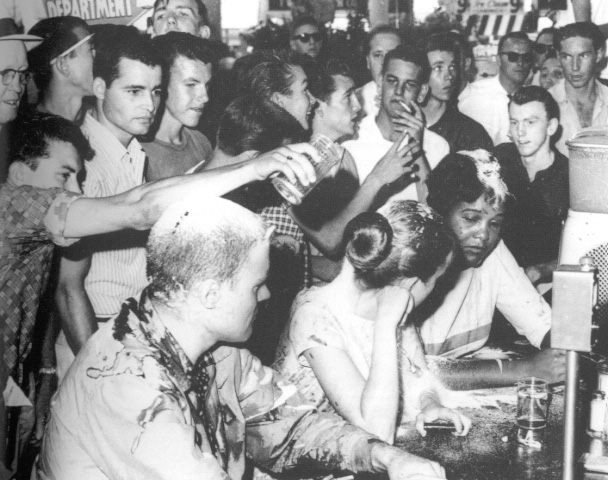
May 28, 1963
Woolworth sit-in, Jackson, MS. May 28, 1963
"This was the most violently attacked sit-in during the 1960s and is the most publicized. A huge mob gathered, with open police support while the three of us sat there for three hours. I was attacked with fists, brass knuckles and the broken portions of glass sugar containers, and was burned with cigarettes. I'm covered with blood and we were all covered by salt, sugar, mustard, and various other things.
Seated, left to right, are myself, Joan Trumpauer (now Mulholland), and Anne Moody (Coming of Age in Mississippi).
Other sit-ins — some in a split-off section and some briefly with our heavily targeted part — were Memphis Norman (himself brutally struck and kicked unconscious), Pearlena Lewis, Lois Chaffee, James Beard, George Raymond, and Walter Williams. )
The response by Jackson's Black community to the sit-in and its violence was tremendously positive. The mass meeting that night was the biggest yet — despite the hordes of hostile city and state police and sheriffs' forces surrounding the church: close to a thousand people attended. Our initial picket demonstration on Capitol Street on December 12, 1962, had launched the Jackson Boycott Movement, — and our Woolworth Sit-In now transposed the Boycott Movement into the massive Jackson Movement."
May 28, 1963
Woolworth sit-in, Jackson, MS. May 28, 1963
"This was the most violently attacked sit-in during the 1960s and is the most publicized. A huge mob gathered, with open police support while the three of us sat there for three hours. I was attacked with fists, brass knuckles and the broken portions of glass sugar containers, and was burned with cigarettes. I'm covered with blood and we were all covered by salt, sugar, mustard, and various other things.
Seated, left to right, are myself, Joan Trumpauer (now Mulholland), and Anne Moody (Coming of Age in Mississippi).
Other sit-ins — some in a split-off section and some briefly with our heavily targeted part — were Memphis Norman (himself brutally struck and kicked unconscious), Pearlena Lewis, Lois Chaffee, James Beard, George Raymond, and Walter Williams. )
The response by Jackson's Black community to the sit-in and its violence was tremendously positive. The mass meeting that night was the biggest yet — despite the hordes of hostile city and state police and sheriffs' forces surrounding the church: close to a thousand people attended. Our initial picket demonstration on Capitol Street on December 12, 1962, had launched the Jackson Boycott Movement, — and our Woolworth Sit-In now transposed the Boycott Movement into the massive Jackson Movement."
46mirrordrum
Review of The Help audible.com
I recently finished the audio version of The Help with Bahni Turpin and Octavia Spencer as two of the narrators. Their part of the narration was exceptional. The novel itself was embarrassing and not particularly well written. I didn’t read any reviews before listening to it or writing down my reactions. I was uncomfortable with the idea of a book written by a white woman that presumed to speak directly for Black folks and I wanted to form my own opinion without being influenced. I am still uncomfortable with much about the novel. The only reason I give it 2 stars is that it may, with all its faults, give a glimpse of what Black maids live(d) through as seen through Stockett’s eyes. Apparently, these experiences are surprising to many people so I suppose that’s something.
The Help is a feel-good fairy tale for white folks. The setting is Jackson, Mississippi in the early 1960s. Eugenia “Skeeter” Phelan, free, white, and 23, has graduated from Ole Miss University. She lives at home on her family’s cotton plantation but she doesn’t want to stay there. She wants to go to New York and become an author but first she needs to write a book.
Fortunately for Skeeter, Hilly Holbrook, a prominent and almost caricatured member of Jackson's white community, provides the topic. Hilly determines to get a law passed that will require white families to have outdoor bathrooms built for their “colored” help—separate but equal. 1963 seems a bit late in the day for Hilly to have come up with this idea, but she does.
Skeeter is struck by the injustice of Hilly’s actions and their effect on Hilly’s maid, Aibileen. Lordy, where has Skeeter been all this long time? Has she just noticed segregation and its consequences in Mississippi? Did she somehow miss, among many other things, the 1962 riots following the admission of African-American student James Meredith to her own white, segregated Alma Mater, Ole Miss?
Well, whatever. Now Skeeter’s had segregation brought to her attention and, I guess, has seen some of its consequences a bit more clearly than before and what lo! This is the topic she’s been looking for. She decides to write a book about the experiences of Black maids in white homes.
She’s determined to enlist the maids themselves to help with the book and to get them to tell her their stories. To this end, she invades the lives of these Black women, starting with Hilly Holbrook’s maid, Aibileen Clark, then Minny Jackson, a maid with a bad rep among white folks, and, eventually, pulls in a number of others.
Skeeter relentlessly badgers them into helping her with her book. In so doing, we are given to believe, she empowers these women to speak out, albeit anonymously. She continually infringes upon these women’s private lives and pleads for their help. Even when Aibileen is so exhausted after a day’s work that she can barely stand, Skeeter comes uninvited to her home at night to beg her to work on the stories. I wanted to smack Skeeter upside the head for bringing the demands of the white world into the privacy of Black women's homes.
Of course the women, starting with Aibileen, give in to Skeeter's importuning. And so it comes to pass that a skinny white girl leads these Black women to tell all, the good, the bad and the ugly, about being Black maids in Jackson. I am agog at the problems with this premise.
I guess I could understand if the toilet incident were a wake-up call for Skeeter, but for the maids? Really? The novel takes place in the ‘60s in the South. Even after legislation in the ‘50s aimed at bringing about integration, almost everything was still segregated. In many states, schools, colleges, medical facilities, drinking fountains, bathrooms, buses, parks, eating establishments, libraries, theatres, ballparks, and beaches were still separated into those for “whites” and those for “colored.” The penalties for trying to cross color lines were severe, sometimes fatal. The Klan was lethally active. Even The Help mentions the assassination of Medgar Evers, a civil rights activist and field secretary of the NAACP, in Jackson in June 1963 and touches on the fear this causes Aibileen.
Frankly, though, despite the fear they would have suffered, I hate to think that Aibileen Clark and Minny Jackson would need some young white woman to show them how to stand up for themselves if they were ready to do so. C’mon. These women have better options than Miss Skeeter and her book, however well-intentioned.
In the 60s, Black women and men, as well as whites, were coming together throughout the South to engage in nonviolent civil disobedience to bring about change in the face of strong, violent white resistance. There were also groups in existence founded by Blacks to help bring about integration and ensure civil rights for Blacks. Groups like the NAACP, SNCC, CORE, and SCLC were on the ground. The Freedom riders visited Jackson in 1961. The March on Washington took place in 1963.
Set in this context, the way these women attempt to redress the evils they face seems to me to be purely a white person’s solution. It’s petty. It trivializes the enormity of what was happening to Black folks and the scope of the changes for which the Movement was aiming.
Stockett attempts to convey the fear the women feel at the thought of reprisals for what they’re doing, but she clearly hasn’t felt that kind of fear herself and she falls far short in imagining or representing it. She does make clear, though, that the maids’ livelihoods, if not indeed their lives, are endangered by participating in Skeeter’s project, or by any behavior not condoned by whites. This makes it even harder to feel good about Skeeter’s self-serving determination to put these women at risk so she can get her book written. It is harder still to accept, first, their willingness to help her and then their protestations of gratitude toward her for giving them this opportunity. Oh please!
There is some acknowledgment of relevant events that are occurring in the South during the period covered by the novel, such as a sit in at a drug store counter, Medgar Evers’ assassination and the March on Washington, but they’re not given enough prominence or weight. For example, Skeeter plays a tacky trick on one of the tacky white folks at around the time of the killings of 4 Black girls by a KKK terrorist on Birmingham Sunday (September 15, 1963). The story of the trick supposedly makes even the New York Times. Aibileen allows that perhaps this happens because there just wasn’t much news that day and that, after all, there’s only so much you can say about the deaths of those 4 girls. Oh really? This is what a Black woman would say about the murder of 4 Black girls by the Klan? Wow.
I do think there’s a book lurking somewhere in Stockett’s experience that might be interesting if she could find and write it. I didn’t really glimpse it until I listened to Stockett’s Too little, too late Afterward to the audio book.
Stockett was raised by Demetrie, a Black nanny whom she loved very much and who died when Stockett was 16. I believe her relationship to Demetrie is probably reflected in the relationship between Aibileen and Hilly Holbrook’s 2-year-old daughter, Mae Mobley. Stockett would probably have been about Mae Mobley’s age in the early 70s. My guess is that Stockett created a character in Aibileen who feels about Mae Mobley as Stockett hopes Demetrie may have felt about her. Given the nature of their relationship, Stockett will never know. Nor do we.
If the depiction of the relationship between Aibileen and Mae Mobley is an accurate reflection of that between Demetrie and Stockett as Stockett envisioned it, there is indeed a painful and complex story there and it’s not a fairy tale.
I would be interested to know what it’s like to be that little white girl, raised by and loving a Black woman, coming to terms with the complexities and implications of that relationship, perhaps with the desire to be Demetrie’s daughter and maybe to be Black herself. Stockett strongly suggests this possibility in Aibileen’s relationship with Mae Mobley. If this was Stockett’s experience and she had told that story, I’d have been interested. Unlike The Help, it wouldn’t have necessitated speaking for Blacks, would have been less self-serving and, if done insightfully, could have been a coming-of-age story worth reading.
As far as the purported subject of the book itself, if you want to know what was really going on during the Civil Rights Movement in the ‘60s, read someone besides Stockett. There are a lot of books out there, but don't expect any of them to make you feel good.
I recently finished the audio version of The Help with Bahni Turpin and Octavia Spencer as two of the narrators. Their part of the narration was exceptional. The novel itself was embarrassing and not particularly well written. I didn’t read any reviews before listening to it or writing down my reactions. I was uncomfortable with the idea of a book written by a white woman that presumed to speak directly for Black folks and I wanted to form my own opinion without being influenced. I am still uncomfortable with much about the novel. The only reason I give it 2 stars is that it may, with all its faults, give a glimpse of what Black maids live(d) through as seen through Stockett’s eyes. Apparently, these experiences are surprising to many people so I suppose that’s something.
The Help is a feel-good fairy tale for white folks. The setting is Jackson, Mississippi in the early 1960s. Eugenia “Skeeter” Phelan, free, white, and 23, has graduated from Ole Miss University. She lives at home on her family’s cotton plantation but she doesn’t want to stay there. She wants to go to New York and become an author but first she needs to write a book.
Fortunately for Skeeter, Hilly Holbrook, a prominent and almost caricatured member of Jackson's white community, provides the topic. Hilly determines to get a law passed that will require white families to have outdoor bathrooms built for their “colored” help—separate but equal. 1963 seems a bit late in the day for Hilly to have come up with this idea, but she does.
Skeeter is struck by the injustice of Hilly’s actions and their effect on Hilly’s maid, Aibileen. Lordy, where has Skeeter been all this long time? Has she just noticed segregation and its consequences in Mississippi? Did she somehow miss, among many other things, the 1962 riots following the admission of African-American student James Meredith to her own white, segregated Alma Mater, Ole Miss?
Well, whatever. Now Skeeter’s had segregation brought to her attention and, I guess, has seen some of its consequences a bit more clearly than before and what lo! This is the topic she’s been looking for. She decides to write a book about the experiences of Black maids in white homes.
She’s determined to enlist the maids themselves to help with the book and to get them to tell her their stories. To this end, she invades the lives of these Black women, starting with Hilly Holbrook’s maid, Aibileen Clark, then Minny Jackson, a maid with a bad rep among white folks, and, eventually, pulls in a number of others.
Skeeter relentlessly badgers them into helping her with her book. In so doing, we are given to believe, she empowers these women to speak out, albeit anonymously. She continually infringes upon these women’s private lives and pleads for their help. Even when Aibileen is so exhausted after a day’s work that she can barely stand, Skeeter comes uninvited to her home at night to beg her to work on the stories. I wanted to smack Skeeter upside the head for bringing the demands of the white world into the privacy of Black women's homes.
Of course the women, starting with Aibileen, give in to Skeeter's importuning. And so it comes to pass that a skinny white girl leads these Black women to tell all, the good, the bad and the ugly, about being Black maids in Jackson. I am agog at the problems with this premise.
I guess I could understand if the toilet incident were a wake-up call for Skeeter, but for the maids? Really? The novel takes place in the ‘60s in the South. Even after legislation in the ‘50s aimed at bringing about integration, almost everything was still segregated. In many states, schools, colleges, medical facilities, drinking fountains, bathrooms, buses, parks, eating establishments, libraries, theatres, ballparks, and beaches were still separated into those for “whites” and those for “colored.” The penalties for trying to cross color lines were severe, sometimes fatal. The Klan was lethally active. Even The Help mentions the assassination of Medgar Evers, a civil rights activist and field secretary of the NAACP, in Jackson in June 1963 and touches on the fear this causes Aibileen.
Frankly, though, despite the fear they would have suffered, I hate to think that Aibileen Clark and Minny Jackson would need some young white woman to show them how to stand up for themselves if they were ready to do so. C’mon. These women have better options than Miss Skeeter and her book, however well-intentioned.
In the 60s, Black women and men, as well as whites, were coming together throughout the South to engage in nonviolent civil disobedience to bring about change in the face of strong, violent white resistance. There were also groups in existence founded by Blacks to help bring about integration and ensure civil rights for Blacks. Groups like the NAACP, SNCC, CORE, and SCLC were on the ground. The Freedom riders visited Jackson in 1961. The March on Washington took place in 1963.
Set in this context, the way these women attempt to redress the evils they face seems to me to be purely a white person’s solution. It’s petty. It trivializes the enormity of what was happening to Black folks and the scope of the changes for which the Movement was aiming.
Stockett attempts to convey the fear the women feel at the thought of reprisals for what they’re doing, but she clearly hasn’t felt that kind of fear herself and she falls far short in imagining or representing it. She does make clear, though, that the maids’ livelihoods, if not indeed their lives, are endangered by participating in Skeeter’s project, or by any behavior not condoned by whites. This makes it even harder to feel good about Skeeter’s self-serving determination to put these women at risk so she can get her book written. It is harder still to accept, first, their willingness to help her and then their protestations of gratitude toward her for giving them this opportunity. Oh please!
There is some acknowledgment of relevant events that are occurring in the South during the period covered by the novel, such as a sit in at a drug store counter, Medgar Evers’ assassination and the March on Washington, but they’re not given enough prominence or weight. For example, Skeeter plays a tacky trick on one of the tacky white folks at around the time of the killings of 4 Black girls by a KKK terrorist on Birmingham Sunday (September 15, 1963). The story of the trick supposedly makes even the New York Times. Aibileen allows that perhaps this happens because there just wasn’t much news that day and that, after all, there’s only so much you can say about the deaths of those 4 girls. Oh really? This is what a Black woman would say about the murder of 4 Black girls by the Klan? Wow.
I do think there’s a book lurking somewhere in Stockett’s experience that might be interesting if she could find and write it. I didn’t really glimpse it until I listened to Stockett’s Too little, too late Afterward to the audio book.
Stockett was raised by Demetrie, a Black nanny whom she loved very much and who died when Stockett was 16. I believe her relationship to Demetrie is probably reflected in the relationship between Aibileen and Hilly Holbrook’s 2-year-old daughter, Mae Mobley. Stockett would probably have been about Mae Mobley’s age in the early 70s. My guess is that Stockett created a character in Aibileen who feels about Mae Mobley as Stockett hopes Demetrie may have felt about her. Given the nature of their relationship, Stockett will never know. Nor do we.
If the depiction of the relationship between Aibileen and Mae Mobley is an accurate reflection of that between Demetrie and Stockett as Stockett envisioned it, there is indeed a painful and complex story there and it’s not a fairy tale.
I would be interested to know what it’s like to be that little white girl, raised by and loving a Black woman, coming to terms with the complexities and implications of that relationship, perhaps with the desire to be Demetrie’s daughter and maybe to be Black herself. Stockett strongly suggests this possibility in Aibileen’s relationship with Mae Mobley. If this was Stockett’s experience and she had told that story, I’d have been interested. Unlike The Help, it wouldn’t have necessitated speaking for Blacks, would have been less self-serving and, if done insightfully, could have been a coming-of-age story worth reading.
As far as the purported subject of the book itself, if you want to know what was really going on during the Civil Rights Movement in the ‘60s, read someone besides Stockett. There are a lot of books out there, but don't expect any of them to make you feel good.
47ffortsa
Couldn't agree with you more. I found the book annoying in the extreme, and read it to the end only because it had been pressed on me by a family member whose friendship I want to encourage. I dont ever plan to se the film.
48jnwelch
Wow, that's a powerful review, Ellie. I haven't read the book, but your comments sure sound on-target.
An interesting perspective: I have an Asian/black godson, having grown up with his African-American dad. When, many years ago, I told his now 30 year old son about meeting his dad after schools were desegregated in liberal Ann Arbor in the 60s, he just couldn't believe the Ann Arbor he knew had desegregated the schools that recently. He grew up in San Francisco, went to college and law school in Ann Arbor, and has experienced racism, but nothing like what his dad knew.
Is that really you in >45 mirrordrum:, or am I misunderstanding?
An interesting perspective: I have an Asian/black godson, having grown up with his African-American dad. When, many years ago, I told his now 30 year old son about meeting his dad after schools were desegregated in liberal Ann Arbor in the 60s, he just couldn't believe the Ann Arbor he knew had desegregated the schools that recently. He grew up in San Francisco, went to college and law school in Ann Arbor, and has experienced racism, but nothing like what his dad knew.
Is that really you in >45 mirrordrum:, or am I misunderstanding?
49richardderus
I so agree with everything you said that all I'll say is "Brava" and leave it at that.
Oh, except one thing: Stockett was born in 1969. LOOOONG after the world she's writing about changed.
Oh, except one thing: Stockett was born in 1969. LOOOONG after the world she's writing about changed.
50mirrordrum
>47 ffortsa: Judy, i read it to the end b/c i wanted to pan it as best i could, being white, and thought i should at least do that much. this meant having to sit through Skeeter's maundering about her exceeeeedingly tiresome relationship with her boyfriend, Stewart. audiobooks are wonderful and i'm blessed to have them but, dear lord, how they can extend a painful experience!
i found this book excruciatingly painful to read and am saddened that people consider it a 'feel-good' novel.
>48 jnwelch: thanks, Joe. i'm glad i read the book so i can present what appears to be a minority opinion amongst white folks. if i can figure out how to turn what i wrote into an actual review, i'm going to post it on The Help page.
one of the things there wasn't room to say in what i wrote is that segregation wasn't just a southern problem any more than racism was and still is. we don't teach our children at all well. not at all.
and nope, not i in the picture. strangely enough, like Skeeter's mother, mine was also dying of cancer in 1963. i left college for a year to take care of her.
i didn't really become active in civil rights/anti-war protests until i returned to Berkeley after her death. by then it was all about the Black Panther Party in Oakland.
i believe the photo may be of the drugstore counter sit-in that somebody in the book mentions in passing. i just wanted an image of what things were like in Jackson in the 60s.
>49 richardderus: thanks, Richard. i found 1962 as a guesstimate for her birth. apparently, it was wrong. so many things are. la!
i found this book excruciatingly painful to read and am saddened that people consider it a 'feel-good' novel.
>48 jnwelch: thanks, Joe. i'm glad i read the book so i can present what appears to be a minority opinion amongst white folks. if i can figure out how to turn what i wrote into an actual review, i'm going to post it on The Help page.
one of the things there wasn't room to say in what i wrote is that segregation wasn't just a southern problem any more than racism was and still is. we don't teach our children at all well. not at all.
and nope, not i in the picture. strangely enough, like Skeeter's mother, mine was also dying of cancer in 1963. i left college for a year to take care of her.
i didn't really become active in civil rights/anti-war protests until i returned to Berkeley after her death. by then it was all about the Black Panther Party in Oakland.
i believe the photo may be of the drugstore counter sit-in that somebody in the book mentions in passing. i just wanted an image of what things were like in Jackson in the 60s.
>49 richardderus: thanks, Richard. i found 1962 as a guesstimate for her birth. apparently, it was wrong. so many things are. la!
51ffortsa
Ellie, I think it's a great review just the way it stands, so don't agonize too much about perfecting whatever you think is missing - just post it. More readers need to know they are not in the minority in their judgement of this book. Can't tell you how happy your review has already made me.
53mirrordrum
thanks, Judy and Joe.
54mirrordrum
reading the secret scripture. from Religio Medici by Sir Thomas Browne
"TO THE READER.
CERTAINLY that man were greedy of life, who
should desire to live when all the world were
at an end; and he must needs be very im-
patient, who would repine at death in the society of all
things that suffer under it. Had not almost every man
suffered by the press, or were not the tyranny thereof
become universal, I had not wanted reason for com-
plaint: but in times wherein I have lived to behold
the highest perversion of that excellent invention, the
name of his Majesty defamed, the honour of Parlia-
ment depraved, the writings of both depravedly, antici-
patively, counterfeitly, imprinted: complaints may
seem ridiculous in private persons; and men of my
condition may be as incapable of affronts, as hopeless
of their reparations. And truly had not the duty I
owe unto the importunity of friends, and the allegiance
I must ever acknowledge unto truth, prevailed with
me; the inactivity of my disposition might have made
these sufferings continual, and time, that brings other
things to light, should have satisfied me in the remedy
of its oblivion. But because things evidently false are
not only printed, but many things of truth most falsely
set forth; in this latter I could not but think myself
engaged: for, though we have no power to redress the
former, yet in the other reparation being within our-
selves, I have at present represented unto the world a
full and intended copy of that piece, which was most
imperfectly and surreptitiously published before."
http://www.gutenberg.org/catalog/world/readfile?fk_files=1442916&pageno=11
This is Roseanne's father's favorite book and the one she has with her in Sligo. Roseanne writes similarly about the comforts of knowing that suffering happens to everyone.
"TO THE READER.
CERTAINLY that man were greedy of life, who
should desire to live when all the world were
at an end; and he must needs be very im-
patient, who would repine at death in the society of all
things that suffer under it. Had not almost every man
suffered by the press, or were not the tyranny thereof
become universal, I had not wanted reason for com-
plaint: but in times wherein I have lived to behold
the highest perversion of that excellent invention, the
name of his Majesty defamed, the honour of Parlia-
ment depraved, the writings of both depravedly, antici-
patively, counterfeitly, imprinted: complaints may
seem ridiculous in private persons; and men of my
condition may be as incapable of affronts, as hopeless
of their reparations. And truly had not the duty I
owe unto the importunity of friends, and the allegiance
I must ever acknowledge unto truth, prevailed with
me; the inactivity of my disposition might have made
these sufferings continual, and time, that brings other
things to light, should have satisfied me in the remedy
of its oblivion. But because things evidently false are
not only printed, but many things of truth most falsely
set forth; in this latter I could not but think myself
engaged: for, though we have no power to redress the
former, yet in the other reparation being within our-
selves, I have at present represented unto the world a
full and intended copy of that piece, which was most
imperfectly and surreptitiously published before."
http://www.gutenberg.org/catalog/world/readfile?fk_files=1442916&pageno=11
This is Roseanne's father's favorite book and the one she has with her in Sligo. Roseanne writes similarly about the comforts of knowing that suffering happens to everyone.
55jnwelch
Hmm, intriguing, Ellie. Interesting short review here: http://couchtrip.wordpress.com/2009/06/28/st-roseanne-of-sligo/
I noticed you're up to 12 thumbs for your review of The Help! I was going to say 10 thumbs and 2 toes, but that wouldn't make any sense at all.
I noticed you're up to 12 thumbs for your review of The Help! I was going to say 10 thumbs and 2 toes, but that wouldn't make any sense at all.
56mirrordrum
King Penguins
Salisbury Plain, South Georgia
Carved gold in the middle of her cheeks,
her dishy commas shimmer in the sun
as she swaggers demurely leading the boys on.
Throwing his head back, a male trumpets and raves,
and sounds like an harmonica or an oncoming train.
Her velvet commas are the hottest he's seen in days,
and her apricot bill just takes his breath away.
So, despite the rapid skuas and the fur seals seething
and the other avid suitors flapping and reeling,
he sidles up close and bump-herds her away
to the outskirts of the rookery for a little heavy breathing.
Her mother was right, of course.
He'll walk all over her.
But for the moment, she is Cleopatra, Marilyn,
Mata Hari all in one. Dawn blooms at her throat
and the South Georgia seas so fertile and rich
all begin at her knees. He's not worried
if she's fit enough to raise a good brood
and outwit life's harsher dramas.
He only knows she was meant for him
And she has a great pair of commas.
--Diane Ackerman from Jaguar of Sweet Laughter: New and Selected Poems
Salisbury Plain, South Georgia
Carved gold in the middle of her cheeks,
her dishy commas shimmer in the sun
as she swaggers demurely leading the boys on.
Throwing his head back, a male trumpets and raves,
and sounds like an harmonica or an oncoming train.
Her velvet commas are the hottest he's seen in days,
and her apricot bill just takes his breath away.
So, despite the rapid skuas and the fur seals seething
and the other avid suitors flapping and reeling,
he sidles up close and bump-herds her away
to the outskirts of the rookery for a little heavy breathing.
Her mother was right, of course.
He'll walk all over her.
But for the moment, she is Cleopatra, Marilyn,
Mata Hari all in one. Dawn blooms at her throat
and the South Georgia seas so fertile and rich
all begin at her knees. He's not worried
if she's fit enough to raise a good brood
and outwit life's harsher dramas.
He only knows she was meant for him
And she has a great pair of commas.
--Diane Ackerman from Jaguar of Sweet Laughter: New and Selected Poems
57mirrordrum
Free Fantasia: Tiger Flowers
(for Michael)
By Robert Hayden
The sporting people
along St. Antoine--
that scufflers'
paradise of ironies--
bet salty money
on his righteous
hook and jab.
I was a boy then, running
(unbeknownst to Pa)
errands for Miss Jackie
and Stack-o'-Diamonds' Eula Mae.
. . . Their perfumes,
rouged Egyptian faces.
Their pianolas jazzing.
O Creole babies,
Dixie odalisques,
speeding through cutglass
dark to see the macho angel
Trick you'd never
turn, his bluesteel prowess
in the ring.
Hardshell believers
amen'd the wreck
as God A'mighty's
will. I'd thought
such gaiety could not
die. Nor could our
elegant avenger.
The Virgin Forest
by Rousseau--
its psychedelic flowers
towering, its deathless
dark dream figure
death the leopard
claws---I choose it
now as elegy
for Tiger Flowers.
--Robert Hayden from Angle of Ascent: New and Selected Poems
(for Michael)
By Robert Hayden
The sporting people
along St. Antoine--
that scufflers'
paradise of ironies--
bet salty money
on his righteous
hook and jab.
I was a boy then, running
(unbeknownst to Pa)
errands for Miss Jackie
and Stack-o'-Diamonds' Eula Mae.
. . . Their perfumes,
rouged Egyptian faces.
Their pianolas jazzing.
O Creole babies,
Dixie odalisques,
speeding through cutglass
dark to see the macho angel
Trick you'd never
turn, his bluesteel prowess
in the ring.
Hardshell believers
amen'd the wreck
as God A'mighty's
will. I'd thought
such gaiety could not
die. Nor could our
elegant avenger.
The Virgin Forest
by Rousseau--
its psychedelic flowers
towering, its deathless
dark dream figure
death the leopard
claws---I choose it
now as elegy
for Tiger Flowers.
--Robert Hayden from Angle of Ascent: New and Selected Poems
58mirrordrum
The Gifts of Venus (Lucretius, De rerum natura 1.1-20)" read in Latin starting about 2:37.
59mirrordrum
The Cold Heaven
By William Butler Yeats
Suddenly I saw the cold and rook-delighting heaven
That seemed as though ice burned and was but the more ice,
And thereupon imagination and heart were driven
So wild that every casual thought of that and this
Vanished, and left but memories, that should be out of season
With the hot blood of youth, of love crossed long ago;
And I took all the blame out of all sense and reason,
Until I cried and trembled and rocked to and fro,
Riddled with light. Ah! when the ghost begins to quicken,
Confusion of the death-bed over, is it sent
Out naked on the roads, as the books say, and stricken
By the injustice of the skies for punishment?
referenced in Instances of the Number 3 by Salley Vickers, p. 114 (large print edition)
By William Butler Yeats
Suddenly I saw the cold and rook-delighting heaven
That seemed as though ice burned and was but the more ice,
And thereupon imagination and heart were driven
So wild that every casual thought of that and this
Vanished, and left but memories, that should be out of season
With the hot blood of youth, of love crossed long ago;
And I took all the blame out of all sense and reason,
Until I cried and trembled and rocked to and fro,
Riddled with light. Ah! when the ghost begins to quicken,
Confusion of the death-bed over, is it sent
Out naked on the roads, as the books say, and stricken
By the injustice of the skies for punishment?
referenced in Instances of the Number 3 by Salley Vickers, p. 114 (large print edition)
60mirrordrum
Spring
Nothing is so beautiful as Spring —
When weeds, in wheels, shoot long and lovely and lush;
Thrush’s eggs look little low heavens, and thrush
Through the echoing timber does so rinse and wring
The ear, it strikes like lightnings to hear him sing;
The glassy peartree leaves and blooms, they brush
The descending blue; that blue is all in a rush
With richness; the racing lambs too have fair their fling.
What is all this juice and all this joy?
A strain of the earth’s sweet being in the beginning
In Eden garden. — Have, get, before it cloy,
Before it cloud, Christ, lord, and sour with sinning,
Innocent mind and Mayday in girl and boy,
Most, O maid’s child, thy choice and worthy the winning.
Gerard Manley Hopkins
italics quoted in Instances of the Number 3 by Salley Vickers, p. 162 (large print edition)
Nothing is so beautiful as Spring —
When weeds, in wheels, shoot long and lovely and lush;
Thrush’s eggs look little low heavens, and thrush
Through the echoing timber does so rinse and wring
The ear, it strikes like lightnings to hear him sing;
The glassy peartree leaves and blooms, they brush
The descending blue; that blue is all in a rush
With richness; the racing lambs too have fair their fling.
What is all this juice and all this joy?
A strain of the earth’s sweet being in the beginning
In Eden garden. — Have, get, before it cloy,
Before it cloud, Christ, lord, and sour with sinning,
Innocent mind and Mayday in girl and boy,
Most, O maid’s child, thy choice and worthy the winning.
Gerard Manley Hopkins
italics quoted in Instances of the Number 3 by Salley Vickers, p. 162 (large print edition)

64mirrordrum
ooh, visitors. such fun. hi judy and joe. :)
> 62 isn't it, Judy? i'd love to have seen a showing of White's work. so much of it is gorgeous and mysterious. it's the kind of thing i'm always seeing and sometimes attempt to photograph. usually without much such success, sad to say.
>63 jnwelch: i messed up the HTML, omitting to close the tag, and White's name didn't appear. i just fixed it. i've got one of his books on hold. very excited. glad you like the poems. i snitch a few from whichever volume(s) i'm wrestling with at any given moment or, as in the case of Vickers' excellent book, poems i'm led to by whatever i read. if i don't do that, i forget both poem and, sometimes, poet. awful!
you should check out Hayden. he's amazing. i'd never even heard of the man until i stumbled on Those winter Sundays.
> 62 isn't it, Judy? i'd love to have seen a showing of White's work. so much of it is gorgeous and mysterious. it's the kind of thing i'm always seeing and sometimes attempt to photograph. usually without much such success, sad to say.
>63 jnwelch: i messed up the HTML, omitting to close the tag, and White's name didn't appear. i just fixed it. i've got one of his books on hold. very excited. glad you like the poems. i snitch a few from whichever volume(s) i'm wrestling with at any given moment or, as in the case of Vickers' excellent book, poems i'm led to by whatever i read. if i don't do that, i forget both poem and, sometimes, poet. awful!
you should check out Hayden. he's amazing. i'd never even heard of the man until i stumbled on Those winter Sundays.

66richardderus
I recently finished The Conference of the Birds and loved Sis's artwork in it. That image does nothing to dissuade me from my admiration.
67mirrordrum
i'm reading The Conference of the Birds on your recommendation. :)
i'm not as swept away by it as you and others have been, but am enjoying it and am preparing to order Conference of the Birds: A Philosophical Religious Poem in Prose by Farid-Ud-Din Attar, et al. to compare differences. i take issue a bit with the ending of Sis' book and want to see what i think abt the original poem. my favorite line is about trying hard to stop trying, or words to that effect. oh yes!
i'm not as swept away by it as you and others have been, but am enjoying it and am preparing to order Conference of the Birds: A Philosophical Religious Poem in Prose by Farid-Ud-Din Attar, et al. to compare differences. i take issue a bit with the ending of Sis' book and want to see what i think abt the original poem. my favorite line is about trying hard to stop trying, or words to that effect. oh yes!
68mirrordrum
"There is a story about a group of people climbing to the top of a mountain. It turns out it's pretty steep, and as soon as they get up to a certain height, a couple of people look down and see how far it is, and completely freeze; they had come up against their edge and they couldn't go beyond it. Their fear was so great, they couldn't move. Other people tripped on ahead, laughing and talking, but as the climb got steeper and more scary, more people began to get scared and freeze. All the way up this mountain there were places where people met their edge and just froze and couldn't go any further. The moral of the story is that it really doesn't make any difference where you meet your edge; just meeting it is the point. Life is a whole journey of meeting your edge again and again. That's where you're challenged; that's where, if you're a person who wants to live, you start to ask yourself questions like, "Now, why am I so scared? What is it that I don't want to see? Why can't I go any further than this?"
The happy people who got to the top were not the heroes of the day. They just weren't afraid of heights; they are going to meet their edge somewhere else. The ones who froze at the bottom were not the losers. They simply stopped first and so their lesson came earlier than the others. However, sooner or later, everybody meets his or her own edge."
from Pema Chodron's Dharma talk Renunciation: Like a Raven in the Wind in the Tricycle "Wisdom Collection."
The happy people who got to the top were not the heroes of the day. They just weren't afraid of heights; they are going to meet their edge somewhere else. The ones who froze at the bottom were not the losers. They simply stopped first and so their lesson came earlier than the others. However, sooner or later, everybody meets his or her own edge."
from Pema Chodron's Dharma talk Renunciation: Like a Raven in the Wind in the Tricycle "Wisdom Collection."
69mirrordrum
Sisters of Sinai: How Two Lady Adventurers Discovered the Hidden Gospels by Janet Soskice
Sinaitic Syriac Palimpsest discovered in 1892 by Agnes Smith Lewis at St. Catherine's monastery at Mt. Sinai and now known as the Lewis Codex. This page is of Matthew XXV, 12-27. The underwriting (i.e., a portion of the Gospel of Matthew), can be seen in the right-hand margin. Query to self: Is this the palimpsest as found or after reagent was applied during the 2nd trip to St. Catherine's in 1983 (?).

Sinaitic Syriac Palimpsest discovered in 1892 by Agnes Smith Lewis at St. Catherine's monastery at Mt. Sinai and now known as the Lewis Codex. This page is of Matthew XXV, 12-27. The underwriting (i.e., a portion of the Gospel of Matthew), can be seen in the right-hand margin. Query to self: Is this the palimpsest as found or after reagent was applied during the 2nd trip to St. Catherine's in 1983 (?).

70Kirconnell
Hi, Ellie. I'm not a fan of poetry, but I did find some of what you quoted compelling. I also enjoyed the art and your review of The Help. I felt the same way about it. I thought that I was the only one.
71richardderus
Hiya Ellie! *smooch*
72mirrordrum
"One must be poor to know the luxury of giving." Middlemarch
73sibylline
Great poetry and pictures here, Ellie.
Very good review of The Help which I broke down and read, to my own annoyance.
Very good review of The Help which I broke down and read, to my own annoyance.
74mirrordrum
from Middlemarch 'the mother standing behind her daughter like a malignant prophecy.'
76mirrordrum
>73 sibylline: hey, Lucy. i got about half way through The help and thought i couldn't do any more. then i decided i wouldn't feel free to write what i thought about it if i left it unfinished so i completed it. i held off reading it for about 3 years.
it seemed important to offer one of the few views i found contrasting with all the adulation.
i can't even bear to watch the movie, much as i esteem Viola Davis who, imo, pretty nearly trumped La Streep in Doubt. let it be said that Streep also holds her in esteem. i'd liked to have been on set to watch them working together!
it seemed important to offer one of the few views i found contrasting with all the adulation.
i can't even bear to watch the movie, much as i esteem Viola Davis who, imo, pretty nearly trumped La Streep in Doubt. let it be said that Streep also holds her in esteem. i'd liked to have been on set to watch them working together!
77mirrordrum
hullo Joe. i thought i'd put it in so i'd not forget it myself. very quotable, is our George.
78jnwelch
Sure is. Middlemarch was excellent, my fave of what I've read of hers.
79sibylline
I only read it recently too - and I doubt I'll ever see the movie, although I might watch it if it was free on Netfiix instant, which it probably will be eventually..... and I gave it a decent rating as, from a writerly standpoint, (for what it is) it was a good 'story', well written, etc.
At a deeper level, the whole question of writing a 'feel good' book like this about an awful time is one that I find I am ambivalent about, ultimately, as I think it is probably just this sort of e-z history that helps some people open up a little and allow themselves to think about what happened, rather than just blocking it all out as too horrible and distant from themselves. Opening up to the past can lead to willingness to change and re-examine beliefs, and even if the shift is small, it is a shift you can't force. Popular culture - which this book surely is - can sometimes do things that serious thoughtful literature can't -- most people simply will not ever read an emotionally wrenching book. I just read The Time of Our Singing and it was, I have to say, one tough read, and I wouldn't expect too many folks to stick it out, (about an interracial family in NY, met and married in the late 30's) who have brilliantly musical children...... I wouldn't expect too many people, much less readers, to be able to handle that material well at all.
If you can find Singing on audio - I think you would go nuts over it. Richard Powers - and forgive me if you've read it already.
So...... I'm willing to just let The Help be what it is, I guess.
At a deeper level, the whole question of writing a 'feel good' book like this about an awful time is one that I find I am ambivalent about, ultimately, as I think it is probably just this sort of e-z history that helps some people open up a little and allow themselves to think about what happened, rather than just blocking it all out as too horrible and distant from themselves. Opening up to the past can lead to willingness to change and re-examine beliefs, and even if the shift is small, it is a shift you can't force. Popular culture - which this book surely is - can sometimes do things that serious thoughtful literature can't -- most people simply will not ever read an emotionally wrenching book. I just read The Time of Our Singing and it was, I have to say, one tough read, and I wouldn't expect too many folks to stick it out, (about an interracial family in NY, met and married in the late 30's) who have brilliantly musical children...... I wouldn't expect too many people, much less readers, to be able to handle that material well at all.
If you can find Singing on audio - I think you would go nuts over it. Richard Powers - and forgive me if you've read it already.
So...... I'm willing to just let The Help be what it is, I guess.
80PaulCranswick
Eminently quotable our George is about right Ellie. My daughter is doing Silas Marner for English Literature this year at school so I'm doing it with her and will I am sure enjoy a reaquaintance.
81mirrordrum
>79 sibylline: you've got a good point, Lucy, and one i was way too angry, and, yes, self-righteous, to recognize. i was so jacked up by that book, i can't tell you.
i did notice in a lot of the comments that people were quite astonished by Stockett's view of what happened and you're right, it may have opened people's eyes a bit. and you're also right that if it hadn't been made into a bit of a confection, it wouldn't have received the kind of attention it did. i'm often (always, by virtue of being human?) just as blinkered by my prejudices as the people i rail at.
i wonder how much codswallop i consume just because it's palatable.
still and all . . . .
>eta i looked up The Time of Our Singing and audible.com doesn't have it but NLS does. not crazy about the narrator but he does a fair amount of non-fiction on audible.com including Freedom Walkers: The Story of the Montgomery Bus Boycott so i've downloaded it. but it's going behind some other looooong books, so it'll be a while. it also sounds as though it will require loin-girding and, depending on what happens with the election, my loins may feel excessively girded for quite a while.
and i have to finish Middlemarch so i can start Return of the native and thank you very much for completely ruining my reading plans. ;)
>80 PaulCranswick: hi, Paul. what fun that you're reading along with your daughter. gotta say i'm not sure i'll be tackling another of our George's books soon. it's daunting in audio, though the narrator is excellent. 36 hours is a lotta lotta ear time. Silas Marner looks appealing though. and it's shortish.
i did notice in a lot of the comments that people were quite astonished by Stockett's view of what happened and you're right, it may have opened people's eyes a bit. and you're also right that if it hadn't been made into a bit of a confection, it wouldn't have received the kind of attention it did. i'm often (always, by virtue of being human?) just as blinkered by my prejudices as the people i rail at.
i wonder how much codswallop i consume just because it's palatable.
still and all . . . .
>eta i looked up The Time of Our Singing and audible.com doesn't have it but NLS does. not crazy about the narrator but he does a fair amount of non-fiction on audible.com including Freedom Walkers: The Story of the Montgomery Bus Boycott so i've downloaded it. but it's going behind some other looooong books, so it'll be a while. it also sounds as though it will require loin-girding and, depending on what happens with the election, my loins may feel excessively girded for quite a while.
and i have to finish Middlemarch so i can start Return of the native and thank you very much for completely ruining my reading plans. ;)
>80 PaulCranswick: hi, Paul. what fun that you're reading along with your daughter. gotta say i'm not sure i'll be tackling another of our George's books soon. it's daunting in audio, though the narrator is excellent. 36 hours is a lotta lotta ear time. Silas Marner looks appealing though. and it's shortish.
82sibylline
It is a very hard book - very very intense and dark in places, and I always think it is kind of a waste of time to try to describe music in prose.... but.... that said.. one of my dearest friends here on LT recommended it so intensely that I read it, and persevered, and now it is so often a reference point in my mind.... that is the test of a book, innit?
83richardderus
"There is no there there" -- Oakland Romney's slogan!
Thanks for sharing that moment, it made me snicker.
Thanks for sharing that moment, it made me snicker.
84ffortsa
Ellie, I was eavesdropping at the cafe and heard you ask Joe about 'Perfume', which has been languishing on my shelf for a long time. Let me know if you decide to give it a try, and I'll read along.
85mirrordrum
“... when you're buying books, you're optimistically thinking you're buying the time to read them.
(Paraphrase of Schopenhauer)”
― Arthur Schopenhauer
too true, alas, too true.
(Paraphrase of Schopenhauer)”
― Arthur Schopenhauer
too true, alas, too true.
86mirrordrum

attributed to Newton but i think he may have been quoting someone else as the full quotation seems to have been "“Who was it who said, "I hold the buying of more books than one can peradventure read, as nothing less than the soul's reaching towards infinity; which is the only thing that raises us above the beasts that perish?" Whoever it was, I agree with him.”"
87richardderus
I have no idea who A. Edward Newton might be/have been, but I suspect I'd've loved him like a long-lost brother. Wonderful!
88mirrordrum
here's your long-lost brother, m'dear.

A. Edward Newton

A. Edward Newton
89mirrordrum

Landscape With The Fall of Icarus
by William Carlos Williams
According to Brueghel
when Icarus fell
it was spring
a farmer was ploughing
his field
the whole pageantry
of the year was
awake tingling
near
the edge of the sea
concerned
with itself
sweating in the sun
that melted
the wings' wax
unsignificantly
off the coast
there was
a splash quite unnoticed
this was
Icarus drowning
90jnwelch
I love this, Ellie! Painting and poem bring a wonderful new perspective on this famous myth.
91mirrordrum
just started A Drowned Maiden's Hair: A Melodrama, narrated by Anne. quite taken with the opening poem:
"The Sands of Dee"
by Charles Kingsley. 1819–1875.
"O Mary, go and call the cattle home,
And call the cattle home,
And call the cattle home,
Across the sands of Dee!"
The western wind was wild and dark wi' foam,
And all alone went she.
The creeping tide came up along the sand,
And o'er and o'er the sand,
And round and round the sand,
As far as eyes could see;
The blinding mist came down and hit the land:
And never home came she.
"O, is it weed, or fish, or floating hair ---
A tress of golden hair,
A drowned maiden's hair ---
Above the nets at sea?
Was never salmon yet that shone so fair
Among the stakes on Dee."
They rowed her in across the rolling foam,
The cruel, crawling foam,
The cruel, hungry foam,
To her grave beside the sea;
But still the boatmen hear her call the cattle home
Across the sands of Dee.
"The Sands of Dee"
by Charles Kingsley. 1819–1875.
"O Mary, go and call the cattle home,
And call the cattle home,
And call the cattle home,
Across the sands of Dee!"
The western wind was wild and dark wi' foam,
And all alone went she.
The creeping tide came up along the sand,
And o'er and o'er the sand,
And round and round the sand,
As far as eyes could see;
The blinding mist came down and hit the land:
And never home came she.
"O, is it weed, or fish, or floating hair ---
A tress of golden hair,
A drowned maiden's hair ---
Above the nets at sea?
Was never salmon yet that shone so fair
Among the stakes on Dee."
They rowed her in across the rolling foam,
The cruel, crawling foam,
The cruel, hungry foam,
To her grave beside the sea;
But still the boatmen hear her call the cattle home
Across the sands of Dee.
92mirrordrum
Remarkable Creatures
Mary Anning and her dog, Tray, with Golden Cap outcropping.
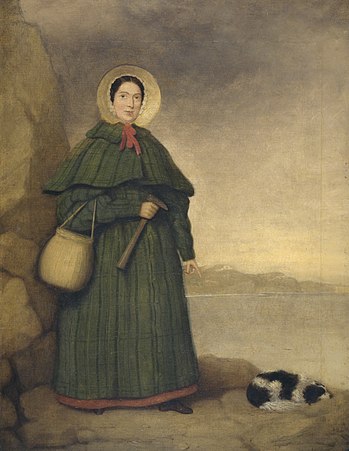
article on Anning from Cal-Berkeley.
Lyme-Regis fossils
Icthyosaur

also see: ichthyosaur specimen with beautiful fin structure
Ammonites

Tracy Chevalier with plesiosaur fossil discovered and restored by Mary Anning in Lyme Regis

Mary Anning and her dog, Tray, with Golden Cap outcropping.
article on Anning from Cal-Berkeley.
Lyme-Regis fossils
Icthyosaur

also see: ichthyosaur specimen with beautiful fin structure
Ammonites

Tracy Chevalier with plesiosaur fossil discovered and restored by Mary Anning in Lyme Regis

93SandDune
#91 I had that poem in an anthology as a child and the idea of 'the creeping tide' made quite an impression on me. I haven't seen it for years.
94richardderus
Happy weekend wind-down, dear Ellie, may the week ahead be full of good books and good fun.
95mirrordrum
>93 SandDune: yes, Rhian, i find i tremendously evocative and chill-making. it has the same effect on me as the Golden Vanity where the lad is sinking in the Lowland sea. i have always imagined his hair spread round him and the sea itself golden at sunset.
96mirrordrum
>thanks, my dear. i hadn't seen you at Joe's for awhile--maybe i just missed your posts--and have been worriting about you so i'm glad to see you today. i expect this cold, damp weather has your body in a bit of a taking. moi aussi.
i certainly do owe you for Remarkable creatures. it's fit in nicely with French Lietenant's woman and the seashell on the mountaintop, both read last year. the one b/c of the geography and t'other because of the religious upheaval caused by the finding of fossils. of course, we now have that problem solved as we know that the Flying Spaghetti Monster can do anything with all those noodley appendages.
i certainly do owe you for Remarkable creatures. it's fit in nicely with French Lietenant's woman and the seashell on the mountaintop, both read last year. the one b/c of the geography and t'other because of the religious upheaval caused by the finding of fossils. of course, we now have that problem solved as we know that the Flying Spaghetti Monster can do anything with all those noodley appendages.
97richardderus

AAAA-men brethren and sistern!
98jnwelch
I loved Remarkable Creatures, Ellie. I just gave a copy to my goddaughter for the holidays.
99PaulCranswick
Ellie - hope to see a little more of you in 2013. Happy new year!
100PaulCranswick
This is just to put you over a hundred posts!!!
102mirrordrum
Best of 2012 out of 84 books read
FICTION
Best of the Best
The Siege by Helen Dunmore
Case Histories by Kate Atkinson
Master Georgie by Beryl Bainbridge
Everything That Rises Must Converge by Flannery O'Connor
Rest of the Best
Digging to America by Anne Tyler
Mr. Penumbra's 24-Hour Bookstore by Robin Sloan
Ella Minnow Pea by Mark Dunn
A Wild Sheep Chase by Haruki Murakami
Ready Player One by Ernest Cline
The Girl Who Circumnavigated Fairyland in a Ship of Her Own Making by Catherynne M. Valente
The Secret Scripture by Sebastian Barry
NON-FICTION
Best of the Best
The Hare with Amber Eyes: A Hidden Inheritance by Edmund De Waal
The Sisters of Sinai: How Two Lady Adventurers Discovered the Hidden Gospels by Janet Soskice
Rest of the Best
Open Veins of Latin America: Five Centuries of the Pillage of a Continent by Eduardo Galeano
Ex Libris: Confessions of a common reader by Anne Fadiman
Generation Kill: Devil Dogs, Iceman, Captain America and The New Face of American War by Evan Wright
The guns of August by Barbara Wertheim Tuchman
FICTION
Best of the Best
The Siege by Helen Dunmore
Case Histories by Kate Atkinson
Master Georgie by Beryl Bainbridge
Everything That Rises Must Converge by Flannery O'Connor
Rest of the Best
Digging to America by Anne Tyler
Mr. Penumbra's 24-Hour Bookstore by Robin Sloan
Ella Minnow Pea by Mark Dunn
A Wild Sheep Chase by Haruki Murakami
Ready Player One by Ernest Cline
The Girl Who Circumnavigated Fairyland in a Ship of Her Own Making by Catherynne M. Valente
The Secret Scripture by Sebastian Barry
NON-FICTION
Best of the Best
The Hare with Amber Eyes: A Hidden Inheritance by Edmund De Waal
The Sisters of Sinai: How Two Lady Adventurers Discovered the Hidden Gospels by Janet Soskice
Rest of the Best
Open Veins of Latin America: Five Centuries of the Pillage of a Continent by Eduardo Galeano
Ex Libris: Confessions of a common reader by Anne Fadiman
Generation Kill: Devil Dogs, Iceman, Captain America and The New Face of American War by Evan Wright
The guns of August by Barbara Wertheim Tuchman
103ronincats

Here's to a great new year ahead, Ellie! I'll be following your thread next year.
I'm interested in how you liked:
Ready Player One by Ernest Cline
The Girl Who Circumnavigated Fairyland in a Ship of Her Own Making by Catherynne M. Valente
The warrior's apprentice by Lois McMaster Bujold
104mirrordrum
hiya Roni. as you can see at post 102, RP1 and 'girl who' made my best of the year list. i listened to both and would recommend both highly. both authors have terrific imaginations.
Valente's creativity is astounding. some of the characters you meet are the Green Wind, Leopard of Little Breezes, Longitude and Latitude, and her beloved companion, the Wyverary A through L, whose mother was a Wyvern (dragon) and whose father was a library.
i only listened to 'warrior's apprentice' because people whose tastes i share, especially Joe, are really high on Bujold. i was skeptical and it took me awhile to get going. when i did, i had the rare experience of not wanting to switch books and when i finished, was ready to start another immediately, though i didn't. Miles Vorkosigan is a great character and one i hope to follow through at least a few more books.
Valente's creativity is astounding. some of the characters you meet are the Green Wind, Leopard of Little Breezes, Longitude and Latitude, and her beloved companion, the Wyverary A through L, whose mother was a Wyvern (dragon) and whose father was a library.
i only listened to 'warrior's apprentice' because people whose tastes i share, especially Joe, are really high on Bujold. i was skeptical and it took me awhile to get going. when i did, i had the rare experience of not wanting to switch books and when i finished, was ready to start another immediately, though i didn't. Miles Vorkosigan is a great character and one i hope to follow through at least a few more books.

