1UK_History_Fan
There is a similar topic over on the Easton Press group and I thought we should have a place here in this group to centralize those questions that need the expertise of the more experienced George Macy book lovers. I know I am just starting to learn some of the important details and so many of you have proven so helpful in the random question asked here and there, that I thought it would be nice to have a forum for asking and sharing.
The idea of creating this topic came to me completely random: I was walking by my bookcase and I just happened to notice my Easton Press Anna Karenina on the shelf and realized I had not looked at it in a really long time. Since I am big fan of the Eichenberg woodcuts that seem to dominate the Great Russian Novels first published by George Macy and then republished by Easton Press, I decided to leaf through it to see some of the illustrations. To my horrified surprise, there is no illustrator listed on the title page, and I could not find any illustrations in the book itself. I am fairy certain this was published by LEC or at least HP previously. Were those copies also unillustrated, which I would find highly unusual?
The idea of creating this topic came to me completely random: I was walking by my bookcase and I just happened to notice my Easton Press Anna Karenina on the shelf and realized I had not looked at it in a really long time. Since I am big fan of the Eichenberg woodcuts that seem to dominate the Great Russian Novels first published by George Macy and then republished by Easton Press, I decided to leaf through it to see some of the illustrations. To my horrified surprise, there is no illustrator listed on the title page, and I could not find any illustrations in the book itself. I am fairy certain this was published by LEC or at least HP previously. Were those copies also unillustrated, which I would find highly unusual?
2HuxleyTheCat
I'll defer to Django for a more comprehensive response, but Barnett Freedman illustrated a beautiful two-vol LEC edition of AK. He also did the stunning six-vol edition of War and Peace for them. Eichenberg illustrated one volume of the HP edition of W&P, with Verestchagin being responsible for the other.
3Django6924
HuxleyleChat has ably answered the OP's question, but I will add that the LEC did an earlier illustrated Anna Karenina, one produced entirely in Russia in 1933 with somewhat prissy period-style wood engravings by Nicholas Piskariov. The Freedman-illustrated Anna was reprinted as a Heritage Press offering (and is gorgeous), but the earlier Anna was never a Heritage Press. Likewise, the LEC War & Peace was never reproduced as a Heritage Press book, but only as Huxley described.
4UK_History_Fan
Thank for the responses, but I think I have whiplash now!
I certainly hope others will use this thread to pose questions and try to get answers.
I certainly hope others will use this thread to pose questions and try to get answers.
5UK_History_Fan
So some eBay seller is advertising a Limited Editions Club prospectus, but in the description mentions that the letter is signed by "MR. GEORGE MACY (of Macy's department store fame)." This is the first I have heard of any connection between the George Macy book companies (LEC and HP) and the famous department store. Is this true or is it just another eager eBay over-selling to try to make a buck?
8leccol
Macy's name wasn't even George Macy. He came from Eastern European Jewish heritage and opted for a more American name. I forget exactly what his parental name was.
Bill Majure has a copy of Helen Macy's hand written memoirs, and I think I got this story from him.
Bill Majure has a copy of Helen Macy's hand written memoirs, and I think I got this story from him.
9UK_History_Fan
> 8
Good grief, how did Bill end up with Helen Macy's hand-written memoirs? Did he ever share?
Good grief, how did Bill end up with Helen Macy's hand-written memoirs? Did he ever share?
10Django6924
>7 WildcatJF:
No connection, other than some of his books were sold there. R.H. Macy, founder of the store had died in the 1870s and left the store to his son R.H., junior, and a daughter. The younger Macys were entirely bought out by Isidor Straus in 1895, well before George Macy was born. (Isidor and his wife, of course, perished on the Titanic in 1912
No connection, other than some of his books were sold there. R.H. Macy, founder of the store had died in the 1870s and left the store to his son R.H., junior, and a daughter. The younger Macys were entirely bought out by Isidor Straus in 1895, well before George Macy was born. (Isidor and his wife, of course, perished on the Titanic in 1912
11beatlemoon
>10 Django6924:
Was Isidor Straus any connection to the Straus in the long-gone Abraham & Straus department store? (aside: I really miss A&S!)
Was Isidor Straus any connection to the Straus in the long-gone Abraham & Straus department store? (aside: I really miss A&S!)
12Django6924
>11 beatlemoon:
Same Straus family, beatlemoon. In fact, Abraham's grandson married Isidor Straus' son. The original Macy's was bought by Isidor and his brother Nathan. After 1915 Isidor's family ran Macy's and Nathan's ran the A&S stores. I believe that Federated bought out Macy's and combined it with the A&S stores and renamed the surviving locations as "Macy's"--the same as what happened to the late, lamented Bullock's stores here in LA, and the great marshall Field's stores in Chicago. None of these changes were improvements, IMO.
Same Straus family, beatlemoon. In fact, Abraham's grandson married Isidor Straus' son. The original Macy's was bought by Isidor and his brother Nathan. After 1915 Isidor's family ran Macy's and Nathan's ran the A&S stores. I believe that Federated bought out Macy's and combined it with the A&S stores and renamed the surviving locations as "Macy's"--the same as what happened to the late, lamented Bullock's stores here in LA, and the great marshall Field's stores in Chicago. None of these changes were improvements, IMO.
13leccol
Helen Macy's memoires (hand written) can be purchased (copies) at Macy's alma mater, Columbia University. Majure shared with me a few items: the one the most interesting was Arthur Szyk's attempt to resale art which Macy had already paid him for. When Macy reminded him that resale of art work was a violation of their contract, Szyk pleaded innocence of not knowing this. But he (Szyk) did desist on trying to get his original art sold again.
15leccol
Your best bet is to find out the procedure for ordering them, and pay the University for them. I don't have any and only know about them through Bill Majure.
16UK_History_Fan
So I have been on an absolute acquisitive tear lately, to the point where my best friend has been searching out a "Betty Ford For Books" type clinic for me (since it would treat the book addiction, might they serve alcohol at least?). The latest haul involved picking up a handful of books from a local brick and mortar store from which I had purchased an online/phone order for several LEC titles. Silly me, thinking I could just pick up the books at the store to save on postage and any potentially shipping damage without spending 4 hours and all of the money that was set aside for a new iPad 3 (not to be used primarily as an e-reader, naturally). None of the books were bargain priced (as one would expect in this ritzy Chicago north shore neighborhood), but the owner was willing to negotiate some discounts for my large 4-figure purchase which at least put the pricing in line with other ABE sellers for similar condition. In total, I acquired 19 titles from her, all but one of which came with the monthly letter and book announcement from the same estate (same limitation number). The worst condition of any was still VG+ with a few being Fine all the way around.
Here is my question, after that lengthy introduction: if a book is otherwise is a collectible condition, are you willing to forgive spine sunning or spine darkening and if so, how much should this impact the value? Now obviously this will vary with the market value of the book itself, so I am asking in relative (i.e. percentage) terms. Should an otherwise fine book in a fine box with all the original literature still be purchased if the only issue is mild sun damage to the spine of the book and should I expect to pay how much less for this issue?
Any advice from our experienced collectors would be greatly appreciated and I am sure benefit other less experienced LEC collectors who read these posts. I also know there are quite a few titles that are nearly impossible to find without spine issues given their binding materials (the recent discussion about the LEC Salammbo being a case in point).
Thanks.
Here is my question, after that lengthy introduction: if a book is otherwise is a collectible condition, are you willing to forgive spine sunning or spine darkening and if so, how much should this impact the value? Now obviously this will vary with the market value of the book itself, so I am asking in relative (i.e. percentage) terms. Should an otherwise fine book in a fine box with all the original literature still be purchased if the only issue is mild sun damage to the spine of the book and should I expect to pay how much less for this issue?
Any advice from our experienced collectors would be greatly appreciated and I am sure benefit other less experienced LEC collectors who read these posts. I also know there are quite a few titles that are nearly impossible to find without spine issues given their binding materials (the recent discussion about the LEC Salammbo being a case in point).
Thanks.
17leccol
Having 500 LECs in my collection, I think I qualify as an avid LEC collector, but your question about toning or sunning is really a personal decision. In my personal case, I will not buy a sunned book unless there are other problems with the book and I intend to rebind it. In this case, I will be saving the book from the trash heap, but just the sunning will not keep another collector from obtaining the book. I don't wish to rebind any book unless it is ready to be abandoned by all.
I have bought from several Chicago book sellers, and have experienced sunning problems from more than one. I have returned the sunned books for a refund with no problem. You get to know sellers and their idiosyncracies after a while. One Chicago bookseller I kept having problems with didn't consider rubbing as a mar. After returning two books for a refund, she was still unconvinced, but afterwards always listed rubbing on my enquiries.
I can't answer the second part of your question about the value of a sunned book, because I wouldn't buy the sunned book in the first place.
I have bought from several Chicago book sellers, and have experienced sunning problems from more than one. I have returned the sunned books for a refund with no problem. You get to know sellers and their idiosyncracies after a while. One Chicago bookseller I kept having problems with didn't consider rubbing as a mar. After returning two books for a refund, she was still unconvinced, but afterwards always listed rubbing on my enquiries.
I can't answer the second part of your question about the value of a sunned book, because I wouldn't buy the sunned book in the first place.
18WildcatJF
Well, here's how I look at sunning and such. There's 1500 (2000 for some, 300 or less for others) of these books in the world, plus some printed privately for friends and such. If you have a lot of money, it is in your best interest to utilize it to get the best that you can get out of that limited pool of books. For me, who is not rich by any stretch of the imagination, I'm content getting books in very good condition with occasional issues like sunning, lack of a letter, and such. I would love to own pristine, untouched books that are like they are fresh from the printer, but I have to be realistic about my monetary situation and be thankful I can get the books I can get my hands on.
That's how I tend to operate. Most of my LEC's have some sunning issues, one has a busted slipcase and some binding defects, and most lack a letter. I cherish them regardless of their faults, because I love having them. I'm proud of the fact I'm in this with such limited funds. For someone who can throw around $1000+ for books like a few of the members here, quality can be a concern. For someone like me who's lucky to have $100 when he shops, I feel that you get what you can and feel fortunate to get a couple or one fairly nice LEC. I may never get the big books, but I don't mind. I'm really happy with what I own. :)
That's how I tend to operate. Most of my LEC's have some sunning issues, one has a busted slipcase and some binding defects, and most lack a letter. I cherish them regardless of their faults, because I love having them. I'm proud of the fact I'm in this with such limited funds. For someone who can throw around $1000+ for books like a few of the members here, quality can be a concern. For someone like me who's lucky to have $100 when he shops, I feel that you get what you can and feel fortunate to get a couple or one fairly nice LEC. I may never get the big books, but I don't mind. I'm really happy with what I own. :)
19Django6924
I tend to agree with Jerry. I have many books in the condition I would describe "As New" and I have some with minor issues, and a few that are candidates for rebinding. The most I ever paid for an LEC was $1200 for a copy of The Grapes of Wrath. This was a special edition, outside of the regular series of 12 books per year and as such there were only 1146 printed rather than the usual 1500. It came with with a special booklet "Why John Steinbeck Wrote The Grapes of Wrath as well as a note on the binding used--rawhide. The rawhide binding was unusual, and the note explained how it would develop handling marks, and indeed, although my copy is absolutely pristine, with the silver (rather than gold) used for the title and the stamped cover medallion in bright, unworn condition, the rawhide exhibits the mottling that would occur from being handled. I don't find this unattractive at all, and I believe that it is more like the patina one finds on old silver or bronze that many collectors see as desirable. (Once in an antique store in Kansas City I saw a gorgeous L.C. Tiffany stained glass lamp in the "Apple Blossom" pattern, and while I admired the glass, I asked about the base which was bright and shiny, wondering if it was a replacement; the dealer told me the person she bought it from had got it in her grandmother's estate, and not wanting it herself, had 'polished the base' thinking it would increase the value. The dealer said in doing so she had decreased the value by at least half.)
I recently bought the LEC edition of The Possessed for less than $30 US. The binding is very slightly faded and the bottoms and tops of the spines very slightly bumped. There was no Monthly Letter. The slipcase is split along the bottom and the split "repaired" with scotch tape. The insides are absolutely fine and unread. I personally would have been willing to pay double what I paid for this book in this condition. My relative has many books which were still unopened in the original LEC packaging from the 1950s and 1960s. One of these we originally thought may have been The Possessed (there was no definite way to know without opening the package) and my relative would have wanted $150 for the book in that condition. Would I have paid that rather than getting the copy I did? I personally would have not done so, although I think her price would have been fair considering sets described as "Fine" with "Near Fine" or "Very Good" slipcases are selling for that and more on ABE, and how can these be considered more desirable than one which was still in the unopened LEC packaging? But the fact is this book is not as special to me as others, for which I would be willing to pay a premium (such as my relative's copy of Green Grow the Lilacs with Thomas Hart Benton's illustrations, which I did buy).
I think it's a matter of how much you want a particular book, and whether you intend to read it. Once you read any book, no matter how careful you are, it's going to exhibit signs of handling. Likewise, some materials are just more fragile and even with the utmost care will show signs of aging, such as sunning or toning. To me, normal aging signs are not unattractive and the flaking that occurs on bindings like the Szyk-illustrated Job and The Book of Ruth and The Canterbury Tales are not reasons to pass them by, even though they usually command steep prices--and for such normal wear I would never consider rebinding them.
Gross misuse and neglect is another matter. One of my relative's books which had been unwrapped, Tess of the d'Urbervilles, and was poorly stored had the pictorial binding eaten away by silverfish, though the interior was in perfect, unread condition. I would not have bought this for any price as I consider the pictorial binding a major element in the book's design, and it would have probably been impossible to replicate the original, and no fine rebinding short of replication would have made the book acceptable to me. I would much rather have had a Very Good or Near Fine copy of the book that was all original.
Although leccol and I disagree on many issues, I think he has hit the point squarely by saying that such matters are entirely a personal decision. For someone who enjoys beautiful books and intends to read them, then buy the books you can afford in the best condition in which you can find them, always being aware that you may find an exceptional copy, usually at a premium price, if you wait long enough. For someone planning buy LEC books as an investment, the only way to go is Fine condition, with Fine slipcase and LEC ephemera, and all original. No matter how much you may spend on fine rebinding, for serious collectors of books as well as antiques, the very highest values go to books that are just as they were shipped when new.
I recently bought the LEC edition of The Possessed for less than $30 US. The binding is very slightly faded and the bottoms and tops of the spines very slightly bumped. There was no Monthly Letter. The slipcase is split along the bottom and the split "repaired" with scotch tape. The insides are absolutely fine and unread. I personally would have been willing to pay double what I paid for this book in this condition. My relative has many books which were still unopened in the original LEC packaging from the 1950s and 1960s. One of these we originally thought may have been The Possessed (there was no definite way to know without opening the package) and my relative would have wanted $150 for the book in that condition. Would I have paid that rather than getting the copy I did? I personally would have not done so, although I think her price would have been fair considering sets described as "Fine" with "Near Fine" or "Very Good" slipcases are selling for that and more on ABE, and how can these be considered more desirable than one which was still in the unopened LEC packaging? But the fact is this book is not as special to me as others, for which I would be willing to pay a premium (such as my relative's copy of Green Grow the Lilacs with Thomas Hart Benton's illustrations, which I did buy).
I think it's a matter of how much you want a particular book, and whether you intend to read it. Once you read any book, no matter how careful you are, it's going to exhibit signs of handling. Likewise, some materials are just more fragile and even with the utmost care will show signs of aging, such as sunning or toning. To me, normal aging signs are not unattractive and the flaking that occurs on bindings like the Szyk-illustrated Job and The Book of Ruth and The Canterbury Tales are not reasons to pass them by, even though they usually command steep prices--and for such normal wear I would never consider rebinding them.
Gross misuse and neglect is another matter. One of my relative's books which had been unwrapped, Tess of the d'Urbervilles, and was poorly stored had the pictorial binding eaten away by silverfish, though the interior was in perfect, unread condition. I would not have bought this for any price as I consider the pictorial binding a major element in the book's design, and it would have probably been impossible to replicate the original, and no fine rebinding short of replication would have made the book acceptable to me. I would much rather have had a Very Good or Near Fine copy of the book that was all original.
Although leccol and I disagree on many issues, I think he has hit the point squarely by saying that such matters are entirely a personal decision. For someone who enjoys beautiful books and intends to read them, then buy the books you can afford in the best condition in which you can find them, always being aware that you may find an exceptional copy, usually at a premium price, if you wait long enough. For someone planning buy LEC books as an investment, the only way to go is Fine condition, with Fine slipcase and LEC ephemera, and all original. No matter how much you may spend on fine rebinding, for serious collectors of books as well as antiques, the very highest values go to books that are just as they were shipped when new.
20UK_History_Fan
> 17, 18, 19
Thank you for your well-considered thoughts and opinion. I think all of you raised very good points. I guess as I evaluate, it really will be on a book-by-book basis and no general statement or rule is likely to work for me. There are certainly books that I will pay a considerable premium to obtain in the best condition that is still affordable (i.e. Faerie Queene, Gone With The Wind, Cicero), and books that I may collect more as a way to fill out my collection than because I desire them greatly (this applies to the many religious books of different religions the LEC produced). These latter works I will likely accept more flaws with to obtain at a more reasonable price. I certainly appreciate Wildcat's (Jerry's?) point about having to work within limited means, and this also applies to me, though perhaps at a slightly more comfortable level, in that I deliberately over-allocate my disposable income to book collecting as that is where I derive the greatest pleasure. Indeed, I usually go a bit overboard. But that splurge generally manifests itself as quantity and total spent over prices paid for individual items. I recently acquired a somewhat spine-damaged (it was badly stained and discolored toward the bottom) copy of a book I might not otherwise have spent $65 on in better condition since I have only limited interest in the subject matter (and since I obtained it for under $40, I felt the discount appropriate to the condition).
I guess the crux of my dilemma, which is still mostly unaddressed, is how to make those evaluations when actually in the bookstore. In other words, if a particular title of normal interest (i.e. something midway between intense interest/priority and indifference) customarily can be had in fine condition for $75, how much of a discount should I be expecting for a copy that is mildly sunned? I struggle with determining whether at what price differential it is worth gambling on holding out for a better, albeit more expensive, copy. Again, Robert makes a very telling point in that this book club is named "Limited Editions" for a reason and to Jerry's point, it is often satisfying to know one has obtained A COPY of one of the limited numbers that exist in the world today. And Don's salvaging and giving new life to copies that would otherwise be trashed is equally laudable. I think all of us are doing this for the love of it rather than as any kind of realistic investment (though it is one of my rationalizations that the several thousand dollars worth of LECs I have bought so far this year is not true expenditure but merely reshuffling my personal balance sheet from cash on hand to fine books inventory!)
Thank you for your well-considered thoughts and opinion. I think all of you raised very good points. I guess as I evaluate, it really will be on a book-by-book basis and no general statement or rule is likely to work for me. There are certainly books that I will pay a considerable premium to obtain in the best condition that is still affordable (i.e. Faerie Queene, Gone With The Wind, Cicero), and books that I may collect more as a way to fill out my collection than because I desire them greatly (this applies to the many religious books of different religions the LEC produced). These latter works I will likely accept more flaws with to obtain at a more reasonable price. I certainly appreciate Wildcat's (Jerry's?) point about having to work within limited means, and this also applies to me, though perhaps at a slightly more comfortable level, in that I deliberately over-allocate my disposable income to book collecting as that is where I derive the greatest pleasure. Indeed, I usually go a bit overboard. But that splurge generally manifests itself as quantity and total spent over prices paid for individual items. I recently acquired a somewhat spine-damaged (it was badly stained and discolored toward the bottom) copy of a book I might not otherwise have spent $65 on in better condition since I have only limited interest in the subject matter (and since I obtained it for under $40, I felt the discount appropriate to the condition).
I guess the crux of my dilemma, which is still mostly unaddressed, is how to make those evaluations when actually in the bookstore. In other words, if a particular title of normal interest (i.e. something midway between intense interest/priority and indifference) customarily can be had in fine condition for $75, how much of a discount should I be expecting for a copy that is mildly sunned? I struggle with determining whether at what price differential it is worth gambling on holding out for a better, albeit more expensive, copy. Again, Robert makes a very telling point in that this book club is named "Limited Editions" for a reason and to Jerry's point, it is often satisfying to know one has obtained A COPY of one of the limited numbers that exist in the world today. And Don's salvaging and giving new life to copies that would otherwise be trashed is equally laudable. I think all of us are doing this for the love of it rather than as any kind of realistic investment (though it is one of my rationalizations that the several thousand dollars worth of LECs I have bought so far this year is not true expenditure but merely reshuffling my personal balance sheet from cash on hand to fine books inventory!)
21WildcatJF
Aye, I'm Jerry.
Here's part of my reasoning. I look at each book. I determine if the cost is justifiable, and if I want the book that badly. I consider the condition, the work, the illustrations, the binding. If the book leaps out to me somehow, and it's within my price range, I commit to the purchase. If the book has a huge problem, and if the price reflects it, I may consider the book, but only if something else doesn't strike me. For example, my favorite shop for years has had a 1932 Tartuffe without the slipcase, without a letter, and had been significantly munched by some sort of animal. Despite being $20 or so, I couldn't justify that purchase. I bought one for $35 in Berkeley with a slipcase and no other major issues, and it's among my favorite LEC's. It was worth the extra money to have a book without a major defect and to be protected with a slipcase (and butcher paper covering it, which I assume is not original). So I think it just comes down to personal preference. It is not advisable to jump at every cheap LEC, perhaps. I make an effort to at least have a slipcase. I try to get books with intact slipcases if possible, but the goal is to have a book as protected as possible, and I want to continue that protection. If books are available with letters, I prefer to get those even if they do not necessarily interest me personally as much as another without. They are rarer, and if the price is comparable, I like to go for complete books.
That's some of my purchasing preferences. I hope that addresses your question a little better.
Here's part of my reasoning. I look at each book. I determine if the cost is justifiable, and if I want the book that badly. I consider the condition, the work, the illustrations, the binding. If the book leaps out to me somehow, and it's within my price range, I commit to the purchase. If the book has a huge problem, and if the price reflects it, I may consider the book, but only if something else doesn't strike me. For example, my favorite shop for years has had a 1932 Tartuffe without the slipcase, without a letter, and had been significantly munched by some sort of animal. Despite being $20 or so, I couldn't justify that purchase. I bought one for $35 in Berkeley with a slipcase and no other major issues, and it's among my favorite LEC's. It was worth the extra money to have a book without a major defect and to be protected with a slipcase (and butcher paper covering it, which I assume is not original). So I think it just comes down to personal preference. It is not advisable to jump at every cheap LEC, perhaps. I make an effort to at least have a slipcase. I try to get books with intact slipcases if possible, but the goal is to have a book as protected as possible, and I want to continue that protection. If books are available with letters, I prefer to get those even if they do not necessarily interest me personally as much as another without. They are rarer, and if the price is comparable, I like to go for complete books.
That's some of my purchasing preferences. I hope that addresses your question a little better.
22HuxleyTheCat
Being a bit of a fatalist, I tend to use the philosophy of 'if I'm meant to have it then it will still be there when I'm in a position to buy it'. So it allows me to step away and do some research on the books I'm not too sure about. It's worked for me in getting my Gibbon Decline and Fall, which went un-bid-for on ebay for over a week at (what I later learned) was a very low price, and my recently acquired The Wood and the Graver which I have coveted for the best part of two years. I've gradually come to the realisation that secondhand books are one commodity that do not fly off the shelves. These days most dealers will be using abe and so on, and anything that is highly desirable and bargain priced is very likely to be snapped up when initially listed - if I find a book on a shelf then the likelihood is that it's been there for a while. Of course, that also allows for a little negotiation on the asking price. Overall, I feel that I have had more than my fair share of luck in acquiring LECs at affordable prices, so I'm not going to beat myself up if the occasional one gets away from me - there are always plenty more on the wants list.
With regard to condition, due to rarity in the UK, choice is limited so it may well be a case of compromising a little. I try not to compromise on the condition of the book at all, but will happily accept a tatty or missing slipcase or lack of newsletter rather than pay $40-50 to the postal service for purchase from the US. I've recently purchased a mint Book of the Dead minus slipcase and newsletter, and I'm very happy with the deal and service I got from the UK bookseller.
One of my major reasons for collecting these books is the artwork, so if a book is supposed to have an associated print laid in then I won't buy a copy unless it's present.
With regard to condition, due to rarity in the UK, choice is limited so it may well be a case of compromising a little. I try not to compromise on the condition of the book at all, but will happily accept a tatty or missing slipcase or lack of newsletter rather than pay $40-50 to the postal service for purchase from the US. I've recently purchased a mint Book of the Dead minus slipcase and newsletter, and I'm very happy with the deal and service I got from the UK bookseller.
One of my major reasons for collecting these books is the artwork, so if a book is supposed to have an associated print laid in then I won't buy a copy unless it's present.
23UK_History_Fan
> 21
It does Jerry thank you! I don't think in any of our "discussions" back and forth we have ever used first names, which is always a pleasant touch.
> 22
Ah, "tatty", one of my favorite Britishicisms that I would love to see catch on here in the US, but alas after 400 years or so, I guess it is just not going to happen!
I agree with what you say about the artwork being my prime motivator in collecting these books. Which is why I tend to be more willing to skip those titles when I simply do not like or appreciate the illustrations, particularly if it goes beyond mere "not my cup of tea" to actual repulsion (isn't it interesting how some artwork has that impact? I almost always feel that way about modern art which is why the Schiff era LECs hold no appeal to me...for which my bank balance thanks my non-comprehensive art appreciation).
To clarify, I did not know about the separate print when I purchased the Villon book and certainly would have held out for a different and more expensive copy had I known. Which is why I still love Library Thing despite the fact that you lovely enablers have cost me thousands in less than a full year! You truly learn something new all the time with a group so diverse and knowledgeable.
Which brings up an interesting point: my last trip to the bookstore revealed a copy of the LEC Machiavelli classic The Prince. While the binding was a sumptuous leather and the book was clearly one of the finer examples of LEC letterpress I have seen, there were absolutely no illustrations whatsoever and the seller wanted $250 for it! I just cannot justify more than $50 or possibly $75 for such an unembellished copy of a book I already own several copies of. This one may need to be permanently on my "too expensive to purchase" list.
It does Jerry thank you! I don't think in any of our "discussions" back and forth we have ever used first names, which is always a pleasant touch.
> 22
Ah, "tatty", one of my favorite Britishicisms that I would love to see catch on here in the US, but alas after 400 years or so, I guess it is just not going to happen!
I agree with what you say about the artwork being my prime motivator in collecting these books. Which is why I tend to be more willing to skip those titles when I simply do not like or appreciate the illustrations, particularly if it goes beyond mere "not my cup of tea" to actual repulsion (isn't it interesting how some artwork has that impact? I almost always feel that way about modern art which is why the Schiff era LECs hold no appeal to me...for which my bank balance thanks my non-comprehensive art appreciation).
To clarify, I did not know about the separate print when I purchased the Villon book and certainly would have held out for a different and more expensive copy had I known. Which is why I still love Library Thing despite the fact that you lovely enablers have cost me thousands in less than a full year! You truly learn something new all the time with a group so diverse and knowledgeable.
Which brings up an interesting point: my last trip to the bookstore revealed a copy of the LEC Machiavelli classic The Prince. While the binding was a sumptuous leather and the book was clearly one of the finer examples of LEC letterpress I have seen, there were absolutely no illustrations whatsoever and the seller wanted $250 for it! I just cannot justify more than $50 or possibly $75 for such an unembellished copy of a book I already own several copies of. This one may need to be permanently on my "too expensive to purchase" list.
24WildcatJF
Hm. The Prince is lovingly bound, that it is, but even I balked at a price tag of $125, half of what you rejected! In fact, I only have one book to my knowledge that is unillustrated, and that's Emerson's essays in a Heritage format. It's got some lovely text design, but I don't think, unless it fell into my lap, I'd want to upgrade it to a LEC. I like visuals. May explain why I love my Zadig so much. :)
25Django6924
>23 UK_History_Fan:, 24
The Prince was one of the books designed by George Macy himself, and he felt illustrations were not right for this particular work. While it is printed to the very highest standards, and using the very best materials, there is virtually no difference in quality between the LEC and the 1954 Heritage versions of the work except for the real leather binding (I have both) so if you want a beautiful copy at a reasonable price, you might track down a Fine copy of the Heritage edition (but only the one from 1954).
The Prince was one of the books designed by George Macy himself, and he felt illustrations were not right for this particular work. While it is printed to the very highest standards, and using the very best materials, there is virtually no difference in quality between the LEC and the 1954 Heritage versions of the work except for the real leather binding (I have both) so if you want a beautiful copy at a reasonable price, you might track down a Fine copy of the Heritage edition (but only the one from 1954).
26UK_History_Fan
> 24
Speaking of visuals, even though it is a book I have little interest in probably reading, I could not resist a rather overpriced copy of Pearl Buck's All Men Are Brothers. The condition of the books was fine, the slipcase and outer shell were only VG/VG-. I only purchased because I could talk the seller down a bit, though she is clearly a fan of the book and priced it more based on how much she likes it than the alternatively available copies. The binding is just so unusual with the red silk cord and the Rice Paper covers. The letterpress printing and the illustrations are absolutely stunning! Some of the best color reproductions I've seen in an LEC. And there are many many pictures. The books are nicely oversized (again, emphasizing the impact this has on the full page color artwork). In addition to the questionable slipcase and clamshell cover condition, I bought this without the Monthly Letter. When I was giving it an even closer inspection after getting home I was thrilled to discover that the monthly letter was in fact tucked into the middle of Volume 1 and opened fully flat (the books are large enough that the letter does not need to be folded and was completely concealed within the borders of the book). It even included the publication announcement from the mailing. I was so happy that it was even more complete than I thought. Again, based on illustrations, it easily makes it into my Top 10 LECs thus far.
On the opposite end, I was very disappointed by the limited illustrations in the 3-volume Balzac Droll Stories (which really did not come with any letter). This was perhaps the worst condition of all the LEC books I bought this weekend with a very "tatty" slipcase, starting to split at all joints, and minor sun fading and wear to the tops and bottoms of the spines. I would only rate it a VG copy at best. But the book internals are fine, the letterpress is impressive, and it was a low enough price that I decided given the lack of impressive illustrations (there are some minor illustrations at the chapter beginnings, but that is all) I should just buy this copy as this is not one I would likely spend much more on.
Speaking of visuals, even though it is a book I have little interest in probably reading, I could not resist a rather overpriced copy of Pearl Buck's All Men Are Brothers. The condition of the books was fine, the slipcase and outer shell were only VG/VG-. I only purchased because I could talk the seller down a bit, though she is clearly a fan of the book and priced it more based on how much she likes it than the alternatively available copies. The binding is just so unusual with the red silk cord and the Rice Paper covers. The letterpress printing and the illustrations are absolutely stunning! Some of the best color reproductions I've seen in an LEC. And there are many many pictures. The books are nicely oversized (again, emphasizing the impact this has on the full page color artwork). In addition to the questionable slipcase and clamshell cover condition, I bought this without the Monthly Letter. When I was giving it an even closer inspection after getting home I was thrilled to discover that the monthly letter was in fact tucked into the middle of Volume 1 and opened fully flat (the books are large enough that the letter does not need to be folded and was completely concealed within the borders of the book). It even included the publication announcement from the mailing. I was so happy that it was even more complete than I thought. Again, based on illustrations, it easily makes it into my Top 10 LECs thus far.
On the opposite end, I was very disappointed by the limited illustrations in the 3-volume Balzac Droll Stories (which really did not come with any letter). This was perhaps the worst condition of all the LEC books I bought this weekend with a very "tatty" slipcase, starting to split at all joints, and minor sun fading and wear to the tops and bottoms of the spines. I would only rate it a VG copy at best. But the book internals are fine, the letterpress is impressive, and it was a low enough price that I decided given the lack of impressive illustrations (there are some minor illustrations at the chapter beginnings, but that is all) I should just buy this copy as this is not one I would likely spend much more on.
27HuxleyTheCat
I'd love to see what other books you managed to pick up in that haul! All Men are Brothers is way up on my wants list both for design / concept of the book and due to nostalgia for The Water Margin TV series.
28UK_History_Fan
I will send you a list of them when I get back from dinner tonight. I had a very expensive but very rewarding day. How much would you have paid for a copy of the Pearl Buck in the condition I described? (note I am not offering to sell, merely price cross-checking/referencing)
29HuxleyTheCat
I paid £55 inclusive of p&p for my Book of the Dead which was a book I wanted very much, is likewise two volumes, has a slipcase difficult to get in fine condition (mine didn't have one), and has a similar range of prices on abe, so I reckon that's about what I'd pay, maybe up to 20% more. If I had a greater disposable income or less things to spend it on then I'd be less careful / parsimonious.
30kdweber
In a perfect world I'd buy LECs with no sunning, perfect slip covers and all accompanying ephemera but in order to buy more books, I've settled for often buying books with mild sunning, no newsletters and/or slipcovers that can be glued back together. For me, these deficiencies are a small price to pay for a much cheaper book that is pristine on the inside and sturdy and in good condition on the outside. I would describe these books as near fine with sunning on the spine but others may feel these books don't qualify for such a label. It doesn't really matter since I'm not planning on selling any of my LECs in my lifetime.
31WildcatJF
28) I'd have to see the books myself. It sounds like a set I'd like to have. I've seen the Heritage and it's pretty nice. I guess $100 or so, but if I recall, didn't Covarrubias (sp) do the art for that? That may up the price some if my memory's correct.
32leccol
First of all, Pearl Buck is not the author but the translator of All Men are Brothers. I used a technique I have often used in obtaining my copy. I emailed the seller because I couldn't believe the book was in the condition he claimed. He emailed me back claiming it was in that condition. Now that I had his email address, I asked what his price would be if I bought directly from him and would he accept returns. He replied he would accept returns, but he was confident when I saw the book, I wouldn't want to return it. His price was $250 less 10% for buying direct and he would pay postage. I ordered the book immediately. When I received it and opened the package, my surprise was extraordinary. The two books, the chemise, and the slipcase were all in MINT condition. A 1940s book as perfect as when it was sent out by the Club.
The secret here is that this was the only LEC the seller had listed on Abe. He probably wasn't aware of how much an LEC collector would value his book. I have used the same technique in procuring MINT copies of The Faerie Queen, Don Quixote (Ricart illustrations), Kwaidan, The Turn of the Screw, and Gil blas. All sellers were not those actively engaged in selling LECs. So I was able to negotiate a price easily less than their listing on Abe or some other book listing.
The Kwaidan, with its little ivory closures fully intact, was my favorite until I got All Men. The Covarrubias' illustrations are even better than his ones in The Discovery and Conquest of Mexico, which is also in MINT condition.
The secret here is that this was the only LEC the seller had listed on Abe. He probably wasn't aware of how much an LEC collector would value his book. I have used the same technique in procuring MINT copies of The Faerie Queen, Don Quixote (Ricart illustrations), Kwaidan, The Turn of the Screw, and Gil blas. All sellers were not those actively engaged in selling LECs. So I was able to negotiate a price easily less than their listing on Abe or some other book listing.
The Kwaidan, with its little ivory closures fully intact, was my favorite until I got All Men. The Covarrubias' illustrations are even better than his ones in The Discovery and Conquest of Mexico, which is also in MINT condition.
33kdweber
>32 leccol: I hope you sent him back a nice email. Kwaidan is high on my wish list but hard to find at a reasonable price in good condition.
34leccol
All of the books I've mentioned were under $250, with Kwaidan being the most expensive at $350.
If you can fine a Kwaidan with the ivory clasps intact, buy it. These books are the finest of Fine Press editions, and are not to be passed over if you can help it.
If you can fine a Kwaidan with the ivory clasps intact, buy it. These books are the finest of Fine Press editions, and are not to be passed over if you can help it.
35UK_History_Fan
Wow, I am starting to wonder if I overpaid then. Seems like the consensus price is around $100 give or take. I realize Don paid significantly more, but my impression from his comments are that while I consider myself picky about condition, I would consider him fastidious (and I don't imply any criticism in that, just observing that he holds out for a higher condition standard than I do). My seller was asking $215, and while the books themselves are in fine condition, the chemise and slipcase are only VG depending on how much one wants to lower the grade for age toning on the reddish orange (or was it originally bright red?) color and the beginnings of splitting to the slipcase. So I would consider Don's price a good reflection of a mint copy and my seller was asking within $10 of that for something less than mint. Since we negotiated on the entire lot purchase price rather than quibbling over individual book prices, I am not sure exactly what value to assign to my final purchase but something between $175 and $215 depending on how my final discount from full retail is allocated to this title. This was in fact the book I used to suggest her prices were above market since I saw other like condition copies online for $150. I get the impression she would not have let it go for less than $200 if I were only buying this book. But I don't know when Don bought his copy so perhaps prices have gone up or he got a really great deal.
At the end if the day these comparisons are interesting but I imagine neither of us have any regrets.
At the end if the day these comparisons are interesting but I imagine neither of us have any regrets.
36leccol
Sean, I got All Men Are Brothers about a year ago. I didn't quibble about the market value etc, I was just very lucky, and the seller didn't deal regularly in LECs. That's the key to all my 30s and 40s LECs. A seller gets a really nice LEC in stock, and that's the only one he has. He's looking for a quick turn around, and I make him an offer. The deal is done, and we're both happy.
As a buyer, you have to have the patience to look for that "Fine" copy. And sometimes it seems as if none are available. As a book dealer who knows little about LECs, you just want to turn a deal. I guess that it takes patience to wait for the right book to come along, and sometimes they never do.
Fifty years ago I read that the first book Napoleon bought after he graduated from artillery school was Gil Blas. This piqued my interest and I was always on the lookout for this book. The day came when I saw one on the internet in Mint condition with the original printed dust wrappers. I snapped it up immediately, but it took 50 years to find it. Now i am on a par with Napoleon.
Did you know that Napoleon was a great reader and book collector? He always travelled on his forays into various battles with a wagon loaded with books. Tolstoy mentions this in War and Peace, and that this wagon of books was lost after Nappy's hasty retreat from Moscow.
Another historical figure who was a great book collector was Thomas Jefferson. that was in the days when ex Prsidents didn't write books and weren't amply rewarded for serving their country. Thomas Jefferson was broke at the end of his Presidency, but he had a magnificent library at his home, Montecello. He had bought many finely bound books in France when he was our ambassador there. He struck a deal with Congress to sell them his library for $25,000. So all his magnificent books were loaded onto wagons for the trip across the Blue Ridge mountains to Washingon DC. but congress, being much like congress of today, renigged on the deal and wouldn't pay Jefferson. Eventually, cooler heads prevailed and he was paid. Jefferson's books are still in Washingto as a natioal treasure. They were the foundation for the Library of Congress.
37Django6924
>35 UK_History_Fan:
I'm not sure what you paid for All Men are Brothers, but $200 US seems to be the going rate for a Fine/Near Fine copy, usually with some issues revolving around the slipcase and/or chemise. I bid up to $250 for one I consider Mint condition a few years back (without the Monthly Letter) and lost. It is certainly one of the Club's more unusual and desirable books (as is anything illustrated and signed by Covarrubias) and is accordingly scarce.
I'm not sure what you paid for All Men are Brothers, but $200 US seems to be the going rate for a Fine/Near Fine copy, usually with some issues revolving around the slipcase and/or chemise. I bid up to $250 for one I consider Mint condition a few years back (without the Monthly Letter) and lost. It is certainly one of the Club's more unusual and desirable books (as is anything illustrated and signed by Covarrubias) and is accordingly scarce.
38leccol
The All Men Are Brothers are hard to find in fine condition. The one I bought is Mint, including chemise and slipcase but without the monthly letter. I paid $225 and its condition is worth every penny; it is the only Mint copy I have seen in 50 years of collecting LECs. As I have said, some of the LECs I have were obtained from dealers who didn't normally handle LECs.They just weren't interested in holding onto one book so a deal was wasily consumated.
39UK_History_Fan
> 38
The only mint copy in 50 years? (at least ones you did not receive directly yourself during your subscription period)? That surprises me as I thought you generally held out for the best possible condition. Or are you making a distinction here between Mint and Fine?
My conclusion is that I neither overpaid nor bought a bargain, but you, Don, actually did get a sweet deal and an amazing find. I would gladly have paid the extra $25 to obtain the whole package in mint conditon and not just the books themselves.
Since you are missing the letter I will try to get a copy uploaded to the LEC Dropbox (do you have access to this Don?) if you still need it. But please keep in mind that I don't have a scanner.
The only mint copy in 50 years? (at least ones you did not receive directly yourself during your subscription period)? That surprises me as I thought you generally held out for the best possible condition. Or are you making a distinction here between Mint and Fine?
My conclusion is that I neither overpaid nor bought a bargain, but you, Don, actually did get a sweet deal and an amazing find. I would gladly have paid the extra $25 to obtain the whole package in mint conditon and not just the books themselves.
Since you are missing the letter I will try to get a copy uploaded to the LEC Dropbox (do you have access to this Don?) if you still need it. But please keep in mind that I don't have a scanner.
40leccol
My long club membership (1965 to 1985) gave me 20 years (20 x 12) of Mint copies. When I started buying used copies, I wanted them in nearly the same condition as the ones I received during my membership years. After awhile, I realized I couldn't achieve this. That's when I got intrested in rebinding.
I have never refused a Fine to MINt copy of any LEC, but many listed as Fine or better are not. I did buy some Fine or better copies with a less than Fine slipcase, but I have been slowly replacing those with custom slipcases covered in bookcloth and lined with velour.
The near Fine LECs I have never bought into. They aren't goood enough for me and I don't wish to rebind books which someone else might be interested in. The 25 LECs I have rebound have all been on their last legs: a Red and the Black flaking on the spine and boards in worse condition, a Red Badge of Courage with a missing spine, a Robonson Crusoe so sun faded it had turned from green to two shades of brown.
It takes a considerable amount of book knowledge to write rebinding specifications so that an east coast binder can follow your instructions. I say east coast because that's where the best binders are.
I am only rebinding LECs from the 30s and 40s and not all of these. I have 25 books finished with another 60 or so to go.
I don't know anything about the LEC drop box, and do not have a scanner myself. I would appreciate a xerox copy if you'd like to mail me one. I can leave my address on your LT profile page.
I just rebound a copy of Typee also illustrated by Covarrubias. He was quite an illustrator, doing several LEC books. He also did Uncle Tpm's Cabin which is getting harder and harder to get close to Fine.
Best,
Don Floyd
I have never refused a Fine to MINt copy of any LEC, but many listed as Fine or better are not. I did buy some Fine or better copies with a less than Fine slipcase, but I have been slowly replacing those with custom slipcases covered in bookcloth and lined with velour.
The near Fine LECs I have never bought into. They aren't goood enough for me and I don't wish to rebind books which someone else might be interested in. The 25 LECs I have rebound have all been on their last legs: a Red and the Black flaking on the spine and boards in worse condition, a Red Badge of Courage with a missing spine, a Robonson Crusoe so sun faded it had turned from green to two shades of brown.
It takes a considerable amount of book knowledge to write rebinding specifications so that an east coast binder can follow your instructions. I say east coast because that's where the best binders are.
I am only rebinding LECs from the 30s and 40s and not all of these. I have 25 books finished with another 60 or so to go.
I don't know anything about the LEC drop box, and do not have a scanner myself. I would appreciate a xerox copy if you'd like to mail me one. I can leave my address on your LT profile page.
I just rebound a copy of Typee also illustrated by Covarrubias. He was quite an illustrator, doing several LEC books. He also did Uncle Tpm's Cabin which is getting harder and harder to get close to Fine.
Best,
Don Floyd
41UK_History_Fan
Does anyone have the Monthly Letter and Publication announcement for Captain James Cook's Explorations In The Pacific (1957 publication)? I have already checked the Dropbox site and there isn't one posted...yet. I am hoping someone can please post it or email me a scan of it. Please let me know. Thanks so much!
42Django6924
>41 UK_History_Fan:
I'm lacking this one as well, but would love to have it. In Hawaii I saw a set of beautiful hand-colored etching that were cannibalized from a book about Cook's expeditions. Although I hate those who do such things, I was mightily tempted to buy one of these--a depiction of a Tahitian ceremonial dance at night (apparently, there was a plot afoot to murder Cook by some of the Tahitians during or after this ceremony, but it fell through.)
I'm lacking this one as well, but would love to have it. In Hawaii I saw a set of beautiful hand-colored etching that were cannibalized from a book about Cook's expeditions. Although I hate those who do such things, I was mightily tempted to buy one of these--a depiction of a Tahitian ceremonial dance at night (apparently, there was a plot afoot to murder Cook by some of the Tahitians during or after this ceremony, but it fell through.)
44UK_History_Fan
Thanks so much busywine! Can definitely wait until next week.
45busywine
>41 UK_History_Fan:, uploaded, hope you can see it. This monthly letter is nice, as it includes another 4 page note on Cook himself. The book is beautiful, I think one of the nicest.
46UK_History_Fan
> 45
I can see it, thanks Chris. And thank you for uploading all the pages (including the supplement) in color!
I can see it, thanks Chris. And thank you for uploading all the pages (including the supplement) in color!
47UK_History_Fan
Question for the experts:
Are we confident that all the LEC books are indeed printed letterpress? While certain titles, particularly from the earliest years of publication, make the letterpress printing completely obvious just by looking at the page, others seem to be closer to a standard typesetting. Whenever I cannot feel the indentation of the letters by gently running my fingers over the page, I tend to get a bit suspicious about the printing style/type. Specifically, I am currently reading Sir Walter Scott's Kennilworth, and nothing about the page reassures me that it was printed letterpress. Contrast this with Waverley, where the indentations of the letters into the paper are so obviously and tactile, and my suspicions merely grow. I realize that certain paper, particularly softer varieties with more matte and less glossy finish, will reveal the indentation of the letters more clearly, but to have a completely smooth page with absolutely no "lift" to the letters makes me wonder.
Are we confident that all the LEC books are indeed printed letterpress? While certain titles, particularly from the earliest years of publication, make the letterpress printing completely obvious just by looking at the page, others seem to be closer to a standard typesetting. Whenever I cannot feel the indentation of the letters by gently running my fingers over the page, I tend to get a bit suspicious about the printing style/type. Specifically, I am currently reading Sir Walter Scott's Kennilworth, and nothing about the page reassures me that it was printed letterpress. Contrast this with Waverley, where the indentations of the letters into the paper are so obviously and tactile, and my suspicions merely grow. I realize that certain paper, particularly softer varieties with more matte and less glossy finish, will reveal the indentation of the letters more clearly, but to have a completely smooth page with absolutely no "lift" to the letters makes me wonder.
48Django6924
>47 UK_History_Fan:
There were a very few LECs that were printed offset--the 2nd version of the poems of François Villon, notably (and the Monthly Letter even notes this as a break from tradition).
Villon was printed over a decade after Kenilworth so I suspect it was printed letterpress. I don't have a Monthly Letter so I can't verify that, and although when I look at a page under a powerful loupe, I seem to see an actual imprint, the paper itself and the relatively small type size are not conducive to showing the deep indentation. This might also be a characteristic of the press itself. While older machines like the Colt Armoury Press stamp with sufficient force to imprint sheet metal, newer letterpress printers are kinder and gentler.
There were a very few LECs that were printed offset--the 2nd version of the poems of François Villon, notably (and the Monthly Letter even notes this as a break from tradition).
Villon was printed over a decade after Kenilworth so I suspect it was printed letterpress. I don't have a Monthly Letter so I can't verify that, and although when I look at a page under a powerful loupe, I seem to see an actual imprint, the paper itself and the relatively small type size are not conducive to showing the deep indentation. This might also be a characteristic of the press itself. While older machines like the Colt Armoury Press stamp with sufficient force to imprint sheet metal, newer letterpress printers are kinder and gentler.
49UK_History_Fan
> 48
Thanks for your thoughts. I don't dislike the book or it's print quality, I just notice no tactile evidence of letterpress printing. I have observed this in other LEC books as well which is why I thought I would ask. I do have the Monthly Letter and it mentions the designer as Robert L. Dothard (fun fact I learned which is why I love the MLs: he also did the Quarto-Millenary) and the press as Lane Press of Burlington, VT but no mention of letterpress or offset print type.
Thanks for your thoughts. I don't dislike the book or it's print quality, I just notice no tactile evidence of letterpress printing. I have observed this in other LEC books as well which is why I thought I would ask. I do have the Monthly Letter and it mentions the designer as Robert L. Dothard (fun fact I learned which is why I love the MLs: he also did the Quarto-Millenary) and the press as Lane Press of Burlington, VT but no mention of letterpress or offset print type.
50Django6924
The company did specialty letterpress printing until 1987:
Over the years, Lane Press has grown from a small letterpress operation with a handful of employees to a prominent magazine printer with 350 employees. It all began in 1904 when Frank Lane started the company as a small letterpress operation on Main Street in Burlington, Vermont. In 1924, his son Ben Lane took over the company and its 12 employees. Known as a "job shop," Lane Press printed invoices, pamphlets, posters and other items for area businesses. In 1935, the company moved to the Kilburn and Gates building on St. Paul Street in Burlington. In the late 1950s, Oscar Drumheller bought the business from Ben Lane and continued to operate from the St. Paul Street location until 1987
The press is still in business, but specializing in magazine and web-based production, and has published a book about its history:
A Celebration of Vermont Printers, 1904-2004, is available in both hard and soft cover. It may be ordered by sending an email to: info@lanepress.com
Over the years, Lane Press has grown from a small letterpress operation with a handful of employees to a prominent magazine printer with 350 employees. It all began in 1904 when Frank Lane started the company as a small letterpress operation on Main Street in Burlington, Vermont. In 1924, his son Ben Lane took over the company and its 12 employees. Known as a "job shop," Lane Press printed invoices, pamphlets, posters and other items for area businesses. In 1935, the company moved to the Kilburn and Gates building on St. Paul Street in Burlington. In the late 1950s, Oscar Drumheller bought the business from Ben Lane and continued to operate from the St. Paul Street location until 1987
The press is still in business, but specializing in magazine and web-based production, and has published a book about its history:
A Celebration of Vermont Printers, 1904-2004, is available in both hard and soft cover. It may be ordered by sending an email to: info@lanepress.com
51UK_History_Fan
> 50
Robert, is there anything you don't know or can't find out? You are like the private librarian for this group :-)
Robert, is there anything you don't know or can't find out? You are like the private librarian for this group :-)
52busywine
>51 UK_History_Fan:, Robert does have amazing knowledge doesn't he! Robert, thanks for always sharing!
53UK_History_Fan
> 48
Robert, since you mentioned you did not have the Monthly Letter for Kenilworth, I uploaded photos of mine to the Dropbox folder (under 1966 Kenilworth). Please let me know if you cannot access it and I will email them to you. I don't have a scanner so I'm afraid you will have to deal with mere photos of the pages. I took them at a fairly high resolution but my hand isn't steady enough for absolutely crispness in the letters.
Robert, since you mentioned you did not have the Monthly Letter for Kenilworth, I uploaded photos of mine to the Dropbox folder (under 1966 Kenilworth). Please let me know if you cannot access it and I will email them to you. I don't have a scanner so I'm afraid you will have to deal with mere photos of the pages. I took them at a fairly high resolution but my hand isn't steady enough for absolutely crispness in the letters.
54Django6924
Thank you! And don't worry about the photos--that's all I have been able to do since my scanner died.
(Incidentally, at the last big Adobe convention, they previewed software for Photoshop that does an amazing job of sharpening an image the is blurred by camera unsteadiness. It doesn't really help if the picture was shot out of focus, but if the problem was caused by the camera moving during the exposure, it can isolate an almost tack sharp image:
http://blogs.adobe.com/photoshopdotcom/2011/10/behind-all-the-buzz-deblur-sneak-...
And thanks to you, and Chris for the compliments. Learning a lot of stuff is one of the good things about getting older
(Incidentally, at the last big Adobe convention, they previewed software for Photoshop that does an amazing job of sharpening an image the is blurred by camera unsteadiness. It doesn't really help if the picture was shot out of focus, but if the problem was caused by the camera moving during the exposure, it can isolate an almost tack sharp image:
http://blogs.adobe.com/photoshopdotcom/2011/10/behind-all-the-buzz-deblur-sneak-...
And thanks to you, and Chris for the compliments. Learning a lot of stuff is one of the good things about getting older
55SophyWestern
> 51 and 52 May I also say how grateful I am to Mr D for his great generosity in answering our queries in such detail - thanks ever so much!
56ironjaw
What an interesting discussion! I must say that my most memorable purchases have been LEC books (and yes Robert I will finally be able to get those books shipped from you next month) so much so that I rarely have time for books from the FS (I have been thinking about lapsing my membership this year!), although I have bought some Franklin Library.
The sad part is due to a very hard year both mentally and physically, I haven't touched a book in nearly a year - most are in their shipping packages waiting to be opened, but the good news is that I will soon be moving so I can start afresh with a whole room dedicated to bookshelves! I don't know whether other members here share the same feeling but if my books aren't organised, my life isn't either.
The sad part is due to a very hard year both mentally and physically, I haven't touched a book in nearly a year - most are in their shipping packages waiting to be opened, but the good news is that I will soon be moving so I can start afresh with a whole room dedicated to bookshelves! I don't know whether other members here share the same feeling but if my books aren't organised, my life isn't either.
57Django6924
>56 ironjaw:
Faisel, I know exactly what you mean--with a most unsettled employment situation, I have been either working, looking for work, learning new software or networking to the extent that I haven't read anything new for the past 6 months--just sneaking in rereading some of the Victorian poets before turning in. Even then it took me almost two weeks to get through "In Memorium." It's great to hear things are starting to look up for you, and I know once you are settled in to your new library and can have your books easily accessible, you'll feel "God's in his heaven, all's right with the world."
Faisel, I know exactly what you mean--with a most unsettled employment situation, I have been either working, looking for work, learning new software or networking to the extent that I haven't read anything new for the past 6 months--just sneaking in rereading some of the Victorian poets before turning in. Even then it took me almost two weeks to get through "In Memorium." It's great to hear things are starting to look up for you, and I know once you are settled in to your new library and can have your books easily accessible, you'll feel "God's in his heaven, all's right with the world."
58UK_History_Fan
Can anyone (I'm thinking about you Robert!) share any insight into the history of the Heritage Press publication of Green Mansions? I recently acquired the LEC with illustrations by Edward Wilson. While I am happy to own it, I have to say these are not my favorite Wilson illustrations. They actually appear a bit blurry to my eye. I know the Covarrubias illustrated HP is another edition to collect, but I'm confused by the publication years. In listings I have seen three different copyright dates: 1936, 1944, and 1972. While I know to avoid the 1972 version, I am not sure what the difference between the 1936 and 1944 editions is. I assume the one to collect is the one with the jungle scene on the cover of the front and back boards. But is this the 1936 or the 1944 version? Was it printed letterpress? I know Robert praised the quality of the paper and provided some illustrations in an earlier post. To further add to the confusion I have seen pictures on ABE/eBay of the jungle-illustrated boards with both the 1936 and 1944 dates listed. But as this would be a duplicate title in my already overstuffed library, I want to be sure to acquire the best HP version as I don't need three copies (the LEC plus two HPs).
Help please! :-)
Help please! :-)
59WildcatJF
58) Robert will likely beat me to the punch, but I'll try to look at my Snadglass tonight and get you some info on it. Not sure offhand if I have the '36 or '44 edition, but the boards are all illustrated by Covarrubias in a rather lovely children's book style on mine.
60Django6924
Sean, this is a bit of a tricky issue, and hopefully Jerry will be able to shed some more light. All Heritage Press copies of Green Mansions, unless there were a Connecticut edition, have the Covarrubias panorama lithographed on the linen covers. The 1944 copyright date is a bit of a puzzle, for to the best of my research, there was no issue of Green Mansions in 1944: it wasn't listed as a forthcoming book in the Prospectus, and Bussacco doesn't show it being issued after 1941 until 1956, the date of my current copy (Sandglass XVI: 20). However, to complicate the issue, my copy is a replacement for a tatty copy I originally bought in Kansas City many years ago, and that had a Sandglass that had the identification code 5CX 1939 EXTRA. Now Green Mansions was the very first book issued to the Heritage Club (the first 6 books printed as "Heritage Press" books were outside of the regular subscription series), thus it had the Sandglass code 1A. Like the first 6 and all the other books in the first series, it had a colophon with information about the printer. I don't remember whether my old copy with the 1939 EXTRA Sandglass had a colophon or not, and I will need to dig into my storage locker to check unless another member here has one.
The only differences I remember between my old copy and the newer one is the paper. The old version had a cream-colored paper (so mentioned in the Sandglass) from the Worthy Paper company, and my 1956 copy is printed on a very white paper made by Chilicothe Paper Mills. I could see no difference in either the quality of the reproduction of the illustrations or crispness of type--though there was a bit more "pop" in the 1956 version because of the whiteness of the paper. The Covarrubias illustrations were reproduced by offset lithography, and the integration of these with the text probably required that the text be printed this way as well--my copy is definitely not letterpress, but neither Sandglass gave any information in this regard.
The only differences I remember between my old copy and the newer one is the paper. The old version had a cream-colored paper (so mentioned in the Sandglass) from the Worthy Paper company, and my 1956 copy is printed on a very white paper made by Chilicothe Paper Mills. I could see no difference in either the quality of the reproduction of the illustrations or crispness of type--though there was a bit more "pop" in the 1956 version because of the whiteness of the paper. The Covarrubias illustrations were reproduced by offset lithography, and the integration of these with the text probably required that the text be printed this way as well--my copy is definitely not letterpress, but neither Sandglass gave any information in this regard.
61UK_History_Fan
Oh gawd, now I'm even more confused. I didn't even know about the 1956 one! Hopefully someone can shed a little more light.
62WildcatJF
58) I'm back home and took a quick look at my copy. It's XVI: 20 like Robert's, and has a 1939, 1944 pub date in the book itself. This Sandglass mentions that Frederic Warde was the designer who had died since its planning. The Chillicothe Paper Company is responsible for my edition as well. So I would guess mine is the same issuing as Robert's. Mine lacks a colophon in the back of the book. Sorry I couldn't add more!
63UK_History_Fan
> 60, 62
Actually you have both been extremely helpful. It is George Macy and his endless reprints with no update to copyright info that is confusing! The book I'm buying is also a Sandglass XVI: 20. So it sounds like that is the edition to get. Though I wouldn't mind having one of the very early Heritage Club books with the Colophon, it is probably not worth holding out for a copy in sufficiently collectible condition for the price I'm willing to spend on a duplicate title in the library.
Actually you have both been extremely helpful. It is George Macy and his endless reprints with no update to copyright info that is confusing! The book I'm buying is also a Sandglass XVI: 20. So it sounds like that is the edition to get. Though I wouldn't mind having one of the very early Heritage Club books with the Colophon, it is probably not worth holding out for a copy in sufficiently collectible condition for the price I'm willing to spend on a duplicate title in the library.
64Django6924
I think in the case of Green Mansions, we are dealing with only two desirable issues: the first edition from the first Heritage Club series in June, 1937, which was re-issued, in my opinion, in 1939 as an extra to the regular series, and the 1956 reissue, which has the multiple copyright date of 1939 and 1944. The 1939 book was probably issued from unordered copies from the first issue. This was probably made necessary by the chaotic state of the supplies of regularly scheduled books which had been interrupted by the outbreak of WW II. Since I don't have a first Heritage edition, and have never seen one, I don't know what copyright date it may have, but I have seen copies for sale with an advertised copyright date of 1936--which would make sense for the original first edition which was issued, as I mentioned above, in June, 1937. There is no reason I can imagine why there would have been a different edition requiring copyright only two years later, so I assume this must have been the result of a legal issue, and doesn't mean there is any actual difference between the 1937 book and the 1939 book. I can imagine there had been more copies of the book printed for the first edition than were actually ordered, so the outbreak of war probably necessitated that these were offered as a stopgap measure--also, from what my Sandglass 5CX 1939 EXTRA implies, the books from the Heritage Club were now being made available to bookshops (it mentions that Green Mansions will be available from booksellers for $3.75). Perhaps the 1939 copyright date was necessitated by making the books available for public markets, and not as a subscription-only service for members.
As I mentioned, I couldn't see any difference between the 1939 book and the 1956 book (other than the paper), and I see no record of the book being issued in any prospectus from 1939 until 1956, so I can only assume the 1944 date was the result of some legal nicety. I did find that the Norwalk, CT incarnation of the HP issued the book in 1972, but it didn't feature the panoramic cover, and probably should be avoided.
As I mentioned, I couldn't see any difference between the 1939 book and the 1956 book (other than the paper), and I see no record of the book being issued in any prospectus from 1939 until 1956, so I can only assume the 1944 date was the result of some legal nicety. I did find that the Norwalk, CT incarnation of the HP issued the book in 1972, but it didn't feature the panoramic cover, and probably should be avoided.
65HuxleyTheCat
>62 WildcatJF: I have that edition too.
66featherwate
Green Mansions
I am definitely not an LEC or HP expert :(, but I notice from the Library of Congress Catalog of Copyright Entries that while the 1935 LEC copyright claim was for the book's design (the designer is not named) and its introduction by William Beebe and its illustrations by Edward A. Wilson, the Heritage Press edition followed a different pattern:
1 In 1936, the Heritage Press obtained copyright only for Miguel Covarrubias's illustrations. This edition, Number BHP-D107D in Michael C. Bussacco's reference books, was a dual imprint of Nonesuch Press and Heritage Press. According to Mr Bussacco, it has a colophon, its design was by Frederick Warde and it had no introduction, only a preface by W. H. Hudson himself. As Hudson had died in 1922, neither Nonesuch nor Heritage could have sought to copyright his work. Perhaps this 'preface' is simply the prologue that always formed part of the book itself?
2 According to Mr Bussacco, the second Heritage Press edition, Number BHP-A1, is identical to the first, other than its 1937 copyright's being in the name of the Heritage Club, for whose members it was printed and to whom it was issued in June 1937. Oddly, I can't find it listed in the Library of Congress catalog; but this may be for a variety of reasons: the online catalog isn't guaranteed infallible, I'm guaranteed fallible, the change of name may not have required formal notification to the Copyright Office given that there was no new material in this edition and that the club and the press were essentially the same organization.
3 In 1944, the Heritage Press sought and obtained an additional copyright in respect of Green Mansions. This was because they had now given it an introduction by Carl Van Doren. However, Michael Bussacco does not record a new Heritage Press edition at this time, so when the book was issued in 1944 as a Heritage Reprint this almost certainly marks the new introduction's first appearance in print. (The Reprints were published with dust jackets, not slipcases – hence their absence from Mr Bussacco's catalog.)
4 The next edition noted by Mr Bussacco is that from 1956, which he lists as copyrighted “1937, 1936 and 1944 Heritage Press for GMC”. He numbers this BHP- 20-16 and records it as the true third Heritage Press edition, i.e. the first slip-cased copy to appear with Carl Van Doren's introduction. Unlike the first two, it has no colophon, which may explain why it also has one less page - but not why it has four fewer illustrations!
The above may explain why a 1944 copyright date exists. But it doesn't explain the existence of a 1939 copyright. I can't in fact find a Heritage Press edition with a 1939 copyright date in the Bussacco books or anywhere else. Could 1939 be only a publication date, representing as Django suggests an extra issue made up of left-over 1937 stock?
I am definitely not an LEC or HP expert :(, but I notice from the Library of Congress Catalog of Copyright Entries that while the 1935 LEC copyright claim was for the book's design (the designer is not named) and its introduction by William Beebe and its illustrations by Edward A. Wilson, the Heritage Press edition followed a different pattern:
1 In 1936, the Heritage Press obtained copyright only for Miguel Covarrubias's illustrations. This edition, Number BHP-D107D in Michael C. Bussacco's reference books, was a dual imprint of Nonesuch Press and Heritage Press. According to Mr Bussacco, it has a colophon, its design was by Frederick Warde and it had no introduction, only a preface by W. H. Hudson himself. As Hudson had died in 1922, neither Nonesuch nor Heritage could have sought to copyright his work. Perhaps this 'preface' is simply the prologue that always formed part of the book itself?
2 According to Mr Bussacco, the second Heritage Press edition, Number BHP-A1, is identical to the first, other than its 1937 copyright's being in the name of the Heritage Club, for whose members it was printed and to whom it was issued in June 1937. Oddly, I can't find it listed in the Library of Congress catalog; but this may be for a variety of reasons: the online catalog isn't guaranteed infallible, I'm guaranteed fallible, the change of name may not have required formal notification to the Copyright Office given that there was no new material in this edition and that the club and the press were essentially the same organization.
3 In 1944, the Heritage Press sought and obtained an additional copyright in respect of Green Mansions. This was because they had now given it an introduction by Carl Van Doren. However, Michael Bussacco does not record a new Heritage Press edition at this time, so when the book was issued in 1944 as a Heritage Reprint this almost certainly marks the new introduction's first appearance in print. (The Reprints were published with dust jackets, not slipcases – hence their absence from Mr Bussacco's catalog.)
4 The next edition noted by Mr Bussacco is that from 1956, which he lists as copyrighted “1937, 1936 and 1944 Heritage Press for GMC”. He numbers this BHP- 20-16 and records it as the true third Heritage Press edition, i.e. the first slip-cased copy to appear with Carl Van Doren's introduction. Unlike the first two, it has no colophon, which may explain why it also has one less page - but not why it has four fewer illustrations!
The above may explain why a 1944 copyright date exists. But it doesn't explain the existence of a 1939 copyright. I can't in fact find a Heritage Press edition with a 1939 copyright date in the Bussacco books or anywhere else. Could 1939 be only a publication date, representing as Django suggests an extra issue made up of left-over 1937 stock?
67Django6924
>66 featherwate:
Outstanding job of literary detective work featherwate, and I believe you have explicated the tortuous copyright issues of this work to my complete satisfaction! It makes sense that the 1936 copyright would be for the Covarrubias illustrations, and that the 1937 date would be for the Heritage Club edition (Sandglass A1). I believe the 1944 copyright was for the Heritage Reprint edition with Van Doren's introduction, which, according to a colophon in other Heritage Reprint editions I have owned, states that a reprint under the wartime rationing regulations must "contain substantially less paper than was used in the original edition."
Incidentally, the LEC edition was designed (and printed) by Carl J.H. Anderson, of the Franklin Printing Company. E.A. Wilson's illustrations were reproduced by offset lithography.
Outstanding job of literary detective work featherwate, and I believe you have explicated the tortuous copyright issues of this work to my complete satisfaction! It makes sense that the 1936 copyright would be for the Covarrubias illustrations, and that the 1937 date would be for the Heritage Club edition (Sandglass A1). I believe the 1944 copyright was for the Heritage Reprint edition with Van Doren's introduction, which, according to a colophon in other Heritage Reprint editions I have owned, states that a reprint under the wartime rationing regulations must "contain substantially less paper than was used in the original edition."
Incidentally, the LEC edition was designed (and printed) by Carl J.H. Anderson, of the Franklin Printing Company. E.A. Wilson's illustrations were reproduced by offset lithography.
68featherwate
>67 Django6924:
Django, were the Heritage Reprints the Readers Club under another name?
(Or vice versa !)
Django, were the Heritage Reprints the Readers Club under another name?
(Or vice versa !)
69WildcatJF
68) The Readers Club books were for the most part unique to its own membership. They did reprint a couple to a few Heritage Press titles, but most of their content was selected by Alexander Woollcott, Sinclair Lewis, Clinton Fadiman and Carl Van Doren. Here is a link of what I've compiled on the Club: http://georgemacyimagery.wordpress.com/2011/09/24/of-interest-the-readers-club/
70UK_History_Fan
> 66
Yes, excellent research featherwate. Didn't even know you could look up copyright info like that but I suppose that is the whole point.
Yes, excellent research featherwate. Didn't even know you could look up copyright info like that but I suppose that is the whole point.
71UK_History_Fan
New question/topic:
This may not be the appropriate forum for this, but I thought I would start here. As an ardent fan of Arthur Rackham illustrations, two Easton Press books that have always intrigued me (though they are generally priced outside my limited interest in the titles) are the Collector's Library of Famous Editions editions of Wagner's Siegfried and the Twilight of the Gods and The Rhinegold and the Valkyrie, both illustrated by Rackham. Usually the Collector's Library of Famous Editions source either Heritage Press exclusives or Limited Editions Club originals (in rather poorly reproduced illustrations, as noted in many other threads). Given this quality degredation, I am wondering where I can pick up the "originals" of these two EP CLFE titles. To the best of my knowledge they do not reproduce either HP or LEC editions, so does anyone know which "famous" edition these EP reprints reproduce?
This may not be the appropriate forum for this, but I thought I would start here. As an ardent fan of Arthur Rackham illustrations, two Easton Press books that have always intrigued me (though they are generally priced outside my limited interest in the titles) are the Collector's Library of Famous Editions editions of Wagner's Siegfried and the Twilight of the Gods and The Rhinegold and the Valkyrie, both illustrated by Rackham. Usually the Collector's Library of Famous Editions source either Heritage Press exclusives or Limited Editions Club originals (in rather poorly reproduced illustrations, as noted in many other threads). Given this quality degredation, I am wondering where I can pick up the "originals" of these two EP CLFE titles. To the best of my knowledge they do not reproduce either HP or LEC editions, so does anyone know which "famous" edition these EP reprints reproduce?
72Django6924
>68 featherwate:
Jerry's excellent blog is a great resource for information about The Reader's Club, so I can only add that the only duplication of which I am aware is 1942's The Literary Works of Abraham Lincoln, which was never, I think, a Heritage Reprint, but became a Heritage Press edition. The copyright date of the LEC edition is 1942 (as it is for all editions), but I don't think there was a 1942 Heritage Press edition as my copy is clearly from 1959 according to the Sandglass code. I will check the Prospectus for the Heritage Club to see if there was an earlier edition. Of course the Reader's Club edition did not include Curry's illustrations.
Other Readers Club books which ought to have been Heritage Press exclusives, if not, perhaps, LEC selections were de la Mare's Memoirs of a Midget, van Tilburg Clark's the Ox-Bow Incident and H.G. Wells's The History of Mr. Polly.
Jerry's excellent blog is a great resource for information about The Reader's Club, so I can only add that the only duplication of which I am aware is 1942's The Literary Works of Abraham Lincoln, which was never, I think, a Heritage Reprint, but became a Heritage Press edition. The copyright date of the LEC edition is 1942 (as it is for all editions), but I don't think there was a 1942 Heritage Press edition as my copy is clearly from 1959 according to the Sandglass code. I will check the Prospectus for the Heritage Club to see if there was an earlier edition. Of course the Reader's Club edition did not include Curry's illustrations.
Other Readers Club books which ought to have been Heritage Press exclusives, if not, perhaps, LEC selections were de la Mare's Memoirs of a Midget, van Tilburg Clark's the Ox-Bow Incident and H.G. Wells's The History of Mr. Polly.
73Django6924
>71 UK_History_Fan:
Sean, there was a late Heritage Press edition of the Rackham-illustrated Wagner operas which was offered to Heritage Club members in the last days of the Club after it had been purchased by MBI. I believe it is identical to the EP edition but with a (rather uninspired) cloth binding rather than the EP leather, gilt, silk moire treatment. Both editions probably were made up from the same pages. The original editions were published in 1910 by William Heinemann in London in a limited edition of two volumes (signed by Rackham). Later that year, a one-volume edition (minus signature) was issued by Heinemann in the U.K. and Doubleday-Page in the US. This was reissued by Heinemann in the 1920s and again in the late 1930s. The original limited 2 volume set is very expensive when found (as is anything with Rackham's signature), and even the later single volume editions are usually offered at a higher price than the EP edition. I'm not sure which of the earlier editions was used by MBI for their photographic facsimiles.
As a gratuitous footnote, I have always had my reservations about this (I own the Heritage Press edition, having been a Club member to the bitter end); Rackham's style is wonderful for Goblin Market and A Midsummer Night's Dream, but for Wagner?
Sean, there was a late Heritage Press edition of the Rackham-illustrated Wagner operas which was offered to Heritage Club members in the last days of the Club after it had been purchased by MBI. I believe it is identical to the EP edition but with a (rather uninspired) cloth binding rather than the EP leather, gilt, silk moire treatment. Both editions probably were made up from the same pages. The original editions were published in 1910 by William Heinemann in London in a limited edition of two volumes (signed by Rackham). Later that year, a one-volume edition (minus signature) was issued by Heinemann in the U.K. and Doubleday-Page in the US. This was reissued by Heinemann in the 1920s and again in the late 1930s. The original limited 2 volume set is very expensive when found (as is anything with Rackham's signature), and even the later single volume editions are usually offered at a higher price than the EP edition. I'm not sure which of the earlier editions was used by MBI for their photographic facsimiles.
As a gratuitous footnote, I have always had my reservations about this (I own the Heritage Press edition, having been a Club member to the bitter end); Rackham's style is wonderful for Goblin Market and A Midsummer Night's Dream, but for Wagner?
74HuxleyTheCat
>73 Django6924: "Rackham's style is wonderful for Goblin Market and A Midsummer Night's Dream, but for Wagner?"
Absolutely for Wagner!!! :o)
Last year I saw a copy of one of the vintage Heinemann editions of the Rhinegold in a favourite bookshop and was blown away by Rackham's work for it, which I thought completely eclipsed what he had done for A Midsummer Night's Dream (but I've always disliked that play, so I may have been a bit biased there). The binding was tired, but I so wish I'd bought the book anyway and maybe put it away as a future re-binding project, as internally it was very nice and the reproduction of the illustrations was wonderful. A beautiful copy bound in full Morocco sold on ebay late last year for just less then £500 which I thought was very reasonable.
Absolutely for Wagner!!! :o)
Last year I saw a copy of one of the vintage Heinemann editions of the Rhinegold in a favourite bookshop and was blown away by Rackham's work for it, which I thought completely eclipsed what he had done for A Midsummer Night's Dream (but I've always disliked that play, so I may have been a bit biased there). The binding was tired, but I so wish I'd bought the book anyway and maybe put it away as a future re-binding project, as internally it was very nice and the reproduction of the illustrations was wonderful. A beautiful copy bound in full Morocco sold on ebay late last year for just less then £500 which I thought was very reasonable.
75Django6924
>74 HuxleyTheCat:
Well, I've always disliked Wagner, so perhaps that is why I have reservations. Fiona, I'm afraid it's just a case of "you say to-may-to, and I say to-mah-to!" (Although I'm sure it's just the reverse for us, but I'm too intimidated to change Gershwin's lyrics.)
Well, I've always disliked Wagner, so perhaps that is why I have reservations. Fiona, I'm afraid it's just a case of "you say to-may-to, and I say to-mah-to!" (Although I'm sure it's just the reverse for us, but I'm too intimidated to change Gershwin's lyrics.)
76HuxleyTheCat
"Intimidated"? Ah, I'm wounded, Robert :o)
Seriously - I'm not the world's biggest Wagner fan either - in its right place though (like in the von Trier film, Melancholia, perfect)... but, standing in that shop in Brighton and flicking through this old volume, the illustrations just stuck me as being somehow just right.
Seriously - I'm not the world's biggest Wagner fan either - in its right place though (like in the von Trier film, Melancholia, perfect)... but, standing in that shop in Brighton and flicking through this old volume, the illustrations just stuck me as being somehow just right.
77UK_History_Fan
Thanks to everyone for the quick responses. Sounds like this may be one case where the EP edition is as desirable as the HP. A quick ABE search did not yield any Heritage editions, perhaps a reflection of the rarity of the late series titles when subscribers might have given up on the oft-sold company. Either that or collectors will not let go of them :-)
78starkimarki
Perhaps the Heinemann reissue of 1976 would be a possibility, especially if you are worried about the quality of EP?
I have just received a 1977 facsimile of Arthur Rackham's Midsummer Night's Dream, with which I was very pleased ( for a fiver ). I wanted to compare his original illustrations with his LEC effort, but, having skimped on research I was surprised to discover that he illustrated the play not twice but thrice, my version being a copy of his 1929 work for The Spencer collection with 12 watercolours; decorations and with calligraphy by Graily Hewitt. I have now ordered a paperback of the 1908 ( with 40 watercolours ) for the sake of completeness. It is striking how well the colours are produced in the LEC. I still prefer W. Heath Robinson's version to date though.
I would very much like to find an affordable version of Willy Pogany's Wagner productions - any ideas?
I have just received a 1977 facsimile of Arthur Rackham's Midsummer Night's Dream, with which I was very pleased ( for a fiver ). I wanted to compare his original illustrations with his LEC effort, but, having skimped on research I was surprised to discover that he illustrated the play not twice but thrice, my version being a copy of his 1929 work for The Spencer collection with 12 watercolours; decorations and with calligraphy by Graily Hewitt. I have now ordered a paperback of the 1908 ( with 40 watercolours ) for the sake of completeness. It is striking how well the colours are produced in the LEC. I still prefer W. Heath Robinson's version to date though.
I would very much like to find an affordable version of Willy Pogany's Wagner productions - any ideas?
79UK_History_Fan
I am hoping someone can shed some light on Macy editions of Faust by Goethe. I was trying to catalogue my duplicate or someday-to-be-replaced copies of the Easton Press Collector's Library of Famous Editions and came across my leather copy of Faust. It features the illustrations of Harry Clarke. According to the LEC Bibliography, the 1932 LEC edition featured the illustrations of Rene Clarke, who was also the book designer and signed that edition. I do not think these are the same people, despite sharing the last name of "Clarke" with the same spelling. I was able to locate Harry via Wikipedia, but can find no info for the appropriate Rene (I keep getting links to some corporate graphic artist).
Was the edition that EP reproduced once a Heritage title? Or does the 1932 LEC in fact match the EP Famous Editions version and Rene and Harry are the same person? Obviously, I don't own the LEC Faust, so I cannot verify this myself.
What I am really driving at is whether or not I should keep or sell (to a friend) my EP edition of Faust. If I can replace the EP with an LEC edition, that is always much preferred, but it sounds like this particular EP CLFE title may not have been previously produced by one of the George Macy companies, in which case I am likely to keep it since I do like the illustrations (poorly reproduced though they invariably are by Easton Press).
Any insights would be greatly appreciated.
Was the edition that EP reproduced once a Heritage title? Or does the 1932 LEC in fact match the EP Famous Editions version and Rene and Harry are the same person? Obviously, I don't own the LEC Faust, so I cannot verify this myself.
What I am really driving at is whether or not I should keep or sell (to a friend) my EP edition of Faust. If I can replace the EP with an LEC edition, that is always much preferred, but it sounds like this particular EP CLFE title may not have been previously produced by one of the George Macy companies, in which case I am likely to keep it since I do like the illustrations (poorly reproduced though they invariably are by Easton Press).
Any insights would be greatly appreciated.
80Django6924
>79 UK_History_Fan:
Rene Clarke was primarily famous as an advertising/corporate graphic artist. In this respect he was much like E. McKnight Kauffer who illustrated some classics, notably Benito Cereno and Green Mansions, but was much better known as a crafter of iconic posters and ads. Clarke had illustrated one of the LEC's earliest issues, Poe's The Narrative of Arthur Gordon Pym which to most people's surprise, did an outstanding job of getting into the eerie atmosphere of the original. Macy tried him next on Faust and was greatly disappointed by the result ("he let me down," Macy was to say later). The artwork is predictably brilliant in execution, but rather superficial in its treatment of one of the towering masterworks of world literature. When Macy released Faust for the Heritage Press, he chose to go with Delacroix's iconic illustrations, which set the standard for all subsequent illustrators.
Ireland's Harry Clarke was no relation, and his work is very different in style. He was very much under the influence of Beardsley and Art Nouveau when he illustrated Faust for a famous limited edition released by George Harrap in England and Dingwall: Rock Limited in the US. The books were limited to 1000 copies for the US and 1000 for Britain (mine is #870 for the US) and were printed at the Cambridge University Press. Clarke was primarily an artist in stained glass, and when I was working in Ireland a few years ago, my off-hours itinerary had to include seeing, in addition to Cecil French Salkeld's wonderful murals in Davy Byrnes' pub, Clarke's equally wonderful windows in Bewley's Oriental Cafe. I must admit, I prefer the cafe windows to Clarke's Faust illustrations. Once again, they miss digging into the heart of that masterpiece, despite their technical brilliance.
Rene Clarke's illustrations were never reissued by the Heritage Press nor by Easton Press, I believe. The LEC edition is notable for some of the finest color reproduction of the era--better than the reproductions of Harry Clarke's illustrations.
Rene Clarke was primarily famous as an advertising/corporate graphic artist. In this respect he was much like E. McKnight Kauffer who illustrated some classics, notably Benito Cereno and Green Mansions, but was much better known as a crafter of iconic posters and ads. Clarke had illustrated one of the LEC's earliest issues, Poe's The Narrative of Arthur Gordon Pym which to most people's surprise, did an outstanding job of getting into the eerie atmosphere of the original. Macy tried him next on Faust and was greatly disappointed by the result ("he let me down," Macy was to say later). The artwork is predictably brilliant in execution, but rather superficial in its treatment of one of the towering masterworks of world literature. When Macy released Faust for the Heritage Press, he chose to go with Delacroix's iconic illustrations, which set the standard for all subsequent illustrators.
Ireland's Harry Clarke was no relation, and his work is very different in style. He was very much under the influence of Beardsley and Art Nouveau when he illustrated Faust for a famous limited edition released by George Harrap in England and Dingwall: Rock Limited in the US. The books were limited to 1000 copies for the US and 1000 for Britain (mine is #870 for the US) and were printed at the Cambridge University Press. Clarke was primarily an artist in stained glass, and when I was working in Ireland a few years ago, my off-hours itinerary had to include seeing, in addition to Cecil French Salkeld's wonderful murals in Davy Byrnes' pub, Clarke's equally wonderful windows in Bewley's Oriental Cafe. I must admit, I prefer the cafe windows to Clarke's Faust illustrations. Once again, they miss digging into the heart of that masterpiece, despite their technical brilliance.
Rene Clarke's illustrations were never reissued by the Heritage Press nor by Easton Press, I believe. The LEC edition is notable for some of the finest color reproduction of the era--better than the reproductions of Harry Clarke's illustrations.
81leccol
The LEC Faust has been described as art deco in design. Other than using a sans serif typeface through out, I don't see this book being very art deco. The Rene Clarke illustrations do not remind me of
art deco at all while they are very colorful. While I like what he did with Arthur Gordon Pym, I have to agree that he missed the boat with Faust. The Delacroix illustrations are more in keeping with the Faustian legend.
art deco at all while they are very colorful. While I like what he did with Arthur Gordon Pym, I have to agree that he missed the boat with Faust. The Delacroix illustrations are more in keeping with the Faustian legend.
82UK_History_Fan
> 80
Robert, as always you are a wealth of information. Thanks for clarifying. From what little I have seen of the LEC Faust, it does look like a must buy for me. The style is suitable to my personal taste. Seems like I will keep the Harry Clarke illustrated Faust as well. While I object strenuously to the muddy typography and poor color saturation of the illustrations, it is a beautifully produced book and I paid less than $40 for it, so I don't feel especially compelled to sell, though I would have if the EP was just a typical poor knock off of the LEC. Since it is different from the LEC I don't mind owning both editions of this classic.
Interesting that you find the Delacroix illustrations among the best of this work. I once purchased the folio Society version, which was one of their quarter leather fine editions (though not explicitly limited). These are large format books that rival some of the bigger LECs in size with good quality art paper for the illustrations and decent paper for the text (though nothing like the hand made stuff in a private press or the quality of an LEC). I had to return it as it was not in nearly the very fine condition described. I have yet to replace it. Maybe I should seek out the HP version which is undoubtedly cheaper than the folio reproduction.
Robert, as always you are a wealth of information. Thanks for clarifying. From what little I have seen of the LEC Faust, it does look like a must buy for me. The style is suitable to my personal taste. Seems like I will keep the Harry Clarke illustrated Faust as well. While I object strenuously to the muddy typography and poor color saturation of the illustrations, it is a beautifully produced book and I paid less than $40 for it, so I don't feel especially compelled to sell, though I would have if the EP was just a typical poor knock off of the LEC. Since it is different from the LEC I don't mind owning both editions of this classic.
Interesting that you find the Delacroix illustrations among the best of this work. I once purchased the folio Society version, which was one of their quarter leather fine editions (though not explicitly limited). These are large format books that rival some of the bigger LECs in size with good quality art paper for the illustrations and decent paper for the text (though nothing like the hand made stuff in a private press or the quality of an LEC). I had to return it as it was not in nearly the very fine condition described. I have yet to replace it. Maybe I should seek out the HP version which is undoubtedly cheaper than the folio reproduction.
83Django6924
>82 UK_History_Fan: " Maybe I should seek out the HP version which is undoubtedly cheaper than the folio reproduction."
And infinitely better reproduced when it comes to the Delacroix illustrations. I will try to take some photos of the FS and the HP so you can compare them side-by-side. I will never forget how disappointed I was in the FS Faust when I received it and found I had paid 15 times as much and gotten much inferior reproductions. (To be fair, Luke's translation is all of Faust, Parts 1 and 2, whereas the Heritage is only Part 1, but still...it seems they could have at least matched the quality of the HP version.
And infinitely better reproduced when it comes to the Delacroix illustrations. I will try to take some photos of the FS and the HP so you can compare them side-by-side. I will never forget how disappointed I was in the FS Faust when I received it and found I had paid 15 times as much and gotten much inferior reproductions. (To be fair, Luke's translation is all of Faust, Parts 1 and 2, whereas the Heritage is only Part 1, but still...it seems they could have at least matched the quality of the HP version.
84leccol
I have the LEC Faust, and l because, like, Django, I find it one of the poorly done LECs because of the typography and a poor attempt to create an art deco design. The illustrations, in color, are very good at holding the design to a high level of color saturation, but I prefer the Delacroix illustrations which are more in tune with the Faustian story line.
I have an HP copy for sale at $15 if anyone is interested, a Fine book with slight edge fading on the slipcase and Sandglass prsent. donald.floyd1741@att.net.
I have an HP copy for sale at $15 if anyone is interested, a Fine book with slight edge fading on the slipcase and Sandglass prsent. donald.floyd1741@att.net.
85Django6924
Following up on my post >83 Django6924:, here are some photos comparing the reproduction of the Delacroix illustrations in the Heritage Press edition and the Folio Society edition. First, compare Faust in his study in the Heritage edition:
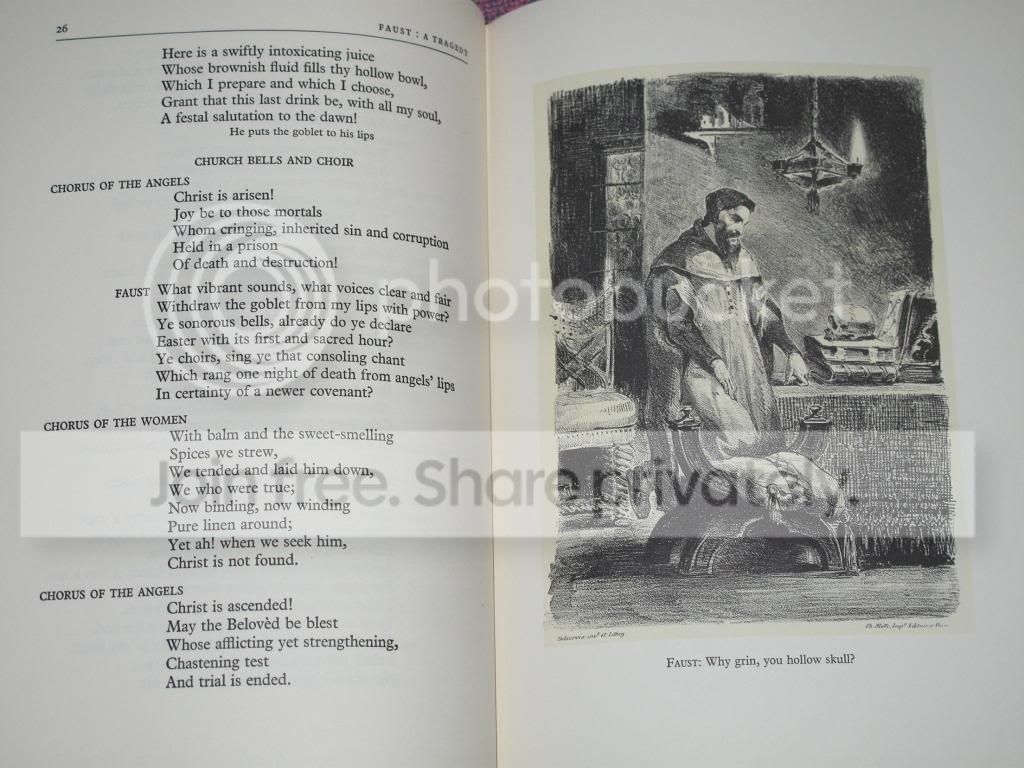
86Django6924
and the Folio edition:
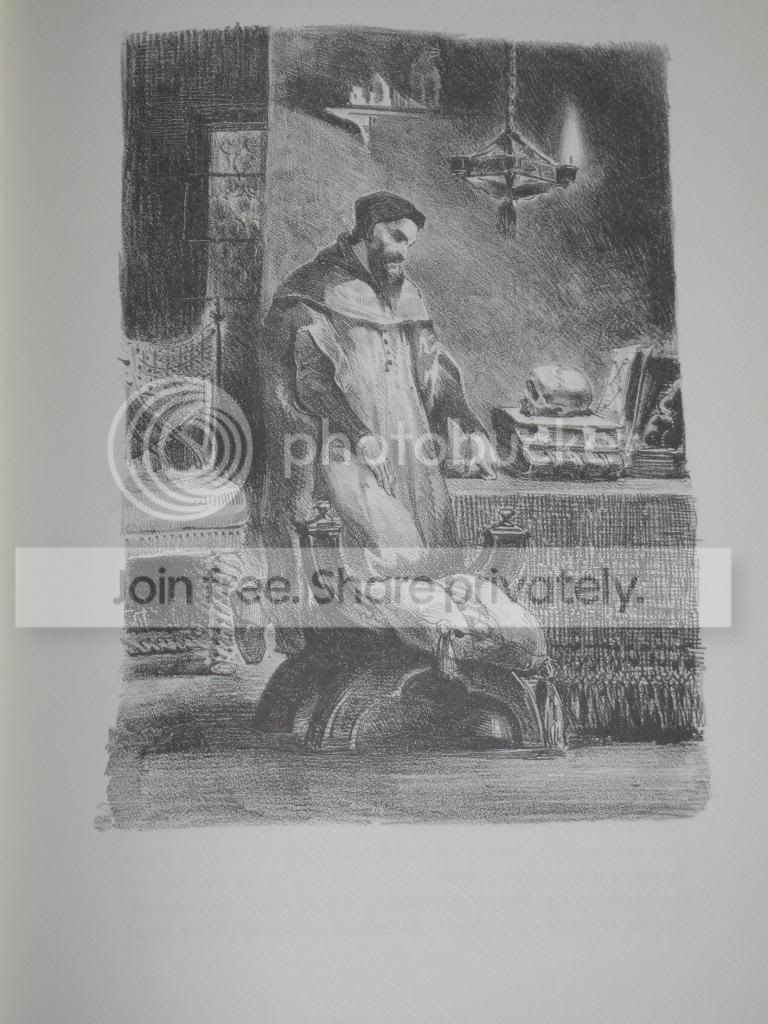
87Django6924
A direct comparison of detail shows how thin the Folio reproduction is in comparison. (The HEritage illustration is on top:

88Django6924
The Folio illustration was reproduced via the halftone process and the Heritage by the more expensive, and fussy, collotype method. A closer detail clearly shows how the dot screen of the halftone makes it difficulty to produce fine details with contrast (again, the Heritage illustration is on top):
89Django6924
Here is another comparison, the Heritage followed by the Folio reproduction of the Walpurgisnacht illustration:

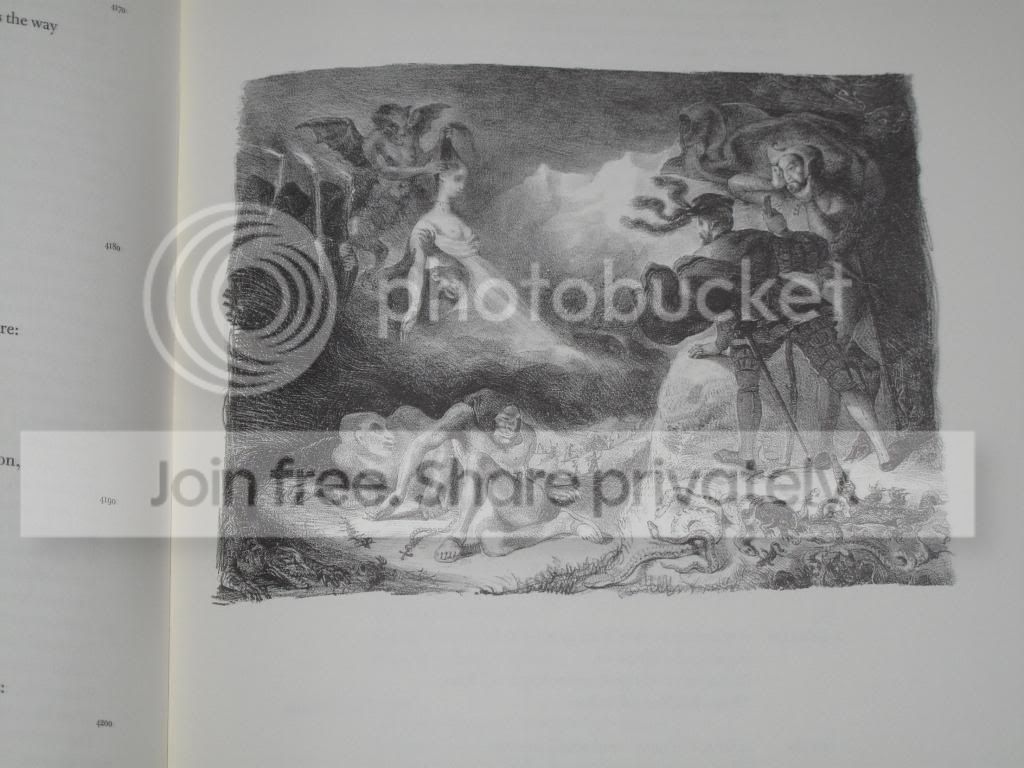

90Django6924
And a closer detail of the above, Heritage on top (ignore the apparent distortion in Faust's head, that is caused by the bending of the page near the center gutter of the open book):


91Django6924
The Folio Society book is very nice, albeit huge, and the one full color painting Delacroix made of one of the Faust illustrations is worth buying the book for (along with a good, very complete modern translation and excellent notes), but I wish they had spent a little more effort on the reproduction of the B&W illustrations.
(If anyone is interested in seeing more photos of the Heritage reproductions, I will be happy to upload them to PhotoBucket; I am also uploading today photos of Harry Clarke's phantasmagoric illustrations from my limited edition Dingwell from the late 1920s. Here is a sample from that famous version:

(If anyone is interested in seeing more photos of the Heritage reproductions, I will be happy to upload them to PhotoBucket; I am also uploading today photos of Harry Clarke's phantasmagoric illustrations from my limited edition Dingwell from the late 1920s. Here is a sample from that famous version:

92UK_History_Fan
Robert, thanks for uploading the comparison. I definitely agree with your assessment. Is your HP the original or the 1959'reprint with blue cover?
93Django6924
>92 UK_History_Fan:
The 1959 reprint, which I got in the mid-60s as a member of the Heritage Club. I've wanted to get the original edition, but it seldom shows up in Fine condition.
The 1959 reprint, which I got in the mid-60s as a member of the Heritage Club. I've wanted to get the original edition, but it seldom shows up in Fine condition.
94Django6924
>92 UK_History_Fan: "Is your HP the original or the 1959'reprint with blue cover?"
OK, I was visiting a local bookstore and found the original Heritage edition of Faust. The publisher is identified on the title page as "The Heritage Club," there is no copyright date, and on the verso of the title page "Printed and made in Great Britain." The binding is the same design as the dark blue 1959 reprint, but the fabric is a sturdier weave of buckram and taupe in color. No Sandglass, but the book is in Near Fine condition (although it has the previous owner's bookplate), and I would rate the slipcase Very Good.
The illustrations themselves are even sharper and more chiaroscuro than in my 1959 version--why? because these have apparently been redrawn from Delacroix's originals onto new (and smaller) lithographic stones by the famous French lithographic establishment of Fernand Mourlot, and printed directly from those new stones. The later Heritage edition photographed the original Delacroix lithos (a portfolio of which was purchased by Macy for the 1938 edition), and reproduced these via collotype.
Which do I prefer? The 1938 versions are very dramatic, and they are direct pulls from the litho stones...but...the fine detail of the shading and subtleties of expression are lost when compared to the later collotypes. M. Mourlot may have been a very great technician in the making and pulling of lithographs, but he was no Delacroix.
OK, I was visiting a local bookstore and found the original Heritage edition of Faust. The publisher is identified on the title page as "The Heritage Club," there is no copyright date, and on the verso of the title page "Printed and made in Great Britain." The binding is the same design as the dark blue 1959 reprint, but the fabric is a sturdier weave of buckram and taupe in color. No Sandglass, but the book is in Near Fine condition (although it has the previous owner's bookplate), and I would rate the slipcase Very Good.
The illustrations themselves are even sharper and more chiaroscuro than in my 1959 version--why? because these have apparently been redrawn from Delacroix's originals onto new (and smaller) lithographic stones by the famous French lithographic establishment of Fernand Mourlot, and printed directly from those new stones. The later Heritage edition photographed the original Delacroix lithos (a portfolio of which was purchased by Macy for the 1938 edition), and reproduced these via collotype.
Which do I prefer? The 1938 versions are very dramatic, and they are direct pulls from the litho stones...but...the fine detail of the shading and subtleties of expression are lost when compared to the later collotypes. M. Mourlot may have been a very great technician in the making and pulling of lithographs, but he was no Delacroix.
95UK_History_Fan
Robert, sorry if I am missing the obvious point, it is after all 1 am in London, but are you saying the 1959 illustrations are preferred?
96Django6924
Yes--as much as I like the dramatic quality of the original edition, the detail in the 1959 version, which accurately reproduces what is in Delacroix's originals, is more compelling. I'll try to take pictures and do a side-by-side comparison.
97andrewsd
Slipcases that don't fit - I have purchased two Heritage Press copies of Joyce's A Portrait of the Artist as a Young Man, both of which have slipcases that seem to be just a bit too small for their books. The spine of this title sticks out slightly further than any other in my collection, and the slipcase is a pain to "slip" the book out of.
This is the first time I have had this experience with a Heritage Press title; all of my other books have cases that fit perfectly. Anyone else have one or two books that just don't seem to fit their slipcases well? I have already ruled out the possibility that a seller used a slipcase from another book.
This is the first time I have had this experience with a Heritage Press title; all of my other books have cases that fit perfectly. Anyone else have one or two books that just don't seem to fit their slipcases well? I have already ruled out the possibility that a seller used a slipcase from another book.
98aaronpepperdine
I've seen this with Macy books from time to time. I can't remember off the top of my head which one at the moment, but there is a LEC on my shelf which sticks out a bit too far from the slipcase.
It happens with other presses too - the three volumes in the Grabhorn Divine Comedy (the smaller, white-bound version, not the vellum Nash) protrude nearly 1/3 an inch out of the slipcase, so much so that the text blocks are visible.
It happens with other presses too - the three volumes in the Grabhorn Divine Comedy (the smaller, white-bound version, not the vellum Nash) protrude nearly 1/3 an inch out of the slipcase, so much so that the text blocks are visible.
99leccol
If you consider the sheer volume published by George Macy, it is not unlikely that some cases fit differently than others. I have seen this on LECs, but not so much on Heritage Press since these were printed by Macy. My LEC of the Count of Monte Cristo and the stories of Hans Christian Anderson stick out beyond the top of the slipcase somewhat. The price of Heritage Press books is such that you can't expect perfection. They sold originally for $4.95 a title and now most in Fine condition sell for $10 or less. when books are the price of a hamburger and a coke, you can't complain.
100kdweber
Of course, there is the infamous shrinking plastic slipcase for Looking Backwards.
101leccol
If you get the book out of this plastic slipcase, consider yourself llucky and discard it, the slipcase I mean.
102Django6924
Or, keep it as an interesting statement on the idiosyncracies of technology and buy a second copy to read (as I did--fortunately copies without the slipcase are cheap.
104booksforreading
Slipcase does not have anything printed on it:
Yesterday, I received Singer’s “The Gentleman From Cracow/The Mirror” and was surprised to see that the back of the slipcase is blank – no title, to name of the author. This is unusual for LEC slipcovers, so I am wondering if anybody else has this book, and the slipcase is the same. Maybe I have a Heritage Press slipcover from another book?
I should probably mention that the actual book is the authentic LEC edition, with signatures, etc.
Yesterday, I received Singer’s “The Gentleman From Cracow/The Mirror” and was surprised to see that the back of the slipcase is blank – no title, to name of the author. This is unusual for LEC slipcovers, so I am wondering if anybody else has this book, and the slipcase is the same. Maybe I have a Heritage Press slipcover from another book?
I should probably mention that the actual book is the authentic LEC edition, with signatures, etc.
105Django6924
>103 andrewsd:
Yes, the clear plastic used was a relatively new item and in those days nobody did tests on dimensional stability over time.
>104 booksforreading:
I'll check when I get home, but there are many LEC slipcases that didn't have the title on the spine--none of the ones printed by the Officina Bodoni, for example
Yes, the clear plastic used was a relatively new item and in those days nobody did tests on dimensional stability over time.
>104 booksforreading:
I'll check when I get home, but there are many LEC slipcases that didn't have the title on the spine--none of the ones printed by the Officina Bodoni, for example
106kdweber
>105 Django6924: But didn't the Officina Bodoni books come with paper dust jackets?
109WildcatJF
104) My Crime and Punishment lacks a slipcase label. I've been meaning to ask if I'm special in that regard or not.
Another fun idea I was pondering was seeing if any of us share volumes from the same limitation number. We may be able to piece together some interesting travel from a particular collector or his/her book collection! If anyone else is game for this, I'll list all of mine and the cities I bought them in.
Another fun idea I was pondering was seeing if any of us share volumes from the same limitation number. We may be able to piece together some interesting travel from a particular collector or his/her book collection! If anyone else is game for this, I'll list all of mine and the cities I bought them in.
110andrewsd
>109 WildcatJF: My LEC Crime & Punishment also lacks a label, so perhaps that means it didn't come with one. The slipcase is in like new condition and no glue spot is present—nothing that would indicate damage or a missing label. Also added to my collection recently, Tolstoy's Resurrection. I am a sucker for the LEC Russian lit publications.
111WildcatJF
110) Would you mind sharing the limitation number on yours, Andrew? Mine is #1500, so I wonder if it's something that was omitted later on or all together.
112andrewsd
>111 WildcatJF: My copy is #1094 of 1500. Wow, at #1500, you have the very last number in the lot! I would think that #1 and #1500 might be the most interesting copies to own.
113booksforreading
>105 Django6924:, 108, 109, 110
Thank you very much for your input! I guess not every LEC slipcase has a label.
Thank you very much for your input! I guess not every LEC slipcase has a label.
114Django6924
>113 booksforreading:
And my copy of The Gentleman From Cracow is in a plain gray slipcase sans title.
And my copy of The Gentleman From Cracow is in a plain gray slipcase sans title.
115UK_History_Fan
I am currently reading or re-reading several of Shakespeare's historical plays, particularly those that feature the Wars of the Roses or its precursor conflicts (basically the cycle from Richard II through Richard III). That led me to my personal copy of the LEC The Life of King Henry V. Several, though by no means all, of the pages are still uncut in what I believe is referred to as the "french fold." I personally have never tried to separate pages in a book bound this way. I know this topic has undoubtedly been covered before, but an initial quick search did not reveal the correct thread.
What is the best advice for carefully (and without damage) separating these pages so I may enjoy my LEC book? What type of "knife" or other tool should I purchase and where might one purchase such a thing (keeping in mind I am in the US)? Any advice is appreciated. This is certainly not my first LEC with uncut pages, but it is the first I've attempted to read so far with this binding style.
What is the best advice for carefully (and without damage) separating these pages so I may enjoy my LEC book? What type of "knife" or other tool should I purchase and where might one purchase such a thing (keeping in mind I am in the US)? Any advice is appreciated. This is certainly not my first LEC with uncut pages, but it is the first I've attempted to read so far with this binding style.
116leccol
You must be talking about the Henry V in the 1939-1940 LEC complete Shakespeare versus the out of series Henry V which was produced after Olivier's interpretation of Henry V.
In the 1939-40 Shakespeare and several other LEC productions, the pages were gathered with several uncut as paper with deckle edges were used. These are not a French fold. this term refers to pages which were were folded so that the double-thick pages could have the opacity needed. These should never be cut apart.
The uncut pages were not cut because the binding technology of the 30s did not allow for those pages within a signature to be cut without destroying the deckle edge.
To cut these apart, a binder's knife is one tool which can be used. Try the Talas site to find such a tool.
In the 1939-40 Shakespeare and several other LEC productions, the pages were gathered with several uncut as paper with deckle edges were used. These are not a French fold. this term refers to pages which were were folded so that the double-thick pages could have the opacity needed. These should never be cut apart.
The uncut pages were not cut because the binding technology of the 30s did not allow for those pages within a signature to be cut without destroying the deckle edge.
To cut these apart, a binder's knife is one tool which can be used. Try the Talas site to find such a tool.
117UK_History_Fan
> 116
Well my terms are obviously confusing to the experts, but I am definitely speaking of the "out of series" Henry V from 1951 with the painted images from Fritz Kredel. The Monthly Letter has the very fascinating history of Macy's long attempt to reproduce illustrations from stills taken from Sir Lawrence Olivier's Henry V film.
Whatever the correct term, the play is impossible to read without first separating the pages since there is text on the inside of the attached pages.
I will search out a binder's knife on the Talas site, but I was hoping for something I could run out and pick up. Obviously I have many editions of Shakespeare and am not lacking in sources for Henry V, but now I have my heart set on reading this version without waiting for a delivery of an online order.
Well my terms are obviously confusing to the experts, but I am definitely speaking of the "out of series" Henry V from 1951 with the painted images from Fritz Kredel. The Monthly Letter has the very fascinating history of Macy's long attempt to reproduce illustrations from stills taken from Sir Lawrence Olivier's Henry V film.
Whatever the correct term, the play is impossible to read without first separating the pages since there is text on the inside of the attached pages.
I will search out a binder's knife on the Talas site, but I was hoping for something I could run out and pick up. Obviously I have many editions of Shakespeare and am not lacking in sources for Henry V, but now I have my heart set on reading this version without waiting for a delivery of an online order.
118Django6924
>117 UK_History_Fan:
leccoll is right about the term french fold (also sometimes called "japanese fold." That style of binding has no printing on the inside of the folded pages and shouldn't be cut, though I believe the LEC version to which you are referring is not french fold but simply one with uncut pages. (I still have my original HP issue of this and never particularly wanted to replace it with an LEC, so I'm guessing here.)
To cut pages I have always used a Wusthof 10" slicing knife, available at most department stores. It is long enough to insert the full length of most pages and sharp enough to cut, and not tear the paper, but not razor sharp, which can sometimes lead you to cut off the fold. You can pay more for a professional binder's knife, but wouldn't you rather spend the money on more books?
leccoll is right about the term french fold (also sometimes called "japanese fold." That style of binding has no printing on the inside of the folded pages and shouldn't be cut, though I believe the LEC version to which you are referring is not french fold but simply one with uncut pages. (I still have my original HP issue of this and never particularly wanted to replace it with an LEC, so I'm guessing here.)
To cut pages I have always used a Wusthof 10" slicing knife, available at most department stores. It is long enough to insert the full length of most pages and sharp enough to cut, and not tear the paper, but not razor sharp, which can sometimes lead you to cut off the fold. You can pay more for a professional binder's knife, but wouldn't you rather spend the money on more books?
119kdweber
>115 UK_History_Fan: I've used a letter opener and a bone folder, both with success.
120UK_History_Fan
This makes me nervous as I am not exactly artistically inclined, but I am a perfectionist, so if I end up with ugly pages, it will only be my own fault and that is frightening!
121Django6924
Just be thankful it's Henry V and not Tristram Shandy! When I cut the pages on my George Harrap Tristram, it took me almost 2 days; I found early that it's better (for me at least), to just cut the pages first and don't try to read the book until after all are cut; trying to "cut as you go" was a disaster for me.
122UK_History_Fan
> 121
Absolutely sound advice Robert. I would not have the patience to "cut as I go." Fortunately I don't have too many like this. I have begun Henry V anyway and I switch to another edition when I need to read one of the "interior" pages with text or simply try to puff open the fold enough to read inside. The acrobatics involved in this is quite amusing, especially since it is a really large volume. I tried your idea of a sharp kitchen knife, even a larger sized one (possibly 9"?) and practiced it on a folded piece of mail (there is no way I'm practicing on an LEC!) and did not like the result at all! Granted, the paper in the LEC is entirely higher quality and will likely cut differently than a notice from my mortgage company informing me that due to higher property taxes they are increasing my monthly escrow requirement, but the experience put me off until I can either buy a better knife or a better tool.
Absolutely sound advice Robert. I would not have the patience to "cut as I go." Fortunately I don't have too many like this. I have begun Henry V anyway and I switch to another edition when I need to read one of the "interior" pages with text or simply try to puff open the fold enough to read inside. The acrobatics involved in this is quite amusing, especially since it is a really large volume. I tried your idea of a sharp kitchen knife, even a larger sized one (possibly 9"?) and practiced it on a folded piece of mail (there is no way I'm practicing on an LEC!) and did not like the result at all! Granted, the paper in the LEC is entirely higher quality and will likely cut differently than a notice from my mortgage company informing me that due to higher property taxes they are increasing my monthly escrow requirement, but the experience put me off until I can either buy a better knife or a better tool.
123leccol
I guessed you were referring to the 1939 LEC since I remembered the Olivier one as not having deckled edges. But I pulled my copy and I was wrong, although all the pages in my copy have been cut. I think that the 30s to 50s LECs were untrimmed on the outer edges to preserve the deckle edges.
When I bought my copy of Heart of Darkness from Chester River, it arrived with all the outer edges cut. I assumed that trimming the deckle edges without destroying the deckle could now be accomplished without hand cutting. Anyone know about this?
From the late 50s onward, paper was used by the LEC without deckle edges. In some of my rebinding projects, I have had to trim all three sides of an LEC to cut old gilding and trim unwanted dirt from the other sides. The deckle edges can be a nice touch, but one has to decide whether encrusted dirt can be lived with or the dirt can be trimmed off destroying the deckle edges.
When I bought my copy of Heart of Darkness from Chester River, it arrived with all the outer edges cut. I assumed that trimming the deckle edges without destroying the deckle could now be accomplished without hand cutting. Anyone know about this?
From the late 50s onward, paper was used by the LEC without deckle edges. In some of my rebinding projects, I have had to trim all three sides of an LEC to cut old gilding and trim unwanted dirt from the other sides. The deckle edges can be a nice touch, but one has to decide whether encrusted dirt can be lived with or the dirt can be trimmed off destroying the deckle edges.
124Django6924
>123 leccol: "When I bought my copy of Heart of Darkness from Chester River, it arrived with all the outer edges cut. I assumed that trimming the deckle edges without destroying the deckle could now be accomplished without hand cutting. Anyone know about this?"
There appears to be a degree of confusion about the exact nature of a "deckle edge;" a true deckle edge is a natural product of old-fashioned methods of paper making; a rough edge caused by opening an uncut page is something else again. Anyone who has handmade paper is familiar how the slurry is held on the screen in the shape of the book page by a frame--the deckle. Since the slurry doesn't make perfect contact with the deckle, this leaves an uneven edge. In modern papermaking, the paper is made in rolls and the paper has a smooth edge. When pages are printed in large sheets, then the sheets folded and bound, the folded edges are sometimes left for the reader to cut open--these are more properly referred to as "uncut pages" and not true deckle edges. Most books you will find with true deckle edges are books printed on sheet-made paper (often hand-made) with sheet-fed presses, and can be very uneven in width and length.
In answer to your question, there is a machine that produces "deckle edges" by rough-cutting the page edges in a randomly-generated fashion. You seldom see a marked difference in length and width of pages so treated.
There appears to be a degree of confusion about the exact nature of a "deckle edge;" a true deckle edge is a natural product of old-fashioned methods of paper making; a rough edge caused by opening an uncut page is something else again. Anyone who has handmade paper is familiar how the slurry is held on the screen in the shape of the book page by a frame--the deckle. Since the slurry doesn't make perfect contact with the deckle, this leaves an uneven edge. In modern papermaking, the paper is made in rolls and the paper has a smooth edge. When pages are printed in large sheets, then the sheets folded and bound, the folded edges are sometimes left for the reader to cut open--these are more properly referred to as "uncut pages" and not true deckle edges. Most books you will find with true deckle edges are books printed on sheet-made paper (often hand-made) with sheet-fed presses, and can be very uneven in width and length.
In answer to your question, there is a machine that produces "deckle edges" by rough-cutting the page edges in a randomly-generated fashion. You seldom see a marked difference in length and width of pages so treated.
125booksforreading
I would like to add that sometimes the safest way to cut pages is with a playing card. I have seen this advice in a couple of books about book collecting, and I have tried this myself - it works nicely and does not need another purchase. I remember that the advice was not to use knifes for cutting the pages to avoid accidental damage.
Just my two cents...
Just my two cents...
126leccol
In perusing the Chester River Heart of Darkness, I wondered how the pages were cut, but it seemed as if the deckle was preserved on the outside edges. My printing experience in advertising pieces was comfined to 4-6 color printing on coated stock so of course deckled paper was never used.
In rebinding LEC's, I had to trim most pages of dirt or gilding, so deckle edges had to go. It was a choice between having dirty or discolored edges or trimming pages back to eliminate such dirt, foxing, etc. The very early LECs with hand made paper, I tried to preserve since the paper from one sheet to the next might vary a 1/4" or more.
In rebinding LEC's, I had to trim most pages of dirt or gilding, so deckle edges had to go. It was a choice between having dirty or discolored edges or trimming pages back to eliminate such dirt, foxing, etc. The very early LECs with hand made paper, I tried to preserve since the paper from one sheet to the next might vary a 1/4" or more.
127featherwate
I'm faced with having to separate nearly 1600 pages of an uncut five-volume set of Shakespeare's tragedies in French with illustrations by Edy Legrand (242 of them, many full page).
Eight hundred slices - I may get though a whole pack of playing cards before I've finished!
Eight hundred slices - I may get though a whole pack of playing cards before I've finished!
128parchment
Please post some photos. For me (but obviously not for many others), Édouard Léon Louis Warschawsky's Don Quixote is THE Don Quixote, and I would love to see his Shakespeare. Did he illustrate only the tragedies?
129Django6924
>127 featherwate:
I would loan you my 10" Wusthof slicer in exchange for posting some pictures when you are finished.
>128 parchment:
For me, too--I love Ricart's work in the earlier LEC version, but no one (not even Dali or Picasso) has captured the essence of the Knight of the Sorrowful Countenance more thoughtfully and beautifully than Legrand.
I would loan you my 10" Wusthof slicer in exchange for posting some pictures when you are finished.
>128 parchment:
For me, too--I love Ricart's work in the earlier LEC version, but no one (not even Dali or Picasso) has captured the essence of the Knight of the Sorrowful Countenance more thoughtfully and beautifully than Legrand.
130featherwate
No, only the tragedies: Titus Andronicus with Roméo et Juliette (how's that for a ménage à trois!); Jules César with Hamlet; Othello with MacBeth; Antoine et Cléopatre with Le roi Lear; and Corolian with Timon d'Athènes.
The publishers, Union Latine d'Editions, followed up with a seven-volume set of comedies in 1952, the gap presumably being caused by the war. I don't know whether Legrand had originally been intended to work on these, but in the event the artist was Berthold Mahn, about whom shamefully I know nothing except that he escaped from a Dickensian childhood (put to work in a stove factory at six years old) to become one of the most prolific and well-regarded of French illustrators. He and Union Latine had produced a five-volume Don Quixote back in 1935 (well, 4 volumes of DQ plus a life of Cervantes).
Yes, I'll try to put up some pictures - when I dis-cover them. I feel like someone breaking into the tomb of a pharaoh in search of wall paintings. For now, here's one that may seem strangely familiar to anyone who owns the LEC Shakespeare....

The publishers, Union Latine d'Editions, followed up with a seven-volume set of comedies in 1952, the gap presumably being caused by the war. I don't know whether Legrand had originally been intended to work on these, but in the event the artist was Berthold Mahn, about whom shamefully I know nothing except that he escaped from a Dickensian childhood (put to work in a stove factory at six years old) to become one of the most prolific and well-regarded of French illustrators. He and Union Latine had produced a five-volume Don Quixote back in 1935 (well, 4 volumes of DQ plus a life of Cervantes).
Yes, I'll try to put up some pictures - when I dis-cover them. I feel like someone breaking into the tomb of a pharaoh in search of wall paintings. For now, here's one that may seem strangely familiar to anyone who owns the LEC Shakespeare....

131UK_History_Fan
Can someone please provide some insight on the Agnes Parker Miller illustrated LEC Thomas Hardy books? I just want to make sure when shopping, I am getting a complete set. I know that at least Jude the Obscure and Mayor of Casterbridge came with a separate detached signed print by APM but what about Tess d'Urbevilles and Far From The Madding Crowd? Which one of these had the hand-colored illustrations, Tess d'Urbevilles?
132Django6924
>131 UK_History_Fan:
Tess had multi-colored wood engravings--in which the colors were applied by differently carved blocks for each color. This was a technique used occasionally by Lynd Ward, frequently by Hans Mueller, but I think Tess is the only time it was used by Miss Parker, though this is a question best answered by the expert on wood engraving, HuxleyTheCat.
Of course The Return of the Native was only produced as a Heritage Press exclusive, and never became an LEC.
Tess had multi-colored wood engravings--in which the colors were applied by differently carved blocks for each color. This was a technique used occasionally by Lynd Ward, frequently by Hans Mueller, but I think Tess is the only time it was used by Miss Parker, though this is a question best answered by the expert on wood engraving, HuxleyTheCat.
Of course The Return of the Native was only produced as a Heritage Press exclusive, and never became an LEC.
133UK_History_Fan
> 132
Thanks Robert. Any idea which LEC Hardy titles came with a separate signed print?
Thanks Robert. Any idea which LEC Hardy titles came with a separate signed print?
134Django6924
I don't, Sean. All my Hardy titles are the Heritage editions. Frankly, I didn't know any of them came with a separate print.
ADDED: Checking in my Club literature, Far From the Madding Crowd came with an additional signed print.
ADDED: Checking in my Club literature, Far From the Madding Crowd came with an additional signed print.
135WildcatJF
134) Aye, Madding Crowd did have a print, and I was fortunate enough to find a copy with it. I'd love to frame it up, but I'd hate to lose it to the sun or some other unforeseen earthly element. According to Mr. Majure, Jude the Obscure's LEC issuing also included a print, but the other two seemingly were issued without.
136andrewsd
I noticed that the monthly letter from my LEC edition of The Trial is stapled. I have never seen this in an LEC before, but from my experience in handling old stapled letters and ephemera, I know that they eventually rust and stain the paper surrounding them. The two staples in my Trial letter have not rusted but look like they are beginning to.
QUESTION: Should I remove the staples, or leave them in the letter as originally intended? What would you recommend?
QUESTION: Should I remove the staples, or leave them in the letter as originally intended? What would you recommend?
137WildcatJF
136) I'd say that it might not be a bad idea to remove them if you're storing the letter in your book. Rust stains do horrific things to books. Otherwise, you could always put the letter in a storage bag or something, although that would probably look a little tacky. I'd take out the staples.
138Django6924
I second Jerry's recommendation.
139andrewsd
>137 WildcatJF:,138 This particular copy came with the letter in its original LEC envelope, another item I would not wish to get rust on. I think I will remove them. This letter is, of course, from the Avon, CT, period. I would expect something as unwise as a stapled monthly letter to come from no other era.
Now, to carefully remove them . . .
*Removed, no issues. Just a faint rust stain on one of the outer pages.
I checked my other letters; four more with staples to remove. :-(
Now, to carefully remove them . . .
*Removed, no issues. Just a faint rust stain on one of the outer pages.
I checked my other letters; four more with staples to remove. :-(
140Django6924
I managed to buy a copy of the original Nonesuch version of Candide, which was distributed to those members of the Heritage Club who opted to take it in addition to, or in lieu of, the regular Heritage Club edition. This was right after the outbreak of WW II, and it was deemed prudent to move the entire production of Nonesuch Press books to the US, but my copy was one of the last printed in France--which was the original production plan for the "Ten Great French Romances." My delight at finding enclosed an 8 page pamphlet "Nonesuch News" outlining the plans for the forthcoming books (which I detailed in another thread), was mixed with dismay when I saw the very rusted staples which had stained the pasteover of the front endpapers.
141andrewsd
>140 Django6924: Rare and antique ephemera has no greater enemy than the staple. Even when collectors throughout the years have been careful to avoid exposure to water, fire, smoke, or light, the staple usually gets by their defenses without much thought.
All five of my letters are now de-stapled. Only one letter suffered a little tearing directly underneath the staple. They were all from the '75 series I think.
All five of my letters are now de-stapled. Only one letter suffered a little tearing directly underneath the staple. They were all from the '75 series I think.
142andrewsd
I've often wondered if it really was the case that all Heritage Press editions had the exact same number of illustrations present in their LEC counterparts. It seemed that it just wouldn't be possible to include every single illustration from, say, a two+ volume LEC set in a single volume HP edition. Even when book length permitted it, I couldn't see the 'budget' HP doing everything the LEC did with an edition. After all, there had to be some incentive to join the LEC beyond the bindings. Now I have found at least one title that validates my doubts.
I recently acquired an LEC copy of Joyce's A Portrait of the Artist as a Young Man. The HP edition has been in my library for some time, but I really wanted to have this book in an LEC. Well, when I was leafing through this book to check for condition, I came across an illustration that I did not remember from the HP. Sure enough, when I checked the HP, the illustration wasn't there. Opposite the last page in chapter II, there is a painting of Stephen and a prostitute sitting naked beside each other on a bed. Now the question is, was this left out of the HP edition because of the depicted nudity? Maybe since HP editions were mass produced, the nudity was deemed inappropriate for wide-scale distribution.
I recently acquired an LEC copy of Joyce's A Portrait of the Artist as a Young Man. The HP edition has been in my library for some time, but I really wanted to have this book in an LEC. Well, when I was leafing through this book to check for condition, I came across an illustration that I did not remember from the HP. Sure enough, when I checked the HP, the illustration wasn't there. Opposite the last page in chapter II, there is a painting of Stephen and a prostitute sitting naked beside each other on a bed. Now the question is, was this left out of the HP edition because of the depicted nudity? Maybe since HP editions were mass produced, the nudity was deemed inappropriate for wide-scale distribution.
143Django6924
>142 andrewsd:
Or, the problem may be that a prior owner of your copy collected erotica. My Heritage Press edition, which I received new when I was a Heritage Club member, has the illustration opposite page 97. I acquired an LEC version a few years ago, and did a side-by-side comparison of the two after reading your post--both have exactly the same number of illustrations.
While there are some instances of the Heritage Press edition containing fewer illustrations than the LEC version--most notably the Rackham-illustrated The Wind in the Willows, every time I've had both editions the number of illustrations is the same. (The Rackham Wind is a curious circumstance where there are fewer illustrations than the LEC, but the Heritage edition contains some illustrations that aren't in the LEC. The Blake-illustrated Pilgrim's Progress is another case where the HP has fewer illustrations than the LEC. I believe that in both cases, the reason for the discrepancy has to do with copyright issues.)
Or, the problem may be that a prior owner of your copy collected erotica. My Heritage Press edition, which I received new when I was a Heritage Club member, has the illustration opposite page 97. I acquired an LEC version a few years ago, and did a side-by-side comparison of the two after reading your post--both have exactly the same number of illustrations.
While there are some instances of the Heritage Press edition containing fewer illustrations than the LEC version--most notably the Rackham-illustrated The Wind in the Willows, every time I've had both editions the number of illustrations is the same. (The Rackham Wind is a curious circumstance where there are fewer illustrations than the LEC, but the Heritage edition contains some illustrations that aren't in the LEC. The Blake-illustrated Pilgrim's Progress is another case where the HP has fewer illustrations than the LEC. I believe that in both cases, the reason for the discrepancy has to do with copyright issues.)
144andrewsd
>143 Django6924: Interesting! I re-examined both of my HP Portrait editions and there doesn't appear to be any removal of the illustration. The signatures look complete, and there is no strip of paper where it could have been razored out in either copy. I should note that these seem to be later printings of this text.
146Django6924
>145 GoriceXII:
The type was never reset on any of the Easton Press reprints, which were printed offset from photographic plates of the originals.
I bought the Easton Press reprint of the LEC Shakespeare before I was able to find a complete set of the LEC, and from a comparison between them, I would say the reproductions of the illustrations is much better than other Easton Press reprints. I'll try to take some pictures for comparison.
The type was never reset on any of the Easton Press reprints, which were printed offset from photographic plates of the originals.
I bought the Easton Press reprint of the LEC Shakespeare before I was able to find a complete set of the LEC, and from a comparison between them, I would say the reproductions of the illustrations is much better than other Easton Press reprints. I'll try to take some pictures for comparison.
148busywine
>147 GoriceXII:, hate to put it this way, but no contest between the LEC and EP. While the EP reprint in this case is good compared to ther EP, it does not come close to comparing to the LEC originals. Nor is the paper anywhere near as nice by a long shot.
151andrewsd
>150 GoriceXII: I own the Heritage Press Brothers Karamazov. The double column feature was used to shorten the page length of this book, I imagine, as the LEC Eichenberg-illustrated set on which it is based is two volumes. The HP edition is a very large and wide book, so this isn't much of an issue; the columns are big enough. I'm not a huge fan of double columns, but this HP edition is definitely worth having. Column width is exactly three inches. I also have Crime & Punishment and The Idiot and they are not double column, but single (and very nice editions at that).


153andrewsd
>152 GoriceXII: You might get used to reading double-column format after the first few pages. That's the way it usually goes for me. Once your reading flow adjusts, the end of a line stops feeling like an interruption.
I should add, buying the Heritage Press edition of The Brothers Karamazov is much easier on your wallet than getting the LEC. The 1949 Eichenberg-illustrated Limited Editions Club two-volume set is nice, but, in my humble opinion, way overpriced when compared to similar Dostoevsky editions. Getting one in fine condition will run you between $250 and $300. I own a mint condition copy of A Raw Youth (same two-vol format and design) that cost me only $50. Even my Crime & Punishment LEC only ran me $125, and that set seems to be harder to find on eBay. I'm sure I will replace the HP edition eventually, but I'm more than happy with it until I can find a reasonably priced LEC.
I should add, buying the Heritage Press edition of The Brothers Karamazov is much easier on your wallet than getting the LEC. The 1949 Eichenberg-illustrated Limited Editions Club two-volume set is nice, but, in my humble opinion, way overpriced when compared to similar Dostoevsky editions. Getting one in fine condition will run you between $250 and $300. I own a mint condition copy of A Raw Youth (same two-vol format and design) that cost me only $50. Even my Crime & Punishment LEC only ran me $125, and that set seems to be harder to find on eBay. I'm sure I will replace the HP edition eventually, but I'm more than happy with it until I can find a reasonably priced LEC.
154Django6924
I am very happy with the HP Karamazov, and will not replace it with an LEC (unless I find one for a song!) because I have the Alexander King-illustrated LEC Karamazov, and I frankly prefer the illustrations in it and the convenient size of the three volumes.
Although I am not a fan of double columns myself, in the HP and LEC volumes that have used it, it does, as andrewsd mentioned, become a non-issue for most readers. Perhaps WildcatJF can tell us which was the first HP to use double columns. I know Macy was not a fan of that format--an opinion he stated in the Monthly Letter for the LEC Life of Cellini when Mardersteig changed the plan for that book--originally to be issued in 2 volumes--to a single volume with double columns.
Although I am not a fan of double columns myself, in the HP and LEC volumes that have used it, it does, as andrewsd mentioned, become a non-issue for most readers. Perhaps WildcatJF can tell us which was the first HP to use double columns. I know Macy was not a fan of that format--an opinion he stated in the Monthly Letter for the LEC Life of Cellini when Mardersteig changed the plan for that book--originally to be issued in 2 volumes--to a single volume with double columns.
155andrewsd
>154 Django6924: That's interesting that Macy expressly stated his dislike for double-columns. I own the 1954 LEC An American Tragedy, and it has double-column formatting. I read somewhere that this was supposed to be the last LEC George Macy 'designed,' but Robert's information now makes me doubt this. If there ever was an LEC that deserved a two-volume set, An American Tragedy would be it. All of the Marsh illustrations are tiny and spread throughout the text as a result.
156Virion
> 154 The 1940 decameron is also double column and designed by george macy. Seems he changed his mind somewhere along the line.
157Django6924
>156 Virion:
I don't know if he ever really changed his mind about double columns--the second Decameron was a book he really wanted to do, but he couldn't offer it as part of the regular series so soon after the earlier edition. The book was printed more or less on demand, and as a result there were only about a third as many copies printed (530), so questions of economics had to prevail. In addition, double columns were very much in style for works from the Renaissance (the first LEC Decameron was also printed in double column format).
I don't know if he ever really changed his mind about double columns--the second Decameron was a book he really wanted to do, but he couldn't offer it as part of the regular series so soon after the earlier edition. The book was printed more or less on demand, and as a result there were only about a third as many copies printed (530), so questions of economics had to prevail. In addition, double columns were very much in style for works from the Renaissance (the first LEC Decameron was also printed in double column format).
158Virion
>157 Django6924: As regard to economics, is printing double column cheaper then single? Also in the 10 years of lec book is stated that the second decameron costs 12.50 dollars instead of the then normal 10 dollars. So hopefully most economics issues were alleviated with the 25% price increase.
159featherwate
If memory serves, the Carlotta Petrina South Wind was a double-column LEC in 1929 but a full-page HP in 1939 (and in subsequent editions). In this case, however, the Heritage edition was effectively an exclusive. George Macy hated the way Mrs Petrina's illustrations had been reproduced in the LEC and commissioned a further set from her. In the event he used a mixture of old and new drawings and presumably took the opportunity of the necessary re-setting to change the Heritage layout to his preferred full page.
160Django6924
>158 Virion:
Yes, double columns means roughly half the printing costs (the time for typesetting is about the same but obviously the time spent in printing is less). Probably even a 25% increase in the price of the book did not keep it from being a break-even project at best.
>159 featherwate:
Correct on all counts, featherwate. The LEC is double-columned and the subsequent Heritage versions were typeset in full page-width lines of type. I have owned all three versions, and still have the LEC and the 1939 Heritage original, and they make an interesting study. In my opinion, the blue-ink illustrations are really fine and I prefer them, They are integrated into the text layout very imaginatively, and rather than "defeating the eye," as Macy claimed, I find them most arresting. The 1939 illustrations are also very fine, in a soft gray, but are inserted as full page illustrations on semi-glossy paper into the text. They are not at all the same illustrations as used in the LEC, and if your only exposure to Ms. Petrina's work has been the illustrations she did for The Aeneid or Paradise Lost, you will see her here in a vein that makes a good case for her being a forerunner of Beryl Markham's wonderfully satiric style.
What bothers my eye most about the LEC is neither the double columns or blue ink, but the distracting paragraph markings. It is a clever idea to run all the sentences together with no spacing between paragraphs and unique little ornaments to mark the start of a new paragraph, but some clever ideas should be resisted.
Yes, double columns means roughly half the printing costs (the time for typesetting is about the same but obviously the time spent in printing is less). Probably even a 25% increase in the price of the book did not keep it from being a break-even project at best.
>159 featherwate:
Correct on all counts, featherwate. The LEC is double-columned and the subsequent Heritage versions were typeset in full page-width lines of type. I have owned all three versions, and still have the LEC and the 1939 Heritage original, and they make an interesting study. In my opinion, the blue-ink illustrations are really fine and I prefer them, They are integrated into the text layout very imaginatively, and rather than "defeating the eye," as Macy claimed, I find them most arresting. The 1939 illustrations are also very fine, in a soft gray, but are inserted as full page illustrations on semi-glossy paper into the text. They are not at all the same illustrations as used in the LEC, and if your only exposure to Ms. Petrina's work has been the illustrations she did for The Aeneid or Paradise Lost, you will see her here in a vein that makes a good case for her being a forerunner of Beryl Markham's wonderfully satiric style.
What bothers my eye most about the LEC is neither the double columns or blue ink, but the distracting paragraph markings. It is a clever idea to run all the sentences together with no spacing between paragraphs and unique little ornaments to mark the start of a new paragraph, but some clever ideas should be resisted.
161andrewsd
>160 Django6924: "It is a clever idea to run all the sentences together with no spacing between paragraphs and unique little ornaments to mark the start of a new paragraph, but some clever ideas should be resisted."
That sounds dreadful indeed.
That sounds dreadful indeed.
162WildcatJF
154) Unfortunately, I can't relate the first circumstance of a double-columned LEC or HP title; I'd guess featherwate is probably correct with South Wind's use being the first.
159) I'll have to put that up on my Exclusive list!
159) I'll have to put that up on my Exclusive list!
163andrewsd
I've seen this very scary-sounding term in a couple of LEC descriptions recently: bio predation
Could someone define this for me? If it means what I think it does, it means bugs or mice have gone to town on the binding/paper and made a real mess of things.
Could someone define this for me? If it means what I think it does, it means bugs or mice have gone to town on the binding/paper and made a real mess of things.
164Django6924
>163 andrewsd:
Most likely silverfish. I have a relative whose father had a large collection of LECs--about half of which had never been opened and the other half stored under less than ideal conditions. Some of them were in boxes in the garage and the labels on the slipcases--and sometimes the bindings themselves, were nibbled in greater or lesser degree by silverfish, who have a particular fondness for the glue used in fine press books.
Most likely silverfish. I have a relative whose father had a large collection of LECs--about half of which had never been opened and the other half stored under less than ideal conditions. Some of them were in boxes in the garage and the labels on the slipcases--and sometimes the bindings themselves, were nibbled in greater or lesser degree by silverfish, who have a particular fondness for the glue used in fine press books.
165parchment.
Perhaps it's Gregor Samsa.
166kafkachen
I always spray the slipcase of new comer inside out with lots of 95% alcohol . until it was soaking wet.
167featherwate
>165 parchment.: Very good. Wish I'd thought of it first! :)
168andrewsd
>164 Django6924: Yes, silverfish and earwig attacks are now added to my list of things to be paranoid about.
>165 parchment.: Of course it is. Thanks for giving me a good laugh today, Parchment. I needed that to ease the pain of the long day of meetings I have before me.
>166 kafkachen: Are you serious?
>165 parchment.: Of course it is. Thanks for giving me a good laugh today, Parchment. I needed that to ease the pain of the long day of meetings I have before me.
>166 kafkachen: Are you serious?
170Django6924
>165 parchment.:
Didn't think he was a bibliophile....
>169 parchment.:
Very interesting--but it looks like it would be uncomfortable to hold.
Didn't think he was a bibliophile....
>169 parchment.:
Very interesting--but it looks like it would be uncomfortable to hold.
171andrewsd
>169 parchment.: WOW—I am speechless. That is officially the best cover I have ever seen for Metamorphosis. As Robert points out, it might be pokey to hold, but that cover is just spectacular. And to find out also that it is a rebound LEC! Amazing.
Also Parchment, thanks for pointing me to that website. After doing a little searching, I've found that I can order the complete Arion Press collection for a mere $195,985 USD. I will be playing the lottery this weekend in hopes of completing that purchase.
Also Parchment, thanks for pointing me to that website. After doing a little searching, I've found that I can order the complete Arion Press collection for a mere $195,985 USD. I will be playing the lottery this weekend in hopes of completing that purchase.
173andrewsd
>172 GoriceXII: The majority of my LEC collection (now 41 volumes) is comprised of books from the 1968-1982 period. Many of the post-Macy 1970s editions are not quite up to the snuff of, say, the 1933 Don Quixote or Brothers Karamazov (works of high art and ultimate fine-press glory), but I wouldn't discount them by any means. They are very similar to those produced under Macy and his family in the 1950s and early '60s and are top-shelf books.
1970s LECs are still very high-quality. They are letterpress, finely bound, and still retain the illustration reproduction methods of earlier LECs. If you take a look at my LT catalog, you can see pictures of the front covers of many of these editions.
I also own a number of Heritage Press books, and while they are quite nice, I would take the LEC any day. There is a definite step up from HP to LEC, no matter what period you are buying from.
The Wordsworth volume looks like it would be a good buy. I've wanted one for awhile. It isn't particularly expensive either.
LECs from all eras are worth owning, and despite differences between periods, they are still miles ahead of their competition (IMHO).
1970s LECs are still very high-quality. They are letterpress, finely bound, and still retain the illustration reproduction methods of earlier LECs. If you take a look at my LT catalog, you can see pictures of the front covers of many of these editions.
I also own a number of Heritage Press books, and while they are quite nice, I would take the LEC any day. There is a definite step up from HP to LEC, no matter what period you are buying from.
The Wordsworth volume looks like it would be a good buy. I've wanted one for awhile. It isn't particularly expensive either.
LECs from all eras are worth owning, and despite differences between periods, they are still miles ahead of their competition (IMHO).
175andrewsd
>174 GoriceXII: '70s editions are great because there are many copies still available in fine condition and at reasonable prices. Some booksellers/eBay sellers try to jack up the price on this title or that, but with some patience, you will run into a chunk of an estate (as I did) or a bookseller trying to move inventory, and you will make some good deals. In my experience over the past five months, most books from the first twenty or so series (1929-1950s) are extremely hard to find in even very good condition, and they are also uncomfortably expensive. There were a lot of good titles published in the later years, and you won't break the bank acquiring them. The '70s have been a great entry point for my collecting. I look forward to acquiring some of the earlier, rarer volumes, but I have a lot of interesting and beautiful books to tide me over until the right copies come along.
176andrewsd
I have a couple of questions:
1. The white leather spine on my Candide seems dry and in danger of cracking. Is there a treatment that anyone could recommend?
2. Has anyone successfully cleaned slipcases of dust or soiling (that won't wipe off with a dry cloth)? If so, what method did you use?
1. The white leather spine on my Candide seems dry and in danger of cracking. Is there a treatment that anyone could recommend?
2. Has anyone successfully cleaned slipcases of dust or soiling (that won't wipe off with a dry cloth)? If so, what method did you use?
177Django6924
1). No. The white leather will crack and deteriorate over time and with usage. The salt in your hands (perspiration) accelerate this, so be cautious when handling.
2). No. I think anything you try to do to clean them is apt to make things worse.
2). No. I think anything you try to do to clean them is apt to make things worse.
178andrewsd
>177 Django6924: Thanks for the advice, Robert. As for the leather, I have been reading with a pillow in my lap, so I don't see myself holding the spine in the cup of my hand for long. Hopefully that extend its life. Until Candide, I've never had a leather LEC that has seemed stiff before. Perhaps its the white color. The slipcase I have made some progress with by using a dry microfiber cloth. I would say it is 90% clean now.
179Django6924
There is something about the preparation of the leather that made it very friable over time. leccol blames it on the sheepskin because other sheepskin-bound LECs exhibit the same characteristics, but bookbinding experts concur that properly-prepared sheepskin is durable for most needs. http://www.edenworkshops.com/sheepskin_leather.html
Something about the dyes uses in making white leather seems to have accelerated the disintegration. I can't remember ever seeing a copy of the Szyk-illustrated Canterbury Tales, Job, or Ruth, all bound with white leather quarter binding, without crumbling leather spines. The Candide is much more recent than these, but apparently seems to suffer the same malady.
Something about the dyes uses in making white leather seems to have accelerated the disintegration. I can't remember ever seeing a copy of the Szyk-illustrated Canterbury Tales, Job, or Ruth, all bound with white leather quarter binding, without crumbling leather spines. The Candide is much more recent than these, but apparently seems to suffer the same malady.
180kdweber
>179 Django6924: "I can't remember ever seeing a copy of the Szyk-illustrated Canterbury Tales, Job, or Ruth, all bound with white leather quarter binding, without crumbling leather spines."
All three of my copies came from the same previous owner (same limitation number) and are in F/NF condition with monthly letters. They must of been stored in ideal conditions. I feel really lucky and although they are among my more expensive LECs they weren't exorbitant at ~$500 for the trio.
All three of my copies came from the same previous owner (same limitation number) and are in F/NF condition with monthly letters. They must of been stored in ideal conditions. I feel really lucky and although they are among my more expensive LECs they weren't exorbitant at ~$500 for the trio.
181leccol
I read the article on sheepskin as a bookbinding provided by Django. But the sheepskin used by the LEC, whether compromised in the dying process or not, just didn't last. I have only seen one copy of Moby Dick in near Fine comdition in my nearly fifty years of collecting LECs. Most suppliers of binding materials don't even stock sheepskin anymore. Also there are many types of binders. Some do not work on books to be restored. They only accept jobs where the book is to be rebound in total. I have some LECs bound in sheepskin which I will proably not rebind in any material. Master binders are skilled crafts men, and they are somewhat supercilious about their craft. They would probably decline a commision where sheepskin was specified.
The white leather used on Candide is not sheepskin, but cowhide. My copy, obtained directly from the LEC, is still sparkling white, like new. If your leather on the Candide spine is cracking, the book was probably stored in less than ideal conditions, and only a spine replacement will restore the cowhide leather (or a full rebinding if you want).
As to the Szyk books. As I have often stated, I rebind those books which would eventually wind up on the scrap heap if not restored to their former glory. I bought Canterbury Tales from Bill Majure for $150 qnd completely rebound it in 1/2 white goatskin with the boards covered in a dark maroon silk-like material from Asahi (Japanese bookbinding cloth). I scanned the spine since I wanted to preserve the original titling. A die was made from the scan and the original titling was stamped on the spine. Bright red and black hand marbled end pages were purchased from Cheena River marblers. All three page ends were trimmed free of dirt etc., then the top page ends were gilded in 22K gold. This book is now beautiful to behold.
The two Szyk biblical books, Job and Ruth, will be completely rebound by next spring. I bought the originals from a book seller who was going out of businessso I only paid a little more than $100 each. The spines of both books were flaking and peeling (sheepskin again). The spines will be covered in white goatskin, but I haven't decided what I will do with the boards etc.
I have a new camera since I dropped and destroyed my Canon I purchased. Because of some physical problems, I can't use a camera with a mutitude of adjustments. The new camera is much simpler to use. I hope to have some pictures soon of my rebound LECs.
Next Tuesday or Wednesday I should receive one of Django's favorites, Main Street. I have mostly just upgraded the original materials. The spine will be covered in a dark grey goatskin, and the boards will be covered in a light grey linen from Asahi. the linen is beautiful and as soft as a baby's skin.
I have loved Grant Wood's work since we studied him in an art appreciation class in college. I recently discovered Wood's DAR (Daughters of the American Revolution) hanging in the Cincinnati Museum of Art. I understand this satirical painting cause a great deal of controversy in the 1930s.
The white leather used on Candide is not sheepskin, but cowhide. My copy, obtained directly from the LEC, is still sparkling white, like new. If your leather on the Candide spine is cracking, the book was probably stored in less than ideal conditions, and only a spine replacement will restore the cowhide leather (or a full rebinding if you want).
As to the Szyk books. As I have often stated, I rebind those books which would eventually wind up on the scrap heap if not restored to their former glory. I bought Canterbury Tales from Bill Majure for $150 qnd completely rebound it in 1/2 white goatskin with the boards covered in a dark maroon silk-like material from Asahi (Japanese bookbinding cloth). I scanned the spine since I wanted to preserve the original titling. A die was made from the scan and the original titling was stamped on the spine. Bright red and black hand marbled end pages were purchased from Cheena River marblers. All three page ends were trimmed free of dirt etc., then the top page ends were gilded in 22K gold. This book is now beautiful to behold.
The two Szyk biblical books, Job and Ruth, will be completely rebound by next spring. I bought the originals from a book seller who was going out of businessso I only paid a little more than $100 each. The spines of both books were flaking and peeling (sheepskin again). The spines will be covered in white goatskin, but I haven't decided what I will do with the boards etc.
I have a new camera since I dropped and destroyed my Canon I purchased. Because of some physical problems, I can't use a camera with a mutitude of adjustments. The new camera is much simpler to use. I hope to have some pictures soon of my rebound LECs.
Next Tuesday or Wednesday I should receive one of Django's favorites, Main Street. I have mostly just upgraded the original materials. The spine will be covered in a dark grey goatskin, and the boards will be covered in a light grey linen from Asahi. the linen is beautiful and as soft as a baby's skin.
I have loved Grant Wood's work since we studied him in an art appreciation class in college. I recently discovered Wood's DAR (Daughters of the American Revolution) hanging in the Cincinnati Museum of Art. I understand this satirical painting cause a great deal of controversy in the 1930s.
182busywine
fwiw, I agree that properly stored, Candide should and can still more as less look as new. Simply not old enough to even have some aging look on the Cowhide. I think the LEC Candide is under-appreciated in fact, I like the design and it is inexpensive.
183andrewsd
>181 leccol:, 182
Thanks for your comments, Don.
Luckily, my Candide is no where near the poor condition of early LECs, so it's not that extreme, but I do notice that the leather just feels a little drier and is less supple than other LECs I own. It still has its glassine and there is no discoloration. Maybe it's just the coloring treatment. I have never owned a white leather book before.
Thanks for your comments, Don.
Luckily, my Candide is no where near the poor condition of early LECs, so it's not that extreme, but I do notice that the leather just feels a little drier and is less supple than other LECs I own. It still has its glassine and there is no discoloration. Maybe it's just the coloring treatment. I have never owned a white leather book before.
186busywine
You can look at my Shakespeare LEC set article on Books and Vines which has each book with one sample illustration. Over time I am adding specific reviews of each book with many more pictures.
http://booksandvines.com/2012/09/28/the-comedies-histories-and-tragedies-of-will...
http://booksandvines.com/2012/09/28/the-comedies-histories-and-tragedies-of-will...
188UK_History_Fan
> 185
You must have missed Post 61 in Monthly Letters and Sandglasses missing/desired in which I provided a link to a Photobucket gallery where all the illustrations for the 37 volumes reside. I am copying the relevant info here:
Separately, I have created a public Photobucket site which contains amateur photos of all the artwork from each of the 37 volumes. I included a picture of the title page and final page for each volume as well as all six pictures, a total of eight photos per volume, for a grand total of 296 photographs. Unfortunately, I find Photobucket extremely non-intuitive to use and I could not find a way to easily organize the photos. So they have been uploaded in a sort of reverse order. My suggestion is to start with the last picture in the album and then scroll left and you will get all eight pictures per volume (alphabetically) in the correct order. The link is below:
http://s1210.photobucket.com/user/UK_History_Fan/library/LEC%20Shakespeare%20Art...
You must have missed Post 61 in Monthly Letters and Sandglasses missing/desired in which I provided a link to a Photobucket gallery where all the illustrations for the 37 volumes reside. I am copying the relevant info here:
Separately, I have created a public Photobucket site which contains amateur photos of all the artwork from each of the 37 volumes. I included a picture of the title page and final page for each volume as well as all six pictures, a total of eight photos per volume, for a grand total of 296 photographs. Unfortunately, I find Photobucket extremely non-intuitive to use and I could not find a way to easily organize the photos. So they have been uploaded in a sort of reverse order. My suggestion is to start with the last picture in the album and then scroll left and you will get all eight pictures per volume (alphabetically) in the correct order. The link is below:
http://s1210.photobucket.com/user/UK_History_Fan/library/LEC%20Shakespeare%20Art...
190andrewsd
>189 GoriceXII: The Sandglass is a short pamphlet included with each Heritage Press volume. They are similar to the LEC Monthly Letters in that they contain short bios on the author and title, plus printing information about the book. In fact, I think most of the content about a title was taken from the LEC ML and adapted with information about the HP edition.
Speaking of Shakespeare, my 40-volume Yale Shakespeare set arrived today. The spines are slightly faded but they are otherwise in fine condition. These are really nice little volumes, 4.5 x 7 inches. I really dislike the whole giant one-volume anthology format that Shakespeare's works are usually put in.
There is a volume entitled Shakespeare of Stratford: A Handbook for Students which I am interested to read, along with the two volumes containing his sonnets and poetry. Thanks again to Robert for the suggestion.
Speaking of Shakespeare, my 40-volume Yale Shakespeare set arrived today. The spines are slightly faded but they are otherwise in fine condition. These are really nice little volumes, 4.5 x 7 inches. I really dislike the whole giant one-volume anthology format that Shakespeare's works are usually put in.
There is a volume entitled Shakespeare of Stratford: A Handbook for Students which I am interested to read, along with the two volumes containing his sonnets and poetry. Thanks again to Robert for the suggestion.
192busywine
Four pages, same size as a normal Macy era monthly letter. Usually included a review of the play itself, about the illustrator, and the illustrator writes some about their work for the edition.
194UK_History_Fan
All commentaries can be found at the group shared Dropbox site. Contact ironjaw (Faisel) if you don't have access and need it.
197andrewsd
The best way I've found to learn this information is by reading Monthly Letters and prospectuses. All of this information is available in the LEC Monthly Letters dropbox that UK_History_Fan referred you to. There you will find a huge number of MLs and my 142-page LEC Promotional Materials collection on PDF. If you want a crash course in the LEC, I would recommend looking through that.
These YouTube videos show demonstrations of some of the art printing techniques used in club books. Lithography and woodcut printing being my favorites:
http://www.youtube.com/watch?v=JHw5_1Hopsc
http://www.youtube.com/watch?v=O0skLwaFpn0
These YouTube videos show demonstrations of some of the art printing techniques used in club books. Lithography and woodcut printing being my favorites:
http://www.youtube.com/watch?v=JHw5_1Hopsc
http://www.youtube.com/watch?v=O0skLwaFpn0
199andrewsd
>197 andrewsd: MLs contain biographical information about the title, its author, and the artist. Usually the last section is dedicated to details about the book's production and materials used. Those video links I posted are the best way to get your head around the art. The special thing about LEC artwork is that all of the prints are done from the original litho stones or woodcuts. For me, I feel a more direct connection with the artist as a result.
200leccol
Only certain special FS books have been printed letterpress. Almost all the LECs are letterpress editions. In the early days of the LEC, type was set by hand. Example of this is the Iliad and Odyssey. Later on, metal type was set using a Merganthaler system.
At first, many instances of paper were made by hand. This can be evidenced by paper which was of various sizes through out the book. If you look at a book such as Aesop's Fables, you will see the pages vary 1/4" in height or more. Later on, paper with a deckle edge was used, but because the deckle edges could not be trimmed automatically, the books were delivered with uncut deckle edges. It was then up to each member to trim by hand the uncut pages. Some books remain with pages untrimed. All of the Shakespeare editions of 1939-1940 were delivered to club members with uncut pages. By around 1950, deckle edges ceased to be used, at least extensively. One of the last books with deckle edges was The Beach at Falesa.
The disadvantage of using deckle edges is that the edges, unless the book is stored always in its slipcase or a solander, become dirty or foxing occurs. When new and bright, deckle edges are attractive, but as they age or the book is improperly stored, they become dirty and sometimes hard to turn. When I rebind a book, I generally trim off the deckle edges since when I do rebind an LEC, I use books which are worse for wear so that pages of books which are still in Fine condition are not disturbed. Nowadays, when deckle edges are used in a Fine press edition, they are trimmed by the publisher who uses techniques which weren't avaiable to Macy.
Because of the difference in page size when hand made paper was used. it would be nigh impossible to trim the pages even if desired.
One reason that LECs are capable of being rebound or otherwise restored, is that all paper used was 100% rag (cotton). I just rebound an LEC copy of Main Street. After trimming the pages of dirt or other discoloration, the pages of this nearly 80-year-old book look as new. By only trimming 1/8" or less, it is hard to tell the pages have been trimmed. Even so, this trimming is sacreligous to some.
There were many different techniques used in printing illustrations used in LECs. Two common techniques used were priinting from lithographic stones or woodcuts. As another poster suggested, reading the Monthly Letter for that book may yield some info. Otherwise, consult some books about books to learn of some of the techoniques common in the early part of the 20th century.
From this rather long and tedious post, I think that it can be discerned that the difference between the Folio Society and the Easton Press and the LEC books is like the difference between night and day. Most Folio and Easton books suffer when comparison is attempted.
At first, many instances of paper were made by hand. This can be evidenced by paper which was of various sizes through out the book. If you look at a book such as Aesop's Fables, you will see the pages vary 1/4" in height or more. Later on, paper with a deckle edge was used, but because the deckle edges could not be trimmed automatically, the books were delivered with uncut deckle edges. It was then up to each member to trim by hand the uncut pages. Some books remain with pages untrimed. All of the Shakespeare editions of 1939-1940 were delivered to club members with uncut pages. By around 1950, deckle edges ceased to be used, at least extensively. One of the last books with deckle edges was The Beach at Falesa.
The disadvantage of using deckle edges is that the edges, unless the book is stored always in its slipcase or a solander, become dirty or foxing occurs. When new and bright, deckle edges are attractive, but as they age or the book is improperly stored, they become dirty and sometimes hard to turn. When I rebind a book, I generally trim off the deckle edges since when I do rebind an LEC, I use books which are worse for wear so that pages of books which are still in Fine condition are not disturbed. Nowadays, when deckle edges are used in a Fine press edition, they are trimmed by the publisher who uses techniques which weren't avaiable to Macy.
Because of the difference in page size when hand made paper was used. it would be nigh impossible to trim the pages even if desired.
One reason that LECs are capable of being rebound or otherwise restored, is that all paper used was 100% rag (cotton). I just rebound an LEC copy of Main Street. After trimming the pages of dirt or other discoloration, the pages of this nearly 80-year-old book look as new. By only trimming 1/8" or less, it is hard to tell the pages have been trimmed. Even so, this trimming is sacreligous to some.
There were many different techniques used in printing illustrations used in LECs. Two common techniques used were priinting from lithographic stones or woodcuts. As another poster suggested, reading the Monthly Letter for that book may yield some info. Otherwise, consult some books about books to learn of some of the techoniques common in the early part of the 20th century.
From this rather long and tedious post, I think that it can be discerned that the difference between the Folio Society and the Easton Press and the LEC books is like the difference between night and day. Most Folio and Easton books suffer when comparison is attempted.
201andrewsd
>200 leccol: Great post, Don!
"After trimming the pages of dirt or other discoloration, the pages of this nearly 80-year-old book look as new. By only trimming 1/8" or less, it is hard to tell the pages have been trimmed. Even so, this trimming is sacreligous to some."
--That's interesting, especially if the textblock edges were foxed or soiled by dust. Deckled edges look nice, but it can make it quite difficult to turn pages. I wouldn't hesitate trimming them if they were dirty. I suppose it takes away an original element of the book's design, but I would think that the dust had already done that.
"Otherwise, consult some books about books to learn of some of the techoniques common in the early part of the 20th century."
--Are there any specific titles you would recommend?
"After trimming the pages of dirt or other discoloration, the pages of this nearly 80-year-old book look as new. By only trimming 1/8" or less, it is hard to tell the pages have been trimmed. Even so, this trimming is sacreligous to some."
--That's interesting, especially if the textblock edges were foxed or soiled by dust. Deckled edges look nice, but it can make it quite difficult to turn pages. I wouldn't hesitate trimming them if they were dirty. I suppose it takes away an original element of the book's design, but I would think that the dust had already done that.
"Otherwise, consult some books about books to learn of some of the techoniques common in the early part of the 20th century."
--Are there any specific titles you would recommend?
203andrewsd
>202 GoriceXII: Rag paper is extremely resistant to the passage of time because of its chemical properties.
Here is the Wikipedia entry:
Cotton paper is made from cotton linters or cotton from used cloths (rags) as the primary material source, hence the name rag paper. Cotton paper is superior in both strength and durability to wood pulp-based paper, which may contain high concentrations of acids.
Properties
Certain cotton fibre paper is known to last hundreds of years without appreciable fading, discoloration, or deterioration, so it is often used for important documents such as the archival copies of dissertations or theses. As a rule of thumb, for each percentage point of cotton fibre, a user may expect one year of resisting deterioration by use (the handling to which paper may be subjected). Legal document paper typically contains 25% cotton. Cotton paper will produce a better printout than copy paper because it is able to absorb ink/toner better.
Cotton paper is typically graded as 25%, 50%, or 100% cotton. Usually it can be checked by holding the cotton paper up to the light and looking just below the watermark for a number. 100% Cotton paper may contain small amounts of acids, and should be tested or certified before use for archival documents.
Second-cut cotton linters have a normal average fibre length of 1.45 µm, and have similar properties as a short softwood pulp.
Uses
Cotton paper is used in some countries' modern banknotes. These banknotes are typically made from 100% cotton paper, but can also be made from a mixture of 75% or less flax. Other materials may also be used and still be known as Currency paper.
Cotton bond paper can be found at most stores that sell stationery and other office products. Though most cotton paper contains a watermark, it is not necessary for it to have one.
Higher quality art papers are often made from cotton.
Also it has found extensive use as a Printed Circuit Board substrate when mixed with epoxy resins and classified into CEM 1, CEM 2 etc.
History
Cotton was first used with a mixture of silk to make paper called Carta Bombycina. In the 1800s, fiber crops such as flax fibres or cotton from used cloths (rags) were the primary material source. By the turn of the 20th century, most of the paper was made from wood pulp, but cotton is still used in specialty papers. As cotton rags now often contain synthetic fibres, papermakers have turned to second-cut cotton linters as raw material sources for making pulp for cotton papers.
Here is the Wikipedia entry:
Cotton paper is made from cotton linters or cotton from used cloths (rags) as the primary material source, hence the name rag paper. Cotton paper is superior in both strength and durability to wood pulp-based paper, which may contain high concentrations of acids.
Properties
Certain cotton fibre paper is known to last hundreds of years without appreciable fading, discoloration, or deterioration, so it is often used for important documents such as the archival copies of dissertations or theses. As a rule of thumb, for each percentage point of cotton fibre, a user may expect one year of resisting deterioration by use (the handling to which paper may be subjected). Legal document paper typically contains 25% cotton. Cotton paper will produce a better printout than copy paper because it is able to absorb ink/toner better.
Cotton paper is typically graded as 25%, 50%, or 100% cotton. Usually it can be checked by holding the cotton paper up to the light and looking just below the watermark for a number. 100% Cotton paper may contain small amounts of acids, and should be tested or certified before use for archival documents.
Second-cut cotton linters have a normal average fibre length of 1.45 µm, and have similar properties as a short softwood pulp.
Uses
Cotton paper is used in some countries' modern banknotes. These banknotes are typically made from 100% cotton paper, but can also be made from a mixture of 75% or less flax. Other materials may also be used and still be known as Currency paper.
Cotton bond paper can be found at most stores that sell stationery and other office products. Though most cotton paper contains a watermark, it is not necessary for it to have one.
Higher quality art papers are often made from cotton.
Also it has found extensive use as a Printed Circuit Board substrate when mixed with epoxy resins and classified into CEM 1, CEM 2 etc.
History
Cotton was first used with a mixture of silk to make paper called Carta Bombycina. In the 1800s, fiber crops such as flax fibres or cotton from used cloths (rags) were the primary material source. By the turn of the 20th century, most of the paper was made from wood pulp, but cotton is still used in specialty papers. As cotton rags now often contain synthetic fibres, papermakers have turned to second-cut cotton linters as raw material sources for making pulp for cotton papers.
204Django6924
202, 203
I can't say with certainty, as the Folio Society doesn't mention it in their promotional literature, but I suspect their books--and those from the Easton Press, and the LOA and other presses who advertise their books as being printed on "archival" or "acid-free" paper--are printed on modern alpha cellulose paper, made from high grade wood pulp that is acid and lignin free and meets the archival standards set by ANSI/NISO Z39.48-1992. Since Folio usually includes the name of the paper each book is printed on, it shouldn't be too hard to track down the composition of the paper--I just don't have time right now, but will try to next week. (Incidentally, since Folio Society makes a point of saying in their literature for the Letterpress Shakespeare that the paper is "mould-made rag," I think it's a good indication that their other books aren't printed on rag paper. Oh, and those gorgeous but oh-so-expensive FS Letterpress Shakespeares have deckled edges--which I was able to savor thanks to jveezer showing me a copy of one of his!)
I can't say with certainty, as the Folio Society doesn't mention it in their promotional literature, but I suspect their books--and those from the Easton Press, and the LOA and other presses who advertise their books as being printed on "archival" or "acid-free" paper--are printed on modern alpha cellulose paper, made from high grade wood pulp that is acid and lignin free and meets the archival standards set by ANSI/NISO Z39.48-1992. Since Folio usually includes the name of the paper each book is printed on, it shouldn't be too hard to track down the composition of the paper--I just don't have time right now, but will try to next week. (Incidentally, since Folio Society makes a point of saying in their literature for the Letterpress Shakespeare that the paper is "mould-made rag," I think it's a good indication that their other books aren't printed on rag paper. Oh, and those gorgeous but oh-so-expensive FS Letterpress Shakespeares have deckled edges--which I was able to savor thanks to jveezer showing me a copy of one of his!)
205featherwate
"Certain cotton fibre paper is known to last hundreds of years without appreciable fading, discoloration, or deterioration, so it is often used for important documents such as the archival copies of dissertations or theses"
And don't forget the papers used by the Heritage Club/Press! Every so often one of the early Sandglasses would remind subscribers that 'a paper chemist' had certified that the rag papers used in the Heritage books would last "more than two centuries". And I have a feeling that somewhere in the promotional literature Macy reproduced such a chemical analysis of one such paper.
He was right to be proud of this. The durability of the paper in many of these books is remarkable.
And don't forget the papers used by the Heritage Club/Press! Every so often one of the early Sandglasses would remind subscribers that 'a paper chemist' had certified that the rag papers used in the Heritage books would last "more than two centuries". And I have a feeling that somewhere in the promotional literature Macy reproduced such a chemical analysis of one such paper.
He was right to be proud of this. The durability of the paper in many of these books is remarkable.
206kafkachen
At China and Japan, when people are buying or selling 'cotton paper' , most of the time they meant paper made from the fiber of Broussonetia papyrifera. a certain tree of the Moraceae family. I dont think rag paper is equal to cotton paper.
Check this out
The Great Cotton-Rag Myth:
http://cool.conservation-us.org/byorg/abbey/ap/ap05/ap05-5/ap05-503.html
Check this out
The Great Cotton-Rag Myth:
http://cool.conservation-us.org/byorg/abbey/ap/ap05/ap05-5/ap05-503.html
209andrewsd
Anyone have any Dickinson suggestions for our dear friend GoriceXII? There must be an Americanist here. :-)
210andrewsd
Could anyone recommend a few titles from the "classical" period of literature (Greek/Roman etc.) aside from The Odyssey? Much appreciated.
211busywine
Aristophanes is fantastic. The Birds and The Frogs are great. And get Lysistrata in some inexpensive non LEC edition, as the story is great! Did HP do Lysistrata?
Aeschylus, Euripedes and Sophocles are great also... There is a reason why their work is still read after thousands of years, it is simply good!
Aeschylus, Euripedes and Sophocles are great also... There is a reason why their work is still read after thousands of years, it is simply good!
212aaronpepperdine
I'm a bit of a philistine when it comes to the ancient classics, but I can add that HP did do Lysistrata and it is a very nice production.
213andrewsd
>211 busywine:
Thanks, Chris! I hoped I would hear from you.
>212 aaronpepperdine: "I'm a bit of a philistine when it comes to the ancient classics"
As am I, which is why I am making an effort to reform myself. I've just discovered the Loeb Classical Library, and I want a couple of titles to start with.
Thanks, Chris! I hoped I would hear from you.
>212 aaronpepperdine: "I'm a bit of a philistine when it comes to the ancient classics"
As am I, which is why I am making an effort to reform myself. I've just discovered the Loeb Classical Library, and I want a couple of titles to start with.
214kdweber
>213 andrewsd: Beware that the earlier translations used in the Loeb editions are fairly bowdlerized. In particular, the earlier Aristophanes editions.
215Django6924
>214 kdweber:
Yes, and although the translations used in the LEC and Heritage editions of Aristophanes plays are excellent, I still prefer the translations by "Anonymous" that are included in the venerable edition of The Complete Greek Drama, edited by Oates and O'Neill and published by Random House. They are much funnier, and ruder, than the versions used in the Macy editions, and from what I can tell by comparing translations (not being able to read Greek myself), they seem to be faithful enough to the originals in detail--remember the Greek texts did not include stage directions or character indications for who is speaking--when these are present in our versions they are the ones supplied by the translator).
Here is a comparison of the Anonymous translation of a passage from Lysistrata with the Seldes translation used by Macy and a scholarly one by Jack Lindsay. First "Anonymous":
Cinesias
....Come, you provoking creature, to bed with you, and don't bring another thing.
Myrrhine
Coming, coming; I'm just slipping off my shoes. Dear boy, will you vote for peace?
Cinesias
I'll think about it. Myrrhine runs away. I'm a dead man, she is killing me! She has gone, and left me in torment! in tragic style I must have someone to lay, I must! Ah me! the loveliest of women has choused and cheated me. Poor little lad, how am I to give you what you want so badly? Where is Cynalopex? quick, man, get him a nurse, do!
Leader of chorus of old men
Poor, miserable wretch, baulked in your amorousness! what tortures are yours! Ah! you fill me with pity. Could any man's back and loins stand such a strain. He stands stiff and rigid, and there's never a wench to help him!
Cinesias
Ye gods in heaven, what pains I suffer!
Leader of chorus of old men
Well, there it is; it's her doing, that abandoned hussy!
Cinesias
No, no! rather say that sweetest, dearest darling.
He departs.
Leader of chorus of old men
That dearest darling? no, no, that hussy, say I! Zeus, thou god of the skies, canst not let loose a hurricane, to sweep them all up into the air, and whirl them round, then drop them down crash! and impale them on the point of this man's tool!
A Spartan Herald enters; he shows signs of being in the same condition as Cinesias.
Herald
Say, where shall I find the Senate and the Prytanes? I am bearer of despatches.
An Athenian Magistrate enters.
Magistrate
Are you a man or a Priapus?
And the same passage as translated by Gilbert Seldes:
KINESIAS:
...now, you, into bed! Just you and I--and don't you dare bring anything else between us.
MYRRHINA:
At last, my dear, I'll just slip off my sandals.
KINESIAS:
Well, at last--
MYRRHINA:
Oh, isn't it wonderful! You remember, Kinesias, you'll vote to make peae.
KINESIAS:
One thing at a time, my dear. We'll consider that later.
MYRRHINA:
You'll what?
KINESIAS:
I'll consider it later.
MYRRHINA: (running off)
Have a good time, Kinesias.
KINESIAS:
Myrrhina! Myrrhina, aren't you going to love me?
MYRRHINA:
I'll consider that later.
KINESIAS:
Oh, I am dead. I am killed by my wife
(Stage directions added by Seldes omitted here)
LEADER OLD MEN CHORUS:
Oh most unhappy men, how I do pity you.
KINESIAS:
You're much too old to know what I have suffered.
SECOND OLD MAN:
That's what comes of surrendering yourself to women--the shameless harlots.
LEADER OLD MEN CHORUS:
Well, boys, now you know it. Never trust women. Keep away from their clutches. All they want is your money.
KINESIAS:
They've taken my life. Come, we'll go down to the town and plow through the brothels
OLD MEN CHORUS:
The brothels are empty. (Kinesias and two others go down).
And lastly, a translation by Jack Lindsay (who translated the LEC edition of Apuleius' The Golden Ass:
CINESIAS
Don't tease me, come here, and get nothing more.
MYRRHINE
I'm coming.... I'm just drawing off my shoes....
You're sure you will vote for Peace?
CINESIAS
I'll think about it.
_She runs off._
I'm dead: the woman's worn me all away.
She's gone and left me with an anguished pulse.
MEN
Baulked in your amorous delight
How melancholy is your plight.
With sympathy your case I view;
For I am sure it's hard on you.
What human being could sustain
This unforeseen domestic strain,
And not a single trace
Of willing women in the place!
CINESIAS
O Zeus, what throbbing suffering!
MEN
She did it all, the harlot, she
With her atrocious harlotry.
WOMEN:
Nay, rather call her darling-sweet.
MEN
What, sweet? She's a rude, wicked thing--
CINESIAS
A wicked thing, as I repeat.
O Zeus, O Zeus,
Canst Thou not suddenly let loose
Some twirling hurricane to tear
Her flapping up along the air
And drop her, when she's whirled around,
Here to the ground
Neatly impaled upon the stake
That's ready upright for her sake.
_He goes out._
_Enter_ SPARTAN HERALD.
_The_ MAGISTRATE _comes forward_.
HERALD
What here gabs the Senate an' the Prytanes?
I've fetcht despatches for them.
MAGISTRATE
Are you a man
Or a monstrosity?
It seems obvious that the Seldes translation used in the LEC, strayed from the original. And it is made clear in the introduction by Seldes that he intended for his version to be a "performing" version of the play. As such, it has plenty of merit, but I still prefer Aristophanes' "performing" version. (Incidentally, the Anonymous version, which was published in 1912 by The Athenian Society, was rumored to have been the work of Oscar Wilde. Though I'm not sure I would accept that, in its vigor, clever stagecraft, and bawdiness it remains my favorite translation. Jack Lindsay's is also excellent, though his technique of using a Scots brogue to differentiate the Spartans' speeches from the Athenians', though perhaps textually appropriate, sits uneasy on my ears.)
Yes, and although the translations used in the LEC and Heritage editions of Aristophanes plays are excellent, I still prefer the translations by "Anonymous" that are included in the venerable edition of The Complete Greek Drama, edited by Oates and O'Neill and published by Random House. They are much funnier, and ruder, than the versions used in the Macy editions, and from what I can tell by comparing translations (not being able to read Greek myself), they seem to be faithful enough to the originals in detail--remember the Greek texts did not include stage directions or character indications for who is speaking--when these are present in our versions they are the ones supplied by the translator).
Here is a comparison of the Anonymous translation of a passage from Lysistrata with the Seldes translation used by Macy and a scholarly one by Jack Lindsay. First "Anonymous":
Cinesias
....Come, you provoking creature, to bed with you, and don't bring another thing.
Myrrhine
Coming, coming; I'm just slipping off my shoes. Dear boy, will you vote for peace?
Cinesias
I'll think about it. Myrrhine runs away. I'm a dead man, she is killing me! She has gone, and left me in torment! in tragic style I must have someone to lay, I must! Ah me! the loveliest of women has choused and cheated me. Poor little lad, how am I to give you what you want so badly? Where is Cynalopex? quick, man, get him a nurse, do!
Leader of chorus of old men
Poor, miserable wretch, baulked in your amorousness! what tortures are yours! Ah! you fill me with pity. Could any man's back and loins stand such a strain. He stands stiff and rigid, and there's never a wench to help him!
Cinesias
Ye gods in heaven, what pains I suffer!
Leader of chorus of old men
Well, there it is; it's her doing, that abandoned hussy!
Cinesias
No, no! rather say that sweetest, dearest darling.
He departs.
Leader of chorus of old men
That dearest darling? no, no, that hussy, say I! Zeus, thou god of the skies, canst not let loose a hurricane, to sweep them all up into the air, and whirl them round, then drop them down crash! and impale them on the point of this man's tool!
A Spartan Herald enters; he shows signs of being in the same condition as Cinesias.
Herald
Say, where shall I find the Senate and the Prytanes? I am bearer of despatches.
An Athenian Magistrate enters.
Magistrate
Are you a man or a Priapus?
And the same passage as translated by Gilbert Seldes:
KINESIAS:
...now, you, into bed! Just you and I--and don't you dare bring anything else between us.
MYRRHINA:
At last, my dear, I'll just slip off my sandals.
KINESIAS:
Well, at last--
MYRRHINA:
Oh, isn't it wonderful! You remember, Kinesias, you'll vote to make peae.
KINESIAS:
One thing at a time, my dear. We'll consider that later.
MYRRHINA:
You'll what?
KINESIAS:
I'll consider it later.
MYRRHINA: (running off)
Have a good time, Kinesias.
KINESIAS:
Myrrhina! Myrrhina, aren't you going to love me?
MYRRHINA:
I'll consider that later.
KINESIAS:
Oh, I am dead. I am killed by my wife
(Stage directions added by Seldes omitted here)
LEADER OLD MEN CHORUS:
Oh most unhappy men, how I do pity you.
KINESIAS:
You're much too old to know what I have suffered.
SECOND OLD MAN:
That's what comes of surrendering yourself to women--the shameless harlots.
LEADER OLD MEN CHORUS:
Well, boys, now you know it. Never trust women. Keep away from their clutches. All they want is your money.
KINESIAS:
They've taken my life. Come, we'll go down to the town and plow through the brothels
OLD MEN CHORUS:
The brothels are empty. (Kinesias and two others go down).
And lastly, a translation by Jack Lindsay (who translated the LEC edition of Apuleius' The Golden Ass:
CINESIAS
Don't tease me, come here, and get nothing more.
MYRRHINE
I'm coming.... I'm just drawing off my shoes....
You're sure you will vote for Peace?
CINESIAS
I'll think about it.
_She runs off._
I'm dead: the woman's worn me all away.
She's gone and left me with an anguished pulse.
MEN
Baulked in your amorous delight
How melancholy is your plight.
With sympathy your case I view;
For I am sure it's hard on you.
What human being could sustain
This unforeseen domestic strain,
And not a single trace
Of willing women in the place!
CINESIAS
O Zeus, what throbbing suffering!
MEN
She did it all, the harlot, she
With her atrocious harlotry.
WOMEN:
Nay, rather call her darling-sweet.
MEN
What, sweet? She's a rude, wicked thing--
CINESIAS
A wicked thing, as I repeat.
O Zeus, O Zeus,
Canst Thou not suddenly let loose
Some twirling hurricane to tear
Her flapping up along the air
And drop her, when she's whirled around,
Here to the ground
Neatly impaled upon the stake
That's ready upright for her sake.
_He goes out._
_Enter_ SPARTAN HERALD.
_The_ MAGISTRATE _comes forward_.
HERALD
What here gabs the Senate an' the Prytanes?
I've fetcht despatches for them.
MAGISTRATE
Are you a man
Or a monstrosity?
It seems obvious that the Seldes translation used in the LEC, strayed from the original. And it is made clear in the introduction by Seldes that he intended for his version to be a "performing" version of the play. As such, it has plenty of merit, but I still prefer Aristophanes' "performing" version. (Incidentally, the Anonymous version, which was published in 1912 by The Athenian Society, was rumored to have been the work of Oscar Wilde. Though I'm not sure I would accept that, in its vigor, clever stagecraft, and bawdiness it remains my favorite translation. Jack Lindsay's is also excellent, though his technique of using a Scots brogue to differentiate the Spartans' speeches from the Athenians', though perhaps textually appropriate, sits uneasy on my ears.)
216WildcatJF
The Macy Lysistrata is a little too restrained for my liking, although I do like Picasso's etchings for it. The anonymous translation is really good (from the one passage I just read), but I like Alan Sommerstein's translation the most. I don't know if I still have it, though, but if I do, I'll try to remember to put that scene up in the next couple of days.
But yes, Aristophanes is a great read, and I recommend him highly.
But yes, Aristophanes is a great read, and I recommend him highly.
217olepuppy
The PBA auction next week includes a a rather beat up Fanfrolico Press edition. Love the cover illustration, I think repeated inside, with the big gal holding back the men with the raised spears.
218featherwate
>217 olepuppy: Yep, Norman Lindsay surely was fond of big sheilas. His Wikipedia entry is accompanied by a photograph of one in his garden, presumably his wife Rose Soady who was his main model. It also relates the sad fate of some of the others:
"His frank and sumptuous nudes were highly controversial. In 1940, Soady took sixteen crates of paintings, drawings and etchings to the U.S. to protect them from the war. Unfortunately, they were discovered when the train they were on caught fire and were impounded and subsequently burned as pornography by American officials. Soady's older brother Lionel remembers Lindsay's reaction: "Don't worry, I'll do more."
There speaks the true spirit of Australia!
NB I assume "the men with the raised spears" is an euphemism?
"His frank and sumptuous nudes were highly controversial. In 1940, Soady took sixteen crates of paintings, drawings and etchings to the U.S. to protect them from the war. Unfortunately, they were discovered when the train they were on caught fire and were impounded and subsequently burned as pornography by American officials. Soady's older brother Lionel remembers Lindsay's reaction: "Don't worry, I'll do more."
There speaks the true spirit of Australia!
NB I assume "the men with the raised spears" is an euphemism?
219olepuppy
-218 Ya gotta see the illustration at the PBA site, but the big gal's in the middle of naked gals on the left and I assume naked guys on the right, but the warriors hold their shields mid level and the tips of their spears protrude over the tops at 45 degree angles. The central figure is perfect for the illustration.
220andrewsd
>218 featherwate:, 219
Here are the images from the PBA site that are being discussed. You can see them in larger detail here. Once you get to the PBA site, click on the images to enlarge.


As an aside, I can never understand how the owners of fine books could let them fall into such disrepair and soil. Even with the ravages of time considered, and excepting acts of God, there is no excuse.
I found a 1927 edition with amazing erotic plates on eBay. You really should check those out as well.
Here are the images from the PBA site that are being discussed. You can see them in larger detail here. Once you get to the PBA site, click on the images to enlarge.


As an aside, I can never understand how the owners of fine books could let them fall into such disrepair and soil. Even with the ravages of time considered, and excepting acts of God, there is no excuse.
I found a 1927 edition with amazing erotic plates on eBay. You really should check those out as well.
221kdweber
>218 featherwate: - 220 I hate the translation but love the paper. It's really just soft core porn. I think this is the largest slipcase I've made.
222olepuppy
218 Thanks for the story...prudish Yanks!
219 Thanks for putting up the pics. I cringed a bit when I saw at the apparent water damage and I wish I knew the story behind it...leaky roof, drunken rampage, kids....
219 Thanks for putting up the pics. I cringed a bit when I saw at the apparent water damage and I wish I knew the story behind it...leaky roof, drunken rampage, kids....
223SteveJohnson
I'm new here and am looking for some basic information. Is there any comprehensive list anywhere of all of the books that LEC published? Same for Heritage? And same again for Heritage after it moved to Connecticut? I'm an addicted estate sales shopper, so when I find HP books they are often present in large numbers (if someone started subscribing, they generally kept up the subscription for several years) so I often find what appear to be duplicates of volumes I already own. But I noticed that one copy I had of HP's The Travels of Marco Polo, published in New York, had different bindings and different color illustrations (same illustrations, however) from the one done in Norwalk (and what is the deal with the books published in Avon?). So I'm wondering if there is any master checklist of the various editions.
While I'm at it -- How do you decipher the code on the Sandglasses as to when they are published?
Many thanks -- I really appreciate the expertise the regulars among the GMd's are willing to share.
While I'm at it -- How do you decipher the code on the Sandglasses as to when they are published?
Many thanks -- I really appreciate the expertise the regulars among the GMd's are willing to share.
224andrewsd
>223 SteveJohnson:
Yes, go to this site for a complete list of LEC titles published:
http://www.majure.net/LECLISTOFTITLES.htm
The majority of LEC titles were republished by the Heritage Press, but there others available. I haven't been able to find an online complete list of HP titles though.
There are some expensive self-published paperbacks written by a hardcore HP collector who offers complete checklists: http://www.amazon.com/Heritage-Press-Catalog-Checklist-Collectors/dp/0981461948/...
Here is one for the Sandglass: http://www.amazon.com/Heritage-Press-Sandglass-Companion-Book/dp/0982256515/ref=...
The LEC and HP were based in CT during the 1970s when the George Macy Companies changed hands and quality shifted to a more 'mass market' approach.
Yes, go to this site for a complete list of LEC titles published:
http://www.majure.net/LECLISTOFTITLES.htm
The majority of LEC titles were republished by the Heritage Press, but there others available. I haven't been able to find an online complete list of HP titles though.
There are some expensive self-published paperbacks written by a hardcore HP collector who offers complete checklists: http://www.amazon.com/Heritage-Press-Catalog-Checklist-Collectors/dp/0981461948/...
Here is one for the Sandglass: http://www.amazon.com/Heritage-Press-Sandglass-Companion-Book/dp/0982256515/ref=...
The LEC and HP were based in CT during the 1970s when the George Macy Companies changed hands and quality shifted to a more 'mass market' approach.
225featherwate
>223 SteveJohnson: Steve, there's a discussion of the ins-and-outs of the many HP editions (actually initiated by andrewsd!) at "List of Heritage Press titles?". Dates back to early May I think.
The paperbacks Andrew mentions are some of them a bit pricey but then they are the most complete source of information on HPs available and as such essential for any collector (and should be essential for dealers too but precious few seem to have bothered - there's a surprise..). I got mine cheaper by buying them as Kindle versions - which have the further advantage of being searchable.
Also an essential source - and it's free! - is the blog run by this group's own WildCat. at http://georgemacyimagery.wordpress.com/.
The paperbacks Andrew mentions are some of them a bit pricey but then they are the most complete source of information on HPs available and as such essential for any collector (and should be essential for dealers too but precious few seem to have bothered - there's a surprise..). I got mine cheaper by buying them as Kindle versions - which have the further advantage of being searchable.
Also an essential source - and it's free! - is the blog run by this group's own WildCat. at http://georgemacyimagery.wordpress.com/.
226Django6924
>223 SteveJohnson:
Steve, I posted the key to decoding the Sandglass somewhere on this site a while ago. I don't know if Jerry (WildcatJF) included it on his blog or not, but here it is again:
It's somewhat odd, but once you know the methodology, easy to use. When the Club started in 1937, it called the first year of books Series "A" and the Sandglass pamphlets were numbered with the letter of the series and the number of the book in that series--but in reverse order. Thus Bierce's "Tales of Soldiers and Civilians" had the number 4G on the pamphlet--the 4th book issued in Series G (that would have made it issued in September, 1943 since the "G" series started in June). In June of 1950, the Sandglass numbering changed to an Arabic numeral plus a Roman numeral, again in reverse order, and the 1950-1951 series was the 15th series, and the books were identified I through XII (or higher) in the order they were issued. So the second Heritage printing of Fathers and Sons had the code IX: 25 means it was the 9th book in the 25th series--that makes it issued in February, 1961.
Hope that helps.
Steve, I posted the key to decoding the Sandglass somewhere on this site a while ago. I don't know if Jerry (WildcatJF) included it on his blog or not, but here it is again:
It's somewhat odd, but once you know the methodology, easy to use. When the Club started in 1937, it called the first year of books Series "A" and the Sandglass pamphlets were numbered with the letter of the series and the number of the book in that series--but in reverse order. Thus Bierce's "Tales of Soldiers and Civilians" had the number 4G on the pamphlet--the 4th book issued in Series G (that would have made it issued in September, 1943 since the "G" series started in June). In June of 1950, the Sandglass numbering changed to an Arabic numeral plus a Roman numeral, again in reverse order, and the 1950-1951 series was the 15th series, and the books were identified I through XII (or higher) in the order they were issued. So the second Heritage printing of Fathers and Sons had the code IX: 25 means it was the 9th book in the 25th series--that makes it issued in February, 1961.
Hope that helps.
227WildcatJF
223) As pointed out by andrewsd, Bill Majure's site is currently the king of online LEC resources. Featherwate is kind enough to mention my blog as a resource, which is its intention. I do have a "Heritage Press Exclusives" page you will find of interest, but I do not have a comprehensive HP Master List. Even the books mentioned by andrew and featherwate are not perfect. As you spend time around these books, the quality between New York and Connecticut editions becomes clearer, and always always ALWAYS check to see what the title page lists as the pub location. This is almost the only foolproof way of getting nicer copies of Heritage title (beyond Django's advice above, which requires Sandglasses to distinguish). George Macy and subsequent holders of the Press did not put a publishing history in their reprints, so it's difficult to pinpoint exactness in a HP title beyond a few choice publications (which I detail in my HP Exclusives page).
Feel free to ask questions about your finds here. We'll do our best to aid you. :)
226) No, I didn't put that on my blog, but I should! Next post will be that exact message, Robert. Thank you. :)
Feel free to ask questions about your finds here. We'll do our best to aid you. :)
226) No, I didn't put that on my blog, but I should! Next post will be that exact message, Robert. Thank you. :)
228andrewsd
Steve, here is the link to that HP editions thread I started last May, mentioned by featherwate: http://www.librarything.com/topic/153854
229SteveJohnson
Wow, I am overwhelmed to return to my post eight hours later and find such a response. Many thanks.
I should mention that this very group is responsible for my current LEC and HP addiction. Since my high school days, I've collected non-fiction, 19th Century and earlier, with illustrations or engravings. I have not had the money to buy fine editions, which means any lost soul of a book, no matter what the condition, was fair game. My wife and I discovered estate sales a few years back, which in the New York metro area, where we live, are a fertile source of both books and the vintage sewing notions she collects.
Eight months or so ago, I was at a sale and found eight volumes from something called the Limited Edition Club. They were lovely, but I assumed the price would be beyond my normal limit of $2 per hardback, so I passed. Fortunately, when I got home I did a Google search for "Limited Edition Club" and stumbled on the George Macy devotees group on LibraryThing. I rushed back to the sale the next day and bought all eight volumes for $24.
I've since found about 100 HP volumes at four separate sales though, sad to say, no more LECs. What is exciting, however, is that the folks who subscribed to the Heritage Press (and I assume the LEC as well) rarely cancelled their subscriptions after a couple of volumes. So when I have found HPs at estate sales, I've found several dozen in most instances. Yesterday, e.g., I bought 37 for $99, including Spenser's Faerie Queene with Agnes Miller Parker's marvelous illustrations.
My only regret thus far is that George Macy did not also produce a line of bookshelves to house his output. I'm about to enter into negotiations with my wife over the wall space in a spare bedroom.
I should mention that this very group is responsible for my current LEC and HP addiction. Since my high school days, I've collected non-fiction, 19th Century and earlier, with illustrations or engravings. I have not had the money to buy fine editions, which means any lost soul of a book, no matter what the condition, was fair game. My wife and I discovered estate sales a few years back, which in the New York metro area, where we live, are a fertile source of both books and the vintage sewing notions she collects.
Eight months or so ago, I was at a sale and found eight volumes from something called the Limited Edition Club. They were lovely, but I assumed the price would be beyond my normal limit of $2 per hardback, so I passed. Fortunately, when I got home I did a Google search for "Limited Edition Club" and stumbled on the George Macy devotees group on LibraryThing. I rushed back to the sale the next day and bought all eight volumes for $24.
I've since found about 100 HP volumes at four separate sales though, sad to say, no more LECs. What is exciting, however, is that the folks who subscribed to the Heritage Press (and I assume the LEC as well) rarely cancelled their subscriptions after a couple of volumes. So when I have found HPs at estate sales, I've found several dozen in most instances. Yesterday, e.g., I bought 37 for $99, including Spenser's Faerie Queene with Agnes Miller Parker's marvelous illustrations.
My only regret thus far is that George Macy did not also produce a line of bookshelves to house his output. I'm about to enter into negotiations with my wife over the wall space in a spare bedroom.
230Django6924
>229 SteveJohnson: " I assumed the price would be beyond my normal limit of $2 per hardback, so I passed. Fortunately, when I got home I did a Google search for "Limited Edition Club" and stumbled on the George Macy devotees group on LibraryThing. I rushed back to the sale the next day and bought all eight volumes for $24. "
I'm moving to New York.....
I'm moving to New York.....
231BuzzBuzzard
I would appreciate a little bit of information about this Heritage Illustrated Bookshelf edition of Wind in the Willows. My understanding is that the Bookshelf editions did not come with a sandglass.
This particular printing has nice blue coarse boards reminiscent of Lord Jim's binding. Size wise the book is smaller than the regular HP editions, which I find attractive. The paper is creamy and thick. I am not an expert on letterpress but this looks like it. It is endearing to know that Wind in the Willows was the last contribution of A. Rckham to the world of illustrated books and I wish his marvelous illustrations were reproduced a little bit nicer. Some almost lack color. Overall really nice edition of a really nice book.
Thanks in advance!


This particular printing has nice blue coarse boards reminiscent of Lord Jim's binding. Size wise the book is smaller than the regular HP editions, which I find attractive. The paper is creamy and thick. I am not an expert on letterpress but this looks like it. It is endearing to know that Wind in the Willows was the last contribution of A. Rckham to the world of illustrated books and I wish his marvelous illustrations were reproduced a little bit nicer. Some almost lack color. Overall really nice edition of a really nice book.
Thanks in advance!


232UK_History_Fan
> 231
Thanks for the photos. I agree, definitely looks to be letterpress.
Thanks for the photos. I agree, definitely looks to be letterpress.
233UK_History_Fan
Question for the experts:
I have had terrible luck in getting the heavy multi-volume early LEC sets delivered without slipcase damage, usually a split to the top such that it becomes a hanging or completely detached flap. I realize some of the more artistically and mechanically inclined suggest making or ordering a new slipcase. But if I just want to repair it without unsightly tape on the outside what do people suggest? I am not really looking for a glue project but given these parameters suggestions are welcome!
I have had terrible luck in getting the heavy multi-volume early LEC sets delivered without slipcase damage, usually a split to the top such that it becomes a hanging or completely detached flap. I realize some of the more artistically and mechanically inclined suggest making or ordering a new slipcase. But if I just want to repair it without unsightly tape on the outside what do people suggest? I am not really looking for a glue project but given these parameters suggestions are welcome!
234kdweber
>233 UK_History_Fan: I use an acid free PVA glue (e.g. Jade from Talas) when not making a replacement slipcase. You might try acid free mending tape on the inside of the case (e.g. filmoplast P). This type of tape is also useful for mending torn pages and reinforcing seams on an inner chemise.
235WildcatJF
231) I only have one Illustrated Bookshelf title, but I can pass along likely information based on that book. It should have had a special Newsletter inside that featured a biography of the author and, in my case, a short essay by the artist. I don't know if yours, given Rackham's unfortunate death in the midst of finishing it, has the latter or not. It should also have a slipcase that may have a printing of the title page illustration on its sides and, like the LEC, the title printed on the back. That's the best I can do without seeing the book myself! Here's my post on my book: http://georgemacyimagery.wordpress.com/2012/03/28/heritage-illustrated-bookshelf...
236Django6924
My Heritage Illustrated Bookshelf editions are as Jerry's--Illustrated slipcase, dustjacket, and with the Monthly Magazine of the Junior Heritage Club.
Your copy is the later issued copy from 1962. The first issued edition of the WITW Heritage Illustrated Bookshelf was 1944, and was differentiated from the later edition by having the illustration of Toad on the front cover and the spine title stamped in gold. The cloth was a different shade of blue as well. Yours seems a particularly well-preserved copy. (Incidentally, the 1940 copyright date found in the Heritage editions is the date of the LEC copyright.)
Your copy is the later issued copy from 1962. The first issued edition of the WITW Heritage Illustrated Bookshelf was 1944, and was differentiated from the later edition by having the illustration of Toad on the front cover and the spine title stamped in gold. The cloth was a different shade of blue as well. Yours seems a particularly well-preserved copy. (Incidentally, the 1940 copyright date found in the Heritage editions is the date of the LEC copyright.)
237BuzzBuzzard
> 235 & 236
My copy also came with an illustrated slip case and a dustjacket. I just did not find them particularly interesting to deserve a picture. However it lacks the monthly magazine.
Would it be unusual for an early 60's HP printing to be letterpress? Assuming of course this is one.
My copy also came with an illustrated slip case and a dustjacket. I just did not find them particularly interesting to deserve a picture. However it lacks the monthly magazine.
Would it be unusual for an early 60's HP printing to be letterpress? Assuming of course this is one.
238andrewsd
>237 BuzzBuzzard: "Would it be unusual for an early 60's HP printing to be letterpress? Assuming of course this is one."
That would be interesting. The only letterpress HP editions I've seen talked about on here have been from the early Macy period. Based on your pictures, it looks like it could be. I've only ever seen that style of lightly-lined paper on letterpress books. However, I'm not sure about the depth of the type imprint.
That would be interesting. The only letterpress HP editions I've seen talked about on here have been from the early Macy period. Based on your pictures, it looks like it could be. I've only ever seen that style of lightly-lined paper on letterpress books. However, I'm not sure about the depth of the type imprint.
239nicklong
^237 & 238
I have a copy as well, but I am missing the letter. My copy has a tan/cream cloth binding. It's from March 1956 and I am pretty sure it was printed via linotype. It is impossible to tell linotype and letterpress apart without a lot of knowledge.
I have a copy as well, but I am missing the letter. My copy has a tan/cream cloth binding. It's from March 1956 and I am pretty sure it was printed via linotype. It is impossible to tell linotype and letterpress apart without a lot of knowledge.
240nicklong
^237
Linotype was used up until the 1970s with regularity, so an early 60s printing is wholly within that timeframe.
Linotype was used up until the 1970s with regularity, so an early 60s printing is wholly within that timeframe.
241Django6924
Actually, most Heritage Press books until the mid-1950s were letterpress. Offset was chiefly used for the reprinting of multi-volume LEC originals, such as the Thousand Nights and a Night, The Decline and Fall of the Roman Empire, etc. The quality of offset had improved significantly by the mid-50s, and even LECs, such as the second printing of the works of F. Villon were done with offset. As far as vdanchev's copy, it could very well be letterpress, as it might actually be a a case of where unbound copies of the earlier book were bound and re-issued in new bindings--a not uncommon practice for the Heritage Press. As andrewsd points out, the use of laid paper would suggest it is letterpress, as printing on laid paper was not ideal for early offset printing machines. It might also be evidence that the pages of your copy were originally printed when the original run were made and re-bound at the later date.
242nicklong
This is via my phone (old photo). It may help shed some light, especially since I haven't seen this before for a HP book:


243nicklong
These pictures were taken in May and I haven't done a formal photoshoot yet. Here's a blurry photo of the cover without dustjacket:

^241
I can't see them redoing the letterpress for that many copies, but I wouldn't know for sure.
Numbers for ^242:
25,000
50,000
Then the rest are 10,000 except the last batch: 20,000. That adds up to 145,000 copies by March 1956.

^241
I can't see them redoing the letterpress for that many copies, but I wouldn't know for sure.
Numbers for ^242:
25,000
50,000
Then the rest are 10,000 except the last batch: 20,000. That adds up to 145,000 copies by March 1956.
244WildcatJF
242) I believe I've seen that in one other Heritage Press book, but that memory is escaping me at the moment. I'll check next week when I am done with finals.
245BuzzBuzzard
Good points nicklong. My copy lists two additional printings 1959 and 1962. So Django appears to be on target with the 1962 copy date. With these two later printings the limitation hits nearly 200K. Isn't this a very high limitation even for a Heritage Press book? I don't see how Macy could have distributed this to members only.
A note on Photoshop. I am using Nikon D5100 that came with a photo editing software, which unlike Photoshop is easy to master. Works great for dealing with the less than ideal light conditions in my office. Yes, unfortunately I have to work for a living...

A note on Photoshop. I am using Nikon D5100 that came with a photo editing software, which unlike Photoshop is easy to master. Works great for dealing with the less than ideal light conditions in my office. Yes, unfortunately I have to work for a living...

246andrewsd
Since Robert mentioned this, here is a picture of the offset text in The Lyrical Poems of Francois Villon. It still looks nice, but you can tell this is not letterpress.


247Django6924
Thanks to vdanchev's superb macro photograph of the limitation page, it is readily apparent that this copy is indeed letterpress--you can see the indentations from the print on the reverse of the page!
And as vdanchev surmises, the book was not just sold to Heritage Club members; in addition to Macy, the other directors of the Heritage Press included Cedric Crowell, General Manager of the Doubleday Bookshops, Frank L. Magel, head of Putnam Bookstores in New York, and A. Koch, head of Brentano Stores in New York. Heritage books were sold through their stores and through affiliated stores throughout the US. As for the Heritage Club itself, by 1942, membership exceeded 9,200, and three of its selections, Lust for Life, Song of Songs, and Mother Goose, had each sold more than 20,000 copies in a single year.
While 200,000 copies is a lot for a Heritage Press volume, don't forget that WITW was a blockbuster with these illustrations--the original publisher gave him rights to publish 2000 copies in its original LEC format; Macy says "now I know I could have sold ten thousand"--and that was at LEC prices!
And as vdanchev surmises, the book was not just sold to Heritage Club members; in addition to Macy, the other directors of the Heritage Press included Cedric Crowell, General Manager of the Doubleday Bookshops, Frank L. Magel, head of Putnam Bookstores in New York, and A. Koch, head of Brentano Stores in New York. Heritage books were sold through their stores and through affiliated stores throughout the US. As for the Heritage Club itself, by 1942, membership exceeded 9,200, and three of its selections, Lust for Life, Song of Songs, and Mother Goose, had each sold more than 20,000 copies in a single year.
While 200,000 copies is a lot for a Heritage Press volume, don't forget that WITW was a blockbuster with these illustrations--the original publisher gave him rights to publish 2000 copies in its original LEC format; Macy says "now I know I could have sold ten thousand"--and that was at LEC prices!
248BuzzBuzzard
My copy of WITW has a $5 price tag on the slip case (I payed $23). Sadly it was sitting somewhere in a bookstore and nobody was willing to pay this bare minimum price...
249Django6924
>248 BuzzBuzzard: nobody was willing to pay this bare minimum price...
Unbelievable...and yet I know many who paid close to a hundred for the recent Folio Society WITW--a nice book by all means, but not of the quality of this one.
Unbelievable...and yet I know many who paid close to a hundred for the recent Folio Society WITW--a nice book by all means, but not of the quality of this one.
250BuzzBuzzard
>249 Django6924:
Me being one of them :). The Folio edition is a truly handsome one. I might actually like the art of the Folio edition a little bit better.
Me being one of them :). The Folio edition is a truly handsome one. I might actually like the art of the Folio edition a little bit better.
251Django6924
Yep, I bought one too. Sandwyck's art really is excellent--certainly worthy of Shepard's and Rackham's (actually better than Shepard's though Shepard's illustrations are the ones I knew and loved as a child--and still do).
252BuzzBuzzard
Interesting to find that Rackham's illustrations are not inserted in the right places according to the story. Anybody else has this issue with his version of WITW?
253Django6924
The color illustrations or the more numerous back & white? I gave my Heritage edition away many years ago and don't really remember thinking anything was amiss about the illustrations, but frankly that is an annoyance when the illustrations are out of place.
254BuzzBuzzard
253) The color illustrations.
255bluphocks
Which translation is used in the HP/LEC/Nonesuch edition of Mademoiselle de Maupin by Theophile Gautier? The fact that no translator is named on the title page (from the images I've seen) makes me wonder if the text is the anonymous Vizetelly translation (which was censored) or an adaptation thereof.
256featherwate
>255 bluphocks: There's no mention of a translator in the Monthly Letter or the Sandglass, either, and looking through the U.S. Copyright Office's Catalog of Copyright Entries I can't see any translation with a link to the LEC or Heritage Press. It could well be that George Macy used the anonymous, unexpurgated translation first issued in 1887 by London publisher Henry Vizetelly (1820-1894), an almost forgotten champion of freedom of expression who was jailed in his sixty-ninth year for publishing obscene libels (better known today as the novels of Emil Zola). The New York Times's sympathetic obituary identified Vizetelly himself as the anonymous translator – and a very good one - of Mlle de Maupin as well as of most, possibly all, of the other great French works he published.
George Macy would certainly have wanted to use an unexpurgated translation. Before he launched the LEC he had run the Macy-Masius publishing house, whose esoteric mix of books included erotica; he also made a point of trying to ensure that LEC editions were published in the fullest texts possible. By the 1940s there were several unabridged de Maupin texts available, including one by the Powys Mather brothers published by the Golden Cockerel Press in England and an American translation by one of Macy's collaborators, Alvah C. Bessie. The 1918 bowdlerized Modern Library edition of Vizetelly's translation had been replaced by a complete edition as early as 1929. Using the Powys Mathers' or Bessie's translations would have required him to pay royalties. If Vizetelly's was as good as the NYT claimed, it would have made both artistic and economic sense to use it!
George Macy would certainly have wanted to use an unexpurgated translation. Before he launched the LEC he had run the Macy-Masius publishing house, whose esoteric mix of books included erotica; he also made a point of trying to ensure that LEC editions were published in the fullest texts possible. By the 1940s there were several unabridged de Maupin texts available, including one by the Powys Mather brothers published by the Golden Cockerel Press in England and an American translation by one of Macy's collaborators, Alvah C. Bessie. The 1918 bowdlerized Modern Library edition of Vizetelly's translation had been replaced by a complete edition as early as 1929. Using the Powys Mathers' or Bessie's translations would have required him to pay royalties. If Vizetelly's was as good as the NYT claimed, it would have made both artistic and economic sense to use it!
257Django6924
>255 bluphocks:
featherwate has explicated the question of MdM's translator as much as can be gleaned from the sources readily at hand. I will just add that my Sandglass (9G) for the Nonesuch edition has the somewhat unhelpful note that when the Ten Great French Romances was being planned, "a Committee of English writers who knew their French was asked to select the best translations-into-English. James Laver, A.S.B. Glover and Jacques LeClerc formed this Committee."
featherwate has explicated the question of MdM's translator as much as can be gleaned from the sources readily at hand. I will just add that my Sandglass (9G) for the Nonesuch edition has the somewhat unhelpful note that when the Ten Great French Romances was being planned, "a Committee of English writers who knew their French was asked to select the best translations-into-English. James Laver, A.S.B. Glover and Jacques LeClerc formed this Committee."
258bluphocks
> 257
Since writing my message, I have obtained a copy of the book and determined that the translation is essentially the same as the Vizetelly translation. There are some differences though:
I was able to find more information on the source of the latter variations in a bibliography of Gautier translations into English (See item 025). The LEC restored the censored paragraphs to a text closely related to the Vizetelly one that had been used for a privately printed edition in the 1880s and by Knopf in 1920. Confusingly it is apparently unclear which of this text and the Vizetelly is the original and which the derivative. Both of these censored the same three paragraphs.
Since writing my message, I have obtained a copy of the book and determined that the translation is essentially the same as the Vizetelly translation. There are some differences though:
- The three paragraphs which were censored in the Vizetelly text (you can see the asterisks in their place on p357 of this scan from archive.org) have been restored (p295 in the Heritage/Noneusch edition).
- There are some minor textual differences. I noticed a paragraph shortly before the censored ones that is different.
- Heritage: "The limbs were proudly and superbly turned, the knees were admirably pure, the ankles elegant and slender, ..."
- Vizetelly: "The knees were admirably pure, the ankles elegant and slender, the legs and thighs proudly and superbly turned, ..."
I was able to find more information on the source of the latter variations in a bibliography of Gautier translations into English (See item 025). The LEC restored the censored paragraphs to a text closely related to the Vizetelly one that had been used for a privately printed edition in the 1880s and by Knopf in 1920. Confusingly it is apparently unclear which of this text and the Vizetelly is the original and which the derivative. Both of these censored the same three paragraphs.
259BuzzBuzzard
Such a pity that Zhenya Gay was commissioned by the LEC only twice. Although I tend to think that the most appropriate medium for book illustrations is the wood engraving, her work for Confessions of an English Opium-Eater is superb. I wish she worked more on serious literature rather than children's books. Does anyone know other works by her that are of the same class as the aforementioned?
260Django6924
>259 BuzzBuzzard:
vdanchev, I have the John Lane edition of Anatole France's The Crime of Sylvestre Bonnard with her superb illustrations. Not as beautifully made a book as the LEC's version, but I wouldn't part with it! I've looked for years for a copy of Ovid's Metamorphoses which she did rather late in her career, but haven't found one I could see before buying.
vdanchev, I have the John Lane edition of Anatole France's The Crime of Sylvestre Bonnard with her superb illustrations. Not as beautifully made a book as the LEC's version, but I wouldn't part with it! I've looked for years for a copy of Ovid's Metamorphoses which she did rather late in her career, but haven't found one I could see before buying.
261leccol
Zhenya Gay's The Ballad of Reading Gaol sold last year at Swann for over $4000. All here seemed to think it was the rebinding by an English binder which jacked the price up. This may be true, but I tend to think of binders as craftsmen, not artists. Perhaps it sold in England. I've seen LECs sold at Bayntun several times what they would sell for in the US.
262Django6924
>255 bluphocks:
Thanks for your research, bluphocks--I never knew about this bowdlerization before.
>261 leccol:
Bayntun has such a cachet that their volumes sell for astronomical prices; I've seen a Heritage Press volume (and not even an HP exclusive!) sell for many times the price of the LEC version of the same book in Fine condition. Although I believe 50 years ago B-R was the Rolls-Royce (when that was without peer) of binders, but I've seen work by America binders that is at least the equal of the current output (and for much less). Still, B-R must have to pay a fortune to retain their master craftsmen, and there probably isn't the market for rebinding there was 50 years ago.
Don, who rebound your LEC Moby-Dick?--that was a superb job.
Thanks for your research, bluphocks--I never knew about this bowdlerization before.
>261 leccol:
Bayntun has such a cachet that their volumes sell for astronomical prices; I've seen a Heritage Press volume (and not even an HP exclusive!) sell for many times the price of the LEC version of the same book in Fine condition. Although I believe 50 years ago B-R was the Rolls-Royce (when that was without peer) of binders, but I've seen work by America binders that is at least the equal of the current output (and for much less). Still, B-R must have to pay a fortune to retain their master craftsmen, and there probably isn't the market for rebinding there was 50 years ago.
Don, who rebound your LEC Moby-Dick?--that was a superb job.
263WildcatJF
260) That is knowledge worth knowing! Gay is one of my favorite LEC illustrators and France is one of my favorite authors, and the pairing would be delightful, I'm sure!
264Django6924
Jerry, I'll try to put up some pictures this weekend.
265BuzzBuzzard
^264
Pictures will be much appreciated! How would you compare Ward's illustrations with Sauvage's for The Crime of Sylvestre Bonnard? Without seeing Ward's work I would think that the delicate style of Sauvage is the most appropriate. Like I don't see him illustrating Confessions of an English Opium-Eater successfully.
Pictures will be much appreciated! How would you compare Ward's illustrations with Sauvage's for The Crime of Sylvestre Bonnard? Without seeing Ward's work I would think that the delicate style of Sauvage is the most appropriate. Like I don't see him illustrating Confessions of an English Opium-Eater successfully.
266Django6924
You mean "Gay's work?" I find it fabulous, but perhaps, like most of her work, rather sombre. It's really impossible to compare the two, though if I were printing the novel myself, and the artists were both alive, I'd have to go with Sauvage.
267BuzzBuzzard
^266
Sorry meant to say Gay! Not sure why I mentioned Ward instead.
Sorry meant to say Gay! Not sure why I mentioned Ward instead.
268leccol
Django, the Binder of my Moby Dick was Sam Ellenport who is now retired and on the lecture circuit. When working, he owned Harcourt Bindery in Boston.
Sam did do a masterful job. Like most Moby Dick copies, mine was almost totally deteriorated and both spines were missing. The cost of the original book was only $175 plus media mail shipping.
I selected all materials and Sam did most of the work, including the new slipcase. The book is bound in 1/2 Harmatan Nigerian goatskin with boards and end pages from the Ann Muir collection of marbled papers.
The marbling of the page ends was done by Chena River Marblers.
There is a picture of the books some where around here downloaded from my LT photo collection.
Sam did do a masterful job. Like most Moby Dick copies, mine was almost totally deteriorated and both spines were missing. The cost of the original book was only $175 plus media mail shipping.
I selected all materials and Sam did most of the work, including the new slipcase. The book is bound in 1/2 Harmatan Nigerian goatskin with boards and end pages from the Ann Muir collection of marbled papers.
The marbling of the page ends was done by Chena River Marblers.
There is a picture of the books some where around here downloaded from my LT photo collection.
269Django6924
>268 leccol:
Great work all around!
vdanchev, Jerry, etc. Check new thread on Zhenya Gay's illustrations for Sylvestre Bonnard.
Great work all around!
vdanchev, Jerry, etc. Check new thread on Zhenya Gay's illustrations for Sylvestre Bonnard.
270jveezer
Does anyone know how the texts for the two LEC editions of Anna Karenina compare? Is it mainly a book design and illustrator difference or is one or the other a better translation or read? While I love illustrations, if I can only have one, I want the one that is the best text. Been working on my LEC wishlist (the next best thing to being able to purchase them, I guess...).
271Django6924
Identical texts-- Text revised by Gustavus Spett, translated from the Russian by Constance Garnett, translation extensively revised by Bernard Guilbert Guerney.
272UK_History_Fan
Ok, so I am very puzzled. I recently spotted two completed auctions on eBay for the 1944 LEC The Poems of Henry Wadsworth Longfellow. Both listings had pictures. One auction featured a red leather book, the other a black leather book. I checked ABE and there appears to be a couple of red leather versions for sale as well as a couple of black leather versions. What is the deal with this title? Did Macy issue it and give people a choice of color? Did he start out with one color and due to some kind of production issue switch to the other one?
Enquiring minds wanna know!!!
Enquiring minds wanna know!!!
273Django6924
I will have to research this a bit but I suspect that the red leather edition might be a Heritage Press printing. During the early years of the Heritage Club, there were often special order editions of some of the Club's offering in a leather-bound edition. I have a few of these, including Cable's Old Creole Days in a red leather edition. They are rare and usually very expensive. Occasionally, they are even signed by the artist (as, for example, in the case of the first issue of the heritage edition of Leaves of Grass bound in green leather and with a number of copies signed by Rockwell Kent).
I'm pretty sure the LEC Longfellow was bound in black leather only, but I will check on the existence of a leather-bound Heritage edition.
I'm pretty sure the LEC Longfellow was bound in black leather only, but I will check on the existence of a leather-bound Heritage edition.
274UK_History_Fan
Thanks Robert, but I'm pretty sure the red was also an LEC. See pictures and description here:
http://www.ebay.com/itm/331154851756?ssPageName=STRK:MESINDXX:IT&_trksid=p39...
http://www.ebay.com/itm/331154851756?ssPageName=STRK:MESINDXX:IT&_trksid=p39...
275Django6924
Correct, and the only Heritage Press edition of the book with leather was a special edition with brown quarter-leather binding.
According to the Adler survey of LEC books, the Longfellow LEC was issued in the Fifteenth series in a limitation of only 1100 copies (the odd period of lower limitations due to WW II), and only in red sheepskin binding. Can't think of any reason for a black leather edition other than a custom binding--not from the LEC.
According to the Adler survey of LEC books, the Longfellow LEC was issued in the Fifteenth series in a limitation of only 1100 copies (the odd period of lower limitations due to WW II), and only in red sheepskin binding. Can't think of any reason for a black leather edition other than a custom binding--not from the LEC.
276Geedge
According to the Heritage Press annotative bibliography, there was a "3/4 blue crushed Morocco binding with gold gilt on the top edge and a gold stamped title and designs on the spine" Bussacco refers to this as a fourth edition, copyright 1943.
277Django6924
>276 Geedge:
Was this from the MBI ownership period? Things become even more confusing (if that were possible) to identify the heritage books from this period with any degree of certainty as regards binding, etc.
Was this from the MBI ownership period? Things become even more confusing (if that were possible) to identify the heritage books from this period with any degree of certainty as regards binding, etc.
278Geedge
Sadly the annotative bibliography isn't always clear about these "variant" editions as to when they were published, only listing the copyright date in this case as 1943. So the bibliography just refers to it as a fourth edition with no issue date, not very helpful I'm afraid.
279Django6924
I think it probably is the same as the Heritage Poems of Edgar Allan Poe I had that was on the interior almost identical to the Easton Press reprint of the Heritage American Poets volume of Poe's poetry, but it said Heritage on the title page and not Easton Press, and was bound in a not very good brown leather with silk moire endpapers.
280SteveJohnson
I have a question about the Illustrated Junior Library, published by Grosset & Dunlap. I just bought a copy of Pinocchio, illustrated by Fritz Kredel, 1946, today and noticed in the list of other books in the series that many of George Macy's favorite illustrators also worked on this series. For example, Arthur Szyk did Andersen's Fairy Tales, Fritz Eichenberg illustrated Black Beauty and The Jungle Book, Lynd Ward did Swiss Family Robinson and Kidnapped, Rafaello Busoni did A Tale of Two Cities, and Kredel also did Grimm's Fairy Tales and Aesop's Fables.
Just wondering if there is any relationship to Macy or whether any of the illustrations from LEC or HP show up in the illustrated library or vice versa.
Just wondering if there is any relationship to Macy or whether any of the illustrations from LEC or HP show up in the illustrated library or vice versa.
281Django6924
>280 SteveJohnson:
No. And no. Ward, Kredel, and Eichenberg were among the most prolific of all illustrators during the first half of the 20th century and did work for many different publishers. I have a half dozen popular novels from the 1940s with beautiful dust jackets illustrated by Lynd Ward. Szyk came to prominence rather late and passed away tragically early, and tended to spend very long periods of time on one assignment (due to the meticulous nature of his work) so it is unusual to see Syzk outside of the Macy canon.
Publishers being as they are, there was no sharing of illustrations between companies.
No. And no. Ward, Kredel, and Eichenberg were among the most prolific of all illustrators during the first half of the 20th century and did work for many different publishers. I have a half dozen popular novels from the 1940s with beautiful dust jackets illustrated by Lynd Ward. Szyk came to prominence rather late and passed away tragically early, and tended to spend very long periods of time on one assignment (due to the meticulous nature of his work) so it is unusual to see Syzk outside of the Macy canon.
Publishers being as they are, there was no sharing of illustrations between companies.
282nicklong
>280 SteveJohnson:
The Illustrated Junior Library volumes truly belong in the "affordable gems" category, but there's been a great variety in the bindings for these titles - like collecting HP volumes, except without Sandglasses. My favorite childhood book was the IJL Aesop's Fables illustrated by Kredel. I've been seeing those volumes rarely these days, and usually see them marked anywhere between $1 and $20.
I'll eventually get around to doing a series of posts about my collection of those volumes. I've been doing mainly maintenance work and just got back to posting about *other* things. Still have yet to hit the "fine books" phase of my library cataloging efforts - I wanted to leave that for last.
The Illustrated Junior Library volumes truly belong in the "affordable gems" category, but there's been a great variety in the bindings for these titles - like collecting HP volumes, except without Sandglasses. My favorite childhood book was the IJL Aesop's Fables illustrated by Kredel. I've been seeing those volumes rarely these days, and usually see them marked anywhere between $1 and $20.
I'll eventually get around to doing a series of posts about my collection of those volumes. I've been doing mainly maintenance work and just got back to posting about *other* things. Still have yet to hit the "fine books" phase of my library cataloging efforts - I wanted to leave that for last.
283featherwate
>281 Django6924:
Publishers being as they are, there was no sharing of illustrations between companies.
Certainly not voluntarily! One of Edwin Grabhorn's grievances against George Macy was the defection of Valenti Angelo to the LEC, taking with him the designs of "a book by Hawthorne - it was a long book, two volumes." which was to have been printed by the Grabhorn Press for Random House as part of a short limited edition series comprising The Red Badge of Courage, the Life of Cellini and the two-volume House of Seven Gables. In the event, the enterprise foundered and only The Red Badge was published.
Grabhorn Valenti Angelo was working for me. He went back east and he took the designs for the book with him and had the Limited Editions Club reproduce it.
Teiser: The same book that you were going to print?
Grabhorn Yes!
In truth, some time elapsed between the failure of the Random House project in 1931 and Angelo's decision to move his family back to New York in 1933 (a move made possible only his selling all his books to David Magee, the Englishman turned San Francisco bookseller who was a close friend and business partner of the Grabhorns. It was a considerable collection, including multiple copies of virtually all the books Angelo had illustrated, copies of early Grabhorn Press books so rare even the Press no longer had any copies, and valuable limited editions like the Eric Gill Canterbury Tales and Four Gospels.). And it was another two years before the LEC published Seven Gables (in one volume).
So Angelo's decision to move to New York was his own, for which Macy can hardly be held responsible!
(There isn't a Monthly Letter or Sandglass for the Seven Gables in the dropbox, so I don't know if they said anything about Valenti Angelo's earlier involvement in the proposed Random House edition.)
Publishers being as they are, there was no sharing of illustrations between companies.
Certainly not voluntarily! One of Edwin Grabhorn's grievances against George Macy was the defection of Valenti Angelo to the LEC, taking with him the designs of "a book by Hawthorne - it was a long book, two volumes." which was to have been printed by the Grabhorn Press for Random House as part of a short limited edition series comprising The Red Badge of Courage, the Life of Cellini and the two-volume House of Seven Gables. In the event, the enterprise foundered and only The Red Badge was published.
Grabhorn Valenti Angelo was working for me. He went back east and he took the designs for the book with him and had the Limited Editions Club reproduce it.
Teiser: The same book that you were going to print?
Grabhorn Yes!
In truth, some time elapsed between the failure of the Random House project in 1931 and Angelo's decision to move his family back to New York in 1933 (a move made possible only his selling all his books to David Magee, the Englishman turned San Francisco bookseller who was a close friend and business partner of the Grabhorns. It was a considerable collection, including multiple copies of virtually all the books Angelo had illustrated, copies of early Grabhorn Press books so rare even the Press no longer had any copies, and valuable limited editions like the Eric Gill Canterbury Tales and Four Gospels.). And it was another two years before the LEC published Seven Gables (in one volume).
So Angelo's decision to move to New York was his own, for which Macy can hardly be held responsible!
(There isn't a Monthly Letter or Sandglass for the Seven Gables in the dropbox, so I don't know if they said anything about Valenti Angelo's earlier involvement in the proposed Random House edition.)
284Django6924
>283 featherwate:
According to the ML for The House of the Seven Gables (I'll try to scan and get it in the Dropbox this week):
The month was December, and the year was 1933. The door to our office opened, and in walked Valenti Angelo...and proceeded to tell us he wanted to work.
Valenti Angelo had spent most of his life in California...for a number of yeears he had been associated with the Grabhorn brothers in their printing shop...Now he had pulled up roots...
In his portfolio, he had some ideas for illustrations for a new edition of The Book of the Thousand Nights and a Night. We took him up on these ideas immediately, and proceeded to issue to our members, last summer, a six-volume edition...which was acclaimed on all sides and later became one of the Fifty Books of the Year. {There's an interesting story behind that I'll save for another time--he also had plans for a Rubaiyat which the Club distributed the year after this ML}.
But suddenly he said he was just beginning to make a series of illustrations to The House of the Seven Gables, and were we interested! {Macy goes on to say that the Club's members had asked for a well-illustrated edition of Hawthorne's novel on several occasions, but they had refrained because they thought such an edition should be "the spiritual companion" to that edition of The Scarlet Letter that had been published with Angelo's illustrations five years earlier.}
...it was printed by the Grabhorn Press and published by Random House. The price for each copy was fifteen dollars, and that was a low price for it indeed; we have been told that the printers lost both of their shirts on the manufacture of the book. But it was a delightful edition...and prices asked for copies of that edition...have risen steadily even during the depression.
When, therefore, Valenti Angelo told us he was making a series of illustrations to The House of the Seven Gables, and that he had no publisher for them, we seized upon what seemed to us a golden opportunity.
That pretty much covers the LEC acknowledgement of the earlier Grabhorn/Angelo/The House of the Seven Gables connection--other than to state the LEC edition was designed by Edmund B. Thompson, and printed at his shop, The Hawthorn House (!), and that "only the size of the book is imitative of The Scarlet Letter." The type is completely hand set, and the rag paper is by the Worthy Paper Company.
The LEC The House of the Seven Gables is a beautiful edition, and I prefer the illustrations in it to the square woodcuts I've seen for Angelo's The Scarlet Letter. There is something rather eerie about these oval vignettes that catches the tone of Hawthorne's novel very well. Of course it may just be that I haven't seen illustrations for The Scarlet Letter that arouse my enthusiasm. I'm not a fan of Henry Varnum Poor's work for the LEC The Scarlet Letter and care even less for Dwiggins' work for the Heritage Press edition. Perhaps The Scarlet Letter is one of those books which defies illustration.
According to the ML for The House of the Seven Gables (I'll try to scan and get it in the Dropbox this week):
The month was December, and the year was 1933. The door to our office opened, and in walked Valenti Angelo...and proceeded to tell us he wanted to work.
Valenti Angelo had spent most of his life in California...for a number of yeears he had been associated with the Grabhorn brothers in their printing shop...Now he had pulled up roots...
In his portfolio, he had some ideas for illustrations for a new edition of The Book of the Thousand Nights and a Night. We took him up on these ideas immediately, and proceeded to issue to our members, last summer, a six-volume edition...which was acclaimed on all sides and later became one of the Fifty Books of the Year. {There's an interesting story behind that I'll save for another time--he also had plans for a Rubaiyat which the Club distributed the year after this ML}.
But suddenly he said he was just beginning to make a series of illustrations to The House of the Seven Gables, and were we interested! {Macy goes on to say that the Club's members had asked for a well-illustrated edition of Hawthorne's novel on several occasions, but they had refrained because they thought such an edition should be "the spiritual companion" to that edition of The Scarlet Letter that had been published with Angelo's illustrations five years earlier.}
...it was printed by the Grabhorn Press and published by Random House. The price for each copy was fifteen dollars, and that was a low price for it indeed; we have been told that the printers lost both of their shirts on the manufacture of the book. But it was a delightful edition...and prices asked for copies of that edition...have risen steadily even during the depression.
When, therefore, Valenti Angelo told us he was making a series of illustrations to The House of the Seven Gables, and that he had no publisher for them, we seized upon what seemed to us a golden opportunity.
That pretty much covers the LEC acknowledgement of the earlier Grabhorn/Angelo/The House of the Seven Gables connection--other than to state the LEC edition was designed by Edmund B. Thompson, and printed at his shop, The Hawthorn House (!), and that "only the size of the book is imitative of The Scarlet Letter." The type is completely hand set, and the rag paper is by the Worthy Paper Company.
The LEC The House of the Seven Gables is a beautiful edition, and I prefer the illustrations in it to the square woodcuts I've seen for Angelo's The Scarlet Letter. There is something rather eerie about these oval vignettes that catches the tone of Hawthorne's novel very well. Of course it may just be that I haven't seen illustrations for The Scarlet Letter that arouse my enthusiasm. I'm not a fan of Henry Varnum Poor's work for the LEC The Scarlet Letter and care even less for Dwiggins' work for the Heritage Press edition. Perhaps The Scarlet Letter is one of those books which defies illustration.
285featherwate
>284 Django6924:
Many thanks for the extra information. Taken at face value it exonerates George Macy from having had designs on Angelo's designs for Seven Gables since it wasn't until after the LEC had published the 1001 Nights that "suddenly {Valenti} said he was just beginning to make a series of illustrations to The House of the Seven Gables, and were we interested!".
This suggests that either Angelo didn't reveal to Macy that the illustrations had in fact originally been prepared for the Grabhorn Press, or that he'd abandoned those and had indeed embarked on a new series. Not that it matters now: from what I've seen of it the LEC Gables is as you say a beautiful and slightly eerie book, whatever the provenance of the illustrations.
Angelo's fifteen dollar Red Badge of Courage may have been a financial disaster for the Grabhorns, but it was hailed by the NYT as a work of outstanding merit. The years 1931/2 would have been good ones in which to be a book collector with some spare cash. As well as the Stephen Crane (and of course the LEC's output), there were three books from Rockwell Kent: Venus and Adonis, Beowulf and The Rockwell Kent Birthday Book(!), H G Wells's Time Machine designed by W A Dwiggins, Zhenya Gay's Catullus, a fine press edition of Dryden's Georgics and for me most desirable of all Wuthering Heights illustrated by Clare Leighton:


Fabulous compositions that put her up there alongside Eichenberg and AMP.
(NB I have been following your advice and giving Hawthorne's prose a fair hearing (reading) and have begun to revise my opinion of it. He does seem archaic, as if he were a contemporary of Walter Scott rather of Charles Dickens, but as with Scott it's worth making the adjustment. Thank you!)
Many thanks for the extra information. Taken at face value it exonerates George Macy from having had designs on Angelo's designs for Seven Gables since it wasn't until after the LEC had published the 1001 Nights that "suddenly {Valenti} said he was just beginning to make a series of illustrations to The House of the Seven Gables, and were we interested!".
This suggests that either Angelo didn't reveal to Macy that the illustrations had in fact originally been prepared for the Grabhorn Press, or that he'd abandoned those and had indeed embarked on a new series. Not that it matters now: from what I've seen of it the LEC Gables is as you say a beautiful and slightly eerie book, whatever the provenance of the illustrations.
Angelo's fifteen dollar Red Badge of Courage may have been a financial disaster for the Grabhorns, but it was hailed by the NYT as a work of outstanding merit. The years 1931/2 would have been good ones in which to be a book collector with some spare cash. As well as the Stephen Crane (and of course the LEC's output), there were three books from Rockwell Kent: Venus and Adonis, Beowulf and The Rockwell Kent Birthday Book(!), H G Wells's Time Machine designed by W A Dwiggins, Zhenya Gay's Catullus, a fine press edition of Dryden's Georgics and for me most desirable of all Wuthering Heights illustrated by Clare Leighton:


Fabulous compositions that put her up there alongside Eichenberg and AMP.
(NB I have been following your advice and giving Hawthorne's prose a fair hearing (reading) and have begun to revise my opinion of it. He does seem archaic, as if he were a contemporary of Walter Scott rather of Charles Dickens, but as with Scott it's worth making the adjustment. Thank you!)
286BuzzBuzzard
Has anyone noticed any quality inconsistencies between low and high limitation numbers of the same LEC?
287aaronpepperdine
Django addressed this in a thread awhile back, and I believe the general consensus is "not at all." And in any case, to my knowledge at least, it isn't necessarily clear that the numbers on the colophon correspond to the order of production, as they were likely written in some time after the sheets were printed.
289BuzzBuzzard
Was a companion volume to the Quarto-Millenary ever published? In the Monthly Letter for Jurgen it is mentioned that one is in the making but I have not seen it.
290Django6924
>289 BuzzBuzzard:
Nope. The LEC never did a similar volume, just a bibliography, BIBLIOGRAPHY Of The FINE BOOKS PUBLISHED By The LIMITED EDITIONS CLUB 1929 - 1985
Nope. The LEC never did a similar volume, just a bibliography, BIBLIOGRAPHY Of The FINE BOOKS PUBLISHED By The LIMITED EDITIONS CLUB 1929 - 1985
291BuzzBuzzard
>290 Django6924:
This is unfortunate. Did they gave any sort of explanation, since it was announced that such a volume is in the making?
This is unfortunate. Did they gave any sort of explanation, since it was announced that such a volume is in the making?
292BuzzBuzzard
Aside from the (highly) unusual binding (which go both ways I suppose) why is The Call of The Wild commanding such a premium price compared to White Fang?
Note: Edited to reflect the true name of the novel White Fang.
Note: Edited to reflect the true name of the novel White Fang.
293leccol
I believe you mean White Fang, not Wild Fang. The higher price for The Call of the Wild is mostly due to the creative binding used: refered to as lumberjack shirting. It is 100% wool (very scratchy, not the soft flannel some insist on calling it), and very suceptible to getting moth holes. If you do get a copy, be sure to spray it with moth repellent. I sprayed my copy.
Other reasons include the fact that The Call of the Wild is a more well known London novel; the illustrator Henry Varnum Poor is better known than Lydia Dabcovich, the White Fang illustrator; the Call of the Wild was also made into a highly popular movie with Clark Gable and Loretta Young. Lastly, White Fang was published in 1973 by the Cardavon Press, one of the unsuccesful owners of the LEC before Shiff bought te club.
The movie didn't follow London's story, but stars like Gable and Young, helped promote the movie when it was made during the 30s. As an aside, Gable and Young had a romance during the filming. She became pregnant and left Hollywood for parts unknown. When she returned it was with a little girl which she claimed she had adopted. It wasn't until the girl was grown that young told her her father was Clark Gable. Gable died soon after, amd I don't lnow if he ever got to meet her. Perhaps our ubiquitous Hollywood reporter, django, knows nore about this Gable-Young romance.
The Call of the Wild was published in 1960 when the Macy family was still running the club. Whether you like the shirting design or not, it was innovative. White Fang was published in 1973 and is bound in a blue-green buckram stamped in black and white. Not a very innovative design. More like an every day Folio Society production.
Other reasons include the fact that The Call of the Wild is a more well known London novel; the illustrator Henry Varnum Poor is better known than Lydia Dabcovich, the White Fang illustrator; the Call of the Wild was also made into a highly popular movie with Clark Gable and Loretta Young. Lastly, White Fang was published in 1973 by the Cardavon Press, one of the unsuccesful owners of the LEC before Shiff bought te club.
The movie didn't follow London's story, but stars like Gable and Young, helped promote the movie when it was made during the 30s. As an aside, Gable and Young had a romance during the filming. She became pregnant and left Hollywood for parts unknown. When she returned it was with a little girl which she claimed she had adopted. It wasn't until the girl was grown that young told her her father was Clark Gable. Gable died soon after, amd I don't lnow if he ever got to meet her. Perhaps our ubiquitous Hollywood reporter, django, knows nore about this Gable-Young romance.
The Call of the Wild was published in 1960 when the Macy family was still running the club. Whether you like the shirting design or not, it was innovative. White Fang was published in 1973 and is bound in a blue-green buckram stamped in black and white. Not a very innovative design. More like an every day Folio Society production.
295featherwate
>294 varielle:
I thought it was a song by "The Troggs"? :0)
I thought it was a song by "The Troggs"? :0)
296BuzzBuzzard
>293 leccol:
I have not seen this movie. British Director Ken Annakin also did an adaptation of the story in 1972. It was released to the American public a few years later. Charlton Heston is in the lead role of John Thornton. The rest of the cast being European is mostly non-recognizable. Interesting fact is that Heston named this to be his worst movie. Filming in Lapland, Finland might not have been a preferable location shoot for him. I will have to watch this version.
I have not seen this movie. British Director Ken Annakin also did an adaptation of the story in 1972. It was released to the American public a few years later. Charlton Heston is in the lead role of John Thornton. The rest of the cast being European is mostly non-recognizable. Interesting fact is that Heston named this to be his worst movie. Filming in Lapland, Finland might not have been a preferable location shoot for him. I will have to watch this version.
298varielle
>293 leccol: I heard the story that Gable came to visit when the daughter was a little girl, but she didn't know, until she was grown, who he was. I believe that story was on Turner Classic Movies, or maybe it was some other Hollywood type with an illegitimate daughter. YOu've got my curiosity up so I will research a bit.
eta - the daughter's obit. No mention of a meeting though. http://www.nytimes.com/2011/12/01/arts/television/judy-lewis-secret-daughter-of-...
eta - the daughter's obit. No mention of a meeting though. http://www.nytimes.com/2011/12/01/arts/television/judy-lewis-secret-daughter-of-...
299leccol
Just read all of the obit. Reads like Young's daughter didn't have too bad a life except for passing at 71. I was born in 1935 also so as a June baby, I was 5 months older than Loretta's child.
One can't blame Young too much for how she behaved. In the 30s, having a child out of wedlock would have been an unforgivable sin for a celebrity.
Gable, in spite of his stardom, didn't have much luck with children or wives. The wife he really loved died in a tragic air crash. When he finally married again, he passed on leaving his wife just a couple of months pregnant. He never lived to see his only son who was in the headlines a short time ago for drunken driving.
Gable died while hospitalized with a heart attack brought on by some strenuous excercise received in filming The Misfits with Marilyn Monroe. A few months later, Miss Monroe followed him in death.
I have read the LEC Gone withthe Wind twice, and Gable is Rhett Butler. Even with his big ears, Gable was the King of Hollywood for years. He lost the academy award for the picture although he did deserve it. Gable had won the award once before and was nominated a second time so he wasn't allowed the award for his most remembered and best picture. The award for that year went to Robert Donat. Can you remember Donat's screen role? And in what two pictires did Gable previously win best actor award and nomination for best actor.
Django will be able to answer these if he reads this.
One can't blame Young too much for how she behaved. In the 30s, having a child out of wedlock would have been an unforgivable sin for a celebrity.
Gable, in spite of his stardom, didn't have much luck with children or wives. The wife he really loved died in a tragic air crash. When he finally married again, he passed on leaving his wife just a couple of months pregnant. He never lived to see his only son who was in the headlines a short time ago for drunken driving.
Gable died while hospitalized with a heart attack brought on by some strenuous excercise received in filming The Misfits with Marilyn Monroe. A few months later, Miss Monroe followed him in death.
I have read the LEC Gone withthe Wind twice, and Gable is Rhett Butler. Even with his big ears, Gable was the King of Hollywood for years. He lost the academy award for the picture although he did deserve it. Gable had won the award once before and was nominated a second time so he wasn't allowed the award for his most remembered and best picture. The award for that year went to Robert Donat. Can you remember Donat's screen role? And in what two pictires did Gable previously win best actor award and nomination for best actor.
Django will be able to answer these if he reads this.
300BuzzBuzzard
I like to think of myself not as a book collector. Yet I have some books that I am sure I will never read. One and incidentally the most expensive in my library is the LEC Faerie Queen. By any means a beautiful set but is there anyone out there that was able to read the whole story?
301kdweber
>300 BuzzBuzzard: I gave it a try and flopped miserably.
303aaronpepperdine
>300 BuzzBuzzard: I've tried a couple times, and it doesn't take very long before I find myself skipping ahead to the next illustration.
304Django6924
>299 leccol:
Don, don't know how I overlooked this one, but if it isn't too late to answer your question about Gable, he won the AA for "It Happened One Night," and richly deserved it. Some of Frank Capra's films haven't worn well over the years, but despite its outdated (not to say outlandish) plot of runaway heiress falling for the newspaperman who helps her return to her insipid fiancé and then the heirs jilting said fiancé at the altar, IHON still holds audiences today--principally for Gable's performance, which kids and simultaneously apotheosizes his tough guy with his black-heart-in-the-right-place-after-all persona; it was the masculine "Pretty Woman" of its day (but better). He was nominated for his Fletcher Christian in "Mutiny on the Bounty," but was victim of a MGM vote split as Franchot Tone and Charles Laughton (brilliant and iconic) were also nominated for the same picture--the statue went to Victor McLaglen for "The Informer." McLaglen, who was always good in a usually sympathetic character part, did his best work in this film and he never had a chance to win another Best Actor Award--though he did get a supporting nomination for "The Quiet Man." Gable really did deserve to win for GWTW--no other actor of the time could have successfully stood up to the spectacle and Vivien Leigh and come away having ceased the dominant impression on the audience, but Robert Donat won for "Goodbye, Mr. Chips." Donat, a fine actor, really deserved it for the previous year, but Hollywood likes to reward snubs of favorite actors by snubbing someone new when they dole out Oscars.
>300 BuzzBuzzard:, 301, 302, 303
In a course in Elizabethan literature, I read all of Book I (the story of the Redcrosse knight), and the Mutability Cantos. Having just come off studying Chaucer, I found Spenser easier going, and the vocabulary was no problem. I have never gone back to read any of the rest of the poem because allegory is my least favorite genre. I did reread some of the Mutability Cantos a few years ago and was very impressed.
Don, don't know how I overlooked this one, but if it isn't too late to answer your question about Gable, he won the AA for "It Happened One Night," and richly deserved it. Some of Frank Capra's films haven't worn well over the years, but despite its outdated (not to say outlandish) plot of runaway heiress falling for the newspaperman who helps her return to her insipid fiancé and then the heirs jilting said fiancé at the altar, IHON still holds audiences today--principally for Gable's performance, which kids and simultaneously apotheosizes his tough guy with his black-heart-in-the-right-place-after-all persona; it was the masculine "Pretty Woman" of its day (but better). He was nominated for his Fletcher Christian in "Mutiny on the Bounty," but was victim of a MGM vote split as Franchot Tone and Charles Laughton (brilliant and iconic) were also nominated for the same picture--the statue went to Victor McLaglen for "The Informer." McLaglen, who was always good in a usually sympathetic character part, did his best work in this film and he never had a chance to win another Best Actor Award--though he did get a supporting nomination for "The Quiet Man." Gable really did deserve to win for GWTW--no other actor of the time could have successfully stood up to the spectacle and Vivien Leigh and come away having ceased the dominant impression on the audience, but Robert Donat won for "Goodbye, Mr. Chips." Donat, a fine actor, really deserved it for the previous year, but Hollywood likes to reward snubs of favorite actors by snubbing someone new when they dole out Oscars.
>300 BuzzBuzzard:, 301, 302, 303
In a course in Elizabethan literature, I read all of Book I (the story of the Redcrosse knight), and the Mutability Cantos. Having just come off studying Chaucer, I found Spenser easier going, and the vocabulary was no problem. I have never gone back to read any of the rest of the poem because allegory is my least favorite genre. I did reread some of the Mutability Cantos a few years ago and was very impressed.
305featherwate
I gave up several hundred lines in, despite Spenser's often startlingly vivid use of language and his gift for characterization (drunken Gluttony trying not to fall off his horse or let go of his 'bouzing can' could be one of Chaucer's pilgrims). What I couldn't take was his unrelenting gynophobia. As Elizabeth rewarded him with a pension, she presumably shared his fear and disgust of women's sexuality (in her case, of course, it would be self-disgust), but the thought of this theme recurring for another 30,000-plus lines was too much for me.
306SteveJohnson
This is off-topic, but I'm hoping it will be of general interest. I'm wondering about the orientation of the titles of books, along the spine. In MOST English-language books, if the book is closed and laid flat on a table, with the spine facing the reader and the front facing up, and the title is printed down the spine (i.e., not horizontally ACROSS it) the title will be upright and legible, from left to right. And yet in Spanish (or at least the books printed in Mexico that I have, including those in English) the reverse is true -- if the title is printed along the spine vertically, it faces in the opposite direction.
The particular reason I'm asking is that I have recently started collecting the Westvaco series of American works issued in fine bindings each Christmas by the West Virginia Paper Co. from the 1950s to the early 2000s. Where their titles are printed down the spine (and 21 of the 23 volumes I have are), they are the reverse from the way titles appear on most other English titles, following the Spanish model.
Hmmm... I decided to look through my 19th century books to see if I could determine when a title first was printed down the spine instead of across it, and out of several hundred books, I only have one example from the 19th century, a "Catalogue of Surgical Instruments" by John Reynders & Co. from 1895 -- and it follows the Westvaco and Spanish model, i.e., if I place it flat on a table with the front facing up, then the title printed down the spine is upside down!
So now I am intrigued -- when did we start printing the titles to books down the cover? And when did (most of us) agree to do it one way and the Spanish folks (and Westvaco and a few others) choose the other?
The particular reason I'm asking is that I have recently started collecting the Westvaco series of American works issued in fine bindings each Christmas by the West Virginia Paper Co. from the 1950s to the early 2000s. Where their titles are printed down the spine (and 21 of the 23 volumes I have are), they are the reverse from the way titles appear on most other English titles, following the Spanish model.
Hmmm... I decided to look through my 19th century books to see if I could determine when a title first was printed down the spine instead of across it, and out of several hundred books, I only have one example from the 19th century, a "Catalogue of Surgical Instruments" by John Reynders & Co. from 1895 -- and it follows the Westvaco and Spanish model, i.e., if I place it flat on a table with the front facing up, then the title printed down the spine is upside down!
So now I am intrigued -- when did we start printing the titles to books down the cover? And when did (most of us) agree to do it one way and the Spanish folks (and Westvaco and a few others) choose the other?
307featherwate
>306 SteveJohnson:
Fascinating subject! Checking my own books I find that all my early Penguin books (1930s/40s right across their range of sub-imprints) face the 'wrong' way; sometime in the 1950s they changed to down the spine. Of the French books I have all that aren't printed horizontally run up the spine - as do French DVD covers and the only Spanish DVD I have.
In the only book I have by a book designer, Stefan Salter has nothing to say about spinal orientation (so far as I can see - there is no index. Tut, tut.) Working mainly for established commercial US publishers he may simply have seen no point in trying to persuade them to adopt the different style up with which he grew (in Germany).
Bradbury Thompson, who set the style that so immediately makes a Westvaco book unmistakable, was an innovator much respected by his peers (he was elected to the the Art Directors Club Hall of Fame in 1977 - the same year as Saul Bass). But I'm not sure how influential he's been in the long term: 'ragged right' text setting, monoalphabets and bottom to top spines don't seem to have made much headway with 'Anglo/NorthernEuropean' book designers in general (or more probably their publishers). Even he gave his most famous book, the Washburn College Bible, a top to bottom title.
(There's a large selection of his designs (but no spines) at
Thompson
Like Merle Armitage, he clearly believed in making an impact!)
One theory about orientation is that top-to-bottom is useful for scholars who are working with several books at a time. Stacking them face up means that the spine wording will then be the right way up. But that hardly sounds like a sufficient explanation. It suggests that French, Spanish, etc scholars are content to read the titles wrong way up rather than taking the obvious step of stacking the books face down!
Fascinating subject! Checking my own books I find that all my early Penguin books (1930s/40s right across their range of sub-imprints) face the 'wrong' way; sometime in the 1950s they changed to down the spine. Of the French books I have all that aren't printed horizontally run up the spine - as do French DVD covers and the only Spanish DVD I have.
In the only book I have by a book designer, Stefan Salter has nothing to say about spinal orientation (so far as I can see - there is no index. Tut, tut.) Working mainly for established commercial US publishers he may simply have seen no point in trying to persuade them to adopt the different style up with which he grew (in Germany).
Bradbury Thompson, who set the style that so immediately makes a Westvaco book unmistakable, was an innovator much respected by his peers (he was elected to the the Art Directors Club Hall of Fame in 1977 - the same year as Saul Bass). But I'm not sure how influential he's been in the long term: 'ragged right' text setting, monoalphabets and bottom to top spines don't seem to have made much headway with 'Anglo/NorthernEuropean' book designers in general (or more probably their publishers). Even he gave his most famous book, the Washburn College Bible, a top to bottom title.
(There's a large selection of his designs (but no spines) at
Thompson
Like Merle Armitage, he clearly believed in making an impact!)
One theory about orientation is that top-to-bottom is useful for scholars who are working with several books at a time. Stacking them face up means that the spine wording will then be the right way up. But that hardly sounds like a sufficient explanation. It suggests that French, Spanish, etc scholars are content to read the titles wrong way up rather than taking the obvious step of stacking the books face down!
308BuzzBuzzard
>306 SteveJohnson:
As far as I can remember one of the essays in the LEC Quarto-Millenary expands a little bit on this subject. If you notice the LEC Shakespeare has the label titles running up (unlike most of the other LECs I have seen). Some binders/designers thought that having titles running down the spine is a crime against the book craft. There was some pretty strong language used in the essay and funny too. I will look for it.
As far as I can remember one of the essays in the LEC Quarto-Millenary expands a little bit on this subject. If you notice the LEC Shakespeare has the label titles running up (unlike most of the other LECs I have seen). Some binders/designers thought that having titles running down the spine is a crime against the book craft. There was some pretty strong language used in the essay and funny too. I will look for it.
309Django6924
It seems like I knew the answer to this at one time, but alas, age has taken its toll and I can't think of the reason.
I do know that British books usually run the title from bottom to top (that is with the book lying face up, the title is upside-down). Bruce Rogers always followed this tradition--hence the LEC, Shakespeare, Utopia, and the Voyage to Brobdingnag. Likewise, Sir Francis Meynall used the bottom to top orientation on the Nonesuch Press books--most notably the Great French Romances.
The reason that make the most sense to me is that since most people when they lie books flat, lie them facing up, that the spine title should be readable without standing on your head. But that's just me.
THIS WEEK'S PUZZLER!!!
Since this thread is "questions for the experts," I'd like to pose one: which Heritage Press books were signed by the illustrator--not as a one-off that a private individual might have requested if he met the artist, but a Heritage book the publisher offered with a signature? There were very few, making them exceedingly rare and expensive. I will not make it easy for you by letting you answer Ink and Blood, as that is, indeed, the most expensive (but not the rarest). I don't know if Jerry (WildcatJF) has finished this semester's classes and can provide the answers, but hopefully a few other Heritage Press fans will rise to the occasion!
I do know that British books usually run the title from bottom to top (that is with the book lying face up, the title is upside-down). Bruce Rogers always followed this tradition--hence the LEC, Shakespeare, Utopia, and the Voyage to Brobdingnag. Likewise, Sir Francis Meynall used the bottom to top orientation on the Nonesuch Press books--most notably the Great French Romances.
The reason that make the most sense to me is that since most people when they lie books flat, lie them facing up, that the spine title should be readable without standing on your head. But that's just me.
THIS WEEK'S PUZZLER!!!
Since this thread is "questions for the experts," I'd like to pose one: which Heritage Press books were signed by the illustrator--not as a one-off that a private individual might have requested if he met the artist, but a Heritage book the publisher offered with a signature? There were very few, making them exceedingly rare and expensive. I will not make it easy for you by letting you answer Ink and Blood, as that is, indeed, the most expensive (but not the rarest). I don't know if Jerry (WildcatJF) has finished this semester's classes and can provide the answers, but hopefully a few other Heritage Press fans will rise to the occasion!
310BuzzBuzzard
>309 Django6924:
I think the red leather Song of Songs is one of these special HP editions. It contained an original lithograph signed by Angelo.
I think the red leather Song of Songs is one of these special HP editions. It contained an original lithograph signed by Angelo.
311kdweber
>309 Django6924: Robert, we've discussed this before. I believe the first 6 HP titles (David Copperfield, Romeo and Juliet, The Scarlet Letter, The Song of Songs, The Story of Manon Lescaut, A Shropshire Lad) were all signed (1500 copies) and besides Ink and Blood the leather bound Leaves of Grass was signed by Rockwell Kent (1000 copies) and the Book of Edward Wilson, A Survey of His Work 1916-1948 was signed. I own copies of four out of the first six books but, alas, later copies - none of them signed having to content myself with the signed Rockwell Kent and Edward Wilson books.
312kdweber
>309 Django6924: The 1935 Romeo and Juliet is probably the finest HP edition that I own. I find it indistinguishable in quality from an LEC edition. I have a follow-up trivia question, what other, if any, Heritage Press books came in a box instead of a slipcase?
313WildcatJF
309) I believe kdweber has correctly answered this question...unless there's one I'm not aware of! And yes, I'm done with my B.A., so I'll be around a little more often. :)
312) Well, not a single one of mine have come in a box! I know the Club issued portfolios of Van Gogh and Rembrandt's art, which I would presume would come in boxes.
312) Well, not a single one of mine have come in a box! I know the Club issued portfolios of Van Gogh and Rembrandt's art, which I would presume would come in boxes.
314Django6924
So far, vdanchev and kdweber have pointed out the most well-known of the signed Heritage editions, but there is one legendary one that no one has yet mentioned. I'll give you a hint: it was not signed on every copy of this edition, but subscribers could request it (rather like the way subscribers could request Alice Liddell's signature in the LEC Alice books).
Ken, your puzzler is a good one--especially since your question specifies "books": I have two boxed Heritage editions of art prints by van Gogh and Rembrandt, but the only book that I can think of which might have come in a box is the Gilbert & Sullivan First Nights with the opening night flyers. If that wasn't what you had in mind, you have definitely stumped this chump! (Yes, I'm a Car Talk fan.)
Ken, your puzzler is a good one--especially since your question specifies "books": I have two boxed Heritage editions of art prints by van Gogh and Rembrandt, but the only book that I can think of which might have come in a box is the Gilbert & Sullivan First Nights with the opening night flyers. If that wasn't what you had in mind, you have definitely stumped this chump! (Yes, I'm a Car Talk fan.)
315BuzzBuzzard
>314 Django6924:
What do you think about the art prints? I bought the Van Gogh prints and ever since am tempted to trow them in the trash bin. This despite my Van Gogh admiration. I don't really see anything special about them.
What do you think about the art prints? I bought the Van Gogh prints and ever since am tempted to trow them in the trash bin. This despite my Van Gogh admiration. I don't really see anything special about them.
316Django6924
>315 BuzzBuzzard:
I will be brutally honest: the art prints were about as good as state-of-the art offset lithography at the time permitted. Since it is stated they are "Reproduced by Various Processes," but those processes aren't identified on each print, I couldn't say if any were reproduced by collotype, which was the highest quality available then. The very best of the prints is the reproduction of Vincent's etching of Dr. Gachet, which is undoubtedly photogravure. The monochrome reproductions are certainly more successful than the color reproductions, but why would you reproduce, for any major piece of art but especially for van Gogh, a monochrome of a work originally in color?
For that matter, even today's finest color reproductions can't begin to do justice to Vincent's paintings. For years I had always liked van Gogh's work which I had seen reproduced in art books and prints, but thought his personal life's story had perhaps inflated his reputation as a painter. Then in the 1970s or 1980s, I went to a major exhibition of van Gogh's painting at the Los Angeles County Museum of Art, and was completely shaken by the experience. I had never seen paint on canvas have such an incredibly three-dimensional and luminous quality (and have still seen none to match these attributes). When I checked into all the finest art books and prints in the museum's bookstore, which for the exhibit had all that were available, I still saw nothing that equalled the effect the actual paintings have. Ten years ago when I was in Amsterdam, I went to the van Gogh Museum, which had an exhibit featuring the work from his period at Arles compared to many paintings of the same subjects by Gauguin, and once again, compared to Gauguin's paintings, Vincent's seemed to leap off the canvas as if they were alive.
In short, I think any reproductions of van Gogh's paintings are flat shadows of the original, and the near 70-year old Heritage prints can only serve as a jog to the visual memory of how wonderful an artist he was.
I will be brutally honest: the art prints were about as good as state-of-the art offset lithography at the time permitted. Since it is stated they are "Reproduced by Various Processes," but those processes aren't identified on each print, I couldn't say if any were reproduced by collotype, which was the highest quality available then. The very best of the prints is the reproduction of Vincent's etching of Dr. Gachet, which is undoubtedly photogravure. The monochrome reproductions are certainly more successful than the color reproductions, but why would you reproduce, for any major piece of art but especially for van Gogh, a monochrome of a work originally in color?
For that matter, even today's finest color reproductions can't begin to do justice to Vincent's paintings. For years I had always liked van Gogh's work which I had seen reproduced in art books and prints, but thought his personal life's story had perhaps inflated his reputation as a painter. Then in the 1970s or 1980s, I went to a major exhibition of van Gogh's painting at the Los Angeles County Museum of Art, and was completely shaken by the experience. I had never seen paint on canvas have such an incredibly three-dimensional and luminous quality (and have still seen none to match these attributes). When I checked into all the finest art books and prints in the museum's bookstore, which for the exhibit had all that were available, I still saw nothing that equalled the effect the actual paintings have. Ten years ago when I was in Amsterdam, I went to the van Gogh Museum, which had an exhibit featuring the work from his period at Arles compared to many paintings of the same subjects by Gauguin, and once again, compared to Gauguin's paintings, Vincent's seemed to leap off the canvas as if they were alive.
In short, I think any reproductions of van Gogh's paintings are flat shadows of the original, and the near 70-year old Heritage prints can only serve as a jog to the visual memory of how wonderful an artist he was.
317BuzzBuzzard
>316 Django6924:
Thinking of it now I have the Rembrandt prints with some additional ones. Will not advise anyone to spend money on them.
Like you, I have always liked art reproductions in catalogs like Taschen. The HP prints however are simply not that good. This is the second time I am being disappointed by the HP enterprise.
Van Gogh's art is outstanding! Anyone who has a chance to see it in person should. About ten years ago (what a coincidence) I visited the Van Gogh museum in Amsterdam. I wish I were Gertrude Stein, so that I could simply say it is wonderful grand marvelous beautiful marvelous wonderful lovely simply wonderful. I might just leave it at this. On a related note the Guggenheim Museum in West LA has one of the Van Gogh irises amongst other things worth seeing.
Thinking of it now I have the Rembrandt prints with some additional ones. Will not advise anyone to spend money on them.
Like you, I have always liked art reproductions in catalogs like Taschen. The HP prints however are simply not that good. This is the second time I am being disappointed by the HP enterprise.
Van Gogh's art is outstanding! Anyone who has a chance to see it in person should. About ten years ago (what a coincidence) I visited the Van Gogh museum in Amsterdam. I wish I were Gertrude Stein, so that I could simply say it is wonderful grand marvelous beautiful marvelous wonderful lovely simply wonderful. I might just leave it at this. On a related note the Guggenheim Museum in West LA has one of the Van Gogh irises amongst other things worth seeing.
318featherwate
>314 Django6924:
Robert - yes, the G&S flyers are in a slim golden box the same height and width as the book of libretti?librettos?, book of words and the two parts then fit into a golden slipcase. Quite a classy production!
According to its Sandglass (VI:16) for the 1951 Edy Legrand HP Don Quixote "the enormous volume {will be} placed in a box covered with a tough paper imported from Italy." But Michael Bussacco's by-author breakdown of HP editions as issued has it in a slipcase. So presumably the Sandglass sentence was one of those occasional mistakes made when adapting the original Monthly Letter wording.
However...one Abe dealer is offering DQ in a box, This could be because
A) they don't know the proper word for a slipcase (quite possible: another dealer is offering an HP Twenty Years After in a 'boxed cover', which I don't think ever happened)
B) the box is one the original purchaser had made for it, or
C) some HP DQs were issued in boxes but the boxes were for some reason impracticable and replaced by slipcases.
The latter would make this particular book a rare bargain for $20!
Robert - yes, the G&S flyers are in a slim golden box the same height and width as the book of libretti?librettos?, book of words and the two parts then fit into a golden slipcase. Quite a classy production!
According to its Sandglass (VI:16) for the 1951 Edy Legrand HP Don Quixote "the enormous volume {will be} placed in a box covered with a tough paper imported from Italy." But Michael Bussacco's by-author breakdown of HP editions as issued has it in a slipcase. So presumably the Sandglass sentence was one of those occasional mistakes made when adapting the original Monthly Letter wording.
However...one Abe dealer is offering DQ in a box, This could be because
A) they don't know the proper word for a slipcase (quite possible: another dealer is offering an HP Twenty Years After in a 'boxed cover', which I don't think ever happened)
B) the box is one the original purchaser had made for it, or
C) some HP DQs were issued in boxes but the boxes were for some reason impracticable and replaced by slipcases.
The latter would make this particular book a rare bargain for $20!
319Django6924
Jack, I remember receiving my HP Don Quixote when I was a member of the Heritage Club in the early 1960s in a slipcase covered in the same green marbled paper as the sides of the volume. I think often booksellers use "box" when they mean "slipcase." I think that that was also what the Sandglass meant, as neither the 1933 nor 1951 versions came in a box, though the earlier one definitely should have!
Thanks for confirmation on the G&S box--we will have to wait to see if this is the correct answer to Ken's puzzler.
vdanchev, I agree with you that only a completist or an antiquarian should make any serious attempt to acquire the van Gogh or Rembrandt reproductions. It isn't really fair to fault the Heritage Press, however, for the technical inadequacies in the reproduction of oil paintings in 1941, any more than it would be fair to complain that a 1939 Cord can't match the performance of a 2014 Toyota Camry which costs one-fith what the Cord cost (adjusted for inflation). When the Heritage prints were made, van Gogh wasn't the superstar he is today, and just assembling high quality color photographs of all the ones included in the Heritage portfolio would have been a trial. And color reproduction in photography was no great shakes then either!--just look at some of the color photographs from the 1940s compared to the quality you can get today. A great deal of effort was lavished on producing these portfolios: where a Heritage Club member paid $2.50 per volume, and the general public could buy Heritage Press books from booksellers for $3.75 per volume, the van Gogh portfolio cost $13.50! --an enormous sum for the day.
Thanks for confirmation on the G&S box--we will have to wait to see if this is the correct answer to Ken's puzzler.
vdanchev, I agree with you that only a completist or an antiquarian should make any serious attempt to acquire the van Gogh or Rembrandt reproductions. It isn't really fair to fault the Heritage Press, however, for the technical inadequacies in the reproduction of oil paintings in 1941, any more than it would be fair to complain that a 1939 Cord can't match the performance of a 2014 Toyota Camry which costs one-fith what the Cord cost (adjusted for inflation). When the Heritage prints were made, van Gogh wasn't the superstar he is today, and just assembling high quality color photographs of all the ones included in the Heritage portfolio would have been a trial. And color reproduction in photography was no great shakes then either!--just look at some of the color photographs from the 1940s compared to the quality you can get today. A great deal of effort was lavished on producing these portfolios: where a Heritage Club member paid $2.50 per volume, and the general public could buy Heritage Press books from booksellers for $3.75 per volume, the van Gogh portfolio cost $13.50! --an enormous sum for the day.
320WildcatJF
314) You've got me, Robert; I've got no idea of a book with that special option. I'd love to know so I can look out for it!
321leccol
I am surprised at all you book people writing about type running up or down the spine. the correct terminology is from head to tail or from tail to head. From head to tail is mostly the American way, with type running from tail to head the English or European . As I have rebound LECs, I was faced with whether to run the type as it was in the original or to depart from this. I decded to run all type from head to tail (if not across the spine) because that's the way I liked it, no matter what Bruce Rogers et al thought.
A slipcase is a slipcase and not a box even if many booksellers term it differently. What you and many others call a box is in reality a solander, although the more common apellation is a clam shell box. In rebinding LECs, I have made several more solanders than were originally made. I did this because I think solanders look nicer (even though more expensiive) since the title can be burned in the solander book cloth in gold and have a more reflective image since the burned in title reflects at different angles. This must be done by a professioonal binder who has access to high temperature fonts, some times costing as much as $400.
The wrap around piece which is used on many LECs is called a chemise. This was used to make the book thicker so that it might fit handier in a slipcase. I have eliminated any chemise and fabricated a solander. The thinner books are actually much thicker with the spine now fabricated from goatskin.
A slipcase is a slipcase and not a box even if many booksellers term it differently. What you and many others call a box is in reality a solander, although the more common apellation is a clam shell box. In rebinding LECs, I have made several more solanders than were originally made. I did this because I think solanders look nicer (even though more expensiive) since the title can be burned in the solander book cloth in gold and have a more reflective image since the burned in title reflects at different angles. This must be done by a professioonal binder who has access to high temperature fonts, some times costing as much as $400.
The wrap around piece which is used on many LECs is called a chemise. This was used to make the book thicker so that it might fit handier in a slipcase. I have eliminated any chemise and fabricated a solander. The thinner books are actually much thicker with the spine now fabricated from goatskin.
322featherwate
>321 leccol:
As I wrote at 307 above, I can recall no English books on my shelves with type running tail to head other than a few elderly Penguin paperbacks. I was in the local library yesterday and took the opportunity to walk along several bays of fiction and non-fiction and found only two tail-to-headers, one of which turned out to have been shelved upside down and the other to be a self-published cook book. I'd suggest this to be the result of so many English publishers being swallowed up by US conglomerates, were it not for the fact head to tail seems to have been the English way for a very long time now.
As I wrote at 307 above, I can recall no English books on my shelves with type running tail to head other than a few elderly Penguin paperbacks. I was in the local library yesterday and took the opportunity to walk along several bays of fiction and non-fiction and found only two tail-to-headers, one of which turned out to have been shelved upside down and the other to be a self-published cook book. I'd suggest this to be the result of so many English publishers being swallowed up by US conglomerates, were it not for the fact head to tail seems to have been the English way for a very long time now.
323leccol
Yes, I agree with you. The LEC designers of the 30s and 40s certainly liked to run the tirle from tail to head, especially Bruce Rogers. I was looking at my copy of Utopia designed by Rogers, and having the single word "Utopia" running from tail to head looks a little weird today. I'm not saying Rogers was wrong, but he lived in a different time.
324Django6924
OK, since no one else has offered to answer my puzzler about the most elusive and perhaps second most valuable signed Heritage Press edition (after Ink and Blood), I'll declare the contest over and satisfy Jerry's curiosity.
In the Sandglass for my first Heritage Press edition of Huck Finn illustrated by Norman Rockwell, there is a notice that with Christmas drawing on apace, the Press intends to print Tom Sawyer, also illustrated by Norman Rockwell in a companion binding, and to place both books in a single box (slipcase), and that the 2 volume boxed set will sell at bookshops for $5--the individual price per volume at the bookshops remaining $3.75. The final paragraph of the Sandglass contains the following:
We intend to persuade Mr. Rockwell to write personal inscriptions in each of these sets which is ordered by a member of the Heritage Club. If you want to place your order for one or more sets personally inscribed by Mr. Rockwell, you must send this order to our office before November first, since we could not ask Mr. Rockwell to make these inscriptions on more than one occasion. We will ask him to do so on November first only, and then ship the books to those who will have ordered them. In placing your order, we suggest that you give us the name of the person to whom you intend to make the gift, in order that Mr. Rockwell may inscribe that name with his own.
In many years of searching, I have not seen this set for sale, and one might suppose the project somehow fell through...except...
In the early 1960s, when I was living in Kansas City, my favorite bookshop was the Bennett-Schneider bookshop on the Country Club Plaza. They sold new books, but had a display case that featured rare books and expensive art editions. You couldn't touch these and they weren't for sale, and the display was rotated on a regular basis. I distinctly remember seeing this set, which had Tom Sawyer lying flat, opened to the title page, and a notecard in front giving the books' particulars--including the fact that the set was personally inscribed by Norman Rockwell to the book's owner (can't remember the name).
Was this just a fluke? Or are there more copies of this set with Mr. Rockwell's inscriptions floating somewhere? I confess I haven't ever seen one of the boxed sets offered for sale. My own Tom Sawyer has a copyright date from 1936, and is marked as a Nonesuch Press/Heritage Press edition on the title page. An intriguing treasure search for those of you who appreciate the productions of the George Macy era!
In the Sandglass for my first Heritage Press edition of Huck Finn illustrated by Norman Rockwell, there is a notice that with Christmas drawing on apace, the Press intends to print Tom Sawyer, also illustrated by Norman Rockwell in a companion binding, and to place both books in a single box (slipcase), and that the 2 volume boxed set will sell at bookshops for $5--the individual price per volume at the bookshops remaining $3.75. The final paragraph of the Sandglass contains the following:
We intend to persuade Mr. Rockwell to write personal inscriptions in each of these sets which is ordered by a member of the Heritage Club. If you want to place your order for one or more sets personally inscribed by Mr. Rockwell, you must send this order to our office before November first, since we could not ask Mr. Rockwell to make these inscriptions on more than one occasion. We will ask him to do so on November first only, and then ship the books to those who will have ordered them. In placing your order, we suggest that you give us the name of the person to whom you intend to make the gift, in order that Mr. Rockwell may inscribe that name with his own.
In many years of searching, I have not seen this set for sale, and one might suppose the project somehow fell through...except...
In the early 1960s, when I was living in Kansas City, my favorite bookshop was the Bennett-Schneider bookshop on the Country Club Plaza. They sold new books, but had a display case that featured rare books and expensive art editions. You couldn't touch these and they weren't for sale, and the display was rotated on a regular basis. I distinctly remember seeing this set, which had Tom Sawyer lying flat, opened to the title page, and a notecard in front giving the books' particulars--including the fact that the set was personally inscribed by Norman Rockwell to the book's owner (can't remember the name).
Was this just a fluke? Or are there more copies of this set with Mr. Rockwell's inscriptions floating somewhere? I confess I haven't ever seen one of the boxed sets offered for sale. My own Tom Sawyer has a copyright date from 1936, and is marked as a Nonesuch Press/Heritage Press edition on the title page. An intriguing treasure search for those of you who appreciate the productions of the George Macy era!
325kdweber
>324 Django6924: I saw a copy of Tom Sawyer signed by Rockwell on eBay but figured it wasn't the correct answer because it was personally inscribed.
326Django6924
>325 kdweber:
Really! That's fascinating! That tends to prove that there must be other personally inscribed Rockwell Twains out there. I wonder what happened to the companion Huck Finn (and slipcase) to that volume?
Really! That's fascinating! That tends to prove that there must be other personally inscribed Rockwell Twains out there. I wonder what happened to the companion Huck Finn (and slipcase) to that volume?
327WildcatJF
324) That's very interesting! I'll definitely need to make a quick update to my Heritage Press exclusives page with that info! Thanks, Robert!
329kdweber
>328 JeromeJ: The LEC published a very nice edition of Three Men in a Boat illustrated by John Griffiths in 1975. I recommend the three volume Folio Society edition of Steven Runciman's A History of the Crusades.
330Django6924
Somewhat older than the Jerome K. Jerome, but still amusing, is the LEC of Surtees' Jorrocks' Jaunts and Jollities. The Folo Society has done all of Jeeves and Blandings, and its own edition of Three Men in a Boat is lovely. British humor being somewhat a matter of personal taste, Macy tended to mostly eschew suck works, but the Folio Society printed editions of all the English humorous classics. The only non-fiction medieval works in the Macy canon would be the Froissart Chronicles.
331scholasticus
>328 JeromeJ:
I can second Django on Froissart.
If you're willing to go beyond LEC, you could get the Runciman History of the Crusades set offered by the Folio Society, as well as Runciman's single-volume study of the fall of Constantinople (1204). FS has also produced an edition of T. E. Lawrence's Crusader Castles, I believe. They also put out a set a few years ago titled something like Eyewitness Histories of the Crusades (4 volumes - I can't find it in my library at the moment to confirm this).
If you want a fairly general work or two to get started, you can't go wrong with Thomas Asbridge's The Crusades, a single-volume treatment of, well, the Crusades. You could also read Asbridge's account of the First Crusade - very good read, those.
Personally, the First and Fourth Crusades are the most interesting to me: the former for the fact that it even got anywhere, let alone actually achieved its objective (I agree with Asbridge in that this was largely due to sheer, stupid luck insofar as the Muslim world never really realised the import of the "Frankish" expeditionary force headed for Jerusalem until it was a fait accompli basically), and the Fourth interests me for the power struggles between the crusaders, the Venetians, the Byzantine court, and Innocent III, and the massive impact it had upon Latin and Orthodox Christianity. (That, and I still cannot quite believe that the 90-year-old Dandalo led his Venetians into battle under the great walls of Constantinople. And won.)
Edited to add titles for Runciman's works.
I can second Django on Froissart.
If you're willing to go beyond LEC, you could get the Runciman History of the Crusades set offered by the Folio Society, as well as Runciman's single-volume study of the fall of Constantinople (1204). FS has also produced an edition of T. E. Lawrence's Crusader Castles, I believe. They also put out a set a few years ago titled something like Eyewitness Histories of the Crusades (4 volumes - I can't find it in my library at the moment to confirm this).
If you want a fairly general work or two to get started, you can't go wrong with Thomas Asbridge's The Crusades, a single-volume treatment of, well, the Crusades. You could also read Asbridge's account of the First Crusade - very good read, those.
Personally, the First and Fourth Crusades are the most interesting to me: the former for the fact that it even got anywhere, let alone actually achieved its objective (I agree with Asbridge in that this was largely due to sheer, stupid luck insofar as the Muslim world never really realised the import of the "Frankish" expeditionary force headed for Jerusalem until it was a fait accompli basically), and the Fourth interests me for the power struggles between the crusaders, the Venetians, the Byzantine court, and Innocent III, and the massive impact it had upon Latin and Orthodox Christianity. (That, and I still cannot quite believe that the 90-year-old Dandalo led his Venetians into battle under the great walls of Constantinople. And won.)
Edited to add titles for Runciman's works.
332BuzzBuzzard
I thought Fritz Eichenberg only did wood engravings for LEC. Turns out he illustrated The Brothers Karamazov with engravings via lithographic stones. I wonder how both compare. His wood engravings are to my mind exquisite.
334Django6924
>332 BuzzBuzzard:
vdanchev, if you like his wood engravings, you should love his lithographs; I wish he had used this technique more often.
>333 JeromeJ:
In 1998 Folio brought out an excellent 5 volume history of the middle ages from their birth to the transition to the Renaissance which contained classic histories by expert such as Moss, Barraclough and Huizinga's The Waning of the Middle Ages. These were the standard texts when I was a graduate student and still very respected today. Huizinga's study is indeed and acknowledged touchstone of medieval studies.
vdanchev, if you like his wood engravings, you should love his lithographs; I wish he had used this technique more often.
>333 JeromeJ:
In 1998 Folio brought out an excellent 5 volume history of the middle ages from their birth to the transition to the Renaissance which contained classic histories by expert such as Moss, Barraclough and Huizinga's The Waning of the Middle Ages. These were the standard texts when I was a graduate student and still very respected today. Huizinga's study is indeed and acknowledged touchstone of medieval studies.
335leccol
On English humour - Try the African novels of Evelyn Waugh, Scoop and Black Mischief. Trememdously funny, published by the Folio Society. The funniest and brilliant novel - which I am sure Djang has read - is Joyce Cary's materpiece The Horses Mouth. Made into an equally funny movie in the late 50s or early 60s with Alec Guiness.
336Django6924
>335 leccol:
A definite second on Don's suggestions--especially The Horse's Mouth, of which Folio did a very nice version in the late 1960s. Regrettably, they never published the other two novels in the Gulley Jimpson saga, which I haven't read but which I've been told are also excellent though not of the high level of outrageous humor of THM.
A definite second on Don's suggestions--especially The Horse's Mouth, of which Folio did a very nice version in the late 1960s. Regrettably, they never published the other two novels in the Gulley Jimpson saga, which I haven't read but which I've been told are also excellent though not of the high level of outrageous humor of THM.
337featherwate
>333 JeromeJ:
"more recommendations for this vein of English humour!"
The Diary of a Nobody, by the brothers George and Weedon Grossmith. It started life as an occasional serial in Punch magazine during 1888-89, making it a pretty much exact contemporary with Three Men in a Boat, first published in 1889. (And the brothers themselves were slightly older contemporaries of Jerome K Jerome.) It was revised and enlarged as a book, which came out in 1892 to only mild acclaim (or, in the case of the New York Times, baffled disdain). Then quite suddenly a 1910 reprint seized the public imagination and it has never been out of print since.
The diarist is Mr Charles Pooter, of “The Laurels”, Brickfield Terrace, Holloway, the suburban house into he and his family have just moved. Pooter is a City clerk and the Grossmiths were poking fun at the aspirant new lower middle-class – a typical Punch pastime. However, the Grossmiths rose above this snobbishness and ended up by creating a truly lovable hero in this much-beset man, and a very, very funny book because of their impeccable comic timing – George was a prolific writer, actor and singer who was a star of several Gilbert & Sullivan shows, and Weedon was a comic actor, writer and artist.
There's an attractively designed Folio Society edition of The Diary (one of a series of short English comic works), but they chose to have it illustrated by John Lawrence, an artist I like very much but in truth Weedon's illustrations are as important to the Diary as those of Cruickshank and Leech were to Dickens's books:

"more recommendations for this vein of English humour!"
The Diary of a Nobody, by the brothers George and Weedon Grossmith. It started life as an occasional serial in Punch magazine during 1888-89, making it a pretty much exact contemporary with Three Men in a Boat, first published in 1889. (And the brothers themselves were slightly older contemporaries of Jerome K Jerome.) It was revised and enlarged as a book, which came out in 1892 to only mild acclaim (or, in the case of the New York Times, baffled disdain). Then quite suddenly a 1910 reprint seized the public imagination and it has never been out of print since.
The diarist is Mr Charles Pooter, of “The Laurels”, Brickfield Terrace, Holloway, the suburban house into he and his family have just moved. Pooter is a City clerk and the Grossmiths were poking fun at the aspirant new lower middle-class – a typical Punch pastime. However, the Grossmiths rose above this snobbishness and ended up by creating a truly lovable hero in this much-beset man, and a very, very funny book because of their impeccable comic timing – George was a prolific writer, actor and singer who was a star of several Gilbert & Sullivan shows, and Weedon was a comic actor, writer and artist.
There's an attractively designed Folio Society edition of The Diary (one of a series of short English comic works), but they chose to have it illustrated by John Lawrence, an artist I like very much but in truth Weedon's illustrations are as important to the Diary as those of Cruickshank and Leech were to Dickens's books:

338Django6924
As featherwate mentioned, George Grossmith was the star of most o the major G&S operas--indeed the comic parts of Ko-Ko in Mikado, the very model of a modern Major-General in Pirates of Penzance, and Sir Joseph in Pinafore were created especially for his comic abilities and his facility with the rapid-fire patter songs.
It's so hard to know whether one man's comedy is another man's boredom, so I normally don't offer recommendations, but among Folio Society publications which I've enjoyed are 1066 and all that and Saki's The Unbearable Bassington. I don't know of a fine press edition, but the collected works of S.J. Perelman (who is an American, but is very much in the zany tradition of Wodehouse (and the Marx Brothers, of course).
It's so hard to know whether one man's comedy is another man's boredom, so I normally don't offer recommendations, but among Folio Society publications which I've enjoyed are 1066 and all that and Saki's The Unbearable Bassington. I don't know of a fine press edition, but the collected works of S.J. Perelman (who is an American, but is very much in the zany tradition of Wodehouse (and the Marx Brothers, of course).
339UK_History_Fan
It has been much commented on previously that the illustrations in the George Macy era published LEC books hold up very well over time, even if the bindings did not. I am always pleasantly surprised at how vivid the colors are even in some of the oldest editions, for example, The Innocent Voyage or the original 1932 2-volume edition of The Three Musketeers.
However, I recently acquired a decent (VG?) copy of Treasure Island from 1941 (faded spine, well worn slipcase, but apparently NF inside). But the colors appear to be rather faded, with the blacks appearing more washed out charcoal gray and the primary colors also appearing faded. Has anyone else noticed this in their copy of this title? I am wondering if it was something unique in the production of this volume or whether perhaps I have a defective copy. Any input is appreciated.
However, I recently acquired a decent (VG?) copy of Treasure Island from 1941 (faded spine, well worn slipcase, but apparently NF inside). But the colors appear to be rather faded, with the blacks appearing more washed out charcoal gray and the primary colors also appearing faded. Has anyone else noticed this in their copy of this title? I am wondering if it was something unique in the production of this volume or whether perhaps I have a defective copy. Any input is appreciated.
340Django6924
>339 UK_History_Fan:
I don't think your copy is unique, and I don't think it is a matter of color fading. I got a new HP reprint of this book when I was a teenage member of the Heritage Club, and had it until some 20 years later when I found a pristine LEC edition. My LEC copy is like new--even the flexible blue denim-colored colored binding is unfaded (and as leccol and featherwate have pointed out, blue bindings from the early 1940s are notoriously prone to fade. I compared the illustrations at the time, and the colors were just about identical. Wilson apparently thought a more desaturated color palette was appropriate for the story, and as a consequence painted in watercolors; my copy was lacking a Monthly Letter, so I'm not sure how these watercolors were reproduced.
As far as the blacks, I wonder if what you are seeing isn't the effect caused by the heavily-ribbed paper used?--the most heavily-ribbed paper I've seen in any book! If you examine the illustrations closely in instances where there is a large area of "black," for example the Jolly Roger used on the marker page for Book IV, "The Stockade", you should see a darker, richer black on the raised ribs compared to the fainter, speckled grayish areas in the "valleys" between the ribs (this is true of all the colors used as well, and gives almost a venetian-blind effect). As a test, look at the signed lithograph of Long John used as a sort of pre-frontispiece frontispiece. This is printed on a smooth paper, and the blacks are quite rich in comparison.
I don't think your copy is unique, and I don't think it is a matter of color fading. I got a new HP reprint of this book when I was a teenage member of the Heritage Club, and had it until some 20 years later when I found a pristine LEC edition. My LEC copy is like new--even the flexible blue denim-colored colored binding is unfaded (and as leccol and featherwate have pointed out, blue bindings from the early 1940s are notoriously prone to fade. I compared the illustrations at the time, and the colors were just about identical. Wilson apparently thought a more desaturated color palette was appropriate for the story, and as a consequence painted in watercolors; my copy was lacking a Monthly Letter, so I'm not sure how these watercolors were reproduced.
As far as the blacks, I wonder if what you are seeing isn't the effect caused by the heavily-ribbed paper used?--the most heavily-ribbed paper I've seen in any book! If you examine the illustrations closely in instances where there is a large area of "black," for example the Jolly Roger used on the marker page for Book IV, "The Stockade", you should see a darker, richer black on the raised ribs compared to the fainter, speckled grayish areas in the "valleys" between the ribs (this is true of all the colors used as well, and gives almost a venetian-blind effect). As a test, look at the signed lithograph of Long John used as a sort of pre-frontispiece frontispiece. This is printed on a smooth paper, and the blacks are quite rich in comparison.
342Django6924
>341 JeromeJ:
The movie is a real treat--especially as a time machine record of London just before the Swinging Sixties-- and I do agree the book is more finely realized. Guinness' fondness for the role is probably somewhat owing to his having adapted the novel himself (nominated for an Academy Award), but as it being his best performance...his George Smiley was memorable, but likewise his Colonel in Bridge on the River Kwai, Major Sinclair in Tunes of Glory, his iconic (and controversial) Fagin in Oliver Twist and my own favorite of his comedy roles, the Professor in The Ladykillers, my all-time favorite British comedy.
The movie is a real treat--especially as a time machine record of London just before the Swinging Sixties-- and I do agree the book is more finely realized. Guinness' fondness for the role is probably somewhat owing to his having adapted the novel himself (nominated for an Academy Award), but as it being his best performance...his George Smiley was memorable, but likewise his Colonel in Bridge on the River Kwai, Major Sinclair in Tunes of Glory, his iconic (and controversial) Fagin in Oliver Twist and my own favorite of his comedy roles, the Professor in The Ladykillers, my all-time favorite British comedy.
343BuzzBuzzard
Are there others among the noble members of this forum that are disappointed at LECs with tucked in illustrations? I can live with The Irish Folk Tales but Fiume's paintings for The Lives of The Twelve Caesars Emperors of Rome just don't do it for me.
344UK_History_Fan
> 343
I know this is considered "fine press" quality, but I have never liked it. It always makes me feel like the illustrations are about to fall off the page (granted, I have yet to see one actually detach). I have also always considered the LEC version of The Lives of The Twelve Caesars Emperors of Rome vastly overrated, which I know is anathema to some who worship anything that comes from Mardersteig, but I find most of the Officina Bodoni productions underwhelming. The illustrations in the Suetonius just don't appeal to me at all. Its probably just a question of personal taste and style, but I prefer my illustrated books more in the style of John Austen or Agnes Parker Miller than the spartan Officina Bodoni interpretations.
I know this is considered "fine press" quality, but I have never liked it. It always makes me feel like the illustrations are about to fall off the page (granted, I have yet to see one actually detach). I have also always considered the LEC version of The Lives of The Twelve Caesars Emperors of Rome vastly overrated, which I know is anathema to some who worship anything that comes from Mardersteig, but I find most of the Officina Bodoni productions underwhelming. The illustrations in the Suetonius just don't appeal to me at all. Its probably just a question of personal taste and style, but I prefer my illustrated books more in the style of John Austen or Agnes Parker Miller than the spartan Officina Bodoni interpretations.
345Jan7Smith
What is the reason some books such as The Three Musketeers HP edition has double column printed pages? This may have been covered before but couldn't find it.
346Django6924
>343 BuzzBuzzard:, 344
I'm with you on the subject of tipped-in illustrations--don't like them, and I have never had one detach from an LEC edition. I understand the stated reason--it permits using a finer method of reproduction without having to sew in (horrors!) a piece of coated stock between the sheets of rag paper--and it isn't a cost-saving issue because it has to be at least as expensive to glue those in, but I still wish the Mardersteig companies hadn't used it (incidentally, they used the same technique for the Heritage Press edition of the Suetonius, and it is such a splendid edition, illustrations aside, I never felt the need to upgrade to the LEC--gorgeous paper, typography and binding! I also have the Folio Society edition with R. Graves' translations, and a comparison of a page of it to a page in my HP will tell you all you ever need to know about the difference between serviceable type setting and truly artistic typesetting; the Mardersteigs may not have always illustrated well, except when they went with wood engravings, but they sure could set type!) Quo Vadis? uses tipped-in illustrations as well, but it doesn't bother me as much there.
>345 Jan7Smith:
Almost all the long Dumas titles use double columns, primarily to hold down the number of pages so the works could be printed in a single volume (the LEC versions are like this as well), but with a nod to the original editions which were printed with double text columns. (The first LEC version of The Three Musketeers did not use double columns and is a 2-volume edition.)
I'm with you on the subject of tipped-in illustrations--don't like them, and I have never had one detach from an LEC edition. I understand the stated reason--it permits using a finer method of reproduction without having to sew in (horrors!) a piece of coated stock between the sheets of rag paper--and it isn't a cost-saving issue because it has to be at least as expensive to glue those in, but I still wish the Mardersteig companies hadn't used it (incidentally, they used the same technique for the Heritage Press edition of the Suetonius, and it is such a splendid edition, illustrations aside, I never felt the need to upgrade to the LEC--gorgeous paper, typography and binding! I also have the Folio Society edition with R. Graves' translations, and a comparison of a page of it to a page in my HP will tell you all you ever need to know about the difference between serviceable type setting and truly artistic typesetting; the Mardersteigs may not have always illustrated well, except when they went with wood engravings, but they sure could set type!) Quo Vadis? uses tipped-in illustrations as well, but it doesn't bother me as much there.
>345 Jan7Smith:
Almost all the long Dumas titles use double columns, primarily to hold down the number of pages so the works could be printed in a single volume (the LEC versions are like this as well), but with a nod to the original editions which were printed with double text columns. (The first LEC version of The Three Musketeers did not use double columns and is a 2-volume edition.)
347Jan7Smith
Thanks. I am not sure I like the double columns, but I suppose it does lessen the pages.
348BuzzBuzzard
>346 Django6924:
I have the HP Quo Vadis? and also do not remember being disappointed.
Will have to look into the double column LECs. How could this be saving space since there is white margin between the columns?
I have the HP Quo Vadis? and also do not remember being disappointed.
Will have to look into the double column LECs. How could this be saving space since there is white margin between the columns?
349Django6924
>348 BuzzBuzzard:
It seems counter-intuitive, but the reason is a combination of the conditions that double-column layouts use slightly smaller fonts than would normally be used in a full-page layout, and that there would be less leading (space between the lines), and that short lines, such as happen often with dialogue, don't waste as much space.
It seems counter-intuitive, but the reason is a combination of the conditions that double-column layouts use slightly smaller fonts than would normally be used in a full-page layout, and that there would be less leading (space between the lines), and that short lines, such as happen often with dialogue, don't waste as much space.
350featherwate
>349 Django6924:
Hence, presumably, its use in many editions of the Bible, which has much poetry as well as dialogue. Though possibly not in the LEC Bible? I haven't seen a copy.
Hence, presumably, its use in many editions of the Bible, which has much poetry as well as dialogue. Though possibly not in the LEC Bible? I haven't seen a copy.
351Django6924
Definitely not in the LEC Holy Bible--five conveniently-sized volumes of beautiful full page typography on luscious paper. In my opinion, one of the high points of the LEC--and one of the select group of books printed on the LEC's own press, and printed in the meticulous tradition of John Nash's printing procedures, the edition designed by George Macy.
352featherwate
>351 Django6924:
Thank you, Robert. I assumed this was so from reading the Monthly Letter in the Dropbox but it wasn't absolutely clear (to me) whether Macy was objecting to columniation per se or only to the cluttering-up of the columns with italics and other scholarly distractions.
The Letter refers to the Club's directors having started planning the Bible three years earlier (in 1932). Oddly, it makes no mention of this having been the very time they were issuing the LEC Four Gospels - perhaps because that austerely beautiful edition designed by Emil Weiss was bi-columnar!
Thank you, Robert. I assumed this was so from reading the Monthly Letter in the Dropbox but it wasn't absolutely clear (to me) whether Macy was objecting to columniation per se or only to the cluttering-up of the columns with italics and other scholarly distractions.
The Letter refers to the Club's directors having started planning the Bible three years earlier (in 1932). Oddly, it makes no mention of this having been the very time they were issuing the LEC Four Gospels - perhaps because that austerely beautiful edition designed by Emil Weiss was bi-columnar!
353Django6924
Jack, if you remember the comments Macy made in the letter for The Life of Benvenuto Cellini, the Director was not a fan of double columns at all (nor am I for that matter), but the beauty of Weiss' The Four Gospels overwhelms any criticism of the double column layout: it just looks the way I want it to.
354leccol
The two-column books are actually easier to read. The armed services use two columns in all of their technical orders. If a book is printed in two-columns using 10 pt type and the columns are 20 picas wide, the columns are much easier to read than say using 10 pt type across 42 picas, 40 picas plus a 2-pica gutter which is eliminated.
The government through research has found that 10 pt Roman type, leaded 1 pt, in 20 pica columns, is much easier to read than running the type across the page in a higher pt size. I wrote tech orders for years so I am vastly familiar with standards.
In advertising, much of the same holds true. A lage picture at the top of a full page ad with type in two columns beneath the picture, with a headline preceding the body copy, has the highest readership scores of all other layouts. Reverse type and type in color decreases ad readership, but art directors continue to use layouts which decrease readership in order to do something different.
Stacking type is another no! no! If you want to read from top to bottom, go to China. The $4000 Arion Don Quixote has stacked type on the spine, indicating the book spine was designed by an unprofessional art director, perhaps the arion owner.
The government through research has found that 10 pt Roman type, leaded 1 pt, in 20 pica columns, is much easier to read than running the type across the page in a higher pt size. I wrote tech orders for years so I am vastly familiar with standards.
In advertising, much of the same holds true. A lage picture at the top of a full page ad with type in two columns beneath the picture, with a headline preceding the body copy, has the highest readership scores of all other layouts. Reverse type and type in color decreases ad readership, but art directors continue to use layouts which decrease readership in order to do something different.
Stacking type is another no! no! If you want to read from top to bottom, go to China. The $4000 Arion Don Quixote has stacked type on the spine, indicating the book spine was designed by an unprofessional art director, perhaps the arion owner.
355BuzzBuzzard
The 1933 Don Quixote ML reads: "...Ricart proceeded to take his gravel in hand, and proceeded to make twenty-five full-page wood-blocks. You would naturally suppose, in this romantic age, and considering the exuberance of this Monthly Letter, that we would now assure you that these wood-blocks are simply marvelous. But they aren't! They are not the best of all illustrations to Don Quixote. They are interesting, technically well-cut, exotic and clever."
For the 1951 Don Quixote the Directors of the LEC admit that even Edy Legrand's illustrations are not the best of all the illustrations made for this book.
Yet IMHO both surpass Mr. Wiley's output for the $4,000 Arion Press Don Quixote.
For the 1951 Don Quixote the Directors of the LEC admit that even Edy Legrand's illustrations are not the best of all the illustrations made for this book.
Yet IMHO both surpass Mr. Wiley's output for the $4,000 Arion Press Don Quixote.
356leccol
The illustrations for the Arion Pess Quixote are cartoonish, and not to my taste. even if the $4000 price tag didn't turn me off. Frankly, I see very little to admire about Arion books.
357kdweber
>356 leccol: Great press work.
358Django6924
>355 BuzzBuzzard:
Yes, I am quite frankly surprised at the MLs' modesty when they talk about the illustrations for both DQs: I find the Ricart to be "marvelous" and feel that Legrand's are simply the most sympathetic and artistic of all the depictions of the Knight of the Sad Countenance. Macy apparently felt Daumier and Doré were the pre-eminent DQ illustrators, but while I admire Daumier's paintings as paintings, they do not work as well as illustrations, and I would say about Doré what the ML says about the Ricart: "interesting {very}, technically well-cut, exotic and clever."
When it comes to illustrating DQ, the Knight has been more fortunate than any literary figure I know. Despite my comments about Daumier and Doré, their work is magnificent, and my own opinions are simply to offer a balancing perspective to the ML's uncharacteristic reserve (which may simply be the old ploy of "an ill-favored thing, but my own").
I do not like Wiley's illustrations either, but considering the expense involved in producing a book such as the AP Don in this age in the U.S., and using a very recent and respected translation, I don't feel the price tag is unwarranted. Don certainly has a point, though, when he says rebinding one of the LECs when an inexpensive copy can be found is likely to be much cheaper and will surely provide much greater satisfaction for most readers. If you haven't seen the presswork and the sumptuous paper of the 1933 version, then you haven't lived (as they used to say).
Yes, I am quite frankly surprised at the MLs' modesty when they talk about the illustrations for both DQs: I find the Ricart to be "marvelous" and feel that Legrand's are simply the most sympathetic and artistic of all the depictions of the Knight of the Sad Countenance. Macy apparently felt Daumier and Doré were the pre-eminent DQ illustrators, but while I admire Daumier's paintings as paintings, they do not work as well as illustrations, and I would say about Doré what the ML says about the Ricart: "interesting {very}, technically well-cut, exotic and clever."
When it comes to illustrating DQ, the Knight has been more fortunate than any literary figure I know. Despite my comments about Daumier and Doré, their work is magnificent, and my own opinions are simply to offer a balancing perspective to the ML's uncharacteristic reserve (which may simply be the old ploy of "an ill-favored thing, but my own").
I do not like Wiley's illustrations either, but considering the expense involved in producing a book such as the AP Don in this age in the U.S., and using a very recent and respected translation, I don't feel the price tag is unwarranted. Don certainly has a point, though, when he says rebinding one of the LECs when an inexpensive copy can be found is likely to be much cheaper and will surely provide much greater satisfaction for most readers. If you haven't seen the presswork and the sumptuous paper of the 1933 version, then you haven't lived (as they used to say).
360Django6924
Mungo Park's work is at the top of all such works. The Folio Society has also published a collection of Burton's writings, including most of Lake Regions of Equatorial Africa under the title The Source of the Nile, and there is also Speke's contradictory account The Journal of the Discovery of the Source of the Nile which is available in many editions. Mary Kingsley's Travel in West Africa was also published by the Folio Society, though is covers the period of the second half of the 19th century.
361featherwate
>359 JeromeJ:, 360
I can't recall much in the way of African exploration records in the period you suggest. One early traveller was Lady Mary Wortley Montagu (1689-1762) whose letters home scandalised her readers - but Africa is only a minor part of them. There is a handy Everyman's Library copy of her letters but I think it's still based on their bowdlerised 1906 edition. Apparently the best edition is that from the Clarendon Press, Oxford, edited by Robert Halsband and published in three volumes in the mid-sixties.
More substantial are the journals of a junior Scots officer, A. Gordon Laing, who spent some months on a fact-finding/mediation mission among warring West African tribes in the early 1820s. "Travels in the Timannee, Kooranko, and Soolima Countries, in Western Africa" reveals him as a pretty good writer. He could be naif: on visiting one king's compound he was accompanied by an honour guard of musketeers. When the king stepped out of his house Laing ordered his men to welcome him with a three-volley of blank cartridges - a perfectly common salute among friendly parties. To his surprise the king fled back into the house and only later did Laing discover that because he had ordered his soldiers to fire into the ground (to avoid setting fire to any thatched huts) the poor man had been peppered with pebbles. But he could also be acute: he saw that the utter inadequacy of most of the missionaries to Africa lay in the fact that their parent societies could offer their employees only a minuscule salary and absolutely no pension, so making an African posting a one-way ticket - hardly an enticing prospect for a competent man.
Laing was one of those whom African exploration killed young, murdered before he was 30 shortly after being possibly the first European in centuries to reach Timbuktu via the Sahara.
If you stretch the definition of Africa a bit - well, quite a bit - to include Palestine and the Middle East there's always the glorious Lady Hester Stanhope (1776-1839). I don't think she left her own written record but after her death her doctor published two or three volumes of her reminiscences and there are several biographies of her, but no fine press edition that I know of.
As Django says, there's much more material later on in the 19thC. Sir Samuel White Baker (accompanied by his wife) was another seeker after the sources of the Nile, but not always an easy read if you're not big on big-game hunting. Completely different is the young Swiss explorer, Isabelle Eberhardt (1877-1904), another woman who had no truck with western conventions. Her last book is Dans l’ombre chaude de l’Islam, a title which is regrettably translated as In the Shadow of Islam, making it sound threatening. It is in fact a short, beautiful evocation of desert life, and given sympathetic treatment would make a wonderful fine press publication. Anybody?
NB There two Folio Society editions of Mary Kingsley, one rather sober-looking one from 1976, and a 2007 one with new illustrations. They have different introductions but I think the texts are essentially the same. I prefer my 1976 copy, finding the 2007 binding rather childish being as I am old and grouchy.
I can't recall much in the way of African exploration records in the period you suggest. One early traveller was Lady Mary Wortley Montagu (1689-1762) whose letters home scandalised her readers - but Africa is only a minor part of them. There is a handy Everyman's Library copy of her letters but I think it's still based on their bowdlerised 1906 edition. Apparently the best edition is that from the Clarendon Press, Oxford, edited by Robert Halsband and published in three volumes in the mid-sixties.
More substantial are the journals of a junior Scots officer, A. Gordon Laing, who spent some months on a fact-finding/mediation mission among warring West African tribes in the early 1820s. "Travels in the Timannee, Kooranko, and Soolima Countries, in Western Africa" reveals him as a pretty good writer. He could be naif: on visiting one king's compound he was accompanied by an honour guard of musketeers. When the king stepped out of his house Laing ordered his men to welcome him with a three-volley of blank cartridges - a perfectly common salute among friendly parties. To his surprise the king fled back into the house and only later did Laing discover that because he had ordered his soldiers to fire into the ground (to avoid setting fire to any thatched huts) the poor man had been peppered with pebbles. But he could also be acute: he saw that the utter inadequacy of most of the missionaries to Africa lay in the fact that their parent societies could offer their employees only a minuscule salary and absolutely no pension, so making an African posting a one-way ticket - hardly an enticing prospect for a competent man.
Laing was one of those whom African exploration killed young, murdered before he was 30 shortly after being possibly the first European in centuries to reach Timbuktu via the Sahara.
If you stretch the definition of Africa a bit - well, quite a bit - to include Palestine and the Middle East there's always the glorious Lady Hester Stanhope (1776-1839). I don't think she left her own written record but after her death her doctor published two or three volumes of her reminiscences and there are several biographies of her, but no fine press edition that I know of.
As Django says, there's much more material later on in the 19thC. Sir Samuel White Baker (accompanied by his wife) was another seeker after the sources of the Nile, but not always an easy read if you're not big on big-game hunting. Completely different is the young Swiss explorer, Isabelle Eberhardt (1877-1904), another woman who had no truck with western conventions. Her last book is Dans l’ombre chaude de l’Islam, a title which is regrettably translated as In the Shadow of Islam, making it sound threatening. It is in fact a short, beautiful evocation of desert life, and given sympathetic treatment would make a wonderful fine press publication. Anybody?
NB There two Folio Society editions of Mary Kingsley, one rather sober-looking one from 1976, and a 2007 one with new illustrations. They have different introductions but I think the texts are essentially the same. I prefer my 1976 copy, finding the 2007 binding rather childish being as I am old and grouchy.
363jveezer
OK, I tried to search this answer out before asking in case it has already been posed. Which edition of Leaves of Grass was used for the 1942 LEC Edition and for the Heritage Press edition(s)?
364Django6924
jveezer, the Rockwell Kent-illustrated HP edition is based on Emory Holloway's edition of The Uncollected Poetry and Prose of Walt Whitman (1921)Doubleday, Doran, as Holloway subsequently revised it for the 1938 Nonesuch edition of Complete Poetry & Selected Prose and Letters . The text includes all the poems known down to that date, even the uncollected and suppressed poems. It is the same selection of poetry found in the Doubleday, Doran edition with Lewis Daniel's illustrations.
I believe the later LEC Leaves of Grass used the same edition: Macy had felt he made a mistake by publishing the 1855 edition as the second offering of the Club "because it contained so little Leaves of Grass," and since by 1942 Macy was a Director of both Nonesuch and the LEC, it would be natural to assume he would have used that edition, but perhaps a member lucky enough to own that 1942 edition can elucidate the matter.
I believe the later LEC Leaves of Grass used the same edition: Macy had felt he made a mistake by publishing the 1855 edition as the second offering of the Club "because it contained so little Leaves of Grass," and since by 1942 Macy was a Director of both Nonesuch and the LEC, it would be natural to assume he would have used that edition, but perhaps a member lucky enough to own that 1942 edition can elucidate the matter.
365Django6924
In 324 above, I wondered if there were other 2-volume editions of Tom Sawyer and Huck Finn signed by Norman Rockwell than the one I saw almost 40 years ago in Kansas City; well, I got my answer today!
http://www.ebay.com/itm/Tom-Sawyer-and-Huckleberry-Finn-Heritage-Press-signed-by...
http://www.ebay.com/itm/Tom-Sawyer-and-Huckleberry-Finn-Heritage-Press-signed-by...
366BuzzBuzzard
This is crazy! I have these two sans signature for around $40.
367featherwate
>366 BuzzBuzzard:
In the introduction to one of his books, Michael Bussacco mentions that to be a true Heritage Press collector one must buy every variant edition of each book. Given the apparent rarity of this particular twainset-and-pearls (to adapt a UK fashion phrase), I guess such a collector will be desperate to have it. But Mr Bussacco apart, are there any? It'll be interesting to see!
Some trivia:
1 There were at least two more two-volumes-in-one-slipcase issues: one from the Heritage Illustrated Bookshelf (1940s?) and the other a Cardavon Press production with a 1940, renewed 1968, copyright.
2 Neither Abebooks nor the ABAA has a Rockwell-signed copy of Tom Sawyer, whether as part of a set or as an individual volume.
2 On Abe, two sellers are offering different copies of an inscribed Huckleberry Finn volume, each listed at $150. One, without a slipcase, is described as good - a trifle optimistically perhaps?: Large, unused bookplate, covering another bookplate, on the reverse side of the frontis. Thin slash near the top of the frontis and title pages (not affecting the illustration or text). 3 date stamps on the title page. Occasional soiling, to the endpapers and text. Book has been re-glued, as there is cracking down the gutter of the rear endpapers.
The other is described as a perfectly ordinary Heritage Press edition in a rusty red cloth with a slipcase in a tweed patterned paper. Whenever the book was published, the inscription can't have been part of the original Christmas signing, since it reads:
Best Wishes to Tom, Cordially Norman Rockwell. September 13, 1965.
Perhaps somewhere there's a matching Tom Sawyer copy inscribed Best Wishes to Huckleberry.....
In the introduction to one of his books, Michael Bussacco mentions that to be a true Heritage Press collector one must buy every variant edition of each book. Given the apparent rarity of this particular twainset-and-pearls (to adapt a UK fashion phrase), I guess such a collector will be desperate to have it. But Mr Bussacco apart, are there any? It'll be interesting to see!
Some trivia:
1 There were at least two more two-volumes-in-one-slipcase issues: one from the Heritage Illustrated Bookshelf (1940s?) and the other a Cardavon Press production with a 1940, renewed 1968, copyright.
2 Neither Abebooks nor the ABAA has a Rockwell-signed copy of Tom Sawyer, whether as part of a set or as an individual volume.
2 On Abe, two sellers are offering different copies of an inscribed Huckleberry Finn volume, each listed at $150. One, without a slipcase, is described as good - a trifle optimistically perhaps?: Large, unused bookplate, covering another bookplate, on the reverse side of the frontis. Thin slash near the top of the frontis and title pages (not affecting the illustration or text). 3 date stamps on the title page. Occasional soiling, to the endpapers and text. Book has been re-glued, as there is cracking down the gutter of the rear endpapers.
The other is described as a perfectly ordinary Heritage Press edition in a rusty red cloth with a slipcase in a tweed patterned paper. Whenever the book was published, the inscription can't have been part of the original Christmas signing, since it reads:
Best Wishes to Tom, Cordially Norman Rockwell. September 13, 1965.
Perhaps somewhere there's a matching Tom Sawyer copy inscribed Best Wishes to Huckleberry.....
368Django6924
>366 BuzzBuzzard:
As leccol mentioned in another thread, scarcity often drives prices on collector items. In all my years of buying and researching Heritage Press editions, this is only the second of these sets I have ever seen--and I've haunted bookstores in person for 40 years and online for almost half that long.
When you consider that Norman Rockwell is, in terms of celebrity status, the most famous American artist of the 20th century, and that the only LEC containing Rockwell's signature, Poor Richard's Almanack, currently is listed on ABE starting at $300 per copy, this doesn't seem so crazy. Remember, there were 1500 copies printed of the LEC--I have to think based on my own collecting experience, that this 2 volume set exists in a much, much smaller number than that. (Incidentally, Bussacco doesn't even mention the existence of this set in his reference work, if I'm not mistaken--could you confirm that, Jack?)
As leccol mentioned in another thread, scarcity often drives prices on collector items. In all my years of buying and researching Heritage Press editions, this is only the second of these sets I have ever seen--and I've haunted bookstores in person for 40 years and online for almost half that long.
When you consider that Norman Rockwell is, in terms of celebrity status, the most famous American artist of the 20th century, and that the only LEC containing Rockwell's signature, Poor Richard's Almanack, currently is listed on ABE starting at $300 per copy, this doesn't seem so crazy. Remember, there were 1500 copies printed of the LEC--I have to think based on my own collecting experience, that this 2 volume set exists in a much, much smaller number than that. (Incidentally, Bussacco doesn't even mention the existence of this set in his reference work, if I'm not mistaken--could you confirm that, Jack?)
369featherwate
>368 Django6924:
Robert, the only Buccasso reference I can find to the set is in his first Sandglass Companion Book, and it's the one you quoted above from Sandglass 4D of September 1940.
It's quite possible, almost a certainty, that he mentions it in the missing fourth volume of his Annotative Bibliography, the one covering authors S-Z (if only Twain had stuck to the name he was born with he'd have been in the first volume!). The bibliographies are really his most useful contribution since they list all the variant designs, slipcases, &c.
He does mention the late Cardavon Press set in his HP Catalog and Checklist (but without any production details). The checklist does reproduce several pages of ephemera at the very end. I've glanced at those but haven't gone through them in detail yet. The reproductions are small, faint and need to be taken in small doses.
I have noticed from them that the Club issued a two-in-one Edgar Rice Burroughs volume, At the Earth’s Core/A Princess of Mars (1996) - didn't know that before. And also that the HP issued a bound volume of the fifty-eight Sandglasses from Series A-E June 1937 to May 1942 (Bound in green cloth 6” by 8⅞”). Another one for the HP completist; which I am not!
Robert, the only Buccasso reference I can find to the set is in his first Sandglass Companion Book, and it's the one you quoted above from Sandglass 4D of September 1940.
It's quite possible, almost a certainty, that he mentions it in the missing fourth volume of his Annotative Bibliography, the one covering authors S-Z (if only Twain had stuck to the name he was born with he'd have been in the first volume!). The bibliographies are really his most useful contribution since they list all the variant designs, slipcases, &c.
He does mention the late Cardavon Press set in his HP Catalog and Checklist (but without any production details). The checklist does reproduce several pages of ephemera at the very end. I've glanced at those but haven't gone through them in detail yet. The reproductions are small, faint and need to be taken in small doses.
I have noticed from them that the Club issued a two-in-one Edgar Rice Burroughs volume, At the Earth’s Core/A Princess of Mars (1996) - didn't know that before. And also that the HP issued a bound volume of the fifty-eight Sandglasses from Series A-E June 1937 to May 1942 (Bound in green cloth 6” by 8⅞”). Another one for the HP completist; which I am not!
370BuzzBuzzard
>368 Django6924:
Scarcity drives prices up but for me the presence of the signature does not add value. This is not to say all men are created equal. I have seen this set though and it has been listed on eBay for quite some time.
I have started collecting books with the HP. At the time I thought I would never be able to afford LEC. Turns out LEC are very affordable even on eBay. Like someone else on this forum mentioned earlier with enough patience one can almost always find a desirable book for less than the prevailing online price. I have seen this quite often. This might not be the case with the HP volume we are discussing since signed copies are likely not very many.
Scarcity drives prices up but for me the presence of the signature does not add value. This is not to say all men are created equal. I have seen this set though and it has been listed on eBay for quite some time.
I have started collecting books with the HP. At the time I thought I would never be able to afford LEC. Turns out LEC are very affordable even on eBay. Like someone else on this forum mentioned earlier with enough patience one can almost always find a desirable book for less than the prevailing online price. I have seen this quite often. This might not be the case with the HP volume we are discussing since signed copies are likely not very many.
371Django6924
vdanchev, the point you make, and one which leccol has made, illustrates the difference between collectors: there are many collectors to whom the presence of a signature is an indispensable factor when it comes to value--depending on whose signature! If I sign my name in my HP copy of Life on the Mississippi, I have seriously reduced the value for the majority of collectors; however if Thomas Hart Benton had inscribed it to me on the title page, it would have perhaps added a hundred dollars worth of value, all other things being equal. And if I had been Harry S Truman, President of the USA, and from Missouri, home state of both Benton and Twain--well, the value of a personal inscription such as that could be astronomical.
That said, for many of us, a signature, even that of the illustrator, is relatively insignificant. I personally buy Heritage Press books with the criteria of, first of all, the edition: in most cases, I prefer to get the initial printing of the work, not just because it was the original design concept, which for me is always of great interest, but also because quite frequently the very first issue of a title has those features I found most desirable--letterpress, the finest grade of paper and binding material, and the best reproduction of the artwork. (This is usually the case, but not always: especially during WW II the materials available are sometimes not up to the standards of a later edition.) Next on my list of what I look for is condition; many collectors regard this as paramount, and I totally understand that preference. Third is price, and although I am willing to pay top dollar for a first edition HP in Mint condition, I would not pay more than a pittance more to obtain a signature, even of an illustrator or an owner who has a desirable provenance.
Those are my criteria, but my views are highly personal, and I can tell you that in the long run, a famous signature has proven to have real market value, no matter how unrealistic that may seem to some. The costliest LECs are those with a signature of James Joyce and Matisse, and Picasso, even though for me neither of those books is as well illustrated as the LEC Main Street.
That said, for many of us, a signature, even that of the illustrator, is relatively insignificant. I personally buy Heritage Press books with the criteria of, first of all, the edition: in most cases, I prefer to get the initial printing of the work, not just because it was the original design concept, which for me is always of great interest, but also because quite frequently the very first issue of a title has those features I found most desirable--letterpress, the finest grade of paper and binding material, and the best reproduction of the artwork. (This is usually the case, but not always: especially during WW II the materials available are sometimes not up to the standards of a later edition.) Next on my list of what I look for is condition; many collectors regard this as paramount, and I totally understand that preference. Third is price, and although I am willing to pay top dollar for a first edition HP in Mint condition, I would not pay more than a pittance more to obtain a signature, even of an illustrator or an owner who has a desirable provenance.
Those are my criteria, but my views are highly personal, and I can tell you that in the long run, a famous signature has proven to have real market value, no matter how unrealistic that may seem to some. The costliest LECs are those with a signature of James Joyce and Matisse, and Picasso, even though for me neither of those books is as well illustrated as the LEC Main Street.
372Django6924
>369 featherwate: "I have noticed from them that the Club issued a two-in-one Edgar Rice Burroughs volume, At the Earth’s Core/A Princess of Mars (1996) - didn't know that before. And also that the HP issued a bound volume of the fifty-eight Sandglasses from Series A-E June 1937 to May 1942 (Bound in green cloth 6” by 8⅞”). "
(Jack, I'm posting a response to this in a continuation of this thread, which is getting, like myself, a bit long in the tooth.)
(Jack, I'm posting a response to this in a continuation of this thread, which is getting, like myself, a bit long in the tooth.)
373encephalophagy
>312 kdweber: Resurrecting this thread to note that my HP copies of The Scarlet Letter and David Copperfield (signed by Dwiggins and Austen respectively) each came in presentation boxes instead of slipcases.
Interestingly, in another thread BuzzBuzzard similarly noted a copy of Song of Songs sold in a presentation box: https://www.librarything.com/topic/267896#6237189.
One can't help wondering if the inaugural six issuances of the Heritage Press were all available in such boxes.
Interestingly, in another thread BuzzBuzzard similarly noted a copy of Song of Songs sold in a presentation box: https://www.librarything.com/topic/267896#6237189.
One can't help wondering if the inaugural six issuances of the Heritage Press were all available in such boxes.
374Glacierman
>373 encephalophagy: I'm curious as to precisely what constitutes a "presentation box."
Is it a clamshell/Solander?
Is it a clamshell/Solander?
375encephalophagy
>374 Glacierman: I'll post a couple of photos of mine when I can. For now here's a link to the Song of Songs sale that includes an image of the presentation box:
https://www.worthpoint.com/worthopedia/song-songs-solomons-heritage-press-189570...
https://www.worthpoint.com/worthopedia/song-songs-solomons-heritage-press-189570...
376Glacierman
>375 encephalophagy: Interesting. Looks like a clam shell box. I've seen the slipcase before, but that is a first for me. The bibliography of that book is very complicated!
377Django6924
>373 encephalophagy:
I think this would require a visit to the Macy Archives at the Harry Ransom Center to (hopefully) answer. I have copies of A Shropshire Lad, and Manon Lescaut with signed illustrations, but both are in plain cardboard slipcases (and flimsy ones at that!). Of course these may not have been the ones sent to Limited Editions Club members to entice them to join or promote the Heritage Club. Were only the ones sent to members of the parent Club signed? Michael Bussacco (to whom all Heritage Press fans owe a debt of gratitude) wrote an article for Bookthink which states:
The Heritage Press Published These Editions
Published in New York City, New York
First Series of Heritage Club Books November 1935 (6)
Additional hand painted illustrations signed by the illustrator (6)
This seems to say only these 6 initial titles had the hand-colored and signed illustrations. If that is so, then the presentation box for Song of Songs seems to be unique. This might be due to the fact it is a sacred text, or that the leather binding would not hold up well being taken in and out of the slipcase.
Hopefully some member of this site will get to the University of Texas one day and search the Macy archives for a definitive answer.
I think this would require a visit to the Macy Archives at the Harry Ransom Center to (hopefully) answer. I have copies of A Shropshire Lad, and Manon Lescaut with signed illustrations, but both are in plain cardboard slipcases (and flimsy ones at that!). Of course these may not have been the ones sent to Limited Editions Club members to entice them to join or promote the Heritage Club. Were only the ones sent to members of the parent Club signed? Michael Bussacco (to whom all Heritage Press fans owe a debt of gratitude) wrote an article for Bookthink which states:
The Heritage Press Published These Editions
Published in New York City, New York
First Series of Heritage Club Books November 1935 (6)
Additional hand painted illustrations signed by the illustrator (6)
This seems to say only these 6 initial titles had the hand-colored and signed illustrations. If that is so, then the presentation box for Song of Songs seems to be unique. This might be due to the fact it is a sacred text, or that the leather binding would not hold up well being taken in and out of the slipcase.
Hopefully some member of this site will get to the University of Texas one day and search the Macy archives for a definitive answer.
378encephalophagy
Following up on my post to include a few photos of the mysterious presentation boxes. I would love to see pics of any others that may be out there!


379Django6924
Fascinating—thank you for sharing!
380Glacierman
Verrrry interresting....
381Lukas1990
>378 encephalophagy: Love Heritage's motto!
382A.Nobody
>378 encephalophagy: My guess is that the presentation boxes were for the books that were sold in stores. From what I read in Grossman's LEC history, these books were released leading into the 1935 Christmas season, and I can see these boxes as being designed to stand out in stores and also look nice as gifts. That's the strong sense they give me, at least.
384Django6924
>383 rogerthat2:
The Huckleberry Finn volume looks to be genuine; since Tom Sawyer isn't signed, I doubt it is one of the set offered in the Sandglass. I don't think in that condition it's worth the asking price.
The Huckleberry Finn volume looks to be genuine; since Tom Sawyer isn't signed, I doubt it is one of the set offered in the Sandglass. I don't think in that condition it's worth the asking price.
Join to post

