This topic is currently marked as "dormant"—the last message is more than 90 days old. You can revive it by posting a reply.
1RandyMetcalfe
Welcome. This is my second year in the 75 Books Challenge group and, I hope, my third in succession at reaching that mark. I've discovered some excellent books through the threads in this group and look forward to more of the same this year. I hope to make my thread a bit more colourful this year, with photos and such. Do come back and visit, comment, or lurk. No doubt I'll be doing something similar on your thread as well. And best of luck on your challenge for 2013!

Was this the answer you were looking for?

Was this the answer you were looking for?
2RandyMetcalfe
Books Read in 2013
January
1. The Lay of the Land by Richard Ford
2. The Fun Stuff by James Wood
3. The Antagonist by Lynn Coady
4. Redshirts by John Scalzi
5. The Virtual Self: How Our Digital Lives Are Altering the World Around Us by Nora Young
6. The Blondes by Emily Schultz
7. Intelligent Virtue by Julia Annas
8. Carry the One by Carol Anshaw
9. Tenth of December by George Saunders
10. Through the Window: Seventeen Essays and a Short Story by Julian Barnes
11. Never Any End to Paris by Enrique Vila-Matas
12. When I Was a Child I Read Books by Marilynne Robinson
February
13. Why We Broke Up by Daniel Handler, illustrated by Maira Kalman
14. The Song of the Quarkbeast by Jasper Fforde
15. The Sweetness at the Bottom of the Pie by Alan Bradley
16. Offshore by Penelope Fitzgerald
17. Beautiful & Pointless: A Guide to Modern Poetry by David Orr
18. Object Lessons: The Paris Review Presents the Art of the Short Story edited by Lorin Stein and Sadie Stein
19. 12883229::Exodus by Lars Iyer
20. 3029191::The Making of a Story by Alice Laplante
March
21. The Reinvention of Love by Helen Humphreys
22. Rock Springs by Richard Ford
23. The Bookshop by Penelope Fitzgerald
24. 5955271::Selected Poems by Eiléan Ní Chuilleanáin
25. Dublinesque by Enrique Vila-Matas
26. An Introduction to English Poetry by James Fenton
27. The Song of Achilles by Madeline Miller
28. Metre, Rhythm and Verse Form by Philip Hobsbaum
29. It Chooses You by Miranda July
30. The Strength of Poetry by James Fenton
31. My Brilliant Friend by Elena Ferrante
32. Women with Men by Richard Ford
33. Varieties of Disturbance by Lydia Davis
April
34. 57071::The Lost Garden by Helen Humphreys
35. To the Lighthouse by Virginia Woolf
36. On Rereading by Patricia Meyer Spacks
May
37. Alone in the Classroom by Elizabeth Hay
38. An Extraordinary Theory of Objects by Stephanie LaCava
39. The Middlesteins by Jami Attenberg
40. Cold Comfort Farm by Stella Gibbons
June
41. What Ho!: The Best of Wodehouse by P. G. Wodehouse
42. Blue Collar, White Collar, No Collar: Stories of Work edited by Richard Ford
43. The Canal by Lee Rourke
44. Travelling Light by Tove Jansson
45. The Art of Racing in the Rain by Garth Stein
46. 99372784::Question and Answer by Allison Pick
47. Small Change by Elizabeth Hay
48. How Literature Saved My Life by David Shields
July
49. Life After Life by Kate Atkinson
50. Canada by Richard Ford
51. Ragged Company by Richard Wagamese
52. The Days of Abandonment by Elena Ferrante
53. Brooklyn Heights by Miral al-Tahawy
54. We Live in Water by Jess Walter
55. Birds of America by Lorrie Moore
September
56. The Brain-Dead Megaphone by George Saunders
57. Taft by Ann Patchett
58. Coin Locker Babies by Ryu Murakami
59. Born Weird by Andrew Kaufman
60. Stoner by John Williams
61. Sleeping Funny by Miranda Hill
62. A Working Theory of Love by Scott Hutchins
63. The Red House by Mark Haddon
October
64. Heaven is Small by Emily Schultz
65. The Book of Joe by Jonathan Tropper
66. The Story of a New Name by Elena Ferrante
67. Traveling Sprinkler by Nicholson Baker
68. Mothers and Sons by Colm Tóibín
69. Mistress of the Art of Death by Ariana Franklin
70. When You Are Engulfed In Flames by David Sedaris
71. 14409830::The Journey Prize Stories 25 compiled by Miranda Hill, Mark Medley, and Russell Wangersky
72. Everything Changes by Jonathan Tropper
November
73. Parnassus On Wheels by Christopher Morley
74. The Haunted Bookshop by Christopher Morley
75. The Unlikely Pilgrimage of Harold Fry by Rachel Joyce
76. Emma: An Annotated Edition by Jane Austen, edited by Bharat Tandon
77. Garbo Laughs by Elizabeth Hay
December
78. Human Voices by Penelope Fitzgerald
79. Who Will Run the Frog Hospital? by Lorrie Moore
80. The Juliet Stories by Carrie Snyder
81. This Book Will Save Your Life by A.M. Homes
82. The Panopticon: A Novel by Jenni Fagan
83. Better Living Through Plastic Explosives by Zsuzsi Gartner
January
1. The Lay of the Land by Richard Ford
2. The Fun Stuff by James Wood
3. The Antagonist by Lynn Coady
4. Redshirts by John Scalzi
5. The Virtual Self: How Our Digital Lives Are Altering the World Around Us by Nora Young
6. The Blondes by Emily Schultz
7. Intelligent Virtue by Julia Annas
8. Carry the One by Carol Anshaw
9. Tenth of December by George Saunders
10. Through the Window: Seventeen Essays and a Short Story by Julian Barnes
11. Never Any End to Paris by Enrique Vila-Matas
12. When I Was a Child I Read Books by Marilynne Robinson
February
13. Why We Broke Up by Daniel Handler, illustrated by Maira Kalman
14. The Song of the Quarkbeast by Jasper Fforde
15. The Sweetness at the Bottom of the Pie by Alan Bradley
16. Offshore by Penelope Fitzgerald
17. Beautiful & Pointless: A Guide to Modern Poetry by David Orr
18. Object Lessons: The Paris Review Presents the Art of the Short Story edited by Lorin Stein and Sadie Stein
19. 12883229::Exodus by Lars Iyer
20. 3029191::The Making of a Story by Alice Laplante
March
21. The Reinvention of Love by Helen Humphreys
22. Rock Springs by Richard Ford
23. The Bookshop by Penelope Fitzgerald
24. 5955271::Selected Poems by Eiléan Ní Chuilleanáin
25. Dublinesque by Enrique Vila-Matas
26. An Introduction to English Poetry by James Fenton
27. The Song of Achilles by Madeline Miller
28. Metre, Rhythm and Verse Form by Philip Hobsbaum
29. It Chooses You by Miranda July
30. The Strength of Poetry by James Fenton
31. My Brilliant Friend by Elena Ferrante
32. Women with Men by Richard Ford
33. Varieties of Disturbance by Lydia Davis
April
34. 57071::The Lost Garden by Helen Humphreys
35. To the Lighthouse by Virginia Woolf
36. On Rereading by Patricia Meyer Spacks
May
37. Alone in the Classroom by Elizabeth Hay
38. An Extraordinary Theory of Objects by Stephanie LaCava
39. The Middlesteins by Jami Attenberg
40. Cold Comfort Farm by Stella Gibbons
June
41. What Ho!: The Best of Wodehouse by P. G. Wodehouse
42. Blue Collar, White Collar, No Collar: Stories of Work edited by Richard Ford
43. The Canal by Lee Rourke
44. Travelling Light by Tove Jansson
45. The Art of Racing in the Rain by Garth Stein
46. 99372784::Question and Answer by Allison Pick
47. Small Change by Elizabeth Hay
48. How Literature Saved My Life by David Shields
July
49. Life After Life by Kate Atkinson
50. Canada by Richard Ford
51. Ragged Company by Richard Wagamese
52. The Days of Abandonment by Elena Ferrante
53. Brooklyn Heights by Miral al-Tahawy
54. We Live in Water by Jess Walter
55. Birds of America by Lorrie Moore
September
56. The Brain-Dead Megaphone by George Saunders
57. Taft by Ann Patchett
58. Coin Locker Babies by Ryu Murakami
59. Born Weird by Andrew Kaufman
60. Stoner by John Williams
61. Sleeping Funny by Miranda Hill
62. A Working Theory of Love by Scott Hutchins
63. The Red House by Mark Haddon
October
64. Heaven is Small by Emily Schultz
65. The Book of Joe by Jonathan Tropper
66. The Story of a New Name by Elena Ferrante
67. Traveling Sprinkler by Nicholson Baker
68. Mothers and Sons by Colm Tóibín
69. Mistress of the Art of Death by Ariana Franklin
70. When You Are Engulfed In Flames by David Sedaris
71. 14409830::The Journey Prize Stories 25 compiled by Miranda Hill, Mark Medley, and Russell Wangersky
72. Everything Changes by Jonathan Tropper
November
73. Parnassus On Wheels by Christopher Morley
74. The Haunted Bookshop by Christopher Morley
75. The Unlikely Pilgrimage of Harold Fry by Rachel Joyce
76. Emma: An Annotated Edition by Jane Austen, edited by Bharat Tandon
77. Garbo Laughs by Elizabeth Hay
December
78. Human Voices by Penelope Fitzgerald
79. Who Will Run the Frog Hospital? by Lorrie Moore
80. The Juliet Stories by Carrie Snyder
81. This Book Will Save Your Life by A.M. Homes
82. The Panopticon: A Novel by Jenni Fagan
83. Better Living Through Plastic Explosives by Zsuzsi Gartner
5richardderus
Hi Randy! Wonderful reading in 2013. I hope it's a year of amazing discoveries.
6RandyMetcalfe
It does not seem likely that I'll finish another book before the end of the year, so I've decided to post my top picks from 2012 now.
Five best reads of 2012
Beloved by Toni Morrison – Lyrical and harrowing and awe-inspiringly well crafted.
The Summer Book by Tove Jansson – Simple, concrete, thoughtful prose, yet entirely haunting. A marvel.
The Sportswriter/Independence Day/The Lay of the Land by Richard Ford (his ‘Frank Bascombe’ trilogy) – Incredible writing, deft and subtle, dense yet light, a richly realized portrait of a man and of America. (Still working to finish the third novel, but including it here for completeness.)
Bird by Bird by Anne Lamott – Certainly the best book on writing I have ever read—the trick, it turns out, is that writers write.
Jonathan Strange and Mr. Norrell by Susanna Clarke – A completely enchanting, fully imagined world with gently stylized prose and, of course, magic.
Five best reads of 2012
Beloved by Toni Morrison – Lyrical and harrowing and awe-inspiringly well crafted.
The Summer Book by Tove Jansson – Simple, concrete, thoughtful prose, yet entirely haunting. A marvel.
The Sportswriter/Independence Day/The Lay of the Land by Richard Ford (his ‘Frank Bascombe’ trilogy) – Incredible writing, deft and subtle, dense yet light, a richly realized portrait of a man and of America. (Still working to finish the third novel, but including it here for completeness.)
Bird by Bird by Anne Lamott – Certainly the best book on writing I have ever read—the trick, it turns out, is that writers write.
Jonathan Strange and Mr. Norrell by Susanna Clarke – A completely enchanting, fully imagined world with gently stylized prose and, of course, magic.
7richardderus
A damned fine list. I haven't read Tove Jansson's book, but it's on order at my village library. Beloved is one of the books that made my hackles rise from beginning to end.
What a great year that had all five of those in it.
What a great year that had all five of those in it.
8PawsforThought
I love Tove Jansson with all my heart; she was an incredible person.
Can't for the life of me understand how anyone could enjoy Beloved, though. I've rarely disliked a book as much as I did that one. *shudder*
Can't for the life of me understand how anyone could enjoy Beloved, though. I've rarely disliked a book as much as I did that one. *shudder*
9RandyMetcalfe
>7 richardderus: Indeed it was a good year, even statistically. According to my rough calculations, I read 19% more books that I rated 4-stars or above this year as compared to last year. At the other end of the spectrum, I read 23% fewer books that I rated 2-stars or less. (Your mileage may vary.) But even without the stats, it just felt like I was reading more and better books this past year, for which I give full credit to LT.
10richardderus
>8 PawsforThought: I almost always find myself on your side of that question when it comes to opinions. In this case, I just flat-out loved the book...for once I was with the majority!
>9 RandyMetcalfe: That's some kind of change, Randy! Almost 20% more four-star reads...wow. I hope my 2013 is like that.
>9 RandyMetcalfe: That's some kind of change, Randy! Almost 20% more four-star reads...wow. I hope my 2013 is like that.
11alcottacre
Welcome back, Randy!
12whitewavedarling
I'm putting Bird by Bird on my wishlist now, just so's you know!
13RandyMetcalfe
>12 whitewavedarling: Hi Jennifer. I hope you enjoy Bird by Bird, especially learning the joys of the SFD :-)
15ChelleBearss
Hi Randy! I saw your intro on the introductions thread and I thought I'd come say hello!
I'm from London, Ontario although I am living in Nova Scotia right now
Happy reading in 2013!
I'm from London, Ontario although I am living in Nova Scotia right now
Happy reading in 2013!
16RandyMetcalfe

1. The Lay of the Land by Richard Ford
Anyone who followed Frank Bascombe through Richard Ford’s previous novels in this trilogy (The Sportswriter and Independence Day) will be forgiven for some trepidation on picking up the final instalment, which is situated during the Thanksgiving Day weekend of 2000. American holidays haven’t been good to Frank. They tend to induce introspection, disruption from the usual routine, and interactions with one’s family, all of which are somewhat risky activities. And for Frank, who is now settled in what he calls his ‘Permanent Period’, such moments of personal and national soul searching usual trigger transformation. A change is certain for the country, mired though it is in the aftermath of the disputed Bush-Gore presidential election. But what kind of change can come for someone in his Permanent Period? What’s next, other than the ‘Next Level’, and what can that be other than death itself?
Frank is estranged from his first wife. His second wife, Sally, has been gone for nearly a year, having followed her former husband (who had been presumed dead) to the Scottish island of Mull. He cannot survive even a brief conversation with his son, Paul, without nearly coming to blows. His daughter, Clarissa, is pursuing her own transformations. His Tibetan colleague in Realty-Wise is itching to climb another rung on the great ladder of being. And Frank is undergoing treatment for prostate cancer. Anxious might be too modest a word to describe Frank’s state of mind.
Once again, Richard Ford paints a masterly picture of the modern condition in this gripping conclusion to his Frank Bascombe trilogy. The prose is dense with hesitant metaphor and promiscuous symbolism as Frank asserts, contradicts, and reasserts himself, more acted upon than acting, and incapable, seemingly, of transacting the smallest bit of business without disaster—physical, emotional, spiritual—rearing up and biting him. It’s hard to imagine a character more in need of our sympathy, or less able or likely to accept it.
Of course, endings are very much the theme of The Lay of the Land. One way or another, it’s the end for Frank. Eschatology breeds an intemperate clamouring for teleology. But whether Frank can piece together his life as a whole is an open question. And the end, when it comes, is always a surprise, however much we prepare ourselves.
Recommended without reservation.
17RandyMetcalfe
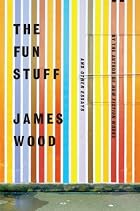
2. The Fun Stuff by James Wood
At his best, James Wood is not merely a fine and sensitive reader of fiction. He is also an engaging wordsmith, a champion of neglected masterpieces, and an honest voice pointing to the absence of clothes on the emperor. This collection of Wood’s recent essays shows him in all of his guises.
The title essay, which examines the art and influence of Who drummer Keith Moon (who could have guessed that James Wood was also a drummer?), carries the full flourish of Wood’s turns of phrase and gentle insight. It is a pleasure to read, but somewhat of an anomaly here since all of the remaining essays collected in this volume concern literature. At times Wood returns us to the work of earlier masters of fiction and criticism: Thomas Hardy, George Orwell, Tolstoy, Edmund Wilson. Here he draws upon the best recent biographies as well as the primary texts to paint a fair portrait of his subjects. But still more fascinating are those essays where his focus is almost entirely on the texts, for it is there that his close reading reaps its richest rewards. His essay on W. G. Sebald’s Austerlitz, for example, shines a clear light on what makes that work such an achievement. In similar fashion, his close reading of Ben Lerner’s Leaving the Atocha Station will leave few in doubt of the positive significance of that first novel.
Wood is not afraid to use his position as a much-read critic to redress misreading, as he does when he gently but firmly corrects Zadie Smith’s reading of Joseph O’Neill’s Netherland. He can be withering when his gaze is fixed upon a writer’s oeuvre, as when he calls out the shallowness of Paul Auster’s fiction. But perhaps his most useful role is when he brings attention to the fine writing of those outside the mainstream view, such as Ismail Kadare or László Krasznahorkai.
It is always a pleasure to read a collection of essays from James Wood and to recommend them to others.
18rosalita
You're off to a good start, Randy! I like the Bascome trilogy a little less than you did. I've never read any Wood, so it might be time to check him out.
19RandyMetcalfe
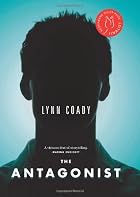
3. The Antagonist by Lynn Coady
A pilgrimage is a journey of moral or spiritual significance. It takes time, involves hardship and struggle, and constitutes a form of penance. In Lynn Coady’s intriguing novel, The Antagonist, Gordon “Rank” Rankin Jr. has set out on a pilgrimage of sorts, though a mediated one. The reader is presented with a one-sided series of emails that Rank writes and sends to a former college buddy, Adam, who years later has taken events from Rank’s life and included them in a novel. Rank is incensed at both this audacious theft of his life and the distortion he feels it has wrought on that life. His angry missives give way to increasingly elaborate accounts of his life, as Rank sets out to “correct” the story of his life that Adam has told. The details mount bit by bit such that the series of emails over the course of four months becomes a compelling autobiography in itself. Or a soul-searching memoir. Or, what is increasingly more probable, an act of penance and contrition. Whether Rank eventually reaches a holy site at the end of his pilgrimage is an open question. That his story is sufficiently gripping to hold the reader throughout its meandering self-scrutiny and petulant currents of defiance is, however, settled.
Lynn Coady sets herself a challenge: how do you make the first-person narrative voice of a hulking brute of a man sufficiently engrossing without verging into stereotype or falsity? For the most part, I think she succeeds in navigating between those dangers. Rank is a complicated figure, played upon by the gods (as he thinks), oversized and at times overwrought. His journey is both personal—as he moves from self involvement to a broader perspective on his life—and literary—as he discovers the joy and danger that writing his life as a story brings forth. Coady nicely mixes Rank’s diction throughout in order to reflect his origin as well as his education. He is nearly forty at the time of taking up his cyber pilgrimage and has come a long way from the oversized youth who nearly killed an opponent with one punch in the parking lot of his father’s Icy Dream franchise.
Regrettably, for me, there were two discordant notes in Coady’s otherwise finely crafted tale. First, Rank escapes his local environment by winning a hockey scholarship to university. This should have set off a red flag for her editor or publisher. There are no athletic scholarships for hockey players or any other sportsmen at Canadian universities. Second, in a key turning point in the plot, Rank makes a principled decision to quit the school’s hockey team when his coach insists, during half time, that he go out and harm players on the other team. How could such a blunder get past a Canadian editor? There is no such thing as a half time intermission in hockey; the game is divided into three periods. My suspicion is that perhaps Rank was initially written as a football player and only in a later draft converted into a hockey player. This would also explain the otherwise discordant references to him as a football player that occur from time to time. These are disappointing lapses in an otherwise compelling story.
20rosalita
Despite the flaws, that book sounds quite interesting! I am forced to add it to my wishlist.
21RandyMetcalfe
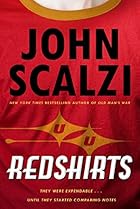
4. Redshirts by John Scalzi
Most of Redshirts is just delicious, nerdy, meta, fun. The initial conceit, that the new crew members on a starship begin to suspect that are suspiciously expendable, transposes into a new key when their expendability looks as though it is linked to “Narrative”, key moments in which the senior officers on the ship are saying or doing something especially, and often incongruously, “dramatic”. What do you do if you begin to suspect that your whole universe is the product of a poorly written television Sci-Fi series, a series in which characters like you and your friends get killed off weekly?
It’s a great premise. But from the start you will begin to get anxious over whether Scalzi can sustain it for the length of a novel. Fortunately there are enough characters and complications in the setup for the working out of the action alone to carry us most of the way through. Most of the way. Then, about two-thirds through things fade away and the reader is presented with three codas set in present day Hollywood, where the weak television series was being made.
The first of these codas is really just filler, very weak. The second is more interesting as a person in the present day world begins to suspect that he might, in fact, not be the person he thinks he is but rather, somehow, connected to fictional characters on a weak television Sci-Fi series his father produces and in which he has sometimes acted. The third coda brings things full circle as the lives and deaths of characters on the series has a direct impact on two lives in the “real” world. And suddenly, a story whose principle conceit petered out about two-thirds through the novel, blossoms into full, rich, meaningful life. Very surprising, and in the end, most satisfying.
22RandyMetcalfe

5. The Virtual Self: How Our Digital Lives Are Altering the World Around Us by Nora Young
Nora Young, the host of CBC Radio’s Spark program, brings the same clear, intelligent voice to her writing as she does to her on-air technology journalism. In The Virtual Self, she explores the culture of self-tracking—the sometimes obsessive recording and, latterly, broadcasting of (often) numerical facts about one’s self, one’s body, one’s position in space (i.e. location), one’s preferences and tastes, even one’s moods. It is a pervasive, if not ubiquitous, phenomenon, as evidenced by the rise of Facebook, Twitter, and even LibraryThing. But what does all this recording of books read, calories counted, kilometres run amount to for the individual? And what emerges in the conglomerate, shared social world when so many are sharing so much about themselves?
Young canvasses the potential benefits of digital self-tracking as well as many of the risks. She interacts with innovators, experts and activists from the digital realm to bring focus to her examination both on the technical end and on the philosophical end of the spectrum. Are we become the disembodied selves that Marshall McLuhan foresaw? Have we forfeited our development and growth to our virtual counterparts? Or are these digital avatars merely useful feedback mechanisms for our “real” selves?
There are real personal, social, and legal risks involved in proffering up so much intimate information about ourselves without a clear sense of who will be putting that data to use and how. Young does not shy away from these controversies, but neither does she succumb to anxiety about them. She thinks that we need clear-headed discussion of the kind of digital world we are creating, consciously or unconsciously, through our participation in these innovative forms of digital sharing. And she provides a useful entry into such a discussion.
23RandyMetcalfe
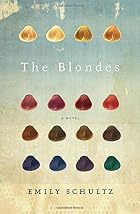
6. The Blondes by Emily Schultz
Mesmerizing. Like Cormac McCarthy on estrogen. Emily Schultz tells a gripping, even haunting, tale in The Blondes, that is subtle, sophisticated, sensitive, quirkily observant, and horrific.
Hazel Hayes is a Ph.D. candidate in Communications Studies spending a term in New York City to pursue her research and, in effect, to avoid her thesis supervisor, Karl Mann, with whom she has inadvisably had an affair. Absence, from Karl and from her other friends in Toronto, does nothing to alleviate her mixed feelings or help her focus on her thesis. And the fact that she has just learned that she is pregnant doesn’t help matters. Her life, her whole world, is a mess. But that’s nothing compared to the mess that is about to ensue when a pandemic of rabies-like madness begins to strike blondes and those whose hair colour has been made blonde through dyeing. From an initial attack that Hazel witnesses in the New York subway to outbreaks at JFK and further afield (the Nordic countries are severely at risk), Hazel must negotiate her way through this field of mayhem in order to get back to Toronto.
That makes it sound like a horror story, but it’s really a meditation on representations of women in culture and advertising, a commentary on systemic sexism, a reflection on a woman’s control over her own body (exacerbated by Hazel’s uncertainty over whether she wants to carry her foetus to term), a searching examination of varieties of grief, and yes, of course, also a bit of a horror story. (Interestingly, “blond/blonde” is one of the few adjectives in written English to retain its masculine and feminine grammatical genders.)
The writing is measured, thoughtful, well paced, and crisp. It was a pleasure to read and think about and I would gladly read anything else Emily Schultz chooses to write. Recommended.
24rosalita
Wow, that Emily Schultz book sounds fascinating — very nice review, Randy! Onto the wishlist with it.
25RandyMetcalfe
Hi, Julia. Margaret Atwood summed up her reading of The Blondes most eloquently with her tweeted reaction: "wow+haha+eek!" If only I had her pithy wordsmith skills.
26RandyMetcalfe
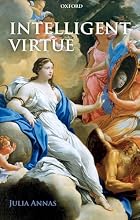
7. Intelligent Virtue by Julia Annas
Julia Annas presents a much-needed examination of virtue that takes us away from the infighting between rival moral theories and ethical theorists and returns us to the phenomena. A virtue, she argues, is an active disposition that is persisting, reliable, and characteristic. It is best thought of as very much like a practical skill such as playing the piano. And as such, anyone acquiring a virtue proceeds along a developmental path from early beginner, modelling one’s behaviour on that of one’s teachers, through iterations of reflection and adjustment as one becomes more fully cognizant of all the aspects of the virtue in question and the reasons one might have for pursuing it, continuing thereafter to aspire towards an ideal of virtuosity, if you will, that is typified by spontaneous access to the appropriate virtuous action in the right way at the right time which is apparently unreflective (you do not need to think about performing the action and then perform it) but which on questioning retains the full wealth of reasons and justifications that one earlier appealed to as one progressed along the developmental path. It is in this sense that virtue is intelligent, no mere repetitive action learned by rote. It is an appealing basis on which to begin one’s thinking about virtue, goodness, and eudaimonism.
This is not an attempt to present an ethical theory. Indeed, Annas explicitly warns us that her examination of virtue is intended to clear up confusion over the common understanding of virtue in order to allow debates between moral philosophers to proceed on a more solid footing. And certainly in the first half of the book she sticks closely to this aim. It is here that she patiently draws out the various ways in which the practical skills analogy for virtue works.
Of course once that base has been laid, there is a natural progression to the unity of virtue, the relationship between virtue and goodness, and on a parallel tack, the relationship between virtue and happiness (allowing that “happiness” is currently a term unfortunately linked to pleasure and desire-satisfaction, which is not what eudaimonism amounts to). By the end, Annas has given us a full range of resources with which to make our own assessment of competing moral theories, their own accounts of virtue, and more especially some of the recently aggressive (though I think mistaken) attacks on the very possibility of virtue as a disposition (e.g. Gilbert Harman) which draw upon startling results from experimental psychology. By emphasising the developmental nature of a virtue as a practical skill, Annas believes, and I agree, that her account avoids the extreme criticism, which might yet apply to accounts of virtue emerging from consequentialist or deontological moral theories.
Intelligent Virtue is a significant achievement that may help refocus the study of virtue and eventually set virtue ethics on a more solid footing. Highly recommended.
27RandyMetcalfe

8. Carry the One by Carol Anshaw
In the small hours of the morning on an otherwise deserted country road, a carload of wedding celebrants, under the influence of alcohol and drugs, crashes into a ten year old girl, killing her. One life is ended by the impact, but the ramifications of the accident echo and multiply in the years that follow in the lives of each of the car’s occupants. For one it means prison. For the others, their guilt and their punishment takes various forms. But for each there can be little doubt that one event will come to dominate the rest of their lives.
Carol Anshaw follows the lives of three siblings over the course of the next twenty-five years: Carmen, whose wedding the others had attended; Alice, who was in the back seat of the car with her lover, Maude; and Nick, who was in the front passenger seat. Each chapter focuses on a different sibling, returning again and again over the years. Swooping between a regal third person, where the course of a character’s life can be announced magisterially, and a close third person narration from virtually inside the head of the character, Anshaw invites us to feel their anguish, doubt, and disappointment. Writing in a lush, lyric mode, she brings her principal characters viscerally to life. So much so that they feel hauntingly, even distressingly, real.
In their separate ways, each character must deal with the fallout from that initial horrific accident. For Alice, a burgeoning artist, the life that might have been for the dead girl begins to play itself out in her paintings. For Carmen, her marriage disintegrates, but she finds solace in her young son. For Nick, the downward spiral is unrelenting. But the effects go far beyond these principal characters.
Certainly an impressive and emotional novel that must be highly recommended.
28kidzdoc
Wow, several excellent reviews here! Intelligent Virtue sounds particularly interesting, so I've added it to my wish list.
29rosalita
When I saw the title of 'Carry the One' I was afraid it was going to be a math book, but instead it sounds quite impressive. I'll be adding it to the wishlist.
30dk_phoenix
Intelligent Virtue sounds very interesting -- on the list it goes! Good news about Redshirts as well, as I'm one of the people who've wondered whether such a gimmick can sustain an entire novel without feeling tired...
31RandyMetcalfe

9. Tenth of December by George Saunders
Astonishingly assured writing of characters so hesitant and fragile that your heart breaks for them. This is George Saunders at his best. With stories so lean that each individual word is vitally important. And even the nuance is nuanced.
Every story in this collection deserves mention as both typical of Saunders’ earlier style, and adventurously striking new ground. With “Escape from Spiderhead” and “My Chivalric Fiasco” we see the satirical Saunders’ alternate future, complete with chemically induced mood, emotion and diction. These are at once lighter than some of his previous satires but perhaps (or because of that) even more cutting. A Saunders protagonist may hope for, even expect, at least within in his own mind, the world to bend itself to his needs and goals, but will find himself almost invariably brought back to reality, or lower, when the world insists on its own integrity.
Saunders is a master of the exorbitant monologue, here represented by “Exhortation” and “The Semplica Girl Diaries”, or the sad sack “Al Roosten”. But perhaps even more impressive are the stories which function as dualistic monologues—not dialogues, to be sure, but rather alternating monologues. Both the opening, shockingly surprising, story, “Victory Lap”, and the concluding title story, “Tenth of December”, take this form. The latter must surely stand as one of the finest, saddest, and bravest short stories I have ever encountered. With characters so vulnerable, so susceptible to destruction by themselves and others, only Saunders’ love for them can sustain them, even help them succeed beyond their own imaginings.
The writing is so swift and spare that a story almost sweeps past you. So take the opportunity to read it again and you will find that you will want to read it yet again, even. Highly recommended.
32kidzdoc
Nice review of Tenth of December, Randy. This book and its author has come under mild derision on my thread, due to the extraordinarily high level attention that both have received this month. I'm glad to read an unbiased review of this book, and I'll consider reading it later this year.
33RandyMetcalfe
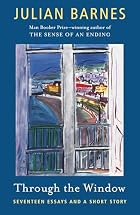
10. Through the Window: Seventeen Essays and a Short Story by Julian Barnes
Any collection of occasional pieces—book reviews, profiles, essays, even short stories—will have some ups and downs, even for an accomplished, erudite writer like Julian Barnes. So it will not be too surprising to learn that the one non-occasional piece of writing in this collection—the preface essay “A Life With Books”—is perhaps the most delightful. There we see the young Julian Barnes and his growing love of books. It is a passion that has followed him his whole life. And though it might sometimes be the case that he has more love for books than for literature, he has enough of the latter (usually) to share with us.
Barnes is very good when he likes an author. He very much likes Penelope Fitzgerald and he very much likes Ford Maddox Ford (there are three essays on Ford in this collection). For such authors he takes pains to draw us to what are salient aspects of their writing for him. He enthuses. And he generally succeeds in encouraging the reader to want to go out and read the books in question sooner rather than later.
For authors that Barnes does not really like, or whose efforts he finds to be lacking, he can be stiff, donnish, unforgiving. That same donnish persona pervades the essays here that resuscitate figures out of the, now dim, yesteryears of (usually French) literary history. They are informative, sometimes insightful, often arch, and, rather like British toast, very dry. They have the habit of reminding the reader just how little depth or breadth must have typified the reader’s education. Which is not really all that much fun. Neither inviting nor accommodating. You may have the distinct hope, while reading, that this tutor will not be marking your final exam.
The short story included in the collection is entitled “Homage to Hemingway”. It patterns itself after a late Hemingway short story, presenting itself in three parts, each a reflection or refraction of the others. In each an unnamed tutor of a creative writing class works through some prepared platitudes, always careful to drop in an anecdote or two, as well as a reference to Hemingway. Curiously, the story conveys a very similar atmosphere to that of the essays: formal, if not entirely formulaic; emotionally distant; full of self-concern; and a touch sad.
A hearty recommendation then for the preface and the delightfully enthusiastic essay on Penelope Fitzgerald, but otherwise, meh.
34RandyMetcalfe
The near juxtaposition of reading Julian Barnes’ Through the Window: Seventeen Essays and a Short Story and James Wood’s The Fun Stuff prompts a further observation. Since these collections are drawn from similar time periods, there are occasional overlaps, which reveal a significant contrast in the writing style and approach of the two writers. Wood is never less than inviting. Even on subjects in which his knowledge must surely be formidable, he never lets his reader feel small. Barnes typically makes one notice his facility with arcane facts and esoterica. Where Wood seems to open up a subject or an author, Barnes tends to close them down. You are surprised but delighted to discover that Wood is both an accomplished rock drummer and aficionado of Keith Moon. You are not surprised to discover that Barnes has a significant collection of first editions in his personal library, which include his father’s school prizes, ninety years after he won them.
Anyway, just an observation.
Anyway, just an observation.
35Mercury57
#33 oh dear. I had this one as a gift and had been looking forward to it at some time. But after reading your review two niggles have started. One is the ref to long forgotten French authors reviewed in a donnish style. And secondly Barnes admiration for Penelope Fitzgerald. I read Offshore by her last year and found it extremely dull.
36RandyMetcalfe
#35 We'll have to agree to disagree on Penelope Fitzgerald, Karen. I think she is brilliant.
37RandyMetcalfe

11. Never Any End to Paris by Enrique Vila-Matas
Ostensibly presented as an ironic homage to Ernest Hemingway’s A Moveable Feast, Enrique Vila-Matas’ quixotic Never Any End to Paris flits between an inverted Roman à clef, bildungsroman, situationist non-happening, and self-help manual on how (not) to write a novel. If that sounds jumbled, enervating, or distracting, you’ll probably also think, at times, that there’s just never any end to Never Any End to Paris. But if serious play is the kind of thing that turns your literary crank, then this may be an excellent introduction to the very serious play of Enrique Vila-Matas.
The narrator supposedly has written a lecture that will be presented over three days at a literary festival in which he looks back on the two years he spent in Paris as a young man. Why Paris? Because Hemingway’s late rose-tinted memoir described it as the place where he was poor and happy. What could be more enticing for a young wannabe writer? Except that the narrator, looking back on his own time in Paris, describes himself as very poor and very unhappy. It was ever thus as we seek to emulate and overcome our literary forebears (not so much the anxiety of influence, but more the influenza of anxiety).
The narrator’s time in Paris is not entirely wasted. He has connections, after all. He lives in a garret owned by Marguerite Duras (which once hid François Mitterand for two nights during the French Resistance). He parties with Paloma Picasso. He sees Samuel Beckett in the Jardin du Luxembourg. And of course the cafés, of which there definitely seems to be no end in Paris. All the while he is struggling to write his first novel, The Lettered Assassin. (It would take someone more knowledgeable than me to determine whether that is a play on the emergence of situationist theory from lettrism.)
The writing is playful and pointed, sometimes insightful, often repetitive (though presumably to a point), ironic to an almost uncomfortable degree, and at times lovely. Its embrace of and flight from modernism might be considered challenging. But it rewards patience (if not effort). And I’m glad I read it.
38RandyMetcalfe
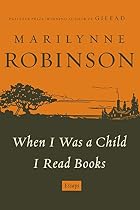
12. When I Was a Child I Read Books by Marilynne Robinson
The kinds of books that Marilynne Robinson read as a child were “old and thick and hard.” She was raised in Idaho, where “lonesome” is “a word with strongly positive connotations.” She learned Latin, and fell in with Horace and Virgil and especially Cicero, at what must have been a substantial high school, an adequate preparation for later attending Brown University. One gets the impression she was studious, and serious, and thoughtful, and just the slightest bit cynical about cynicism itself. In a word: wise. Was and is, if these essays are anything to go by. She was also raised in a Christian household (Presbyterian) and her Christian community (later she became a Congregationalist) has imbued her thinking and life every step of the way. Indeed, almost all of the essays in this volume speak to and from that base.
Even for those who are not co-religionists, Ms Robinson’s essays will impress, with their cogent and elegant prose, historical rootedness, and clear thinking. With witty and subtle turns of phrase she punctures the gaseous arguments of unthinking economists, ahistorical political scientists, illiberal liberals, and inhuman anthropologists. She urges us, in her arguments, to return to the historical record, to revisit the meanings of terms as they were used at the time they were used, to not accept blithely the cant of economists concerning human nature. A healthy drop of cynicism, perhaps, might be the curative to restore a bit of hope into our outlook. Perhaps.
She is especially good on the origins of American liberalism and the notion of community. Unless you are already extremely conversant with non-conformist religious theology of the 17th, 18th and 19th century, you will almost certainly learn something from the sources she draws upon. And even a passing familiarity with her line of thought might make one less burdened by dismay when looking at what passes as intelligent discussion in America.
And yet, I find I am at a loss as to what to make of these essays. “Make” in the sense of how they might lead my thought onward. For surely if one does not grant the religionist premise of her arguments, they amount to little more than curlicues. So, gently recommended for those for whom the arguments herein might hold substantive value (I’ll assume you know who you are), and otherwise gently recommended for an insight into the thought of one of America’s fine novelists.
39scaifea
Although the religious part may irk me, I think I'll add this to the wishlist nonetheless; I've read some of her stuff and like it quite a bit, plus, anyone who loves Cicero is a friend of mine.
40RandyMetcalfe
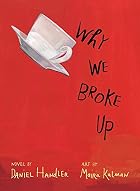
13. Why We Broke Up by Daniel Handler, illustrated by Maira Kalman
There are few enough beautiful books on the market these days that perhaps I should mention just how beautiful this book is first. The cover and many illustrations by Maira Kalman are enchanting. They are also integral to the story since they present to us first a box and then each of the contents of that box. Through the contents of the box Daniel Handler offers an epistolary account of a teen relationship: one long, long letter from Min to Ed detailing the mementos she collected along the way, from 5 October to 12 November. The lifetime of a relationship that is as deep in its way as any you might encounter.
There are a number of remarkable things here. Min’s voice is captivating—hurt, obviously, since this “letter” is written after the break up, but fully capable of reliving the birth and growth of her feelings for Ed in such a way that they are entirely real for the reader. And Ed too, despite being a basketball star whose one saving grace (other than his charm) is his gift for math, is rendered lovingly. Or rather, the Ed we see through Min’s letter is attractive and enticing and just a little bit dumb. No wonder, perhaps, that a smart and creative and quirky girl from a completely different set at high school would fall for him when he turned his attention towards her.
Min is a cinephile. She connects the events in her life to scenes in movies, usually old ones that play at the local repertory theatre. The movies and the actors and actresses all come to life for us, as they do for Min and her friends. But the wonderful thing here is that Daniel Handler has invented an entire alternate history of cinema in order to capture Min’s inner life. Brilliant. I started wishing that some of these were real films that I too could go watch.
A five-week relationship between two teenagers sounds like a slight thing. And, I suppose, it is in many respects. But here it has been handled so charmingly, so lovingly, that you may find it, well, charming and lovely. And I recommend it on those grounds.
41Mercury57
My vocab has increased by reading your review Paul - never cane across the word cinephile before. My iPad wont even let me spell that with an o
42RandyMetcalfe
#41 Never discount the possibility of a typo, Karen. That should have been cinephile, and has now been duly corrected. On the other hand, never let your iPad prevent linguistic mutation; how else will we evolve?
43Mercury57
I'm ok with evolution of language. What bugs me is when people let auto spell check do the work entirely and the result is just wrong. I'm not talking of simple typos here but would you believe it postgraduate exam papers by public relations students. I despair
44RandyMetcalfe
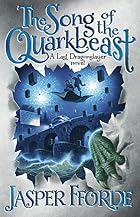
14. The Song of the Quarkbeast by Jasper Fforde
An entertaining sequel in Jasper Fforde’s Last Dragonslayer series. Jennifer Strange, the foundling acting-manager of Kazam—the biggest House of Enchantment in the world, uses wit and cunning to marshal her limited resources, in the absence of the the Great Zambini, to keep Kazam in the black, thwart the evil designs of the Amazing Blix, pave the way for Quarkbeast enabled enlightenment, right some wrong, and chalk one up for foundlings everywhere. So, you know, the usual.
Fforde’s writing is constrained, I think, by his younger target audience for the dragonslayer series. Just when it seems he is about to let rip on a Thursday-Next-like riff, he pulls back. He certainly curtails the body-count (as well as the body-double count) and if Jennifer were any more chaste and virtuous she would have to be imaginary. He also treads ever so carefully around Terry Pratchett’s Discworld formula of thematic comedy. But it’s all in a good cause, I suppose. Which is to say, a fast-paced tale full of adventure, magic, and Trolls. It would be nice, however, to see what Fforde could do with Jennifer Strange without the shackles, so to speak.
45RandyMetcalfe

15. The Sweetness at the Bottom of the Pie by Alan Bradley
The first half of this mystery is a delightful, though scarcely believable, romp as the eleven year old Flavia de Luce—erstwhile chemist, poisons expert, and terror of her older sisters, Ophelia and Daphne—races from her laboratory in the east wing of Buckshaw, their manor home, to Bishop’s Lacey on her bicycle, Gladys, in order to research the public newspaper archive in the library, ransack a guest’s room at the Thirteen Drakes, confront the law in the form of Inspector Hewitt and generally keep us glued to our seats, if only so as not to fall off the tram. There’s been a murder and the key suspect for the police is Flavia’s father, the retiring philatelist widower, Colonel de Luce. Flavia will prove that he hasn’t done the deed even if she has to claim to have done it herself. It is 1950 in England in the home counties but it might very well be 1930 with Blyton’s famous five on the case.
So far, so fun. But then the novel or the novelist runs out of steam. We are dosed with three consecutive chapters of back story delivered by Flavia’s father in an ostensible monologue. The wind has been sucked from our sails and the story never again regains its pace or verve. The remaining chapters offer increasingly implausible scenarios in order to feed the reader further information, which does not obviate the need for an over-hasty and pedestrian conclusion that ties things up neatly, oh so neatly.
It’s easy to see how Bradley won a prize for his first chapter and story outline, just as it is understandable that he might not have had the experience to master the novel as a whole in this his first outing. Perhaps the further tales of Flavia are more consistent but just as charming. Alas, I’ll never know.
46RandyMetcalfe

16. Offshore by Penelope Fitzgerald
Few authors so lovingly render the ephemeral. Fewer still appreciate that the ephemeral is the real, since all lives are lives of transition and flux, whether tidal or not. The inhabitants of the aging barges on Battersea Reach, afloat (usually) on the Thames, but anchored to the shore, however tenuously, have mostly not found their place yet in the burgeoning Swinging London of the 1960s. Nenna, circumstantially estranged from her husband, Edward, lives on Grace with her two girls, Martha and Tilda, both more at home on water than land. Maurice lives on Maurice, but perhaps more aptly lives on gaslight and “friends” he meets in bars in the city. Willis, an aging marine artist, wants to sell Dreadnought in order to spend his last days ashore, but to do so he can only show it at low tide when it is not leaking quite so much. And Richard, formerly of the Royal Navy (torpedoed 3 times), well-caulked owner of Lord Jim, oversees them all, literally, since Lord Jim is by far the largest craft in their midst. But all of them are fragile, if not already broken, and only the youngest, Tilda, actually thrives.
In this short novel, Penelope Fitzgerald is masterfully concise, poignant, and honest. It is a world she knows intimately, having lived it before the incessant development of 1960s London swept the Reach clean. Yet here it comes fully to life again, vital, elemental, though perhaps just out of reach.
It is a novel you can read in a brief span, but you will undoubtedly return to again and again. And each visit will be a rich harvest in the flotsam and jetsam of your reading life. Highly recommended, every time.
47RandyMetcalfe
A note about reading aloud. For years now, my wife and I have read books aloud to each other. Not incessantly or exclusively, but consistently. Some books read aloud better than others. We are in the process of reading each of Penelope Fitzgerald's books this way (having read them separately and silently long ago). If you haven't done so, do try reading Offshore aloud to someone you love. It really is a treat. Fitzgerald's phrasing and word choice and articulation take over, and the very gentle humour seems to effervesce. At least it seems that way to me.
49Mercury57
#46 We are definitely going to agree to disagree on Offshore Randy - I thought it was dull sorry!
50RandyMetcalfe
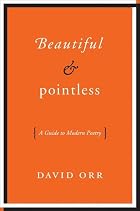
17. Beautiful & Pointless: A Guide to Modern Poetry by David Orr
David Orr’s book is subtitled, A Guide to Modern Poetry. “Poetry,” Orr tells us, is like a foreign country with strange customs, like Belgium. You wouldn’t think of going to Belgium without first investing in a bit of research, finding out what language they speak there, what currency they use, whether they have any cities worth visiting, or museums, or culinary specialities to look forward to trying. In short, you’d probably want a guidebook, something that will give you a flavour of what you can expect to experience but won’t require you to learn the names and telephones number of everyone in the country in order to gain admittance. It’s possible that Orr believes that Beautiful and Pointless is just such a book. There are certainly some interesting things to learn in it, and it is written in a light and jocular style (I mean, Belgium, right?), and gosh, those Belgians sure have funny practices, the way they cuss and fight and generally think they are far more important than in fact they are. The problem is that I’m not sure anyone would want to visit Belgium, or rather the land of modern poetry, on the basis of this so-called guide. But if Orr were to drop the subtitle, then this book is pretty much what it says on the tin: beautiful and pointless.
There are some pleasures available in reading this book. I enjoyed the chapter, “The Fishbowl”, on the practice of poetry, from Creative Writing programs, to poetry competitions, to criticism and reviews, and the incessant need to publish early and often. Some chapters, admittedly, are less entertaining and less coherent, e.g. “Ambition”, “The Personal”, and “The Political”. And the final chapter, “Why Bother?” unwittingly reissues Jeremy Bentham’s derisory “push pin versus poetry” complaint shortly after Orr has disavowed turning to the philosophers to assist in answering the question the chapter title asks. He would have done better to leave it to the professionals. Still, it’s not a bad read, I suppose, in a blokey sort of way.
Of course, if you’ve been struggling with a collection of modern poetry and have turned to Beautiful and Pointless as an aid, you may, like me, feel somewhat disappointed. So, not recommended for what perhaps it would like to be recommended for. But certainly no worse than push pin.
51RandyMetcalfe

18. Object Lessons: The Paris Review Presents the Art of the Short Story edited by Lorin Stein and Sadie Stein
Over sixty years, one might guess that a journal as prestigious as The Paris Review will have published one or two or twenty truly outstanding short stories. The twenty stories presented in Object Lessons were selected from The Paris Review’s back catalogue by twenty current practitioners of the short story form, each of whom introduces their selection with some reflections, or analysis, or generalized enthusing.
The stories selected display significant range and variation, and most would easily be acknowledged as exemplars of what is possible with this form. Some will be well known already, such as Raymond Carver’s “Why Don’t You Dance”, or Jorge Luis Borges’ “Funes, the Memorious”. Others deserve to be better known, perhaps, than they are, such as Norman Rush’s “Lying Presences” or Mary Robison’s “Likely Lake” or Mary-Beth Hughes’ “Pelican Song”. And others will simply fascinate you, such as Denis Johnson’s “Car Crash While Hitchhiking” or Guy Davenport’s “Dinner at the Bank of England” or Dallas Wiebe’s “Night Flight to Stockholm”.
So, you can rest assured that the story content of this collection will be well worth the price of admission. Less satisfactory are the short introductory essays by the nominal selectors of the stories. I get the impression that either the brief for these essays was not particularly clear, or that getting twenty young(ish) authors to follow a brief is rather like herding cats. Some treated the exercise like an exercise in a textbook on aspects of the short story. Others took their task to be championing an author they felt to be sorely neglected. Others just blurbed, as though they were composing an extended blurb for the back cover of a book that contained one and only one short story. So, the usefulness of these introductions is somewhat tempered.
Least satisfying, even to the point of being annoying, is the patronising editors’ note at the outset, which is reproduced in part on the back cover. Apparently this collection is intended “for readers who are not (or are no longer) in the habit of reading short stories”. I’m not entirely certain how such a statement of intent is meant to motivate these non-readers of short stories to pick up this volume, or even purchase it. It certainly would not have motivated me. Rather, let’s just say that Object Lessons is a treat for those who love short stories, or for those who may come to love the form through encountering the stories herein. Recommended on that basis.
52RandyMetcalfe
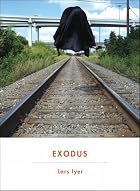
19. Exodus by Lars Iyer
W. and Lars are back for the third and final instalment of Lars Iyer’s besotted double-act. After Spurious and Dogma, Exodus follows the put upon philosophers on a conference tour of Britain. W. has retained his post at Plymouth University by means of a technicality, though he has been relegated to teaching Sports Science students Badminton Ethics. The much abused Lars persists in his damp, underground flat in Newcastle (though thankfully the rats are gone) but he has just as little hope of surviving the desecration of Humanities faculties, and most regrettably Philosophy departments, across the country. All that’s left to them now is despair. Despair and Plymouth Gin.
W. and Lars meander across the country and across the (continental) philosophical landscape. W. is ever nostalgic for his postgraduate days at Essex University, though he appears to be the last hanger-on from those days still in academic employment. Will his early experience of life in the wilds of Canada(!) sustain him in the thoughtless wilderness of modern Britain? Is thinking even possible anymore? Or are they all now on the long march from Egypt heading toward a Canaan that W. and Lars will never be able to enter? If so, it is a curious exodus that leads to London and Edinburgh and Oxford and Dundee only to bring them back to Plymouth and one long, last drunken dark night of the soul and dreams of Plymouth Sound glinting like utopia.
It’s over. It’s been a desperate journey across the three novels, full of philosophical musings, sly observations on the state of tertiary education in Britain, exultation of the generative properties of Plymouth Gin, and endless abuse by W. of his erstwhile companion, his Boswell, his inspiration and exasperation, and ultimately his one true friend.
53whitewavedarling
Perhaps it's too sarcastic a response, but as someone who loves poetry, my first instinct is to say that nobody who'd name a book about poetry Beautiful and Pointless has any business writing a book about poetry! Ah well, I'm sorry it was such a disappointment, but I do thank you for the review that points me in any other direction!
54RandyMetcalfe

20. The Making of a Story by Alice Laplante
Norton Guides are typically used as textbooks, often in introductory college classes. They tend to be well-produced, expertly written, and extremely practical as pedagogical tools (usually with enough flexibility to enable an instructor to take them in different directions as the need arises). The Making of a Story by Alice LaPlante meets all of these points and more. Over fourteen chapters it presents a sensible survey of key points in the production of both fiction and creative non-fiction, including chapters on characterisation, narration, point of view, dialogue, and more. While each chapter is useful, I would say that the penultimate chapter on revision, “Learning to Fail Better”, is the most useful of all, not least because of its recognition of the limitations of the (typical) workshop method of teaching creative writing.
Each chapter contains a set of two or more exercises to help reinforce the main points of the chapter. These exercises are very well constructed, neither too lengthy (they could easily be done within a class) nor too arch (they don’t seem excessively contrived). Some draw upon whatever writing the participant may have been doing in his or her own time, but most are standalone exercises, which is better.
A surprisingly useful component of The Making of Story is the “Reading as a Writer” selections at the end of each chapter. These consist of short stories or creative non-fiction pieces that illustrate the points being made in the chapter. They are exceptionally well-chosen, everything from Raymond Carver to John Cheever to Joan Didion, Denis Johnson, Lorrie Moore, Anne Lamott, Francine Prose, Barbara Ehrenreich, Tim O’Brien, Ernest Hemingway and more. Well done Norton for getting permission for the inclusion of so many fine examples. In themselves, they make this a valuable collection. And as part of the greater whole, they help make this a guide I am happy to recommend.
56RandyMetcalfe
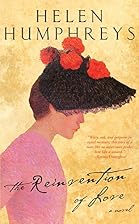
21. The Reinvention of Love by Helen Humphreys
Helen Humphreys writes with such a sure hand that she may in fact be hindered rather than helped by choosing to focus upon the brief, infertile, frenzied, but curious affair between Charles Saint-Beuve and Adèle Hugo, the wife of Victor Hugo and mother of his four children. The sepia tone of the writing cloys at times, as though it were merely the result of an Instagram filter. Yet there is certainly something here worth Humphreys’ time and talent. Saint-Beuve is sexually ambiguous, a comfortable cross-dresser with a secret that limits his willingness to explore his own appetites. Adèle is rapacious, and, to me at least, inexplicable. Together their love is a meringue, a swirl of passion, full of air.
The other significant player in this drama is Victor Hugo himself, but like his ego he seems too large for such a trifling affair. Is ‘trifling’ unfair? And if not, who is trifling with whom? Certainly Adèle breaks off relations with Saint-Beuve as soon as her husband learns of the affair and demands its end. The eddies of their “love” continue to swirl for some time, but it’s hard to take it seriously given how comprehensively it ends. Not so much the reinvention of love as the devolution of love.
And then there is the curious section that ties these events to Canada in the form of the deluded youngest daughter of Victor and Adèle, known as Dédé. She escapes the voluntary exile that her father has chosen for his family on the island of Guernsey in order to follow her supposed lover, a British officer, to Halifax in Canada. Her love, however, is even less substantial than Saint-Beuve’s and Adèle’s in that it appears to be entirely imaginary (at least as presented here). Not too surprisingly, Dédé ends her days confined for more than 45 years to an asylum.
Like me, you may find yourself admiring Humphreys’ writing more than the story she has chosen to tell. Which is somewhat disappointing. With madness, cross-dressing, hermaphrodites, adultery, and great poetry and literature on hand, surely there is a gripping story to tell. Perhaps Saint-Beuve’s diffidence has infected his own tale and neutered it (an ironic commentary on his biographical theory of literary criticism if there ever was one). But not a recommendation for this particular story (though I would gladly read another Helen Humphreys effort).
57lkernagh
De-lurking to say that is an excellent review of The Reinvention of Love! I felt it was a rather difficult book to write a review for, for the same reasons you have mentioned. I love Humphreys' skill and finesse with the written word but the story struggled a bit, for me, given the real individuals the characters represent.
58RandyMetcalfe
#57 Thanks, Lori. Much appreciated.
59RandyMetcalfe
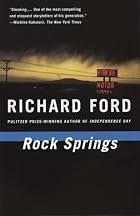
22. Rock Springs by Richard Ford
Richard Ford’s first collection of short stories, published in 1987, established him as one of the foremost short story writers in America. Take a dip in Rock Springs even today and it is easy to see why this was the case. These stories ache. There is so much raw sadness, as well as, confusedly, resistant optimism here. The former ties Ford’s short stories to Raymond Carver, perhaps, but it is the latter that sounds a note all his own. He has such a strong voice that his imitators must be legion. Just how he achieves this, however, is endlessly fascinating.
It is easy to single out the first three stories in the collection for special mention: “Rock Springs”, “Great Falls”, and “Sweethearts”. Each is riveting. Tales of heartbreak and loss, love and despair, violence and its consequences, as characters skim the surface of survival in the wide, lonely spaces of Montana. The local bar and the highway that heads up toward Canada (an almost mythical otherworld, here) are the only exits, if you don’t count Deer Lodge prison as an exit. The events are simple and simply told, unadorned but ruminating. Like the dirge you might hear at the end of the night at a country dance.
The other thing that makes this collection so enticing is the way that Ford works his seam. The Montana stories aren’t like his Frank Bascombe novels, and they aren’t like his other collections of short stories (so I’m told). But as you read them, you’ll think that they are so pure that they must come directly from his soul. You won’t be able to even imagine him writing any other way. Which, in my book, is high praise indeed. Highly recommended.
60rosalita
Randy, that review has convinced me to give Ford another try. I was less than impressed with 'Canada', his most recent, although I did like the Bascombe trilogy.
61RandyMetcalfe
#60 I'm glad you haven't given up on Ford, Julia. I have ever increasing respect for his talents as a writer and as a person. (If you can catch one, he is wonderful to hear in interviews: humble, humane, honest.) I haven't read his Canada yet, but I will get to it. Next up for me (from him) however will be a later collection of his short stories.
62RandyMetcalfe
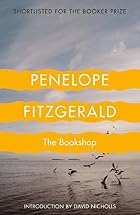
23. The Bookshop by Penelope Fitzgerald
This is an exquisitely turned tale of late hope, determination, and ambition that flourishes briefly in the damp soil of East Anglia only to be washed away by the tidal surge of forces ranged against it. It is almost too perfect, too understated, too painfully just. In 1959, a widow, Mrs Florence Green, determines to make something of herself by opening a bookshop in the small seaside town of Hardborough. Perhaps she is merely reclaiming her lost youth, spent working in a bookshop in London, where she met her husband and where the best of her still resides. Certainly she does not set about disturbing the settled prejudices and power structure of her community, where she has lived for the past eight years. But disturb it she does. The doyenne of Hardborough, Mrs Gamart, declares an interest in the property that Florence has purchased for her enterprise, the Old House—a damp, decrepit, unused building lying fallow. Mrs Gamart wants it for an Arts centre. She warns Florence off, insists that other properties would do for her just as well, and when Florence persists, Mrs Gamart initiates, stealthily, a campaign that sees Florence drummed out of Hardborough, out of business, and out of East Anglia.
Of course Florence has her supporters: the enigmatic Mr Raven who keeps watch on the common and the Sea Scouts; Christine, the 10-year-old assistant Florence reluctantly takes on; and the weighty nod of Mr Burndish of Holt House, whose roots lie deeper in the Anglian backwash than any other soul, including Mrs Gamart. And yet it will not be enough against the ranged forces of bureaucracy, nepotism, and cowardice.
If you didn’t know that the novel was based in personal experience—Penelope Fitzgerald and her husband did run a bookshop in East Anglia in the late 1950s—you might be forgiven for thinking that The Bookshop was in fact an allegory. In this case an allegory of Fitzgerald’s career as a novelist, a role she does not take up until she is 60 and then, despite her estimable talents, is dismissed, mocked, even insulted, by a large segment of the literary establishment. Fortunately, unlike Mrs Green, Fitzgerald persisted. The Bookshop is the first of her novels to thoroughly establish her withering wit and curiously poignant take on life and its tribulations. Highly recommended.
63RandyMetcalfe
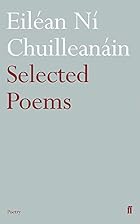
24. Selected Poems by Eiléan Ní Chuilleanáin
This collection of poems spans Eiléan Ní Chuilleanáin’s poetic output from 1972 to 2001. A lifetime of sorts, though a remarkably consistent lifetime, if these poems are the sole evidence. Always respected in her native Ireland and in select centres beyond, she seemed to emerge into prominence with the awarding of the Griffin Poetry Prize in 2010 for her collection, The Sun Fish, published in 2009. Perhaps this Faber and Faber Selected Poems, published the previous year, helped promulgate that international attention.
The poems, typically in free verse, are brief (most no more than one page), elemental (usually fixated upon earth and water), periodically erudite (both classical and Catholic), sometimes personal, and, except in rare cases, almost hermetically sealed—preserving and transporting imagery that has no obvious connection to the world outside the poem. Or perhaps that last observation is more an admission of my own failing in reading, since many of the poems seemed powerful and heartfelt and yet remained inscrutable to me.
The most accessible of the poems are perhaps those that reference Odysseus’ interrupted journey home such as “The Swineherd” and “The Second Voyage”. Equally, there are numerous reference to water and earth, and the boundary that marks their engagement, as perhaps is fitting for an island poet. Religious imagery recurs, usually aligned to the movement of women through the church from novitiate to sisterhood. But women outside the church are also a focus of many of these poems, modest interiors perhaps, but rarely in the first person.
I don’t suppose I am an ideal reader for these poems. But I think if you are patient with them, give them space, and return to them a third or fourth time, they begin to yield a bounty. I will certainly return to them again and look forward to Eiléan Ní Chuilleanáin’s further collections.
64RandyMetcalfe
One the pleasures of living in a reading household is sharing "best" reads. The above collection of poetry is one of my wife's top three reads from 2012, passed on to me to read in 2013. She is a far better and more practised reader of poetry than I, but I welcomed the opportunity to read something she felt strongly about. I'm glad I did. I have two more of her top three reads of 2012 on my shelf for this year, but this was the only poetry selection. She's returned the favour by taking on board my top three from 2012, including The Sportswriter by Richard Ford, which I'm delighted to say she loved.
It makes for interesting conversation over the dinner table, and I can hardly wait to see what she will be sending my way next year.
It makes for interesting conversation over the dinner table, and I can hardly wait to see what she will be sending my way next year.
66RandyMetcalfe
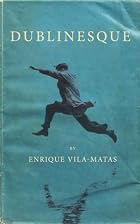
25. Dublinesque by Enrique Vila-Matas
It is the end of the Gutenberg era. It is the end of literature. Or the end of the novel. Or the end of the author. Or, at least, the end of the publisher, Samuel Riba. He has lost his publishing house. He’s been forced to give up alcohol for his health. His life has become a chore. And his wife, Celia, is well on her way to becoming a Buddhist. Will anything matter to him ever again? Well, there’s always Dublin.
Riba becomes obsessed with James Joyce’s Ulysses. He decides to invite a few friends to meet him in Dublin in order to celebrate Bloomsday, June 16th, the day on which Joyce’s great modernist novel takes place. They will visit some of Blooms’ haunts, including the Martello tower just outside Dublin and the cemetery where Paddy Dignam was buried (in the novel). But Riba has other plans as well. He intends another funeral, of sorts. He and his friends will commemorate the end of the Gutenberg era.
On the surface, that sounds like a potentially intriguing plot line. But nothing here is unmediated. All surfaces are textured and textualized. So it will come as no surprise that soon Samuel Beckett’s life and work comes to the fore, as well as Philip Larkin’s poetry, and Paul Auster’s New York, and much more. It is a feast of reference and allusion, literary and philosophical. So much so that the novel, if there is a novel here, is drenched in it, not unlike Barcelona in the unending rain of that Spring of 2008.
Vila-Matas takes on a controlled, close, third person narrative voice in Dublinesque, seeking perhaps the distancing that W. G. Sebald achieves in his great works. Here, it works sometimes. More often it feels forced, as though this is a voice that is constantly struggling not to devolve into his more natural first person. The overall effect, however, is fascinating. Is this what the novel is meant to be at the end of modernism? I don’t know. Certainly Vila-Matas does not play it safe. Riba’s “English leap”, which he undertakes in defiance of his earlier “French leap”, is paralleled by Vila-Matas’ more mature, thoughtful, and darker stance here. Recommended for modernists, post-modernists, and Joyceans of all descriptions.
67RandyMetcalfe

26. An Introduction to English Poetry by James Fenton
If you need a very brief introduction to English poetry, then this short book by James Fenton would be an excellent place to start. In 22 very short chapters, he covers everything from the history and scope of English poetry to form, iambic pentameter, the genius of the trochee, stanzas long and short, sonnets, rhyme, free verse, song, and poetic drama and opera. So, you can imagine that things move rather quickly. But perhaps it would be better to say that there is no dross bulking out this text. Just thoroughly serviceable, and often memorable, encounters with the various aspects of English poetry.
The style of this introduction is especially engaging. Fenton is immediate and honest in his opinions and prejudices (he doesn’t think much of free verse or poetry written for the eye rather than with an eye to oral presentation). But he backs up his views with reference to fabulous examples from the history of English poetry. For example, he thinks the villanelle—a form borrowed from the French—can’t be much more than trivial or comic. And then he proceeds to show how in the hands of a master, like Dylan Thomas, even this trivial form can be immensely effective and powerful. Think of Thomas’ “Do Not Go Gentle Into That Good Night”.
Fenton is also very good on linking the aspects of poetry (rhythm, rhyme, metre) to meaning. This is always a challenge, since it can sometimes seem that a poet is merely technically brilliant. But Fenton argues persuasively that a mark of good poetry is when technical brilliance serves the meaning that the poet wishes to express. I find him convincing.
The final few chapters on free verse and song and opera and such seemed to race a bit. Certainly I could have stood a bit more content on just why free verse has apparently been so dominant in the 20th century and whether any of it is any good. But you can’t do everything in such a brief introduction to English poetry. And after all, it is an introduction. As such, it should and will prompt the reader to want to pursue an interest in English poetry further. Recommended.
68RandyMetcalfe

27. The Song of Achilles by Madeline Miller
Madeline Miller breathes new life into the story of Achilles, his close companion Patroclus, and the fateful sequence of events that lead to their death and fame. Especially compelling is the first third of the novel centred on the boyhood and development of Patroclus and Achilles. In fine style, sepia-tinted but sharp, Miller reveals both boys as all too human. Patroclus’ life is marred by early tragedy, and Achilles’ by the knowledge that his destiny is fixed by the gods. Away from the court of Pileus, under the tutelage of the centaur, Chiron, Achilles and Patroclus grow in knowledge and in manhood. And it is there that their affection for each other grafts them together. It is beautifully told.
Once the boys leave Mount Pelion, the approach of war with Troy sets plots in motion that carry us forward relentlessly, somewhat overwhelming the lovely prose. Machinations. Thumping plot devices, no less clumsy for having been laid down four thousand years ago. And as the story takes over, the character, especially of Achilles, begins to fade into the mythic. By the time they reach the beaches near Troy, Achilles is become hardened. And in turn the affection between him and Patroclus becomes less real, less believable.
One day of killing becomes a month, a year, five years, nine years. This is a story inevitably soaked in blood. Miller does not turn away from the awfulness that is the necessary bulwark of Achilles’ great fame. Patroclus naturally becomes submerged into the background, despite being the narrator of the tale. For the reader, the thump of battle quickens the pulse and pace of plot as it moves inexorably to its well-known end.
This is fine writing, excessively readable, but with fealty to its Homeric origins. There is no rescuing Achilles from his fate. And there is no way for him to avoid becoming less than human even as he approaches his godhead. (Perhaps only his inhumanly cold son, Pyrrhus, surpasses him in this.) And so the mourning, when it comes, must necessarily be as much for the earlier part of the story—the younger man, the boy and his friend, Patroclus, and this revelling in each other—as it is for anything that comes thereafter. Nicely done.
69RandyMetcalfe

28. Metre, Rhythm and Verse Form by Philip Hobsbaum
There is something inspiring, and just a bit intimidating, when a master of prosody and the history of English poetry sets about delineating the varieties of poetic metre, rhythm, and verse form. Philip Hobsbaum is never less than exhilarating in this high-paced introduction, though at times the wealth of technical detail on such matters as sprung rhythm or the use of Trager-Smith notation threatens to overwhelm the neophyte. Patience is undoubtedly a virtue with a text like this, and a degree of humility. Don’t expect to take it all in and retain it, actively, in a single reading. Rather, treat it as a resource that may be returned to again and again.
I especially liked Hobsbaum’s lengthy and informative chapter on free verse, which delineated the three forms that fall under that appellation, and is particularly useful on what Hobsbaum calls ‘free verse proper’. This turns out to be an exceptionally difficult form, so much so that Hobsbaum laments, “One may well be astonished that unpractised poets continue to attempt it, when forms more likely to bring success—sprung rhythm, pararhyme—lie so close to their hand.”
You will certainly come away from this book with a newfound appreciation for the amount and level of technical craftsmanship that goes into great poetry of any era. Whether that will aid your appreciation of the poems you read, however, is an open question. Recommended.
70RandyMetcalfe
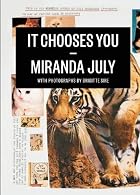
29. It Chooses You by Miranda July
After many drafts of her screenplay for her film, The Future, Miranda July found herself veering toward a period of sustained procrastination. Her procrastination took a peculiar form. She decided to contact individuals selling items in the PennySaver. If the seller agreed, July would bring along a photographer and her assistant and conduct an interview. A modest gratuity was offered. The purpose of these interviews and photographs was not clear at the outset. In some way, July knew she was on some sort of quest. But for what? Or for whom? It Chooses You consists of partial transcripts of these interviews, with accompanying photographs, interlaced with July’s account of the ongoing development of her script for her film.
There is a tone to this kind of life writing, which, if you get it right, seems to justify almost any amount of uncomfortable honesty. July hits that tone almost from the start. It’s the kind of thing that turns what might be construed as invasive ogling of lives that are strange or sad or denuded of hope, or worse, into self-reflection. Because as much as it looks like July has put these people on display, it is really herself who is put on display. That’s not always comfortable and it’s not always salutary.
Nevertheless, something positive emerges over the course of the PennySaver interviews. Some of that becomes incorporated into the next draft of July’s screenplay. But most of it is embodied in her last interviewee, Joe Putterlik. Joe is so fresh and real (he is 81 at the time) that July is moved to write him into her script and to have him play himself. The interaction between Joe and July is affecting and its documentation here is a fitting memorial to Joe, who died before this book was published or July’s film was released. An interesting read, modestly recommended.
71RandyMetcalfe
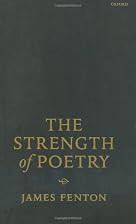
30. The Strength of Poetry by James Fenton
The twelve essays contained in this volume were delivered at Oxford between 1995 and 1999 during James Fenton’s tenure there as Oxford Professor of Poetry. They are, each of them, masterly engagements with the lives and loves of poets, and most especially with their poetry. Fenton writes with assurance and sympathy. He tends towards the encroachment of biographical details into his criticism—in almost every case, details of the poet’s life under scrutiny, which would not have been generally or publicly available during the poet’s life, inform and adjust the interpretation of the poetry. That is a debatable strategy, but Fenton acknowledges its risks, most notably in the final essay. It does, however, make for highly readable accounts and a personable critical style.
In some ways, Fenton is better dealing with male poets. He writes with conviction and respect on Marianne Moore, Elizabeth Bishop, and Sylvia Plath. But he truly shines when discussing Wilfrid Owen, Seamus Heaney, D.H. Lawrence, and W.H. Auden, on whom there are three essays. Perhaps I should have placed Philip Larkin at the front of that list, but unusually here, Fenton’s scholarship and incisive observation diminishes rather than burnishes Larkin’s reputation. It was ever thus—poets move up or down in standing as critics disabuse us of our blinders with respect to them.
Fine criticism, I think, typically draws us back to the texts it explores with renewed enthusiasm. That is surely the case here. This is criticism that gently nudges us in certain directions and then, for the most part, seeks to absent the field. It returns us to the poems and lets their strengths act upon us. A fine collection of essays, highly recommended.
72RandyMetcalfe

31. My Brilliant Friend Elena Ferrante
Elena and Lila have been friends since they were children together in the slums of Naples. The novel opens with a framing prologue with the two women in their sixties, but the focus here is on their lives from the ages of six to seventeen. They are bound to each other, at times inseparable, at times at the furthest remove. Each takes the other as a kind of superego, a spur to acts and endeavours that will take them out of their families, their claustrophobic neighbourhood, their lives, in fact, and onward to something they know not what. Their horizons are stultifyingly limited initially, but together, at least, they are able to lift themselves up in order to see beyond. However, this is post-war Italy, and what is beyond the horizon is not always so attractive.
The relationship between Elena and Lila is the brilliant centre of this story, but swirling around that intimate friendship—one in which both girls at different points refer to the other pointedly and justifiably as “my brilliant friend”—are a huge cast of characters, economic and political tensions, passion and consequence. Initially that host is limited to immediate family or the families of others who live in the same building. Only gradually does that circle expand. Elena is a diligent student, but Lila is, without seeming to even try, utterly brilliant. Unlike her friend, Lila can already read and write before she gets to school. She taught herself. Lila’s autodidacticism becomes a recurring motif. We see Lila read through the circulating library, and teach herself Latin and Greek. There seems no limit to what Lila might be capable of. No limit other than the imaginative capacity to think herself outside of her own situation. Perhaps. Fortunately Lila’s development spurs Elena on to renewed efforts of her own, though within the school environment. And so each enables the other to flourish.
Elena’s development, thanks to the encouragement of teachers, takes her, in school, beyond anything her parents might have hoped for her. Her friend, however, needs to be more inventive. And she is. Lila is an alchemist of old, transmuting base metals into gold. Or in this case, working within the elements and forces of her local environment to create dramatic new possibilities. Seeing her way through. By the end, however, it is unclear which girl has succeeded.
You will find yourself rooting for both Lila and Elena even as you fear for them. And the dramatic conclusion to My Brilliant Friend will have you waiting impatiently, as I now am, to get your hands on the second volume of this trilogy. Highly recommended.
74RandyMetcalfe
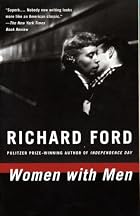
32. Women with Men by Richard Ford
The three lengthy short stories in this collection have all the hallmarks of Ford’s early brilliance as well as his middle period introspective anxiety. His writing is never less than compelling, at times thought provoking, and at others unsettling. He has a remarkable ability to turn a story on a dime, either through external events or through misplaced introspection. Yet these shifts never seem extraordinary once they have occurred. The reader just accepts them, possibly even saying to themselves, “that’s what I was expecting all along.” And then another shift takes you off in a different direction.
“Jealous” is set in Montana and feels like an extension of the stories in Ford’s first collection, Rock Springs. The bleak landscape, lives lived on the edge—the edge of despair, alcoholism, and violence—family disruption, and the transition to manhood. It’s all there. Here the narrator, a boy of 17, is a touchstone for the other characters—his father, his aunt, his absent mother. Both a means to highlight their stories and their sadness, and to reflect that back onto the vast emptiness of the prairie.
Depending on the Ford you prefer, “The Womanizer” may appeal more. Here is the Ford of the Frank Bascombe trilogy. In this case, the protagonist is a man in Paris for a few days. He is intelligent, in his way. He is worldly, unafraid to partake of opportunities that arise before him. And he is introspective. Incessantly. Argumentatively. And without any clear grip on reality. It is an enthralling effect. A bit like watching a train wreck in slow motion. And unsettling as well, since introspection is more typically associated (from Socrates to Descartes) with rational thought and behaviour. Here, not so much.
The final story in the collection, “Occidentals”, feels transitional. Again we are in Paris. Again we have the hyper-introspective male protagonist. Again we are on the cusp of something, some kind of transition perhaps heralded by the couple’s hotel being located on the border of a cemetery. And Paris, or at least Ford’s imagined American Paris fully mediated by his character’s encounters with it through literature (the protagonist is a novelist who recently had been a literature professor), is significant. Perhaps Paris plays the role that Canada played in Ford’s Montana stories—a far-off imaginary space (even if you are a tourist in it) where much is possible.
These stories will, I think, captivate any reader interested in how Richard Ford handles the longer short story form. Recommended.
75Mercury57
>20 rosalita: This solves the dilemma of what to buy as a birthday present for a friend who has just embarked on a creative writing course. Thank you!!
76Mercury57
>66 RandyMetcalfe: - this one is already on my wishlist but reading your review notches it up the pecking order
77RandyMetcalfe
#75, 76 - Glad you are finding something useful here, Karen. I'd be interested to hear what text(s) your friend ends up using in her/his course.
78RandyMetcalfe

33. Varieties of Disturbance by Lydia Davis
Of the 57 varieties of disturbance to be found in Lydia Davis’ collection of the same name, the variety itself may not be so various, but the execution of each exemplar is exquisite. These “stories” range from a single line to many pages, though length is no marker of how closely any individual example will resemble whatever you currently consider a story to be. You might wish to think of them as exercises, though the fact that each seems perfectly formed and complete rather belies the unfinished aspect one typically associates with exercises. Some work better than others for some people (I’m guessing) on some days. I have a suspicion that on other days others would work better for me (or other people). So this is really just a blanket recommendation—you’ll simply have to see for yourself which of these excursions work for you.
I like many of the very, very short entries. But this type of aphoristic exclamation can seem contrived (at least on some days for some people). If brevity is the soul of wit, it does not follow that wit is always achieved through brevity. At the next level, there a great many entries of about one page in length. In these, Davis seems almost expansive, luxuriously so, where so many writers might have found a one page story to be the limit of their skill with concision. There are a few entries that are much longer and which have the form and technique of psychological studies or treatises in computational linguistics: “We Miss You: A Study of Get-Well Letters from a Class of Fourth-Graders”, “Helen and Vi: A Study in Health and Vitality”. Remarkable achievements, though I don’t entirely know what to do with such perfect simulacra other than to treat them as the very objects they mirror.
For me, the stories that worked best, at least today, were the Kafkaesque “Kafka Cooks Dinner” and the remarkable account of two academics taking a walk around Oxford after having participated in a conference there, “The Walk”. But I’m sure your favourites will vary. Recommended.
79RandyMetcalfe
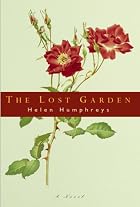
34. The Lost Garden by Helen Humphreys
It is 1941. England. London is being bombed nightly. And amidst the chaos and shortages, young women are accepted for service in the countryside far away from the bombs. This “Land Army” will fight its own battles as it struggles to turn fallow acreage back into productive soil. Gwen Davis, late of the Royal Horticultural Society and the air raid shelters of London, has been tasked with taking charge of a group of young women assigned to an estate in Devon, seeing to it that they put its grounds back into productive service. Also billeted at “Mosel”, but up in the “big house”, is a group of Canadian soldiers waiting to be reassigned to a new company with which they will re-enter the war. Death stalks their memories and their future. And in the midst of loss, there is also longing and, for some, fidelity.
Nearly all of the women and men in this story are wounded emotionally. Some are healing and others merely hanging on. Humphreys weaves an intricate pattern using the richness of the flora and the haunting interiority of Virginia Woolf’s late novels. Indeed, Woolf is central to Gwen’s view on the world and her recent suicide has added a tincture of self-pity to the disappointments accompanying other losses. It is a daring move on Humphreys’ part, to raise the spectre of Woolf and risk comparison. In this case, I think she succeeds though perhaps in an emotionally overwrought manner that Woolf herself would disavow. Gently recommended for emotional warmth and nutrient rich humus.
80RandyMetcalfe

35. To the Lighthouse by Virginia Woolf
A novel that deserves and demands the full attention of the reader, it is hardly surprising that To the Lighthouse might be described as a novel of and about attention. As the narration flits between Mrs Ramsay and her husband, their eight children, and their numerous guests all gathered at the Ramsay summer house on a Hebridean island, one thought leads to another, one observation spills into the next, one emotion peaks and subsides as another peaks and subsides like the waves endlessly rolling in upon the shore. And then there is the question of the lighthouse on a crag of rock across the bay, whose light pierces the summer house and its inhabitants, ceaselessly. Will James, the youngest Ramsay, be taken to the lighthouse the following day?
If Mrs Dalloway is the quintessential stream-of-consciousness novel, then Woolf’s next novel, To the Lighthouse, must surely be the start of something new, something even more intense, more challenging. Attention, or perhaps perception would be a better term, or even, as Lily Briscoe terms it “vision”, is the challenge. For it seems clear that it is almost impossible to really see someone, anyone. Even Mrs Ramsay, who is as much the centre of all that is as anyone could be, even for her, Lily thinks, it would take at least fifty pairs of eyes. And yet, the wonder of it is, that for some—the poet Augustus Carmichael, the painter Lily Briscoe, even the still beautiful wife and mother, Mrs Ramsay—the thing itself can be achieved. And it is an achievement when it comes. Even though it may disappear as quickly as it came.
If you are willing to engage with this novel fully, if you can focus your attention sufficiently (don’t be surprised if you find you need to read it in small chunks), if you let the consciousness of the novel guide you as it sparkles across the minds of those characters arrayed before you, then this novel will repay your effort manifold. If not, then set it aside for a few years and try again later. It’s worth it. Highly recommended.
81RandyMetcalfe

36. On Rereading by Patricia Meyer Spacks
You might pick up On Rereading with two divergent, though related, expectations. You might think that such a book would canvas and interrogate research in the field of cognitive psychology on reading, its processes, and its impact. On the other hand, you might anticipate a theoretical account of rereading steeped in one or another philosophical worldview. Know now then that your expectations will be frustrated. However, also know that what you will find in Patricia Meyer Spacks’ charming and personal treatment of her own rereading ‘experiments’ is a thoughtful and thought-provoking exploration of rereading as it relates to at least one individual. No doubt someday the books you were hoping to find will also be written, by someone. In the meantime, do take the time to enjoy Spacks’ mature thoughts on some of the books that she has returned to repeatedly over the course of a long life spent with literature.
The running theme throughout the book is sameness and difference. Clearly one returns to the same text on rereading. How then is it possible to experience a palpable difference in that text’s reception? Either the reader must have missed something the first time around (since the text remains the same), or the reader herself must be different. At various points Spacks opts for both these explanations, though favouring the latter. Her lifetime of reading, she argues, has changed her and in so doing, it changes what is possible for her in relationship to some beloved text.
That reading changes us as readers is taken as read by Spacks. It is, I think, a more controversial claim than she acknowledges. Fortunately, I agree with her, and am therefore more than willing to go along with her on her journey. I especially enjoyed her chapter on Jane Austen, whose novels she too thinks warrant multiple reads. At times she wants to test whether books she loved when she was very young, such as Alice in Wonderland, can hope to sustain anything more than a sepia-tinted pleasure. They can. Of course some books on rereading do not fair so well. And it is this difference in opinion on rereading that Spacks eventually finds most disturbing. Rather unfortunately it undermines her confidence in her judgement. But I think at this point she fails to take seriously her initial axiom: reading changes us. If this is true, then the judgements rendered substantially later on rereading cannot and should not be in conflict with our earlier judgements.
Read this book for its fine prose, its refreshing engagement with literature that you too may wish to reread, and its serious treatment of a phenomenon that deserves far more scrutiny and analysis. It may not be the book you are looking for, but it will serve, perhaps, until that one comes along. Recommended.
82Mercury57
>35 Mercury57: Thanks for the tip on how to read Woolf to get the most out of it. I read this decades ago and just couldn't see what the big deal was. But now I realise I just read it with the same attention span I would give a bog standard detective novel. I see the error of my ways!
83RandyMetcalfe
#82. I'll confess, Karen, To the Lighthouse was hard to read. This time, however, I'm blaming the tiny print and poor choice of font in the edition I had. My eyes kept skipping from one line to the next. Maybe I'm getting old.
No, that can't be it ;-)
No, that can't be it ;-)
84RandyMetcalfe
I'm off starting next week for a bit of a wander for about a month. Not sure if I'll be able to keep up with LT while I'm away. The itinerary is pleasant, all places that are familiar and lots of friends to visit with -- London, Oxford, Southampton, and Paris.
I'm only taking one book with me. But I expect to come home with a few more :-)
I'm only taking one book with me. But I expect to come home with a few more :-)
85lit_chick
Superb reviews here, Randy. Particularly enjoyed your comments on The Reinvention of Love, The Song of Achilles, and To the Lighthouse. I am another who was disappointed in Bradley's Flavia.
eta: Happy travels!
eta: Happy travels!
86RandyMetcalfe
#85 Thanks Nancy!
88RandyMetcalfe
37. Alone in the Classroom by Elizabeth Hay
Sometimes the characters a writer pursues take on a seeming life of their own, wresting control of a tale from the hand that holds the pen. In Alone in the Classroom, the narrator, Anne, sets out to write about her mother but gets diverted into the lives of her father's older sister, Connie, an unsettling sexual predator named Parley, a traumatized dyslexic boy named Michael, and the disturbing events that tie them together over the course of more than sixty years. Anne's mother still appears but she has become a minor character, and ultimately what sets out as biography reveals itself as autobiography. Or maybe that is always the case in some respect. And, if so, does it have its analog in fiction? Has Elizabeth Hay, herself, suffered the same befuddling as her narrator? Certainly the results here appear jumbled, moving forward (or back) in fits and starts. What appears to be the centre of the story collapses or suddenly shifts out of sight. As the details begin to emerge, connections between characters become clearer but their significance is obscured. And what you are left with is the muddled mess of lives lived. Only a writer with the expressive power and observational talent of a fine poet could turn such a muddle into a compelling narrative. A writer like Elizabeth Hay.
The story turns on the relationship between Connie, who is 18 in her first teaching post in a small town in Saskatchewan, her sadistic and frighteningly self-absorbed school principal, Parley, and the severely dyslexic (at the time dyslexia is not a recognized condition) student, Michael, who is, in Connie's eyes, clearly intelligent and sensitive. Both in this initial encounter and when Connie crosses paths with Parley again eight years later, Connie's strength and Parley's weakness are revealed. But the tripartite construction continues to re-emerge again and again, in different forms and often with different participants. What does it all mean? For Anne, the narrator imposing narrative order on disordered lives, its significance is rich. But Anne's need for order is just a further hue for Hay's palette, so the meaning for the reader remains open.
Writing that so faithfully brings its characters to life, escaping the simplifying tendency of art will, I think, naturally be at times confusing. At least I was confused at times. Certainly this writing forces the reader to slow down, to work things out, to make connections, even to reread sections. (I wanted to reread the book from the start numerous times as I went along, realizing that I had missed vital aspects on my first pass.) It's like the difference between reading a longhand letter from a dear friend and a scrabbled email; the former gives you pause, gladly. Elizabeth Hay's writing gives me pause. Highly recommended.
89RandyMetcalfe
38. An Extraordinary Theory of Objects by Stephanie LaCava
A good title and a quirky technique of extended explanatory footnotes is not enough to raise this self-indulgent memoir above the level of a whiny teen blog. It is not unusual or surprising to learn that a teenage girl thought of herself as weird or strange or unique. That doesn't make her weird or strange or unique. It just makes her an ordinary teenager. That she lives a life of unacknowledged privilege, flitting between homes in New York, Paris, and Cape Cod makes her self-regard near insufferable. Perhaps it is therefore unsurprising that the author has found herself in the world of high fashion, profile blogging, and illness narrative. It's all about the packaging, as evidenced by the fact that I picked this book up in a bookstore and bought it on the strength of its look and feel without knowing anything about it.
It isn't that LaCava is a bad writer. Just the opposite. That's the real disappointment here. I think she might be well worth reading if she channelled her teen angst and vaunted reading of books (does that really make someone special these days?) into crafting fiction. And the ability to speak another language might mark you out as brilliant if you are an insular white New Yorker, but I'm not sure it distinguishes you even from the taxi drivers you are so delighted at confounding in Paris, all of whom typically speak more than two languages. I look forward to what this writer produces once she gets over herself. But for now, not recommended.
90RandyMetcalfe
39. The Middlesteins by Jami Attenberg
This novel has many of the ingredients of a contemporary suburban comedy: gently extreme but non-self-aware characters; a telescopic perspective that can examine these characters over a sixty-year span (and beyond, since at points, as though the author is bored with the story she is telling, she leaps far into the future of individual characters in order to give the reader a glimpse of how their life turns out); a self-inflicted crisis; and some impending high-pressure occasions that will force all of the characters into close proximity. You might think that all one need do with such ingredients is to throw them in a bowl, stir them up, place the mixture on the stove and let it simmer. Thus the difference between a cook and a chef: it's love. A writerly chef loves all of her characters, whatever their flaws, and works hard to bring them fully to life. The cook is satisfied with whatever results from the recipe no matter how bland and tasteless it might be. It seems strange that a book so focused on food (at least superficially) should end up being so processed and flat.
And it's not funny either, which might have been a saving grace. It's not even quirkily observant and sweet. It's the kind of book you would otherwise be happy to leave at the cottage after a summer read, but you don't because you don't want to clutter up the cottage with stuff you'll definitely never use again.
All of which makes the effusive blurbs quoted in the copy I had virtually inexplicable.
91RandyMetcalfe
I'm back from my month away, but still existing on European time given what hour I am adding this post. It was a lovely time: fabulous friends, wonderful galleries and museums, parks and promenades, and more than a few great book stores. The London Review Bookshop gains special mention -- incredibly well stocked, friendly and knowledgeable staff, and Monmouth coffee in the cake shop attached (the cakes are rather nice too!).
92RandyMetcalfe
40. Cold Comfort Farm by Stella Gibbons
Flora Poste is twenty, recently orphaned, and almost, but not quite, destitute. She has an income of 100 pounds per annum, a host of wealthy friends of her class, a remarkable head on her shoulders, and a network of relatives, near and distant, to whom she might appeal for succour. Much to her friend’s shock, Flora agrees to be taken in by her relations at Cold Comfort Farm in Sussex (dread county!). It is just the sort of place where Flora’s gifts as a meddlesome sorter-out of lives and futures can find grist for her mill. From old aunt Ada’s “I saw something in the woodshed!” madness, to cousin Seth’s brooding Lawrencian animal magnetism, to uncle Amos’ hell-fire sermonizing, to the elfine Elfine’s poetic rambles up the Downs, to the obnoxious intellectual, Mr Myburg, who just can’t help falling in love with whomever, it is a convoluted, complicated, conflicted cacophony of animal desire and high art, with just a dash of natural beauty thrown in for good taste. Flora sets to work immediately “tidying” the muddle that is Cold Comfort Farm. Her work is cut out for her.
The writing is jaunty and optimistic. Flora’s good nature and appetite for tidying is infectious. And enough situations arise to satisfy the ardent desire of any reader for “comedy”.
It may not be, “Probably the funniest book ever written,” as the blurb on the cover of my copy put it. But it certainly intends to be in the running. And it was probably funnier when it was first published, if that makes sense. One of limiting aspects of literary satire is the degree of familiarity, on the part of audience, with the object being satirized. If the reader is not steeped in the novels of D.H. Lawrence, Thomas Hardy, and the bucolic novelists of the late 19th and early 20th century, then some of the targets here may be hit without the reader being fully conscious of the author’s success. Is it, “Screamingly funny and wildly subversive”, as another blurb on my copy declares? Well, funny, certainly, and mildly subversive, perhaps. Gently recommended.
93RandyMetcalfe
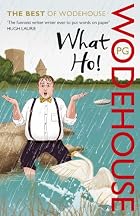
41. What Ho!: The Best of Wodehouse by P. G. Wodehouse
In a career that spanned some 73 years, a “best of” selection might understandably be somewhat hefty. In this collection, despite its heft, the lightness of the comic prose rings through. You might easily treat this as a collection to dip into now and then. Or you might read it straight through. In either case you will find yourself refreshed and always eager for more. More silliness, more scrapes and capers, more misunderstandings, more tomfoolery, and more twists in the tale and righting of the ship than you could hope for. None of it means a great deal. Unless good fun and laughter mean something beyond themselves.
What is remarkable here is the incredible consistency of the writing. In virtually every selection, the writing is unmistakably Wodehouse. Characters vary (it’s not all Jeeves and Wooster!), locales migrate (with a steady diet of city apartments, the club, and country homes), but the touch is ever light and the humour effervesces. Gently recommended for silly good fun.
94RandyMetcalfe
42. Blue Collar, White Collar, No Collar: Stories of Work edited by Richard Ford
Two elements make for a powerful collection of short stories. First, you need an editor with literary intelligence, the piercing eye that sees to the heart of a tale regardless of its provenance, and the wisdom to know that writers sometimes fail and that often even their less-than-perfect stories are but rough diamonds. Second you need a criterion, an overarching theme, something that pulls the collection together into a whole even before a book cover is slapped on it. Here the burning literary intelligence of Richard Ford, editor to this fine collection, more than meets the first condition. And the theme of work, in all its varieties, satisfies the second.
There are more than thirty stories in this collection and virtually all of them are excellent in their way. Some are exemplars of the kind of story that is tightly associated with a particular author, such as Richard Yates’ “A Glutton for Punishment” or Junot Díaz’ “Edison, New Jersey” or Ford’s own “Under the Radar”. Some are just stunning tours de force, such as Joyce Carol Oates’ “High Lonesome” or ZZ Packer’s “Geese” or James Alan McPherson’s “A Solo Song: For Doc”. And some I just plain liked, such as Richard Bausch’s “Unjust” or John Cheever’s “The World of Apples” or Edward P. Jones’ “The Store” or Thomas McGuane’s “Cowboy” or Elizabeth Strout’s “Pharmacy”.
The truth is that I liked a great many of these stories. And perhaps you will too.
95ffortsa
I have been absent from your thread for much too long. Wonderfully written reviews as always.
On Rereading sounds like just what I need to help me slow down and pay attention. And great comments about reading Woolf. She does demand attention, absorption, and quiet, but the rewards are wonderful.
On Rereading sounds like just what I need to help me slow down and pay attention. And great comments about reading Woolf. She does demand attention, absorption, and quiet, but the rewards are wonderful.
96RandyMetcalfe
#95 Very kind words, Judy, as ever. Thanks!
97RandyMetcalfe
43. The Canal by Lee Rourke
The narrator of Lee Rourke’s The Canal is bored. It’s not a problem. He finds boredom endlessly fascinating. So much so that he quits his job and sets out to pursue his boredom full time. And the best place for this research, apparently, is a bench adjoining the towpath along Regent’s Canal in London. This particular bench is located near the soundlessly clashing borders of two London boroughs, Hackney and Islington. It is a locale of derelict factories, council estates, youth gangs, and the encroaching transmogrification of the derelict into the highly productive (in the form of offices full of office workers with “snazzy” flat screen monitors) and the inordinately expensive (in the form of posh condos). Sitting on his bench day after day our narrator has a good view of the office workers and the local fauna – coots, Canada geese, and swans. And eventually someone sits down beside him, someone just as bored with everything as he is. And she’s good looking too. Boredom has its perks.
The writing here is very flat. The characters are two-dimensional. And for vast stretches, not a great deal happens. All of which fits well with the premise the narrator establishes at the outset. But it doesn’t really hold one’s attention. A touch boring. So I guess that counts as success.
About two-thirds of the way through my view of the novel changed significantly. I suddenly started thinking of it as much more like a graphic novel, specifically something by Daniel Clowes. If you are familiar with Clowes’ Wilson or his David Boring, then you will be well placed to catch what I think Lee Rourke is up to here. At least for me, thinking of it that way made the novel work much better.
Of course in such a flat, almost motionless, presentation, when action does suddenly emerge it almost cannot fail to come across as explosive, even melodramatic. Which can be a bit of a shock. But not to worry. Things settle down quickly enough and the boredom that the narrator set out with is firmly with him at the end.
It might not be for everyone, but Lee Rourke is undoubtedly a writer to keep tabs on.
98RandyMetcalfe
44. Travelling Light by Tove Jansson
Tove Jansson’s short stories, like much of her longer work for adults, is written in a spare, direct style that eschews symbol and metaphor in favour of concrete particulars and unsentimental realism. The quest for unadorned simplicity is consuming, as evidenced by the way it creeps into the very theme and content of stories such as “The Hothouse” or “Travelling Light”, the title story of this collection. It is a goal that is sometimes best reached by not aiming at it directly.
In “An Eightieth Birthday” a young couple engage with art in theory and practice on the occasion of the 80th birthday party of the young woman’s grandmother. ‘Success’, in artistic terms, as the story makes plain, is a fraught question whose answers are various and not always appetising. Jansson explores more of the darker side of her characters’ personalities in some of the stories in this collection. The disquieting “The Woman Who Borrowed Memories” will leave you on edge and “The PE Teacher’s Death” and “The Gulls” are almost burdened by the near mental collapse of one or more central character. There is even, perhaps oddly in this collection, a seeming post-apocalyptic story of two co-dependent marginal characters struggling to meet their end in the best way they can manage.
While the themes and content of the stories in this collection are less cohesive than other Jansson collections, the writing remains crisp and pure throughout. Like the endless summer light on the skerry islands off Finland’s coast, or Jansson’s unsentimental presentation of children (especially in “The Summer Child”), the stories here will be both familiar and new to readers of Jansson’s other works for adults. Gently recommended.
99RandyMetcalfe
45. The Art of Racing in the Rain by Garth Stein
Denny is a semi-professional race car driver with a knack for driving in inclement weather. Eve is his wife whose field is fertile (!). Zoë is their daughter who is very young. And Enzo is their dog, from whose point of view this story is told. As dogs go, Enzo is pretty smart and far along the great chain of being. Indeed, Enzo is convinced that in his next incarnation he will return as a human. So he might as well start practising for that now.
You may suspect that this novel is likely to be blighted by insufferable tweeness. It is. Some bad things happen to people we are supposed to love (well, Enzo loves them, so that should be good enough for you). Some people who ought to know better behave very badly. That bit is entirely inexplicable, and not just to Enzo. And other stuff just happens. It’s a bit like bad weather when you are driving, isn’t it? Sometimes you’ve just got to drive through it. Go with the flow. Keep your eyes ahead of you because your car will follow your eyes. Trust your car and your talent and your perseverance. And eventually you’ll get through to your just reward. Even if your reward is going to come in the next life, as it is for Enzo. Oh my.
Is it just twee, or is it pernicious pandering to our base instincts and the proffering of hokey metaphysics to prop up a worldview that would be better swept away? Is it both? Obviously, many readers enjoy this kind of overt heartstring tweaking and quasi-redemptive narrative arc. And of course there is the fact that the narrator is a dog, which you’d have to be pretty hard-hearted not to melt over. Maybe such writing is entirely innocuous. But I don’t think so.
101RandyMetcalfe
46. Question and Answer by Allison Pick
The poems in the title collection (the book is divided into three sub-collections: Q & A, (Still) Life, and The River Reflected) address themselves to questions posed by poets who might rightly be thought of influencing Pick’s poetic development. The questions are in some instances metaphysical (“How is one to speak with dead?” “Will it go on?”) and in other instances somewhat more mundane (“Anyone for tea before the night falls?”). In most cases the response is less an answer to the question posed than ruminations upon the question, as though the question were merely an echo sounding while Pick’s thoughts are heading in a different direction. However, the call and response format is enticing, if only because it frees Pick from the personal, which dominates the poems in the subsequent collections. The poems in (Still) Life, where they are not in fact poetic equivalents to painterly still lives (Apple, Orange, Watermelon, Pear etc.) are intensely felt studies of Pick’s relations with kin whose lives were stilled during the holocaust. It makes for an anxious juxtaposition, but perhaps that is the desired effect. Again the poems in The River Reflected section are perhaps more random though often returning to the theme of meditation and reflection.
I don’t have a final or even a finely rendered opinion on these poems. They all struck me as fine poems, for the most part. But rarely did a particular image leap out or a single poem stop me in my tracks. However, the fact that I don’t feel settled is probably a sign that there is more here that needs thinking about and rereading. And that cannot be a bad quality in any poem. So I’ll think about them a bit more and in the meantime gently recommend this collection to others in order to get some assistance with my thinking.
102ffortsa
re#45 - quite an intriguing review, as you set up an expectation that I will object to the heartstring-plucking, as I often do. Just a bit of manipulation? When I have some time, I'll have to find out for myself.
103RandyMetcalfe
#102 - You'll either love it, Judy, or feel like you need a shower after reading it. The Art of Racing in the Rain is a book club selection for next month; I'm keen to hear what the other members think. I suspect the reaction will be mixed, but they are a curious group and constantly surprise my expectations.
104RandyMetcalfe
47. Small Change by Elizabeth Hay
Variously described as a collection of short stories and a novel, Elizabeth Hay’s Small Change explores the theme of friendship in its many forms. Certainly some of the chapters stand well alone as short stories, though each is linked to the central character of Beth, or ‘Bethie’, who sometimes narrates in the first person, and other times is the object of a third person narrator. The chapters retain their short story character in the skirting, fragmentary nature of the narrative. A large cast of characters appear over the course of the book, but other than Beth, the reader catches only a glimpse of each and usually only in the story in which they, or rather their special contribution to Beth’s understanding of friendship, predominate. The result is that the reader is left uncommitted to these characters and that puts a strain upon our emotional attachment to Beth. For this is without doubt Beth’s story and here the book’s novelistic aspect comes to the fore. We see Beth at various points throughout her life: as a young girl, competing at school, dealing with parents and later with children, finding and losing love, believing and doubting herself, moving from Toronto to New York to Ottawa to Mexico and back to Ottawa – always in flight to or from relationships. In short, it is a novel of a life.
Elizabeth Hay writes with poetic intensity. Sentence fragments abound. Pithy insight and the arresting turn of phrase take precedence over narrative drive and structure. When it works, it works very well. The challenge is whether it ever overcomes the feeling of being a deliberate writing exercise. That’s a bit unfair since I do think it achieves something wonderful (at times). But such writing demands a great deal of patience of its reader and no small degree of generosity.
Curiously, it is generosity that the central character, Beth, lacks. Although she enters into friendships with hope and gusto, she always seems to, at the same time, be pulling back, preparing for her exit. She is a woman “past forty” who looks back on her life, “counting up friendships and arriving at small change.” It is, of course, very sad, that a life weighed and measured should amount to so little, at least according to person who has lived it. And in the end that mood tends to overwhelm the more positive or progressive aspects of the life and the stories that make it up. One cannot help but be thoughtful in response, and hope one’s thoughts are not as bleak as Beth’s. Well worth reading.
105RandyMetcalfe
48. How Literature Saved My Life by David Shields
There is a kind of portentous playfulness that is in vogue these days. It is not the disingenuous false modesty of the calculatedly ironic. It is not the light-hearted comic jape, satisfied perhaps to be merely play. It is not the tangential take, the oblique angle that reveals much. It is not the one or two-fingered salute to the powers that be. No. It is full of regard, if only self regard. It is grand in its ambitions, or at least its statement of its ambitions. It is deathly serious, though burdened by a great fear of seriousness. And it loves more than anything to appropriate, unearned, the portentous pronouncements of others, bouncing from one to another like a log driver delicately stepping across his charges safe so long as he moves on before the log rolls.
Autobiography is all, in the new vogue. Criticism, we’re told, is a form of autobiography. Fiction is really just autobiography. Biography? Right again, it’s also autobiography. And non-fiction – that vast bloomy everything that isn’t just a chronicle of one damn fictional thing after another – non-fiction is autobiography too. Presumably so is this brief review. It’s all about me. Or so, I suppose, David Shields might say.
Undoubtedly there is a spirited freshness about such writing. It can seem electric, if not electrifying. But its energy feels chemical, like the buzz after a short hit of some illicit drug, rather than grounded and substantial. And it quickly, for me at least, becomes tired, and all too quickly tiresome. It is, in the end, a perfect form for the Internet. But its pleasures may not extend to even a book as brief as this one.
That said, there were bits of this book that I enjoyed – a clever phrase, a wry observation here or there. Just not enough to sustain my interest, and certainly not enough either to save my life or end it.
107RandyMetcalfe
49. Life After Life by Kate Atkinson
No one, I think, will deny that Kate Atkinson is an accomplished, sometimes daring, author. In Life After Life she demonstrates her power to evoke a time period (mostly covering the two great wars of the 20th century), to infuse the representation of middle class English life with as much variety as perhaps it admits (admittedly limited), to understand the pathos pooled in British reserve and the endless fascination of the “what if” or the “if only”.
Ursula Todd, Atkinson’s focus here, experiences the “what if” and the “if only” in vivid and repetitive fashion as she proceeds to live and relive her life – each time somewhat differently (sometimes very differently) – in a process that must, I suppose, be interpreted as progressive. But progress toward what exactly? Is it the ultimate “do-over”? Ought we to suppose that we are all forced to relive our lives again and again until we get it “right”? And if so, what does “right” mean here?
Perhaps it is unfortunate, though unavoidable, that Atkinson’s narrative conceit will draw attention to the implausible metaphysics of its imagining. Although there is frequent mention of reincarnation in the course of the novel, what Ursula undergoes would not typically be described as reincarnation. There is no migration of souls; she is just the same person again and again. With slight variations due, again inexplicably, to premonitions intruding from one iteration into another that lead her to make somewhat different choices at key moments. Choices that have significant ramifications on her life as a whole. It’s all a bit silly really, and for me, at least it distracts from Atkinson’s otherwise significant gifts as writer.
I especially liked the lengthy treatment of life in London under the blitz. And I enjoyed the numerous secondary characters – Izzie, Pamela, Sylvie, Teddy, Miss Woolf – who come to life in these passages. It seems strange then, perhaps, that Ursula herself seems less lively, less real than those around her. But that, I think, may be an unintended consequence of the narrative conceit in play. So that what we have here is less Ursula’s story (since our sympathy is not bound to her) and more the story of a time and place. One rather wants to ask whether that is enough? Should we, at least with a novelist as accomplished as Kate Atkinson, hope for something more? I think so.
108RandyMetcalfe
50. Canada by Richard Ford
Is a man born a bank robber? Is he born a murderer? And if not, at what point does he become a bank robber or a murderer, such that in describing him we might, rightly, note that his bank robbery or the murders he commits were there in him all along? That transition, the border between what might be and what is, fascinates the narrator of Canada as he looks back over 50 years to his life as a fifteen year old boy in Great Falls, Montana. Dell and his twin sister Berner are the children of Neeva and Bev Parsons, who, in the course of a very few days transform themselves from ineffectual parents to ineffectual bank robbers. Dell struggles to see where or when precisely the transformation took place. It is almost a metaphysical transformation, something abstract, yet with real consequences. Those consequences include further transformations for Dell and Berner and their flight from Great Falls – west for Berner on her own, and north to Canada for Dell where he will learn that having bank robbers as parents is not the worst thing that can (and does) happen to him.
Ford’s writing here is lean and awkward, like the boy in whose voice he recounts these events. Only later, when we realize that Dell is really narrating his story from his vantage point as a 65-year-old high school English teacher, do we begin to appreciate how subtle Ford’s narrative has been. In the first third of the novel Dell sounds like a stilted, backward, child, almost implausibly naïve. When does he himself transform into the man he will become? Is it when he crosses the practically non-existent border into Canada (these events take place in 1960)? Or does it take something more, something definite? At one point a character tells Dell, “Doing things for the right reasons is the key to Canada.” And that might be our cue. It is actions themselves that make things what they are. We see this in Dell’s fascination with the game of chess, whose rules he has studied and stratagems imaginatively exploited, but which he never gets to play. But it is in the playing, one move following another, that a game becomes what it is.
Canada draws deep on Ford’s Montana stories (e.g. Rock Springs) and in so doing sets a markedly different tone to his Frank Bascombe novels. Thoughtful and deliberate here, as against frenetically immediate there, one can only admire Ford’s range and mastery. I think this is a novel that bears rereading and that it will become more significant on each pass. And on that basis, I recommend it.
110RandyMetcalfe
#109 - Ever a kind word. Thanks, Judy!
112RandyMetcalfe
#111 - Thanks, Julia! I didn't love Canada but I do have tremendous, and increasing, respect for Richard Ford's skills.
113rosalita
Oh, he's a wonderful writer. I am always amazed at how well he can hold my attention with such long passages of exposition and virtually no direct dialogue. It seems to break all the "show, don't tell" rules about writing but he makes it work.
114RandyMetcalfe
51. Ragged Company by Richard Wagamese
There is much that is “likeable” in Ragged Company. Four homeless “rounders” surviving on the streets on their wits and their willingness to be each other’s “wing man” escape an especially harsh winter cold front in the warmth of an afternoon cinema showing of Wings of Desire. There they meet Granite Harvey, ex-newspaperman, who has his own sadness that he is escaping at the film. A bond develops and one way or another you just know these five sad figures are going to learn something, possibly a great deal, from each other. When fate drops a winning lottery ticket into the hands of the rounders, opportunities abound for life transformations good and bad. Sprinkle in a bit of native spiritualism (three of rounders have native roots), add a dash of heart-of-gold (everyone here has one – don’t you?), bring everything to an emotive boil and then simmer until each key character finds his (typically artistic) true self; serve with a hint of tragedy to ensure that the remaining figures really treasure the gifts they’ve been given. If this is sounding like an afternoon made-for-TV movie full of schmaltz and life-messages, then you are getting the picture. There is much that is “likeable” here, but unfortunately the whole does not add up to something that is worthy of our affections.
Wagamese writes with poetic flair. The narrative voice moves across the five main characters in short alternating chapters. Perhaps this is meant to be a way of differentiating them. After all, some do swear a lot, while others mumble. In practice, the effect is just the opposite. All of the characters end up sounding the same. Scrape away their superficial differences – which is precisely what the emotional traumas that unfold do – and they each arrive at their true “voice”, which turns out to be elegiac, world weary, yet hopeful. One character begins the novel with that voice, Amelia “One For the Dead” One Sky. It is thus Amelia who sets the tone for the novel and who becomes the ideal to which all of the others unknowingly aspire. That’s no bad thing. She is a wonderful character. But it might have been better to forego the narrative crutch of a different voice for each chapter and have grasped the significance of the story with both hands.
One aspect of the story puzzled me. No mention is made of the source of the winning lottery ticket – it is found, not purchased. But it is not found blowing in the wind. It is found inside a cigarette packet along with three-quarters of a pack of cigarettes and a twenty-dollar bill. So it isn’t merely that “Digger” finds the lottery ticket. Someone else must have lost it, along with the twenty-dollar note. That no mention is made of this strikes me as problematic. The fortune that is bestowed upon the four rounders is thus not mere good fortune. It may not be purloined, but it is hardly won. Perhaps that is true of all fortune, good or ill. I don’t know. But it seemed to be a huge theme that lay exposed and unexplored. And that may go hand in hand with the fact that although the novel professes to deal with lives that are grittily real, in fact little realism can be found in either the events or in the reactions to events experienced by the characters.
In the end, it’s all just too much like one of the insipid movies (E.T., Fields of Dreams, etc.) that inspire the characters. Regretfully not recommended.
115RandyMetcalfe

52. The Days of Abandonment by Elena Ferrante
At the outset of The Days of Abandonment, the narrator’s husband announces that he wants to leave her. His announcement is void of emotion, reminiscent of Camus’ Meursault. His declaration is also entwined with self-serving professions of his own confusion and weariness after fifteen years of marriage. His wife is bemused at first, confident that he will come to his senses. Only gradually does it become plain to her that she has been abandoned, dispensed with, and – with the dawning realization that he has been involved in an affair for more than five years – humiliated. What begins in near tranquillity rapidly transforms as the narrator’s passion takes hold and rends her very sanity in response to her husband’s betrayal. It is a startling descent and entirely riveting. The narrator plummets to an almost bestial level only to, through the force of her own will, reascend, to rebuild her shattered sense of self, and reclaim her equilibrium.
Ferrante displays remarkable control here with her narrator. She never slips into parody, both conforming to stereotypes of the “abandoned woman” (here modelled on a particular abandoned woman from the narrator’s childhood thirty years previous) while at the same time aggressively attacking those stereotypes. It is fabulous writing. The lengthy description of the day in August during which her “madness” comes to a head whilst events conspire to send her almost beyond redemption is harrowing.
The ability that Ferrante displays in bringing her protagonist back from the brink is nothing short of astonishing. She avoids magical solutions as well as crassly romantic ones. And by the end we are certain that we are dealing with a narrator, and no doubt an author, who is entirely whole, grounded, and clear-sighted. Highly recommended.
116RandyMetcalfe
53. Brooklyn Heights by Miral al-Tahawy
The immigrant experience is, typically, Janus like, looking forward and backward at the same time. In this beautifully rendered portrait of Hend, a woman from Egypt with a young son living amidst the Muslim immigrant community in Brooklyn, the concentration is upon the past, the life she knew as a young girl growing up in a village outside Cairo. Sights and smells and tastes of the homeland are as important as who did what when. In fact we never learn precisely how or why it is that Hend has migrated to America without her husband. We are simply asked to accept an underlying threat and a sense that she is still somehow fleeing.
There are lovely passages here evoking a place and time with which many readers of this translation may be unfamiliar. That is no bar to enjoyment. What comes across is just how rich and complex and, of course at times, troubling the earlier portion of the lives of these immigrants has been. Although their American aspect may reduce them to a oneness (one character even remarks that all of the Arab immigrants look alike to her), there is much that lies beneath the surface that distinguishes them.
What is missing here is an equally rooted experience of life in America. It’s almost as though, having made it to Brooklyn, these immigrants are still not quite fully in America. There is still that Brooklyn Bridge to cross. And for the time being they are still on the Brooklyn side. But that is merely a cavil and not a substantive criticism. Indeed very little could diminish the wonderful writing in this portrait of a woman estranged from her past and perhaps from herself. Recommended.
117RandyMetcalfe

54. We Live in Water by Jess Walter
Jess Walter’s novels are liberally sprinkled with wit and daring (who else would write a novel titled, The Financial Lives of the Poets), a recognition that a life – any life – is filled with drama and pathos (and opportunities for wit), and a curious affection for the underside of Washington State. So it is no surprise to find that his short stories in this, his first collection, mirror the preoccupations of his novels. The only question is whether he succeeds as well in the short form as his does when he can be expansive.
The answer is that, for the most part, he does succeed. A few stories here are excellent: the brilliantly funny and poignant, “Anything Helps”; the gritty tale of sacrifice in the title story, “We Live in Water”; the toughly observed, “Wheelbarrow Kings”. Each of these stories is narrowly focused, concentrated, if you will, and I think that is when Walter’s natural zesty exuberance works best. (The same might also be said of his novels.)
Some of these stories feel a bit borrowed. “Don’t Eat Cat” – a zombie tale of loss and regret – and “Virgo” – a study in obsession (but also funny) – might cause you to think of George Saunders. In others I thought I saw the influence of Richard Ford (can anyone make use of Deer Lodge prison in Montana without raising the “Ford” flag?) and Lorrie Moore . That’s no bad thing, of course. But it suggests that Walter is still (at least in some of these stories) reaching for his own unique voice. The excellent stories mentioned above and the overall quality of the writing give reason for hope that, if Walter continues to follow the rigours of the short form, he will more consistently hit all of the right notes. But I hope he doesn’t stop writing novels. Gently recommended.
118RandyMetcalfe
55. Birds of America by Lorrie Moore
Amongst the twelve stories in this collection are, arguably, a few of the finest examples of what is possible with the short story form. The others are just very good. These might be construed as middle-period Moore. Less arch, less achingly funny, less theoretical, perhaps, than her first collection, Self-Help. More anguished, less certain, more grounded, but less willing to accept the status quo.
For sheer poignancy, perhaps, “People Like That Are the Only People Here” stands out. An infant boy is diagnosed with a Wilms’ tumor and we follow the distraught parents from diagnosis to operation to exit from the paediatric oncology ward of the hospital. What might be mere heart-tugging emotion is transformed by Moore into a study of regard, self-regard, otherness and narrative involvement. Astounding.
It is, however, “Dance in America” that is by far the most impressive story here. An aging dancer transitioning from performance to dance education visits an old college friend, whom she has not seen in twelve years, when she is asked to give some educational workshops in the town where he lives. She is life-weary, disappointed in herself and others, and uncertain about the worth of her new endeavours. Her friend and his wife have a young son, Eugene, who is suffering from cystic fibrosis. Eugene is vibrant, creative, funny and full of life, though without sufficient breath to fully partake. The interactions between the four characters are subtle and gentle and don’t amount to much. But by the end, both the protagonist and the reader are challenged to shake their hands at fate, at the universe, at whatever, and defiantly shout, “This is it!” It is a remarkable short story. One of the best I’ve ever read.
There are many other stories here worth mentioning. Instead, I’ll just note that Moore’s linguistic wit abounds across these tales. That has the effect of making the stories seem lighter, even less substantial, than they are. Don’t be fooled. This is the real thing. Highly recommended.
119RandyMetcalfe
Has it really been more than a month since I last finished a book? It has. I've been stuck on two novels, neither of which has maintained my interest. I still haven't finished them. So I decided to change tacks and read a non-fiction book. But it may also have been the nice August weather that distracted me. Whatever, I'm back and here follows my first review for September.
120RandyMetcalfe
56. The Brain-Dead Megaphone by George Saunders
I’m not entirely sure why some of the finest writers of fiction, be it short stories or novels, end up writing occasional, topical, non-fiction. It may have something to do with mortgages, children who need shoes, and putting food on the table. I take it that they get paid, though probably not handsomely, on delivery of whatever topical non-fiction piece they have been commissioned to write. Yes, commissioned; this isn’t even writing on spec. With fiction you tend to write it and then have to send it out somewhere hoping beyond hope that someone will like it enough to offer to publish it and maybe even pay you a pittance for it somewhere down the line. It’s not a good system for meeting monthly mortgage payments and that annoying need for daily sustenance. And so, eventually, a fine writer of fiction, be it of short stories or novels, will accrue a substantial body of non-fiction pieces that he or she will, often, collect together into a book that has nothing that makes it cohere other than the fact that each piece has been written by this same fine author who typically writes fiction. The Brain-Dead Megaphone is such a collection. Fortunately, the author in question is George Saunders, so most, though perhaps not all, of the topical pieces in this collection are a) funny, b) satirical, c) outlandish, or d) something even more than outlandish (but still funny).
The only essay here that defies the norm and fails, rather, as a result, is the title essay, which is po-faced and not funny in the least. Skip that one, if you can. Turn quickly, instead, to Saunders’ exploration of Dubai, which is weirder than the strange futuristic societies in his short stories, or his trek to visit a possible incarnation of the Buddha in Nepal. Apparently GQ paid good money to send George on these trips and then also paid for the articles he wrote thereafter. It is a very strange world, indeed.
I very much enjoyed his essay, “Mr. Vonnegut in Sumatra” where he comes to grips with the ‘real’ nature of fiction for the first time in his life. There are also other pieces here on fiction, teaching creative writing, on the great American novel, and more. They offer a fascinating insight into Saunders’ creative practice.
But more often than not Saunders cannot resist his incessant need for satire, even when at his own expense. In “A Brief Study of the British” or “Ask the Optimist!” or “Thought Experiment” he is just riffing on whatever theme is at hand. It’s great good fun. Which is something, and may even be enough. So long as it pays the bills and allows him to get back to what he does best, i.e. writing fiction. Gently recommended.
121RandyMetcalfe
57. Taft by Ann Patchett
John Nickel manages a blues bar in Memphis. He is a former blues drummer who stowed his drum kit when his girlfriend got pregnant. But when she gave birth to their son, Franklin, she still refused to marry him. Now she and Franklin have moved to Florida and he is stuck in the rut of his life, still in Memphis, still managing a marginal bar, still waiting for life to happen. Then into his bar and his life walks gamine Fay Taft, fey in name and nature, seeking employment and more. Fay and her more problematic younger brother Carl are like the re-emergence of a blues cliché, with the promise of sex, drugs, and noire-like violence that brings the story to climax and just as quickly dissipates.
Patchett is usually worth reading even when, as here, she does not entirely succeed in bringing off what she attempts. Along with the main storyline set in the bar, there is a second line, like a backbeat, following the life of Fay’s recently deceased father. But it is unclear what this second storyline is doing, and even more confusing that it appears to be imagined by John himself. It smacks of high concept and design, perhaps, but the result is a muddle.
However, the real problem in this novel is that the narrative voice of John is simply unbelievable. No doubt it is brave of Patchett to even attempt it. But I don’t think she succeeds, as evidenced by the fact that I didn’t even realize John was black until three-quarters of the way through the novel when he explicitly says it of himself. That intrusion feels like an editor’s pen pointing out that even at this late date we have no clear vision of who this man is. Yet this in a first-person narrative. Pretty obviously something hasn’t clicked.
The result is that although the novel is not very long, it simply failed to hold my attention. I kept drifting off. And then the climactic violent final episode just appears, almost out of nowhere, or so it seems. There are better Patchett novels out there and, I hope, more yet to come. This one, though, is best left on the shelf.
122RandyMetcalfe
58. Coin Locker Babies by Ryu Murakami
Two boys, Hashi and Kiku, separately abandoned in coin lockers as newborns, somewhat miraculously survive their poor start in life only to discover that what follows makes their beginnings seem positively mundane. The boys are adopted together and their lives are forever linked. Kiku grows strong and athletic, a pole-vaulter with blinding speed. Hashi discovers that he has a talent for song, or perhaps more accurately sound, which he uses to envelop and overwhelm his audiences. But they’ve both got a lot of anger management issues and a compulsive desire for, first, matricide (if only they could find their missing biological mothers) and beyond that the destruction of everything and everyone else. Moving from one extreme, even surreal, situation to the next the boys eventually find their way to Tokyo and, in different ways, realize their dreams, or nightmares.
Nothing will really prepare you for the aggressive violence of this novel, unless you’ve been saturated by the endless violent imagery of much anime and Japanese cinema. Whether that itself is a result of the influence of Murakami’s writing or was the nascent spur to it, I do not know. The effect, however, on current readers is probably less visceral than it may have been in the 1980s when this book first burst upon the scene in Japan. Indeed I found the heightened teen angst and anger tiresome and much of the violence to be risible, even though I could acknowledge how groundbreaking this might have appeared at the time. In the end it just couldn’t hold my interest. Not recommended, even if your favourite niece doing a degree in Japanese Studies tells you you’ve just got to read it.
123RandyMetcalfe
59. Born Weird by Andrew Kaufman
The five siblings of the Weird family each have a special power, call it a blessing or call it a curse, or call it a blurse. They were gifted with these at their births by their paternal grandmother. Now she is about to die and she has decided to lift these blurses so that they can get on with their lives. That is, if they can all gather at her hospital bedside before she passes in thirteen days. And so a rollicking adventure is set in motion taking us from one side of the country to the other, with stops in Upliffta along the way. It is a weirdly funny tale, which is no less than you might expect from a family with such a name.
At times humorous, at times zany (think Marx brothers), Born Weird has the virtue of never trying to be more than it is. It is light and lyrical and it (almost) never takes itself too seriously. Perfect lo-fat froth for your next cappuccino.
124RandyMetcalfe

60. Stoner by John Williams
A life, even an academic life, is a rounded whole. It begins with a certain impetus, takes on a trajectory which may alter once or twice depending on the buffeting of the winds along the way or any unanticipated obstacles that appear in one’s path, and then slowly the life-arc turns earthward and meets its natural end. William Stoner, the only son of poor farmers in Missouri deviates from his expected trajectory when it is recommended to his father that, given the boy’s good grades, he might consider the new agricultural program at the university in Columbia. William enters the university in 1910 to learn about soil but before the end of his second year he has another change of course during a survey course on English literature. Like a revelation, he finds his calling and thereafter pursues doggedly the life of the mind. The novel follows him down this path and the many trials that will come his way, right through to his final days. He dies with a book in his hands, as perhaps many academics might idealistically see themselves passing. And he thinks, on the whole, his life has been a good one.
His life has been nearly unremittingly awful. And only the gentle pacing and obvious love that John Williams has for him as an author can sustain our interest in this sad but honourable man. His marital life is a disaster and that becomes the norm both for his role as a father and his role within the university. Feuds, irrational and unrelenting, dog his every step. And only a brief liaison with a female graduate student temporarily transforms his drudgery into a perfect heaven. All too brief.
The writing is stolid, if that term can be applied non-pejoratively. The reader is kept, for the most part, at an emotional distance from the eponymous hero of this tale. Only his circumstances force us to transcend that distance, though perhaps also forcing us to connect with him in the abstract rather than directly. Edith, Stoner’s wife, is entirely inexplicable and no attempt is made to alleviate our incomprehension of her actions. Likewise the animosity evinced toward Stoner over more than twenty years by the Chair of his department is obscure. It is as though they become forces of nature blocking him, denying him all hope of happiness either personal or professional.
In the end it probably comes across as a sad life. But I suspect Williams’ intent is rather more nuanced. No Ilyich-like epiphany rescues Stoner. His life, its meaning and worth, is, like the book he authored early in his academic career, in his own hands at the end. It is as though Williams is saying that it is solely within his power to decide one way or the other whether it has been a good life. It is a refreshingly clear-eyed approach to one’s end. Recommended for its honest and accurate portrayal of the academic life, but be prepared to be a bit sad.
125RandyMetcalfe
61. Sleeping Funny by Miranda Hill
The nine stories that make up Sleeping Funny are never less than competent. Some are excellent, and one or two perhaps give a hint of great things to come. As with any first collection, there is quite a range. Early in one’s career, I imagine, a writer is trying out different styles or writing personas. So we have Hill’s Alice Munro story, “Because of Geraldine”, or her Helen Humphreys story, “Rise: A Requiem”. These are nonetheless fine stories in themselves, but Hill is much more interesting when her writing begins to move into a voice which, for want of a better label, we might call her own. Certainly the reader hears that voice in the excellent “Petitions to St. Chronic” or the title story, “Sleeping Funny”, though the latter feels the weight of Munro as well perhaps.
I very much enjoyed the surprising “Apple” though perhaps it is more of a one-off. And with doubt the opening story, “The Variance”, reveals that Hill has the potential to rise above the particular and the personal to approach the political. In all, a lot of good reading here and plenty of potential for some truly excellent writing to come. One to watch, I think.
126RandyMetcalfe
62. A Working Theory of Love by Scott Hutchins
This novel is full of surprises. It gives the impression at the outset that it will be a geeky exploration of what it is to be human, set in San Francisco with lattes. Okay, I’m always up for a bit of Turing testing, and lattes. Of course you expect it to be hipsterish with hook-up sex and outré kinkiness, but with lattes. But as you get into the book a bit, get beneath the surface so to speak, you find there is another entirely more serious, even dark, side to this story. Love, platonic and sexual, maternal and paternal, becomes the figured base of the tale, with the more problematic relationship between fathers and sons driving things forward. All of this is complicated by the fact that one key actor is less than actual, being the dead father of the protagonist, Neill Bassett, Jr., synthetically realized through scanning in the detailed journals of Neill’s father into a proto-AI computer project appropriately named Dr. Bassett. As Neill’s synthetic father gains depth and character – i.e. becomes more human – so too Neill’s frustrated relationship with his father gains heft. However, this is no ordinary son-meets-dead-father story since Neill’s father was a suicide. Did I mention that the novel gets a bit dark?
Not everything works here. The writing is a bit choppy. The presentation of software development is a bit implausible (one of the first rules of programming is to have a way to back out of changes, which is not followed here presumably for plot device reasons). The on-again off-again sexual relationships that Neill has are at times distasteful and at times fantastical (or maybe I’m getting old). The ending is contrived and hurried. Numerous characters (such as Neill’s brother) and themes (such as Turing’s own sexuality) are given short change.
But enough does work to at least make the novel enjoyable. There are, I suppose, two different kinds of novels of ideas. In one, the author thinks through all of the implications and ramifications of his ideas first and the novel is, in effect, the culmination of that thinking. In the other, the author appears to be doing his thinking in the novel itself, muddling down some blind alleys, chopping and changing when necessary, but, obviously, reaching some kind of viable conclusion (as least viable enough to convince someone to publish the book). This is the latter kind of novel. If you prefer the former, you may find this a bit too draft-like in its execution. But I found it to be passable.
127RandyMetcalfe

63. The Red House by Mark Haddon
Two families share a holiday cottage in Herefordshire near Hay-on-Wye. The connection between the two families is Richard and Angela, adult siblings who hardly know one another. Richard, a doctor, wealthy but emotionally detached is on his second marriage, this time with Louisa who has a teenage daughter, Melissa, from her first marriage. Richard has offered to foot the bill for the cottage to enable the two families to get to know one another. Accompanying Angela is her husband, Dominic, their teenage children, Alex and Daisy, and their younger son, Benjamin. A week in hill country with almost no mobile phone reception and eight excessively fragile and potentially overwrought (for a variety of reasons) individuals. What could go wrong? Just everything, that’s all.
As you might expect from that setup, this feels a bit stagey, verging on melodrama. Maybe Mark Haddon was thinking of writing a play. But the narrative mode he takes precludes that possibility. He presents us with a fractured, serially first person account which jumps from inside one character’s head to the next at times from one sentence to the next. It makes for a difficult first chapter until you get the hang of it. Unfortunately it isn’t clear to what end Haddon has used this device. This isn’t To The Lighthouse, after all. It’s more like a British soap opera.
Inevitably the problems of each of the eight protagonists emerge and transmute in the emotional cauldron that is this holiday cottage. There are sexual awakenings, underlying class fears, bullying, abuse of various kinds, some lingering mental instability, and some awareness raising. But nothing really emerges as an overriding theme. And so, with the fractured narrative and the disconnected “problems”, the reader is curiously uncommitted to these characters. Which is too bad. I wanted to like this book more than I did because I think it is a real advance on Haddon’s earlier writing. But he seems unwilling to take the risk of a less arch writing style that might commit him to real engagement of his own with one or more characters. I trust that there will be more and better from Haddon in the future.
128RandyMetcalfe
The above, The Red House, was my first ebook.
Recently I was gifted with a Google Nexus 7. I downloaded the appropriate app, OverDrive Media Console, to facilitate borrowing ebooks from our public library. Mark Haddon's book seemed like a good fit.
I know lots of people on LT read ebooks so my experience won't be unique. I'd say it was adequate. I love the Google Nexus itself and am also enjoying reading The New Yorker magazine on it, which is a different reading experience because it has its own app and the e-version of the magazine has lots of additional multimedia content. I'm looking forward to reading a book in the Google Play app, but I've yet to find an ebook I want to spend real money on. It'll come and now that I know it's no big deal, I'll be more willing to give it a go again.
Recently I was gifted with a Google Nexus 7. I downloaded the appropriate app, OverDrive Media Console, to facilitate borrowing ebooks from our public library. Mark Haddon's book seemed like a good fit.
I know lots of people on LT read ebooks so my experience won't be unique. I'd say it was adequate. I love the Google Nexus itself and am also enjoying reading The New Yorker magazine on it, which is a different reading experience because it has its own app and the e-version of the magazine has lots of additional multimedia content. I'm looking forward to reading a book in the Google Play app, but I've yet to find an ebook I want to spend real money on. It'll come and now that I know it's no big deal, I'll be more willing to give it a go again.
129RandyMetcalfe
64. Heaven is Small by Emily Schultz
Gordon Small dies at the outset of this novel. Then he gets a job as a Proofreader at Heaven Books, a gigantic publishing house for romance novels. It is solid work, though a bit tedious. And it takes him a few months before he begins to tweak that there might be something odd about his situation. For example, he hasn’t eaten any food in weeks. He can now run on a treadmill for hours without breaking a sweat. He finds it near impossible to smoke a cigarette given that he doesn’t seem to breath in or exhale. And then he spots his ex-wife commiserating with his former work colleague, which was rather odd since he didn’t think they knew each other. But at some point it clicks for him and he realizes that he is actually dead.
Spending eternity in the production of romance novels doesn’t really sound like the kind of heaven most people would like to partake of. And that is true for Gordon as well. So he sets about frustrating the plans of the corporation and working to make “contact” with the outside world and his former ex-wife, whom he still loves without reserve. Needless to say, hijinks ensue.
Emily Schultz has a vibrant imagination and gladly takes up the challenge of a tremendous literary conceit. That she doesn’t entirely succeed here is less important than the promise that her talent will produce better and funnier, yet still conceptually interesting, novels in the future. There are some glitches. For example, at times she writes as though she has never met a simile that she didn’t “like”. But that comes and goes, which is probably an indication that this is an early and not entirely consistent novel. She also wavers between irony and sarcasm as though she isn’t entirely certain what the difference is. But again, that’s a small complaint. I shall look forward to her future efforts, ideally with more professional typesetting than House of Anansi Press has provided for this novel.
130RandyMetcalfe
Delighted to learn that Alice Munro has been awarded the Nobel Prize for Literature in 2013. Well deserved. Congratulations to her!
131RandyMetcalfe

65. The Book of Joe by Jonathan Tropper
Joe Grossman is going home. Not that Bush Falls is likely to give him a warm welcome. His incendiary best-selling novel, and the big budget film based on it, have pretty much guaranteed that the seventeen years and the two and a half hour driving distance between Bush Falls and Joe’s apartment in Manhattan is still not long enough or far enough for Joe to be away from home. But a dying father has called him home.
It doesn’t help that Joe’s current writing has not been going well. His agent is less than thrilled with the manuscript he’s just submitted and more than hints that the difficult second novel often produces sub-standard efforts. He too thinks Joe needs to go back to Bush Falls and confront whatever demons are preventing him from writing the way he did with his first novel, the one in which he got even with the town for the horrible events that took place during his senior year in high school.
Jonathan Tropper set ups numerous opportunities for comic set pieces, verbal gunfire, and awkwardness to the nth degree. But the surprising thing is how this comic novel turns on itself to become a poignant examination of death, dying, love and remorse. It borders on being insightful and profound, and if it doesn’t quite get there (the incessant drive for the zinger is an inherently constraining, conservative impulse) it at least suggests that Tropper might have the potential for some real show stoppers down the line. Which is recommendation enough for me.
132RandyMetcalfe
66. The Story of a New Name by Elena Ferrante
Picking up almost immediately from where the first novel of Ferrante’s Neapolitan trilogy concluded, The Story of a New Name traces the lives of Elena and her friend Lila from ages 16 to 23. Superficially they are on utterly disparate trajectories. Lila, married at 16, undergoes humiliation after humiliation, beatings and abuse from her husband, scurrilous gossip and innuendo from relatives and neighbours, and financial ruin. A brief summer of adulterous love spirals out of control and leaves Lila with an infant son, no husband, no lover, and, ultimately a need to re-establish her name as Cerullo, scrubbing away the years she has had to endure as Signora Carracci. By contrast, Elena goes from one academic triumph to the next, obtaining both her high school diploma, and, after a gaining a scholarship to the university in Pisa, eventually her university diploma as well. To top it off she writes a much-praised short novel that is published not long after she finishes at the university. But we would be wrong to think that Elena and Lila’s lives are any less entangled than they were in their first youth. The ‘Elena Greco’ on the cover of her novel is as much a constructed name and identity for Elena as the, now, ‘Signora Cerullo’ is for Lila.
I couldn’t help thinking of the relationship between Elena and Lila as comparable to an elaborate dance. Ferrante has structured their lives in such an intricate formal pattern (even their sexual relations are matched), yet the wonder is that the novel never once becomes forced or contrived. Each step in the dance seems both compelled and entirely free. It is a so well done that it can take your breath away.
Ferrante’s writing matches her two protagonists. At times it becomes almost formal and argumentative, as when the increasingly educated Elena tries to think through her emotional confusion. At other times it soars with near poetic and existential angst. And yet again it can be as basic as the most basic functions of life in the poorer neighbourhoods of Naples. Riveting. The only disappointment is that I will now have to wait impatiently for the final volume to appear. Highly recommended.
133RandyMetcalfe
67. Traveling Sprinkler by Nicholson Baker
Paul Chowder is back. The poignant poet of Baker’s The Anthologist is now fifty-five and feeling his age. His on/off relationship with Roz is currently off, but he is regretting that terribly. He is supposed to be writing a new book of poems, which his publisher thinks might sell given the popularity of the anthology he edited. But Paul never manages to do anything directly. So when he should be writing poetry we find him instead rekindling his love of music, learning how to lay down tracks with music software, and writing protest songs and, more important, love songs, the latter entirely with Roz in mind.
It is a slow meander, just as it should be when you wander down the backroads of your memories. We learn of Paul’s early career as a bassoonist and the moment when he realized that poetry, after all, was what he was really destined for. We follow his digressions into the politics of the moment and wade gently through his observations on pop music, dance, trance, and hip-hop. But it is his insight into classical composers, particularly Debussy, and his ongoing reflections on various American poets that really hold the reader. That, and his ongoing struggle to express his love for Roz.
If you fell in love with Paul Chowder’s voice in The Anthologist, then you will certainly love Baker’s return here to perhaps his most sentimental and affecting creation. Definitely recommended.
134RandyMetcalfe
68. Mothers and Sons by Colm Tóibín
The stories collected here are muted, almost stripped of emotion despite some highly charged events occurring. It is as though Colm Tóibín wants the reader to take a step back and view these events calmly, dispassionately, perhaps forensically. And for some stories that works great. I like it especially in “The Use of Reason” and “A Priest in the Family”. Perhaps not so much in “Famous Blue Raincoat” or “A Summer Job”.
Most of these stories are straight-ahead short stories, narrow in scope and character, limited to a short time period, realistic both in terms of psychology and locale. In short, however much they mine the thematic connections between mothers and sons (which they all do), they do not breathe new life into the short form itself. I suspect that is probably a sign that Tóibín is more comfortable in the longer, novel form.
Inevitably different readers will prefer one or another of the stories here (they are all worthy), but for me it was “The Name of the Game” that stood out. Not unusually, a death initiates the action, which again not unusually, involves a life struggle, or, perhaps better, a struggle for survival. Class difference, which is not a major issue in most of these stories, is front and centre here, and because the action takes place at a distance from Dublin, Dublin can stand as an ideal, however misplaced, for the female protagonist, Nancy. Nancy’s struggle to transform the economic mess she has been left in by the untimely death of her husband reveals hidden strength in her, and no small amount of cunning. That I would gladly have seen the story expanded into a novel may just reveal my own preference for Tóibín’s longer, leisurely paced, novels. Well, to each their own, I guess. Gently recommended.
135RandyMetcalfe
69. Mistress of the Art of Death by Ariana Franklin
I'm not offering a review of this book. I read it because it was the selection for the book club I frequent. But I confess that I really have almost zero interest in mysteries, historical fiction, or historical mysteries. In its way, I suppose, this is a fine example of the latter. Certainly it wears its research well. And at least the author did not feel compelled to force the reader to participate vicariously in the excessively brutal and sadistic crimes perpetrated by the villain of the piece. Indeed much of the novel one could enjoy simply as a piece of well-researched historical fiction. Alas, mysteries must be plot-driven; likewise here. That leads to some clunkiness. Okay, a lot of clunkiness. But that's no worse than expected.
I think I'll skip this month's meeting of our book club so that those who thoroughly enjoy this genre of fiction can enjoy a more genial discussion without my grumping.
136RandyMetcalfe

70. When You Are Engulfed In Flames By David Sedaris
The occasional pieces collected here are typical David Sedaris pieces: light, funny, slightly skewed, and warm-hearted. They are also impressively crafted, with balancing echoes and gently threaded motifs. Sedaris writes in a manner that appears almost off-the-cuff, as though the essay in question was tossed off late in the evening after a hearty meal and possibly too much to drink. But that level of insouciance takes a tremendous amount of skill and effort, as anyone who has ever attempted it will attest. There is no need to pick a favourite as most, other than the one long selection, “The Smoking Section”, share a common format in tone and length. Dip in and enjoy.
137RandyMetcalfe
71. The Journey Prize Stories 25 compiled by Miranda Hill, Mark Medley, and Russell Wangersky
The 2013 edition of the Journey Prize brings together twelve of the best stories published in the past year in literary journals or magazines in Canada. As ever, the range is fabulous. There are stories set in the post-apocalyptic future, the Mauritanian past, and mid-70s Windsor, Ontario. There are stories with teen hipster Chinese-Canadians in Vancouver, elderly women in Japan, comic book store workers. Some of the stories are confidently straight-ahead, while others challenge the short story form itself in daring ways.
There were no stories here that did not deserve to be found in this volume. Which makes it very hard to select a favourite. However, I’ll limit myself to singling out “Sleep World” by Zoey Leigh Peterson, which subtly challenges the base elements of story-telling and then answers that challenge beautifully. Remarkable.
138RandyMetcalfe
72. Everything Changes by Jonathan Tropper
Zack King is over 30. He has a job that pays well but that gives no satisfaction. He has a really rich friend, Jed, who lets him share his great house in Manhattan. He has an extremely beautiful (and rich) girlfriend who is about to become his fiancé. He has a brother who is a punk rock musician. He’s got another brother who is mentally challenged but to whom Zack is the greatest brother and friend. His best friend, Rael, died in a car crash two years earlier, which Zack survived. His best friend had an infant child named Sophie whom Zack visits frequently and delights. He even changes her diapers when called upon. Sophie’s mom is the all too gorgeous Tamara, who doesn’t deserve the grief she’s had to suffer. Fortunately Zack has been there throughout to help her with Sophie and with her loss of Rael. Oh, yes, and Zack has daddy issues due to an absconding father who left him and his brothers in the lurch when they were children. Needless to say, complications ensue.
Jonathan Tropper’s writing is always peppy and full of zing. His man-boy protagonist is always a real everyman (well, at least the kind of everyman we’d all like to be, right). He’s got problems. But his problems are mostly self-inflicted (how could they not be when you are as self-interested as Zack). And the solution when it comes is bound to be a violent overthrow of his self-image and the birth of his new self (because everything is really all about him, after all). And Zack will end up feeling mighty good about himself by the time we reach the end of the novel.
Very readable, high rate of box-ticking, feel-good narrative arc. Yet entirely unsatisfying. Read it on the beach, but leave it there for the tide to wash back out to sea.
139RandyMetcalfe
73. Parnassus On Wheels by Christopher Morley
Helen McGill is the long-suffering sister of the “Sage of Redfield”, her brother Andrew. For more than 15 years Helen has kept house for Andrew at Sabine Farm. Andrew, however, is more interested in his literary pursuits than in farming and apparently he has the knack, for his first two publications have made him famous. When Roger Mifflin arrives at the farm one morning with his horse-drawn travelling bookshop, the eponymous Parnassus on Wheels, looking to offer Andrew the chance of a lifetime, Helen is afraid that her unappreciative brother will abandon her and jump at the opportunity to purchase said Parnassus in order to go wandering about the countryside in the ongoing quest for material for his next book. Helen won’t have that. So she purchases the Parnassus herself and leaves her brother to his fate. Setting off with ‘Perfesser’ Mifflin, who has agreed to show her the rudiments of the trade, she is bound for adventure, literary and otherwise, or whatever else a nearly-forty, fat, housewife can find. Little does she suspect that what she will find is love.
Christopher Morley’s writing is delightfully rustic and pacey. There is a humour here that borders on but does not partake of satire. It’s more like opera buffa. And just as fun.
140RandyMetcalfe
74. The Haunted Bookshop by Christopher Morley
The irrepressible bookseller, Roger “Professor” Mifflin, is back. Now married to Helen McGill (as was implied might happen at the end of Parnassus on Wheels), Roger is ensconced in a second-hand bookshop in Brooklyn. He likes to describe it as haunted by the ghosts of all great literature. He continues to enthuse and pontificate, somewhat, on the ameliorative effects of literature and thus the vital service to society contributed by booksellers. As part of his social efforts he has agreed to take on staff the daughter of a book loving industrialist who would like his (he thinks wayward) daughter to gain some perspective and proper proportion through association with great literature. Titania is exquisitely beautiful, for Brooklyn, and naturally becomes the object of the delusional affection of Roger’s other young acquaintance, the advertising copywriter, Aubrey Gilbert. If that were not enough, there is a plot afoot to assassinate President Wilson as he journeys to the Peace Conference subsequent to the armistice of 1918. Only Roger and Aubrey can save the day!
In many ways, though somewhat lengthier this novel is slighter than its predecessor. Or perhaps Christopher Morley lost his head a bit to the enthusiasm that greeted his first novel in 1917. Here, the Mifflin character comes across as (somewhat) tedious. Aubrey Gilbert is thoroughly obnoxious in his efforts to take on the role of the action hero, all with an eye to winning Titania’s affection. And the melodramatic plot is risible. It remains a curious article of Americana from the inter-war years, but little more. Not recommended.
141RandyMetcalfe
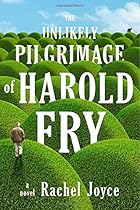
75. The Unlikely Pilgrimage of Harold Fry by Rachel Joyce
Harold receives a brief note from Queenie, whom he hasn’t seen or spoken to in twenty years. She is in a hospice in the north of England. She wants to say good-bye. Harold responds by writing a brief note of sympathy. He sets off to post his reply but what with one thing and another he passes first one post-box, then another, then another. Finally, he resolves that the only response that will suffice is one that he delivers in person. He owes Queenie that much. And without thinking about it too much he just keeps walking.
Unfortunately, Harold has set out from the village of Kingsbridge in the far Southwest of England. It is going to be rather a long walk to Berwick-upon-Tweed – more than 600 miles away. But that doesn’t matter. After 65 years Harold knows he simply has to do this. Queenie needs it. He adds a postscript to his letter of response alerting Queenie that he is walking up to meet her and that she should hold on until he gets there. Thus begins Harold’s unlikely pilgrimage.
Joyce’s episodic first novel begins in a suitably abstract and unemotional manner. It rather reminded me of the writing of Magnus Mills. That she is unable to sustain that tone or manner may stem from this being a first novel. Or it may be the pressure to turn Harold’s journey into something symbolic, something momentous, something burdened by its own self-aware Christian allegory eventually becomes overwhelming. Certainly the writing begins to slide when it migrates from the fixated stare of unthinking Harold on the road. Soon enough Harold is becoming self-reflective about the meaning of his journey. And that’s when his unlikely journey becomes unlikeable. It’s too bad, really, as there was a great deal of potential here. Perhaps though this first novel was a bit of a pilgrimage for Rachel Joyce as well and we might well expect something with enough inner character to finish well on her next outing. I would certainly not be averse to taking another chance on her.
142RandyMetcalfe
I appear to have reached my 75th title for the year. I'm a little disappointed it wasn't a better one. I promise you that my 76th (which I am more than half finished) will receive a rave review. Last year I reached my 75th book before the end of October. And what was the lucky book? The wonderful Alice Munro's Dear Life: Stories. Now that was a good way to hit a milestone!
143rosalita
Congratulations on reaching 75, Randy, even if the milestone book was a bit of a dud. You've piqued my curiosity about your next review!
144RandyMetcalfe
Thanks, Julia. I won't keep you in suspense too long. I can tell you this much (he says, temptingly), it is, for the most part, a re-read. But you better give me until the end of the week to finish reading it. Cheers!
146RandyMetcalfe
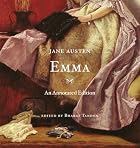
76. Emma: An Annotated Edition by Jane Austen, edited by Bharat Tandon
This beautiful large format hardcover edition of Emma has oversize pages which allow for the annotations from editor Bharat Tandon to appear alongside the principal text. There are relevant drawings and reproductions of paintings and even stills from filmic adaptations. But the text is never burdened at any point. The annotations tend to be clarificatory or informational, but sometimes also helpfully interpretative, especially where critical opinions diverge on the importance of key scenes.
Bharat Tandons’ introduction is worthy of special note. It is accessible yet erudite. It points up some of the key tools Austen deploys in writing Emma, such as her liberal use of free indirect style. And it is rightly conscious of the fact that no one would purchase such a heavy, large and somewhat expensive edition unless they were coming back to Emma, coming back with love. This is an edition of Emma almost designed, as it were, for rereaders.
No other novel, for me, has been so important over the many years that I have read and reread it. And this fine edition fully justifies the pleasure to be taken in reading it again, slowly. Highly recommended.
147RandyMetcalfe
I promised a rave review for my 76th book and I hope I have delivered. Here is a little more about why I like this book.
One of the special treats in returning to Emma with such a fine edition is that the reader has the perfect excuse to slow down his reading. There is no need to race along with the plot from one misguided intervention in the lives of others to the next. The reader can take his time. Time to savour Austen’s very precise observations. Time to revel in her withering, warts and all, presentation of grasping tastelessness (e.g. Mrs. Elton) and her superficially similar but in fact very different presentation of kind-hearted senselessness (e.g. Miss Bates). There is plenty of scope here also to take note of how intricately Austen has structured her plot. It is impossible not to imagine her, pen in hand, being delighted with the nuances she has placed on Emma’s self-deceptive insights, knowing full well that all will be revealed in the third volume. It is a delight that transfers naturally to the rereader.
What struck most this time was Mr. Knightley's clear-eyed blind love of Emma. He knows she has flaws. In fact he, more than anyone, points out her flaws. And yet once he becomes aware of his love for her, he finds her, "faultless in spite of all her faults." Indeed. That's exactly how I feel about the novel, Emma: faultless in spite of all its faults.
One of the special treats in returning to Emma with such a fine edition is that the reader has the perfect excuse to slow down his reading. There is no need to race along with the plot from one misguided intervention in the lives of others to the next. The reader can take his time. Time to savour Austen’s very precise observations. Time to revel in her withering, warts and all, presentation of grasping tastelessness (e.g. Mrs. Elton) and her superficially similar but in fact very different presentation of kind-hearted senselessness (e.g. Miss Bates). There is plenty of scope here also to take note of how intricately Austen has structured her plot. It is impossible not to imagine her, pen in hand, being delighted with the nuances she has placed on Emma’s self-deceptive insights, knowing full well that all will be revealed in the third volume. It is a delight that transfers naturally to the rereader.
What struck most this time was Mr. Knightley's clear-eyed blind love of Emma. He knows she has flaws. In fact he, more than anyone, points out her flaws. And yet once he becomes aware of his love for her, he finds her, "faultless in spite of all her faults." Indeed. That's exactly how I feel about the novel, Emma: faultless in spite of all its faults.
148rosalita
Wow, that edition of "Emma" sounds absolutely wonderful. I've only read it once but I really liked it. I can definitely see that it would stand up to repeated re-readings, and I'm going to try to do that starting in 2014. Long ago I read a biography of Rex Stout (the creator of the incomparable Nero Wolfe and Archie Goodwin). The biographer asked him a few days before he died what Wolfe was doing, and Stout replied, "Re-reading 'Emma'." I remember in one of the Wolfe books that cantankerous misogynist saying Jane Austen forced him to re-consider his theory that no woman could write as well as a man.
149RandyMetcalfe
That's excellent! I hope I am doing something just as sensible as I approach my end.
150rosalita
Me too, although based on current trends it's much more likely that my final act on this earth will be checking LT threads!
152RandyMetcalfe
#151 Thanks.
153RandyMetcalfe
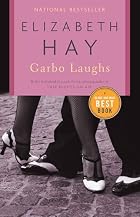
77. Garbo Laughs by Elizabeth Hay
Elizabeth Hay introduces her novel with an epigraph from legendary film critic, Pauline Kael: “We will never know the extent of the damage that movies are doing to us.” That brilliantly sets the underlying condition for the principal characters in this novel: Harriet, a harried novelist suffering from loss of sleep and extreme emotions; Harriet’s two children, Jane who is eleven and wants to be an actress and Kenny, who is nine and wants to be Frank Sinatra; and Dinah who lives across the road, yearns for Harriet’s husband, Lew, and takes an instant liking to Kenny, whose first words to her are, “Who do you like better, Frank Sinatra or Marlon Brando?” Movies, especially the movies of a bygone age, form the basis of their conversation, their desires, and their judgements. Just how much damage this obsessing over film has done to them remains an open question.
Hay beautifully evokes life in Ottawa in the late nineties. But the focus here is more narrowly upon the street on which they live which is a vibrant community of its own, stocked with eccentric characters, old hands, and angry North of England types. In their ways, they are each connected to the arts. Most are writers or journalists or wannabe writers or CBC radio personalities. All, however, are passionate about the early history of cinema. And since this takes place in that now fading era before the Internet took hold and IMDB replaced such tomes as Kael’s 5001 Nights at the Movies, nuggets of cinematic information, real or apocryphal, are like gold traded between them and sometimes horded.
But the real story lies between Harriet and Dinah and Lew. Their desires and commitments unfurl like the fractal spores of the rare fern that Lew has brought back with him from Cuba. As Harriet observes late in the novel, “How oddly disjointed so much of life is, she thought, and how little it takes – a few words, arranged a certain way – for it to make sense again.” It is a beautiful observation and, I think, it captures Hay’s disorientingly close narrative technique. It does feel disjointed, just like life, and yet, in these few words arranged into a novel, it does seem to make sense. Recommended, along with everything else Elizabeth Hay has written (or will write).
154RandyMetcalfe

78. Human Voices by Penelope Fitzgerald
Set amidst the arcane workings of the BBC at its Broadcasting House headquarters in central London during the darkest days of WWII, Human Voices follows the passions and whimsy of senior staff and junior staff as they struggle to make themselves heard in a world turned on its edge. Fitzgerald’s BBC emerges from her direct experience at the time, but even thirty or sixty years after the events depicted, much of the aura of the BBC remains. The Corporation, as it is sometimes called, is like a hulking vessel being manoeuvred by minuscule human tugboats. Yet somehow, as Fitzgerald makes clear, it really is individuals, real live human beings who make this beloved institution function. And perhaps that is why so many of us are committed to it despite its faults.
At times the writing is brilliantly funny. At times it is incredibly atmospheric, almost as chaotic as the myriad of storylines and interests racing through the city at that time. But it is the characters, or rather the characters with Character that make this story come to life. Fitzgerald abjures caricature. The characters, however peculiar they might appear, are entirely recognisable British figures. That she can make us care for them is a remarkable testament to her skill. And while the madcap nature of some of the events links this novel back to her first hilarious effort with The Golden Child, the studied intelligence of the presentation of an entire complex, even byzantine, structure points towards Fitzgerald’s late great novels.
Pleasantly recommended.
155RandyMetcalfe
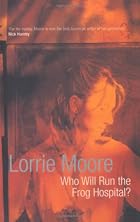
79. Who Will Run the Frog Hospital? by Lorrie Moore
On a trip to Paris years later with her husband, Daniel, Berie reminisces about her adolescent years in Horsehearts, a town in upstate New York, and especially about her relationship with Sils, her best friend in those years. In Paris, Berie’s acerbic wit is at times withering, at times desperate. But back in Horsehearts, when she was an underdeveloped teen, she was wide-eyed and naïve, though perhaps already inured to life’s irony given the summer jobs that she and Sils have working at a down market fairy-tale theme park. Sils is fifteen but looks twenty. So perhaps naturally it is Sils who takes the lead - with boys and booze and bongs, only the latter two of which Berie is able to indulge. Through sexual misadventure, larceny, and the indifference of parents, Berie and Sils test the boundaries set by Horsehearts and their own hearts.
This is a wonderfully written (almost) coming-of-age novel. Moore can do more in a few sentences than many writers can muster in whole novels. Indeed the observations, even the emotions, are often so compressed, so pared down, that it sometimes feels as though this novel could expand exponentially with the merest addition of a bit of water or air or something. Or maybe that was just me wishing that it was considerably longer than it is.
In the end, there is no clear connection between the Berie we see in Paris with Daniel and the Berie we see in Horsehearts with Sils. Even a trip back to the town for a high-school reunion fails to draw the connection. In their different ways both girls have moved on. And that, ultimately, is what is saddest in this tale. For no relationship they are ever likely to have in the years ahead will measure up to the intensity of the bond they formed in youth and cannot reforge as adults. Definitely a novel that needs rereading after you read the rest of Moore’s oeuvre. Recommended.
156richardderus
First, shamefacedly belated congratulations on your 75th read...a book I wholeheartedly concur was an underwhelming read...and a hearty "huzzah!" for the pleasures of Emma, newly vouchsafed to me by a recentish reappraisal of Austen and her works.
Human Voices was a giant treat for me when I found it quite some time ago, on a visit to London.
Happy reading!
Human Voices was a giant treat for me when I found it quite some time ago, on a visit to London.
Happy reading!
157RandyMetcalfe
#156 Thanks, Richard! My wife and I are reading Penelope Fitzgerald's novels to each other in order. They are our "car" books; alas we don't drive very much at all so it is taking a long time :-( It's my second time through, but it's amazing how much more I get out of them reading aloud. She has such a delicate comic touch. And a silent tip of the hat to anyone who acknowledges the wonder that is Austen's Emma.
158richardderus
"A delicate comic touch" is the perfect description of Fitzgerald's appeal. I thought it was obvious, as in I expected anyone who read her work to see the sly-boots side-eye she was giving the reader the entire time. Alas, it is not so. I've read so many reviews of her books that miss this overtone entirely. It seems to me Offshore is her least-understood and -appreciated work, possibly only excepting The Bookshop.
To me, Fitzgerald is the mean person's Barbara Pym.
To me, Fitzgerald is the mean person's Barbara Pym.
159RandyMetcalfe
#158 I'm with you on Offshore, a beautiful book. Pym has her moments of flint. I love them both, differently, as everyone should be loved.
160richardderus
They run neck-and-neck for my affections most days. Can't deny the appeal of each.
161RandyMetcalfe

80. The Juliet Stories by Carrie Snyder
Thrust into the strange and potentially dangerous locale of Managua, Nicaragua, in 1984, Juliet is at the mercy of her activist parents’ desires and her own nascent hopes and fears. Along with her two younger brothers, Juliet experiences the chaos and confusion of radical upheaval, but also the singular acts of kindness and beauty that are present, perhaps, everywhere.
Beautifully told in an immediate, almost raw, style, the stories may stand alone, but together they form a linear structure as Juliet moves into adolescence and beyond into adulthood. Life remains unpredictable even after Juliet and her family move back to Canada. Love, desire, death, fealty and falsehood – Juliet experiences them all. Some things she comprehends, some she does not. And ever she appears to be groping toward some kind of future, some clarity about herself and what she will do with her life.
The first half, especially, is tremendously affecting. The second half is less direct, less lived, more told, less certain, and possibly more challenging. It would be hard to say which I prefer more. Or perhaps I’m simply confessing that I have been won over and would gladly follow Carrie Snyder wherever her narrative voice might lead. It would be hard not expect, or at least hope for, great things to come from this author. Recommended.
162RandyMetcalfe
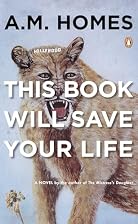
81. This Book Will Save Your Life by A.M. Homes
Richard Novak is having a problem. He’s not entirely clear what that problem is. It may be the end of his life. Or at least the end of whatever was passing for his life. All he knows is that he is in pain. Excruciating pain. All over. Or maybe he was always in pain and is just now realising it. Richard is not especially in touch with his feelings, or his memories, or his ex-wife and son, who live on the other side of the country in New York. Safe to say that change is coming. And once it starts, there is no telling where it will end.
This novel starts like a Don Delillo novel of angst and estranged emotion. Everything is so at arm’s length that it feels as though the protagonist, Richard, is hardly involved. But gradually things start to warm up. Soon Richard is facing down his pain, battling with kidnappers and forces of nature, developing friendships with movie stars and iconic authors and even, eventually with his son. Things become almost madcap. It’s as though what started out as a Don Delillo novel transformed into a Douglas Coupland novel. Or maybe it is better to simply describe this as an A.M. Homes novel.
The writing is captivating and fresh. I never knew what would happen next. And if it was a bit thin at times, well, I suppose that is a risk for any comic writing, though this might not be best described as comic, except in the metaphysical sense. Certainly I enjoyed reading it well enough to warrant reading more by A.M. Homes. And for that, it is gently recommended.
163RandyMetcalfe
Winding down.
It is nearly that time in December when my reading slows down considerably. As I have a moment, I thought I might take this opportunity to thank all those who have visited my thread during the past year. If you've left a comment, thank you. If you've stopped by and read a review but have not left a comment, thank you as well. I'll assume the latter covers a large group. I suspect that because I know I read through lots of threads in this group and almost never contribute a comment (even though I promised myself I'd be a better at that this year). No doubt one of your reviews caused me to smile, or chuckle, or nod in agreement, or, just as good, throw my hands up in disagreement. It's been a pleasure spending time in the shared space of loving books with you.
On other threads, apart from the numerous thoughtful and thought-provoking reviews, I've enjoyed travelling vicariously with those who share their visits to amazing cities full of bookshops and theatres, or catch a boat up the coast, or a flyer to the east. I've smiled at the quirky posters and marvelled at some of the photography people have shared. I've been awed by the industriousness of some readers here, and at the industriousness of a number of the posters in the group. And, of course, I've loved the book porn, the nook porn, and the debates on the best reading chair. All in all, it's been a great year.
If I don't get around to thanking you personally in your currently thread, rest assured that I wanted to.
Now back to the books. There's still time to get through one or two more and maybe catch one that makes it into my top five for the year.
Cheers!
It is nearly that time in December when my reading slows down considerably. As I have a moment, I thought I might take this opportunity to thank all those who have visited my thread during the past year. If you've left a comment, thank you. If you've stopped by and read a review but have not left a comment, thank you as well. I'll assume the latter covers a large group. I suspect that because I know I read through lots of threads in this group and almost never contribute a comment (even though I promised myself I'd be a better at that this year). No doubt one of your reviews caused me to smile, or chuckle, or nod in agreement, or, just as good, throw my hands up in disagreement. It's been a pleasure spending time in the shared space of loving books with you.
On other threads, apart from the numerous thoughtful and thought-provoking reviews, I've enjoyed travelling vicariously with those who share their visits to amazing cities full of bookshops and theatres, or catch a boat up the coast, or a flyer to the east. I've smiled at the quirky posters and marvelled at some of the photography people have shared. I've been awed by the industriousness of some readers here, and at the industriousness of a number of the posters in the group. And, of course, I've loved the book porn, the nook porn, and the debates on the best reading chair. All in all, it's been a great year.
If I don't get around to thanking you personally in your currently thread, rest assured that I wanted to.
Now back to the books. There's still time to get through one or two more and maybe catch one that makes it into my top five for the year.
Cheers!
164rosalita
Randy, I don't post much but in looking at my catalog I've gotten nearly a dozen recommendations from you this year, so thanks for those! I hope your reading year ends on a real high, and I'll look forward to adding more books to my wishlist from you next year!
165richardderus

Celebrate the return of the light with feasts, merriment, and gratitude for all the wonders of this wide green earth.
RMD
166RandyMetcalfe
Thanks Richard. And a merry solstice to you too!
167richardderus
Thank you, Randy!
168RandyMetcalfe
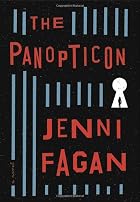
82. The Panopticon: A Novel by Jenni Fagan
Anais Hendricks is fifteen. She has been “in care” ever since her, possibly schizophrenic, mother appeared at a mental institute, gave birth to her, then promptly disappeared. Anais – the name she has settled on, for the time being – has rarely known parental love. And the one time she did form a mother-daughter bond, she later came across her adoptive mother stabbed to death in the bath. What with one thing and another (these things being drugs, underage sex, abuse, theft, battery, and the more than 140 current charges that the police have on the books against her, including assault of a police woman who is now in a coma and may not survive), life isn’t dealing Anais a very good hand. Getting locked up in The Panopticon looks like merely the preliminary step toward permanent incarceration. But despite life’s hard knocks, Anais is, deep inside, a good person, a creative person, and potentially a Queen of the Outcasts (though that last bit of information has been delivered to her by a mad priest). She does have a knack for survival and for friendship. And with her life about to turn one way or the other, Anais has to take things in hand to turn it her way.
Jenni Fagan’s story is at once harrowing and ethereal. Anais’ voice is mesmerizing. Her rigid moral code (despite all the theft and battery) has the reader sympathizing with her plight from the outset. It isn’t always clear whether this novel is heading towards gritty realism or fantasy. Right up until the end, I would have been willing to accept it going either way. At times it even borders on the fantastical. Perhaps the most plausible comparison would be to a graphic novel, or even better a film that appears to be based on a graphic novel (think of Zack Snyder’s Sucker Punch). But there is no escape from Anais’ incredibly harsh reality, no matter how many drugs she does.
I honestly didn’t know what to expect when I picked up this novel, and I’m glad to say that I don’t fully know now what it amounts to. That counts for something with me. Recommended.
169richardderus
Drat you. I almost made it to 2014 without adding another book to the cart.
170RandyMetcalfe
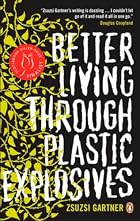
83. Better Living Through Plastic Explosives by Zsuzsi Gartner
Gartner’s short stories are rarely predictable, frequently pushing the boundaries (if there still are any boundaries), sometimes poignant, and almost always awkwardly (or uncannily) funny. I’m struggling to find the right comparator, but Saunders, Homes, and Selecky come to mind.
Many of the stories here involve transformations, both personal and metaphysical. In “Summer of the Flesh Eater”, the inhabitants of a quiet suburban cul-de sac devolve into proto-humans. In “The Adopted Chinese Daughters’ Rebellion”, the multi-cultural extremism of another small suburban community mutates into trans-culturalism. In “We Come in Peace”, discarnate beings incarnate in the bodies of a clutch of suburban children only to learn the lesson that the physical makes its own demands. In “Mister Kakami”, an old growth island off the coast sets its own agenda for the intruding exploiters of its natural charms.
Many of the stories come across as singular, each a tour de force, perhaps, of technique and the well-turned phrase, but lacking roots in emotional insight or psychological truth. It’s as though the high concept, which usually involves a kind of joke, is designed for the graduate student lounge or the sushi wine bar. And in the graduate student lounge, or the sushi wine bar, or the literary journal, they might well be exemplars. But perhaps it is asking too much that they also be something more. Alas, the nagging problem with “metaphysical” storylines is that they risk philosophical scrutiny and that probably puts too great a demand upon the storyteller. Enjoy them for what they are, and pass the sushi.
171RandyMetcalfe
I believe this closes out my reading for the year, so I'll post my top picks from 2013 now.
Five best reads of 2013
To the Lighthouse by Virginia Woolf - A novel of and about attention that fully warrants all the attention you can give it.
My Brilliant Friend by Elena Ferrante - A brilliant friendship beautifully explored. Definitely read everything you can by Ferrante.
Tenth of December by George Saunders - Stories with characters so vulnerable, so susceptible to destruction by themselves and others, that only Saunders’ love for them can sustain them.
Traveling Sprinkler by Nicholson Baker - The welcome return of the sentimental and affecting poet, Paul Chowder.
Birds of America by Lorrie Moore - Less arch, less achingly funny than early Moore, but even more poignant and existentially defiant.
I've left off only Jane Austen's Emma, which tops my top five every year I read it.
Five best reads of 2013
To the Lighthouse by Virginia Woolf - A novel of and about attention that fully warrants all the attention you can give it.
My Brilliant Friend by Elena Ferrante - A brilliant friendship beautifully explored. Definitely read everything you can by Ferrante.
Tenth of December by George Saunders - Stories with characters so vulnerable, so susceptible to destruction by themselves and others, that only Saunders’ love for them can sustain them.
Traveling Sprinkler by Nicholson Baker - The welcome return of the sentimental and affecting poet, Paul Chowder.
Birds of America by Lorrie Moore - Less arch, less achingly funny than early Moore, but even more poignant and existentially defiant.
I've left off only Jane Austen's Emma, which tops my top five every year I read it.

