Virago Remembrance Celebrations, 2014
This topic was continued by Virago Remembrance Celebrations, 2014 - Page Two.
Talk Virago Modern Classics
Join LibraryThing to post.
This topic is currently marked as "dormant"—the last message is more than 90 days old. You can revive it by posting a reply.
1rainpebble
On this day in 2007 Tillie Olsen, author of Tell Me a Riddle passed away. Some of her other works were:
Yonnondio,
Silences,
Mothers to Daughter, Daughter to Mother: Mothers on Mothering: A Daybook and Reader,
Mothers & Daughters: That Special Quality: An Exploration in Photographs with Estelle Jussim, and
The Riddle of Life And Death.
Several of her works were published by the Feminist Press.

Olsen was born to Russian Jewish immigrants in Wahoo, Nebraska and moved to Omaha while a young child. There she attended Lake School in the Near North Side through the eighth grade, living among the city's Jewish community. At age 15, she dropped out of Omaha High School to enter the work force. Over the years Olsen worked as a waitress, domestic worker, and meat trimmer. She was also a union organizer and political activist in the Socialist community. In the 1930s she joined the American Communist party. She was briefly jailed in 1934 while organizing a packing house workers' union (the charge was "making loud and unusual noise"), an experience she wrote about in The Nation and The Partisan Review. She later moved to San Francisco, California, where in 1936 she met and lived with Jack Olsen, who was an organizer and a longshoreman. She married Jack in 1944, on the eve of his departure for service in World War II. San Francisco remained her home until her 85th year when she moved to Berkeley, California, to a cottage behind the home of her youngest daughter.
Yonnondio,
Silences,
Mothers to Daughter, Daughter to Mother: Mothers on Mothering: A Daybook and Reader,
Mothers & Daughters: That Special Quality: An Exploration in Photographs with Estelle Jussim, and
The Riddle of Life And Death.
Several of her works were published by the Feminist Press.

Olsen was born to Russian Jewish immigrants in Wahoo, Nebraska and moved to Omaha while a young child. There she attended Lake School in the Near North Side through the eighth grade, living among the city's Jewish community. At age 15, she dropped out of Omaha High School to enter the work force. Over the years Olsen worked as a waitress, domestic worker, and meat trimmer. She was also a union organizer and political activist in the Socialist community. In the 1930s she joined the American Communist party. She was briefly jailed in 1934 while organizing a packing house workers' union (the charge was "making loud and unusual noise"), an experience she wrote about in The Nation and The Partisan Review. She later moved to San Francisco, California, where in 1936 she met and lived with Jack Olsen, who was an organizer and a longshoreman. She married Jack in 1944, on the eve of his departure for service in World War II. San Francisco remained her home until her 85th year when she moved to Berkeley, California, to a cottage behind the home of her youngest daughter.
2elkiedee
Although she wrote a relatively small amount of fiction, and some of her non fiction book Silences about some of the issues facing women (and many men) finding time and space (in all senses of the word) to write indicates why, Tillie Olsen was also a great supporter of a lot of later women writers - when I was researching my dissertation for my BA more than 20 years ago I came across so many references to Tillie Olsen's work in the writing community.
3rainpebble

On this day in 1902 Stella Gibbons, author of Cold Comfort Farm was born.
Stella Dorothea Gibbons was born & died in London. She died on December 19, 1989. The English novelist and poet whose first novel, Cold Comfort Farm (1932), a burlesque of the rural novel, won for her in 1933 the Femina Vie Heureuse Prize and immediate fame.
The daughter of a London doctor who worked in the poor section of London, she experienced many unhappy years as a child. Depressed by her environment and family life, Gibbons, the eldest of three children, created marvelous fairy tales that she told to her two brothers to help them forget their unhappy situation. Educated at home until she reached her teens, she then attended the North London Collegiate School for Girls and University College, London, where she studied journalism. After graduation she worked for a time for the British United Press as a cable decoder and held various other jobs over a period of 10 years (1923–33), including those of drama and literature critic, reporter, and fashion writer.
Cold Comfort Farm was a popular and critical success but was never equaled by her later work. Her later fiction, although well written, was said by critics to dwindle into magazine entertainment. Gibbons wrote several other novels, including Westwood; or, The Gentle Powers (1946) and Here Be Dragons (1956), two works that deal with a young woman’s disillusionment and education, as well as The Charmers (1965) and Woods in Winter (1970). She also published poetry and four collections of short stories.

4rainpebble
Any one of you please feel free to post your remembrances of authors, or others of importance & interest, to this thread. I am definitely no bleuroses. :-)
Thank you,
belva
Thank you,
belva
5lauralkeet
I think you've picked up the mantle very nicely, Belva! Thank you very much for creating this thread.
6rainpebble
You are very welcome Laura and thank you for your kind words.
7rainpebble
On this day in 1934 Dorothy Edwards, author of Winter Sonata passed away.

She was born August 18th, 1903 and was a Welsh novelist of the early 20th century. Edwards was from Ogmore Vale in South Wales, was educated at Howell's School for girls in Llandaff and at Cardiff University. She was politically active, working for socialist and Welsh nationalist causes, but wrote in English. She was also a talented amateur singer. On January 6th, 1934 she threw herself in front of a train near Caerphilly railway station. She left a suicide note stating: "I am killing myself because I have never sincerely loved any human being all my life. I have accepted kindness and friendship and even love without gratitude, and given nothing in return."
Edwards wrote a short story, The Conquered, which was included in A View Across The Valley (an anthology re-claiming female Welsh nature writers).

She was born August 18th, 1903 and was a Welsh novelist of the early 20th century. Edwards was from Ogmore Vale in South Wales, was educated at Howell's School for girls in Llandaff and at Cardiff University. She was politically active, working for socialist and Welsh nationalist causes, but wrote in English. She was also a talented amateur singer. On January 6th, 1934 she threw herself in front of a train near Caerphilly railway station. She left a suicide note stating: "I am killing myself because I have never sincerely loved any human being all my life. I have accepted kindness and friendship and even love without gratitude, and given nothing in return."
Edwards wrote a short story, The Conquered, which was included in A View Across The Valley (an anthology re-claiming female Welsh nature writers).
8rainpebble
On this day in 1840 author of Cecilia, Fanny Burney, passed away.

She was born in Lynn Regis, now King's Lynn, England on June 13th, 1752 to musical historian Dr Charles Burney (1726–1814) and Mrs Esther Sleepe Burney (1725–62). The third of six children, she was self-educated and began writing what she called her “scribblings” at the age of ten. In 1793, aged forty-two, she married a French exile, General Alexandre D'Arblay. Their only son, Alexander, was born in 1794. After a lengthy writing career, and travels that took her to France for more than ten years, she settled in Bath, England, where she died.


She was born in Lynn Regis, now King's Lynn, England on June 13th, 1752 to musical historian Dr Charles Burney (1726–1814) and Mrs Esther Sleepe Burney (1725–62). The third of six children, she was self-educated and began writing what she called her “scribblings” at the age of ten. In 1793, aged forty-two, she married a French exile, General Alexandre D'Arblay. Their only son, Alexander, was born in 1794. After a lengthy writing career, and travels that took her to France for more than ten years, she settled in Bath, England, where she died.

9kaggsy
Thank you for these posts Belva - always so interesting. I have Winter Sonata on Mount TBR and her life sounds so intriguing and tragic.
10kaggsy

Today is the birthday of Zora Neale Hurston born in Notasulga, Alabama, in 1891. She grew up in Eatonville, Florida, the first incorporated African-American community in the United States, with a population of about 125. When she was 13, her mother died, and her father remarried immediately, so she was sent to a boarding school in Jacksonville, Florida. She was expelled when her father stopped paying her tuition, and she went to live with a series of family members.
She went to Howard University, and cofounded the school's newspaper, The Hilltop. She was offered a scholarship to Barnard College, where she studied anthropology, and she was the college's only black student. She published many short stories in the 1920s and early '30s, and her first book, Mules and Men (1935), was an anthropological study of African-American folklore. She's best known for her novel Their Eyes Were Watching God (1937) published by Virago.
A founding member of the Harlem Renaissance, Hurston died in poverty in 1960 and was buried in an unmarked grave. In 1973, novelist Alice Walker and literary scholar Charlotte Hunt found an unmarked grave in the cemetery where Hurston was buried, and marked it as hers. Alice Walker wrote about the event in her article "In Search of Zora Neale Hurston" (1975), and the article sparked a renewed interest in Hurston's writing.
(basic information courtesy of The Writer's Almanac)
12kaggsy
Strange - that doesn't show up here at the moment. I wonder if it is a geographical or time difference issue??
13Sakerfalcon
It's only on the US google site. I hate when they do that; I could understand if they had a specific UK one on the same day, but why not share the doodle worldwide if there is nothing else special that day? If their reasoning is that ZNH is not well-known over here, then surely all the more reason to draw people's attention to her! *steps down from soapbox*
Here's an image of it
from Time
Here's an image of it
from Time
14kaggsy
Thanks! I think that's really stupid, particulary as we read her over here and Virago is a UK publishing house (or at least were when they started - don't know about now!)
15laytonwoman3rd
Thanks, Claire. I've come across that difference in Google before, but didn't think about the fact that it affect this one. I wonder if we could express our indignation to Google somehow...
EDIT: Yes, at the bottom of the Google page, under "Settings" is a link for feedback. I just sent them a message, summarizing what you both said, Karen and Claire.
EDIT: Yes, at the bottom of the Google page, under "Settings" is a link for feedback. I just sent them a message, summarizing what you both said, Karen and Claire.
17outrageoussocks
Just came by to say that it's not every day a virago is a google highlight...glad it was already noted, though sorry it can't be seen outside the US!

19rainpebble
I have loved her Their Eyes Are Watching God at least twice and perhaps three times. It is a most wonderful book!
20Sakerfalcon
>15 laytonwoman3rd:: Good work, Linda!
21CurrerBell
I've read Their Eyes Were Watching God as well as Jonah's Gourd Vine and a few of the stories, but I'd like to get to the other novels, the autobiography, and some of the folklore. I've got both of her Library of America volumes.
22rainpebble
>21 CurrerBell::
Mike, I loved Jonah's Gourd Vine as well. Hurston is such a fine writer that I believe one would be hard put not to appreciate her work. I would like to get the autobiography too.
Mike, I loved Jonah's Gourd Vine as well. Hurston is such a fine writer that I believe one would be hard put not to appreciate her work. I would like to get the autobiography too.
23kaggsy

Today is the 106th birthday of Simone de Beauvoir (9 January 1908 – 14 April 1986) and she has also been awarded a Google doodle:
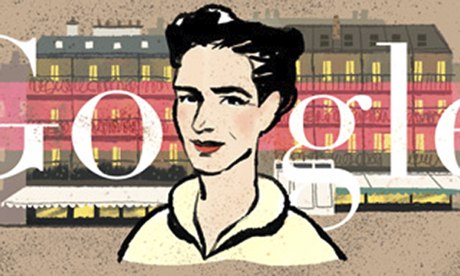
Wikpedia tells us:
"Simone-Lucie-Ernestine-Marie Bertrand de Beauvoir, commonly known as Simone de Beauvoir, was a French writer, intellectual, existentialist philosopher, political activist, feminist, and social theorist. She did not consider herself a philosopher but she had a significant influence on both feminist existentialism and feminist theory. Beauvoir wrote novels, essays, biographies, an autobiography, monographs on philosophy, politics, and social issues. She is best known for her novels, including She Came to Stay and The Mandarins, as well as her 1949 treatise The Second Sex, a detailed analysis of women's oppression and a foundational tract of contemporary feminism."
Her Virago book is All Men are Mortal and her life and work are still inspiring women today.
24rainpebble
On this day in 1923 Katherine Mansfield, author of The Aloe and many short stories, passed away. She was born Katherine Mansfield Beauchamp Murry on October 14th, 1888. She wrote under the name of Katherine Mansfield and was a prominent modernist writer of short fiction who was born and brought up in colonial New Zealand.
When she was 19, Mansfield left New Zealand and settled in the United Kingdom, where she became a friend of modernist writers such as D.H. Lawrence and Virginia Woolf.
During the First World War she contracted extrapulmonary tuberculosis, which led to her death at the age of 34. She suffered a fatal pulmonary hemorrhage in January 1923 after running up a flight of stairs. She died on January 9th and was buried in a cemetery in Avon.
Katherine Mansfield is renowned for her short stories and was a cousin of Elizabeth von Arnim, another writer of Virago. She had three sisters and one brother and was an accomplished cellist. She was known to live a bohemian lifestyle.
You can find a great deal about her life here:
http://en.wikipedia.org/wiki/Katherine_Mansfield

Katherine Mansfield's Birthplace in Thorndon, Wellington.
25CurrerBell
Best wishes to my kid sister, Anne Bronte, who was born January 17, 1820. Here's a portrait I drew of her sometime or other back around 1834....

....when she would have been about fourteen years old and I was about eighteen. (My drawing skills really were every bit as good as brother Branwell's, if I do be permitted to say so.)
Anne, of course, went by the name Acton Bell, and her poetry was really quite good – and many critics today, for some reason or another, think her poetry was even better than mine (though everyone places sister Emily's poetry first, and perhaps I won't quarrel there). We three sisters, in 1846, did publish a set of poems together – Poems by Currer, Ellis, and Acton Bell – but it didn't do very well, only selling two copies, and cost us quite a bit of money and got Papa upset to no end! (You young ladies of today who might have literary aspirations should really be careful of self-publishing.)
In any case, Anne wrote Agnes Grey and published it in 1847 to some success, and subsequently published The Tenant of Wildfell Hall, which I understand many readers of your century find "feminist" but which I, back in my day, thought awfully crude with its drunken husband, so I never republished it after Anne died of tuberculosis in 1849.
I was with Anne in Scarborough when she died, and my dear friend Ellen Nussey joined me and comforted me, and our (Ellen and my) former schoolmistress Miss Wooler also joined us for the funeral. We buried Anne in Scarborough, thinking it would be too much strain for Papa if we returned her body to Haworth.

....when she would have been about fourteen years old and I was about eighteen. (My drawing skills really were every bit as good as brother Branwell's, if I do be permitted to say so.)
Anne, of course, went by the name Acton Bell, and her poetry was really quite good – and many critics today, for some reason or another, think her poetry was even better than mine (though everyone places sister Emily's poetry first, and perhaps I won't quarrel there). We three sisters, in 1846, did publish a set of poems together – Poems by Currer, Ellis, and Acton Bell – but it didn't do very well, only selling two copies, and cost us quite a bit of money and got Papa upset to no end! (You young ladies of today who might have literary aspirations should really be careful of self-publishing.)
In any case, Anne wrote Agnes Grey and published it in 1847 to some success, and subsequently published The Tenant of Wildfell Hall, which I understand many readers of your century find "feminist" but which I, back in my day, thought awfully crude with its drunken husband, so I never republished it after Anne died of tuberculosis in 1849.
I was with Anne in Scarborough when she died, and my dear friend Ellen Nussey joined me and comforted me, and our (Ellen and my) former schoolmistress Miss Wooler also joined us for the funeral. We buried Anne in Scarborough, thinking it would be too much strain for Papa if we returned her body to Haworth.
26rainpebble
Currer, I love this remembrance. A very warm & loving tribute to your sister Anne. And your drawing is truly exquisite.
27CurrerBell
26> Oh, good heavens, Miss Whetstone, I forgot to mention that I based my character of Caroline Helstone (Shirley) on Anne, just as I based the charactor of Shirley Keeldar on Emily.
28rainpebble
LOL!~!
29rainpebble

Nina Bawden was born on this day in 1925. Nina Bawden was a prolific writer of the following Virago:
Family Money,
Circles of Deceit,
The Birds on the Trees,
Tortoise by Candlelight,
A Little Love, A Little Learning,
The Ice House,
A Woman of My Age,
Walking Naked,
Devil by the Sea,
Afternoon of a Good Woman,
George Beneath a Paper Moon,
Ruffian on the Stair,
The Grain of Truth,
Familiar Passions,
Anna Apparent and
A Nice Change, a Virago fiction along with
In My Own Time: Almost an Autobiography, a Virago nonfiction.
She also penned a great many children's stories & Y/A books.
Bawden was an English novelist and children's writer. She was shortlisted for the Booker Prize in 1987 and the Lost Man Booker Prize in 2010. She is one of a select group to have both served as a Booker judge and made the shortlist as an author.
She was raised in Ilford, Essex, in "a rather nasty housing estate that her mother despised". Her mother was a teacher and her father a member of the Royal Marines. She was evacuated during World War II to Aberdare, Wales, at age fourteen. She spent school holidays at a farm in Shropshire with her mother and her brothers.
She attended Somerville College, Oxford, where she gained a degree in Philosophy, Politics and Economics.
From 1946 to 1954 Bawden was married to Harry Bawden. They had two sons, Nicholas (who committed suicide in 1981) and Robert. In 1954 she married Austen Kark, a reporter who eventually rose to managing director of the BBC World Service. They had a daughter, Perdita, who died in March 2012. She also had two stepdaughters: Cathy lives in New Zealand and Teresa in London.
In 2002 Bawden was badly injured in the Potters Bar rail crash, in which her husband Austen Kark was killed. Her testimony about the crash, and the management and maintenance mistakes that caused it, became a major part of David Hare's play The Permanent Way.
Bawden died at her home in north London in August 2012. Her family announced the death on 22 August.
30rainpebble

For those of you who, like myself, are followers of the Bloomsbury group:
Lytton Strachey passed away on this day in the year of our Lord 1932.
He was born March 1st, 1880 and was a British writer and critic.
He was a founding member of the Bloomsbury Group and author of Eminent Victorians. He is perhaps best known for establishing a new form of biography in which psychological insight and sympathy are combined with irreverence and wit. His 1921 biography Queen Victoria was awarded the James Tait Black Memorial.
31kaggsy
Thank you Belva - I have a huge fondness for Carrington and love that picture!
32rainpebble
Oh Karen, that just made my heart smile. I adore Dora Carrington and I too, love the painting. She truly fascinates me. It makes me happy to know that someone else loves her as well. And I love Strachey not only for himself but because she loved him so.
33kaggsy
Belva, that's exactly how I feel. I had a major obsession with her in my twenties and I still love her life and work. She was such a tragic figure and her love for Strachey was illogical and all-consuming. It's so nice to know someone else feels the same way!
34kaggsy

Today is the birthday of Edith Wharton, born in 1862. She had an illustrious career as a novelist and was a Pulitzer Prize-winner, and was nominated for the Nobel Prize in Literature in 1927, 1928 and 1930.
She is known as an astute critic of the upper-class turn-of-the-century society she moved in and some of her best known works are The House of Mirth and The Age of Innocence. She also wrote exemplary short stories and ghost stories, and many of her much-loved works are published by Virago.
Wharton was quite a woman of letters, mixing with authors such as Henry James, Sinclair Lewis, Cocteau and Andre Gide. She spent much of her life living in Paris and died in 1937.
35rainpebble
Wharton wrote so beautifully. And I would most likely kill for that hand muff. Do they even make those any longer? Love the photo as well Karen. Thank you.
36rainpebble
Virginia Woolf was born on this day in 1882. While not a Virago author, at least I am unable find where Virago published her, she is a Persephone author with A Writer's Diary and Flush: A Biography.
The books that always come to my mind when I think of her are Mrs. Dalloway, To the Lighthouse, A Room of One's Own, Orlando: A Biography and Moments of Being. I love all of her works but I will confess to having a special place in my heart for Mrs. Dalloway, A Room of One's Own, and especially Moments of Being.
She was married to Leonard Woolf from 1921 until her death in 1941. During her lifetime she was known for her lifestyle as as well as for her haunting prose. Part of the Bloomsbury group, she was the sister of Vanessa Bell, Thoby & Adrian Stephen.
Suffering from depression and possibly a form of mental illness Virginia Woolf is thought to have committed suicide by drowning herself. She left this note for her husband:
"I have a feeling I shall go mad. I cannot go on any longer in these terrible times. I hear voices and cannot concentrate on my work. I have fought against it but cannot fight any longer. I owe all my happiness to you but cannot go on and spoil your life."
37rainpebble

On this day in 1998 Attia Hosain passed away. She was the author of Sunlight on a Broken Column and Phoenix Fled, both Virago.
"She was born in 1913 into an aristocratic family in Lucknow - a city that is a byword for Muslim scholarship and culture. From her father she inherited a keen interest in politics and nationalism. From her mother's family of poets and scholars she drew a rich knowledge of Urdu, Persian and Arabic. Her knowledge of English came from an English governess, and subsequently as one of the few Indian girls at an English medium school. She was the first woman from her background to take a degree at Lucknow University.
From early on she was a communicator, first through feature articles for Indian papers, the Pioneer and the Statesman, and membership of the radical Progressive Writers' Movement. The fiction came later, as a result - she recently speculated - of politics and dislocation.
In 1947, when India was partitioned into India and Pakistan, Hosain was in London with her husband, who had been posted the year before to the High Commission. The division of the two countries and the separation of two religious communities caused her great pain. Immensely proud of her heritage as both a Muslim and an Indian, she chose to remain in England and bring up her daughter and son - now the film director Waris Hussein - on her own. The change brought her a career as a regular broadcaster with her own women's programme on the BBC World Service and a new perspective.
But the sense of damaged cultural roots never fully died away. "Here I am, I have chosen to live in this country which has given me so much; but I cannot get out of my blood the fact that I had the blood of my ancestors for 800 years in another country." It was that, she said in her last piece - to be published in an anthology later this year - that drove her to write.
In 1953, Chatto and Windus brought out her book of short stories Phoenix Fled. Eight years later came Sunlight on a Broken Column, an evocative and carefully detailed novel which traces, via the story of young Laila, a society in transition. It was over 20 years, however, before the book was widely recognized. Brought out of oblivion by Virago in their splendid Modern Classics in 1988, it re-established Attia Hosain in the public eye and gave her a platform which she embraced with zest."
~taken from her obituary in The Independent

38kaggsy
What a striking woman. I have Sunlight on a Broken Column on my TBR ( I think....)
40kaggsy

Today is the birthday of Colette (shown here with Jean Cocteau).
"Look for a long time at what pleases you, and a longer time at what pains you." This quote from great Parisian writer Colette underlines the author's hawk-eyed approach to life and writing. Known as one of the most astute, brilliant and versatile pens of 20th century French literature, Colette was also an immensely talented journalist, dancer and social commentator. Over her lifetime, she produced around 50 novels and countless tracts and news articles. Among her most famous books are Gigi and Chéri.
For the greater part of the 20th century, France considered Colette its pre-eminent "woman" writer-- but in retrospect she is now widely lauded as one of the century's major literary geniuses, irrespective of sex.
Colette is also often credited for challenging rigid attitudes and assumptions about gender roles. A highly public persona, Colette enjoyed pushing the envelope by appearing in men's clothing, flaunting affairs with women and assigning her fictional characters personality traits or feelings not in line with traditional ideas of masculinity and femininity.
Colette died in 1954 in Paris. She was 81. She is buried at Pere-Lachaise Cemetery.
Virago published one Colette volume, The Other Woman.
41rainpebble
The Other Woman is the only book of Colette's that I have read. Looking back on it I liked it a lot. It was a 4 star read for me and I recall thinking that I wanted to read more by her. Have yet to do that but still intend to.
Thank you Karen.
Also today is the anniversary of the death of Zora Neale Hurston, (1960), who was also born in the month of January. kaggsy has a very nice bio on her in remembrance of that. You can find it on post #10.
She wrote Their Eyes Were Watching God & Jonah's Gourd Vine, both Virago Modern Classics and wonderful works of literature.

Thank you Karen.
Also today is the anniversary of the death of Zora Neale Hurston, (1960), who was also born in the month of January. kaggsy has a very nice bio on her in remembrance of that. You can find it on post #10.
She wrote Their Eyes Were Watching God & Jonah's Gourd Vine, both Virago Modern Classics and wonderful works of literature.

42CurrerBell
Antonia White made a lot of her living by French-to-English translation, and her translations of Colette are highly regarded – especially of the Claudine quartet. (Got to get around to reading them some time.)
43romain
I've read both of the Cheri books and The Other Woman, but my favorite is the Gigi short story. Interestingly I have walked out of only a couple of movies in my life and one of them was Gigi. I was young and I HATED the singing. I also own all the Claudine books and, like Mike, have 'got to get around to reading them some time'.
44Sakerfalcon
I have read the Claudine books and enjoyed them, while thinking that they would be better if she hadn't succumbed to her husband's pressure to "spice them up". They read as though she had fun doing it though. I've read most of what has been translated into English and think the short stories are some of her best work. Also, My mother's house and Sido, which are autobiographical.
45kaggsy
Her short stories *are* excellent, aren't they? I re-read them all a few years back and really loved them.
46Sakerfalcon
>45 kaggsy:: The Penguin Collected Stories is one of my Desert Island books!
47CDVicarage
I read my way through Colette's works in my early twenties and I have a virtually complete collection of the Penguin editions - not quite all matching, unfortunately. I also have a few french editions, I thought that would be a good way to improve my french. It might have worked if I'd actually read them.
49rainpebble
Today is the anniversary of the 1961 death of Angela Thirkell. She was born January 30, 1890 & wrote the Barsetshire series, taking the imagined locale from Anthony Trollope's Chronicles of Barsetshire.
Her first Virago was one of nonfiction: Trooper to the Southern Cross, which is the first Thirkell I read, having not yet heard of her other works. My therapist saw me reading that in her waiting room and was so delighted as Thirkell is one of her favorite authors and Thirkell's books are the only ones that she does not pass on to others. She clued me in to her other works and thus began my collecting of Angela Thirkell works.
Of recent years Virago has gone on to publish her:
High Rising,
Wild Strawberries,
Pomfret Towers and
Christmas at High Rising, a book of short stories which perhaps many of us read during this Christmas season.
One can find much more about Angela Thirkell here:
http://en.wikipedia.org/wiki/Angela_Thirkell
and a comprehensive listing of her books, links included, here:
http://www.angelathirkell.org/atbooks.htm

50CurrerBell
Never heard of her. Interesting, because I'm reading The Warden right now – my first Trollope, and not particularly caring for it. (Trollope makes just about anyone seem progressive, though maybe that's just The Warden!) Anyway, I'll have to look Thirkell up.
51rainpebble

Today is also the anniversary of the 2004 passing of Janet Frame, whose Virago include An Angel at My Table, Faces in the Water and Living in the Maniototo
Janet Frame was born in Dunedin, New Zealand in 1924 into a working class family. She was raised with a love of words, of literature and of nature, and her writing talent was recognised at an early age. However writing, especially for a woman was not regarded as a 'real job'.
"They think I'm going to be a schoolteacher but I'm going to be a poet": taken from her Autobiography, Volume 1.
The fate befalling the young woman who wanted to be a poet has been well documented. Desperately unhappy because of family tragedies and finding herself heading towards the wrong vocation (as a schoolteacher), her only escape appeared to be in submission to society's judgement of her as abnormal. She spent four and a half years out of eight years, incarcerated in mental hospitals. The story of her almost miraculous survival of the horrors and brutalising treatment in unenlightened institutions has become well known. She continued to write throughout her troubled years, and her first book The Lagoon and Other Stories won a prestigious literary prize, thus convincing her doctors not to carry out a planned lobotomy.
She returned to society, but not the one that had labelled her a misfit. She sought the support and company of other writers and set out single-mindedly and courageously to achieve her goal of being accepted as a writer. She wrote her first novel Owls Do Cry while staying in a rented hut in fellow author Frank Sargeson’s back garden, and then left New Zealand, not to return for seven years.
52rainpebble
>50 CurrerBell:;
Angela Thirkell is a lovely writer Mike. Though if the reader is looking for a lot of depth he/she won't find it here. The comparison of Barbara Pym comes to mind with, in my opinion, Thirkell coming out on top. I enjoy her books tremendously but a scholar may not agree. You might give her a try or at least find out more about her to see if you might want to read one of her books.
Angela Thirkell is a lovely writer Mike. Though if the reader is looking for a lot of depth he/she won't find it here. The comparison of Barbara Pym comes to mind with, in my opinion, Thirkell coming out on top. I enjoy her books tremendously but a scholar may not agree. You might give her a try or at least find out more about her to see if you might want to read one of her books.
53rainpebble

Angela Mackall Thirkell was born on this day in 1890.
From the Editorial Observer:
Life, Love and the Pleasures of Literature in Barsetshire
By VERLYN KLINKENBORG
Published: January 4, 2008
"The weather has been cold, the snow deep, the long, dark evenings perfect for holing up with a book. In the past few weeks, I’ve read nine of Angela Thirkell’s Barsetshire novels. I expect to keep going right through all 29 of them, and when I’m done I may start over again. This is a confession of sorts. When I first came upon Thirkell, nearly 30 years ago, she seemed like a diverting minor writer. Minor now seems too slight a word to me for the purveyor of such major pleasures.
Thirkell wrote nearly a novel a year between 1933 and her death in 1961, all set in the fictional English county of Barsetshire — a landscape borrowed from Trollope, who was the prolific author of novels that once seemed more minor than they do now. Unlike Trollope, Thirkell is uninterested in money and politics and ecclesiastical power. Many readers would say she is interested in love, because each of her novels ends with an engagement — the formal sign that hers is a comic universe. But love is just the device that frames her books, that brings them to a point.
One of Thirkell’s characters is Laura Morland, an author of mysteries — one a year — set in the fashion world. “Not but what they are all the same,” Mrs. Morland explains, “because my publisher says that pays better.” Thirkell’s novels are all the same, too. If you cut only the scenes that take place during tea, half of Thirkell would be missing. I’d like to say that her countryside becomes more intricate, novel by novel, but it doesn’t. The war darkens it, and so does England’s dire postwar recovery.
But her continuing characters continue as they’ve always done. Mrs. Brandon wins the heart of every man she sees. Mrs. Morland is forever losing her tortoise-shell hairpins. A young heroine — determined and dutiful — is always falling at last into the arms of a sensible man, who is often her elder by more than a few years.
What interests Thirkell is people talking, and the nonsense they talk. It makes no difference who. It might be the chaotic English of a Mixo-Lydian refugee in a novel set during the war or the inane chatter of the beautiful Rose Fairweather, whose favorite adjectives are “dispiriting” and “shattering,” though she has never been dispirited or shattered. Or the effusive biographer George Knox who, in a fit of illness in the first of these Barsetshire novels, says to his friend, Mrs. Morland, “Even Wordsworth was more interesting that I am at this moment.”
These are novels full of what might be called applied literature, whole lifetimes of shared reading welling up allusively in conversation. The reader hears the constant sound of familiar authors passing back and forth behind the scenes, like servants heading from the kitchen to the dining room in great English houses. And yet the talk is wonderful because it is simply neighborhood gossip. The war encroaches on Barsetshire, but the gossip continues, against a broader, grimmer backdrop.
Thirkell has often been called nostalgic because she is describing a kind of life — English county life — that was vanishing even as her books were appearing. Yet there is nothing nostalgic or sentimental in her tone. She is brusque, judgmental, and also, somehow, tolerant, for without her tolerance these stories would never get off the ground. If she pokes fun at Miss Hampton and Miss Bent, a gay couple living in one of the Barsetshire villages, it is nothing compared to the fun they poke at everyone around them. For every Mr. Bissell — a schoolmaster fond of the word “Cappitleist” — there is a Mrs. Bissell, who is the soul of efficient goodness.
That is one reason to love Thirkell — the simple reassurances these books offer. There are many other reasons, too. As you read her, you can feel the world around you poking and prodding at her text. How do those May-December marriages — contracted with a single kiss — work out in the end? Is there really no crime? No outbursts of repressed rage? Is genteel poverty always resolved by a fortunate marriage? In the end, these questions matter no more than the question of Thirkell’s literary stature. You read her, laughing, and want to do your best to protect her characters from any reality but their own."
I loved this article when I came across it and thought that many of you who read Angela Thirkell would find it interesting as well. At least I hope you did.
Happy Birthday Ms. Angela Thirkell.
(see also post #49)
54rainpebble

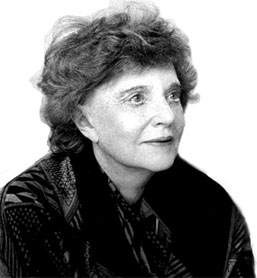
Muriel Spark was born on this day in 1918. Among her Virago are: A Far Cry from Kensington, Loitering with Intent, Symposium and The Comforters. However she is perhaps best known as the author of The Prime of Miss Jean Brodie.
"Dame Muriel Spark, (1 February 1918 – 13 April 2006), was an award-winning Scottish novelist. In 2008 The Times newspaper named Spark in its list of "the 50 greatest British writers since 1945", at #8.
She was born Muriel Sarah Camberg in Edinburgh, the daughter of Sarah Elizabeth Maud (née Uezzell) and Bernard Camberg, an engineer. Her father was Jewish and her mother had been raised a Presbyterian, as was Spark. She was educated at James Gillespie's High School for Girls (1923 – 1935). The family lived in the Bruntsfield area of Edinburgh. In 1934–35 she took a course in "Commercial correspondence and précis writing" at Heriot-Watt College. She taught English for a brief time and then worked as a secretary in a department store.
On 3 September 1937 she married Sidney Oswald Spark, and soon followed him to Rhodesia (now Zimbabwe). Their son Robin was born in July 1938. Within months she discovered that her husband was manic depressive and prone to violent outbursts. In 1940 Muriel left Sidney and Robin. She returned to the United Kingdom in early 1944, taking residence at the Helena Club in London; years later the club would be her inspiration for the fictional May of Teck Club in The Girls of Slender Means. She worked in Intelligence for the remainder of World War II. She provided money at regular intervals to support her son as he toiled unsuccessfully over the years. Spark maintained it was her intention for her family to set up home in England, but Robin returned to Britain with his father later to be brought up by his maternal grandparents in Scotland.
Spark began writing seriously after the war, under her married name, beginning with poetry and literary criticism. In 1947 she became editor of the Poetry Review. In 1953 Muriel Spark was baptized in the Church of England but in 1954 she decided to join the Roman Catholic Church, which she considered crucial in her development toward becoming a novelist. Penelope Fitzgerald, a fellow novelist and contemporary of Spark, wrote that Spark "had pointed out that it wasn't until she became a Roman Catholic... that she was able to see human existence as a whole, as a novelist needs to do." In an interview with John Tusa on BBC Radio 4, she said of her conversion and its effect on her writing: "I was just a little worried, tentative. Would it be right, would it not be right? Can I write a novel about that — would it be foolish, wouldn't it be? And somehow with my religion — whether one has anything to do with the other, I don't know — but it does seem so, that I just gained confidence…" Graham Greene and Evelyn Waugh supported her in her decision.
Between 1955 and 1965 she lived in a bedsit at 13 Baldwin Crescent, Camberwell, south-east London. Her first novel, The Comforters, was published in 1957. It featured several references to Catholicism and conversion to Catholicism, although its main theme revolved around a young woman who becomes aware that she is a character in a novel.
The Prime of Miss Jean Brodie (1961) was more successful. Spark displayed originality of subject and tone, making extensive use of flashforwards and imagined conversations. It is clear that James Gillespie's High School was the model for the Marcia Blaine School in the novel.
After living in New York City for some years, she moved to Rome, where she met artist and sculptor Penelope Jardine in 1968. In the early 1970s they settled in Tuscany, in the village of Civitella della Chiana, of which in 2005 Spark was made an honorary citizen. She was the subject of frequent rumours of lesbian relationships from her time in New York onwards, although Spark and her friends denied their validity. She left her entire estate to Jardine, taking measures to ensure that her son receive nothing.
Spark refused permission to publish a biography of her written by Martin Stannard. Penelope Jardine now holds publication approval rights, and the book was published in July 2009. On 27 July 2009 Stannard was interviewed on Front Row, the BBC Radio 4 arts programme. According to A. S. Byatt, "She, Jardine, was very upset by the book and had to spend a lot of time going through it, line by line, to try to make it a little bit fairer".
Spark received the James Tait Black Memorial Prize in 1965 for The Mandelbaum Gate, the US Ingersoll Foundation T. S. Eliot Award in 1992 and the David Cohen Prize in 1997. She became Dame Commander of the Order of the British Empire in 1993, in recognition of her services to literature. She has been twice shortlisted for the Booker Prize, in 1969 for The Public Image and in 1981 for Loitering with Intent. In 1998, she was awarded the Golden PEN Award by English PEN for "a Lifetime's Distinguished Service to Literature". In 2010, Spark was shortlisted for the Lost Man Booker Prize of 1970 for The Driver's Seat.
Spark and her son Robin had a strained relationship. They had a falling out when Robin's Orthodox Judaism prompted him to petition for his late grandmother to be recognized as Jewish (Spark's maternal grandmother, Adelaide Hyams, had married Spark's maternal grandfather, Tom Uezzell, in a church; it was unclear whether both of Adelaide's parents were Jewish). The devout Catholic Spark reacted by accusing him of seeking publicity to further his career as an artist. During one of her last book signings in Edinburgh she responded to an enquiry from a journalist asking if she would see her son by saying 'I think I know how best to avoid him by now'."
~from Wikipedia
55kaggsy
Thank you Belva. I've loved all the Sparks I've read so far so it's nice to think of her on her birthday.
56rainpebble

Today we celebrate the birth of Gertrude Stein who was born in 1874. She is the author of the Virago Blood on the Dining Room Floor but is perhaps better known for The Autobiography of Alice B. Toklas and for her love/hate relationship with Papa, ie Ernest Hemingway.
""Stein was an American writer of novels, poetry and plays that eschewed the narrative, linear, and temporal conventions of 19th-century literature, and a fervent collector of Modernist art. She was born in West Allegheny (Pittsburgh), Pennsylvania, raised in Oakland, California, and moved to Paris in 1903, making France her home for the remainder of her life.
For some forty years, the Stein home at 27 rue de Fleurus on the Left Bank of Paris was a renowned Saturday evening gathering place for both expatriate American artists and writers and others noteworthy in the world of vanguard arts and letters, most notably Pablo Picasso. Entrée into the Stein salon was a sought-after validation, and Stein became combination mentor, critic, and guru to those who gathered around her, including Ernest Hemingway, who described the salon in A Moveable Feast.
In 1933, Stein published a kind of memoir of her Paris years, The Autobiography of Alice B. Toklas, written in the voice of Toklas, her life partner. The book became a literary bestseller and vaulted Stein from the relative obscurity of cult literary figure into the light of mainstream attention."
~gleaned from Wikipedia
57rainpebble

Today we also celebrate the birthdate in 1901 of the lovely Rosamond Lehmann, author of the Virago The Invitation to the Waltz, Dusty Answer, Ballad and the Source, A Note in Music, The Echoing Grove, The Weather in the Streets, The Gipsy's Baby, A Sea-Grape Tree, & the nonfiction Virago The Swan in the Evening: Fragments of an Inner Life.
"Rosamond Nina Lehmann, CBE (3 February 1901 - 12 March 1990), was a British novelist. Her first novel, Dusty Answer (1927), was a succès de scandale; she subsequently became established in the literary world and intimate with members of the Bloomsbury set. Her novel The Ballad and the Source received particular critical acclaim and both The Echoing Grove and The Weather In The Streets were filmed after her death.
Rosamond Lehmann was born in Bourne End, Buckinghamshire, the second of four children of Rudolph Chambers Lehmann (1856-1929) and his American wife Alice Mary Davis (1873-1956), from New England. Rosamond's father was a Liberal MP, founder of Granta magazine and editor of the Daily News. Her older sister was Helen Chambers Lehmann (1899-1985) and her younger sister was the actress Beatrix Lehmann (1903-1979). Her younger brother was John Lehmann (1907–1989), the writer and publisher. The American playwright Owen Davis was her cousin, and her great-grandfather Robert Chambers founded Chambers Dictionary. Her great-uncle was the artist Rudolf Lehmann.
Home educated, in 1919 she won a scholarship to Girton College, University of Cambridge. She graduated with a second class degree in both English Literature (1921) and Modern and Medieval Languages (1922). In December 1923 she married Walter Leslie Runciman (later 2nd Viscount Runciman of Doxford) (1900–1989), and the couple went to live in Newcastle upon Tyne. It was an unhappy marriage: they separated in 1927 and were divorced later that year.
In 1927, Lehmann published her first novel, Dusty Answer, to great critical and popular acclaim. The novel's heroine, Judith, is attracted to both men and women, and interacts with fairly openly gay and lesbian characters during her years at Cambridge. The novel was a succès de scandale. Though none of her later novels were as successful as her first, Lehmann went on to publish six more, as well as a play (No More Music, 1939), a collection of short stories (The Gypsy's Baby & Other Stories, 1946), a spiritual autobiography (The Swan in the Evening, 1967), and a photographic memoir of her friends (Rosamond Lehmann's Album, 1985), many of whom were famous Bloomsbury figures such as Leonard and Virginia Woolf, Dora Carrington, and Lytton Strachey. She also translated two French novels into English: Jacques Lemarchand's Genevieve (1948) and Jean Cocteau's Children of the Game (1955). Her novels include A Note in Music (1930), Invitation to the Waltz (1932), The Weather in the Streets (1936), The Ballad and the Source (1944), The Echoing Grove (1953), and A Sea-Grape Tree (1976).
In 1928, Lehmann married Wogan Philipps, 2nd Baron Milford, an artist. They had two children, a son Hugo (1929–1999) and a daughter Sarah, also known as Sally (1934–1958). The family lived at Ipsden House in Oxfordshire between 1930 and 1939. The marriage fell apart during the late Thirties with her husband leaving to take part in the Spanish Civil War. During World War II Lehmann helped to edit and also contributed to New Writing, a periodical edited by her brother, John Lehmann. She had an affair with the journalist Goronwy Rees and then a "very public affair" for nine years (1941–1950) with the married poet Cecil Day-Lewis, who eventually left her to marry his second wife, Jill Balcon."
~from Wikipedia
58rainpebble
On this day in 1977 we lost Ruth Adam, author of I'm Not Complaining, a Virago. She also wrote A Woman's Place: 1910-1975 which was published by Persephone.
59kaggsy
Thank you Belva - I have read and enjoyed both Stein and Lehmann, and have I'm Not Complaining on Mount TBR!
60rainpebble
>59 kaggsy::
Karen, I don't know that I enjoy Stein's writings so much as I enjoy reading bios of her and of others that include her. She had a very strong and fascinating persona.
(thank you kaggsy)
Karen, I don't know that I enjoy Stein's writings so much as I enjoy reading bios of her and of others that include her. She had a very strong and fascinating persona.
(thank you kaggsy)
61rainpebble

Today we observe the 2006 passing of Deborah Kellaway, who edited The Virago Book of Women Gardeners. She also wrote the introduction for The Solitary Summer by Elizabeth von Arnim. Her passions were gardening & writing.
She wrote The Making of an English Country Garden about she and her husband creating their 1 acre garden in Norfolk. Both of her daughters grew up to become journalists.
62rainpebble

Today we observe the 1941 passing of Elizabeth von Arnim, who wrote the beloved Virago titles as:
The Enchanted April,
Elizabeth and Her German Garden,
The Solitary Summer,
Vera,
The Adventures of Elizabeth in Rugen,
Mr. Skeffington,
The Pastor's Wife,
The Caravaners,
Christopher and Columbus,
All the Dogs of My Life,
Fraulein and Mr Anstruther, and
Love, (unable to find touchstone).
63kaggsy
Thank you Belva. I was lucky enough to find a beautiful condition copy of Fraulein Schmidt and Mr Anstruther on a visit to London yesterday - picture will follow when I am more organised!
64rainpebble
I look forward to seeing it Karen. Am wondering if the cover art is different than mine.
65rainpebble

Today we observe the 1998 passing of the lovely Martha Gellhorn, notable journalist and author the Virago A Stricken Field and Liana. The very beautiful The Weather in Africa was also authored by her.
As a journalist she was considered by many to be one of the greatest war correspondents of the 20th century. She reported on every major world conflict that took place during her 60-year career.
Gellhorn was the third wife of American novelist Ernest Hemingway.
At the age of 89, ill and almost completely blind, she committed suicide.
66laytonwoman3rd
I really enjoy Martha Gellhorn's work. The Weather in Africa has been on my wishlist for a long time. What a dame! (As I'm sure Ernest must have said about her sometime!)
67rainpebble
I am quite sure of that Linda. And that book is marvelous!
68rainpebble

Yesterday we observed the 1992 passing of Angela Carter. Carter authored several VMCs, among them: The Magic Toyshop, The Passion of New Eve, Shadow Dance, Fireworks, & Several Perceptions. She also wrote Virago fiction & edited more than one compilation of Virago shorts. Angela Carter has a great number of works to her credit.
In 2008, The Times ranked Carter tenth in their list of "The 50 greatest British writers since 1945". In 2012, Nights at the Circus was selected as the best ever winner of the James Tait Black Memorial Prize.
At the time of her death, Carter had started work on a sequel to Charlotte Brontë's Jane Eyre based on the later life of Jane's stepdaughter, Adèle Varens; only a synopsis survives.
Angela Carter died aged 51 in 1992 at her home in London after developing lung cancer.
Reading about her life & times, Angela Carter was a fascinating woman and went to great lengths to learn about herself, other women & the world around her.
69rainpebble

On this date in 1879 Dorothy Canfield Fisher was born.
She is noted for her Persephone, The Home-Maker as well as the VMCs The Brimming Cup and Her Son's Wife.
Canfield "was an educational reformer, social activist, and best-selling American author in the early decades of the twentieth century. She strongly supported women's rights, racial equality, and lifelong education. She was named by Eleanor Roosevelt as one of the ten most influential women in the United States. In addition to bringing the Montessori method of child-rearing to the United States, she presided over the country's first adult education program, and shaped literary tastes by serving as a member of the Book of the Month Club selection committee from 1925 to 1951."
~ Wikipedia
I found it quite interesting that she was named for Dorothea Brooke of Middlemarch. If one looks to find out more about this author & humanitarian there is much to be learned. She was a woman of many ideas and she carried a great deal of them through. Her personal life is also very interesting.
70rainpebble

Today we observe the 1902 birth of Virago author Kay Boyle who wrote
My Next Bride, Year Before Last & Plagued by the Nightingale, all published by Virago, plus many other books and collections.
Boyle was an American writer, educator, and political activist. She, along with husband Baron Joseph von Franckenstein, were victims of early 1950s McCarthyism. Her husband was dismissed by Roy Cohn from his post in the Public Affairs Division of the U.S. State Department and Boyle lost her position as foreign correspondent for The New Yorker, a post she had held for six years. She was blacklisted by most of the major magazines. During this period, her life and writing became increasingly political.
KayBoyle died at a seniors home in Mill Valley, California, in 1992.
71rainpebble

Today we observe the 1903 birth of Anaïs Nin, author of Delta of Venus and of the Virago The Four-Chambered Heart.
Anaïs Nin was born to Spanish-Cuban parents in France, where she was also raised. She spent some time in Spain and Cuba but lived most of her life in the United States where she became an established author. She published journals which span more than 60 years, beginning when she was 11 years old and ending shortly before her death, novels, critical studies, essays, short stories, and much erotica. A great deal of her work, including Delta of Venus and Little Birds, was published posthumously.
She died in 1977.
72rainpebble

Also today we observe the anniversary of the 2002 passing of A.L. Barker. Born Audrey Lilian Barker in 1921, she was an English novelist and short story writer. She was born in St Pauls Cray, Kent and brought up in Beckenham. During her lifetime she published ten collections of short stories and eleven novels, one of which, John Brown's Body, was shortlisted for the Booker Prize in 1970. She was also the winner of the inaugural Somerset Maugham Prize in 1947 with her collection of short stories called Innocents.
Her Virago publications are John Brown's Body, Submerged and The Gooseboy. She also has some Virago fiction to her credit. Among them The Haunt and A Case Examined.
73rainpebble

Today we remember Jane Bowles on the anniversary of her birth in 1917. Bowles authored two Virago Modern Classics: Two Serious Ladies and Everything Is Nice: The Collected Stories. Her total body of work consists of one novel, one play and six short stories.
Tennessee Williams once said of Bowles that she was "the most underrated writer of fiction in American literature." And John Ashbury said of her: "It is to be hoped that she will be recognized for what she is: one of the finest modern writers of fiction in any language."
Since her death in 1973, she has been considered a writer's writer, little known to the general public but with a loyal following of intensely devoted readers.
74rainpebble

Not a Virago author but I mention her here because I know that so many of we Viragoites read & love her body of work.
Elizabeth Bowen passed away on this date in 1973.
Edited to state that indeed Elizabeth Bowen is a Virago author. She has a Virago nonfiction: Bowen's Court.
So Yea!~! I have long thought that she should be a Virago author and kaggsy kindly let me in on the fact that she is.
75kaggsy
Thank you for all your work on this thread Belva - and for reminding me to look out for Everything is Nice!
Indeed, we do love Bowen - and what a beautiful picture of her. Does the fact that Virago published Bowen's Court (non fiction) allow us to include her in?
Indeed, we do love Bowen - and what a beautiful picture of her. Does the fact that Virago published Bowen's Court (non fiction) allow us to include her in?
76rainpebble
>75 kaggsy::
Indeed Karen, that would make Elizabeth Bowen a Virago author. I didn't realize. Thank you. I will go back up and change that and it makes me so happy to know that Virago has published her. The first Bowen I read was A World of Love and I recall that even as I was reading the book, thinking: "This should be a Virago." Of course it's not but............
And yes, she was beautiful. Thank you again.
Indeed Karen, that would make Elizabeth Bowen a Virago author. I didn't realize. Thank you. I will go back up and change that and it makes me so happy to know that Virago has published her. The first Bowen I read was A World of Love and I recall that even as I was reading the book, thinking: "This should be a Virago." Of course it's not but............
And yes, she was beautiful. Thank you again.
77rainpebble

On this date in 1892 Agnes Smedley was born. She authored the Virago Daughter of Earth, an autobiographical novel.
She was born in Osgood, Missouri on, the second of five children. When she was nine she and her family moved to Trinidad, Colorado, where she witnessed many of the events in the 1903-04 coal miners' strike. Her father worked for several of the coal companies in Colorado and the family moved back and forth across southwestern Colorado. At the age of 17, Smedley took the county teacher's exam and taught in rural schools near her home for a semester. She returned home when her mother became ill and died.
Later that year she enrolled in a business school in Greeley, Colorado. Suffering from physical and emotional stress in 1911, she checked into a sanatorium. A family friend in Arizona offered her a place to stay after she was discharged, and from 1911 to 1912 Smedley was enrolled in Tempe Normal School. She published her first writings as editor and contributor to the school paper. At Tempe she became friends with a woman named Thorberg Brundin and her brother Ernest Brundin. Both were members of the Socialist Party and gave Smedley her first exposure to socialist ideas. When the Brundins left Tempe for San Francisco, they invited her to come stay with them, and in August 1912 she married Ernest. After six years of marriage they divorced and she moved to New York City where among other new activities she worked with Margaret Sanger at the Birth Control Review.
She was known for her sympathetic chronicling of the Communist forces in the Chinese Civil War. During World War I, she worked in the United States for the independence of India from the United Kingdom, receiving financial support from the government of Germany, and for many years worked for or with the Comintern, frequently in an espionage capacity. As the lover of Soviet super spy Richard Sorge in Shanghai in the early 1930s, she helped get him established for his final and greatest work as spymaster in Tokyo. She also worked on behalf of various causes including women's rights, birth control, and children's welfare. Smedley wrote six books including a novel, reportage, and a biography of the Chinese general Zhu De. She was a reporter for newspapers such as New York Call, Frankfurter Zeitung and Manchester Guardian, and wrote for periodicals such as the Modern Review, New Masses, Asia, New Republic, and Nation.
I was unable to find out much about Ms. Smedley other than her early years and her Chinese communistic/spy connections.
78rainpebble
Please, any of you who find errors in my posts I would love it if you would post a correction here for me. I have even made the mistake of putting up an incorrect photo for an author. :-(
But yes, please do let me know.
Also if any of you would like to put up a remembrance post please feel free to do so. This is definitely not my thread. It belongs to all of us.
Happy Sunday, one and all.
hugs all round,
belva
But yes, please do let me know.
Also if any of you would like to put up a remembrance post please feel free to do so. This is definitely not my thread. It belongs to all of us.
Happy Sunday, one and all.
hugs all round,
belva
79kaggsy
Thanks Belva, and for all your work. I do put up the occasional post when something turns up but you are so much more on the ball!
Hugs to you to!
Hugs to you to!
80rainpebble
Thanks Karen. I appreciate it.

82NanaCC
Peyton Place was the first book I ever read on the sly while I was babysitting, maybe 1960. My mother would have been horrified. :)
83rainpebble
I am sure Colleen that she would have been! Most parents probably would have been.
We were very fortunate growing up. I don't recall ever reading anything on the sly as my parents were very into books ........ & NO T.V. in the house. I am sure they may not have been pleased with all of our literary choices but I cannot remember any of the 7 of us kids ever being told we could not read a particular book and I do remember my sister reading Candide, A Clockwork Orange and Lolita. One very positive thing I can say about my mother; she was open minded about all literature. We kids (& my parents as well), always had a book at the ready. My Pop only had a 6th grade education and yet he was one of the most well read & well spoken men I have every come to know.
We were very fortunate growing up. I don't recall ever reading anything on the sly as my parents were very into books ........ & NO T.V. in the house. I am sure they may not have been pleased with all of our literary choices but I cannot remember any of the 7 of us kids ever being told we could not read a particular book and I do remember my sister reading Candide, A Clockwork Orange and Lolita. One very positive thing I can say about my mother; she was open minded about all literature. We kids (& my parents as well), always had a book at the ready. My Pop only had a 6th grade education and yet he was one of the most well read & well spoken men I have every come to know.
84NanaCC
Belva, I didn't mean to give the impression that my mother ever told me not to read a particular book. She was an avid reader too. I read the book at a house where I was babysitting after the kids went to bed. I just can't imagine my mother ever having that book in our house, and I remember thinking that she would have been horrified. But that was my 13 year old mind telling me that.
85rainpebble
Sometimes our parents fool us, don't they? I don't think my mother would have 'purchased' Peyton Place either. Wasn't it wonderful growing up amidst readers?
I loved growing up in a house filled with 9 readers. There was always a great conversation going on in one corner or another.
I loved growing up in a house filled with 9 readers. There was always a great conversation going on in one corner or another.
86rainpebble
(Think I can fudge and sneak this one in? We'll see.)
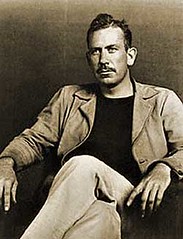
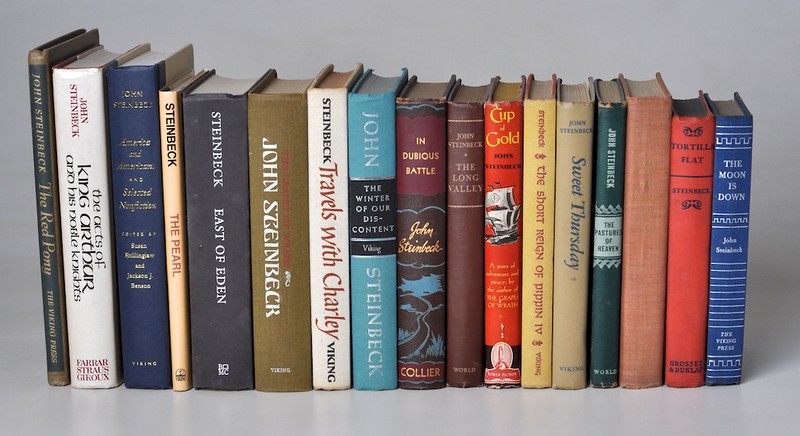
Today I honor my favorite author, John Steinbeck, born on this day in 1902. My favorite of all of his works is The Winter of Our Discontent. It is also the first of his novels that I read & I was in the 5th grade.
Today I honor my favorite author, John Steinbeck, born on this day in 1902. My favorite of all of his works is The Winter of Our Discontent. It is also the first of his novels that I read & I was in the 5th grade.
87laytonwoman3rd
>86 rainpebble: Well, very sneaky, Belva. Although I must say, I will give you a pass on this one. I read Steinbeck pretty early too, and was just mesmerized by his words. I think, in honor of his birthday, I will go settle in for a re-read of The Pearl. (Sounds like it could be a Virago title.)
88CurrerBell
86> That's quite alright, Belva, I might just try to sneak Papa in one of these days. (He did publish a collection called Cottage Poems, you know.)
89kaggsy
What a lovely picture! Travels with Charley and A Russian Journal are my favourite - though I am very fond of Cannery Row too!
90rainpebble
>89 kaggsy::
Wasn't he a gorgeous man? And such a man! Also Tortilla Flat Karen. C.R. & T.F. just crack me up every time I read them! And I always have to read them in tandem. Weird, eh?
>88 CurrerBell::
"Oh my Papa, to me he was so wonderful." I know most do not, but I love him Mike! And yes he did publish that work.
>87 laytonwoman3rd::
Yes Linda. It was a test to see if anyone really reads this stuff. lol!~! The Pearl does sound Viragoish and today would be a perfect day for that read.
I remember feeling quite that same way by his prose. It still has that effect on my. I know that he gave the world a lot but I do so wish there was even more.
Wasn't he a gorgeous man? And such a man! Also Tortilla Flat Karen. C.R. & T.F. just crack me up every time I read them! And I always have to read them in tandem. Weird, eh?
>88 CurrerBell::
"Oh my Papa, to me he was so wonderful." I know most do not, but I love him Mike! And yes he did publish that work.
>87 laytonwoman3rd::
Yes Linda. It was a test to see if anyone really reads this stuff. lol!~! The Pearl does sound Viragoish and today would be a perfect day for that read.
I remember feeling quite that same way by his prose. It still has that effect on my. I know that he gave the world a lot but I do so wish there was even more.
91rainpebble

Today we observe the 1988 birth of F. Tennyson Jesse, author of the VMCs The Lacquer Lady, A Pin to See the Peepshow and Moonraker.
Fryniwyd Tennyson Jesse, born Wynifried, also recorded as Winifred Margaret Jesse, grew up to become an English criminologist, journalist and author. She also wrote as Wynifried Margaret Tennyson. She was the second of three daughters of the Reverend Eustace Tennyson D'Eyncourt Jesse, and a great-niece of the poet Alfred Lord Tennyson. She married Harold Marsh Harwood, (1874–1959), a businessman and theatre manager, in September pf 1918. "Fryn", as she was known to all of her friends, is a self-made contraction of "Wynifried". She first used her pen-name when she was 19 but adopted it for the remainder of her life.
Her A Pin To See the Peepshow, (Virago Modern Classics), a fictional treatment of the case of Edith Thompson and Frederick Bywaters, and Murder & Its Motives, (London, W. Heinemann Ltd., 1924), which divided killers into six categories based on their motivations: those who murder for Gain, Revenge, Elimination, Jealousy, Conviction and Lust of killing. This classification of motive has remained influential.
She also wrote the neglected classic, The Lacquer Lady, (Virago Modern Classics), which recounts the true story of how European Maid of Honour, Fanny, helped bring about the fall of the Burmese Royal Family at the end of the nineteenth century.
At the outbreak of war in 1914, Fryn asked The Daily Mail to send her to Belgium to report on the war for the paper, and she reported from Antwerp, including from the front-line, until she was forced out by the German occupation of the city. The Daily Citizen wrote of her “To my mind, quite the most brilliant ... is Miss F Tennyson Jesse, who has been doing splendid work in Belgium. Not only has she an infallible nose for news, but she has unlimited courage. Best of all she can write.” In 1915 she went to Holland, and later she went a number of times into France to report on the state of the Red Cross hospitals there and to write about what was then called The Women’s Army. She also reported on the German attacks on Belgium for Collier's Weekly.
She still found time throughout the war to write novels, plays, short stories and poetry and she also met her future husband, a budding playwright called Harold Harwood, whom she always called Tottie. They collaborated on plays as well as writing their own. They were eventually married in 1918. She was 30 and he was 44. They had no children. They were able to run two houses on their financial successes; in the winter they would stay in a house in Provence, and in the summer at a house near Goodwood, Sussex. They continued these arrangements until 1937 when they moved to London, to a smaller house in St John’s Wood.
Fryn had 36 works published during her life, including 9 novels, (her most famous being “A Pin to see the Peepshow”), 3 books of short stories, 2 volumes of poems, 9 plays, 8 books of criminology, 1 history book (The Story of Burma), 2 collections of letters from London in the early days of the 1939/45 war, and 4 books of collected essays, including ‘The Sword of Deborah” a picture of the lives of women during the Great War. She collaborated with her husband in the writing and production of 7 plays.
She died on August 6th, 1958.
92kaggsy
Thank you Belva - I absolutely adored A Pin to see The Peepshow - it's one my favourite Viragos.
93rainpebble

Also today we remember Antonia White. She was born on this day in 1899 and authored Frost in May, the very first Virago Modern Classic.
For some untold reason I was amazed at her beauty.
White was born as Eirine Botting to parents Cecil and Christine Botting. She later took her mother's maiden name. Her father taught Greek and Latin at St. Paul’s School. She was baptized in the Protestant Church of England but converted to Roman Catholicism at the age of 7 when her father converted. She struggled with religion and did not feel that she fit in with the other girls at her school, many of whom were from upper-class Catholic families. She attended the Convent of the Sacred Heart, Roehampton.
Although she is remembered as a modernist writer, she developed a terrible fear of writing after a misunderstanding when she was 15. She had been working on what was going to her first novel, which was to be a present for her father. She wanted to surprise him with a book about wicked people whose lives are changed as they discover religion. She attempted to give a detailed description of the evil characters. But because of her lack of experience, she was unable to describe their wickedness except to say that they “Indulged in nameless vices”. The story was found unfinished by officials at her Catholic school and she was then expelled from the school without being given the opportunity to explain her book. She describes this incident as being her most vivid and tragic memory. “My superb gift to my father was absolutely my undoing” she remarked in an interview. She did not begin writing novels again until 20 years later, when her father died.
After she was expelled from the convent at Roehampton, she attended St. Paul’s Girls' School (the sister school to St Paul's School where her father taught), but did not fit in there either. When she left school she attempted to become an actress, but was unsuccessful. She then wrote for magazines and worked in advertising, where she earned £250 a year promoting Mercolized wax. She spent nine years working as a copywriter in London and she also worked for the BBC as a translator. Antonia White's translations of Colette's Claudine novels were recognized for their elegance and erudition and remain the standard texts today.
In 1921 she was married to the first of her three husbands. The marriage was annulled only 2 years later, and reportedly was never consummated. She immediately fell in love again with a man named Robert, who was an officer in the Scots Guards. They never married and their relationship was brief but intense, which led to her experiencing a severe mental breakdown. She was committed to Bethlem, a public asylum, where she spent the next year of her life.
She had described her breakdown as a period of “mania”. After she left the hospital, she spent four years participating in Freudian studies. She struggled the rest of her life with mental illness which she referred to as “The Beast”.
Her second marriage was to a man named Eric Earnshaw Smith, but this marriage ended in divorce. By the age of 30, she had been married 3 times. During her second marriage, she had fallen in love with two men. One was Rudolph 'Silas' Glossop, described as “a tall handsome young man with a slightly melancholy charm”. The other was Tom Hopkinson, then a copywriter. She had trouble deciding whom she should marry following her divorce, and she married Hopkinson in 1930. She had two daughters, Lyndall Hopkinson and Susan Chitty, who have both written autobiographical books about their hard and difficult relationship with their mother.
By 1931 she was married to Tom Hopkinson and was friends with novelist Djuna Barnes, and she was with Barnes when the latter wrote her now famous novel depicting a lesbian affair gone bad, Nightwood. This novel was based on Barnes's relationship with Thelma Wood. In 1933, White completed her first novel, Frost in May, which fictionalized her experiences at Catholic boarding school and her expulsion. She also began writing a second novel but a failed marriage and mental illness hindered its completion.
Fifteen years later she completed her second novel The Lost Traveller, which was published in 1950. In the subsequent five years, after undergoing treatment for mental illness and reconverting to Catholicism, she completed the Clara Batchelor trilogy, which includes The Lost Traveller, about her relationship with her mother and father, The Sugar House, about her first unconsummated marriage, and Beyond the Glass, about an intense love-affair followed by a breakdown which is vividly described. As with her previous work, the trilogy was fictional, but mainly autobiographical. The four novels together narrate her life from ages 9 to 23. In 1966, she published a collection of letters entitled The Hound and the Falcon: The Story of a Reconversion to the Catholic Faith. She wrote Three in a Room, a three-act comedy, as well as many short stories, poems and juvenile fiction.
Her career as a writer seems to have been driven by the desire to cope with a sense of failure, resulting initially from her first attempt at writing, and with mental illness. She was quoted as saying, “The old terrors always return and often, with them, a feeling of such paralyzing lack of self-confidence that I have to take earlier books of mine off their shelf just to prove to myself that I actually wrote them and they were actually printed, bound, and read. I find that numbers of writers experience these same miseries over their work and do not, as is so often supposed, enjoy the process. "Creative joy" is something I haven't felt since I was fourteen and don't expect to feel again."
With regard to the content of her writing, White remarked, “My novels and short stories are mainly about ordinary people who become involved in rather extraordinary situations. I do not mean in sensational adventures but in rather odd and difficult personal relationships largely due to their family background and their incomplete understanding of their own natures. I use both Catholic and non-Catholic characters and am particularly interested in the conflicts that arise between them and in the influences they have on each other.” Two of the main themes in White’s novels are her relationship with her father and her Catholic faith.
(most of this was gleaned from Wikipedia)
Her Virago Modern Classics include:
Frost in May, Lost Traveller, Sugar House, Beyond the Glass, Stranger, and As Once in May.
She also authored The Hound and the Falcon & Antonia White: Diaries (Vol. 1, 1926-1957), both Virago nonfiction.
Antonia White died April 10th, 1980.
______________________________________________________________
I had completed this when I came across this site: http://catholicauthors.com/
There I found this article that Antonia White had written about herself and found it very interesting. I thought that you might as well.
Antonia White
"I SUPPOSE IT IS NATURAL FOR AN ONLY CHILD MUCH addicted to reading to take early to writing. I think I was five when I first began to 'compose' on my own, using very pompous language copied from the Victorian children's books on my grandmother's shelves. Like all children, I found it difficult to finish the works so enthusiastically begun. However, when I was seven, I found a most satisfactory solution to this problem: I discovered the blurb. So instead of laboriously composing books, I took to writing highly flattering reviews of works by myself. Nothing of these existed but their titles, but I got as much satisfaction out of the self-written reviews as if I had actually produced the volumes I attributed to my 'versatile pen.' Now, fifty years later, it still gives me a curiously unreal feeling to read press-notices of my own novels. I think I find it hard to realize that the book really exists and is not just a figment of my imagination.
I was born in 1899 and baptized a Protestant. In 1906, my father, who was a schoolmaster, became a Catholic and thereby prevented himself from ever becoming a headmaster of any of the English Public Schools. My mother was converted along with him. It is her maiden name of White that I use as a writer. Her brother, Victor White, emigrated to the United States and became a naturalized American citizen. The portrait of my great-great grandfather by Sir Thomas Lawrence now hangs in the Art Gallery of Omaha, Nebraska, and, if ever I visit the United States, I shall go and look at that portrait which I remember so well from my childhood. I was received into the Church at seven. At nine, I went to a convent school and it was there on my fifteenth birthday, that something happened that affected my whole writing life. It was one of those tragi-comic misunderstandings, but it gave me a shock from which I have never quite recovered. Up to that day, I had thoroughly enjoyed writing. I was monotonously 'top in composition' in class and, on freestudy afternoons, I would write stories and poems for the sheer pleasure of it. These would often be carefully copied into exercise books and presented to my parents and grandparents. When I was fourteen, I planned something really ambitious months ahead as a surprise for my father's birthday,-nothing less than a full-length novel. My father was the person I most loved and feared in the whole world, and I planned my novel to astonish and delight him by being highly edifying as well as sensational. My characters were to begin by being dreadfully wicked and worldly and, after a series of exciting adventures, to end up by being dramatically converted. The worst of all was to finish up as a saintly Trappist. I had written about five chapters of the wicked and worldly part. Being very innocent, I did not know how to make my future Trappist wicked enough so I merely said he 'indulged in nameless vices'. . . a phrase I had read somewhere and which seemed an excellent blanket. Unfortunately, I yielded to author's vanity and let a school friend see these opening chapters. She rashly read them in study-time and a nun confiscated the manuscript. The next thing I knew was that my parents were sent for and I was virtually expelled. I was too paralyzed to explain to my outraged father that I had meant no harm and that all my characters were to end up paragons of virtue. He remained so convinced that I must have a precociously corrupted mind that it was not till long after his death that I ever attempted to write another novel. I put that absurd, yet agonizing, episode into the first novel I ever published, Frost in Ma~d (Viking Press). But that was not till 1934. . . twenty years after it occurred.
From the time I left school, apart from a brief period of being a deservedly unsuccessful actress, I did, however, earn my living by writing in one form or another. I wrote magazine stories and articles; I wrote free-lance advertising for five years and spent nine as a copy-writer in a big London agency. But, apart from two or three short stories, I wrote nothing 'serious.' I felt safe only writing things to order. I was obsessed with the idea that if I wrote anything of my own, something wicked and corrupt would creep into it and I would be faced again with horrified disapprobation.
Frost in May was written almost by accident and, once again, to please someone I loved. I was turning out some old papers and found some totally forgotten pages I had written while still at my convent school. My husband read them and said "You must finish this and make it into a novel. I want a chapter every Saturday night read aloud to me." I obeyed. The book was finished, quickly accepted, and is still being sold. Because a loved person had approved of it, I thought the 'curse' on my novel-writing had been lifted forever. Far from it. After I had written a few chapters of my next novel, my husband left me. It must have seemed to my unconscious mind that writing drove away affection and all the old sense of guilt returned I pegged on with articles and advertising copy to order and it was not till a breakdown landed me in nearly four years of psychoanalytical treatment that I slowly and laboriously resumed my interrupted novel. Even so, it was fifteen years in all between the writing of the first and the last chapters of The Lost Traveller (Viking Press), which was published in 1950.
Since then, I have had published two more novels: The SugarHouse (Eyre, 1952) and Beyond the Glass (Regnery, 1954). But, though I can now force myself to write, it is never a pleasure. The old terrors always return and often, with them, a feeling of such paralyzing lack of self-confidence that I have to take earlier books of mine off their shelf just to prove to myself that I actually wrote them and they were actually printed, bound, and read. I find that numbers of writers experience these same miseries over their work and do not, as is so often supposed, enjoy the process. "Creative joy" is something I haven't felt since I was fourteen and don't expect to feel again. I have just had to learn to peg on without this pleasurable sensation. There is, however, a definite satisfaction in finishing a novel, though it is apt to disappear when the proofs arrive. And there is a more solid comfort in occasionally finding in an old book passages that give one quite a pleasant surprise.
Though bad reviews can wound a lot, good ones do not always inflate one as much as they might. So often the flattering remarks seem to bear no relation to the novel one has actually written' so that one feels rather like a cat that has been awarded a prize in a dog-show. What is far more heartening than even the kindest review is the letter from the stranger who has read the book and taken the trouble to write a personal appreciation. Best of all is the stranger who finds something in what one has written that corresponds to their own experience of life or even illuminates it. One such letter from a stranger in New Jersey (she is now a friend of many years' standing) gave me courage to tackle a difficult theme . . . that of insanity. It is to this Catholic woman doctor that I dedicated my last novel, Beyond the Glass.
My novels and short stories are mainly about ordinary people who become involved in rather extraordinary situations. I do not mean in sensational adventures but in rather odd and difficult personal relationships largely due to their family background and their incomplete understanding of their own natures. I use both Catholic and non-Catholic characters and am particularly interested in the conflicts that arise between them and in the influences they have on each other. The fact that I lapsed from both faith and practice for fifteen years is naturally something I bitterly regret. Nevertheless, I think that it has given me a real understanding of those outside of the Church and of problems for Catholics themselves which those who have been spared 'doubts' do not always appreciate. Since I was fortunate enough to recover my faith in 1940, every year has given me a deeper conviction of its truth. If anything I have written or may write one day could reduce some of the misunderstandings between Catholics and non-Catholics, I would be more than rewarded for all the qualms and miseries I have every time I embark on the seemingly impossible task of writing another novel."
EDITOR'S NOTE: Miss White is also distinguished as a translator from the French. In 1949 her version of Guy de Maupassant's Une vie was awarded the Denyee Clairouin Prize; and since then she has turned into English Henri Bordeaux's A Pathway to Heaven (1952), Dr. Alexis Carrel's "Reflections on Life" ( 1953 ), and Paul Andre Lesort's "The Wind Bloweth Where It Listeth" (1955).
94rainpebble

Today we also observe the birth date in 1942 of Josephine Hart, author of the Virago Damage and Sin.
Josephine Hart, Lady Saatchi, was an Irish writer, theatrical producer and television presenter who lived in London. She wrote the novel Damage, which was the basis for the 1992 film of the same name, directed by Louis Malle and starring Jeremy Irons, Miranda Richardson and Juliette Binoche.
Born at Mullingar, County Westmeath, she attended a convent school at Carrickmacross, County Monaghan, where she was encouraged by the nuns to recite verse at Irish festivals. She moved to London in 1964.
Formerly a director of Haymarket Publishing, Hart was a founder of Gallery Poets and West End Poetry Hour. She produced several West End plays, including the Evening Standard Award winner The House of Bernarda Alba by Federico García Lorca.
She appeared on television as the presenter for the Thames TV series "Books by My Bedside". Her papers are currently housed at the Howard Gotlieb Archival Research Center at Boston University.
Hart was married to Maurice Saatchi, advertising magnate and former political advisor with whom she had one son, Edward Saatchi. She also has a son Adam Buckley from a previous marriage.
Hart died, aged 69, from primary peritoneal cancer on June 2nd, 2011.
Her very interesting obituary is here if you feel so inclined:
http://www.telegraph.co.uk/news/obituaries/culture-obituaries/film-obituaries/85...
Reading all of this about Josephine Hart strongly encourages me to give her books a reread and shows her in a very different slant than I 'had assumed'.
95rainpebble

Olivia Manning was born on this date in 1908. She is the author of Fortunes of War: The Balkan Trilogy and Fortunes of War: The Levant Trilogy. She also authored the Virago: The Doves of Venus, The Play Room and The Wind Changes.
Olivia Mary Manning was a British novelist, poet, writer and reviewer. Her fiction and non-fiction, frequently detailing journeys and personal odysseys, were principally set in England, Ireland, Europe and the Middle East. She often wrote from her personal experience, though her books also demonstrate strengths in imaginative writing. Her books are widely admired for her artistic eye and vivid descriptions of place.
Manning's youth was divided between Portsmouth and Ireland, giving her what she described as "the usual Anglo-Irish sense of belonging nowhere". She attended art school, and moved to London, where her first serious novel, The Wind Changes, was published in 1937. In August 1939 she married R.D. Smith ("Reggie"), a British Council lecturer posted in Bucharest, Romania, and subsequently in Greece, Egypt and Palestine as the Nazis overran Eastern Europe. Her experiences formed the basis for her best known work, the six novels making up The Balkan Trilogy and The Levant Trilogy, known collectively as Fortunes of War. The overall quality of her output was considered uneven by critics, but this series, published between 1960 and 1980, was described by Anthony Burgess as "the finest fictional record of the war produced by a British writer".
Manning returned to London after the war and lived there until her death, writing poetry, short stories, novels, non-fiction, reviews, and drama for the British Broadcasting Corporation. Both Manning and her husband had affairs, but they never contemplated divorce. Her relationships with writers such as Stevie Smith and Iris Murdoch were difficult, as an insecure Manning was jealous of their greater success. Her constant grumbling about all manner of subjects is reflected in her nickname, "Olivia Moaning", but Reggie never wavered in his role as his wife's principal supporter and encourager, confident that her talent would ultimately be recognized. As she had feared real fame only came after her death in 1980 when an adaptation of Fortunes of War was televised in 1987.
Manning's books have received limited critical attention; as during her life, opinions are divided, particularly about her characterization and portrayal of other cultures. Her works tend to minimize issues of gender, and are not easily classified as feminist literature. Nevertheless, recent scholarship has highlighted Manning's importance as a woman writer of war fiction and of the British Empire in decline. Her works are critical of war, racism, colonialism and imperialism, and examine themes of displacement and physical and emotional alienation.
Olivia Manning died on July 23rd, 1980.
96kaggsy
Happy birthday Olivia! She's created some of the most irritating characters I've read about, but yet a very compelling series of novels! Strange!
97fannyprice
Belva, thanks so much for all your work maintaining this thread. I am learning so much.
98rainpebble
Why, thank you fanny. This morning I was sitting here at the computer with a 101.8 degree temp wondering if it was worth it and your comment shows that it definitely is. :-)
And Karen, the more I read about her the more it sounded like she was an irritating character herself. Our Virago authors seem to be a rare breed unto their own. I love reading about them. Sometimes I feel rather like a voyeur when I am reading different pages about them. And I assume you are speaking about her Fortunes of War trilogies? I did read wonderful reviews on those books. Really must get around to them one day.
And Karen, the more I read about her the more it sounded like she was an irritating character herself. Our Virago authors seem to be a rare breed unto their own. I love reading about them. Sometimes I feel rather like a voyeur when I am reading different pages about them. And I assume you are speaking about her Fortunes of War trilogies? I did read wonderful reviews on those books. Really must get around to them one day.
99kaggsy
98: Yes, Belva, I've read all 3 of the Fortunes of War books and they were wonderful, despite the fact that Guy and Harriet were so annoying! But her descriptions of place were lovely, and her supporting characters stole the show. As she based Harriet on herself, I guess she would be irritating!
(Sorry your feeling poorly - hope the temp goes down soon)
(Sorry your feeling poorly - hope the temp goes down soon)
100Sakerfalcon
I really must read the sequels to Frost in May. Maybe for this year's AV/AA ...
101rainpebble
I don't think you will be sorry Claire. I found them all terrific. But checking back to the book pages I see that Frost in May is the only one I rated (5*), & reviewed I guess I will be reading the others along with you. :-)
102CurrerBell
People might not think of her this way, but White can be hilariously funny. A good example is the scene in Frost in May where the elderly, half-blind nun accidentally sticks a safety pin in the earlobe of one of the "poor girls" who are taking first communion (confirmation?) with Nanda and her classmates — and the girl doesn't say anything because she thinks that's part of the ceremony, after which the mother superior gives Nanda and her classmates a lecture on what they can learn from the girl's saintly patience!
And in White's short story collection Strangers, also a Virago, there's an equally hilarious story titled (as I recall) "The Exile," a monologue by a whack job who wants to be a nun butthe bishop won't have anything to do with her, so she plans to cross the channel and go on pilgrimage on foot to Rome to make an appeal to the pope.
If you don't have memories of pre-Vatican2 Catholicism, you might not catch all of White's humor, but it's definitely there.
I've really got to get around to reading Jane Dunn's (non-Virago) biography one of these days. I've got it around somewhere.
And in White's short story collection Strangers, also a Virago, there's an equally hilarious story titled (as I recall) "The Exile," a monologue by a whack job who wants to be a nun but
If you don't have memories of pre-Vatican2 Catholicism, you might not catch all of White's humor, but it's definitely there.
I've really got to get around to reading Jane Dunn's (non-Virago) biography one of these days. I've got it around somewhere.
103rainpebble

Yesterday, March 3rd was the 1797 birth anniversary of Emily Eden.
Emily Eden was an English poet and novelist who gave witty pictures of English life in the early 19th century.
Born in Westminster, Eden was the seventh daughter & twelfth child of William Eden, 1st Baron Auckland, and his wife Eleanor Elliot. She was the great-great-great-aunt of Anthony Eden. In her youth, she and her sister Fanny travelled to India, where her brother George Eden, 1st Earl of Auckland was in residence there as Governor-General from 1835 to 1842. She wrote accounts of her time in India, later collected in the volume Up The Country: Letters Written to Her Sister from the Upper Provinces of India (1867). She also wrote two very successful novels, (both Virago), The Semi-Detached House (1859) and The Semi-Attached Couple (1860). The latter was written in 1829 but not published until 1860. Both novels have a comic touch that critics have compared with Jane Austen, who was Emily's favorite author.
In addition, her letters & private correspondence were edited & published in 1919 by her great-niece Violet Dickinson, a close friend of Virginia Woolf. The letters contain some memorable comments on English public life, most famously her welcome for the new King William IV: "an immense improvement on the last unforgiving animal (George IV)—this man at least wishes to make everybody happy."
Emily never married and was financially well-off enough that she did not need to write but did so out of passion for the art. After the death of Caroline Lamb, mutual friends hoped she might marry Lord Melbourne, who had become a close friend, although she claimed to find him "bewildering" and to be shocked by his profanity. Melbourne's biographer Lord David Cecil remarks that it might have been an excellent thing if they had married but "love is not the child of wisdom, and neither of them wanted to."

She departed this earth on the 5th of August in 1869
105CurrerBell
103> I've got the twofer Virago volume of The Semi-Attached Couple & The Semi-Detached House around the house somewhere. I didn't know anything about Emily Eden — not even her dates of birth and death — so thanks for this post, Belva, as I see she's Victorian so I'll especially have to get around to her. (I don't know when I bought the Virago volume, but it would have been something I picked up on sight as a greenie in some used book store, nothing that I'd bought specifically.)
Incidentally, as to her comments about George IV and William IV, I just recently finished Christopher Hibbert's George III: A Personal History (2**), which includes material on both of those sons of George III. I've also just recently finished Antonia Fraser's really excellent Perilous Question, which covers the passage of the Reform Act at the beginning of William IV's reign, and I've got Unruly Queen (George IV's wife Caroline) on TBR and it's by Antonia's daughter Flora Fraser.
Incidentally, as to her comments about George IV and William IV, I just recently finished Christopher Hibbert's George III: A Personal History (2**), which includes material on both of those sons of George III. I've also just recently finished Antonia Fraser's really excellent Perilous Question, which covers the passage of the Reform Act at the beginning of William IV's reign, and I've got Unruly Queen (George IV's wife Caroline) on TBR and it's by Antonia's daughter Flora Fraser.
106Sakerfalcon
I loved The semi-attached couple and The semi-detached house; they get compared to Austen but I think Eden is even more scathing in her critique of society and its pretensions. I also own Up the country and need to finish it. I started it when I was in India last year but got distracted!
107CDVicarage
The semi-attached couple and The semi-detached house is one of the Viragos I bought soon after its publication but then gave away at one of my many moves. There are several that I once owned and now regret the lack of, though I'm gradually replacing them.
108rainpebble

Today we remember poet and author Stevie Smith who authored three novels in her lifetime. Novel on Yellow Paper, Over the Frontier and The Holiday are all VMCs. Truth be told these are the only works of fiction Stevie Smith produced in her lifetime, though she was a prolific poet.
Stevie Smith, born Florence Margaret Smith in Kingston upon Hull, was the second daughter of Ethel and Charles Smith. Her father was a shipping agent, a business that he had inherited from his father. As the company and his marriage began to fall apart, he ran away to sea and Smith saw very little of her father after that. When she was three years old she moved with her mother and sister to Palmers Green in North London where Smith would live until her death in 1971. She resented the fact that her father had abandoned his family. Later when her mother became ill, her aunt Madge Spear came to live with them and raised Smith and her elder sister Molly and became the most important person in Smith's life. Spear was a feminist who claimed to have "no patience" with men and. Smith and Molly were raised without men and thus became attached to their own independence, in contrast to what Smith described as the typical Victorian family atmosphere of "father knows best". When Smith was five she developed tubercular peritonitis and was sent to a sanatorium near Broadstairs, Kent, where she remained for three years. She related that her preoccupation with death began when she was seven, at a time when she was very distressed at being sent away from her mother. Death and fear fascinated her and provide the subjects of many of her poems. When suffering from the depression to which she was subject all her life she was so consoled by the thought of death as a release that, as she put it, she did not have to commit suicide. She wrote in several poems that death was "the only god who must come when he is called". Her mother died when Smith was 16 and suffered through her life from an acute nervousness, described as a mix of shyness and intense sensitivity.
Smith was educated at Palmers Green High School and North London Collegiate School for Girls. She spent the remainder of her life with her aunt and worked as private secretary to Sir Neville Pearson with Sir George Newnes at Newnes Publishing Company in London from 1923 to 1953. Despite her secluded life she corresponded and socialized widely with other writers and creative artists, including Elisabeth Lutyens, Sally Chilver, Inez Holden, Naomi Mitchison, Isobel English and Anna Kallin. After she retired from Sir Neville Pearson's service following a nervous breakdown she gave poetry readings and broadcasts on the BBC that gained her new friends and readers among a younger generation. Sylvia Plath became a fan of her poetry, "a desperate Smith-addict", and made an appointment to meet her but committed suicide before the meeting occurred.
Her last collection, Scorpion and other Poems was published posthumously in 1972, and the Collected Poems followed in 1975. Her three novels were republished and there was a successful play based on her life, "Stevie", written by Hugh Whitemore. It was filmed in 1978 by Robert Enders and starred Glenda Jackson and Mona Washbourne.
She was described by her friends as being naive and selfish in some ways and formidably intelligent in others, having been raised by her aunt as both a spoiled child and a resolutely autonomous woman. Likewise, her political views vacillated between her aunt's Toryism and her friends' left-wing tendencies. Smith was celibate for most of her life, although she rejected the idea that she was lonely as a result, alleging that she had a number of intimate relationships with friends and family that kept her fulfilled. She never entirely abandoned or accepted the Anglican faith of her childhood, describing herself as a "lapsed atheist", and wrote sensitively about theological puzzles; "There is a God in whom I do not believe/Yet to this God my love stretches." Her 14-page essay of 1958, "The Necessity of Not Believing", concludes: "There is no reason to be sad, as some people are sad when they feel religion slipping off from them. There is no reason to be sad, it is a good thing."
All three of her novels are lightly fictionalised accounts of her own life, which got her into trouble at times as people recognized themselves. Smith said that two of the male characters in her last book are different aspects of George Orwell, who was close to Smith (there were even rumours that they were lovers; he was married to his first wife at the time).
Apart from death, common subjects include loneliness; myth and legend; absurd vignettes, usually drawn from middle-class British life, war, human cruelty and religion. Though her poems were remarkably consistent in tone and quality throughout her life, their subject matter changed over time, with less of the outrageous wit of her youth and more reflection on suffering, faith and the end of life. Her best-known poem is Not Waving but Drowning. She was awarded the Cholmondeley Award for Poets in 1966 and won the Queen's Gold Medal for poetry in 1969.
She wrote nine volumes of poetry. The first, A Good Time Was Had By All, established her as a poet: soon her poems were found in periodicals. A confessional poet, her style was often very dark; her characters were perpetually saying "goodbye" to their friends or welcoming death. At the same time her work has an eerie levity and can be very funny though it is neither light nor whimsical. "Stevie Smith often uses the word 'peculiar' and it is the best word to describe her effects" (Hermione Lee). She was never sentimental, undercutting any pathetic effects with the ruthless honesty of her humour.
The title of her first poetry book, A Good Time was Had By All, itself became a catch phrase, still occasionally used to this day. Smith said she got the phrase from parish magazines, where descriptions of church picnics often included this phrase.
This saying has become so familiar that it is recognized even by those who are unaware of its origin. Variations appear in pop culture, including "Being for the Benefit of Mr Kite" by The Beatles.
Please forgive my carrying on like this but the further I read about this poet and author, (who I must admit did not make much of an impression on me with my reading of The Holiday, which I will admit is the only work of hers I have read), the more fascinated I became I became by the 'person' of Stevie Smith.
109CurrerBell
108> {Grrr} You're costing me money, Belva. I just went on ABE and bought her Collected Poems.
110kaggsy
Belva, we would forgive you anything for your lovely posts here! I read all Stevie Smith's works avidly over 30 years ago - and I'm a little scared to revisit them in case they're not quite so good as I recall (though I have dipped back into bits of poetry and loved it!)
111rainpebble
>109 CurrerBell::
Sorry Mike, but from everything I have read 'of' her Collected Poems, it is a lovely volume with her sharing her depths and her wit as well. I hope you love it.
>110 kaggsy::
Karen, you shame me. I have only read The Holiday and I believe that was one of my first Virago. Obviously I was not prepared for it as it went right over my head. But now, having read so much about her, her pathos, her style.....I am looking forward to reading it again along with some of her poetry & her other two Virago, which I am fortunate enough to have. (the Virago, not the poetry)
I do know what you mean about 'going back' though. Occasionally works are not as special as when you first read them.
**off to Abe's to check out Stevie's poetry**
Sorry Mike, but from everything I have read 'of' her Collected Poems, it is a lovely volume with her sharing her depths and her wit as well. I hope you love it.
>110 kaggsy::
Karen, you shame me. I have only read The Holiday and I believe that was one of my first Virago. Obviously I was not prepared for it as it went right over my head. But now, having read so much about her, her pathos, her style.....I am looking forward to reading it again along with some of her poetry & her other two Virago, which I am fortunate enough to have. (the Virago, not the poetry)
I do know what you mean about 'going back' though. Occasionally works are not as special as when you first read them.
**off to Abe's to check out Stevie's poetry**
112rainpebble


Today we remember the 2005 death of Alice Thomas Ellis, author of two Virago: The Sin Eater and The Summer House: A Trilogy.
From her obituary:
Clare Colvin
The Guardian, Thursday 10 March 2005 05.06 EST
Alice Thomas Ellis, who has died aged 72, was known in the literary world under two names. As Alice Thomas Ellis, her pen name, she was a critically acclaimed novelist, whose fiction combined a sense of tragedy with black comedy; she was also columnist for several years of the popular Home Life series in the Spectator, a weekly dispatch featuring domesticity on the edge of chaos.
As Anna Haycraft, she was the respected fiction editor of Gerald Duckworth & Co, the publishing house run by her husband Colin Haycraft. She and Colin were famous for their spectacularly successful publishing parties at the Duckworth offices of the Old Piano Factory in London's Camden Town, or at their home in Gloucester Crescent, NW1, distinctive for its Gothic green window frames and overgrown garden. They came to epitomise north London literary bohemia, gathering in to their garden parties near neighbours such as Jonathan Miller, AJ Ayer, Kingsley Amis, Beryl Bainbridge, Oliver Sacks, and the odd tramp who had sniffed out the champagne cocktails.
Thomas Ellis's roots were in Wales, and several of her novels had a Welsh background. She was born in Liverpool as Anna Lindholm, daughter of Alexandra and John Lindholm, and educated at Bangor school and Liverpool School of Art. At 19 she converted to Catholicism, and went into a convent as a postulant nun. She left when, after slipping a disc, the convent refused to take her back.
She then embarked on bohemian life in 1950s Chelsea. She dressed entirely in black - which in later years included the occasional Jean Muir - and earned her living working in a delicatessen where one of the customers was the young Colin Haycraft. They married in 1956.
Much of Thomas Ellis's life was absorbed by motherhood. She had seven children, of whom four sons, William, Thomas, Oliver, Arthur, and a daughter, Sarah, survive. A prematurely born daughter, Rosalind, died after two days; her second son Joshua died at the age of 19 after he fell off a roof at Euston station while trainspotting. She likened the continuing pain of his death to a form of amputation.
Her first novel, The Sin Eater, which exposed the hidden rancours of Irish, Welsh and English, was published in 1977 while he was in a coma. It was his death, she said, that made her go on writing. Her novels, spare, beautifully written, and often with a supernatural or macabre element, include The Birds Of The Air (1980), The 27th Kingdom (1982), The Other Side Of The Fire (1983), and Unexplained Laughter (1985). Her trilogy, The Clothes In The Wardrobe (1987), The Skeleton In The Cupboard (1988) and The Fly In The Ointment (1989), about infidelity and betrayal, was filmed for television as The Summerhouse, with Jeanne Moreau. The Inn At The Edge Of The World (1990) alluded to Celtic myth, and Pillars Of Gold (1992) was a satire on urban anonymity. A collection of stories, The Evening Of Adam (1994) and a novel about the mysterious appearance of a newborn baby, Fairy Tale (1996), followed.
Her non-fiction included: four collected volumes of Home Life, a memoir titled A Welsh Childhood, a polemic against the liberalising elements in the Catholic church, Serpent On The Rock (1994), and two books about food, the most recent being Fish, Flesh and Good Red Herring: A Gallimaufry (2004).
The breadth of the subjects she dealt with indicates her complex personality. She wrote about strong and independent women, yet she was staunchly anti-feminist. She was averse to housework, but cooked delicious food for her friends and children's friends who dropped by, though she rarely sat down to eat, preferring to linger in the doorway, throwing an occasional remark into the conversation.
She took a relaxed view of her friends' tangled love lives and would listen sympathetically to the latest instalment at the kitchen table by the Aga, with wine and cigarettes, yet she was fiercely opposed to the liberal movement of the Catholic church - the idea of women priests was anathema. Her attack on the reforms of the late Derek Worlock, Archbishop of Liverpool, in the Catholic Herald brought the fury of the nation's Catholic bishops down on her head, and she was sacked as the Herald's columnist.
Unfazed, she moved on to the Oldie. I met Thomas Ellis in the early 1990s and she became the editor for my first novel, which Duckworth published. Anyone who ever experienced her as an editor would return for advice like a homing pigeon, even when moving on to another publishing house and another editor. Her most celebrated author, Beryl Bainbridge, remained with Duckworth for years, largely because of the confidence she felt in Anna Haycraft as editor. She combined a novelist's imagination with an editor's forensic skills, getting immediately to the heart of the problem, with an observation such as, "Lovely characters, darling, but where's the plot?"
The Haycrafts' later years in publishing were beset by financial problems. Small independent publishers were being squeezed by the big conglomerates. Thomas Ellis fulminated against the money-obsessed culture that had infiltrated the profession. Colin Haycraft died of a stroke in 1994, largely caused by financial worries, and Duckworth went through a period of upheaval with a change of ownership.
Thomas Ellis sold the house in Gloucester Crescent and moved to their second home, a farmhouse in Powys, north Wales, with her cat Basil (named after her old theological adversary, Cardinal Basil Hume). Surrounded by mountains, reached by a single track lane, with the nearest shop five miles away, it was not an ideal place for someone who did not drive, though she claimed to like the isolation. Friends, family and her children's former nanny, by then her secretary, Janet, would make the long journey to keep in touch with her. She worked on her latest book, finding endless fascination in the history of food and wrote columns for the Oldie and other journals - undertaking a considerable amount of work while appearing to do little other than lie on the sofa watching old films.
In 2003, she was diagnosed with lung cancer, and underwent an operation that appeared to be successful, but cancer was diagnosed again earlier this year. (2005)
She was a rare spirit who was generous in her life, inspirational in her writing, and whose death is a reminder of what has been lost in publishing today.
Amanda Craig writes:
When two novelists meet they are often as wary of each other as prize-fighters, but Anna was a kind of motherly mentor, dourly witty and always unexpected. I interviewed her for a magazine before she became famous, and when she found I was living nearby and struggling to write my first novel she offered a lifeline to literary London. Her house in Gloucester Crescent was stuffed with icons, pots and papers (she wrote all her novels and Home Life on her kitchen table), and her excellent parties were attended by the finest minds.
Anna and I put each other in our novels - I appeared as Lydia, the witty heroine of Unexplained Laughter, raging at being crossed in love, and she contributed to my own Ruth Viner, the wise mother of three boys with a huge house hung with laundry (and an escaped boa constrictor). Her voice, swooping with vowels, was one of the most attractive I've ever heard, and a number of men told me they would be overcome by her Magna Mater beauty as she stood beside her Aga.
She was impatient with feminism, pointing out that any woman who could cook could also poison. There was something both witchy and saintly about her, and in 1991 when I told her how my husband and I were desperate for a baby, she put her hands over my womb, giggled and said: "That should do the trick." It did.
She was a true bohemian, yet an ardent Catholic, believing the only point in sex was making babies. Anna loved all her children with passion, and never lost her faith that her dead son was waiting for her in heaven. I hope she is right about this, as about so much else.
Alice Thomas Ellis (Anna Haycraft), writer, born September 9 1932; died March 8 2005.
113rainpebble
Alice Thomas Ellis was my kind of woman: averse to housework, but cooked delicious food for her friends and children's friends who dropped by.
114rainpebble

Today we also remember the 1962 death of Jean Devanny, who authored the Virago Cindie. Devanny was born Jane (Jean) Devanny January 7th, 1894 in Ferntown, New Zealand. She migrated to Australia in 1929, eventually moving to Townsville in northern Queensland, where she died at the age of 68.
From the:
Cultural Atlas of North Queensland—Writing
Jean Devanny Contributor: Stephen Torre
Jean Devanny was born in N.Z. but came to Australia with her husband in 1929, where they joined the Communist Party. Devanny was subsequently expelled for a number of years for reasons which were unspecified but which probably had to do with her feminist attitudes. She was prominent in the party until she left of her own accord in 1950. Much of Devanny’s work deals with the problems experienced by women as they struggle with the oppressions of class and gender. Devanny was also prominent among Australian women writers between the wars; she was a friend of both Miles Franklin and Marjorie Barnard. Most of her life in Australia was spent in North Queensland and several of her books, both fictional and non-fictional, are set here.
Sugar Heaven is a novel about the 1935 strike on the Queensland canefields over the issue of Weil’s disease spread by rats in unburnt cane. At the beginning of the novel, the central character, Dulcie, is passive and naïve but, through her experiences, develops into a leader of the women’s strike support group.
One of the themes in Paradise Flow, published in 1938, is the necessity of resisting fascism; the novel is the story of a love triangle in which the husband, who has fascist leanings, is shot by a cane farmer whom he has exploited; the lovers are then reunited. In her preface to a recent edition, Diane Menghetti notes the sympathetic way in which migrants are portrayed in the novel. After Devanny’s death, the script of a play of Paradise Flow was discovered; it was edited and published by Carole Ferrier in 1985.
Cindie is the story of a young woman who comes to work as a maid on a sugar-cane plantation in North Queensland. While the wife of the plantation owner is overpowered by the isolation, Cindie relishes the exotic atmosphere. She learns the business of cane-growing and rises from maid to independent woman. Apart from documenting plantation life at the turn of the century, the novel deals with racial tension and the economic effects of legislation.
Travels in North Queensland is a non-fictional work. In the first part, Devanny writes of the Great Barrier Reef. With some companions, she spent several months on various islands off the coast and observed marine life by means of a diving bell. In the second half of the work, she describes her journeys through the Gulf Country. Possessing a sharp eye for the details of flora and fauna, she combines vivid description with exciting incident.
"By Tropic Sea and Jungle; Adventures in North Queensland" is an autobiographical work but tells the story, not so much of Devanny herself, but of the people and the lifestyle of North Queensland. In the foreword, Katharine Susannah Prichard says that Devanny "knows and loves the north: is sensitive to its beauty but deeply concerned always about human values" . . . "the book . . . is like one of those gorgeous butterflies that drift down from North Queensland".
Devanny approached the writing of Bird of Paradise with the concept of producing "a story about the national integrity of the Australian people during wartime . . . what our people think about the war and the society they would like to see arising out of it"." The text ranges from the dogged efforts of loggers in the northern rainforests in maintaining vital supplies of wood to the struggles of women in the factories to obtain promised wages for their long hours of toil.
"Point of Departure" is Jean Devanny’s autobiography; it remained unpublished during her lifetime. She had been an extremely committed member of the Communist Party but her ideals and aims frequently clashed with those of other, mainly male, party members. "Point of Departure" was edited and published by Carole Ferrier in 1985.
115souloftherose
>93 rainpebble: Belva, thank you for that fascinating post about Antonia White. My copy of Frost in May just got bumped higher in my to read pile!
116kaggsy
>113 rainpebble: I'm with you on that one, Belva!
117kaggsy

Today is the birthday of Vita Sackville-West (9 March 1892 – 2 June 1962), one of our most beloved Virago authors.
"Vita Sackville-West was born near Sevenoaks, England. Her father was a baron, and she grew up at the family estate, Knole House, a Tudor mansion in Kent with a long history. The Archbishop of Canterbury had lived there until King Henry VIII took it away because he wanted it for himself. Knole House has 365 rooms, one for each day of the year.
She was educated at home by a governess, then went to an all-girls school. She started writing poetry at an early age, and by the time she was 18, she had written eight novels and several plays, some of them in French or Italian. She was beautiful, more than six feet tall, with dark, heavy-lidded eyes. She fell in love with several women, some of them her classmates. When she was 21, she married a diplomat, Harold Nicholson, even while she was in a passionate affair with another woman. She said of Nicholson: "Our relationship was so fresh, so intellectual, so unphysical, that I never thought of him in that aspect at all ... Some men seem to be born to be lovers, others to be husbands; he belongs to the latter category." For his part, Nicholson had his own share of lovers. Despite their unconventional marriage, Sackville-West and Nicholson remained devoted to each other for the rest of their lives, writing each other daily when they were apart, and raising a son together.
In December of 1922, when Sackville-West was 30 years old, she met Virginia Woolf at a dinner party. Eventually they became friends, and then lovers. Sackville-West was the inspiration for the main character in Woolf's novel Orlando (1928). In 1927, busily working on her novel and jealous of Sackville-West's affair with a woman named Mary Campbell, Woolf wrote her a letter: "Suppose Orlando turns out to be about Vita; and its all about you and the lusts of your flesh and the lure of your mind (heart you have none, who go gallivanting down the lanes with Campbell) — suppose there's the kind of shimmer of reality which sometimes attaches to my people ... Shall you mind?"
Although she is best remembered as the inspiration for Orlando, Sackville-West was a successful writer in her own right. She wrote more than 15 novels and 10 books of poetry, including The Edwardians (1930) and All Passion Spent (1931). For the last 15 years of her life, she contributed a weekly gardening column called "In Your Garden" to the Observer. She wrote the columns just to make money, and even called them "beastly," but they are considered classics of garden writing, and still widely read today."
(Information courtesy The Writer's Almanac)
119rainpebble
>118 kaggsy::
Karen, it's Vita! She was larger than life and thusly deserving of a big picture. Thank you for your post. I loved getting up to it this morning. It was like old times.
(((♥)))
Karen, it's Vita! She was larger than life and thusly deserving of a big picture. Thank you for your post. I loved getting up to it this morning. It was like old times.
(((♥)))
120rainpebble

(L to R): Jack Sanders, Ann Bridge and her very good friend George Mallory climbing Pen-y-Pass in 1911. Pen-y-Pass is a mountain pass in Snowdonia, Gwynedd, North-West Wales.
Today is the anniversary of the 1974 death of Ann Bridge, author of Illyrian Spring (1935) and Peking Picnic (1932), her two Virago.
Though she had some twenty seven works published between the years of 1932 and 1973 (her last being published posthumously) they are mostly out of print today. Bridge wrote novels, a mystery series and some autobiographical nonfiction.
Born in September of 1989, she was a lover of mountain climbing and had sixteen first-class ascents to her credit. She was also an avid gardener and a lover of archaeology, rare in a woman of her day.
On a visit to Argyll in 2013 she met diplomat Owen St. Clair O'Malley. They married that same year and had two daughters and a son. It sounds an unhappy marriage and Bridge was described as "stormy, troubled, troublesome" and "an unloved wife".
Of her novels, Illyrian Spring (1935) is credited with increasing tourism to Yugoslavia. Frontier Passage (1942) was a source of information used by British intelligence to set up a World War II anti-German resistance movement in Spain. The Dark Moment (1951) traces the decline of the Ottoman Empire and the role of women in the revolution.
121kaggsy
>119 rainpebble: No problem Belva - you are so often ahead of me with these, but I'm happy to post if I pick up an anniversary! And the picture of Vita is so lovely it deserves to be big! x
122rainpebble
Definitely! Love her & LOVE the hat.
123Liz1564
From Harold Nicolson Volume One 1886-1929 by James Lees-Milne (p. 99)
"In June (1918) Vita was sitting to the Scotch artist, William Strang, for her portrait, which had been commissioned by Lady Sackville. Harold went to see the portrait in progress and thought it very successful.
' Darling, I did love the piccy so. It is absolutely my little Mar, she's all there-her little straight body-her boyhood of Ralegh manner and above all those sweet gentle eyes-It is so young and so grown up. It doesn't date. She is younger than the sham Chippendale chair on which she sits, and the eyelids are a little weary.'
It was indeed an excellent likeness as well as a most pleasing picture. Vita is made to sit bolt upright, hand on hip, her long straight torso shown to advantage, her face meditative and imperious like some proud buccaneer's. She is wearing a green jacket, striped and fringed, and a large red hat, by which title the picture is exhibited in the Glasgow Art Gallery today. For apparently Lady Sackville, on a visit to the artist's studio, complained that the mouth was wrong and seizing a brush began to show Strang how it should be altered. Strang was so incensed by this interference that he refused to let her buy the picture. Thus by far the best portrait of Vita, which ought to be hanging among those of her ancestors in the Knole galleries, was lost."
NOTE: "Mar'" is a pet name VIta and Harold used when addressing each other privately. They also use "baby talk" when they are discussing very personal topics.
"In June (1918) Vita was sitting to the Scotch artist, William Strang, for her portrait, which had been commissioned by Lady Sackville. Harold went to see the portrait in progress and thought it very successful.
' Darling, I did love the piccy so. It is absolutely my little Mar, she's all there-her little straight body-her boyhood of Ralegh manner and above all those sweet gentle eyes-It is so young and so grown up. It doesn't date. She is younger than the sham Chippendale chair on which she sits, and the eyelids are a little weary.'
It was indeed an excellent likeness as well as a most pleasing picture. Vita is made to sit bolt upright, hand on hip, her long straight torso shown to advantage, her face meditative and imperious like some proud buccaneer's. She is wearing a green jacket, striped and fringed, and a large red hat, by which title the picture is exhibited in the Glasgow Art Gallery today. For apparently Lady Sackville, on a visit to the artist's studio, complained that the mouth was wrong and seizing a brush began to show Strang how it should be altered. Strang was so incensed by this interference that he refused to let her buy the picture. Thus by far the best portrait of Vita, which ought to be hanging among those of her ancestors in the Knole galleries, was lost."
NOTE: "Mar'" is a pet name VIta and Harold used when addressing each other privately. They also use "baby talk" when they are discussing very personal topics.
124rainpebble
Thank you for sharing that tidbit Elaine. I found that very interesting.
It is a lovely portrait of Vita. Strang did a marvelous job. I bet 'mommy dearest' was maaaaad!
It is a lovely portrait of Vita. Strang did a marvelous job. I bet 'mommy dearest' was maaaaad!
125rainpebble

Janet Flanner, author of the VMC Paris Was Yesterday, 1925-1939, was born on this day in 1892 in in Indianapolis, Indiana.
In 1918 she married William Lane Rehm, a friend that she had made while at the University of Chicago. He was an artist in New York City, and she later admitted that she married him to get out of Indianapolis. The marriage lasted for only a few years and they divorced amicably in 1926. Rehm was supportive of Flanner's career until his death.
Janet Flanner was bisexual. In 1918, the same year she married her husband, she met Solita Solano (Sarah Wilkinson). They met in Greenwich Village, and the two became lifelong lovers, although both became involved with other lovers throughout their relationship. Solano was drama editor for the New York Tribune and also wrote for National Geographic. The two women are portrayed as "Nip" and "Tuck" in the 1928 novel Ladies Almanack, by Djuna Barnes, who was a friend of Flanner's. While in New York, Janet Flanner moved in the circle of the Algonquin Round Table, but was not a member. She also met the couple Jane Grant and Harold Ross through painter Neysa McMein. It was through this connection that Harold Ross offered her the position of French Correspondent to the New Yorker.
After periods in Pennsylvania and New York, in her mid twenties, Flanner left the United States for Paris.
In September 1925 Flanner published her first "Letter from Paris" in The New Yorker, which had been launched the previous February, and with which she would be professionally linked for the next five decades. Her columns covered a wide range of topics, including artists, performances, and crime, including a lengthy feature on murderesses Christine and Léa Papin. She also published several installments about the Stavisky Affair. Flanner was also known for her obituaries -- examples include those of Isadora Duncan and Edith Wharton. Flanner had first come to the attention of editor Harold Ross through his first wife, Jane Grant, who was a friend of Flanner's from the Lucy Stone League, an organization that fought for women to preserve their maiden names after marriage, in the manner of Lucy Stone. Flanner joined the group in 1921.
Flanner was a prominent member of the American expatriate community which included Ernest Hemingway, F. Scott Fitzgerald, John Dos Passos, E. E. Cummings, Hart Crane, Djuna Barnes, Ezra Pound, and Gertrude Stein – the world of the Lost Generation and Les Deux Magots. While in Paris she became very close friends with Gertrude Stein and her lover, Alice B. Toklas. In 1932 she fell in love with Noel Haskins Murphy, a singer from a village just outside Paris, and had a short-lived romance. This did not affect her relationship with Solano.
She played a crucial role in introducing her contemporaries to new artists in Paris, including Pablo Picasso, Georges Braque, Henri Matisse, André Gide, Jean Cocteau, and the Ballets Russes, as well as crime passionel and vernissage, the triumphant crossing of the Atlantic Ocean by Charles Lindbergh and the depravities of the Stavisky Affair.
Her prose style has since come to epitomise the "New Yorker style" – its influence can be seen decades later in the prose of Bruce Chatwin. An example: "The late Jean De Koven was an average American tourist in Paris but for two exceptions: she never set foot in the Opéra, and she was murdered."
Flanner lived in New York City during World War II with Natalia Danesi Murray and her son William B. Murray, still writing for The New Yorker. She returned to Paris in 1944.
Her New Yorker work during World War II included not only her famous "Letter from Paris" columns, but also included a seminal 3-part series profiling Hitler (1936), and coverage of the Nuremberg trials (1945). Additionally, she contributed a series of little-known weekly radio broadcasts for the NBC Blue Network during the months following the liberation of Paris in late 1944.
Flanner authored one novel, The Cubical City, which achieved little success.
In 1948 she was made a knight of Legion d'Honneur. In 1958 she was awarded an honorary doctorate by Smith College. She covered the Suez crisis, the Soviet invasion of Hungary, and the strife in Algeria which led to the rise of Charles de Gaulle. She was a leading member of the influential coterie of mostly lesbian women that included Natalie Clifford Barney and Djuna Barnes. Flanner lived in Paris with Solano, who put away her own literary aspirations to be Flanner's personal secretary. Even though the relationship was not monogamous, they lived together for over 50 years.
For Paris Journal, 1944-1965 she won the 1966 U.S. National Book Award in category Arts and Letters. Extracts of her Paris journal were turned into a piece for chorus and orchestra by composer Ned Rorem.
In 1971, she was the third guest during the infamous scuffle between Gore Vidal and Norman Mailer on the Dick Cavett Show, getting in between the two after a drunken Mailer started insulting his fellow guests and their host.
Four years later, she returned to New York City permanently to be cared for by Natalia Danesi Murray. Flanner died on November 7, 1978 due to unknown causes.
She was cremated and her ashes were scattered with Murray's over Cherry Grove in Fire Island where they met in 1940 according to Murray's son in his book Janet, My Mother, and Me.

CREDIT: Janet Flanner and Ernest Hemingway, both in uniform, seated reading papers at a table in the Deux Magots cafe in Paris, France, 1940-1945. Prints and Photographs Division, Library of Congress.
~ information gleaned from Wikipedia
127rainpebble
Karen, I have had her Virago for eons. Must read it. Guess we are paddling the same boat. lol!~!
128rainpebble

Today marks the 1929 birth of Christa Wolf, author of the following Virago:
No Place on Earth,
Cassandra: A Novel and Four Essays,
Modern Childhood or Patterns of Childhood, &
The Quest for Christa T.
"Christa Wolf, née Christa Ihlenfeld (born March 18, 1929, Landsberg an der Warthe, Germany now Gorzów Wielkopolski, Poland—died December 1, 2011, Berlin), German novelist, essayist, and screenwriter most often associated with East Germany.
Wolf was reared in a middle-class, pro-Nazi family. With the defeat of Germany in 1945, she moved with her family to East Germany. She studied at the Universities of Jena and Leipzig (1949–53), thereafter working as editor of the East German Writers’ Union magazine and as a reader for book publishers. After 1962 she was a full-time writer.
Wolf’s first novel was Moskauer Novelle (1961; "Moscow Novella”). Her second novel, Der geteilte Himmel (1963; Divided Heaven; filmed 1964), established her reputation. This work explores the political and romantic conflicts of Rita and Manfred. He defects to West Berlin for greater personal and professional freedom, and she, after a brief stay with him, rejects the West and returns to East Berlin. The novel brought Wolf political favour.
Nachdenken über Christa T. (1968; The Quest for Christa T.) concerns an ordinary woman who questions her socialist beliefs and life in a socialist state and then dies prematurely of leukemia. Though well received by Western critics, the novel was severely attacked by the East German Writers’ Congress, and its sale was forbidden in East Germany.
Wolf’s other works included Kindheitsmuster (1976; A Model Childhood), a semiautobiographical account of growing up in the Third Reich; Till Eulenspiegel (1972; filmed 1974), which interprets the folk legend from a Marxist point of view; Kassandra (1983; Cassandra: A Novel and Four Essays), an inner monologue that associates nuclear power with patriarchal power; Was bleibt (1990; What Remains), an account of the surveillance practices of the East German government, in which Wolf implicates herself; Störfall (1987; Accident: A Day’s News), which juxtaposes the Chernobyl disaster with the narrator’s brother’s brain tumour operation; Auf dem Weg nach Tabou (1997; Parting from Phantoms: Selected Writings, 1990–1994); Medea: A Novel (1998); and Leibhaftig (2002; "In the Flesh"), in which the narrator experiences a health crisis that parallels the disintegration of the East German state. The memoir Ein Tag im Jahr: 1960–2000 (2003; One Day a Year) was a project 40 years in the making. Once each year, on September 27, Wolf recorded her thoughts on her life and surroundings, and the book provides a unique look at East Germany from the rise of the Berlin Wall to the post-unification period."
~ information from Encyclopædia Britannica
I don't believe that Wolf is very well read though she appears to be 'collected'. I have found that learning something about this author makes me curious indeed to attempt her works.
129kaggsy
Thank you Belva. I think Wolf is a fascinating character, but I've struggled to read her books. I have several on Mount TBR and have been beaten at every attempt. I don't know if it's just me, or that her work is complex......
130rainpebble

H. H. Richardson authored two VCMs: Getting of Wisdom and Maurice Guest.
"Ethel Florence Lindesay Richardson, (3 January 1870 – 20 March 1946), known by her pen name Henry Handel Richardson, was an Australian author.
Born in East Melbourne, Victoria, Australia into a prosperous family that later fell on hard times, Ethel Florence (who preferred to answer to Et, Ettie or Etta) was the elder daughter of Walter Lindesay Richardson MD (c. 1826–79) and his wife Mary (née Bailey).
The family lived in various towns across Victoria during Richardson's childhood and youth. These included Chiltern, Queenscliff, Koroit and, most happily, Maldon, where Richardson's mother was postmistress (her father having died when she was 9, of syphilis). The Richardsons' home in Chiltern, 'Lake View', is now owned by the National Trust and open to visitors.
Richardson left Maldon to become a boarder at Presbyterian Ladies' College (PLC) in Melbourne in 1883 and attended from the ages of 13 to 17. This experience was the basis for The Getting of Wisdom, a coming-of-age novel admired by H. G. Wells. At PLC she started to develop her ability to credibly mix fact with fiction, a skill she used to advantage in her novels.
Richardson excelled in the arts and music during her time at PLC, and her mother took the family to Europe in 1888, to enable Richardson to continue her musical studies at the Leipzig Conservatorium. Richardson set her first novel, Maurice Guest, in Leipzig.
In 1894 in Munich Richardson married the Scot John George Robertson, whom she had met in Leipzig where he was studying German literature and who later briefly taught at the University of Strasburg, where his wife became ladies' tennis champion. In 1903, the couple moved to London, where Robertson had been appointed to the first chair of German at University College, London. Richardson returned to Australia in 1912, in order to research family history for The Fortunes of Richard Mahony, but after her return to England, she remained there for the rest of her life. She and her sister Lillian were ardent supporters of the suffragette movement, Lillian even being imprisoned for destroying public property. She was involved in psychic research, and after her husband's death, she claimed she maintained daily contact with him via seances.
Richardson experienced lesbian desire throughout her life. At Presbyterian Ladies' College, she fell in love with an older schoolgirl; the feelings of adolescent females awakening to their sexuality were reflected in her second novel, The Getting of Wisdom. After her mother's death, she fell passionately in love with the Italian actress Eleonora Duse, but had to be content to love her from a distance. Her friend Olga Roncoroni, who had lived in the Robertson household for many years, filled the gap left by the death of her husband. After her own death, many of her private papers were destroyed, in accordance with her instructions.
The Fortunes of Richard Mahony is Richardson's famous trilogy about the slow decline, owing to character flaws and an unnamed brain disease, of a successful Australian physician and businessman and the emotional/financial effect on his family. It was highly praised by Sinclair Lewis, among others, and was inspired by Richardson's own family experiences. The central characters were based loosely on her own parents. Richardson also produced a single volume of short stories and an autobiography that greatly illuminates the settings of her novels, although her Australian Dictionary of Biography entry doubts that it is reliable.
Manning Clark noted Richardson's excitement at Don Bradman's cricketing prowess in 1930: "She talked with pride about the achievements of Bradman ...and was so excited by the performance of the boy from Bowral she scarcely talked on anything else when Vance Palmer called on her."
Richardson died of cancer on 20 March 1946 in Hastings, East Sussex, England. Her cremated remains were scattered by her wish with her husband's at sea.
(Iris Murdoch is her second cousin twice removed.)"
~ information from Wiki
131rainpebble

Today we observe the 1855 birth date of Virago author Olive Schreiner. She wrote one of my most beloved Virago, The Story of an African Farm, along with From Man to Man.
"Olive Emilie Albertina was born the ninth of twelve children to Gottlob and Rebecca Schreiner. Her German father and English mother, both missionaries in South Africa, provided a household grounded in a strict Calvinist tradition. Gottlob Schreiner’s failures in mission work as well as a number of businesses prompted chronic financial insecurity which led to the family’s eventual disunion and, significantly, Schreiner’s separation from her parents at the age of twelve. After studying at her brother’s school in Cradock for three years, Schreiner began working as a governess, an occupation she pursued for eleven years. As a child, she exhibited her precocity, challenging her parents’ deep religious devotion and the family’s deep religious roots. Her intellect was further developed during her tenure as a governess, as she studied the works of a wide array of prominent Victorian intellectuals, wrote a considerable number of her own short stories, and began to develop her own social ideas–ideas that would eventually brand her as a Victorian revolutionist. During this eight-year period as a governess, Schreiner saved enough to buy herself passage to England, where she hoped to study medicine.
In 1881 Schreiner arrived in England, abandoned her initial aspirations of becoming a medical doctor because of her own poor health, and, for the second time, sought publication of her book, The Story of an African Farm. Chapman and Hall’s acceptance of the novel in 1883 marked a landmark in Schreiner’s career as a novelist and later, as a social activist. The novel’s immediate success, which persisted throughout her lifetime, provided her acceptance among a group of revolutionary and, at the time, infamous thinkers. Thereafter, Schreiner began to associate with a distinguished group of intellectuals, not only exposing herself to England’s literary and intellectual élite, but introducing and expounding her own social ideas as well.
She returned to South Africa in 1889 and met her husband, Samuel Cronwright, three years later. After meeting Cronwright and before the outbreak of the Anglo-Boer War in 1899, Schreiner suffered the loss of her first child (a tragedy that emerges prominently in her later fiction) and published a considerable number of fictional pieces as well as political essays. Schreiner’s intellectual role escalated to that of an outspoken, often revolutionary political leader. Her political and literary work included tracts opposing Cecil Rhodes‘ colonialist activities in Africa as well as England’s involvement in the Anglo-Boer War. Her political activism in the twentieth century included further polemical writing, her participation in women’s suffrage groups, and a stalwart pacifistic stance against the outbreak of World War I.
Undoubtedly, scholarly treatment of Schreiner’s fiction during the last twenty years has undermined her political writings considerably. Quite simply, Schreiner’s fiction lacks the straightforwardness of her political writing and reveals her own ambivalence towards native South Africans. As a result, criticism of her fiction ranges from sympathy to disdain.Whereas critics such as Joyce Avrech Berkman in The Healing Imagination of Olive Schreiner provide relatively sympathetic frameworks, emphasizing the revolutionary, anti-imperialist nature of Schreiner’s fiction, critics such as Anne McClintock in Imperial Leather underscore Schreiner’s negative representation of natives as indicative of an inherent contradiction, which blemishes the novelist’s work. Regardless of such critical discourse, Schreiner’s life and writing provide invaluable exposure to both the latter stages of the colonialist movement in South Africa and one vigilant woman’s discourse, however ambivalent, against late nineteenth-century, early twentieth-century imperialism, war, and oppression of women."
~ from: Postcolonial Studies @ Emory
Olive Schreiner died December 11, 1920, Wynberg, Cape Town, South Africa.
Her chronology is here: http://postcolonialstudies.emory.edu/olive-schreiner/#ixzz2wtRdMpoX
132rainpebble

Today we remember Virago author Mary Webb who was born in 1881 on this date. Her published Virago are: Precious Bane, Gone to Earth, Seven for a Secret, The Golden Arrow, The House in Dormer Forest and Armour Wherein He Trusted. Precious Bane appears to be her most read work here on L.T. and the comments I hear/read about her seems to be a pretty mixed bag.
"Webb was an English romantic novelist and poet of the early 20th century, whose work is set chiefly in the Shropshire countryside and among Shropshire characters and people which she knew. Her novels have been successfully dramatized, most notably the film Gone to Earth in 1950 by Michael Powell and Emeric Pressburger. They inspired the famous parody Cold Comfort Farm. (my note: did not know this)
She was born Mary Meredith in 1881 at Leighton Lodge in the Shropshire village of Leighton, 8 miles (13 km) southeast of Shrewsbury. Her father, George Edward Meredith, a private schoolteacher, inspired his daughter with his own love of literature and the local countryside. On the side of her mother, Sarah Alice, she was descended from a family related to Sir Walter Scott. Mary loved to explore the countryside around her home, and developed a gift of detailed observation and description, of both people and places, which infuses her poetry and prose.
At one year old, she moved with her parents to Much Wenlock, where they lived at a house called The Grange outside the town. Mary was taught by her father then sent to a finishing school for girls at Southport in 1895.
Her parents moved the family again in Shropshire, north to Stanton upon Hine Heath in 1896, before settling at Meole Brace, now on the outskirts of Shrewsbury, in 1902.
At the age of 20, she developed symptoms of Graves' disease, a thyroid disorder (which resulted in bulging protuberant eyes and throat goitre), which caused ill health throughout her life and probably contributed to her early death. This affliction gave her great empathy with the suffering, and finds its fictional counterpart in the disfiguring harelip of Prue Sarn, the heroine of Precious Bane.
Her first published writing was a five verse poem, written on hearing news of the Shrewsbury rail accident in October 1907. Her brother, Kenneth Meredith, so liked the paper and thought it potentially comforting for those affected by the disaster that, without her knowledge, he took it to the newspaper offices of the Shrewsbury Chronicle, who printed the poem anonymously. Mary, who usually burnt her early poems, was appalled before hearing the newspaper received appreciative letters from its readers.
In 1912, she married, at Meole Brace's Holy Trinity parish church, Henry Bertram Law Webb, a teacher who at first supported her literary interests. They lived for a time in Weston-super-Mare, before moving back to Mary's beloved Shropshire where they worked as market gardeners until Henry secured a job as a teacher at the Priory School for boys in Shrewsbury.
The couple lived briefly in Rose Cottage near the village of Pontesbury between the years 1914 and 1916, during which time she wrote The Golden Arrow. Her time in the village was commemorated in 1957 by the opening of the Mary Webb School.
The publication of The Golden Arrow in 1917 enabled them to move to Lyth Hill, Bayston Hill a place Mary loved, buying a plot of land and building Spring Cottage.
In 1921, they bought a second property in London hoping that she would be able to achieve greater literary recognition. This, however, did not happen. By 1927, she was suffering increasingly bad health, her marriage was failing, and she returned to Spring Cottage alone. She died at St Leonards on Sea, aged 46. She was buried in Shrewsbury, at the General Cemetery in Longden Road.
In her own lifetime, she won the Prix Femina Vie Heureuse for Precious Bane, but her output was not otherwise greatly esteemed. It was only after her death that Stanley Baldwin, then Britain's Prime Minister, brought about her commercial success through his approbation; at a Literary Fund dinner in 1928, Baldwin referred to her as a neglected genius. Consequently her collected works were republished in a standard edition by Jonathan Cape, becoming best sellers in the 1930s and running into many editions.
Her work is still widely admired. Three of her novels have been reprinted in recent times by Virago; these, like her writing in general, are notable for their descriptions of nature, and of human psychology.
Stella Gibbons's 1932 novel Cold Comfort Farm was a parody of Webb's work, as well as of other "loam and lovechild" writers like Sheila Kaye-Smith and Mary E. Mann and, further back, Thomas Hardy. In a 1966 Punch article, Gibbons observed:
"The large agonized faces in Mary Webb's book annoyed me ... I did not believe people were any more despairing in Herefordshire sic than in Camden Town.
The museum at the Tourist Information Centre in Much Wenlock includes a lot of information on Mary Webb including a display of photographs of the filming of her novel Gone to Earth in 1950.
Her cottage on Lyth Hill (not open to the public) can still be seen. In September 2013, plans were submitted for its demolition."
~ from Wikipedia
Mary Webb died 10/08/1927.
133rainpebble

Today is the anniversary of the 1920 death of Mrs. Humphry Ward, author of the Virago Marcella.
Have any of you read this one?
134kaggsy
>133 rainpebble: I haven't Belva, though I've known her name for years. I need to go back a little further with my reading maybe, into the 19th century, as I mostly lurk in the 20th!
135Sakerfalcon
It took me a couple of tries to get into, but I really liked Marcella. It reminded me a bit of Middlemarch although with a narrower focus. Both Marcella and Dorothea suffer when their idealism clashes with reality.
136rainpebble
 Catherine MacFarlane Carswell, who authored the Virago Open the Door! and The Camomile was born on this day in 1879.
"Catherine Roxburgh Carswell (née Macfarlane; 27 March 1879 – 18 February 1946) was a Scottish author, biographer and journalist, now known as one of the few women who took part in the Scottish Renaissance. Unlike her controversial biography of Scotland's literary hero Robert Burns, her earlier work, two novels set in Edwardian Glasgow, lived in the shadows until their republication by feminist publishing house Virago in 1987. Her work is now considered an integral part of Scottish women's writing of the early 20th century.
Carswell was born in Glasgow, the second of the four children of George and Mary Anne Macfarlane, God-fearing middle-class Free Church Glaswegians. She attended the New Park School for Girls in Glasgow.
In 1901 she enrolled for English literature classes at the University of Glasgow. Among her professors were Walter Raleigh and Adolphus Alfred Jack. Although considered a star pupil she could not, as a woman, be awarded a degree. She then spent two years of musical studies at the Frankfurt Hoch Conservatory, a period she drew upon when writing The Camomile. She returned to Glasgow intent on a future in the arts.
In September 1904 she met her first husband Herbert Jackson, a Second Boer War veteran and artist who suffered from paranoid delusions. She married him after a "whirlwind courtship" only a month later. Thinking that he was sterile he accused Carswell of betraying him upon the news of her pregnancy and threatened to kill her in March 1905. He was taken to a mental institution where he remained for the rest of his life, considered too dangerous to be discharged. He never met his daughter Diana who was born the following October.
In 1908 she made legal history when her marriage with Herbert Jackson was dissolved after she established that his mental illness had started prior to their engagement and he was not aware of what he was doing when he married her.
Working as a critic for the Glasgow Herald she entered into a lengthy affair with the artist Maurice Greiffenhagen who then was at the heights of his fame and went on to be an academician, her elder by seventeen years. He was married and with a family. It was also around this time that she began to establish her numerous literary connections and later became a close friend of D. H. Lawrence.
Her daughter Diana died of pneumonia in 1913 two years after they had moved to London. Around that time she started working on her first novel Open the Door! and became engaged to Donald Carswell, an old acquaintance from Glasgow University and the Glasgow Herald, whom she married early in 1915. Their son John was born in the following autumn.
The same year she lost her job after a favorable review of Lawrence's The Rainbow, but continued in journalism as assistant drama critic for the Observer. During the autumn of 1916 she had nearly finished the work on her novel and she exchanged lengthy letters about it with Lawrence, who in return asked her for advice with his newest novel, Women in Love.
Her first novel Open the Door! was finally published in 1920 and won the 250-guinea Andrew Melrose Prize. Although by no means autobiographical, the story of a Glaswegian girl called Joanna, resembles in many ways her own life and represents her search for independence. Melrose, who selected the book personally, recorded the "profound impression" it made on him.
Only two years later she published her second and last novel, The Camomile, another portrait of a woman living in the Second City of the Empire at the turn of the century.
Neither of her first two books had brought her fame or fortune and she became only well known after finishing a controversial biography of Scotland's national poet Robert Burns in 1930. Orthodox Burns-fans dismissed this frank, demystifying account of the poet's life, the Burns club attacked her with sermons in Glasgow Cathedral and someone sent her a bullet accompanied by a letter asking her to "make the world a cleaner place".
After the death of D. H. Lawrence she immediately started working on his biography which was published in 1932 as The Savage Pilgrimage. This was regarded as libellous by John Middleton Murry who tried to suppress the book and insisted on changes and deletions. The original edition was republished in 1981 by Cambridge University Press.
In the 1930s there followed three anthologies, journalistic reviews and a third biography The Tranquil Heart about the Italian Renaissance author and poet Giovanni Boccaccio (1937).
1936 saw the collaborative publication dedicated to Lord Tweedsmuir (John Buchan) with her husband Donald and illustrator Evelyn Dunbar (later commissioned as one of the few female Official British WW2 artists) of The Scots Week-End and Caledonian Vade-Mecum for Host, Guest and Wayfarer (George Routledge & Sons Ltd.)
In 1940 her husband Donald was killed in a street accident during the Blackout. She continued to live alone in London where she worked on a two-volume biography of John Buchan together with his widow Lady Tweedsmuir. Volume I, The Clearing House, was published in 1946, and Volume 2, John Buchan by His Wife and Friends, in 1947.
Catherine Carswell died of pleurisy following pneumonia 18 February 1946, aged 66, in the Radcliffe Infirmary at Oxford. Her son John edited her fragmentary autobiographical texts, and published it in 1950 under the title Lying Awake: An Unfinished Autobiography."
~information gleaned from Wikipedia
137kaggsy
Thank you Belva - I have read The Camomile which I liked very much and have Open the Door and Lying Awake on Mount TBR. Interestingly, her son John wrote a biography of another Virago author, Ivy Litvinov
138Sakerfalcon
I too really enjoyed The camomile. Open the door is still on Mount Tbr - maybe I'll read it this AV/AA.
139rainpebble
>137 kaggsy: & 138:
Karen & Claire;
First of all, you are most welcome & thank you for all of the encouragement. I appreciate it.
I am glad to know that you both enjoyed The Camomile. And perhaps I will read Carswell during AV/AA this summer as well. Would be kind of fun to read the same book/author as someone else.
Karen & Claire;
First of all, you are most welcome & thank you for all of the encouragement. I appreciate it.
I am glad to know that you both enjoyed The Camomile. And perhaps I will read Carswell during AV/AA this summer as well. Would be kind of fun to read the same book/author as someone else.
140rainpebble

Today we lovingly remember our beloved Persephone author Virginia Woolf, who left us on this day in 1941. Her published Persephone are Flush: A Biography and A Writer's Diary. She and her husband Leonard Woolf owned a publishing company, Hogarth Press, and she wrote other books which are much loved by many of us. Some of those are: Mrs. Dalloway, A Room of One's Own, To The Lighthouse, The Years, Moments of Being, Orlando: A Biography, The Waves, Night and Day and others.
______________________________________________________________
On This Day
April 3, 1941
OBITUARY
Virginia Woolf Believed Dead
By Special Cable to The New York Times
LONDON, April 2--Mrs. Virginia Woolf, novelist and essayist, who has been missing from her home since last Friday, is believed to have been drowned at Rodwell, near Lewes, where she and her husband, Leonard Sidney Woolf, had a country residence.
Mr. Woolf said tonight:
"Mrs. Woolf is presumed to be dead. She went for a walk last Friday, leaving a letter behind, and it is thought she has been drowned. Her body, however, has not been recovered."
The circumstances surrounding the novelist's disappearance were not revealed. The authorities at Lewes said they had no report of Mrs. Woolf's supposed death.
It was reported her hat and cane had been found on the bank of the Ouse River. Mrs. Woolf had been ill for some time.
The Woolfs ran the Hogarth Press from 1917 to 1938, when Mrs. Woolf retired to devote her time to writing. Her last book was "Roger Fry, a Biography," published last year.
Mrs. Woolf was born in 1882. She was a daughter of Sir Leslie Stephen. James Russell Lowell was her godfather.
______________________________________________________________
Long Noted As Novelist
Mrs. Woolf's First Work Was Published in 1915
Mrs. Virginia Woolf was a granddaughter of Thackeray and a relative of the Darwins, Symondses and Stracheys. She grew up in a household that Stevenson, Ruskin, Lowell, Hardy, Meredith and other writers visited. As the wife of Leonard Woolf and the sister-in-law of Clive Bell, Mrs. Woolf had a literary circle of her own.
She was the author of fifteen books of high quality, in which the critics met up with at least four different kinds of thinking and writing. This led to her being characterized as "the multiple Mrs. Woolf."
In "Three Guineas" Mrs. Woolf replied to the question of a barrister: "How in your opinion are we to prevent war?" The keynote of this work was her remark that the inquiry must be unique in the history of human correspondence, "since when before has an educated man asked a woman how in her opinion war can be prevented."
Of one of her novels, "The Years," Ralph Thompson, book reviewer of The New York Times, said: "Mrs. Woolf is nearest perfection when dealing with the past or with a present that has already begun to lose itself in the past. Then she is near perfection indeed."
When not working on novels and longer essays, Mrs. Woolf frequently wrote critical articles for literary magazines, entering a number of literary controversies. One of her last tilts was with book reviewers in December, 1939.
She contended it was a "public duty" to abolish the book reviewer, holding that reviews were so hurriedly written that the reviewer was unable to deal adequately with the books his editor sent him. Mrs. Woolf declared no Act of Parliament would be necessary to abolish the reviewer, contending that the tendencies she deplored would soon condition him out of existence.
Commenting editorially on Mrs. Woolf's description of Augustine Birrell, as a "born writer," The New York Times in August, 1930, described Mrs. Woolf as "one of the most subtle, original and modern of moderns, herself a born writer."
Mrs. Woolf's published works began with "The Voyage" in 1915, followed by "Night and Day" in 1919, "Monday or Tuesday" in 1921, "Jacob's Room" in 1922, "The Common Reader," and "Mrs. Dalloway" in 1925; "To the Lighthouse," in 1927; "Orlando" and "A Room of One's Own" in 1929; "The Waves," 1931; "The Common Reader, Second Series," in 1932; "Flush," in 1933; "The Years," in 1937; "Three Guineas," in 1938, and "Roger Fry, A Biography," in 1940.
All her education was received at home from private tutors. Her favorite recreation was printing, in which she joined with her husband, Leonard Woolf, novelist and essayist, founder of the Hogarth Press and former literary editor of The Nation.
______________________________________________________________
April 19, 1941
Mrs. Woolf's Body Found
Verdict of Suicide Is Returned in Drowning of Novelist
THE ASSOCIATED PRESS
LONDON, April 19 -- Dr. E. F. Hoare, Coroner at New Haven, Sussex, gave a verdict of suicide today in the drowning of Virginia Woolf, novelist who had been bombed from her home twice. Her body was recovered last night from the River Ouse near her week-end house at Lewes.
The Coroner read a note that Mrs. Woolf had left for her husband, Leonard.
"I have a feeling I shall go mad," the note read. "I cannot go on any longer in these terrible times. I hear voices and cannot concentrate on my work. I have fought against it but cannot fight any longer. I owe all my happiness to you but cannot go on and spoil your life."
Her husband testified that Mrs. Woolf had been depressed for a considerable length of time.
When their Bloomsbury home was wrecked by a bomb some time ago, Mr. and Mrs. Woolf moved to another near by. It, too, was made uninhabitable by a bomb, and the Woolfs then moved to their weekend home in Sussex.
Mrs. Woolf, who was 59, vanished March 28.
______________________________________________________________

141rainpebble
I am terribly sorry about the photos being so large. My program for working with pictures has gone all wonky. I need to find another.
Please forgive,
belva
Please forgive,
belva
142kaggsy
Belva, don't apologise - Woolf deserves such large, beautiful pictures. And thank you for the news reports - I hadn't seen these before and they're terribly moving. Truly, she was a genius and much missed.
143rainpebble
Thank you Karen. I always appreciate your warm comments.
These are photos I had not seen previously either & they are lovely of V.W.
She was a genius as you said and there was something so pure about her writing no matter what she was writing about. And for me, even if I don't 'get' what Woolf was writing about in a particular piece her writing alone is enough to make the read worth the reading, most often several times over.
These are photos I had not seen previously either & they are lovely of V.W.
She was a genius as you said and there was something so pure about her writing no matter what she was writing about. And for me, even if I don't 'get' what Woolf was writing about in a particular piece her writing alone is enough to make the read worth the reading, most often several times over.
144rainpebble

Vera Brittain died on this date in 1970. She was author of the Virago: Testament of Youth, Testament of Friendship, The Dark Tide, & Honourable Estate. She also wrote Testament of Experience which is a Virago nonfiction and she authored Chronicle of Youth: War Diary, 1913-17 upon which she based Testament of Youth.
145kaggsy
>143 rainpebble: She certainly was, Belva, and as you say the beauty of her prose is enough reason for reading her.
146rainpebble

In 1855 on this date Charlotte Brontë (ie Currer Bell) passed from this earth. She authored two Virago: Jane Eyre and Villette.
"Before the publication of Villette, Charlotte received a proposal of marriage from Arthur Bell Nicholls, her father's curate who had long been in love with her. She initially turned down his proposal, and her father objected to the union at least partly because of Nicholls' poor financial status. Elizabeth Gaskell, who believed marriage provided 'clear and defined duties' that were beneficial for a woman, encouraged Charlotte to consider the positive aspects of such a union, and tried to use her contacts to engineer an improvement in Nicholls' financial situation. Charlotte meanwhile was increasingly attracted to the intense attachment displayed by Nicholls, and by January 1854 had accepted his proposal. They gained the approval of her father by April, and married in June. They took their honeymoon in Ireland.
Charlotte became pregnant soon after the marriage but her health declined rapidly and, according to Gaskell, she was attacked by "sensations of perpetual nausea and ever-recurring faintness." She died with her unborn child on 31 March 1855, aged 38. Her death certificate gives the cause of death as phthisis, but many biographers suggest she died from dehydration and malnourishment due to vomiting caused by severe morning sickness or hyperemesis gravidarum. There also is evidence that she died from typhus which she may have caught from Tabitha Ackroyd, the Brontë household's oldest servant, who died shortly before her. Charlotte was interred in the family vault in the Church of St Michael and All Angels at Haworth.
The novel Charlotte first wrote, The Professor, was published posthumously in 1857. The fragment of a new novel she had been writing in her last years has been twice completed by recent authors, the more famous version being Emma Brown: A Novel from the Unfinished Manuscript by Charlotte Brontë by Clare Boylan in 2003. Much Angria material has appeared in published form since the author's death."
~Wikipedia
147CurrerBell
>146 rainpebble: Thank you so very much, my dear Miss Whetstone, for that lovely memorial. I really so do enjoy my time here on LT and especially so with my VMC friends.
Yes, yes, I really am here! There's this weird someone or other from the Philadelphia area in the United States who's been channeling me for well over six years now. (I do wish, though, that I could sometimes have the good fortune of my friend Ramtha, who gets to meet Shirley MacLaine and travel in all those gliterati circles.)
Em, Annie, and the whole family send their best, as does Miss Clare Boylan (who joined us back in 2006 and with whom Branny has unfortunately been making a bit of a pest of himself ever since).
Miss Boylan's been thinking up a revision of her "Emma Brown" production — she's been talking to my friend Mrs. Gaskell and thinking along the lines of something quite a bit more gothic — but Ramtha can be so very stuffy about transmitting such material to Miss MacLaine's friends in the literary agencies so you may have a few centuries to wait. We really have all the time in the world up here, as eventually all of you will find out. (Oooh, Annie, stop pinching. I'm not being morbid, just teasing my VMC friends a bit.)
Best,
Charl
Yes, yes, I really am here! There's this weird someone or other from the Philadelphia area in the United States who's been channeling me for well over six years now. (I do wish, though, that I could sometimes have the good fortune of my friend Ramtha, who gets to meet Shirley MacLaine and travel in all those gliterati circles.)
Em, Annie, and the whole family send their best, as does Miss Clare Boylan (who joined us back in 2006 and with whom Branny has unfortunately been making a bit of a pest of himself ever since).
Miss Boylan's been thinking up a revision of her "Emma Brown" production — she's been talking to my friend Mrs. Gaskell and thinking along the lines of something quite a bit more gothic — but Ramtha can be so very stuffy about transmitting such material to Miss MacLaine's friends in the literary agencies so you may have a few centuries to wait. We really have all the time in the world up here, as eventually all of you will find out. (Oooh, Annie, stop pinching. I'm not being morbid, just teasing my VMC friends a bit.)
Best,
Charl
148rainpebble
Dear Charl,
We are so happy that you joined us today for we are ever interested in your comments and you do indeed bring much to the party. Is sounds as though you are rather busy where you are and do enjoy a lively company.
Thank you for visiting and I do hope those bruises from Annie's pinching heal nicely.
Regards,
your VMC friends
We are so happy that you joined us today for we are ever interested in your comments and you do indeed bring much to the party. Is sounds as though you are rather busy where you are and do enjoy a lively company.
Thank you for visiting and I do hope those bruises from Annie's pinching heal nicely.
Regards,
your VMC friends
149rainpebble

Today we remember Enid Bagnold who died on this date in 1981. She wrote the Virago: The Squire, The Loved and Envied, The Happy Foreigner and A Diary without Dates. Bagnold also is the author of the beloved National Velvet and other childrens books and the plays she wrote, namely The Chalk Garden, later made into a movie.
"Born: 27-Oct-1889
Birthplace: Rochester, Kent, England
Died: 31-Mar-1981
Location of death: London, England
Cause of death: unspecified
Remains: Buried, St. Margaret Churchyard, Rottingdean, East Sussex, England
Gender: Female
Race or Ethnicity: White
Occupation: Novelist, Playwright
Nationality: England
Executive summary: National Velvet
Husband: Sir Roderick Jones (Chairman of Reuters, b. 1877, m. 1920, d. 1962)"
~NNDB
150rainpebble
 Christina Stead, author of the Virago: For Love Alone, The Salzburg Tales, Cotter's England, Letty Fox: Her Luck, Miss Herbert: The Suburban Wife, The Puzzleheaded Girl, The Beauties and the Furies, A Little Tea, a Little Chat, and The People with the Dogs also died on this date in 1983. Stead also authored the Virago fiction I'm Dying Laughing: The Humourist and The Little Hotel.
"Stead died on 31 March 1983 at Balmain, Sydney, and was cremated, her ashes scattered by staff in the grounds of the Northern Suburbs crematorium. As well as I’m Dying Laughing, her literary executor, R. G. Geering, edited another posthumous publication, Ocean of Story: The Uncollected Stories of Christina Stead (1985) and, in 1992, two volumes of selected letters. The New South Wales Premier’s Christina Stead Prize for Fiction and the Fellowship of Australian Writers Christina Stead awards commemorate her. A photographic portrait by Jacqueline Mitelman (1981) is held by the National Portrait Gallery, Canberra."
~Australian Dictionary of Biography, Volume 18
151kaggsy
Thank you Belva - you are always so alert to these anniversaries. And these are another two ladies who languish unread on Mount TBR - if only there were more time for books....... *sigh*
152rainpebble
I know. So many of mine are yet awaiting me as well. I am very thankful that our yearly theme this year has quite a few VCMs that fit in so nicely. Because of that I have read eight to this point in the year. And I concur: "if only there were more time for books"........
153rainpebble

On this date in 1828 Mrs. Oliphant was born. She authored the VMC Miss Marjoribanks, Hester, Salem Chapel, The Rector and The Doctor's Family, s
The Perpetual Curate, Phoebe, Junior and The Doctor's Family and Other Stories. She also wrote The Mystery of Mrs Blencarrow, and, Queen Eleanor and Fair Rosamond, a Persephone and contributed to the Virago fiction work Victorian Ghost Stories: By Eminent Women Writers by Richard Dalby.
Margaret Oliphant was born at Wallyford and spent her childhood in Glasgow and Liverpool. She was a Scottish novelist and historical writer and her fictional work includes domestic realism, the historical novel and tales of the supernatural.
In May of 1852 she married her cousin, Frank Wilson Oliphant, and settled at Harrington Square in London. An artist working mainly in stained glass, her husband had delicate health and three of their six children died in infancy, while the father himself developed alarming symptoms of consumption. For the sake of his health they moved to Florence and then to Rome where Frank Oliphant died. His wife left almost entirely without resources returned to England and took up the burden of supporting her three remaining children by her literary activity.
She had now become a popular writer and worked with amazing industry to sustain her position. Unfortunately her home life was full of sorrow and disappointment. In January of 1864 her only remaining daughter Maggie died in Rome and was buried in her father's grave. Her brother who had emigrated to Canada was shortly afterward involved in financial ruin and Mrs. Oliphant offered a home to him and his children and added their support to her already heavy responsibilities.
In 1866 she settled at Windsor to be near her sons who were being educated at Eton. That year her second cousin, Annie Louisa Walker, came to live with her as a companion-housekeeper. This was to be her home for the rest of her life and for more than thirty years she pursued a varied literary career with courage scarcely broken by a series of the gravest troubles. The ambitions she cherished for her sons were unfulfilled. Cyril Francis, the elder, died in 1890 leaving a Life of Alfred de Musset, incorporated in his mother's Foreign Classics for English Readers. The younger, Francis (whom she called "Cecco") collaborated with her in the Victorian Age of English Literature and won a position at the British Museum but was rejected by Sir Andrew Clark, a famous physician. Cecco died in 1894. With the last of her children lost to her she had but little further interest in life. Her health steadily declined and she died at Wimbledon, London on June 25th, 1897.
154rainpebble

On this date in 1928 Maya Angelou, author of I Know Why the Caged Bird Sings, The Heart of a Woman, Wouldn't Take Nothing for My Journey Now,
Gather Together in My Name, All God's Children Need Traveling Shoes,
Singin' and Swingin' and Gettin' Merry Like Christmas, Letter to My Daughter and A Song Flung Up to Heaven; all Virago nonfiction works.
bio: Maya Angelou is an American author and poet. She has published seven autobiographies, three books of essays, and several books of poetry, and is credited with a list of plays, movies, and television shows spanning more than fifty years.
Born: April 4, 1928 (age 86), St. Louis, MO
Spouse: Paul du Feu (m. 1973–1981), Vusumzi Make (m. 1960–1963), Enistasious Tosh Angelos (m. 1951–1954)
Awards: Presidential Medal of Freedom, More
Education: California Labor School, George Washington High School
Parents: Bailey Johnson, Vivian Baxter Johnson
155laytonwoman3rd
How appropriate to celebrate her birthday during Poetry Month!
156rainpebble
Deservedly so and I thought as much myself Linda.
157rainpebble

Today is the 1979 anniversary of the death of VMC author Isabel Bolton who wrote New York Mosaic.
According to L.T. 56 of us own this VMC. There are no reviews. It languishes on my shelves.
How many of us have read it?
159rainpebble

In 1917 on this date Leonora Carrington, VMC author of The Hearing Trumpet and The Seventh Horse and Other Tales was born.
"Leonora Carrington OBE (6 April 1917 – 25 May 2011) was a British- born Mexican artist, surrealist painter and novelist. She lived most of her adult life in Mexico City, and was one of the last surviving participants in the Surrealist movement of the 1930s.
Carrington was born in Clayton Green, Chorley, Lancashire, England. Her father was a wealthy textile manufacturer, and her mother, Maureen (née Moorhead), was Irish. She had three brothers: Patrick, Gerald, and Arthur.
Educated by governesses, tutors, and nuns, she was expelled from two schools, including New Hall School, Chelmsford, for her rebellious behaviour, until her family sent her to Florence where she attended Mrs Penrose's Academy of Art. Her father opposed her career as an artist, but her mother encouraged her. She returned to England and was presented at Court, but according to her, she brought a copy of Aldous Huxley's Eyeless in Gaza (1936) to read instead. In 1935, she attended the Chelsea School of Art in London for one year, and with the help of her father's friend Serge Chermayeff, she was able to transfer to Ozenfant Academy in London (1935–38).
In 1927, at the age of ten, she saw her first Surrealist painting in a Left Bank gallery and met many Surrealists, including Paul Éluard. She became familiar with Surrealism from a copy of Herbert Read's book, 'Surrealism' (1936), which was given to her by her mother. She received little encouragement from her family to forge an artistic career. Matthew Gale, a curator at Tate Modern, singled out the Surrealist poet and patron Edward James as the only champion of her work in Britain. James bought many of her paintings and arranged a show in 1947 for her work at Pierre Matisse's Gallery in New York. Some works are still hanging at his former family home, currently West Dean College in West Dean, West Sussex.
Seeing Max Ernst's work in the 1936 International Surrealist Exhibition in London, Carrington was immediately attracted to the Surrealist artist before she even met him. In 1937, Carrington met Ernst at a party held in London. The artists bonded and returned together to Paris, where Ernst promptly separated from his wife. In 1938, leaving Paris, they settled in Saint Martin d'Ardèche in southern France. The new couple collaborated and supported each others artistic development. It has been noted that these two artists collaborated and created sculptures of guardian animals (Ernst created his birds and Carrington created a plaster horse head) to decorate their home in Saint Martin d'Ardèche. In 1939, Carrington painted a portrait of Max Ernst, as a tribute to their relationship.
With the outbreak of World War II, Ernst was arrested by the French authorities for being a "hostile alien" (being German). With the intercession of Paul Éluard, and other friends, including the American journalist Varian Fry, he was discharged a few weeks later. Soon after the Nazi invaded France, Ernst was arrested again, this time by the Gestapo because of the type of art he created was considered decadent by the Nazis. He managed to escape and leaving Carrington behind, fled to America with the help of Peggy Guggenheim, who was a sponsor of the arts.
After Ernst's arrest, Carrington was devastated and fled to Spain. Paralyzing anxiety and growing delusions culminated in a final breakdown at the British Embassy in Madrid. Her parents intervened and had her institutionalized. She was given "convulsive therapy" with cardiazol, a powerful anxiogenic drug that was eventually banned by some authorities, for instance U.S. Food and Drug Administration (FDA). In addition to Cardiazol, she was also given Barbiturate Luminal.
After being released into the care of a nurse who took her to Lisbon, Carrington ran away and sought refuge in the Mexican Embassy. Meanwhile, Ernst had been extricated from Europe with the help of Peggy Guggenheim, whom he married in 1941. That marriage ended a few years later. Ernst and Carrington had experienced so much misery that they were unable to reconnect. Three years after being released from the asylum and with the encouragement of André Breton, Carrington wrote down the events of her psychotic experience in her novel Down Below. She also looked to creating art to depict her experience as can be seen in her Portrait of Dr. Morales and Map of Down Below.
Following the escape to Lisbon, Carrington arranged passage out of Europe with Renato Leduc, a Mexican Ambassador. Leduc was a friend of Pablo Picasso, and agreed to marry Carrington just for the travel arrangements. Events from that period would inform her work, perhaps forever. She lived and worked in Mexico after spending part of the 1960s in New York City. While in Mexico, she was asked to create a mural which she named El Mundo Magico de los Mayas, in 1963. It was influenced by folk stories from the region she lived in.
"I didn't have time to be anyone's muse... I was too busy rebelling against my family and learning to be an artist." -- Leonora Carrington, 1983
She later married Imre Weisz (also known as Emerico, or by the nickname "Cziki"), a photographer and the darkroom manager for Robert Capa during the Spanish Civil War. They had two sons: Gabriel, an intellectual and a poet, and Pablo, a doctor and Surrealist artist.
Leonora Carrington died at age 94, in a hospital in Mexico City (25 May 2011) due to complications from pneumonia.
The first important exhibition of her work appeared in 1947, at the Pierre Matisse Gallery in New York City. Carrington was invited to show her work in an international exhibition of Surrealism, where she was the only female English professional painter. She became a celebrity almost overnight. In Mexico, she authored and successfully published several books.
The first major exhibition of her work in UK for twenty years, took place at Chichester's Pallant House Gallery, West Sussex, from 17 June to 12 September 2010, as part of a season of major international exhibitions called Surreal Friends. These were taken place celebrating women's role in Surrealist movement. Her work was exhibited alongside pieces by her close friends; the Spanish painter Remedios Varo (1908–1963) and the Hungarian photographer Kati Horna (1912–2000).
In 2013 Carrington was the subject of a major retrospective at the Irish Museum of Modern Art, Dublin. Titled The Celtic Surrealist it was curated by Sean Kissane and looked at Carrington's Irish background to illuminate many cultural, political and mythological themes present in her work.
In Carrington's artwork, one can see her depiction of horses within her Self-Portrait (Inn of the Dawn Horse) or within her painting The Horses of Lord Candlestick. During her childhood, Carrington's fascination with drawing horses was even prevalent. She incorporated the use of horses in her writings as well. Within her first published short story, "The House of Fear", Carrington places the horse in the role of a psychic guide to a young heroine. In 1935, Carrington's first essay Jezzamathatics or Introduction to the Wonderful Process of Painting was published before The Seventh Horse. In addition to her enjoyment of depicting horses and writing, Carrington also commonly used codes of words to dictate interpretation in her artwork. "Candlestick" is a code that she commonly used to represent her family, and the word "lord," for her father.
In 2005, Christie's auctioned Carrington's "Juggler", and the realized price was US $713,000, setting a new record for the highest price paid at auction for a living surrealist painter. Carrington painted portraits of the telenovela actor Enrique Álvarez Félix, son of actress María Félix, a friend of Carrington's first husband.
The following is Leonora Carrington's self portrait, Inn of the Dawn Horse.

160rainpebble

On this day in 2007 Joan Wyndham, author of the VMC Love Lessons died.
Wyndham of East Knoyle, Wiltshire, UK was a British writer and memoirist who rose to literary prominence late in life through the diaries she had kept more than 40 years earlier, which were an account of her romantic adventures during the Second World War, when she was an attractive teenager who had strayed into London's Bohemian set. Her literary reputation rests on Love Lessons (1985) and Love Is Blue (1986), two selections from her diaries which led one critic to call her "a latterday Pepys in camiknickers."
She was born on October 11, 1921 & died of cancer at age 85. She was/is survived by her two daughters & both her first and second husbands as well.
161rainpebble

On this date in 1997 we lost Helene Hanff, who authored the VMC 84, Charing Cross Road which was adapted for the theater and film industries. She was born in Philadelphia, Pennsylvania in 1916.
162kaggsy
Dear Belva, I think you deserve some kind of award from us for all your work on this thread - thank you from me at least for all your fascinating posts! I have gone off to order a copy of 84 Charing Cross Road in your honour (I confess I've never read it!
163Korrick
I adore Hanff's 84, Charing Cross Road. The sequel's waiting on my shelves for me to read.
164rainpebble
Thank you Karen. It is such a wonderful wee book.
I need to get the sequel Korrick. It sounds rather good itself.
I need to get the sequel Korrick. It sounds rather good itself.
165rainpebble

I know it seems as if we were just discussing Antonia White and we were because she was born born 1 March 1899 in London.
She died on today's date in the year 1980. White was a prolific VCM author writing, having begun her string of them with the very first Virago: Frost in May (1933) and following with: The Lost Traveler (1950), The Sugar House (1952, Beyond the Glass (1954, Strangers (1954), The Hound and the Falcon: The Story of a Reconversion to Catholic Faith (1965), and her autobiography As Once in May.
This topic was continued by Virago Remembrance Celebrations, 2014 - Page Two.

