DieFledermaus gets back to reading in 2015
This topic was continued by DieFledermaus gets back to reading in 2015, Part II.
Talk Club Read 2015
Join LibraryThing to post.
This topic is currently marked as "dormant"—the last message is more than 90 days old. You can revive it by posting a reply.
1DieFledermaus
Hello! I’m DieFledermaus (or DieF, DF, Fledermaus, Maus etc) aka Stephanie. I missed last year in Club Read due to life stuff and am looking forward to getting back to more regular reading. There were a lot of reading deserts with a couple binges – hoping things will be more binge-like this year.
2014 wasn’t quite the disaster I thought it was although I did try to pick short books and ones that I thought would be quick reads. I read 53 books. 9 were nonfiction (17%) although I was a bit cheaty – some were more novelistic and by authors who I like as novelists e.g., In Praise of Shadows by Tanizaki and The Queen’s Necklace by Szerb, others were memoirs such as The Pillow Book and The Diary of Lady Murasaki). 31 (58%) were by female authors (with 2 others coauthored by male/female authors).
Nationality breakdown –
British – 14; Japanese – 11; American – 10; French – 3; Hungarian – 3; Canadian – 2 and one each for Albanian, Argentine, Austrian, Croatian, German, Haitian, Irish, Norwegian, Polish, Russian
Best Fiction 2014 –
Collected Stories of Stefan Zweig
Room – Emma Donoghue
Other notable fiction –
Collected Ghost Stories – M.R. James
Revenge – Yoko Ogawa
The Manuscript Found in Saragossa – Jan Potocki
The Infamous Rosalie – Evelyne Trouillot
Best Nonfiction 2014 –
The Queen’s Necklace – Antal Szerb
Other notable nonfiction –
The Sun King – Nancy Mitford
A History of Mistresses – Elizabeth Abbott
The Pillow Book - Sei Shonagon
In Praise of Shadows – Junichiro Tanizaki
Goals for this year will be similar to past years - read more nonfiction, read more books by female authors, read more by non-American/European authors. I also want to try to reduce the TBR pile. Other goals will be to participate in various group/theme reads. Reading Globally has Indian literature for the first quarter theme read and I want to check my piles for WWI literature.
I also watch a lot of operas and will probably post reviews. It would be great to see them all live, but that would be a lot of time and money, so the majority of things I watch are DVDs, operas screened in a movie theater, or streaming videos from various sites. I’ll watch pretty much anything although I don’t like older productions because the video quality is not that great.
2014 wasn’t quite the disaster I thought it was although I did try to pick short books and ones that I thought would be quick reads. I read 53 books. 9 were nonfiction (17%) although I was a bit cheaty – some were more novelistic and by authors who I like as novelists e.g., In Praise of Shadows by Tanizaki and The Queen’s Necklace by Szerb, others were memoirs such as The Pillow Book and The Diary of Lady Murasaki). 31 (58%) were by female authors (with 2 others coauthored by male/female authors).
Nationality breakdown –
British – 14; Japanese – 11; American – 10; French – 3; Hungarian – 3; Canadian – 2 and one each for Albanian, Argentine, Austrian, Croatian, German, Haitian, Irish, Norwegian, Polish, Russian
Best Fiction 2014 –
Collected Stories of Stefan Zweig
Room – Emma Donoghue
Other notable fiction –
Collected Ghost Stories – M.R. James
Revenge – Yoko Ogawa
The Manuscript Found in Saragossa – Jan Potocki
The Infamous Rosalie – Evelyne Trouillot
Best Nonfiction 2014 –
The Queen’s Necklace – Antal Szerb
Other notable nonfiction –
The Sun King – Nancy Mitford
A History of Mistresses – Elizabeth Abbott
The Pillow Book - Sei Shonagon
In Praise of Shadows – Junichiro Tanizaki
Goals for this year will be similar to past years - read more nonfiction, read more books by female authors, read more by non-American/European authors. I also want to try to reduce the TBR pile. Other goals will be to participate in various group/theme reads. Reading Globally has Indian literature for the first quarter theme read and I want to check my piles for WWI literature.
I also watch a lot of operas and will probably post reviews. It would be great to see them all live, but that would be a lot of time and money, so the majority of things I watch are DVDs, operas screened in a movie theater, or streaming videos from various sites. I’ll watch pretty much anything although I don’t like older productions because the video quality is not that great.
2DieFledermaus
Books Read -
January -
1.) Suddenly, a Knock at the Door - Etgar Keret
2.) The Little Stranger - Sarah Waters
3.) The Gossamer Years - Michitsuna no Haha
4.) Last Words from Montmartre - Qiu Miaojin
5.) The Walls of Delhi - Uday Prakash
6.) The Last Brother - Nathacha Appanah
7.) The Drinker - Hans Fallada
8.) The Artist of Disappearance - Anita Desai
9.) The Victims Return - Stephen Cohen
10.) Aracoeli - Elsa Morante
February -
11.) The General in his Labyrinth - Gabriel Garcia Marquez
12.) All the Pretty Horses - Cormac McCarthy
13.) Family Sayings - Natalia Ginzburg
14.) The Dogs and the Wolves - Irene Nemirovsky
15.) Wise Children - Angela Carter
March -
16.) Prague in Danger - Peter Demetz
17.) Generations of Winter - Vasily Aksyonov
18.) The Infernal Desire Machines of Doctor Hoffman - Angela Carter
19.) The World of Yesterday - Stefan Zweig
April -
20.) The Magic Toyshop - Angela Carter
21.) Talks with T.G. Masaryk - Karel Capek
22.) The Vagabond - Colette
23.) Tomorrow in the Battle Think on Me - Javier Marias
January -
1.) Suddenly, a Knock at the Door - Etgar Keret
2.) The Little Stranger - Sarah Waters
3.) The Gossamer Years - Michitsuna no Haha
4.) Last Words from Montmartre - Qiu Miaojin
5.) The Walls of Delhi - Uday Prakash
6.) The Last Brother - Nathacha Appanah
7.) The Drinker - Hans Fallada
8.) The Artist of Disappearance - Anita Desai
9.) The Victims Return - Stephen Cohen
10.) Aracoeli - Elsa Morante
February -
11.) The General in his Labyrinth - Gabriel Garcia Marquez
12.) All the Pretty Horses - Cormac McCarthy
13.) Family Sayings - Natalia Ginzburg
14.) The Dogs and the Wolves - Irene Nemirovsky
15.) Wise Children - Angela Carter
March -
16.) Prague in Danger - Peter Demetz
17.) Generations of Winter - Vasily Aksyonov
18.) The Infernal Desire Machines of Doctor Hoffman - Angela Carter
19.) The World of Yesterday - Stefan Zweig
April -
20.) The Magic Toyshop - Angela Carter
21.) Talks with T.G. Masaryk - Karel Capek
22.) The Vagabond - Colette
23.) Tomorrow in the Battle Think on Me - Javier Marias
3DieFledermaus
More
4DieFledermaus
Operas, concert etc.
1.) Hansel und Gretel - Glyndebourne
2.) Jenůfa - Deutsche Oper Berlin
3.) Fidelio - La Scala
4.) Tosca - Seattle*
5.) Les Brigands - Opera Comique
6.) Dirty Dancing - Paramount*
7.) Don Giovanni - La Monnaie
8.) Katia Kabanova - Théâtre des Bouffes du Nord
9.) Rinaldo - Glyndebourne
10.) Lucia di Lammermoor - Bayerische Staatsoper
11.) Parsifal - Royal Opera House (ROH, Covent Garden)
12.) Semele – Seattle*
13.) Andrea Chenier – ROH
14.) The Merry Wives of Windsor – Wallonie
15.) Luisa Miller – Wallonie
16.) Aleko - Opera National de Lorraine
17.) Alcina – La Monnaie
18.) Moses und Aron - Ruhrtriennale
19.) Tamerlano – La Monnaie
20.) The Vertiginous Thrill of Forsythe - PNB*
1.) Hansel und Gretel - Glyndebourne
2.) Jenůfa - Deutsche Oper Berlin
3.) Fidelio - La Scala
4.) Tosca - Seattle*
5.) Les Brigands - Opera Comique
6.) Dirty Dancing - Paramount*
7.) Don Giovanni - La Monnaie
8.) Katia Kabanova - Théâtre des Bouffes du Nord
9.) Rinaldo - Glyndebourne
10.) Lucia di Lammermoor - Bayerische Staatsoper
11.) Parsifal - Royal Opera House (ROH, Covent Garden)
12.) Semele – Seattle*
13.) Andrea Chenier – ROH
14.) The Merry Wives of Windsor – Wallonie
15.) Luisa Miller – Wallonie
16.) Aleko - Opera National de Lorraine
17.) Alcina – La Monnaie
18.) Moses und Aron - Ruhrtriennale
19.) Tamerlano – La Monnaie
20.) The Vertiginous Thrill of Forsythe - PNB*
5DieFledermaus
Wishlist -
Books about Haiti -
1.) Toussaint L'Ouverture - Madison Smartt Bell (recommended by Rebecca)
2.)The Kingdom of this World - Alejo Carpentier - about Haiti slave revolt, rec by Rebecca
3.) Ripe to Burst - Franketienne
4.) Massacre River - Rene Philoctete
5.) Children of Heroes - Lyonel Trouillot (kidzdoc recs)
6.) Cockroach - Rawi Hage (Nickelini rec, Canadian, based on Hunger)
7.) The Fortunes of Africa - Martin Meredith - good overview, rec by AnnieMod
8.) Pather Panchali - Bibhutibhushan Banerji
9.) Spillover - David Quammen
10.) The Fat Years - Koon Chung Chan
11.) One Part Woman - Perumal Murugan
12.) Trafalgar - Angelica Gorodischer
13.) The Reprisal - Laudomia Bonanni
14.) Little Kingdoms - Steven Millhauser (Poquette rec, short stories, metafictional, like Calvino or Schulz)
15.) The Frozen Heart - Almudena Grandes
Books about Haiti -
1.) Toussaint L'Ouverture - Madison Smartt Bell (recommended by Rebecca)
2.)The Kingdom of this World - Alejo Carpentier - about Haiti slave revolt, rec by Rebecca
3.) Ripe to Burst - Franketienne
4.) Massacre River - Rene Philoctete
5.) Children of Heroes - Lyonel Trouillot (kidzdoc recs)
6.) Cockroach - Rawi Hage (Nickelini rec, Canadian, based on Hunger)
7.) The Fortunes of Africa - Martin Meredith - good overview, rec by AnnieMod
8.) Pather Panchali - Bibhutibhushan Banerji
9.) Spillover - David Quammen
10.) The Fat Years - Koon Chung Chan
11.) One Part Woman - Perumal Murugan
12.) Trafalgar - Angelica Gorodischer
13.) The Reprisal - Laudomia Bonanni
14.) Little Kingdoms - Steven Millhauser (Poquette rec, short stories, metafictional, like Calvino or Schulz)
15.) The Frozen Heart - Almudena Grandes
6DieFledermaus
Books read from TBR (this will only be books on the pile before 2015 and won't include ebooks) -
1.) Suddenly, a Knock at the Door by Etgar Keret
2.) The Gossamer Years - Michitsuna no Haha
3.) The Drinker - Hans Fallada
4.) The Victims Return - Stephen Cohen
5.) Aracoeli - Elsa Morante
6.) All the Pretty Horses - Cormac McCarthy
7.) Family Sayings - Natalia Ginzburg
8.) The Dogs and the Wolves - Irene Nemirovsky
9.) Wise Children - Angela Carter
1.) Suddenly, a Knock at the Door by Etgar Keret
2.) The Gossamer Years - Michitsuna no Haha
3.) The Drinker - Hans Fallada
4.) The Victims Return - Stephen Cohen
5.) Aracoeli - Elsa Morante
6.) All the Pretty Horses - Cormac McCarthy
7.) Family Sayings - Natalia Ginzburg
8.) The Dogs and the Wolves - Irene Nemirovsky
9.) Wise Children - Angela Carter
7DieFledermaus
This is what I'm watching right now - Hansel und Gretel from Glyndebourne
It expires Jan 4th
http://www.telegraph.co.uk/culture/music/glyndebourne/11297176/Hansel-und-Gretel...
It expires Jan 4th
http://www.telegraph.co.uk/culture/music/glyndebourne/11297176/Hansel-und-Gretel...
8baswood
>7 DieFledermaus: what a treat thanks for the link.
9rebeccanyc
Welcome back; I'm looking forward to seeing what you read this year as I missed your comments last year. I loved Szerb's The Queen's Necklace too, and mistakenly put it on my list as fiction (will have to correct that) and I bought The Manuscript Found in Saragossa after someone else in Club Read gave it a great review, so I'm glad to know you loved it too.
10Poquette
It is so good to see you here, DF! I missed 2013 altogether because of "life stuff" and rejoined late in 2014, so I know it can happen. But I have always enjoyed your book selection, your reviews and comments and you interest in opera! Looking forward . . .
12DieFledermaus
>8 baswood: - Glad it was helpful - I think it's a really cute production.
>9 rebeccanyc: - Thanks! I can see that with the Szerb - it did feel more novelistic. I'd like to read the Dumas also, although I saw your review about reading it after the Szerb. The Manuscript found in Saragossa is a lot of fun because of all the interlocking stories.
>10 Poquette: - I did miss your thoughtful reviews in 2013. I'm hoping to have more time this year. I also found last year that I didn't want to read a lot of my books or things I am usually interested in because they were "too depressing", but have noticed that I feel more excited about my depressing books.
>11 japaul22: - Thanks for stopping by! I'm glad to be back. Looks like a lot of people have piles of interesting reads for the year.
>9 rebeccanyc: - Thanks! I can see that with the Szerb - it did feel more novelistic. I'd like to read the Dumas also, although I saw your review about reading it after the Szerb. The Manuscript found in Saragossa is a lot of fun because of all the interlocking stories.
>10 Poquette: - I did miss your thoughtful reviews in 2013. I'm hoping to have more time this year. I also found last year that I didn't want to read a lot of my books or things I am usually interested in because they were "too depressing", but have noticed that I feel more excited about my depressing books.
>11 japaul22: - Thanks for stopping by! I'm glad to be back. Looks like a lot of people have piles of interesting reads for the year.
13DieFledermaus
For the Reading Globally theme read - Indian literature - I only have a couple books that would qualify in the TBR pile -
English, August - Upamanyu Chatterjee
The Enchantress of Florence - Salman Rushdie
Also made a list of library ebooks that I can get –
Selected Short Stories – Rabindranath Tagore
Helium – Jaspreet Singh
An Obedient Father – Akhil Sharma
The Hope Factory – Lavanya Sankaran
The Walls of Delhi – Uday Prakash
Malgudi Days – R.K. Narayan
The Girl in the Garden – Kamala Nair
River of Smoke, Sea of Poppies, The Glass Palace, The Hungry Tide – Amitav Ghosh
Witness the Night – Kishwar Desai
Diamond Dust, Fasting, Feasting, The Artist of Disappearance – Anita Desai
The In-Between World of Vikram Lall – M.G. Vassanji
Red Earth and Pouring Rain, Sacred Games – Vikram Chandra
Last Man in Tower – Aravind Adiga
Untouchable – Mulk Raj Anand
Need to do some more library ebook research so this post will probably be edited
English, August - Upamanyu Chatterjee
The Enchantress of Florence - Salman Rushdie
Also made a list of library ebooks that I can get –
Selected Short Stories – Rabindranath Tagore
Helium – Jaspreet Singh
An Obedient Father – Akhil Sharma
The Hope Factory – Lavanya Sankaran
The Walls of Delhi – Uday Prakash
Malgudi Days – R.K. Narayan
The Girl in the Garden – Kamala Nair
River of Smoke, Sea of Poppies, The Glass Palace, The Hungry Tide – Amitav Ghosh
Witness the Night – Kishwar Desai
Diamond Dust, Fasting, Feasting, The Artist of Disappearance – Anita Desai
The In-Between World of Vikram Lall – M.G. Vassanji
Red Earth and Pouring Rain, Sacred Games – Vikram Chandra
Last Man in Tower – Aravind Adiga
Untouchable – Mulk Raj Anand
Need to do some more library ebook research so this post will probably be edited
14Linda92007
Welcome back, Stephanie! That is quite an impressive list of Indian literature library ebooks. I would be surprised if even one of them were in my library system's offerings.
15DieFledermaus
>14 Linda92007: - Thanks, Linda! Sorry to hear about your library system. The Seattle Public Library has Overdrive - I think that's supposed to be pretty popular with libraries.
16DieFledermaus
Hansel und Gretel
Glyndebourne (streaming opera here)
Cast -
Hansel: Jennifer Holloway
Gretel: Adriana Kučerová
Witch: Wolfgang Ablinger-Sperrhacke
Mother: Irmgard Vilsmaier
Father:Klaus Kuttler
Dew Fairy:Malin Christensson
The Sandman:Amy Freston
Conductor: Kazushi Ono
Director: Laurent Pelly
This is a fun production of a charming opera. It’s an adaptation of the fairy tale, but this version is set in contemporary times with hints of the current age’s excess and materialism. The singing is generally strong and the orchestra, conducted by Kazushi Ono, sounds light and fleet if a bit subdued.
The composer is Engelbert Humperdinck (I did a double take the first time I saw his name – turns out the pop singer borrowed it from him) who set a libretto by his sister. The plot expands the story of two children who lose their way in the woods and get in trouble when they meet a witch in a candy house. In this one, no one abandons the kids in the woods – their exasperated mother sends them out to pick berries and they can’t find the way back. Hansel und Gretel has a post-Wagnerian richness to the through-composed music (it was first performed in 1893) and it is also quite infectious. Things can get a bit saccharine at times – I always wondered about the whole “gingerbread kids come to life”, but thought it was better not to question it; the angels seemed unnecessary although the interlude has some nice music – but in general it is a delightful and charming opera. Probably the most famous piece is the magical, transparent overture –
https://www.youtube.com/watch?v=jqeI6zvP2C4
although the children’s Evening Prayer in Act II is also well-known.
This production from Glyndebourne was directed by Laurent Pelly. I really like Pelly’s work in comedic pieces. The opening is quite clever – as the overture plays, someone delivers a box and all the cast members look at it with some confusion as it is repeatedly given and returned. Finally, the two singers playing Hansel and Gretel get the box and look in – here the opera starts and we see that their house is a giant cardboard box. It’s also a sly nod to the fact that a lot of filmed opera productions start with trips through the attractive festival grounds or fancy opera houses.

Mezzo Jennifer Holloway as Hansel (in a trouser role) and soprano Adriana Kučerová as Gretel are game actors, dancing, skipping, sulking, constantly moving, and they both sing well. Pelly continues with glimpses of excess consumption and waste – the father brings home a plastic bag of canned and boxed foods, which elicits much excitement, Gretel makes a wreath out of garbage, and the Dew Fairy is all in plastic, with a little plastic handbag that dispenses dew. The woods are filled with chopped trees and lots of trash, and the witch’s house is a grocery store.
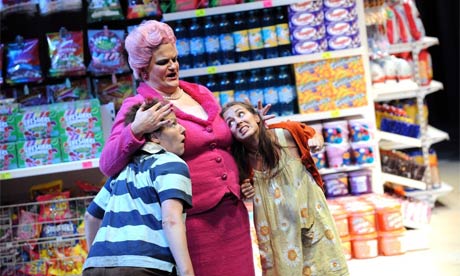
I’ve seen/heard productions with either a male or female singer as the witch – here it is tenor Wolfgang Ablinger-Sperrhacke. At first, he comes out looking like Dame Edna, then, after capturing the children, he gleefully jumps around in a balding wig, a dirty and disheveled coat, and a bra. A lot of campy fun, especially during his evil witch song. His voice isn’t the prettiest, and is a bit stressed in the (few) high notes, but he’s the witch so who cares?

I would recommend this one, as the opera itself has some wonderful music, the singing is good and the production was amusing.
Glyndebourne (streaming opera here)
Cast -
Hansel: Jennifer Holloway
Gretel: Adriana Kučerová
Witch: Wolfgang Ablinger-Sperrhacke
Mother: Irmgard Vilsmaier
Father:Klaus Kuttler
Dew Fairy:Malin Christensson
The Sandman:Amy Freston
Conductor: Kazushi Ono
Director: Laurent Pelly
This is a fun production of a charming opera. It’s an adaptation of the fairy tale, but this version is set in contemporary times with hints of the current age’s excess and materialism. The singing is generally strong and the orchestra, conducted by Kazushi Ono, sounds light and fleet if a bit subdued.
The composer is Engelbert Humperdinck (I did a double take the first time I saw his name – turns out the pop singer borrowed it from him) who set a libretto by his sister. The plot expands the story of two children who lose their way in the woods and get in trouble when they meet a witch in a candy house. In this one, no one abandons the kids in the woods – their exasperated mother sends them out to pick berries and they can’t find the way back. Hansel und Gretel has a post-Wagnerian richness to the through-composed music (it was first performed in 1893) and it is also quite infectious. Things can get a bit saccharine at times – I always wondered about the whole “gingerbread kids come to life”, but thought it was better not to question it; the angels seemed unnecessary although the interlude has some nice music – but in general it is a delightful and charming opera. Probably the most famous piece is the magical, transparent overture –
https://www.youtube.com/watch?v=jqeI6zvP2C4
although the children’s Evening Prayer in Act II is also well-known.
This production from Glyndebourne was directed by Laurent Pelly. I really like Pelly’s work in comedic pieces. The opening is quite clever – as the overture plays, someone delivers a box and all the cast members look at it with some confusion as it is repeatedly given and returned. Finally, the two singers playing Hansel and Gretel get the box and look in – here the opera starts and we see that their house is a giant cardboard box. It’s also a sly nod to the fact that a lot of filmed opera productions start with trips through the attractive festival grounds or fancy opera houses.

Mezzo Jennifer Holloway as Hansel (in a trouser role) and soprano Adriana Kučerová as Gretel are game actors, dancing, skipping, sulking, constantly moving, and they both sing well. Pelly continues with glimpses of excess consumption and waste – the father brings home a plastic bag of canned and boxed foods, which elicits much excitement, Gretel makes a wreath out of garbage, and the Dew Fairy is all in plastic, with a little plastic handbag that dispenses dew. The woods are filled with chopped trees and lots of trash, and the witch’s house is a grocery store.
I’ve seen/heard productions with either a male or female singer as the witch – here it is tenor Wolfgang Ablinger-Sperrhacke. At first, he comes out looking like Dame Edna, then, after capturing the children, he gleefully jumps around in a balding wig, a dirty and disheveled coat, and a bra. A lot of campy fun, especially during his evil witch song. His voice isn’t the prettiest, and is a bit stressed in the (few) high notes, but he’s the witch so who cares?

I would recommend this one, as the opera itself has some wonderful music, the singing is good and the production was amusing.
17ELiz_M
>16 DieFledermaus: Ah, Laurent Pelly! I love his production of La Fille du régiment -- the set was designed to look like crinkled maps and the bit with the duchess was cleverly staged.
18detailmuse
Welcome back, I'm looking forward to your reading this year. Have to admit to a smile, seeing Room in the company of the others in your "best of" list. Many thanks for the link to Hansel and Gretel, I've started it and will watch at least some before it's pulled today.
>The composer is Engelbert Humperdinck (I did a double take the first time I saw his name {I did too!} – turns out the pop singer borrowed it from him {aha!}).
>The composer is Engelbert Humperdinck (I did a double take the first time I saw his name {I did too!} – turns out the pop singer borrowed it from him {aha!}).
19Poquette
Ah, Hansel and Gretel! Humperdinck! Such beautiful music. And I thoroughly enjoyed your commentary. Turns out there are quite a few of us opera lovers here in Club Read, so I suspect you will have a captive audience for your opera reviews.
20DieFledermaus
>17 ELiz_M: - Definitely agree - La Fille du Régiment is a lot of fun, and Pelly's production is great. Did you see the filmed version with Natalie Dessay or a live production? I saw the one with Dessay and was impressed by her performance.
>18 detailmuse: - Good to see you here! Aww, I really liked Room - I thought the author pulled off the high-concept premise very well.
For a long time, I assumed the singer made up "Engelbert Humperdinck" for a stage name and was a bit confused when I learned he was a real person. I also thought of Humperdinck in The Princess Bride - not the best association.
>19 Poquette: - Yeah, it is some really beautiful music and also not too angsty! Sometimes I want to listen to something heavily orchestrated but light and cheerful so this fits the bill. I was pretty happy to see a lot of opera fans in Club Read - my RL friends will come to the opera with me as part of a fun night out but aren't really fans, and I hang out at a few blogs but the people there tend to be voice people which I am really not.
>18 detailmuse: - Good to see you here! Aww, I really liked Room - I thought the author pulled off the high-concept premise very well.
For a long time, I assumed the singer made up "Engelbert Humperdinck" for a stage name and was a bit confused when I learned he was a real person. I also thought of Humperdinck in The Princess Bride - not the best association.
>19 Poquette: - Yeah, it is some really beautiful music and also not too angsty! Sometimes I want to listen to something heavily orchestrated but light and cheerful so this fits the bill. I was pretty happy to see a lot of opera fans in Club Read - my RL friends will come to the opera with me as part of a fun night out but aren't really fans, and I hang out at a few blogs but the people there tend to be voice people which I am really not.
21DieFledermaus
Suddenly, a Knock at the Door by Etgar Keret
Finished 1/3/15
Etgar Keret’s short stories are very short – the longest ones are around ~10 pages. They usually have some bizarre, metafictional or fantastical elements and are a quick read. I’d previously read another collection, The Nimrod Flipout, and enjoyed that one although I don’t think any of the individual stories stuck with me. This collection was similarly fun and the stories flew by, although there were some that seemed pointless and others relied on random twists at the end.
I liked the more metafictional stories about writers – the first one “Suddenly, a Knock on the Door”, where the author-narrator is forced to come up with stories; “The Story, Victorious” – a bit Calvino-esque; “Creative Writing”, where stories from a writing workshop reflect a troubled relationship; and “What Animal Are You” which shows a writer pretending to write for a picture. A number of stories find various sad loners, widows and widowers or single fathers in absurd or unreal situations. “Cheesus Christ” moves through a series of people with fleeting connections, showing their sad lives and problems. Two soldiers come to inform a woman that her husband “Simyon” is dead, but there’s a problem: she’s not married. This one had a nice twist – good for such a short story. In “Healthy Start” a lonely man pretends to be whoever it is that random people at a diner are looking for. A hopelessly in love man imagines parallel worlds where he is happy in “Parallel Universes.” There are many very short stories in this collection and of course not all of them work. “Pick a Color” about people of differing colors interacting, is rather simplistic; “Grab the Cuckoo by the Tail”, about a recently dumped man and his annoying friend doesn’t quite hit the mark. Despite the fantastic nature of some of the stories, they are firmly grounded in the everyday and illuminate the ironies, absurdities, and sadness of ordinary life.
I don’t know that any of these stories are going to stick with me, but it was a good read and I kept wanting more.
Finished 1/3/15
Etgar Keret’s short stories are very short – the longest ones are around ~10 pages. They usually have some bizarre, metafictional or fantastical elements and are a quick read. I’d previously read another collection, The Nimrod Flipout, and enjoyed that one although I don’t think any of the individual stories stuck with me. This collection was similarly fun and the stories flew by, although there were some that seemed pointless and others relied on random twists at the end.
I liked the more metafictional stories about writers – the first one “Suddenly, a Knock on the Door”, where the author-narrator is forced to come up with stories; “The Story, Victorious” – a bit Calvino-esque; “Creative Writing”, where stories from a writing workshop reflect a troubled relationship; and “What Animal Are You” which shows a writer pretending to write for a picture. A number of stories find various sad loners, widows and widowers or single fathers in absurd or unreal situations. “Cheesus Christ” moves through a series of people with fleeting connections, showing their sad lives and problems. Two soldiers come to inform a woman that her husband “Simyon” is dead, but there’s a problem: she’s not married. This one had a nice twist – good for such a short story. In “Healthy Start” a lonely man pretends to be whoever it is that random people at a diner are looking for. A hopelessly in love man imagines parallel worlds where he is happy in “Parallel Universes.” There are many very short stories in this collection and of course not all of them work. “Pick a Color” about people of differing colors interacting, is rather simplistic; “Grab the Cuckoo by the Tail”, about a recently dumped man and his annoying friend doesn’t quite hit the mark. Despite the fantastic nature of some of the stories, they are firmly grounded in the everyday and illuminate the ironies, absurdities, and sadness of ordinary life.
I don’t know that any of these stories are going to stick with me, but it was a good read and I kept wanting more.
22arubabookwoman
Welcome back Stephanie. I'm so glad to be able to follow your reading again this year. Have you completed your studies?
I have English August, Untouchable, and Red Earth and Pouring Rain, and may choose one of them for the Reading Globally segment. I have already started reading Pather Panchali, and it's quite good so far.
I have English August, Untouchable, and Red Earth and Pouring Rain, and may choose one of them for the Reading Globally segment. I have already started reading Pather Panchali, and it's quite good so far.
23DieFledermaus
>22 arubabookwoman: - Thanks, it's good to be back and I'm excited/concerned about what will happen to my wishlist after following everyone's threads. Yup, finished with school. Hoping that will mean a bit more time for reading. I still have a couple things to finish but all the paperwork is in.
I don't think I saw anyone else list English, August on the thread - good to know someone else might read it. The pile is more jumbled than usual right now so I'll be starting with The Walls of Delhi by Uday Prakash.
I don't think I saw anyone else list English, August on the thread - good to know someone else might read it. The pile is more jumbled than usual right now so I'll be starting with The Walls of Delhi by Uday Prakash.
24DieFledermaus
The Little Stranger by Sarah Waters
Finished 1/4/15
The first Waters book I read, Night Watch, was picked up a bit half-heartedly. I had a vague idea that Waters was an author I should read so I got the book when I saw it on sale. Then I proceeded to blow through it feverishly. I read The Little Stranger in a similarly addictive fashion. I’ll have to make a note to get another Waters when I want something addictive and well-written. The Little Stranger fits a theme from last year, when I did a Gothic read (with Gothic defined very, very loosely), so I had The Haunting of Hill House fresh in my mind. The Turn of the Screw and We Have Always lived in the Castle also came to mind when reading this book.
The big house in this one is Hundreds Hall, the estate of the Ayres in Warwickshire. Formerly the country squire types, they have fallen on hard times, and after WWII, Mrs. Ayres, her daughter Caroline and son Roderick are living a poor and reclusive life. The narrator is country doctor Faraday. His mother formerly worked for the Ayres as a nursemaid and he has always had an interest in the house. Called to Hundreds to treat a sick maid, Faraday soon forms a relationship with the family when he starts treating Roderick, who was injured in the war. Waters takes her time getting to the odd happenings in the house. When she does, there are some classic Gothic questions – are the strange events real or the wind/rats/creaky house? Is someone playing a trick? If they are real, what is causing them? While to some extent the book ends ambiguously and multiple possibilities are raise – with various levels of support – I thought the author made the answer pretty clear.
The potential supernatural events are nicely creepy and suspenseful, although nothing that hasn’t been done before – knockings, locked doors, things moving. Before that, however, Waters develops the relationship between Faraday, the family, and the community. A somewhat unhealthy, codependent relationship springs up between Farady and the Ayres family. The family is always calling on him – sometimes to treat their medical issues, other times for company, and often to share their secrets and get emotional support from him. Mrs. Ayres, Caroline, and Roderick all confide in him and let him see their true condition. While this breeds intimacy, there are repeated signs that they do this because they look down on Faraday and would never show their real feelings to polite society and their “real friends.” Faraday, for his part, is overinvolved in the family affairs and his world starts to revolve around the Ayres and Hundreds.
The class divide in the book is handled well. The old order is changing after WWII, but class still permeates nearly every aspect of life in the town. The portrayal of the varying ranks of doctors, the tension between Dr. Faraday and the family, and general gossipy atmosphere of the town are well done. I thought the Baker-Hydes, a nouveau riche family, were a bit cartoonish but the story is seen through Faraday’s eyes and he can be a biased and unreliable narrator. A predictable romance was tepid and irritating, but later developments are interesting. The writing was very fluid and kept me turning pages.
Finished 1/4/15
The first Waters book I read, Night Watch, was picked up a bit half-heartedly. I had a vague idea that Waters was an author I should read so I got the book when I saw it on sale. Then I proceeded to blow through it feverishly. I read The Little Stranger in a similarly addictive fashion. I’ll have to make a note to get another Waters when I want something addictive and well-written. The Little Stranger fits a theme from last year, when I did a Gothic read (with Gothic defined very, very loosely), so I had The Haunting of Hill House fresh in my mind. The Turn of the Screw and We Have Always lived in the Castle also came to mind when reading this book.
The big house in this one is Hundreds Hall, the estate of the Ayres in Warwickshire. Formerly the country squire types, they have fallen on hard times, and after WWII, Mrs. Ayres, her daughter Caroline and son Roderick are living a poor and reclusive life. The narrator is country doctor Faraday. His mother formerly worked for the Ayres as a nursemaid and he has always had an interest in the house. Called to Hundreds to treat a sick maid, Faraday soon forms a relationship with the family when he starts treating Roderick, who was injured in the war. Waters takes her time getting to the odd happenings in the house. When she does, there are some classic Gothic questions – are the strange events real or the wind/rats/creaky house? Is someone playing a trick? If they are real, what is causing them? While to some extent the book ends ambiguously and multiple possibilities are raise – with various levels of support – I thought the author made the answer pretty clear.
The potential supernatural events are nicely creepy and suspenseful, although nothing that hasn’t been done before – knockings, locked doors, things moving. Before that, however, Waters develops the relationship between Faraday, the family, and the community. A somewhat unhealthy, codependent relationship springs up between Farady and the Ayres family. The family is always calling on him – sometimes to treat their medical issues, other times for company, and often to share their secrets and get emotional support from him. Mrs. Ayres, Caroline, and Roderick all confide in him and let him see their true condition. While this breeds intimacy, there are repeated signs that they do this because they look down on Faraday and would never show their real feelings to polite society and their “real friends.” Faraday, for his part, is overinvolved in the family affairs and his world starts to revolve around the Ayres and Hundreds.
The class divide in the book is handled well. The old order is changing after WWII, but class still permeates nearly every aspect of life in the town. The portrayal of the varying ranks of doctors, the tension between Dr. Faraday and the family, and general gossipy atmosphere of the town are well done. I thought the Baker-Hydes, a nouveau riche family, were a bit cartoonish but the story is seen through Faraday’s eyes and he can be a biased and unreliable narrator. A predictable romance was tepid and irritating, but later developments are interesting. The writing was very fluid and kept me turning pages.
25baswood
Enjoyed your review of The little Stranger
26Cait86
I'm a big Sarah Waters fan; never been disappointed by one of her books. Fingersmith is very good - a big, sprawling Victorian-era novel full of twists and turns.
27kidzdoc
Great review of The Little Stranger, Dr. DieF (congratulations, fellow doctor!). It's on my list of books to read this year, so I'm glad that you enjoyed it.
Nice review of Suddenly, A Knock at the Door. I've read one of Keret's short story collections, The Bus Driver Who Wanted to Be God, which I found to be brilliant and hilarious in spots but droll and pointless in others. Based on your comments I don't think I'll read anything else by him.
Nice review of Suddenly, A Knock at the Door. I've read one of Keret's short story collections, The Bus Driver Who Wanted to Be God, which I found to be brilliant and hilarious in spots but droll and pointless in others. Based on your comments I don't think I'll read anything else by him.
28rebeccanyc
I enjoyed The Little Stranger too, particularly as I realized the increasing unreliability of Faraday. I haven't read any Keret, but maybe I should.
And congrats on your degree!
And congrats on your degree!
29japaul22
I read The Little Stranger last year and felt much the same as you. It wasn't perfect, but it was oh-so-readable.
30bragan
Suddenly, A Knock at the Door sounds great. Club Read is certainly doing dangerous things to my wishlist already this year; that's another one on.
And I also liked The Little Stranger. The only Waters I've read so far were that and Fingersmith, and based on those, I'd say "addictive" is a good word for her writing. It's hard not to just plow right through it, somehow. I got The Night Watch through SantaThing this year, also, and am very much looking forward to it.
And I also liked The Little Stranger. The only Waters I've read so far were that and Fingersmith, and based on those, I'd say "addictive" is a good word for her writing. It's hard not to just plow right through it, somehow. I got The Night Watch through SantaThing this year, also, and am very much looking forward to it.
31dchaikin
Loved your review of The Little Strangers. I'll keep Waters in mind.
And welcome back and congrats on finishing your degree!
And welcome back and congrats on finishing your degree!
32DieFledermaus
>25 baswood: - Thanks!
>26 Cait86: - Hi Cait! It's good to hear that - I know Fingersmith is probably her best-known (and reviewed?) book, but I was thinking I might read Affinity next - sounded like another Gothic.
>27 kidzdoc: - Heh heh, thanks! I think I saw a cartoon in the New Yorker? where a reservation is for "Dr. and Mrs. X" and the waiter asks something like "Real doctor or PhD?" We liked to joke about that in my lab. Hope you enjoy The Little Stranger when you get to it!
It does sound like Keret's short story collections are similar, but I kept wanting to read more so I'll probably get another one. Not necessarily something I have to read right away though.
>28 rebeccanyc: - I do like a good unreliable narrator book. A lot of the "possible unreliable narrator" Gothic novels I was thinking of have young, isolated or fragile women as narrators - here it's the rational medical man who is biased and does some really stupid things.
Keret is a quick read - might be a good contrast to various tomes or fat Russian and French histories.
>29 japaul22: - Definitely. I didn't even mind ~100 pages until possible ghosts. I just enjoyed reading about awkward class misunderstandings and awkward parties.
>30 bragan: - I think Etgar Keret will fit right in with the eclectic mishmash. Yeah, I know what you mean with Waters's books - I was up even later than usual finishing both of them. I liked The Night Watch as well, although like many books it has a past story and a present one and I thought the past story was better. However, Waters handles them in a pretty original way.
>31 dchaikin: - Thanks, Waters might be good for an addictive break from all your pretty heavy reading!
>26 Cait86: - Hi Cait! It's good to hear that - I know Fingersmith is probably her best-known (and reviewed?) book, but I was thinking I might read Affinity next - sounded like another Gothic.
>27 kidzdoc: - Heh heh, thanks! I think I saw a cartoon in the New Yorker? where a reservation is for "Dr. and Mrs. X" and the waiter asks something like "Real doctor or PhD?" We liked to joke about that in my lab. Hope you enjoy The Little Stranger when you get to it!
It does sound like Keret's short story collections are similar, but I kept wanting to read more so I'll probably get another one. Not necessarily something I have to read right away though.
>28 rebeccanyc: - I do like a good unreliable narrator book. A lot of the "possible unreliable narrator" Gothic novels I was thinking of have young, isolated or fragile women as narrators - here it's the rational medical man who is biased and does some really stupid things.
Keret is a quick read - might be a good contrast to various tomes or fat Russian and French histories.
>29 japaul22: - Definitely. I didn't even mind ~100 pages until possible ghosts. I just enjoyed reading about awkward class misunderstandings and awkward parties.
>30 bragan: - I think Etgar Keret will fit right in with the eclectic mishmash. Yeah, I know what you mean with Waters's books - I was up even later than usual finishing both of them. I liked The Night Watch as well, although like many books it has a past story and a present one and I thought the past story was better. However, Waters handles them in a pretty original way.
>31 dchaikin: - Thanks, Waters might be good for an addictive break from all your pretty heavy reading!
33DieFledermaus
Last Words from Montmartre by Qiu Miaojin
Finished 1/4/15
I probably shouldn’t have finished this book. It didn’t get better and was quite repetitive. At least it was short, but it was a slog even to finish that. The book is a series of letters from the narrator to their ex-lover Xu. Supposedly, a reader should be able to read them in any order – which I thought meant there would be some metafictional concept, but instead it meant random stories about the narrator’s life and lots and lots of pseudo-philosophizing and entitled, creepy whining about the relationship. Occasionally the narrator changes sex, but I don’t think this altered how I read the irritating bits – the whining would be creepy if it was coming from a heterosexual man or a lesbian. There are a few glimpses of LGBT life in France in the early 90’s and those provided slight hints of a possibly interesting, non-rambling story but there were too few and they were too short and undeveloped. Also, there was excessive quotation overuse.
The letters open with the narrator bemoaning the loss of a relationship and the death of their co-pet rabbit, Bunny. At first, it was okay, if not particularly new. The relationship is described in very vague terms. I suppose this could be deliberate, but it just made me not care at all. The narrator harps on the fact that Xu cheated in the past, but only alludes to their own violent, destructive behavior. Later, they do mention in an offhanded way that they hit Xu during the relationship. There’s a lot of clichéd, high-flown talk about how their spirits are in harmony and how the narrator can never love anyone else. This really felt like teenage-level angst. The letters seem to have been sent to Xu, but she doesn’t respond and her family refuses to pass along messages or let the narrator talk to her. The narrator’s thoughts are extremely condescending and entitled. There is talk about how Xu doesn’t know what she wants and is not mature yet (when she does become mature, obviously she will want the narrator again). Xu is not the “real” Xu, since clearly the real Xu would do whatever the narrator wanted. The narrator claims they would leave Xu alone if that was what she wanted, but since the narrator knows better than Xu what she wants, that will never have to happen. Really, really sounds like stalker logic. Also, there is nonstop quoting, of words that don’t need to be in quotes. It’s like the author just recently discovered that “air quotes” are a “thing”. In the introduction, it is mentioned how raw and ugly the author’s thoughts are. I’m sure plenty of people have all sorts of ugly and overdramatic thoughts with dashes of “stuff learned from a philosophy class” about their “one true love” that they put down on paper, but I don’t need to read them. This is an example -
“I felt like a gorilla shacked in leg-irons, struggling to break out with all my might, head wounded, streaming blood, but to no avail. The pain erupted like molten lava, scorching and melting away all our ‘intimacy.’ You didn’t make up your mind in time. You couldn’t figure out how to be with me. So my furious fucking anger obliterated any childlike ‘faith’ you had in me, and your uncompromising coldness toward me deepened. I believe you hated me, too, and this hatred was expressed as coldness. And here I’ve arrived at the crux of the matter. It was at this point your eros started to split into bits of love and desire. You still gave me some pieces of this ‘love’ by taking care of me physically, but soon your hatred began to manifest itself as indifference, rejection, a shutting down. So my desire became unhinged and my pain excruciating. When you stop wanting me – withdrawing your eros – I go insane, truly insane. I’ve reached an apex of insanity (ha ha).”
Of course some of this could be the translation, but I can’t imagine the original is much better. Unfortunately, this is not only a book that I can’t recommend, it is one I have to actively warn against.
Finished 1/4/15
I probably shouldn’t have finished this book. It didn’t get better and was quite repetitive. At least it was short, but it was a slog even to finish that. The book is a series of letters from the narrator to their ex-lover Xu. Supposedly, a reader should be able to read them in any order – which I thought meant there would be some metafictional concept, but instead it meant random stories about the narrator’s life and lots and lots of pseudo-philosophizing and entitled, creepy whining about the relationship. Occasionally the narrator changes sex, but I don’t think this altered how I read the irritating bits – the whining would be creepy if it was coming from a heterosexual man or a lesbian. There are a few glimpses of LGBT life in France in the early 90’s and those provided slight hints of a possibly interesting, non-rambling story but there were too few and they were too short and undeveloped. Also, there was excessive quotation overuse.
The letters open with the narrator bemoaning the loss of a relationship and the death of their co-pet rabbit, Bunny. At first, it was okay, if not particularly new. The relationship is described in very vague terms. I suppose this could be deliberate, but it just made me not care at all. The narrator harps on the fact that Xu cheated in the past, but only alludes to their own violent, destructive behavior. Later, they do mention in an offhanded way that they hit Xu during the relationship. There’s a lot of clichéd, high-flown talk about how their spirits are in harmony and how the narrator can never love anyone else. This really felt like teenage-level angst. The letters seem to have been sent to Xu, but she doesn’t respond and her family refuses to pass along messages or let the narrator talk to her. The narrator’s thoughts are extremely condescending and entitled. There is talk about how Xu doesn’t know what she wants and is not mature yet (when she does become mature, obviously she will want the narrator again). Xu is not the “real” Xu, since clearly the real Xu would do whatever the narrator wanted. The narrator claims they would leave Xu alone if that was what she wanted, but since the narrator knows better than Xu what she wants, that will never have to happen. Really, really sounds like stalker logic. Also, there is nonstop quoting, of words that don’t need to be in quotes. It’s like the author just recently discovered that “air quotes” are a “thing”. In the introduction, it is mentioned how raw and ugly the author’s thoughts are. I’m sure plenty of people have all sorts of ugly and overdramatic thoughts with dashes of “stuff learned from a philosophy class” about their “one true love” that they put down on paper, but I don’t need to read them. This is an example -
“I felt like a gorilla shacked in leg-irons, struggling to break out with all my might, head wounded, streaming blood, but to no avail. The pain erupted like molten lava, scorching and melting away all our ‘intimacy.’ You didn’t make up your mind in time. You couldn’t figure out how to be with me. So my furious fucking anger obliterated any childlike ‘faith’ you had in me, and your uncompromising coldness toward me deepened. I believe you hated me, too, and this hatred was expressed as coldness. And here I’ve arrived at the crux of the matter. It was at this point your eros started to split into bits of love and desire. You still gave me some pieces of this ‘love’ by taking care of me physically, but soon your hatred began to manifest itself as indifference, rejection, a shutting down. So my desire became unhinged and my pain excruciating. When you stop wanting me – withdrawing your eros – I go insane, truly insane. I’ve reached an apex of insanity (ha ha).”
Of course some of this could be the translation, but I can’t imagine the original is much better. Unfortunately, this is not only a book that I can’t recommend, it is one I have to actively warn against.
34rebeccanyc
>33 DieFledermaus: Unfortunately, this is not only a book that I can’t recommend, it is one I have to actively warn against. Too bad you read the whole thing, but thanks for the warning!
35DieFledermaus
Rebecca - yeah, I probably should have stopped after 50 pages or so...but it was so short, and maybe it got better? I couldn't remember the last time I disliked a book this much, so I checked my star ratings and it was 2011. Oddly enough, several of them were NYRBs, which was the main reason I read this one. I know some other people really liked those ones though. I think it's probably a good thing if NYRB publishes some "high standard deviation in ratings" books.
36DieFledermaus
Jenůfa
Deutsche Oper Berlin
Jenůfa – Michaela Kaune
Kostelnička – Jennifer Larmore
Laca – Will Hartmann
Števa – Ladislav Elgr
Grandmother Buryja – Hanna Schwarz
Conductor – Donald Runnicles
Director – Christof Loy
Leos Janáček is one of my favorite composers, and Jenůfa was the first opera in his mature style. Instead of imitations of Dvorak and Smetana, his concise, mature style is based on short motifs that are repeated multiple times (somehow never getting tiresome) and the melody of speech (or folk songs, as in this opera). Definitely not atonal, but sometimes lacking in a tonal center and very idiosyncratic. In a further departure from Smetana/Dvorak, Jenůfa was based on a controversial play by Gabriela Preissova - instead of a cheerful Czech peasant opera like The Bartered Bride, it is a violent and sordid story. I was interested in this production from the Deutsche Oper Berlin because the director was Christof Loy (also – Janáček. Not like there are tons of productions of his operas). The setting and costumes are pretty standard Loy – minimalist backdrop, stark stage with only a table and a couple chairs for furniture, modern dress with suits for the men and dresses for the women.
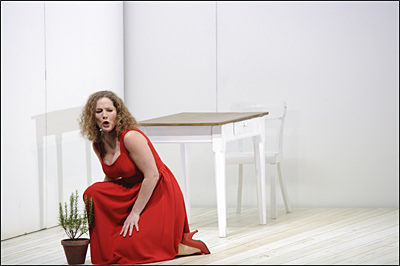
I thought the Personenregie was very detailed. The standout singer was Jennifer Larmore as the Kostelnička – she gave an intense performance with strong vocal characterization. I had some issues with the other singers – overall the singing was not as good as the other productions of Jenůfa that I’ve seen, but this didn’t hinder my enjoyment of a good production of a wonderful opera.
The story provides a harsh view of village life – Jenůfa has an illegitimate child and has been abandoned by the baby’s father, Števa. Her stepmother, the Kostelnička (sacristan), was always very proud of her and didn’t approve of the drunken, careless Števa. To save Jenůfa from dishonor, Kostelnička drugs her and drowns the baby so Jenůfa can marry Laca, Števa’s half-brother who has long been in love with her. Jenůfa’s growing maturity and Kostelnička’s devouring guilt and hatred are very well portrayed and the music is alternately lyrical or jagged and ominous. Some plot elements had to be cut and the opera doesn’t quite make clear the tangled family history. Jenůfa’s father and Števa’s father were the sons of Grandmother Buryja; Kostelnička is the second wife of Jenůfa’s father. Števa’s father married a widow with a son, Laca; the couple later had Števa, who inherited the mill and the money and was the favored son, leaving Laca jealous and bitter.
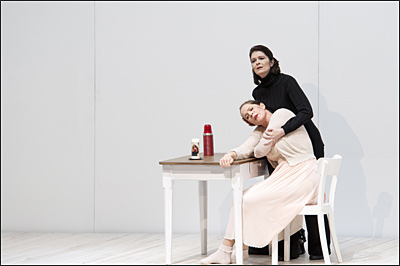
The opera is through-composed, and the solos are more monologues than arias. I love the opening, with the xylophone representing the ever-turning mill and the quicksilver mood changes, as Jenůfa fears Števa will be drafted (and therefore can’t marry her) and prays it won’t happen, Grandmother Buryja grumbles, and Laca sarcastically comments. Act II has a number of fine monologues – Kostelnička describing how she hoped and prayed that the baby would be born dead, her plea to Števa to marry Jenůfa and her final conflicted thoughts before killing the baby. Jenůfa’s dramatic prayer is the longest piece in the second act. The Act III finale is very beautiful, with lots of forgiveness and love, but also resignation after so many bad things have happened.
The curtain opens silently with Kostelnička led into an empty room with a table and chair. Then the opera starts playing out as if it’s her memory. The walls are all white and besides a glimpse of the fields in Act I, it stays the same until the end, when the walls move, Jenůfa and Laca join hands and walk out into the black stage and away from her stepmother. This framing centers the plot around Kostelnička – a valid interpretation as the opera’s actual name is Její pastorkyňa or “Her Stepdaughter”, with the “her” referring to Kostelnička. Grandmother Buryja is smartly dressed and doesn’t look old, a contrast to other productions I’ve seen where she is portrayed as very old, sometimes blind. It sets up an immediate contrast between her and Jenůfa, in a red dress, and Laca, who wears worn work clothes. My quibble there is that the red dress is out of place amongst the other women and Jenůfa doesn’t seem likely to be wearing it that day – she is unhappy and nervous that Števa will be conscripted.

Jennifer Larmore is terrific throughout – her confrontation with Števa in Act II is very tense and her disintegration following the murder is gripping. Števa is not a very sympathetic character, but in the last act, he is shown to be as worn as Laca and Jenůfa, a contrast to his new fiancée Karolka, cheerful and trendily dressed, and he acts as guilty and defeated as Kostelnička when the baby is discovered. (Another quibble was when Karolka’s mother, the mayor’s wife comments that she does not want to follow the customs of the gentry while going around in furs and a fancy dress. Usually fine with far bigger mismatches, but these were small things that could have easily been corrected and Loy’s direction was otherwise pretty sensitive to the music and plot). While Larmore sang strongly, I had some issues with the other singers. Michaela Kaune as Jenůfa started out a bit rough but warmed up in the second act, although her high notes shaded sharp. Ladislav Elgr, Števa, had a clotted, woolly-sounding voice. Will Hartmann was good in Laca’s bitter, angry moments but the voice was pitchy and unsteady in softer, lyrical music. The conducting, by Donald Runnicles, was quite good.
Deutsche Oper Berlin
Jenůfa – Michaela Kaune
Kostelnička – Jennifer Larmore
Laca – Will Hartmann
Števa – Ladislav Elgr
Grandmother Buryja – Hanna Schwarz
Conductor – Donald Runnicles
Director – Christof Loy
Leos Janáček is one of my favorite composers, and Jenůfa was the first opera in his mature style. Instead of imitations of Dvorak and Smetana, his concise, mature style is based on short motifs that are repeated multiple times (somehow never getting tiresome) and the melody of speech (or folk songs, as in this opera). Definitely not atonal, but sometimes lacking in a tonal center and very idiosyncratic. In a further departure from Smetana/Dvorak, Jenůfa was based on a controversial play by Gabriela Preissova - instead of a cheerful Czech peasant opera like The Bartered Bride, it is a violent and sordid story. I was interested in this production from the Deutsche Oper Berlin because the director was Christof Loy (also – Janáček. Not like there are tons of productions of his operas). The setting and costumes are pretty standard Loy – minimalist backdrop, stark stage with only a table and a couple chairs for furniture, modern dress with suits for the men and dresses for the women.
I thought the Personenregie was very detailed. The standout singer was Jennifer Larmore as the Kostelnička – she gave an intense performance with strong vocal characterization. I had some issues with the other singers – overall the singing was not as good as the other productions of Jenůfa that I’ve seen, but this didn’t hinder my enjoyment of a good production of a wonderful opera.
The story provides a harsh view of village life – Jenůfa has an illegitimate child and has been abandoned by the baby’s father, Števa. Her stepmother, the Kostelnička (sacristan), was always very proud of her and didn’t approve of the drunken, careless Števa. To save Jenůfa from dishonor, Kostelnička drugs her and drowns the baby so Jenůfa can marry Laca, Števa’s half-brother who has long been in love with her. Jenůfa’s growing maturity and Kostelnička’s devouring guilt and hatred are very well portrayed and the music is alternately lyrical or jagged and ominous. Some plot elements had to be cut and the opera doesn’t quite make clear the tangled family history. Jenůfa’s father and Števa’s father were the sons of Grandmother Buryja; Kostelnička is the second wife of Jenůfa’s father. Števa’s father married a widow with a son, Laca; the couple later had Števa, who inherited the mill and the money and was the favored son, leaving Laca jealous and bitter.
The opera is through-composed, and the solos are more monologues than arias. I love the opening, with the xylophone representing the ever-turning mill and the quicksilver mood changes, as Jenůfa fears Števa will be drafted (and therefore can’t marry her) and prays it won’t happen, Grandmother Buryja grumbles, and Laca sarcastically comments. Act II has a number of fine monologues – Kostelnička describing how she hoped and prayed that the baby would be born dead, her plea to Števa to marry Jenůfa and her final conflicted thoughts before killing the baby. Jenůfa’s dramatic prayer is the longest piece in the second act. The Act III finale is very beautiful, with lots of forgiveness and love, but also resignation after so many bad things have happened.
The curtain opens silently with Kostelnička led into an empty room with a table and chair. Then the opera starts playing out as if it’s her memory. The walls are all white and besides a glimpse of the fields in Act I, it stays the same until the end, when the walls move, Jenůfa and Laca join hands and walk out into the black stage and away from her stepmother. This framing centers the plot around Kostelnička – a valid interpretation as the opera’s actual name is Její pastorkyňa or “Her Stepdaughter”, with the “her” referring to Kostelnička. Grandmother Buryja is smartly dressed and doesn’t look old, a contrast to other productions I’ve seen where she is portrayed as very old, sometimes blind. It sets up an immediate contrast between her and Jenůfa, in a red dress, and Laca, who wears worn work clothes. My quibble there is that the red dress is out of place amongst the other women and Jenůfa doesn’t seem likely to be wearing it that day – she is unhappy and nervous that Števa will be conscripted.

Jennifer Larmore is terrific throughout – her confrontation with Števa in Act II is very tense and her disintegration following the murder is gripping. Števa is not a very sympathetic character, but in the last act, he is shown to be as worn as Laca and Jenůfa, a contrast to his new fiancée Karolka, cheerful and trendily dressed, and he acts as guilty and defeated as Kostelnička when the baby is discovered. (Another quibble was when Karolka’s mother, the mayor’s wife comments that she does not want to follow the customs of the gentry while going around in furs and a fancy dress. Usually fine with far bigger mismatches, but these were small things that could have easily been corrected and Loy’s direction was otherwise pretty sensitive to the music and plot). While Larmore sang strongly, I had some issues with the other singers. Michaela Kaune as Jenůfa started out a bit rough but warmed up in the second act, although her high notes shaded sharp. Ladislav Elgr, Števa, had a clotted, woolly-sounding voice. Will Hartmann was good in Laca’s bitter, angry moments but the voice was pitchy and unsteady in softer, lyrical music. The conducting, by Donald Runnicles, was quite good.
37baswood
Really enjoyed your review of Jenufa. I do hope you will continue posting your opera/music reviews.
38DieFledermaus
Thanks, bas. I do enjoy putting my thoughts down about the operas I watch and it's nice to have somewhere to post them.
Random opera question - do people mind if there are a ton of opera plot spoilers, including giving away the ending? I don't really think about that since I usually know the ending (and programs will give a synopsis of the whole thing). When I started posting book reviews on LT, I changed my reviews to not discuss the ending (I did in my book journal) and I've added some background for the various operas here. I could refrain from revealing which characters are secret brothers and who gets poisoned by flowers and who dies in an avalanche if that bothers people.
Random opera question - do people mind if there are a ton of opera plot spoilers, including giving away the ending? I don't really think about that since I usually know the ending (and programs will give a synopsis of the whole thing). When I started posting book reviews on LT, I changed my reviews to not discuss the ending (I did in my book journal) and I've added some background for the various operas here. I could refrain from revealing which characters are secret brothers and who gets poisoned by flowers and who dies in an avalanche if that bothers people.
39rebeccanyc
>35 DieFledermaus: I generally adore NYRBs, but there have been some I really disliked and wondered what they were thinking! (For example, A Meaningful Life, Memoirs of Hecate County, and especially After Claude.) And there were others I felt so so about.
40janeajones
Oh I hated After Claude too -- it's probably the only book I've ever given just one star too -- only to acknowledge that I had read it.
41kidzdoc
Great review of Last Words from Montmartre, DieF. I read it yesterday morning, but forgot to comment on it. I read that the author committed suicide, at the age of 26, not long after it was written, and that it seems to be at least somewhat autobiographical in nature. Anyway, I definitely won't read it.
I enjoyed your review of Jenufa!
I enjoyed your review of Jenufa!
42SassyLassy
>39 rebeccanyc: Oh dear. NYRB's Memoirs of Hecate County is close to the top of my TBR American shelf, but every time I pick it up, I seem daunted by the length. The new year seemed more promising, as I wouldn't have such a close eye on how much I was reading, but I still haven't quite made it.
>33 DieFledermaus: I might have been tempted to stop reading at when the co-pet rabbit, Bunny appeared, but I sympathize with the urge to keep going just in case things get better. Thanks for the warning.
>33 DieFledermaus: I might have been tempted to stop reading at when the co-pet rabbit, Bunny appeared, but I sympathize with the urge to keep going just in case things get better. Thanks for the warning.
43rebeccanyc
>42 SassyLassy: Well, you might like it better than I did, but in my review I said the best thing I could say about it was that I bought it at a remaindered price! (Also, it's a collection of stories, so you don't have to read them all.) I did learn a lot from Wilson's To the Finland Station, although it was marred by some racism and antisemitism and by being written too early (before we all learned a lot about the aftermath of the Finland Station).
44detailmuse
>20 DieFledermaus: no not a diss on Room, I also thought Donoghue pulled it off. Just that it's so mainstream and contemporary in your list :)
I enjoyed Suddenly A Knock on the Door, tiny sizzling stories, imaginative. I'll read more by him.
I enjoyed Suddenly A Knock on the Door, tiny sizzling stories, imaginative. I'll read more by him.
45Poquette
I saw a production of Jenůfa way back in the late 70s or early 80s at the San Francisco Opera House. I enjoyed reading your comments about the opera. One of my regrets is that I did not keep an opera diary back then. I saw so many wonderful productions and great singers, and it is difficult to recall it all at this late date. :-(
46DieFledermaus
I read various negative reviews of After Claude so I always think 'No' whenever I see it in the bookstore. There are a couple other NYRBs that I am not interested in reading because of some bad reviews I must have read somewhere - The Child by Jules Valles and The Radiance of the King by Camara Laye. I already have Memoirs of Hecate County though!
The NYRBs that I disliked rather than felt were just meh were Hadrian the Seventh by Frederick Rolfe and Wish Her Safe at Home by Stephen Benatar.
>41 kidzdoc: - I was debating whether to mention that in the review - I thought one reason they might have published it was because the author was well known for her other books, but they thought this one would be interesting because of her life? There is a lot about despair and suicide.
>42 SassyLassy: - Heh heh. I have known a few people who had pet rabbits that were pretty spoiled. One had its own room, another was allowed to run around the house all day. There was a lot of self-pity about the dead bunny, but I could have tolerated that. Things never got better though.
>44 detailmuse: - Ah! Understood. I think the Ogawa and Abbott were both ~90's but they're definitely not as popular. Room lived up to the hype for me, but there are a lot book that don't.
>45 Poquette: - I'd love to see it live some day! Janacek operas are rather thin on the ground in the U.S. The only one I saw live, The Makropoulos Case, was at San Francisco (a fantastic production).
If you had a couple minutes....
http://archive.sfopera.com/qry1operalist.asp
Searchable archive from the SF Opera. Looks like they had it 1980 and 1986, both with extremely impressive casts
The NYRBs that I disliked rather than felt were just meh were Hadrian the Seventh by Frederick Rolfe and Wish Her Safe at Home by Stephen Benatar.
>41 kidzdoc: - I was debating whether to mention that in the review - I thought one reason they might have published it was because the author was well known for her other books, but they thought this one would be interesting because of her life? There is a lot about despair and suicide.
>42 SassyLassy: - Heh heh. I have known a few people who had pet rabbits that were pretty spoiled. One had its own room, another was allowed to run around the house all day. There was a lot of self-pity about the dead bunny, but I could have tolerated that. Things never got better though.
>44 detailmuse: - Ah! Understood. I think the Ogawa and Abbott were both ~90's but they're definitely not as popular. Room lived up to the hype for me, but there are a lot book that don't.
>45 Poquette: - I'd love to see it live some day! Janacek operas are rather thin on the ground in the U.S. The only one I saw live, The Makropoulos Case, was at San Francisco (a fantastic production).
If you had a couple minutes....
http://archive.sfopera.com/qry1operalist.asp
Searchable archive from the SF Opera. Looks like they had it 1980 and 1986, both with extremely impressive casts
47baswood
I will not be put off by opera spoilers. As far as I am concerned the more I know about an opera before I see it the better.
48rebeccanyc
>46 DieFledermaus: I really liked The Radiance of the King, and I sort of liked Wish Her Safe at Home, but I can see how you'd have to be in the modd for it.
49Poquette
>46 DieFledermaus: It was the 1980 production of Jenůfa that I saw with Sena Jurinac and Elizabeth Söderström, etc.
Thanks for that link, by the way. That is a tremendous resource, which I was unaware of since I have been away from San Francisco for more than ten years now. I have put that in my favorites because every now and then I wish I could remember when I saw what or who was in such-and-such a production! Now I can figure it out. I should have written the date on my librettos which I still have, but who knew I would even care some day. Well, some day has arrived . . .
Thanks for that link, by the way. That is a tremendous resource, which I was unaware of since I have been away from San Francisco for more than ten years now. I have put that in my favorites because every now and then I wish I could remember when I saw what or who was in such-and-such a production! Now I can figure it out. I should have written the date on my librettos which I still have, but who knew I would even care some day. Well, some day has arrived . . .
50DieFledermaus
>47 baswood: - Okay, good - more spoilers will be forthcoming!
>48 rebeccanyc: - Rebecca, I found Wish Her Safe at Home to be really unbelievable, although the writing was pretty good at first, and I was irritated at rather than horrified for the main character. Your review of The Radiance of the King is considerably more positive than the other ones (those must have been the ones I based my opinion on). Hmm...will have to think about that one.
>49 Poquette: - Glad it was helpful. That really sounded like an awesome performance! SF Opera is doing Jenůfa for the next season - I'd love to go, but will have to see. I keep the programs from concerts and operas so I'll remember what/who I saw, but they've built up a lot. Did you see any of the weird Russian ones from the Mariinsky with Gergiev from the early-mid 90's? I would have really liked to have seen those, although I saw filmed versions of a few of them.
>48 rebeccanyc: - Rebecca, I found Wish Her Safe at Home to be really unbelievable, although the writing was pretty good at first, and I was irritated at rather than horrified for the main character. Your review of The Radiance of the King is considerably more positive than the other ones (those must have been the ones I based my opinion on). Hmm...will have to think about that one.
>49 Poquette: - Glad it was helpful. That really sounded like an awesome performance! SF Opera is doing Jenůfa for the next season - I'd love to go, but will have to see. I keep the programs from concerts and operas so I'll remember what/who I saw, but they've built up a lot. Did you see any of the weird Russian ones from the Mariinsky with Gergiev from the early-mid 90's? I would have really liked to have seen those, although I saw filmed versions of a few of them.
51DieFledermaus
Currently reading - I'm reading The Drinker by Hans Fallada. Gripping, but the narrator is extremely unpleasant and unsympathetic. I think this is another one with a first-person narrator who is very unhappy and obsessive - while I felt bad for the author of The Gossamer Years because of her constrained situation, I really disliked the narrators of The Little Stranger and Last Words from Montmartre. Will need to mix it up with further books.
I finished watching Fidelio from La Scala and just need to add links and such to the review. Here's a link -
http://concert.arte.tv/fr/fidelio-beethoven-barenboim-scala-milan
although it is region-limited (I use Hola Unblocker) and it looks like someone posted it on YouTube also.
I finished watching Fidelio from La Scala and just need to add links and such to the review. Here's a link -
http://concert.arte.tv/fr/fidelio-beethoven-barenboim-scala-milan
although it is region-limited (I use Hola Unblocker) and it looks like someone posted it on YouTube also.
52Poquette
>50 DieFledermaus: I kept all programs for years but there were too many to manage and when I moved ten years ago in a fit of housekeeping I threw them away. By the nineties I was priced out of the opera market and only attended sporadically performances I couldn't bear to miss.
53DieFledermaus
Poquette - yeah, they do build up fast. I already have several pretty fat binders full of programs, along with the enormous TBR pile. I can see how you wouldn't want to take years and years worth of programs with you when you moved!
Ugh, yes, opera prices - I usually got student tickets or was in the under-40 subscriber group, but there were various other things I did, like organized a huge group or stood in line at unhealthy times.
I'd love to hear about any of the other operas you saw at SF!
Ugh, yes, opera prices - I usually got student tickets or was in the under-40 subscriber group, but there were various other things I did, like organized a huge group or stood in line at unhealthy times.
I'd love to hear about any of the other operas you saw at SF!
54DieFledermaus
Fidelio
La Scala
Fidelio/Leonore – Anja Kampe
Florestan – Klaus Florian Vogt
Rocco – Kwangchul Youn
Don Pizarro – Falk Struckmann
Marzelline – Mojca Erdmann
Jaquino – Florian Hoffman
Don Fernando – Peter Mattei
Conductor – Daniel Barenboim
Director – Deborah Warner
Beethoven’s only opera is well-known for having some plot issues (as well as its tortured conception). The beginning feels too light and the Jaquino-Marzelline-Fidelio triangle doesn’t go anywhere; the ending is deux ex machina. However, there is some glorious music. I’m not bothered by some of the general and vague plot bits (how Leonore got around to impersonating a boy, the unexplained actions that angered Pizarro and got Florestan thrown into prison) as it make the opera more symbolic and thus easier to translate. This production from La Scala was not a great one, although the singing and playing were very good. The concept was unclear and some of the blocking was dull and confusing. Anja Kampe as Leonore was wonderful and she had strong support, but I was a bit disappointed with Klaus Florian Vogt’s Florestan.
Leonore’s husband, Florestan, has been unjustly imprisoned. She dresses as a man, “Fidelio”, to ingratiate herself in with Rocco, the jailer at a prison where she believes her husband is being held. Unfortunately, Rocco’s daughter Marzelline falls in love with “him” and spurns her former suitor Jaquino. Rocco agrees to the marriage, and Leonore goes along with it to gain his trust and be allowed down to see the prisoner. Don Pizarro, the governor of the jail, has a grudge against Florestan (for an unspecified action) and decides he has to kill him when he hears the minister is coming for a surprise inspection. Leonore risks her life to save her husband and is rewarded in the end with Florestan freed, a happy chorus of prisoners, and Pizarro punished.
Deborah Warner’s production from La Scala is set in contemporary times but the context is somewhat unclear. Is it supposed to be the holding area for insurgent street warfare or something? A fight between groups of down-and-outs living under the freeway? The guards are dressed casually, in hoodies and caps, as are Rocco and Fidelio. Rocco’s desk is in the same space as Marzelline’s ironing board. I wouldn’t mind a more casual, urban setting, but everything is grey, grey, grey and cluttered.
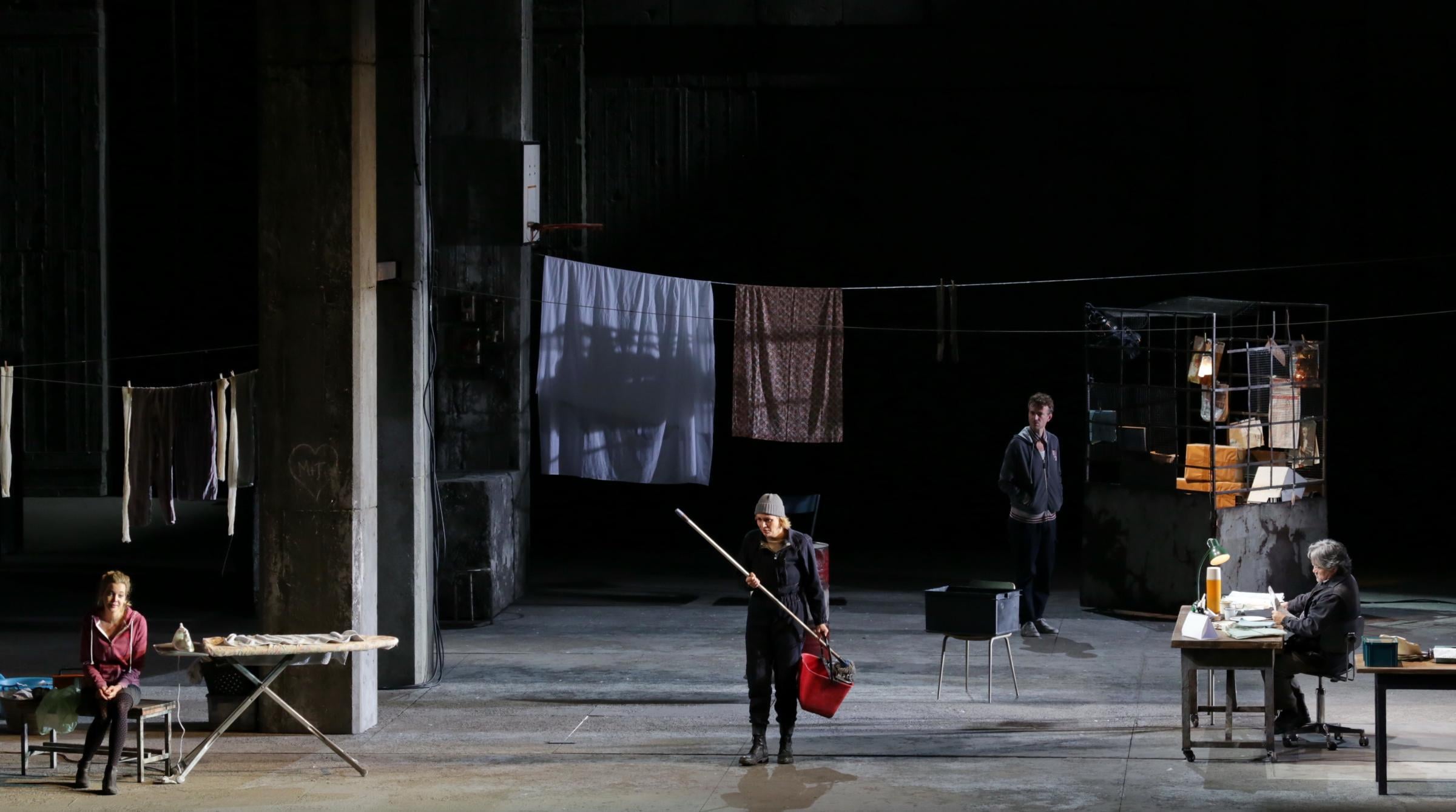
There are actually multiple overtures for Fidelio. They get played a lot in concert and I feel like I should know them better, but I don’t. There was some nice music in the one here, but I couldn’t tell you which version it is. For the first half hour or so, the opera seems like some Mozart Singspiel (there is dialogue instead of all music). The music is light and pretty with a somewhat standard setup. Jaquino is pursuing Marzelline, who loves Fidelio. Mojca Erdmann was good enough as Marzelline but Florian Hoffman was hard to hear at times as Jaquino. Rocco and “Fidelio” come out, and Rocco agrees to the marriage of Marzelline and Fidelio with a jaunty aria about the need to have money to be happy. Kwangchul Youn sang strongly throughout and convincingly played an ordinary man thrust into a horrible situation.
The opera becomes more interesting and dramatic with the appearance of Rocco’s boss, Don Pizarro, who has a gloating evil aria where he recalls how he was almost taken down by Florestan, who is now stuck in his prison. Falk Struckmann is a bit clipped and worn as Pizarro, but otherwise sings well, although he doesn’t do too much about the thin characterization of the villain.
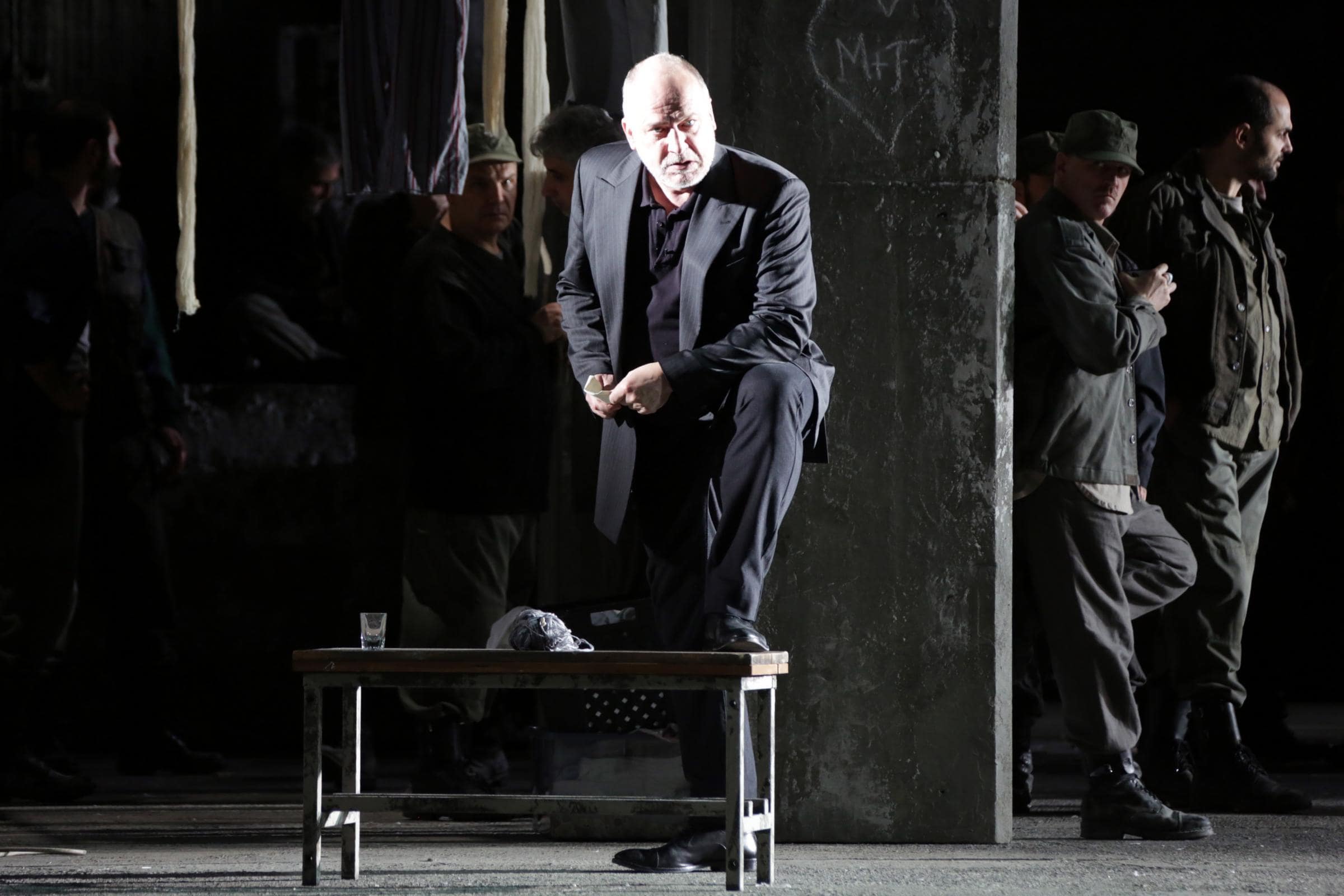
Leonore overhears Pizarro’s plan to murder the prisoner and sings her magnificent “Abscheulicher! Wo eilst du hin?“, at first declaiming her rage, then sadly recalling the past, then switching to determination and hope.
https://www.youtube.com/watch?v=ebXNo_J0Yz4
Kampe sang very well, with only a bit of tiring on the final coloratura leaps (not sure how true this is, but I read somewhere that Beethoven didn’t know how to write for voice and just treated it like another instrument, so this role combines a Wagnerian heaviness with bel canto-like leaps and runs). After this, the opera moves from highlight to highlight – the beautiful and well-known Prisoner’s Chorus (“O welche Lust”),
https://www.youtube.com/watch?v=6MF3IKyfgcg
where Marzelline and co. break the rules to let the prisoners outside, Florestan’s anguished “Gott! Welch Dunkel hier”,
https://www.youtube.com/watch?v=pJEUqzFcLkQ
the dramatic quartet, and “O namenlose Freude”, the ecstatic duet between Leonore and Florestan (one of those pieces where I always feel that little warm spark when I listen to it).
https://www.youtube.com/watch?v=Yi4SmInLjZg
I had heard very good things about Vogt so I was expecting something really special – he had a nice voice and sang prettily, but I think the aria lacked some intensity and expression. He continued to sing well, but not excitingly, for the rest of the opera so I was a bit disappointed.
The lighting and clutter made it hard to distinguish what was going on in the second act, as Rocco and Leonore dig a grave for the prisoner and Florestan is off in the darkness somewhere. There was a lot of standing around for the second act quartet with Rocco, Pizarro, Leonore and Florestan and more at the final celebratory chorus. I do not like it when singers just stand around, singing to the audience (well, if it’s part of the concept, that is fine – I’ve enjoyed Robert Wilson’s stuff). The quartet is pretty dramatic, as Leonore reveals who she is and both she and Pizarro threaten each other. But the singers mostly just stand there or randomly trot back and forth. Also, there’s a bit of confusing stage business at the end where Pizarro tries to attack Leonore? then just walks off stage (I think?).
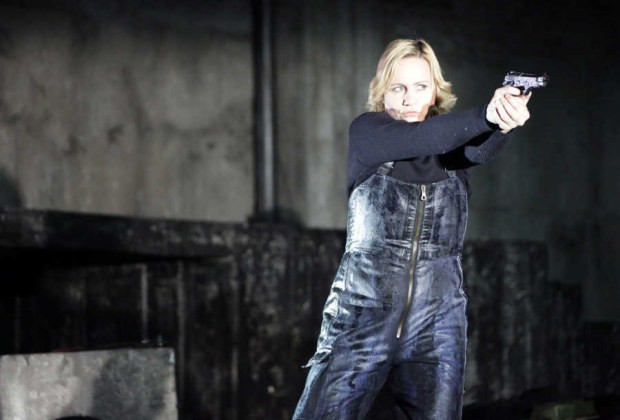
For “O namenlose Freude”, Leonore and Florestan sing at the audience on opposite sides of the stage. I don’t think they necessarily have to rush to embrace each other or anything, and I think there could be a powerful staging where they are hesitant and wary of each other and can’t quite believe the situation, but this just seemed lazy. For some reason, everyone has construction worker hard hats at the end as Don Fernando comes to set Florestan free and punish Don Pizarro. I wished there was more of Peter Mattei as he sang with beautiful, velvety voice and was a noble Don Fernando.

The orchestra was light and nimble in the first part, with a nice Wagnerian warmth in the second half, but I think the horns could have used some more oomph. Note: the audience lived up to their reputation and were quite loud and chatty.
La Scala
Fidelio/Leonore – Anja Kampe
Florestan – Klaus Florian Vogt
Rocco – Kwangchul Youn
Don Pizarro – Falk Struckmann
Marzelline – Mojca Erdmann
Jaquino – Florian Hoffman
Don Fernando – Peter Mattei
Conductor – Daniel Barenboim
Director – Deborah Warner
Beethoven’s only opera is well-known for having some plot issues (as well as its tortured conception). The beginning feels too light and the Jaquino-Marzelline-Fidelio triangle doesn’t go anywhere; the ending is deux ex machina. However, there is some glorious music. I’m not bothered by some of the general and vague plot bits (how Leonore got around to impersonating a boy, the unexplained actions that angered Pizarro and got Florestan thrown into prison) as it make the opera more symbolic and thus easier to translate. This production from La Scala was not a great one, although the singing and playing were very good. The concept was unclear and some of the blocking was dull and confusing. Anja Kampe as Leonore was wonderful and she had strong support, but I was a bit disappointed with Klaus Florian Vogt’s Florestan.
Leonore’s husband, Florestan, has been unjustly imprisoned. She dresses as a man, “Fidelio”, to ingratiate herself in with Rocco, the jailer at a prison where she believes her husband is being held. Unfortunately, Rocco’s daughter Marzelline falls in love with “him” and spurns her former suitor Jaquino. Rocco agrees to the marriage, and Leonore goes along with it to gain his trust and be allowed down to see the prisoner. Don Pizarro, the governor of the jail, has a grudge against Florestan (for an unspecified action) and decides he has to kill him when he hears the minister is coming for a surprise inspection. Leonore risks her life to save her husband and is rewarded in the end with Florestan freed, a happy chorus of prisoners, and Pizarro punished.
Deborah Warner’s production from La Scala is set in contemporary times but the context is somewhat unclear. Is it supposed to be the holding area for insurgent street warfare or something? A fight between groups of down-and-outs living under the freeway? The guards are dressed casually, in hoodies and caps, as are Rocco and Fidelio. Rocco’s desk is in the same space as Marzelline’s ironing board. I wouldn’t mind a more casual, urban setting, but everything is grey, grey, grey and cluttered.
There are actually multiple overtures for Fidelio. They get played a lot in concert and I feel like I should know them better, but I don’t. There was some nice music in the one here, but I couldn’t tell you which version it is. For the first half hour or so, the opera seems like some Mozart Singspiel (there is dialogue instead of all music). The music is light and pretty with a somewhat standard setup. Jaquino is pursuing Marzelline, who loves Fidelio. Mojca Erdmann was good enough as Marzelline but Florian Hoffman was hard to hear at times as Jaquino. Rocco and “Fidelio” come out, and Rocco agrees to the marriage of Marzelline and Fidelio with a jaunty aria about the need to have money to be happy. Kwangchul Youn sang strongly throughout and convincingly played an ordinary man thrust into a horrible situation.
The opera becomes more interesting and dramatic with the appearance of Rocco’s boss, Don Pizarro, who has a gloating evil aria where he recalls how he was almost taken down by Florestan, who is now stuck in his prison. Falk Struckmann is a bit clipped and worn as Pizarro, but otherwise sings well, although he doesn’t do too much about the thin characterization of the villain.
Leonore overhears Pizarro’s plan to murder the prisoner and sings her magnificent “Abscheulicher! Wo eilst du hin?“, at first declaiming her rage, then sadly recalling the past, then switching to determination and hope.
https://www.youtube.com/watch?v=ebXNo_J0Yz4
Kampe sang very well, with only a bit of tiring on the final coloratura leaps (not sure how true this is, but I read somewhere that Beethoven didn’t know how to write for voice and just treated it like another instrument, so this role combines a Wagnerian heaviness with bel canto-like leaps and runs). After this, the opera moves from highlight to highlight – the beautiful and well-known Prisoner’s Chorus (“O welche Lust”),
https://www.youtube.com/watch?v=6MF3IKyfgcg
where Marzelline and co. break the rules to let the prisoners outside, Florestan’s anguished “Gott! Welch Dunkel hier”,
https://www.youtube.com/watch?v=pJEUqzFcLkQ
the dramatic quartet, and “O namenlose Freude”, the ecstatic duet between Leonore and Florestan (one of those pieces where I always feel that little warm spark when I listen to it).
https://www.youtube.com/watch?v=Yi4SmInLjZg
I had heard very good things about Vogt so I was expecting something really special – he had a nice voice and sang prettily, but I think the aria lacked some intensity and expression. He continued to sing well, but not excitingly, for the rest of the opera so I was a bit disappointed.
The lighting and clutter made it hard to distinguish what was going on in the second act, as Rocco and Leonore dig a grave for the prisoner and Florestan is off in the darkness somewhere. There was a lot of standing around for the second act quartet with Rocco, Pizarro, Leonore and Florestan and more at the final celebratory chorus. I do not like it when singers just stand around, singing to the audience (well, if it’s part of the concept, that is fine – I’ve enjoyed Robert Wilson’s stuff). The quartet is pretty dramatic, as Leonore reveals who she is and both she and Pizarro threaten each other. But the singers mostly just stand there or randomly trot back and forth. Also, there’s a bit of confusing stage business at the end where Pizarro tries to attack Leonore? then just walks off stage (I think?).
For “O namenlose Freude”, Leonore and Florestan sing at the audience on opposite sides of the stage. I don’t think they necessarily have to rush to embrace each other or anything, and I think there could be a powerful staging where they are hesitant and wary of each other and can’t quite believe the situation, but this just seemed lazy. For some reason, everyone has construction worker hard hats at the end as Don Fernando comes to set Florestan free and punish Don Pizarro. I wished there was more of Peter Mattei as he sang with beautiful, velvety voice and was a noble Don Fernando.

The orchestra was light and nimble in the first part, with a nice Wagnerian warmth in the second half, but I think the horns could have used some more oomph. Note: the audience lived up to their reputation and were quite loud and chatty.
55rebeccanyc
>51 DieFledermaus: I found The Drinker very difficult to read but I kept reading because I wanted to see how far he would fall! It is said that Fallada wrote it while in a Nazi "mental hospital."
56DieFledermaus
I know what you mean - it's gripping in a "what will happen next" way, and the prose is very readable, but the narrator is behaving so horribly. It looked like there was a good Afterward where I'm assuming they cover some of Fallada's life, but I won't read it until after I finish the book.
57DieFledermaus
The Gossamer Years by Michitsuna no Haha
Finished 1/4/15
The narrator of this diary makes a wish on New Year’s morning, early in the second book – referring to her husband, “That he may be with me thirty days and thirty nights a month”. Unfortunately, she is a second wife in Heian-era Japan and her husband is not the faithful sort. The bulk of the diary describes her unhappy relationship with her husband, a well-connected and highly placed prince of the powerful Fujiwara family. Her jealousy and painful situation makes for an intense, if occasionally claustrophobic read. It provides an interesting contrast to other Heian-era diaries such as The Pillow Book and The Diary of Lady Murasaki (and of course her magnificent novel, The Tale of Genji, about a well-connected and highly placed prince, who has one real love but many, many women and affairs).
As with other Heian chroniclers, not much is known about the author of The Gossamer Years, not even her name. Often, women are referred to by their position or the position of a male relative. The narrator here is called the mother of Michitsuna. I read some comments on Heian diaries noting the dissonance of reading about the intimate details of these women’s lives while knowing very little about them, not even a name. This was definitely what I felt about the narrator of the Gossamer Years – we get a lot about her daily life and her unhappiness, but what is known about her is mostly her relations to various men. Oddly enough, she was related by blood or marriage to Sei Shonagon, Murasaki Shikibu and Sarashina (author of As I Crossed the Bridge of Dreams). The author was born to the provincial governor class and made what would be considered an excellent marriage to Kaneie Fujiwara.
The narrator describes her correspondence with her husband (the Prince, as he is referred to) with only a subtle allusion to their marriage. She mostly describes how resistant to his advances she was. The notes suggest that this part of the diary was written from memory, and it’s easy to see how the narrator’s bitterness at the marriage would have colored her writing about the initial courtship. At first, her husband visits her frequently (especially given that she was not his only wife and he did have a highly-placed position) but she resents every day or two that he is absent. The main crisis in the first section is her husband taking up with the “woman in the alley”, a woman from a lower class. The narrator’s rage, jealousy, and resentment take up a good portion of her diary. She had a son, but he was not enough. Unlike the other Heian-era diaries I read, she was not serving an Empress and found the time heavy on her hands. The descriptions of clothes, ceremonies and festivals are minimal compared with some other books from the same time. Although the narrator, like other highly ranked women, had serving women and a retinue, she was only happy in the company of her husband, her father or other family members (there are a few friends as well). The constant exchange of poems between the author and her husband will be familiar to anyone who has read Genji or The Pillow Book, but there are some differences – there are a couple very long poems with a detailed examination of the narrator’s or her husband’s feelings. Another dramatic event in the first book is the death of the narrator’s mother and her grief.
In the second book, things go well for the author initially – the Prince is consistent in his visits. When they start to slack, the author and her husband exchange angry or passive-aggressive poems. There’s a vicious cycle to the narrator’s behavior that provokes more unhappiness – she drives off her husband with her anger (sometimes not receiving him, or being irritable when he comes around), he stops visiting, she is unhappy, things continue in that fashion. She’s stuck between two bad options – show her anger, or hide it and pretend to be content when she is not. The author’s ideal relationship seems to be the modern ideal (that is today enforced as the Only Way) – a monogamous marriage where the couple spend all their time together. Her jealousy, and how it drives them further apart while making neither happy, is also understandable. The narrator describes how her son matures and starts to take part in public life. One of the few things, it seems, that she could do also makes various visits and pilgrimages to several shrines and temples. During an especially cold period with the Prince, the author thinks of becoming a nun and goes on a retreat to a temple for an extended period of time, leading to rumors that she has left her husband. The Prince comes to try to get her to return, sends many others, and even her family members try to persuade her to return. This seems to be another instance of the author being stuck with no good choices – she feels some relief with her retreat, but the world keeps trying to pull her back. At the end, she returns with her husband.
In the third part, the relationship grows colder and even the author seems resigned, although there are still multiple instances of her getting promises from the Prince that he will visit her, followed by her disappointment. The author continues to think about death or becoming a nun, but she does try to focus on other things – further trips to shrines, descriptions of her son’s flirtation, his continued rise, and her adopting a girl who was her husband’s daughter by another woman. A good portion of the final section describes the narrator’s attempts to manage a persistent suitor of her adopted daughter. In another irony, although her husband has pretty much abandoned her at this point, he is jealous as he thinks the man is making advances to the author. The diary breaks off in the middle.
The introduction is the original one from the 60’s and sometimes it feels a little paternalistic – the translator talking about hysteria and such. Still, there is a lot of good background there. Sometimes I felt the translator took liberties (for example, referring to as the author’s sister when the actual translation would be something like “someone close to her”). Although this is a fairly unhappy diary, I would recommend it to anyone interested in the Heian period.
Finished 1/4/15
The narrator of this diary makes a wish on New Year’s morning, early in the second book – referring to her husband, “That he may be with me thirty days and thirty nights a month”. Unfortunately, she is a second wife in Heian-era Japan and her husband is not the faithful sort. The bulk of the diary describes her unhappy relationship with her husband, a well-connected and highly placed prince of the powerful Fujiwara family. Her jealousy and painful situation makes for an intense, if occasionally claustrophobic read. It provides an interesting contrast to other Heian-era diaries such as The Pillow Book and The Diary of Lady Murasaki (and of course her magnificent novel, The Tale of Genji, about a well-connected and highly placed prince, who has one real love but many, many women and affairs).
As with other Heian chroniclers, not much is known about the author of The Gossamer Years, not even her name. Often, women are referred to by their position or the position of a male relative. The narrator here is called the mother of Michitsuna. I read some comments on Heian diaries noting the dissonance of reading about the intimate details of these women’s lives while knowing very little about them, not even a name. This was definitely what I felt about the narrator of the Gossamer Years – we get a lot about her daily life and her unhappiness, but what is known about her is mostly her relations to various men. Oddly enough, she was related by blood or marriage to Sei Shonagon, Murasaki Shikibu and Sarashina (author of As I Crossed the Bridge of Dreams). The author was born to the provincial governor class and made what would be considered an excellent marriage to Kaneie Fujiwara.
The narrator describes her correspondence with her husband (the Prince, as he is referred to) with only a subtle allusion to their marriage. She mostly describes how resistant to his advances she was. The notes suggest that this part of the diary was written from memory, and it’s easy to see how the narrator’s bitterness at the marriage would have colored her writing about the initial courtship. At first, her husband visits her frequently (especially given that she was not his only wife and he did have a highly-placed position) but she resents every day or two that he is absent. The main crisis in the first section is her husband taking up with the “woman in the alley”, a woman from a lower class. The narrator’s rage, jealousy, and resentment take up a good portion of her diary. She had a son, but he was not enough. Unlike the other Heian-era diaries I read, she was not serving an Empress and found the time heavy on her hands. The descriptions of clothes, ceremonies and festivals are minimal compared with some other books from the same time. Although the narrator, like other highly ranked women, had serving women and a retinue, she was only happy in the company of her husband, her father or other family members (there are a few friends as well). The constant exchange of poems between the author and her husband will be familiar to anyone who has read Genji or The Pillow Book, but there are some differences – there are a couple very long poems with a detailed examination of the narrator’s or her husband’s feelings. Another dramatic event in the first book is the death of the narrator’s mother and her grief.
In the second book, things go well for the author initially – the Prince is consistent in his visits. When they start to slack, the author and her husband exchange angry or passive-aggressive poems. There’s a vicious cycle to the narrator’s behavior that provokes more unhappiness – she drives off her husband with her anger (sometimes not receiving him, or being irritable when he comes around), he stops visiting, she is unhappy, things continue in that fashion. She’s stuck between two bad options – show her anger, or hide it and pretend to be content when she is not. The author’s ideal relationship seems to be the modern ideal (that is today enforced as the Only Way) – a monogamous marriage where the couple spend all their time together. Her jealousy, and how it drives them further apart while making neither happy, is also understandable. The narrator describes how her son matures and starts to take part in public life. One of the few things, it seems, that she could do also makes various visits and pilgrimages to several shrines and temples. During an especially cold period with the Prince, the author thinks of becoming a nun and goes on a retreat to a temple for an extended period of time, leading to rumors that she has left her husband. The Prince comes to try to get her to return, sends many others, and even her family members try to persuade her to return. This seems to be another instance of the author being stuck with no good choices – she feels some relief with her retreat, but the world keeps trying to pull her back. At the end, she returns with her husband.
In the third part, the relationship grows colder and even the author seems resigned, although there are still multiple instances of her getting promises from the Prince that he will visit her, followed by her disappointment. The author continues to think about death or becoming a nun, but she does try to focus on other things – further trips to shrines, descriptions of her son’s flirtation, his continued rise, and her adopting a girl who was her husband’s daughter by another woman. A good portion of the final section describes the narrator’s attempts to manage a persistent suitor of her adopted daughter. In another irony, although her husband has pretty much abandoned her at this point, he is jealous as he thinks the man is making advances to the author. The diary breaks off in the middle.
The introduction is the original one from the 60’s and sometimes it feels a little paternalistic – the translator talking about hysteria and such. Still, there is a lot of good background there. Sometimes I felt the translator took liberties (for example, referring to as the author’s sister when the actual translation would be something like “someone close to her”). Although this is a fairly unhappy diary, I would recommend it to anyone interested in the Heian period.
58FlorenceArt
>57 DieFledermaus: Thanks for the detailed review! It sounds like a very depressing book and I don't think I would like to read it, though I'm sure it's interesting. And it reminds me that one day, I should try (again) to read the Tale of the Genji.
60janeajones
Well detailed review. I read this book a few years ago and found it the flip-side of The Tale of Genji -- though not nearly so delightful.
62rebeccanyc
Fascinating review and interesting info about Japanese writers.
63DieFledermaus
>58 FlorenceArt:, 59, 60 - Thanks - I did really love Genji and this book definitely seemed like a contrast to that novel. I know some people don't like Genji or The Pillow Book - saying they're too frivolous or boring or they don't want to read about one guy running around sleeping with every woman in sight - and thought this might be a good book to recommend.
>61 baswood: - Thanks bas. I am always amazed at all the stuff you can find on YouTube. Very nice for becoming familiar with random bits of music.
>62 rebeccanyc: - I remember when I read The Tale of Genji and was very puzzled to learn that "Murasaki Shikibu" was not the author's name...I'd seen it in all the lists and books and other things.
>61 baswood: - Thanks bas. I am always amazed at all the stuff you can find on YouTube. Very nice for becoming familiar with random bits of music.
>62 rebeccanyc: - I remember when I read The Tale of Genji and was very puzzled to learn that "Murasaki Shikibu" was not the author's name...I'd seen it in all the lists and books and other things.
64DieFledermaus
The Walls of Delhi by Uday Prakash
Finished 1/14/15
Although all three stories in this collection are somewhat or very depressing, they are written with a characteristic verve and have enough humor so that reading them is not an unpleasant experience. Prakash looks at various people living on the brink of poverty in and around Delhi as they come up against injustice and corruption, occasionally have a bit of luck, and try to get on with their lives. He has a loose, conversational way of narrating that I quite liked and also takes time to develop the lives and worlds of his characters – the main plots often wouldn’t start for a number of pages.
The first story, “The Walls of Delhi”, opens with a look at a range of food cart operators hawking their wares and scraping by, noting that occasionally one of the regulars would disappear and never be heard from again. One such disappearance, the narrator tells us, was Ramnivas Pasiya. An unhappily married janitor, Ramnivas finds his life turned around when he discovers some dirty money at his job one day. He spoils his mistress and gives his family a better life, but unfortunately, his luck doesn’t last. The second story is about “Mohandas”, who, despite his low caste status, is extremely intelligent and graduated with high marks. Unfortunately, he cannot find work since he has no connections and no money to bribe his way. His fight against the system becomes increasingly precarious. In the last story, “Mangosil”, a poor couple, Chandrakant and Shobha, have a happy marriage but no children until they have Suri, who has a dangerously oversized head and a preternatural intelligence.
There’s some meandering in all of the stories and I really liked that here. Ramnivas isn’t the most sympathetic character, but I loved reading the commentary from the food sellers and how he is suddenly flooded with family members upon becoming wealthy. “Mohandas” was a bit Kafka-esque, in that a large portion of the plot has Mohandas trying to prove that he is really Mohandas when someone else steals his stellar academic credentials (leading him to question his own identity). It also reminded me of some more straightforward tales of good men going to desperate lengths for justice, as in “Michael Kohlhaas” by Heinrich von Kleist. The narrator intrudes a lot in this story – he claims to know Mohandas, makes overt comparisons to Gandhi, and occasionally has asides where he describes what’s going on in the world, with various examples of corruption in India. Even though “Mohandas” is a pretty unhappy story, there is enough humor and glimpses of everyday life so that it doesn’t feel like series of miserable events. “Mangosil” isn’t just about a sick and precocious child – the author describes Shobha’s horrific first marriage, the couple’s happy life in a slum, the various changes to the family, and the gentrification and inequality throughout Delhi that affects Shobha and Chandrakant as well as the narrator. I would be happy to read more by Prakash and would recommend this collection.
Finished 1/14/15
Although all three stories in this collection are somewhat or very depressing, they are written with a characteristic verve and have enough humor so that reading them is not an unpleasant experience. Prakash looks at various people living on the brink of poverty in and around Delhi as they come up against injustice and corruption, occasionally have a bit of luck, and try to get on with their lives. He has a loose, conversational way of narrating that I quite liked and also takes time to develop the lives and worlds of his characters – the main plots often wouldn’t start for a number of pages.
The first story, “The Walls of Delhi”, opens with a look at a range of food cart operators hawking their wares and scraping by, noting that occasionally one of the regulars would disappear and never be heard from again. One such disappearance, the narrator tells us, was Ramnivas Pasiya. An unhappily married janitor, Ramnivas finds his life turned around when he discovers some dirty money at his job one day. He spoils his mistress and gives his family a better life, but unfortunately, his luck doesn’t last. The second story is about “Mohandas”, who, despite his low caste status, is extremely intelligent and graduated with high marks. Unfortunately, he cannot find work since he has no connections and no money to bribe his way. His fight against the system becomes increasingly precarious. In the last story, “Mangosil”, a poor couple, Chandrakant and Shobha, have a happy marriage but no children until they have Suri, who has a dangerously oversized head and a preternatural intelligence.
There’s some meandering in all of the stories and I really liked that here. Ramnivas isn’t the most sympathetic character, but I loved reading the commentary from the food sellers and how he is suddenly flooded with family members upon becoming wealthy. “Mohandas” was a bit Kafka-esque, in that a large portion of the plot has Mohandas trying to prove that he is really Mohandas when someone else steals his stellar academic credentials (leading him to question his own identity). It also reminded me of some more straightforward tales of good men going to desperate lengths for justice, as in “Michael Kohlhaas” by Heinrich von Kleist. The narrator intrudes a lot in this story – he claims to know Mohandas, makes overt comparisons to Gandhi, and occasionally has asides where he describes what’s going on in the world, with various examples of corruption in India. Even though “Mohandas” is a pretty unhappy story, there is enough humor and glimpses of everyday life so that it doesn’t feel like series of miserable events. “Mangosil” isn’t just about a sick and precocious child – the author describes Shobha’s horrific first marriage, the couple’s happy life in a slum, the various changes to the family, and the gentrification and inequality throughout Delhi that affects Shobha and Chandrakant as well as the narrator. I would be happy to read more by Prakash and would recommend this collection.
65Poquette
If The Walls of Delhi is as interesting as your comments, it must be pretty good. I am adding it to my wish list!
66lilisin
>63 DieFledermaus:
.... but.... but.... but Murasaki Shikibu is the name of the author...
.... but.... but.... but Murasaki Shikibu is the name of the author...
67FlorenceArt
>66 lilisin: Isn't it a pseudonym?
68kidzdoc
Great review of The Walls of Delhi, DieF; I loved it as well.
69lilisin
>67 FlorenceArt:
It's her pen name but since her real name isn't known with 100% certainty, she basically became Murasaki Shikibu. I think I was just caught off guard by the original comment in post 63 as it sounded as if she hadn't written the book at all (which upon rereading isn't the case at all).
It's her pen name but since her real name isn't known with 100% certainty, she basically became Murasaki Shikibu. I think I was just caught off guard by the original comment in post 63 as it sounded as if she hadn't written the book at all (which upon rereading isn't the case at all).
70baswood
Enjoyed your excellent review of The Walls of Delhi
71FlorenceArt
I didn't comment on it but I enjoyed your review of The Walls of Delhi too. I put it on my wishlist, but then apparently the original language is Hindi, not English, and I couldn't find a French translation. Maybe there will be one later.
About Murasaki Shikibu, I don't think people were called by their name much at the time. I once attempted to read The Tale of the Genji, and I remember that the introduction explained that the characters are all named by their official function, which is confusing because they can get promoted in the course of the book, and it's difficult to keep track. So later tradition has invented nicknames for each of them, which are used in most translations. But the translation I had bought was by a purist who had gone back to the original text. That kind of discouraged me because I have trouble enough keeping track of characters when they have only one name. That's one of the reasons I didn't go very far in my reading, perhaps even the only reason. I don't remember exactly.
Also, one thing I remember hearing when I was studying Japanese is that Japanese language literature was initially created by women. Because they were not supposed to be able to write in Chinese, the learned men's language. But sometimes a man would write in Japanese to pass as a woman (or pretented to be a woman in order to write in Japanese? I don't remember precisely either. All this was a long time ago).
About Murasaki Shikibu, I don't think people were called by their name much at the time. I once attempted to read The Tale of the Genji, and I remember that the introduction explained that the characters are all named by their official function, which is confusing because they can get promoted in the course of the book, and it's difficult to keep track. So later tradition has invented nicknames for each of them, which are used in most translations. But the translation I had bought was by a purist who had gone back to the original text. That kind of discouraged me because I have trouble enough keeping track of characters when they have only one name. That's one of the reasons I didn't go very far in my reading, perhaps even the only reason. I don't remember exactly.
Also, one thing I remember hearing when I was studying Japanese is that Japanese language literature was initially created by women. Because they were not supposed to be able to write in Chinese, the learned men's language. But sometimes a man would write in Japanese to pass as a woman (or pretented to be a woman in order to write in Japanese? I don't remember precisely either. All this was a long time ago).
72DieFledermaus
>69 lilisin: - Yeah - before reading Genji I thought it was her first and last name and was puzzled with the Nickname/also name of her main character + father's position. I read her diary last year and I think there is a scene where someone calls her Murasaki - I was wondering if that was where it came from. Names can be tricky for Heian authors. I think they had hypotheses for both Murasaki Shikibu and Sei Shonagon, but yes for uncertainty.
>71 FlorenceArt: - Oh, that sucks about the translation. I think the one I read had a cast list and a lot of notes, so while I occasionally had to check up on someone or flip back some pages, I wasn't completely lost.
I read that too in various introductions - that the Japanese language was created by women and that official documents by men were in Chinese. There are a couple scenes (in The Pillow Book) where the author has to pretend NOT to know Chinese since it wasn't appropriate for women. I'm not sure if I can think of any examples of men writing as women or vice versa, although in various books there were cases of someone else writing a poem and the recipient being offended or knowing that it wasn't the person because of the handwriting or something.
>65 Poquette:, >70 baswood: - Thanks bas and Poquette.
>68 kidzdoc: - Thanks, it was your review that convinced me to read it - was trying to decide from different library offerings. I have some Anita Desai novellas now.
>71 FlorenceArt: - Oh, that sucks about the translation. I think the one I read had a cast list and a lot of notes, so while I occasionally had to check up on someone or flip back some pages, I wasn't completely lost.
I read that too in various introductions - that the Japanese language was created by women and that official documents by men were in Chinese. There are a couple scenes (in The Pillow Book) where the author has to pretend NOT to know Chinese since it wasn't appropriate for women. I'm not sure if I can think of any examples of men writing as women or vice versa, although in various books there were cases of someone else writing a poem and the recipient being offended or knowing that it wasn't the person because of the handwriting or something.
>65 Poquette:, >70 baswood: - Thanks bas and Poquette.
>68 kidzdoc: - Thanks, it was your review that convinced me to read it - was trying to decide from different library offerings. I have some Anita Desai novellas now.
73DieFledermaus
Tosca
Seattle (live)
Floria Tosca - Ausrine Stundyte
Mario Cavaradossi - Stefano Secco
Baron Scarpia - Greer Grimsley
Cesare Angelotti - Aubrey Allicock
Spoletta - Alasdair Elliott
Sciarrone - Barry Johnson
Sacristan - Peter Strummer
Tosca is one of those operas that a good chunk of the operagoing population loves to hate. It seems like there are a bunch of those, with reasons such as “Rosenkavalier is too self-conscious, the music is syrupy, and the farce at the end is stupid”; “Wagner’s music goes on forever, the operas are boring, and he was horrible person”; “Who wants to listen to Wozzeck and Lulu except masochists?”; “Faust is a dusty, dated piece of claptrap and Marguerite is a passive doormat”; “Salome is a nasty piece of shit”. The reasons for hating Giacomo Puccini’s La Boheme tend to be its popularity + being too sentimental; for Puccini’s Tosca, it’s almost opposite – too popular also, but too sadistic and melodramatic. I love all those operas though, and have seen Tosca a pile of times. The music is rich and beautiful and very catchy (was stuck in my head for months) and it’s one of the best examples of music highlighting the drama.
The opera is set in a specific place and time – Rome in 1800, when Napoleon was seen as a great liberator and the Bourbons were the opposing reactionaries. All three acts are also set in specific real-life locations – the church of Sant’Andrea della Valle in the first, Palazzo Farnese (now the French embassy) for the second, and Castel Sant’Angelo for the third. This might explain why it seems like there aren’t many Regietheater productions – which is a shame, as I am interested in those.
According to some people I’ve gone with, the first act can be a bit confusing. The escaped convict, Angelotti, who is helped by Mario Cavaradossi, a liberal painter, is more of a MacGuffin. There are some characters who aren’t really important (the sacristan) or are important but never appear (Marchesa Attavanti). But the first act sets up the conflict – Cavaradossi helps Angelotti escape and becomes the target of the evil police chief Scarpia. Scarpia manipulates Cavaradossi’s lover, Floria Tosca, a famous – and famously jealous - opera singer (who Scarpia has been lusting after for awhile) into revealing where they’ve gone.
In the second act, Cavaradossi is arrested, but tells them nothing during the interrogation. Scarpia has him tortured and forces Tosca to listen until she breaks down and tells him where Angelotti is. Cavaradossi is dragged off to be executed after his angry denunciations of Scarpia and the government. When they’re alone, Scarpia tells Tosca that she has to have sex with him in order to save Cavaradossi. She angrily refuses and fights him off, but finally gives in. Scarpia claims they will stage a mock execution with a firing squad. As he is writing out a pass for her that will allow the couple to leave Rome, Tosca sees a knife and impulsively stabs him. She goes to Cavaradossi to tell him everything, and they imagine being free and happy together. After the “fake” execution, Tosca discovers, to her horror, that Cavaradossi is dead and Scarpia tricked her. Having discovered Scarpia’s murder, the guards come to arrest Tosca and she jumps to her death from the Castel Sant’Angelo.
Some of the music here is very famous – Cavaradossi’s opening aria, “Recondita armonia”, a light and airy song contrasting the Marchesa Attavanti to his love, Tosca -
https://www.youtube.com/watch?v=l8PMgBrAjEQ
“Vissi d’arte”, where Tosca unhappily wonders why everything is happening to her, when she’s tried to be a good person –
https://www.youtube.com/watch?v=_OIExoUb8jk
And “E lucevan le stelle”, Cavaradossi’s anguished recollection of happier times with Tosca as he faces death -
https://www.youtube.com/watch?v=f6urNGBR95w
although I also really like the first act duet and even though Scarpia’s music is supposed to be evil, it’s still Puccini and still pretty.
Ausrine Stundyte was very impressive in the title role. She had a huge, powerful, and flexible voice and was also a very expressive singer. I think there’s a certain mezzo-ish hue to her basic voice, which isn’t my favorite, but that’s mostly a personal preference. She played Tosca as a coy, flirtatious diva, which might not be new, but she gave a committed performance. Her “Vissi d’arte” was wonderful, starting on a mournful whisper and sounding more like a plaintive prayer than just a pretty song. Stefano Secco had a bright, strong voice – and he couldn’t wait to hold all the high notes – but he was a bit of a cipher as Cavaradossi. He seemed a little too concerned with his painting in Act I. At least this isn’t a thankless role like Pinkerton, which I saw him in earlier. I’ve also seen Greer Grimsley before, as an excellent Wotan in various Ring cycles and, more relevantly, as Don Pizarro (bad guy from Fidelio). His Pizarro seemed like a milquetoast bureaucrat, but he turned into a gloating monster when he thought he could get away with it. Similarly, his Scarpia is a smirking sadist who can’t wait to throw off his polite façade from Act I – he sings with a nice booming tone and is nastily effective.
While the singers were very good, there were some issues with the orchestra, which was odd as they are normally quite good and dependable. It was opening night, so sometimes things haven’t been fully worked out, but usually I see that with singers. There were some timing problems, especially in the first act, and the horns were blatty at times. The balance was off and pretty much everyone except Stundyte got drowned out at some point. (I think this got corrected, I saw in other reviews that it was just the first performance.) The production is very painterly and pretty – but super, super traditional. The painting looks like a painting, Scarpia is all in black, Tosca is wearing a red dress and tiara for the second act, she does the usual stage business with the candles and crucifix after killing Scarpia. It’s not my favorite type of production, but it was fine. A minor quibble would be that guards seems to wander off and on stage at the very end and were a bit distracting. But, it’s Tosca, the singers are good, and I’m assuming the orchestra corrected any opening night blahs. Seattleites should go see it.
Seattle (live)
Floria Tosca - Ausrine Stundyte
Mario Cavaradossi - Stefano Secco
Baron Scarpia - Greer Grimsley
Cesare Angelotti - Aubrey Allicock
Spoletta - Alasdair Elliott
Sciarrone - Barry Johnson
Sacristan - Peter Strummer
Tosca is one of those operas that a good chunk of the operagoing population loves to hate. It seems like there are a bunch of those, with reasons such as “Rosenkavalier is too self-conscious, the music is syrupy, and the farce at the end is stupid”; “Wagner’s music goes on forever, the operas are boring, and he was horrible person”; “Who wants to listen to Wozzeck and Lulu except masochists?”; “Faust is a dusty, dated piece of claptrap and Marguerite is a passive doormat”; “Salome is a nasty piece of shit”. The reasons for hating Giacomo Puccini’s La Boheme tend to be its popularity + being too sentimental; for Puccini’s Tosca, it’s almost opposite – too popular also, but too sadistic and melodramatic. I love all those operas though, and have seen Tosca a pile of times. The music is rich and beautiful and very catchy (was stuck in my head for months) and it’s one of the best examples of music highlighting the drama.
The opera is set in a specific place and time – Rome in 1800, when Napoleon was seen as a great liberator and the Bourbons were the opposing reactionaries. All three acts are also set in specific real-life locations – the church of Sant’Andrea della Valle in the first, Palazzo Farnese (now the French embassy) for the second, and Castel Sant’Angelo for the third. This might explain why it seems like there aren’t many Regietheater productions – which is a shame, as I am interested in those.
According to some people I’ve gone with, the first act can be a bit confusing. The escaped convict, Angelotti, who is helped by Mario Cavaradossi, a liberal painter, is more of a MacGuffin. There are some characters who aren’t really important (the sacristan) or are important but never appear (Marchesa Attavanti). But the first act sets up the conflict – Cavaradossi helps Angelotti escape and becomes the target of the evil police chief Scarpia. Scarpia manipulates Cavaradossi’s lover, Floria Tosca, a famous – and famously jealous - opera singer (who Scarpia has been lusting after for awhile) into revealing where they’ve gone.
In the second act, Cavaradossi is arrested, but tells them nothing during the interrogation. Scarpia has him tortured and forces Tosca to listen until she breaks down and tells him where Angelotti is. Cavaradossi is dragged off to be executed after his angry denunciations of Scarpia and the government. When they’re alone, Scarpia tells Tosca that she has to have sex with him in order to save Cavaradossi. She angrily refuses and fights him off, but finally gives in. Scarpia claims they will stage a mock execution with a firing squad. As he is writing out a pass for her that will allow the couple to leave Rome, Tosca sees a knife and impulsively stabs him. She goes to Cavaradossi to tell him everything, and they imagine being free and happy together. After the “fake” execution, Tosca discovers, to her horror, that Cavaradossi is dead and Scarpia tricked her. Having discovered Scarpia’s murder, the guards come to arrest Tosca and she jumps to her death from the Castel Sant’Angelo.
Some of the music here is very famous – Cavaradossi’s opening aria, “Recondita armonia”, a light and airy song contrasting the Marchesa Attavanti to his love, Tosca -
https://www.youtube.com/watch?v=l8PMgBrAjEQ
“Vissi d’arte”, where Tosca unhappily wonders why everything is happening to her, when she’s tried to be a good person –
https://www.youtube.com/watch?v=_OIExoUb8jk
And “E lucevan le stelle”, Cavaradossi’s anguished recollection of happier times with Tosca as he faces death -
https://www.youtube.com/watch?v=f6urNGBR95w
although I also really like the first act duet and even though Scarpia’s music is supposed to be evil, it’s still Puccini and still pretty.
Ausrine Stundyte was very impressive in the title role. She had a huge, powerful, and flexible voice and was also a very expressive singer. I think there’s a certain mezzo-ish hue to her basic voice, which isn’t my favorite, but that’s mostly a personal preference. She played Tosca as a coy, flirtatious diva, which might not be new, but she gave a committed performance. Her “Vissi d’arte” was wonderful, starting on a mournful whisper and sounding more like a plaintive prayer than just a pretty song. Stefano Secco had a bright, strong voice – and he couldn’t wait to hold all the high notes – but he was a bit of a cipher as Cavaradossi. He seemed a little too concerned with his painting in Act I. At least this isn’t a thankless role like Pinkerton, which I saw him in earlier. I’ve also seen Greer Grimsley before, as an excellent Wotan in various Ring cycles and, more relevantly, as Don Pizarro (bad guy from Fidelio). His Pizarro seemed like a milquetoast bureaucrat, but he turned into a gloating monster when he thought he could get away with it. Similarly, his Scarpia is a smirking sadist who can’t wait to throw off his polite façade from Act I – he sings with a nice booming tone and is nastily effective.
While the singers were very good, there were some issues with the orchestra, which was odd as they are normally quite good and dependable. It was opening night, so sometimes things haven’t been fully worked out, but usually I see that with singers. There were some timing problems, especially in the first act, and the horns were blatty at times. The balance was off and pretty much everyone except Stundyte got drowned out at some point. (I think this got corrected, I saw in other reviews that it was just the first performance.) The production is very painterly and pretty – but super, super traditional. The painting looks like a painting, Scarpia is all in black, Tosca is wearing a red dress and tiara for the second act, she does the usual stage business with the candles and crucifix after killing Scarpia. It’s not my favorite type of production, but it was fine. A minor quibble would be that guards seems to wander off and on stage at the very end and were a bit distracting. But, it’s Tosca, the singers are good, and I’m assuming the orchestra corrected any opening night blahs. Seattleites should go see it.
74Poquette
Who could not love the music of Tosca? The story is indeed melodramatic, but the music is gorgeous and always gets to me. It seems as though I have seen it many times because it was very popular in San Francisco, but one memorable performance I saw was the San Francisco Opera production in 1978 with Pavarotti and Montserrat Caballé — two really BIG stars! Caballé looked positively lithe next to him! They had starred together the year before in Turandot. It was a stunning performance. I was there the night Prince Charles attended, which seemed to add a little extra zest to the whole event.
75DieFledermaus
I agree, the music is wonderful and the people I've taken to see it all ended up enjoying it. But I do see a lot of Puccini-hate around the interwebz. That sounds like a really awesome production - very jealous! Especially because that was probably when Pavarotti was singing well and very committed. I have some of his recordings and he is great in them, but I heard a lot of stories about how he kept cancelling and didn't care in later years.
Funny about Prince Charles. Occasionally I'll hear about some head of states or elected officials who will go. Ruth Bader Ginsburg is a pretty well-known opera fan and I think she (and Scalia maybe?) had a silent role in one production.
Funny about Prince Charles. Occasionally I'll hear about some head of states or elected officials who will go. Ruth Bader Ginsburg is a pretty well-known opera fan and I think she (and Scalia maybe?) had a silent role in one production.
76DieFledermaus
This is what I'm watching right now - a production of Offenbach's operetta Les Brigands
http://culturebox.francetvinfo.fr/live/musique/opera/les-brigands-de-jacques-off...
http://culturebox.francetvinfo.fr/live/musique/opera/les-brigands-de-jacques-off...
77Poquette
>75 DieFledermaus: For some reason there was a lot of excitement around Prince Charles' visit to San Francisco. I think everybody was geared up to give a bang-up performance. It was the opening night for Turandot, which hadn't been seen in SF for a good long time. In those days, it was Caballé who had the reputation of being a no show, and I think it was her first appearance ever in SF. We were all waiting breathlessly to see how everything would come together. It was really a sensation and wonderful to be there and a wonderful memory.
78DieFledermaus
It does seem like people get really excited when the British royals visit. There was a lot of press around William and Kate visiting NYC recently. Did you actually see Prince Charles? I'll admit, if I knew someone famous was going to be at a performance, I'd probably try to sneak a peek or figure out where they were sitting. I do have a lot of "weird things that happened at a performance, not on stage" stories, but no famous people yet.
79DieFledermaus
The Last Brother by Nathacha Appanah
Finished 1/19/15
Although this is a short book, it packs quite a punch and is very well-written. It’s the story of a friendship between a young Mauritian boy and a Jewish boy from Prague who is part of a group of emigrants detained in Mauritius. The book is an engaging read and the author wonderfully develops a sense of place. She opens with Raj, the narrator, looking back at his life and remembering his friendship with David. I’ve read a number of books with a past story and present story, and usually the past story tends to be more compelling. However, here the modern bits are woven in well and only provide glimpses of Raj’s life – so I was actually a bit curious about his future, instead of being annoyed that the author has filler sections.
The first few chapters vividly recreate Raj’s family life at the Mapou cane fields. It’s a very poor life, the family has almost nothing, and their father is violent at times, but Raj has his two brothers. His relationship with his brothers affects him for the rest of the book and provides several motivations, so it is fairly important. Appanah develops the relationship very well, despite only having a few scenes and chapters to do so. The friendship between Raj and David works well, as at first it is tentative and mainly driven by Raj’s slight obsession, although there are some coincidences there. The setting – first at Mapou, then at the family’s isolated forest house (where they move when Raj’s father gets a job as a prison guard) – is also well-written. Descriptions of the parched desert of Mapou, followed by torrential rains, and Raj’s relationship with the forest at their new home are memorably done. Raj’s view of his parents is a little one dimensional – his father is a violent bully, who is also a cringing coward in front of his bosses, while his mother is loving and hardworking, supports his relationship with David, and is an expert at making herbal concoctions, to the point of being almost magic. But these are minor quibbles in an affecting and vividly written book.
Finished 1/19/15
Although this is a short book, it packs quite a punch and is very well-written. It’s the story of a friendship between a young Mauritian boy and a Jewish boy from Prague who is part of a group of emigrants detained in Mauritius. The book is an engaging read and the author wonderfully develops a sense of place. She opens with Raj, the narrator, looking back at his life and remembering his friendship with David. I’ve read a number of books with a past story and present story, and usually the past story tends to be more compelling. However, here the modern bits are woven in well and only provide glimpses of Raj’s life – so I was actually a bit curious about his future, instead of being annoyed that the author has filler sections.
The first few chapters vividly recreate Raj’s family life at the Mapou cane fields. It’s a very poor life, the family has almost nothing, and their father is violent at times, but Raj has his two brothers. His relationship with his brothers affects him for the rest of the book and provides several motivations, so it is fairly important. Appanah develops the relationship very well, despite only having a few scenes and chapters to do so. The friendship between Raj and David works well, as at first it is tentative and mainly driven by Raj’s slight obsession, although there are some coincidences there. The setting – first at Mapou, then at the family’s isolated forest house (where they move when Raj’s father gets a job as a prison guard) – is also well-written. Descriptions of the parched desert of Mapou, followed by torrential rains, and Raj’s relationship with the forest at their new home are memorably done. Raj’s view of his parents is a little one dimensional – his father is a violent bully, who is also a cringing coward in front of his bosses, while his mother is loving and hardworking, supports his relationship with David, and is an expert at making herbal concoctions, to the point of being almost magic. But these are minor quibbles in an affecting and vividly written book.
80DieFledermaus
Les Brigands
Opera Comique
Falsacappa - Eric Huchet
Fiorella - Daphné Touchais
Fragoletto - Julie Boulianne
Duke of Manuta - Martial Defontaine
Pietro - Franck Leguérinel
Princess of Granada - Michèle Lagrange
Pipo - Jean-Marc Martinez
Jacques Offenbach’s operettas are some of my favorite fluff. With the right director, they can be A+ examples of operatic fluff. (For example, I loved all the Laurent Pelly Offenbach operettas that I saw and would rate his Orphee aux Enfers as Fluff that all other fluffs are compared to.) This production of a lesser-known operetta, Les Brigands, is more cute and amusing than brilliant and inventive. The singers were generally good and the orchestra was appropriately sprightly, with a few horn honks here and there. The overtly theatrical cutout-type production isn’t my favorite, but it was fine. As with all of Offenbach’s operettas, the music is ridiculously catchy and fun.

Falsacappa is the well-known head of a band of brigands. Everyone is always singing his name, which is indeed well-suited for melody. His daughter, Fiorella, has happily lived the bandit life, but recently she’s fallen in love with a farmer – she saw him when they were robbing his house. Luckily, the feeling was mutual and the farmer, Fragoletto, comes to find the band. At first, Falsacappa is doubtful, but Fragoletto volunteers to join the brigands and to prove himself by ambushing a passerby. While Fragoletto is off proving his worth, a lost traveler – actually the Duke of Mantua – stumbles into the gang. Fiorella thinks he’s charming and after they flirt, she urges him to escape. Meanwhile, Fragoletto is successful and they intercept a message describing the Duke of Mantua’s marriage to the Princess of Granada. The princess’s dowry will wipe out part of the debt owed to Granada, but the message notes that the princess’s escort will be paid the remaining 3 million francs. Falsacappa decides that the band will waylay the princess and her escorts, impersonate them, and claim the 3 million francs.
They proceed to poorly imitate the cooks and hoteliers at the hotel where the princess is due, then lock up the escort for the Princess and the Spanish party, with various mishaps and confusions. Fiorella dresses as the Princess and Falsacappa as the Granadan official tasked with receiving the money. They are almost foiled when the Duke thinks he recognizes Fiorella as the bandit’s daughter, but she easily outwits him (he is similar to that other Duke of Mantua, from Rigoletto, in that he apparently has binders full of women, but is very stupid). Unfortunately, the treasury is empty and the official treasurer can’t pay Falsacappa. While the angry criminal is calling him a thief, the real Princess of Granada et al. come, the brigands’ scheme is revealed, and they are all about to be executed, until Fiorella reminds the Duke of how she saved him earlier. Everything ends happily, with Fiorella and Fragoletto planning to get married and live a respectable life.
The performers and orchestra were all pretty good. I don’t really love the style of production – it’s not realistic enough to qualify as a “realistic” production but there’s nothing to make it any other particular style. The backdrops are cutouts that have a very theatrical feel and the costumes are also slightly exaggerated, “theater” versions of what bandits, dukes and Spaniards would wear.

There are some silly bits, but I think Offenbach operettas should have some stupid-funny parts. The best bits – the gang hide from the incompetent carabiniers by looking away or putting something over their faces; as some of the brigands sing about how they’ll act as cooks, others create a storm of feathers plucking chickens, then have their rubber chickens dance along.

I don’t know what the most famous bits of music are, but there are plenty of cheerful and infectious songs and Fiorella and Fragoletto get some time for sweet romantic pieces as well. The satire here is mostly on the incompetent authorities – the carabiniers are always too late, the treasurer is insolvent, the duke is a foppish fool and can’t tell the real party from the bad imposters. Probably for people who already like Offenbach and want to explore some of his lesser-known works, but that describes me, and I’m glad this production was filmed.
Opera Comique
Falsacappa - Eric Huchet
Fiorella - Daphné Touchais
Fragoletto - Julie Boulianne
Duke of Manuta - Martial Defontaine
Pietro - Franck Leguérinel
Princess of Granada - Michèle Lagrange
Pipo - Jean-Marc Martinez
Jacques Offenbach’s operettas are some of my favorite fluff. With the right director, they can be A+ examples of operatic fluff. (For example, I loved all the Laurent Pelly Offenbach operettas that I saw and would rate his Orphee aux Enfers as Fluff that all other fluffs are compared to.) This production of a lesser-known operetta, Les Brigands, is more cute and amusing than brilliant and inventive. The singers were generally good and the orchestra was appropriately sprightly, with a few horn honks here and there. The overtly theatrical cutout-type production isn’t my favorite, but it was fine. As with all of Offenbach’s operettas, the music is ridiculously catchy and fun.

Falsacappa is the well-known head of a band of brigands. Everyone is always singing his name, which is indeed well-suited for melody. His daughter, Fiorella, has happily lived the bandit life, but recently she’s fallen in love with a farmer – she saw him when they were robbing his house. Luckily, the feeling was mutual and the farmer, Fragoletto, comes to find the band. At first, Falsacappa is doubtful, but Fragoletto volunteers to join the brigands and to prove himself by ambushing a passerby. While Fragoletto is off proving his worth, a lost traveler – actually the Duke of Mantua – stumbles into the gang. Fiorella thinks he’s charming and after they flirt, she urges him to escape. Meanwhile, Fragoletto is successful and they intercept a message describing the Duke of Mantua’s marriage to the Princess of Granada. The princess’s dowry will wipe out part of the debt owed to Granada, but the message notes that the princess’s escort will be paid the remaining 3 million francs. Falsacappa decides that the band will waylay the princess and her escorts, impersonate them, and claim the 3 million francs.
They proceed to poorly imitate the cooks and hoteliers at the hotel where the princess is due, then lock up the escort for the Princess and the Spanish party, with various mishaps and confusions. Fiorella dresses as the Princess and Falsacappa as the Granadan official tasked with receiving the money. They are almost foiled when the Duke thinks he recognizes Fiorella as the bandit’s daughter, but she easily outwits him (he is similar to that other Duke of Mantua, from Rigoletto, in that he apparently has binders full of women, but is very stupid). Unfortunately, the treasury is empty and the official treasurer can’t pay Falsacappa. While the angry criminal is calling him a thief, the real Princess of Granada et al. come, the brigands’ scheme is revealed, and they are all about to be executed, until Fiorella reminds the Duke of how she saved him earlier. Everything ends happily, with Fiorella and Fragoletto planning to get married and live a respectable life.
The performers and orchestra were all pretty good. I don’t really love the style of production – it’s not realistic enough to qualify as a “realistic” production but there’s nothing to make it any other particular style. The backdrops are cutouts that have a very theatrical feel and the costumes are also slightly exaggerated, “theater” versions of what bandits, dukes and Spaniards would wear.

There are some silly bits, but I think Offenbach operettas should have some stupid-funny parts. The best bits – the gang hide from the incompetent carabiniers by looking away or putting something over their faces; as some of the brigands sing about how they’ll act as cooks, others create a storm of feathers plucking chickens, then have their rubber chickens dance along.

I don’t know what the most famous bits of music are, but there are plenty of cheerful and infectious songs and Fiorella and Fragoletto get some time for sweet romantic pieces as well. The satire here is mostly on the incompetent authorities – the carabiniers are always too late, the treasurer is insolvent, the duke is a foppish fool and can’t tell the real party from the bad imposters. Probably for people who already like Offenbach and want to explore some of his lesser-known works, but that describes me, and I’m glad this production was filmed.
81rebeccanyc
>79 DieFledermaus: I read The Last Brother several years ago and loved it. Glad you did too.
83Poquette
>78 DieFledermaus: I did not actually see Prince Charles. Our seats were in the center orchestra just in front of the boxes, and Charles was apparently in a box just above and behind. The steep angle made it impossible to see the occupants of the boxes directly above. Too bad, but that's how it goes sometimes.
>80 DieFledermaus: Will have to drop everything and watch Les Brigands one of these days. Enjoyed your account of the proceedings!
>80 DieFledermaus: Will have to drop everything and watch Les Brigands one of these days. Enjoyed your account of the proceedings!
84kidzdoc
Great review of The Last Brother, DieF; I loved it as well.
85DieFledermaus
>81 rebeccanyc:, >84 kidzdoc: - I think it was both of your reviews that inspired me to read The Last Brother (and some other ones by CRers).
>83 Poquette: - Too bad about Prince Charles, although it sounds like you had excellent seats. I usually like to be in the orchestra, as close as possible, although more generally I'm in the nosebleed seats.
>82 baswood:, >83 Poquette: - Hope you have some time to watch Les Brigands. I don't think there are any Offenbach operettas that I would warn against (and I also love Les Contes d'Hoffmann, which certainly has some whimsical parts). I think the same site has Barbe-Bleu which I'll try to watch later.
>83 Poquette: - Too bad about Prince Charles, although it sounds like you had excellent seats. I usually like to be in the orchestra, as close as possible, although more generally I'm in the nosebleed seats.
>82 baswood:, >83 Poquette: - Hope you have some time to watch Les Brigands. I don't think there are any Offenbach operettas that I would warn against (and I also love Les Contes d'Hoffmann, which certainly has some whimsical parts). I think the same site has Barbe-Bleu which I'll try to watch later.
86DieFledermaus
The Drinker by Hans Fallada
Finished 1/20/15
I read this book very quickly when I picked it up, but was a bit reluctant to do so because the narrator is extremely unsympathetic. The narrator is the drinker of the title, and we spend the whole book in his head. Erwin Sommer starts out as a happily married, successful businessman, then quickly becomes a selfish, violent, stupid, delusional drunk. I have to give the author credit, as the book is in part a brutal self-portrait, and he writes unsparingly about the narrator’s descent. It’s very readable, but is a somewhat unpleasant experience.
The narrator at first gives a quick picture of his marriage. It starts out happily, as they were both very much in love. He and Magda, his wife, started a successful business and bought a house. After Magda left the business and became a housewife, the couple grew apart and the business faltered. Sommer quickly turns to drink after losing an important contract and trying to keep it from Magda. Soon he is drinking all the time and hiding his drinking. Fallada’s depiction of a marriage that moves from happiness to discomfort and quarrels seems realistic, though it is only shown in a few scenes. His narrator’s too-rapid alcoholic is a little too convenient though. Sommer’s selfish actions make him extremely unsympathetic and you don’t even have any other characters to focus on – the long-suffering Magda is only seen through his eyes and Sommer starts associating with just-as-horrible con men and women. Soon enough, he is thrown into prison and ends up in a sanatorium. It was interesting to read about the daily life of Sommer and the other inmates, and his characterization of the various types he meets while incarcerated is also good. The afterward in my copy is very thorough, and there’s an apt quote describing the strength of Fallada’s work –
“The technique is straightforward; it is good old Naturalism, slightly short on imagination, but then the author is not claiming to have written a great work of imaginative literature…This is no artistic masterpiece. But it is genuine, so uncannily genuine that it give you the shivers…It is written by someone who knows that particular world like the back of his hand, yet can keep exactly the right distance needed to depict it…close, but not too close.”
Finished 1/20/15
I read this book very quickly when I picked it up, but was a bit reluctant to do so because the narrator is extremely unsympathetic. The narrator is the drinker of the title, and we spend the whole book in his head. Erwin Sommer starts out as a happily married, successful businessman, then quickly becomes a selfish, violent, stupid, delusional drunk. I have to give the author credit, as the book is in part a brutal self-portrait, and he writes unsparingly about the narrator’s descent. It’s very readable, but is a somewhat unpleasant experience.
The narrator at first gives a quick picture of his marriage. It starts out happily, as they were both very much in love. He and Magda, his wife, started a successful business and bought a house. After Magda left the business and became a housewife, the couple grew apart and the business faltered. Sommer quickly turns to drink after losing an important contract and trying to keep it from Magda. Soon he is drinking all the time and hiding his drinking. Fallada’s depiction of a marriage that moves from happiness to discomfort and quarrels seems realistic, though it is only shown in a few scenes. His narrator’s too-rapid alcoholic is a little too convenient though. Sommer’s selfish actions make him extremely unsympathetic and you don’t even have any other characters to focus on – the long-suffering Magda is only seen through his eyes and Sommer starts associating with just-as-horrible con men and women. Soon enough, he is thrown into prison and ends up in a sanatorium. It was interesting to read about the daily life of Sommer and the other inmates, and his characterization of the various types he meets while incarcerated is also good. The afterward in my copy is very thorough, and there’s an apt quote describing the strength of Fallada’s work –
“The technique is straightforward; it is good old Naturalism, slightly short on imagination, but then the author is not claiming to have written a great work of imaginative literature…This is no artistic masterpiece. But it is genuine, so uncannily genuine that it give you the shivers…It is written by someone who knows that particular world like the back of his hand, yet can keep exactly the right distance needed to depict it…close, but not too close.”
87DieFledermaus
This is what I'm watching right now - Don Giovanni at La Monnaie
http://www.lamonnaie.be/en/mymm/related/event/422/media/2213/Don%20Giovanni%20-%...
Some cautions - I heard mixed reviews of the singers and the production is on the weirder side. Maybe for people who already love Don Giovanni and want to see a different take on it?
http://www.lamonnaie.be/en/mymm/related/event/422/media/2213/Don%20Giovanni%20-%...
Some cautions - I heard mixed reviews of the singers and the production is on the weirder side. Maybe for people who already love Don Giovanni and want to see a different take on it?
88dchaikin
Interesting quote from the afterward of The Drinker. Your review makes me want to read it.
The Last Brother is on my wishlist because of a review in www.Belletrista.com, avaland's now inactive online magazine.
The Last Brother is on my wishlist because of a review in www.Belletrista.com, avaland's now inactive online magazine.
89avaland
>79 DieFledermaus: Glad you enjoyed The Last Brother. I, too, enjoyed it some time ago (during our Belletrista era, as Dan has also noted). I saw the author at the PEN festival in NYC (2011?) and she credits inspiration from Aharon Appelfeld's work.
90DieFledermaus
>88 dchaikin: - I did find The Drinker compelling if not enjoyable, and that quote was a very good description of why. Hope you'll enjoy The Last Brother - it's a pretty quick read.
>89 avaland: - It must have been pretty interesting to hear the author speak in person. I've been meaning to read some of Appelfeld's work - I wanted to get Badenheim 1939 but have never seen it in stores, although I've seen other books by him.
>89 avaland: - It must have been pretty interesting to hear the author speak in person. I've been meaning to read some of Appelfeld's work - I wanted to get Badenheim 1939 but have never seen it in stores, although I've seen other books by him.
91DieFledermaus
Dirty Dancing
Paramount (live)
Frances “Baby” Houseman – Jillian Mueller
Dr. Jake Houseman – Mark Elliot Wilson
Marjorie Houseman – Caralyn Kozlowski
Lisa Houseman – Emily Rice
Johnny Castle – Josh Drake
Penny Johnson – Jenny Winton
Robbie – Michael Thomas Pugliese
The stage version of Dirty Dancing, strangely enough, inspired various thoughts of what a musical “is” and on the cognitive dissonance of watching a performance. I’ll say upfront that it was pretty fun, went by fast, and was altogether an enjoyable night. But, yeah, had some issues. It sticks pretty close to the movie, following the plot, trying (not always successfully) to recreate the scenery, and using a lot of the dialogue. The dancing was really fun to watch – I think it’s more exciting to watch live than in a film where they could do any number of takes. However, in some ways, this was a problem. The main characters didn’t do much singing – the popular songs from the movie were played as background and accompaniment for the dances.
The plot is taken straight from the movie. Frances “Baby” Houseman vacations with her affluent family at a Catskills resort and has a romance with Johnny, a dancing instructor from the wrong side of the tracks. There was an obvious effort made to make the singer/actor/dancers who played Baby and Johnny look as close as possible to Jennifer Grey and Patrick Swayze, who gave iconic performances in the movie. They did a good job, as Jillian Mueller especially has some of Baby’s awkward and shy movements, but unfortunately this led to even more comparisons with the movie. Mueller had a rather high voice, while I remembered Grey had a low one. I feel a bit bad, because probably women with high voices are seen as less serious, but the voice change + some of the hurried action + some of the bits that were played as comedy made Mueller come across as ditzy and shallow while Grey played Baby as naïve and self-conscious, but also well-meaning and earnest. Another problem this created was my issue with Baby’s father, Dr. Jake Houseman who is kindly and supportive, but also unthinkingly classist. He was played by Jerry Orbach in the film and I thought he did a good job. Mark Elliot Wilson, as Jake, did not look like Orbach so whenever he was there, I was thinking “Not Jerry Orbach”, which I might have let go if no one was looking like their movie counterparts.
The dancing was generally good and exciting, but this created another set of problems. It seemed like the plot elements were hurriedly dispatched in quick scenes so that more dancing could happen. Because dancing was so central to the production, the standout performer ended up being Jenny Winton, who played Penny, another dancer at the resort who is a close friend of Johnny’s, also working-class, and whose pregnancy and abortion creates much of the conflict. Winton was a very good dancer and the scenes highlighted her skills. Josh Drake’s Johnny was overshadowed by her in their dances together. Sometimes, there was too much dancing – the scene where Baby discovers that Penny is pregnant was rather confusingly staged and the dancers there proved distracting. Also….since dancing was the highlight of the production, it is actually a problem that Baby is not a great dancer for the majority of the show. Mueller is shown learning the steps and looking ill at ease and, at a big dance at another hotel, she makes several (intentional) mistakes. This just makes her less exciting to watch and her errors were played for laughs instead of being painfully awkward like in the movie. The movie was made on a budget that was low even for the time, so it has a realistic, low-key feel. This is obviously a big, flashy production, so the “bad” dancing from the main character is a lot more jarring (especially when the dancing is the best part of the show). There was “bad” singing too…which also just seemed wrong. I had to wrack my brains a bit to think of other times I saw that happening and they were few and far between. So this is an exaggeration, but maybe it would be a bit like having an opera about Florence Foster Jenkins?
Then there is the format of the show. My friend compared it to Jersey Boys – there are pop songs that sometimes are recorded and sometimes have a live band and singer. The solo singers for the songs were good, but none of the main characters were really allowed to do anything songwise. In fact, the most extensive singing from one of the characters was Lisa, Baby’s conservative, shallow sister, played by Emily Rice. Her song was the bad Hawaiian one from the movie, and it just wasn’t good. The audience laughed, but I thought, Why did they have to have that song at all? I’m used to people singing for the whole musical or breaking out into song or singing while dying or something, but deliberately bad singing is just weird. There’s also the group song at the final concert, which is interrupted by Johnny. That’s another deliberately bad one, and I had the same thoughts of Why? The answer was probably that they wanted to follow the movie as closely as possible and were counting on audience nostalgia to fill in any hurried plot points or not mind bad songs or a general lack of singing. There were a lot of moments like this, where a movie scene didn’t easily translate to the stage and it might have been better to rework it. However, the audience was really excited and also really loud (the people behind us were singing along). It was entertaining enough despite my issues.
Paramount (live)
Frances “Baby” Houseman – Jillian Mueller
Dr. Jake Houseman – Mark Elliot Wilson
Marjorie Houseman – Caralyn Kozlowski
Lisa Houseman – Emily Rice
Johnny Castle – Josh Drake
Penny Johnson – Jenny Winton
Robbie – Michael Thomas Pugliese
The stage version of Dirty Dancing, strangely enough, inspired various thoughts of what a musical “is” and on the cognitive dissonance of watching a performance. I’ll say upfront that it was pretty fun, went by fast, and was altogether an enjoyable night. But, yeah, had some issues. It sticks pretty close to the movie, following the plot, trying (not always successfully) to recreate the scenery, and using a lot of the dialogue. The dancing was really fun to watch – I think it’s more exciting to watch live than in a film where they could do any number of takes. However, in some ways, this was a problem. The main characters didn’t do much singing – the popular songs from the movie were played as background and accompaniment for the dances.
The plot is taken straight from the movie. Frances “Baby” Houseman vacations with her affluent family at a Catskills resort and has a romance with Johnny, a dancing instructor from the wrong side of the tracks. There was an obvious effort made to make the singer/actor/dancers who played Baby and Johnny look as close as possible to Jennifer Grey and Patrick Swayze, who gave iconic performances in the movie. They did a good job, as Jillian Mueller especially has some of Baby’s awkward and shy movements, but unfortunately this led to even more comparisons with the movie. Mueller had a rather high voice, while I remembered Grey had a low one. I feel a bit bad, because probably women with high voices are seen as less serious, but the voice change + some of the hurried action + some of the bits that were played as comedy made Mueller come across as ditzy and shallow while Grey played Baby as naïve and self-conscious, but also well-meaning and earnest. Another problem this created was my issue with Baby’s father, Dr. Jake Houseman who is kindly and supportive, but also unthinkingly classist. He was played by Jerry Orbach in the film and I thought he did a good job. Mark Elliot Wilson, as Jake, did not look like Orbach so whenever he was there, I was thinking “Not Jerry Orbach”, which I might have let go if no one was looking like their movie counterparts.
The dancing was generally good and exciting, but this created another set of problems. It seemed like the plot elements were hurriedly dispatched in quick scenes so that more dancing could happen. Because dancing was so central to the production, the standout performer ended up being Jenny Winton, who played Penny, another dancer at the resort who is a close friend of Johnny’s, also working-class, and whose pregnancy and abortion creates much of the conflict. Winton was a very good dancer and the scenes highlighted her skills. Josh Drake’s Johnny was overshadowed by her in their dances together. Sometimes, there was too much dancing – the scene where Baby discovers that Penny is pregnant was rather confusingly staged and the dancers there proved distracting. Also….since dancing was the highlight of the production, it is actually a problem that Baby is not a great dancer for the majority of the show. Mueller is shown learning the steps and looking ill at ease and, at a big dance at another hotel, she makes several (intentional) mistakes. This just makes her less exciting to watch and her errors were played for laughs instead of being painfully awkward like in the movie. The movie was made on a budget that was low even for the time, so it has a realistic, low-key feel. This is obviously a big, flashy production, so the “bad” dancing from the main character is a lot more jarring (especially when the dancing is the best part of the show). There was “bad” singing too…which also just seemed wrong. I had to wrack my brains a bit to think of other times I saw that happening and they were few and far between. So this is an exaggeration, but maybe it would be a bit like having an opera about Florence Foster Jenkins?
Then there is the format of the show. My friend compared it to Jersey Boys – there are pop songs that sometimes are recorded and sometimes have a live band and singer. The solo singers for the songs were good, but none of the main characters were really allowed to do anything songwise. In fact, the most extensive singing from one of the characters was Lisa, Baby’s conservative, shallow sister, played by Emily Rice. Her song was the bad Hawaiian one from the movie, and it just wasn’t good. The audience laughed, but I thought, Why did they have to have that song at all? I’m used to people singing for the whole musical or breaking out into song or singing while dying or something, but deliberately bad singing is just weird. There’s also the group song at the final concert, which is interrupted by Johnny. That’s another deliberately bad one, and I had the same thoughts of Why? The answer was probably that they wanted to follow the movie as closely as possible and were counting on audience nostalgia to fill in any hurried plot points or not mind bad songs or a general lack of singing. There were a lot of moments like this, where a movie scene didn’t easily translate to the stage and it might have been better to rework it. However, the audience was really excited and also really loud (the people behind us were singing along). It was entertaining enough despite my issues.
92Poquette
interesting discussion of the contrast between the stage and movie productions. Who would have thought? I enjoyed the movie many years ago but now I'd like to see it again!
93DieFledermaus
Yeah, I want to see the movie again after seeing the show - I've seen it several times but not recently. I imagine they were probably thinking "The movie is really popular, it will be great to have live dancing, let's do it!" but didn't think about how to rework scenes or what to cut out. The dancing was fun to watch, but I had a lot of nitpicks.
94DieFledermaus
The Artist of Disappearance by Anita Desai
Finished 122/15
These novellas by Anita Desai are written in a crystalline, engaging style, which kept me reading even in parts about characters just going about their daily lives or a less interesting detour in the final piece. Because of this, I’ll definitely seek out more of Desai’s work. The first novella is about a bored government worker stuck in a provincial post who visits a dilapidated estate full of exotic curios. The second follows an unhappy woman whose life becomes more exciting as she reconnects with an old schoolmate and works for her as a translator. In the final piece, an isolated man with an unfortunate history collides with the modern world.
Desai’s writing immediately pulled me into “The Museum of Final Journeys”, the first story. Even though the first part describes the narrator’s discomfort with his new place and position and the boring routines of his office, it is somehow compelling. The main plot is involving and somewhat quixotic, even if the whole story is only an odd and discomfiting reminiscence of the now older narrator. The next story “Translator Translated” also has a wonderful opening hook, as the main character, Prema, a mediocrity back in school, sees golden girl Tara, now a respected publisher. Against the odds, Prema is able to interest Tara in her favorite author, who writes in a neglected language. Prema’s love for and obsession with translating is well-written, and I also liked the parts that switch between third and first person – usually I dislike it when authors do that. Prema goes around with an air of defeat, so it never seemed like things could work out for her. However, the story didn’t go where I expected it to. The story also raised a number of interesting issues regarding the translator-author relationship. The title story is the last one. At first, it tells the story of Ravi, an eccentric and withdrawn man who lives in a burned-out house. Even though his family’s decline is related in a more “telling instead of showing” way, it is still involving with some sharp writing. I found the second half less compelling as there is an abrupt subject change, although the end ties everything up. Definitely worth a look.
Finished 122/15
These novellas by Anita Desai are written in a crystalline, engaging style, which kept me reading even in parts about characters just going about their daily lives or a less interesting detour in the final piece. Because of this, I’ll definitely seek out more of Desai’s work. The first novella is about a bored government worker stuck in a provincial post who visits a dilapidated estate full of exotic curios. The second follows an unhappy woman whose life becomes more exciting as she reconnects with an old schoolmate and works for her as a translator. In the final piece, an isolated man with an unfortunate history collides with the modern world.
Desai’s writing immediately pulled me into “The Museum of Final Journeys”, the first story. Even though the first part describes the narrator’s discomfort with his new place and position and the boring routines of his office, it is somehow compelling. The main plot is involving and somewhat quixotic, even if the whole story is only an odd and discomfiting reminiscence of the now older narrator. The next story “Translator Translated” also has a wonderful opening hook, as the main character, Prema, a mediocrity back in school, sees golden girl Tara, now a respected publisher. Against the odds, Prema is able to interest Tara in her favorite author, who writes in a neglected language. Prema’s love for and obsession with translating is well-written, and I also liked the parts that switch between third and first person – usually I dislike it when authors do that. Prema goes around with an air of defeat, so it never seemed like things could work out for her. However, the story didn’t go where I expected it to. The story also raised a number of interesting issues regarding the translator-author relationship. The title story is the last one. At first, it tells the story of Ravi, an eccentric and withdrawn man who lives in a burned-out house. Even though his family’s decline is related in a more “telling instead of showing” way, it is still involving with some sharp writing. I found the second half less compelling as there is an abrupt subject change, although the end ties everything up. Definitely worth a look.
95Poquette
Your review of The Artist of Disappearance reminds me that I have Baumgartner's Bombay here somewhere as yet unread. The stories sound interesting. In particular, translation is a subject that intrigues me anyway, and I dare say even a fictional treatment would have something useful to say. I shall keep my eye open for this book.
96janeajones
Interesting review of the Desai novellas. I've read some of her short stories, but nothing longer.
97reva8
>64 DieFledermaus: Thanks for your review of Uday Prakash's collection - I read one of these story last year (Walls of Delhi, but in Hindi) and I agree - they're depressing, but well written. If you enjoyed him, I'd suggest Jason Grunebaum's translation of another book by him, called The Girl with the Golden Parasol.
I also loved Anita Desai's The Artist of Disappearance, and that's a lovely review. She's really best known for Fire on the Mountain but I loved Baumgartner's Bombay the best, and would probably recommend that.
If you liked Desai, an Indian author you should try is Shashi Deshpande. She writes fierce, lucid prose - but like Prakash, can also be very depressing. I'd suggest The Dark Holds No Terrors or In the Country of Deceit.
I'm looking forward to the rest of your book reviews, especially the India books!
I also loved Anita Desai's The Artist of Disappearance, and that's a lovely review. She's really best known for Fire on the Mountain but I loved Baumgartner's Bombay the best, and would probably recommend that.
If you liked Desai, an Indian author you should try is Shashi Deshpande. She writes fierce, lucid prose - but like Prakash, can also be very depressing. I'd suggest The Dark Holds No Terrors or In the Country of Deceit.
I'm looking forward to the rest of your book reviews, especially the India books!
98DieFledermaus
>95 Poquette: >96 janeajones: >97 reva8: - Baumgartner's Bombay sounds like it has a good premise. I want to read some more by Desai for the quarter, but it will probably be Fasting, Feasting and Diamond Dust (that one is a short story collection).
Poquette - the translator story was definitely my favorite. One of the issues that seemed relevant for the current Indian theme read was whether translating everything into English was further marginalizing other languages.
Jane - was there a specific story collection that you read?
rv88 - thanks for stopping by. The intro for The Walls of Delhi mentioned The Girl with the Golden Parasol - I thought it sounded interesting, but that one might have to be a special order. I hadn't heard of Shashi Deshpande before - thanks for the recommendation! I'm always interested in finding new women writers. I'll have to remember to pair her books with something non-depressing.
Poquette - the translator story was definitely my favorite. One of the issues that seemed relevant for the current Indian theme read was whether translating everything into English was further marginalizing other languages.
Jane - was there a specific story collection that you read?
rv88 - thanks for stopping by. The intro for The Walls of Delhi mentioned The Girl with the Golden Parasol - I thought it sounded interesting, but that one might have to be a special order. I hadn't heard of Shashi Deshpande before - thanks for the recommendation! I'm always interested in finding new women writers. I'll have to remember to pair her books with something non-depressing.
99DieFledermaus
Aracoeli by Elsa Morante
Finished 1/30/15
This book is wonderfully written, but it is also easy to see why some people would dislike it. A quick description of the story would make it sound predictable – from an unhappy present, the narrator thinks back on his childhood and his loving relationship with his long-dead mother Aracoeli, which eventually turned sour. However, the erudite, labyrinthine prose which describes both the arid, dead end life of Emanuele in 1970’s Milan and his pre-WWII childhood sets the book apart. It’s certainly very dense prose, which I think could make it hard going, but I really enjoyed Morante’s writing so everything went by quickly even the present sections, which could be a bit flat (deliberately so). The subject of Aracoeli is similar to the other Morantes that I’ve read – History: A Novel and Arturo’s Island - in that all are about the almost too-close love between a mother (or mother figure) and son(s). However, all have a very different feel even if one can see some similarities. Aracoeli, despite being a realistic story, has a fantastic or hallucinatory quality due to Emanuele’s constant fantasizing, dreaming or obsessing.
The first half of the book switches between Manuele’s empty present life, where he decides to go back to Aracoeli’s Spanish hometown, and the past, where he describes his parents’ anomalous relationship and marriage and their happy life together. The prose is wonderfully vivid and little details, like a servant’s snobbery, the differing character of their neighbors, or Aracoeli’s shopping habits, end up being memorable. Manuele’s father, a naval officer, and Aracoeli, an uneducated peasant girl, have a love at first sight relationship. After she has Manuele, his father moves them to a small house outside of the city until their marriage and removal to a class-appropriate flat. Manuele’s Aunt Monda, a helpful and busy spinster, provides support and teaches Aracoeli how to behave correctly. The narrator recollects their time in the little house as a lost paradise, when he had his mother all to himself. Even when they moved and he had to share her with his father, his life was still happy. He believes Aracoeli loves him less as he grows older and uglier, but their final estrangement starts with some family tragedies and Aracoeli’s increasingly bizarre behavior. The second half of the book stays in the past and depicts Aracoeli’s unhappy end.
Describing the plot can’t really give the feel of the book, with Manuele’s feverish obsessions and dreams, his frequently recurring inside references, occasional disquisitions on fate and unhappiness, and his detailed descriptions of every facet of the only happiness he’s ever known. The juxtaposition between the lengthy, twisting prose and Manuele’s childish self or the mundane events in the 1970’s works well. His present life is very depressing and he only has bad memories of life after Aracoeli. While the prose was still creative and high-flown in these sections, they weren’t as interesting to read. Besides the dead-end feel of the present sections, the other problem I had with the book was a possible interpretation of Manuele’s stunted romantic relationships. Unfortunately, his life seems to fit a negative stereotype of gay men – he turned to men because of a rejecting mother and badly behaving/gross women. Those bits were annoying, but overall this is a very well-written book. Recommended, with the above caveats.
Finished 1/30/15
This book is wonderfully written, but it is also easy to see why some people would dislike it. A quick description of the story would make it sound predictable – from an unhappy present, the narrator thinks back on his childhood and his loving relationship with his long-dead mother Aracoeli, which eventually turned sour. However, the erudite, labyrinthine prose which describes both the arid, dead end life of Emanuele in 1970’s Milan and his pre-WWII childhood sets the book apart. It’s certainly very dense prose, which I think could make it hard going, but I really enjoyed Morante’s writing so everything went by quickly even the present sections, which could be a bit flat (deliberately so). The subject of Aracoeli is similar to the other Morantes that I’ve read – History: A Novel and Arturo’s Island - in that all are about the almost too-close love between a mother (or mother figure) and son(s). However, all have a very different feel even if one can see some similarities. Aracoeli, despite being a realistic story, has a fantastic or hallucinatory quality due to Emanuele’s constant fantasizing, dreaming or obsessing.
The first half of the book switches between Manuele’s empty present life, where he decides to go back to Aracoeli’s Spanish hometown, and the past, where he describes his parents’ anomalous relationship and marriage and their happy life together. The prose is wonderfully vivid and little details, like a servant’s snobbery, the differing character of their neighbors, or Aracoeli’s shopping habits, end up being memorable. Manuele’s father, a naval officer, and Aracoeli, an uneducated peasant girl, have a love at first sight relationship. After she has Manuele, his father moves them to a small house outside of the city until their marriage and removal to a class-appropriate flat. Manuele’s Aunt Monda, a helpful and busy spinster, provides support and teaches Aracoeli how to behave correctly. The narrator recollects their time in the little house as a lost paradise, when he had his mother all to himself. Even when they moved and he had to share her with his father, his life was still happy. He believes Aracoeli loves him less as he grows older and uglier, but their final estrangement starts with some family tragedies and Aracoeli’s increasingly bizarre behavior. The second half of the book stays in the past and depicts Aracoeli’s unhappy end.
Describing the plot can’t really give the feel of the book, with Manuele’s feverish obsessions and dreams, his frequently recurring inside references, occasional disquisitions on fate and unhappiness, and his detailed descriptions of every facet of the only happiness he’s ever known. The juxtaposition between the lengthy, twisting prose and Manuele’s childish self or the mundane events in the 1970’s works well. His present life is very depressing and he only has bad memories of life after Aracoeli. While the prose was still creative and high-flown in these sections, they weren’t as interesting to read. Besides the dead-end feel of the present sections, the other problem I had with the book was a possible interpretation of Manuele’s stunted romantic relationships. Unfortunately, his life seems to fit a negative stereotype of gay men – he turned to men because of a rejecting mother and badly behaving/gross women. Those bits were annoying, but overall this is a very well-written book. Recommended, with the above caveats.
100DieFledermaus
Recently finished watching a chamber version of Janacek's Katia Kabanova from the Théâtre des Bouffes du Nord in Paris - a really nice production
http://www.medici.tv/#!/katia-kabanova-janacek-andre-engel-bouffes-du-nord
Need to review it along with the Don Giovanni from La Monnaie
Books to review - The Victims Return about survivors of the Gulag and The General in his Labyrinth by Gabriel Garcia Marquez about the last days of Simon Bolivar
http://www.medici.tv/#!/katia-kabanova-janacek-andre-engel-bouffes-du-nord
Need to review it along with the Don Giovanni from La Monnaie
Books to review - The Victims Return about survivors of the Gulag and The General in his Labyrinth by Gabriel Garcia Marquez about the last days of Simon Bolivar
101SassyLassy
DieF, I have read Morante's History and what you say about quick descriptions sounding predictable would apply there too, but as you then say about Aracoeli, her writing sets her novels apart. You do make Aracoeli sound like a book to read.
I read The Victims Return in 2013 and thought is well worthwhile. I'll be interested in your review.
I read The Victims Return in 2013 and thought is well worthwhile. I'll be interested in your review.
103AnnieMod
>99 DieFledermaus: Wonderful review of Aracoeli although I am not sure I want to read the book - not that I mind depressing books but... . Sounds like an interesting author to keep an eye on. Which book would you recommend as a first for someone not familiar with the author? (as you mentioned you've read 3 of them)?
104DieFledermaus
>101 SassyLassy: - Yeah, agree - History is another one where just a summary of the plot can't really tell you what make the book so good. I didn't include it in my review, but the back of the book (and some other reviews I read) provide some more plot points that are a bit spoiler-ish for Aracoeli and make it sound really weird, but somehow it works when you read the book.
The reason I picked up The Victims Return was your review - I thought it was very informative, especially with all the first person accounts that the author had access to.
>102 baswood: - Thanks, Bas, she is definitely worth checking out.
>103 AnnieMod: - Thanks Annie. I would suggest starting with either History or Arturo's Island. I thought they were both good, and both have some points in favor of reading them first. Arturo's Island has a dreamy, timeless atmosphere and is shorter and somewhat less depressing than History. History is Morante's most popular book and is usually considered her best novel, but is quite long. If you don't mind depressing topics (WWII setting, part-Jewish family, misery and death) and a lengthy book, I'd say start with History, for something lighter, go with Arturo's Island.
The reason I picked up The Victims Return was your review - I thought it was very informative, especially with all the first person accounts that the author had access to.
>102 baswood: - Thanks, Bas, she is definitely worth checking out.
>103 AnnieMod: - Thanks Annie. I would suggest starting with either History or Arturo's Island. I thought they were both good, and both have some points in favor of reading them first. Arturo's Island has a dreamy, timeless atmosphere and is shorter and somewhat less depressing than History. History is Morante's most popular book and is usually considered her best novel, but is quite long. If you don't mind depressing topics (WWII setting, part-Jewish family, misery and death) and a lengthy book, I'd say start with History, for something lighter, go with Arturo's Island.
105DieFledermaus
Katia Kabanova
Théâtre des Bouffes du Nord
Katia - Kelly Hodson
Boris - Paul Gaugler
Varvara - Céline Laly
Kabanicha - Elena Gabouri
Koudriac - Jérôme Billy
Tichon - José Canales
Dikoj - Michel Hermon
While The Cunning Little Vixen is probably my favorite Janáček and a never-to-be-forgotten night seeing The Makropoulos Case is one of my best live theater experiences, I’ve always thought the score for Janáček’s Katia Kabanova is the most conventionally beautiful. The plot is probably the most conventional as well – it is a familiar 19th c. story of an unhappy wife who has an affair and commits suicide. But if the opera isn’t as odd or radical as the others, it does fit with Janáček’s fascination with Russian culture, also represented by From the House of the Dead amongst his operas. This production was a chamber version with piano accompaniment. Usually, I don’t love this, but I was actually looking forward to hearing the beautiful score in a different form. The opera was cut a bit (chorus is missing), but it’s a very intimate performance and sensitively directed.
The opera was based on Alexander Ostrovsky’s 19th c. play The Storm. Katia is the unhappy wife – she loves her husband Tichon, but they are both ruled by Kabanicha, his petty tyrant of a mother. While Tichon is away on a business trip, Katia gives in to her impulse to break away and meets with Boris, who has admired her from afar (a meeting facilitated by Varvara, Kabanicha’s foster daughter). During a violent storm, the guilt-ridden Katia confesses to Tichon and Kabanicha, then runs off. Becoming more disoriented, she has a last meeting with Boris before jumping to her death into the river.
The set is sparse – just a staged area with stairs and doors – but the Personenregie is quite good. While I did miss Janáček’s creative orchestration (including sleigh bells), the only times I really found the piano lacking were the opening of the third act – the storm – and the end, which was a bit too muted. The director is Andre Engel – I previously enjoyed his very warm and beautiful (despite all the snow) production of The Cunning Little Vixen. I’ve seen a couple other productions of Katia Kabanova, and the biggest difference here was that Katia, while torn and guilty, is not desperate and losing a grip on reality. After her breakdown and confession in the storm, she is back to normal and calmly taking her suitcase and leaving. Kelly Hodson was a wonderful Katia – she has a light and pretty lyric voice, but easily conveys Katia’s anguish. The costumes are modern without being any particular style – this works very well for Hodson’s Katia. She looks like an ordinary middle class housewife, and initially is a cheerful and self-sacrificing woman. Her ordinariness makes her decline even more harrowing. The final scene with Boris is especially good. Katia, with her suitcase and traveling clothes, bumps into Boris, similarly attired. The symmetry makes you think they could have a happy ending for a second, but any hopes of that are dashed when Katia rushes to embrace him and Boris quickly sticks out his hand to shake. Katia’s forgetfulness and rambling in their conversation is usually done as evidence of her breakdown, here she is obviously uncomfortable and rejected. She is still calm and resigned as she prepares to jump – neatly taking off her dress and folding it.
The other singers provide strong support, though Michel Hermon sounds a bit worn and clotted as Dikoj. Céline Laly as Varvara is convincingly young and rebellious, and she and Jérôme Billy, as Koudriac, make a cute couple in their scene together. Elena Gabouri sings well as Kabanicha. Her character often gets compared to Jenufa’s Kostelnicka, but I always find Kostelnicka sympathetic even though she does more objectively bad things (baby killing). Kabanicha is the kind of realistically horrible person who is instantly recognizable (nothing Katia does is ever good enough, she regularly accuses Tichon of not loving her). However, I do like her intimate scene with Dikoj – it shows a different side of both of them, as Dikoj is the oppressive uncle of Boris – Boris’s Kabanicha. Here, Dikoj and Kabanicha have a sort of S&M relationship, which actually fits well with their personalities, and it is done in a low-key and realistic way. Kabanicha gets the final insult of the opera, as after Katia’s body is pulled from the river, she takes her daughter-in-law’s ring for herself. There are a number of nice touches like that in this excellent production.
I do love this piece, but it isn’t performed that often. Not sure what the best known parts are, so linking some bits that I like
The prelude – starts out dark and brooding, swells dramatically, some of Katia’s beautiful themes are heard, and there are sleigh bells
https://www.youtube.com/watch?v=7Xmv3aOHUpU
Katia’s Act I monologue, a bit long, but very dramatic, with some wonderful soaring music –
https://www.youtube.com/watch?v=aReCw5JR52g&list=PLQOaOorADTbkjbwqyFoRk_xbqc...
Théâtre des Bouffes du Nord
Katia - Kelly Hodson
Boris - Paul Gaugler
Varvara - Céline Laly
Kabanicha - Elena Gabouri
Koudriac - Jérôme Billy
Tichon - José Canales
Dikoj - Michel Hermon
While The Cunning Little Vixen is probably my favorite Janáček and a never-to-be-forgotten night seeing The Makropoulos Case is one of my best live theater experiences, I’ve always thought the score for Janáček’s Katia Kabanova is the most conventionally beautiful. The plot is probably the most conventional as well – it is a familiar 19th c. story of an unhappy wife who has an affair and commits suicide. But if the opera isn’t as odd or radical as the others, it does fit with Janáček’s fascination with Russian culture, also represented by From the House of the Dead amongst his operas. This production was a chamber version with piano accompaniment. Usually, I don’t love this, but I was actually looking forward to hearing the beautiful score in a different form. The opera was cut a bit (chorus is missing), but it’s a very intimate performance and sensitively directed.
The opera was based on Alexander Ostrovsky’s 19th c. play The Storm. Katia is the unhappy wife – she loves her husband Tichon, but they are both ruled by Kabanicha, his petty tyrant of a mother. While Tichon is away on a business trip, Katia gives in to her impulse to break away and meets with Boris, who has admired her from afar (a meeting facilitated by Varvara, Kabanicha’s foster daughter). During a violent storm, the guilt-ridden Katia confesses to Tichon and Kabanicha, then runs off. Becoming more disoriented, she has a last meeting with Boris before jumping to her death into the river.
The set is sparse – just a staged area with stairs and doors – but the Personenregie is quite good. While I did miss Janáček’s creative orchestration (including sleigh bells), the only times I really found the piano lacking were the opening of the third act – the storm – and the end, which was a bit too muted. The director is Andre Engel – I previously enjoyed his very warm and beautiful (despite all the snow) production of The Cunning Little Vixen. I’ve seen a couple other productions of Katia Kabanova, and the biggest difference here was that Katia, while torn and guilty, is not desperate and losing a grip on reality. After her breakdown and confession in the storm, she is back to normal and calmly taking her suitcase and leaving. Kelly Hodson was a wonderful Katia – she has a light and pretty lyric voice, but easily conveys Katia’s anguish. The costumes are modern without being any particular style – this works very well for Hodson’s Katia. She looks like an ordinary middle class housewife, and initially is a cheerful and self-sacrificing woman. Her ordinariness makes her decline even more harrowing. The final scene with Boris is especially good. Katia, with her suitcase and traveling clothes, bumps into Boris, similarly attired. The symmetry makes you think they could have a happy ending for a second, but any hopes of that are dashed when Katia rushes to embrace him and Boris quickly sticks out his hand to shake. Katia’s forgetfulness and rambling in their conversation is usually done as evidence of her breakdown, here she is obviously uncomfortable and rejected. She is still calm and resigned as she prepares to jump – neatly taking off her dress and folding it.
The other singers provide strong support, though Michel Hermon sounds a bit worn and clotted as Dikoj. Céline Laly as Varvara is convincingly young and rebellious, and she and Jérôme Billy, as Koudriac, make a cute couple in their scene together. Elena Gabouri sings well as Kabanicha. Her character often gets compared to Jenufa’s Kostelnicka, but I always find Kostelnicka sympathetic even though she does more objectively bad things (baby killing). Kabanicha is the kind of realistically horrible person who is instantly recognizable (nothing Katia does is ever good enough, she regularly accuses Tichon of not loving her). However, I do like her intimate scene with Dikoj – it shows a different side of both of them, as Dikoj is the oppressive uncle of Boris – Boris’s Kabanicha. Here, Dikoj and Kabanicha have a sort of S&M relationship, which actually fits well with their personalities, and it is done in a low-key and realistic way. Kabanicha gets the final insult of the opera, as after Katia’s body is pulled from the river, she takes her daughter-in-law’s ring for herself. There are a number of nice touches like that in this excellent production.
I do love this piece, but it isn’t performed that often. Not sure what the best known parts are, so linking some bits that I like
The prelude – starts out dark and brooding, swells dramatically, some of Katia’s beautiful themes are heard, and there are sleigh bells
https://www.youtube.com/watch?v=7Xmv3aOHUpU
Katia’s Act I monologue, a bit long, but very dramatic, with some wonderful soaring music –
https://www.youtube.com/watch?v=aReCw5JR52g&list=PLQOaOorADTbkjbwqyFoRk_xbqc...
106dchaikin
>99 DieFledermaus: excellent review of Aracoeli. It's a book i'm terribly fond of but hesitant to recommend. It's just so bleak and i think it drags on in his childhood in repetitive ways. But the writing is so wonderful in a way i have not encountered anywhere else. Just seeing title brings back only my impression of her writing.
I don't think History ever reaches the eloquence of Aracoeli, although it's a much more readable book. I haven't read Arturo's Island.
Have you come across her biography- Woman of Rome by Lily Tuck?
I don't think History ever reaches the eloquence of Aracoeli, although it's a much more readable book. I haven't read Arturo's Island.
Have you come across her biography- Woman of Rome by Lily Tuck?
107AnnieMod
>104 DieFledermaus: I don't have troubles with depressing topics most of the time :) Thanks for the advice.
108rebeccanyc
>86 DieFledermaus: What kept me reading The Drinker was to see how far he could fall . . .
>94 DieFledermaus: I have several books by Anita Desai (but not the one you reviewed) and hoping to read at least one for this quarter's Reading Globally theme read.
>94 DieFledermaus: I have several books by Anita Desai (but not the one you reviewed) and hoping to read at least one for this quarter's Reading Globally theme read.
109DieFledermaus
>106 dchaikin: - I know what you mean - there are a lot of books that I thought were excellent, but I'm hesitant to recommend them because they're difficult in some way. Luckily, it seems like there are a lot of people here who are interested in all kinds of stuff and I get recommendations for other difficult books to read. I don't think either History or Arturo's Island had the kind of prose in Aracoeli, although I liked them both very much. I have the Morante biography on the library ebook list. After reading all Poquette's bio recommendations, I was thinking I should read that or a Colette bio soon.
>107 AnnieMod: - No, didn't think so - the books I added to the list from your thread are The Fortunes of Africa and Spillover! Although I definitely have times when I don't want to read depressing books and nothing on the pile looks good.
>108 rebeccanyc: - I did have the occasional feeling while reading the Drinker that I had to finish to see how his horrible story ended. I have Every Man Dies Alone and I still want to read it, so wasn't completely turned off by The Drinker.
Which books by Anita Desai are you planning to read? I want to read Fasting, Feasting or Diamond Dust sometime soon, but right now I'm reading Witness the Night by Kishwar Desai and it's going a bit slowly.
>107 AnnieMod: - No, didn't think so - the books I added to the list from your thread are The Fortunes of Africa and Spillover! Although I definitely have times when I don't want to read depressing books and nothing on the pile looks good.
>108 rebeccanyc: - I did have the occasional feeling while reading the Drinker that I had to finish to see how his horrible story ended. I have Every Man Dies Alone and I still want to read it, so wasn't completely turned off by The Drinker.
Which books by Anita Desai are you planning to read? I want to read Fasting, Feasting or Diamond Dust sometime soon, but right now I'm reading Witness the Night by Kishwar Desai and it's going a bit slowly.
110DieFledermaus
The Victims Return: Survivors of the Gulag after Stalin by Stephen F. Cohen
Finished 1/28/15
This informative account of life after the Gulag is enhanced by a number of first-person accounts – the author had a close relationship with Anna Larina, widow of Vladimir Bukharin (one of the most prominent victims of the 1930’s show trials), and through her met a number of other survivors. The book is short but provides a nuanced look at how people reacted after coming home and their problems. I also appreciated the inclusion of many pictures of the people that Cohen talked to. He did give them much of the credit and also highlighted the important work of some of the lower level officials, former prisoners themselves, who spearheaded the efforts to release and rehabilitate the victims: Olga Shatunovskaya and Aleksei Snegov. Besides a history of the Gulag survivors, Cohen traces the changing attitudes to them and how it was often correlated with a positive or negative view of Stalin. There was a lot about the author and his research and problems, but most of the time it was related to his efforts to collect material and his run-ins with higher ups. It was only in the last couple of chapters where I found it a bit distracting and annoying.
The first chapter is very author-centric, but I thought it was interesting to read about how he came into contact with his sources and there was a quick history of other Gulag accounts that had been published during the post-Stalin years. The rest is a history up to the present. In the second chapter, on liberation, Cohen describes the release of prisoners after the death of Stalin in 1953. Unsurprisingly, those who had connections and knew highly-placed officials were the first to have their cases heard. In an absurdly extreme example, Vyacheslav Molotov, Stalin’s right-hand man, freed his wife Polina the day after Stalin’s funeral and brought her home, where they continued their marriage as if she had never been imprisoned. Cohen notes that he could find no evidence that Molotov helped any other detainees and in fact actively opposed the efforts of Khrushchev and Mikoyan to free them. The release process was slow, but sped up after Khrushchev’s 1956 “Secret Speech” denouncing Stalin and the formation of commissions to go to each camp and determine who could be released, a project started by Shatunovskaya and Snegov. Even after release, some chose to stay in the far east, others were not allowed to go back to the major cities, and of course many died there waiting for freedom.
The next chapter is quite good, weaving the personal stories with an emphasis on the varied reactions of the returnees. Some were forever fearful, others openly displayed their status as zeks. Some slipped back into their former lives and were forgotten, others wrote and spoke about their experiences, and others rejoined the Communist party and achieved fame and success. While some families had happy reunions, others found they were estranged from their spouses and children. Cohen looks at the basics – jobs, apartments, “rehabilitations” or exonerations. Few ever recovered possessions that had been seized by the NKVD when they were arrested (the author notes that Anna Larina got a few of Bukharin’s things back when they were mailed anonymously). The fight for apartments and dachas could be contentious. The returns raised a problem – as described by Akhmatova “Now those who were arrested will return, and two Russias will be eyeball to eyeball: the one that put people in the camps and the one put there.” While it would be easy to imagine anger and dreams of revenge, Cohen has several stories of forgiveness or a belief that everyone was a victim.
Shatunovskaya and Snegov’s actions as advisers of Khrushchev are given a closer look. Former midlevel officials who were sent off to the Gulag, they were released and due to personal ties to Khrushchev and Mikoyan, joined their inner circle. The pair informed them of the situation, urged Khrushchev to give his 1956 speech, formed the commissions that led to releases, and collected an archive of material related to the imprisonments – some of which disappeared later and would not be released for years. Cohen also looks at the actions of Nikita Khrushchev and Anastas Mikoyan, both formerly close associates of Stalin. In contrast to Stalin’s other cronies Molotov, Kaganovich, Voroshilov and Malenkov, Khrushchev and Mikoyan approved the releases and actively tried to help returnees. The author speculates why and in general has very positive views about the two (although the suggestions of a need for atonement suggests there’s something to atone for). I do wish he had gone into some of their actions under Stalin a bit more, but it is a short book. While the releases continued, rehabilitation of the prisoners and guilt of their oppressors was a thornier issue. Khrushchev’s anti-Stalinism led to the cultural “thaw”, but there was fear in the ranks of a Soviet Nuremberg. Khrushchev’s ousting would be the end of the thaw until Gorbachev.
Cohen has a sharp, succinct analysis of Brezhnev’s rule. His supporters did not want a “re-Stalinization” as had been suggested. They wanted security and stability, which was not Stalin’s reign of terror or Khrushchev’s hunt for guilt. There would not be mass arrests and an extensive Gulag population – those who were arrested would know what they did (obviously defying the state). But while Brezhnev did not want another terror, dissent was quelled - writers were expelled, voluntarily emigrated, or simply could not publish their works. Brezhnev welcomed back Molotov et al., rehabilitated Stalin’s image, and ignored the Gulag survivors. Works were still produced but through the underground samizdat press. The Gorbachev years would see another reversal – the Soviet Union officially ended, Bukharin was portrayed as a victim of Stalin, further works about the Gulag could be published, and in 1991 Gorbachev issued a blanked rehabilitation for all the remaining victims. (This is the chapter where there is maybe too much Cohen.) The author concludes in an epilogue near the present (although Putin is still in power and has certainly done much more in the years since) where he examines the rise of Stalin’s popularity again in the wake of the economically unstable Yeltsin years. He has evidence of both anti- and pro-Stalin sentiment, but suggests that the victims long return is not over – while there are fewer Gulag survivors still alive, their descendants as well as the glasnost generation will be determining the future.
Finished 1/28/15
This informative account of life after the Gulag is enhanced by a number of first-person accounts – the author had a close relationship with Anna Larina, widow of Vladimir Bukharin (one of the most prominent victims of the 1930’s show trials), and through her met a number of other survivors. The book is short but provides a nuanced look at how people reacted after coming home and their problems. I also appreciated the inclusion of many pictures of the people that Cohen talked to. He did give them much of the credit and also highlighted the important work of some of the lower level officials, former prisoners themselves, who spearheaded the efforts to release and rehabilitate the victims: Olga Shatunovskaya and Aleksei Snegov. Besides a history of the Gulag survivors, Cohen traces the changing attitudes to them and how it was often correlated with a positive or negative view of Stalin. There was a lot about the author and his research and problems, but most of the time it was related to his efforts to collect material and his run-ins with higher ups. It was only in the last couple of chapters where I found it a bit distracting and annoying.
The first chapter is very author-centric, but I thought it was interesting to read about how he came into contact with his sources and there was a quick history of other Gulag accounts that had been published during the post-Stalin years. The rest is a history up to the present. In the second chapter, on liberation, Cohen describes the release of prisoners after the death of Stalin in 1953. Unsurprisingly, those who had connections and knew highly-placed officials were the first to have their cases heard. In an absurdly extreme example, Vyacheslav Molotov, Stalin’s right-hand man, freed his wife Polina the day after Stalin’s funeral and brought her home, where they continued their marriage as if she had never been imprisoned. Cohen notes that he could find no evidence that Molotov helped any other detainees and in fact actively opposed the efforts of Khrushchev and Mikoyan to free them. The release process was slow, but sped up after Khrushchev’s 1956 “Secret Speech” denouncing Stalin and the formation of commissions to go to each camp and determine who could be released, a project started by Shatunovskaya and Snegov. Even after release, some chose to stay in the far east, others were not allowed to go back to the major cities, and of course many died there waiting for freedom.
The next chapter is quite good, weaving the personal stories with an emphasis on the varied reactions of the returnees. Some were forever fearful, others openly displayed their status as zeks. Some slipped back into their former lives and were forgotten, others wrote and spoke about their experiences, and others rejoined the Communist party and achieved fame and success. While some families had happy reunions, others found they were estranged from their spouses and children. Cohen looks at the basics – jobs, apartments, “rehabilitations” or exonerations. Few ever recovered possessions that had been seized by the NKVD when they were arrested (the author notes that Anna Larina got a few of Bukharin’s things back when they were mailed anonymously). The fight for apartments and dachas could be contentious. The returns raised a problem – as described by Akhmatova “Now those who were arrested will return, and two Russias will be eyeball to eyeball: the one that put people in the camps and the one put there.” While it would be easy to imagine anger and dreams of revenge, Cohen has several stories of forgiveness or a belief that everyone was a victim.
Shatunovskaya and Snegov’s actions as advisers of Khrushchev are given a closer look. Former midlevel officials who were sent off to the Gulag, they were released and due to personal ties to Khrushchev and Mikoyan, joined their inner circle. The pair informed them of the situation, urged Khrushchev to give his 1956 speech, formed the commissions that led to releases, and collected an archive of material related to the imprisonments – some of which disappeared later and would not be released for years. Cohen also looks at the actions of Nikita Khrushchev and Anastas Mikoyan, both formerly close associates of Stalin. In contrast to Stalin’s other cronies Molotov, Kaganovich, Voroshilov and Malenkov, Khrushchev and Mikoyan approved the releases and actively tried to help returnees. The author speculates why and in general has very positive views about the two (although the suggestions of a need for atonement suggests there’s something to atone for). I do wish he had gone into some of their actions under Stalin a bit more, but it is a short book. While the releases continued, rehabilitation of the prisoners and guilt of their oppressors was a thornier issue. Khrushchev’s anti-Stalinism led to the cultural “thaw”, but there was fear in the ranks of a Soviet Nuremberg. Khrushchev’s ousting would be the end of the thaw until Gorbachev.
Cohen has a sharp, succinct analysis of Brezhnev’s rule. His supporters did not want a “re-Stalinization” as had been suggested. They wanted security and stability, which was not Stalin’s reign of terror or Khrushchev’s hunt for guilt. There would not be mass arrests and an extensive Gulag population – those who were arrested would know what they did (obviously defying the state). But while Brezhnev did not want another terror, dissent was quelled - writers were expelled, voluntarily emigrated, or simply could not publish their works. Brezhnev welcomed back Molotov et al., rehabilitated Stalin’s image, and ignored the Gulag survivors. Works were still produced but through the underground samizdat press. The Gorbachev years would see another reversal – the Soviet Union officially ended, Bukharin was portrayed as a victim of Stalin, further works about the Gulag could be published, and in 1991 Gorbachev issued a blanked rehabilitation for all the remaining victims. (This is the chapter where there is maybe too much Cohen.) The author concludes in an epilogue near the present (although Putin is still in power and has certainly done much more in the years since) where he examines the rise of Stalin’s popularity again in the wake of the economically unstable Yeltsin years. He has evidence of both anti- and pro-Stalin sentiment, but suggests that the victims long return is not over – while there are fewer Gulag survivors still alive, their descendants as well as the glasnost generation will be determining the future.
111wandering_star
Very interesting. And terrible to think that people's ordeals don't finish even when imprisonment is over.
112RidgewayGirl
The Victims Return sounds interesting, although I'm not sure I want to read it. Thanks for the comprehensive review.
113Linda92007
Excellent review of Aracoeli, DieF. I am not familiar with Elsa Morante, but your discussion is intriguing and I will now be watching for one of her books.
114rebeccanyc
>109 DieFledermaus: I read Every Man Dies Alone first, and that's what made me move on to other works by Fallada (I also read Wolf among Wolves). As for Anita Desai, I've had Feasting, Fasting, Clear Light of Day, and Baumgartner's Bombay on the TBR for decades, so I'll read one of those, but haven't decided which one yet.
>110 DieFledermaus: Interesting to learn about the survivors of the Gulag, after reading a lot about the Gulag itself.
>110 DieFledermaus: Interesting to learn about the survivors of the Gulag, after reading a lot about the Gulag itself.
115SassyLassy
Great to read your review. It and the book itself made me wonder just how long historical memory lasts. This may be in part influenced by the recent seventieth anniversary of the liberation of Auschwitz as well. So many historical events reverberate down through generations, generations who as you point out will be determining the future, that you wonder if there will ever be an entente between the two sides.
I agree with you about the author imposing himself on the last bit, sort of "Hey, look who I know", but as you say, it was good to have his interest explained at the beginning of the book.
I agree with you about the author imposing himself on the last bit, sort of "Hey, look who I know", but as you say, it was good to have his interest explained at the beginning of the book.
116reva8
>110 DieFledermaus: That's a great review, thank you.
117DieFledermaus
>111 wandering_star:, >112 RidgewayGirl: - Glad to hear it was helpful.
>113 Linda92007: - Thanks, Linda. I was able to find a used copy of History at a store but had to specifically order Aracoeli and Arturo's Island (well, Aracoeli was a present, but had to be ordered).
>114 rebeccanyc: - Will be looking forward to your Desai reviews.
The Victims Return was definitely a good follow up to Gulag and the Montefiore Stalin books.
>115 SassyLassy: - Yeah, it did seem a little bizarre to me that the majority of the population had a negative view of Stalin in 1990 but that number had gone down in the late 2000's. I'm sure the view of Stalin in the west is much different from what is presented in Russia, but the historical memory is still present.
I liked the inclusion of the pictures, but there were so many with the author. Surely he must have taken some or had some that did not include him. I really only found the intrusions annoying at the end, but I think I'm a bit sensitive since I've read some books that have extremely annoying author interruptions.
>116 reva8: - Thanks, rv.
>113 Linda92007: - Thanks, Linda. I was able to find a used copy of History at a store but had to specifically order Aracoeli and Arturo's Island (well, Aracoeli was a present, but had to be ordered).
>114 rebeccanyc: - Will be looking forward to your Desai reviews.
The Victims Return was definitely a good follow up to Gulag and the Montefiore Stalin books.
>115 SassyLassy: - Yeah, it did seem a little bizarre to me that the majority of the population had a negative view of Stalin in 1990 but that number had gone down in the late 2000's. I'm sure the view of Stalin in the west is much different from what is presented in Russia, but the historical memory is still present.
I liked the inclusion of the pictures, but there were so many with the author. Surely he must have taken some or had some that did not include him. I really only found the intrusions annoying at the end, but I think I'm a bit sensitive since I've read some books that have extremely annoying author interruptions.
>116 reva8: - Thanks, rv.
118DieFledermaus
Rinaldo
Glyndebourne
Rinaldo – Sonia Prina
Almirena – Anett Fritsch
Armida – Brenda Rae
Argante – Luca Pisaroni
Goffredo – Varduhi Abrahamyan
Eustazio – Tim Mead
Georg Friedrich Handel is probably best known for The Messiah, but he composed a pile of operas and oratorios. The oft-repeated joke is that a German who wrote Italian operas was the best-known English composer until the 20th century. Handel’s operas fall squarely into the Italian opera seria category, and if anyone is talking about the “Baroque revival” or “Baroque operas”, they probably mean Handel. Opera seria is usually a case of Not My Thing (in contrast, I really like French baroque operas, e.g., Lully and Rameau). Most of this is due to the format and the nonstop da capo arias, although in general I like later music what with the whole “ruined by Wagner” thing.
Opera seria usually has 6 or 7 characters who get apportioned various da capo arias in between the harpsichord-accompanied recitative where all the plot happens – arias are for expressing emotion. But arias from opera seria are a different flavor from the familiar ones from 19th c. Italian operas. There’s a lot of ornamentation, but not like the more familiar bel canto type. It is an ABA format and the whole aria is usually just 4 lines –the first two lines are sung, then the second, then the first again, with different ornamentation. Also, the words tend to be very generalized, sometimes metaphoric sentiments – the emphasis was more on the poetry instead of moving the plot along or having the characters describe a bunch of things. There is one opera seria that I love – Giulio Cesare – but found the other ones that I saw meh or decent-ish depending on the production. This production, directed by Robert Carsen, was wonderful – one of those that made me think maybe I do love Rinaldo. Maybe?

Rinaldo premiered in 1711 and was one of Handel’s greatest successes. It is an adaptation of the story from Tasso’s Jerusalem Delivered, specifically the plot of the evil sorceress Armida’s love for noble Christian knight Rinaldo. Armida’s story has been made into a number of operas by well-known composers – Lully, Salieri, Haydn, Rossini, Dvorak and others all had a crack at it. One can see why the operas are usually titled Armida instead of Rinaldo. Armida – and in this one, her lover and co-baddie Argante – is more interesting than the too-good and virtuous Rinaldo and Almirena. Armida and Argante are frequently plotting, agonizing over their love problems, full of rage at their love problems, and carrying out their evil plans. Rinaldo and Almirena are mostly passive and reactive, besides being dully good and resisting Armida and Argante’s advances.
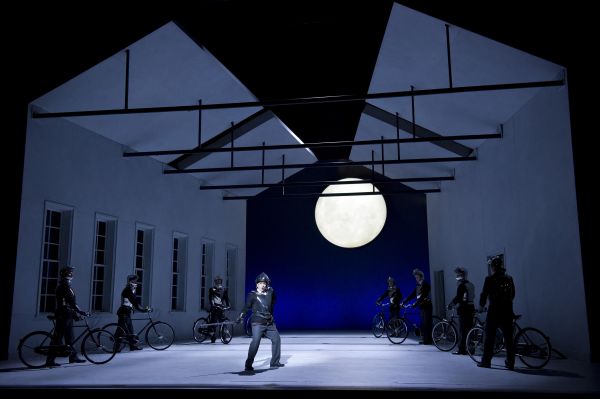
In the other operas I saw (by Rossini and Lully) Armida wants to get rid of Rinaldo, but unhappily falls in love with him and uses her magic to make him love her. The other Crusaders come to rescue him and he abandons Armida, who ends the opera in a vengeful rage. In the Handel version, Rinaldo is in love with Almirena, the daughter of Goffredo, commander of the troops. Armida and Argante decide they have to dispense with Rinaldo in order to win the battle, so they kidnap Almirena and trick Rinaldo into going with Armida’s minions. Of course Armida and Argante fall in love with their victims. Armida rages at both Argante and Rinaldo, there are several battles, and – this being another opera seria feature – there’s a happy ending, where the Crusaders are victorious but forgive Armida and Argante, who make up with each other.
There’s one hit song for this one - Almirena’s lament "Lascia ch'io pianga"
https://www.youtube.com/watch?v=NP6vkt9tKR8
This production sets the opera in a school. It seems like this wouldn’t translate well, but it is very clever, entertaining, and in some cases enhances or supports the plot. During the overture, one boy is bullied by his classmates, then punished by his teachers. As the class prepares to learn about the Crusades, knights jump out from behind the blackboard and punish the bullies, with the boy cheering them on. His wish-fulfillment fantasy continues, with him of course playing the role of the bravest knight, Rinaldo. His girlfriend (whose picture was stolen by the bullies in the overture) is Almirena and the teachers are the antagonists Armida and Argante. Armida/Argante being teachers adds an extra layer of inappropriateness to their attempts to win Rinaldo/Almirena.

A lot of the plot elements fit well with the idea of a kid’s fantasy – a clear good vs. evil story, magic and sorcerers, epic battles and even the too-convenient plot points (Armida and Argante fall in love too fast). The school setting is a lot of fun. The knights occasionally don school uniforms, Armida and Argante have hybrid teacher/standard evildoer outfits, the Christian mage is a mad scientist and the battles are in an explosion-filled laboratory or the schoolyard. Carsen has a lot of inventive bits – when the Crusaders go to rescue Almirena, they all ride bikes and Rinaldo has an E.T. moment; there are some creative drawings on the chalkboard; the gym is a torture chamber.

The singing is very good as well. Brenda Rae is wonderful as Armida – she isn’t daunted by the high notes and gamely runs around the stage in her pleather bad girl outfit. Luca Pisaroni (Argante) isn’t quite as facile with the ornamentation, but he still sings well. They both get some splendid opening songs, while those of Goffredo and Rinaldo are a little standard. Sonia Prina, in the trouser role of Rinaldo, is convincing as an unhappy schoolboy in the opening, then as an upright, if somewhat naïve, Crusader. Almirena does get some very nice music – besides "Lascia ch'io pianga", her “Augeletti che cantate” is a lovely, airy piece. Anett Fritsch has a light and pretty voice and is a sweet, if a bit hapless, Almirena. Countertenor Tim Mead, as Eustazio, another Crusader, sounded hooty and strained in his aria at the end of Act I, but was quite good in Act II.
This is a fantastic production which I would happily recommend.
Glyndebourne
Rinaldo – Sonia Prina
Almirena – Anett Fritsch
Armida – Brenda Rae
Argante – Luca Pisaroni
Goffredo – Varduhi Abrahamyan
Eustazio – Tim Mead
Georg Friedrich Handel is probably best known for The Messiah, but he composed a pile of operas and oratorios. The oft-repeated joke is that a German who wrote Italian operas was the best-known English composer until the 20th century. Handel’s operas fall squarely into the Italian opera seria category, and if anyone is talking about the “Baroque revival” or “Baroque operas”, they probably mean Handel. Opera seria is usually a case of Not My Thing (in contrast, I really like French baroque operas, e.g., Lully and Rameau). Most of this is due to the format and the nonstop da capo arias, although in general I like later music what with the whole “ruined by Wagner” thing.
Opera seria usually has 6 or 7 characters who get apportioned various da capo arias in between the harpsichord-accompanied recitative where all the plot happens – arias are for expressing emotion. But arias from opera seria are a different flavor from the familiar ones from 19th c. Italian operas. There’s a lot of ornamentation, but not like the more familiar bel canto type. It is an ABA format and the whole aria is usually just 4 lines –the first two lines are sung, then the second, then the first again, with different ornamentation. Also, the words tend to be very generalized, sometimes metaphoric sentiments – the emphasis was more on the poetry instead of moving the plot along or having the characters describe a bunch of things. There is one opera seria that I love – Giulio Cesare – but found the other ones that I saw meh or decent-ish depending on the production. This production, directed by Robert Carsen, was wonderful – one of those that made me think maybe I do love Rinaldo. Maybe?

Rinaldo premiered in 1711 and was one of Handel’s greatest successes. It is an adaptation of the story from Tasso’s Jerusalem Delivered, specifically the plot of the evil sorceress Armida’s love for noble Christian knight Rinaldo. Armida’s story has been made into a number of operas by well-known composers – Lully, Salieri, Haydn, Rossini, Dvorak and others all had a crack at it. One can see why the operas are usually titled Armida instead of Rinaldo. Armida – and in this one, her lover and co-baddie Argante – is more interesting than the too-good and virtuous Rinaldo and Almirena. Armida and Argante are frequently plotting, agonizing over their love problems, full of rage at their love problems, and carrying out their evil plans. Rinaldo and Almirena are mostly passive and reactive, besides being dully good and resisting Armida and Argante’s advances.
In the other operas I saw (by Rossini and Lully) Armida wants to get rid of Rinaldo, but unhappily falls in love with him and uses her magic to make him love her. The other Crusaders come to rescue him and he abandons Armida, who ends the opera in a vengeful rage. In the Handel version, Rinaldo is in love with Almirena, the daughter of Goffredo, commander of the troops. Armida and Argante decide they have to dispense with Rinaldo in order to win the battle, so they kidnap Almirena and trick Rinaldo into going with Armida’s minions. Of course Armida and Argante fall in love with their victims. Armida rages at both Argante and Rinaldo, there are several battles, and – this being another opera seria feature – there’s a happy ending, where the Crusaders are victorious but forgive Armida and Argante, who make up with each other.
There’s one hit song for this one - Almirena’s lament "Lascia ch'io pianga"
https://www.youtube.com/watch?v=NP6vkt9tKR8
This production sets the opera in a school. It seems like this wouldn’t translate well, but it is very clever, entertaining, and in some cases enhances or supports the plot. During the overture, one boy is bullied by his classmates, then punished by his teachers. As the class prepares to learn about the Crusades, knights jump out from behind the blackboard and punish the bullies, with the boy cheering them on. His wish-fulfillment fantasy continues, with him of course playing the role of the bravest knight, Rinaldo. His girlfriend (whose picture was stolen by the bullies in the overture) is Almirena and the teachers are the antagonists Armida and Argante. Armida/Argante being teachers adds an extra layer of inappropriateness to their attempts to win Rinaldo/Almirena.

A lot of the plot elements fit well with the idea of a kid’s fantasy – a clear good vs. evil story, magic and sorcerers, epic battles and even the too-convenient plot points (Armida and Argante fall in love too fast). The school setting is a lot of fun. The knights occasionally don school uniforms, Armida and Argante have hybrid teacher/standard evildoer outfits, the Christian mage is a mad scientist and the battles are in an explosion-filled laboratory or the schoolyard. Carsen has a lot of inventive bits – when the Crusaders go to rescue Almirena, they all ride bikes and Rinaldo has an E.T. moment; there are some creative drawings on the chalkboard; the gym is a torture chamber.

The singing is very good as well. Brenda Rae is wonderful as Armida – she isn’t daunted by the high notes and gamely runs around the stage in her pleather bad girl outfit. Luca Pisaroni (Argante) isn’t quite as facile with the ornamentation, but he still sings well. They both get some splendid opening songs, while those of Goffredo and Rinaldo are a little standard. Sonia Prina, in the trouser role of Rinaldo, is convincing as an unhappy schoolboy in the opening, then as an upright, if somewhat naïve, Crusader. Almirena does get some very nice music – besides "Lascia ch'io pianga", her “Augeletti che cantate” is a lovely, airy piece. Anett Fritsch has a light and pretty voice and is a sweet, if a bit hapless, Almirena. Countertenor Tim Mead, as Eustazio, another Crusader, sounded hooty and strained in his aria at the end of Act I, but was quite good in Act II.
This is a fantastic production which I would happily recommend.
119DieFledermaus
For some reason, I haven't much felt like reading ebooks lately. This is helping to reduce the pile (I still want to read actual books), but it's making Witness the Night by Kishwar Desai go slowly. (Also had some other planned ebooks reads that aren't happening.)
Things to review -
The General in his Labyrinth - Gabriel Garcia Marquez
All the Pretty Horses - Cormac McCarthy
Family Sayings - Natalia Ginzburg
The Dogs and the Wolves - Irene Nemirovsky
Don Giovanni - La Monnaie
Lucia di Lammermoor - Bayerische Staatsoper
Parsifal - ROH
Things to review -
The General in his Labyrinth - Gabriel Garcia Marquez
All the Pretty Horses - Cormac McCarthy
Family Sayings - Natalia Ginzburg
The Dogs and the Wolves - Irene Nemirovsky
Don Giovanni - La Monnaie
Lucia di Lammermoor - Bayerische Staatsoper
Parsifal - ROH
120dchaikin
Excellent review of The Victims Return. A lot to wonder about there.
121Poquette
Enjoyed your review of Rinaldo. You are probably going to laugh at this, but Handel is right at the top of my favorite composers list (along with Mozart, Schubert and Bach). Theodora (my favorite), L'Allegro, Il Penseroso and The Occasional Oratorio (along with Messiah, of course) are mindboggling assemblages of gorgeous music. In the opera department, Julio Cesare is a standout. Have you heard the old New York City Opera/Beverly Sills/Norman Treagle version? Rather unconventional, but in my mind, one of the great Handel listening experiences.
I saw a version of Rinaldo in the 1990s on an obscure cable station called Ovation. (I wonder what happened to them? They seem to have disappeared into cable oblivion.) They did a lot of reruns, and I think I watched it three times. I thought it was from Glyndebourne, but I could be wrong. At any rate, it was a much different production than the one you watched. Sorry, I don't remember who was in it. Anyway, it was delightful to be reminded about it through your review.
I saw a version of Rinaldo in the 1990s on an obscure cable station called Ovation. (I wonder what happened to them? They seem to have disappeared into cable oblivion.) They did a lot of reruns, and I think I watched it three times. I thought it was from Glyndebourne, but I could be wrong. At any rate, it was a much different production than the one you watched. Sorry, I don't remember who was in it. Anyway, it was delightful to be reminded about it through your review.
122DieFledermaus
>120 dchaikin: - Thanks - I've definitely thought about the book when reading various news stories about Russia.
>121 Poquette: - Nope, no laughing! There are a lot of people around here who like Handel and early music (I once got to chatting with a couple at an early music concert and they were talking about how much they loved the theorbo player and had seen him several times). I think I'm at the other end - I get excited to see some weird atonal or contemporary pieces and my friends who like classical music think that's odd.
I'm actually not that familiar with Schubert and Bach (no operas), but I'm watching a semi-staged performance of Winterreise from Aix-en-Provence
http://concert.arte.tv/fr/le-voyage-dhiver-de-schubert-au-festival-daix-en-prove...
Have you ever seen the Mark Morris ballet set to L'Allegro? I heard really good things about it and would love to see it. I have a production of Theodora that I'm going to try to watch sometime soon - good to know it's one you would recommend! I don't think the recording of Giulio Cesare that I have is from NYCO - I will have to check to see who it is. They probably have some clips from Sills on YouTube, will look. I saw three productions of Giulio Cesare and they were all really fun - all were a little concept-y, but nothing too radical (the McVicar production at the Met with Dessay although there's a Glyndebourne DVD; the Pelly production with Dessay/Zazzo; Salzburg version with Bartoli/Scholll).
I've never heard of Ovation, but it looks like they are still going -
http://www.ovationtv.com/
I used to get the Arts Channel (?) but they only showed clips of various performances, not the whole thing. It was sort of soothing to have on in the background and I did pick up a couple pieces that I liked.
>121 Poquette: - Nope, no laughing! There are a lot of people around here who like Handel and early music (I once got to chatting with a couple at an early music concert and they were talking about how much they loved the theorbo player and had seen him several times). I think I'm at the other end - I get excited to see some weird atonal or contemporary pieces and my friends who like classical music think that's odd.
I'm actually not that familiar with Schubert and Bach (no operas), but I'm watching a semi-staged performance of Winterreise from Aix-en-Provence
http://concert.arte.tv/fr/le-voyage-dhiver-de-schubert-au-festival-daix-en-prove...
Have you ever seen the Mark Morris ballet set to L'Allegro? I heard really good things about it and would love to see it. I have a production of Theodora that I'm going to try to watch sometime soon - good to know it's one you would recommend! I don't think the recording of Giulio Cesare that I have is from NYCO - I will have to check to see who it is. They probably have some clips from Sills on YouTube, will look. I saw three productions of Giulio Cesare and they were all really fun - all were a little concept-y, but nothing too radical (the McVicar production at the Met with Dessay although there's a Glyndebourne DVD; the Pelly production with Dessay/Zazzo; Salzburg version with Bartoli/Scholll).
I've never heard of Ovation, but it looks like they are still going -
http://www.ovationtv.com/
I used to get the Arts Channel (?) but they only showed clips of various performances, not the whole thing. It was sort of soothing to have on in the background and I did pick up a couple pieces that I liked.
123Poquette
>122 DieFledermaus: Modern music is definitely an acquired taste, but I am working on it. There are a few things I like, but I found I have to think of a modern opera more in terms of the total audio and visual production than as a musical experience per se.
I love Die Winterreise! Schubert's songs are sublime.
I passed up the Mark Morris L'Allegro when it was done in San Francisco with the Philharmonia Baroque. Where Handel and earlier music is concerned, I'm into it for the music. Color me narrow-minded! ;-)
Thanks much for the links!
I love Die Winterreise! Schubert's songs are sublime.
I passed up the Mark Morris L'Allegro when it was done in San Francisco with the Philharmonia Baroque. Where Handel and earlier music is concerned, I'm into it for the music. Color me narrow-minded! ;-)
Thanks much for the links!
124DieFledermaus
>123 Poquette: - I do think it's a bit of an acquired taste. There are definitely some modern operas where I enjoyed them, but that was based on the whole production and I'm not sure I'd want to just listen to the music alone (although I feel that way about some older operas also).
I am enjoying the Schubert so far - will report back on the performance.
The Morris ballet was how I first heard of L'Allegro - I've seen something by him at the ballet company here and enjoyed it so I wanted to see that one as well. Heh heh, I've actually picked up some pieces I liked listening to them in a ballet. But for more Handel - I'm going to see Semele later in the month and will probably do a review for that one.
I am enjoying the Schubert so far - will report back on the performance.
The Morris ballet was how I first heard of L'Allegro - I've seen something by him at the ballet company here and enjoyed it so I wanted to see that one as well. Heh heh, I've actually picked up some pieces I liked listening to them in a ballet. But for more Handel - I'm going to see Semele later in the month and will probably do a review for that one.
125DieFledermaus
The General in his Labyrinth by Gabriel Garcia Marquez
Finished 2/2/15
Garcia Marquez’s depiction of the last few months in the life of Simón Bolívar, liberator of South America, is an absorbing and interesting read. There’s no magic realism in this one, but there are many ironies and absurdities, possible ghosts and portents, and occasional delusions. The overwhelming image of the book is one of ruin and decay – the General’s failing health is described at length. In addition, as they travel from Santa Fe de Bogota to Cartagena via the Magdalena River, the General recalls earlier days in the same places where he was young and energetic, greeted by adoring crowds, feted as a hero, and sleeping with many, many women. Now the officials have to keep away violent protesters and quickly paint over the graffiti denouncing him. The townspeople respond tepidly, if at all, to his arrival and any attempts to recreate the past – playing the waltz that he previously ordered to be done continuously – fall flat. It also appears that his dream of a united South America will never happen, as the political infighting grows worse, and regions split off.
There’s no overt magical events, but there is a quixotic feel to the book, even though it was based on true events and it is obvious that Garcia Marquez did extensive research (describing the writings and works of some of Bolívar’s companions after his death, for example). Besides the night and day reactions to the General, his journeys have the sad, inevitable feeling of never happening and never going anywhere. At the beginning, he is constantly talking about leaving with his retinue, but many believe he will never leave. There’s always a reason – someone wants him to stay, he needs a passport. When they finally start out, it is with the plan of reaching Cartagena and taking a ship to London. No one believes this plan, and the General’s attempts to make it believable almost sabotage it even more. With all his appointments, terms as president, taking and retaking various places, his life seems to have a circular or repetitive quality – certainly making the title appropriate. There are a couple instances of disappearing women or ghosts that the general believes he sees, although who can know the truth about that? His legal wrangling over the Aroa mines also has a Kafka-esque or Jarndyce vs. Jarndyce feel.
Bolívar’s character is not always sympathetic, but always interesting. His friends and supporters, like his money, are dwindling and he really is only close to his oldest servant, Jose Palacios. Even Manuela Saez, his lover of years, keeps him at a distance – she made a firm resolution not to be dragged down with him. He’s irascible, stubborn, foolish, and his extreme need to be admired and not criticized moves into slightly unhealthy territory. There are several examples of Bolivar’s cruel or violent actions, but I almost felt there should be more of that. The main contrast is between his former glory and present misery. But this was a good read, and reminded me that I should read more Garcia Marquez.
Finished 2/2/15
Garcia Marquez’s depiction of the last few months in the life of Simón Bolívar, liberator of South America, is an absorbing and interesting read. There’s no magic realism in this one, but there are many ironies and absurdities, possible ghosts and portents, and occasional delusions. The overwhelming image of the book is one of ruin and decay – the General’s failing health is described at length. In addition, as they travel from Santa Fe de Bogota to Cartagena via the Magdalena River, the General recalls earlier days in the same places where he was young and energetic, greeted by adoring crowds, feted as a hero, and sleeping with many, many women. Now the officials have to keep away violent protesters and quickly paint over the graffiti denouncing him. The townspeople respond tepidly, if at all, to his arrival and any attempts to recreate the past – playing the waltz that he previously ordered to be done continuously – fall flat. It also appears that his dream of a united South America will never happen, as the political infighting grows worse, and regions split off.
There’s no overt magical events, but there is a quixotic feel to the book, even though it was based on true events and it is obvious that Garcia Marquez did extensive research (describing the writings and works of some of Bolívar’s companions after his death, for example). Besides the night and day reactions to the General, his journeys have the sad, inevitable feeling of never happening and never going anywhere. At the beginning, he is constantly talking about leaving with his retinue, but many believe he will never leave. There’s always a reason – someone wants him to stay, he needs a passport. When they finally start out, it is with the plan of reaching Cartagena and taking a ship to London. No one believes this plan, and the General’s attempts to make it believable almost sabotage it even more. With all his appointments, terms as president, taking and retaking various places, his life seems to have a circular or repetitive quality – certainly making the title appropriate. There are a couple instances of disappearing women or ghosts that the general believes he sees, although who can know the truth about that? His legal wrangling over the Aroa mines also has a Kafka-esque or Jarndyce vs. Jarndyce feel.
Bolívar’s character is not always sympathetic, but always interesting. His friends and supporters, like his money, are dwindling and he really is only close to his oldest servant, Jose Palacios. Even Manuela Saez, his lover of years, keeps him at a distance – she made a firm resolution not to be dragged down with him. He’s irascible, stubborn, foolish, and his extreme need to be admired and not criticized moves into slightly unhealthy territory. There are several examples of Bolivar’s cruel or violent actions, but I almost felt there should be more of that. The main contrast is between his former glory and present misery. But this was a good read, and reminded me that I should read more Garcia Marquez.
126reva8
>125 DieFledermaus: Interesting review, thanks for this!
127avaland
>125 DieFledermaus: Interesting to read about a Marquez that doesn't include magical realism, so less the surreal but perhaps a touch of the Gothic (ghosts)? :-)
128rebeccanyc
That's a Garcia Marquez I haven't read, so I particularly enjoyed your review. I read a biography of Simon Bolivar several years ago and found it interesting but lengthy and dry.
129FlorenceArt
>125 DieFledermaus: Great review, thank you! I suppose I should read Garcia Marquez some day. Well I did read Love in the Time of the Cholera but I don't remember much about it.
130Poquette
>125 DieFledermaus: I am adding The General in His Labyrinth to my wish list based on your interesting review. I have been putting off getting into Latin American lit because there is so much else out there I want to read first, but I am feeling the pull. I was enthralled by Love in the Time of Cholera and read a bio of Bolivar in junior high, so it is written on high that I must read The General sooner rather than later.
131rebeccanyc
Love in the Time of Cholera is my favorite of the Garcia Marquezes I've read, much more than One Hundred Years of Solitude for example. I did enjoy the first (and only) part of his autobiography, Living to Tell the Tale, and it led me to read more of his work.
132DieFledermaus
>126 reva8: - Thanks!
>127 avaland: - Maybe a bit more Gothic than some of others, although I think the decay/claustrophobia aspect of it seemed more like the latter half of One Hundred Years of Solitude rather than some of the other Gothics that I have read.
>128 rebeccanyc:, >130 Poquette: - Poquette, glad to add to the list! I bought the book years ago and thought I should read a bio of Bolivar before reading it. That didn't happen, but I've been trying to reduce the TBR list so I just read his Wikipedia page. You two will probably have a better idea of all the background reading the book.
>129 FlorenceArt: - Thanks! I've also read One Hundred Years of Solitude, Love in the Time of Cholera, No One Writes to the Colonel (short stories), and The Story of a Shipwrecked Sailor (long journalism), but they were all years ago (maybe the last one in 2006 or so?) - I'm thinking I should read some more now.
>131 rebeccanyc: - My favorite is One Hundred Years of Solitude, but I liked Love in the Time of Cholera a lot also.
Any recommendations for other Garcia Marquez books? I was thinking Autumn of the Patriarch or Chronicle of a Death Foretold next.
>127 avaland: - Maybe a bit more Gothic than some of others, although I think the decay/claustrophobia aspect of it seemed more like the latter half of One Hundred Years of Solitude rather than some of the other Gothics that I have read.
>128 rebeccanyc:, >130 Poquette: - Poquette, glad to add to the list! I bought the book years ago and thought I should read a bio of Bolivar before reading it. That didn't happen, but I've been trying to reduce the TBR list so I just read his Wikipedia page. You two will probably have a better idea of all the background reading the book.
>129 FlorenceArt: - Thanks! I've also read One Hundred Years of Solitude, Love in the Time of Cholera, No One Writes to the Colonel (short stories), and The Story of a Shipwrecked Sailor (long journalism), but they were all years ago (maybe the last one in 2006 or so?) - I'm thinking I should read some more now.
>131 rebeccanyc: - My favorite is One Hundred Years of Solitude, but I liked Love in the Time of Cholera a lot also.
Any recommendations for other Garcia Marquez books? I was thinking Autumn of the Patriarch or Chronicle of a Death Foretold next.
133DieFledermaus
Lucia di Lammermoor
Bayerische Staatsoper
Lucia Ashton – Diana Damrau
Edgardo di Ravenswood – Pavel Breslik
Enrico Ashton – Levente Molnár
Arturo – Emanuele D'Aguanno
Raimondo – Alexander Tsymbalyuk
Alisa – Rachael Wilson
Bel canto drama isn’t my favorite thing (although bel canto comedies are a lot of fun), but Lucia di Lammermoor is a great opera – plenty of beautiful music, drama, and acting opportunities. Unfortunately, this production by the Bayerische Staatsoper was rather forgettable. Lucia di Lammermoor is one of Gaetano Donizetti’s best-known and most popular operas – there are several famous pieces. There’s a Romeo and Juliet-type romance between Lucia and Edgardo, whose families are mortal enemies. The couple swears vows before Edgardo leaves for the continent (it was based on a Walter Scott novel, there was probably more about politics and history there, but it’s a side note in the opera). Several months later, Lucia’s brother Enrico has been intercepting Edgardo’s letters and shows his sister a forged letter claiming Edgardo is unfaithful. He wants Lucia to marry Arturo to save the family. Lucia unhappily agrees, but after she signs the marriage contract, Edgardo bursts in and curses her. Lucia, in a fit of insanity, kills Arturo and sings floods of coloratura runs before dying. Edgardo, on hearing the news, says he will soon follow her.

My favorite bit is Lucia’s mournful opening aria “Regnava nel silencio”
https://www.youtube.com/watch?v=2kGKKM_c6lM
The Act II sextet is pretty well known – it was apparently used in movies like Scarface and The Departed –
https://www.youtube.com/watch?v=0ItN6J5wSlM
Lucia’s mad scene music has also been used in a bunch of things – the one I am familiar with is the alien diva singing in The Fifth Element
https://www.youtube.com/watch?v=0_XBU-PQZnE
There are two concepts here and they clash somewhat. The setting is a ruined, decaying room and the Gothic feel is supported by symbolic paintings and ghostly little girls (little Lucia?) running around. However, all the characters are American 50’s and 60’s archetypes. Lucia has a Jackie Kennedy look, with pearls and pleated dresses, and the men wear suits. Her marriage to Arturo is supposed to be a loveless political match, and the signing of the marriage contract is staged as a press conference. Edgardo looks like he stepped out of Grease or Rebel Without a Cause – honestly, it’s almost over the top and laughable, and Breslik is not the James Dean type. I think either of these would be fine, if not great, alone (despite James Dean), but together they seemed mismatched. Would Kennedy-types really allow people to see their house in that condition?

I’ve loved Diana Damrau in other things, but here I had some problems. The voice was a bit harsh and some of the high notes were a stretch. Also, she had a lot of exaggerated operatic mannerisms – twirling, sobbing into her hands, falling down on the floor. I did like the portrayal of Lucia as a strong-willed woman whose madness gives her license to do what she wants instead of a fragile victim driven to insanity. Her Lucia confidently strides around with a gun instead of slowly coming, blood-stained, down the stairs. Maybe I was too distracted by Breslik’s ill-suited leather jackets, but the singing was just fine, not memorable. Levente Molnár, as Enrico, was also more decent than great. Unfortunately, Emanuele D'Aguanno – Arturo – had a pitchy, unstable voice. I suppose Rachael Wilson, the Alisa, was good, and she had more to do than usual – she was always set aside from the chorus and seemed to be the only one who understood Lucia.

Eh, this probably isn't the one to see if you've never seen Lucia before. Maybe for people who really like Damrau or Breslik? They also used a glass harmonica instead of flute for the mad scene, which was interesting. It had an eerie, hollow sound which was very appropriate.
Bayerische Staatsoper
Lucia Ashton – Diana Damrau
Edgardo di Ravenswood – Pavel Breslik
Enrico Ashton – Levente Molnár
Arturo – Emanuele D'Aguanno
Raimondo – Alexander Tsymbalyuk
Alisa – Rachael Wilson
Bel canto drama isn’t my favorite thing (although bel canto comedies are a lot of fun), but Lucia di Lammermoor is a great opera – plenty of beautiful music, drama, and acting opportunities. Unfortunately, this production by the Bayerische Staatsoper was rather forgettable. Lucia di Lammermoor is one of Gaetano Donizetti’s best-known and most popular operas – there are several famous pieces. There’s a Romeo and Juliet-type romance between Lucia and Edgardo, whose families are mortal enemies. The couple swears vows before Edgardo leaves for the continent (it was based on a Walter Scott novel, there was probably more about politics and history there, but it’s a side note in the opera). Several months later, Lucia’s brother Enrico has been intercepting Edgardo’s letters and shows his sister a forged letter claiming Edgardo is unfaithful. He wants Lucia to marry Arturo to save the family. Lucia unhappily agrees, but after she signs the marriage contract, Edgardo bursts in and curses her. Lucia, in a fit of insanity, kills Arturo and sings floods of coloratura runs before dying. Edgardo, on hearing the news, says he will soon follow her.

My favorite bit is Lucia’s mournful opening aria “Regnava nel silencio”
https://www.youtube.com/watch?v=2kGKKM_c6lM
The Act II sextet is pretty well known – it was apparently used in movies like Scarface and The Departed –
https://www.youtube.com/watch?v=0ItN6J5wSlM
Lucia’s mad scene music has also been used in a bunch of things – the one I am familiar with is the alien diva singing in The Fifth Element
https://www.youtube.com/watch?v=0_XBU-PQZnE
There are two concepts here and they clash somewhat. The setting is a ruined, decaying room and the Gothic feel is supported by symbolic paintings and ghostly little girls (little Lucia?) running around. However, all the characters are American 50’s and 60’s archetypes. Lucia has a Jackie Kennedy look, with pearls and pleated dresses, and the men wear suits. Her marriage to Arturo is supposed to be a loveless political match, and the signing of the marriage contract is staged as a press conference. Edgardo looks like he stepped out of Grease or Rebel Without a Cause – honestly, it’s almost over the top and laughable, and Breslik is not the James Dean type. I think either of these would be fine, if not great, alone (despite James Dean), but together they seemed mismatched. Would Kennedy-types really allow people to see their house in that condition?

I’ve loved Diana Damrau in other things, but here I had some problems. The voice was a bit harsh and some of the high notes were a stretch. Also, she had a lot of exaggerated operatic mannerisms – twirling, sobbing into her hands, falling down on the floor. I did like the portrayal of Lucia as a strong-willed woman whose madness gives her license to do what she wants instead of a fragile victim driven to insanity. Her Lucia confidently strides around with a gun instead of slowly coming, blood-stained, down the stairs. Maybe I was too distracted by Breslik’s ill-suited leather jackets, but the singing was just fine, not memorable. Levente Molnár, as Enrico, was also more decent than great. Unfortunately, Emanuele D'Aguanno – Arturo – had a pitchy, unstable voice. I suppose Rachael Wilson, the Alisa, was good, and she had more to do than usual – she was always set aside from the chorus and seemed to be the only one who understood Lucia.

Eh, this probably isn't the one to see if you've never seen Lucia before. Maybe for people who really like Damrau or Breslik? They also used a glass harmonica instead of flute for the mad scene, which was interesting. It had an eerie, hollow sound which was very appropriate.
134ursula
>132 DieFledermaus: I've read Chronicle of a Death Foretold. It's a fun little novella. It's easy to fit in anytime, since it's so short.
135rebeccanyc
>132 DieFledermaus: I read the most Garcia Marquez in the 80s, so don't remember a lot, but I did read Chronicle of a Death Foretold more recently and enjoyed it (but stay away from Memories of My Melancholy Whores, which I also read more recently). And as I said, in >131 rebeccanyc:, I did like his memoir, Living To Tell the Tale.
136Poquette
>133 DieFledermaus: Very much enjoyed your review of Lucia di Lamermoor, probably my favorite of the Italian bel canto operas. The aria that pretty much always sends me into orbit is "Spargi d'amore pianto," "Sprinkle with bitter tears my earthly remains." How melodramatic can it get? I swear it's the music that sucks me in.
https://www.youtube.com/watch?v=5h-HrKEZ7kM
I am completely out of touch with the current opera scene, and am embarrassed to say I had never heard of any of these singers. I listened to some of the Diana Damrau clips and she does have a nice voice. My most memorable Lucia was with Beverly Sills. It would seem that we are about a generation apart in our involvement with opera. Your reviews are helping me get back into the swim!
https://www.youtube.com/watch?v=5h-HrKEZ7kM
I am completely out of touch with the current opera scene, and am embarrassed to say I had never heard of any of these singers. I listened to some of the Diana Damrau clips and she does have a nice voice. My most memorable Lucia was with Beverly Sills. It would seem that we are about a generation apart in our involvement with opera. Your reviews are helping me get back into the swim!
137DieFledermaus
>134 ursula:, >135 rebeccanyc: - Thanks Ursula and Rebecca, it sounds like Chronicle of a Death Foretold is the one to read, and the library has it as an ebook. I wasn't really interested in Memories of my Melancholy Whores as the premise sounded uninteresting - you confirmed what I was thinking.
>136 Poquette: - Thanks - glad to hear they are helpful! Lucia definitely seems to be a "best of genre" for bel canto drama. Besides the beautiful music and plenty of showboating opportunities - yup, there's some good concentrated melodrama there. I really like Damrau, and have seen Breslik in something else (he was a good Lensky so I probably typecast him as "cute poet" not "James Dean") but I'm not familiar with any of the other singers. I think the only one I've seen recently where I was at least familiar with all the names was Fidelio (well, Tosca also, although didn't know Stundyte, she sings mainly in Europe).
For Beverly Sills - I saw some clips on YouTube from Giulio Cesare with Treagle, but they weren't from NYCO. I did find this however - Sills appearing with the Muppets and attempting to outsing them -
https://www.youtube.com/watch?v=f4jXBpPwJv0
>136 Poquette: - Thanks - glad to hear they are helpful! Lucia definitely seems to be a "best of genre" for bel canto drama. Besides the beautiful music and plenty of showboating opportunities - yup, there's some good concentrated melodrama there. I really like Damrau, and have seen Breslik in something else (he was a good Lensky so I probably typecast him as "cute poet" not "James Dean") but I'm not familiar with any of the other singers. I think the only one I've seen recently where I was at least familiar with all the names was Fidelio (well, Tosca also, although didn't know Stundyte, she sings mainly in Europe).
For Beverly Sills - I saw some clips on YouTube from Giulio Cesare with Treagle, but they weren't from NYCO. I did find this however - Sills appearing with the Muppets and attempting to outsing them -
https://www.youtube.com/watch?v=f4jXBpPwJv0
138DieFledermaus
All the Pretty Horses by Cormac McCarthy
Finished 2/6/15
There are already a bunch of reviews for this book. I enjoyed it quite a bit and was a little surprised at how lively it was. It felt more like No Country for Old Men (McCarthy’s sparse take on a genre plot) even if there were some similarities to Blood Meridian (more of a Western). I was a fan of the baroquely gorgeous prose in Blood Meridian – there is some of that in All the Pretty Horses, with the occasional glowing, stream of consciousness sentence-paragraph, but most of the story is related in McCarthy’s other style, clipped, short sentences. The plot is bookended with two trips across the Texas/Mexico border (it takes place after WWII), and these were my favorite parts. The middle section has more action, but is also more predictable – an obvious romance, for example. After reading this one, I’m looking forward to The Crossing.
John Grady Cole is the teenage protagonist, and while he is naïve in many ways, he is both an experienced cowhand and world-weary in other ways. After learning that he will lose the family land, he runs away with his best friend Lacey Rawlins – they plan to cross the border and find work. In their travels, they pick up an even younger kid and have several adventures. I enjoyed the loose, rambling structure of this first part and there were even some comic bits. The author establishes John Grady’s special relationship with horses very well throughout the book – the title is entirely appropriate. It’s also a way he relates to people – his father, (not) his mother, Rawlins (they have an easy rapport riding and working with horses), the kid (there’s a mystery with his horse, later there’s some conflict). Even the rather clichéd romance starts out with glimpses of each other riding and a big moment occurs over another horse. The final horseback journey is very different from the first one, even down to the people who accompany him. While in Mexico, John Grady finds work, love, violence, history, and more adventures, but again, everything comes back to horses.
Finished 2/6/15
There are already a bunch of reviews for this book. I enjoyed it quite a bit and was a little surprised at how lively it was. It felt more like No Country for Old Men (McCarthy’s sparse take on a genre plot) even if there were some similarities to Blood Meridian (more of a Western). I was a fan of the baroquely gorgeous prose in Blood Meridian – there is some of that in All the Pretty Horses, with the occasional glowing, stream of consciousness sentence-paragraph, but most of the story is related in McCarthy’s other style, clipped, short sentences. The plot is bookended with two trips across the Texas/Mexico border (it takes place after WWII), and these were my favorite parts. The middle section has more action, but is also more predictable – an obvious romance, for example. After reading this one, I’m looking forward to The Crossing.
John Grady Cole is the teenage protagonist, and while he is naïve in many ways, he is both an experienced cowhand and world-weary in other ways. After learning that he will lose the family land, he runs away with his best friend Lacey Rawlins – they plan to cross the border and find work. In their travels, they pick up an even younger kid and have several adventures. I enjoyed the loose, rambling structure of this first part and there were even some comic bits. The author establishes John Grady’s special relationship with horses very well throughout the book – the title is entirely appropriate. It’s also a way he relates to people – his father, (not) his mother, Rawlins (they have an easy rapport riding and working with horses), the kid (there’s a mystery with his horse, later there’s some conflict). Even the rather clichéd romance starts out with glimpses of each other riding and a big moment occurs over another horse. The final horseback journey is very different from the first one, even down to the people who accompany him. While in Mexico, John Grady finds work, love, violence, history, and more adventures, but again, everything comes back to horses.
139DieFledermaus
Don Giovanni
La Monnaie
Don Giovanni - Jean-Sébastien Bou
Leporello - Andreas Wolf
Donna Anna - Barbara Hannigan
Don Ottavio - Topi Lehtipuu
Donna Elvira - Rinat Shaham
Zerlina - Julie Mathevet
Masetto -Jean-Luc Ballestra
Commendatore -Willard White
Don Giovanni is one of those operas that is regularly listed as The Best Opera Ever. There are a number of well-known songs, and the libretto was written by Mozart’s regular and best-known collaborator, Lorenzo da Ponte, in a much-celebrated partnership. Based on the plays of Moliere and Tirso de Molino, the opera adapts the Don Juan story, following his attempts to rape/seduce multiple women and avoid various angry men and women until he is punished for a murder by being dragged down to hell by a stone statue.
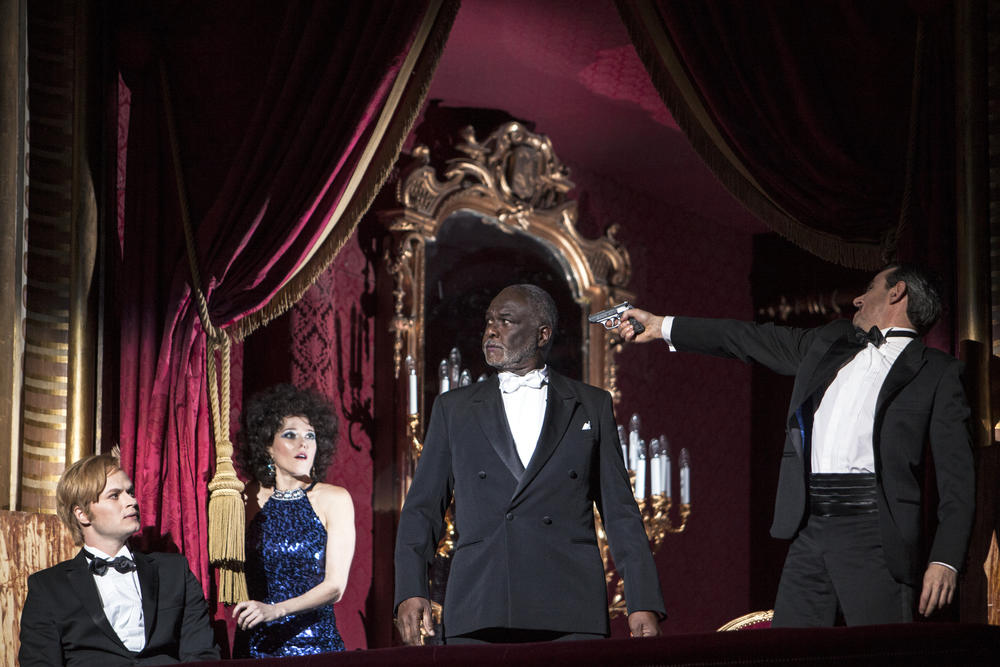
I think my expectations about this production didn’t help. I’d heard the singing was not great, so maybe I was expecting some bad singing? It wasn’t good at first, though I think most of the performers improved in the second act (but still, I’ve never heard such a limp and lifeless Catalogue Aria). Also, the main reason I wanted to see this one (well besides it being Don Giovanni, which I love) was the production by noted weirdo production director Krzysztof Warlikowski. I was expecting something really crazy. Instead, some of it seemed like a straight 70’s disco time period move, there were random bits that either needed more explaining/development or were meh, the characterization of Donna Anna was risible, erratic and confused, and I kept making comparisons to the very Regie Tcherniakov production that I saw.

It opens with the performers watching a film from the theater boxes. I would not have known this if I hadn’t read the reviews, but the film is apparently a shot for shot remake of scenes from the film Shame, about a sex addict. Don Giovanni certainly seems to be sick in this production, but if I hadn’t known about this before, I’d assume he was an alcoholic (he’s often drinking, staggering and crawling around, hooked up to an IV). Besides the randomness of the film, it doesn’t feel cohesive – the film is coolly intimate, black and white, with a lot of close-ups and a modern setting, while the actual production has garish disco 1970’s type costumes, with a lot of action and various characters milling around in the background. Even Don Giovanni’s addiction wasn’t as interesting as it could be – the Tcherniakov production I saw had an even more disheveled and drunk Don Giovanni, and this concept didn’t seem to be followed through the whole opera. The characters all had costumes that screamed disco, and at one point Don Giovanni and Leporello have fake beards. I always like to see how directors do their relationship, but here it was boring because they spent the recitatives dressing or standing around randomly.

Barbara Hannigan as Donna Anna probably had the silliest character concept. There’s the standard “Donna Anna is in love with Giovanni” paired with a lot of weird robot moves and hysteria. She obviously dislikes Don Ottavio and kills him in the finale. I would actually be fine with this, but it is very random. Also her father the Commendatore is either not dead or a zombie and they are having a relationship (Willard White sounded somewhat worn, but otherwise sang strongly). Hannigan throws herself into the role though, but I don’t think vocally it is a fit. The concept for Don Ottavio is interesting – usually he is a blandly good tenor, but here he is cool and indifferent to Anna, which explains her preferring Don Giovanni. Zerlina also seems like a knowing peasant girl instead of a naïve victim, and she sings one of her arias like a performance on the disco stage – a nice touch as, though she is consoling Masetto, she is making it a bit about herself. The other piece I liked was the staging of the final scene, where Don Giovanni is dragged off by the stone statue. On seeing the Commendatore come back to life, he kills himself in a fit of desperation. However, even this was irritating, as there was a random dancer doing movements off to the side (also maybe a bit racist? There’s a silent role for a young girl in white who maybe represents Don Giovanni’s ideal love or good side or something, but the dancer is a black woman in black who is associated with death – yeah, not great).

Jean-Sébastien Bou as Don Giovanni sounded okay in the loud, dramatic parts, but not in the songs that required a beautiful sound like the well-known duet with Zerlina, “La ci darem la mano” or the serenade “Deh vieni alla finestra.” As Leporello, Andreas Wolf was not very memorable except for unfortunately singing a very flat Catalogue Aria. He wasn’t helped by the stage business, where he mostly just stood around. I think after the Catalogue Aria, my next favorite bits are Donna Elvira’s arias. Here, Rinat Shaham sounded scoopy and strained in “Ah, chi mi dice mai" but she improved in the second act (in general, I think most of the singers did).
There are two different versions of Don Giovanni as there were premieres in Prague and Vienna. Usually, companies use an unholy marriage of the Prague and Vienna versions, to paraphrase a description I heard (all Don Ottavio and Donna Elvira’s arias, leave out the Zerlina-Leporello duet, have the ending with everyone saying what they’re going to do and moralizing). I’ve seeing the duet added and + or – some arias, but I’ve never seen it end with Don Giovanni’s end. I thought they were going to do that here – would be a bit daring – but no, ended in the traditional way.
This isn't a great production, but it's a great opera, will post some bits from it later
La Monnaie
Don Giovanni - Jean-Sébastien Bou
Leporello - Andreas Wolf
Donna Anna - Barbara Hannigan
Don Ottavio - Topi Lehtipuu
Donna Elvira - Rinat Shaham
Zerlina - Julie Mathevet
Masetto -Jean-Luc Ballestra
Commendatore -Willard White
Don Giovanni is one of those operas that is regularly listed as The Best Opera Ever. There are a number of well-known songs, and the libretto was written by Mozart’s regular and best-known collaborator, Lorenzo da Ponte, in a much-celebrated partnership. Based on the plays of Moliere and Tirso de Molino, the opera adapts the Don Juan story, following his attempts to rape/seduce multiple women and avoid various angry men and women until he is punished for a murder by being dragged down to hell by a stone statue.
I think my expectations about this production didn’t help. I’d heard the singing was not great, so maybe I was expecting some bad singing? It wasn’t good at first, though I think most of the performers improved in the second act (but still, I’ve never heard such a limp and lifeless Catalogue Aria). Also, the main reason I wanted to see this one (well besides it being Don Giovanni, which I love) was the production by noted weirdo production director Krzysztof Warlikowski. I was expecting something really crazy. Instead, some of it seemed like a straight 70’s disco time period move, there were random bits that either needed more explaining/development or were meh, the characterization of Donna Anna was risible, erratic and confused, and I kept making comparisons to the very Regie Tcherniakov production that I saw.

It opens with the performers watching a film from the theater boxes. I would not have known this if I hadn’t read the reviews, but the film is apparently a shot for shot remake of scenes from the film Shame, about a sex addict. Don Giovanni certainly seems to be sick in this production, but if I hadn’t known about this before, I’d assume he was an alcoholic (he’s often drinking, staggering and crawling around, hooked up to an IV). Besides the randomness of the film, it doesn’t feel cohesive – the film is coolly intimate, black and white, with a lot of close-ups and a modern setting, while the actual production has garish disco 1970’s type costumes, with a lot of action and various characters milling around in the background. Even Don Giovanni’s addiction wasn’t as interesting as it could be – the Tcherniakov production I saw had an even more disheveled and drunk Don Giovanni, and this concept didn’t seem to be followed through the whole opera. The characters all had costumes that screamed disco, and at one point Don Giovanni and Leporello have fake beards. I always like to see how directors do their relationship, but here it was boring because they spent the recitatives dressing or standing around randomly.

Barbara Hannigan as Donna Anna probably had the silliest character concept. There’s the standard “Donna Anna is in love with Giovanni” paired with a lot of weird robot moves and hysteria. She obviously dislikes Don Ottavio and kills him in the finale. I would actually be fine with this, but it is very random. Also her father the Commendatore is either not dead or a zombie and they are having a relationship (Willard White sounded somewhat worn, but otherwise sang strongly). Hannigan throws herself into the role though, but I don’t think vocally it is a fit. The concept for Don Ottavio is interesting – usually he is a blandly good tenor, but here he is cool and indifferent to Anna, which explains her preferring Don Giovanni. Zerlina also seems like a knowing peasant girl instead of a naïve victim, and she sings one of her arias like a performance on the disco stage – a nice touch as, though she is consoling Masetto, she is making it a bit about herself. The other piece I liked was the staging of the final scene, where Don Giovanni is dragged off by the stone statue. On seeing the Commendatore come back to life, he kills himself in a fit of desperation. However, even this was irritating, as there was a random dancer doing movements off to the side (also maybe a bit racist? There’s a silent role for a young girl in white who maybe represents Don Giovanni’s ideal love or good side or something, but the dancer is a black woman in black who is associated with death – yeah, not great).

Jean-Sébastien Bou as Don Giovanni sounded okay in the loud, dramatic parts, but not in the songs that required a beautiful sound like the well-known duet with Zerlina, “La ci darem la mano” or the serenade “Deh vieni alla finestra.” As Leporello, Andreas Wolf was not very memorable except for unfortunately singing a very flat Catalogue Aria. He wasn’t helped by the stage business, where he mostly just stood around. I think after the Catalogue Aria, my next favorite bits are Donna Elvira’s arias. Here, Rinat Shaham sounded scoopy and strained in “Ah, chi mi dice mai" but she improved in the second act (in general, I think most of the singers did).
There are two different versions of Don Giovanni as there were premieres in Prague and Vienna. Usually, companies use an unholy marriage of the Prague and Vienna versions, to paraphrase a description I heard (all Don Ottavio and Donna Elvira’s arias, leave out the Zerlina-Leporello duet, have the ending with everyone saying what they’re going to do and moralizing). I’ve seeing the duet added and + or – some arias, but I’ve never seen it end with Don Giovanni’s end. I thought they were going to do that here – would be a bit daring – but no, ended in the traditional way.
This isn't a great production, but it's a great opera, will post some bits from it later
140rebeccanyc
>138 DieFledermaus: Glad you enjoyed All the Pretty Horses because a friend lent it to me over a year ago and thought I would like it even though I hated The Road and had been avoiding McCarthy for that reason.
141DieFledermaus
Hope you enjoy the book when you get to it, Rebecca. I did think it was more accessible than, well, Blood Meridian. (No Country for Old Men went pretty fast.) I haven't read The Road yet, but it is on the pile. Will have to see if it's too grim/boring. I liked the movie, but a friend who I went with said they cut out some of the grim parts.
142Poquette
Interesting production of Don Giovanni. I share your love of the music although I am not sorry I missed that particularly interpretation! ;-)
143ELiz_M
One of my favorite moments at work was due to Don Giovanni. I have a picture of it in my member gallery, I'll let you guess which one it is ;)
144DieFledermaus
Haven't been on much lately - have had some RL things filling up the weekends and am sick right now, but instead of reading I've mostly been coughing, sleeping, watching random cooking competition shows and random streaming operas. I have some reviews to write from earlier in the month and a lot of threads to catch up on. Hopefully will be feeling better soon.
146FlorenceArt
Hope you feel better soon!
148rebeccanyc
Adding my wishes for a speedy recovery!
150dchaikin
Hoping you're not still sick. I missed your post on All the Pretty Horses. That's encouraging. I read an essay recently that talked about the trilogy and how All the Pretty Horses was McCarthy's first popular read, while The Crossing is heavily philosophical making it one of his more difficult books. Curious how that will work out. I'll read the trilogy later this year.
151DieFledermaus
Thanks for all the good wishes everyone. I’m pretty much recovered right now. I was getting better, then had to travel for a work commitment and the cough came back with a vengeance. Looking forward to catching up with everyone’s threads!
Here’s what I’ve read and need to review –
Family Sayings – Natalia Ginzburg
The Dogs and the Wolves – Irene Nemirovsky
Wise Children – Angela Carter
I’m reading Generations of Winter right now. It goes pretty fast when I’ve had time to read it, and there are a lot of good things about the book, but I have all these little complaints.
I spent a lot of time while sick staring at random Internet stuff and watching operas. I might be in a bit of a reading valley, so thinking I should read some short books (and I’m in line for another Sarah Waters book) to kickstart my reading.
Here’s what I’ve watched recently – need to review also –
Parsifal (Wagner) – ROH
Semele (Handel) – Seattle (live)
Andrea Chenier (Giordano) – ROH
The Merry Wives of Windsor (Nicolai) – Wallonie
http://culturebox.francetvinfo.fr/festivals/opera-royal-de-wallonie-liege/les-jo...
Luisa Miller (Verdi) – Wallonie
http://culturebox.francetvinfo.fr/festivals/opera-royal-de-wallonie-liege/luisa-...
Aleko (Rachmaninoff) - Opera National de Lorraine
http://culturebox.francetvinfo.fr/live/musique/opera/aleko-de-rachmaninov-a-lope...
Alcina (Handel) – La Monnaie
http://culturebox.francetvinfo.fr/live/musique/opera/alcina-de-haendel-a-la-monn...
Moses und Aron (Schoenberg) - Ruhrtriennale
Tamerlano (Handel) – La Monnaie
http://culturebox.francetvinfo.fr/live/musique/opera/tamerlano-de-haendel-a-la-m...
Here’s what I’ve read and need to review –
Family Sayings – Natalia Ginzburg
The Dogs and the Wolves – Irene Nemirovsky
Wise Children – Angela Carter
I’m reading Generations of Winter right now. It goes pretty fast when I’ve had time to read it, and there are a lot of good things about the book, but I have all these little complaints.
I spent a lot of time while sick staring at random Internet stuff and watching operas. I might be in a bit of a reading valley, so thinking I should read some short books (and I’m in line for another Sarah Waters book) to kickstart my reading.
Here’s what I’ve watched recently – need to review also –
Parsifal (Wagner) – ROH
Semele (Handel) – Seattle (live)
Andrea Chenier (Giordano) – ROH
The Merry Wives of Windsor (Nicolai) – Wallonie
http://culturebox.francetvinfo.fr/festivals/opera-royal-de-wallonie-liege/les-jo...
Luisa Miller (Verdi) – Wallonie
http://culturebox.francetvinfo.fr/festivals/opera-royal-de-wallonie-liege/luisa-...
Aleko (Rachmaninoff) - Opera National de Lorraine
http://culturebox.francetvinfo.fr/live/musique/opera/aleko-de-rachmaninov-a-lope...
Alcina (Handel) – La Monnaie
http://culturebox.francetvinfo.fr/live/musique/opera/alcina-de-haendel-a-la-monn...
Moses und Aron (Schoenberg) - Ruhrtriennale
Tamerlano (Handel) – La Monnaie
http://culturebox.francetvinfo.fr/live/musique/opera/tamerlano-de-haendel-a-la-m...
152SassyLassy
Generations of Winter has been sitting on my TBR for some time, so I'll be interested to hear your comments.
153rebeccanyc
>152 SassyLassy: Ditto!
154reva8
>151 DieFledermaus: I'm glad to hear you're feeling better! I look forward to your reviews, particularly of Irene Nemirovsky's The Dogs and the Wolves (haven't read it, but Suite Francaise was a fine book).
155baswood
Hope that cough finally disappears. Get completely well soon.
Work is the enemy of good health.
Work is the enemy of good health.
156Poquette
Adding my good wishes to everyone else's!
That's quite a list of operas you've been watching. I started to watch Verdi's Macbeth on PBS a week or so ago but couldn't get into it and ended up turning it off. Too much else on my mind to settle down. Oh well.
That's quite a list of operas you've been watching. I started to watch Verdi's Macbeth on PBS a week or so ago but couldn't get into it and ended up turning it off. Too much else on my mind to settle down. Oh well.
157avaland
Stephanie, I'm looking forward to your comments on Wise Children. It's wonderful to see someone reading Carter.
158DieFledermaus
Semele (Handel)
Seattle (live)
Semele – Brenda Rae
Jupiter/Apollo – Alek Shrader
Juno/Ino – Stephanie Blythe
Iris – Amanda Forsythe
Cadmus/Somnus – John Del Carlo
Athamus – Randall Scotting
One of the reasons I’m not a huge fan of Italian opera seria is the nonstop da capo aria-ing. However, Semele is more varied than some opera serias, and there is humor and mythological shenanigans. This was an attractive, sleek production with some creative touches although, liking weird and busy productions myself, I wished they had gone a little further with it. The singing was very good also, and the orchestra (reduced to an appropriate size) sounded light and never drowned out the singers. Handel ruled the roost for a while with his Italian operas, but soon they fell out of fashion. He came back though, in a spectacular way – with English oratorios. These would be unstaged and generally had religious topics, but Semele – which is in English – was based on the Greek/Roman myth. Because it wasn’t an Italian opera seria, with an expensive production and almost no chorus (to give time to the singers to show off in the da capo arias), Handel could add more chorus in this one as well as duets and a more varied structure.
Semele, daughter of Cadmus, is about to marry Athamus, but is unhappy because she loves Jupiter instead. Her sister Ino is also unhappy because she loves Athamus. At the last minute, Jupiter swoops down as an eagle and carries Semele off. His wife, Juno, is furious and plots with her servant Iris to go see Somnus, the god of sleep. Semele, now living in a luxurious palace, is unhappy, but gladly greets her sister when she visits. She is brooding on her mortality now that she is in love with the immortal Jupiter. Juno convinces Somnus to put the monsters guarding Semele’s palace to sleep so she can enter as “Ino” and manipulate Semele into asking Jupiter to reveal his true self to her (supposedly so she can become immortal) which would kill her. All that happens and Semele dies, but the chorus sings happily at the end since from her ashes will come Bacchus, who will supposedly make everyone happy? It felt tacked on.
The production emphasizes the divide between the gods and mortals and is also very attractive, although it probably could have been busier. It opens with the credits, like a movie, with the gods represented by enormous projections and the humans highlighted on stage looking very small. The sets are open and elegant, especially Semele’s palace, which has projections for her gorgeous views. However, Semele is small and lonely in her huge room, while the gods fill up their spaces, either with elaborate costumes or (when they’re singing off stage) again represented by projections.
Brenda Rae was very good as Semele. I’d seen her as Armida in Handel’s Rinaldo (a filmed version) and liked her a lot there. She had a bright, expressive voice although it was a bit smaller than I thought. Stephanie Blythe is one of my favorite singers, and she was very impressive here. As Ino, she sang with a sweet, light tone and was appropriately mournful in the first act. In Act II, as Juno, she unleashed a warm, full, Wagnerian sound and her voice dripped with contempt as she learned from Iris about her husband’s love nest. I wouldn’t have guessed that it was the same singer doing Juno and Ino if I was just listening to it. Ino’s Act II duet with Semele is very pretty and their voices blended well. As “Ino” in the last act, Blythe lightened her voice again, but added a dark, mocking note to her singing – a nice mix of Juno and Ino. I think the ornamentation in “Hence, Iris, away” was a little flat, but sounded good elsewhere. Blythe is shy and sad as Ino but perfectly regal and haughty as Juno. Her Iris, Amanda Forsythe, has a pretty, pert voice and was an entertaining and kinetic actress. Alek Shrader sang all the ornamentation well, but his basic voice sounds flat and pinched and the high notes were pinched as well. John Del Carlo was appropriately stentorian as Cadmus and got to have a lot of fun as Somnus – he had a huge, long bathrobe illuminated by green lights, which had a mind of its own (the dancers) and had missed the couch for napping.
Seattle (live)
Semele – Brenda Rae
Jupiter/Apollo – Alek Shrader
Juno/Ino – Stephanie Blythe
Iris – Amanda Forsythe
Cadmus/Somnus – John Del Carlo
Athamus – Randall Scotting
One of the reasons I’m not a huge fan of Italian opera seria is the nonstop da capo aria-ing. However, Semele is more varied than some opera serias, and there is humor and mythological shenanigans. This was an attractive, sleek production with some creative touches although, liking weird and busy productions myself, I wished they had gone a little further with it. The singing was very good also, and the orchestra (reduced to an appropriate size) sounded light and never drowned out the singers. Handel ruled the roost for a while with his Italian operas, but soon they fell out of fashion. He came back though, in a spectacular way – with English oratorios. These would be unstaged and generally had religious topics, but Semele – which is in English – was based on the Greek/Roman myth. Because it wasn’t an Italian opera seria, with an expensive production and almost no chorus (to give time to the singers to show off in the da capo arias), Handel could add more chorus in this one as well as duets and a more varied structure.
Semele, daughter of Cadmus, is about to marry Athamus, but is unhappy because she loves Jupiter instead. Her sister Ino is also unhappy because she loves Athamus. At the last minute, Jupiter swoops down as an eagle and carries Semele off. His wife, Juno, is furious and plots with her servant Iris to go see Somnus, the god of sleep. Semele, now living in a luxurious palace, is unhappy, but gladly greets her sister when she visits. She is brooding on her mortality now that she is in love with the immortal Jupiter. Juno convinces Somnus to put the monsters guarding Semele’s palace to sleep so she can enter as “Ino” and manipulate Semele into asking Jupiter to reveal his true self to her (supposedly so she can become immortal) which would kill her. All that happens and Semele dies, but the chorus sings happily at the end since from her ashes will come Bacchus, who will supposedly make everyone happy? It felt tacked on.
The production emphasizes the divide between the gods and mortals and is also very attractive, although it probably could have been busier. It opens with the credits, like a movie, with the gods represented by enormous projections and the humans highlighted on stage looking very small. The sets are open and elegant, especially Semele’s palace, which has projections for her gorgeous views. However, Semele is small and lonely in her huge room, while the gods fill up their spaces, either with elaborate costumes or (when they’re singing off stage) again represented by projections.
Brenda Rae was very good as Semele. I’d seen her as Armida in Handel’s Rinaldo (a filmed version) and liked her a lot there. She had a bright, expressive voice although it was a bit smaller than I thought. Stephanie Blythe is one of my favorite singers, and she was very impressive here. As Ino, she sang with a sweet, light tone and was appropriately mournful in the first act. In Act II, as Juno, she unleashed a warm, full, Wagnerian sound and her voice dripped with contempt as she learned from Iris about her husband’s love nest. I wouldn’t have guessed that it was the same singer doing Juno and Ino if I was just listening to it. Ino’s Act II duet with Semele is very pretty and their voices blended well. As “Ino” in the last act, Blythe lightened her voice again, but added a dark, mocking note to her singing – a nice mix of Juno and Ino. I think the ornamentation in “Hence, Iris, away” was a little flat, but sounded good elsewhere. Blythe is shy and sad as Ino but perfectly regal and haughty as Juno. Her Iris, Amanda Forsythe, has a pretty, pert voice and was an entertaining and kinetic actress. Alek Shrader sang all the ornamentation well, but his basic voice sounds flat and pinched and the high notes were pinched as well. John Del Carlo was appropriately stentorian as Cadmus and got to have a lot of fun as Somnus – he had a huge, long bathrobe illuminated by green lights, which had a mind of its own (the dancers) and had missed the couch for napping.
159DieFledermaus
The Merry Wives of Windsor (Nicolai)
Opéra Royal de Wallonie-Liège
Frau Fluth - Anneke Luyten
Frau Reich - Sabina Willeit
Sir John Falstaff - Franz Hawlata
Herr Fluth - Werner Van Mechelen
Herr Reich - Laurent Kubla
Anna Reich - Sophie Junker
Fenton - Davide Giusti
Junker Spärlich - Stefan Cifolelli
Dr. Cajus - Patrick Delcour
Having read exactly zero of Shakespeare’s Falstaff plays, I had to compare Otto Nicolai’s The Merry Wives of Windsor (Die Lustigen Weiber von Windsor) to Verdi’s Falstaff, which is the far better known opera. As far as Falstaff goes, I love the music, which is through-composed and sprightly, and I have seen some wonderful productions of it. That one was based on both The Merry Wives of Windsor and some of the Henrys. Keeping the title of the Shakespeare was certainly the right move for this opera, as it really is more about Alice Ford (Frau Fluth) and Meg Page (Frau Reich) than Falstaff. Falstaff is surprisingly elusive in this opera, and the production has a Regietheater concept that plays with that fact. There’s new dialogue for the characters with a psychiatrist, who believes that Falstaff is not real, but is a creation of the characters to express their anxieties over their relationship troubles. Falstaff is rarely seen – he’s hidden behind curtains or supposedly in vases. I thought this worked well, better than I would expect, but overall it was more mildly interesting than brilliant (or execrable). The singing was good for the most part and the music was pretty and melodious, with a lot of long ensembles (a contrast to Falstaff, which has many great tunes, but which appear only in snatches before moving on to something new).
Frau Fluth and Frau Reich find that Sir John Falstaff has written them the same love note, and they resolve to get revenge. Meanwhile, Anna Reich is being pursued by Junker Spärlich, who is rich and her father’s choice, Dr. Cajus, who is French and her mother’s choice, and Fenton, who she actually loves. Frau Fluth arranges a meeting with Falstaff, but they are interrupted by her jealous husband and Falstaff gets thrown out with the laundry. Herr Fluth finds nothing and has to apologize to his wife. Jealous Herr Fluth goes to Falstaff and impersonates an unsuccessful, wealthy suitor of Frau Fluth and finds out that they have another meeting scheduled. This time, Frau Fluth and Reich dress Falstaff up as an old woman to escape the notice of her husband, but Falstaff gets beaten by the irritable Herr Fluth. Finally, Frau Fluth arranges a rendezvous in the supposedly haunted Herne’s Grove and, with everyone else in on the joke, they trick Falstaff into thinking he is being attacked by supernatural beings. Anna and Fenton arrange a quick marriage while in disguise and everything ends happily.
Well, this isn’t exactly what happens in this production. It starts out pretty normal, with Frau Fluth and Reich meeting and plotting. Then Frau Fluth sees her psychiatrist, but he believes Falstaff is a delusion. It seems possible in the next scene, as Falstaff is carried out in a vase (instead of a laundry basket). He also menaces Herr Fluth as the jealous husband meets with the psychiatrist and has some delusions. I think there were some cuts to the recitatives, so even more Falstaff was cut. In the end, he acts as a kind of Pan, causing discord between all the couples, instead of having the joke be on him.
Anneke Luyten and Sabina Willeit were both very good as the ladies, with bright and pretty voices. Sophie Junker makes a winsome Anna. Unfortunately, the men don’t fare as well. Franz Hawlata was probably the best – even being hidden most of the time, he makes Falstaff a menacing and commanding presence and has a strong voice, it was just a bit garbled and effortful at times. Werner Van Mechelen was perfectly decently, but the voice was rather flat. Davide Giusti was unfortunately pitchy and sharp so Fenton’s melodious romantic music fell flat. This is a nice production of a rarely performed opera - would recommend it.
Opéra Royal de Wallonie-Liège
Frau Fluth - Anneke Luyten
Frau Reich - Sabina Willeit
Sir John Falstaff - Franz Hawlata
Herr Fluth - Werner Van Mechelen
Herr Reich - Laurent Kubla
Anna Reich - Sophie Junker
Fenton - Davide Giusti
Junker Spärlich - Stefan Cifolelli
Dr. Cajus - Patrick Delcour
Having read exactly zero of Shakespeare’s Falstaff plays, I had to compare Otto Nicolai’s The Merry Wives of Windsor (Die Lustigen Weiber von Windsor) to Verdi’s Falstaff, which is the far better known opera. As far as Falstaff goes, I love the music, which is through-composed and sprightly, and I have seen some wonderful productions of it. That one was based on both The Merry Wives of Windsor and some of the Henrys. Keeping the title of the Shakespeare was certainly the right move for this opera, as it really is more about Alice Ford (Frau Fluth) and Meg Page (Frau Reich) than Falstaff. Falstaff is surprisingly elusive in this opera, and the production has a Regietheater concept that plays with that fact. There’s new dialogue for the characters with a psychiatrist, who believes that Falstaff is not real, but is a creation of the characters to express their anxieties over their relationship troubles. Falstaff is rarely seen – he’s hidden behind curtains or supposedly in vases. I thought this worked well, better than I would expect, but overall it was more mildly interesting than brilliant (or execrable). The singing was good for the most part and the music was pretty and melodious, with a lot of long ensembles (a contrast to Falstaff, which has many great tunes, but which appear only in snatches before moving on to something new).
Frau Fluth and Frau Reich find that Sir John Falstaff has written them the same love note, and they resolve to get revenge. Meanwhile, Anna Reich is being pursued by Junker Spärlich, who is rich and her father’s choice, Dr. Cajus, who is French and her mother’s choice, and Fenton, who she actually loves. Frau Fluth arranges a meeting with Falstaff, but they are interrupted by her jealous husband and Falstaff gets thrown out with the laundry. Herr Fluth finds nothing and has to apologize to his wife. Jealous Herr Fluth goes to Falstaff and impersonates an unsuccessful, wealthy suitor of Frau Fluth and finds out that they have another meeting scheduled. This time, Frau Fluth and Reich dress Falstaff up as an old woman to escape the notice of her husband, but Falstaff gets beaten by the irritable Herr Fluth. Finally, Frau Fluth arranges a rendezvous in the supposedly haunted Herne’s Grove and, with everyone else in on the joke, they trick Falstaff into thinking he is being attacked by supernatural beings. Anna and Fenton arrange a quick marriage while in disguise and everything ends happily.
Well, this isn’t exactly what happens in this production. It starts out pretty normal, with Frau Fluth and Reich meeting and plotting. Then Frau Fluth sees her psychiatrist, but he believes Falstaff is a delusion. It seems possible in the next scene, as Falstaff is carried out in a vase (instead of a laundry basket). He also menaces Herr Fluth as the jealous husband meets with the psychiatrist and has some delusions. I think there were some cuts to the recitatives, so even more Falstaff was cut. In the end, he acts as a kind of Pan, causing discord between all the couples, instead of having the joke be on him.
Anneke Luyten and Sabina Willeit were both very good as the ladies, with bright and pretty voices. Sophie Junker makes a winsome Anna. Unfortunately, the men don’t fare as well. Franz Hawlata was probably the best – even being hidden most of the time, he makes Falstaff a menacing and commanding presence and has a strong voice, it was just a bit garbled and effortful at times. Werner Van Mechelen was perfectly decently, but the voice was rather flat. Davide Giusti was unfortunately pitchy and sharp so Fenton’s melodious romantic music fell flat. This is a nice production of a rarely performed opera - would recommend it.
160DieFledermaus
Luisa Miller (Verdi)
Wallonie
Luisa Miller – Patrizia Ciofi
Rodolfo – Gregory Kunde
Miller – Nicola Alaimo
Count Walter -Luciano Montanaro
Wurm – Bálint Szabó
Duchess Federica – Cristina Melis
Luisa Miller is generally considered to be the start of Verdi’s middle period, where he produced some of his most famous operas such as Rigoletto, La Traviata, and Il Trovatore. I’ve seen another production of this opera before and didn’t enjoy it, but found this staging to be much better. There are still a lot of ensembles where everyone sings the same bits over and over, and it wasn’t helped here where during those setpieces, the singers mostly parked and barked. Also, there were random children running and hiding in various scenes, which was a bit distracting and didn’t add much. But it was a nice production, traditional and attractive, with Luisa’s scenes taking place outdoors and the scenes with Count Walter et al. in a grand but dark and claustrophobic room. Still, I think there is a problem with the opera, which is that it is too melodramatic. Don’t get me wrong, I enjoy some good operatic melodrama, but it’s all melodrama all the time here. The singers were generally very good, even the secondary parts. As the title character, Ciofi sang well, but there was clear effort in her singing and the voice was a little thin and stressed sounding.
Luisa Miller is, like some of Verdi’s other operas, about father-children relationships. There are also piles of tropes and plot twists and turns that pop up in his other operas. I almost wanted to get a checklist or something. Luisa is a humble, virtuous and loving village girl who is engaged to “Carlo”. As the town happily celebrates their engagement, Luisa’s father Miller has some misgivings – he notes that they don’t know much about Carlo’s background. Miller wanted Luisa to marry Wurm, the count’s steward, instead (clearly he doesn’t have the best judgment about daughter husbands). Wurm angrily admonishes Miller, but the father replies that he is no tyrant and wants Luisa to marry the man she loves. Wurm then informs him that Carlo has been lying to them all and he is actually the count’s son Rodolfo.
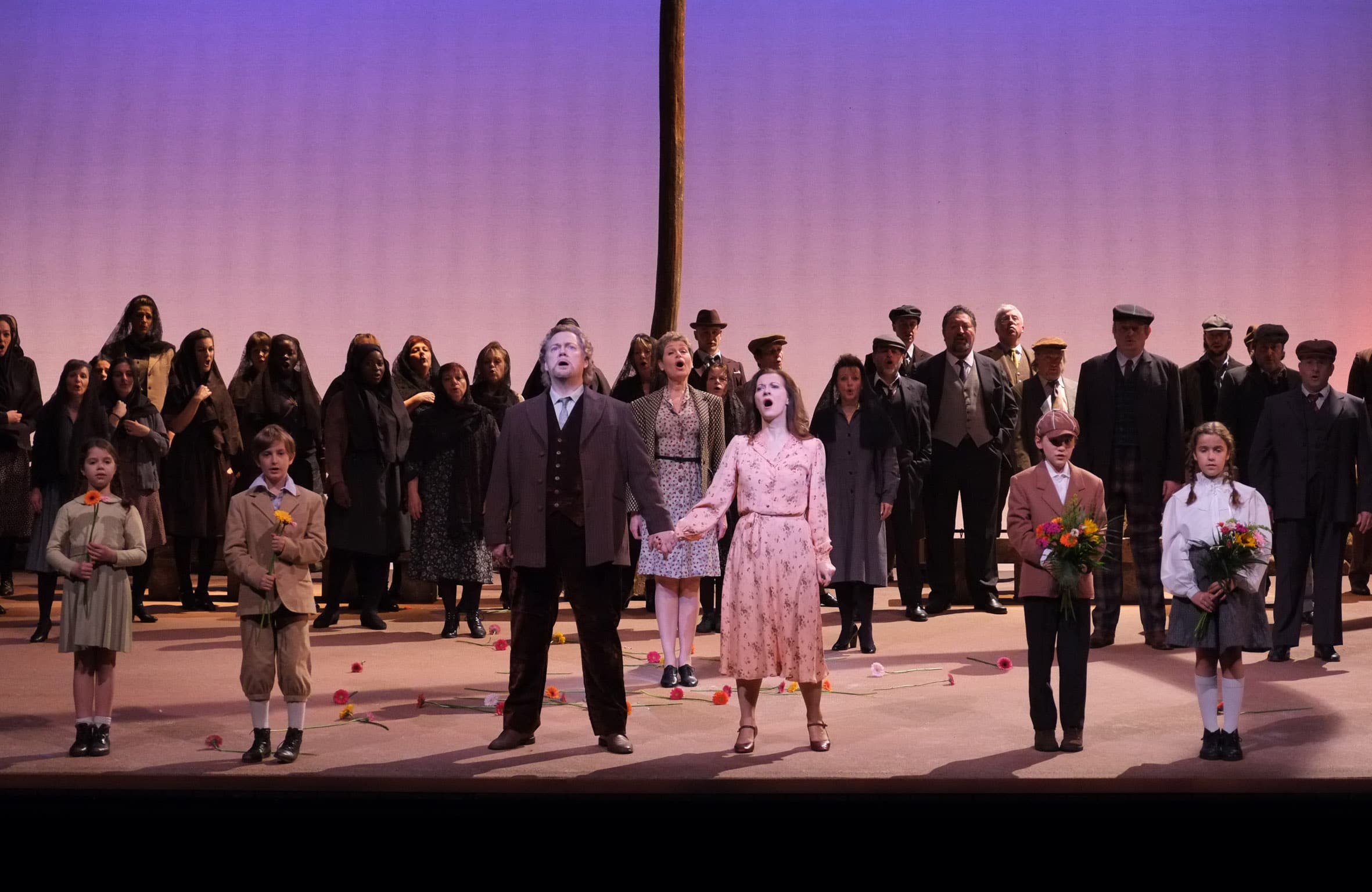
In the next scene, Wurm is tattling on Rodolfo to Count Walter. The count is furious, but decides the best way to deal with the situation is surprise! engagement! He calls Rodolfo in and, not mentioning Luisa at all, acts pleased, saying he has arranged a marriage for Rodolfo to his cousin, the widowed Duchess Federica, who admitted that she had loved Rodolfo since childhood, but had to accept an arranged marriage. When they are alone, Rodolfo throws himself on Federica’s mercy and tells her that he loves someone else. Federica is angry and jealous. Meanwhile, Miller is telling Luisa that Carlo is a liar. Luisa refuses to believe him, but it is confirmed by Rodolfo who shows up at that minute. They are all interrupted by the count’s hunting party, but Rodolfo says he has a trump card – he knows the count’s Deep, Dark Secret (DDS) of how he gained the position. The count uses the opportunity to insult Luisa, getting angry defenses from Miller and Rodolfo. His men are going to arrest Miller and Luisa, and Rodolfo tries to prevent them, saying he will go to jail along with them and then saying he’ll kill Luisa before he lets them take her. The count is like, “Cool, go ahead” to both threats. Rodolfo finally flings the DDS threat at him and the count retreats. That is all in the first act! There’s a lot more!

In the second act, Luisa is horrified to learn that her father has been arrested. Wurm tells her that he’ll be released if she writes a letter claiming that she really loved him and was only using Rodolfo for his position. Luisa is disgusted, but finally agrees. Besides being a cartoon villain, Wurm is also clearly delusional, as he mentions that he still wants to try to marry her while she’s writing the letter (rubbing salt into the wound). She also has to pretend to be lovey with him in front of Federica, so the duchess still thinks she has a chance. Wurm and Count Walter are discussing the DDS, which I think is pretty obvious – they arranged the murder of the count’s cousin, the rightful count. Of course, Walter claims he only did it for his son. He certainly knows what will make his son happy, but actually not. Then they meet with Luisa and Federica, and Luisa does a lot of lying about her Love for Wurm. Having made sure that the letter was delivered to Rodolfo, the count then goes to him saying he changed his mind and will approve Rodolfo’s marriage to Luisa (rubbing salt in the wound). Wouldn’t want to have a bad relationship with his son after all the murdering and backdoor engagement breaking that he did. Rodolfo is distraught thinking Luisa betrayed him and agrees to the count’s suggestion to revenge-marry Federica.

In the final act, Luisa is calm after all the melodrama…because she’s planning to die by starvation. Okay. Miller comes back (at least the count didn’t renege on that? He prob would have if he could) and is angry on hearing Luisa’s talk about Rodolfo learning the truth when she is dead (sometime in the near future). Finally, she agrees to live for him and they plan to leave the village. Rodolfo’s marriage is being prepared but he has other plans. He asks Luisa if she wrote the note and she says she did (as part of the promise she made Wurm). But then when he excoriates Luisa, she acts all hurt, as if he should psychically know the truth? (Not that she shouldn’t be hurt, but it’s like she doesn’t even understand what he is thinking.) It’s not very heroic of Rodolfo, but he poisons the cup that both he and Luisa drink from, so they’ll be dying soon in a murder-suicide. When Luisa finds out, she is free to tell him that she was forced to write the note by his father. She’s also not as angry as she should be. Miller is furious at him, but what can he do, Rodolfo is already dying. The count comes by and all he gets is Rodolfo stabbing Wurm and telling his father that it is all his fault, maybe there’s some DDS talk in there too or something, before dying.
This is a ton of melodrama, but this production made a decent case for the opera and there are good parts for the singers. Ciofi was affecting, with some of the above vocal issues. I’d heard positive things about Gregory Kunde, and he was very good here. The smaller roles of Count Walter, Wurm and Duchess Federica were strongly sung as well.
Wallonie
Luisa Miller – Patrizia Ciofi
Rodolfo – Gregory Kunde
Miller – Nicola Alaimo
Count Walter -Luciano Montanaro
Wurm – Bálint Szabó
Duchess Federica – Cristina Melis
Luisa Miller is generally considered to be the start of Verdi’s middle period, where he produced some of his most famous operas such as Rigoletto, La Traviata, and Il Trovatore. I’ve seen another production of this opera before and didn’t enjoy it, but found this staging to be much better. There are still a lot of ensembles where everyone sings the same bits over and over, and it wasn’t helped here where during those setpieces, the singers mostly parked and barked. Also, there were random children running and hiding in various scenes, which was a bit distracting and didn’t add much. But it was a nice production, traditional and attractive, with Luisa’s scenes taking place outdoors and the scenes with Count Walter et al. in a grand but dark and claustrophobic room. Still, I think there is a problem with the opera, which is that it is too melodramatic. Don’t get me wrong, I enjoy some good operatic melodrama, but it’s all melodrama all the time here. The singers were generally very good, even the secondary parts. As the title character, Ciofi sang well, but there was clear effort in her singing and the voice was a little thin and stressed sounding.
Luisa Miller is, like some of Verdi’s other operas, about father-children relationships. There are also piles of tropes and plot twists and turns that pop up in his other operas. I almost wanted to get a checklist or something. Luisa is a humble, virtuous and loving village girl who is engaged to “Carlo”. As the town happily celebrates their engagement, Luisa’s father Miller has some misgivings – he notes that they don’t know much about Carlo’s background. Miller wanted Luisa to marry Wurm, the count’s steward, instead (clearly he doesn’t have the best judgment about daughter husbands). Wurm angrily admonishes Miller, but the father replies that he is no tyrant and wants Luisa to marry the man she loves. Wurm then informs him that Carlo has been lying to them all and he is actually the count’s son Rodolfo.
In the next scene, Wurm is tattling on Rodolfo to Count Walter. The count is furious, but decides the best way to deal with the situation is surprise! engagement! He calls Rodolfo in and, not mentioning Luisa at all, acts pleased, saying he has arranged a marriage for Rodolfo to his cousin, the widowed Duchess Federica, who admitted that she had loved Rodolfo since childhood, but had to accept an arranged marriage. When they are alone, Rodolfo throws himself on Federica’s mercy and tells her that he loves someone else. Federica is angry and jealous. Meanwhile, Miller is telling Luisa that Carlo is a liar. Luisa refuses to believe him, but it is confirmed by Rodolfo who shows up at that minute. They are all interrupted by the count’s hunting party, but Rodolfo says he has a trump card – he knows the count’s Deep, Dark Secret (DDS) of how he gained the position. The count uses the opportunity to insult Luisa, getting angry defenses from Miller and Rodolfo. His men are going to arrest Miller and Luisa, and Rodolfo tries to prevent them, saying he will go to jail along with them and then saying he’ll kill Luisa before he lets them take her. The count is like, “Cool, go ahead” to both threats. Rodolfo finally flings the DDS threat at him and the count retreats. That is all in the first act! There’s a lot more!

In the second act, Luisa is horrified to learn that her father has been arrested. Wurm tells her that he’ll be released if she writes a letter claiming that she really loved him and was only using Rodolfo for his position. Luisa is disgusted, but finally agrees. Besides being a cartoon villain, Wurm is also clearly delusional, as he mentions that he still wants to try to marry her while she’s writing the letter (rubbing salt into the wound). She also has to pretend to be lovey with him in front of Federica, so the duchess still thinks she has a chance. Wurm and Count Walter are discussing the DDS, which I think is pretty obvious – they arranged the murder of the count’s cousin, the rightful count. Of course, Walter claims he only did it for his son. He certainly knows what will make his son happy, but actually not. Then they meet with Luisa and Federica, and Luisa does a lot of lying about her Love for Wurm. Having made sure that the letter was delivered to Rodolfo, the count then goes to him saying he changed his mind and will approve Rodolfo’s marriage to Luisa (rubbing salt in the wound). Wouldn’t want to have a bad relationship with his son after all the murdering and backdoor engagement breaking that he did. Rodolfo is distraught thinking Luisa betrayed him and agrees to the count’s suggestion to revenge-marry Federica.

In the final act, Luisa is calm after all the melodrama…because she’s planning to die by starvation. Okay. Miller comes back (at least the count didn’t renege on that? He prob would have if he could) and is angry on hearing Luisa’s talk about Rodolfo learning the truth when she is dead (sometime in the near future). Finally, she agrees to live for him and they plan to leave the village. Rodolfo’s marriage is being prepared but he has other plans. He asks Luisa if she wrote the note and she says she did (as part of the promise she made Wurm). But then when he excoriates Luisa, she acts all hurt, as if he should psychically know the truth? (Not that she shouldn’t be hurt, but it’s like she doesn’t even understand what he is thinking.) It’s not very heroic of Rodolfo, but he poisons the cup that both he and Luisa drink from, so they’ll be dying soon in a murder-suicide. When Luisa finds out, she is free to tell him that she was forced to write the note by his father. She’s also not as angry as she should be. Miller is furious at him, but what can he do, Rodolfo is already dying. The count comes by and all he gets is Rodolfo stabbing Wurm and telling his father that it is all his fault, maybe there’s some DDS talk in there too or something, before dying.
This is a ton of melodrama, but this production made a decent case for the opera and there are good parts for the singers. Ciofi was affecting, with some of the above vocal issues. I’d heard positive things about Gregory Kunde, and he was very good here. The smaller roles of Count Walter, Wurm and Duchess Federica were strongly sung as well.
161DieFledermaus
Alcina (Handel)
La Monnaie
Alcina - Sandrine Piau
Ruggiero - Maite Beaumont
Bradamante - Angélique Noldus
Morgana - Sabina Puértolas
Oberto - Chloé Briot
Oronte - Daniel Behle
Melisso - Giovanni Fulanetto
Unfortunately, even with a very nice production, this was one of those Handel opera serias where it feels like a parade of da capo arias. The first act was a bit whiplash inducing plotwise – the recitatives between the arias were exposition of the “As you know, Bob” variety and a bunch of characters were dumped in every new scene. However, there was more focus in the second act, when all the relationships had been developed. Some of the coupling and uncouplings felt perfunctory – the Alcina-Ruggiero relationship was the interesting one.

The production by Pierre Audi emphasized the relationships instead of the magic and spectacle and, by having various characters on stage during the arias, showed some of the nuances between the characters. The story is like the Armida one – or maybe like Circe/Odysseus – Alcina, the evil sorceress who turns men into animals etc., is in love with the noble knight Ruggiero. His fiancée, Bradamante, comes disguised as her brother along with Ruggiero’s former tutor Melisso. There is much romantic confusion as Bradamante tries to get Ruggiero away from Alcina.
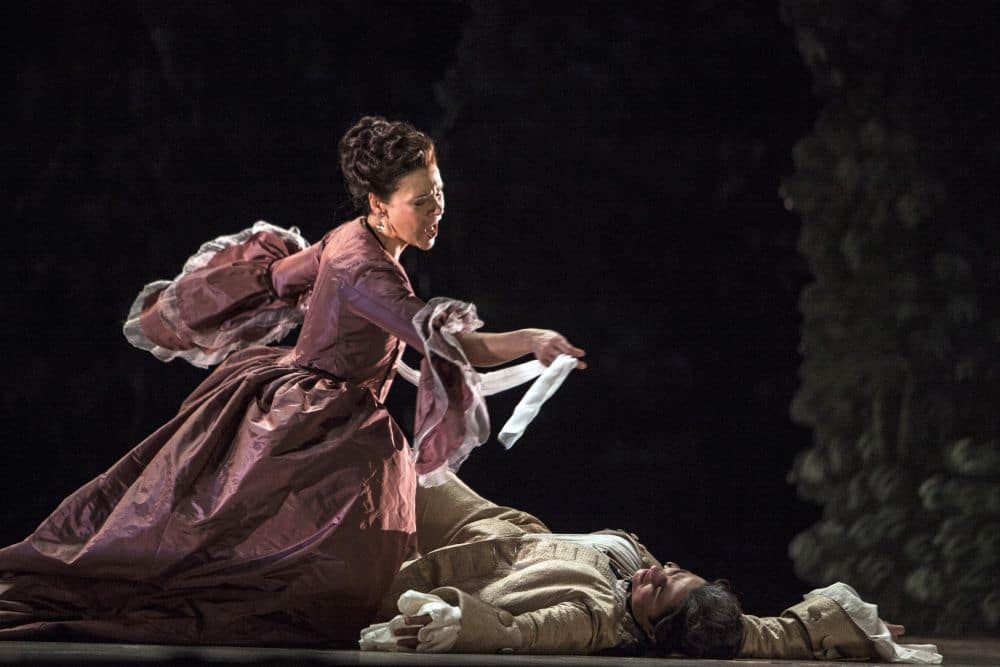
The singers were for the most part very good. Sandrine Piau sounded a bit thin and worn, but she was an expressive singer and made Alcina sympathetic. If anything, Alcina was a little too normal and relatable – it made the whole thing seem like a period piece about relationship drama instead of a magical, mythological tale. The characters wore period costumes (maybe Handel era?) and the setting was minimal. The few backdrops looked like something that would have been onstage during Handel’s time as well. I liked the sets, but wished that maybe there was more spectacle, especially as I didn’t find the opera itself engrossing. Maite Beaumont as Ruggiero didn’t handle the ornamentation quite as well as some of the singers, but it was a good performance. Bradamante (Angélique Noldus) sang well, but she didn’t have as many dramatic pieces as Alcina and seemed poor competition for her. Ruggiero’s response to Alcina’s pleas is a rather flat excuse about Bradamante being his fiancée (not how much he loves her), which added to the idea that his relationship with Alcina was the real one. Sabina Puértolas and Daniel Behle nicely characterized the smaller roles of Morgana and Oronte, and Chloé Briot had a sweet voice in the trouser role of Oberto, but Giovanni Fulanetto as Melisso sounded a bit gruff. I didn’t really think any of the arias stood out, although Alcina probably had the longest and most dramatic ones. I might need a weirder, busier production for this one.
La Monnaie
Alcina - Sandrine Piau
Ruggiero - Maite Beaumont
Bradamante - Angélique Noldus
Morgana - Sabina Puértolas
Oberto - Chloé Briot
Oronte - Daniel Behle
Melisso - Giovanni Fulanetto
Unfortunately, even with a very nice production, this was one of those Handel opera serias where it feels like a parade of da capo arias. The first act was a bit whiplash inducing plotwise – the recitatives between the arias were exposition of the “As you know, Bob” variety and a bunch of characters were dumped in every new scene. However, there was more focus in the second act, when all the relationships had been developed. Some of the coupling and uncouplings felt perfunctory – the Alcina-Ruggiero relationship was the interesting one.

The production by Pierre Audi emphasized the relationships instead of the magic and spectacle and, by having various characters on stage during the arias, showed some of the nuances between the characters. The story is like the Armida one – or maybe like Circe/Odysseus – Alcina, the evil sorceress who turns men into animals etc., is in love with the noble knight Ruggiero. His fiancée, Bradamante, comes disguised as her brother along with Ruggiero’s former tutor Melisso. There is much romantic confusion as Bradamante tries to get Ruggiero away from Alcina.
The singers were for the most part very good. Sandrine Piau sounded a bit thin and worn, but she was an expressive singer and made Alcina sympathetic. If anything, Alcina was a little too normal and relatable – it made the whole thing seem like a period piece about relationship drama instead of a magical, mythological tale. The characters wore period costumes (maybe Handel era?) and the setting was minimal. The few backdrops looked like something that would have been onstage during Handel’s time as well. I liked the sets, but wished that maybe there was more spectacle, especially as I didn’t find the opera itself engrossing. Maite Beaumont as Ruggiero didn’t handle the ornamentation quite as well as some of the singers, but it was a good performance. Bradamante (Angélique Noldus) sang well, but she didn’t have as many dramatic pieces as Alcina and seemed poor competition for her. Ruggiero’s response to Alcina’s pleas is a rather flat excuse about Bradamante being his fiancée (not how much he loves her), which added to the idea that his relationship with Alcina was the real one. Sabina Puértolas and Daniel Behle nicely characterized the smaller roles of Morgana and Oronte, and Chloé Briot had a sweet voice in the trouser role of Oberto, but Giovanni Fulanetto as Melisso sounded a bit gruff. I didn’t really think any of the arias stood out, although Alcina probably had the longest and most dramatic ones. I might need a weirder, busier production for this one.
162Poquette
That's a lot of opera you've been absorbing! Your reviews make me want to go out and get a bunch of videos!
"Where'er you walk" from Semele has always been one of my favorite arias.
"Where'er you walk" from Semele has always been one of my favorite arias.
163AnnieMod
Thanks for all those Opera reviews. :) I had not seen an opera in a very long time and that makes me want to go and actually see something...
164DieFledermaus
>162 Poquette: - Thanks - I hope you find a good one to watch. Was the Macbeth the one from the Met with Netrebko/Lucic? I did enjoy that one, but early Verdi is usually not my thing. I think Macbeth is probably my favorite of his early operas though.
Semele definitely had a lot of good songs. I found it went by really fast. I really liked "Oh sleep, why dost thou leave me" and "Myself I shall adore."
>163 AnnieMod: - AnnieMod - did you see a lot of operas in Bulgaria? If I had the money, I'd love to go see some in Europe. They have all the weird stagings there and will often stage less popular Russian, Czech, Hungarian, Polish etc. operas over there. Luckily, a lot of companies and France/Italy will post streaming ones.
Semele definitely had a lot of good songs. I found it went by really fast. I really liked "Oh sleep, why dost thou leave me" and "Myself I shall adore."
>163 AnnieMod: - AnnieMod - did you see a lot of operas in Bulgaria? If I had the money, I'd love to go see some in Europe. They have all the weird stagings there and will often stage less popular Russian, Czech, Hungarian, Polish etc. operas over there. Luckily, a lot of companies and France/Italy will post streaming ones.
165DieFledermaus
This is pretty long and ranty - also spoilers for Generations of Winter
Generations of Winter by Vasily Aksyonov
Finished 3/24/15
I really wanted to like this book and expected that I would – fat histories of generations of the same family usually appeal to me and I’m very interested in the Soviet period. It went by quickly and the writing was fairly smooth, but a bunch of little issues continued and became bigger and more annoying until they almost overwhelmed the positive qualities of the book, and by page 400 of 600 or so, I was a bit reluctant to pick it up. In a “Such bad food, and the portions were so small!” comment, my copy, by Vintage, had only the first two books of the trilogy and I’m pretty torn about whether I want to read the third – would like it to find out what happens, but there were so many irritations.
The story follows the liberal, well-off Gradov family from the 1920’s, when the NEP (a limited return to capitalism after the war communism of the Revolution) was taking effect through the brutal collectivization of the peasants and the Great Terror in the 30’s and ending after World War II. Generous and talented father Boris is one of the best doctors in the Soviet Union and Mary is a cultured wife and mother, loving and supportive if somewhat nagging. Eldest son Nikita is married to the beautiful Veronika and rising fast as an officer in the military, having participated in several decisive battles in the revolution. Kirill, the second son, is a dour true believer Bolshevik, and Nina, the baby and only daughter, is a free-spirited Trotskyite poet. The story is fairly engrossing, but some issues appeared early on and never stopped.
1.) There’s a serious Forrest Gump feel in the way the characters interact with history. Bulgakov and Mandelstam pop up at parties. Boris treats Stalin when no one else can do it, and he is involved in the shady death and cover up of a (real-life) military officer - an affair that splits Nikita and his friend Vuinovich apart. (As competent military officers, they regularly scorn the amateur Klim Voroshilov, a Stalin crony.) Mary is Georgian so there are scenes in Tblisi where their duplicitous cousin hangs out with Lavrenty Beria and later comes with him to Moscow (where he would eventually become the hated and feared head of the NKVD). Later, Nikita seems to singlehandedly save Moscow and he’s almost portrayed as the most important and competent general (he’s willing to argue with Stalin when even Zhukov is suggesting he go along with the program, his fate is similar to that of Rokossovsky and Nikita is regularly mentioned in connection with him, but he has more to do than Rokossovksy {Konstantin Rokossovsky was a marshal arrested during the purges – he was badly beaten during interrogation, losing multiple teeth, and is sort of the go-to example for “military officer later released who had to work with his oppressors”}). Kirill sees the brutal communal farm collectivization up close. I kept thinking that maybe someone would be at the Katyn massacre for the WWII sections – didn’t happen, but then it gets a mention and there’s a Polish section that goes in a predictable way (it’s Nikita vs. everyone else).
2.) It almost felt like the book was written by an American or British author, as opposed to Aksyonov, who was Russian, born in 1932, and the son of one of the best-known Gulag memoirists, Evgenia Ginzburg. Many of the references feel obvious, not quite correct, or something that makes sense with the hindsight of the present. (For example – the characters don’t like the current Soviet literature, but are excited by translations of Hemingway, Joyce and Proust – rather obvious “good” Western authors; a physicist refers to exciting work being done by Einstein, Bohr…..and Oppenheimer {I’m not sure if he’d even know Oppenheimer at that period, and it felt too foreshadow-y}; some characters go to see WWII-era German movies, noting stars such as….Leni Riefenstahl???? I didn’t even know she’d been an actress, but looked it up – she hadn’t been in anything for several years before the war and was directing. It really seemed like a case of Nazi movies = Riefenstahl). It’s clear that the good characters are associated with Western liberalism and culture. There’s even an American reporter as a POV character at the opening of the book. Some of the slang feels very American, although that could be the translation.
3.) I was very sick of reading about how beautiful Nina and Veronika were and how many men were lining up to be in love with them. As it kept happening, it got more ridiculous and laughable. At the beginning, Nina has a group of men orbiting around her who are all in love with her. Veronika, though married, also has many admirers. Even as the years pass, the author is careful to note multiple times that they were both still very beautiful. There are some men who remain in love with the women for years, even after marrying other people, and there are other men who fall in love with them at first sight. There’s even this – Kirill marries a very unattractive woman (whose unattractiveness and bad hygiene is mentioned as much as Nina and Veronika’s beauty) and when he is away from her, while masturbating, “Kirill never had visions of his wife but rather of a slim, dark-complexioned girl who resembled his sister, if she wasn’t actually her.”
4.) In general, the characters were rather one note with a lot of Mary Sue-ism for the Gradov family members and a slightly squicky stereotyping for other characters. The Gradovs are generally all intelligent and sympathetic, and even the bad things they do are cases of them having no good choices, plus they feel really bad about it. Mary doesn’t have that much to do – she is a stereotypical housewife/stay at home mom, who is loving and caring, but usually nagging and worrying. (Like the other “good” characters, she has Western tastes – her Chopin playing is a family touchstone.) However, Boris, Nina, and Nikita seem to be the best at whatever they do. Boris is the best doctor in the Soviet Union. Nikita may as well be the best military officer, for all that is shown. Nina, besides having binders full of men after her, frequently gets her poems published (I didn’t really like any of the ones that were shown, but very likely could be the translation) and ends up writing a much-loved and popular song on a lark. Kirill, at first, is rather unsympathetic – he’s the family killjoy and also a bit of a poser, but then he has an epiphany and realizes the other Gradovs are right. (In fact, there are several character epiphanies, where they realize the Soviet system is all wrong.)
There are a few characters who are just bad – rather predictably, they are all spies and NKVD members (besides Stalin and co, but that goes without saying). Besides the Gradovs, there are a few other perfect characters, and they are all in the same mode – liberal, Western-influenced men who are the best ever at their thing. Then there are some characters who are…well, good when it comes down to it, and they do care about the Gradovs, but they just aren’t as sympathetic as them. Veronika’s looks are part of her stereotypical character as a shallow, materialistic woman. She’s really concerned with clothes, things, and men being in love with her. She does love Nikita, and is mostly depicted as not at fault for all the bad things that happen to her, but her character stays the same for the whole book. Cecilia, Kirill’s wife, is the opposite – a true believer Communist intellectual, who – since she is an intellectual – is also described as unfeminine, ugly, with poor hygiene, who makes an embarrassing mother. Also, whenever she was there, there were usually references to her being Jewish. This happened with the few other Jewish characters as well. It was part of a slightly uncomfortable, two-faced attitude that seemed to be from the author – “Anti-Semitism is bad, but these Jewish characters are really Jewish, with all these Jewish characteristics!” A lot of the other female characters are pretty stereotypical as well – one who is a passive sex object, a femme fatale, throwaway rape victims. The few characters who have peasant backgrounds are also less sympathetic than the Gradovs – one is one of the evil characters, another is rather anti-Semitic and does considerably worse things (although he gets an epiphany scene as well).
5.)Weird chapters about animals and plants. Although there are occasional references to War and Peace, the author seems to want to distinguish the book from the 19th century format, so adds some modernism in the form of quick quotes from newspapers. Okay, that’s fine. But then there are chapters from animal and plant POVs, sometimes they are reincarnated characters – Lenin is reincarnated as a squirrel. At best, this doesn’t add anything, but at worst, it comes off as ridiculous and puzzling.
I didn't hate the book, but was torn about whether it was more good than bad or more bad than good. The period it is set is interesting, and for the most part the writing flowed well, but I'd have a hard time recommending it.
Generations of Winter by Vasily Aksyonov
Finished 3/24/15
I really wanted to like this book and expected that I would – fat histories of generations of the same family usually appeal to me and I’m very interested in the Soviet period. It went by quickly and the writing was fairly smooth, but a bunch of little issues continued and became bigger and more annoying until they almost overwhelmed the positive qualities of the book, and by page 400 of 600 or so, I was a bit reluctant to pick it up. In a “Such bad food, and the portions were so small!” comment, my copy, by Vintage, had only the first two books of the trilogy and I’m pretty torn about whether I want to read the third – would like it to find out what happens, but there were so many irritations.
The story follows the liberal, well-off Gradov family from the 1920’s, when the NEP (a limited return to capitalism after the war communism of the Revolution) was taking effect through the brutal collectivization of the peasants and the Great Terror in the 30’s and ending after World War II. Generous and talented father Boris is one of the best doctors in the Soviet Union and Mary is a cultured wife and mother, loving and supportive if somewhat nagging. Eldest son Nikita is married to the beautiful Veronika and rising fast as an officer in the military, having participated in several decisive battles in the revolution. Kirill, the second son, is a dour true believer Bolshevik, and Nina, the baby and only daughter, is a free-spirited Trotskyite poet. The story is fairly engrossing, but some issues appeared early on and never stopped.
1.) There’s a serious Forrest Gump feel in the way the characters interact with history. Bulgakov and Mandelstam pop up at parties. Boris treats Stalin when no one else can do it, and he is involved in the shady death and cover up of a (real-life) military officer - an affair that splits Nikita and his friend Vuinovich apart. (As competent military officers, they regularly scorn the amateur Klim Voroshilov, a Stalin crony.) Mary is Georgian so there are scenes in Tblisi where their duplicitous cousin hangs out with Lavrenty Beria and later comes with him to Moscow (where he would eventually become the hated and feared head of the NKVD). Later, Nikita seems to singlehandedly save Moscow and he’s almost portrayed as the most important and competent general (he’s willing to argue with Stalin when even Zhukov is suggesting he go along with the program, his fate is similar to that of Rokossovsky and Nikita is regularly mentioned in connection with him, but he has more to do than Rokossovksy {Konstantin Rokossovsky was a marshal arrested during the purges – he was badly beaten during interrogation, losing multiple teeth, and is sort of the go-to example for “military officer later released who had to work with his oppressors”}). Kirill sees the brutal communal farm collectivization up close. I kept thinking that maybe someone would be at the Katyn massacre for the WWII sections – didn’t happen, but then it gets a mention and there’s a Polish section that goes in a predictable way (it’s Nikita vs. everyone else).
2.) It almost felt like the book was written by an American or British author, as opposed to Aksyonov, who was Russian, born in 1932, and the son of one of the best-known Gulag memoirists, Evgenia Ginzburg. Many of the references feel obvious, not quite correct, or something that makes sense with the hindsight of the present. (For example – the characters don’t like the current Soviet literature, but are excited by translations of Hemingway, Joyce and Proust – rather obvious “good” Western authors; a physicist refers to exciting work being done by Einstein, Bohr…..and Oppenheimer {I’m not sure if he’d even know Oppenheimer at that period, and it felt too foreshadow-y}; some characters go to see WWII-era German movies, noting stars such as….Leni Riefenstahl???? I didn’t even know she’d been an actress, but looked it up – she hadn’t been in anything for several years before the war and was directing. It really seemed like a case of Nazi movies = Riefenstahl). It’s clear that the good characters are associated with Western liberalism and culture. There’s even an American reporter as a POV character at the opening of the book. Some of the slang feels very American, although that could be the translation.
3.) I was very sick of reading about how beautiful Nina and Veronika were and how many men were lining up to be in love with them. As it kept happening, it got more ridiculous and laughable. At the beginning, Nina has a group of men orbiting around her who are all in love with her. Veronika, though married, also has many admirers. Even as the years pass, the author is careful to note multiple times that they were both still very beautiful. There are some men who remain in love with the women for years, even after marrying other people, and there are other men who fall in love with them at first sight. There’s even this – Kirill marries a very unattractive woman (whose unattractiveness and bad hygiene is mentioned as much as Nina and Veronika’s beauty) and when he is away from her, while masturbating, “Kirill never had visions of his wife but rather of a slim, dark-complexioned girl who resembled his sister, if she wasn’t actually her.”
4.) In general, the characters were rather one note with a lot of Mary Sue-ism for the Gradov family members and a slightly squicky stereotyping for other characters. The Gradovs are generally all intelligent and sympathetic, and even the bad things they do are cases of them having no good choices, plus they feel really bad about it. Mary doesn’t have that much to do – she is a stereotypical housewife/stay at home mom, who is loving and caring, but usually nagging and worrying. (Like the other “good” characters, she has Western tastes – her Chopin playing is a family touchstone.) However, Boris, Nina, and Nikita seem to be the best at whatever they do. Boris is the best doctor in the Soviet Union. Nikita may as well be the best military officer, for all that is shown. Nina, besides having binders full of men after her, frequently gets her poems published (I didn’t really like any of the ones that were shown, but very likely could be the translation) and ends up writing a much-loved and popular song on a lark. Kirill, at first, is rather unsympathetic – he’s the family killjoy and also a bit of a poser, but then he has an epiphany and realizes the other Gradovs are right. (In fact, there are several character epiphanies, where they realize the Soviet system is all wrong.)
There are a few characters who are just bad – rather predictably, they are all spies and NKVD members (besides Stalin and co, but that goes without saying). Besides the Gradovs, there are a few other perfect characters, and they are all in the same mode – liberal, Western-influenced men who are the best ever at their thing. Then there are some characters who are…well, good when it comes down to it, and they do care about the Gradovs, but they just aren’t as sympathetic as them. Veronika’s looks are part of her stereotypical character as a shallow, materialistic woman. She’s really concerned with clothes, things, and men being in love with her. She does love Nikita, and is mostly depicted as not at fault for all the bad things that happen to her, but her character stays the same for the whole book. Cecilia, Kirill’s wife, is the opposite – a true believer Communist intellectual, who – since she is an intellectual – is also described as unfeminine, ugly, with poor hygiene, who makes an embarrassing mother. Also, whenever she was there, there were usually references to her being Jewish. This happened with the few other Jewish characters as well. It was part of a slightly uncomfortable, two-faced attitude that seemed to be from the author – “Anti-Semitism is bad, but these Jewish characters are really Jewish, with all these Jewish characteristics!” A lot of the other female characters are pretty stereotypical as well – one who is a passive sex object, a femme fatale, throwaway rape victims. The few characters who have peasant backgrounds are also less sympathetic than the Gradovs – one is one of the evil characters, another is rather anti-Semitic and does considerably worse things (although he gets an epiphany scene as well).
5.)Weird chapters about animals and plants. Although there are occasional references to War and Peace, the author seems to want to distinguish the book from the 19th century format, so adds some modernism in the form of quick quotes from newspapers. Okay, that’s fine. But then there are chapters from animal and plant POVs, sometimes they are reincarnated characters – Lenin is reincarnated as a squirrel. At best, this doesn’t add anything, but at worst, it comes off as ridiculous and puzzling.
I didn't hate the book, but was torn about whether it was more good than bad or more bad than good. The period it is set is interesting, and for the most part the writing flowed well, but I'd have a hard time recommending it.
166AnnieMod
>164 DieFledermaus: I wish...
I grew up in a small town that had no opera house. Then when I moved to Sofia, I first could not afford it, then work got busy and I was rarely able to make it downtown for a live performance. So saw a few but a lot less than I wish I had...
However if TV counts, one of the Bulgarian TVs was screening an opera or ballet almost every Sunday - mainly Russian and Bulgarian productions; occasionally something from Poland or the Czech Republic or Italy. I rarely missed these...
Which reminds me that the cinema next door are screening ballets/operas in the mornings on weekends. With the Phoenix Movie Festival going now they are skipping this weekend but it looks like Strauss' Arabella next Saturday. Not the same as live by a long shot but still better than a DVD recording on a small TV.
I grew up in a small town that had no opera house. Then when I moved to Sofia, I first could not afford it, then work got busy and I was rarely able to make it downtown for a live performance. So saw a few but a lot less than I wish I had...
However if TV counts, one of the Bulgarian TVs was screening an opera or ballet almost every Sunday - mainly Russian and Bulgarian productions; occasionally something from Poland or the Czech Republic or Italy. I rarely missed these...
Which reminds me that the cinema next door are screening ballets/operas in the mornings on weekends. With the Phoenix Movie Festival going now they are skipping this weekend but it looks like Strauss' Arabella next Saturday. Not the same as live by a long shot but still better than a DVD recording on a small TV.
167RidgewayGirl
Interesting comments on Generations of Winter. It sounds like the setting couldn't make up for bad writing. "Beautiful" as a description of a woman is so useless and demeaning that I have a hard time overcoming that, and it's too bad there were so many flaws in the book as it otherwise sounds right up my alley. I think you should post your comments onto the book's page, since all that is there now are a few very short and laudatory reviews.
168rebeccanyc
>165 DieFledermaus: I've had that book on the TBR for several years after it was recommended to me here on LT; thanks for warning me so I don't have to read it. I had no idea the author was Evgenia Ginzburg's son.
169DieFledermaus
>166 AnnieMod: - Heh, yeah I count TV/laptop screen/movie theater as seeing an opera, otherwise there would be a lot that I haven't seen. Weekly opera channel sounds really nice - occasionally they'll have something on PBS, and for awhile I had the arts channel going regularly in the background, but they only played clips on that one. Not sure how close you are to the Arizona company, but it looks like they'll be doing Daughter of the Regiment in a few weeks.
I usually look here to see what other companies are doing -
http://operabase.com/plan.cgi?lang=en&season=2014/15
and here for streaming ones -
http://operacat.com/
We have several movie theaters that will show the Met productions and one that has ROH production. I know one has shown National Theater plays in the past and I think there was even one theater that used to have some La Scala productions. I agree it's really nice to see it on the big screen if you can't go live.
>167 RidgewayGirl: - Thanks - yes, the time period was interesting and enough happened plotwise to make the book go fairly fast, but there were just so many irritations. I posted the review now - usually am a bit better about cataloging, but have been behind on that.
>168 rebeccanyc: - Yeah, it didn't take that long given its size, but there are plenty of other books that you could be reading. Even other fat Russian novels about multiple generations of one family! Will have to find another one as a palate cleanser. Well, I still have Life and Fate that I need to read.
I usually look here to see what other companies are doing -
http://operabase.com/plan.cgi?lang=en&season=2014/15
and here for streaming ones -
http://operacat.com/
We have several movie theaters that will show the Met productions and one that has ROH production. I know one has shown National Theater plays in the past and I think there was even one theater that used to have some La Scala productions. I agree it's really nice to see it on the big screen if you can't go live.
>167 RidgewayGirl: - Thanks - yes, the time period was interesting and enough happened plotwise to make the book go fairly fast, but there were just so many irritations. I posted the review now - usually am a bit better about cataloging, but have been behind on that.
>168 rebeccanyc: - Yeah, it didn't take that long given its size, but there are plenty of other books that you could be reading. Even other fat Russian novels about multiple generations of one family! Will have to find another one as a palate cleanser. Well, I still have Life and Fate that I need to read.
170rebeccanyc
>169 DieFledermaus: I wouldn't call Life and Fate a palate cleanser, but if you want something Russian for that, and you haven't read it, I would recommend Dead Souls -- thoroughly entertaining.
171DieFledermaus
>170 rebeccanyc: - Oh, Dead Souls is a fun one, and I love his short stories. I managed to dig The Twelve Chairs out of the pile - I think that one is supposed to be funny so hopefully I can fit it in somewhere.
Also found A Heart So White and Tomorrow in the Battle Think on Me both by Javier Marias for the theme read.
I didn't exactly mean to go on an Angela Carter jag, but I read Wise Children, The Infernal Desire Machines of Doctor Hoffman and The Magic Toyshop - enjoyed them all, although would probably recommend The Infernal Desire Machines.... for people who are okay with weird, disturbing Carter.
Also found A Heart So White and Tomorrow in the Battle Think on Me both by Javier Marias for the theme read.
I didn't exactly mean to go on an Angela Carter jag, but I read Wise Children, The Infernal Desire Machines of Doctor Hoffman and The Magic Toyshop - enjoyed them all, although would probably recommend The Infernal Desire Machines.... for people who are okay with weird, disturbing Carter.
172DieFledermaus
Family Sayings by Natalia Ginzburg
Finished 2/9/15
Family Sayings is Ginzburg’s memoir of growing up in a large, quirky family in the pre-WWII years and the family’s experiences during and after the war. Most of the time, the focus is not on her, the narrator, but her parents, siblings, their friends, and their partners. It’s very detailed, intimate, and amusing, with the inside jokes and references frequently popping up to provide a good characterization of all the friends and relatives who people the book. When the war starts, everything becomes more difficult, but even with some close calls, the family mainly stays the same – her father grumbles, the siblings fight and marry and complain. However, when serious things do happen, there’s a kind of distance in Ginzburg’s descriptions – she’ll matter-of-factly state that someone’s parents were transported off, never to return, and never elaborates on her husband’s death – the only in-depth descriptions are a couple of her experiences before and after. It’s very effective at bringing attention to these incidents with the contrast in narrative style, as well as showing how even large losses give way to the rhythm of daily life.
Her father looms large over the first half of the book. He is amusing to read about, but would likely be difficult to live with – a constantly complaining, constantly criticizing man who is sure that there is only one right way to do things. He loves mountain climbing and makes everyone else participate, but it has to be done his way. He likes and dislikes people for random reasons, plays favorites with his children, and has various obsessions. The narrator’s mother is more conciliatory and, like everyone else, she has her sayings and memories that have become part of the family lore – the opera that she started when she was a girl, the few memories of a brother who committed suicide, how every previous house was better than the one they live in now. All the narrator’s siblings are introduced – Gino, the golden boy who is the favorite due to his intelligence and love of mountaineering, Paola and Mario, both romantic, emotional, and addicted to literature and poetry (and constantly engaging in a silent war with their father), and Alberto, the sports-obsessed son who also manages to incur the disapproval of his father and mother. While her father and mother differ in personality, both are committed to socialism and various leftist politicians visit during the narrator’s childhood. Friends and romantic partners are also described in detail.
Even though all the sons get into trouble early on in the war years – arrests or exile – nothing seems serious at first. Natalia’s mother sighs when the excitement is over and her father still does the same complaining and laughing. But the situation gradually becomes worse as people they know are executed and the racial campaigns start. Still, the narrator continues with her depictions of the relationships and daily life of the family. Alberto becomes a serious married man and doctor, Mario loses his interest in art and romance, Paola marries and divorces. Natalia also marries, but even the descriptions about her early married life give way to stories about her friends. Even with the losses of the war, life goes on, new characters are introduced, her parents summer and mountain climb with the grandchildren now, and the family references and jokes continue on.
Finished 2/9/15
Family Sayings is Ginzburg’s memoir of growing up in a large, quirky family in the pre-WWII years and the family’s experiences during and after the war. Most of the time, the focus is not on her, the narrator, but her parents, siblings, their friends, and their partners. It’s very detailed, intimate, and amusing, with the inside jokes and references frequently popping up to provide a good characterization of all the friends and relatives who people the book. When the war starts, everything becomes more difficult, but even with some close calls, the family mainly stays the same – her father grumbles, the siblings fight and marry and complain. However, when serious things do happen, there’s a kind of distance in Ginzburg’s descriptions – she’ll matter-of-factly state that someone’s parents were transported off, never to return, and never elaborates on her husband’s death – the only in-depth descriptions are a couple of her experiences before and after. It’s very effective at bringing attention to these incidents with the contrast in narrative style, as well as showing how even large losses give way to the rhythm of daily life.
Her father looms large over the first half of the book. He is amusing to read about, but would likely be difficult to live with – a constantly complaining, constantly criticizing man who is sure that there is only one right way to do things. He loves mountain climbing and makes everyone else participate, but it has to be done his way. He likes and dislikes people for random reasons, plays favorites with his children, and has various obsessions. The narrator’s mother is more conciliatory and, like everyone else, she has her sayings and memories that have become part of the family lore – the opera that she started when she was a girl, the few memories of a brother who committed suicide, how every previous house was better than the one they live in now. All the narrator’s siblings are introduced – Gino, the golden boy who is the favorite due to his intelligence and love of mountaineering, Paola and Mario, both romantic, emotional, and addicted to literature and poetry (and constantly engaging in a silent war with their father), and Alberto, the sports-obsessed son who also manages to incur the disapproval of his father and mother. While her father and mother differ in personality, both are committed to socialism and various leftist politicians visit during the narrator’s childhood. Friends and romantic partners are also described in detail.
Even though all the sons get into trouble early on in the war years – arrests or exile – nothing seems serious at first. Natalia’s mother sighs when the excitement is over and her father still does the same complaining and laughing. But the situation gradually becomes worse as people they know are executed and the racial campaigns start. Still, the narrator continues with her depictions of the relationships and daily life of the family. Alberto becomes a serious married man and doctor, Mario loses his interest in art and romance, Paola marries and divorces. Natalia also marries, but even the descriptions about her early married life give way to stories about her friends. Even with the losses of the war, life goes on, new characters are introduced, her parents summer and mountain climb with the grandchildren now, and the family references and jokes continue on.
173DieFledermaus
Parsifal
Royal Opera House (Covent Garden)
Parsifal – Simon O’Neill
Kundry – Angela Denoke
Gurnemanz – Rene Pape
Amfortas – Gerald Finley
Klingsor – Willard White
Wagner’s last opera has some of his most beautiful and transcendent music, but I’ve always found the plot to be rather off-putting. Luckily, it is also ambiguous and open to interpretation. I’ve seen multiple productions, and they have all been on the weirder side – a good thing for me, and I enjoyed them all. This one, from the Royal Opera House (Covent Garden), is another high-concept production (although I think it’s a little Regie-lite) and I enjoyed it, although some bits – especially Act II – were less creative. The singing was in general very good and the orchestra – under music director Antonio Pappano – sounded wonderful, both rich and warm, but also shimmering and translucent in the appropriate parts.
The plot is similar to some other Wagner operas in that it is based on a medieval romance, but it is considerably more Jesus-y. The knight of the Holy Grail have been badly weakened by the loss of the magic spear, when their leader, Amfortas, was seduced by a woman and stabbed with the spear by the evil magician Klingsor (who has a grudge against them when he wasn’t allowed to join them following self-castration), and Amfortas’s subsequent never-healing wound. Amfortas had a vision that one day a holy fool would arrive to save them. Meanwhile, everyone tries to find a cure for Amfortas, including Kundry, a mysterious woman who Gurnemanz, another knight, once found in a death-like sleep. When an unknown man kills a swan and seems to know nothing, Gurnemanz and the others think he is the holy fool. Unfortunately, his indifferent response to the grail ceremony leaves them disappointed.
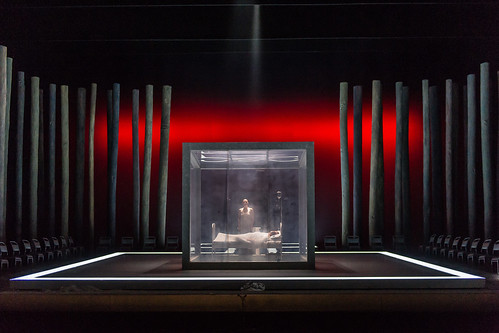
Sometime later (one of those things that is ambiguous like much of the opera), the man (spoiler alert, his name is Parsifal, although the title really ruins it) comes to Klingsor’s evil magic castle. After defeating the knights and attempting to get away from Klingsor’s flower maidens, he runs into Kundry, who is being controlled by Klingsor (and was earlier responsible for seducing Amfortas). Kundry tries to rules-lawyer Parsifal into bed (she’s good at it), but he resists in the end and defeats Klingsor, taking back the spear. The third act also take place after an unspecified amount of time has passed, with the order in ruins. Gurnemanz finds Kundry again asleep (and she only has a line in the whole act) and both of them see Parsifal return with the spear. The end is one of those death-and-redemption Wagner things, with some wonderful and glowing music, where Amfortas’s wound is healed, Kundry (after her whole laughing at Jesus issues) is redeemed and dies, and Parsifal takes over as the head of the knights.

There is a sickness/medical theme to this production – there’s a central box on the stage that has a bed, in the first act used as a hospital bed for Amfortas (and also where various recollected scenes take place) and is where Kundry tries to seduce Parsifal in the second act. (Oddly enough, I have seen another staging where a bed was central to the production.) Amfortas staggers around in a hospital gown and some of the knights are dressed like doctors. Kundry, also clad in patient garb, is bald in the first act. There’s an austere beauty and symmetry in the first act. It’s a very male heavy opera, and there’s a quick nod to that, as disapproving male doctors keep a group of concerned women away from Amfortas. A couple of the scenes that are shown on the bed as flashbacks are a bit obvious – Amfortas is seduced by Kundry, Klingsor self-castrates. The second act wasn’t as imaginative. There’s still an emphasis on the bed, as Kundry attempts to seduce Parsifal, but Klingsor and the flower maidens are rather boringly dressed in a black leather coat and sexy evening dresses. The third act returns to the sickness theme, as Parsifal is blind after his encounter with Klingsor.
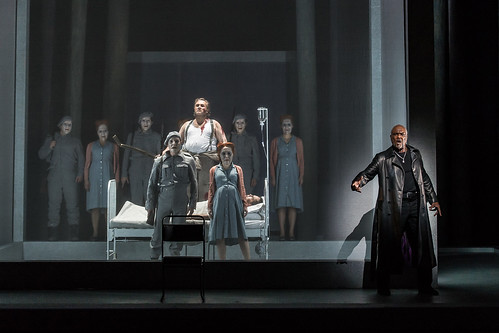
Unsurprisingly, Rene Pape was fantastic as Gurnemanz, who has long, long monologues. Simon O’Neill started out a little hesitant, but then warmed up and was strong for the rest of the opera. Angela Denoke is a good actress and her Kundry was appropriately conflicted and anguished. She sounded good in the first act, but started faltering in the long scene between Kundry and Parsifal in the second act. As Amfortas, Gerald Finley was very tormented in the first act, but he sounded somewhat rough in the third act. I’ve really liked him in other stuff, but he was a bit generic here. It seems like Wagner should have done more with Klingsor – if you’re going to have an evil self-castrating wizard, you should probably do something with him – but Willard White was quite good in his bits in act two. Not the best Parsifal I’ve seen, but in general I did enjoy the staging and singing, and am always happy to see this opera.
I really love the music, but this is one of those operas that I'm hesitant to recommend for a bunch of reasons.
Music-wise, a lot of it is in hard to separate chunks - although the prelude is very famous -
https://www.youtube.com/watch?v=AQOfIENN2tk
it's both angsty and noble sounding
Royal Opera House (Covent Garden)
Parsifal – Simon O’Neill
Kundry – Angela Denoke
Gurnemanz – Rene Pape
Amfortas – Gerald Finley
Klingsor – Willard White
Wagner’s last opera has some of his most beautiful and transcendent music, but I’ve always found the plot to be rather off-putting. Luckily, it is also ambiguous and open to interpretation. I’ve seen multiple productions, and they have all been on the weirder side – a good thing for me, and I enjoyed them all. This one, from the Royal Opera House (Covent Garden), is another high-concept production (although I think it’s a little Regie-lite) and I enjoyed it, although some bits – especially Act II – were less creative. The singing was in general very good and the orchestra – under music director Antonio Pappano – sounded wonderful, both rich and warm, but also shimmering and translucent in the appropriate parts.
The plot is similar to some other Wagner operas in that it is based on a medieval romance, but it is considerably more Jesus-y. The knight of the Holy Grail have been badly weakened by the loss of the magic spear, when their leader, Amfortas, was seduced by a woman and stabbed with the spear by the evil magician Klingsor (who has a grudge against them when he wasn’t allowed to join them following self-castration), and Amfortas’s subsequent never-healing wound. Amfortas had a vision that one day a holy fool would arrive to save them. Meanwhile, everyone tries to find a cure for Amfortas, including Kundry, a mysterious woman who Gurnemanz, another knight, once found in a death-like sleep. When an unknown man kills a swan and seems to know nothing, Gurnemanz and the others think he is the holy fool. Unfortunately, his indifferent response to the grail ceremony leaves them disappointed.
Sometime later (one of those things that is ambiguous like much of the opera), the man (spoiler alert, his name is Parsifal, although the title really ruins it) comes to Klingsor’s evil magic castle. After defeating the knights and attempting to get away from Klingsor’s flower maidens, he runs into Kundry, who is being controlled by Klingsor (and was earlier responsible for seducing Amfortas). Kundry tries to rules-lawyer Parsifal into bed (she’s good at it), but he resists in the end and defeats Klingsor, taking back the spear. The third act also take place after an unspecified amount of time has passed, with the order in ruins. Gurnemanz finds Kundry again asleep (and she only has a line in the whole act) and both of them see Parsifal return with the spear. The end is one of those death-and-redemption Wagner things, with some wonderful and glowing music, where Amfortas’s wound is healed, Kundry (after her whole laughing at Jesus issues) is redeemed and dies, and Parsifal takes over as the head of the knights.

There is a sickness/medical theme to this production – there’s a central box on the stage that has a bed, in the first act used as a hospital bed for Amfortas (and also where various recollected scenes take place) and is where Kundry tries to seduce Parsifal in the second act. (Oddly enough, I have seen another staging where a bed was central to the production.) Amfortas staggers around in a hospital gown and some of the knights are dressed like doctors. Kundry, also clad in patient garb, is bald in the first act. There’s an austere beauty and symmetry in the first act. It’s a very male heavy opera, and there’s a quick nod to that, as disapproving male doctors keep a group of concerned women away from Amfortas. A couple of the scenes that are shown on the bed as flashbacks are a bit obvious – Amfortas is seduced by Kundry, Klingsor self-castrates. The second act wasn’t as imaginative. There’s still an emphasis on the bed, as Kundry attempts to seduce Parsifal, but Klingsor and the flower maidens are rather boringly dressed in a black leather coat and sexy evening dresses. The third act returns to the sickness theme, as Parsifal is blind after his encounter with Klingsor.
Unsurprisingly, Rene Pape was fantastic as Gurnemanz, who has long, long monologues. Simon O’Neill started out a little hesitant, but then warmed up and was strong for the rest of the opera. Angela Denoke is a good actress and her Kundry was appropriately conflicted and anguished. She sounded good in the first act, but started faltering in the long scene between Kundry and Parsifal in the second act. As Amfortas, Gerald Finley was very tormented in the first act, but he sounded somewhat rough in the third act. I’ve really liked him in other stuff, but he was a bit generic here. It seems like Wagner should have done more with Klingsor – if you’re going to have an evil self-castrating wizard, you should probably do something with him – but Willard White was quite good in his bits in act two. Not the best Parsifal I’ve seen, but in general I did enjoy the staging and singing, and am always happy to see this opera.
I really love the music, but this is one of those operas that I'm hesitant to recommend for a bunch of reasons.
Music-wise, a lot of it is in hard to separate chunks - although the prelude is very famous -
https://www.youtube.com/watch?v=AQOfIENN2tk
it's both angsty and noble sounding
174rebeccanyc
>172 DieFledermaus: Family Sayings sounds charming.
175AlisonY
>165 DieFledermaus: it's a shame Generations of Winter didn't make the grade. The synopsis I read on Amazon made it sound quite good. We appreciate you saving us 600 pages of below par reading!
Looking forward to your review of The Dogs and the Wolves, as again from the blurb this sounds like the kind of book I'd enjoy.
Looking forward to your review of The Dogs and the Wolves, as again from the blurb this sounds like the kind of book I'd enjoy.
176DieFledermaus
>174 rebeccanyc: - Rebecca - yes, all the family details were pretty amusing. It eventually took a serious turn though.
>175 AlisonY: - I was expecting it to be pretty good too - I'd seen mostly positive reviews. Yeah, 600 pages of "Is this worth it?" isn't that fun.
I really like Irene Nemirovsky's stuff, but I think The Dogs and the Wolves was the weakest of her books that I've read. Have you read anything else by her? I can probably recommend anything else that I've read (there's a bunch, just not Suite Française
>175 AlisonY: - I was expecting it to be pretty good too - I'd seen mostly positive reviews. Yeah, 600 pages of "Is this worth it?" isn't that fun.
I really like Irene Nemirovsky's stuff, but I think The Dogs and the Wolves was the weakest of her books that I've read. Have you read anything else by her? I can probably recommend anything else that I've read (there's a bunch, just not Suite Française
177DieFledermaus
I received a small pile of birthday books -
The Stones Cry Out - Hikaru Okuizumi
The Mandarins - Simone de Beauvoir
Massacre River - Rene Philoctete
As I Crossed a Bridge of Dreams - Sarashina
The Back Room - Carmen Martin Gaite
Nine Fairy Tales and One More Thrown in for Good Measure - Karel Capek
Not sure if I'll be able to prioritize older books....new shiny books are so tempting.
The Stones Cry Out - Hikaru Okuizumi
The Mandarins - Simone de Beauvoir
Massacre River - Rene Philoctete
As I Crossed a Bridge of Dreams - Sarashina
The Back Room - Carmen Martin Gaite
Nine Fairy Tales and One More Thrown in for Good Measure - Karel Capek
Not sure if I'll be able to prioritize older books....new shiny books are so tempting.
178rebeccanyc
Happy birthday! I've had Massacre River on the TBR since someone recommended here on LT, but I don't remember who.
179AlisonY
>176 DieFledermaus:: no, I haven't read any of Irene Nemirovsky's books yet, so if you have recommendations on where to start I'm all ears.
And from Rebecca's post above, it seems that birthday wishes are in order - have a great day!
And from Rebecca's post above, it seems that birthday wishes are in order - have a great day!
180rebeccanyc
Well, that's because in >177 DieFledermaus: she said she "received a small pile of birthday books"!
181AlisonY
>180 rebeccanyc: you have a sharp eye!!
182kidzdoc
Happy Birthday, Stephanie! I plan to read The Mandarins for the fourth quarter Reading Globally challenge, and I'll probably read The Back Room next week. I enjoyed (not sure that's the right word) Massacre River, so I hope that you like it as well.
I enjoyed your review of Family Sayings.
I enjoyed your review of Family Sayings.
183lilisin
>177 DieFledermaus:
The Stones Cry Out is an excellent one. A short and quick read but nevertheless impactful.
The Stones Cry Out is an excellent one. A short and quick read but nevertheless impactful.
185RidgewayGirl
Happy Birthday! That's a well-chosen stack of books there!
186baswood
Enjoyed your review of Parsifal an opera that I know and love. I also remember seeing a production (on TV) a couple of years ago that featured a bed on central stage in the third act.
187Poquette
Catching up after a brief absence. Appreciate the links in >169 DieFledermaus: above.
>171 DieFledermaus: I read Angela Carter's collected stories — Burning Your Boats I believe it was — and was quite taken with her. Some of her stories I thought were works of staggering genius while others I absolutely hated. I cannot think of another writer who has caused me such a wide swing in reactions. When she is good, she is very good indeed.
>173 DieFledermaus: Re your review of Parsifal and the off-putting plot, for many years I attended operas or listened to them on the Met broadcasts with only the vaguest idea of what was going on, merely soaking in the gorgeous music and voices. When I eventually started reading the librettos in preparation I realized that this glorious music I had been enjoying for decades couldn't make up for the tawdry stories, and I finally reached a point where I didn't care whether I ever saw many of those popular operas again. (All the brutality to women in particular — especially in Italian opera — started to get to me.) You are right, if you don't look too deeply, you can make Parsifal into whatever you want it to be. I do love the music.
>177 DieFledermaus: Nice birthday haul. Feeling very je ne sais quoi because I have read none of them!
>171 DieFledermaus: I read Angela Carter's collected stories — Burning Your Boats I believe it was — and was quite taken with her. Some of her stories I thought were works of staggering genius while others I absolutely hated. I cannot think of another writer who has caused me such a wide swing in reactions. When she is good, she is very good indeed.
>173 DieFledermaus: Re your review of Parsifal and the off-putting plot, for many years I attended operas or listened to them on the Met broadcasts with only the vaguest idea of what was going on, merely soaking in the gorgeous music and voices. When I eventually started reading the librettos in preparation I realized that this glorious music I had been enjoying for decades couldn't make up for the tawdry stories, and I finally reached a point where I didn't care whether I ever saw many of those popular operas again. (All the brutality to women in particular — especially in Italian opera — started to get to me.) You are right, if you don't look too deeply, you can make Parsifal into whatever you want it to be. I do love the music.
>177 DieFledermaus: Nice birthday haul. Feeling very je ne sais quoi because I have read none of them!
188DieFledermaus
Thanks for the birthday wishes everyone!
>178 rebeccanyc: - Heh, I got the recommendation on your first thread from kidzdoc
>179 AlisonY: - Thanks Alison!
My favorite Nemirovsky so far is All Our Worldly Goods about the lives, loves, and troubles of a couple of French families in the first half of the 20th century.
Her short stories and novellas were also very good – I’d recommend Le Bal and Snow in Autumn and Dimanche and other stories. Le Bal is a wonderfully horrible little story – one of those that’s like a punch in the stomach, but in a good way. Snow in Autumn is about a family fleeing Russia after the Revolution. I liked pretty much all the stories in the collection – the writing was very good and they pulled you in quickly. A lot of those are about people going about their daily lives, but others are set during the wars.
So I didn’t love The Dogs and the Wolves as much as some of the others. A lot of Nemirovsky’s work is semi-autobiographical – lots of stories about Russian emigrants in France, others about girls growing up with horrible mothers (Nemirovsky’s mother was one of those). There are aspects of The Dogs and the Wolves that echo Nemirovsky’s life, but for that one, while I liked the depiction of the Jewish community in a Ukrainian town, there was a lot of jumping around in time and some of the relationships felt underdeveloped. The wine of Solitude is another story that is a bit similar – about a young woman moving from Kiev to France (and dealing with a horrid mother) and I liked that one.
I enjoyed Fire in the Blood, an involving read about the lives and secrets of the inhabitants of a French village.
I thought David Golder, Jezebel and The Courilof Affair were all good, but they did have a bunch of horrible people in them. Jezebel was interesting because a lot of it was from the POV of the Horrible Mother (instead of the Nemirovsky-like character) and that one had a queasy intensity that was very memorable. Sometimes I wondered if David Golder was trading in Jewish stereotypes, even though Nemirovsky was Jewish herself.
>182 kidzdoc: - The Mandarins would probably be a good one for the theme read. I haven't read anything by her before. Thanks for the recommendation for Massacre River and I'll be looking forward to your review of The Back Room.
>183 lilisin: - Good to hear, I did read a lot of positive reviews for that one. It does look like a quick read - I didn't expect it to be so short.
>184 dchaikin:, >185 RidgewayGirl: - Thanks!
>186 baswood: - Oh, yeah, that was the one I was thinking of - the Herheim Bayreuth production. I think I saw it when you linked to it.
>187 Poquette: - I've liked most everything I've read by Carter, but I could see how some of her stuff would be very off-putting - there's a lot of disturbing, rape-y stuff in some of her stories and novels. The Infernal Desire Machines of Doctor Hoffman was definitely in the category of weird, disturbing, and rape-filled. I thought Wise Children and The Magic Toyshop were both wonderful takes on various genres and tropes - but there were still some slightly disturbing bits (incest, rapey scenes).
Heh, I think I had the opposite experience - I always had to study the opera and listen to it with the libretto when I was first getting into it. I'm not as strict about that now, but I do like having the libretto on hand when I'm watching something so I can follow all the shifts that go on, especially in monologue-type scenes (like Jenufa's in the second act, or anything in various Wagners). I know what you mean about lots of operas being "bad stuff happens to women". That's definitely a factor in Parsifal in the depiction of Kundry, though I did see one production where at the end Amfortas dies instead of Kundry and it is implied that she'll be leading the order.
I haven't read anything from the haul yet either!
>178 rebeccanyc: - Heh, I got the recommendation on your first thread from kidzdoc
>179 AlisonY: - Thanks Alison!
My favorite Nemirovsky so far is All Our Worldly Goods about the lives, loves, and troubles of a couple of French families in the first half of the 20th century.
Her short stories and novellas were also very good – I’d recommend Le Bal and Snow in Autumn and Dimanche and other stories. Le Bal is a wonderfully horrible little story – one of those that’s like a punch in the stomach, but in a good way. Snow in Autumn is about a family fleeing Russia after the Revolution. I liked pretty much all the stories in the collection – the writing was very good and they pulled you in quickly. A lot of those are about people going about their daily lives, but others are set during the wars.
So I didn’t love The Dogs and the Wolves as much as some of the others. A lot of Nemirovsky’s work is semi-autobiographical – lots of stories about Russian emigrants in France, others about girls growing up with horrible mothers (Nemirovsky’s mother was one of those). There are aspects of The Dogs and the Wolves that echo Nemirovsky’s life, but for that one, while I liked the depiction of the Jewish community in a Ukrainian town, there was a lot of jumping around in time and some of the relationships felt underdeveloped. The wine of Solitude is another story that is a bit similar – about a young woman moving from Kiev to France (and dealing with a horrid mother) and I liked that one.
I enjoyed Fire in the Blood, an involving read about the lives and secrets of the inhabitants of a French village.
I thought David Golder, Jezebel and The Courilof Affair were all good, but they did have a bunch of horrible people in them. Jezebel was interesting because a lot of it was from the POV of the Horrible Mother (instead of the Nemirovsky-like character) and that one had a queasy intensity that was very memorable. Sometimes I wondered if David Golder was trading in Jewish stereotypes, even though Nemirovsky was Jewish herself.
>182 kidzdoc: - The Mandarins would probably be a good one for the theme read. I haven't read anything by her before. Thanks for the recommendation for Massacre River and I'll be looking forward to your review of The Back Room.
>183 lilisin: - Good to hear, I did read a lot of positive reviews for that one. It does look like a quick read - I didn't expect it to be so short.
>184 dchaikin:, >185 RidgewayGirl: - Thanks!
>186 baswood: - Oh, yeah, that was the one I was thinking of - the Herheim Bayreuth production. I think I saw it when you linked to it.
>187 Poquette: - I've liked most everything I've read by Carter, but I could see how some of her stuff would be very off-putting - there's a lot of disturbing, rape-y stuff in some of her stories and novels. The Infernal Desire Machines of Doctor Hoffman was definitely in the category of weird, disturbing, and rape-filled. I thought Wise Children and The Magic Toyshop were both wonderful takes on various genres and tropes - but there were still some slightly disturbing bits (incest, rapey scenes).
Heh, I think I had the opposite experience - I always had to study the opera and listen to it with the libretto when I was first getting into it. I'm not as strict about that now, but I do like having the libretto on hand when I'm watching something so I can follow all the shifts that go on, especially in monologue-type scenes (like Jenufa's in the second act, or anything in various Wagners). I know what you mean about lots of operas being "bad stuff happens to women". That's definitely a factor in Parsifal in the depiction of Kundry, though I did see one production where at the end Amfortas dies instead of Kundry and it is implied that she'll be leading the order.
I haven't read anything from the haul yet either!
189AlisonY
>188 DieFledermaus: thanks for this - will take a look at her other books you recommended.
190DieFledermaus
>189 AlisonY: - Hope you find it helpful!
191reva8
>177 DieFledermaus: I'm so very late, but happy birthday!
192DieFledermaus
>191 reva8: - Thanks, and not really late - still trying to plan things with friends and the family thing will be next month!
193DieFledermaus
The Magic Toyshop by Angela Carter
Finished 4/6/15
This is a very good Gothic novel, with wonderful prose, although it didn’t have much of the subversion of tropes that is sometimes found in Carter’s work. There aren’t really any magic realist elements either. However, there are plenty of dark and bizarre set pieces and twists, and the depiction of Melanie’s isolation and unhappiness at finding herself a Dickensian orphan in a repressed and uncomfortable household is excellent. I wasn’t completely on board with the resolution to a number of plot threads and the ending is rather abrupt, but overall this is another captivating Carter.
Melanie is on the cusp of adulthood and constantly thinking about love, marriage, and growing up. Her father, a successful author, and her mother are on a lecture tour of America while she and her brother and sister are at home. Her curiosity about sex and whether she is beautiful and Lady Chatterley’s Lover reaches a climax when she tries on her mother’s wedding gown and decides to wander around in it outside in the moonlight. This turns out to be not as romantic as she thinks. Almost immediately after, the children receive word that their parents have died in a plane crash and they are bundled off from their comfortable life to live with Uncle Philip, their mother’s brother, an eccentric toymaker. His wife, Aunt Margaret, is a sadly beaten down woman who doesn’t talk but frequently communicates with her eraseboard. Her two brothers also live with them – neat and quiet Francie, a fiddle player, and disheveled, sarcastic Finn who is learning the trade from Uncle Philip. Uncle Philip himself is largely absent from their day to day life, but he is an oppressive, menacing presence in the old house and his real passion – a puppet theater – becomes increasingly threatening to Melanie.
The writing is wonderfully evocative. A number of the setpieces – Melanie creeping around in the wedding dress, her hearing some night music, a walk with Finn to the ruined exposition grounds, a charged rehearsal and performance for the puppet theater - are memorably described and modern twists on Gothic tropes. However, I think my favorite passage was just a description of Aunt Margaret’s Sunday attire. Many of Carter’s other works are takes on fairy tales, and in this one, Uncle Philip is repeatedly compared to Bluebeard. But even with a few scenes that strain at the more realistic feel of the novel, besides the writing, the best part is the depiction of Melanie’s loneliness on losing her parents and leaving her home. Despite the fact that she has a brother and sister, she is still lonely. Jonathon has always been lost in the world of model shipbuilding and he continues that at their uncle’s house. Victoria is the baby and acts like one – she is immediately taken up by Aunt Margaret, who has no children. The little changes – the unpleasant bathroom – and significant ones – Uncle Philip’s violence and controlling attitude – both affect Melanie, and although they moved from the country to London, the family is even more isolated - the house and shop are dark, old, creaky and almost out of the 19th century. I didn’t especially care for Finn, who could be creepy but was also the object of Melanie's romantic thoughts, and thought some of his storyline was predictable. The ending is somewhat rushed and bizarre. Overall though an engrossing and well-written read.
Finished 4/6/15
This is a very good Gothic novel, with wonderful prose, although it didn’t have much of the subversion of tropes that is sometimes found in Carter’s work. There aren’t really any magic realist elements either. However, there are plenty of dark and bizarre set pieces and twists, and the depiction of Melanie’s isolation and unhappiness at finding herself a Dickensian orphan in a repressed and uncomfortable household is excellent. I wasn’t completely on board with the resolution to a number of plot threads and the ending is rather abrupt, but overall this is another captivating Carter.
Melanie is on the cusp of adulthood and constantly thinking about love, marriage, and growing up. Her father, a successful author, and her mother are on a lecture tour of America while she and her brother and sister are at home. Her curiosity about sex and whether she is beautiful and Lady Chatterley’s Lover reaches a climax when she tries on her mother’s wedding gown and decides to wander around in it outside in the moonlight. This turns out to be not as romantic as she thinks. Almost immediately after, the children receive word that their parents have died in a plane crash and they are bundled off from their comfortable life to live with Uncle Philip, their mother’s brother, an eccentric toymaker. His wife, Aunt Margaret, is a sadly beaten down woman who doesn’t talk but frequently communicates with her eraseboard. Her two brothers also live with them – neat and quiet Francie, a fiddle player, and disheveled, sarcastic Finn who is learning the trade from Uncle Philip. Uncle Philip himself is largely absent from their day to day life, but he is an oppressive, menacing presence in the old house and his real passion – a puppet theater – becomes increasingly threatening to Melanie.
The writing is wonderfully evocative. A number of the setpieces – Melanie creeping around in the wedding dress, her hearing some night music, a walk with Finn to the ruined exposition grounds, a charged rehearsal and performance for the puppet theater - are memorably described and modern twists on Gothic tropes. However, I think my favorite passage was just a description of Aunt Margaret’s Sunday attire. Many of Carter’s other works are takes on fairy tales, and in this one, Uncle Philip is repeatedly compared to Bluebeard. But even with a few scenes that strain at the more realistic feel of the novel, besides the writing, the best part is the depiction of Melanie’s loneliness on losing her parents and leaving her home. Despite the fact that she has a brother and sister, she is still lonely. Jonathon has always been lost in the world of model shipbuilding and he continues that at their uncle’s house. Victoria is the baby and acts like one – she is immediately taken up by Aunt Margaret, who has no children. The little changes – the unpleasant bathroom – and significant ones – Uncle Philip’s violence and controlling attitude – both affect Melanie, and although they moved from the country to London, the family is even more isolated - the house and shop are dark, old, creaky and almost out of the 19th century. I didn’t especially care for Finn, who could be creepy but was also the object of Melanie's romantic thoughts, and thought some of his storyline was predictable. The ending is somewhat rushed and bizarre. Overall though an engrossing and well-written read.
194DieFledermaus
Talks with T.G. Masaryk by Karel Čapek
Finished 4/15/15

Following the breakup of the Austro-Hungarian empire after World War I, many of the (new) countries in central and eastern Europe fell under increasingly repressive regimes. But there was one country which maintained its liberal parliamentary democracy – the First Republic of Czechoslovakia – and this was due in no small part to its president, Tomáš Garrigue (T.G.) Masaryk, who had also actively campaigned for independence during the war. Masaryk was chosen as president while still in America as the war was concluding and retired in 1935, dying two years after that. He had helped to maintain the republic which consisted of Czech lands and Slovakia, populated by Germans, Czechs, Slovaks and Hungarians, Catholics and Protestants and Jews. His background certainly demonstrated his ability to move in a variety of circles. Born to a peasant background, with a Slovak father, he lived and worked in Vienna and was initially uncomfortable with Prague and the Czech language. He married a Danish-American woman and took her name (Garrigue) and was fluent in multiple languages, eagerly studying the culture and literature of Germany, Russia, England, France, America and other countries. As a philosophy professor, he was embroiled in several controversies and high-profile affairs, exposing a fraudulent manuscript and defending Serbs sentenced to death and Jews accused of ritual murder. He became active in politics, forming many connections that he would later use after WWI broke out. Masaryk left Prague and travelled around Europe and America, promoting the idea of Czech independence and assisting with the formation of the Czechoslovak Legion in Russia.
Later in his life, a series of conversations with the well-known writer Karel Čapek were turned into a book, Talks with T. G. Masaryk. This version, by Catbird Press, has a couple prefatory essays by Čapek, then the rest of the book is in Masaryk’s own words. It’s engagingly and simply written, and Čapek has structured the book in a more or less chronological order, with all the tangents Masaryk takes generally related to the subject at hand. Masaryk is eager to elaborate on education of children or the value of religious rituals in a small community or his studies of foreign literature, but will often offhandedly mention his brushes with spies and death or his being chosen as president. Čapek and Masaryk were friendly (there’s a cute cartoon of the two of them in the book), and Čapek was a good choice for an idiosyncratic Masaryk biography – both have an idealistic, humanistic worldview, although there’s a strong strain of pragmatism in Masaryk’s actions and words.
Masaryk has many warm memories of his childhood, but notes that his father was essentially a serf. The family moved around frequently and his schooling was similarly haphazard – a few years here and there, training and tutoring in various positions. Masaryk spent a number of years in Vienna. As he grew older, the conflict between Germans and Czechs would regularly appear. As a boy, he identified with his village instead of a nation, but he found that he was not accepted by the German students at school. The constant puzzling over and identifying with various nations is a frequent theme for Masaryk. He had an exceptionally wide range of interests and describes his avid reading and book collecting – very enjoyable. He even notes that his interest in Czech literature was rather belated.
As Masaryk moved into academia, he became involved in all the political struggles that one would expect in that arena. His descriptions of the controversies that he became embroiled in are a little short on detail – probably unsurprisingly, he expected his audience to be aware of the scandals in the not too distant past. Also, there is some name-dropping and while I recognized a lot of the Czech and foreign historical and cultural figures, I wasn’t familiar with the current Czech and Austrian politicians (except Beneš, Masaryk’s longtime collaborator).
I could definitely believe that Masaryk would rather be sitting in his study reading than out leading the nation, but he did get involved in a number of debates and eventually politics – there was at least a strong sense of duty, possibly some self-righteousness. His simple narrative style sometimes almost downplays dramatic events – Čapek notes this in one of his opening essays (where Masaryk refused to lie to get into a hotel when shooting was going on outside, but his description of his motivation is matter-of-fact). Similarly, when describing his leaving the country at the outbreak of war, the narration is a bit flat. His descriptions of moving among various European countries and America – dealing with spies and intelligence and negotiations – are very interesting. I especially enjoyed his analyses and comparisons of the different nations. He concludes with the presidency, although that chapter is not too detailed. However, Čapek ends with his warm and idealistic summation of the past and hopes for the future.
Some of his ideas and beliefs are very much of the time, but this is a good account of an impressive and interesting man in his own words.
Finished 4/15/15

Following the breakup of the Austro-Hungarian empire after World War I, many of the (new) countries in central and eastern Europe fell under increasingly repressive regimes. But there was one country which maintained its liberal parliamentary democracy – the First Republic of Czechoslovakia – and this was due in no small part to its president, Tomáš Garrigue (T.G.) Masaryk, who had also actively campaigned for independence during the war. Masaryk was chosen as president while still in America as the war was concluding and retired in 1935, dying two years after that. He had helped to maintain the republic which consisted of Czech lands and Slovakia, populated by Germans, Czechs, Slovaks and Hungarians, Catholics and Protestants and Jews. His background certainly demonstrated his ability to move in a variety of circles. Born to a peasant background, with a Slovak father, he lived and worked in Vienna and was initially uncomfortable with Prague and the Czech language. He married a Danish-American woman and took her name (Garrigue) and was fluent in multiple languages, eagerly studying the culture and literature of Germany, Russia, England, France, America and other countries. As a philosophy professor, he was embroiled in several controversies and high-profile affairs, exposing a fraudulent manuscript and defending Serbs sentenced to death and Jews accused of ritual murder. He became active in politics, forming many connections that he would later use after WWI broke out. Masaryk left Prague and travelled around Europe and America, promoting the idea of Czech independence and assisting with the formation of the Czechoslovak Legion in Russia.
Later in his life, a series of conversations with the well-known writer Karel Čapek were turned into a book, Talks with T. G. Masaryk. This version, by Catbird Press, has a couple prefatory essays by Čapek, then the rest of the book is in Masaryk’s own words. It’s engagingly and simply written, and Čapek has structured the book in a more or less chronological order, with all the tangents Masaryk takes generally related to the subject at hand. Masaryk is eager to elaborate on education of children or the value of religious rituals in a small community or his studies of foreign literature, but will often offhandedly mention his brushes with spies and death or his being chosen as president. Čapek and Masaryk were friendly (there’s a cute cartoon of the two of them in the book), and Čapek was a good choice for an idiosyncratic Masaryk biography – both have an idealistic, humanistic worldview, although there’s a strong strain of pragmatism in Masaryk’s actions and words.
Masaryk has many warm memories of his childhood, but notes that his father was essentially a serf. The family moved around frequently and his schooling was similarly haphazard – a few years here and there, training and tutoring in various positions. Masaryk spent a number of years in Vienna. As he grew older, the conflict between Germans and Czechs would regularly appear. As a boy, he identified with his village instead of a nation, but he found that he was not accepted by the German students at school. The constant puzzling over and identifying with various nations is a frequent theme for Masaryk. He had an exceptionally wide range of interests and describes his avid reading and book collecting – very enjoyable. He even notes that his interest in Czech literature was rather belated.
As Masaryk moved into academia, he became involved in all the political struggles that one would expect in that arena. His descriptions of the controversies that he became embroiled in are a little short on detail – probably unsurprisingly, he expected his audience to be aware of the scandals in the not too distant past. Also, there is some name-dropping and while I recognized a lot of the Czech and foreign historical and cultural figures, I wasn’t familiar with the current Czech and Austrian politicians (except Beneš, Masaryk’s longtime collaborator).
I could definitely believe that Masaryk would rather be sitting in his study reading than out leading the nation, but he did get involved in a number of debates and eventually politics – there was at least a strong sense of duty, possibly some self-righteousness. His simple narrative style sometimes almost downplays dramatic events – Čapek notes this in one of his opening essays (where Masaryk refused to lie to get into a hotel when shooting was going on outside, but his description of his motivation is matter-of-fact). Similarly, when describing his leaving the country at the outbreak of war, the narration is a bit flat. His descriptions of moving among various European countries and America – dealing with spies and intelligence and negotiations – are very interesting. I especially enjoyed his analyses and comparisons of the different nations. He concludes with the presidency, although that chapter is not too detailed. However, Čapek ends with his warm and idealistic summation of the past and hopes for the future.
Some of his ideas and beliefs are very much of the time, but this is a good account of an impressive and interesting man in his own words.
195reva8
>193 DieFledermaus: Angela Carter is fantastic, isn't she? I can never decide if I actually like her work or if I'm creepily mesmerised by it.
>194 DieFledermaus: This is a really interesting review, and I'm going to hunt up the book.
>194 DieFledermaus: This is a really interesting review, and I'm going to hunt up the book.
196rebeccanyc
>193 DieFledermaus: >194 DieFledermaus: You've made me want to get to the Angela Carter on my TBR (Nights at the Circus) really soon, and to get the Capek on my TBR soon too. Of course, new books always intrude on my efforts to read from my TBR . . .!
197Poquette
>193 DieFledermaus: Excellent review of The Magic Toyshop. You covered all the bases that I relate to in Carter's work, and I look forward to eventually reading the book.
198kidzdoc
Great review of The Magic Toyshop, Stephanie! Did you read this for Paul Cranswick's British Author Challenge in the 75 Books group? I haven't chosen a book by Angela Carter to read yet, but this one sounds more interesting than the other ones I've heard about, so I'll add it to my wish list.
199janeajones
I love The Magic Toyshop -- and it does foreshadow many of the elements that Carter brings to brilliance in Nights at the Circus.
200DieFledermaus
>195 reva8: - Yup, fantastic in both senses of the word. I think I feel a little of both - lots of liking, lots of parts that are creepy but mesmerizing!
>196 rebeccanyc: - I know the feeling, and hope you can fit Nights at the Circus into your reading somewhere.
>197 Poquette: - Thanks! Hope this one falls into the "love" category of the Carter love/hate.
>198 kidzdoc: - No, I'll have to check out the thread. It's great that the group is going to read her work. I've read the more popular Carter novels (and her collected short stories) and I'm wondering if I should try to make an effort to read her earlier stuff - maybe someone there will read one. Already read Nights at the Circus, The Passion of New Eve, Wise Children and The Infernal Desire Machines of Doctor Hoffman as well as Burning Your Boats, the story collection. Wondering about Heroes and Villains, Love, and Shadow Dance.
>199 janeajones: - Yes, I think it's a more conventional story, which makes sense as it was written earlier, but still had a lot of enjoyable Carter touches.
>196 rebeccanyc: - I know the feeling, and hope you can fit Nights at the Circus into your reading somewhere.
>197 Poquette: - Thanks! Hope this one falls into the "love" category of the Carter love/hate.
>198 kidzdoc: - No, I'll have to check out the thread. It's great that the group is going to read her work. I've read the more popular Carter novels (and her collected short stories) and I'm wondering if I should try to make an effort to read her earlier stuff - maybe someone there will read one. Already read Nights at the Circus, The Passion of New Eve, Wise Children and The Infernal Desire Machines of Doctor Hoffman as well as Burning Your Boats, the story collection. Wondering about Heroes and Villains, Love, and Shadow Dance.
>199 janeajones: - Yes, I think it's a more conventional story, which makes sense as it was written earlier, but still had a lot of enjoyable Carter touches.
201DieFledermaus
The Vagabond by Colette
Finished 4/16/15
In Colette’s semi-autobiographical novel, the narrator, Renée Néré, has a past that is quite similar to the author’s – she is divorced from a controlling, cheating man, was a well-known writer in the past, and is currently making a living as an actress, mime, and dancer in a variety of seedy theaters. Her life is lonely, but she has a kind of satisfaction at supporting herself. One day, Maxime walks into her dressing room, is kicked out, and doggedly pursues her. Renée is torn between her desire for love and her wounds from her marriage and desire for independence. While on a provincial tour, she goes back and forth over her love in a series of letters.
Although Renée’s somewhat aborted romance dominates the second half of the novel, at first Colette writes of the pleasures, stresses, and loneliness in her single life as a stage performer. The writing is light and fizzy, making even descriptions of empty rooms and cheap restaurants a delight. The narrator has lost most of her social circle after the divorce, but she has a few friends, whose irritating quirks are amusingly related. Her spoiled dog Fossette provides some companionship, but Renée does spend a lot of time unhappily enduring the single life. Although she gets along with her fellow performers, everyone keeps things light and shallow and they all know that their relationships are transient.
Maxime comes off rather stalker-ish – I didn’t like him and Renée is completely indifferent to him at first. She relates her horrible, suffocating life as a wife and it’s easy to see why she has avoided any romance. However, Colette does a good job of showing Renée’s change of heart, in the way that her formerly contemptuous descriptions of Maxime change. Still, there are plenty of signs that her feelings aren’t related to Maxime himself and that it won’t work. After all the talk of her isolation, it seems that she would be susceptible to anyone who was as persistent as he is. She also misses physical affection and sex, and some of her attraction to him is based on that. Maxime makes plenty of promises and declarations of love – it’s a pretty common way for people to be swept up into a relationship that they’re not looking for. He is a rather stolid and somewhat controlling type who is already making plans for marriage while Renée is still sorting out her feelings. They are separated when Renée leaves for her tour, and again, the description of the itinerant theater life (vagabonds, as she remarks) is interesting to read about. Much recommended.
Finished 4/16/15
In Colette’s semi-autobiographical novel, the narrator, Renée Néré, has a past that is quite similar to the author’s – she is divorced from a controlling, cheating man, was a well-known writer in the past, and is currently making a living as an actress, mime, and dancer in a variety of seedy theaters. Her life is lonely, but she has a kind of satisfaction at supporting herself. One day, Maxime walks into her dressing room, is kicked out, and doggedly pursues her. Renée is torn between her desire for love and her wounds from her marriage and desire for independence. While on a provincial tour, she goes back and forth over her love in a series of letters.
Although Renée’s somewhat aborted romance dominates the second half of the novel, at first Colette writes of the pleasures, stresses, and loneliness in her single life as a stage performer. The writing is light and fizzy, making even descriptions of empty rooms and cheap restaurants a delight. The narrator has lost most of her social circle after the divorce, but she has a few friends, whose irritating quirks are amusingly related. Her spoiled dog Fossette provides some companionship, but Renée does spend a lot of time unhappily enduring the single life. Although she gets along with her fellow performers, everyone keeps things light and shallow and they all know that their relationships are transient.
Maxime comes off rather stalker-ish – I didn’t like him and Renée is completely indifferent to him at first. She relates her horrible, suffocating life as a wife and it’s easy to see why she has avoided any romance. However, Colette does a good job of showing Renée’s change of heart, in the way that her formerly contemptuous descriptions of Maxime change. Still, there are plenty of signs that her feelings aren’t related to Maxime himself and that it won’t work. After all the talk of her isolation, it seems that she would be susceptible to anyone who was as persistent as he is. She also misses physical affection and sex, and some of her attraction to him is based on that. Maxime makes plenty of promises and declarations of love – it’s a pretty common way for people to be swept up into a relationship that they’re not looking for. He is a rather stolid and somewhat controlling type who is already making plans for marriage while Renée is still sorting out her feelings. They are separated when Renée leaves for her tour, and again, the description of the itinerant theater life (vagabonds, as she remarks) is interesting to read about. Much recommended.
202DieFledermaus
The Infernal Desire Machines of Doctor Hoffman by Angela Carter
Finished 3/27/15
While many of Angela Carter’s short stories and novels are delightful, bizarre, and twisted takes on fairy tales and genre stories, some tend more towards the dark, disturbing, and random. I’d probably put a bunch of stories and The Passion of New Eve in the latter category as well as this one, The Infernal Desire Machines of Dr. Hoffman. It has a very episodic, random feel, like an old-timey picaresque. There are also a lot of disturbing elements – for example, there is more than one gang rape in the book (err…there’s a centaur gang rape, for those who want to avoid that). The Passion of New Eve had a random feel and lots of bizarre sex and violence, but in that one, I felt there was a strong feminist thread running through the narrative, the author upended a lot of stereotypes, and it was more coherent in its focus on various aspects of an apocalyptic America. There wasn’t as much of that in this one – the stereotypes stayed stereotypes. For example, although the two main characters and One True Lovers, the narrator and Albertina, are both described as non-white, there are multiple characters who are portrayed in a “stereotypical native” way. I also didn’t find the book as cohesive as The Passion of New Eve, even with links to the main Albertina/Dr. Hoffman plot. It was still involving and had Carter’s wonderfully descriptive language, but not her best effort.
I thought the first chapter, describing the War on Reality, was superb. I was expecting something random, but was still a bit disappointed that Carter didn’t focus on that thread. In fact, after the initial chapter, the narrator encounters people and groups who are pretty much unaware of what is going on in the city. The narrator, Desiderio, is a dedicated but rather colorless bureaucrat. He describes how things in the city turned topsy-turvey – a plague brought down by the formerly believed-dead mad scientist Dr. Hoffman.
“The Doctor started his activities in very small ways. Sugar tasted a little salty, sometimes. A door one had always seen to be blue modulated by scarcely perceptible stages until, suddenly, it was a green door.”
But there’s no denying this incident – “During a certain performance of The Magic Flute one evening in the month of May, as I sat in the gallery enduring the divine illusion of perfection which Mozart imposed on me and which I poisoned for myself since I could not forget it was false, a curious, greenish glitter in the stalls below me caught my eye. I leaned forward. Papageno struck his bells and, at that very moment, as if the bells caused it, I saw the auditorium was full of peacocks in full spread who very soon began to scream in intolerably raucous voices, utterly drowning the music so that I instantly became bored and irritated. Boredom was my first reaction to incipient delirium.”
Things rapidly degenerate, as the dead roam the streets, inanimate objects come alive, and phantoms invade everyone’s dreams.
Desiderio faithfully assists the Minister, who is the only one willing to continue defending the city, but admits to himself that he is agnostic in the battle. He has strange dreams that are dominated by his ideal woman, Albertina, and she comes to be his only passion. The Minister sends him outside of the city on a mission related to Dr. Hoffman, but from then on, the narrator runs into one and another set of weird characters. He starts out in the creepy house of a missing mayor, finds refuge with boat-dwelling natives, joins a circus, falls in with a Marquis de Sade-like nobleman, and wanders a weird fantasy land. There are links to Hoffman and Albertina, but sometimes it feels like a stretch. Even when Albertina appears, there is still wandering and randomness. Carter’s writing makes everything very vivid and I was into the story enough, but this one was probably my least favorite of her works so far.
Finished 3/27/15
While many of Angela Carter’s short stories and novels are delightful, bizarre, and twisted takes on fairy tales and genre stories, some tend more towards the dark, disturbing, and random. I’d probably put a bunch of stories and The Passion of New Eve in the latter category as well as this one, The Infernal Desire Machines of Dr. Hoffman. It has a very episodic, random feel, like an old-timey picaresque. There are also a lot of disturbing elements – for example, there is more than one gang rape in the book (err…there’s a centaur gang rape, for those who want to avoid that). The Passion of New Eve had a random feel and lots of bizarre sex and violence, but in that one, I felt there was a strong feminist thread running through the narrative, the author upended a lot of stereotypes, and it was more coherent in its focus on various aspects of an apocalyptic America. There wasn’t as much of that in this one – the stereotypes stayed stereotypes. For example, although the two main characters and One True Lovers, the narrator and Albertina, are both described as non-white, there are multiple characters who are portrayed in a “stereotypical native” way. I also didn’t find the book as cohesive as The Passion of New Eve, even with links to the main Albertina/Dr. Hoffman plot. It was still involving and had Carter’s wonderfully descriptive language, but not her best effort.
I thought the first chapter, describing the War on Reality, was superb. I was expecting something random, but was still a bit disappointed that Carter didn’t focus on that thread. In fact, after the initial chapter, the narrator encounters people and groups who are pretty much unaware of what is going on in the city. The narrator, Desiderio, is a dedicated but rather colorless bureaucrat. He describes how things in the city turned topsy-turvey – a plague brought down by the formerly believed-dead mad scientist Dr. Hoffman.
“The Doctor started his activities in very small ways. Sugar tasted a little salty, sometimes. A door one had always seen to be blue modulated by scarcely perceptible stages until, suddenly, it was a green door.”
But there’s no denying this incident – “During a certain performance of The Magic Flute one evening in the month of May, as I sat in the gallery enduring the divine illusion of perfection which Mozart imposed on me and which I poisoned for myself since I could not forget it was false, a curious, greenish glitter in the stalls below me caught my eye. I leaned forward. Papageno struck his bells and, at that very moment, as if the bells caused it, I saw the auditorium was full of peacocks in full spread who very soon began to scream in intolerably raucous voices, utterly drowning the music so that I instantly became bored and irritated. Boredom was my first reaction to incipient delirium.”
Things rapidly degenerate, as the dead roam the streets, inanimate objects come alive, and phantoms invade everyone’s dreams.
Desiderio faithfully assists the Minister, who is the only one willing to continue defending the city, but admits to himself that he is agnostic in the battle. He has strange dreams that are dominated by his ideal woman, Albertina, and she comes to be his only passion. The Minister sends him outside of the city on a mission related to Dr. Hoffman, but from then on, the narrator runs into one and another set of weird characters. He starts out in the creepy house of a missing mayor, finds refuge with boat-dwelling natives, joins a circus, falls in with a Marquis de Sade-like nobleman, and wanders a weird fantasy land. There are links to Hoffman and Albertina, but sometimes it feels like a stretch. Even when Albertina appears, there is still wandering and randomness. Carter’s writing makes everything very vivid and I was into the story enough, but this one was probably my least favorite of her works so far.
203janeajones
Much as I am an ardent fan of Carter -- I am NOT a fan of The Infernal Desire Machines of Doctor Hoffmann -- read it years ago, and really couldn't make any sense of it. And I have no desire to reread it.
204Poquette
Enjoyed your reviews of Colette's Vagabond and Carter's Infernal Desire Machines of Doctor Hoffmann. I hope to get to Colette one of these days, but I suspect — despite its various fascinations — Carter's book is not quite up my street. Thanks for the excellent review, however! ;-)
206DieFledermaus
>203 janeajones: - Yeah, that has definitely been my least favorite of her novels so far. It did really seem random. Couldn't find much of a connecting thread for all the chapters.
>204 Poquette: - Thanks! Yup, there are much better Carters to read, although I didn't think that one was a complete waste of time. Hope you have time to get to Colette.
>205 baswood: - I've enjoyed everything that I've read by her so far. The into to The Vagabond had a couple other good suggestions and I have the Claudine novels on the shelf.
>204 Poquette: - Thanks! Yup, there are much better Carters to read, although I didn't think that one was a complete waste of time. Hope you have time to get to Colette.
>205 baswood: - I've enjoyed everything that I've read by her so far. The into to The Vagabond had a couple other good suggestions and I have the Claudine novels on the shelf.
207DieFledermaus
Things that I've watched recently or am watching -
Barbe-bleue - Jacques Offenbach
http://culturebox.francetvinfo.fr/live/musique/opera/barbe-bleue-doffenbach-a-lo...
L'Etoile - Emmanuel Chabrier
http://culturebox.francetvinfo.fr/live/musique/opera/letoile-demmanuel-chabrier-...
Both are fluffy French operettas with fun productions.
Dardanus - Jean-Philippe Rameau
http://www.medici.tv/#!/dardanus-rameau-pichon-opera-national-bordeaux
A rare French baroque opera
Barbe-bleue - Jacques Offenbach
http://culturebox.francetvinfo.fr/live/musique/opera/barbe-bleue-doffenbach-a-lo...
L'Etoile - Emmanuel Chabrier
http://culturebox.francetvinfo.fr/live/musique/opera/letoile-demmanuel-chabrier-...
Both are fluffy French operettas with fun productions.
Dardanus - Jean-Philippe Rameau
http://www.medici.tv/#!/dardanus-rameau-pichon-opera-national-bordeaux
A rare French baroque opera
208DieFledermaus
Tomorrow in the Battle Think on Me by Javier Marias
Finished 4/23/15
I liked this book, but I think a lot of that was due to the fact that I like these kinds of books. Marias writes with long, paragraph length sentences (while having few paragraphs) in an almost stream-of-consciousness style. I usually like that, and I did enjoy his writing, but I wasn’t impressed – maybe I’ve seen too many authors writing in a similar manner. In some other books, the writing has been so wonderful that I overlooked plot issues, but I had a number of nitpicks about the plot here. Still, it was a tense and involving story – will be reading more by the author.
Victor, the narrator, is having dinner with Marta while her husband is away. After she puts her young son to bed, they move to the bedroom and start kissing and taking off their clothes. Suddenly, she pulls back in pain and soon after dies. Victor finds himself in an extremely awkward situation. If he calls for help, their near-adultery will be discovered (and it can’t help Marta, who is dead). If he leaves, he’ll be leaving Marta’s son alone – he has no idea when her husband will be back or who will take care of the boy. He ponders this in Marias’s long, long sentences, and his thoughts take him back earlier in the evening and to his childhood and all over. Although Victor examines the consequences and his discomfort of his situation, his thoughts also wander off on many tangents. The rest of the story is narrated in a similar fashion, as Victor tries to worm his way – a bit inexplicably – into Marta’s family’s life. He also recollects a similarly indecisive and painful evening, with his ex-wife, which also left scars.
Even though Victor is the narrator, sometimes his decisions and behaviors are extremely questionable. His thoughts are interesting, but there’s some distance between the reader and the first person narrator. Also, the story feels limited. I think the book could have been more effective with a very claustrophobic feel to recreate the feeling of Victor’s obsessiveness. The writing supports that – there’s a repetitiveness that is very effective. However, plotwise, that is somewhat defeated by the addition of various other scenes, one about Victor’s past relationship, which was interesting but not related to the main plot, and another where Victor visits the racing track with a friend, which almost felt pointless. Instead, it feels like a lot of pondering over various adulteries and relationships among a small group of people. In addition, the female characters are generally limited in roles as romantic/sexual partners or prospects – Victor is always commenting on their looks – and the book wouldn’t pass the Bechdel test. While I liked the writing, I didn’t love it enough to overlook some of the things that bothered me, although I’d probably read more by the author.
Finished 4/23/15
I liked this book, but I think a lot of that was due to the fact that I like these kinds of books. Marias writes with long, paragraph length sentences (while having few paragraphs) in an almost stream-of-consciousness style. I usually like that, and I did enjoy his writing, but I wasn’t impressed – maybe I’ve seen too many authors writing in a similar manner. In some other books, the writing has been so wonderful that I overlooked plot issues, but I had a number of nitpicks about the plot here. Still, it was a tense and involving story – will be reading more by the author.
Victor, the narrator, is having dinner with Marta while her husband is away. After she puts her young son to bed, they move to the bedroom and start kissing and taking off their clothes. Suddenly, she pulls back in pain and soon after dies. Victor finds himself in an extremely awkward situation. If he calls for help, their near-adultery will be discovered (and it can’t help Marta, who is dead). If he leaves, he’ll be leaving Marta’s son alone – he has no idea when her husband will be back or who will take care of the boy. He ponders this in Marias’s long, long sentences, and his thoughts take him back earlier in the evening and to his childhood and all over. Although Victor examines the consequences and his discomfort of his situation, his thoughts also wander off on many tangents. The rest of the story is narrated in a similar fashion, as Victor tries to worm his way – a bit inexplicably – into Marta’s family’s life. He also recollects a similarly indecisive and painful evening, with his ex-wife, which also left scars.
Even though Victor is the narrator, sometimes his decisions and behaviors are extremely questionable. His thoughts are interesting, but there’s some distance between the reader and the first person narrator. Also, the story feels limited. I think the book could have been more effective with a very claustrophobic feel to recreate the feeling of Victor’s obsessiveness. The writing supports that – there’s a repetitiveness that is very effective. However, plotwise, that is somewhat defeated by the addition of various other scenes, one about Victor’s past relationship, which was interesting but not related to the main plot, and another where Victor visits the racing track with a friend, which almost felt pointless. Instead, it feels like a lot of pondering over various adulteries and relationships among a small group of people. In addition, the female characters are generally limited in roles as romantic/sexual partners or prospects – Victor is always commenting on their looks – and the book wouldn’t pass the Bechdel test. While I liked the writing, I didn’t love it enough to overlook some of the things that bothered me, although I’d probably read more by the author.
209DieFledermaus
Tamerlano
La Monnaie
Tamerlano – Christophe Dumaux
Asteria – Sophie Karthäuser
Andronico – Delphine Galou
Bajazet – Jeremy Ovenden
Irene – Ann Hallenberg
Leone – Nathan Berg
This opera forms a pair with Alcina, both being from La Monnaie and directed by Pierre Audi. (Just going to add a push for La Monnaie – they stream a lot of their operas and have some of the most exciting seasons around, even if there’s the occasional dud.) I liked this one better than Alcina – there were several arias that I thought were pretty nice, the relationships weren’t as muddled as in Alcina, and the characters weren’t too tasteful and normal – there’s more raging and bad behavior in this one. It had the same stripped-down period costumes and scenery and the focus on character interactions.
Tamerlano has conquered Bajazet, but is in love with his daughter Asteria, who he originally promised to Andronico. Andronico and Asteria are in love, but Andronico is forced to make Tamerlano’s proposals to her, which makes Asteria believe he is throwing her over for Irene, Tamerlano’s fiancée who he offered to Andronico. Irene is furious when she arrives at the court to find that she is expected to marry Andronico instead of Tamerlano. Bajazet is furious that Asteria is even considering marrying Tamerlano. Andronico is furious that Asteria is considering marrying Tamerlano. Asteria is furious that Andronico would even propose her marrying Tamerlano, but she agrees while secretly plotting to kill Tamerlano. She is thwarted, but that just makes Tamerlano want her more. He finally realizes it’s a better idea to marry Irene instead. Asteria tries to kill him again, and he is going to punish her, Andronico, and Bajazet until Bajazet kills himself and Tamerlano feels bad, says Andronico and Asteria can marry, and it ends sort of happily.

As in Alcina, there are few sets and in some scenes, a chair is the only piece of furniture. I still would have preferred more spectacle. Again, I thought the detailed character interactions were well done. However, the main couple, Asteria and Andronico, are a bit boring. Asteria is also an incompetent murderer. Sophie Karthäuser sang nicely, although Delphine Galou wasn’t quite as solid. Christophe Dumaux is excellent as Tamerlano – he’s whiny, excitable, and petty, and certainly more entertaining than Asteria and Andronico with all his raging. Bajazet also rages and roars, but Jeremy Ovenden’s voice was harsh at times. Ann Hallenberg had a rich voice and made Irene coolly regal when she wasn’t in a rage. While the singers did a good job and it was tasteful production, this one didn’t completely work for me.
La Monnaie
Tamerlano – Christophe Dumaux
Asteria – Sophie Karthäuser
Andronico – Delphine Galou
Bajazet – Jeremy Ovenden
Irene – Ann Hallenberg
Leone – Nathan Berg
This opera forms a pair with Alcina, both being from La Monnaie and directed by Pierre Audi. (Just going to add a push for La Monnaie – they stream a lot of their operas and have some of the most exciting seasons around, even if there’s the occasional dud.) I liked this one better than Alcina – there were several arias that I thought were pretty nice, the relationships weren’t as muddled as in Alcina, and the characters weren’t too tasteful and normal – there’s more raging and bad behavior in this one. It had the same stripped-down period costumes and scenery and the focus on character interactions.
Tamerlano has conquered Bajazet, but is in love with his daughter Asteria, who he originally promised to Andronico. Andronico and Asteria are in love, but Andronico is forced to make Tamerlano’s proposals to her, which makes Asteria believe he is throwing her over for Irene, Tamerlano’s fiancée who he offered to Andronico. Irene is furious when she arrives at the court to find that she is expected to marry Andronico instead of Tamerlano. Bajazet is furious that Asteria is even considering marrying Tamerlano. Andronico is furious that Asteria is considering marrying Tamerlano. Asteria is furious that Andronico would even propose her marrying Tamerlano, but she agrees while secretly plotting to kill Tamerlano. She is thwarted, but that just makes Tamerlano want her more. He finally realizes it’s a better idea to marry Irene instead. Asteria tries to kill him again, and he is going to punish her, Andronico, and Bajazet until Bajazet kills himself and Tamerlano feels bad, says Andronico and Asteria can marry, and it ends sort of happily.

As in Alcina, there are few sets and in some scenes, a chair is the only piece of furniture. I still would have preferred more spectacle. Again, I thought the detailed character interactions were well done. However, the main couple, Asteria and Andronico, are a bit boring. Asteria is also an incompetent murderer. Sophie Karthäuser sang nicely, although Delphine Galou wasn’t quite as solid. Christophe Dumaux is excellent as Tamerlano – he’s whiny, excitable, and petty, and certainly more entertaining than Asteria and Andronico with all his raging. Bajazet also rages and roars, but Jeremy Ovenden’s voice was harsh at times. Ann Hallenberg had a rich voice and made Irene coolly regal when she wasn’t in a rage. While the singers did a good job and it was tasteful production, this one didn’t completely work for me.
210DieFledermaus
Barbe-bleue
Opéra National de Lorraine
Barbe-Bleue - Avi Klemberg
Boulotte - Anaïk Morel
King Bobêche - Antoine Normand
Popolani - Lionel Lhote
Oscar - Julien Véronèse
Saphir - Pascal Charbonneau
Queen Clémentine - Sophie Angebault
Fleurette/Hermia - Norma Nahoun
Jacques Offenbach’s operettas are light, fun, and silly, so I was wondering how he would do the Bluebeard story – which is decidedly not fun and silly - in Barbe-bleue. It does end up being frothy fun, as well as extremely convoluted. There’s a second plot with a disguised prince and princess and plenty of twists and weirdness. This is a cute production from the Opéra National de Lorraine which sets all the acts in different household rooms, emphasizing the domestic concerns of many of the characters – besides Barbe-bleue’s frequent marrying, the king and queen have marital problems, Popolani has a rather absurd domestic situation, and the prince and princess have the usual stumbling blocks of shepherd disguises/secret princesses as well as a love quadrangle on their way to marriage.

Fleurette, a shepherdess, is in love with Saphir, a shepherd. Well, she thinks he is a shepherd, he is actually a prince (as happens). Saphir is also being pursued by the voracious Boulotte. Oscar, the king’s minister, has come to the village to find the princess Hermia, who was abandoned by King Bobeche when she was a baby for….opera plot reasons. Popolani, Barbe-bleue’s resident mad scientist, has come to the village to find a new wife for him. It turns out that Fleurette is Hermia and she is taken off to meet her parents; Saphir is happy because now he can tell his parents about her. Boulotte is chosen to marry Barbe-bleue and she is happy – briefly, of course.

Princess Hermia is unhappy for a few seconds when she thinks she is going to have to marry a strange prince, but it turns out to be her shepherd. Then Barbe-bleue presents his new wife to the king and queen, Boulotte runs after Saphir again and shocks the court, and Barbe-bleue decides he wants the princess for wife number seven. He tells Popolani to poison Boulotte like he’s done with his other wives and Popolani does so, but revives her after Barbe-bleue leaves. Apparently, all the other wives have been living with Popolani in a kind of Popolani harem. They all decide to get revenge on Barbe-bleue, who has gone back to the court and challenged the prince to a duel. Barbe-bleue “wins” their duel and is going to marry Hermia, but Boulotte and all the wives (as well as a number of courtiers who the king sent off to be executed, thinking they were having an affair with Queen Clementine, although she is actually having one with Oscar) burst in and reveal everyone’s secrets. The prince and princess end up together, all the wives pair off with the courtiers (and Popolani), and Barbe-bleue and Boulotte are stuck together, hopefully more happily this time.
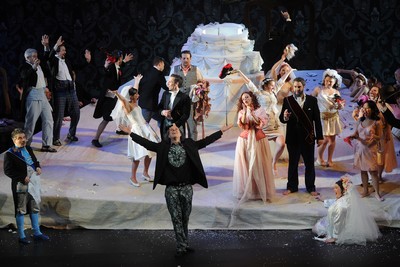
For the most part the singing was good and the singers were game for all the silliness. However, Avi Klemberg in the title role sounded as though the music was a struggle. The songs were all catchy and fun as usual, although I didn’t have any standout favorites. Barbe-bleue’s introductory song was pretty amusing though. It was a very amusing production – the acts took place on a giant bed, table, or in the laundry room. There were a number of fun touches – Saphir has sheep pajamas in the first act, Barbe-bleue’s wives tumble out of the washer in wedding dresses, looking very foamy, Barbe-bleue and Boulotte have pillows for horses. One of the characters acts as a kind of narrator with much dialogue in between the music, and I couldn’t tell you what he said as he went off-libretto. I enjoyed this one and am glad that the various French theaters have been filming productions of Offenbach’s lesser-known works.
Opéra National de Lorraine
Barbe-Bleue - Avi Klemberg
Boulotte - Anaïk Morel
King Bobêche - Antoine Normand
Popolani - Lionel Lhote
Oscar - Julien Véronèse
Saphir - Pascal Charbonneau
Queen Clémentine - Sophie Angebault
Fleurette/Hermia - Norma Nahoun
Jacques Offenbach’s operettas are light, fun, and silly, so I was wondering how he would do the Bluebeard story – which is decidedly not fun and silly - in Barbe-bleue. It does end up being frothy fun, as well as extremely convoluted. There’s a second plot with a disguised prince and princess and plenty of twists and weirdness. This is a cute production from the Opéra National de Lorraine which sets all the acts in different household rooms, emphasizing the domestic concerns of many of the characters – besides Barbe-bleue’s frequent marrying, the king and queen have marital problems, Popolani has a rather absurd domestic situation, and the prince and princess have the usual stumbling blocks of shepherd disguises/secret princesses as well as a love quadrangle on their way to marriage.

Fleurette, a shepherdess, is in love with Saphir, a shepherd. Well, she thinks he is a shepherd, he is actually a prince (as happens). Saphir is also being pursued by the voracious Boulotte. Oscar, the king’s minister, has come to the village to find the princess Hermia, who was abandoned by King Bobeche when she was a baby for….opera plot reasons. Popolani, Barbe-bleue’s resident mad scientist, has come to the village to find a new wife for him. It turns out that Fleurette is Hermia and she is taken off to meet her parents; Saphir is happy because now he can tell his parents about her. Boulotte is chosen to marry Barbe-bleue and she is happy – briefly, of course.

Princess Hermia is unhappy for a few seconds when she thinks she is going to have to marry a strange prince, but it turns out to be her shepherd. Then Barbe-bleue presents his new wife to the king and queen, Boulotte runs after Saphir again and shocks the court, and Barbe-bleue decides he wants the princess for wife number seven. He tells Popolani to poison Boulotte like he’s done with his other wives and Popolani does so, but revives her after Barbe-bleue leaves. Apparently, all the other wives have been living with Popolani in a kind of Popolani harem. They all decide to get revenge on Barbe-bleue, who has gone back to the court and challenged the prince to a duel. Barbe-bleue “wins” their duel and is going to marry Hermia, but Boulotte and all the wives (as well as a number of courtiers who the king sent off to be executed, thinking they were having an affair with Queen Clementine, although she is actually having one with Oscar) burst in and reveal everyone’s secrets. The prince and princess end up together, all the wives pair off with the courtiers (and Popolani), and Barbe-bleue and Boulotte are stuck together, hopefully more happily this time.
For the most part the singing was good and the singers were game for all the silliness. However, Avi Klemberg in the title role sounded as though the music was a struggle. The songs were all catchy and fun as usual, although I didn’t have any standout favorites. Barbe-bleue’s introductory song was pretty amusing though. It was a very amusing production – the acts took place on a giant bed, table, or in the laundry room. There were a number of fun touches – Saphir has sheep pajamas in the first act, Barbe-bleue’s wives tumble out of the washer in wedding dresses, looking very foamy, Barbe-bleue and Boulotte have pillows for horses. One of the characters acts as a kind of narrator with much dialogue in between the music, and I couldn’t tell you what he said as he went off-libretto. I enjoyed this one and am glad that the various French theaters have been filming productions of Offenbach’s lesser-known works.
211reva8
>208 DieFledermaus: This is an interesting review, thanks. I've always wondered what the appeal of Javier Marias' writing is. I used to think that it was just losing something in translation. I tried Your Face Tomorrow and found it very hard to plough through. I'll probably avoid this one.
212rebeccanyc
>208 DieFledermaus: Curiously, I just finished another book by Javier Marias, Voyage along the Horizon, but I won't have time to write a review until tomorrow or the weekend. It was an odd book, and I have to think about it some more before I know what I want to say.
213kidzdoc
Great review of Tomorrow in the Battle Think of Me, Stephanie. I would have been very tempted to read it based on its synopsis, but I have plenty of other books I'd rather read first. I read A Heart So White at least 10 years ago and liked (but not loved) it, but I haven't read anything else by Javier Marías.
214Poquette
>208 DieFledermaus: Intrigued by your review of Javier Marias, with whom I am not familiar. Like you I have been sucked in by the style of writing you describe. I might give him a look next year. ;-)
Enjoyed your opera reviews, as always.
Enjoyed your opera reviews, as always.
215DieFledermaus
>211 reva8: - Reva, I read good reviews about the trilogy, but I'll probably read a couple more of his books and see what I think.
>212 rebeccanyc: - Interesting - I had never heard of that one before - will have to check out your review.
>213 kidzdoc: - Thanks! A Heart So White is on the shelf (I actually know where it is!) and I'll probably try to get to it soon. I was also thinking about reading A Man of Feeling which the library has. The premise for this one was pretty intriguing - one of the reasons why I read it first - but there were some plot issues.
>214 Poquette: - Yeah, I liked his style, but it did seem a bit familiar. I like the book enough to read a couple others.
>212 rebeccanyc: - Interesting - I had never heard of that one before - will have to check out your review.
>213 kidzdoc: - Thanks! A Heart So White is on the shelf (I actually know where it is!) and I'll probably try to get to it soon. I was also thinking about reading A Man of Feeling which the library has. The premise for this one was pretty intriguing - one of the reasons why I read it first - but there were some plot issues.
>214 Poquette: - Yeah, I liked his style, but it did seem a bit familiar. I like the book enough to read a couple others.
This topic was continued by DieFledermaus gets back to reading in 2015, Part II.

