DieFledermaus gets back to reading in 2015, Part II
This is a continuation of the topic DieFledermaus gets back to reading in 2015.
Talk Club Read 2015
Join LibraryThing to post.
This topic is currently marked as "dormant"—the last message is more than 90 days old. You can revive it by posting a reply.
2DieFledermaus
Books Read -
January -
1.) Suddenly, a Knock at the Door - Etgar Keret
2.) The Little Stranger - Sarah Waters
3.) The Gossamer Years - Michitsuna no Haha
4.) Last Words from Montmartre - Qiu Miaojin
5.) The Walls of Delhi - Uday Prakash
6.) The Last Brother - Nathacha Appanah
7.) The Drinker - Hans Fallada
8.) The Artist of Disappearance - Anita Desai
9.) The Victims Return - Stephen Cohen
10.) Aracoeli - Elsa Morante
February -
11.) The General in his Labyrinth - Gabriel Garcia Marquez
12.) All the Pretty Horses - Cormac McCarthy
13.) Family Sayings - Natalia Ginzburg
14.) The Dogs and the Wolves - Irene Nemirovsky
15.) Wise Children - Angela Carter
March -
16.) Prague in Danger - Peter Demetz
17.) Generations of Winter - Vasily Aksyonov
18.) The Infernal Desire Machines of Doctor Hoffman - Angela Carter
19.) The World of Yesterday - Stefan Zweig
April -
20.) The Magic Toyshop - Angela Carter
21.) Talks with T.G. Masaryk - Karel Capek
22.) The Vagabond - Colette
23.) Tomorrow in the Battle Think on Me - Javier Marias
24.) The Relic - Eca de Queiroz
January -
1.) Suddenly, a Knock at the Door - Etgar Keret
2.) The Little Stranger - Sarah Waters
3.) The Gossamer Years - Michitsuna no Haha
4.) Last Words from Montmartre - Qiu Miaojin
5.) The Walls of Delhi - Uday Prakash
6.) The Last Brother - Nathacha Appanah
7.) The Drinker - Hans Fallada
8.) The Artist of Disappearance - Anita Desai
9.) The Victims Return - Stephen Cohen
10.) Aracoeli - Elsa Morante
February -
11.) The General in his Labyrinth - Gabriel Garcia Marquez
12.) All the Pretty Horses - Cormac McCarthy
13.) Family Sayings - Natalia Ginzburg
14.) The Dogs and the Wolves - Irene Nemirovsky
15.) Wise Children - Angela Carter
March -
16.) Prague in Danger - Peter Demetz
17.) Generations of Winter - Vasily Aksyonov
18.) The Infernal Desire Machines of Doctor Hoffman - Angela Carter
19.) The World of Yesterday - Stefan Zweig
April -
20.) The Magic Toyshop - Angela Carter
21.) Talks with T.G. Masaryk - Karel Capek
22.) The Vagabond - Colette
23.) Tomorrow in the Battle Think on Me - Javier Marias
24.) The Relic - Eca de Queiroz
3DieFledermaus
Books Read -
May -
25.) As I Crossed a Bridge of Dreams - Sarashina
26.) The Stones Cry Out - Hikaru Okuizumi
27.) Longitude - Dava Sobel
28.) The Passport - Herta Müller
29.) Far from the Tree - Andrew Solomon
30.) The Pledge - Friedrich Dürrenmatt
31.) The Girl on the Train - Paula Hawkins
32.) The Back Room - Carmen Martín Gaite
33.) The Twelve Chairs - Ilya Ilf, Evgeny Petrov
34.) Nine Fairy Tales and One More Thrown in for Good Measure - Karel Capek
35.) The Hunger Angel - Herta Müller
36.) Conundrum - Jan Morris
37.) Liquidation - Imre Kertesz
June -
38.) The City and the Mountains - Eca de Queiros
39.) Five Days at Memorial - Sheri Fink
40.) The Dwarf - Par Lagerkvist
41.) Skylark - Dezső Kosztolányi
42.) The Day of the Owl - Leonardo Sciascia
43.) Diamond Dust - Anita Desai
44.) The Line - Olga Grushin
45.) Witness the Night - Kishwar Desai
46.) The Skin - Curzio Malaparte
47.) Yes Please - Amy Poehler
July -
48.) A Heart So White - Javier Marias
49.) From the Score to the Stage - Evan Baker
50.) The Bride Price - Buchi Emecheta
51.) Ashes and Diamonds - Jerzy Andrzejewski
52.) Snow Man - David Albahari
August -
53.) Subtly Worded and Other Stories - Teffi
54.) The Thing Around Your Neck - Chimamanda Ngozie Adichie
55.) The Gourmet Club - Junichiro Tanizaki
56.) Invitation to a Beheading - Vladimir Nabokov
September -
57.) Nobody Knows My Name - James Baldwin
58.) The Death of Mr. Baltisberger - Bohumil Hrabal
59.) Are You My Mother? - Alison Bechdel
60.) Niki: The Story of a Dog - Tibor Dery
61.) Monsieur Monde Vanishes - Georges Simenon
May -
25.) As I Crossed a Bridge of Dreams - Sarashina
26.) The Stones Cry Out - Hikaru Okuizumi
27.) Longitude - Dava Sobel
28.) The Passport - Herta Müller
29.) Far from the Tree - Andrew Solomon
30.) The Pledge - Friedrich Dürrenmatt
31.) The Girl on the Train - Paula Hawkins
32.) The Back Room - Carmen Martín Gaite
33.) The Twelve Chairs - Ilya Ilf, Evgeny Petrov
34.) Nine Fairy Tales and One More Thrown in for Good Measure - Karel Capek
35.) The Hunger Angel - Herta Müller
36.) Conundrum - Jan Morris
37.) Liquidation - Imre Kertesz
June -
38.) The City and the Mountains - Eca de Queiros
39.) Five Days at Memorial - Sheri Fink
40.) The Dwarf - Par Lagerkvist
41.) Skylark - Dezső Kosztolányi
42.) The Day of the Owl - Leonardo Sciascia
43.) Diamond Dust - Anita Desai
44.) The Line - Olga Grushin
45.) Witness the Night - Kishwar Desai
46.) The Skin - Curzio Malaparte
47.) Yes Please - Amy Poehler
July -
48.) A Heart So White - Javier Marias
49.) From the Score to the Stage - Evan Baker
50.) The Bride Price - Buchi Emecheta
51.) Ashes and Diamonds - Jerzy Andrzejewski
52.) Snow Man - David Albahari
August -
53.) Subtly Worded and Other Stories - Teffi
54.) The Thing Around Your Neck - Chimamanda Ngozie Adichie
55.) The Gourmet Club - Junichiro Tanizaki
56.) Invitation to a Beheading - Vladimir Nabokov
September -
57.) Nobody Knows My Name - James Baldwin
58.) The Death of Mr. Baltisberger - Bohumil Hrabal
59.) Are You My Mother? - Alison Bechdel
60.) Niki: The Story of a Dog - Tibor Dery
61.) Monsieur Monde Vanishes - Georges Simenon
4DieFledermaus
Operas, concert etc.
1.) Hansel und Gretel - Glyndebourne
2.) Jenůfa - Deutsche Oper Berlin
3.) Fidelio - La Scala
4.) Tosca - Seattle*
5.) Les Brigands - Opera Comique
6.) Dirty Dancing - Paramount*
7.) Don Giovanni - La Monnaie
8.) Katia Kabanova - Théâtre des Bouffes du Nord
9.) Rinaldo - Glyndebourne
10.) Lucia di Lammermoor - Bayerische Staatsoper
11.) Parsifal - Royal Opera House (ROH, Covent Garden)
12.) Semele – Seattle*
13.) Andrea Chenier – ROH
14.) The Merry Wives of Windsor – Wallonie
15.) Luisa Miller – Wallonie
16.) Aleko - Opera National de Lorraine
17.) Alcina – La Monnaie
18.) Moses und Aron - Ruhrtriennale
19.) Tamerlano – La Monnaie
20.) The Vertiginous Thrill of Forsythe - PNB*
21.) Schnittke/Shostakovich - Seattle Symphony*
22.) Barbe-Bleue - Opera National de Lorraine
23.) L'Etoile - Dutch National Opera/De Nationale Opera (De Nederlandse Opera, DNO)
24.) Dardanus - Bordeaux
25.) Ariadne auf Naxos - Seattle*
26.) Król Roger - ROH
27.) Lulu - Bayerische Staatsoper
28.) Cavalleria Rusticana /Pagliacci - Salzburg
29.) Les Fetes Venitiennes - Opera Comique/Les Arts Florissants
30.) The Cunning Little Vixen - DNO
31.) Tannhauser - Bayreuth
32.) Arabella - Bayerische Staatsoper
33.) Medee (Marc-Antoine Charpentier) - Theater Basel
34.) Das Rheingold - Staatsoper Stuttgart
35.) La Belle Hélène - Théâtre du Châtelet
36.) Dialogues des Carmélites - Bayerische Staatsoper
37.) Götterdämmerung - Vienna Staatsoper
38.) Katia Kabanova - Salzburg
39.) Alice in Wonderland - Bayerische Staatsoper
40.) Iphigenie en Tauride - Grand Théâtre de Genève
41.) Les Mousquetaires au Couvent - Opera Comique
42.) A Midsummer Night’s Dream - Aix-en-Provence
43.) Manon Lescaut - Bayerische Staatsoper
44.) Nabucco - Seattle*
45.) Werther - Vienna Staatsoper
46.) Platée - Opéra National de Paris
47.) The Rape of Lucretia - Glyndebourne
48.) Fidelio - Salzburg
49.) Poliuto - Glyndebourne
50.) Die Walküre - Staatsoper Stuttgart
51.) Les Indes Galantes - Opéra National de Paris
52.) Turandot - Bregenz
53.) Winterreise - Aix-en-Provence
54.) Les Contes d'Hoffmann - Bregenz
55.) Kullervo - Finnish National Opera/Ballet
56.) El Retablo de Maese Pedro - Teatro Real
1.) Hansel und Gretel - Glyndebourne
2.) Jenůfa - Deutsche Oper Berlin
3.) Fidelio - La Scala
4.) Tosca - Seattle*
5.) Les Brigands - Opera Comique
6.) Dirty Dancing - Paramount*
7.) Don Giovanni - La Monnaie
8.) Katia Kabanova - Théâtre des Bouffes du Nord
9.) Rinaldo - Glyndebourne
10.) Lucia di Lammermoor - Bayerische Staatsoper
11.) Parsifal - Royal Opera House (ROH, Covent Garden)
12.) Semele – Seattle*
13.) Andrea Chenier – ROH
14.) The Merry Wives of Windsor – Wallonie
15.) Luisa Miller – Wallonie
16.) Aleko - Opera National de Lorraine
17.) Alcina – La Monnaie
18.) Moses und Aron - Ruhrtriennale
19.) Tamerlano – La Monnaie
20.) The Vertiginous Thrill of Forsythe - PNB*
21.) Schnittke/Shostakovich - Seattle Symphony*
22.) Barbe-Bleue - Opera National de Lorraine
23.) L'Etoile - Dutch National Opera/De Nationale Opera (De Nederlandse Opera, DNO)
24.) Dardanus - Bordeaux
25.) Ariadne auf Naxos - Seattle*
26.) Król Roger - ROH
27.) Lulu - Bayerische Staatsoper
28.) Cavalleria Rusticana /Pagliacci - Salzburg
29.) Les Fetes Venitiennes - Opera Comique/Les Arts Florissants
30.) The Cunning Little Vixen - DNO
31.) Tannhauser - Bayreuth
32.) Arabella - Bayerische Staatsoper
33.) Medee (Marc-Antoine Charpentier) - Theater Basel
34.) Das Rheingold - Staatsoper Stuttgart
35.) La Belle Hélène - Théâtre du Châtelet
36.) Dialogues des Carmélites - Bayerische Staatsoper
37.) Götterdämmerung - Vienna Staatsoper
38.) Katia Kabanova - Salzburg
39.) Alice in Wonderland - Bayerische Staatsoper
40.) Iphigenie en Tauride - Grand Théâtre de Genève
41.) Les Mousquetaires au Couvent - Opera Comique
42.) A Midsummer Night’s Dream - Aix-en-Provence
43.) Manon Lescaut - Bayerische Staatsoper
44.) Nabucco - Seattle*
45.) Werther - Vienna Staatsoper
46.) Platée - Opéra National de Paris
47.) The Rape of Lucretia - Glyndebourne
48.) Fidelio - Salzburg
49.) Poliuto - Glyndebourne
50.) Die Walküre - Staatsoper Stuttgart
51.) Les Indes Galantes - Opéra National de Paris
52.) Turandot - Bregenz
53.) Winterreise - Aix-en-Provence
54.) Les Contes d'Hoffmann - Bregenz
55.) Kullervo - Finnish National Opera/Ballet
56.) El Retablo de Maese Pedro - Teatro Real
5DieFledermaus
Wishlist -
Books about Haiti -
1.) Toussaint L'Ouverture - Madison Smartt Bell (recommended by Rebecca)
2.)The Kingdom of this World - Alejo Carpentier - about Haiti slave revolt, rec by Rebecca
3.) Ripe to Burst - Franketienne
4.) Massacre River - Rene Philoctete
5.) Children of Heroes - Lyonel Trouillot (kidzdoc recs)
6.) Cockroach - Rawi Hage (Nickelini rec, Canadian, based on Hunger)
7.) The Fortunes of Africa - Martin Meredith - good overview, rec by AnnieMod
8.) Pather Panchali - Bibhutibhushan Banerji
9.) Spillover - David Quammen
10.) The Fat Years - Koon Chung Chan
11.) One Part Woman - Perumal Murugan
12.) Trafalgar - Angelica Gorodischer
13.) The Reprisal - Laudomia Bonanni
14.) Little Kingdoms - Steven Millhauser (Poquette rec, short stories, metafictional, like Calvino or Schulz)
15.) The Frozen Heart - Almudena Grandes
Books about Haiti -
1.) Toussaint L'Ouverture - Madison Smartt Bell (recommended by Rebecca)
2.)The Kingdom of this World - Alejo Carpentier - about Haiti slave revolt, rec by Rebecca
3.) Ripe to Burst - Franketienne
4.) Massacre River - Rene Philoctete
5.) Children of Heroes - Lyonel Trouillot (kidzdoc recs)
6.) Cockroach - Rawi Hage (Nickelini rec, Canadian, based on Hunger)
7.) The Fortunes of Africa - Martin Meredith - good overview, rec by AnnieMod
8.) Pather Panchali - Bibhutibhushan Banerji
9.) Spillover - David Quammen
10.) The Fat Years - Koon Chung Chan
11.) One Part Woman - Perumal Murugan
12.) Trafalgar - Angelica Gorodischer
13.) The Reprisal - Laudomia Bonanni
14.) Little Kingdoms - Steven Millhauser (Poquette rec, short stories, metafictional, like Calvino or Schulz)
15.) The Frozen Heart - Almudena Grandes
6DieFledermaus
Books read from TBR (this will only be books on the pile before 2015 and won't include ebooks) -
1.) Suddenly, a Knock at the Door by Etgar Keret
2.) The Gossamer Years - Michitsuna no Haha
3.) The Drinker - Hans Fallada
4.) The Victims Return - Stephen Cohen
5.) Aracoeli - Elsa Morante
6.) All the Pretty Horses - Cormac McCarthy
7.) Family Sayings - Natalia Ginzburg
8.) The Dogs and the Wolves - Irene Nemirovsky
9.) Wise Children - Angela Carter
10.) Prague in Danger - Peter Demetz
11.) Generations of Winter - Vasily Aksyonov
12.) The Infernal Desire Machines of Doctor Hoffman - Angela Carter
13.) The World of Yesterday - Stefan Zweig
14.) Talks with T.G. Masaryk - Karel Capek
15.) The Vagabond - Colette
16.) Tomorrow in the Battle Think on Me - Javier Marias
1.) Suddenly, a Knock at the Door by Etgar Keret
2.) The Gossamer Years - Michitsuna no Haha
3.) The Drinker - Hans Fallada
4.) The Victims Return - Stephen Cohen
5.) Aracoeli - Elsa Morante
6.) All the Pretty Horses - Cormac McCarthy
7.) Family Sayings - Natalia Ginzburg
8.) The Dogs and the Wolves - Irene Nemirovsky
9.) Wise Children - Angela Carter
10.) Prague in Danger - Peter Demetz
11.) Generations of Winter - Vasily Aksyonov
12.) The Infernal Desire Machines of Doctor Hoffman - Angela Carter
13.) The World of Yesterday - Stefan Zweig
14.) Talks with T.G. Masaryk - Karel Capek
15.) The Vagabond - Colette
16.) Tomorrow in the Battle Think on Me - Javier Marias
7DieFledermaus
The Relic by Eca De Queiroz
Finished 4/30/15
This books started out as an amusing portrait of a religious hypocrite, but then ran into some problems. There was an extended dream sequence where the narrator finds himself in Jerusalem during the last days of Jesus. It felt very flat, as the author spent a lot of time describing people and scenery with not much commentary from the narrator. The whole tone was different, and, for the most part, this chapter didn’t add anything although the conclusion was interesting. Also, the author trotted out the tired bit blaming the Jews for the death of Jesus. It was much too long and I found myself frequently flipping ahead to see where that part ended. It was unfortunate, because the other books by Queiroz that I’d read were more serious examinations of social and religious hypocrisy, so at first I enjoyed the shift to comedy. There was a twist near the end that I could see coming from several miles away, but the last few pages were surprisingly subtle and the actual end was pure comic gold. I find it hard to recommend though because the dream sequence was so long and boring.
Teodorico Raposo, the narrator, is an orphan who goes to live with his rich, obsessively devout aunt. She uses her money to control people and is disgusted by any sort of romance or love. Teodorico manages to have some good times while living away from her, but after he gets his degree and moves back in, she continues to monitor his room and belongings. Still, he secretly sees his mistress Adelia at night while pretending to be devoutly religious by day. After learning that his aunt will likely leave her fortune to Jesus, the narrator tries to be even more of a hypocrite – praying constantly and running from church to church all day. He hits on a trip to Jerusalem as a solution to his problem and also to get away from Adelia, who has dumped him for someone else. Instead of seeing all the sights, Teodorico is excited to sleep with as many women as possible, but he ends up seeing some things anyway, due to his traveling companion, the pedantic German scholar Topsius. There is one other thing that the narrator has in mind – his aunt requests that he pick up a precious relic, and he imagines that finding something spectacular will win him his inheritance.
Teodorico’s adventures in religious hypocrisy were entertaining. He’s not a sympathetic character and modern readers will find him even more unpleasant – casual sexism and anti-Semitic comments. His over-the-top relic collecting was also amusing. However, the too-long dream sequence interrupts the narrative. It’s about 1/3 of the total book and it was not especially interesting. The shift in mood was abrupt and the narrator seems like a different person – he passively describes the setting. It’s almost like the author is trying to do some sort of historical travel writing, but boring travel writing. Will have to look for some of the author’s other comedies, as this one was disappointing.
Finished 4/30/15
This books started out as an amusing portrait of a religious hypocrite, but then ran into some problems. There was an extended dream sequence where the narrator finds himself in Jerusalem during the last days of Jesus. It felt very flat, as the author spent a lot of time describing people and scenery with not much commentary from the narrator. The whole tone was different, and, for the most part, this chapter didn’t add anything although the conclusion was interesting. Also, the author trotted out the tired bit blaming the Jews for the death of Jesus. It was much too long and I found myself frequently flipping ahead to see where that part ended. It was unfortunate, because the other books by Queiroz that I’d read were more serious examinations of social and religious hypocrisy, so at first I enjoyed the shift to comedy. There was a twist near the end that I could see coming from several miles away, but the last few pages were surprisingly subtle and the actual end was pure comic gold. I find it hard to recommend though because the dream sequence was so long and boring.
Teodorico Raposo, the narrator, is an orphan who goes to live with his rich, obsessively devout aunt. She uses her money to control people and is disgusted by any sort of romance or love. Teodorico manages to have some good times while living away from her, but after he gets his degree and moves back in, she continues to monitor his room and belongings. Still, he secretly sees his mistress Adelia at night while pretending to be devoutly religious by day. After learning that his aunt will likely leave her fortune to Jesus, the narrator tries to be even more of a hypocrite – praying constantly and running from church to church all day. He hits on a trip to Jerusalem as a solution to his problem and also to get away from Adelia, who has dumped him for someone else. Instead of seeing all the sights, Teodorico is excited to sleep with as many women as possible, but he ends up seeing some things anyway, due to his traveling companion, the pedantic German scholar Topsius. There is one other thing that the narrator has in mind – his aunt requests that he pick up a precious relic, and he imagines that finding something spectacular will win him his inheritance.
Teodorico’s adventures in religious hypocrisy were entertaining. He’s not a sympathetic character and modern readers will find him even more unpleasant – casual sexism and anti-Semitic comments. His over-the-top relic collecting was also amusing. However, the too-long dream sequence interrupts the narrative. It’s about 1/3 of the total book and it was not especially interesting. The shift in mood was abrupt and the narrator seems like a different person – he passively describes the setting. It’s almost like the author is trying to do some sort of historical travel writing, but boring travel writing. Will have to look for some of the author’s other comedies, as this one was disappointing.
8DieFledermaus
The Stones Cry Out by Hikaru Okuizumi
Finished 5/3/15
Tsuyoshi Manase seems to have found a happy ending after the horrors of World War II. He takes up his father’s business selling old books and is successful. He marries, has two sons, and leads a seemingly placid life. He might be a bit eccentric, with a serious hobby collecting rocks, but he is stable and hardworking. However, his hobby stems from an incident during the war, where Manase was trapped in a cave with a dying man who rambled on about stones. Some of those memories remain fresh and occasionally trickle into his dreams, while everything else about the war – and even his day-to-day life – slips away. But for the most part, Masase appears to have escaped from the horror of those days. Unfortunately, he cannot escape the past, which appears as a family tragedy and leads inexorably to an unhappy end. Although this book is quite short, it packs a punch. The prose is simple and smooth, providing a sharp contrast to the sudden reversals or agonizing decisions in the story.
Manase obsessively collects and studies stones, becoming something of an amateur expert and making several small but impressive discoveries. At first, his hobby doesn’t seem too threatening or limiting. The world of stones, as described by the lance corporal in the cave, stretches back billions of years and is an always changing cycle of decay and renewal. There is a connection, both with the outside world and Manase’s past. But after the family disintegrates, the stones are symbolic in a more disturbing way. Perhaps a more pedestrian view of them would be as mute, lifeless things, an appropriate symbol for Manase’s response. At some critical moments, Manase can’t communicate. Even his painstaking work preserving slices of stones seems like a sad shadow of Manase himself, stuck in his unchanging life even as other people are moving on and growing up.
The straightforward prose also works well when, later on in the novel, several plot elements are left ambiguous or surreal. There is a feeling of everything being circular and inescapable – motifs repeat throughout the years, some elements strongly parallel earlier ones (two caves, two stones mutely witnessing pivotal events), and Manase picks at and analyzes his memories, just as he does his stones. Even with his years of study, Manase seems stuck using the words of the lance corporal to describe his stones. A tense and powerful read – recommended.
Finished 5/3/15
Tsuyoshi Manase seems to have found a happy ending after the horrors of World War II. He takes up his father’s business selling old books and is successful. He marries, has two sons, and leads a seemingly placid life. He might be a bit eccentric, with a serious hobby collecting rocks, but he is stable and hardworking. However, his hobby stems from an incident during the war, where Manase was trapped in a cave with a dying man who rambled on about stones. Some of those memories remain fresh and occasionally trickle into his dreams, while everything else about the war – and even his day-to-day life – slips away. But for the most part, Masase appears to have escaped from the horror of those days. Unfortunately, he cannot escape the past, which appears as a family tragedy and leads inexorably to an unhappy end. Although this book is quite short, it packs a punch. The prose is simple and smooth, providing a sharp contrast to the sudden reversals or agonizing decisions in the story.
Manase obsessively collects and studies stones, becoming something of an amateur expert and making several small but impressive discoveries. At first, his hobby doesn’t seem too threatening or limiting. The world of stones, as described by the lance corporal in the cave, stretches back billions of years and is an always changing cycle of decay and renewal. There is a connection, both with the outside world and Manase’s past. But after the family disintegrates, the stones are symbolic in a more disturbing way. Perhaps a more pedestrian view of them would be as mute, lifeless things, an appropriate symbol for Manase’s response. At some critical moments, Manase can’t communicate. Even his painstaking work preserving slices of stones seems like a sad shadow of Manase himself, stuck in his unchanging life even as other people are moving on and growing up.
The straightforward prose also works well when, later on in the novel, several plot elements are left ambiguous or surreal. There is a feeling of everything being circular and inescapable – motifs repeat throughout the years, some elements strongly parallel earlier ones (two caves, two stones mutely witnessing pivotal events), and Manase picks at and analyzes his memories, just as he does his stones. Even with his years of study, Manase seems stuck using the words of the lance corporal to describe his stones. A tense and powerful read – recommended.
9rebeccanyc
>7 DieFledermaus: I've only read The Maias by Eca de Queiros, but I have The City and the Mountains on the TBR. I hadn't heard of The Relic and, after your review, I'm not sure I'll read it!
>8 DieFledermaus: Hadn't heard of this one either, but it sounds intriguing.
>8 DieFledermaus: Hadn't heard of this one either, but it sounds intriguing.
10labfs39
Two wonderful reviews, DieF. You tell just enough to inform and intrigue without going into the entire enchilada. The Stones Cry Out cries out to go onto my wishlist, but my ears are stones at the moment, as I try to come to grips with my TBR. I'm so glad you are back on LT this year.
11reva8
>8 DieFledermaus: Both, The Stones Cry Out and The Relic sound interesting, particularly the latter. Wonderful reviews!
12dchaikin
I think maybe i just read too many of your reviews at once. All my thoughts have kind of blended together and canceled each other out. In any case, fascinated by yhe books you have been reading and your reviews.
As a geologist I really should read The Stones Cry Out. Wondering about The Relic and what the purpose of the dream was and why it took up so much of the book. Too bad it didn't quite work.
As a geologist I really should read The Stones Cry Out. Wondering about The Relic and what the purpose of the dream was and why it took up so much of the book. Too bad it didn't quite work.
13Poquette
I have not read anything by Eca de Quieros but I am putting him on my wish list. Despite its flaws — forewarned is forearmed! — The Relic sounds intriguing. And so does The Stones Cry Out.
14lilisin
I really enjoyed The Stones Cry Out when I read it in 2012 but unfortunately I wasn't able to write a good review of it as I'm not as good with my words as you are. So thanks for this wonderful review that has inspired others to read to this great book.
15SassyLassy
>7 DieFledermaus: Having read The Crime of Father Amaro back in March, and reading your review of The Relic, it looks as if Eca de Queiros has certain themes that absorb him. I agree with you about his skilled use of humour as protest. I have The Maias on my TBR after reading a review by rebecca a while back.
16DieFledermaus
>9 rebeccanyc: - Rebecca, I have The City and the Mountains on the shelf as well. I might try to read it soon, but will probably try to finish something by Jose Saramago and Carmen Martin Gaite first before circling back to more de Queiros and Marias.
>10 labfs39: - Thanks, I know what you mean about TBR overload!
>11 reva8: - Thanks!
>12 dchaikin: - I'd be interested to hear a geologist's take on the book, and it was a quick read.
I'm assuming the author really wanted to do some sort of travel writing, but time travel writing. Maybe he'd been researching and was so excited, he wanted to stick that in the book, but it contrasted to the rest of the story and not in a good way. The intro said that even the critics of the day complained about that part.
>13 Poquette: - I can recommend any of the other de Queiros books that I've read - The Crime of Father Amaro, The Yellow Sofa, and Cousin Basilio. I agree about forewarned - it's possible that I wouldn't have minded the extended dream sequence as much if I knew that going in.
>14 lilisin: - Thanks - definitely agree that it is a book to read! I know I found out about it on LT, but I don't remember if it was a review or if I found it poking around in some people's libraries.
>15 SassyLassy: - The Maias is on the pile somewhere, but I'm not sure where. I did like the other Queiros books that I read. Reading the synopsis of some of his other ones - it does sound like he has a lot about hypocrisy, self-delusions and provincialism.
>10 labfs39: - Thanks, I know what you mean about TBR overload!
>11 reva8: - Thanks!
>12 dchaikin: - I'd be interested to hear a geologist's take on the book, and it was a quick read.
I'm assuming the author really wanted to do some sort of travel writing, but time travel writing. Maybe he'd been researching and was so excited, he wanted to stick that in the book, but it contrasted to the rest of the story and not in a good way. The intro said that even the critics of the day complained about that part.
>13 Poquette: - I can recommend any of the other de Queiros books that I've read - The Crime of Father Amaro, The Yellow Sofa, and Cousin Basilio. I agree about forewarned - it's possible that I wouldn't have minded the extended dream sequence as much if I knew that going in.
>14 lilisin: - Thanks - definitely agree that it is a book to read! I know I found out about it on LT, but I don't remember if it was a review or if I found it poking around in some people's libraries.
>15 SassyLassy: - The Maias is on the pile somewhere, but I'm not sure where. I did like the other Queiros books that I read. Reading the synopsis of some of his other ones - it does sound like he has a lot about hypocrisy, self-delusions and provincialism.
17DieFledermaus
Recently watched this one -
https://www.youtube.com/watch?v=cPYwTdghHb8
a terrific Polish opera, Król Roger, composed by Szymanowski, from the ROH
Would also recommend this one -
http://culturebox.francetvinfo.fr/festivals/operas-de-france/la-favorite-de-doni...
Donizetti's La Favorite, which I saw last year. I'm not the biggest fan of bel canto dramas, and this one has some implausible plot turns and the "Oh no! Fallen woman!" issues, but the gorgeous production (with costumes by Christian Lacroix) and strong performances made it very enjoyable.
https://www.youtube.com/watch?v=cPYwTdghHb8
a terrific Polish opera, Król Roger, composed by Szymanowski, from the ROH
Would also recommend this one -
http://culturebox.francetvinfo.fr/festivals/operas-de-france/la-favorite-de-doni...
Donizetti's La Favorite, which I saw last year. I'm not the biggest fan of bel canto dramas, and this one has some implausible plot turns and the "Oh no! Fallen woman!" issues, but the gorgeous production (with costumes by Christian Lacroix) and strong performances made it very enjoyable.
18DieFledermaus
The Passport by Herta Müller
Finished 5/5/15
While this book was depressing, it wasn’t quite as soul-crushing as her collection of short stories, Nadirs. However, I found I didn’t think it was as good as Nadirs, which was effective in its way, or The Land of Green Plums, which had a more expansive prose style. There were short sections that were very vivid and almost hallucinatory, like some of the pieces in Nadirs, and I thought those were the best parts of the book. In those cases, the flat, succinct style works well as a contrast, but narrating the whole story in that style became tedious. Windisch, a miller, is trying to escape a small, decaying village in the Banat (German) region of Romania. Everyone else is leaving or talking of leaving as well. However, obtaining the required passport proves difficult. Windisch tries to bribe the local officials with flour, but finds that he is expected to send his daughter Amalie as payment instead. While sporadic parts of the story worked, this isn’t the Müller that I’d recommend.
Finished 5/5/15
While this book was depressing, it wasn’t quite as soul-crushing as her collection of short stories, Nadirs. However, I found I didn’t think it was as good as Nadirs, which was effective in its way, or The Land of Green Plums, which had a more expansive prose style. There were short sections that were very vivid and almost hallucinatory, like some of the pieces in Nadirs, and I thought those were the best parts of the book. In those cases, the flat, succinct style works well as a contrast, but narrating the whole story in that style became tedious. Windisch, a miller, is trying to escape a small, decaying village in the Banat (German) region of Romania. Everyone else is leaving or talking of leaving as well. However, obtaining the required passport proves difficult. Windisch tries to bribe the local officials with flour, but finds that he is expected to send his daughter Amalie as payment instead. While sporadic parts of the story worked, this isn’t the Müller that I’d recommend.
19DieFledermaus
The Pledge by Friedrich Dürrenmatt
Finished 5/14/15
An interesting, if not too memorable, meta-detective story. Related in a cool factual style, the story is told to the narrator – a crime novelist – by a retired police chief. We know the unhappy ending of the dogged detective, Matthäi, who is the main character, as they visit him at the beginning of the tale. The first half is a very standard setup. Matthäi is the best detective on the force, although he has no personal life, is obsessive, and clashes with the other officers. A young girl is found murdered in a small town and Matthäi makes a promise to her mother that he will find the culprit. Suspicion immediately falls on the peddler who found her body as he has a criminal record, and the circumstantial evidence also points to him. Some of Matthäi’s associates extract a confession, but only after nearly a day of questioning. However, Matthäi believes the real killer is still out there and goes rogue, becomes fixated, and does morally questionable things to discover the truth. There is some musing by the police chief on the tidiness of detective stories and the lionization of rogue, smartest-man-in-the-room type detectives, and the ending subverts the usual expectations. A quick and interesting read.
Finished 5/14/15
An interesting, if not too memorable, meta-detective story. Related in a cool factual style, the story is told to the narrator – a crime novelist – by a retired police chief. We know the unhappy ending of the dogged detective, Matthäi, who is the main character, as they visit him at the beginning of the tale. The first half is a very standard setup. Matthäi is the best detective on the force, although he has no personal life, is obsessive, and clashes with the other officers. A young girl is found murdered in a small town and Matthäi makes a promise to her mother that he will find the culprit. Suspicion immediately falls on the peddler who found her body as he has a criminal record, and the circumstantial evidence also points to him. Some of Matthäi’s associates extract a confession, but only after nearly a day of questioning. However, Matthäi believes the real killer is still out there and goes rogue, becomes fixated, and does morally questionable things to discover the truth. There is some musing by the police chief on the tidiness of detective stories and the lionization of rogue, smartest-man-in-the-room type detectives, and the ending subverts the usual expectations. A quick and interesting read.
20DieFledermaus
L'Etoile by Emmanuel Chabrier
Dutch National Opera/De Nationale Opera (De Nederlandse Opera, DNO)
Lazuli - Stéphanie d’Oustrac
Laoula - Hélène Guilmette
Ouf - Christophe Mortagne
Siroco - Jérôme Varnier
Hérisson - Elliot Madore
Aloès - Julie Boulianne
It’s a shame this operetta by Emmanuel Chabrier isn’t as well-known as some of Offenbach’s, since it is a lot of fun despite the very daffy plot (or maybe because of it?) and the music is inventive and catchy. The production, directed by Laurent Pelly, is also a lot of fun – he throws in random concepts and costumes and sets, which perfectly fits the very unserious, random plot. The music was light and bubbly, and there was some very nice orchestration - a couple pieces had me looking them up later on YouTube. The singers were all pretty successful, although I think I prefer Stéphanie d’Oustrac in some of the earlier rep that I’ve seen her in – she has a warm, attractive voice but sometimes I though the music called for something brighter and more energetic.
King Ouf loves to celebrate his birthday with crowd-pleasing entertainments, including a public execution. He doesn’t want to pick innocent people for that, so on his birthday, he goes around in disguise trying to get the citizens to criticize the government so he will have someone “bad” to execute. Unfortunately for him, all his subjects know his plan so on that day they go around suspiciously eyeing strangers and shouting support for the government. The king vents his irritation to his royal astrologer, Siroco.
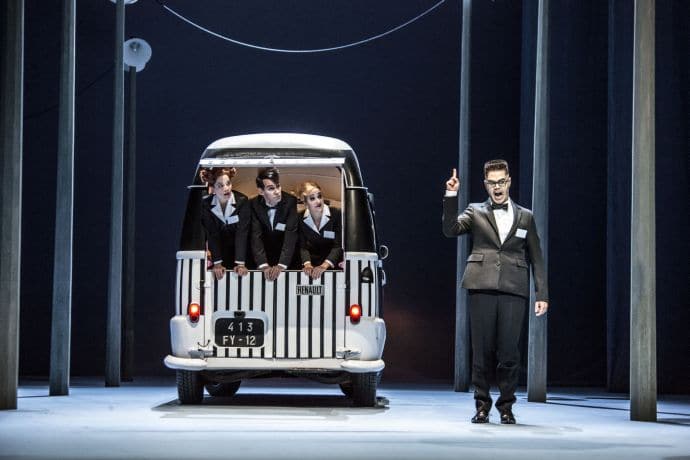
Meanwhile, the ambassador Hérisson de Porc-Epic is bringing Princess Laoula to marry the king. Hérisson is paranoid, so for opera plot reasons, he has the princess posing as his wife. The group – which also includes his real wife Aloès and his secretary Tapioca – is, on top of that, posing as salespeople. Just to top it off, Hérisson hasn’t told Laoula what the point of their trip is. Operatic insta-love occurs when the princess and a poor peddler, Lazuli, briefly see each other, but Lazuli is crushed when he learns that the princess is married (of course he doesn’t know she isn’t really married, or is a princess, or is engaged to someone else). In his anger, he tells off Ouf, who excitedly calls for the execution. Lazuli is about to be impaled on a chair, when Siroco rushes in to warn the king that his star readings have told him that Ouf will die 24 hrs after Lazuli. The king immediately stops the execution and takes Lazuli off to his palace.

Lazuli is comfortably ensconced in the palace, but is bored. He is trying to leave – with Ouf and Siroco trying to stop him – when the ambassador’s party arrives. Ouf, trying to placate Lazuli, tells him he can marry Laoula and throws Hérisson in jail. Laoula and the others go along with the ruse – Ouf thinks Aloès is his bride – and the couple runs off together. Hérisson gets out and tries to stop Lazuli, who falls overboard (he and Laoula were escaping by boat) and is believed to be dead. Ouf unhappily bemoans his fate – he will be dying in a day. A provision in his will has Siroco executed 15 min after his death, so the astrologer is equally miserable.
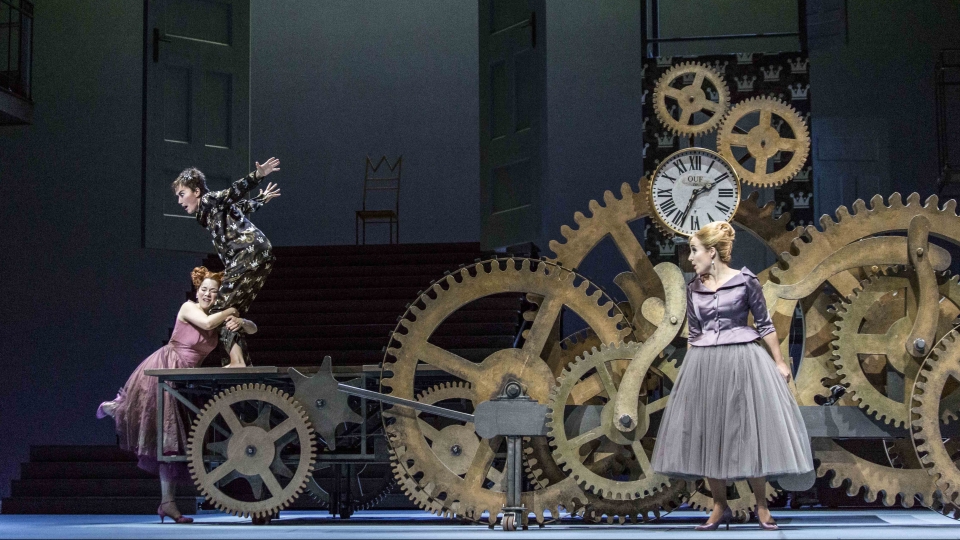
Of course Lazuli isn’t dead. He tells Laoula to meet him outside the city, as the wedding to Ouf is cancelled, what with his impending death. But Ouf decides maybe he wants to be married for several hours and try to make some little Oufs. Laoula attempts to change his mind, but then the 24 hrs are up and Ouf is not dead. He’s about to punish Siroco, when Lazuli is brought in, Ouf agrees to let him and the princess marry, and names Lazuli as his heir – thinking he has gotten one over on him, as Lazuli should be dying before him.
Well, the plot seems even crazier when it’s written out like that. It was a lot of fun though. The production is a jumble that suggests various places and some bits that might not make sense, but you go along with it anyway, because why not? The first act takes place in an open area with multiple loudspeakers installed – looking like some Communist-era meeting place. Ouf himself is costumed as an exaggerated cartoon dictator and Christophe Mortagne plays up the part. The “salespeople” have spiffy outfits and a tiny car, Ouf’s guards have dog heads, and the palace ladies wear giant pink poufs. The palace has an MC Escher feel and all the gears and wheels in the sets finally morph into clocks counting down the minutes until Ouf’s (and Siroco’s) death.
The singing and playing under Patrick Fournillier were good, with a few clangs here and there. I hadn’t heard the music before and it was very nice – sparkling, like an Offenbach, with some memorable and amusing songs. The drinking song for Ouf and Siroco isn’t a catchy, jaunty tune, but a lurching, staggering attempt to drown their unhappiness. The chorus’s gleeful song at the end of act one is cheerful, addictive, and all excitement….for an execution. But Lazuli’s dreamy aria musing on his fate in the stars had me looking it up –
https://www.youtube.com/watch?v=eAtz4KewI4Y
and there was a delicate quartet for the four lovers (Lazuli and Laoula, Aloès and Tapioca – not her husband). Unfortunately, couldn’t find that one on YouTube. I’d love to see it live and very much enjoyed this production.
Dutch National Opera/De Nationale Opera (De Nederlandse Opera, DNO)
Lazuli - Stéphanie d’Oustrac
Laoula - Hélène Guilmette
Ouf - Christophe Mortagne
Siroco - Jérôme Varnier
Hérisson - Elliot Madore
Aloès - Julie Boulianne
It’s a shame this operetta by Emmanuel Chabrier isn’t as well-known as some of Offenbach’s, since it is a lot of fun despite the very daffy plot (or maybe because of it?) and the music is inventive and catchy. The production, directed by Laurent Pelly, is also a lot of fun – he throws in random concepts and costumes and sets, which perfectly fits the very unserious, random plot. The music was light and bubbly, and there was some very nice orchestration - a couple pieces had me looking them up later on YouTube. The singers were all pretty successful, although I think I prefer Stéphanie d’Oustrac in some of the earlier rep that I’ve seen her in – she has a warm, attractive voice but sometimes I though the music called for something brighter and more energetic.
King Ouf loves to celebrate his birthday with crowd-pleasing entertainments, including a public execution. He doesn’t want to pick innocent people for that, so on his birthday, he goes around in disguise trying to get the citizens to criticize the government so he will have someone “bad” to execute. Unfortunately for him, all his subjects know his plan so on that day they go around suspiciously eyeing strangers and shouting support for the government. The king vents his irritation to his royal astrologer, Siroco.
Meanwhile, the ambassador Hérisson de Porc-Epic is bringing Princess Laoula to marry the king. Hérisson is paranoid, so for opera plot reasons, he has the princess posing as his wife. The group – which also includes his real wife Aloès and his secretary Tapioca – is, on top of that, posing as salespeople. Just to top it off, Hérisson hasn’t told Laoula what the point of their trip is. Operatic insta-love occurs when the princess and a poor peddler, Lazuli, briefly see each other, but Lazuli is crushed when he learns that the princess is married (of course he doesn’t know she isn’t really married, or is a princess, or is engaged to someone else). In his anger, he tells off Ouf, who excitedly calls for the execution. Lazuli is about to be impaled on a chair, when Siroco rushes in to warn the king that his star readings have told him that Ouf will die 24 hrs after Lazuli. The king immediately stops the execution and takes Lazuli off to his palace.

Lazuli is comfortably ensconced in the palace, but is bored. He is trying to leave – with Ouf and Siroco trying to stop him – when the ambassador’s party arrives. Ouf, trying to placate Lazuli, tells him he can marry Laoula and throws Hérisson in jail. Laoula and the others go along with the ruse – Ouf thinks Aloès is his bride – and the couple runs off together. Hérisson gets out and tries to stop Lazuli, who falls overboard (he and Laoula were escaping by boat) and is believed to be dead. Ouf unhappily bemoans his fate – he will be dying in a day. A provision in his will has Siroco executed 15 min after his death, so the astrologer is equally miserable.
Of course Lazuli isn’t dead. He tells Laoula to meet him outside the city, as the wedding to Ouf is cancelled, what with his impending death. But Ouf decides maybe he wants to be married for several hours and try to make some little Oufs. Laoula attempts to change his mind, but then the 24 hrs are up and Ouf is not dead. He’s about to punish Siroco, when Lazuli is brought in, Ouf agrees to let him and the princess marry, and names Lazuli as his heir – thinking he has gotten one over on him, as Lazuli should be dying before him.
Well, the plot seems even crazier when it’s written out like that. It was a lot of fun though. The production is a jumble that suggests various places and some bits that might not make sense, but you go along with it anyway, because why not? The first act takes place in an open area with multiple loudspeakers installed – looking like some Communist-era meeting place. Ouf himself is costumed as an exaggerated cartoon dictator and Christophe Mortagne plays up the part. The “salespeople” have spiffy outfits and a tiny car, Ouf’s guards have dog heads, and the palace ladies wear giant pink poufs. The palace has an MC Escher feel and all the gears and wheels in the sets finally morph into clocks counting down the minutes until Ouf’s (and Siroco’s) death.
The singing and playing under Patrick Fournillier were good, with a few clangs here and there. I hadn’t heard the music before and it was very nice – sparkling, like an Offenbach, with some memorable and amusing songs. The drinking song for Ouf and Siroco isn’t a catchy, jaunty tune, but a lurching, staggering attempt to drown their unhappiness. The chorus’s gleeful song at the end of act one is cheerful, addictive, and all excitement….for an execution. But Lazuli’s dreamy aria musing on his fate in the stars had me looking it up –
https://www.youtube.com/watch?v=eAtz4KewI4Y
and there was a delicate quartet for the four lovers (Lazuli and Laoula, Aloès and Tapioca – not her husband). Unfortunately, couldn’t find that one on YouTube. I’d love to see it live and very much enjoyed this production.
21dchaikin
>18 DieFledermaus: interesting to compare your kind of underwhelmed response to The Passport with mine. We all have different responses to books. It struck some kind of nerve with me and led me to read more Muller.
22rebeccanyc
Enjoying catching up with your reading. I haven't had any urge to read Herta Muller.
23DieFledermaus
>21 dchaikin: - Yeah, I've definitely liked some books that it seemed like everyone else disliked. Right now I'm reading The Hunger Angel and liking it a lot ("enjoy" isn't really a word I'd associate with Muller).
>22 rebeccanyc: - I could definitely see how Muller would be unappealing! Even though I thought Nadirs worked better than The Passport, I'd find it hard to recommend. There was something a bit hypnotic about The Land of Green Plums though.
>22 rebeccanyc: - I could definitely see how Muller would be unappealing! Even though I thought Nadirs worked better than The Passport, I'd find it hard to recommend. There was something a bit hypnotic about The Land of Green Plums though.
24DieFledermaus
Far From the Tree: Parents, Children, and the Search for Identity by Andrew Solomon
Finished 5/12/15
Although this book, at 900+ pages (although 200 of those are notes) would make a good doorstopper, it is one of those books that I would recommend to everyone. The wide-ranging topics in the book are all connected by their focus on horizontal identities: children who are different in some way from their parents. (Vertical identities would be something that would be inherited from the parents: black parents with black children, girls all have a woman as a parent.) Many of the horizontal identities would be considered disabilities (although the author discusses the term, meaning, and controversies on definitions at length) – deafness, dwarfism, Down syndrome, autism, schizophrenia, but there is also a chapter on prodigies – children highly gifted in the field of classical music in this case. In the case of children born of rape, the child will not necessarily differ from the mother, but the painful conception hangs over the relationship. A child who has committed a crime will also implicate his parents, even if the relationship is loving. Transgender children are at a high risk of rejection from their birth families. Andrew Solomon writes movingly about the parent-child relationship and sympathetically portrays the lives of a number of families. He deftly explains the nuances of the science, general living difficulties, and controversies about the different conditions. While his own opinions are pretty clear, Solomon is remarkably nonjudgmental. The impetus for the book came from his own troubled relationship with his parents, who found it difficult to accept their gay son. Usually, I am a bit wary when an author wants to insert him/herself into a work of nonfiction (that is not explicitly about the author, like a memoir), but in this case it works very well. Solomon is already comparing families dealing with the same condition and compares different groups. His writing about his own experiences is also quite insightful. The first chapter is about his experience growing up and the final chapter about his efforts to start a family with his partner. They end up with a very non-traditional, but seemingly happy and supportive, extended family.
Solomon focuses on horizontal communities – or the lack of community. In the first two chapters, on deaf children and little people (following the more personal one describing his relationship with his parents), the author skillfully captures the strength of the communities that have developed. There is often tension over “losing” a deaf child to the Deaf community, especially because of the communication barrier. There are deaf boarding schools, colleges, and activist groups so some hearing parents often find themselves growing more distant from their deaf children. The little people community has a similarly high level of solidarity, but, with smaller numbers, there is always going to be negotiation with the outside world. Even in those communities, there are conflicts – whether being deaf or dwarf is an identity or disability, whether to date and marry only within the group, whether having children like them should be avoided or is desired – for example, “deaf of deaf” children tend to do better on a number of markers. In the deaf communities, proponents of either American Sign Language or oral communication (lip reading/speech) tend to be fiercely protective of their sides. While Solomon talks to people across the board, he has a clear opinion in favor of ASL, as early as possible. But even with some conflicts, the deaf and dwarf communities are fairly strong and cohesive. Throughout the rest of the book, Solomon contrasts them to other communities.
While there is historical background on how the deaf and little people were treated in the past, movements to recognize and develop communities for other conditions were slow to form. Many of the people Solomon interviews are activists, founders of support groups, or very well-known in the community. While these stories were quite interesting in showing the difficulties and ignorance in the past (although the present is still problematic), this led to my strongest quibble with the book: sometimes it seemed that a high percentage of the people he interviewed were well-off East Coasters. For example, nearly all the families interviewed in the chapter on Down syndrome were New Yorkers, most of them well-off, and some were very prominent and visible DS activists. One story was about an educated, ambitious couple where the wife was a writer for Sesame Street. Her son made an appearance on the show, becoming one of the first public figures with DS.
The autism communities, in contrast, are full of infighting. Although there are opposing views on the surgeries for deaf people and little people, with autism and schizophrenia, the conditions themselves are not fully understood, and indeed the chapters for DS, autism, and schizophrenia movingly relate the perpetual search for treatment or improvement that many parents and children undertake. While hearing parents of deaf children worry about losing them to deaf schools, peers, and partners, the choice to send children with DS, autism or schizophrenia to residential facilities is filled with guilt. Solomon notes that in the past, children deemed developmentally delayed would be shut up and forgotten, but now we have gone in the opposite direction – getting services, treatment, and residential placement is an agonizing bureaucratic struggle and limited services are spread too thin. If sometimes I thought that the chapter on DSfocused on people who were a bit too well-off, the stories in the chapters on autism, schizophrenia, and disability (referring to children with a range of conditions, but who were severely impaired in things like communicating, moving, and eating) were more varied.
The chapter on child classical music prodigies was interesting, but I didn’t think it was quite as well-organized as some of the others. Some of the comparisons to other conditions could be a stretch, but Solomon did convincingly portray the isolation and sometimes difficult parent-child relationships that came along with being a prodigy. Solomon clearly has a love of classical music and opera – references easily slip into the book – which explains his focus on this one area. He talks to some very well-known prodigies such as Leon Fleisher, Lang Lang, Joshua Bell, Nico Muhly. There’s not as much about community here, and Solomon does note the lack of support for families. In several of the other chapters, the author places a lot of emphasis on the importance of early treatment, and here, he describes the worries parents have over pushing their child early to make the most of their gift or trying to give them a normal life as both paths have downsides.
Meaningful communities for women who choose to give birth to a child from rape or parents of criminals are almost nonexistent. Both conditions have some shame and stigma, and unsurprisingly, the sections were sometimes difficult to read. In these chapters, as elsewhere, the author provides many details of his subjects’ lives and he often relates how poverty, mental illness, and other factors exacerbate or contribute to other conditions.
In the chapter focusing on transgender children, Solomon is enormously sympathetic and pretty clearly on the side of supporting transitions. Almost all the families he portrays have parents who were very supportive from the start or eventually came around – while some of the families have difficult lives in general, a lot of the conflict is parents and children vs. a judgmental society. As he uses real, full names for the families (except in a few cases, like the family of one severely disabled girl in the Disability chapter who opted for controversial surgery and had strong reasons to remain anonymous), it makes sense that people who treated their trans children cruelly or disowned them wouldn’t want to talk to him. In all the chapters, however, Solomon does present opposing views, actual cases or anonymous comments about treatment that would incur judgment or is illegal – people giving up different children as soon as possible, parents murdering autistic children or babies born after rape, trans children who committed suicide after familial rejection.
For all this, the book is in no way a parade of misery. Many of the families profiled discussed their strong, loving relationships with their children, or how becoming an activist was intensely rewarding, or, no matter the difficulties, how happy they were with their choices. Solomon gives detailed stories that cover a span of many years, so there is always a sense of life moving and new troubles and happiness arising. In this way, the book provides a hint of how families get used to even very difficult situations. There is some discussion about how people are highly motivated to be satisfied with their choices – they can’t unmake them in most cases – and also how, for example, parents who placed their children in residential facilities or parents who kept them at home may both have been content with their choices, as those inclined to each direction would have done so. Solomon notes “Many of the people I interviewed said they would never exchange their experiences for any other life” even when it came attached with much pain. There is a lengthy description of the Klebolds, whose son, Dylan Klebold, was one of the perpetrators of the Columbine school shooting. Sue Klebold told the author: “I know it would have been better for the world if Dylan had never been born. But I believe it would not have been better for me.”
While overall the book is a hefty read, each section flew by. I could usually read a chapter in one sitting. In addition, the book is very well-written with a number of memorable and insightful sentences. For example, describing some of his own experiences – first with dyslexia, then being gay –
“The standards of perpetual triumph were high in our house, and that early victory over dyslexia was formative: with patience, love, intelligence, and will, we had trounced a neurological abnormality. Unfortunately, it set the stage for our later struggles by making it hard to believe that we couldn’t reverse the creeping evidence of another perceived abnormality – my being gay.”
Or comparing schizophrenia to some of the other conditions –
“The trauma of Down syndrome is that it is present prenatally and can therefore undermine the early stages of bonding. The challenge of autism is that it sets in or is detected in the toddler years, and so transfigures the child to whom parents have already bonded. The shock of schizophrenia is that it manifests in late adolescence or early adulthood, and parents must accept that the child they have known and loved for more than a decade may be irrevocably lost, even as that child looks much the same as ever.”
And he concludes with ideas that have percolated throughout the book –
“Sometimes, I had thought the heroic parents in this book were fools, enslaving themselves to a life’s journey with their alien children, trying to breed identity out of misery. I was startled to learn that my research had built me a plank, and that I was ready to join them on their ship.”
Finished 5/12/15
Although this book, at 900+ pages (although 200 of those are notes) would make a good doorstopper, it is one of those books that I would recommend to everyone. The wide-ranging topics in the book are all connected by their focus on horizontal identities: children who are different in some way from their parents. (Vertical identities would be something that would be inherited from the parents: black parents with black children, girls all have a woman as a parent.) Many of the horizontal identities would be considered disabilities (although the author discusses the term, meaning, and controversies on definitions at length) – deafness, dwarfism, Down syndrome, autism, schizophrenia, but there is also a chapter on prodigies – children highly gifted in the field of classical music in this case. In the case of children born of rape, the child will not necessarily differ from the mother, but the painful conception hangs over the relationship. A child who has committed a crime will also implicate his parents, even if the relationship is loving. Transgender children are at a high risk of rejection from their birth families. Andrew Solomon writes movingly about the parent-child relationship and sympathetically portrays the lives of a number of families. He deftly explains the nuances of the science, general living difficulties, and controversies about the different conditions. While his own opinions are pretty clear, Solomon is remarkably nonjudgmental. The impetus for the book came from his own troubled relationship with his parents, who found it difficult to accept their gay son. Usually, I am a bit wary when an author wants to insert him/herself into a work of nonfiction (that is not explicitly about the author, like a memoir), but in this case it works very well. Solomon is already comparing families dealing with the same condition and compares different groups. His writing about his own experiences is also quite insightful. The first chapter is about his experience growing up and the final chapter about his efforts to start a family with his partner. They end up with a very non-traditional, but seemingly happy and supportive, extended family.
Solomon focuses on horizontal communities – or the lack of community. In the first two chapters, on deaf children and little people (following the more personal one describing his relationship with his parents), the author skillfully captures the strength of the communities that have developed. There is often tension over “losing” a deaf child to the Deaf community, especially because of the communication barrier. There are deaf boarding schools, colleges, and activist groups so some hearing parents often find themselves growing more distant from their deaf children. The little people community has a similarly high level of solidarity, but, with smaller numbers, there is always going to be negotiation with the outside world. Even in those communities, there are conflicts – whether being deaf or dwarf is an identity or disability, whether to date and marry only within the group, whether having children like them should be avoided or is desired – for example, “deaf of deaf” children tend to do better on a number of markers. In the deaf communities, proponents of either American Sign Language or oral communication (lip reading/speech) tend to be fiercely protective of their sides. While Solomon talks to people across the board, he has a clear opinion in favor of ASL, as early as possible. But even with some conflicts, the deaf and dwarf communities are fairly strong and cohesive. Throughout the rest of the book, Solomon contrasts them to other communities.
While there is historical background on how the deaf and little people were treated in the past, movements to recognize and develop communities for other conditions were slow to form. Many of the people Solomon interviews are activists, founders of support groups, or very well-known in the community. While these stories were quite interesting in showing the difficulties and ignorance in the past (although the present is still problematic), this led to my strongest quibble with the book: sometimes it seemed that a high percentage of the people he interviewed were well-off East Coasters. For example, nearly all the families interviewed in the chapter on Down syndrome were New Yorkers, most of them well-off, and some were very prominent and visible DS activists. One story was about an educated, ambitious couple where the wife was a writer for Sesame Street. Her son made an appearance on the show, becoming one of the first public figures with DS.
The autism communities, in contrast, are full of infighting. Although there are opposing views on the surgeries for deaf people and little people, with autism and schizophrenia, the conditions themselves are not fully understood, and indeed the chapters for DS, autism, and schizophrenia movingly relate the perpetual search for treatment or improvement that many parents and children undertake. While hearing parents of deaf children worry about losing them to deaf schools, peers, and partners, the choice to send children with DS, autism or schizophrenia to residential facilities is filled with guilt. Solomon notes that in the past, children deemed developmentally delayed would be shut up and forgotten, but now we have gone in the opposite direction – getting services, treatment, and residential placement is an agonizing bureaucratic struggle and limited services are spread too thin. If sometimes I thought that the chapter on DSfocused on people who were a bit too well-off, the stories in the chapters on autism, schizophrenia, and disability (referring to children with a range of conditions, but who were severely impaired in things like communicating, moving, and eating) were more varied.
The chapter on child classical music prodigies was interesting, but I didn’t think it was quite as well-organized as some of the others. Some of the comparisons to other conditions could be a stretch, but Solomon did convincingly portray the isolation and sometimes difficult parent-child relationships that came along with being a prodigy. Solomon clearly has a love of classical music and opera – references easily slip into the book – which explains his focus on this one area. He talks to some very well-known prodigies such as Leon Fleisher, Lang Lang, Joshua Bell, Nico Muhly. There’s not as much about community here, and Solomon does note the lack of support for families. In several of the other chapters, the author places a lot of emphasis on the importance of early treatment, and here, he describes the worries parents have over pushing their child early to make the most of their gift or trying to give them a normal life as both paths have downsides.
Meaningful communities for women who choose to give birth to a child from rape or parents of criminals are almost nonexistent. Both conditions have some shame and stigma, and unsurprisingly, the sections were sometimes difficult to read. In these chapters, as elsewhere, the author provides many details of his subjects’ lives and he often relates how poverty, mental illness, and other factors exacerbate or contribute to other conditions.
In the chapter focusing on transgender children, Solomon is enormously sympathetic and pretty clearly on the side of supporting transitions. Almost all the families he portrays have parents who were very supportive from the start or eventually came around – while some of the families have difficult lives in general, a lot of the conflict is parents and children vs. a judgmental society. As he uses real, full names for the families (except in a few cases, like the family of one severely disabled girl in the Disability chapter who opted for controversial surgery and had strong reasons to remain anonymous), it makes sense that people who treated their trans children cruelly or disowned them wouldn’t want to talk to him. In all the chapters, however, Solomon does present opposing views, actual cases or anonymous comments about treatment that would incur judgment or is illegal – people giving up different children as soon as possible, parents murdering autistic children or babies born after rape, trans children who committed suicide after familial rejection.
For all this, the book is in no way a parade of misery. Many of the families profiled discussed their strong, loving relationships with their children, or how becoming an activist was intensely rewarding, or, no matter the difficulties, how happy they were with their choices. Solomon gives detailed stories that cover a span of many years, so there is always a sense of life moving and new troubles and happiness arising. In this way, the book provides a hint of how families get used to even very difficult situations. There is some discussion about how people are highly motivated to be satisfied with their choices – they can’t unmake them in most cases – and also how, for example, parents who placed their children in residential facilities or parents who kept them at home may both have been content with their choices, as those inclined to each direction would have done so. Solomon notes “Many of the people I interviewed said they would never exchange their experiences for any other life” even when it came attached with much pain. There is a lengthy description of the Klebolds, whose son, Dylan Klebold, was one of the perpetrators of the Columbine school shooting. Sue Klebold told the author: “I know it would have been better for the world if Dylan had never been born. But I believe it would not have been better for me.”
While overall the book is a hefty read, each section flew by. I could usually read a chapter in one sitting. In addition, the book is very well-written with a number of memorable and insightful sentences. For example, describing some of his own experiences – first with dyslexia, then being gay –
“The standards of perpetual triumph were high in our house, and that early victory over dyslexia was formative: with patience, love, intelligence, and will, we had trounced a neurological abnormality. Unfortunately, it set the stage for our later struggles by making it hard to believe that we couldn’t reverse the creeping evidence of another perceived abnormality – my being gay.”
Or comparing schizophrenia to some of the other conditions –
“The trauma of Down syndrome is that it is present prenatally and can therefore undermine the early stages of bonding. The challenge of autism is that it sets in or is detected in the toddler years, and so transfigures the child to whom parents have already bonded. The shock of schizophrenia is that it manifests in late adolescence or early adulthood, and parents must accept that the child they have known and loved for more than a decade may be irrevocably lost, even as that child looks much the same as ever.”
And he concludes with ideas that have percolated throughout the book –
“Sometimes, I had thought the heroic parents in this book were fools, enslaving themselves to a life’s journey with their alien children, trying to breed identity out of misery. I was startled to learn that my research had built me a plank, and that I was ready to join them on their ship.”
25AlisonY
Wow - that sounds like a really interesting read (although I fear the sheer length of it will put me off from reading it). Great review on a fascinating subject that we can all connect with.
26rebeccanyc
That's a great review of a book that has both intrigued me and seemed hopelessly daunting because of its length. Thanks for all the detail and insight.
27dchaikin
>23 DieFledermaus: ok, funny, but I did not like The Hunger Angel. I mean I appreciated it, but didn't like it. : )
28dchaikin
Great review of Far from the Tree. I was also intimidated by the length. But, I'm really happy to read your review because it's not the book I thought it was. I was imagining a book about just children in general, not about various types of specific issues.
29DieFledermaus
>25 AlisonY: - Thanks, and yes, I agree it is a subject that almost anyone can relate to, even in just a "raising children is difficult/has felt different/has had difficulties with parents" kind of way. Sometimes I can be hesitant to recommend even my favorite novels, but I think I'd recommend this one to "humans".
>26 rebeccanyc: - Thanks - agree that is is a bit daunting to look at - I couldn't take this one around and, since mine was a hardcover, had to keep putting it down while reading it. I saw it on sale and remembered a good review (in the NY Times?) as well as a very strong recommendation from a friend. I was just looking at the first few pages, then ended up reading the whole first chapter. I think each chapter is manageable - they were about 50-70 pages each. Also, each one seemed a bit like a longer New Yorker article (with weaving background with personal stories and a couple issues/cases in some of them), but much richer because of all the connections and comparisons.
>27 dchaikin:, 28 - Hmmm, interesting to hear the different opinions on Muller. Have you read Nadirs? I think that was more like The Passport than the other ones that I've read. I might prefer longform Muller - longer books, longer sentences. I have The Appointment somewhere, not sure where, but I think that one was longer as well.
I agree that the subtitle for Far from the Tree is not very illuminating.
>26 rebeccanyc: - Thanks - agree that is is a bit daunting to look at - I couldn't take this one around and, since mine was a hardcover, had to keep putting it down while reading it. I saw it on sale and remembered a good review (in the NY Times?) as well as a very strong recommendation from a friend. I was just looking at the first few pages, then ended up reading the whole first chapter. I think each chapter is manageable - they were about 50-70 pages each. Also, each one seemed a bit like a longer New Yorker article (with weaving background with personal stories and a couple issues/cases in some of them), but much richer because of all the connections and comparisons.
>27 dchaikin:, 28 - Hmmm, interesting to hear the different opinions on Muller. Have you read Nadirs? I think that was more like The Passport than the other ones that I've read. I might prefer longform Muller - longer books, longer sentences. I have The Appointment somewhere, not sure where, but I think that one was longer as well.
I agree that the subtitle for Far from the Tree is not very illuminating.
30DieFledermaus
Ariadne auf Naxos by Richard Strauss
Seattle
The Composer - Kate Lindsey
Prima Donna/Ariadne - Christiane Libor
Zerbinetta - Sarah Coburn
Tenor/Bacchus - Issachah Savage
The Music Master/Truffaldino - Patrick Carfizzi
I really enjoy metafictional novels, and make an effort to look for them, but metafictional operas are a bit thin on the ground. Richard Strauss’s Ariadne auf Naxos is the prime example of a metafictional opera and it is a very good one. Although it is scored for a chamber orchestra, the music is rich and beautiful. There’s a Wagnerian ending and an epic coloratura aria, lots of clowning around and Serious Operatic Angst. I like productions that emphasize the meta- feel (usually I want to see the Composer doing something during the Opera part of it) and this was a good one, besides being attractive and fun. The singing and orchestra were very good as well.
This was another collaboration between Strauss and Hugo von Hofmannsthal, who also wrote the libretto for Der Rosenkavalier. The Composer – not based on Strauss, if anything, he is more like Hofmannsthal – has written a serious opera called Ariadne auf Naxos which will be presented at a party for the town’s richest man. He is unhappy to learn that a comedy troupe headed by sexy, fickle Zerbinetta will be performing after the opera. The Composer and Zerbinetta are even more put off when they learn that, to make time for fireworks at the end of the evening, the opera and comedy have to be combined. The Composer is horrified, the Prima Donna and Tenor quarrel over whose music will be cut, but Zerbinetta is more resourceful and flirtatiously convinces the Composer to go through with it.
The opera is presented next. Ariadne has been abandoned by Theseus on the island of Naxos. Although she is comforted by a trio of nymphs, she is unhappy and looking forward to death. Zerbinetta and her suitors try to cheer her up, but it doesn’t work. Finally, Zerbinetta sings her 15 min, very difficult aria describing her initial unhappiness after losing a lover, which soon passes when a new one comes around.
https://www.youtube.com/watch?v=MUFnAIWaFZg
Ariadne still doesn’t listen, but she is excited when Bacchus comes to the island as she believes he is death. He’s wary of love as well, having had a run in with the sorceress Circe, but at the end they are blissfully in love.
Kate Lindsey is a singer who has the whole package – beautiful, expressive voice, convincing and sympathetic actress – and she took the trouser role of the Composer. She didn’t quite steal the show here as she did when I saw her in Les Contes d’Hoffmann, but she was excellent as usual. Her gleaming high notes were very secure, and she also blended well with Sarah Coburn in their music together. She easily captured the young, frustrated, too idealistic and too emotional Composer with her performance. Sarah Coburn and Christiane Libor were also excellent, singing the difficult roles of Zerbinetta and the Prima Donna/Ariadne. Coburn has a bright voice and pinpoint coloratura, and sang the music sprawled on a grand piano and flirting with the guests. Libor sounded haughty and diva-ish in the Prologue, but was warm and melancholy as Ariadne. The Music Teacher- the mentor of the Composer – isn’t the biggest role, but Patrick Carfizzi sang very strongly. However, Issachah Savage had an edge to his voice when he came out at the end as Bacchus, and he had some difficulty with upward and downward runs. He had a lot of power and volume though and the basic voice was attractive. The orchestra, conducted by Lawrence Renes, was light and nimble when required but also lush sounding at the ends of both acts.
I enjoyed the production, directed by Chris Alexander, which emphasized the makeshift performance conditions and the opera-within-the-opera format. The first part is set backstage, and it has a hurried, functional feel. The prima donna and tenor have dressing rooms with pieces of paper hastily taped over the men’s and women’s bathrooms. There’s a constant flow of people interrupting the composer, and catering is setting up a table in the background. The second half, the opera/comedy hybrid, obviously takes place in the rich man’s gallery (unfortunately, they probably couldn’t have any Microsoft/Bill Gates allusions in the production). There’s a large sculpture that the performers move in and out of and all the guests are sitting at tables watching (from later reports the guests included the former general director, a newspaper columnist, and the director of one of the local hospitals in addition to the usual extras). A piano is pulled in for Zerbinetta’s scenes, but my favorite bit was the entrance of Bacchus – supposed to be serious, but he comes riding in on the champagne cart that made an appearance at the catering table in the prologue. There’s a nice Hollywood ending, as the much-derided fireworks frame Ariadne and Bacchus and the Composer and Zerbinetta ending up together – but even that is illusory, as the tenor and prima donna hate one another and it’s more like a fun but short-lived fling for Zerbinetta.
Seattle
The Composer - Kate Lindsey
Prima Donna/Ariadne - Christiane Libor
Zerbinetta - Sarah Coburn
Tenor/Bacchus - Issachah Savage
The Music Master/Truffaldino - Patrick Carfizzi
I really enjoy metafictional novels, and make an effort to look for them, but metafictional operas are a bit thin on the ground. Richard Strauss’s Ariadne auf Naxos is the prime example of a metafictional opera and it is a very good one. Although it is scored for a chamber orchestra, the music is rich and beautiful. There’s a Wagnerian ending and an epic coloratura aria, lots of clowning around and Serious Operatic Angst. I like productions that emphasize the meta- feel (usually I want to see the Composer doing something during the Opera part of it) and this was a good one, besides being attractive and fun. The singing and orchestra were very good as well.
This was another collaboration between Strauss and Hugo von Hofmannsthal, who also wrote the libretto for Der Rosenkavalier. The Composer – not based on Strauss, if anything, he is more like Hofmannsthal – has written a serious opera called Ariadne auf Naxos which will be presented at a party for the town’s richest man. He is unhappy to learn that a comedy troupe headed by sexy, fickle Zerbinetta will be performing after the opera. The Composer and Zerbinetta are even more put off when they learn that, to make time for fireworks at the end of the evening, the opera and comedy have to be combined. The Composer is horrified, the Prima Donna and Tenor quarrel over whose music will be cut, but Zerbinetta is more resourceful and flirtatiously convinces the Composer to go through with it.
The opera is presented next. Ariadne has been abandoned by Theseus on the island of Naxos. Although she is comforted by a trio of nymphs, she is unhappy and looking forward to death. Zerbinetta and her suitors try to cheer her up, but it doesn’t work. Finally, Zerbinetta sings her 15 min, very difficult aria describing her initial unhappiness after losing a lover, which soon passes when a new one comes around.
https://www.youtube.com/watch?v=MUFnAIWaFZg
Ariadne still doesn’t listen, but she is excited when Bacchus comes to the island as she believes he is death. He’s wary of love as well, having had a run in with the sorceress Circe, but at the end they are blissfully in love.
Kate Lindsey is a singer who has the whole package – beautiful, expressive voice, convincing and sympathetic actress – and she took the trouser role of the Composer. She didn’t quite steal the show here as she did when I saw her in Les Contes d’Hoffmann, but she was excellent as usual. Her gleaming high notes were very secure, and she also blended well with Sarah Coburn in their music together. She easily captured the young, frustrated, too idealistic and too emotional Composer with her performance. Sarah Coburn and Christiane Libor were also excellent, singing the difficult roles of Zerbinetta and the Prima Donna/Ariadne. Coburn has a bright voice and pinpoint coloratura, and sang the music sprawled on a grand piano and flirting with the guests. Libor sounded haughty and diva-ish in the Prologue, but was warm and melancholy as Ariadne. The Music Teacher- the mentor of the Composer – isn’t the biggest role, but Patrick Carfizzi sang very strongly. However, Issachah Savage had an edge to his voice when he came out at the end as Bacchus, and he had some difficulty with upward and downward runs. He had a lot of power and volume though and the basic voice was attractive. The orchestra, conducted by Lawrence Renes, was light and nimble when required but also lush sounding at the ends of both acts.
I enjoyed the production, directed by Chris Alexander, which emphasized the makeshift performance conditions and the opera-within-the-opera format. The first part is set backstage, and it has a hurried, functional feel. The prima donna and tenor have dressing rooms with pieces of paper hastily taped over the men’s and women’s bathrooms. There’s a constant flow of people interrupting the composer, and catering is setting up a table in the background. The second half, the opera/comedy hybrid, obviously takes place in the rich man’s gallery (unfortunately, they probably couldn’t have any Microsoft/Bill Gates allusions in the production). There’s a large sculpture that the performers move in and out of and all the guests are sitting at tables watching (from later reports the guests included the former general director, a newspaper columnist, and the director of one of the local hospitals in addition to the usual extras). A piano is pulled in for Zerbinetta’s scenes, but my favorite bit was the entrance of Bacchus – supposed to be serious, but he comes riding in on the champagne cart that made an appearance at the catering table in the prologue. There’s a nice Hollywood ending, as the much-derided fireworks frame Ariadne and Bacchus and the Composer and Zerbinetta ending up together – but even that is illusory, as the tenor and prima donna hate one another and it’s more like a fun but short-lived fling for Zerbinetta.
31kidzdoc
"Soul-crushing" is a perfect description for Nadirs. The Passport was a slightly less painful book to read, but that isn't saying much. One LT friend has tried to convince me that The Hunger Angel and Land of Green Plums are far better books to read, but I can't say that I'm jumping at the bit to get to either one of them.
Fabulous review of Far from the Tree! I have it on my Kindle, and I'll definitely read it this summer.
Fabulous review of Far from the Tree! I have it on my Kindle, and I'll definitely read it this summer.
32janeajones
Wonderful and illuminating review of Far From the Tree.
33dchaikin
I did read Nadirs. I found it much darker than The Passport. I found it more personal and she had a lot of ugly things she was getting out her system. For whatever reason I found a magic in the passport that was in the descriptions. Passport was ugly underneath, but had nice aspects on the surface. Nadirs was ugly everywhere.
34baswood
Really enjoyed your review of Far from the Tree
35DieFledermaus
>31 kidzdoc: - I just finished The Hunger Angel and I'd agree with the other LT-er, but there are plenty of good books out there to read without more Muller. Even though The Hunger Angel takes place in a Russian labor camp, I found it much less soul-crushing than Nadirs.
Far From the Tree is a good one to have on Kindle - it's very chunky.
>33 dchaikin: - Nadirs did have a more personal feel - that might be part of why I found it so soul-crushing. I think the things that worked in Nadirs worked in The Passport - some of the language and imagery was very evocative (even if overall it was pretty depressing), but there were more sections that felt a bit flat in The Passport. Since the stories in Nadirs were essentially separate, I could focus on each one as having one or a few images, points, or events.
Nadirs was ugly everywhere.
Heh, not going to disagree with that.
>32 janeajones:, >34 baswood: - Thanks Jane and bas.
Far From the Tree is a good one to have on Kindle - it's very chunky.
>33 dchaikin: - Nadirs did have a more personal feel - that might be part of why I found it so soul-crushing. I think the things that worked in Nadirs worked in The Passport - some of the language and imagery was very evocative (even if overall it was pretty depressing), but there were more sections that felt a bit flat in The Passport. Since the stories in Nadirs were essentially separate, I could focus on each one as having one or a few images, points, or events.
Nadirs was ugly everywhere.
Heh, not going to disagree with that.
>32 janeajones:, >34 baswood: - Thanks Jane and bas.
36DieFledermaus
The Girl on the Train by Paula Hawkins
Finished 5/15/15
I had very strong mixed feelings about this book. On one hand, it flew by – I read the majority of the book in one sitting – and I appreciated the focus on three flawed and often wildly unsympathetic female characters (as male anti-heroes are a dime a dozen). On the other hand, I thought pretty much all the characters were very stereotypical and the twists that kept piling up actually contributed to the stereotypes, rather than contradicting them. Also, for a book that is somewhat dependent on twists and reveals, I guessed some of the major ones, which was letdown. (I think books that are heavily dependent on twists can get stuck in a Catch-22 – if the twist comes out of left field or is unbelievable, readers are irritated and disappointed; if the twist is more believable, it is likely that readers will guess it and be disappointed.)
The main narrator is Rachel, a divorced woman who commutes to London by train every day. She always watches for the neighborhood where she previously lived, and observes the inhabitants of one flat, who she has nicknamed Jason and Jess. Rachel is very unhappy and imagines that Jason and Jess are living an ideal married life. One day she learns that Jess has gone missing and believes that the things that she’s seen from the train have given her some clues to the case. Rachel goes to the police, but, as she is an unreliable, alcoholic witness, is given the brush off. She starts to obsessively investigate on her own.
The other major narrator is Jess, whose real name is Megan. Rachel is not what she seems and her story is gradually related in her sections; likewise, Megan is not living the perfect life that Rachel imagines. Megan’s story starts about a year earlier than Rachel’s and leads up to her disappearance.
Rachel can be extremely unsympathetic at times. She starts out seeming unfortunate, if somewhat pathetic – the alcoholic who was cheated on, then dumped by her husband. However, as she reveals more of her backstory and starts making increasingly bad, obsessive choices, she comes off as a self-destructive stalker. Rachel switches her obsession from her ex-husband Tom and his new wife Anna to Scott (aka Jason), the husband of Megan. I couldn’t count the number of times she kept taking the train to stalk/see Tom/Anna or Scott. There are a few things about Rachel that aren’t as creepy – her happy memories of her marriage, the ambivalent feelings she confesses to a therapist, her situation with her roommate, which comes across as realistically awkward – but her actions are very creepy. Her constant drinking and horrible drunken behavior could be hard to read as well – I felt bad for her roommate, who had to put up with her. However, the author did effectively catch all her justifications, minimizations, and resolutions associated with drinking. Unfortunately, all the other characters tended to be stereotypes as well – Megan as the manipulative, unreliable, promiscuous woman and Anna as the smug and self-satisfied wife and mother who would usually be the antagonist to the more sympathetic heroine. The men don’t fare too well either. Hard to say for this one - it's an addictive read and left me thinking, but sometimes annoyed thoughts.
Finished 5/15/15
I had very strong mixed feelings about this book. On one hand, it flew by – I read the majority of the book in one sitting – and I appreciated the focus on three flawed and often wildly unsympathetic female characters (as male anti-heroes are a dime a dozen). On the other hand, I thought pretty much all the characters were very stereotypical and the twists that kept piling up actually contributed to the stereotypes, rather than contradicting them. Also, for a book that is somewhat dependent on twists and reveals, I guessed some of the major ones, which was letdown. (I think books that are heavily dependent on twists can get stuck in a Catch-22 – if the twist comes out of left field or is unbelievable, readers are irritated and disappointed; if the twist is more believable, it is likely that readers will guess it and be disappointed.)
The main narrator is Rachel, a divorced woman who commutes to London by train every day. She always watches for the neighborhood where she previously lived, and observes the inhabitants of one flat, who she has nicknamed Jason and Jess. Rachel is very unhappy and imagines that Jason and Jess are living an ideal married life. One day she learns that Jess has gone missing and believes that the things that she’s seen from the train have given her some clues to the case. Rachel goes to the police, but, as she is an unreliable, alcoholic witness, is given the brush off. She starts to obsessively investigate on her own.
The other major narrator is Jess, whose real name is Megan. Rachel is not what she seems and her story is gradually related in her sections; likewise, Megan is not living the perfect life that Rachel imagines. Megan’s story starts about a year earlier than Rachel’s and leads up to her disappearance.
Rachel can be extremely unsympathetic at times. She starts out seeming unfortunate, if somewhat pathetic – the alcoholic who was cheated on, then dumped by her husband. However, as she reveals more of her backstory and starts making increasingly bad, obsessive choices, she comes off as a self-destructive stalker. Rachel switches her obsession from her ex-husband Tom and his new wife Anna to Scott (aka Jason), the husband of Megan. I couldn’t count the number of times she kept taking the train to stalk/see Tom/Anna or Scott. There are a few things about Rachel that aren’t as creepy – her happy memories of her marriage, the ambivalent feelings she confesses to a therapist, her situation with her roommate, which comes across as realistically awkward – but her actions are very creepy. Her constant drinking and horrible drunken behavior could be hard to read as well – I felt bad for her roommate, who had to put up with her. However, the author did effectively catch all her justifications, minimizations, and resolutions associated with drinking. Unfortunately, all the other characters tended to be stereotypes as well – Megan as the manipulative, unreliable, promiscuous woman and Anna as the smug and self-satisfied wife and mother who would usually be the antagonist to the more sympathetic heroine. The men don’t fare too well either. Hard to say for this one - it's an addictive read and left me thinking, but sometimes annoyed thoughts.
37SassyLassy
Liked your all too true explanation of the twist dilemma. I've been considering this book for evenings on a long road trip this summer. "Addictive" is usually what's required in those circumstances, so it's a strong contender. The Hunger Angel is on my TBR, but I suspect that wouldn't work at all!
38DieFledermaus
The Girl on the Train is definitely addictive, although not really a fun or happy book. I'm going to have to try to think of some books that had twists that worked for me - this one I thought was a little obvious.
I liked The Hunger Angel, but agree that it's not an addictive summer travel book.
I liked The Hunger Angel, but agree that it's not an addictive summer travel book.
39DieFledermaus
As I Crossed a Bridge of Dreams by Sarashina
Finished 5/1/15
This was a very interesting book, both by itself and as an addition to the other known Heian-era diaries written by women. The author’s outlook and experience provides a contrast to the other diaries that I’ve read. Of course there are also some similarities. Like Sei Shonagon, Murasaki Shikibu and Michitsuna no Haha (authors of The Pillow Book, The Tale of Genji and Diary of Lady Murasaki, and The Gossamer Years), the author of this diary was from the provincial governor class, and her real name is unknown – she is referred to as Sarashina or Lady Sarashina, after a place rather offhandedly mentioned. Sarashina also doesn’t seem to have much knowledge of the conflicts that were active at that time. And this is another diary where readers get a lot of intimate thoughts and experiences, but not much concrete information about the author – her husband is mentioned casually, for example. But unlike Sei Shonagon and Murasaki Shikibu, Sarashina’s attempt at court service was not successful. Sometimes those two authors are criticized by the too-positive tone of their memoirs (when there was actually a lot of political infighting at the time, not to mention the rebellion against the capital), but Sarashina isn’t enthralled by court service and doesn’t have any sections of the empress favoring her or complimenting her wit. Her focus on all the clothing of the era is also minimal. She describes a number of unhappy events – mostly the deaths of family members, later her husband – but until the end, the overall tone isn’t too unhappy. While I found The Gossamer Years absorbing, it was a pretty depressing book, with the author always unhappy that her highly ranked husband (who also had another wife) never had time for her. Sarashina seems genuinely interested in the pilgrimages she takes – the author of The Gossamer Years also took many trips, but it was only to fill the unhappy times when her husband was away.
Who can resist this wonderful opening section?
“Yet even shut away in the provinces I somehow came to hear that the world contained things known as Tales, and from that moment my greatest desire was to read them for myself. To idle away the time, my sister, my stepmother, and others in the household would tell me stories from the Tales, including episodes about Genji, the Shining Prince; but, since they had to depend on their memories, they could not possibly tell me all I wanted to know and their stories only made me more curious than ever…I would perform my ablutions and, stealing into the altar room, would prostrate myself and pray fervently, ‘Oh, please arrange things so that we may soon go to the Capital, where there are so many Tales, and please let me read them all.’”
From there, Sarashina describes the family’s move from the provinces to the capital. In general, I enjoyed reading about her descriptions of places and trips. The pilgrimages that she took weren’t mainly an excuse for social events, and she doesn’t really comment on everyone she sees and the clothes that they’re wearing.
There are some unhappy events – her sister dies and she is separated from her father when he leaves the capital. Sarashina is also devastated when she learns that a woman whose handwriting she admired has died. The intro – a bit dated – suggests that she’s overemotional or something like that, but her grief doesn’t really seem out of place to me. Exchanging letters, judging poetry, and assessing someone by their handwriting were all pretty commonplace in the capital. Sarashina was still fairly young at the time, and, as a woman, she was generally secluded and communicated through writing and behind screens. Her unhappiness over the death of someone she didn’t know doesn’t seem out of character.
Sarashina describes her indifferent success at Court and one fleeting hint at romance. Her mentions of her husband are rather muted, but she is unhappy after his death. A running motif in the memoir is her dreams – she describes them as prophetic.
Sadly, towards the end, the author decides that some of her bad fortune is due to her excessive focus on tales, in a sort of Northanger Abbey way. She tries to refocus her prayers and writes a lot about her loneliness. However, the end feels like an ending – not like the piece was cut off. Certainly recommended for anyone interested in the Heian era.
Finished 5/1/15
This was a very interesting book, both by itself and as an addition to the other known Heian-era diaries written by women. The author’s outlook and experience provides a contrast to the other diaries that I’ve read. Of course there are also some similarities. Like Sei Shonagon, Murasaki Shikibu and Michitsuna no Haha (authors of The Pillow Book, The Tale of Genji and Diary of Lady Murasaki, and The Gossamer Years), the author of this diary was from the provincial governor class, and her real name is unknown – she is referred to as Sarashina or Lady Sarashina, after a place rather offhandedly mentioned. Sarashina also doesn’t seem to have much knowledge of the conflicts that were active at that time. And this is another diary where readers get a lot of intimate thoughts and experiences, but not much concrete information about the author – her husband is mentioned casually, for example. But unlike Sei Shonagon and Murasaki Shikibu, Sarashina’s attempt at court service was not successful. Sometimes those two authors are criticized by the too-positive tone of their memoirs (when there was actually a lot of political infighting at the time, not to mention the rebellion against the capital), but Sarashina isn’t enthralled by court service and doesn’t have any sections of the empress favoring her or complimenting her wit. Her focus on all the clothing of the era is also minimal. She describes a number of unhappy events – mostly the deaths of family members, later her husband – but until the end, the overall tone isn’t too unhappy. While I found The Gossamer Years absorbing, it was a pretty depressing book, with the author always unhappy that her highly ranked husband (who also had another wife) never had time for her. Sarashina seems genuinely interested in the pilgrimages she takes – the author of The Gossamer Years also took many trips, but it was only to fill the unhappy times when her husband was away.
Who can resist this wonderful opening section?
“Yet even shut away in the provinces I somehow came to hear that the world contained things known as Tales, and from that moment my greatest desire was to read them for myself. To idle away the time, my sister, my stepmother, and others in the household would tell me stories from the Tales, including episodes about Genji, the Shining Prince; but, since they had to depend on their memories, they could not possibly tell me all I wanted to know and their stories only made me more curious than ever…I would perform my ablutions and, stealing into the altar room, would prostrate myself and pray fervently, ‘Oh, please arrange things so that we may soon go to the Capital, where there are so many Tales, and please let me read them all.’”
From there, Sarashina describes the family’s move from the provinces to the capital. In general, I enjoyed reading about her descriptions of places and trips. The pilgrimages that she took weren’t mainly an excuse for social events, and she doesn’t really comment on everyone she sees and the clothes that they’re wearing.
There are some unhappy events – her sister dies and she is separated from her father when he leaves the capital. Sarashina is also devastated when she learns that a woman whose handwriting she admired has died. The intro – a bit dated – suggests that she’s overemotional or something like that, but her grief doesn’t really seem out of place to me. Exchanging letters, judging poetry, and assessing someone by their handwriting were all pretty commonplace in the capital. Sarashina was still fairly young at the time, and, as a woman, she was generally secluded and communicated through writing and behind screens. Her unhappiness over the death of someone she didn’t know doesn’t seem out of character.
Sarashina describes her indifferent success at Court and one fleeting hint at romance. Her mentions of her husband are rather muted, but she is unhappy after his death. A running motif in the memoir is her dreams – she describes them as prophetic.
Sadly, towards the end, the author decides that some of her bad fortune is due to her excessive focus on tales, in a sort of Northanger Abbey way. She tries to refocus her prayers and writes a lot about her loneliness. However, the end feels like an ending – not like the piece was cut off. Certainly recommended for anyone interested in the Heian era.
40DieFledermaus
The Twelve Chairs by Ilya Ilf and Evgeny Petrov
Finished 5/23/15
I very much enjoyed this rollicking, absurd satire until the end, where it was like hitting a wall. Set in the 1920’s Soviet Union, the story follows former nobleman-turned-provincial clerk Ippolit Matveyevich Vorobyaninov, searching for the family jewels of his recently dead mother-in-law, and Ostap Bender, an inventive con man. Bender’s nonstop schemes were extremely amusing and the secondary characters and ridiculous situations were fun as well. The authors make fun of various types, presenting a satiric portrait of Soviet society at the time. I probably didn’t get all the allusions or satire, but it was still funny anyway. Vorobyaninov could be annoying at time – the amoral anarchy of Bender is much more appealing. Unfortunately, the ending is unhappy for the pair, but also a pat Soviet morality conclusion, with a much different tone from the rest of the novel. It felt tacked on. The rest of the ride was good fun though.
Vorobyaninov has been leading a dull life in a provincial backwater until his mother-in-law Claudia Ivanovna dies, revealing shortly before that she hid her jewels in twelve chairs that they formerly owned. He goes back to their old home in Stargorod and fortuitously meets Bender, who he confides in and who decides to join up in the search. But before she died, Claudia Ivanovna also told the secret to Father Fyodor. He has also come to look for the chairs, and there are several brawls between him and the pair. The chairs eventually get split up and Bender and Vorobyaninov have to go chasing them all over the Soviet Union. Along their trip – which takes them from Stargorod to Moscow to even further afield – the pair encounters a number of people. They form a fake secret resistance and meet unhappy vegetarians, stubborn bureaucrats, too-busy newspapermen, an engineer who gets locked out his flat while naked, an empty-headed woman who has a quixotic quest to compete with the Vanderbilt daughter, and a backwater chess club. Vorobyaninov and Bender are Soviet outcasts – Vorobyaninov as a former nobleman and Bender as a dishonest, apolitical swindler, so unfortunately, they have to come to a bad end. Father Fyodor’s final scene isn’t happy either, but it is wonderfully absurd.
Finished 5/23/15
I very much enjoyed this rollicking, absurd satire until the end, where it was like hitting a wall. Set in the 1920’s Soviet Union, the story follows former nobleman-turned-provincial clerk Ippolit Matveyevich Vorobyaninov, searching for the family jewels of his recently dead mother-in-law, and Ostap Bender, an inventive con man. Bender’s nonstop schemes were extremely amusing and the secondary characters and ridiculous situations were fun as well. The authors make fun of various types, presenting a satiric portrait of Soviet society at the time. I probably didn’t get all the allusions or satire, but it was still funny anyway. Vorobyaninov could be annoying at time – the amoral anarchy of Bender is much more appealing. Unfortunately, the ending is unhappy for the pair, but also a pat Soviet morality conclusion, with a much different tone from the rest of the novel. It felt tacked on. The rest of the ride was good fun though.
Vorobyaninov has been leading a dull life in a provincial backwater until his mother-in-law Claudia Ivanovna dies, revealing shortly before that she hid her jewels in twelve chairs that they formerly owned. He goes back to their old home in Stargorod and fortuitously meets Bender, who he confides in and who decides to join up in the search. But before she died, Claudia Ivanovna also told the secret to Father Fyodor. He has also come to look for the chairs, and there are several brawls between him and the pair. The chairs eventually get split up and Bender and Vorobyaninov have to go chasing them all over the Soviet Union. Along their trip – which takes them from Stargorod to Moscow to even further afield – the pair encounters a number of people. They form a fake secret resistance and meet unhappy vegetarians, stubborn bureaucrats, too-busy newspapermen, an engineer who gets locked out his flat while naked, an empty-headed woman who has a quixotic quest to compete with the Vanderbilt daughter, and a backwater chess club. Vorobyaninov and Bender are Soviet outcasts – Vorobyaninov as a former nobleman and Bender as a dishonest, apolitical swindler, so unfortunately, they have to come to a bad end. Father Fyodor’s final scene isn’t happy either, but it is wonderfully absurd.
42rebeccanyc
>39 DieFledermaus: >40 DieFledermaus: As I Crossed a Bridge of Dreams sounds interesting, and I appreciate your linking it to other books you have read. The Twelve Chairs sounds like it would fit in with my other reading of Russian/Soviet literature.
43janeajones
39+42> I agree that Lady Sarashina's diary is quite fascinating. Interesting look into Buddhist practices in Japan at that time too. I have used it for a group project on Heian Japan in my humanities course.
44DieFledermaus
>41 baswood: - Yeah, that one was a lot of fun...too bad about the end, but I think if you know it's coming, it's probably less annoying.
>42 rebeccanyc: - Thanks Rebecca - I think As I crossed a Bridge of Dreams is definitely interesting in the context of other Heian diaries, but can be enjoyed on its own. The Twelve Chairs does sound like one that would fit with your reading!
>43 janeajones: - Interesting, Jane - what other texts did you use for your course? I'd like to read more about Heian-era Japan and have been looking up other possible books.
>42 rebeccanyc: - Thanks Rebecca - I think As I crossed a Bridge of Dreams is definitely interesting in the context of other Heian diaries, but can be enjoyed on its own. The Twelve Chairs does sound like one that would fit with your reading!
>43 janeajones: - Interesting, Jane - what other texts did you use for your course? I'd like to read more about Heian-era Japan and have been looking up other possible books.
45DieFledermaus
The reading has been going well, but for some reason I haven't felt much like writing reviews. Will have to get on that.
Books that need reviewing -
Longitude - Dava Sobel
The Back Room - Carmen Martin Gaite
Nine Fairy Tales - Karel Capek
The Hunger Angel - Herta Muller
Conundrum - Jan Morris
Liquidation - Imre Kertesz
The City and the Mountains - Eca de Queiros
Five Days at Memorial - Sheri Fink
The Dwarf - Par Lagerkvist
and even older -
The Dogs and the Wolves - Irene Nemirovsky
Wise Children - Angela Carter
Prague in Danger - Peter Demetz
The World of Yesterday - Stefan Zweig
Also recently watched -
Lulu (Berg) - Bayerische Staatsoper
Cavalleria Rusticana (Mascagni)/Pagliacci (Leoncavallo) - Salzburg
Les Fetes Venitiennes (Campra) - Opera Comique/Les Artes Florissants
http://culturebox.francetvinfo.fr/festivals/operas-de-france/les-fetes-venitienn...
Books that need reviewing -
Longitude - Dava Sobel
The Back Room - Carmen Martin Gaite
Nine Fairy Tales - Karel Capek
The Hunger Angel - Herta Muller
Conundrum - Jan Morris
Liquidation - Imre Kertesz
The City and the Mountains - Eca de Queiros
Five Days at Memorial - Sheri Fink
The Dwarf - Par Lagerkvist
and even older -
The Dogs and the Wolves - Irene Nemirovsky
Wise Children - Angela Carter
Prague in Danger - Peter Demetz
The World of Yesterday - Stefan Zweig
Also recently watched -
Lulu (Berg) - Bayerische Staatsoper
Cavalleria Rusticana (Mascagni)/Pagliacci (Leoncavallo) - Salzburg
Les Fetes Venitiennes (Campra) - Opera Comique/Les Artes Florissants
http://culturebox.francetvinfo.fr/festivals/operas-de-france/les-fetes-venitienn...
46ELiz_M
>45 DieFledermaus: Oooh, please review The Back Room soon.
47AlisonY
And The Dogs and the Wolves - I have that on my wish list!
48rebeccanyc
Wow. You've been busy reading. I can see why you wouldn't want to interrupt reading to write reviews, but I hope you will, even if they're only snippets.
49kidzdoc
I'm also looking forward to your review of The Back Room, Stephanie! I almost brought it with me to London on Tuesday but decided not to at the last minute. I'll read it for the fourth quarter Reading Globally theme, though.
50DieFledermaus
>46 ELiz_M:, >49 kidzdoc: - Okay, The Back Room review coming up!
>47 AlisonY: - Grrrr, need to get to The Dogs and the Wolves. I think it's at the bottom of the read, not yet reviewed pile!
>48 rebeccanyc: - I might do that for Longitude. It looks like that one is pretty well-reviewed.
>47 AlisonY: - Grrrr, need to get to The Dogs and the Wolves. I think it's at the bottom of the read, not yet reviewed pile!
>48 rebeccanyc: - I might do that for Longitude. It looks like that one is pretty well-reviewed.
51DieFledermaus
The Back Room by Carmen Martín Gaite
Finished 5/18/15
Although this is a metafictional work, it is done in a very low-key, casual way, and rather naturally subverts a lot of tropes. There is a lot of ambiguity as well. The narrator is an obvious portrait of the author, so there are mentions of her work and writing. Halfway through the book, the narrator notes that after the death of Franco, many memoirs appeared, but she doesn’t want to write a typical memoir. Indeed, the reminiscences of her childhood are fragmented and non-chronological, and some important facts (her marriage) are mentioned once, then dropped. Besides the novel being an anti-post-Franco memoir, it also departs from the familiar novelistic structure of one character relating their story to another. Usually when this happens, the viewpoint shifts from the first character to the storyteller, or the person who the story is being told to is a very minor character. The majority of the story is about the person doing the telling. But here, the questioner is an ambiguous man in black who could have several possible identities, and his life intrudes on the story in one chapter. The discussion between the narrator and the man in black is a large part of the novel and things jump from subject to subject, and there is some conversational sparring. Because of this, the story moves around a lot, but it feels very natural – like a somewhat rambling conversation. There are several different styles – most notably, a stream-of-consciousness half-awake first chapter and one that consists of a phone conversation but is also a pastiche of the romantic dramas written by the narrator and her friend as girls. A recurrent motif is the popular music and culture of the day – I think someone familiar with the era might have found that more meaningful, but that didn’t hinder my enjoyment of the book. I quite liked the structure, was absorbed by the narrative (such as it was), and found the author’s descriptions to be sharp and memorable.
The first chapter is very interesting, written in an almost stream-of-consciousness style as the narrator is about to go to sleep. Her thoughts wander all over, and eventually she gets up, although it isn’t entirely clear whether this happened or whether she dreamed it. Is the letter that she finds real or imagined? The first chapter also introduces possible identities for the man in black: the literal man in black from the print “Luther’s Discussion with the Devil”; the letter writer of the possibly apocryphal letter; or the ideal confidante from her dreams. It’s also possible that he could be a journalist, although coming to call after midnight, as he does in the next chapter, seems suspect. In any case, the discussion between the narrator and the man in black makes up much of the rest of the book, although in alternating chapters – there’s one with their conversation, followed by one involving kitchen reminiscing by the narrator, followed by another conversation, then one chapter that consists of a phone call between the narrator and a mysterious woman. Then there’s a chapter describing the end of their conversation and one wrapping it up, with the narrator wondering whether it happened or was all a dream.
The narrator’s confusion seems plausible enough – she mentions that she has been forgetting things lately, but there could be other explanations. Whole thing is a dream? Man in black is screwing with her? Her uncertainty contributes to the ambiguous situation and the anti-standard memoir feel. During the conversation, the narrator talks about being blocked in her writing and various projects she considered which adds to the meta structure. References to popular songs, movies, and celebrities of her childhood are frequent – sometimes they almost feel more real than her actual life, again destabilizing the narrative. Fictional places are also touchstones for the narrator; one is a place mentioned in a song, the other the world that she and her friend created in their stories. The more conventional glimpses of her life are interesting though – an aborted infatuation, the death of a relative, bomb shelters, thoughts on Franco’s daughter, childhood friends. One of my favorites was her musing on the different classes of dressmakers. Certainly an odd book, but it flows well and has that kind of dream logic so you go along with it.
Finished 5/18/15
Although this is a metafictional work, it is done in a very low-key, casual way, and rather naturally subverts a lot of tropes. There is a lot of ambiguity as well. The narrator is an obvious portrait of the author, so there are mentions of her work and writing. Halfway through the book, the narrator notes that after the death of Franco, many memoirs appeared, but she doesn’t want to write a typical memoir. Indeed, the reminiscences of her childhood are fragmented and non-chronological, and some important facts (her marriage) are mentioned once, then dropped. Besides the novel being an anti-post-Franco memoir, it also departs from the familiar novelistic structure of one character relating their story to another. Usually when this happens, the viewpoint shifts from the first character to the storyteller, or the person who the story is being told to is a very minor character. The majority of the story is about the person doing the telling. But here, the questioner is an ambiguous man in black who could have several possible identities, and his life intrudes on the story in one chapter. The discussion between the narrator and the man in black is a large part of the novel and things jump from subject to subject, and there is some conversational sparring. Because of this, the story moves around a lot, but it feels very natural – like a somewhat rambling conversation. There are several different styles – most notably, a stream-of-consciousness half-awake first chapter and one that consists of a phone conversation but is also a pastiche of the romantic dramas written by the narrator and her friend as girls. A recurrent motif is the popular music and culture of the day – I think someone familiar with the era might have found that more meaningful, but that didn’t hinder my enjoyment of the book. I quite liked the structure, was absorbed by the narrative (such as it was), and found the author’s descriptions to be sharp and memorable.
The first chapter is very interesting, written in an almost stream-of-consciousness style as the narrator is about to go to sleep. Her thoughts wander all over, and eventually she gets up, although it isn’t entirely clear whether this happened or whether she dreamed it. Is the letter that she finds real or imagined? The first chapter also introduces possible identities for the man in black: the literal man in black from the print “Luther’s Discussion with the Devil”; the letter writer of the possibly apocryphal letter; or the ideal confidante from her dreams. It’s also possible that he could be a journalist, although coming to call after midnight, as he does in the next chapter, seems suspect. In any case, the discussion between the narrator and the man in black makes up much of the rest of the book, although in alternating chapters – there’s one with their conversation, followed by one involving kitchen reminiscing by the narrator, followed by another conversation, then one chapter that consists of a phone call between the narrator and a mysterious woman. Then there’s a chapter describing the end of their conversation and one wrapping it up, with the narrator wondering whether it happened or was all a dream.
The narrator’s confusion seems plausible enough – she mentions that she has been forgetting things lately, but there could be other explanations. Whole thing is a dream? Man in black is screwing with her? Her uncertainty contributes to the ambiguous situation and the anti-standard memoir feel. During the conversation, the narrator talks about being blocked in her writing and various projects she considered which adds to the meta structure. References to popular songs, movies, and celebrities of her childhood are frequent – sometimes they almost feel more real than her actual life, again destabilizing the narrative. Fictional places are also touchstones for the narrator; one is a place mentioned in a song, the other the world that she and her friend created in their stories. The more conventional glimpses of her life are interesting though – an aborted infatuation, the death of a relative, bomb shelters, thoughts on Franco’s daughter, childhood friends. One of my favorites was her musing on the different classes of dressmakers. Certainly an odd book, but it flows well and has that kind of dream logic so you go along with it.
53ELiz_M
>51 DieFledermaus: Excellent review, it sounds like a book I would enjoy -- now I want to hunt this down as soon as possible...
54Poquette
Getting back into the swim . . .
Enjoyed your reviews of Chabrier and Strauss's Ariadne auf Naxos. I saw Ariadne many years ago but for some reason it draws a total blank. You have inspired me to think I should take another look.
>39 DieFledermaus: As I Crossed a Bridge of Dreams sounds fascinating. Loved the quote from the opening section.
Enjoyed your reviews of Chabrier and Strauss's Ariadne auf Naxos. I saw Ariadne many years ago but for some reason it draws a total blank. You have inspired me to think I should take another look.
>39 DieFledermaus: As I Crossed a Bridge of Dreams sounds fascinating. Loved the quote from the opening section.
55DieFledermaus
>52 baswood: - Yup, this one could definitely be called interesting!
>53 ELiz_M: - Thanks, and I hope you find the book soon.
>54 Poquette: - Glad to see you back! Ariadne is definitely worth a look. Did you see it in San Francisco?
It is a great opening quote!
>53 ELiz_M: - Thanks, and I hope you find the book soon.
>54 Poquette: - Glad to see you back! Ariadne is definitely worth a look. Did you see it in San Francisco?
It is a great opening quote!
56DieFledermaus
Saw this one back a bit -
Moses und Aron - Arnold Schoenberg
Ruhrtriennale
Moses – Dale Duesing
Aron – Andreas Conrad
This was a very good production of a not-very-produced opera. It’s by Arnold Schoenberg, who created the twelve-tone (atonal) system and is certainly one of the bete noires of modern music. This one was unfinished at his death, but he worked on it on and off for many years. The ending is rushed, but it finishes with Aron’s death and with an abrupt conclusion to the conflict between Moses and Aron that had been playing out for the whole opera. Schoenberg nicely characterizes the different scenes, and Moses and Aron are immediately set apart with Aron’s very high tessitura, which is a sharp contrast to Moses’s spoken words. The text can be rather obscure, and I found myself thinking of the philosophical difference between the two as one between the showy, more melodious singing of Aron and the declamation of Moses, certainly more in line with the Sprechtstimme of other atonal composers.

Moses initially resists his call to action – from God – but eventually gives in and meets Aron. They take their message to the people, but Moses is harsh while Aron tries to placate them. They are able to gain the confidence of the people until Moses leaves to receive revelation from God, and the people grow restless. Aron tries to quell the dissent. It doesn’t work, so he give in and allows a golden calf to be built with much orgy-ing. A furious Moses returns and excoriates Aron – there’s a lot of this, then Aron dies.

The performance takes place in a large industrial building. Everyone is in modern dress which further removes the opera from the Biblical conflict. Dale Duesing doesn’t get the showy singing of Aron (or, actually, any singing), sung by Andreas Conrad, but he is still a formidable and harsh Moses. Conrad handles the demands of the role well. There’s not too much in the way of sets, but there are some projections that are very effective – I liked the appearance of the serpent. The characters will often scribble out words on rolls of paper, which then get torn up – no stone tablets here, instead, words are empty and ideas can be easily dismissed. Moses does seem to have a Sisyphean task, dealing with God and the angry people, who run amok in the raw and bloody Golden Calf scene.
Moses und Aron - Arnold Schoenberg
Ruhrtriennale
Moses – Dale Duesing
Aron – Andreas Conrad
This was a very good production of a not-very-produced opera. It’s by Arnold Schoenberg, who created the twelve-tone (atonal) system and is certainly one of the bete noires of modern music. This one was unfinished at his death, but he worked on it on and off for many years. The ending is rushed, but it finishes with Aron’s death and with an abrupt conclusion to the conflict between Moses and Aron that had been playing out for the whole opera. Schoenberg nicely characterizes the different scenes, and Moses and Aron are immediately set apart with Aron’s very high tessitura, which is a sharp contrast to Moses’s spoken words. The text can be rather obscure, and I found myself thinking of the philosophical difference between the two as one between the showy, more melodious singing of Aron and the declamation of Moses, certainly more in line with the Sprechtstimme of other atonal composers.

Moses initially resists his call to action – from God – but eventually gives in and meets Aron. They take their message to the people, but Moses is harsh while Aron tries to placate them. They are able to gain the confidence of the people until Moses leaves to receive revelation from God, and the people grow restless. Aron tries to quell the dissent. It doesn’t work, so he give in and allows a golden calf to be built with much orgy-ing. A furious Moses returns and excoriates Aron – there’s a lot of this, then Aron dies.

The performance takes place in a large industrial building. Everyone is in modern dress which further removes the opera from the Biblical conflict. Dale Duesing doesn’t get the showy singing of Aron (or, actually, any singing), sung by Andreas Conrad, but he is still a formidable and harsh Moses. Conrad handles the demands of the role well. There’s not too much in the way of sets, but there are some projections that are very effective – I liked the appearance of the serpent. The characters will often scribble out words on rolls of paper, which then get torn up – no stone tablets here, instead, words are empty and ideas can be easily dismissed. Moses does seem to have a Sisyphean task, dealing with God and the angry people, who run amok in the raw and bloody Golden Calf scene.
57DieFledermaus
Purchases in the last few weeks -
Skylark - Dezső Kosztolányi
The Gourmet Club - Junichiro Tanizaki
The Bride Price - Buchi Emecheta
The Physics of Sorrow - Georgi Gospodinov
Are You My Mother? - Alison Bechdel
Nobody Knows My Name - James Baldwin
Segu - Maryse Conde
(Also picked up Conundrum by Jan Morris but err...already read that one)
Skylark - Dezső Kosztolányi
The Gourmet Club - Junichiro Tanizaki
The Bride Price - Buchi Emecheta
The Physics of Sorrow - Georgi Gospodinov
Are You My Mother? - Alison Bechdel
Nobody Knows My Name - James Baldwin
Segu - Maryse Conde
(Also picked up Conundrum by Jan Morris but err...already read that one)
58rebeccanyc
Skylark is odd, but I enjoyed it.
59dchaikin
Wow, you have been doing a ton of reading. Fascinated by Sarashina, and enjoyed your latest book and opera?/Musical? reviews.
60reva8
Great review of The Back Room, and I'm looking forward to the rest, if and when you get around them. That's a super haul of books, too.
61arubabookwoman
I'm trying to keep up with LT more during the second half of the year, and I've just spent a pleasant hour or so perusing this thread and its predecessor--lots of great reading and I've really enjoyed the musical discussions.
I've shied away from reading Angela Carter because of her reputation for "fairy tale" elements, but your review entices. I've been listening to an audio of Rushdie's memoir Joseph Anton, and she was a close friend of his during his hiding (and died of cancer during that time). She seemed to be a lovely person. Durrenmatt is another author I'd like to get to soon.
I also really liked The Stones Cry Out. Of some of your recent acquisitions, I also have Massacre River, and hope to read it soon. I read The Frozen Heart last year, and though it's rather long, I liked it very much.
I've read two books by de Queiros, The Maias and The Crime of Father Amara and loved both. I have The Tragedy of the Street of Flowers on the TBR shelf, or more accurately the TBR shelves and shelves and shelves........
And way back on your last thread, I read, or rather tried to read Generations of Winter a few years ago, and intensely disliked it for many of the reasons you stated in your review. It's one of the few books I didn't finish.
I have Far From the Tree sitting next to me as I type. I started it a few months ago and loved the first chapter. Don't know why I set it aside, maybe because it is such a massive undertaking, but your idea of reading a chapter a day is good. My older daughter recently completed a fellowship in developmental pediatrics, and is now a professor at Baylor University Medical School. She sees patients at Texas Children's Hospital, and most of the patients she sees are autistic, although she sees children with other developmental disorders, including DS. I think I will be passing this book along to her after I finish it.
Looking forward to following your reading the rest of the year.
I've shied away from reading Angela Carter because of her reputation for "fairy tale" elements, but your review entices. I've been listening to an audio of Rushdie's memoir Joseph Anton, and she was a close friend of his during his hiding (and died of cancer during that time). She seemed to be a lovely person. Durrenmatt is another author I'd like to get to soon.
I also really liked The Stones Cry Out. Of some of your recent acquisitions, I also have Massacre River, and hope to read it soon. I read The Frozen Heart last year, and though it's rather long, I liked it very much.
I've read two books by de Queiros, The Maias and The Crime of Father Amara and loved both. I have The Tragedy of the Street of Flowers on the TBR shelf, or more accurately the TBR shelves and shelves and shelves........
And way back on your last thread, I read, or rather tried to read Generations of Winter a few years ago, and intensely disliked it for many of the reasons you stated in your review. It's one of the few books I didn't finish.
I have Far From the Tree sitting next to me as I type. I started it a few months ago and loved the first chapter. Don't know why I set it aside, maybe because it is such a massive undertaking, but your idea of reading a chapter a day is good. My older daughter recently completed a fellowship in developmental pediatrics, and is now a professor at Baylor University Medical School. She sees patients at Texas Children's Hospital, and most of the patients she sees are autistic, although she sees children with other developmental disorders, including DS. I think I will be passing this book along to her after I finish it.
Looking forward to following your reading the rest of the year.
62DieFledermaus
>58 rebeccanyc: - I finished that one recently and agree - odd, but good.
>59 dchaikin: - Thanks - I've been keeping up with the reading, but the reviewing has been a bit slow.
>60 reva8: - Thanks Reva!
>61 arubabookwoman: - Great to see you here! I didn't know that about Carter - interesting. Have been thinking I should read more by Rushdie since I really liked the novels I've read by him so far. I heard very good things about Joseph Anton. I'd like to read more by Durrenmatt also - the works he's known for seem to be The Judge and his Hangman and some plays.
Good to hear about de Queiros since The Maias is on the pile somewhere...I know what you mean about the TBR shelf, or more accurately the TBR shelves and shelves and shelves......... I did end up liking The City and the Mountains more than The Relic.
Generations of Winter was definitely a real disappointment, especially because of all the good reviews I read. I think I could have enjoyed the book with all its issues, but they kept coming up again and again.
Far from the Tree sounds like it would be an excellent book for your daughter. It looked pretty daunting when I bought it, but then I ended up reading the first chapter when I was planning to just flip through it. I think it ended up being more like 2 chapters a week, but whenever I read it, I could read a huge chunk at a time - pretty compelling. I hope you get a chance to read it soon.
>59 dchaikin: - Thanks - I've been keeping up with the reading, but the reviewing has been a bit slow.
>60 reva8: - Thanks Reva!
>61 arubabookwoman: - Great to see you here! I didn't know that about Carter - interesting. Have been thinking I should read more by Rushdie since I really liked the novels I've read by him so far. I heard very good things about Joseph Anton. I'd like to read more by Durrenmatt also - the works he's known for seem to be The Judge and his Hangman and some plays.
Good to hear about de Queiros since The Maias is on the pile somewhere...I know what you mean about the TBR shelf, or more accurately the TBR shelves and shelves and shelves......... I did end up liking The City and the Mountains more than The Relic.
Generations of Winter was definitely a real disappointment, especially because of all the good reviews I read. I think I could have enjoyed the book with all its issues, but they kept coming up again and again.
Far from the Tree sounds like it would be an excellent book for your daughter. It looked pretty daunting when I bought it, but then I ended up reading the first chapter when I was planning to just flip through it. I think it ended up being more like 2 chapters a week, but whenever I read it, I could read a huge chunk at a time - pretty compelling. I hope you get a chance to read it soon.
63DieFledermaus
We've been having a heatwave here which has made the reading sometimes a bit sporadic and the reviewing has been going slow as well. It might not be that hot to people from hot places, but it is "Seattle hot".
Recently read -
Skylark - Dezső Kosztolányi
The Day of the Owl - Leonardo Sciascia
Diamond Dust - Anita Desai
The Line - Olga Grushin
Witness the Night - Kishwar Desai
The Skin - Curzio Malaparte
Yes Please - Amy Poehler
A Heart So White - Javier Marias
Currently reading -
The Bride Price - Buchi Emecheta
Ashes and Diamonds - Jerzy Andrzejewski - almost finished with that one, but I took it out of the commute reading pile, and it got buried under a couple thigns
Invitation to a Beheading - Vladimir Nabokov
From the Score to the Stage: An Illustrated History of Continental Opera Production and Staging - Evan Baker - probably not going to be of interest to many people
Recently read -
Skylark - Dezső Kosztolányi
The Day of the Owl - Leonardo Sciascia
Diamond Dust - Anita Desai
The Line - Olga Grushin
Witness the Night - Kishwar Desai
The Skin - Curzio Malaparte
Yes Please - Amy Poehler
A Heart So White - Javier Marias
Currently reading -
The Bride Price - Buchi Emecheta
Ashes and Diamonds - Jerzy Andrzejewski - almost finished with that one, but I took it out of the commute reading pile, and it got buried under a couple thigns
Invitation to a Beheading - Vladimir Nabokov
From the Score to the Stage: An Illustrated History of Continental Opera Production and Staging - Evan Baker - probably not going to be of interest to many people
64DieFledermaus
Nine Fairy Tales and One More Thrown in for Good Measure by Karel Capek
Finished 5/26/15
Karel Capek wrote novels, short stories, essays, and plays in a number of different genres. This is his book of fairy tales, and it has the same casual, rambling, humanistic feeling as many of his other stories and novels. The main problem I had with this one was that some of the stories were too sweet – too-happy endings, Jesus-y figures. I guess that’s to be expected with fairy tales. The rambling tangents and daily Czech life with ordinary people running into the supernatural were entertaining though.
The first story “The Great Cat’s Tale” is a long one and has a very long tangent where the princess believes her cat is stolen and there’s a big chase but it turns out that the cat was somewhere else. The first part of the story is an amusing bit with an old woman outwitting the king, and the depiction of the cat-dog friendship is fun as well. However, this one definitely has its too-sappy moments.
In “The Dog’s Tale” Peanut the dog sees some fairy dogs, but the descriptions of his early life are the best part. Capek wrote another book about cats and dogs – his affectionate familiarity is in this story and the first one.
“The Bird’s Tale” reminded me a bit of his play “The Insect Play”, about anthropomorphic insects, although here they are anthropomorphic birds.
The two robbers’ stories are amusingly twisty – the first has the narrator’s great-grandfather finding himself in a sticky situation with a gang of robbers, the second is an ironic tale of the head thief’s son, who was brought up to be a courteous gentleman and who finds it difficult taking over the family business.
“The Tramp’s Tale” is a quixotic story about a man who is wrongly accused and a shaggy dog explanation.
Stories about the police, the mailman and doctors have nymphs, water sprites, dragons and others running into everyday problems and running up against bureaucracy.
Finished 5/26/15
Karel Capek wrote novels, short stories, essays, and plays in a number of different genres. This is his book of fairy tales, and it has the same casual, rambling, humanistic feeling as many of his other stories and novels. The main problem I had with this one was that some of the stories were too sweet – too-happy endings, Jesus-y figures. I guess that’s to be expected with fairy tales. The rambling tangents and daily Czech life with ordinary people running into the supernatural were entertaining though.
The first story “The Great Cat’s Tale” is a long one and has a very long tangent where the princess believes her cat is stolen and there’s a big chase but it turns out that the cat was somewhere else. The first part of the story is an amusing bit with an old woman outwitting the king, and the depiction of the cat-dog friendship is fun as well. However, this one definitely has its too-sappy moments.
In “The Dog’s Tale” Peanut the dog sees some fairy dogs, but the descriptions of his early life are the best part. Capek wrote another book about cats and dogs – his affectionate familiarity is in this story and the first one.
“The Bird’s Tale” reminded me a bit of his play “The Insect Play”, about anthropomorphic insects, although here they are anthropomorphic birds.
The two robbers’ stories are amusingly twisty – the first has the narrator’s great-grandfather finding himself in a sticky situation with a gang of robbers, the second is an ironic tale of the head thief’s son, who was brought up to be a courteous gentleman and who finds it difficult taking over the family business.
“The Tramp’s Tale” is a quixotic story about a man who is wrongly accused and a shaggy dog explanation.
Stories about the police, the mailman and doctors have nymphs, water sprites, dragons and others running into everyday problems and running up against bureaucracy.
65DieFledermaus
The Line by Olga Grushin
Finished 6/22/15
Although this was an interesting and very well-written book, I felt some disappointment on finishing it. This was mostly because I was comparing it to Olga Grushin’s first novel, The Dream Life of Sukhanov, which was excellent. The Dream Life of Sukhanov was a compulsive read, with beautiful prose and a twisty plot that worked well. However, The Line didn’t work as well for me – although the writing was still wonderful, the story felt more disjointed, the characters were somewhat flat, and there were too many coincidences.
A mysterious kiosk pops up one day in an unnamed Soviet city and Anna, a quietly dissatisfied teacher, starts waiting in line. Her husband and son eventually join her in the wait which continues on through the seasons. Rumors spread that the kiosk will sell tickets to a concert by the famous composer Igor Selinsky, who fled the Soviet Union. Anna, Sergei, and their son Alexander – as well as Anna’s mother – are all hoping to get a ticket for varying reasons and eventually much of their lives are taken up by the line – they make friends, plot and dream, fall in love, find and lose jobs, and re-evaluate their lives while waiting in the line. The premise was based on a concert held by Stravinsky, whose life is a model for Selinsky.
To start, it took me longer to get into this one compared to Sukhanov, which was very addictive. Also, the story shifts between Anna, Sergei, Alexander and a few other characters, which made the book seem choppy. Sukhanov’s story switched between the past, present and his dreams/hallucinations, but these sections all developed his conflicts and character, while the split narratives here resulted in characters who felt somewhat flat - Anna is a hardworking, self-sacrificing woman; Sergei is downtrodden and unhappy, but that just makes him selfish; Alexander is a teenage delinquent with idealistic, inchoate yearnings. There were also too many coincidences in the plot and some unbelievable twists. The ending felt pat. I’d definitely read another book by Grushin – again, the writing was very good – but this one didn’t measure up to her first novel.
Finished 6/22/15
Although this was an interesting and very well-written book, I felt some disappointment on finishing it. This was mostly because I was comparing it to Olga Grushin’s first novel, The Dream Life of Sukhanov, which was excellent. The Dream Life of Sukhanov was a compulsive read, with beautiful prose and a twisty plot that worked well. However, The Line didn’t work as well for me – although the writing was still wonderful, the story felt more disjointed, the characters were somewhat flat, and there were too many coincidences.
A mysterious kiosk pops up one day in an unnamed Soviet city and Anna, a quietly dissatisfied teacher, starts waiting in line. Her husband and son eventually join her in the wait which continues on through the seasons. Rumors spread that the kiosk will sell tickets to a concert by the famous composer Igor Selinsky, who fled the Soviet Union. Anna, Sergei, and their son Alexander – as well as Anna’s mother – are all hoping to get a ticket for varying reasons and eventually much of their lives are taken up by the line – they make friends, plot and dream, fall in love, find and lose jobs, and re-evaluate their lives while waiting in the line. The premise was based on a concert held by Stravinsky, whose life is a model for Selinsky.
To start, it took me longer to get into this one compared to Sukhanov, which was very addictive. Also, the story shifts between Anna, Sergei, Alexander and a few other characters, which made the book seem choppy. Sukhanov’s story switched between the past, present and his dreams/hallucinations, but these sections all developed his conflicts and character, while the split narratives here resulted in characters who felt somewhat flat - Anna is a hardworking, self-sacrificing woman; Sergei is downtrodden and unhappy, but that just makes him selfish; Alexander is a teenage delinquent with idealistic, inchoate yearnings. There were also too many coincidences in the plot and some unbelievable twists. The ending felt pat. I’d definitely read another book by Grushin – again, the writing was very good – but this one didn’t measure up to her first novel.
66baswood
Heatwaves seem to be in fashion at the moment; temperatures here in France ranging from 30-38 degrees centigrade for the last two weeks. Keep cool and carry on reading!
67rebeccanyc
I do mean to read some Karel Capek; I have several of his books on the TBR, given to me by a friend.
68DieFledermaus
>66 baswood: - Hope they'll drop out of fashion soon. 30-38C sounds way too hot. It's been around 30-34 here, but I think further east it got up to 40C. They also had a big fire in eastern Washington state, which got a lot of news coverage, although here apparently someone was deliberately setting brush fires along the freeway. Hope you're keeping cool also.
>67 rebeccanyc: - I do love Capek, and his stories go by very quickly. I think I remember you had Tales from Two Pockets? That one was a lot of fun. Did you have War with the Newts also?
>67 rebeccanyc: - I do love Capek, and his stories go by very quickly. I think I remember you had Tales from Two Pockets? That one was a lot of fun. Did you have War with the Newts also?
69DieFledermaus
The City and the Mountains by Eca de Queiros
Finished 6/4/15
An entertaining satire about city life and country life, marred a bit by the ending which is predictable and sentimental (although the ending was not finished by de Queiros – his friend completed it). Jacinto is well-educated and rich, has friends and lovers from the cream of Parisian society, lives in an enormous apartment with all the latest technological marvels, and has piles upon piles of books and knowledge of all the latest philosophies that are supposed to make him happy. Perhaps unsurprisingly, he is not happy. When Ze Fernandes, the narrator, visits him after seven years away in the country, Jacinto is starting to get bored of the endless whirl of society visits, and then all his gadgets start malfunctioning. There are some good comical scenes with technology thwarting and attacking Jacinto. Even though the overall message is one of the falsity of city life compared to the real life going on in the country, de Queiros has leisurely, lovingly described depictions of all the society parties and characters and Jacinto’s luxurious life. He does continually poke fun at their affectations and contradictions, as well as at the sometimes-useless or malfunctioning machines. Jacinto becomes an ennui-ridden shut-in after vainly trying to give his life meaning with charity or philosophy, and he finally decides a change of scenery to his country estate might help. In true Jacinto fashion, though, his trip involves him boxing up most of the furnishings, gadgets, and stuff in his apartment and sending it to the estate.
Jacinto and Ze Fernandes run into trouble from the moment they arrive in the countryside. Although predictably Jacinto starts loving rural living and throws himself into the management of the estate, there are at least hints that some of it is just his usual quest for the new. Also, some of his good works are possible because of the feudal-type arrangement of country society (whereas his funding of institutions to help the poor in the city is rather remote). There are still the same leisurely descriptions of country life, and the author does poke fun at the beliefs of some of their neighbors as well as Jacinto’s overenthusiasm. The book probably seems slow by modern standards, but it was enjoyable and well-written.
Finished 6/4/15
An entertaining satire about city life and country life, marred a bit by the ending which is predictable and sentimental (although the ending was not finished by de Queiros – his friend completed it). Jacinto is well-educated and rich, has friends and lovers from the cream of Parisian society, lives in an enormous apartment with all the latest technological marvels, and has piles upon piles of books and knowledge of all the latest philosophies that are supposed to make him happy. Perhaps unsurprisingly, he is not happy. When Ze Fernandes, the narrator, visits him after seven years away in the country, Jacinto is starting to get bored of the endless whirl of society visits, and then all his gadgets start malfunctioning. There are some good comical scenes with technology thwarting and attacking Jacinto. Even though the overall message is one of the falsity of city life compared to the real life going on in the country, de Queiros has leisurely, lovingly described depictions of all the society parties and characters and Jacinto’s luxurious life. He does continually poke fun at their affectations and contradictions, as well as at the sometimes-useless or malfunctioning machines. Jacinto becomes an ennui-ridden shut-in after vainly trying to give his life meaning with charity or philosophy, and he finally decides a change of scenery to his country estate might help. In true Jacinto fashion, though, his trip involves him boxing up most of the furnishings, gadgets, and stuff in his apartment and sending it to the estate.
Jacinto and Ze Fernandes run into trouble from the moment they arrive in the countryside. Although predictably Jacinto starts loving rural living and throws himself into the management of the estate, there are at least hints that some of it is just his usual quest for the new. Also, some of his good works are possible because of the feudal-type arrangement of country society (whereas his funding of institutions to help the poor in the city is rather remote). There are still the same leisurely descriptions of country life, and the author does poke fun at the beliefs of some of their neighbors as well as Jacinto’s overenthusiasm. The book probably seems slow by modern standards, but it was enjoyable and well-written.
70DieFledermaus
The Day of the Owl by Leonardo Sciascia
Finished 6/18/15
A taut murder mystery, although the conflicts arise not so much from whodunit as from the corruption found at every level of society and the nameless characters who are closely observing the case. Salvatore Colasberna is shot dead one morning while boarding the bus in a small Sicilian town. Captain Bellodi, a native of Parma, starts investigating and the trail leads to other murders and multiple culprits. Bellodi is calm and methodical in his investigation, but his disregard for the usual traditions gets him into trouble. As the case progresses, there are cuts to scenes with nameless men discussing and vaguely issuing threats. The book was published in the 60’s and some characters, including politicians, are denying the existence of the mafia. It's probably a little standard now - the stereotype for a Sicilian murder mystery today would involve the mafia, but Bellodi faces multiple people trying to push the murder as a Cavalleria Rusticana-type crime of passion. A good read nonetheless.
Finished 6/18/15
A taut murder mystery, although the conflicts arise not so much from whodunit as from the corruption found at every level of society and the nameless characters who are closely observing the case. Salvatore Colasberna is shot dead one morning while boarding the bus in a small Sicilian town. Captain Bellodi, a native of Parma, starts investigating and the trail leads to other murders and multiple culprits. Bellodi is calm and methodical in his investigation, but his disregard for the usual traditions gets him into trouble. As the case progresses, there are cuts to scenes with nameless men discussing and vaguely issuing threats. The book was published in the 60’s and some characters, including politicians, are denying the existence of the mafia. It's probably a little standard now - the stereotype for a Sicilian murder mystery today would involve the mafia, but Bellodi faces multiple people trying to push the murder as a Cavalleria Rusticana-type crime of passion. A good read nonetheless.
71DieFledermaus
Dardanus - Jean-Philippe Rameau
Opera National de Bordeaux
Dardanus - Reinoud Van Mechelen
Iphise - Gaëlle Arquez
Venus - Karina Gauvin
Antenor - Florian Sempey
Teucer/Ismenor - Nahuel Di Pierro
Amor, a Dream etc. - Katherine Watson
Handelian opera seria has its own conventions – it’s not my favorite type of rep, although I’ve seen some good ones recently. French baroque opera also has some rather set conventions, but I really enjoy French baroques. While “baroque” opera usually makes people think of Handel, there are two main composers associated with the French baroque movement: Jean-Baptiste Lully and Jean-Philippe Rameau. Lully, despite being Italian (real name: Giovanni Battista Lulli), is the father of French opera – he was close to King Louis XIV and obtained a monopoly to put on operas. There were a few other composers who managed some workarounds (I’ve seen a couple things by Marc-Antoine Charpentier) but he generally squashed the competition as long as he was living. After his death, French opera stagnated until Rameau rose to prominence. Rameau is generally considered the superior composer. He kept many elements of the Lullian format but added various orchestral innovations. If the format of opera seria is “A bastardized-as-needed mythological/historical plot stretched out over three hours with harpsichord-accompanied recitative and florid da capo arias, with a happy ending” the French tragedie-lyrique is “A bastardized-as-needed mythological/historical plot stretched out over three hours with dancing and chorus thrown in at every turn, with a happy ending”. I must say that I like the dancing and chorus thrown in at every turn. The music is generally melodic and catchy, but also more restrained than opera seria, and the whole thing feels more through-composed. In addition, I’ve seen some really great productions, so on the whole, I look forward to random French baroque operas.

Rameau’s Dardanus has the same type of plot stretched out with lots of interludes for dancing and choral bits. Dardanus and Iphise are in love, but their countries are at war. Iphise has fallen for Dardanus but tries to repress her traitorous feelings. Her father, the king, tells her she has to marry Antenor, who is leading a charge against the army for the other side, which is being led by Dardanus. She goes to consult the seer Ismenor. Dardanus has shown up there first though – he uses magic to transform into Ismenor and hears Iphise’s confession. When he reveals his true identity, she flees.

In the next act, Dardanus has been captured and Antenor unhappily realizes who it is that Iphise really loves. Antenor has to go defeat a sea monster while Venus helps Dardanus escape. While escaping, Dardanus sees the fight and saves Antenor, who gives him his sword as a pledge, not realizing who his rescuer is. Dardanus shows up at the end and Antenor can’t oppose him after he reveals the sword. The gods also support his marriage to Iphise, her father can’t oppose it, and the couple can finally be together, with much chorus and dancing.

This is a really nice production by Michel Fau from the Opera National de Bordeaux – it has an overall baroque feel, with painted wings, drops and borders, but various modern touches. The color palette is too bright and brilliant to be truly baroque, but it’s very attractive. As usual, there is a lot of dancing, but while it’s not modern, there’s a loose, contemporary feel. The director also has some meta elements – some characters and the chorus look on in theater boxes. I like Rameau’s music a lot, and this is another good example. Gaëlle Arquez and Reinoud van Mechelen make a nice couple as Iphise and Dardanus and sang well, although Arquez sounded a bit thin in the first act. Florian Sempey – Antenor – sang strongly as well. Katherine Watson had multiple small roles - Amore, a Shepherdess, a Dream – and had a sweet and bright voice, although I found Karina Gauvin somewhat pitchy in the first act as Venus. Another very good production – recommended.
Opera National de Bordeaux
Dardanus - Reinoud Van Mechelen
Iphise - Gaëlle Arquez
Venus - Karina Gauvin
Antenor - Florian Sempey
Teucer/Ismenor - Nahuel Di Pierro
Amor, a Dream etc. - Katherine Watson
Handelian opera seria has its own conventions – it’s not my favorite type of rep, although I’ve seen some good ones recently. French baroque opera also has some rather set conventions, but I really enjoy French baroques. While “baroque” opera usually makes people think of Handel, there are two main composers associated with the French baroque movement: Jean-Baptiste Lully and Jean-Philippe Rameau. Lully, despite being Italian (real name: Giovanni Battista Lulli), is the father of French opera – he was close to King Louis XIV and obtained a monopoly to put on operas. There were a few other composers who managed some workarounds (I’ve seen a couple things by Marc-Antoine Charpentier) but he generally squashed the competition as long as he was living. After his death, French opera stagnated until Rameau rose to prominence. Rameau is generally considered the superior composer. He kept many elements of the Lullian format but added various orchestral innovations. If the format of opera seria is “A bastardized-as-needed mythological/historical plot stretched out over three hours with harpsichord-accompanied recitative and florid da capo arias, with a happy ending” the French tragedie-lyrique is “A bastardized-as-needed mythological/historical plot stretched out over three hours with dancing and chorus thrown in at every turn, with a happy ending”. I must say that I like the dancing and chorus thrown in at every turn. The music is generally melodic and catchy, but also more restrained than opera seria, and the whole thing feels more through-composed. In addition, I’ve seen some really great productions, so on the whole, I look forward to random French baroque operas.

Rameau’s Dardanus has the same type of plot stretched out with lots of interludes for dancing and choral bits. Dardanus and Iphise are in love, but their countries are at war. Iphise has fallen for Dardanus but tries to repress her traitorous feelings. Her father, the king, tells her she has to marry Antenor, who is leading a charge against the army for the other side, which is being led by Dardanus. She goes to consult the seer Ismenor. Dardanus has shown up there first though – he uses magic to transform into Ismenor and hears Iphise’s confession. When he reveals his true identity, she flees.

In the next act, Dardanus has been captured and Antenor unhappily realizes who it is that Iphise really loves. Antenor has to go defeat a sea monster while Venus helps Dardanus escape. While escaping, Dardanus sees the fight and saves Antenor, who gives him his sword as a pledge, not realizing who his rescuer is. Dardanus shows up at the end and Antenor can’t oppose him after he reveals the sword. The gods also support his marriage to Iphise, her father can’t oppose it, and the couple can finally be together, with much chorus and dancing.

This is a really nice production by Michel Fau from the Opera National de Bordeaux – it has an overall baroque feel, with painted wings, drops and borders, but various modern touches. The color palette is too bright and brilliant to be truly baroque, but it’s very attractive. As usual, there is a lot of dancing, but while it’s not modern, there’s a loose, contemporary feel. The director also has some meta elements – some characters and the chorus look on in theater boxes. I like Rameau’s music a lot, and this is another good example. Gaëlle Arquez and Reinoud van Mechelen make a nice couple as Iphise and Dardanus and sang well, although Arquez sounded a bit thin in the first act. Florian Sempey – Antenor – sang strongly as well. Katherine Watson had multiple small roles - Amore, a Shepherdess, a Dream – and had a sweet and bright voice, although I found Karina Gauvin somewhat pitchy in the first act as Venus. Another very good production – recommended.
73FlorenceArt
>71 DieFledermaus: I usually just skim your opera reviews since I'm not very interested, but the photos caught my eyes this time. I might try to find this! Love all the pink flowers.
74rebeccanyc
>68 DieFledermaus: I have Tales from Two Pockets and an combination of Hordubal; Meteor; An Ordinary Life. I may try to read it for what I'm calling my Project TBR.
>68 DieFledermaus: I've been meaning to read The City and the Mountains too.
>69 DieFledermaus: I enjoyed The Day of the Owl too, as well as several other Sciascias I've read.
>68 DieFledermaus: I've been meaning to read The City and the Mountains too.
>69 DieFledermaus: I enjoyed The Day of the Owl too, as well as several other Sciascias I've read.
75FlorenceArt
>71 DieFledermaus: I watched the prologue of Dardanus last night and enjoyed it, but 36 minutes of it was enough for one viewing. I intend to watch the rest soon though.
76janeajones
Catching up on your thread. I utterly empathize with being behind in reviews -- I have about 5 books I need to address.
44> Other Heian books:
The Tale of Genji, of course -- wonderful but looong
The Diary of Lady Murasaki -- kind of a mixed bag, nothing like the wonderfulness of Genji, but interesting commentary on Heian court life
The Pillowbook of Sei Shonagan -- again commentary on Heian court life by a contemporary of Murasaki (they didn't like each other) -- highly witty, rather snobbish and often acerbic
The Gossamer Years: The Diary of a Noblewoman of Heian Japan -- kind of a flip side of The Tale of Genji -- a noblewoman miserable with her philandering husband.
The Confessions of Lady Nijo -- actually from the Kamakura period, but still heavily Heian-influenced -- fascinating memoir of the concubine of an Emperor who becomes a Buddhist nun.
51> The Back Room sounds intriguing, reminds me a of a book I recently finished, The 351 Books of Irma Arcuri.
65> I liked The Line better than you did, but I've not read The Dream Life of Sukhanov yet. I agree that Olga Grushin is quite a wonderful writer.
44> Other Heian books:
The Tale of Genji, of course -- wonderful but looong
The Diary of Lady Murasaki -- kind of a mixed bag, nothing like the wonderfulness of Genji, but interesting commentary on Heian court life
The Pillowbook of Sei Shonagan -- again commentary on Heian court life by a contemporary of Murasaki (they didn't like each other) -- highly witty, rather snobbish and often acerbic
The Gossamer Years: The Diary of a Noblewoman of Heian Japan -- kind of a flip side of The Tale of Genji -- a noblewoman miserable with her philandering husband.
The Confessions of Lady Nijo -- actually from the Kamakura period, but still heavily Heian-influenced -- fascinating memoir of the concubine of an Emperor who becomes a Buddhist nun.
51> The Back Room sounds intriguing, reminds me a of a book I recently finished, The 351 Books of Irma Arcuri.
65> I liked The Line better than you did, but I've not read The Dream Life of Sukhanov yet. I agree that Olga Grushin is quite a wonderful writer.
77reva8
Just catching up on your thread, and enjoying your reviews. I've had my eye on Olga Grushin's The Dream Life of Sukhanov for a while. I gather you liked that one, which I'm glad to know, although I'm sorry that The Line didn't match up to it. Liked the review of de Quieros as well, and I'm looking forward to your thoughts on Invitation to a Beheading, when you get there (this was a prescribed text in a course I once took, on the death penalty and it affected all of us quite deeply)
78detailmuse
Enjoyed catching up. The opera sets are evocative, even stunning.
In May, I finally reached the front of the queue for the e-audiobook of The Girl on the Train and then didn't finish it in time so I'm back in the long queue for the last quarter or so. lol I read your comments to refresh myself; it's easy to listen to but seemed repetitive and forgettable.
I too have Far From the Tree on my wishlist and was daunted by its length. After your review, I will pursue it, probably on Kindle or audio. You've reminded me that I have the somewhat-related The Normal One: Life With a Difficult or Damaged Sibling in my TBRs.
In May, I finally reached the front of the queue for the e-audiobook of The Girl on the Train and then didn't finish it in time so I'm back in the long queue for the last quarter or so. lol I read your comments to refresh myself; it's easy to listen to but seemed repetitive and forgettable.
I too have Far From the Tree on my wishlist and was daunted by its length. After your review, I will pursue it, probably on Kindle or audio. You've reminded me that I have the somewhat-related The Normal One: Life With a Difficult or Damaged Sibling in my TBRs.
79DieFledermaus
>72 baswood: - Thanks!
>73 FlorenceArt:, >75 FlorenceArt: - It is a really beautiful production, isn't it? I hope you find time to watch it. I usually do that too when I'm watching operas on my laptop - stop to eat or check your email or check Librarything. Sometimes I'll have two operas that I'm watching and will switch back and forth between them.
>74 rebeccanyc: - Hope you get to them soon! I'd be really interested in a review of the novels. I don't have them but would like to get them - I'll pretty much read anything by Capek.
I picked up The City and the Mountains for the group read, but I'd like to read another of his other books if I can dig the out of the pile. Although I remember you were a little meh about The Maias.
Agree about the other Sciascias that I've read being good, although I was more mixed about The Moro Affair which was nonfiction.
>76 janeajones: - Heh, yes to Genji being wonderful but looong. I'll admit I was a little disappointed by The Diary of Lady Murasaki after Genji. The descriptions of Heian life were interesting, but I liked her contemplative sections more. I made a note of The Confessions of Lady Nijo after seeing it mentioned in your thread, but will probably have to wait until my sister asks for a booklist for Christmas/birthday - otherwise I usually just buy whatever is on sale in the bookstores.
I'll have to check out The 351 Books of Irma Arcuri as more like The Back Room would be good.
>76 janeajones:, >77 reva8: - It did seem like all the reviews I read of The Line were more positive than my impressions. But even though I was a little disappointed, I checked her website to see if she had anything else coming out and it said she was working on another novel.
Reva, I'm about halfway through Invitation to a Beheading. It's a little puzzling, but I've been drawing a lot of comparisons to the Stalinist period since I've read a lot about that era. I know plenty of people made comparisons to Kafka - wondering if it would have been helpful to read him first. I read some short stories but none of the novels.
>78 detailmuse: - There were definitely repetitive parts - lots of Rachel drinking, then taking the bus to stalk people.
Hope you get to Far from the Tree as that is a fantastic book and would be an excellent ebook or audio choice.
>73 FlorenceArt:, >75 FlorenceArt: - It is a really beautiful production, isn't it? I hope you find time to watch it. I usually do that too when I'm watching operas on my laptop - stop to eat or check your email or check Librarything. Sometimes I'll have two operas that I'm watching and will switch back and forth between them.
>74 rebeccanyc: - Hope you get to them soon! I'd be really interested in a review of the novels. I don't have them but would like to get them - I'll pretty much read anything by Capek.
I picked up The City and the Mountains for the group read, but I'd like to read another of his other books if I can dig the out of the pile. Although I remember you were a little meh about The Maias.
Agree about the other Sciascias that I've read being good, although I was more mixed about The Moro Affair which was nonfiction.
>76 janeajones: - Heh, yes to Genji being wonderful but looong. I'll admit I was a little disappointed by The Diary of Lady Murasaki after Genji. The descriptions of Heian life were interesting, but I liked her contemplative sections more. I made a note of The Confessions of Lady Nijo after seeing it mentioned in your thread, but will probably have to wait until my sister asks for a booklist for Christmas/birthday - otherwise I usually just buy whatever is on sale in the bookstores.
I'll have to check out The 351 Books of Irma Arcuri as more like The Back Room would be good.
>76 janeajones:, >77 reva8: - It did seem like all the reviews I read of The Line were more positive than my impressions. But even though I was a little disappointed, I checked her website to see if she had anything else coming out and it said she was working on another novel.
Reva, I'm about halfway through Invitation to a Beheading. It's a little puzzling, but I've been drawing a lot of comparisons to the Stalinist period since I've read a lot about that era. I know plenty of people made comparisons to Kafka - wondering if it would have been helpful to read him first. I read some short stories but none of the novels.
>78 detailmuse: - There were definitely repetitive parts - lots of Rachel drinking, then taking the bus to stalk people.
Hope you get to Far from the Tree as that is a fantastic book and would be an excellent ebook or audio choice.
80DieFledermaus
Witness the Night by Kishwar Desai
Finished 6/24/15
It took me a while to get into this book, but I enjoyed reading about the main character and the setting. Simran Singh, a social worker brought in to help with a murder case, is the narrator, but the book switches between her story and the diaries of the murder suspect, 14 year old Durga, as well as emails between Simran and Durga’s sister-in-law. From the start, the reader knows a bit more about the murders as they are described by Durga. Unfortunately, this format made the book a bit choppy so it took me some time to get into it. Durga’s whole family was poisoned and she was found tied to her bed, showing signs of sexual assault, but with no one else to pin the crime on, she is the main suspect. Simran’s old friend calls her back to her hometown, Jullundar, and as she investigates and revisits former acquaintances, the town and community turn distinctly sinister. Simran is older, perpetually single, drinks and smokes, and shows no interest in traditional markers of success, much to the dismay of her mother. I enjoyed reading about her and her uncomfortable attempts to navigate the provincial, stifling town. Both Simran and Durga’s stories focus on the poor position of women in the town, in both large and small ways. However, the mystery plods along for a while and some of the characters turn out to be a bit over the top in evil and motivations. The ending has some deux ex machina characteristics.
Finished 6/24/15
It took me a while to get into this book, but I enjoyed reading about the main character and the setting. Simran Singh, a social worker brought in to help with a murder case, is the narrator, but the book switches between her story and the diaries of the murder suspect, 14 year old Durga, as well as emails between Simran and Durga’s sister-in-law. From the start, the reader knows a bit more about the murders as they are described by Durga. Unfortunately, this format made the book a bit choppy so it took me some time to get into it. Durga’s whole family was poisoned and she was found tied to her bed, showing signs of sexual assault, but with no one else to pin the crime on, she is the main suspect. Simran’s old friend calls her back to her hometown, Jullundar, and as she investigates and revisits former acquaintances, the town and community turn distinctly sinister. Simran is older, perpetually single, drinks and smokes, and shows no interest in traditional markers of success, much to the dismay of her mother. I enjoyed reading about her and her uncomfortable attempts to navigate the provincial, stifling town. Both Simran and Durga’s stories focus on the poor position of women in the town, in both large and small ways. However, the mystery plods along for a while and some of the characters turn out to be a bit over the top in evil and motivations. The ending has some deux ex machina characteristics.
81DieFledermaus
Diamond Dust by Anita Desai
Finished 6/19/15
Excellent stories by Anita Desai, with a variety of settings and precise, crystalline prose. Most of them tend to be quiet, slice-of-life stories with sharp portrayals of discomfort and isolation. My favorites were the first and last. In “Royalty”, the life of a comfortable, successful couple – Sarla and Ravi – is upended temporarily by a visit from their charismatic, capricious famous friend Raja. Desai nicely shows all the little annoyances caused by the visit - they have to cancel their trip and stay in the sweltering heat; invitation etiquette causes some snubs; Raja is cheerfully selfish. There is a long backstory between Raja and several of the characters, but Desai leaves that to the reader’s imagination.
The final story, “The Rooftop Dwellers”, follows Moyna, a single woman carefully guarding her independence, as she moves to a rooftop apartment after being kicked out of a women’s hostel. All the major events in the story – which is comparatively long – are the stuff of everyday life – moving, job troubles, problems with the landlord, but the writing is wonderful and I was caught up in Moyna’s story.
“Winterscape”, the second story, creates a nice contrast between the life of a modern couple in Canada and the complicated situation with the husband’s mother and aunt – who are both mothers to him, in different ways – back in India.
The title story has some humor, as it is about the antics of a badly behaved dog, Diamond, and his owner who spoils him nonstop, creating problems with his wife and friends. However, this one comes to a bad end.
“Underground” is deftly written, although the two halves feel a little disjointed. A couple is desperately looking for a hotel, but everyone tells them that the White House, which appears to have vacancies, isn’t an option. The owner of the hotel refuses to let them in – he unhappily recalls his past and marriage.
“The Man Who Saw Himself Drown” is a little surreal, but feels a bit distant as well. The narrator, well, sees himself drown and is taken for dead.
Desai skillfully evokes Polly’s dreamy adolescent interest in art in “The Artist’s Life”. Polly is still on a high coming back from summer camp with a fascinating art instructor, but the odd tenant living behind the house also takes up some of her interest.
“Five Hours to Simla or Faisla” is a somewhat comical, absurdist story where an angry truck driver randomly decides to hold up traffic. Everyone is overheating, angry, and attempting to get him to move.
“Tepoztlan Tomorrow” was the weakest I thought – the writing was still vivid, but the story was mainly Louis returning to his hometown and seeing his relatives rigidly clinging to their old ways and his old friends passionately protesting the development of the town, while he is stuck and passive.
Finished 6/19/15
Excellent stories by Anita Desai, with a variety of settings and precise, crystalline prose. Most of them tend to be quiet, slice-of-life stories with sharp portrayals of discomfort and isolation. My favorites were the first and last. In “Royalty”, the life of a comfortable, successful couple – Sarla and Ravi – is upended temporarily by a visit from their charismatic, capricious famous friend Raja. Desai nicely shows all the little annoyances caused by the visit - they have to cancel their trip and stay in the sweltering heat; invitation etiquette causes some snubs; Raja is cheerfully selfish. There is a long backstory between Raja and several of the characters, but Desai leaves that to the reader’s imagination.
The final story, “The Rooftop Dwellers”, follows Moyna, a single woman carefully guarding her independence, as she moves to a rooftop apartment after being kicked out of a women’s hostel. All the major events in the story – which is comparatively long – are the stuff of everyday life – moving, job troubles, problems with the landlord, but the writing is wonderful and I was caught up in Moyna’s story.
“Winterscape”, the second story, creates a nice contrast between the life of a modern couple in Canada and the complicated situation with the husband’s mother and aunt – who are both mothers to him, in different ways – back in India.
The title story has some humor, as it is about the antics of a badly behaved dog, Diamond, and his owner who spoils him nonstop, creating problems with his wife and friends. However, this one comes to a bad end.
“Underground” is deftly written, although the two halves feel a little disjointed. A couple is desperately looking for a hotel, but everyone tells them that the White House, which appears to have vacancies, isn’t an option. The owner of the hotel refuses to let them in – he unhappily recalls his past and marriage.
“The Man Who Saw Himself Drown” is a little surreal, but feels a bit distant as well. The narrator, well, sees himself drown and is taken for dead.
Desai skillfully evokes Polly’s dreamy adolescent interest in art in “The Artist’s Life”. Polly is still on a high coming back from summer camp with a fascinating art instructor, but the odd tenant living behind the house also takes up some of her interest.
“Five Hours to Simla or Faisla” is a somewhat comical, absurdist story where an angry truck driver randomly decides to hold up traffic. Everyone is overheating, angry, and attempting to get him to move.
“Tepoztlan Tomorrow” was the weakest I thought – the writing was still vivid, but the story was mainly Louis returning to his hometown and seeing his relatives rigidly clinging to their old ways and his old friends passionately protesting the development of the town, while he is stuck and passive.
82rebeccanyc
>79 DieFledermaus: i enjoyed a lot about The Maias, especially the characterizations and the portrait of a world gone by, but there was a coincidence on which the plot turned that I found contrived.
>80 DieFledermaus: >81 DieFledermaus: I haven't heard of Kishwar Desai but I love Anita Desai. Are they related?
>80 DieFledermaus: >81 DieFledermaus: I haven't heard of Kishwar Desai but I love Anita Desai. Are they related?
83DieFledermaus
>82 rebeccanyc: - Hmmm, I'll have to see if that ends up bothering me when I read The Maias although I'm not sure when that will be.
I don't think they're related - didn't see anything on their author pages. I did find Kishwar Desai's book when I was searching for Anita Desai's stuff on the library site though.
I don't think they're related - didn't see anything on their author pages. I did find Kishwar Desai's book when I was searching for Anita Desai's stuff on the library site though.
84DieFledermaus
Longitude by Dava Sobel
Finished 5/4/15
I read the majority of this book in one sitting. It’s elegantly and clearly written and Sobel knows how to keep the reader’s attention – describing dramatic shipwrecks, scientific inquiry by some of the best minds of the day, or the competition to solve the longitude problem. The fact that there were no reliable means to determine longitude led to navigational problems and the aforementioned shipwrecks. Many thought the solution would come from astronomy, and, once a large prize had been established by Parliament, Sobel describes the effort of many scientists. However, the real hero of the book is John Harrison, an unassuming clockmaker, who looked for a mechanical solution instead. Harrison would eventually develop the chronometer, but was opposed by his own perfectionism as well as Nevil Maskelyne, representing the astronomy side of things. I picked up this book mainly for Sobel, but found the story itself very interesting.
Finished 5/4/15
I read the majority of this book in one sitting. It’s elegantly and clearly written and Sobel knows how to keep the reader’s attention – describing dramatic shipwrecks, scientific inquiry by some of the best minds of the day, or the competition to solve the longitude problem. The fact that there were no reliable means to determine longitude led to navigational problems and the aforementioned shipwrecks. Many thought the solution would come from astronomy, and, once a large prize had been established by Parliament, Sobel describes the effort of many scientists. However, the real hero of the book is John Harrison, an unassuming clockmaker, who looked for a mechanical solution instead. Harrison would eventually develop the chronometer, but was opposed by his own perfectionism as well as Nevil Maskelyne, representing the astronomy side of things. I picked up this book mainly for Sobel, but found the story itself very interesting.
85DieFledermaus
Skylark by Dezső Kosztolányi
Finished 6/15/15
Skylark is an involving and well-written book which starts out with some comic slice-of-life moments, but ends up showing the agonizing unhappiness of the Vajkays, the main family. In the first chapter, daughter Skylark is going on a trip to see some relatives and her parents are packing, wondering how they will survive the week without her. A more typical story would follow Skylark as she makes the journey for the first time, but here the focus is on her parents, who are often referred to as Mother and Father. They live in a provincial, dusty Hungarian town and are provincial and dusty themselves. They never take part in society. Akos Vajkay has one passion – genealogy – and his wife and daughter occupy themselves with the running of the household. Skylark is a dutiful and dull daughter who is unfortunately extremely unattractive and has remained unmarried. As her parents timidly venture outside their usual activities, they come to realize how stifling their lives have been. There are some nicely descriptive scenes with the Vajkays nervously going to a restaurant, theater, and around town. The other character portraits are lively and interesting as well. Underneath their placid life are simmering resentments and fears that are brought up both on Skylark’s trip and Mother and Father’s life back home. It’s very different from the other book by the author that I read, Kornel Esti, but is well-written and well worth reading.
Finished 6/15/15
Skylark is an involving and well-written book which starts out with some comic slice-of-life moments, but ends up showing the agonizing unhappiness of the Vajkays, the main family. In the first chapter, daughter Skylark is going on a trip to see some relatives and her parents are packing, wondering how they will survive the week without her. A more typical story would follow Skylark as she makes the journey for the first time, but here the focus is on her parents, who are often referred to as Mother and Father. They live in a provincial, dusty Hungarian town and are provincial and dusty themselves. They never take part in society. Akos Vajkay has one passion – genealogy – and his wife and daughter occupy themselves with the running of the household. Skylark is a dutiful and dull daughter who is unfortunately extremely unattractive and has remained unmarried. As her parents timidly venture outside their usual activities, they come to realize how stifling their lives have been. There are some nicely descriptive scenes with the Vajkays nervously going to a restaurant, theater, and around town. The other character portraits are lively and interesting as well. Underneath their placid life are simmering resentments and fears that are brought up both on Skylark’s trip and Mother and Father’s life back home. It’s very different from the other book by the author that I read, Kornel Esti, but is well-written and well worth reading.
86rebeccanyc
>85 DieFledermaus: I read Skylark long before I read Kornel Esti and I agree that they are very different books. I found Skylark sad.
87DieFledermaus
Yeah, the quiet desperation at the end of the book was pretty depressing. I did enjoy both books though and would be interested in reading something else by him. Did you have anything else by Kosztolányi on the pile? It looks like Anna Edes is available but I'm not sure if there's anything else.
88DieFledermaus
Currently reading two books that have to be finished since there were a bunch of holds on them at the library -
My Brilliant Friend - Elena Ferrante
Napoleon - Andrew Roberts
I had both on the library list, but after reading all the good reviews here of My Brilliant Friend, I decided to jump on the bandwagon. FlorenceArt's thread had a mind boggling statistic about how there had been ~1 book per day written about Napoleon since his death. Decided I should read something about him and the Roberts is a recent one that got a good review in the paper.
My Brilliant Friend - Elena Ferrante
Napoleon - Andrew Roberts
I had both on the library list, but after reading all the good reviews here of My Brilliant Friend, I decided to jump on the bandwagon. FlorenceArt's thread had a mind boggling statistic about how there had been ~1 book per day written about Napoleon since his death. Decided I should read something about him and the Roberts is a recent one that got a good review in the paper.
89DieFledermaus
The Cunning Little Vixen - Leos Janacek
DNO
Vixen - Rosemary Joshua
Forester - Dale Duesing
Fox - Hannah Esther Minutillo
Schoolmaster - John Graham Hall
Pastor - Alexander Vassiliev
Harasta - Robert Poulton
There are certain pitfalls in staging specific operas; the one that gets mentioned for Janacek’s The Cunning Little Vixen is fears of cutesy stagings. The composer adapted a popular comic strip about the adventures of a vixen in the Moravian forests so there are a lot of singing anthropomorphic animals. This staging by Richard Jones is a bit standard in its cutesiness, but there are a few scenes that have a nice mix of the weird, disturbing and funny. For the most part, the singing was good with one unfortunate notable exception. However, the orchestra for the Nederlandse Opera wasn’t very successful with the score. Still, there aren’t too many productions of this opera, one of my favorites, so it wasn’t unenjoyable.

The Cunning Little Vixen opens with the Forester catching a young vixen and taking her home to be a pet. In this first scene, Janacek has the strings sighing and murmuring to represent the forest and his terse “cellular” style quickly gives the motifs of a number of animals and insects. (Janacek has an idiosyncratic and very recognizable style – short motifs that are repeated a number of times and can quickly and instantly change to another motif very different in tone).
Here’s the magical prelude –
https://www.youtube.com/watch?v=UWegHsqf6es
After this marvelous scene, the vixen, unhappy at being domesticated, creates a scene and runs off (there’s a funny bit where she acts as a Communist agitator). She has further adventures – kicking a badger out of his den, meeting a fox and getting married, continually dodging the Forester.
The scene where she meets the fox has operatic insta-love, but it makes sense – they’re animals
https://www.youtube.com/watch?v=rOPuOebkRUY
https://www.youtube.com/watch?v=gLB7qUx2Yt4
Intercut with all of her adventures are scenes with the Forester and his friends the Parson and Schoolmaster reminiscing and thinking wistfully about Terynka, the elusive woman who provides a parallel to the vixen. Janacek changes his ending from the comics, which had the marriage between the fox and the vixen as the finale. In the opera, the vixen ends up getting shot by a poacher. However, that’s not the end of the opera – it ends with the Forester looking back on the past and some wonderfully sublime music.
https://www.youtube.com/watch?v=Vv9LSINiLtA

I was disappointed with the orchestra – the horns were blatty, the music sounded muddy when it should be transparent, rushed when it should have been lush and languid, and sometimes the balance was off. It was odd since I’ve seen a lot of productions from the DNO and the orchestra has usually been very good. Not horrible, but not up to the level of all the other productions of this opera that I’ve seen. For the most part, the singers were good, but Dale Duesing as the Forester sounded rough and weak, with an unattractive timbre. This was really unfortunate in the final scene, as the fantastic monologue that ends the opera is certainly one of the most beautiful parts in an opera that has many – Janacek requested that it be played at his funeral. Here I was just sadly reminded of better ones that I’d seen or heard. The production was fine, if a bit standard. There are a series of hills made of steps; this represents the forest or the Forester’s home, with some of the scenes taking place at the front of the stage. The first few scenes were fairly standard, but the scene where the fox and vixen meet, then marry was nicely loopy, with weird purple moons, people dressed as trees, and a big animal mating frenzy at the end. I’d have to recommend other productions of this wonderful opera before this one, but it is always nice to see it performed.
DNO
Vixen - Rosemary Joshua
Forester - Dale Duesing
Fox - Hannah Esther Minutillo
Schoolmaster - John Graham Hall
Pastor - Alexander Vassiliev
Harasta - Robert Poulton
There are certain pitfalls in staging specific operas; the one that gets mentioned for Janacek’s The Cunning Little Vixen is fears of cutesy stagings. The composer adapted a popular comic strip about the adventures of a vixen in the Moravian forests so there are a lot of singing anthropomorphic animals. This staging by Richard Jones is a bit standard in its cutesiness, but there are a few scenes that have a nice mix of the weird, disturbing and funny. For the most part, the singing was good with one unfortunate notable exception. However, the orchestra for the Nederlandse Opera wasn’t very successful with the score. Still, there aren’t too many productions of this opera, one of my favorites, so it wasn’t unenjoyable.

The Cunning Little Vixen opens with the Forester catching a young vixen and taking her home to be a pet. In this first scene, Janacek has the strings sighing and murmuring to represent the forest and his terse “cellular” style quickly gives the motifs of a number of animals and insects. (Janacek has an idiosyncratic and very recognizable style – short motifs that are repeated a number of times and can quickly and instantly change to another motif very different in tone).
Here’s the magical prelude –
https://www.youtube.com/watch?v=UWegHsqf6es
After this marvelous scene, the vixen, unhappy at being domesticated, creates a scene and runs off (there’s a funny bit where she acts as a Communist agitator). She has further adventures – kicking a badger out of his den, meeting a fox and getting married, continually dodging the Forester.
The scene where she meets the fox has operatic insta-love, but it makes sense – they’re animals
https://www.youtube.com/watch?v=rOPuOebkRUY
https://www.youtube.com/watch?v=gLB7qUx2Yt4
Intercut with all of her adventures are scenes with the Forester and his friends the Parson and Schoolmaster reminiscing and thinking wistfully about Terynka, the elusive woman who provides a parallel to the vixen. Janacek changes his ending from the comics, which had the marriage between the fox and the vixen as the finale. In the opera, the vixen ends up getting shot by a poacher. However, that’s not the end of the opera – it ends with the Forester looking back on the past and some wonderfully sublime music.
https://www.youtube.com/watch?v=Vv9LSINiLtA
I was disappointed with the orchestra – the horns were blatty, the music sounded muddy when it should be transparent, rushed when it should have been lush and languid, and sometimes the balance was off. It was odd since I’ve seen a lot of productions from the DNO and the orchestra has usually been very good. Not horrible, but not up to the level of all the other productions of this opera that I’ve seen. For the most part, the singers were good, but Dale Duesing as the Forester sounded rough and weak, with an unattractive timbre. This was really unfortunate in the final scene, as the fantastic monologue that ends the opera is certainly one of the most beautiful parts in an opera that has many – Janacek requested that it be played at his funeral. Here I was just sadly reminded of better ones that I’d seen or heard. The production was fine, if a bit standard. There are a series of hills made of steps; this represents the forest or the Forester’s home, with some of the scenes taking place at the front of the stage. The first few scenes were fairly standard, but the scene where the fox and vixen meet, then marry was nicely loopy, with weird purple moons, people dressed as trees, and a big animal mating frenzy at the end. I’d have to recommend other productions of this wonderful opera before this one, but it is always nice to see it performed.
90DieFledermaus
Arabella - Richard Strauss
Bayerische Staatsoper
Arabella - Anja Harteros
Mandryka - Thomas Mayer
Zdenka - Hanna-Elisabeth Müller
Matteo - Joseph Kaiser
Count - Kurt Rydl
Countess - Doris Soffel
Arabella seems like an effort to replicate the success of Der Rosenkavalier, but it never rises to that level. The plot is creaky and filled-out, none of the characters are as sympathetic or amusing as Rosenkavalier’s, and the central relationship feels a bit forced. However, as it is Strauss, there is some beautiful music. I was excited to see this production from the Bayerische Staatsoper mainly because Anja Harteros was playing Arabella. She was excellent, but none of the rest of the cast or the production matched her level. The orchestra was good though – nicely balanced (for the most part), fleet and transparent, but took the beautiful moments slow enough to allow for some nice wallowing.

Arabella’s aristocratic Viennese family is on the brink of financial ruin, and she must make a splendid match to save them. She has multiple suitors, but isn’t interested in any of them. Because of the precarious financial situation, her younger sister Zdenka can’t be out in society and has to pretend to be a boy. Arabella is unhappy that she can’t feel anything for the men who are interested in her, and has a melancholy monologue about her inability to love as well as the possible excitement of a stranger that she saw – reminiscent of the Marschallin’s soliloquy on the nature of time. It doesn’t come off as well as that wonderful piece but is still attractive. One of the suitors, Matteo, is being pushed onto Arabella by Zdenka as Matteo is the best friend of “Zdenko”. It turns out that the stranger Arabella saw is Mandryka the nephew of her father the Count’s old friend.

Mandryka and Arabella meet for the first time at a ball and fall in operatic insta-love. They agree to an engagement, then Arabella plans to go off dancing for the rest of the evening. Matteo is dismayed that Arabella is ignoring him and melodramatically talks to going far away and maybe killing himself. Zdenka is desperate and says Arabella does love him and gives him the key to her hotel room. (She is planning to be “Arabella” for him – obviously a bad idea.) Mandryka overhears this and is furious, especially after he finds that Arabella has gone back to the hotel. Arabella meets Matteo as she is coming and he is leaving – he is confused that she is so cool to him, having just left “Arabella” in her hotel room. Then her parents and Mandryka come, and there is much confusion and anger, until Zdenka shows up to clear everything up. Zdenka and Matteo end up together and Arabella forgives Mandryka – a happy ending for everyone.

The main problem with this staging was the Mandryka – Thomas Mayer just wasn’t good. In the first act, it was very hard to hear him, his voice sounded thin and worn, and he lunged and strained for anything resembling a high-ish note. It was unfortunate that his music in the first act was with Kurt Rydl, Arabella’s father Count Waldner. Rydl also had a rough, wispy voice, but he was much clearer than Mayer. I was thinking earlier that the Count had not much voice left, but when he outsang Mandryka, that was a very bad sign. Also, it wasn’t too bad for Arabella’s blustering, unsympathetic father to have a less than attractive voice, but Mandryka gets a lot of Strauss’s beautiful, melodious music. Mayer had more volume in the second act, but he had a hollow, swallowed sound and still strained for high notes. The Countess Waldner – Doris Soffel – had more voice than Rydl although she had a tendency to sound strident, but this wasn’t out of character for the harried Countess. Also, she unintentionally showed up Arabella in the Act II ball. She looked very frumpy in the first act, with messy hair and a ratty bathrobe, but looked great at the ball, with an elegant updo and close fitting white dress with a red scarf and black gloves as accents. As Zdenka, Hanna-Elisabeth Müller was good if not exciting and her duet with Arabella was well-sung (my favorite bit of the opera - scene below.) Joseph Kaiser sounded a little rough as Matteo.
https://www.youtube.com/watch?v=XU-qXiWo9mQ
Anja Harteros was an excellent Arabella though – she has a large, full sound with an expressive voice and plenty of floaty high notes. She probably tried the hardest to do some acting although she seemed a bit mannered in the first act as a flirty and capricious woman uninterested in her suitors, but was more in her element being serious and dignified after meeting Mandryka. Everyone seemed to be left to their own devices for acting though – lots of moments with singers being on opposite sides of the stage when they were supposed to be interacting. The production was attractive enough with somewhat angular, Art Deco-y sets, but, except for Harteros, overall everything was meh – probably better productions of this one out there.
Bayerische Staatsoper
Arabella - Anja Harteros
Mandryka - Thomas Mayer
Zdenka - Hanna-Elisabeth Müller
Matteo - Joseph Kaiser
Count - Kurt Rydl
Countess - Doris Soffel
Arabella seems like an effort to replicate the success of Der Rosenkavalier, but it never rises to that level. The plot is creaky and filled-out, none of the characters are as sympathetic or amusing as Rosenkavalier’s, and the central relationship feels a bit forced. However, as it is Strauss, there is some beautiful music. I was excited to see this production from the Bayerische Staatsoper mainly because Anja Harteros was playing Arabella. She was excellent, but none of the rest of the cast or the production matched her level. The orchestra was good though – nicely balanced (for the most part), fleet and transparent, but took the beautiful moments slow enough to allow for some nice wallowing.

Arabella’s aristocratic Viennese family is on the brink of financial ruin, and she must make a splendid match to save them. She has multiple suitors, but isn’t interested in any of them. Because of the precarious financial situation, her younger sister Zdenka can’t be out in society and has to pretend to be a boy. Arabella is unhappy that she can’t feel anything for the men who are interested in her, and has a melancholy monologue about her inability to love as well as the possible excitement of a stranger that she saw – reminiscent of the Marschallin’s soliloquy on the nature of time. It doesn’t come off as well as that wonderful piece but is still attractive. One of the suitors, Matteo, is being pushed onto Arabella by Zdenka as Matteo is the best friend of “Zdenko”. It turns out that the stranger Arabella saw is Mandryka the nephew of her father the Count’s old friend.

Mandryka and Arabella meet for the first time at a ball and fall in operatic insta-love. They agree to an engagement, then Arabella plans to go off dancing for the rest of the evening. Matteo is dismayed that Arabella is ignoring him and melodramatically talks to going far away and maybe killing himself. Zdenka is desperate and says Arabella does love him and gives him the key to her hotel room. (She is planning to be “Arabella” for him – obviously a bad idea.) Mandryka overhears this and is furious, especially after he finds that Arabella has gone back to the hotel. Arabella meets Matteo as she is coming and he is leaving – he is confused that she is so cool to him, having just left “Arabella” in her hotel room. Then her parents and Mandryka come, and there is much confusion and anger, until Zdenka shows up to clear everything up. Zdenka and Matteo end up together and Arabella forgives Mandryka – a happy ending for everyone.

The main problem with this staging was the Mandryka – Thomas Mayer just wasn’t good. In the first act, it was very hard to hear him, his voice sounded thin and worn, and he lunged and strained for anything resembling a high-ish note. It was unfortunate that his music in the first act was with Kurt Rydl, Arabella’s father Count Waldner. Rydl also had a rough, wispy voice, but he was much clearer than Mayer. I was thinking earlier that the Count had not much voice left, but when he outsang Mandryka, that was a very bad sign. Also, it wasn’t too bad for Arabella’s blustering, unsympathetic father to have a less than attractive voice, but Mandryka gets a lot of Strauss’s beautiful, melodious music. Mayer had more volume in the second act, but he had a hollow, swallowed sound and still strained for high notes. The Countess Waldner – Doris Soffel – had more voice than Rydl although she had a tendency to sound strident, but this wasn’t out of character for the harried Countess. Also, she unintentionally showed up Arabella in the Act II ball. She looked very frumpy in the first act, with messy hair and a ratty bathrobe, but looked great at the ball, with an elegant updo and close fitting white dress with a red scarf and black gloves as accents. As Zdenka, Hanna-Elisabeth Müller was good if not exciting and her duet with Arabella was well-sung (my favorite bit of the opera - scene below.) Joseph Kaiser sounded a little rough as Matteo.
https://www.youtube.com/watch?v=XU-qXiWo9mQ
Anja Harteros was an excellent Arabella though – she has a large, full sound with an expressive voice and plenty of floaty high notes. She probably tried the hardest to do some acting although she seemed a bit mannered in the first act as a flirty and capricious woman uninterested in her suitors, but was more in her element being serious and dignified after meeting Mandryka. Everyone seemed to be left to their own devices for acting though – lots of moments with singers being on opposite sides of the stage when they were supposed to be interacting. The production was attractive enough with somewhat angular, Art Deco-y sets, but, except for Harteros, overall everything was meh – probably better productions of this one out there.
91baswood
Still enjoying those opera reviews. I hope you enjoy writing them and reliving the experience.
92rebeccanyc
>87 DieFledermaus: No more Kosztolanyi on the pile, DieF.
93DieFledermaus
>91 baswood: - Thanks - some backlog coming up. It's probably a bit bad, but it is sometimes easier to write the more negative ones - get the ranting out.
>92 rebeccanyc: - None for me either. Maybe NYRB will come out with another one?
>92 rebeccanyc: - None for me either. Maybe NYRB will come out with another one?
94DieFledermaus
Médée– Marc-Antoine Charpentier
Theater Basel
Médée – Magdalena Kozena
Jason – Anders J. Dahlin
Creon – Luca Tittoto
Creusa – Meike Hartmann
Oronte – Robin Adams
A well-done production of a rare French baroque opera. Kožená was intense and moving as the title character and the other performers were strong as well. The choral bits were lovely and Kožená had a lot of opportunities to mourn and rage, but the plot felt a bit more padded out than usual. Médée gets an extended revenge though – instead of just killing Creusa and her children, she also drives Creon mad and burns down Corinth before gloating to Jason and leaving.

The Medea story is fleshed out here – Médée used her magic/murdered people to help Jason and they had two children together, but now Jason is tired of her. The king of Corinth, Creon, tells Médée that she has to leave the city although Jason and the children can stay. His daughter Creusa is engaged to Oronte, but she secretly wants Jason. When Médée finds out that Creusa and Jason are planning to get married, she flies into a rage, summoning demons to drive Creon insane, poisoning a robe that she sent to Creusa, killing her, murdering her two children, and setting Corinth on fire before flying off.
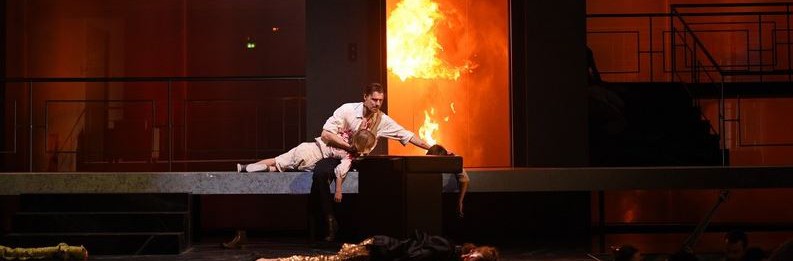
The sets are sparse and modern as are the costumes. Everyone except Médée is dressed in black, grey and white, immediately establishing her as foreign. The performances are all good, especially Kožená, who is very committed. Jason’s (Anders J. Dahlin) high tenor appropriately clashes with Kožená’s dark, full and sometimes raw sound, but fits with Creusa’s (Meike Hartmann) chirpy, pretty voice. Luca Tittoto as Creon was a little too vibrato-heavy, but the singing and playing were otherwise well done. Music-wise, it felt a bit more padded than some other French baroque operas and the dancing and choral bits were more low-key, but overall this is a good performance.
Theater Basel
Médée – Magdalena Kozena
Jason – Anders J. Dahlin
Creon – Luca Tittoto
Creusa – Meike Hartmann
Oronte – Robin Adams
A well-done production of a rare French baroque opera. Kožená was intense and moving as the title character and the other performers were strong as well. The choral bits were lovely and Kožená had a lot of opportunities to mourn and rage, but the plot felt a bit more padded out than usual. Médée gets an extended revenge though – instead of just killing Creusa and her children, she also drives Creon mad and burns down Corinth before gloating to Jason and leaving.

The Medea story is fleshed out here – Médée used her magic/murdered people to help Jason and they had two children together, but now Jason is tired of her. The king of Corinth, Creon, tells Médée that she has to leave the city although Jason and the children can stay. His daughter Creusa is engaged to Oronte, but she secretly wants Jason. When Médée finds out that Creusa and Jason are planning to get married, she flies into a rage, summoning demons to drive Creon insane, poisoning a robe that she sent to Creusa, killing her, murdering her two children, and setting Corinth on fire before flying off.
The sets are sparse and modern as are the costumes. Everyone except Médée is dressed in black, grey and white, immediately establishing her as foreign. The performances are all good, especially Kožená, who is very committed. Jason’s (Anders J. Dahlin) high tenor appropriately clashes with Kožená’s dark, full and sometimes raw sound, but fits with Creusa’s (Meike Hartmann) chirpy, pretty voice. Luca Tittoto as Creon was a little too vibrato-heavy, but the singing and playing were otherwise well done. Music-wise, it felt a bit more padded than some other French baroque operas and the dancing and choral bits were more low-key, but overall this is a good performance.
95DieFledermaus
Andrea Chenier - Umberto Giordano
ROH
Andrea Chenier - Jonas Kaufmann
Carlo Gerard - Zeljko Lucic
Maddalena de Coigny - Eva-Maria Westbroek
Bersi - Denyce Graves
Countess di Coigny - Rosalind Plowright
This was a solid, if not spectacular, production of Andrea Chenier. The production is very grand and traditional, which is fine if not too creative. While the singers were all good and I’ve liked them a lot in other things, overall the singing was not as exciting as it could be. There are a number of nice musical moments in the opera and it goes by quickly enough, but the central relationship could use more development and the French Revolution setting isn’t as fleshed out as it could be.

The opera is based on the real-life poet Andre Chenier, who was executed in the Revolution. In the first act, Chenier is visiting the salon of the Countess and her daughter Maddalena. Maddalena teasingly insults the poet, but he responds earnestly. The party is interrupted by their servant, Carlo Gerard, who angrily denounces the aristocracy and goes to join the mob. Some time has passed in the second act – Chenier is feeling the net of the Revolution closing around him and friends urge him to escape. He has been corresponding with a mysterious person who turns out to be Maddalena. Their ecstatic reunion is interrupted by Gerard, who has been searching for Maddalena. In the third act, Gerard has engineered Chenier’s arrest. He is disillusioned with the Revolution and now is only concerned with his childhood love for Maddalena. Maddalena agrees to the usual Soprano’s Bargain – she’ll have sex with him if he helps her free Chenier – but he can’t go through with it and helps her anyway. Chenier is still sentenced to death; in the final act Maddalena switches places with a condemned woman and they are both executed at the end (of course exiting singing about their love).

David McVicar is usually a perfectly adequate director – his productions are generally traditional, but some are big and splashy and exciting while others can be big and dull. I wouldn’t exactly say this one was dull. It was a bit too big in some of the scenes – makes sense for the first and third act, but the characters got lost in the giant sets in the more intimate scenes. Like everyone, I am a fan of Jonas Kaufmann and was excited to see him in this new role. Although he sang well, it seemed like he was holding back until the final duet, when he really let loose and sang with ardor and ringing top notes. He’s good at gloomy and tormented heroes, but seemed a bit forced in his Act II attempts to be careless. Eva-Maria Westbroek and Zeljko Lucic were also solid, if not that memorable. Lucic seemed more like a weary and disillusioned Rigoletto than the fiery Gerard. But overall a pretty decent production of the opera.
ROH
Andrea Chenier - Jonas Kaufmann
Carlo Gerard - Zeljko Lucic
Maddalena de Coigny - Eva-Maria Westbroek
Bersi - Denyce Graves
Countess di Coigny - Rosalind Plowright
This was a solid, if not spectacular, production of Andrea Chenier. The production is very grand and traditional, which is fine if not too creative. While the singers were all good and I’ve liked them a lot in other things, overall the singing was not as exciting as it could be. There are a number of nice musical moments in the opera and it goes by quickly enough, but the central relationship could use more development and the French Revolution setting isn’t as fleshed out as it could be.

The opera is based on the real-life poet Andre Chenier, who was executed in the Revolution. In the first act, Chenier is visiting the salon of the Countess and her daughter Maddalena. Maddalena teasingly insults the poet, but he responds earnestly. The party is interrupted by their servant, Carlo Gerard, who angrily denounces the aristocracy and goes to join the mob. Some time has passed in the second act – Chenier is feeling the net of the Revolution closing around him and friends urge him to escape. He has been corresponding with a mysterious person who turns out to be Maddalena. Their ecstatic reunion is interrupted by Gerard, who has been searching for Maddalena. In the third act, Gerard has engineered Chenier’s arrest. He is disillusioned with the Revolution and now is only concerned with his childhood love for Maddalena. Maddalena agrees to the usual Soprano’s Bargain – she’ll have sex with him if he helps her free Chenier – but he can’t go through with it and helps her anyway. Chenier is still sentenced to death; in the final act Maddalena switches places with a condemned woman and they are both executed at the end (of course exiting singing about their love).

David McVicar is usually a perfectly adequate director – his productions are generally traditional, but some are big and splashy and exciting while others can be big and dull. I wouldn’t exactly say this one was dull. It was a bit too big in some of the scenes – makes sense for the first and third act, but the characters got lost in the giant sets in the more intimate scenes. Like everyone, I am a fan of Jonas Kaufmann and was excited to see him in this new role. Although he sang well, it seemed like he was holding back until the final duet, when he really let loose and sang with ardor and ringing top notes. He’s good at gloomy and tormented heroes, but seemed a bit forced in his Act II attempts to be careless. Eva-Maria Westbroek and Zeljko Lucic were also solid, if not that memorable. Lucic seemed more like a weary and disillusioned Rigoletto than the fiery Gerard. But overall a pretty decent production of the opera.
96DieFledermaus
Les Fêtes Vénitiennes - André Campra
Opera Comique/Les Arts Florissants
Singers = lots
Emmanuelle de Negri, Élodie Fonnard, Rachel Redmond, Emilie Renard, Cyril Auvity, Reinoud Van Mechelen, Marcel Beekman, Marc Mauillon, François Lis, Sean Clayton, Geoffroy Buffière
This is a very fun, creative and attractive production of a rare French baroque opera by André Campra. Post-Lully but pre-Rameau, it was a success. The composer had a number of entrees that would be presented after one of multiple prologues and they could be switched around – here they chose three. Campra’s music is melodic and attractive, with the usual choral and dance interludes. William Christie and his group Les Arts Florissants are wonderful as usual and there are many fine singers. I enjoyed the production by Robert Carsen, who always does a great job with baroque operas, although if I had one criticism it would be “too much red.”

In the first entrée, the prince is in love with Iphise, a poor but loving woman, but is pretending he is the servant to the prince. He tries to tempt her by having his friend impersonate him, but she is true to their love. They happily end up together, with dancing and the chorus celebrating.
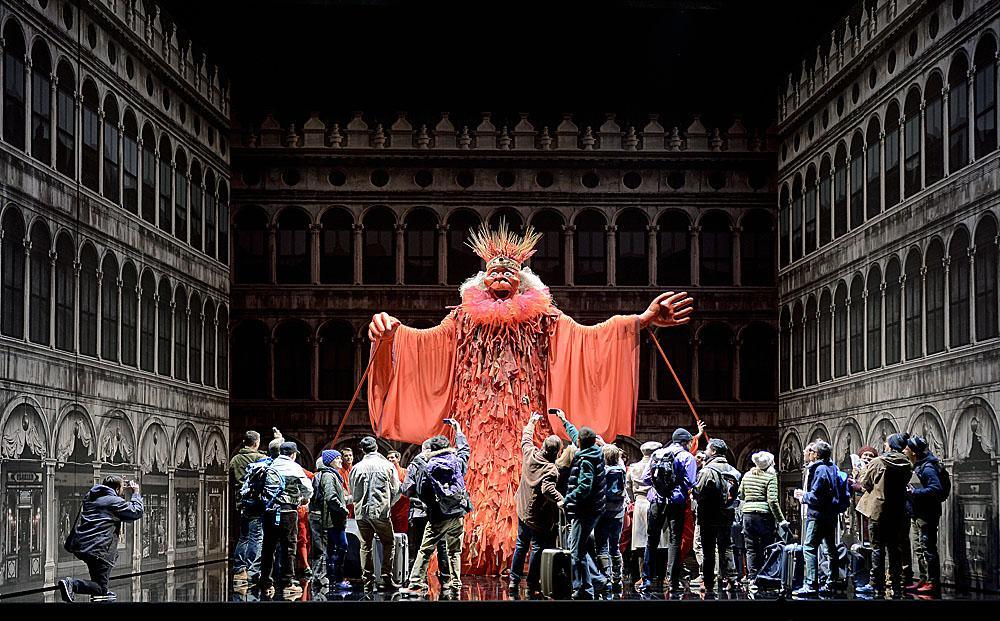
In the second selection, two women, Isabella and Lucile, are in love with the same man, Leandre, and are hoping to catch him at night seducing the other woman. Instead, they find him serenading a third woman, Irene. They surprise him and at first he thinks it is Irene and admits he only loves her, not Isabelle and Lucile. His girlfriends reveal their identities and spurn him, leaving him musing on luck and fate.
The third entrée is a bit meta – it’s set backstage as singers are preparing to put on an opera. Leontine is playing Flore and Damire is Boreas. They realize they both love each other, but Rodolphe, a wealthy patron, also loves Leontine. In the opera, the god Boreas abducts Flore, but after, the opera can't go on since Damire and Leontine have really run off, leaving and angry Rodolphe behind.
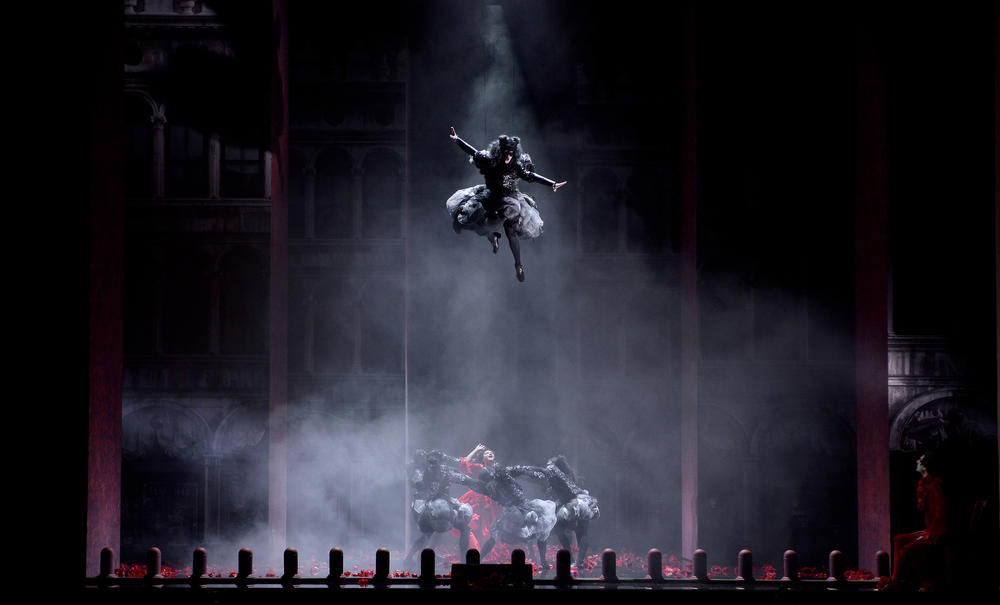
In the prologue, Carsen has modern tourists caught up in the festival, but everything starts to break down as Folly reigns. The entrees have period costumes that are a bit modern and stylized and attractive and grand sets. The singing is very good and Carsen gets good performances out of most of the singers. Definitely recommended for French baroque fans, especially as this is a pretty rarely performed opera.
Opera Comique/Les Arts Florissants
Singers = lots
Emmanuelle de Negri, Élodie Fonnard, Rachel Redmond, Emilie Renard, Cyril Auvity, Reinoud Van Mechelen, Marcel Beekman, Marc Mauillon, François Lis, Sean Clayton, Geoffroy Buffière
This is a very fun, creative and attractive production of a rare French baroque opera by André Campra. Post-Lully but pre-Rameau, it was a success. The composer had a number of entrees that would be presented after one of multiple prologues and they could be switched around – here they chose three. Campra’s music is melodic and attractive, with the usual choral and dance interludes. William Christie and his group Les Arts Florissants are wonderful as usual and there are many fine singers. I enjoyed the production by Robert Carsen, who always does a great job with baroque operas, although if I had one criticism it would be “too much red.”

In the first entrée, the prince is in love with Iphise, a poor but loving woman, but is pretending he is the servant to the prince. He tries to tempt her by having his friend impersonate him, but she is true to their love. They happily end up together, with dancing and the chorus celebrating.
In the second selection, two women, Isabella and Lucile, are in love with the same man, Leandre, and are hoping to catch him at night seducing the other woman. Instead, they find him serenading a third woman, Irene. They surprise him and at first he thinks it is Irene and admits he only loves her, not Isabelle and Lucile. His girlfriends reveal their identities and spurn him, leaving him musing on luck and fate.
The third entrée is a bit meta – it’s set backstage as singers are preparing to put on an opera. Leontine is playing Flore and Damire is Boreas. They realize they both love each other, but Rodolphe, a wealthy patron, also loves Leontine. In the opera, the god Boreas abducts Flore, but after, the opera can't go on since Damire and Leontine have really run off, leaving and angry Rodolphe behind.
In the prologue, Carsen has modern tourists caught up in the festival, but everything starts to break down as Folly reigns. The entrees have period costumes that are a bit modern and stylized and attractive and grand sets. The singing is very good and Carsen gets good performances out of most of the singers. Definitely recommended for French baroque fans, especially as this is a pretty rarely performed opera.
97DieFledermaus
Król Roger - Karol Szymanowski
ROH
Roger - Mariusz Kwiecien
Roxana - Georgia Jarman
Shepherd - Saimir Pirgu
Edrisi - Kim Begley
The opening of Karol Szymanowski’s opera is rather extraordinary – sung acapella by the chorus, it glows with a dark, haunting beauty.
https://www.youtube.com/watch?v=5gPDi-SP5vw
https://www.youtube.com/watch?v=7qQlPI3ahDk
It’s a short opera, but the orchestration is inventive, alternating between highly perfumed, sumptuous melodies and angular, agitated music. The plot is interesting, as it is one of those ambiguous ones that can be interpreted in a number of different ways. It’s very, very loosely based on the real-life King Roger of Sicily but is usually seen in terms of an Apollonian vs. Dionysian conflict. Kasper Holten’s production is attractive and interesting, but I think he didn’t go far enough with the concept of the opera being Roger’s mental conflict. The singers were very good although the Personenregie was more generalized and not as detailed as some other productions of this opera that I’ve seen. (I really like this opera so this performance from the ROH is the 5th one that I’ve seen.)

A mysterious shepherd has been preaching about a foreign god, and Roger’s people urge him to punish him. The shepherd continues his ecstatic preaching when he is brought in, and he affects both Roger and his wife Roxana. Instead of punishing him, Roger orders him to come back for a trial. Later, Roxana sings a plea for mercy, but when the shepherd returns, he disregards Roger and continues his rapturous preaching, whipping the crowd into a Dionysian frenzy. Even Roxana falls under his spell and the whole population follows him as he leaves, abandoning Roger and his adviser Edrisi. Roger and Edrisi seek out Roxana and the others; when they find them, the shepherd reveals his identity as Dionysus. Roxana urges Roger to come with them, but he declines. In the morning, he joyfully greets the sun (but sometimes goes insane and/or dies).

The orchestra sounded rich and full under Antonio Pappano. I’ve seen Mariusz Kwiecien do this role several times and he was great as usual, although his character didn’t have as much to do. Saimir Pirgu had a sweet, pretty voice but was something of a cipher as the Shepherd. Georgia Jarman’s Roxana was strongly sung, although I think I like a lighter voice in the role - she has probably the best known piece, a haunting and timeless sounding song.
https://www.youtube.com/watch?v=014AESt5Fy4

There is a huge statue of Roger’s head in the first act, and the second takes place inside the head. I thought Holten was going for a concept with the conflict being internal to Roger – especially at the end of Act II, when the Shepherd, acting as a sort of Id, kicks Roger out of his own head. But in the final act, the head is destroyed and characters pop up in the tiers around the stage. This is a good performance of a beautiful but not well-known opera - recommended.
The ROH streamed it and it is still available -
https://www.youtube.com/watch?v=cPYwTdghHb8
ROH
Roger - Mariusz Kwiecien
Roxana - Georgia Jarman
Shepherd - Saimir Pirgu
Edrisi - Kim Begley
The opening of Karol Szymanowski’s opera is rather extraordinary – sung acapella by the chorus, it glows with a dark, haunting beauty.
https://www.youtube.com/watch?v=5gPDi-SP5vw
https://www.youtube.com/watch?v=7qQlPI3ahDk
It’s a short opera, but the orchestration is inventive, alternating between highly perfumed, sumptuous melodies and angular, agitated music. The plot is interesting, as it is one of those ambiguous ones that can be interpreted in a number of different ways. It’s very, very loosely based on the real-life King Roger of Sicily but is usually seen in terms of an Apollonian vs. Dionysian conflict. Kasper Holten’s production is attractive and interesting, but I think he didn’t go far enough with the concept of the opera being Roger’s mental conflict. The singers were very good although the Personenregie was more generalized and not as detailed as some other productions of this opera that I’ve seen. (I really like this opera so this performance from the ROH is the 5th one that I’ve seen.)

A mysterious shepherd has been preaching about a foreign god, and Roger’s people urge him to punish him. The shepherd continues his ecstatic preaching when he is brought in, and he affects both Roger and his wife Roxana. Instead of punishing him, Roger orders him to come back for a trial. Later, Roxana sings a plea for mercy, but when the shepherd returns, he disregards Roger and continues his rapturous preaching, whipping the crowd into a Dionysian frenzy. Even Roxana falls under his spell and the whole population follows him as he leaves, abandoning Roger and his adviser Edrisi. Roger and Edrisi seek out Roxana and the others; when they find them, the shepherd reveals his identity as Dionysus. Roxana urges Roger to come with them, but he declines. In the morning, he joyfully greets the sun (but sometimes goes insane and/or dies).

The orchestra sounded rich and full under Antonio Pappano. I’ve seen Mariusz Kwiecien do this role several times and he was great as usual, although his character didn’t have as much to do. Saimir Pirgu had a sweet, pretty voice but was something of a cipher as the Shepherd. Georgia Jarman’s Roxana was strongly sung, although I think I like a lighter voice in the role - she has probably the best known piece, a haunting and timeless sounding song.
https://www.youtube.com/watch?v=014AESt5Fy4

There is a huge statue of Roger’s head in the first act, and the second takes place inside the head. I thought Holten was going for a concept with the conflict being internal to Roger – especially at the end of Act II, when the Shepherd, acting as a sort of Id, kicks Roger out of his own head. But in the final act, the head is destroyed and characters pop up in the tiers around the stage. This is a good performance of a beautiful but not well-known opera - recommended.
The ROH streamed it and it is still available -
https://www.youtube.com/watch?v=cPYwTdghHb8
98kidzdoc
Fabulous book and opera reviews, Stephanie! I didn't get around to The Back Room in the spring, but I hope to read it in October.
99DieFledermaus
>98 kidzdoc: - Thanks - hope you enjoy The Back Room when you get to it!
100DieFledermaus
Some more back opera reviews -
Tannhäuser - Richard Wagner
Bayreuth
Tannhäuser - Torsten Kerl
Venus - Michelle Breedt
Elisabeth - Camilla Nylund
Wolfram - Markus Eiche
Landgraf Hermann - Kwangchul Youn
Bayreuth currently has the reputation of having some of the most out-there stagings. This is definitely one of them. Whenever I hear about a production that has everyone enraged that some director is destroying opera, I usually want to see it to see what the fuss is about. In fact, a lot of the people who are complaining about the production in question haven’t even seen it. So this one was the “Biogas Tannhäuser”, directed by Sebastian Baumgarten. The orchestra sounded great, although the singing was a bit more mixed. I ended up enjoying the productions – I had some criticisms (though not exactly the same ones that I read about), but there was a lot that was interesting in Baumgarten’s staging.
The traditional story of Tannhäuser isn’t entirely followed in this production, but follows the hero as he leaves the no longer satisfying hedonistic paradise of the Venusberg (where his lover is the goddess Venus) for his former home the Wartburg. It opens with a well-known prelude, lush and dramatic –
https://www.youtube.com/watch?v=Uav1p7groPk
After leaving an enraged Venus, he encounters his old friends who urge him to return. At first he resists, but they tell him Elisabeth, niece of Landgraf Hermann, has been unhappy ever since he left so he agrees to go with them. Elisabeth joyfully returns to the hall where they will have the usual musical competition that she abandoned since Tannhäuser left – singing probably the most famous piece “Dich, teure halle”
https://www.youtube.com/watch?v=038d7kF2cZM
Elisabeth and Tannhäuser happily reunite, although Wolfram, who also loves Elisabeth, feels he has lost. The Landgraf announces the competition, saying the prize is essentially Elisabeth’s hand. Wolfram and the others sing of chaste, pedestal-y love, but Tannhäuser sings of the pleasures of the flesh, enraging the crowd, especially after he reveals he was in the Venusberg. They all condemn him, but he is saved by Elisabeth, who says he should have a chance at redemption by going on a pilgrimage to Rome.
Sometime later, Elisabeth is still waiting for him to return. Wolfram sadly muses on this in his Song to the Evening Star –
https://www.youtube.com/watch?v=n8Yr1uQFhNc
Elisabeth dies of Sudden Operatic Death Syndrome (SODS) before Tannhäuser returns. Wolffram sees him, but his former friend is agitated and seeking out the Venusberg, as his sin was deemed too bad for him to be forgiven. Venus calls out to Tannhäuser, who is tempted, but when Wolfram mentions Elisabeth, he rejects Venus and also dies of SODS. Usually he is redeemed when the pope’s staff grows new shoots.

The production here is set in a large industrial space with various bits of machinery – so definitely not your usual Tannhäuser. It seems to be a postapocalyptic setting, with the Wartburg being a conformist cult. Not that big of a deal – I’ve seen various other postapocalyptic Wagners. However, I could see why people might think the director is pretentious. Apparently he had reams of material explaining the production and there are random quotes that pop up on screens – some seem vaguely related to the events on stage, some are quotes from Wagner, but I stopped translating after a while. I actually thought the production was comprehensible on its own, so these just felt like distractions.
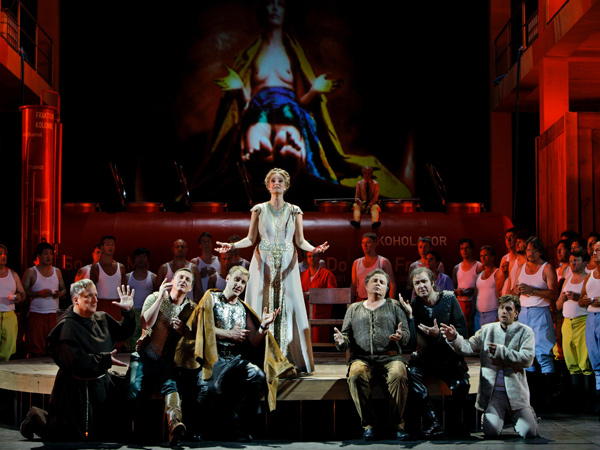
Some of the major complaints were related to the portrayal of Venus and Elisabeth. Venus is pregnant (and gives birth at the end) and Elisabeth kills herself by jumping into one of the machines. Oddly enough, these changes didn’t bother me. In fact, I thought the director handled their characters very well. The Venusberg rises out of the middle of the industrial space, with workers looking on in the first act. In addition, Venus interacts with some of the other characters in the Wartburg, besides making an appearance at the competition, triggering Elisabeth’s jealousy. The two worlds, instead of being separate, are the same, suggesting Tannhäuser never really left and can’t really escape. His going back (or trying to go back) between the two worlds is even more circular here. Venus and Elisabeth are often seen as two sides of the same coin – sometimes they’re even played by the same singer. Baumgarten plays up the virgin/whore dichotomy – and its hypocrisy. Other community members are fine dallying with Venus, and everyone knows the Venusberg is just below the surface, but publicly proclaiming his association makes everyone turn on Tannhäuser.

If anything, I didn’t think the machines were used enough – Elisabeth throws her jewelry away at the end, then kills herself, but otherwise they don’t get much mileage. Also, for a postapocalyptic society, there’s a lot of Christian imagery, which didn’t fit well. Otherwise, the lighting at various points made the stage look surprisingly inviting and the futuristic/postapocalyptic/cult-y feel worked well. All the characters are constantly kept drunk and the pilgrimage turns out to be a brainwashing/reprogramming. The viciously enforced conformity and rigid rituals also work well with the Wartburg as a cult.
The orchestra sounded great, but some of the singers were just okay. Markus Eiche as Wolfram was pretty boring (to be fair, I was comparing to a great Wolfram in the last one I saw – he was the best singer in that whole production). Camilla Nylund was probably the best singer although some high notes went awry, and she made Elisabeth passionate and strong-willed. Michelle Breedt was a decent enough Venus. Torsten Kerl sounded sometimes pitchy and rough as Tannhäuser. Probably for other Regie addicts only.
Tannhäuser - Richard Wagner
Bayreuth
Tannhäuser - Torsten Kerl
Venus - Michelle Breedt
Elisabeth - Camilla Nylund
Wolfram - Markus Eiche
Landgraf Hermann - Kwangchul Youn
Bayreuth currently has the reputation of having some of the most out-there stagings. This is definitely one of them. Whenever I hear about a production that has everyone enraged that some director is destroying opera, I usually want to see it to see what the fuss is about. In fact, a lot of the people who are complaining about the production in question haven’t even seen it. So this one was the “Biogas Tannhäuser”, directed by Sebastian Baumgarten. The orchestra sounded great, although the singing was a bit more mixed. I ended up enjoying the productions – I had some criticisms (though not exactly the same ones that I read about), but there was a lot that was interesting in Baumgarten’s staging.
The traditional story of Tannhäuser isn’t entirely followed in this production, but follows the hero as he leaves the no longer satisfying hedonistic paradise of the Venusberg (where his lover is the goddess Venus) for his former home the Wartburg. It opens with a well-known prelude, lush and dramatic –
https://www.youtube.com/watch?v=Uav1p7groPk
After leaving an enraged Venus, he encounters his old friends who urge him to return. At first he resists, but they tell him Elisabeth, niece of Landgraf Hermann, has been unhappy ever since he left so he agrees to go with them. Elisabeth joyfully returns to the hall where they will have the usual musical competition that she abandoned since Tannhäuser left – singing probably the most famous piece “Dich, teure halle”
https://www.youtube.com/watch?v=038d7kF2cZM
Elisabeth and Tannhäuser happily reunite, although Wolfram, who also loves Elisabeth, feels he has lost. The Landgraf announces the competition, saying the prize is essentially Elisabeth’s hand. Wolfram and the others sing of chaste, pedestal-y love, but Tannhäuser sings of the pleasures of the flesh, enraging the crowd, especially after he reveals he was in the Venusberg. They all condemn him, but he is saved by Elisabeth, who says he should have a chance at redemption by going on a pilgrimage to Rome.
Sometime later, Elisabeth is still waiting for him to return. Wolfram sadly muses on this in his Song to the Evening Star –
https://www.youtube.com/watch?v=n8Yr1uQFhNc
Elisabeth dies of Sudden Operatic Death Syndrome (SODS) before Tannhäuser returns. Wolffram sees him, but his former friend is agitated and seeking out the Venusberg, as his sin was deemed too bad for him to be forgiven. Venus calls out to Tannhäuser, who is tempted, but when Wolfram mentions Elisabeth, he rejects Venus and also dies of SODS. Usually he is redeemed when the pope’s staff grows new shoots.

The production here is set in a large industrial space with various bits of machinery – so definitely not your usual Tannhäuser. It seems to be a postapocalyptic setting, with the Wartburg being a conformist cult. Not that big of a deal – I’ve seen various other postapocalyptic Wagners. However, I could see why people might think the director is pretentious. Apparently he had reams of material explaining the production and there are random quotes that pop up on screens – some seem vaguely related to the events on stage, some are quotes from Wagner, but I stopped translating after a while. I actually thought the production was comprehensible on its own, so these just felt like distractions.
Some of the major complaints were related to the portrayal of Venus and Elisabeth. Venus is pregnant (and gives birth at the end) and Elisabeth kills herself by jumping into one of the machines. Oddly enough, these changes didn’t bother me. In fact, I thought the director handled their characters very well. The Venusberg rises out of the middle of the industrial space, with workers looking on in the first act. In addition, Venus interacts with some of the other characters in the Wartburg, besides making an appearance at the competition, triggering Elisabeth’s jealousy. The two worlds, instead of being separate, are the same, suggesting Tannhäuser never really left and can’t really escape. His going back (or trying to go back) between the two worlds is even more circular here. Venus and Elisabeth are often seen as two sides of the same coin – sometimes they’re even played by the same singer. Baumgarten plays up the virgin/whore dichotomy – and its hypocrisy. Other community members are fine dallying with Venus, and everyone knows the Venusberg is just below the surface, but publicly proclaiming his association makes everyone turn on Tannhäuser.

If anything, I didn’t think the machines were used enough – Elisabeth throws her jewelry away at the end, then kills herself, but otherwise they don’t get much mileage. Also, for a postapocalyptic society, there’s a lot of Christian imagery, which didn’t fit well. Otherwise, the lighting at various points made the stage look surprisingly inviting and the futuristic/postapocalyptic/cult-y feel worked well. All the characters are constantly kept drunk and the pilgrimage turns out to be a brainwashing/reprogramming. The viciously enforced conformity and rigid rituals also work well with the Wartburg as a cult.
The orchestra sounded great, but some of the singers were just okay. Markus Eiche as Wolfram was pretty boring (to be fair, I was comparing to a great Wolfram in the last one I saw – he was the best singer in that whole production). Camilla Nylund was probably the best singer although some high notes went awry, and she made Elisabeth passionate and strong-willed. Michelle Breedt was a decent enough Venus. Torsten Kerl sounded sometimes pitchy and rough as Tannhäuser. Probably for other Regie addicts only.
101DieFledermaus
Das Rheingold – Richard Wagner
http://www.medici.tv/#!/richard-wagner-der-ring-des-nibelungen-the-rhinegold
Staatsoper Stuttgart
Wotan - Wolfgang Probst
Alberich - Esa Ruuttunen
Loge - Robert Künzle
Fricka - Michaela Schuster
Freia - Helga Rós Indridadóttir
Mime - Eberhard Francesco Lorenz
Donner - Motti Kastón
Froh - Bernhard Schneider
I love this opera, the first in Wagner’s Ring Cycle, which was a good thing because the production and orchestra were so-so in this performance from the Staatsoper Stuttgart and the singing was below average. It was the start of a fairly interesting-sounding project – a Ring Cycle where every opera was staged by a different director. The director here was Joachim Schlömer. He sets the mythological Norse story in an Art Deco-ish lobby with a large fountain in the middle. The characters are in 30’s style dress, with suits for everyone. There’s no overarching concept for why the opera is set in a lobby and the Personenregie is random or minimal. There are a couple hints at something possibly interesting – the Tarnhelm is a mirror, Freia is onstage at various points and seems unhappy at losing Fasolt – but they aren’t developed.

The mythological, magical plot starts when the malevolent dwarf Alberich steals the Rheingold from the Rhinemaidens, forging a ring that he could use to control the world. Meanwhile, Wotan, the king of the gods, is in a bind, having promised the giants Fafner and Fasolt his sister-in-law Freia, goddess of youth, for building him a magnificent castle, Valhalla. Loge, his sometimes friend and the trickster god, tells them that Alberich has been amassing a hoard of gold, and the giants agree to take that instead of Freia. Wotan and Loge find that Alberich has forced the Nibelungs to mine his gold and made his brother, Mime, forge a magical helmet, the Tarnhelm. They trick Alberich into turning into a frog, then capture him, forcing him to give them his gold as a ransom. Wotan takes the ring, causing an enraged Alberich to curse its owners. The giants then demand all the gold, as well as the ring – at first Wotan refuses the ring, until the earth goddess Erda warns him that it will destroy whoever has it. The giants fight over the ring until Fafner kills Fasolt, the first victim of the curse. As the gods triumphantly enter Valhalla, the Rhinemaidens bemoan their lost gold below.
I think the sets were fine, and the production would have been more interesting with more detailed character work or an overarching concept, but there was nothing like that here. The orchestra sounded sometimes rushed or unbalanced or murky. Singing varied wildly. On the plus side, Michaela Schuster as Fricka had a generous, warm voice and any stridency in tone didn’t seem out of character for her. Helga Rós Indridadóttir also sang a good Freia, although the voice was a little larger than is usual for the character. 2/3 of the Rhinemaidens were good, but one sounded unfortunately pitchy. The singers for Donner and Froh had weak voices, and Eberhard Francesco Lorenz’s Mime was thin and nasal sounding. Robert Künzle as Loge probably had the most attractive voice of the men. However, he tired repeatedly throughout the opera and sometimes strained for notes. He was a sprightly Loge though. Unfortunately, Wolfgang Probst as Wotan and Esa Ruuttunen as Alberich – who really have to carry the opera – both had harsh, worn voices. So this isn’t the place to start for Ring Cycle watching.
http://www.medici.tv/#!/richard-wagner-der-ring-des-nibelungen-the-rhinegold
Staatsoper Stuttgart
Wotan - Wolfgang Probst
Alberich - Esa Ruuttunen
Loge - Robert Künzle
Fricka - Michaela Schuster
Freia - Helga Rós Indridadóttir
Mime - Eberhard Francesco Lorenz
Donner - Motti Kastón
Froh - Bernhard Schneider
I love this opera, the first in Wagner’s Ring Cycle, which was a good thing because the production and orchestra were so-so in this performance from the Staatsoper Stuttgart and the singing was below average. It was the start of a fairly interesting-sounding project – a Ring Cycle where every opera was staged by a different director. The director here was Joachim Schlömer. He sets the mythological Norse story in an Art Deco-ish lobby with a large fountain in the middle. The characters are in 30’s style dress, with suits for everyone. There’s no overarching concept for why the opera is set in a lobby and the Personenregie is random or minimal. There are a couple hints at something possibly interesting – the Tarnhelm is a mirror, Freia is onstage at various points and seems unhappy at losing Fasolt – but they aren’t developed.

The mythological, magical plot starts when the malevolent dwarf Alberich steals the Rheingold from the Rhinemaidens, forging a ring that he could use to control the world. Meanwhile, Wotan, the king of the gods, is in a bind, having promised the giants Fafner and Fasolt his sister-in-law Freia, goddess of youth, for building him a magnificent castle, Valhalla. Loge, his sometimes friend and the trickster god, tells them that Alberich has been amassing a hoard of gold, and the giants agree to take that instead of Freia. Wotan and Loge find that Alberich has forced the Nibelungs to mine his gold and made his brother, Mime, forge a magical helmet, the Tarnhelm. They trick Alberich into turning into a frog, then capture him, forcing him to give them his gold as a ransom. Wotan takes the ring, causing an enraged Alberich to curse its owners. The giants then demand all the gold, as well as the ring – at first Wotan refuses the ring, until the earth goddess Erda warns him that it will destroy whoever has it. The giants fight over the ring until Fafner kills Fasolt, the first victim of the curse. As the gods triumphantly enter Valhalla, the Rhinemaidens bemoan their lost gold below.
I think the sets were fine, and the production would have been more interesting with more detailed character work or an overarching concept, but there was nothing like that here. The orchestra sounded sometimes rushed or unbalanced or murky. Singing varied wildly. On the plus side, Michaela Schuster as Fricka had a generous, warm voice and any stridency in tone didn’t seem out of character for her. Helga Rós Indridadóttir also sang a good Freia, although the voice was a little larger than is usual for the character. 2/3 of the Rhinemaidens were good, but one sounded unfortunately pitchy. The singers for Donner and Froh had weak voices, and Eberhard Francesco Lorenz’s Mime was thin and nasal sounding. Robert Künzle as Loge probably had the most attractive voice of the men. However, he tired repeatedly throughout the opera and sometimes strained for notes. He was a sprightly Loge though. Unfortunately, Wolfgang Probst as Wotan and Esa Ruuttunen as Alberich – who really have to carry the opera – both had harsh, worn voices. So this isn’t the place to start for Ring Cycle watching.
102DieFledermaus
La Belle Helene - Jacques Offenbach
http://concert.arte.tv/fr/la-belle-helene-au-theatre-du-chatelet
Théâtre du Châtelet
Helen – Gaëlle Arquez
Paris – Merto Sungu
Menelaus - Gilles Ragon
Orestes - Kangmin Justin Kim
Calchas - Jean-Philippe Lafont
Agamemmnon - Marc Barrard
This production of one of Offenbach’s operettas skewering Greek myths as well as present day (for him) mores is really creative and fun. Directors Giorgio Barberio Corsetti and Pierrick Sorin have the singers, wearing Greek inspired but very nontraditional costumes (Greek bikini, Greek little boy outfit, Greek couture dress) perform in front of what is essentially a green screen and show up on a screen at the top of the stage, with background and effects filled in. It’s very clever and the meta-feel can be related both to putting on an opera and all the dissimulation and performing that the characters do in the opera. There were a couple singers with somewhat grainy or rough voices, but everyone seemed committed to the silliness and the overall it was highly enjoyable.

The plot is a silly retelling of the Helen-Paris-Menelaus triangle. There’s a lot of padding though – lots of characters gambling and whining, although Orestes as a cheerfully stupid boy is pretty funny. Paris has judged the contest between the three goddesses and awarded Venus the prize. In return, she offered him Helen, supposed to be the most beautiful woman. Helen questions Calchas, the high priest, about the contest and seems a little too excited. Then Paris, dressed as a shepherd, shows up and Calchas agrees to help him. He bests the Greek warriors in a logic game, then gets Calchas to have a “prophecy” directing Menelaus to go off to make offerings to the gods. While he is away, Paris tries to seduce Helen, who is tempted but manages to decline. At night, Paris sneaks into her room and, convinced (or “convinced”) it is a dream, Helen goes along with it. They are interrupted when Menelaus comes home early and chases Paris out.

Venus has cursed all the Greek women, who are now insatiable, leading to discord. Agamemnon tries to convince Menelaus to let Helen go to save everyone else, but Menelaus refuses. However, he agrees to let Helen go with Aphrodite’s priestess and make sacrifices to appease the goddess. As they leave, Paris throws off his priestess disguise. Plotwise, this isn’t my favorite Offenbach, but the music is witty and catchy as usual, and this is a great production.
http://concert.arte.tv/fr/la-belle-helene-au-theatre-du-chatelet
Théâtre du Châtelet
Helen – Gaëlle Arquez
Paris – Merto Sungu
Menelaus - Gilles Ragon
Orestes - Kangmin Justin Kim
Calchas - Jean-Philippe Lafont
Agamemmnon - Marc Barrard
This production of one of Offenbach’s operettas skewering Greek myths as well as present day (for him) mores is really creative and fun. Directors Giorgio Barberio Corsetti and Pierrick Sorin have the singers, wearing Greek inspired but very nontraditional costumes (Greek bikini, Greek little boy outfit, Greek couture dress) perform in front of what is essentially a green screen and show up on a screen at the top of the stage, with background and effects filled in. It’s very clever and the meta-feel can be related both to putting on an opera and all the dissimulation and performing that the characters do in the opera. There were a couple singers with somewhat grainy or rough voices, but everyone seemed committed to the silliness and the overall it was highly enjoyable.

The plot is a silly retelling of the Helen-Paris-Menelaus triangle. There’s a lot of padding though – lots of characters gambling and whining, although Orestes as a cheerfully stupid boy is pretty funny. Paris has judged the contest between the three goddesses and awarded Venus the prize. In return, she offered him Helen, supposed to be the most beautiful woman. Helen questions Calchas, the high priest, about the contest and seems a little too excited. Then Paris, dressed as a shepherd, shows up and Calchas agrees to help him. He bests the Greek warriors in a logic game, then gets Calchas to have a “prophecy” directing Menelaus to go off to make offerings to the gods. While he is away, Paris tries to seduce Helen, who is tempted but manages to decline. At night, Paris sneaks into her room and, convinced (or “convinced”) it is a dream, Helen goes along with it. They are interrupted when Menelaus comes home early and chases Paris out.

Venus has cursed all the Greek women, who are now insatiable, leading to discord. Agamemnon tries to convince Menelaus to let Helen go to save everyone else, but Menelaus refuses. However, he agrees to let Helen go with Aphrodite’s priestess and make sacrifices to appease the goddess. As they leave, Paris throws off his priestess disguise. Plotwise, this isn’t my favorite Offenbach, but the music is witty and catchy as usual, and this is a great production.
103DieFledermaus
A Midsummer Night’s Dream – Benjamin Britten
http://culturebox.francetvinfo.fr/festivals/festival-international-dart-lyrique-...
Aix-en-Provence
Tytania - Sandrine Piau
Oberon - Lawrence Zazzo
Puck - Miltos Yerolemou
Hermia - Elizabeth DeShong
Helena - Layla Claire
Lysander - Rupert Charlesworth
Demetrius - John Chest
Bottom - Brindley Sherratt
Theseus - Scott Conner
Hippolyta - Allyson McHardy
Benjamin Britten’s Peter Grimes is probably his best-known and most highly-regarded opera, and indeed the story of a difficult, isolated, unsympathetic man and his interactions with the suspicious, closed-minded community is powerful and memorably scored. However, I think I like his delightful adaptation of Shakespeare’s A Midsummer Night’s Dream a little better. Britten convincingly creates three very different sound worlds for the intersecting plots of the lovers on the run, quarreling fairies, and rustics trying to put on a play. He also has some breathtakingly beautiful and haunting music. It might go on a bit with the Pyramus and Thisbe bit at the end, but maybe the play does that as well. I never once asked myself, “Did that really have to be made into an opera?” I’d seen this production before (from Liceu), and thought it was fun and cute – maybe not the most insightful production ever, but I was happy to see it again.

Britten adapted the plot by chopping off the first part that takes place in Athens and starting with the quarrel between the fairy queen and king, Tytania and Oberon. The fairies’s music is wonderful and very appropriate – Tytania is a coloratura soprano and Oberon is a countertenor, a children’s chorus acts as the fairy train, harp and celesta are used generously. The opera opens with the sighing and groaning of the forest – sliding, weird music which is used throughout– which then merges with the fairy themes. The four mismatched lovers have more standard music with strings and woodwinds in major keys, but it’s a touch frenetic, reflecting their oversize vows, declarations and (sometimes love potion-addled) emotions. Bottom the weaver and company come to the woods to practice their play, with abrupt low brass and percussion accompaniment. Puck is a speaking role, and he also has his own distinctive music, an energetic riff on trumpet and snare drum.
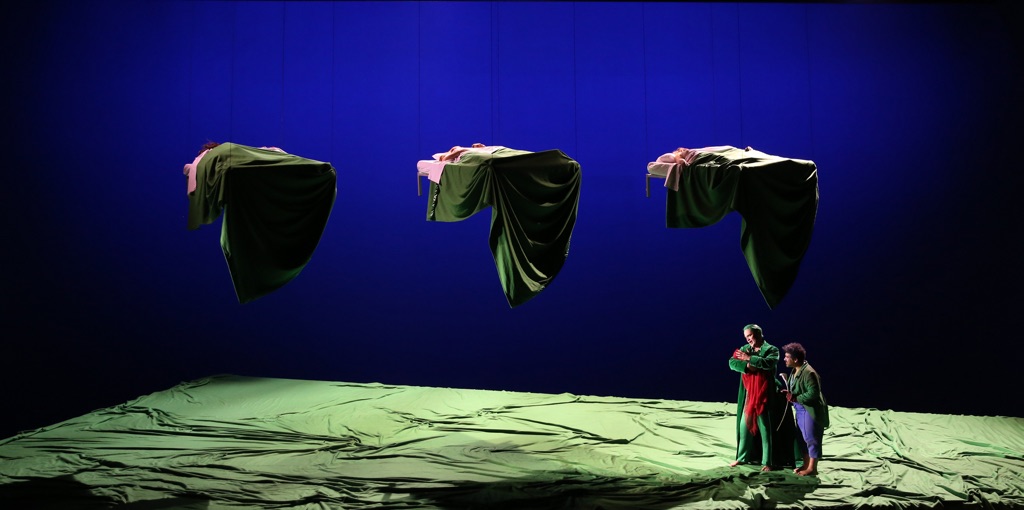
There are many highlights, but my favorite play-to-opera moment comes after Bottom has been transformed by Puck. He scares his friends away with his ass head, but Bottom thinks they are playing a trick on him, saying he won’t fall for it and will stay there singing a song to show them he is not afraid. Bottom commences with a lurching, groaning piece, waking up Tytania (who has been doused with the love potion). Tytania’s music is all coloratura note jumping with a delicate accompaniment, a sharp contrast to Bottom’s moaning, and she has the lines –
I pray thee, gentle mortal,
sing again:
Mine ear is much enamour'd
of thy note; so is mine eye
enthralled to thy shape;
I laughed at that.

The singers were all pretty good. Sandrine Piau might have been a bit thin as Tytania, but she was appropriately melodramatic and diva-ish. Miltos Yerolemou was a fun and clownish Puck, popping up in the orchestra and audience. Lawrence Zazzo sang well as Oberon, with none of that countertenor hootiness which can be annoying. The orchestra sounded great – horns could have been a little sharper, but that is minor issue. I’d seen Robert Carsen’s production before, but it’s still a lot of fun and I don’t think I noticed previously how sensitive he is to the music – lots of the actions or little flourishes happen seemingly on cue. The first act takes place on a giant bed. In the next act, there are multiple beds that the characters sleep in and bounce in and out of. The fairies are all green and blue; the lovers wear white but gradually get green stained. Lots of fun – highly recommended.
Lots of great music -
The opening - forest sounds, nice choral bits, Tytania and Oberon's scene https://www.youtube.com/watch?v=zYO3rKrfujM
Oberon's song -
https://www.youtube.com/watch?v=6sFPTMUA3uI
Tytania wakes up and the fairies reconcile
https://www.youtube.com/watch?v=CilOuwaQlN8&list=PLx1aYneGQyQ9zAUMO0ceB9f8vd...
The lovers wake up and sing a quartet - gorgeous!
https://www.youtube.com/watch?v=jOl96b9xr_A
http://culturebox.francetvinfo.fr/festivals/festival-international-dart-lyrique-...
Aix-en-Provence
Tytania - Sandrine Piau
Oberon - Lawrence Zazzo
Puck - Miltos Yerolemou
Hermia - Elizabeth DeShong
Helena - Layla Claire
Lysander - Rupert Charlesworth
Demetrius - John Chest
Bottom - Brindley Sherratt
Theseus - Scott Conner
Hippolyta - Allyson McHardy
Benjamin Britten’s Peter Grimes is probably his best-known and most highly-regarded opera, and indeed the story of a difficult, isolated, unsympathetic man and his interactions with the suspicious, closed-minded community is powerful and memorably scored. However, I think I like his delightful adaptation of Shakespeare’s A Midsummer Night’s Dream a little better. Britten convincingly creates three very different sound worlds for the intersecting plots of the lovers on the run, quarreling fairies, and rustics trying to put on a play. He also has some breathtakingly beautiful and haunting music. It might go on a bit with the Pyramus and Thisbe bit at the end, but maybe the play does that as well. I never once asked myself, “Did that really have to be made into an opera?” I’d seen this production before (from Liceu), and thought it was fun and cute – maybe not the most insightful production ever, but I was happy to see it again.

Britten adapted the plot by chopping off the first part that takes place in Athens and starting with the quarrel between the fairy queen and king, Tytania and Oberon. The fairies’s music is wonderful and very appropriate – Tytania is a coloratura soprano and Oberon is a countertenor, a children’s chorus acts as the fairy train, harp and celesta are used generously. The opera opens with the sighing and groaning of the forest – sliding, weird music which is used throughout– which then merges with the fairy themes. The four mismatched lovers have more standard music with strings and woodwinds in major keys, but it’s a touch frenetic, reflecting their oversize vows, declarations and (sometimes love potion-addled) emotions. Bottom the weaver and company come to the woods to practice their play, with abrupt low brass and percussion accompaniment. Puck is a speaking role, and he also has his own distinctive music, an energetic riff on trumpet and snare drum.
There are many highlights, but my favorite play-to-opera moment comes after Bottom has been transformed by Puck. He scares his friends away with his ass head, but Bottom thinks they are playing a trick on him, saying he won’t fall for it and will stay there singing a song to show them he is not afraid. Bottom commences with a lurching, groaning piece, waking up Tytania (who has been doused with the love potion). Tytania’s music is all coloratura note jumping with a delicate accompaniment, a sharp contrast to Bottom’s moaning, and she has the lines –
I pray thee, gentle mortal,
sing again:
Mine ear is much enamour'd
of thy note; so is mine eye
enthralled to thy shape;
I laughed at that.

The singers were all pretty good. Sandrine Piau might have been a bit thin as Tytania, but she was appropriately melodramatic and diva-ish. Miltos Yerolemou was a fun and clownish Puck, popping up in the orchestra and audience. Lawrence Zazzo sang well as Oberon, with none of that countertenor hootiness which can be annoying. The orchestra sounded great – horns could have been a little sharper, but that is minor issue. I’d seen Robert Carsen’s production before, but it’s still a lot of fun and I don’t think I noticed previously how sensitive he is to the music – lots of the actions or little flourishes happen seemingly on cue. The first act takes place on a giant bed. In the next act, there are multiple beds that the characters sleep in and bounce in and out of. The fairies are all green and blue; the lovers wear white but gradually get green stained. Lots of fun – highly recommended.
Lots of great music -
The opening - forest sounds, nice choral bits, Tytania and Oberon's scene https://www.youtube.com/watch?v=zYO3rKrfujM
Oberon's song -
https://www.youtube.com/watch?v=6sFPTMUA3uI
Tytania wakes up and the fairies reconcile
https://www.youtube.com/watch?v=CilOuwaQlN8&list=PLx1aYneGQyQ9zAUMO0ceB9f8vd...
The lovers wake up and sing a quartet - gorgeous!
https://www.youtube.com/watch?v=jOl96b9xr_A
104DieFledermaus
Götterdämmerung - Richard Wagner
http://www.theoperaplatform.eu/en/opera/wagner-le-crepuscule-des-dieux
Vienna Staatsoper
Brünnhilde – Evelyn Herlitzius
Siegfried – Stephen Gould
Gunther – Boaz Daniel
Gutrune – Caroline Wenborne
Hagen – Falk Struckmann
While the other three operas in the Ring Cycle can probably be watched on their own and understood and enjoyed, I imagine that watching only Götterdämmerung will be a bit confusing. It concludes the whole thing and there are many references to the past and tangled backstories and old grudges, as well as new ones. The prologue opens with the Norns threading the fate of the world, relating some things that happened in previous operas or even further back. Then the thread is cut and they can’t see what happens next. On Brünnhilde’s rock – picking up where Siegfried ended - she and Siegfried are happy and in love, but Siegfried has to go off hero-ing.
Siegfried and Brünnhilde get involved with Gunther and Gutrune, the Gibichungs. Brünnhilde believes Siegfried has betrayed her and conspires to kill him with Gunther and his half-brother Hagen (really Alberich's son). Siegfried dies and Brünnhilde learns the truth (it was a potion that caused him to forget her). At the end, she rides into his funeral pyre, purifying the ring and ending the reign of the gods.
I’d heard unpleasant mutterings about the director Sven-Eric Bechtolf – that he only got work because he was friends with some influential people. Well, this production from the Vienna Staatsoper isn’t going to change anyone’s mind. It was extremely dull and unimaginative. The lighting was pretty poor and everything was unrelentingly dark with occasional sickly green highlights. The Norns are apparently determining the fate of the world in some sort of Christmas tree lot. Brünnhilde’s rock also has Christmas trees, but red ones (later I thought that was maybe supposed to be the flames, but still – red Christmas trees). The Gibichungs seem to hate both furniture and color.

I’d seen Herlitzius before in a superb production of Elektra, where she was fantastic in the title role. In the first act, I was attempting to remember why I liked her so much. The voice sounded rather unattractive and she strained for the high notes, pretty much shouting on a couple of them. I wasn’t really feeling it between her and Siegfried, and I love the dawn/duet music. That was pretty disappointing. But she was completely mesmerizing in Act II, flinging herself around the stage with abandon, unconcerned about honor or dignity like Siegfried and Gunther kept going on about, from the moment she entered, looking like a wounded animal. Her singing was all raw and intense desperation, with occasional punctuations of scorn, as she publicly recalled her and Siegfried’s love and mocked Gunther for his concern about his sister. She warily concludes her agreement with Hagen to kill Siegfried with a tense handshake, then momentarily hunches up again, realizing what she’s done, before throwing herself into a righteous fury again. She was good in the final act as well, although the voice started to peter out at the end. I think she must work best when her character is angry and tormented – Brünnhilde’s joyful obliviousness in the first act isn’t really her thing.*

The Siegfried, Stephen Gould, is decent enough and manages the very difficult part. His voice started out sounding surprisingly clear and youthful for the role, but later on sounded tired, monochromatic and unexpressive. He was an energetic and boyish Siegfried though. Boaz Daniel’s Gunther was somewhat boring and a bit more faceless than usual. Caroline Wenborne was a sweet voiced Gutrune in Act I, but showed steely resolve when she thought Siegfried might be cheating on her in Act II. Falk Struckmann certainly tried hard as Hagen, and the call to the men came off pretty well, but his voice is snarly and has thinned and hollowed out. To be fair, I’m probably thinking of other Hagens with deep, rounded, ringing voices which is what I would prefer. Surprisingly, the orchestra, under Simon Rattle, sounded a bit hesitant and murky. The opera has lots and lots of parts with leitmotifs coming one after another, and they should be very clear, but here there was mushiness and hesitation. I think it would be a good effort from a lot of other orchestras, but I had high expectations for Vienna and this conductor. This is a really shitty production and neither the singers nor the orchestra make it a must see. Herlitzius would be better seen in the Elektra (Aix-en-Provence, dir. Chereau, with Meier/Pieczonka).
*After seeing this, I thought she would be a good Kundry or Ortrud – I checked out her Operabase page and she has those two roles in her repertoire, as well as Isolde** – I’d at least be interested in seeing her interpretation. She does seem to be very aware of her strengths and weaknesses. I thought she’d be excellent in some of the roles she has performed or has upcoming – Renata from The Fiery Angel, Katerina from Lady Macbeth of the Mtsensk, Emilia Marty in The Makropoulos Case. It would be very easy for me to see why people wouldn’t like her though.
**She’s been singing Isolde in Bayreuth this year – the things I’ve heard so far haven’t been good.
http://www.theoperaplatform.eu/en/opera/wagner-le-crepuscule-des-dieux
Vienna Staatsoper
Brünnhilde – Evelyn Herlitzius
Siegfried – Stephen Gould
Gunther – Boaz Daniel
Gutrune – Caroline Wenborne
Hagen – Falk Struckmann
While the other three operas in the Ring Cycle can probably be watched on their own and understood and enjoyed, I imagine that watching only Götterdämmerung will be a bit confusing. It concludes the whole thing and there are many references to the past and tangled backstories and old grudges, as well as new ones. The prologue opens with the Norns threading the fate of the world, relating some things that happened in previous operas or even further back. Then the thread is cut and they can’t see what happens next. On Brünnhilde’s rock – picking up where Siegfried ended - she and Siegfried are happy and in love, but Siegfried has to go off hero-ing.
Siegfried and Brünnhilde get involved with Gunther and Gutrune, the Gibichungs. Brünnhilde believes Siegfried has betrayed her and conspires to kill him with Gunther and his half-brother Hagen (really Alberich's son). Siegfried dies and Brünnhilde learns the truth (it was a potion that caused him to forget her). At the end, she rides into his funeral pyre, purifying the ring and ending the reign of the gods.
I’d heard unpleasant mutterings about the director Sven-Eric Bechtolf – that he only got work because he was friends with some influential people. Well, this production from the Vienna Staatsoper isn’t going to change anyone’s mind. It was extremely dull and unimaginative. The lighting was pretty poor and everything was unrelentingly dark with occasional sickly green highlights. The Norns are apparently determining the fate of the world in some sort of Christmas tree lot. Brünnhilde’s rock also has Christmas trees, but red ones (later I thought that was maybe supposed to be the flames, but still – red Christmas trees). The Gibichungs seem to hate both furniture and color.

I’d seen Herlitzius before in a superb production of Elektra, where she was fantastic in the title role. In the first act, I was attempting to remember why I liked her so much. The voice sounded rather unattractive and she strained for the high notes, pretty much shouting on a couple of them. I wasn’t really feeling it between her and Siegfried, and I love the dawn/duet music. That was pretty disappointing. But she was completely mesmerizing in Act II, flinging herself around the stage with abandon, unconcerned about honor or dignity like Siegfried and Gunther kept going on about, from the moment she entered, looking like a wounded animal. Her singing was all raw and intense desperation, with occasional punctuations of scorn, as she publicly recalled her and Siegfried’s love and mocked Gunther for his concern about his sister. She warily concludes her agreement with Hagen to kill Siegfried with a tense handshake, then momentarily hunches up again, realizing what she’s done, before throwing herself into a righteous fury again. She was good in the final act as well, although the voice started to peter out at the end. I think she must work best when her character is angry and tormented – Brünnhilde’s joyful obliviousness in the first act isn’t really her thing.*

The Siegfried, Stephen Gould, is decent enough and manages the very difficult part. His voice started out sounding surprisingly clear and youthful for the role, but later on sounded tired, monochromatic and unexpressive. He was an energetic and boyish Siegfried though. Boaz Daniel’s Gunther was somewhat boring and a bit more faceless than usual. Caroline Wenborne was a sweet voiced Gutrune in Act I, but showed steely resolve when she thought Siegfried might be cheating on her in Act II. Falk Struckmann certainly tried hard as Hagen, and the call to the men came off pretty well, but his voice is snarly and has thinned and hollowed out. To be fair, I’m probably thinking of other Hagens with deep, rounded, ringing voices which is what I would prefer. Surprisingly, the orchestra, under Simon Rattle, sounded a bit hesitant and murky. The opera has lots and lots of parts with leitmotifs coming one after another, and they should be very clear, but here there was mushiness and hesitation. I think it would be a good effort from a lot of other orchestras, but I had high expectations for Vienna and this conductor. This is a really shitty production and neither the singers nor the orchestra make it a must see. Herlitzius would be better seen in the Elektra (Aix-en-Provence, dir. Chereau, with Meier/Pieczonka).
*After seeing this, I thought she would be a good Kundry or Ortrud – I checked out her Operabase page and she has those two roles in her repertoire, as well as Isolde** – I’d at least be interested in seeing her interpretation. She does seem to be very aware of her strengths and weaknesses. I thought she’d be excellent in some of the roles she has performed or has upcoming – Renata from The Fiery Angel, Katerina from Lady Macbeth of the Mtsensk, Emilia Marty in The Makropoulos Case. It would be very easy for me to see why people wouldn’t like her though.
**She’s been singing Isolde in Bayreuth this year – the things I’ve heard so far haven’t been good.
105DieFledermaus
Alice in Wonderland – Unsuk Chin
Bayerische Staatsoper
Singers = lots
Sally Matthews, Pia Komsi, Julia Rempe, Dietrich Henschel, Andrew Watts, Guy De Mey, Cynthia Jansen, Gwyneth Jones, Steven Humes, Christian Rieger, Rudiger Trebes
This was a 2007 premiere of Unsuk Chin’s opera, based on the classic Lewis Carroll story. I really enjoyed the music and it succeeded in conveying the absurdity of the tale, as well as emphasizing the darkness. I ddon’t think the vocal writing was quite as successful. Also the production wasn’t that great – at least for watching the video of it. Logistically, it didn’t seem to work well either.

The libretto, written by Chin and playwright David Henry Hwang, covers a lot of the plot from the book in short scenes. The opera is bookended by two nightmares, then follows Alice’s pursuit of the mysterious white rabbit as she meets talking animals and absurd people. I didn’t always like the rhymey libretto – although some random modern references were funny. However, the music was really inventive – it wasn’t straight atonal but was weirdly atmospheric with lots of percussion, odd harmonics, and swirling dissonances. There were some structurally odd parts too – a couple instrumental only interludes, including one with a jazzy clarinet for the caterpillar’s explanations. The vocal writing wasn’t the best, which, to be fair, seems to be a frequent problem in contemporary operas. Half the time it seemed the like characters just talked. There wasn’t an attempt to make one part have The Most Difficult Coloratura Ever, but the Cheshire Cat had a kind of moaning coloratura part, and the Queen of Hearts had some screechy Wagner-heavy music (she was played by Gwyneth Jones!!!).

I had more problems with the production. The libretto didn’t always lay everything out and sometimes I had to fill in by thinking about the movie or book. However, this was exacerbated by the production by Achim Freyer. There were giant puppets for most of the characters – Alice was a singer (Sally Matthews) who had a giant puppet outfit, but the others had puppets acting out the parts while the singers sang downstage. The stage was steeply raked with holes where various characters popped out. Scenery was formed with strings, e.g., strings forming the shape of a house. It could be difficult to tell who was supposed to be interacting with who or what was happening (e.g., Alice growing bigger) without some previous knowledge of the story. I’m not sure how it played in the theater, but for the filmed opera, the camera kept jumping around from singer to puppet or between singers, making it even harder to keep track of what was going on. The singers worked hard with what they had though. I’d be interested in seeing something else by Chin since I liked her music – this one would get a qualified recommendation.
Bayerische Staatsoper
Singers = lots
Sally Matthews, Pia Komsi, Julia Rempe, Dietrich Henschel, Andrew Watts, Guy De Mey, Cynthia Jansen, Gwyneth Jones, Steven Humes, Christian Rieger, Rudiger Trebes
This was a 2007 premiere of Unsuk Chin’s opera, based on the classic Lewis Carroll story. I really enjoyed the music and it succeeded in conveying the absurdity of the tale, as well as emphasizing the darkness. I ddon’t think the vocal writing was quite as successful. Also the production wasn’t that great – at least for watching the video of it. Logistically, it didn’t seem to work well either.

The libretto, written by Chin and playwright David Henry Hwang, covers a lot of the plot from the book in short scenes. The opera is bookended by two nightmares, then follows Alice’s pursuit of the mysterious white rabbit as she meets talking animals and absurd people. I didn’t always like the rhymey libretto – although some random modern references were funny. However, the music was really inventive – it wasn’t straight atonal but was weirdly atmospheric with lots of percussion, odd harmonics, and swirling dissonances. There were some structurally odd parts too – a couple instrumental only interludes, including one with a jazzy clarinet for the caterpillar’s explanations. The vocal writing wasn’t the best, which, to be fair, seems to be a frequent problem in contemporary operas. Half the time it seemed the like characters just talked. There wasn’t an attempt to make one part have The Most Difficult Coloratura Ever, but the Cheshire Cat had a kind of moaning coloratura part, and the Queen of Hearts had some screechy Wagner-heavy music (she was played by Gwyneth Jones!!!).

I had more problems with the production. The libretto didn’t always lay everything out and sometimes I had to fill in by thinking about the movie or book. However, this was exacerbated by the production by Achim Freyer. There were giant puppets for most of the characters – Alice was a singer (Sally Matthews) who had a giant puppet outfit, but the others had puppets acting out the parts while the singers sang downstage. The stage was steeply raked with holes where various characters popped out. Scenery was formed with strings, e.g., strings forming the shape of a house. It could be difficult to tell who was supposed to be interacting with who or what was happening (e.g., Alice growing bigger) without some previous knowledge of the story. I’m not sure how it played in the theater, but for the filmed opera, the camera kept jumping around from singer to puppet or between singers, making it even harder to keep track of what was going on. The singers worked hard with what they had though. I’d be interested in seeing something else by Chin since I liked her music – this one would get a qualified recommendation.
106DieFledermaus
The Hunger Angel by Herta Muller
Finished 5/28/15
“Enjoy” is not a word I would associate with Herta Muller’s works, but this book was vivid and powerful, with strong imagery and writing. It’s the experiences of the narrator in a Soviet prison camp and Muller conveys the privation, desperation and monotony of such a life. Most chapters focus on a minor item or event, and it does have an episodic feel, but the characters change or die throughout the narrative and there are a number of symbolic threads that run through the whole book. The writing is detailed and quite descriptive, a strong contrast to some of her other works which have short, staccato sentences. It’s a pretty compelling books despite frequent bouts of despair and monotony that pop up. With all the details that the narrator relates, it certainly feels realistic – Muller notes in the Afterword that much of the book is based on the experiences of Oscar Pastior, a deportee from her village.
Finished 5/28/15
“Enjoy” is not a word I would associate with Herta Muller’s works, but this book was vivid and powerful, with strong imagery and writing. It’s the experiences of the narrator in a Soviet prison camp and Muller conveys the privation, desperation and monotony of such a life. Most chapters focus on a minor item or event, and it does have an episodic feel, but the characters change or die throughout the narrative and there are a number of symbolic threads that run through the whole book. The writing is detailed and quite descriptive, a strong contrast to some of her other works which have short, staccato sentences. It’s a pretty compelling books despite frequent bouts of despair and monotony that pop up. With all the details that the narrator relates, it certainly feels realistic – Muller notes in the Afterword that much of the book is based on the experiences of Oscar Pastior, a deportee from her village.
107DieFledermaus
The Skin by Curzio Malaparte
Finished 6/26/15
I had strong mixed feelings about this book and there was probably a lot of repulsion in the mix, but the writing was very fluid and the imagery was certainly memorable. It helped that I had read Malaparte’s previous novelistic memoir/pseudo-journalistic account Kaputt before – I knew from that one that there was a lot of truth fudging, stories that were maybe more symbolic than realistic, and various ways of making himself look, if not heroic, than at least like a sympathetic and clear-sighted observer. Malaparte did know how to tell a horrible and compelling story that could be hard to forget. There is more of that here. However, in this case, instead of being the country-hopping journalist talking to soldiers, ordinary people, and narcissistic dictators, Malaparte is the liaison to the American army occupying Naples. Being Italian, the occupation is very personal to him, and his resentment, rage, and despair practically leaps off the page. Seen from that point of view, the stories seem to be Hieronymous Bosch-ian, hellish, symbolic depictions of Naples’ degradation.
Malaparte the character is slippery and morally changeable – sometimes he is hectoring the Americans for their ignorance or hypocrisy, other times he shrugs and notes that selling children is probably the best thing for their parents to do. Even his moments of moral indignation feel false and hypocritical – there’s a sense that he is condemning the things that he almost lovingly depicts in vivid, extremely detailed, sometimes hysteria-tinged colors. The intro in this edition by NYRB perfectly captures the feel of much of the book, noting it “depicts, with a certain voluptuous horror, a depraved and ruined postwar Naples under American occupation, a world where selling out is the ugly and cunning art of survival.” There are ridiculous/horrible scenes that go on too long and many chapters also have a brutal comic feel. Malaparte has a creepily fetishistic interest in various groups (that he likely considered “other”) – dwarves, black American soldiers, gay men. It is certainly distasteful today, but that, along with Malaparte’s moral hypocrisy, fits right into the perverse narrative.
Each chapter mostly focuses on separate episodes, but many of the characters reappear – mainly Malaparte’s friend Colonel Jack Hamilton, a learned and gentlemanly American who doesn’t get quite as much criticism as some of the others. Various chapters are about the plague (really symbolic of Neapolitan toadying), a virgin prostitute, a party held by gay soldiers and their friends, a banquet supplied by the aquarium and a volcanic eruption – but that can’t really describe all the random musings and circuitous routes Malaparte takes in his writing. It’s very smoothly written and compelling if you can get past all the nastiness. Even with all the terrible and disgusting things that happen to people, the most disturbing story for me was one about his dog (lots of “No….not the dog!” thoughts while reading it).
Finished 6/26/15
I had strong mixed feelings about this book and there was probably a lot of repulsion in the mix, but the writing was very fluid and the imagery was certainly memorable. It helped that I had read Malaparte’s previous novelistic memoir/pseudo-journalistic account Kaputt before – I knew from that one that there was a lot of truth fudging, stories that were maybe more symbolic than realistic, and various ways of making himself look, if not heroic, than at least like a sympathetic and clear-sighted observer. Malaparte did know how to tell a horrible and compelling story that could be hard to forget. There is more of that here. However, in this case, instead of being the country-hopping journalist talking to soldiers, ordinary people, and narcissistic dictators, Malaparte is the liaison to the American army occupying Naples. Being Italian, the occupation is very personal to him, and his resentment, rage, and despair practically leaps off the page. Seen from that point of view, the stories seem to be Hieronymous Bosch-ian, hellish, symbolic depictions of Naples’ degradation.
Malaparte the character is slippery and morally changeable – sometimes he is hectoring the Americans for their ignorance or hypocrisy, other times he shrugs and notes that selling children is probably the best thing for their parents to do. Even his moments of moral indignation feel false and hypocritical – there’s a sense that he is condemning the things that he almost lovingly depicts in vivid, extremely detailed, sometimes hysteria-tinged colors. The intro in this edition by NYRB perfectly captures the feel of much of the book, noting it “depicts, with a certain voluptuous horror, a depraved and ruined postwar Naples under American occupation, a world where selling out is the ugly and cunning art of survival.” There are ridiculous/horrible scenes that go on too long and many chapters also have a brutal comic feel. Malaparte has a creepily fetishistic interest in various groups (that he likely considered “other”) – dwarves, black American soldiers, gay men. It is certainly distasteful today, but that, along with Malaparte’s moral hypocrisy, fits right into the perverse narrative.
Each chapter mostly focuses on separate episodes, but many of the characters reappear – mainly Malaparte’s friend Colonel Jack Hamilton, a learned and gentlemanly American who doesn’t get quite as much criticism as some of the others. Various chapters are about the plague (really symbolic of Neapolitan toadying), a virgin prostitute, a party held by gay soldiers and their friends, a banquet supplied by the aquarium and a volcanic eruption – but that can’t really describe all the random musings and circuitous routes Malaparte takes in his writing. It’s very smoothly written and compelling if you can get past all the nastiness. Even with all the terrible and disgusting things that happen to people, the most disturbing story for me was one about his dog (lots of “No….not the dog!” thoughts while reading it).
108FlorenceArt
>107 DieFledermaus: I was very impressed by Kaputt as a teenager or young adult, but I don't know what I would think of it now. Interesting reviews about The Skin and also The Hunger Angel.
Also I noticed that A Midsummer Night's Dream is on CultureBox, and in fact I may have caught a glimpse of it while browsing the iPad app. I might give it a try...
Also I noticed that A Midsummer Night's Dream is on CultureBox, and in fact I may have caught a glimpse of it while browsing the iPad app. I might give it a try...
109janeajones
Interesting review of The Hunger Angel. I've not read any Muller, and given the reviews I've read, I'm not sure I want to experience the despair they seem to invoke. As I get older, my tolerance for that sort of thing has really disappated.
110kidzdoc
Nice review of The Hunger Angel, Stephanie. An LT friend of mine gave me a copy of it, and I hope to read it this month or next.
112DieFledermaus
>108 FlorenceArt: - I read Kaputt several years back and some of the scenes have stayed with me. It was very memorable and the writing was impressive. The Skin had a personal element that added a nastiness that wasn't in Kaputt (not that that one didn't have its share of horrible things). I also don't remember as much of the weird fetishizing that bothered me in The Skin, although that and the narrator added a kind of meta-repulsion to the narrative repulsion. The book was worthwhile reading even if I'd find it hard to recommend.
Hope you get a chance to watch A Midsummer Night's Dream!
>109 janeajones: - There are definitely times when I can't do Mulller. Last year, the books on my shelf all looked unappealing so I mostly read library ebooks.
>110 kidzdoc: - Hope you find it a worthwhile read. It's depressing, but not as relentlessly bleak as Nadirs.
>111 baswood: - Heh, I have some catching up to do also - both for opera and book reviews.
Hope you get a chance to watch A Midsummer Night's Dream!
>109 janeajones: - There are definitely times when I can't do Mulller. Last year, the books on my shelf all looked unappealing so I mostly read library ebooks.
>110 kidzdoc: - Hope you find it a worthwhile read. It's depressing, but not as relentlessly bleak as Nadirs.
>111 baswood: - Heh, I have some catching up to do also - both for opera and book reviews.
113DieFledermaus
Definitely in a reading slump right now. I'll probably finish Subtly Worded and Other Stories by Teffi and The Thing Around Your Neck by Chimamanda Ngozi Adichie this week though.
The opera watching has been going a bit better - some recently watched and probably going to watch soon
Several from Rameau -
Les Paladins - I saw this one last year, it was a lot of fun - lots of modern dancing, naked people, bunnies, cartoon castles
http://concert.arte.tv/fr/les-paladins-de-rameau-mis-en-scene-par-jose-montalvo
Platee - a comedy with frogs, gods, theatergoers, dancing waiters, plus other random dancing
http://concert.arte.tv/fr/platee-de-rameau-mis-en-scene-par-laurent-pelly
Les Indes Galantes - haven't seen this one yet, but the music and singing should be good - it's William Christie and co.
http://concert.arte.tv/fr/les-indes-galantes-de-rameau-mis-en-scene-par-andrei-s...
Productions from Glyndebourne -
The Rape of Lucretia (Benjamin Britten) expires Sunday evening, Donizetti's Poliuto will start later
http://www.glyndebourne.com/tickets-and-whats-on/other-ways-to-see-our-operas/wa...
Fidelio (Beethoven) from Salzburg - Adrianne Pieczonka and Jonas Kaufmann are great as the leads, although the production has some weird elements - the dialogue is cut and recorded creaking, screeching, and sighing replaces it
http://www.medici.tv/#!/fidelio-beethoven-opera-live-salzburg-festival-2015
The opera watching has been going a bit better - some recently watched and probably going to watch soon
Several from Rameau -
Les Paladins - I saw this one last year, it was a lot of fun - lots of modern dancing, naked people, bunnies, cartoon castles
http://concert.arte.tv/fr/les-paladins-de-rameau-mis-en-scene-par-jose-montalvo
Platee - a comedy with frogs, gods, theatergoers, dancing waiters, plus other random dancing
http://concert.arte.tv/fr/platee-de-rameau-mis-en-scene-par-laurent-pelly
Les Indes Galantes - haven't seen this one yet, but the music and singing should be good - it's William Christie and co.
http://concert.arte.tv/fr/les-indes-galantes-de-rameau-mis-en-scene-par-andrei-s...
Productions from Glyndebourne -
The Rape of Lucretia (Benjamin Britten) expires Sunday evening, Donizetti's Poliuto will start later
http://www.glyndebourne.com/tickets-and-whats-on/other-ways-to-see-our-operas/wa...
Fidelio (Beethoven) from Salzburg - Adrianne Pieczonka and Jonas Kaufmann are great as the leads, although the production has some weird elements - the dialogue is cut and recorded creaking, screeching, and sighing replaces it
http://www.medici.tv/#!/fidelio-beethoven-opera-live-salzburg-festival-2015
114rebeccanyc
>113 DieFledermaus: I'll be interested in your reviews of both Subtly Worded and The Thing Around Your Neck.
115DieFledermaus
>114 rebeccanyc: - I did finish both of them, as well as The Gourmet Club by Tanizaki. Still need to work to get out of that slump though - as well as finish some review.
Some short ones -
Some short ones -
116DieFledermaus
The Bride Price by Buchi Emecheta
Finished 7/6/15
A short but engaging read. Although the main conflict is given as the forbidden love of Aku-nna and Chike, who is descended from slaves, the author spends much of the book describing the communities, traditions, and encroachments of the West. I enjoyed the at first leisurely pace of the book, showing the family’s life in Lagos, then in the more rural town of Ibuza. Aku-nna and her brother Nna-nndo lose their father early on and have to move with their mother, called Ma Blackie, back to her hometown of Ibuza. Emecheta nicely captures all the little conflicts and uncertainties that come with the move. Aku-nna becomes more isolated in her new life, as Ma Blackie is absorbed in her new marriage and the divide between her and her brother grows larger. Aku-nna’s uncle Okonkwo, her mother’s new husband, is the “big man” who opposes her relationship and sees her as something that will bring him a hefty bride price – surely his name is not a coincidence. Chike and Aku-nna’s relationship is almost too perfect (although they meet a lot of opposition from the community) although it becomes clear why at the end.
Finished 7/6/15
A short but engaging read. Although the main conflict is given as the forbidden love of Aku-nna and Chike, who is descended from slaves, the author spends much of the book describing the communities, traditions, and encroachments of the West. I enjoyed the at first leisurely pace of the book, showing the family’s life in Lagos, then in the more rural town of Ibuza. Aku-nna and her brother Nna-nndo lose their father early on and have to move with their mother, called Ma Blackie, back to her hometown of Ibuza. Emecheta nicely captures all the little conflicts and uncertainties that come with the move. Aku-nna becomes more isolated in her new life, as Ma Blackie is absorbed in her new marriage and the divide between her and her brother grows larger. Aku-nna’s uncle Okonkwo, her mother’s new husband, is the “big man” who opposes her relationship and sees her as something that will bring him a hefty bride price – surely his name is not a coincidence. Chike and Aku-nna’s relationship is almost too perfect (although they meet a lot of opposition from the community) although it becomes clear why at the end.
117DieFledermaus
The Gourmet Club by Junichiro Tanizaki
Finished 8/17/15
This collection of stories revisits many of Tanizaki’s usual subjects – various erotic obsessions, sadomasochistic relationships, the juxtaposition of the gross and the sublime. The stories all go by very fast – not only is there the question “Where is this going to go?” but one often finds oneself wondering “How far will he go?” The two longest stories, the title one and “Mr. Bluemound” pile up more and more details about their characters’ obsessions, with scenes that straddle the line between absurd and horrible. While “The Two Acolytes” is a departure from most of Tanizaki’s work – that one seems to reconcile the tension between the body and the spirit in a quiet way – the rest of the stories fit nicely together, starting with a story about children, moving through disillusioned men who need ever more extreme stimuli, and ending with an old married man who has memories and dreams that touch on earlier subjects, but everything is burned out now.
In “The Children”, the narrator befriends an aristocratic brother and sister and finds himself drawn into their sadomasochistic games. Even in this early story, there is a touch of the surreal and fanciful, which is seen throughout the entire collection.
The narrator of “The Secret” is an ennui-filled man who hopes that moving somewhere private and out of the way in the city will alleviate his dullness. He thinks up more fanciful ways to amuse himself, but his excursions while crossdressing lead to a new adventure altogether.
“The Two Acolytes” are boys who have been raised in a Buddhist monastery on an isolated mountain. They have never seen a woman before and both develop obsessions with the unknown but supposedly beautiful women, but they end up on two different paths.
“The Gourmet Club” is a group of rich, idle men who are obsessed with food and eating, but their overrefined palates have left them in continual pursuit of ever-different, ever-better tastes. One of the members stumbles onto a group of Chinese expats with a similar culinary obsession. He desperately wants to taste their food but ends up spying on the feast. He is inspired to make dining a total experience, often in grotesque ways. This one had a feverish narrative and lots of vivid, almost surreal descriptions of food. Good stuff.
“Mr. Bluemound” is probably the most extreme story in the collection. It starts out with a familiar premise – a well-known director plucked a young, beautiful girl out of obscurity, made her a star with his movies, and married her. This story often has somewhat controlling and objectifying overtones, but this is nothing compared to the superfan that the director meets. A stranger that he encounters is obsessed with his wife and describes his obsession with mounting creepy intensity. He keeps going on and on and ends with scenes that are somehow hilarious and horrifying at the same time.
In the final story, “Manganese Dioxide Dreams”, an older man and his family visit Tokyo and see movies, visit the theater and eat at restaurants. His thoughts wander to the erotic and violent, but there’s less obsession now, more cool analysis, and although he goes over all the food he’s eating, there are concerns about health - a sharp contrast to “The Gourmet Club”.
Finished 8/17/15
This collection of stories revisits many of Tanizaki’s usual subjects – various erotic obsessions, sadomasochistic relationships, the juxtaposition of the gross and the sublime. The stories all go by very fast – not only is there the question “Where is this going to go?” but one often finds oneself wondering “How far will he go?” The two longest stories, the title one and “Mr. Bluemound” pile up more and more details about their characters’ obsessions, with scenes that straddle the line between absurd and horrible. While “The Two Acolytes” is a departure from most of Tanizaki’s work – that one seems to reconcile the tension between the body and the spirit in a quiet way – the rest of the stories fit nicely together, starting with a story about children, moving through disillusioned men who need ever more extreme stimuli, and ending with an old married man who has memories and dreams that touch on earlier subjects, but everything is burned out now.
In “The Children”, the narrator befriends an aristocratic brother and sister and finds himself drawn into their sadomasochistic games. Even in this early story, there is a touch of the surreal and fanciful, which is seen throughout the entire collection.
The narrator of “The Secret” is an ennui-filled man who hopes that moving somewhere private and out of the way in the city will alleviate his dullness. He thinks up more fanciful ways to amuse himself, but his excursions while crossdressing lead to a new adventure altogether.
“The Two Acolytes” are boys who have been raised in a Buddhist monastery on an isolated mountain. They have never seen a woman before and both develop obsessions with the unknown but supposedly beautiful women, but they end up on two different paths.
“The Gourmet Club” is a group of rich, idle men who are obsessed with food and eating, but their overrefined palates have left them in continual pursuit of ever-different, ever-better tastes. One of the members stumbles onto a group of Chinese expats with a similar culinary obsession. He desperately wants to taste their food but ends up spying on the feast. He is inspired to make dining a total experience, often in grotesque ways. This one had a feverish narrative and lots of vivid, almost surreal descriptions of food. Good stuff.
“Mr. Bluemound” is probably the most extreme story in the collection. It starts out with a familiar premise – a well-known director plucked a young, beautiful girl out of obscurity, made her a star with his movies, and married her. This story often has somewhat controlling and objectifying overtones, but this is nothing compared to the superfan that the director meets. A stranger that he encounters is obsessed with his wife and describes his obsession with mounting creepy intensity. He keeps going on and on and ends with scenes that are somehow hilarious and horrifying at the same time.
In the final story, “Manganese Dioxide Dreams”, an older man and his family visit Tokyo and see movies, visit the theater and eat at restaurants. His thoughts wander to the erotic and violent, but there’s less obsession now, more cool analysis, and although he goes over all the food he’s eating, there are concerns about health - a sharp contrast to “The Gourmet Club”.
118DieFledermaus
Iphigenie en Tauride – Christoph Willibald von Gluck
Grand Théâtre de Genève
I mainly wanted to see this one because of Anna Caterina Antonacci, who was singing Iphigenie. She gave a great performance. The other singers tended to be decent to good, but I liked the production, which had vivid splashes of color and giant life size puppets acting alongside the singers. Based on the Greek story, the opera follows Iphigenie, the daughter of Agamemnon, who finds her brother Orestes again while she is a priestess for the brutal Scythians. There’s a lot of angsting by Iphigenie, who has to sacrifice a person, and between Orestes and his friend Pylas over who is going to sacrifice themselves for the other. Iphigenie recognizes her brother right before she sacrifices him, and in the end they are saved by the gods. Gluck is mainly known as a reformer against the structures of opera seria, so the vocal parts aren’t too showy and there is a lot of chorus. The puppets and singers were identically costumes in a stylized Greek theater way and there was an amphitheater-like structure for background.
Grand Théâtre de Genève
I mainly wanted to see this one because of Anna Caterina Antonacci, who was singing Iphigenie. She gave a great performance. The other singers tended to be decent to good, but I liked the production, which had vivid splashes of color and giant life size puppets acting alongside the singers. Based on the Greek story, the opera follows Iphigenie, the daughter of Agamemnon, who finds her brother Orestes again while she is a priestess for the brutal Scythians. There’s a lot of angsting by Iphigenie, who has to sacrifice a person, and between Orestes and his friend Pylas over who is going to sacrifice themselves for the other. Iphigenie recognizes her brother right before she sacrifices him, and in the end they are saved by the gods. Gluck is mainly known as a reformer against the structures of opera seria, so the vocal parts aren’t too showy and there is a lot of chorus. The puppets and singers were identically costumes in a stylized Greek theater way and there was an amphitheater-like structure for background.
119DieFledermaus
Les Mousquetaires au Couvent – Louis Varney
Opéra-Comique
A fun, if forgettable, piece of fluff. It doesn’t have the sparkle of Offenbach’s operettas but is still enjoyable. The production wasn’t my favorite kind – it looks overly theatrical – but the singers were very energetic. When I first saw this on arte
http://concert.arte.tv/fr/les-mousquetaires-au-couvent-de-louis-varney-mis-en-sc...
my reaction was “whut?” having never heard of the operetta or Varney before. Apparently, he was a popular French composer of operettas in the mid-19th c., but has been largely forgotten since. The plot follow two musketeers who sneak into a convent in disguise so one can rescue the girl he loves from having to take orders. There are some fun bits as one of the men, disguised as a fasting religious hermit, eats and drinks too much, then gives a sermon on the pleasures of love. It all ends happily of course. Entertaining enough if not too memorable.
Opéra-Comique
A fun, if forgettable, piece of fluff. It doesn’t have the sparkle of Offenbach’s operettas but is still enjoyable. The production wasn’t my favorite kind – it looks overly theatrical – but the singers were very energetic. When I first saw this on arte
http://concert.arte.tv/fr/les-mousquetaires-au-couvent-de-louis-varney-mis-en-sc...
my reaction was “whut?” having never heard of the operetta or Varney before. Apparently, he was a popular French composer of operettas in the mid-19th c., but has been largely forgotten since. The plot follow two musketeers who sneak into a convent in disguise so one can rescue the girl he loves from having to take orders. There are some fun bits as one of the men, disguised as a fasting religious hermit, eats and drinks too much, then gives a sermon on the pleasures of love. It all ends happily of course. Entertaining enough if not too memorable.
120DieFledermaus
Subtly Worded and Other Stories by Teffi (Nadezhda Lokhvitskaya)
Finished 8/16/15
I had never heard of Teffi before seeing this collection of short stories from Pushkin Press, but she was a well-known literary figure in the years before the Revolution, with admirers such as Lenin, Bunin, Zoshchenko and Tsar Nicolas II. She was mainly known as a light, comic writer, but this collection has a nice range of styles and there were very few weak stories.
There are certainly some lighter, ironic social pieces – a man displaces his anger at his boss onto his family and it moves downward from there, another man tries to use willpower to conquer his alcoholism, a woman is excited to wear a new hat, a cheating wife is counseled by her friend to break it off, but finds a way around it. However, even in the first pre-Revolution section, there are more personal stories of quiet pains – a young girl is kept in the dark about her parents’ disintegrating marriage, another feels all the stabs of childhood jealousy.
Teffi’s prose is highly readable and some of her more experimental styles are used in stories that outwardly seem amusing, but contain darker elements. The long story on Rasputin is a breathless account of her experiences with the much-feared, much-discussed man. “Petrograd Monologue” is an almost stream-of-consciousness style as the narrator tries to distract herself from hunger by thinking of art, music, and beauty. The title story has Teffi’s friend revising her letter to friends back in the Soviet Union – things must be “subtly worded” or their friends could be arrested. There’s a clipped style and the revisions are silly – “Your brother Ivan” changes to “Your sister Ivan” and Teffi’s postscript goes from “My warmest greeting to all of you” to “To hell with the lot of you.” – but the threat is real.
The two overtly supernatural stories are otherwise strongly realistic and unhappy - in one a man has returned from the dead and his life in his former village is described, in the other the narrator is a charismatic, brilliant girl who falls on hard times during the Revolution and remembers a past preternatural experience at the right time.
The final stories, especially the last two, are feverishly unhappy and seem personal – “Thy Will” is about an artist who is gradually losing her mind, and in “And Time Was No More” the author imagines her death in a hallucinatory dream sequence.
This is an accomplished collection – hopefully there will be more translations of her work.
Finished 8/16/15
I had never heard of Teffi before seeing this collection of short stories from Pushkin Press, but she was a well-known literary figure in the years before the Revolution, with admirers such as Lenin, Bunin, Zoshchenko and Tsar Nicolas II. She was mainly known as a light, comic writer, but this collection has a nice range of styles and there were very few weak stories.
There are certainly some lighter, ironic social pieces – a man displaces his anger at his boss onto his family and it moves downward from there, another man tries to use willpower to conquer his alcoholism, a woman is excited to wear a new hat, a cheating wife is counseled by her friend to break it off, but finds a way around it. However, even in the first pre-Revolution section, there are more personal stories of quiet pains – a young girl is kept in the dark about her parents’ disintegrating marriage, another feels all the stabs of childhood jealousy.
Teffi’s prose is highly readable and some of her more experimental styles are used in stories that outwardly seem amusing, but contain darker elements. The long story on Rasputin is a breathless account of her experiences with the much-feared, much-discussed man. “Petrograd Monologue” is an almost stream-of-consciousness style as the narrator tries to distract herself from hunger by thinking of art, music, and beauty. The title story has Teffi’s friend revising her letter to friends back in the Soviet Union – things must be “subtly worded” or their friends could be arrested. There’s a clipped style and the revisions are silly – “Your brother Ivan” changes to “Your sister Ivan” and Teffi’s postscript goes from “My warmest greeting to all of you” to “To hell with the lot of you.” – but the threat is real.
The two overtly supernatural stories are otherwise strongly realistic and unhappy - in one a man has returned from the dead and his life in his former village is described, in the other the narrator is a charismatic, brilliant girl who falls on hard times during the Revolution and remembers a past preternatural experience at the right time.
The final stories, especially the last two, are feverishly unhappy and seem personal – “Thy Will” is about an artist who is gradually losing her mind, and in “And Time Was No More” the author imagines her death in a hallucinatory dream sequence.
This is an accomplished collection – hopefully there will be more translations of her work.
121DieFledermaus
Nabucco - Giuseppe Verdi
Seattle
Abigaille – Mary Elizabeth Williams
Nabucco – Gordon Hawkins
Zaccaria – Christian Van Horn
Fenena – Jamie Barton
Ismaele – Russell Thomas
I find the plot of Nabucco to be dully melodramatic. Lots of melodramatic stuff happens, but it all seems rather boring to me. All the characters are one dimensional, although I guess Abigaille gets to have fun chewing the scenery. Nabucco is Nebuchadnezzar, king of Babylon, who is persecuting the Hebrew people. His two daughters, Abigaille and Fenena, are in love with Ismaele, a Hebrew prince, but Ismaele only loves Fenena. Abigaille finds out that she is actually the daughter of a slave and she turns on everyone, trying to order the murder of the newly converted Fenena and everyone else, and attempting to dethrone Nabucco, who was struck by lightning after declaring himself god. Stuff ends happily after Abigaille commits suicide.
The singers were almost across the board excellent. Even the singer who sang Anna, who has like two lines or something, had a notably sweet, attractive voice. Abigaille has horrifically difficult, voice-shredding music and Mary Elizabeth Williams did a wonderful job in a role where if the singer just makes it through, it’s a success. She had a strong, attractive, expressive voice, with only a couple high notes that went awry and some slightly messy coloratura. She impressively transitioned from Abigaille’s shrieks and leaps to sad and reflective music in her big cavatina/cabaletta in the second part – in fact, almost all the singers were very good at switching from rage, fear or thundering to prayers, sadness or romantic music. Jamie Barton had a sweet, floaty voice and Russell Thomas also had a full, sweet sound – I wished those two had more music. As the sympathetic lovers, they were surprisingly absent. Zaccaria, the Jewish high priest, had tons of music though, often with choral accompaniment. Luckily, Christian Van Horn had a dark, full, beautiful sound, because otherwise I would have been bored with all the going on. Gordon Hawkins as Nabucco was the weakest singer – he still had a decent voice, it was just a little worn compared to everyone else and he didn’t sound as good in the quieter moments.
Even though the singers were very good, I found that I switched between mild boredom and mild interest. It’s hard to be invested in all the melodrama if you don’t care that much about the characters, and over-the-top lines like Abigaille telling Ismaele he has to choose between her love or death, or Nabucco declaring that he is god got a shrug and an “okay, this is happening now” from me. Probably the most dramatically involving scene was between Abigaille and a letter. The production had an interesting innovation – the orchestra was on stage. They sounded good and somewhat brighter than usual. However, other than that there was a lot of standing around and stock operatic acting and the projections had me puzzling over them a bit: “So it’s supposed to be abstract….no realistic….no abstract.” Also the costumes seemed like a too-theatrical throwback, especially Abigaille, who came out looking like a Technicolor, bedazzled Valkyrie. While there was great singing in this one, the production didn’t convince me that I don’t find this opera boring.
Although the chorus singing “Va, pensiero” is well-known -
https://www.youtube.com/watch?v=e1JkhNOcXGo
Seattle
Abigaille – Mary Elizabeth Williams
Nabucco – Gordon Hawkins
Zaccaria – Christian Van Horn
Fenena – Jamie Barton
Ismaele – Russell Thomas
I find the plot of Nabucco to be dully melodramatic. Lots of melodramatic stuff happens, but it all seems rather boring to me. All the characters are one dimensional, although I guess Abigaille gets to have fun chewing the scenery. Nabucco is Nebuchadnezzar, king of Babylon, who is persecuting the Hebrew people. His two daughters, Abigaille and Fenena, are in love with Ismaele, a Hebrew prince, but Ismaele only loves Fenena. Abigaille finds out that she is actually the daughter of a slave and she turns on everyone, trying to order the murder of the newly converted Fenena and everyone else, and attempting to dethrone Nabucco, who was struck by lightning after declaring himself god. Stuff ends happily after Abigaille commits suicide.
The singers were almost across the board excellent. Even the singer who sang Anna, who has like two lines or something, had a notably sweet, attractive voice. Abigaille has horrifically difficult, voice-shredding music and Mary Elizabeth Williams did a wonderful job in a role where if the singer just makes it through, it’s a success. She had a strong, attractive, expressive voice, with only a couple high notes that went awry and some slightly messy coloratura. She impressively transitioned from Abigaille’s shrieks and leaps to sad and reflective music in her big cavatina/cabaletta in the second part – in fact, almost all the singers were very good at switching from rage, fear or thundering to prayers, sadness or romantic music. Jamie Barton had a sweet, floaty voice and Russell Thomas also had a full, sweet sound – I wished those two had more music. As the sympathetic lovers, they were surprisingly absent. Zaccaria, the Jewish high priest, had tons of music though, often with choral accompaniment. Luckily, Christian Van Horn had a dark, full, beautiful sound, because otherwise I would have been bored with all the going on. Gordon Hawkins as Nabucco was the weakest singer – he still had a decent voice, it was just a little worn compared to everyone else and he didn’t sound as good in the quieter moments.
Even though the singers were very good, I found that I switched between mild boredom and mild interest. It’s hard to be invested in all the melodrama if you don’t care that much about the characters, and over-the-top lines like Abigaille telling Ismaele he has to choose between her love or death, or Nabucco declaring that he is god got a shrug and an “okay, this is happening now” from me. Probably the most dramatically involving scene was between Abigaille and a letter. The production had an interesting innovation – the orchestra was on stage. They sounded good and somewhat brighter than usual. However, other than that there was a lot of standing around and stock operatic acting and the projections had me puzzling over them a bit: “So it’s supposed to be abstract….no realistic….no abstract.” Also the costumes seemed like a too-theatrical throwback, especially Abigaille, who came out looking like a Technicolor, bedazzled Valkyrie. While there was great singing in this one, the production didn’t convince me that I don’t find this opera boring.
Although the chorus singing “Va, pensiero” is well-known -
https://www.youtube.com/watch?v=e1JkhNOcXGo
122DieFledermaus
Werther – Jules Massenet
Vienna Staatsoper
Werther – Jean-François Borras
Charlotte – Angela Gheorghiu
Albert – Ludovic Tezier
Sophie - Daniela Fally
Angela Gheorghiu is an old school diva who has a beautiful voice but an extremely limited repertoire, so I wanted to see her in this new role. She sang very well and her voice sounded dark and warm so I wasn’t bothered by her taking on Charlotte, who is usually sung by a mezzo. Sometimes her acting was a bit mannered, although in general the production was more on the meh side. Jean-François Borras sang well although sometimes the voice had a metallic edge and getting from note to note could occasionally be messy. He wasn’t sympathetic enough to make me not think Werther was being whiny and selfish though. I really liked Ludovic Tezier in some other stuff, where he made unsympathetic characters interesting, but he started out sounding hesitant and he didn’t get much to do as Albert except at the end, where he spies on Charlotte, who has rushed to the dying Werther’s bedside. Sophie, Charlotte’s sister – sung here by Daniela Fally – somehow seemed extra annoying. The production centered around a huge tree which was just weird and pointless. It also made the stage too dark.

It took me a while to warm up to Massenet in general, but this one has some very pretty music – best known one is prob Werther’s aria "Pourquoi me reveiller" –
https://www.youtube.com/watch?v=DhRud88Jvoc
But compared to Gounod’s Faust, another French take on Goethe, something about this one bothers me – it seems to pervert the Goethe at a very basic level. I once read a criticism of Faust as “the molestation of Germany’s greatest poet” but there are lots of Faust stories, it was even based on a French play, they hardly ever – maybe never? – say his name. Werther is all Goethe. It’s been awhile, but Werther’s hopeless love in the book never seemed sympathetic to me – he disrupts Charlotte’s contented marriage and goes around with this attitude that everyone is out to get him. His suicide comes off as manipulative and selfish. But in the opera, Charlotte and Werther have TWU WUV and she rushes to be with him as he dies at the end. So a good production of the opera has to get me to go along with this idea, which has happened before, but not here.
Vienna Staatsoper
Werther – Jean-François Borras
Charlotte – Angela Gheorghiu
Albert – Ludovic Tezier
Sophie - Daniela Fally
Angela Gheorghiu is an old school diva who has a beautiful voice but an extremely limited repertoire, so I wanted to see her in this new role. She sang very well and her voice sounded dark and warm so I wasn’t bothered by her taking on Charlotte, who is usually sung by a mezzo. Sometimes her acting was a bit mannered, although in general the production was more on the meh side. Jean-François Borras sang well although sometimes the voice had a metallic edge and getting from note to note could occasionally be messy. He wasn’t sympathetic enough to make me not think Werther was being whiny and selfish though. I really liked Ludovic Tezier in some other stuff, where he made unsympathetic characters interesting, but he started out sounding hesitant and he didn’t get much to do as Albert except at the end, where he spies on Charlotte, who has rushed to the dying Werther’s bedside. Sophie, Charlotte’s sister – sung here by Daniela Fally – somehow seemed extra annoying. The production centered around a huge tree which was just weird and pointless. It also made the stage too dark.

It took me a while to warm up to Massenet in general, but this one has some very pretty music – best known one is prob Werther’s aria "Pourquoi me reveiller" –
https://www.youtube.com/watch?v=DhRud88Jvoc
But compared to Gounod’s Faust, another French take on Goethe, something about this one bothers me – it seems to pervert the Goethe at a very basic level. I once read a criticism of Faust as “the molestation of Germany’s greatest poet” but there are lots of Faust stories, it was even based on a French play, they hardly ever – maybe never? – say his name. Werther is all Goethe. It’s been awhile, but Werther’s hopeless love in the book never seemed sympathetic to me – he disrupts Charlotte’s contented marriage and goes around with this attitude that everyone is out to get him. His suicide comes off as manipulative and selfish. But in the opera, Charlotte and Werther have TWU WUV and she rushes to be with him as he dies at the end. So a good production of the opera has to get me to go along with this idea, which has happened before, but not here.
123rebeccanyc
>120 DieFledermaus: Thanks for the Teffi review. I've had it on the TBR for a while and your review gives me a little nudge . . .
124baswood
Good to have reviews of two little known short story collections. The pieces by Teffi look particularly intriguing, especially that essay about her meeting with Rasputin.
125rebeccanyc
I forgot to mention that one of the translators (and the introduction writer) of the Teffi volume is Anne Marie Jackson, who is on LT as anisoara. That's how I heard about the book, either in the Russian Authors group or Reading Globally.
126janeajones
I've added the Teffi collection to my wish list -- how did you come about this one?
127DieFledermaus
>123 rebeccanyc: - Hope you have a chance to get to it soon, Rebecca. And that's really interesting about Anne Marie Jackson! I thought the translation was good - obviously difficult to tell since I can't read the original, but the prose was really nice and the stories varied stylistically.
>124 baswood: - Yeah, I always want to post longish reviews for books that don't have any or only have a couple short ones. I know I've been grateful for detailed reviews of the rare/unpopular books I was considering.
The Rasputin story was interesting and also weird. Some of the fun was in all the hype surrounding the meeting.
>126 janeajones: - Jane - I like Pushkin Press and the library has several of their books as ebooks. Sometimes I'll do searches where I look at the most recently acquired NYRB/Pushkin etc. book and that was where I first saw this one. I was interested after reading a bit about her - she was a popular Russian woman writer (sometimes can be hard to find translated female authors) - so I added the book to the library list. Rebecca recently mentioned that a story of hers was in an anthology, and I thought light, comic short stories might be good for a reading slump.
>124 baswood: - Yeah, I always want to post longish reviews for books that don't have any or only have a couple short ones. I know I've been grateful for detailed reviews of the rare/unpopular books I was considering.
The Rasputin story was interesting and also weird. Some of the fun was in all the hype surrounding the meeting.
>126 janeajones: - Jane - I like Pushkin Press and the library has several of their books as ebooks. Sometimes I'll do searches where I look at the most recently acquired NYRB/Pushkin etc. book and that was where I first saw this one. I was interested after reading a bit about her - she was a popular Russian woman writer (sometimes can be hard to find translated female authors) - so I added the book to the library list. Rebecca recently mentioned that a story of hers was in an anthology, and I thought light, comic short stories might be good for a reading slump.
128DieFledermaus
Snow Man by David Albahari
Finished 7/17/15
This novella is interesting at times and a fast read, but not too memorable. The narrator has fled the conflict in his home country through an appointment at a Canadian college. He doesn’t think back on his past and there are no flashbacks. Instead, the book opens with him arriving at the house provided by the university and continues on through his early discombobulated days. He explores the house, goes shopping, meets his neighbors, meets the faculty and staff at the college, performs his academic and speaking duties, and clings to orange juice as a lifeline. His isolation is shown in the absence of the past (although one rather paternalistic professor keeps trying to talk to him about it) and the close focus on the minutiae of his new life. Although the narrator gives talks to students and goes out for drinks with colleagues, the narrative mostly skips these events, describing instead his numbing routine of going back and forth to various places. The style effectively conveys the narrator’s frozen state of mind, but it can be repetitive. Finally, towards the end, there is a suggestion of some thawing, which takes place during a snowstorm.
Finished 7/17/15
This novella is interesting at times and a fast read, but not too memorable. The narrator has fled the conflict in his home country through an appointment at a Canadian college. He doesn’t think back on his past and there are no flashbacks. Instead, the book opens with him arriving at the house provided by the university and continues on through his early discombobulated days. He explores the house, goes shopping, meets his neighbors, meets the faculty and staff at the college, performs his academic and speaking duties, and clings to orange juice as a lifeline. His isolation is shown in the absence of the past (although one rather paternalistic professor keeps trying to talk to him about it) and the close focus on the minutiae of his new life. Although the narrator gives talks to students and goes out for drinks with colleagues, the narrative mostly skips these events, describing instead his numbing routine of going back and forth to various places. The style effectively conveys the narrator’s frozen state of mind, but it can be repetitive. Finally, towards the end, there is a suggestion of some thawing, which takes place during a snowstorm.
129DieFledermaus
Lulu - Alban Berg
Bayerische Staatsoper
Lulu - Marlis Petersen
Dr. Schon/Jack the Ripper - Bo Skovhus
Countess Geschwitz - Daniela Sindram
Alwa - Matthias Klink
Schigolch - Pavlo Hunka
http://www.medici.tv/#!/lulu-berg-bayerische-staatsoper
I very much enjoy taking people to the opera; however, there are a number of operas that I like, but would never take anyone to see. Many Wagners fall in this category – a 4 hr + opera can be a hard sell. Plus, some of his operas have…issues. Plot issues. Besides Wagner, there are a number of other operas that are not great for people. I love Debussy’s only opera, Pelleas et Melisande, but I can see why people might not like it. It’s based on a Symbolist play, so some of the events might seem random, the music is restrained, and it is through-composed, with not much in the way of traditional arias. (Actual thing that happened – I saw it live, it was wonderful, but there was a couple next to me who did not like it - they sat through the first two acts, then looked at the program and said “There are THREE MORE acts of this??!!” and fled at the intermission.) I am also wary of Baroque operas, even something as tuneful and fun as Giulio Cesare, as da capo arias can send people running for the exits (Another thing – saw a Baroque opera, after 10 min some people left, and others laughed derisively and chatted throughout the first act.) But it’s hard to top Alban Berg’s opera Lulu as people-repellent. It’s three hours long, it’s atonal, and it has an intensely sordid story, with most of the characters being pretty horrible.

Lulu is based on two plays by Frank Wedekind, Erdgeist and Die Büchse der Pandora. She comes off as an archetypical femme fatale or maneater, running through husbands and cheating, but also a victim, as she is controlled and used by various men and ends up as a prostitute who is killed by Jack the Ripper. The first half of the opera sees Lulu respectably married to a professor, but she is still involved with Dr. Schon. Schon was the man who took her in and had a relationship with her, but then married her off so he could marry someone appropriate. Lulu runs through three husbands and is sent to prison when she kills the third one, Schon. Her admirers, including the Countess Geschwitz, Alwa – Schon’s son – and Schigolch – who may or may not be her father – break her out. In Paris, Lulu is briefly the toast of society again, but a stock crash and several blackmail attempts cause her to flee. In London, she works as a prostitute and meets a nasty end – one of her clients kills Alwa, the last is Jack the Ripper and he kills her and Geschwitz.

Dmitri Tcherniakov is one of my favorite opera directors, and while I enjoyed this production from the Bayerische Staatsoper and thought his Personenregie was good as usual, it seemed a little tame for him. I actually thought a previous production I saw of the opera was a bit crazier (it didn’t help that both Lulus were too-bright redheads, so I was making some comparisons). It’s a very sleek, minimalist production – lots of glass walls, little furniture, the portrait of Lulu is just a pen drawing on one of the glass walls. The drawing suggests that Lulu is a blank, interpreted by her many admirers in whatever way they want. The sometimes menacing, sometimes coupling chorus that stares at her through the labyrinthine glass walls also suggests Lulu as someone who is always watched and desired. It doesn’t necessarily say much about her in this production, but Marlis Petersen is very good as Lulu, singing and acting strongly. The highlight of her performance – and also the production, I thought – was Act III, where she runs into a bunch of Weimar/fin-de-siecle archetypes and her fortunes collapse. Petersen interacts with people and emotes while sitting in a chair the whole time, and she portrays Lulu’s conflict and anguish very well. She had strong support, although Bo Skovhus as Dr. Schon/Jack the Ripper probably could have made more of an impression. Overall a pretty good production of a difficult opera.
Bayerische Staatsoper
Lulu - Marlis Petersen
Dr. Schon/Jack the Ripper - Bo Skovhus
Countess Geschwitz - Daniela Sindram
Alwa - Matthias Klink
Schigolch - Pavlo Hunka
http://www.medici.tv/#!/lulu-berg-bayerische-staatsoper
I very much enjoy taking people to the opera; however, there are a number of operas that I like, but would never take anyone to see. Many Wagners fall in this category – a 4 hr + opera can be a hard sell. Plus, some of his operas have…issues. Plot issues. Besides Wagner, there are a number of other operas that are not great for people. I love Debussy’s only opera, Pelleas et Melisande, but I can see why people might not like it. It’s based on a Symbolist play, so some of the events might seem random, the music is restrained, and it is through-composed, with not much in the way of traditional arias. (Actual thing that happened – I saw it live, it was wonderful, but there was a couple next to me who did not like it - they sat through the first two acts, then looked at the program and said “There are THREE MORE acts of this??!!” and fled at the intermission.) I am also wary of Baroque operas, even something as tuneful and fun as Giulio Cesare, as da capo arias can send people running for the exits (Another thing – saw a Baroque opera, after 10 min some people left, and others laughed derisively and chatted throughout the first act.) But it’s hard to top Alban Berg’s opera Lulu as people-repellent. It’s three hours long, it’s atonal, and it has an intensely sordid story, with most of the characters being pretty horrible.

Lulu is based on two plays by Frank Wedekind, Erdgeist and Die Büchse der Pandora. She comes off as an archetypical femme fatale or maneater, running through husbands and cheating, but also a victim, as she is controlled and used by various men and ends up as a prostitute who is killed by Jack the Ripper. The first half of the opera sees Lulu respectably married to a professor, but she is still involved with Dr. Schon. Schon was the man who took her in and had a relationship with her, but then married her off so he could marry someone appropriate. Lulu runs through three husbands and is sent to prison when she kills the third one, Schon. Her admirers, including the Countess Geschwitz, Alwa – Schon’s son – and Schigolch – who may or may not be her father – break her out. In Paris, Lulu is briefly the toast of society again, but a stock crash and several blackmail attempts cause her to flee. In London, she works as a prostitute and meets a nasty end – one of her clients kills Alwa, the last is Jack the Ripper and he kills her and Geschwitz.

Dmitri Tcherniakov is one of my favorite opera directors, and while I enjoyed this production from the Bayerische Staatsoper and thought his Personenregie was good as usual, it seemed a little tame for him. I actually thought a previous production I saw of the opera was a bit crazier (it didn’t help that both Lulus were too-bright redheads, so I was making some comparisons). It’s a very sleek, minimalist production – lots of glass walls, little furniture, the portrait of Lulu is just a pen drawing on one of the glass walls. The drawing suggests that Lulu is a blank, interpreted by her many admirers in whatever way they want. The sometimes menacing, sometimes coupling chorus that stares at her through the labyrinthine glass walls also suggests Lulu as someone who is always watched and desired. It doesn’t necessarily say much about her in this production, but Marlis Petersen is very good as Lulu, singing and acting strongly. The highlight of her performance – and also the production, I thought – was Act III, where she runs into a bunch of Weimar/fin-de-siecle archetypes and her fortunes collapse. Petersen interacts with people and emotes while sitting in a chair the whole time, and she portrays Lulu’s conflict and anguish very well. She had strong support, although Bo Skovhus as Dr. Schon/Jack the Ripper probably could have made more of an impression. Overall a pretty good production of a difficult opera.
130DieFledermaus
Yes Please by Amy Poehler
Finished 6/27/15
Amy Poehler’s comic memoir is a fun and fast read. I was mainly familiar with her from Saturday Night Live (and still remember her as Andy’s little sister on Late Night with Conan O’Brien). After reading this, I learned that she was in the Upright Citizens Brigade (this is probably something I should have known? I had heard of them) and now want to watch Parks and Recreations.
The book generally goes in chronological order but there is a lot of jumping around as well as random comedic bits. I never minded the jumping around but preferred the more standard memoir parts to the humor pieces (although her chapter on divorce was very nontraditional and pretty funny; also the annotations in the Parks and Recreations chapter were informative and funny as well). Poehler has an engagingly earnest style that is peppered with silly or random asides. She first describes her happy, if a bit boring, childhood and first taste of acting glory in elementary school. Further chapters focus on her work in the improv scene in Chicago and New York, the SNL years, being nominated for awards, her good working relationships with other comedians such as Seth Meyers and Tina Fey, and various stories about friendships and family. Poehler seems like someone you’d want to be friends with – besides being funny, she is very supportive of her co-stars and one chapter is an extended mea culpa. I was looking for something lighter at the time and this book was very enjoyable.
Finished 6/27/15
Amy Poehler’s comic memoir is a fun and fast read. I was mainly familiar with her from Saturday Night Live (and still remember her as Andy’s little sister on Late Night with Conan O’Brien). After reading this, I learned that she was in the Upright Citizens Brigade (this is probably something I should have known? I had heard of them) and now want to watch Parks and Recreations.
The book generally goes in chronological order but there is a lot of jumping around as well as random comedic bits. I never minded the jumping around but preferred the more standard memoir parts to the humor pieces (although her chapter on divorce was very nontraditional and pretty funny; also the annotations in the Parks and Recreations chapter were informative and funny as well). Poehler has an engagingly earnest style that is peppered with silly or random asides. She first describes her happy, if a bit boring, childhood and first taste of acting glory in elementary school. Further chapters focus on her work in the improv scene in Chicago and New York, the SNL years, being nominated for awards, her good working relationships with other comedians such as Seth Meyers and Tina Fey, and various stories about friendships and family. Poehler seems like someone you’d want to be friends with – besides being funny, she is very supportive of her co-stars and one chapter is an extended mea culpa. I was looking for something lighter at the time and this book was very enjoyable.
131DieFledermaus
Ashes and Diamonds by Jerzy Andrzejewski
Finished 7/13/15
A better title for this book might be “Ashes and Ashes”, but although it is rather depressing, it is also an impressive, excellent read. It is all the more impressive that the book was published in 1948, and although there is a lot that goes unspoken (the actions of the Polish partisans and the uneasy relations with the Soviet Union are mentioned in sideways fashion), it is not difficult to see the start of the conflicts and changes that would affect Poland for the next several decades. The book takes places over the course of a few days before and after the end of World War II in the Polish town of Ostrowiec. Unlike, say, the U.S., where the end of WWII meant celebrations, a return to normalcy and triumph over Nazis, Poland after the war was devastated. 25% of the population had been killed, they had been overrun by both the Nazis and Soviets, some of the most notorious concentration camps were located on Polish soil, and the Soviet encroachment was already becoming apparent.
The author follows several related and intersecting characters. There’s an assassination plot, a murder, plotting by various radical groups, political machinations and infighting, and a Communist meeting at the local hotel where many of the characters come to talk, drink and party hedonistically. Andrzejewski portrays his characters sympathetically – at least at first. Gradually, some of their backstories become clearer, and many are shown to be morally gray, compromised, scarily sociopathic, naïve or going down a dangerous path. As many are related, the reader knows why certain characters are acting in puzzling ways which baffle their friends and family. For example, the Kossecki family has reunited after the privations of the war, but they are all in their own isolated misery. Mrs. Kossecki had to hold down their home during the war and longs for their contented, successful pre-war life. She doesn’t understand her husband, newly returned from the camps, or her two sons, Alek and Andrew, who are both radicalized in different ways. Michael Chelmicki, a recent arrival, is taking on an assignment for his shadowy group, but over the course of a couple days finds himself at odds with his friends. Szczuka, a loyal Communist in town for the meeting, can’t communicate with his in-laws, members of the local aristocracy who are carrying on as though it were the pre-war days, and realizes there is an unbridgeable gap between him and his old friend, an upright Socialist.
Besides the inevitably depressing subject matter (murders, people dead or returning from concentration camps), the grey, defeated atmosphere of the book is rather depressing. There’s a sense of emptiness and loss – they sacrificed and lost so much for a present that feels hollow and hopeless. The partisans and radical groups now have no clear goal. Regaining things that they lost seems like an insurmountable task to many of the characters. Those who seem the least affected are the wealthy who have a strong streak of denial, and some selfish, ruthless characters who see the loss of many structures as an opportunity for themselves. Even when the end of the war is announced, the population can barely be bothered to note it – it is just another day and they still have to struggle to survive. It doesn’t help knowing what will happen in the future. (Andrzejewski portrays several of the Communists sympathetically – although others are scheming and selfish – but the introduction notes that the pre-war purges would have likely selected for the scheming and selfish.)
The two introductions in my copy, by Northwestern University Press, were very helpful. They also add in a couple excised passages. However, the names remain anglicized – for example, Maciek is changed to Michael, which was a bit annoying.
Finished 7/13/15
A better title for this book might be “Ashes and Ashes”, but although it is rather depressing, it is also an impressive, excellent read. It is all the more impressive that the book was published in 1948, and although there is a lot that goes unspoken (the actions of the Polish partisans and the uneasy relations with the Soviet Union are mentioned in sideways fashion), it is not difficult to see the start of the conflicts and changes that would affect Poland for the next several decades. The book takes places over the course of a few days before and after the end of World War II in the Polish town of Ostrowiec. Unlike, say, the U.S., where the end of WWII meant celebrations, a return to normalcy and triumph over Nazis, Poland after the war was devastated. 25% of the population had been killed, they had been overrun by both the Nazis and Soviets, some of the most notorious concentration camps were located on Polish soil, and the Soviet encroachment was already becoming apparent.
The author follows several related and intersecting characters. There’s an assassination plot, a murder, plotting by various radical groups, political machinations and infighting, and a Communist meeting at the local hotel where many of the characters come to talk, drink and party hedonistically. Andrzejewski portrays his characters sympathetically – at least at first. Gradually, some of their backstories become clearer, and many are shown to be morally gray, compromised, scarily sociopathic, naïve or going down a dangerous path. As many are related, the reader knows why certain characters are acting in puzzling ways which baffle their friends and family. For example, the Kossecki family has reunited after the privations of the war, but they are all in their own isolated misery. Mrs. Kossecki had to hold down their home during the war and longs for their contented, successful pre-war life. She doesn’t understand her husband, newly returned from the camps, or her two sons, Alek and Andrew, who are both radicalized in different ways. Michael Chelmicki, a recent arrival, is taking on an assignment for his shadowy group, but over the course of a couple days finds himself at odds with his friends. Szczuka, a loyal Communist in town for the meeting, can’t communicate with his in-laws, members of the local aristocracy who are carrying on as though it were the pre-war days, and realizes there is an unbridgeable gap between him and his old friend, an upright Socialist.
Besides the inevitably depressing subject matter (murders, people dead or returning from concentration camps), the grey, defeated atmosphere of the book is rather depressing. There’s a sense of emptiness and loss – they sacrificed and lost so much for a present that feels hollow and hopeless. The partisans and radical groups now have no clear goal. Regaining things that they lost seems like an insurmountable task to many of the characters. Those who seem the least affected are the wealthy who have a strong streak of denial, and some selfish, ruthless characters who see the loss of many structures as an opportunity for themselves. Even when the end of the war is announced, the population can barely be bothered to note it – it is just another day and they still have to struggle to survive. It doesn’t help knowing what will happen in the future. (Andrzejewski portrays several of the Communists sympathetically – although others are scheming and selfish – but the introduction notes that the pre-war purges would have likely selected for the scheming and selfish.)
The two introductions in my copy, by Northwestern University Press, were very helpful. They also add in a couple excised passages. However, the names remain anglicized – for example, Maciek is changed to Michael, which was a bit annoying.
132baswood
Wonderful opera reviews. As a younger person I remember going to see a production of Lohengrin when I lived in London. I struggled to keep awake, but now I would jump at the chance to see it again. Perhaps with opera there is a "right time" for some people.
133DieFledermaus
Dialogues des Carmelites - Francis Poulenc
Bayerische Staatsoper
http://www.medici.tv/#!/dialogues-carmelites-tcherniakov-nagano
Blanche de la Force - Susan Gritton
Madame de Croissy - Sylvie Brunet
Madame Lidoine/Mother Marie of St. Augustine - Soile Isokoski
Sister Constance - Hélène Guilmette
Mother Marie of the Incarnation - Susanne Resmark
Chevalier de la Force - Bernard Richter
Marquis de la Force - Alain Vernhes
An excellent production of Poulenc’s opera of nuns caught up in the French Revolution, although there is a modern setting here. The orchestra, under the baton of Kent Nagano, was wonderful – silky, golden tone, nicely balanced, with sharp, clear and dramatic exclamations when necessary. I don’t remember liking the score as much the other time I saw the opera, so they clearly did a good job. The singers were all generally good and gave committed performances – one could quibble that some sounded rough or shrill, but with such a great overall performance, it didn’t really bother me.

As dissent stirs in France, Blanche de la Force, a frightened and unhappy noblewoman, retreats to a convent. She adjusts to life as a nun – shown in several scenes. The old prioress, Madame de Croissy, dies painfully. After her death, revolutionary fervor finally drives the nuns out, but they all make a vow of martyrdom. They are arrested after secretly meeting. However, Blanche has run away to her old home. One of the nuns, Mother Marie, comes to find her. Blanche is unhappy as her father has been executed and she has to act as a servant for her former servants, but she tells Mother Marie to leave. As the nuns go to the guillotine, Blanche comes and joins them, and they are all executed.

The director Dmitri Tcherniakov sets the opera in the present. Blanche and her family are all stylishly dressed and prosperous. However, the opening scenes with her at home are on a gray, empty stage with swirling fog. The outside has always been oppressive for Blanche and the scenes outside of the convent appropriately convey that. In contrast, the convent seems more like a modern commune or retreat where people go to get away from the world. It’s a small wooden building, but is warmly lit and full of people. Even that, though, has a cramped, cage-like feel. The performances are strong, although sometimes Tcherniakov does go for exaggeration. He dramatically alters the ending, but it still retains the same feel of sacrifice and martyrdom.
Bayerische Staatsoper
http://www.medici.tv/#!/dialogues-carmelites-tcherniakov-nagano
Blanche de la Force - Susan Gritton
Madame de Croissy - Sylvie Brunet
Madame Lidoine/Mother Marie of St. Augustine - Soile Isokoski
Sister Constance - Hélène Guilmette
Mother Marie of the Incarnation - Susanne Resmark
Chevalier de la Force - Bernard Richter
Marquis de la Force - Alain Vernhes
An excellent production of Poulenc’s opera of nuns caught up in the French Revolution, although there is a modern setting here. The orchestra, under the baton of Kent Nagano, was wonderful – silky, golden tone, nicely balanced, with sharp, clear and dramatic exclamations when necessary. I don’t remember liking the score as much the other time I saw the opera, so they clearly did a good job. The singers were all generally good and gave committed performances – one could quibble that some sounded rough or shrill, but with such a great overall performance, it didn’t really bother me.

As dissent stirs in France, Blanche de la Force, a frightened and unhappy noblewoman, retreats to a convent. She adjusts to life as a nun – shown in several scenes. The old prioress, Madame de Croissy, dies painfully. After her death, revolutionary fervor finally drives the nuns out, but they all make a vow of martyrdom. They are arrested after secretly meeting. However, Blanche has run away to her old home. One of the nuns, Mother Marie, comes to find her. Blanche is unhappy as her father has been executed and she has to act as a servant for her former servants, but she tells Mother Marie to leave. As the nuns go to the guillotine, Blanche comes and joins them, and they are all executed.

The director Dmitri Tcherniakov sets the opera in the present. Blanche and her family are all stylishly dressed and prosperous. However, the opening scenes with her at home are on a gray, empty stage with swirling fog. The outside has always been oppressive for Blanche and the scenes outside of the convent appropriately convey that. In contrast, the convent seems more like a modern commune or retreat where people go to get away from the world. It’s a small wooden building, but is warmly lit and full of people. Even that, though, has a cramped, cage-like feel. The performances are strong, although sometimes Tcherniakov does go for exaggeration. He dramatically alters the ending, but it still retains the same feel of sacrifice and martyrdom.
134DieFledermaus
>132 baswood: - Cross-posted!
Thanks! I do hope you'll have another opportunity to see it again, although that is definitely a long night in the theater. I've never seen that one live.
Heh, that's probably true - I remember struggling to stay awake for a concert when I was in high school. I also tend to think that there's a "right opera" and "right production". Still looking for that one that will suddenly make me decide Nabucco isn't boring.
Thanks! I do hope you'll have another opportunity to see it again, although that is definitely a long night in the theater. I've never seen that one live.
Heh, that's probably true - I remember struggling to stay awake for a concert when I was in high school. I also tend to think that there's a "right opera" and "right production". Still looking for that one that will suddenly make me decide Nabucco isn't boring.
135rebeccanyc
>131 DieFledermaus: I really liked Ashes and Diamonds too, and I must have read the same edition because it had two introductions (which explained the poem the title came from, among other things), and I was also annoyed by the anglicization of names.
137DieFledermaus
>135 rebeccanyc: - Yeah, it was weird to me that one of the sections that was cut contained the poem that gives the book its title and I wished they had changed the names back. It seems like they took an earlier translation - for which the first intro had been written - and added the notes and the excised bits, along with a new introduction.
>136 kidzdoc: - Thanks, Darryl!
>136 kidzdoc: - Thanks, Darryl!
138DieFledermaus
I added a lot of pictures of opera productions that I recently watched, here are some historical ones, for a review of From the Score to the Stage by Evan Baker -

Design for Rameau's Dardanus
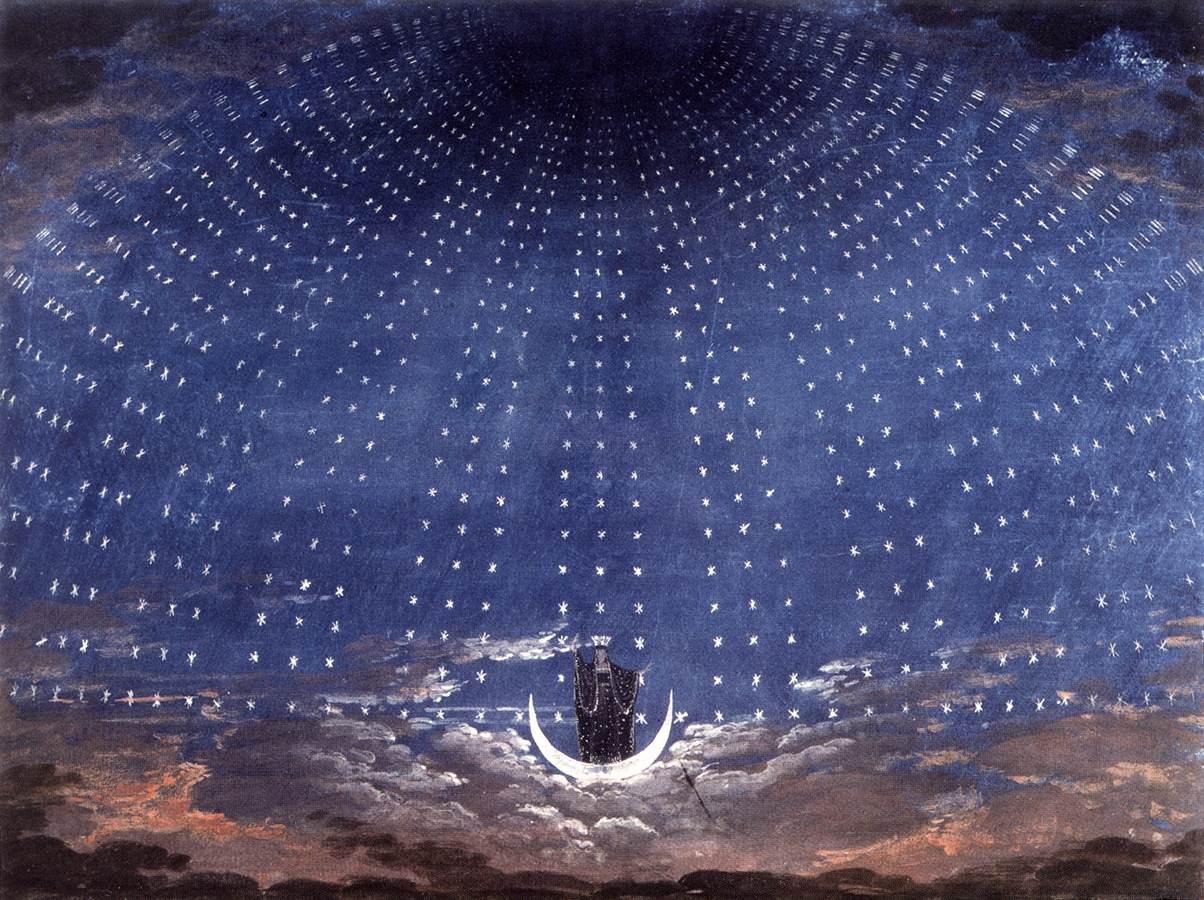
Schinkel's design for Mozart's Die Zauberflote, the first entrance of the Queen of the Night
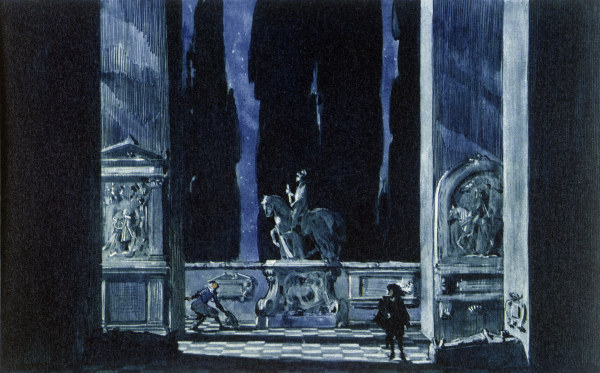
Mahler and Roller's controversial production of Don Giovanni
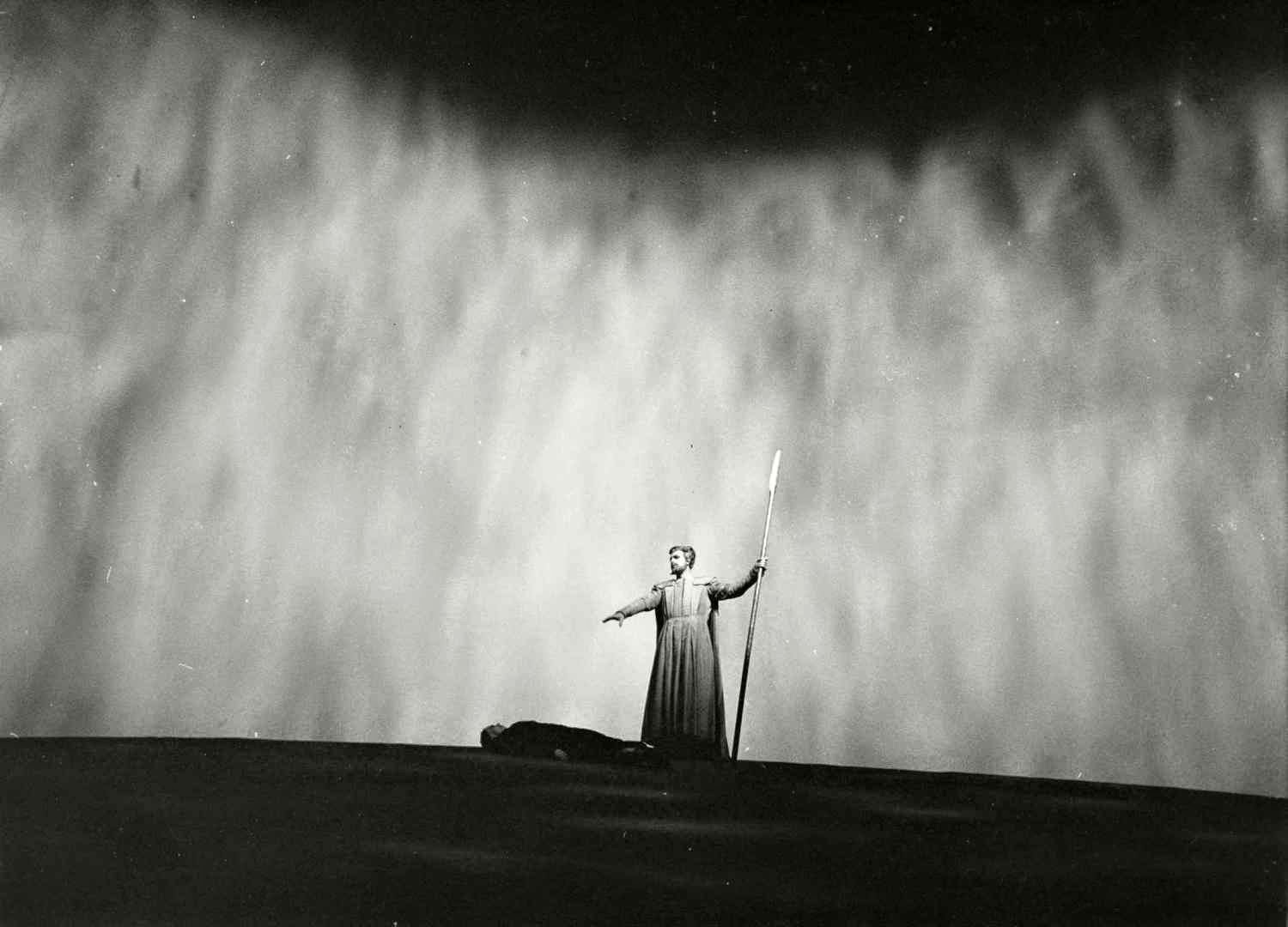
Minimalist Bayreuth production of the Ring Cycle
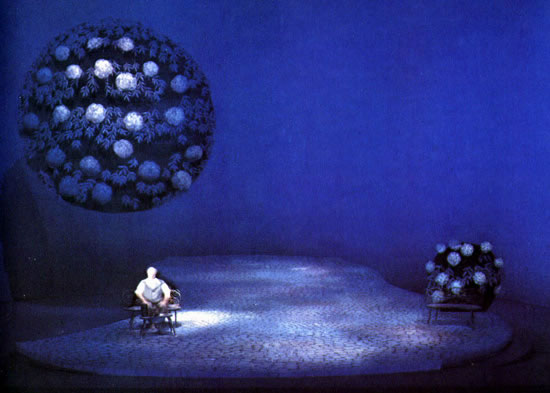
Controversial Bayreuth production of Die Meistersinger von Nurnberg

Design for Rameau's Dardanus
Schinkel's design for Mozart's Die Zauberflote, the first entrance of the Queen of the Night
Mahler and Roller's controversial production of Don Giovanni
Minimalist Bayreuth production of the Ring Cycle
Controversial Bayreuth production of Die Meistersinger von Nurnberg
139DieFledermaus
From the Score to the Stage: An Illustrated History of Continental Opera Production and Staging by Evan Baker
Finished 7/4/15
In this extremely informative and well-researched history of operatic productions, Baker covers opera stagings from the early 17th c. spectacles for kings and emperors to current-day Regietheater productions. As opposed to a standard history of opera, many of the influential people are impresarios, architects, and stage directors as well as the usual composers and librettists.
There is only sporadic information on some of the earliest productions, and the ones that Baker covers at length are fairly obscure now. He does describe what is known about the premiere of L’Orfeo, the first operatic masterpiece, by Monteverdi, but it’s not much. The theater technologies as well as the building of various theaters are also described. Productions consisting of painted backdrops, wings that held the scenery pieces (flats representing trees, ships, statues, etc.), and borders with painted cloths for clouds, branches and ceilings were commonly in use for several hundred years. The contraptions used for flying effects, water, and fire are also described and would remain basically unchanged for much of operatic history. Baker spends a lot of time on lighting and lighting effects through the years. This turns out to be very relevant, as lighting was usually the number one expense for theaters. From candles to Argand lamps to gas lamps, fire was a constant hazard. Pretty much all the theaters that the author describes went on to be destroyed by fire (a distant second cause of theater destruction was World War II). The first opera impresario, Marco Faustini, was working in the 17th century, although it would later be noted that impresarios rarely made money. Theatrical spectacle was important – as the author notes “stage effects compensated for many of the weaknesses in opera – poor music and offhand librettos created solely to enable the scenographers to achieve the most striking visual results possible.” Most of the Italian theaters in the first chapters are Venetian, and had a haphazard approach to directing an opera, but in France the situation was different as Jean-Baptiste Lully, the father of French opera, chose the collaborators to put on his operas and directed the singers himself.
In the 18th c. and beyond, theatrical productions would be strongly affected by the writings of Ferdinando Galli-Bibiena. The Galli-Bibienas were a family of architects and stage designers who planned many of the theaters in the German and Italian lands. Ferdinando wrote several treatises on stagecraft. Some of his most influential ideas were about stage perspective. Up to that time, productions generally had the center of the stage as the vanishing point, as many theaters had been built with only the audience members in the front-center in mind. Ferdinando Galli-Bibiena proposed alternatives – stagings seen from angles, showing rooms from various views. There was still no positon of a stage director and rehearsals were undertaken by the librettist, composer, impresario, or even a singer. Pietro Metastasio was an extremely famous librettist, whose works would continue to be adapted by composers after his death. He also acted as a director – not much is known about his productions, but he was reputed to be a careful and thoughtful director. Still, acting was very rudimentary and Baker prints cartoons or criticisms of the nonexistent operatic acting. He often has long citations in the book from first person sources, and the quotes are generally very illuminating and sometimes entertaining.
In the latter half of the 18th c. Christoph Willibald von Gluck composed operas in a deliberate contrast to the opera seria of earlier years. He toned down the vocal pyrotechnics and made the chorus a larger part, but he also railed against staging spectacles for the sake of spectacles. He was a very involved and energetic director. The author covers his work putting on his own operas as well as Mozart’s Idomeneo and Die Zauberflote. In lighting matters, the Argand lamp was developed, an oil lamp that provided more illumination and eliminated the problem of smoke in the theater that was created by candles. Scenery painters would have to adapt to each new lighting advancement though. However, without a strong, involved director, productions were sloppy. Singers felt free to interpose unrelated songs, the costumes would either be the singers’ own clothes or taken from an unrelated production, and the chorus and dancers were overworked and underpaid. For a long time, the chorus would march out, form a half circle on stage, sing their parts, then march offstage. These practices continued into the 19th c. In Berlin, Count Karl Moritz von Bruhl became essentially the general director of the court theaters and attempted to institute some reforms. He promoted the idea of accurate stage productions with appropriate costumes and found the money to make them happen. He hired Karl Friedrich Schinkel as the stage designer and theater architect, who also promoted the ideas of unity of production and period accuracy. Schinkel published his designs for various operas – including a well-known one of the Queen of the Night’s appearance in Die Zauberflote. There is a long section about one of the best known German Romantic operas, Carl Maria von Weber’s Der Freischutz, focusing on the staging of the Wolf’s Glen scene. Still striking in its hellish imagery and imaginative orchestration today, the scene shows Max, the hero, and Caspar, the devil’s minion, summoning the demonic Samiel, with lots of stormy weather, ghostly apparitions, and shrieking orchestra. There is an interesting account of a dispute between Weber and the stage designer - the designer wanted to have a less elaborate Wolf's Glen scene, implying that the apparitions were in Max and Caspar's mind, but Weber rejected the idea as being too sophisticated for the public.
The author spends a lot of time describing the elaborate productions for the French theaters in the early 19th c. While there were a few where much care was lavished on the productions, the majority tended to be sloppily put together and performed - this was the case with many of the houses and operas that are described. Even with Gluck's criticisms of spectacle, spectacle continued to be popular. The author notes how volcanoes were a trendy thing to include in operas and that there were several that had one. A series of spectacular productions at the Paris Opera made it the leading opera house –Nicolas Isouard’s Aladin ou La Lampe merveilleuse, Meyerbeer’s operas, Gounod’s Faust. Under the direction of Louis-Desire Veron, the house was briefly profitable (although was receiving substantial government subsidies), but Baker notes that opera was pretty much never profitable. Indeed, all his discussion of the efforts, people, and technology that goes into putting on a performance emphasizes why they never made money. At the Paris Opera, the position of stage director was finally solidified. The productions for Faust and Carmen, another megahit of the 19th century, were very realistic. Besides the music, a few old stage tricks made the production for Faust a sensation – traps for Faust’s transformation from an old doctor to a young man, the vision of Marguerite behind a screen. Baker does note – and at several other times – that the productions, while successful, made realistic productions de rigueur until later in the 20th c.
Giuseppe Verdi and Richard Wagner are the two dominant Italian and German operatic composers of the 19th c. and they also had a strong influence on stage productions and the operatic business. Verdi’s fame and popularity allowed him to address the shoddy copyright laws in the 19th c. Along with Ricordi, the largest and most powerful publisher of Italian operas, he helped to regulate opera publication and distribution and impede the casual borrowing that frequently went on. Verdi was very interested in how his operas were presented – there are some quotes from him and other composers decrying the lazy productions of their works – and he refused to work for theaters that he thought could not successfully present his operas. Wagner was as obsessive about his productions as he was about everything else. With the patronage of King Ludwig of Bavaria, he was able to design an opera house to his specifications at Bayreuth, a sleepy Bavarian town. The theater to this day has a festival of his works and is known to have impressive acoustics. Wagner left detailed accounts of what he wanted in his productions, which were generally realistic, and had to push against the generally sloppy standards of the day. His efforts paid off, but his legacy led to creative stagnation, as highly detailed, realistic productions were seen as the only proper way to stage Wagnerian operas.
Adolphe Appia was an architect who had a number of radical ideas for Wagnerian stagings – suggesting that they needn’t be realistic. He also had ideas on using lighting to create a unified production. This was around the time when electric lighting was being installed in theaters – again, set designers had to rethink their color palettes to deal with the new technology. Appia even wrote to Wagner’s widow, Cosima Wagner, to present his works, but she was contemptuous of his ideas. Eventually, he was able to stage a few Wagner operas, but they were not a success and his importance would only become apparent in the latter half of the 20th c.
Gustav Mahler is not a name that usually pops up in operatic history, but as director of the Vienna Opera, he helped promote more radical productions along with set designer Alfred Roller. There was a controversial production of Don Giovanni based on a series of pillars instead of wings/drops/flats and one of Tristan, where instead of a realistic ship in the opening, there was a more abstract view. But the tradition of popular realistic productions had set in, although the author notes some innovation in the use of lighting, for example, in the vigil scene from Giacomo Puccini’s Madama Butterfly. The problems with poor acting was a regular complaint throughout the years, but Baker points to some directors and singers who tried to change that – some of the best known ones such as Fyodor Chaliapin (and Maria Callas in the post-war years), but also the director Max Reinhardt, who had a hit with his production of Richard Strauss’s Der Rosenkavalier. Most of the productions that are described or depicted in the book seem pretty tame today, but some of the productions from the Krolloper, a smaller house during the Weimar years, would be more radical than a lot of current stagings.
In the final chapter, the developments since WWII are followed. It was here that Appia's theories were put into practice. Wagner's grandsons, Wieland and Wolfgang Wagner, ran the festival at Bayreuth and oversaw several controversial productions. Some were abstract, almost minimalist, like their Ring Cycle, and the stripped-down Meistersinger also raised hackles. Again, Baker does a good job of distinguishing the causes of outrage - pictures from the Meistersinger production seem like not a big deal, but the drawings of past stagings do provide a strong contrast. There were still some ideas about One Right Way, since Wagner wrote extensively about what he wanted in a production. Baker notes the impact and radical productions of directors Jean-Pierre Ponnelle and Götz Friedrich and discusses the current Regietheater movement, refreshingly without a lot of the usual biases that you see.
There are a number of great illustrations in this book, but it is maybe too dense to be a good coffee table book. Definitely interesting and informative, but probably more for people have a strong interest in the subject.
Finished 7/4/15
In this extremely informative and well-researched history of operatic productions, Baker covers opera stagings from the early 17th c. spectacles for kings and emperors to current-day Regietheater productions. As opposed to a standard history of opera, many of the influential people are impresarios, architects, and stage directors as well as the usual composers and librettists.
There is only sporadic information on some of the earliest productions, and the ones that Baker covers at length are fairly obscure now. He does describe what is known about the premiere of L’Orfeo, the first operatic masterpiece, by Monteverdi, but it’s not much. The theater technologies as well as the building of various theaters are also described. Productions consisting of painted backdrops, wings that held the scenery pieces (flats representing trees, ships, statues, etc.), and borders with painted cloths for clouds, branches and ceilings were commonly in use for several hundred years. The contraptions used for flying effects, water, and fire are also described and would remain basically unchanged for much of operatic history. Baker spends a lot of time on lighting and lighting effects through the years. This turns out to be very relevant, as lighting was usually the number one expense for theaters. From candles to Argand lamps to gas lamps, fire was a constant hazard. Pretty much all the theaters that the author describes went on to be destroyed by fire (a distant second cause of theater destruction was World War II). The first opera impresario, Marco Faustini, was working in the 17th century, although it would later be noted that impresarios rarely made money. Theatrical spectacle was important – as the author notes “stage effects compensated for many of the weaknesses in opera – poor music and offhand librettos created solely to enable the scenographers to achieve the most striking visual results possible.” Most of the Italian theaters in the first chapters are Venetian, and had a haphazard approach to directing an opera, but in France the situation was different as Jean-Baptiste Lully, the father of French opera, chose the collaborators to put on his operas and directed the singers himself.
In the 18th c. and beyond, theatrical productions would be strongly affected by the writings of Ferdinando Galli-Bibiena. The Galli-Bibienas were a family of architects and stage designers who planned many of the theaters in the German and Italian lands. Ferdinando wrote several treatises on stagecraft. Some of his most influential ideas were about stage perspective. Up to that time, productions generally had the center of the stage as the vanishing point, as many theaters had been built with only the audience members in the front-center in mind. Ferdinando Galli-Bibiena proposed alternatives – stagings seen from angles, showing rooms from various views. There was still no positon of a stage director and rehearsals were undertaken by the librettist, composer, impresario, or even a singer. Pietro Metastasio was an extremely famous librettist, whose works would continue to be adapted by composers after his death. He also acted as a director – not much is known about his productions, but he was reputed to be a careful and thoughtful director. Still, acting was very rudimentary and Baker prints cartoons or criticisms of the nonexistent operatic acting. He often has long citations in the book from first person sources, and the quotes are generally very illuminating and sometimes entertaining.
In the latter half of the 18th c. Christoph Willibald von Gluck composed operas in a deliberate contrast to the opera seria of earlier years. He toned down the vocal pyrotechnics and made the chorus a larger part, but he also railed against staging spectacles for the sake of spectacles. He was a very involved and energetic director. The author covers his work putting on his own operas as well as Mozart’s Idomeneo and Die Zauberflote. In lighting matters, the Argand lamp was developed, an oil lamp that provided more illumination and eliminated the problem of smoke in the theater that was created by candles. Scenery painters would have to adapt to each new lighting advancement though. However, without a strong, involved director, productions were sloppy. Singers felt free to interpose unrelated songs, the costumes would either be the singers’ own clothes or taken from an unrelated production, and the chorus and dancers were overworked and underpaid. For a long time, the chorus would march out, form a half circle on stage, sing their parts, then march offstage. These practices continued into the 19th c. In Berlin, Count Karl Moritz von Bruhl became essentially the general director of the court theaters and attempted to institute some reforms. He promoted the idea of accurate stage productions with appropriate costumes and found the money to make them happen. He hired Karl Friedrich Schinkel as the stage designer and theater architect, who also promoted the ideas of unity of production and period accuracy. Schinkel published his designs for various operas – including a well-known one of the Queen of the Night’s appearance in Die Zauberflote. There is a long section about one of the best known German Romantic operas, Carl Maria von Weber’s Der Freischutz, focusing on the staging of the Wolf’s Glen scene. Still striking in its hellish imagery and imaginative orchestration today, the scene shows Max, the hero, and Caspar, the devil’s minion, summoning the demonic Samiel, with lots of stormy weather, ghostly apparitions, and shrieking orchestra. There is an interesting account of a dispute between Weber and the stage designer - the designer wanted to have a less elaborate Wolf's Glen scene, implying that the apparitions were in Max and Caspar's mind, but Weber rejected the idea as being too sophisticated for the public.
The author spends a lot of time describing the elaborate productions for the French theaters in the early 19th c. While there were a few where much care was lavished on the productions, the majority tended to be sloppily put together and performed - this was the case with many of the houses and operas that are described. Even with Gluck's criticisms of spectacle, spectacle continued to be popular. The author notes how volcanoes were a trendy thing to include in operas and that there were several that had one. A series of spectacular productions at the Paris Opera made it the leading opera house –Nicolas Isouard’s Aladin ou La Lampe merveilleuse, Meyerbeer’s operas, Gounod’s Faust. Under the direction of Louis-Desire Veron, the house was briefly profitable (although was receiving substantial government subsidies), but Baker notes that opera was pretty much never profitable. Indeed, all his discussion of the efforts, people, and technology that goes into putting on a performance emphasizes why they never made money. At the Paris Opera, the position of stage director was finally solidified. The productions for Faust and Carmen, another megahit of the 19th century, were very realistic. Besides the music, a few old stage tricks made the production for Faust a sensation – traps for Faust’s transformation from an old doctor to a young man, the vision of Marguerite behind a screen. Baker does note – and at several other times – that the productions, while successful, made realistic productions de rigueur until later in the 20th c.
Giuseppe Verdi and Richard Wagner are the two dominant Italian and German operatic composers of the 19th c. and they also had a strong influence on stage productions and the operatic business. Verdi’s fame and popularity allowed him to address the shoddy copyright laws in the 19th c. Along with Ricordi, the largest and most powerful publisher of Italian operas, he helped to regulate opera publication and distribution and impede the casual borrowing that frequently went on. Verdi was very interested in how his operas were presented – there are some quotes from him and other composers decrying the lazy productions of their works – and he refused to work for theaters that he thought could not successfully present his operas. Wagner was as obsessive about his productions as he was about everything else. With the patronage of King Ludwig of Bavaria, he was able to design an opera house to his specifications at Bayreuth, a sleepy Bavarian town. The theater to this day has a festival of his works and is known to have impressive acoustics. Wagner left detailed accounts of what he wanted in his productions, which were generally realistic, and had to push against the generally sloppy standards of the day. His efforts paid off, but his legacy led to creative stagnation, as highly detailed, realistic productions were seen as the only proper way to stage Wagnerian operas.
Adolphe Appia was an architect who had a number of radical ideas for Wagnerian stagings – suggesting that they needn’t be realistic. He also had ideas on using lighting to create a unified production. This was around the time when electric lighting was being installed in theaters – again, set designers had to rethink their color palettes to deal with the new technology. Appia even wrote to Wagner’s widow, Cosima Wagner, to present his works, but she was contemptuous of his ideas. Eventually, he was able to stage a few Wagner operas, but they were not a success and his importance would only become apparent in the latter half of the 20th c.
Gustav Mahler is not a name that usually pops up in operatic history, but as director of the Vienna Opera, he helped promote more radical productions along with set designer Alfred Roller. There was a controversial production of Don Giovanni based on a series of pillars instead of wings/drops/flats and one of Tristan, where instead of a realistic ship in the opening, there was a more abstract view. But the tradition of popular realistic productions had set in, although the author notes some innovation in the use of lighting, for example, in the vigil scene from Giacomo Puccini’s Madama Butterfly. The problems with poor acting was a regular complaint throughout the years, but Baker points to some directors and singers who tried to change that – some of the best known ones such as Fyodor Chaliapin (and Maria Callas in the post-war years), but also the director Max Reinhardt, who had a hit with his production of Richard Strauss’s Der Rosenkavalier. Most of the productions that are described or depicted in the book seem pretty tame today, but some of the productions from the Krolloper, a smaller house during the Weimar years, would be more radical than a lot of current stagings.
In the final chapter, the developments since WWII are followed. It was here that Appia's theories were put into practice. Wagner's grandsons, Wieland and Wolfgang Wagner, ran the festival at Bayreuth and oversaw several controversial productions. Some were abstract, almost minimalist, like their Ring Cycle, and the stripped-down Meistersinger also raised hackles. Again, Baker does a good job of distinguishing the causes of outrage - pictures from the Meistersinger production seem like not a big deal, but the drawings of past stagings do provide a strong contrast. There were still some ideas about One Right Way, since Wagner wrote extensively about what he wanted in a production. Baker notes the impact and radical productions of directors Jean-Pierre Ponnelle and Götz Friedrich and discusses the current Regietheater movement, refreshingly without a lot of the usual biases that you see.
There are a number of great illustrations in this book, but it is maybe too dense to be a good coffee table book. Definitely interesting and informative, but probably more for people have a strong interest in the subject.
140RidgewayGirl
I will never read that book, but I very much enjoyed reading your review.
141AlisonY
I know nothing about opera, but some of those stage backgrounds are particularly beautiful.
142rebeccanyc
>140 RidgewayGirl: Ditto.
143ELiz_M
>139 DieFledermaus: Oooooooooh, I want!
144FlorenceArt
>139 DieFledermaus: Very interesting overview of the history of stage production of operas. In Marie-Antoinette there is a short passage about the production of Gluck's Iphigénie by Gluck himself in Paris. Apparently he was rather dictatorial and things didn't go very well with French musicians and singers, but he had Marie-Antoinette's support. He even postponed the premiere (to which the whole court was supposed to attend) because of of the singers had gotten sick and he absolutely refused to have a last minute replacement.
145DieFledermaus
>140 RidgewayGirl:, >142 rebeccanyc: - Heh heh - thanks.
>141 AlisonY: - There were a lot of great pictures in the book - I was happy to find some by just Googling around.
>143 ELiz_M: - Hope you can find a copy!
>144 FlorenceArt: - I remember reading about Gluck in the Zweig bio and how Marie Antoinette supported him, although not as much the specific details. Was he the one who gave her music lessons back in Vienna? In another book that I read, The Birth of an Opera, there was a chapter on Gluck's Alceste. The first person accounts also portrayed him as a dictatorial director. From the Baker book, it did sound like directors (or whoever was putting together the production) had to really push to get the singers, dancers and chorus to do what they wanted.
>141 AlisonY: - There were a lot of great pictures in the book - I was happy to find some by just Googling around.
>143 ELiz_M: - Hope you can find a copy!
>144 FlorenceArt: - I remember reading about Gluck in the Zweig bio and how Marie Antoinette supported him, although not as much the specific details. Was he the one who gave her music lessons back in Vienna? In another book that I read, The Birth of an Opera, there was a chapter on Gluck's Alceste. The first person accounts also portrayed him as a dictatorial director. From the Baker book, it did sound like directors (or whoever was putting together the production) had to really push to get the singers, dancers and chorus to do what they wanted.
146FlorenceArt
>145 DieFledermaus: Yes, Gluck gave Marie-Antoinette music lessons when she was young.
147DieFledermaus
>146 FlorenceArt: - I thought I remembered reading that - thanks.
148DieFledermaus
Poliuto - Gaetano Donizetti
Glyndebourne
Poliuto – Michael Fabiano
Paolina – Ana María Martínez
Severo – Igor Golovatenko
Callistene – Matthew Rose
Glyndebourne does an early version of this rare Donizetti opera. It’s not something that has to be seen, but this production does have very good singing. It’s a standard story – love triangle with the two men on opposite political sides. Paolina mistakenly believed her love, the Roman proconsul Severo, died and married Poliuto, who recently converted to Christianity - a crime punishable by death. Severo is sent to stamp out the spread of Christianity. When Poliuto sees his wife unhappily rejecting Severo, he thinks she has betrayed him. He confesses his crime and rejects Paolina. She tries to save him, but he refuses to switch to the old gods. Paolina then has an unbelievable insta-conversion to Christianity, and they go off to face the lions together.

The singers were all excellent – Michael Fabiano has a bright, big voice and handled the challenges of the role well; Ana María Martínez surprisingly has a dark, warm, mezzoish voice, but was nimble and light in the ornamentation; Igor Golovatenko smoothly sang his part and was a sympathetic Severo and even Matthew Rose, as the one dimensional bad guy Callistene, sang strongly. The production was okay – it was set in the 20th century, probably Fascist era, with huge grey pillars. They do create an oppressive atmosphere, but sometimes move awkwardly and there were random hide and seek moments. The projections are sometimes nicely subtle and appropriate, but too obvious at other times. The opera itself is a bit weird because it seems like either Poliuto or Severo could be the hero – also reflected in Donizetti’s various changes to the title over the years. There are some nice pieces for the three main characters, but the chorus music feels rather square and blandly triumphant and even the arias sound standard.
Glyndebourne
Poliuto – Michael Fabiano
Paolina – Ana María Martínez
Severo – Igor Golovatenko
Callistene – Matthew Rose
Glyndebourne does an early version of this rare Donizetti opera. It’s not something that has to be seen, but this production does have very good singing. It’s a standard story – love triangle with the two men on opposite political sides. Paolina mistakenly believed her love, the Roman proconsul Severo, died and married Poliuto, who recently converted to Christianity - a crime punishable by death. Severo is sent to stamp out the spread of Christianity. When Poliuto sees his wife unhappily rejecting Severo, he thinks she has betrayed him. He confesses his crime and rejects Paolina. She tries to save him, but he refuses to switch to the old gods. Paolina then has an unbelievable insta-conversion to Christianity, and they go off to face the lions together.

The singers were all excellent – Michael Fabiano has a bright, big voice and handled the challenges of the role well; Ana María Martínez surprisingly has a dark, warm, mezzoish voice, but was nimble and light in the ornamentation; Igor Golovatenko smoothly sang his part and was a sympathetic Severo and even Matthew Rose, as the one dimensional bad guy Callistene, sang strongly. The production was okay – it was set in the 20th century, probably Fascist era, with huge grey pillars. They do create an oppressive atmosphere, but sometimes move awkwardly and there were random hide and seek moments. The projections are sometimes nicely subtle and appropriate, but too obvious at other times. The opera itself is a bit weird because it seems like either Poliuto or Severo could be the hero – also reflected in Donizetti’s various changes to the title over the years. There are some nice pieces for the three main characters, but the chorus music feels rather square and blandly triumphant and even the arias sound standard.
149DieFledermaus
Platée – Jean-Philippe Rameau
Opéra National de Paris
Platée – Paul Agnew
Folly – Mireille Delunsch
Mercury – Yann Beuron
Jupiter – Vincent Le Texier
Juno - Doris Lamprecht
This is a comedy by Rameau, rather than one of his tragedie lyriques, and has even more dancing than usual. Appropriately enough, the music was less melodic and lyrical, but there were more interesting effects – croaking, thundering, braying, chirping. Laurent Pelly directed this production and it is very successful. There are a lot of different types of dancing and the comedic bits are funny. I also liked the silent role of a frog, who seems to have a lot of personality. The singing wasn’t quite as good as a lot of other French baroque operas that I’ve seen, but there aren’t as many opportunities for flashy or pretty songs. Mireille Delunsch as Folly gets some tricky parts and does well though. While overall this production was very enjoyable, there’s just something about the plot that is off-putting – gods messing with mortals is pretty standard, but the treatment of Platée comes off as petty and mean.
After a prologue with the gods, Mercury suggests a trick to reconcile Jupiter and Juno. Jupiter will pretend to marry Platée, the ugliest nymph, and have Juno interrupt the wedding. Platée is silly and vain, but it still comes off as mean. Jupiter comes to court her and there is much dancing and celebrating. Juno is enraged to hear about her husband’s infidelity, and she storms in to break up the wedding, but realizes it is a joke as soon as she sees Platée. She and Jupiter reconcile and leave, but the chorus continues to jeer at Platée.

Pelly’s production has a lot of meta-elements – the prologue starts with the audience in a theater; the seats fall apart and crack as greenery invades and it turns into Platée ’s swamp. The dancing is all over the place, which I enjoyed – dancing waiters, dancing couples, dancing theatergoers, some in weird or modern or jerky styles. Paul Agnew does a reverse trousers role to play Platée. I don’t think he could be said to sing beautifully, although he does a good job characterizing her. Vincet Le Texier as Jupiter and Doris Lamprecht as Juno sounded somewhat pitchy, but the other roles of the gods were well-sung. There is a silent role of the frog, who pops up at the table and in the theater and seems to have a crush on Platée. I sometimes get annoyed at the tendency of opera productions to do a “pair the spares” at the end (like, say, Jaquino and Marzelline in Fidelio or Lisa and that other guy in La Sonnambula), but I wouldn’t have minded the frog and Platée running off at the end. Instead, the opera ends with the crowd triumphantly mocking her. But overall this is a very creative and fun production of the opera.
Opéra National de Paris
Platée – Paul Agnew
Folly – Mireille Delunsch
Mercury – Yann Beuron
Jupiter – Vincent Le Texier
Juno - Doris Lamprecht
This is a comedy by Rameau, rather than one of his tragedie lyriques, and has even more dancing than usual. Appropriately enough, the music was less melodic and lyrical, but there were more interesting effects – croaking, thundering, braying, chirping. Laurent Pelly directed this production and it is very successful. There are a lot of different types of dancing and the comedic bits are funny. I also liked the silent role of a frog, who seems to have a lot of personality. The singing wasn’t quite as good as a lot of other French baroque operas that I’ve seen, but there aren’t as many opportunities for flashy or pretty songs. Mireille Delunsch as Folly gets some tricky parts and does well though. While overall this production was very enjoyable, there’s just something about the plot that is off-putting – gods messing with mortals is pretty standard, but the treatment of Platée comes off as petty and mean.
After a prologue with the gods, Mercury suggests a trick to reconcile Jupiter and Juno. Jupiter will pretend to marry Platée, the ugliest nymph, and have Juno interrupt the wedding. Platée is silly and vain, but it still comes off as mean. Jupiter comes to court her and there is much dancing and celebrating. Juno is enraged to hear about her husband’s infidelity, and she storms in to break up the wedding, but realizes it is a joke as soon as she sees Platée. She and Jupiter reconcile and leave, but the chorus continues to jeer at Platée.

Pelly’s production has a lot of meta-elements – the prologue starts with the audience in a theater; the seats fall apart and crack as greenery invades and it turns into Platée ’s swamp. The dancing is all over the place, which I enjoyed – dancing waiters, dancing couples, dancing theatergoers, some in weird or modern or jerky styles. Paul Agnew does a reverse trousers role to play Platée. I don’t think he could be said to sing beautifully, although he does a good job characterizing her. Vincet Le Texier as Jupiter and Doris Lamprecht as Juno sounded somewhat pitchy, but the other roles of the gods were well-sung. There is a silent role of the frog, who pops up at the table and in the theater and seems to have a crush on Platée. I sometimes get annoyed at the tendency of opera productions to do a “pair the spares” at the end (like, say, Jaquino and Marzelline in Fidelio or Lisa and that other guy in La Sonnambula), but I wouldn’t have minded the frog and Platée running off at the end. Instead, the opera ends with the crowd triumphantly mocking her. But overall this is a very creative and fun production of the opera.
150ELiz_M
>145 DieFledermaus: "From the Baker book, it did sound like directors (or whoever was putting together the production) had to really push to get the singers, dancers and chorus to do what they wanted..."
They still do.
They still do.
151NanaCC
I've really been enjoying your opera reviews. I've only seen a handful, and you make me want to get to NYC for more.
152FlorenceArt
>149 DieFledermaus: I like that frog, especially if he's the only one who didn't make fun of Platée. Do you think he was in the scenario or did the director add him?
153baswood
Enjoyed your review of From the score to the stage
154DieFledermaus
>150 ELiz_M: - Heh, some things never change. Occasionally, I'll hear stories/rumors leaking out, but it usually involves something like Difficult Singer X or Difficult Director Y or "That Regietheater concept is stupid/gross."
>151 NanaCC: - Thanks - that is really nice to hear. I like to go to NYC for opera also - there aren't too many places in the US where you can see multiple operas in one visit.
>152 FlorenceArt: - The greenie at >149 DieFledermaus: is Platée (drag role) - here's the frog

There are a lot of frogs croaking since Platée lives in a swamp - the music has a nice imitation - but the director added the character. Sometimes productions that add an extra, non-speaking/singing character get criticized for that, but I thought it worked really well here. Also, I was impressed that the actor conveyed a lot with body language while dressed in a frog suit. It was nice to have him since I thought the plot comes off as mean - I guess anti-bullying concerns weren't big in 1745 France.
>153 baswood: - Thanks!
>151 NanaCC: - Thanks - that is really nice to hear. I like to go to NYC for opera also - there aren't too many places in the US where you can see multiple operas in one visit.
>152 FlorenceArt: - The greenie at >149 DieFledermaus: is Platée (drag role) - here's the frog

There are a lot of frogs croaking since Platée lives in a swamp - the music has a nice imitation - but the director added the character. Sometimes productions that add an extra, non-speaking/singing character get criticized for that, but I thought it worked really well here. Also, I was impressed that the actor conveyed a lot with body language while dressed in a frog suit. It was nice to have him since I thought the plot comes off as mean - I guess anti-bullying concerns weren't big in 1745 France.
>153 baswood: - Thanks!
155DieFledermaus
The World of Yesterday by Stefan Zweig
Finished 3/31/15
Stefan Zweig’s autobiography is a wonderful, engaging read, a vivid look at life, art, culture and society in various European cities leading up to World War II. Zweig does tend to namedrop, but he is as passionate and enthusiastic about his lesser-known friends as he is about some of the people who would go on to be the best-known thinkers and writers of the day. There isn’t as much about his personal life and works – for example, he mentions his marriage to his second wife as an aside and does not talk much about his first wife either. He doesn’t spend much time on his influences and processes for his novels, stories, and nonfiction works either. Instead, it’s about the people, cultural movements, and milieu of the period from the late 19th century up to World War II, although eventually the tumult of wars, inflation, and creeping repression becomes the main topic.
The opening of his first chapter is marvelous, describing “The World of Security” from his youth. Everyone believed the Austrian government was solid and stable, people had turned from the barbarism of the past, and science and technology would continue to improve ordinary people’s lives. Everything was well-ordered and in its place, everything would continue to get better. Zweig’s very subjective view is from a contented segment of the population - wealthy, cultured Jewish families. He frequently makes notes from the present, and there is some dismay at the naivety of those days, but a bit of nostalgia also. He is more critical of the education and sexual mores of late 19th/early 20th century Vienna – he unhappily recalls the cold, uninspiring schools from his childhood and the hypocrisy of a Vienna rife with prostitution and pornography but firmly upholding the ban on young people learning about sex.
Zweig, along with his fellow schoolmates, did find passion and meaning in art and literature – they were always reading and into whatever was new or different. He mentions that most of the group drifted off to normal lives later on – and that other classes had different obsessions, sports being the other one he recalled – but he gained a solid cultural background from his own studies, while learning nothing much at school. An early celebrity spotting was Hugo von Hofmannsthal, who he met as a young man. University wasn’t much different – Zweig decided to take the opportunity to pursue his interests and get into new social circles, while procrastinating on his writing and then doing it all as the deadline approached. He traveled to Berlin and hung out with bohemians – which gave rise to an interesting comment about his work –
“Perhaps the very fact that I came from a solidly established background, and felt to some extent that this ‘security’ complex weighted me down, made me more likely to be fascinated by those who almost recklessly squandered their lives, their time, their money, their health and reputation – passionate monomaniacs obsessed by aimless existence for its own sake – and perhaps readers may notice this preference of mine for intense, intemperate characters in my novels and novellas.”
He also started writing short pieces and poetry. In celebrity meetings, Zweig mentions his encounters with Theodor Herzl. After taking his degree, the author commenced a period of traveling and meeting new people. His descriptions of the cities are very lively, as are his portraits of his friends. This part could feel a bit like “And then I met X….then I met Y…..then I met Z”, but the writing makes it interesting. He discusses meeting Romain Rolland, Rainer Maria Rilke, and other well-known artists, but also has lots of praise for his lesser-known friends Emile Verhaeren and Leon Balzagette. He visited Paris, London, Spain, Italy, and Belgium and went even further afield, to America and India. Besides his travels and friends, Zweig’s descriptions of his hobby collecting autographs and manuscripts are interesting. His start as a playwright at first appeared auspicious, but then began to seem cursed, as various people connected to his play died.
From his POV, all of Vienna was in denial about WWI until it happened. He forthrightly admits his cowardice and describes how he took a safe library job during the war. However, although many writers beat the nationalist drum and churned out propaganda, Zweig couldn’t forget his friends and knowledge of other countries and banded together with other artists to try to promote cross country communication. Many were on board with nationalism, so it ended up being mainly Zweig and a few friends exchanging letters and writing anti-xenophobic articles, although he notes that Romain Rolland did a lot of humane work. Zweig’s contribution was the play Jeremiah. Its anti-war sentiment and criticism of unchecked power became appealing towards the end of the war, when the population had lost their enthusiasm for hatred. Jeremiah was a huge success and Zweig’s popularity increased. Austria after the war had massive inflation and privation, and the author’s unhappy account of those years is very compelling. Zweig, it seems, hibernated at his house in Salzburg to eke out the post-war years. However, after that, he had a period of happiness, security, and fame.
He continued to write, travel and meet with his friends. Zweig describes a couple trips to the Soviet Union and Italy. While he had many positive impressions of both places and became fast friends with Gorky, he also saw evidence of repression and growing fascism. In the Soviet Union, he gave away all his supplies – which were lacking there – and an anonymous note describing how he was under surveillance set him on alert. In Italy, he tried to help a woman whose husband had been imprisoned, with moderately positive results. His life in Salzburg was peaceful and happy. One change was the influx of society as the town became a cultural center with a prestigious festival. In this section, he also talks a little about his writing style – there are some amusing quotes about his dislike of anything long-winded.
Zweig’s story could be seen as a rise and fall – if so, the pinnacle would be his 50th birthday, where he surveys his past hurdles and successes, and wonders if his life will continue on in the same contented fashion – with a slight note of dissatisfaction. He remembers his wish for some more excitement, but is not prepared for the darkness that upends his life and Europe. While he occasionally focuses on the political upheavals earlier in the book, in the final chapters, it is the main subject. At first, the author’s circle saw Hitler only as an unimportant rabble-rouser, who would likely sink without a trace any day now. But his influence soon became apparent, and Zweig’s books were banned, along with other Jewish authors.
Zweig describes his intellectually stimulating collaboration with Richard Strauss, the great German composer, when he worked as the librettist of Die schweigsame Frau. The Nazis wanted Strauss on their side but didn’t like Zweig’s name on his works. There’s a long section describing the conflict, and Zweig seems to have written this part with a half-smile, recalling how he discomfited Hitler. He sat at home in Salzburg while Strauss and others battled it out. The premiere was a success, but then the whole run of performances was canceled. Things continued to go downhill, but the event that caused Zweig to leave Austria forever seems comparatively small – his house was searched by the local police. However, that was an affront unimaginable in previous times, and the author was obviously correct in his foresight.
He went to England and monitored the events there, despairing at Chamberlain’s appeasement and not even celebrating when Britain declared war in 1939, as he knew he would be seen as foreign and suspect. Unsurprisingly, Zweig’s writing becomes more hopeless and unhappy towards the end – in his final visit to Vienna, he notes
“But everyone I spoke to in Vienna genuinely appeared not to have a care in the world. They invited each other to parties where evening dress was de rigueur, never guessing that they would soon be wearing the convict garb of the concentration camps; they crowded into the shops to do Christmas shopping for their attractive homes, with no idea that a few months later those home would be confiscated and looted. For the first time I was distressed by the eternally light-hearted attitude of old Vienna, which I always used to love so much – I suppose I will dream of it all my life…”
He ends with his plan to leave England and a down note –
“And I knew that yet again all the past was over, all achievements were as nothing – our own native Europe, for which we had lived, was destroyed, and the destruction would last long after our own lives. Something else was beginning, a new time, and who knew how many hells and purgatories we still had to go through to reach it?”
Zweig’s death is probably as famous as his life – he and his wife escaped the ravages of Europe, but committed suicide together in 1942. But his autobiography stands as impressive memorial to the times in which he lived.
Finished 3/31/15
Stefan Zweig’s autobiography is a wonderful, engaging read, a vivid look at life, art, culture and society in various European cities leading up to World War II. Zweig does tend to namedrop, but he is as passionate and enthusiastic about his lesser-known friends as he is about some of the people who would go on to be the best-known thinkers and writers of the day. There isn’t as much about his personal life and works – for example, he mentions his marriage to his second wife as an aside and does not talk much about his first wife either. He doesn’t spend much time on his influences and processes for his novels, stories, and nonfiction works either. Instead, it’s about the people, cultural movements, and milieu of the period from the late 19th century up to World War II, although eventually the tumult of wars, inflation, and creeping repression becomes the main topic.
The opening of his first chapter is marvelous, describing “The World of Security” from his youth. Everyone believed the Austrian government was solid and stable, people had turned from the barbarism of the past, and science and technology would continue to improve ordinary people’s lives. Everything was well-ordered and in its place, everything would continue to get better. Zweig’s very subjective view is from a contented segment of the population - wealthy, cultured Jewish families. He frequently makes notes from the present, and there is some dismay at the naivety of those days, but a bit of nostalgia also. He is more critical of the education and sexual mores of late 19th/early 20th century Vienna – he unhappily recalls the cold, uninspiring schools from his childhood and the hypocrisy of a Vienna rife with prostitution and pornography but firmly upholding the ban on young people learning about sex.
Zweig, along with his fellow schoolmates, did find passion and meaning in art and literature – they were always reading and into whatever was new or different. He mentions that most of the group drifted off to normal lives later on – and that other classes had different obsessions, sports being the other one he recalled – but he gained a solid cultural background from his own studies, while learning nothing much at school. An early celebrity spotting was Hugo von Hofmannsthal, who he met as a young man. University wasn’t much different – Zweig decided to take the opportunity to pursue his interests and get into new social circles, while procrastinating on his writing and then doing it all as the deadline approached. He traveled to Berlin and hung out with bohemians – which gave rise to an interesting comment about his work –
“Perhaps the very fact that I came from a solidly established background, and felt to some extent that this ‘security’ complex weighted me down, made me more likely to be fascinated by those who almost recklessly squandered their lives, their time, their money, their health and reputation – passionate monomaniacs obsessed by aimless existence for its own sake – and perhaps readers may notice this preference of mine for intense, intemperate characters in my novels and novellas.”
He also started writing short pieces and poetry. In celebrity meetings, Zweig mentions his encounters with Theodor Herzl. After taking his degree, the author commenced a period of traveling and meeting new people. His descriptions of the cities are very lively, as are his portraits of his friends. This part could feel a bit like “And then I met X….then I met Y…..then I met Z”, but the writing makes it interesting. He discusses meeting Romain Rolland, Rainer Maria Rilke, and other well-known artists, but also has lots of praise for his lesser-known friends Emile Verhaeren and Leon Balzagette. He visited Paris, London, Spain, Italy, and Belgium and went even further afield, to America and India. Besides his travels and friends, Zweig’s descriptions of his hobby collecting autographs and manuscripts are interesting. His start as a playwright at first appeared auspicious, but then began to seem cursed, as various people connected to his play died.
From his POV, all of Vienna was in denial about WWI until it happened. He forthrightly admits his cowardice and describes how he took a safe library job during the war. However, although many writers beat the nationalist drum and churned out propaganda, Zweig couldn’t forget his friends and knowledge of other countries and banded together with other artists to try to promote cross country communication. Many were on board with nationalism, so it ended up being mainly Zweig and a few friends exchanging letters and writing anti-xenophobic articles, although he notes that Romain Rolland did a lot of humane work. Zweig’s contribution was the play Jeremiah. Its anti-war sentiment and criticism of unchecked power became appealing towards the end of the war, when the population had lost their enthusiasm for hatred. Jeremiah was a huge success and Zweig’s popularity increased. Austria after the war had massive inflation and privation, and the author’s unhappy account of those years is very compelling. Zweig, it seems, hibernated at his house in Salzburg to eke out the post-war years. However, after that, he had a period of happiness, security, and fame.
He continued to write, travel and meet with his friends. Zweig describes a couple trips to the Soviet Union and Italy. While he had many positive impressions of both places and became fast friends with Gorky, he also saw evidence of repression and growing fascism. In the Soviet Union, he gave away all his supplies – which were lacking there – and an anonymous note describing how he was under surveillance set him on alert. In Italy, he tried to help a woman whose husband had been imprisoned, with moderately positive results. His life in Salzburg was peaceful and happy. One change was the influx of society as the town became a cultural center with a prestigious festival. In this section, he also talks a little about his writing style – there are some amusing quotes about his dislike of anything long-winded.
Zweig’s story could be seen as a rise and fall – if so, the pinnacle would be his 50th birthday, where he surveys his past hurdles and successes, and wonders if his life will continue on in the same contented fashion – with a slight note of dissatisfaction. He remembers his wish for some more excitement, but is not prepared for the darkness that upends his life and Europe. While he occasionally focuses on the political upheavals earlier in the book, in the final chapters, it is the main subject. At first, the author’s circle saw Hitler only as an unimportant rabble-rouser, who would likely sink without a trace any day now. But his influence soon became apparent, and Zweig’s books were banned, along with other Jewish authors.
Zweig describes his intellectually stimulating collaboration with Richard Strauss, the great German composer, when he worked as the librettist of Die schweigsame Frau. The Nazis wanted Strauss on their side but didn’t like Zweig’s name on his works. There’s a long section describing the conflict, and Zweig seems to have written this part with a half-smile, recalling how he discomfited Hitler. He sat at home in Salzburg while Strauss and others battled it out. The premiere was a success, but then the whole run of performances was canceled. Things continued to go downhill, but the event that caused Zweig to leave Austria forever seems comparatively small – his house was searched by the local police. However, that was an affront unimaginable in previous times, and the author was obviously correct in his foresight.
He went to England and monitored the events there, despairing at Chamberlain’s appeasement and not even celebrating when Britain declared war in 1939, as he knew he would be seen as foreign and suspect. Unsurprisingly, Zweig’s writing becomes more hopeless and unhappy towards the end – in his final visit to Vienna, he notes
“But everyone I spoke to in Vienna genuinely appeared not to have a care in the world. They invited each other to parties where evening dress was de rigueur, never guessing that they would soon be wearing the convict garb of the concentration camps; they crowded into the shops to do Christmas shopping for their attractive homes, with no idea that a few months later those home would be confiscated and looted. For the first time I was distressed by the eternally light-hearted attitude of old Vienna, which I always used to love so much – I suppose I will dream of it all my life…”
He ends with his plan to leave England and a down note –
“And I knew that yet again all the past was over, all achievements were as nothing – our own native Europe, for which we had lived, was destroyed, and the destruction would last long after our own lives. Something else was beginning, a new time, and who knew how many hells and purgatories we still had to go through to reach it?”
Zweig’s death is probably as famous as his life – he and his wife escaped the ravages of Europe, but committed suicide together in 1942. But his autobiography stands as impressive memorial to the times in which he lived.
156rebeccanyc
Wpw! That's an excellent tour through The World of Yesterday. I have it on the TBR but I almost feel I don't have to read it after reading your comprehensive review.
157SassyLassy
This sounds like an excellent book. It always helps with learning history to have some idea of the characters involved and the "real" people of their time.
158FlorenceArt
Thank you for the photo of the frog! I have added Zweig's autobiography to my wishlist, it sounds fascinating.
159baswood
Enjoyed your excellent review of The World of Yesterday
160kidzdoc
Fabulous review of The World of Yesterday, Stephanie! I'll move this much higher on my TBR list.
162DieFledermaus
>156 rebeccanyc: - Thanks, Rebecca - but you won't want to miss Zweig's writing!
>157 SassyLassy: - Yes, it's always interesting to read how various famous people were viewed by their contemporaries. Zweig wrote several bios of famous historical people, but also about some of his friends.
>158 FlorenceArt: - He is a cute frog! And glad to add to the list.
>159 baswood:, >161 dchaikin: - Thanks!
>160 kidzdoc: - Hope you get a chance to read it sometime soon.
It seemed like there was a little bump of Zweig interest after he was listed as inspiration for the movie The Grand Budapest Hotel - I think this one would be a better companion to the movie than most of the short stories, novellas, and novels that I read.
>157 SassyLassy: - Yes, it's always interesting to read how various famous people were viewed by their contemporaries. Zweig wrote several bios of famous historical people, but also about some of his friends.
>158 FlorenceArt: - He is a cute frog! And glad to add to the list.
>159 baswood:, >161 dchaikin: - Thanks!
>160 kidzdoc: - Hope you get a chance to read it sometime soon.
It seemed like there was a little bump of Zweig interest after he was listed as inspiration for the movie The Grand Budapest Hotel - I think this one would be a better companion to the movie than most of the short stories, novellas, and novels that I read.
163DieFledermaus
The Death of Mr. Baltisberger by Bohumil Hrabal
Finished 9/3/15
Bohumil Hrabal’s most famous novels are justly celebrated, but this short story collection is rambling and monotonous. Hrabal has a jolting use of dark comedy and the stories read with a conversational ease, but they all start to blur together after a while. Most of them are just the conversations of a couple or a group of people, who tell stories that are sometimes comic, sometimes horrific, sometimes both. They go by quickly enough, but I never felt an especially strong urge to pick up the book. It seems like each story is just characters rambling in different places – conversations in a bar, on a train, at a racetrack, in an office, on the way to a funeral. Most of the stories don’t have an arc or much of a plot, although “Romance” features a growing relationship between a boy and a Romani girl that seems like it shouldn’t work, and “Angel Eyes” is the story of a baker who has a series of increasingly frustrating meetings with insurance agents. I noticed that stories that I liked best tended to be in the first half of the book – everything started to seem a bit pointless and the same towards the end. Also, there is a lot about motorcycles, maybe someone who is more into them than I am would find that interesting.
Some of the stories that I thought used the rambling best were “Palaverers”, where the narrator visits a family who has a lot of funny/horrible stories about their father, including a sickle-to-head accident while the narrator is present, a run-in with an outhouse, and a motorcycle accident; “A Dull Afternoon”, which is a nice slice of life set in a bar – a young man who drinks, smokes and can’t be pulled away from his book is looked at with suspicion, soccer watchers go in and out, and the local soccer expert finds he is challenged by an outsider; and “At the Sign of the Greentree”, which takes place in a bar still damaged by the time a streetcar plowed into it and has the tavernkeeper and his brother-in-law exchanging streetcar-related stories while warily eyeing the wall.
Finished 9/3/15
Bohumil Hrabal’s most famous novels are justly celebrated, but this short story collection is rambling and monotonous. Hrabal has a jolting use of dark comedy and the stories read with a conversational ease, but they all start to blur together after a while. Most of them are just the conversations of a couple or a group of people, who tell stories that are sometimes comic, sometimes horrific, sometimes both. They go by quickly enough, but I never felt an especially strong urge to pick up the book. It seems like each story is just characters rambling in different places – conversations in a bar, on a train, at a racetrack, in an office, on the way to a funeral. Most of the stories don’t have an arc or much of a plot, although “Romance” features a growing relationship between a boy and a Romani girl that seems like it shouldn’t work, and “Angel Eyes” is the story of a baker who has a series of increasingly frustrating meetings with insurance agents. I noticed that stories that I liked best tended to be in the first half of the book – everything started to seem a bit pointless and the same towards the end. Also, there is a lot about motorcycles, maybe someone who is more into them than I am would find that interesting.
Some of the stories that I thought used the rambling best were “Palaverers”, where the narrator visits a family who has a lot of funny/horrible stories about their father, including a sickle-to-head accident while the narrator is present, a run-in with an outhouse, and a motorcycle accident; “A Dull Afternoon”, which is a nice slice of life set in a bar – a young man who drinks, smokes and can’t be pulled away from his book is looked at with suspicion, soccer watchers go in and out, and the local soccer expert finds he is challenged by an outsider; and “At the Sign of the Greentree”, which takes place in a bar still damaged by the time a streetcar plowed into it and has the tavernkeeper and his brother-in-law exchanging streetcar-related stories while warily eyeing the wall.
164DieFledermaus
Are You My Mother? by Alison Bechdel
Finished 9/7/15
I very much enjoyed Alison Bechdel’s previous graphic novel memoir, Fun Home, but this one doesn’t quite measure up even though it is a worthwhile read. If the former book was about Bechdel’s distant, unhappy father, his closeted life, and Bechdel’s own identity as a lesbian, the latter follows the author’s distant, unhappy mother, her interrupted artistic ambitions, and Bechdel’s work as an artist. Are You My Mother? is much more fragmented than Fun Home and it felt a bit like writer’s block. I usually like disjointed, metafictional narratives and still enjoyed this one. Sometimes I had to fill in bits of her mother’s past from Fun Home, although Bechdel probably didn’t include some of the background to avoid being repetitive. Also, I am personally not that interested in Freudian-type psychoanalysis and there was some of that here, with various dreams and their interpretations. Bechdel includes bits about Donald Winnicott, a pioneering psychoanalyst, Virginia Woolf, even Dr. Seuss. In general, I enjoyed these and the author does a good job of relating it to her life. Sometimes the psychoanalytical focus felt a little stifling though (for example, all the chapters are named after a psychological concept). As with Fun Home, the parts about the author’s life and her mother are excellent – subtle, realistic, sometimes casually horrible. While I liked some of the tangents, I found myself wanting more about Bechdel’s childhood, relationships and present life.
There’s a lot of jumping around initially - showing Bechdel working on the memoir about her father, her habit of keeping a diary (with a rather sad note about how she had her mother’s full attention when she agreed to write down young Alison’s activities), some background on Winnicott, Bechdel’s therapists over the years, and her current relationship with her mother, which usually involved her listening as her mother talked. The second chapter continues these threads, also developing one of Bechdel’s relationships, with a woman named Eloise. I got more into the book as it went on, as the author describes the disintegration of various romantic relationships, her enduring therapeutic ones, including her strong feelings for her therapists, and more on life with her mother, who preferred her sons to Alison, endured bouts of depression, and tried to fit in theatrical roles while raising a family. While Bechdel’s father committed suicide, her relationship with her mother was still ongoing and the author paints a picture of a relationship that can be difficult and unsatisfying, even as she acknowledges her mother’s own struggles and her generosity – for example, her mother supported her while Bechdel struggled to make it as an artist. It ends with Bechdel recognizing the less tangible gifts from her mother, but throughout the book, there is always a sense that some very basic things were absent in their relationship. Although this one didn’t have the concentration of Fun Home, it is definitely worth reading.
Finished 9/7/15
I very much enjoyed Alison Bechdel’s previous graphic novel memoir, Fun Home, but this one doesn’t quite measure up even though it is a worthwhile read. If the former book was about Bechdel’s distant, unhappy father, his closeted life, and Bechdel’s own identity as a lesbian, the latter follows the author’s distant, unhappy mother, her interrupted artistic ambitions, and Bechdel’s work as an artist. Are You My Mother? is much more fragmented than Fun Home and it felt a bit like writer’s block. I usually like disjointed, metafictional narratives and still enjoyed this one. Sometimes I had to fill in bits of her mother’s past from Fun Home, although Bechdel probably didn’t include some of the background to avoid being repetitive. Also, I am personally not that interested in Freudian-type psychoanalysis and there was some of that here, with various dreams and their interpretations. Bechdel includes bits about Donald Winnicott, a pioneering psychoanalyst, Virginia Woolf, even Dr. Seuss. In general, I enjoyed these and the author does a good job of relating it to her life. Sometimes the psychoanalytical focus felt a little stifling though (for example, all the chapters are named after a psychological concept). As with Fun Home, the parts about the author’s life and her mother are excellent – subtle, realistic, sometimes casually horrible. While I liked some of the tangents, I found myself wanting more about Bechdel’s childhood, relationships and present life.
There’s a lot of jumping around initially - showing Bechdel working on the memoir about her father, her habit of keeping a diary (with a rather sad note about how she had her mother’s full attention when she agreed to write down young Alison’s activities), some background on Winnicott, Bechdel’s therapists over the years, and her current relationship with her mother, which usually involved her listening as her mother talked. The second chapter continues these threads, also developing one of Bechdel’s relationships, with a woman named Eloise. I got more into the book as it went on, as the author describes the disintegration of various romantic relationships, her enduring therapeutic ones, including her strong feelings for her therapists, and more on life with her mother, who preferred her sons to Alison, endured bouts of depression, and tried to fit in theatrical roles while raising a family. While Bechdel’s father committed suicide, her relationship with her mother was still ongoing and the author paints a picture of a relationship that can be difficult and unsatisfying, even as she acknowledges her mother’s own struggles and her generosity – for example, her mother supported her while Bechdel struggled to make it as an artist. It ends with Bechdel recognizing the less tangible gifts from her mother, but throughout the book, there is always a sense that some very basic things were absent in their relationship. Although this one didn’t have the concentration of Fun Home, it is definitely worth reading.
165NanaCC
>164 DieFledermaus: I haven't read either of Bechdel's books, but I know that Fun Home was adapted for Broadway, and won several Tony awards. Did Are You My Mother seem as if it could also be developed as a play?
166janeajones
Catching up on your reviews. Wonderful one of Zweig's autobiography. How disillusioned he must have been at the end.
167dchaikin
My wife recently picked up Fun Home, I thought I might read it as well. I certainly hope to now, after your comments. I didn't know much of anything about it before.
168DieFledermaus
>165 NanaCC: - I saw that also - was glad to hear that the adaptation was successful. I think Are You My Mother? could probably be adapted, but it might have to be cut a bit. Maybe they could leave out the non-Alison tangents and show the past story, with adult Alison commenting on the past, having conversations with her mother, talking to her therapist, and working on her books on the side.
>166 janeajones: - Yeah, it was pretty obvious that although Zweig tried to have a not entirely bleak ending, he was extremely pessimistic. I knew how he died so I probably had that in mind at the end also.
>167 dchaikin: - I'd definitely recommend Fun Home - as long as you don't mind graphic novels, I know some people who don't like the format. Hope you get a chance to read it!
>166 janeajones: - Yeah, it was pretty obvious that although Zweig tried to have a not entirely bleak ending, he was extremely pessimistic. I knew how he died so I probably had that in mind at the end also.
>167 dchaikin: - I'd definitely recommend Fun Home - as long as you don't mind graphic novels, I know some people who don't like the format. Hope you get a chance to read it!
169DieFledermaus
Nobody Knows My Name by James Baldwin
Finished 9/1/15
Insightful and powerful essays by James Baldwin. The first half covers Baldwin’s experience as a black man in Europe and America, the North and the South, as well as racism in general. The second half consists of essays describing encounters with various writers and artists – Richard Wright, Norman Mailer, Ingmar Bergman. The writing is fluid and probing, and Baldwin raises many issues that, frankly, are still a problem today. Even though some of the pieces are very much of their time – the section on Wright is an obituary, Baldwin covers school integration and reports on one specific conference – it’s easy to relate his thoughts to current issues.
The first piece is on Baldwin’s thoughts on being a black American in Europe. There’s some relief from the overt American racism, but many other issues crop up in Europe. “Princes and Powers” is a long report on a conference that Baldwin attended focusing on black writers and artists. This is a very specific piece, but Baldwin succinctly and clearly summarizes the various problems raised by the speakers about evaluating writing and the arts by Western standards. “Fifth Avenue, Uptown” is a powerful essay describing the Harlem neighborhood where Baldwin grew up -
“People are continually pointing out to me the wretchedness of white people in order to console me for the wretchedness of blacks. But an itemized account of the American failure does not console me and it should not console anyone else. That hundreds of thousands of white people are living, in effect, no better than the "niggers" is not a fact to be regarded with complacency. The social and moral bankruptcy suggested by this fact is of the bitterest, most terrifying kind.”
“He knows that he certainly does not want his children living this way. He can retreat from his uneasiness in only one direction: into a callousness which very shortly becomes second nature. He becomes more callous, the population becomes more hostile, the situation grows more tense, and the police force is increased. One day, to everyone's astonishment, someone drops a match in the powder keg and everything blows up. Before the dust has settled or the blood congealed, editorials, speeches, and civil-rights commissions are loud in the land, demanding to know what happened. What happened is that Negroes want to be treated like men.”
“Northerners indulge in an extremely dangerous luxury. They seem to feel that because they fought on the right side during the Civil War, and won, that they have earned the right merely to deplore what is going on in the South, without taking any responsibility for it; and that they can ignore what is happening in Northern cities because what is happening in Little Rock or Birmingham is worse…I know Negroes who prefer the South and white Southerners, because "At least there, you haven't got to play any guessing games!" …even if Birmingham is worse, no doubt Johannesburg, South Africa, beats it by several miles, and Buchenwald was one of the worst things that ever happened in the entire history of the world. The world has never lacked for horrifying examples; but I do not believe that these examples are meant to be used as justification for our own crimes. This perpetual justification empties the heart of all human feeling. The emptier our hearts become, the greater will be our crimes.”
Baldwin then moves from Europe to the North to the South, where he reports on school integration and highlights many subtle differences between the North and the South. His profiles of black children who are the first to go to white schools, and their defensive, closed-off behavior, are sympathetic but unhappy. Baldwin takes some of the well-meaning whites to task, although he also notes how well-off African Americans have their own grim deals to make. He is highly critical of William Faulkner and Faulkner’s cautions to go slow and take into account the Southern character.
In the first piece for the second half, Baldwin describes a hypothetical novel and grapples with some of the issues with writing a particularly American one. The second essay, “The Male Prison” was the weakest I thought, although probably that was because the piece is criticism of Andre Gide’s Madeleine, which I had never heard of before. Baldwin talks to Ingmar Bergman in “The Northern Protestant”, an interesting, if somewhat rambling, piece. It is certainly more lighthearted than most of the others. Both “Alas, Poor Richard” and “The Black Boy Looks at the White Boy” are involving, if somewhat conflicted, with Baldwin working out his feelings towards his sometimes friends, Wright and Mailer.
Finished 9/1/15
Insightful and powerful essays by James Baldwin. The first half covers Baldwin’s experience as a black man in Europe and America, the North and the South, as well as racism in general. The second half consists of essays describing encounters with various writers and artists – Richard Wright, Norman Mailer, Ingmar Bergman. The writing is fluid and probing, and Baldwin raises many issues that, frankly, are still a problem today. Even though some of the pieces are very much of their time – the section on Wright is an obituary, Baldwin covers school integration and reports on one specific conference – it’s easy to relate his thoughts to current issues.
The first piece is on Baldwin’s thoughts on being a black American in Europe. There’s some relief from the overt American racism, but many other issues crop up in Europe. “Princes and Powers” is a long report on a conference that Baldwin attended focusing on black writers and artists. This is a very specific piece, but Baldwin succinctly and clearly summarizes the various problems raised by the speakers about evaluating writing and the arts by Western standards. “Fifth Avenue, Uptown” is a powerful essay describing the Harlem neighborhood where Baldwin grew up -
“People are continually pointing out to me the wretchedness of white people in order to console me for the wretchedness of blacks. But an itemized account of the American failure does not console me and it should not console anyone else. That hundreds of thousands of white people are living, in effect, no better than the "niggers" is not a fact to be regarded with complacency. The social and moral bankruptcy suggested by this fact is of the bitterest, most terrifying kind.”
“He knows that he certainly does not want his children living this way. He can retreat from his uneasiness in only one direction: into a callousness which very shortly becomes second nature. He becomes more callous, the population becomes more hostile, the situation grows more tense, and the police force is increased. One day, to everyone's astonishment, someone drops a match in the powder keg and everything blows up. Before the dust has settled or the blood congealed, editorials, speeches, and civil-rights commissions are loud in the land, demanding to know what happened. What happened is that Negroes want to be treated like men.”
“Northerners indulge in an extremely dangerous luxury. They seem to feel that because they fought on the right side during the Civil War, and won, that they have earned the right merely to deplore what is going on in the South, without taking any responsibility for it; and that they can ignore what is happening in Northern cities because what is happening in Little Rock or Birmingham is worse…I know Negroes who prefer the South and white Southerners, because "At least there, you haven't got to play any guessing games!" …even if Birmingham is worse, no doubt Johannesburg, South Africa, beats it by several miles, and Buchenwald was one of the worst things that ever happened in the entire history of the world. The world has never lacked for horrifying examples; but I do not believe that these examples are meant to be used as justification for our own crimes. This perpetual justification empties the heart of all human feeling. The emptier our hearts become, the greater will be our crimes.”
Baldwin then moves from Europe to the North to the South, where he reports on school integration and highlights many subtle differences between the North and the South. His profiles of black children who are the first to go to white schools, and their defensive, closed-off behavior, are sympathetic but unhappy. Baldwin takes some of the well-meaning whites to task, although he also notes how well-off African Americans have their own grim deals to make. He is highly critical of William Faulkner and Faulkner’s cautions to go slow and take into account the Southern character.
In the first piece for the second half, Baldwin describes a hypothetical novel and grapples with some of the issues with writing a particularly American one. The second essay, “The Male Prison” was the weakest I thought, although probably that was because the piece is criticism of Andre Gide’s Madeleine, which I had never heard of before. Baldwin talks to Ingmar Bergman in “The Northern Protestant”, an interesting, if somewhat rambling, piece. It is certainly more lighthearted than most of the others. Both “Alas, Poor Richard” and “The Black Boy Looks at the White Boy” are involving, if somewhat conflicted, with Baldwin working out his feelings towards his sometimes friends, Wright and Mailer.
170DieFledermaus
Turandot – Giacomo Puccini
Bregenz
Turandot – Mlada Khudoley
Calaf – Riccardo Massi
Liu – Guanqun Yu
Timur – Michael Ryssov
Altoum – Manuel von Senden
Ping – Andre Schuen
Pang – Taylan Reinhard
Pong – Cosmin Ifrim
Summer opera festivals all have their own character. Some are huge, some small, some have standard offerings, others are well-known for new or weird pieces. Occasionally, you’ll hear talk about ones where the attendees are cliqueish and snobby. Some are known to be tourist-trappy, with giant, elaborate productions. I avoid the Verona ones, which generally are super traditional, but am often interested in the Bregenz festival productions. The big tourist attraction is the floating stage in Lake Constance. However, after seeing a few, I’m starting to wonder if the productions are attractive, elaborate and full of spectacle but a bit empty.
This one of Andrea Chenier, based on Jacques-Louis David’s painting The Death of Marat, was very eye-catching, but sometimes the singers were lost in the sets
/Review/InReviewBregenzChenierhdl1111.jpg)
Their production of Tosca was featured in the James Bond movie Quantum of Solace. Space was used a bit awkwardly in the production although my complaints would be more about the singing in the one I saw

Also, the festival had the most boring Robert Carsen production I’ve ever seen with Il Trovatore set on some sort of oil refinery or something. That seemed like the beginning and the end of any thought that was put into the staging.

The story of Turandot is less believable than usual – ice princess Turandot (from some sort of fantasy past China) kills her suitors if they can’t answer three riddles. Calaf, the prince of Tartary reunites with his father and Liu, a slave who loves him, right as he sees Turandot and falls in love. He answers all three questions correctly, but offers her an out if she can tell him his name. Turandot orders the population to find out his name, and they are about to torture Liu until she kills herself. Somehow, Turandot ends up in love with Calaf, and the opera ends happily? So the plot is very meh, but there is a pile of gorgeous music. Turandot’s big, loud aria “In questa reggia” is thrilling,
https://www.youtube.com/watch?v=3jo4mFngwwg
but the one that everyone knows is “Nessun dorma”, the theme for both soccer and 12-year old talent show competitors.
https://www.youtube.com/watch?v=eCw7n6P_BAE

The production here was by Marco Arturo Marelli. It felt too simplistic – there’s a framing motif, where Calaf is the composer, scribbling at a desk, then in a hospital bed at the end. This seemed like an excuse to throw in every China cliché ever – Great Wall, clay statues, lanterns, dragons. Also, the Puccini bit was abandoned at the end and the director didn’t really take into account that the composer died before completing the opera. It’s very easy for a Liu to steal the show, vocally at least – Turandot and Calaf are very difficult roles – and that’s what happened here. Guanqun Yu sang with a full, warm sound and was consistent throughout the opera. Riccardo Massi had an attractive voice and sang with that meltingly romantic tone that is perfect for Puccini. However, he was consistently hard to hear for the whole opera. The Bregenz Seebuhne isn’t really the best place to judge vocal size, but no one else seemed to have that problem. Massi also was a bit messy getting from note to note on occasion and sounded tired in Act II. Overall, Mlada Khudoley was fine as Turandot, but there was a certain choppiness to her voice and “In questa reggia”, while competently sung, sounded dull and unexpressive. The supporting singers were all decent without being very noticeable except for Andre Schuen as Ping who had a surprisingly beautiful voice.
Bregenz
Turandot – Mlada Khudoley
Calaf – Riccardo Massi
Liu – Guanqun Yu
Timur – Michael Ryssov
Altoum – Manuel von Senden
Ping – Andre Schuen
Pang – Taylan Reinhard
Pong – Cosmin Ifrim
Summer opera festivals all have their own character. Some are huge, some small, some have standard offerings, others are well-known for new or weird pieces. Occasionally, you’ll hear talk about ones where the attendees are cliqueish and snobby. Some are known to be tourist-trappy, with giant, elaborate productions. I avoid the Verona ones, which generally are super traditional, but am often interested in the Bregenz festival productions. The big tourist attraction is the floating stage in Lake Constance. However, after seeing a few, I’m starting to wonder if the productions are attractive, elaborate and full of spectacle but a bit empty.
This one of Andrea Chenier, based on Jacques-Louis David’s painting The Death of Marat, was very eye-catching, but sometimes the singers were lost in the sets
/Review/InReviewBregenzChenierhdl1111.jpg)
Their production of Tosca was featured in the James Bond movie Quantum of Solace. Space was used a bit awkwardly in the production although my complaints would be more about the singing in the one I saw

Also, the festival had the most boring Robert Carsen production I’ve ever seen with Il Trovatore set on some sort of oil refinery or something. That seemed like the beginning and the end of any thought that was put into the staging.

The story of Turandot is less believable than usual – ice princess Turandot (from some sort of fantasy past China) kills her suitors if they can’t answer three riddles. Calaf, the prince of Tartary reunites with his father and Liu, a slave who loves him, right as he sees Turandot and falls in love. He answers all three questions correctly, but offers her an out if she can tell him his name. Turandot orders the population to find out his name, and they are about to torture Liu until she kills herself. Somehow, Turandot ends up in love with Calaf, and the opera ends happily? So the plot is very meh, but there is a pile of gorgeous music. Turandot’s big, loud aria “In questa reggia” is thrilling,
https://www.youtube.com/watch?v=3jo4mFngwwg
but the one that everyone knows is “Nessun dorma”, the theme for both soccer and 12-year old talent show competitors.
https://www.youtube.com/watch?v=eCw7n6P_BAE

The production here was by Marco Arturo Marelli. It felt too simplistic – there’s a framing motif, where Calaf is the composer, scribbling at a desk, then in a hospital bed at the end. This seemed like an excuse to throw in every China cliché ever – Great Wall, clay statues, lanterns, dragons. Also, the Puccini bit was abandoned at the end and the director didn’t really take into account that the composer died before completing the opera. It’s very easy for a Liu to steal the show, vocally at least – Turandot and Calaf are very difficult roles – and that’s what happened here. Guanqun Yu sang with a full, warm sound and was consistent throughout the opera. Riccardo Massi had an attractive voice and sang with that meltingly romantic tone that is perfect for Puccini. However, he was consistently hard to hear for the whole opera. The Bregenz Seebuhne isn’t really the best place to judge vocal size, but no one else seemed to have that problem. Massi also was a bit messy getting from note to note on occasion and sounded tired in Act II. Overall, Mlada Khudoley was fine as Turandot, but there was a certain choppiness to her voice and “In questa reggia”, while competently sung, sounded dull and unexpressive. The supporting singers were all decent without being very noticeable except for Andre Schuen as Ping who had a surprisingly beautiful voice.
171rebeccanyc
>169 DieFledermaus: I read James Baldwin decades ago. Sounds like his work has held up and that I might be due for a reread.
173dchaikin
>169 DieFledermaus: ditto what Bas said, the Baldwin quotes are terrific.
>170 DieFledermaus: quite the stage set.
>170 DieFledermaus: quite the stage set.
174DieFledermaus
Well, the reading has been very sporadic lately. I just started a new job (and was doing job interviews/preparation/etc before) so not sure how much time I'll have for reading. Mostly been reading New Yorkers and random internet stuff, although I watched some operas. I have a bunch of reviews to write from past reading also.
I finished Stalin's Daughter: The Extraordinary and Tumultuous Life of Svetlana Alliluyeva by Rosemary Sullivan which was a good read.
Today I picked up a few books -
Nervous Conditions by Tsitsi Dangarembga
The Bridge of Beyond by Simone Schwarz-Bart
Dita Saxova by Arnost Lustig
Prague: Capital of the Twentieth Century by Derek Sayer
I finished Stalin's Daughter: The Extraordinary and Tumultuous Life of Svetlana Alliluyeva by Rosemary Sullivan which was a good read.
Today I picked up a few books -
Nervous Conditions by Tsitsi Dangarembga
The Bridge of Beyond by Simone Schwarz-Bart
Dita Saxova by Arnost Lustig
Prague: Capital of the Twentieth Century by Derek Sayer
175rebeccanyc
Nervous Conditions and The Bridge of Beyond are both wonderful books. Congratulations on the new job!
176RidgewayGirl
Congratulations on the new job. I hope you'll enjoy it.

